

Akata
A blue, lionlike beast springs forward, its mane of tendrils streaming above two long, sucker-lined tails.
Akatas are silent alien predators that cross space inside protective cocoons. A fallen meteorite can release hunters seeking both food and hosts for their young.
Size An adult stands about 3½ feet tall and weighs roughly 400 pounds.
Signs Broken greenish cocoons, trails leading away from an impact site, and bite victims suffering unexplained wasting suggest an infestation.
Demeanor An akata watches in stillness, tests the air for scent, and moves with sudden purpose when prey interests it.
Encounters Nearby life can awaken a cocoon's occupant, which takes several minutes to emerge. That delay gives cautious visitors a chance to retreat before the hunter breaks free.
Communication Akatas cannot hear or vocalize. Shouting and spoken threats gain no response; sight and scent guide their attention.
Conflict It stalks close before biting and lashing with its tentacles. Climbing lets it reach isolated prey from unexpected directions or escape attackers who surround it.
Special Traits It needs no air and can remain dormant without food or water for centuries, protected inside a hard, nearly metallic cocoon.
Social Life Packs can contain dozens; the first hunter encountered may have many companions nearby.
Life Cycle A bite deposits tiny larvae in a humanoid host. If the infection kills the host, a surviving larva animates the corpse as a void zombie, extending the danger beyond the adult hunters.
Origin Akatas escaped their home world's destruction on fragments of the shattered planet. Sealed within cocoons, they drifted through space until those fragments struck other worlds, carrying a living remnant of the catastrophe to unfamiliar shores.
Resources Cocoons contain greenish noqual of such poor quality that it cannot serve as a crafting material. Prospectors drawn by the apparent skymetal deposit may unwittingly disturb sleepers.
N Medium
Init +6; Senses 120 ft., ; Perception +1
DEFENSE
AC 13, touch 12, flat-footed 11 (+2 Dex, +1 natural)
hp 15 (2d8+6)
Fort +3, Ref +2, Will +4
Defensive Abilities ; cold, disease, poison; fire 30
Weaknesses , to salt water
OFFENSE
Speed 40 ft., 20 ft.
Melee bite +2 (1d6+1 plus ), 2 tentacles –3 (1d3)
STATISTICS
Str 12, Dex 15, Con 16, Int 3, Wis 12, Cha 11
Base Atk +1; +2; CMD 14 (18 vs. trip)
Feats
Skills Acrobatics +6 (+10 jump), Climb +9, Stealth +10
Racial Modifiers +4 Stealth
SQ
ECOLOGY
Environment any
Organization solitary, pair, or pack (3–30)
Treasure standard
SPECIAL ABILITIES
Deaf (Ex) Akatas cannot hear. They are immune to spells and effects that rely on hearing to function, but they also cannot make Perception checks to listen.
Disease (Ex) Void Death: Bite—injury; save Fort DC 12; onset 1 hour; frequency 1/day; effect 1d2 Dex and 1d2 Con damage; an infected creature who dies rises as a void zombie 2d4 hours later; cure 2 consecutive saves.
Hibernation (Ex) Akatas can enter a state of hibernation for an indefinite period of time when food is scarce. When an akata wishes to enter hibernation, it seeks out a den and surrounds itself in a layer of fibrous material excreted from its mouth—these fibers quickly harden into a dense, almost metallic cocoon. While hibernating, an akata does not need to drink or eat. The cocoon has hardness 10 and 60 hit points, and is immune to fire and bludgeoning (including falling) damage. As long as the cocoon remains intact, the akata within remains unharmed. The akata remains in a state of hibernation until it senses another living creature within 10 feet or is exposed to extreme heat, at which point it claws its way to freedom in 1d4 minutes as its cocoon degrades to fragments of strange metal.
Salt Water Vulnerability (Ex) Salt water acts as an extremely strong acid to akatas. A splash of salt water deals 1d6 points of damage to an akata, and full immersion in salt water deals 4d6 points of damage per round.
Void Bite (Ex) Akatas hold hundreds of invisibly small larval young within their mouths, spreading these parasitic creatures to hosts through their bite. Only humanoids make suitable hosts for akata young—all other creature types are immune to this parasitic infection. The disease itself is known as void death.
Shriezyx
Bone-colored plates sheath this green, spiderlike creature, whose hooked legs surround a wide mouth strung with slime.
Shriezyx are ravenous artificial predators that outlasted their makers. Breaching an ancient wall can release a colony that has survived for generations on scraps and vermin.
Size A typical adult stands about 3 feet tall and weighs approximately 300 pounds.
Signs Clicking claws behind masonry, shed shells, and bones caught in fleshy webbing warn of an occupied chamber.
Demeanor A shriezyx advances eagerly toward food and reacts sharply to immediate threats. Simple rewards hold its attention better than elaborate promises.
Encounters Intruders commonly provoke a rush from hiding. Offered meat may occupy a hungry individual, while a burning torch can make it hesitate or recoil.
Conflict It spits numbing webs to hinder prey, climbs around obstructions, and closes with venomous fangs and repeated claw strikes. Regeneration helps it sustain the assault.
Special Traits Its webbing consists of sticky, unfinished flesh. Fresh strands deaden the nerves, while older webs remain adhesive after the numbing substance fades; vibrations also reveal movement near its hiding place.
Diet Rats and other vermin sustain it through lean periods, though it eagerly takes larger prey when the opportunity arises.
Social Life Hives may answer to an unusually intelligent queen who commands their movements and sends them to hunt. When she dies, the survivors often scatter or turn feral.
Relationships Some derros and drow use them as guards or mounts, enforcing obedience with food and fire. Alchemists may instead keep specimens for the useful materials they shed.
Life Cycle Shriezyx reproduce with partners or lay unfertilized eggs that yield copies of the parent. Eggs can remain viable for years before water, fresh air, or sustained warmth prompts them to hatch.
Origin Ancient arcanists learned fleshwarping from qlippoth lords, assembling shriezyx in arcane vats from the flesh of many creatures. These soldiers guarded monuments and laboratories, but their resistance to mental control frustrated their commanders. Their makers therefore bred queens capable of directing them. As the civilization declined, its creations spread far beyond the ruins it left behind.
Resources Fleshy webs provide alchemical ingredients, and shed shells can be worked into explosives. A living specimen can supply both without being killed.
CE Medium
Init +7; Senses 60 ft., 60 ft.; Perception +12
DEFENSE
AC 17, touch 13, flat-footed 14 (+3 Dex, +4 natural)
hp 38 (7d8+7); 3 (fire)
Fort +5, Ref +5, Will +6
Defensive Abilities ; mind-affecting effects
Weaknesses , to fire
OFFENSE
Speed 30 ft., 30 ft.
Melee bite +8 (1d6+1 plus ), 4 claws +8 (1d4+1)
Special Attacks , (+8 ranged, DC 14, 7 hp)
STATISTICS
Str 13, Dex 17, Con 12, Int 3, Wis 12, Cha 2
Base Atk +5; +6; CMD 19 (31 vs. trip)
Feats , , ,
Skills Climb +15, Perception +12
Racial Modifiers +4 Perception
Languages Aklo
ECOLOGY
Environment any
Organization solitary, pair, or hive (3–12)
Treasure incidental
SPECIAL ABILITIES
Fear of Fire (Ex) A shriezyx within 30 feet of a fire the size of a torch or larger becomes as long as it remains within that range. If damaged by fire, a shriezyx must make a successful Will save (DC equals the amount of fire damage dealt) or become for 1 round.
Poison (Ex) Bite—injury; save Fort DC 14; frequency 1/round for 6 rounds; effect 1d2 Str; cure 1 save.
Slowing Toxin (Su) A shriezyx’s web is coated with a supernatural toxin that numbs and deadens the nerves on contact. Any creature struck by a shriezyx’s web must succeed at a DC 14 Fortitude save or become slowed (as the slow spell) for 1 minute. Each round, a victim may attempt a new DC 14 Fortitude save to end the effect early. This toxin fades quickly from spun webs—it can only affect targets on the round the web is spun. Existing webs remain sticky and tangled, but do not have this slowing effect. The save DC is Constitution-based.
Lunar Naga
A pale, white-haired face rises above an armless, serpentine body sheathed in glossy violet-black scales.
Lunar nagas study elaborate zodiacs for meaning in the stars and planets. Their observatories shelter reclusive scholars, valued advisers, and occasional prophets corrupted by the dark powers between the stars.
Size An adult exceeds 10 feet in length and weighs around 200 pounds.
Signs Star charts, carefully positioned instruments, and repeated night watches can reveal an observatory that initially appears abandoned.
Demeanor Patient with observation but guarded with strangers, it warms to informed questions. Clouded skies can make an interrupted observer unusually irritable.
Encounters It usually receives visitors after dark. A useful observation or patience during a delicate measurement earns more goodwill than interrupting with demands.
Conflict Searing rays and weakening magic hold attackers at a distance. It can turn invisible to deliver an unexpected venomous bite, or retreat with magically quickened movement when its records matter more than the fight.
Special Traits The shimmer of its swaying coils can hold watchers entranced and draw them after it while it concentrates. Magic also lets it manipulate small objects and delicate instruments without hands.
Lair Ruined towers and mountain retreats provide open views of the sky. An underground resident makes nightly trips to an exposed observing place when possible.
Social Life Some live in small nests, though their individual studies can keep each observer absorbed in separate work.
Relationships Some advise neighboring communities as soothsayers or guide travelers by the stars. Corrupted individuals instead turn their followers toward dreadful cosmic patrons.
Resources Charts, journals, and instruments may be valuable to scholars. Its venom serves as a ritual intoxicant among followers; commercial demand also fuels captivity, giving it reason to distrust those seeking to buy or sell the substance.
CN Large
Init +4; Senses 60 ft., ; Perception +14
DEFENSE
AC 20, touch 14, flat-footed 15 (+4 Dex, +1 dodge, +6 natural, –1 size)
hp 68 (8d8+32)
Fort +6, Ref +8, Will +9
OFFENSE
Speed 40 ft.
Melee bite +7 (2d6+3 plus )
Space 10 ft.; Reach 5 ft.
Special Attacks , +3d6
(CL 5th; concentration +8)
2nd (5/day)—invisibility, scorching ray
1st (7/day)—charm person (DC 14), expeditious retreat, magic missile, ray of enfeeblement (DC 14)
0 (at will)—detect magic, disrupt undead, mage hand, open/close, prestidigitation, ray of frost
STATISTICS
Str 14, Dex 19, Con 18, Int 13, Wis 16, Cha 17
Base Atk +6; +9; CMD 24 (can’t be tripped)
Feats , , , , (Stealth)
Skills Bluff +7, Diplomacy +7, Knowledge (arcana) +5, Knowledge (nature) +9, Perception +14, Spellcraft +8, Stealth +14
Languages Aklo, Common
ECOLOGY
Environment any land
Organization solitary or nest (2–4)
Treasure standard
SPECIAL ABILITIES
Hypnosis (Su) Once per day, by weaving and coiling its body and hissing as a standard action, a lunar naga can cause its scales to shimmer and glow with moonlike radiance. All creatures within 30 feet who can see the naga must make a DC 17 Will save to avoid becoming . The lunar naga can maintain this fascination effect as long as it concentrates; creatures follow the still-glowing naga if it moves as long as it maintains the effect by concentrating. The save DC is Charisma-based.
Poison (Ex) Bite—injury; save Fort DC 18; frequency 1/round for 6 rounds; effect 1d3 Con and 1 Wis; cure 1 save.
Spells A lunar naga casts spells as a 5th-level sorcerer.
Rhu-Chalik
A pearly orb gleams beneath this floating mass of pitted violet flesh, with four slender tendrils trailing behind.
Rhu-chaliks, also called void wanderers, are patient interstellar scouts that steal copies of exceptional minds. One may quietly haunt a community for years while deciding whose thoughts deserve a place in its masters' distant archives.
Size A typical individual measures about 3 feet across and weighs roughly 30 pounds.
Signs A witness may confidently remember a meeting that companions deny ever happened. Unexplained gaps in memory can conceal both the scout's visits and its interest in a particular person.
Demeanor It studies emotional reactions intently; an unusual outburst may interest it long after everyone else has forgotten the quarrel.
Encounters It usually observes invisibly and reads thoughts before approaching. An offer of an unusual experience may draw it into conversation, though revealing an extraordinary mind can also make someone its next subject.
Motivation It values a singular perspective over an easy capture. An accomplished thinker, an unfamiliar culture, or a life unlike those already sampled can justify a long and careful investigation.
Communication It shares thoughts and memories directly, offering an experience during conversation without needing to describe it in words.
Conflict It draws frightening visions from a target’s thoughts, then lashes rescuers with pain-inducing tendrils. Aerial movement and invisibility let it abandon a failed attempt without surrendering its interest in the victim.
Special Traits Once its terror has rendered a victim unconscious, it can transmit a copy of that person's consciousness across space. Reviving the victim before the process finishes prevents transmission; a completed copy leaves the original mind intact but temporarily disoriented.
Diet It feeds on thoughts and emotions without injuring their source, returning to favorite minds and sometimes stirring new feelings to change their flavor.
Relationships Believers in mental transcendence sometimes assist its work. Its masters also command neh-thalggus, whose harvesting requires physical brains.
Origin Void wanderers cross interstellar distances without ships, enduring journeys that span ages. They serve a vast alliance of alien intelligences whose archives support an immense effort to understand existence. Although solitary abroad, they number in the billions in their native regions, feeding amid populations of disembodied minds.
CE Small
Init +7; Senses 60 ft., ; Perception +10
DEFENSE
AC 18, touch 14, flat-footed 15 (+4 armor, +3 Dex, +1 size)
hp 68 (8d8+32); 2
Fort +6, Ref +5, Will +8
Defensive Abilities all-around vision; cold, disease
OFFENSE
Speed 5 ft., 60 ft. (perfect)
Melee 4 tendrils +11 (1d4+3 plus )
Special Attacks pain touch, ,
(CL 10th; concentration +12)
Constant—mage armor
At will—detect thoughts (DC 14), invisibility, share memory (DC 14)
1/day—modify memory (DC 16)
STATISTICS
Str 16, Dex 16, Con 19, Int 13, Wis 14, Cha 15
Base Atk +6; +8; CMD 21
Feats , , , (tendril)
Skills Bluff +8, Diplomacy +8, Fly +13, Intimidate +10, Perception +10, Sense Motive +7, Stealth +15, Use Magic Device +10
Languages Aklo; 100 ft.
SQ ,
ECOLOGY
Environment any
Organization solitary
Treasure none
SPECIAL ABILITIES
Pain Touch (Ex) A rhu-chalik secretes an enzyme that coats its tendrils. When this enzyme comes into contact with a living creature, it causes excruciating pain. Any creature that comes into contact with the enzyme must succeed at a DC 18 Fortitude save or take a –2 penalty on attack rolls, ability checks, and skill checks for 1d4 rounds. If a creature is affected by multiple pain touch attacks, the duration stacks but the penalty doesn’t. This is a pain effect. The save DC is Charisma-based.
Project Terror (Su) As a standard action, a rhu-chalik can harness the fears of any creature on which it has successfully used detect thoughts within the last minute. This effect creates terrible, nightmarish visions in the target’s mind; the target must succeed at a DC 16 Will save or be and take 1d4 points of Wisdom damage. The save DC is Charisma-based.
Void Transmission (Su) If a creature takes an amount of Wisdom damage from the rhu-chalik’s project terror ability that equals or exceeds the creature’s Wisdom score, the creature falls as normal. At that point, the rhu-chalik can take 10 minutes to copy and absorb the creature’s entire consciousness and send that consciousness through the void of space to its waiting masters. If the creature’s Wisdom damage is healed and the creature is revived prior to the end of this process, this effect fails. If the creature’s Wisdom damage is healed after its consciousness is successfully transmitted, the creature awakens disoriented, and takes a –2 penalty on attack rolls, ability checks, and skill checks for 24 hours. This effect otherwise doesn’t harm the target, as the target’s consciousness isn’t eliminated, only duplicated and transmitted.
Aatheriexa
A tangle of glossy pink stalks drifts forward, eyes swiveling at their tips around a gaping ring of needle teeth.
Aatheriexas turn captives into guards, laborers, and experimental subjects. A settlement under one’s hidden direction may maintain its usual routines while its people become another creature’s possessions.
Size The central body is about 2 feet across; relaxed tentacles spread roughly 5 feet wide, and an adult weighs around 150 pounds.
Signs Animals recoil from its proximity. Unexplained obedience to a hidden master and prisoners bearing wasting injuries can reveal the reach of its control.
Demeanor It appraises strangers for usefulness and tests its captives’ endurance, often more interested in a puzzling result than their pleas.
Encounters It may inspect newcomers through magical sight before sending a servant to approach them. Unfamiliar magical knowledge can buy a hearing, especially when its bearer has enough protection to make capture costly.
Motivation It wants capable servants and greater command of magic. A promising experiment or a source of unfamiliar lore can persuade it to delay other ambitions.
Communication It can address minds directly. An intermediary repeating its offer may already be under magical compulsion.
Conflict It sends enthralled guards forward while charming or dominating a useful opponent. Behind that screen, it seizes one foe with its long tentacles and drags them into a withering, venomous constriction. Lightning breaks concentrated resistance; when pressed, it leaves servants fighting while it skims toward an escape.
Special Traits It glides close to solid or liquid surfaces, crossing water as readily as floors. Its occasional journeys between planets use teleportation, allowing it to abandon a world or carry its ambitions to a new one.
Lair A concealed workshop inside an occupied stronghold provides experimental space and labor. Captive quarters double as guard posts, forcing rescuers to contend with the people they came to save.
Social Life Small pods and larger invading groups cooperate in acquiring captives and magical knowledge. Such associations can unravel when a member decides its companions have nothing more to offer.
Relationships An ambitious spellcaster might become a temporary collaborator or teacher. The alliance becomes precarious once the aatheriexa believes it has learned everything useful.
Origin Before their homeworld was destroyed, aatheriexas belonged to a civilization of conquerors and slavers. One tradition blames a disastrous magical ritual or civil war for the catastrophe, though its cause remains uncertain. The scattered survivors carried their old ambitions into exile, rebuilding influence through captives and acquired knowledge.
NE Medium
Init +9; Senses , 120 ft., , see invisibility; Perception +28
Aura (30 ft.)
DEFENSE
AC 21, touch 15, flat-footed 16 (+5 Dex, +6 natural)
hp 84 (13d8+26)
Fort +6, Ref +9, Will +8
5/magic; cold, disease, poison
OFFENSE
Speed 5 ft., 50 ft. (good)
Melee +15 (3d6 plus and )
Space 5 ft.; Reach 5 ft. (15 ft. with tentacles)
Special Attacks (3d6 plus withering), , (tentacles, 5 feet)
(CL 13th; concentration +17)
At will—calm emotions (DC 16), charm monster (DC 18), clairaudience/clairvoyance (clairvoyance only), daze monster (DC 16), feather fall
3/day—dispel magic, lightning bolt (DC 17)
1/day—dominate monster (DC 23)
1/month—interplanetary teleport
STATISTICS
Str 11, Dex 21, Con 14, Int 18, Wis 10, Cha 19
Base Atk +9; +9 (+21 grapple); CMD 24 (32 vs. grapple, can’t be tripped)
Feats , , , , , (Perception), , (tentacle),
Skills Acrobatics +21, Diplomacy +17, Fly +20, Knowledge (arcana) +14, Perception +28, Sense Motive +13, Spellcraft +15, Stealth +21, Use Magic Device +17
Racial Modifiers +6 Perception
Languages Aklo, Common, Draconic, Undercommon; 100 ft.
SQ , ,
ECOLOGY
Environment any land
Organization solitary, pair, pod (3–5), or invasion (6–36)
Treasure standard
SPECIAL ABILITIES
Float (Ex) Aatheriexa can fly, though they must remain with 2 feet of a solid or liquid surface.
Gnaw (Ex) When an aatheriexa shares the same square as a creature, it can automatically deal 3d6 points of damage as a swift action by gnawing with its central maw.
Tentacles (Ex) An aatheriexa’s barbed eyestalk tentacles must all strike at a single target, but they do so as a primary attack. The tentacles deal bludgeoning and slashing damage and grant the aatheriexa a +8 bonus on grapple combat maneuver checks.
Withering (Ex) An aatheriexa’s tentacles secrete a toxin that causes flesh to swiftly rot and slough off the bone. A creature damaged by an aatheriexa’s tentacles or constrict attack must succeed at a DC 18 Fortitude save or take 1d4 points of Strength damage and 1d4 points of Constitution damage. This is a poison effect and the save DC is Constitution-based.
Aboleth
Three amber eyes stare from a broad green head; long tentacles trail beside a curved body edged with ragged fins.
Aboleths rule through concealed agents, coerced servants, and patient deception. One lurking beneath a settlement may be establishing a foothold for an ancient aquatic civilization that still considers surface peoples its subjects.
Size An adult is approximately 25 feet long and weighs about 6,500 pounds.
Signs Greasy slime along the waterline and residents making secret visits to a flooded site can suggest its presence. Its illusions may conceal the true arrangement of a chamber.
Demeanor Controlled and condescending, it expects other beings to justify their usefulness. Open devotion to a rival divine authority can offend its sense of entitlement.
Encounters A servant or projected image receives visitors first. Information and access can buy a hearing, but the proposed exchange often creates another dependency.
Conflict It screens itself with servants and illusions, drawing opponents toward false openings while attempting to dominate a useful attacker. At close quarters it lashes with its tentacles; when the fight turns against it, it slips into deeper water and leaves its agents to delay pursuit.
Special Traits Underwater mucus can alter a victim’s breathing, while a tentacle strike can leave the skin dependent on moisture. Rescuing an affected captive may require water and treatment as well as escape.
Diet Living creatures can become meals as readily as servants; intelligence offers no protection from that appraisal.
Lair Submerged ruins and cavern lakes offer concealment, controlled approaches, and room for attendants who cannot safely leave the water.
Social Life Individuals work alone or in groups within a larger aquatic civilization. Far below the surface, their cities combine immense, unsettling architecture with populations of captive servants drawn from many peoples.
Relationships Skum can serve as guards, while faceless stalkers carry influence into settlements. Veiled masters occupy a higher place in their civilization.
Origin Aboleths belong to a civilization that claimed dominion over the world in its earliest ages and still regards younger peoples as subjects. Its rulers cultivated surface societies through hidden influence and the reshaping of living creatures. When those societies resisted, their masters answered with a catastrophe intended to destroy them, yet survivors rebuilt beyond their control. The cities beneath the sea endure, and renewed activity among their servants suggests ambitions that centuries of retreat have never extinguished.
Resources Wealth and magical objects support its schemes. A recovered agent's instructions may reveal more of the threat than the contents of a treasure chamber.
LE Huge ()
Init +5; Senses 60 ft.; Perception +14
Aura (5 feet)
DEFENSE
AC 20, touch 9, flat-footed 19; (+1 Dex, +11 natural, –2 size)
hp 84 (8d8+48)
Fort +8, Ref +5, Will +11
OFFENSE
Speed 10 ft., 60 ft.
Melee 4 tentacles +10 (1d6+5 plus )
Space 15 ft.; Reach 15 ft.
(CL 16th; concentration +19)
At will—hypnotic pattern (DC 15), illusory wall (DC 17), mirage arcana (DC 18), persistent image (DC 18), programmed image (DC 19), project image (DC 20), veil (DC 19)
3/day—dominate monster (DC 22)
STATISTICS
Str 20, Dex 12, Con 22, Int 15, Wis 17, Cha 17
Base Atk +6; +13; CMD 24 (can’t be tripped)
Feats , , , (tentacle)
Skills Bluff +11, Intimidate +14, Knowledge (any one) +13, Perception +14, Spellcraft +13, Swim +24
Languages Aboleth, Aklo, Aquan, Undercommon
ECOLOGY
Environment any aquatic
Organization solitary, pair, brood (3–6), or shoal (7–19)
Treasure double
SPECIAL ABILITIES
Mucus Cloud (Ex) While underwater, an aboleth exudes a cloud of transparent slime. All creatures adjacent to an aboleth must succeed on a DC 20 Fortitude save each round or lose the ability to breathe air (but gain the ability to breathe water) for 3 hours. Renewed contact with an aboleth’s mucus cloud and failing another save extends the effect for another 3 hours. The save DC is Constitution-based.
Slime (Ex) A creature hit by an aboleth’s tentacle must succeed on a DC 20 Fortitude save or his skin and flesh transform into a clear, slimy membrane over the course of 1d4 rounds. The creature’s new “flesh” is soft and tender, reducing its Constitution score by 4 as long as it persists. If the creature’s flesh isn’t kept moist, it dries quickly and the victim takes 1d12 points of damage every 10 minutes. Remove disease and similar effects can restore an afflicted creature to normal, but immunity to disease offers no protection from this attack. The save DC is Constitution-based.
Neh-Thalggu
Brains bulge beneath clear domes atop a violet, crablike body; amber eyes line its legs beside heavy claws and a circular maw.
A neh-thalggu, commonly called a brain collector, is an alien investigator whose stolen brains enlarge its knowledge and magical power. It treats intelligent inhabitants as specimens, so a meeting may begin with clinical questions or a tempting offer before its purpose becomes apparent.
Signs Brainless bodies are its clearest calling card. A decaying mass of unfamiliar organic material may mark the landing place of the living vessel that delivered it.
Demeanor It discusses memories with clinical interest, treating a specimen’s objections as practical obstacles rather than reasons for remorse.
Encounters It may assume a humanoid form to question isolated travelers without revealing itself. Useful information can prolong the conversation, but a subject who follows it somewhere private gives it the opportunity it wants.
Motivation It protects and improves its collection. Empty stores make replacement urgent; a well-supplied collector can spend longer pursuing a particular mystery or choosing an informative victim.
Communication It projects thoughts into nearby minds, offering quiet invitations even when its proposal is to add the listener’s brain to its collection.
Conflict It shields itself with magic and immobilizes or weakens a chosen victim before closing with rending claws and a debilitating bite. Flight and invisibility protect its brain collection when a hunt goes badly.
Special Traits Seven blisters preserve stolen humanoid brains as an external store of knowledge and arcane power. Extraction requires a helpless victim or a very fresh corpse, giving the collector reason to linger near someone it has just brought down.
Diet It eats flesh, but preserves the brains it collects for analysis and spellcraft rather than digesting them for nourishment.
Relationships Some cultists willingly offer their own brains, and may shelter or provision a collector while awaiting that fate. Rhu-chaliks serve the same distant masters by harvesting copies of minds.
Life Cycle After absorbing enough thoughts, it curls into torpor and consumes its oldest stored brain. Over several days, its body changes until a more powerful yah-thelgaad emerges from the old shell.
Origin Neh-thalggus arrive from distant worlds aboard enormous living vessels. They serve an interstellar alliance of alien intelligences, balancing personal investigations against their overlords’ directives. Primordial cosmic forces inspire in them the reverence and fear that other peoples reserve for gods.
CE Large
Init +7; Senses 60 ft.; Perception +17
DEFENSE
AC 21, touch 19, flat-footed 18 (+3 Dex, +2 natural, +7 insight, –1 size)
hp 105 (10d8+60)
Fort +9, Ref +6, Will +11
10/magic; confusion effects; 19
OFFENSE
Speed 10 ft., 40 ft. (perfect)
Melee bite +13 (1d8+7 plus ), 2 claws +13 (1d6+7)
Space 10 ft.; Reach 5 ft.
Special Attacks (2 claws, 2d6+7)
(CL 7th; concentration +17)
3rd (5/day)—lightning bolt (DC 16), hold person (DC 16)
2nd (7/day)—acid arrow, alter self, invisibility
1st (7/day)—grease (DC 14), magic missile, ray of enfeeblement (DC 14), shield, unseen servant
0 (at will)—acid splash, dancing lights, detect magic, mage hand, open/close, prestidigitation, read magic
STATISTICS
Str 24, Dex 16, Con 23, Int 19, Wis 18, Cha 17
Base Atk +7; +15; CMD 35 (can’t be tripped)
Feats , , , , ,
Skills Fly +15, Knowledge (arcana, dungeoneering, and planes) +23, Perception +17, Sense Motive +17, Spellcraft +17, Stealth +12, Use Magic Device +16
Languages Abyssal, Aklo, Common, Draconic, Protean, Undercommon; (100 feet)
SQ ,
ECOLOGY
Environment any
Organization solitary
Treasure double
SPECIAL ABILITIES
Brain Collection (Ex) A neh-thalggu can store up to seven humanoid brains and use them to enhance its knowledge and power. Each stored brain grants a neh-thalggu a cumulative +1 insight bonus to AC, concentration checks, and Knowledge checks. A neh-thalggu can extract a brain from a opponent with a coup de grace attack, or as a standard action from a body that has been dead for no more than 1 minute. A neh-thalggu that has fewer than seven brains gains one negative level for each missing brain. These negative levels can never become permanent, but they can only be removed by replacing one of its collected brains. The stats presented here assume a monster with a full collection.
Poison (Ex) Bite—injury; save Fort DC 21; frequency 1/round for 6 rounds; effect 1d2 Strength damage and staggered for 1 round; cure 2 consecutive saves. The save DC is Constitution-based.
Spells A neh-thalggu casts spells as a 7th-level sorcerer. For each negative level it takes from missing brains, its caster level is reduced by 1. A neh-thalggu with no collected brains cannot cast any of its spells.
Strange Knowledge (Ex) All knowledge skill are class skills for neh-thalggus.
Yithian
Paired pincers click above a ridged cone of flesh, beside a stalked, fringed head and a cluster of open tubes.
Yithians are scholars whose minds travel between bodies, worlds, and eras. Their patient study can resemble peaceful diplomacy until a promising observer becomes an unwilling host. They preserve civilizations in their records while readily sacrificing individual freedom to obtain that knowledge.
Size Their familiar conical bodies stand about 10 feet tall and can weigh several tons.
Signs An acquaintance abruptly changes habits, struggles with familiar movements, and develops an appetite for obscure information; recovered hosts may dream of an immense alien city.
Demeanor A yithian is methodical and inquisitive, often asking precise questions while overlooking the distress behind an answer.
Encounters Firsthand testimony or access to a closed archive can encourage cooperation. A yithian may obtain the same knowledge from an unwilling informant through body exchange.
Motivation Knowledge and the survival of its people outweigh the convenience, privacy, and sometimes the lives of other beings.
Communication Pincer clicks and movements carry speech among their own kind. Telepathy lets them converse with unfamiliar peoples and hosts.
Conflict It paralyzes dangerous opponents, crushes nearby foes with its pincers, or exchanges minds to seize a useful host. Preserving its discoveries usually matters more than finishing a fight.
Special Traits It explores distant worlds through astral projection. Mind exchange leaves the displaced person inhabiting the yithian's body, and the returning host may retain only dreamlike fragments after the yithian erases the experience.
Diet The conical bodies consume soft vegetable preparations and manufactured nutrients; a visiting mind must instead accommodate its borrowed body's needs.
Lair Their cities hold immense archives, with volumes stored in fitted metal cases. A captive scholar may earn access by recording the history and customs of their own time.
Social Life Their communities share research institutions and exchange ideas across eras. Parents raise the relatively few young, while much adult leisure goes to scholarship and art.
Relationships They fear flying polyps, ancient enemies they once forced underground. Guarded passages and an unwillingness to discuss that enemy betray anxiety beneath their scholarly composure.
Life Cycle The conical form produces spores that develop in shallow nursery pools, and its natural lifespan can extend for thousands of years. Exceptional minds sometimes escape bodily death by taking a younger host.
Origin Facing extinction on a dying world, their ancestors cast their minds into another world’s conical inhabitants. The displaced beings perished in the abandoned bodies. These refugees carry their civilization through successive forms rather than belonging to one enduring bodily species. Their explorations of later eras have revealed further catastrophes, prompting preparations for another migration.
LN Large
Init +1; Senses , 60 ft., 60 ft.; Perception +25
DEFENSE
AC 23, touch 10, flat-footed 22 (+1 Dex, +13 natural, –1 size)
hp 105 (14d8+42); 5
Fort +9, Ref +5, Will +15
10/magic; acid 10, cold 10, fire 10
OFFENSE
Speed 20 ft., 10 ft.
Melee 2 pincers +15 (2d8+9/×3)
Space 10 ft.; Reach 10 ft.
Special Attacks , ,
(CL 15th; concentration +19)
At will—astral projection (self only), detect thoughts (DC 16), hold monster (DC 19), modify memory (DC 18)
STATISTICS
Str 22, Dex 13, Con 17, Int 24, Wis 19, Cha 18
Base Atk +10; +17; CMD 28
Feats , , , , , ,
Skills Climb +14, Diplomacy +18, Heal +18, Knowledge (arcana, engineering, geography, history) +21, Knowledge (planes) +24, Linguistics +21, Perception +25, Sense Motive +22, Use Magic Device +18
Languages Aklo, Common, Yithian, 20 other languages; 100 ft.
SQ
ECOLOGY
Environment Any
Organization solitary, pair, band (3–9), or enclave (10–100)
Treasure standard
SPECIAL ABILITIES
Amnesia (Su) Once per day as a standard action, a yithian can attempt to inflict amnesia on a target it is able to communicate telepathically with. A target can resist this attack with a DC 21 Will save. If the target fails its save, it takes a permanent –4 penalty on Will saving throws and all skill checks, and loses all memories save for those the yithian chooses to leave intact. This effect can be cured by heal or greater restoration. This is a mind-affecting insanity effect. The save DC is Charisma-based.
Deadly Pincers (Ex) A yithian always applies 1–1/2 times its Strength modifier to damage dealt by its pincer attacks, and deals triple damage on a critical hit. Pincers are primary attacks for yithians.
Mind Swap (Su) As a full-round action, a yithian can trade minds with another living creature it is able to communicate telepathically with. This functions as magic jar, except the two minds trade bodies. An unwilling target can resist the mind swap with a DC 21 Will save, after which that particular yithian cannot attempt to swap minds with that creature again for 24 hours. The yithian can end the effect of this mind swap at any time and over any distance as a full-round action, instantly returning both minds to the proper bodies—if the yithian wishes, it may attempt to use its amnesia power on the other mind as a free action when it ends the mind swap in this way. This is a mind-affecting effect. The save DC is Charisma-based.
Scholar (Ex) Yithians treat all knowledge skills as class skills.
Egregore
Violet brains cluster beneath a hovering blue eye, encircled by luminous ribbons that curl into pink-tipped tendrils.
An egregore gives a fellowship's shared will a separate body and voice. A hospitable refuge and a ruthless conspiracy can produce very different guardians, each defending the purpose that unites its creators.
Size Its core spans about 12 feet and weighs roughly 300 pounds; extended light bands reach 13–15 feet across.
Signs Pulses of light accompany its presence. Nearby associates may react together to news that no one has spoken aloud.
Demeanor It speaks with the certainty of someone surrounded by agreement, returning difficult questions to the fellowship's shared purpose.
Encounters It watches how visitors treat its people. A trusted member's introduction can encourage conversation; threats against that member can prompt intervention.
Motivation Preserve its community and advance the purpose around which its members united.
Communication Telepathy carries its voice to outsiders, while bonded members share simple thoughts and emotions through their guardian.
Conflict It hovers beside allies, strengthening and healing them while hypnotic lights occupy foes outside the melee. Luminous lashes and psychic barriers let it shield its fellows when enemies close.
Special Traits Its brainlike core and floating emblem embody communal identity. The light bands can become solid enough to handle objects.
Social Life A psychic leader and twelve followers usually form its circle. Their guardian has its own personality, and disagreements with it may require persuasion.
Life Cycle A full gathering can ritually replace departed members. The egregore fades when its last sustaining bond ends.
Creation An egregore begins with thirteen people united around a common purpose: a strong-willed psychic leader and twelve followers whose latent mental energies the leader gathers through a shared ritual. Their combined will takes living form as a guardian shaped by the fellowship’s ideals, perhaps bearing an eye for a vigilant order or a shield for a protective community. Although bound to its creators and formed to advance their aims, the egregore possesses its own personality and exists as a distinct living being of the Material Plane, rather than a summoned outsider. Larger congregations can produce mightier manifestations; accounts tell of doomsday cults gathering hundreds of participants to awaken an abomination, only to lose control and perish at their creation’s hands. Its continued existence depends on the fellowship that sustains it, and when that community finally ceases to exist, the egregore dissolves into the psychic ether from which it arose.
N Large
Init +7; Senses 60 ft., ; Perception +21
Aura (30 ft., DC 22)
DEFENSE
AC 27, touch 13, flat-footed 23 (+4 armor, +3 Dex, +1 dodge, +6 natural, +4 shield, –1 size)
hp 123 (13d8+65), 5
Fort +10, Ref +9, Will +15
Defensive Abilities ; 5/—; 21
OFFENSE
Speed 30 ft., 40 ft. (perfect)
Melee 4 +14 (1d8+6)
Space 10 ft.; Reach 10 ft.
Special Attacks , light tentacles
(CL 13th; concentration +19)
24 PE—heal (6 PE), mass bear’s endurance (6 PE), mass bull’s strength (6 PE)
(CL 13th; concentration +19)
Constant—mage armor, mental barrier I
At will—cure moderate wounds
STATISTICS
Str 22, Dex 17, Con 18, Int 19, Wis 20, Cha 23
Base Atk +9; +16; CMD 30
Feats , , , , , ,
Skills Bluff +19, Escape Artist +19, Fly +25, Intimidate +22, Knowledge (arcana) +20, Perception +21, Sense Motive +18, Spellcraft +20
Languages Abyssal, Celestial, Common, Infernal; 100 ft.
SQ ,
ECOLOGY
Environment any
Organization cult (1 plus 13–20 cultists)
Treasure standard
SPECIAL ABILITIES
Cult Mind (Su) An egregore is created by the combined will of a number of cult members equal to its Hit Dice (minimum 13), and can have a maximum number of members in its cult mind equal to its Hit Dice. Each member must be an intelligent, living creature. These cultists pour their collective psychic consciousness into the collaborative creation of the egregore, granting each member a number of advantages. Creating an egregore involves a ritual lasting 1 day and costing 1,000 gp per Hit Die of the egregore. New creatures can be added to the cult mind only if previous members die or depart. Adding a new member to the cult mind requires a ritual lasting 1 day and costing 1,000 gp. All the other members who are still a part of the cult mind must be present during this ritual or it fails. As long as a member of the cult mind is within 1 mile of the egregore, the egregore can use any of its spell-like abilities on that member, regardless of the spell’s range. If a member of the cult mind is targeted by a mind-affecting spell, the egregore can attempt a Will save as well, and the cult member uses the better of the two results. If the cult member still fails, another member of the cult mind can choose to be affected instead. In addition, the members of the cult mind share a limited form of telepathy: they are able to send and receive simple messages and emotions, much like the empathic link between a wizard and his familiar. If a member of the cult mind is slain or travels more than 1 mile from the egregore, its link to the cult mind is severed, and every other member must succeed at a DC 20 Will save or be for 1 round. If the number of members in the cult mind drops below half of the number of Hit Dice possessed by the egregore, the egregore must succeed at a DC 20 Will save or suffer from confusion. The egregore can attempt a new save at the start of each round to regain its senses. As long as the remaining number of members is less than half the egregore’s Hit Dice, the egregore must attempt a new save each time a member of its cult mind is slain or leaves the cult mind. If the last member of the cult is slain or leaves the cult mind, the egregore dissipates harmlessly in 1d4 rounds.
Hypnotic Oscillation (Sp) As a standard action, an egregore can weave a hypnotic pattern using its bands of light in a 10-foot radius around itself. Members of its cult mind are immune and don’t count towards the spell’s Hit Die limit, but otherwise this ability functions as the spell.
Light Tentacles (Su) An egregore produces bands of light powered by its concentrated mental energy. It can cause these bands to become solid and lash out as tentacles. These tentacles follow all the normal rules for tentacles, except that they function as though they had the brilliant energy weapon special ability.
Psychic Conduit (Ex) Any member of a cult mind can channel any psychic spells it casts through the egregore, as long as the cultist is within 30 feet of the egregore. If a cultist casts spells in this way, treat the egregore as if it were the spellcaster for purposes of the spell’s range, point of origin, and other functions that depend on the caster’s location. The creature casting the spell still provokes any attacks of opportunity or other negative consequences of casting a spell. The egregore takes 1d6 points of slashing damage per level of spell cast through it in this way as the energy cuts its way out of the creature, though its damage reduction applies. (A 0-level spell channeled through the egregore deals no damage to it.)
When a larger cult creates an egregore, it is often considerably more dangerous than standard egregores. Use the following guidelines when creating an egregore master. An egregore master is created by combining the will of a powerful cult leader and his followers. While the minimum number of cultists required for the creation of a normal egregore is 13, the more members willing to surrender to the cult mind and the stronger their belief in the ideals of the leader, the more powerful the resultant being.
Hit Dice: An egregore master always has more Hit Dice than a normal egregore, though after 13 Hit Dice, increasing its Hit Dice by 1 typically requires adding two or more cult members. An egregore master can have a cult of any size (minimum 15).
Challenge Rating: For every 2 Hit Dice over 13 an egregore master possesses, increase its CR by 1. Size: Once an egregore master reaches 15 Hit Dice, its size increases to Huge; at 20 Hit Dice it becomes Gargantuan, and at 25 or more Hit Dice it becomes Colossal.
Armor Class: An egregore master has a natural armor bonus equal to half its Hit Dice.
Attacks: For every 3 Hit Dice the egregore master possesses beyond 13, it gains one additional light tentacle attack.
Caster Level: An egregore master has a caster level equal to its HD or the caster level of the cult leader, whichever is lower.
Psychic Magic: For every 2 Hit Dice the egregore master possesses above 13, it adds one spell to those it can cast using psychic magic, and its maximum PE increases by an amount equal to the spell’s level. An egregore master can choose a spell from any spell list, but it can’t choose a spell with a level equal to more than half its Hit Dice. Egregore masters typically choose spells that enhance the powers of their cult minds or protect their members. It is very rare for an egregore master to choose offensive spells.
Leng Hound
A gaunt, hound-faced figure stoops on spindly limbs, ragged bat wings spread above long fingers ending in hooked claws.
Leng hounds are intelligent grave guardians from a distant nightmare realm. A stolen burial treasure can draw their attention far beyond the cemetery, turning a brief intrusion into a prolonged pursuit.
Size A typical Leng hound stands about 7 feet tall but weighs only 150 pounds.
Signs Scratching at shuttered windows, unexplained wingbeats, and gathering bats can precede its appearance. A pursued victim may hear howling that companions cannot hear.
Demeanor It prolongs uncertainty with mocking calls and glimpses of movement, letting its quarry wonder when the attack will come.
Encounters Visitors who leave a burial untouched might pass unchallenged. Returning stolen goods gives them something to negotiate over, but the hound may value punishment more than restitution.
Motivation Protect its chosen grave, punish intruders, and preserve access to the cemetery's carrion.
Conflict It harrows quarry with its howl and bat swarms, then swoops in to savage them with jaws and claws. Flight and short teleporting retreats keep it from being surrounded; when badly pressed, it returns magically to its linked grave to recover.
Special Traits A bond with the grave of someone evil in life lets it trace thieves and stolen goods across otherwise impossible distances.
Diet It eats carrion, including the cemetery's buried dead.
Lair It retracts its wings, fur, and jaws to wait inside a coffin as an apparent humanoid corpse.
Social Life It may work alone or in a small pack; several guardians need not reveal themselves together.
Origin These living horrors haunt ancient ruins on the nightmare plateau of Leng. Summoners draw them into grave service by offering a corpse furnished with valuable burial goods and access to the cemetery’s dead.
Resources Stolen grave goods can carry the guardian’s attention home with the thief, making restitution a practical question rather than an abstract moral one.
CE Medium ()
Init +11; Senses 60 ft., , sense fear; Perception +21
DEFENSE
AC 25, touch 18, flat-footed 17 (+7 Dex, +1 dodge, +7 natural)
hp 123 (13d8+65); 10
Fort +9, Ref +11, Will +13
Defensive Abilities ; cold, disease
OFFENSE
Speed 40 ft., 40 ft. (good)
Melee bite +18 (2d6+9/19–20), 2 claws +18 (1d6+9)
Special Attacks ,
(CL 12th; concentration +16)
Constant—sense fear
At will—locate creature, locate object
3/day—dimension door, quickened summon swarm (bats only)
1/day—word of recall ()
STATISTICS
Str 29, Dex 24, Con 21, Int 14, Wis 20, Cha 19
Base Atk +9; +18; CMD 36
Feats , , (bite), , , (summon swarm),
Skills Acrobatics +23, Disguise +17 (+27 when using ), Fly +27, Perception +21, Stealth +23, Survival +21
Racial Modifiers +10 Disguise when using charnel deception
Languages Aklo, Common
SQ charnel deception, (as human skeleton when using charnel deception), grave link,
ECOLOGY
Environment any
Organization solitary or pack (2–8)
Treasure standard
SPECIAL ABILITIES
Charnel Deception (Ex) A Leng hound can retract its bestial features into its body as a full-round action—its fur and wings retract, the skin covering them slithers into hidden cavities, and its jaws pull back into a humanlike face. This grants it a +10 bonus on Disguise checks to appear as the decayed corpse of a slightly deformed human or similarly sized humanoid.
Grave Link (Su) As a full-round action, a Leng hound can designate a grave containing the corpse of a creature that was evil in life as its grave link. When the Leng hound uses word of recall, it returns to this grave (a Leng hound with no active grave link cannot use word of recall). If a creature disturbs this grave or loots it, the Leng hound’s locate creature and locate object spell-like abilities have no range limit when searching for the creature that disturbed the grave or any objects looted from the grave.
Haunting Howl (Su) Three times per day, a Leng hound can emit a deep, sardonic howl. Only creatures within 300 feet that the Leng hound has tracked or attempted to find with divination spell-like abilities can hear this haunting howl. Such creatures must succeed at a DC 20 Will save or take 1d4 points of Intelligence, Wisdom, and Charisma damage and become for 1 hour. This is a mind-affecting fear effect. The save DC is Charisma-based.
Mutilate (Ex) A Leng hound savages its victims, shredding flesh and crushing bones. Whenever a Leng hound hits a creature with all three natural attacks in a single round, or with Vital Strike, the target must succeed at a DC 21 Fortitude save or take 2 points of Constitution drain. The save DC is Constitution-based.
Trench Mist
Gaunt figures emerge from rolling yellow fog, their reaching hands and open mouths appearing and vanishing in its folds.
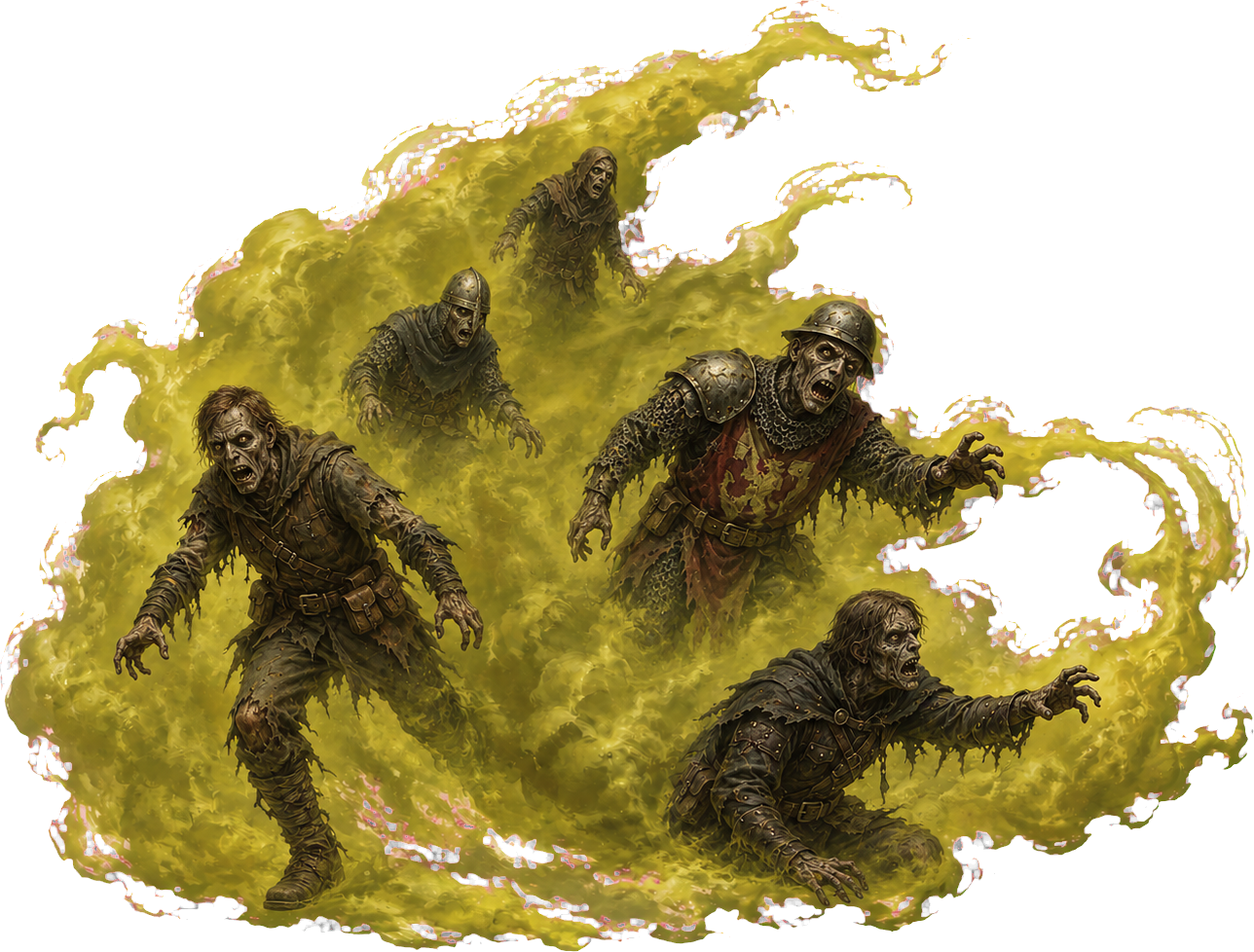
A trench mist is a thinking battlefield fog that turns casualties into a company of its own. It carries war beyond the battle that created it, hunting survivors and raiding settlements to replenish its servants' weapons and supplies.
Size Its cloud usually spans about 20 feet and weighs less than a pound.
Signs Moving silhouettes and soldiers' equipment emerge within discolored ground fog; the dead advance together beneath its cover.
Demeanor It drifts with deliberate purpose, waiting for an opening before its soldiers move together.
Encounters Battlefield scavengers and rescuers offer fresh victims. Armies familiar with these mists sometimes call a cease-fire and evacuate after gas attacks; their abandoned positions can remain dangerous long after the fighting stops.
Communication It has no speaking voice but addresses nearby minds, drawing on the experience of the dead within it.
Conflict It rolls over clustered living foes, scalding and draining them while concealed servants strike from within. They sense enemies through its cover; the cloud itself can slip through cracks when opposed.
Special Traits The cloud cannot carry or manipulate objects, so its servants handle weapons, doors, and other solid equipment.
Relationships Its juju zombies contribute memories and practiced skills to its consciousness. A veteran soldier among them can make the whole company more resourceful.
Life Cycle Those killed inside the mist may rise moments later as juju zombies bound to it. Deprived of this company, the mist can settle into battlefield soil for years, until farming or renewed war awakens it.
Origin Trench mists arise when lingering poisonous gases absorb the souls and anguish of soldiers killed in mass attacks. Both battlefield chemicals and deadly magical vapors can give rise to them, turning the means of slaughter into a consciousness intent on continuing it.
NE Gargantuan ()
Init +9; Senses 60 ft., ; Perception +25
DEFENSE
AC 12, touch 12, flat-footed 6 (+5 Dex, +1 dodge, –4 size)
hp 127 (15d8+60); 5
Fort +8, Ref +10, Will +10
Defensive Abilities , ; 10/magic; acid, electricity, sonic
OFFENSE
Speed 40 ft. (perfect)
Melee touch +7 (6d6 acid plus 6d6 negative energy)
Space 20 ft.; Reach 10 ft.
Special Attacks , ing mists (DC 22, 6d6 acid plus 6d6 negative energy)
STATISTICS
Str —, Dex 20, Con 16, Int 7, Wis 13, Cha 10
Base Atk +11; +15; CMD 31 (can’t be tripped)
Feats (engulfing mists), , , , , , (Perception),
Skills Fly +25, Perception +25
Languages Common (can’t speak); 30 ft.
SQ ,
ECOLOGY
Environment any
Organization solitary, pair, or horror (3–5)
Treasure none
SPECIAL ABILITIES
Create Juju Zombie (Su) A trench mist can animate any corporeal creature that is slain while engulfed within the mist’s form. The victim rises as a juju zombie in 1d4 rounds, and is under the control of the trench mist that created it. A juju zombie becomes free-willed if it is separated from its parent trench mist. A trench mist can animate and control a number of juju zombies whose Hit Die total does not exceed twice the trench mist’s own Hit Dice. Any additional juju zombies beyond that become free-willed.
Engulfing Mists (Ex) A trench mist can engulf foes. A creature engulfed by a trench mist does not gain the condition and can move normally—such a creature is not in danger of suffocating, but as long as it begins its turn engulfed, it takes the trench mist’s touch damage. A trench mist’s vapors obscure sight as per the spell obscuring mist. The save DC to avoid the engulfing mists is Constitution-based.
Gaseous (Ex) A trench mist has a body composed of vapor. This form grants it the amorphous defensive ability and allows it to pass through small holes or even mere cracks with no reduction to its speed, but it can’t enter water or other liquids. A trench mist doesn’t have a Strength score. It can’t manipulate or wear objects, and it is treated as a creature three size categories smaller than its actual size (Medium for most trench mists) for the purpose of how wind affects it.
Juju Zombie Symbiosis (Su) Because of its symbiotic relationship with the juju zombies it creates, a trench mist shares its senses with its animated zombies as long as they are engulfed within its form, granting them lifesense and making them immune to the concealment the trench mist imposes upon creatures within and outside of its foggy form.
Moon-Beast
A foul odor hangs around a pale, eyeless brute, pink feelers drooping over its face and violet claws spread beneath heavy shoulders.
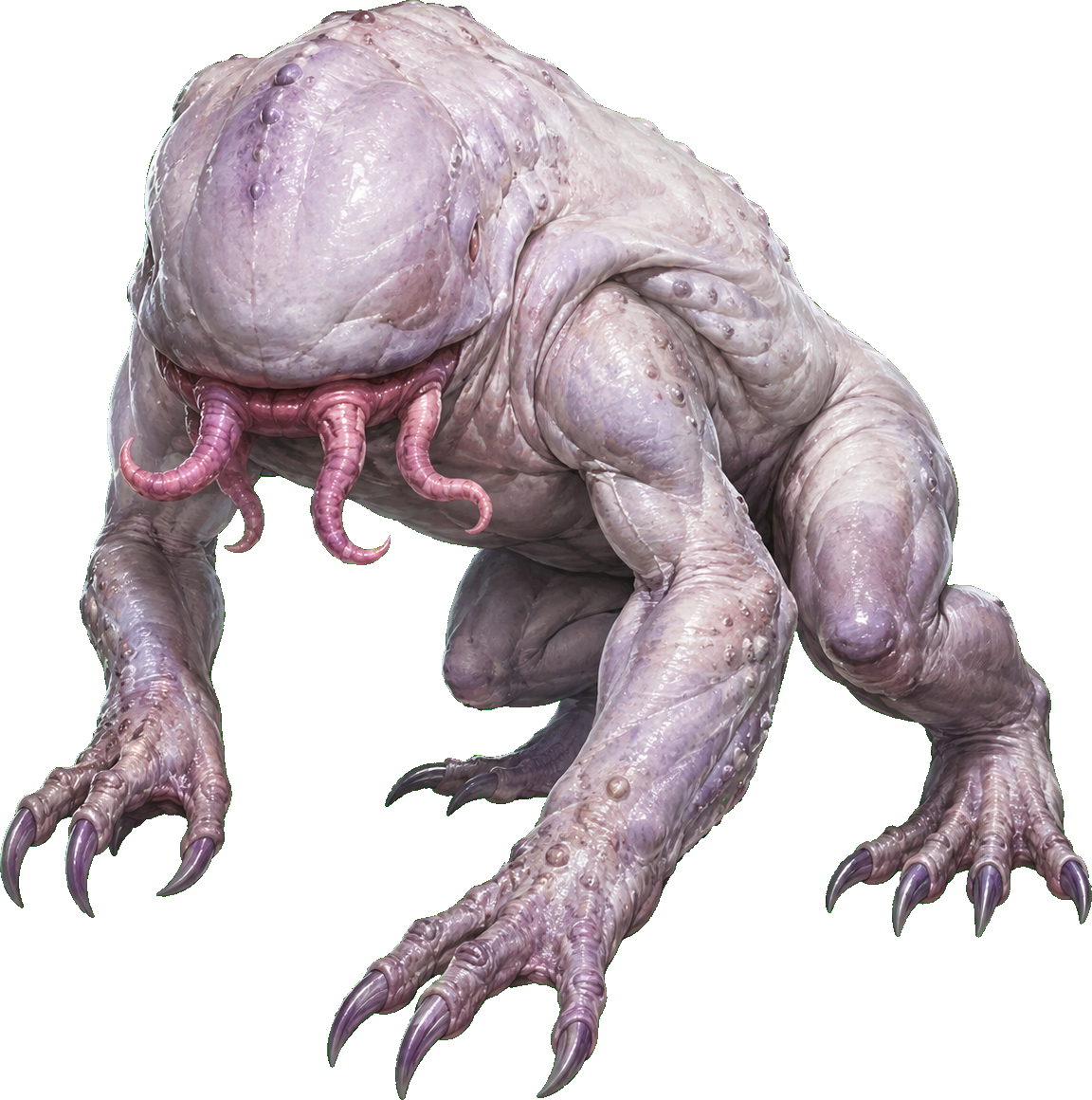
Moon-beasts conduct an interworld trade in captives, dispatching black galleys to distant ports. An encounter may begin as a commercial proposition while concealing a plan to turn visitors into cargo.
Size A typical adult is about 9 feet long and weighs around 800 pounds.
Signs Black galleys, a penetrating foul odor, and intermediaries offering unusually fine rubies can announce their presence before the masters appear.
Demeanor They expect obedience and linger over another creature's distress, treating submission as an achievement to savor.
Encounters A trader may negotiate through an agent while secretly reading visitors' thoughts. Useful information or a profitable bargain can delay hostility, but hospitality may conceal preparations for abduction.
Communication They converse telepathically and perceive their surroundings without eyes; their silence gives no assurance that they have overlooked an intruder.
Conflict It spreads confusion and turns opponents against companions from behind a screen of servants. At close quarters, rending tentacles sap mental resilience to heal its wounds. It can escape into the air or flee alone to another plane.
Special Traits Their yielding bodies squeeze through narrow openings, and they need not breathe, making ordinary cells unreliable confinement.
Diet Captives may become food, mine and field laborers, or sacrifices to its otherworldly patrons.
Lair Their stone cities overlook dark, oily seas on the far side of the dreaming moon. Elsewhere, cliffside trading stations and shipboard quarters shelter them near cargo and prisoners.
Social Life Cabals cooperate in commerce and worship, relying on captive crews and agents to sustain their enterprises.
Relationships Denizens of Leng serve as merchants and crews, sometimes as partners and sometimes as slaves. Their shared dealings do not assure equal standing.
Origin Moon-beasts hail from the shared moon of sleeping minds in the Dimension of Dream. Ancient frescoes depict black galleys arriving on the nightmare plateau of Leng and its people submitting to their crews’ masters as gods. The moon-beasts themselves worship demanding powers beyond the stars, gathering captives as offerings as well as merchandise.
Resources Cargo may include rubies, ritual objects, and unfamiliar goods. Transaction records can lead rescuers toward prisoners who have already been sold or transported onward.
CE Large
Init +7; Senses 90 ft.; Perception +21
DEFENSE
AC 25, touch 13, flat-footed 21 (+3 Dex, +1 dodge, +12 natural, –1 size)
hp 133 (14d8+70)
Fort +9, Ref +9, Will +15
Defensive Abilities ; 10/piercing or slashing; cold, gaze attacks, illusions, poison; electricity 30; 22
OFFENSE
Speed 50 ft., 20 ft.; air walk
Melee 2 claws +15 (1d6+6), 4 tentacles +11 (1d6+3)
Space 10 ft.; Reach 10 ft.
Special Attacks (2 tentacles, 1d6+9 plus )
(CL 11th; concentration +18)
Constant—air walk
At will—detect thoughts (DC 19)
3/day—charm monster (DC 21), dispel magic, dominate person (DC 22), shadow conjuration (DC 21), shadow evocation (DC 22), veil (DC 23)
1/day—confusion (DC 21), major image (DC 20), mirage arcana (DC 22), plane shift (self only)
STATISTICS
Str 22, Dex 17, Con 20, Int 19, Wis 18, Cha 25
Base Atk +10; +17; CMD 31
Feats , , , , , , (tentacle)
Skills Climb +14, Diplomacy +14, Intimidate +24, Knowledge (arcana) +11, Knowledge (planes) +18, Perception +21, Sense Motive +18, Spellcraft +21, Stealth +24, Use Magic Device +21
Racial Modifiers +8 Stealth
Languages Aklo (cannot speak); 300 ft.
SQ ,
ECOLOGY
Environment any land
Organization solitary, pair, or cabal (3–5)
Treasure double
SPECIAL ABILITIES
Wisdom Drain (Su) A creature that takes rend damage from a moon-beast must succeed at a DC 22 Will save or take 1d4 points of Wisdom drain. A moon-beast heals 5 points of damage for each point of Wisdom it drains in this manner. If it drains a victim to 0 Wisdom, the moon-beast gains the effects of a heal spell. The save DC is Constitution-based.
Syricta
A hooded cobra rises from a writhing knot of green snakes, smaller fanged heads branching from its arms and lower coils.
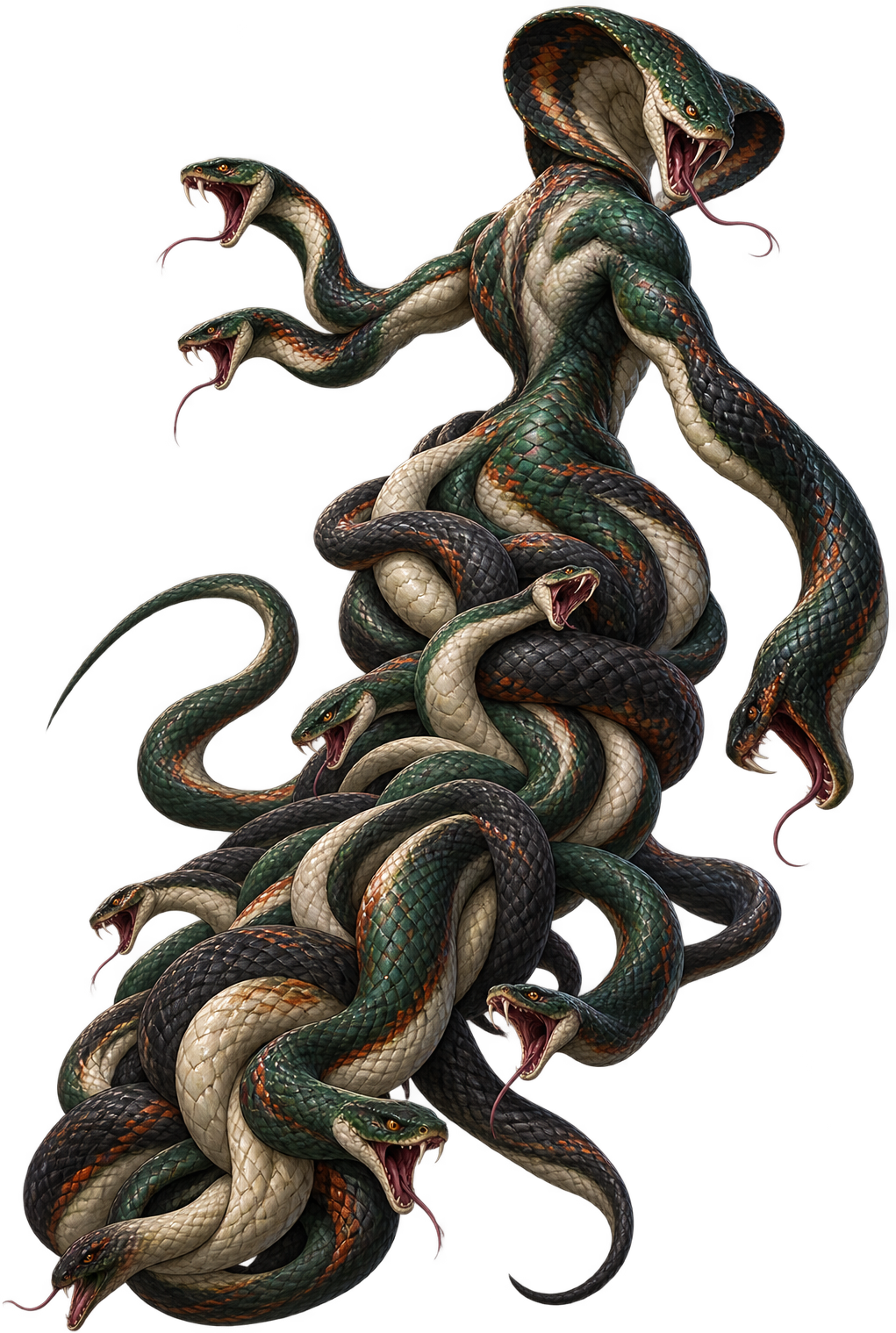
Syrictas are ritual-bred enforcers created by serpentfolk. Their makers bind formidable strength and a cruel temperament to obedience, producing guards that may defend an order long after their own survival is in doubt.
Size An adult stands about 9 feet tall and weighs roughly 550 pounds.
Signs A broad tangle of winding trails can resemble several snakes passing together rather than one heavy creature.
Demeanor An uncommanded syricta asserts itself with threats and torments anyone who appears unable to retaliate.
Encounters A guard confronts visitors according to its orders; learning whom or what it protects gives negotiations a starting point. An unsupervised syricta may back down from confident resistance.
Motivation Its master’s orders override self-preservation; without commands, personal safety comes before loyalty to a place or companion.
Conflict It bowls through opponents with its biting lower snakes, then seizes and constricts a survivor. Surrounded, it exhales a brief venom cloud to discourage enemies from closing; it flees a losing fight unless ordered to stand and die.
Special Traits Its smaller heads can use weapons and tools, though an occupied head cannot bite.
Social Life Independent groups submit to the strongest member but seldom last. Syrictas cannot breed replacements and form few lasting attachments.
Origin A ritual transfers the vitality of snake eggs into a malformed serpentfolk egg. Its makers condition the resulting hybrid to accept their commands.
CE Large
Init +2; Senses 60 ft., ; Perception +22
DEFENSE
AC 29, touch 11, flat-footed 27 (+2 Dex, +18 natural, –1 size)
hp 178 (17d8+102)
Fort +11, Ref +9, Will +12
mind-affecting effects, paralysis, poison; 23
Weaknesses
OFFENSE
Speed 40 ft.
Melee 3 bites +22 (2d6+10/19–20 plus ), tentacle +20 (1d6+5 plus )
Space 10 ft.; Reach 10 ft.
Special Attacks (1d6+10), , ,
STATISTICS
Str 31, Dex 14, Con 22, Int 7, Wis 14, Cha 17
Base Atk +12; +23 (+27 overrun); CMD 35 (37 vs. overrun, can’t be tripped)
Feats , (bite), , , , , , (bite), (tentacle)
Skills Intimidate +31, Perception +22, Survival +7
Languages Aklo, Draconic, Undercommon
ECOLOGY
Environment any land
Organization solitary, pair, knot (3–5)
Treasure standard
SPECIAL ABILITIES
Poison (Ex) Bite—injury; save Fort DC 24; frequency 1/round for 6 rounds; effect 1d4 Strength; cure 2 consecutive saves.
Poison Cloud (Ex) Once per day as a swift action, a syricta can exhale a poisonous cloud from its nostrils in a 20-foot radius centered on it. Any creature within the cloud or entering it must immediately succeed at a DC 24 Fortitude save or be affected by the syricta’s poison. The cloud dissipates at the beginning of the syricta’s next turn.
Serpentfolk Pawn (Ex) A syricta’s immunity to mind-affecting effects doesn’t apply against serpentfolk or any effects originating from a serpentfolk (for example, a mind fog cast by a serpentfolk would bypass the syricta’s immunity to mind-affecting effects).
Snake Overrun (Ex) The numerous snake heads and tails of a syricta’s lower torso deal 6d6 points of bludgeoning, piercing, and slashing damage to creatures when it succeeds on an overrun combat maneuver against them. Creatures that take damage from a syricta’s snake overrun are also subjected to the syricta’s poison.
Argus
A horned giant with long arms and hooked hands watches through dozens of eyes scattered across its knotted, leathery hide.
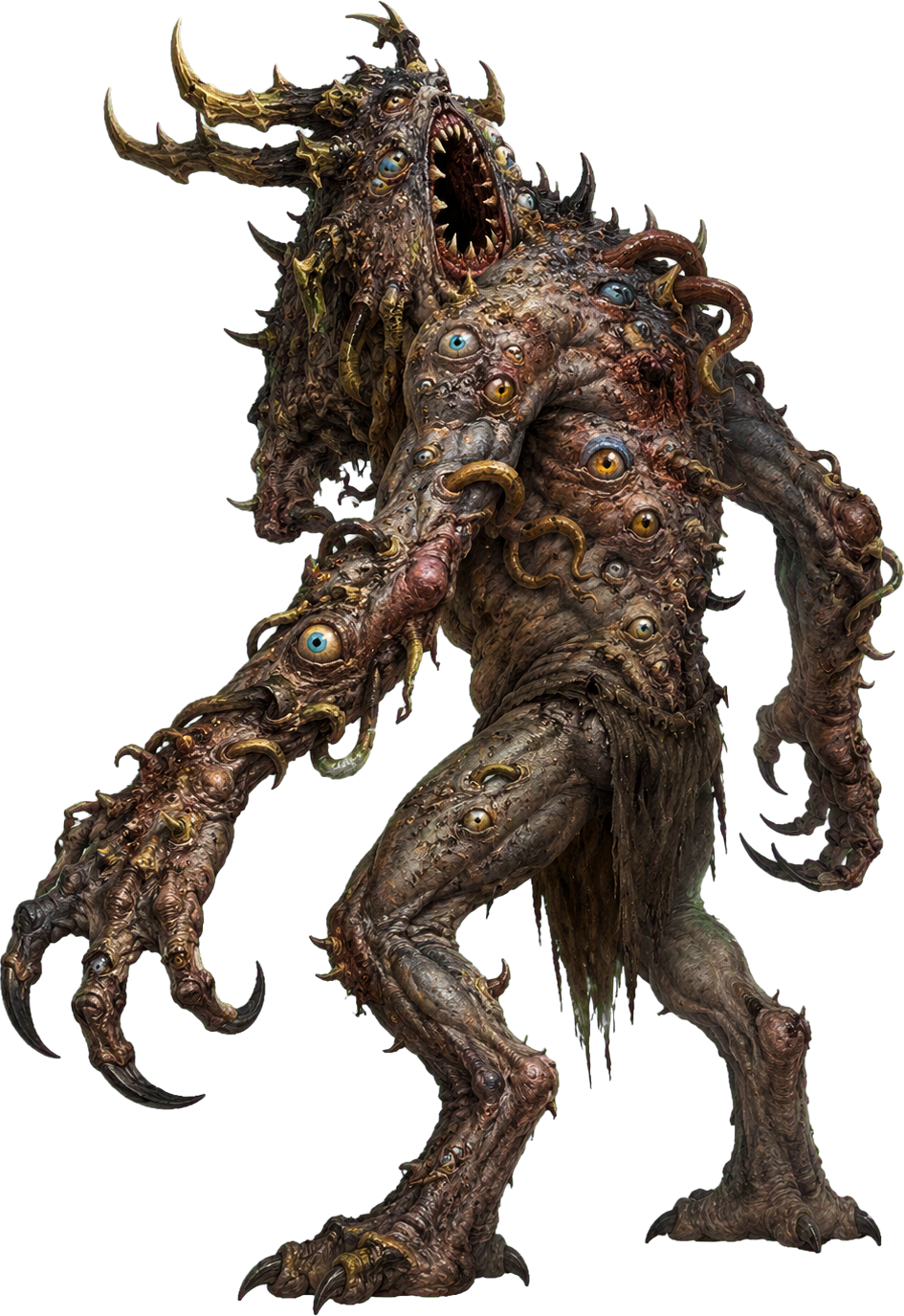
An argus is a solitary guardian whose monstrous appearance conceals a lonely, thoughtful mind. Its long watch leaves room for conversation and a love of beautiful things, provided visitors respect the responsibility that binds it.
Size A typical adult stands about 25 feet tall and weighs 18,000 pounds.
Signs Enormous footprints and a repeatedly worn vantage point can reveal its station before visitors reach the guarded boundary.
Demeanor Loneliness and ridicule weigh heavily on it. Respectful visitors bearing songs or stories may find a thoughtful companion beneath the brooding exterior.
Encounters It must believe visitors intend neither harm nor theft. Permission to converse does not grant permission to approach its charge.
Conflict It hurls stones at approaching attackers, then seizes and crushes those who close, sometimes tearing at their eyes. Its many eyes foil flanking, and it can catch hurled boulders. It usually holds its station when pursuit would expose its charge.
Special Traits Its vision penetrates darkness, mist, and magical disguises, while distant movement remains remarkably clear. It also detects magical attempts to watch it, making covert observation difficult even for visitors who remain physically concealed.
Territory Its duty centers on a specific place, object, or captive. It may welcome company beyond that boundary while refusing to yield a single step within it.
Origin An argus belongs to an ancient lineage related to titans, reshaped by a deity into a restless sentry. The transformation commonly punishes an affront or rebellion, turning the creature’s continuing service into a reminder of its conflict with divine authority.
Resources Its recollections may preserve useful history, offered during an otherwise uneventful watch. Whatever it guards is not automatically its property to give away.
LN Gargantuan ()
Init +12M; Senses , arcane sight, 60 ft., detect scrying, , , , true seeing; Perception +29
Aura (40 ft., DC 16)
DEFENSE
AC 30, touch 12, flat-footed 28 (+2 Dex, +4 insight, +18 natural, –4 size)
hp 184 (13d8+126)
Fort +10, Ref +6, Will +9
Defensive Abilities , ; 10/epic; blindness, dazzled; cold 30, fire 30
Weaknesses to fascination and sleep
OFFENSE
Speed 40 ft.
Melee 2 claws +20 (3d6+14 plus ), bite +19 (2d8+14)
Ranged rock +8 (3d6+14)
Space 20 ft.; Reach 20 ft.
Special Attacks , (3d6+14), , fascinating , 6/day, +1d8), (2 claws, 3d6+21), (200 ft.)
(CL 14th; concentration +20)
Constant—arcane sight, detect scrying, true seeing
At will—arcane eye, clairaudience/clairvoyance, status, true strike
3/day—quickened true strike
STATISTICS
Str 39, Dex 14, Con 23, Int 13, Wis 12, Cha 10
Base Atk +9; +27 (+31 grapple); CMD 43
Feats M, M, M, , (true strike), (Perception), (claw)
Skills Climb +24, Handle Animal +6, Intimidate +30, Knowledge (history) +10, Perception +29 (+37 on vision–based Perception checks), Sense Motive +23, Swim +24
Racial Modifiers +8 on vision-based Perception checks
Languages Aklo, Celestial, Common
ECOLOGY
Environment any land
Organization solitary
Treasure standard
SPECIAL ABILITIES
Absolute Readiness (Ex) An argus is never surprised or flat-footed. It can act in the surprise round as if it were a normal round.
Accurate Strikes (Ex) An argus’s attacks ignore the AC bonus granted to targets by any cover less than total cover, and the miss chance granted to targets by any concealment less than total concealment.
Eye Gouge (Ex) If an argus rends or pins an opponent, as a swift action it can attempt a dirty trick maneuver to the target. If its combat maneuver check exceeds the DC by 10 or more, the opponent is permanently .
Fascinating Gaze (Su) A creature within 40 feet of an argus must succeed at a DC 16 Will saving throw or be for 5d6 rounds. If the creature has 4 or fewer Hit Dice, it is instead for 5d6 rounds. An argus can’t use this ability in the same round it uses frightful presence. The save DC is Charisma-based.
Limitless Vision (Ex) An argus takes no distance penalties on Perception checks.
Flying Polyp
Shrill piping follows a floating spiral of flesh, eyes, and gaping mouths, its tentacled outline flickering in and out of view.
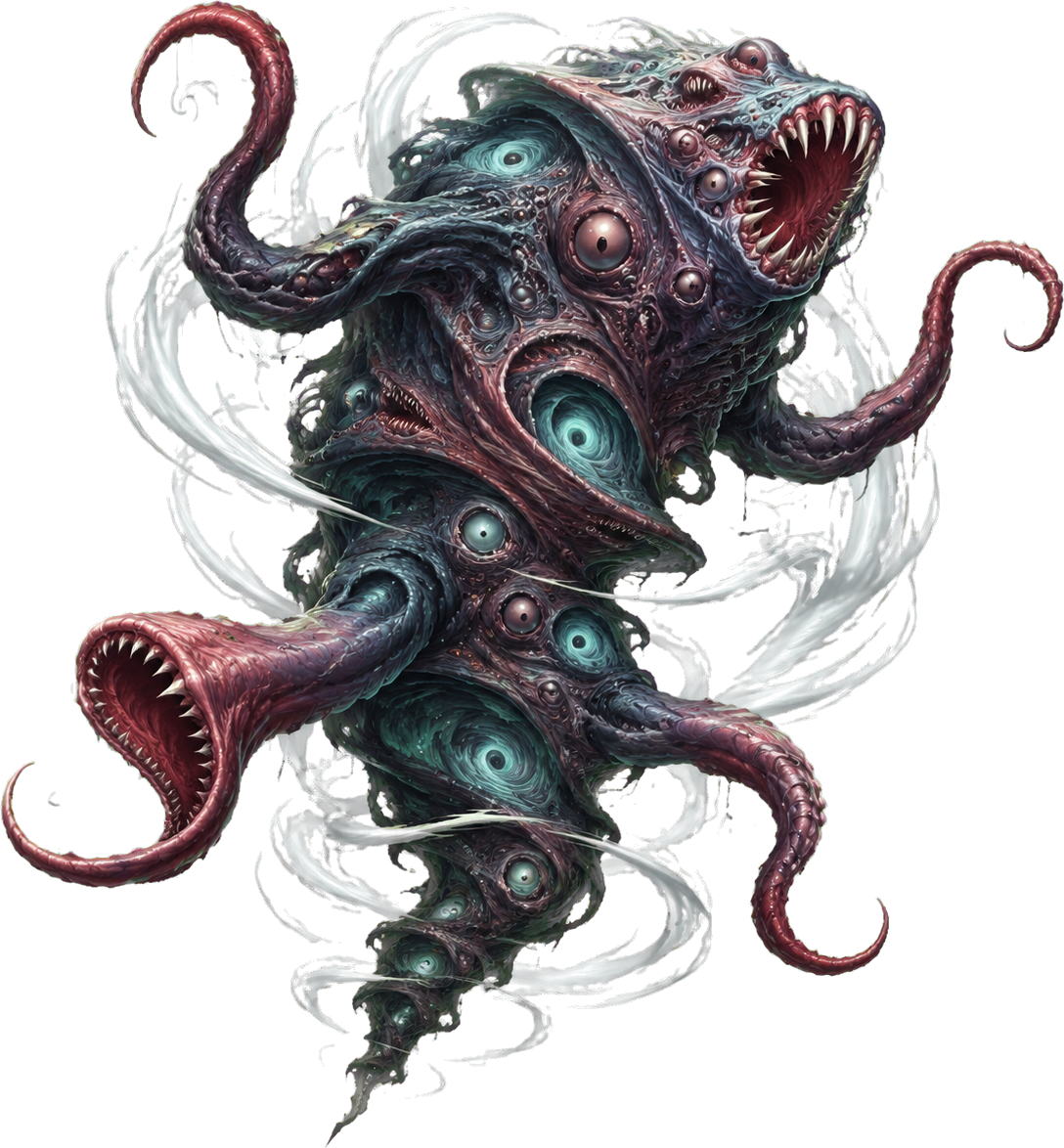
Flying polyps are alien conquerors that build cities and destroy rival civilizations with wind. Their sealed ruins may still hold the builders, nursing defeats older than the surrounding kingdoms.
Size A typical polyp extends about 30 feet but weighs no more than 2,000 pounds.
Signs Whistling drafts and wind-scoured masonry betray their presence; the piping can continue after its source vanishes from view.
Demeanor Calculated and implacable, they can nurse a defeat for ages. Intelligence makes them purposeful enemies, not reliable negotiating partners.
Encounters Opening a sealed shaft can release a polyp into passages far beyond its former prison. It treats nearby inhabitants as obstacles to reclaiming the surface.
Conflict Clinging winds hinder escape while violent blasts scatter groups. It seizes isolated targets with its tentacles, shielding itself with directed gusts, flight, and flickering visibility.
Special Traits Its damp flesh becomes intermittently transparent or invisible. Wounds release gusts and whistling air instead of ordinary blood.
Lair Sand-laden winds carve its towers and chambers from basalt. Deep wells connect ancient ruins to occupied caverns whose architecture offers unfamiliar routes and awkward footing.
Social Life Small war bands cooperate in construction and campaigns; their cities show little interest in trade or ordinary civic life.
Life Cycle They appear not to die of old age. A sealed cavern may hold survivors of a war whose other witnesses vanished long ago.
Origin Flying polyps have carried their wars from world to world; some can surround themselves with stolen air and lead their kind through space. Other peoples have occasionally defeated these invaders and imprisoned the survivors underground. The yithians number among their ancient adversaries. Geological upheavals can breach forgotten prisons, releasing conquerors still intent on avenging the humiliation of their defeat.
CE Huge ()
Init +6; Senses 60 ft.; Perception +26
Aura (90 ft., DC 24)
DEFENSE
AC 29, touch 16, flat-footed 26 (+5 deflection, +2 Dex, +1 dodge, +13 natural, –2 size)
hp 207 (18d8+126)
Fort +13, Ref +12, Will +16
Defensive Abilities , , ; 10/magic and slashing; acid, cold, sonic; 25
Weaknesses to electricity
OFFENSE
Speed 30 ft., 60 ft. (perfect)
Melee 4 tentacles +21 (1d8+9/19–20 plus )
Space 15 ft.; Reach 15 ft.
Special Attacks (1d8+9), ,
(CL 14th; concentration +19)
At will—alter winds, gust of wind (DC 17), whispering wind, wind walk
3/day—control winds (DC 20), river of wind (DC 19), wind wall
1/day—control weather, whirlwind (DC 23)
STATISTICS
Str 28, Dex 15, Con 24, Int 19, Wis 20, Cha 21
Base Atk +13; +24 (+28 grapple); CMD 42 (can’t be tripped)
Feats , , , (tentacle), , , , , (tentacle)
Skills Fly +27, Knowledge (engineering) +22, Knowledge (history) +22, Knowledge (nature) +22, Perception +26, Spellcraft +25, Stealth +15, Use Magic Device +23
Languages Aklo
ECOLOGY
Environment any
Organization solitary, pair, or storm (3–10)
Treasure standard
SPECIAL ABILITIES
Deflecting Winds (Su) A flying polyp’s mastery over air and wind allows it to surround itself with blasts of precisely aimed gusts, granting the creature a +5 deflection bonus to its Armor Class and a +4 resistance bonus on Reflex saving throws.
Partial Invisibility (Su) A flying polyp’s body constantly flickers and shifts, passing from visibility to invisibility in a seemingly random pattern and often not wholly at once, leaving the creature’s body in what appear to be multiple sections. This ability, combined with the flying polyp’s amorphous, elastic form, makes it difficult to target the creature, granting it a 20% miss chance against all attacks. By concentrating, a flying polyp can become fully invisible.
Sucking Wind (Su) This attack allows the flying polyp to send an eerie wind out to slow and eventually stop a creature’s escape. The wind itself isn’t particularly strong, but it creates a peculiar sucking sensation as if it were attempting to pull creatures back toward the flying polyp. Activating this ability is a full-round action, and it must concentrate each round to maintain the effect. The sucking wind manifests as a 100-foot-radius spread, with the flying polyp at the center. Each round the polyp maintains concentration, the sucking wind’s radius increases by 100 feet, to a maximum radius of a mile. A flying polyp can detect creatures within this area via tremorsense. As a free action, it can increase the effects of the sucking wind on up to five different creatures within the area at one time. Each targeted creature must succeed at a DC 26 Fortitude save each round it remains in the area of the sucking wind or it is slowed until it leaves the area. A creature already under the effects of any slowing effect (such as from this sucking wind or a slow spell) that fails this save is held in place for 1 round—it is not , but cannot move via any means. Freedom of movement protects against the effects of the sucking wind, and control winds negates its effects in the area of effect of the control winds spell. Natural windstorms or other powerful winds have no effect on a sucking wind. A flying polyp can activate a sucking wind once per day, and can maintain concentration on the effect for up to an hour. The save DC is Constitution-based.
Wind Blast (Su) Once every 1d4 rounds as a standard action, a flying polyp can create a powerful blast of wind at a range of up to 120 feet. This blast of wind creates a sudden explosion of flesh-scouring wind in a 30-foot-radius burst. All creatures within this area take 14d6 points of bludgeoning damage, with a successful DC 26 Reflex save halving the damage. In addition, these winds can check or blow away creatures as if they were tornado-strength winds. The save DC is Constitution-based.
Conqueror Worm
A ring of glossy black eyes surrounds this pale worm's four hooked jaws, above thick folds of yellowish flesh.
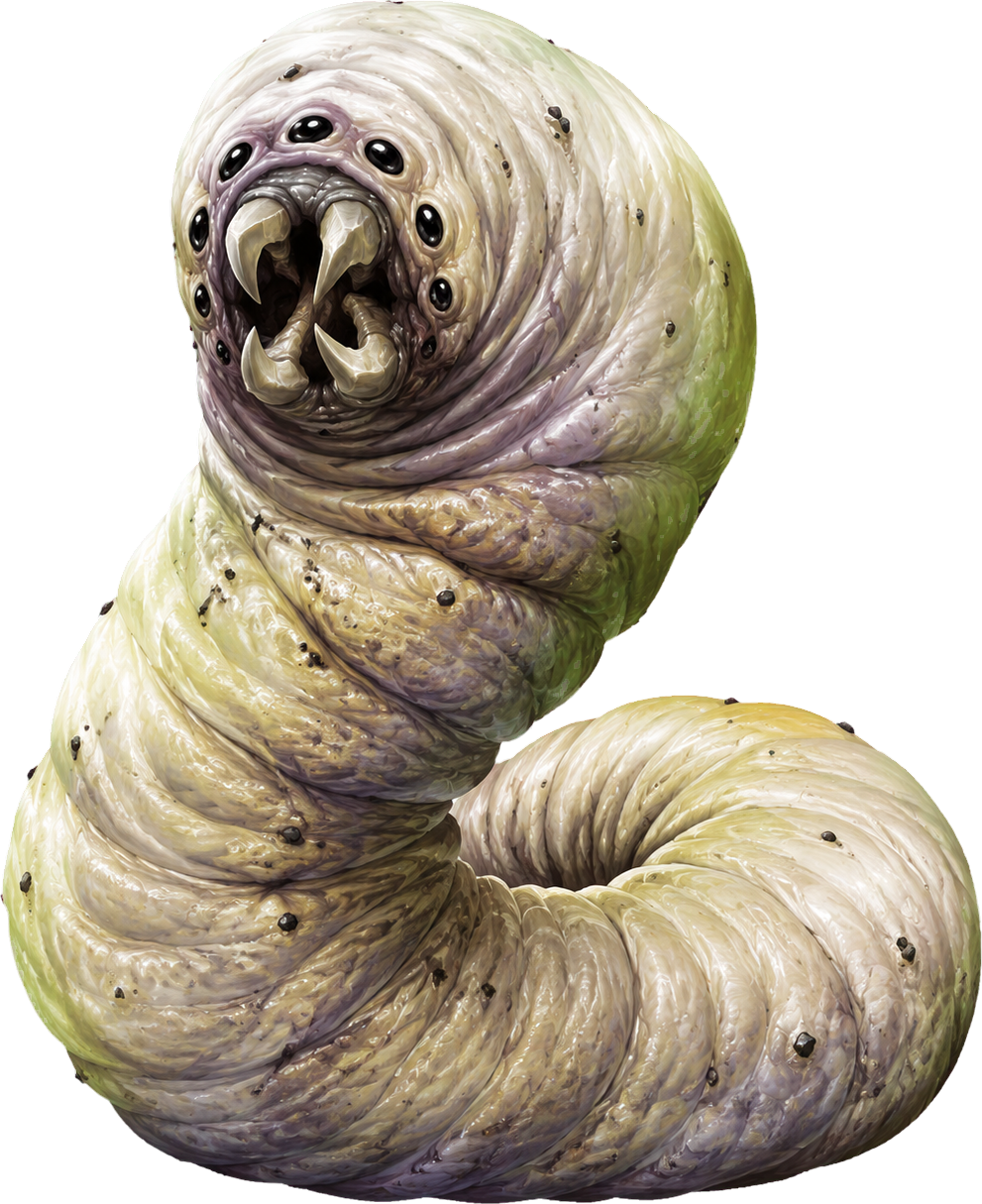
A conqueror worm rules from concealment, treating communities as instruments of its amusement. Beneath a seat of power, it cultivates influential servants and arranges rivalries whose apparent winners may serve the same hidden master.
Size A typical worm reaches about 80 feet in length and weighs 70 tons.
Signs Opposing leaders may repeatedly make decisions that benefit the same hidden interest. Secret excavations or protected underground routes can provide a more tangible lead.
Demeanor Patient and theatrical, it lets victims believe they choose freely, arranging reversals whose cruelty becomes apparent only after they commit themselves.
Encounters Its agents may offer employment, patronage, or privileged information before anyone meets the worm. A useful party can be recruited against another of its own servants.
Motivation It wants the private satisfaction of directing a society’s choices. When that game grows stale, it engineers catastrophe and seeks another realm to manipulate.
Communication It uses speech, dreams, and persuasive telepathy to reach potential servants. Mental conversation can establish a lasting bond, through which it sends further messages and invades the victim’s mind from afar.
Conflict Controlled servants delay attackers while it breaks dangerous opponents’ resolve. Acid and a swallowing maw punish anyone reaching its refuge; it can burrow away while its agents continue the fight.
Special Traits A worm can grant divine magic to worshippers, giving its claim to godhood a tangible foundation. Each worm has its own holy emblem, often a ring of eyes.
Territory Compromised officials and dependencies form its true domain. Rival factions may serve the same master, letting it profit from a change of government.
Lair It shelters in a defended underground chamber beneath or near its chosen seat of power. Its mental bonds let it direct distant agents without exposing this refuge.
Relationships Cultists treat it as a god, while many officials never learn the nature of their patron. When its games end, even favored servants may receive a final summons underground to be killed by their master.
Life Cycle At death, it may seize someone already bound to its mind. The host loses hair, grows pale and swollen, then forms a cocoon and emerges as the worm’s new body. Expelling the possessing mind before the change finishes can save the host and stop the worm’s return.
NE Colossal
Init +11; Senses 60 ft., 120 ft., true seeing; Perception +37
DEFENSE
AC 37, touch 9, flat-footed 30 (+7 Dex, +28 natural, –8 size)
hp 406 (28d8+280)
Fort +21, Ref +18, Will +24
Defensive Abilities ; 15/good and piercing; acid, cold, disease, mind-affecting effects, poison; 32
OFFENSE
Speed 60 ft., 30 ft.; air walk
Melee bite +31 (6d8+18/19–20 plus 8d6 acid), slam +31 (4d10+18/19–20)
Space 30 ft.; Reach 30 ft.
Special Attacks (100-ft. line, 20d8 acid, Reflex DC 34 half, usable every 1d4 rounds), , , (8d6 bludgeoning and 8d6 acid damage, AC 24, 40 hp)
(CL 19th; concentration +28)
Constant—air walk, true seeing
At will—detect thoughts (DC 21)
(CL 19th; concentration +29)
9th (5)—dominate monster (DC 29), implosion (DC 29), time stop
8th (7)—demand (DC 28), mass charm monster (DC 28), psychic crush IV (DC 27)
7th (8)—ego whip V (DC 26), insanity (DC 27), project image (DC 27)
6th (8)—mass inflict pain (DC 25), mind thrust VI (DC 25), veil (DC 26)
5th (8)—greater command (DC 25), greater synaptic pulse (DC 24), mind fog (DC 25), possession (DC 24)
4th (8)—dream, hallucinatory terrain (DC 24), mind probe (DC 23), scrying (DC 24)
3rd (9)—clairaudience/clairvoyance, dispel magic, illusory script (DC 23), telekinetic maneuver
2nd (9)—enthrall (DC 22), share memory (DC 22), status, suggestion (DC 22), undetectable alignment
1st (9)—alarm, entropic shield, mage armor, psychic reading, unseen servant
0 (at will)—arcane mark, daze (DC 20), detect magic, detect psychic significance, mage hand, message, open/close, read magic, telekinetic projectile
STATISTICS
Str 47, Dex 24, Con 30, Int 31, Wis 22, Cha 29
Base Atk +21; +47; CMD 64 (can’t be tripped)
Feats , , , (bite, slam), , , , , , , , ,
Skills Bluff +37, Diplomacy +37, Intimidate +40, Knowledge (arcana, engineering, geography, history, local, nobility, religion) +38, Perception +37, Sense Motive +34, Spellcraft +41, Use Magic Device +37
Languages Abyssal, Aklo, Celestial, Common, Draconic, Dwarven, Elven, Gnome, Halfling, Infernal, Terran, Undercommon; 200 ft.
SQ
ECOLOGY
Environment any
Organization solitary
Treasure double
SPECIAL ABILITIES
Deific Conqueror worms can grant divine spells to their worshipers. Granting spells does not require any specific action on a conqueror worm’s behalf. Conqueror worms grant access to the domains of Charm, Evil, Nobility, and Trickery, and their favored weapon varies but is always a simple weapon (daggers and sickles being the most common choices). Each conqueror worm has its own unique holy symbol, although typically it resembles a ring of eyes.
Mental Invader (Su) A conqueror worm infects the minds of others from afar, allowing it to control its puppets without leaving the safety of the earth’s depths. When a conqueror worm communicates with a creature mentally, such as by using telepathy or spells such as dream, it can attempt to form a lasting mental connection with that creature. The target can resist this connection with a successful DC 33 Will save. A target that succeeds at this save is immune to that conqueror worm’s mental invader ability forever. Once a connection is formed, the worm can communicate with the bonded creature using telepathy over any distance, and can target the bonded creature with mind-affecting spells and effects regardless of range. A worm can form bonds with a number of creatures equal to its Intelligence modifier (10 for the typical conqueror worm). If a new bond would exceed this limit, the worm must choose to break one of its previous connections. The effects of a bond are suppressed while the worm and the bonded creature are on different planes. A bond can otherwise be only via a break enchantment, miracle, or wish spell cast on the bonded creature, or by the worm’s death. This is a mind-affecting effect. The save DC is Charisma-based.
Telepathic Escape (Su) A conqueror worm can escape death by casting its mind out of its body at the moment of death. Up to once per day, when an attack, spell, or effect would reduce a conqueror worm to 0 or fewer hit points or otherwise kill it instantly, it can transfer its mind to one of the creatures it has formed a connection with using its mental invader ability. The target can attempt a DC 33 Will save to resist being overtaken. If the target succeeds, the conqueror worm can be killed normally. If the target fails, the conqueror worm transfers its soul into the bonded creature’s body. This functions as the spell possession (CL 21st) except the possession is permanent. A host body possessed by a conqueror worm in this way undergoes terrible changes to its physiology. Every day, the host must succeed at a DC 33 Fortitude save or take 1d6 points of Charisma drain. Over time, the host slowly grows more wormlike in appearance, losing body hair, growing obese, and taking on a pale yellow-white coloration. When the host’s Charisma score is drained to 0, an ectoplasmic cocoon forms around the creature. Over the course of the next 24 hours, the host grows to an enormous size, and at the end of this time emerges in a brand new body as a new conqueror worm that retains the memories of its previous incarnation, at which point the host creature is effectively dead (and can be resurrected normally). If the host is slain before this transformation completes, the conqueror worm dies as well. The effect can also be ended by any effect that successfully expels the conqueror worm’s possessing spirit from the host. This is a mind-affecting effect. The save DCs are Charisma-based.
Drakainia
This horned mother's torso rises from swollen nodules and tentacles, primal orange energy tracing the flesh beneath her outstretched claws.
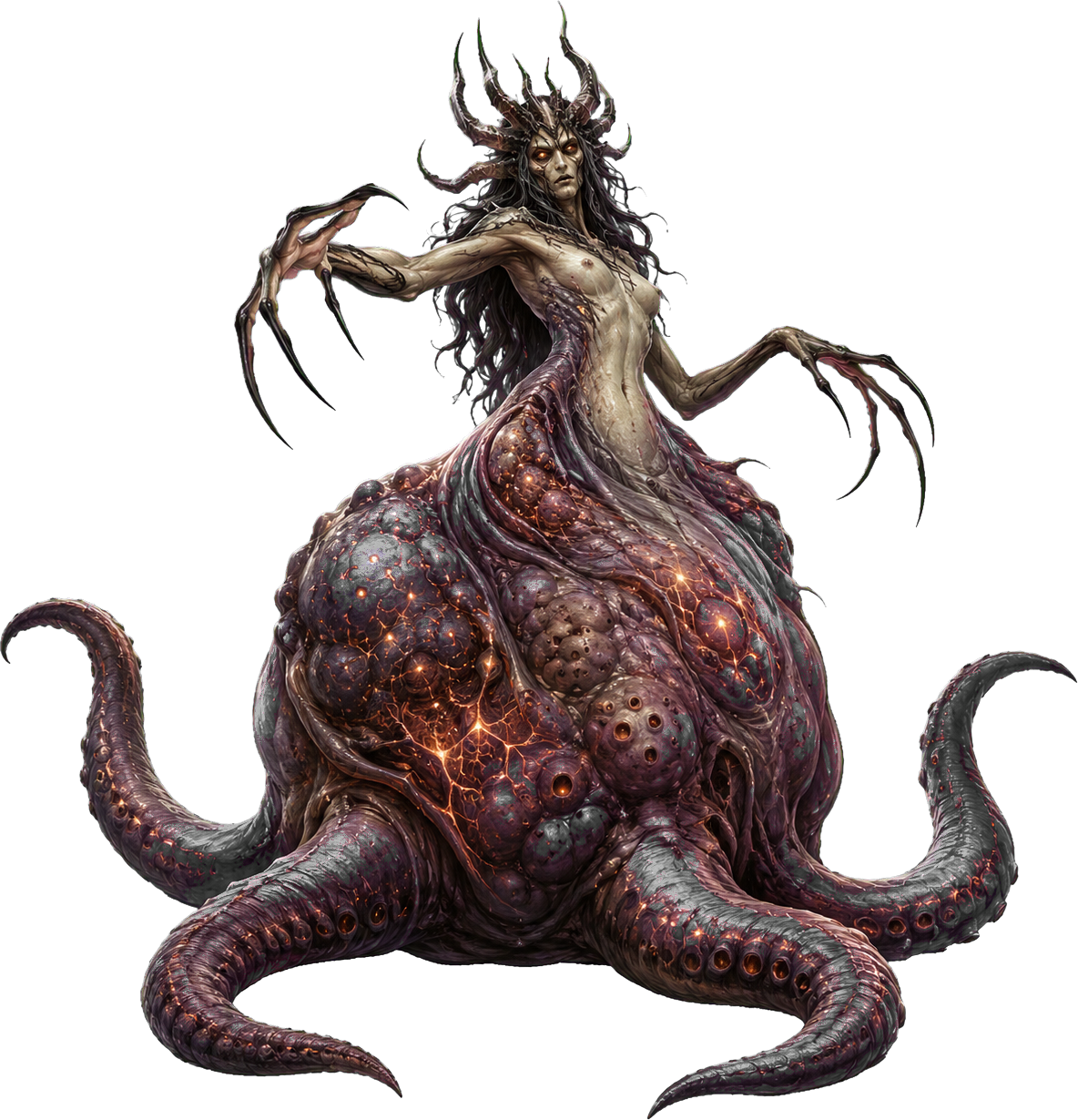
A drakainia turns her refuge into a nursery of monstrous offspring. She evaluates visitors as experimental material, potential collaborators, or threats to be sacrificed for her own survival.
Signs Creatures with mismatched or repeated features may share the same refuge. Captives showing abrupt physical changes make delay especially dangerous.
Demeanor She can be composed and persuasive while discussing other lives with chilling detachment. Favor toward a successful creation never guarantees its safety.
Encounters Her attendants surround visitors before she speaks. A proposal advancing her work can buy time, but her favor offers captives no lasting protection.
Conflict She lets her brood engage first, then reaches past them with slashing claws and lashing tentacles. She protects herself by shifting harmful effects onto nearby offspring and can teleport away through another spawn when pressed. Her followers are both a fighting force and a reserve of escape routes.
Special Traits Her presence accelerates illnesses and developing life; even young of ordinary parents can acquire mutations when born near her. A nursery can therefore alter the surrounding creatures as well as those she deliberately creates.
Relationships Favored creations act as defenders, while others are expendable. A survivor separated from her influence could provide information about her refuge.
Life Cycle She produces mutated offspring directly and can force living captives to carry developing young. A brood may include radically different forms, and favored creations receive advantages that help them survive the nursery.
Origin A drakainia draws on uncontrolled primal life, making her both a creator and a calamity. Tales portray these otherworldly mothers as wanderers that seed distant worlds with monsters. Their strongest creations can become formidable beings in their own right, so a lasting monster lineage may begin with one mother's passing visit.
Whenever a drakainia produces offspring, whether carrying it herself or using a surrogate, the newborn bears unnatural mutations. Her gestation aura also warps other developing young: a pregnant creature within its reach bears a child of its parents’ kind, altered by one of the following mutations.
| d% | Result |
|---|---|
| 01–10 | Fatal Mutation The creature is birthed stillborn and horribly disfigured. |
| 11–20 | Covered in Eyes (Ex) Eyes cover the front and back of the creature’s head. It gains all-around vision. |
| 21–30 | Chameleon Scales (Ex) This creature is covered in scales that shift their hue to blend in with their surroundings. The creature gains a +8 racial bonus on Stealth checks and gains hide in plain sight. |
| 31–40 | Poison Glands (Ex) The creature has a pair of poison sacs near its mouth. It gains immunity to poison, and three times per day it can spit a dose of poison up to 20 feet as a ranged touch attack. Poison: Contact—injury; save Fort DC 10 + 1/2 the creature’s HD + its Constitution modifier; frequency 1/round for 6 rounds; effect 1d3 Con damage; cure 1 save. |
| 41–50 | Sticky (Ex) The creature’s limbs are covered in tiny, hooked hairs that give its skin a downy appearance. It gains the grab ability on its primary natural attacks (if it has any) or its unarmed strike, and a +8 racial bonus on Climb checks. |
| 51–60 | Serpent-Headed Tail (Ex) The creature has a tail that ends in a snake head. This provides a +4 circumstance bonus on Perception checks and a primary bite attack (1d3 + the creature’s Strength modifier for a Medium creature). In addition, the creature gains Improved Trip as a bonus feat. |
| 61–70 | Vestigial Companion (Ex) The creature has the head of an animal (usually a goat, chicken, or dog) growing out of its back or torso, providing the scent ability. If the base creature already has scent, this mutation allows it to determine the direction of a particular scent as a free action. |
| 71–80 | Multiple Heads (Ex) The creature has 2d4 heads, granting it a +4 racial bonus on saving throws against illusions and enchantments and a +8 racial bonus on Perception checks. The creature speaks an additional number of languages equal to its total number of heads. Each head speaks with a different voice. |
| 81–90 | Tentacles (Ex) The creature’s legs are replaced with multiple tentacles. It can’t be tripped and gains a +8 racial bonus to CMD and a +8 racial bonus on combat maneuver checks to grapple. |
| 91–99 | Impenetrable Skin (Ex) The drakainia spawn’s skin is tough and scaly. It gains DR/— equal to half its HD (maximum 10). |
| 100 | Favored Spawn (Su) Favored spawn are those a drakainia has marked as successful or quasi-successful mutations. These powerful spawn gain a +4 luck bonus on all saving throws, a +4 increase to natural armor, a +4 inherent bonus to two ability scores, and 1 mythic rank. |
NE Huge ()
Init +9; Senses 120 ft., , true seeing; Perception +39
Aura (30 ft.)
DEFENSE
AC 48, touch 13, flat-footed 43 (+5 Dex, +35 natural, –2 size)
hp 642 (25d8+530); 10 (negative energy)
Fort +28, Ref +15, Will +21
10/epic; bleed, disease, poison, polymorph effects; 36
OFFENSE
Speed 50 ft., 30 ft., 30 ft.
Melee 2 claws +31 (4d8+14/16–20/×4), gore +28 (4d6+7), 4 tentacles +29 (2d6+7)
Space 15 ft.; Reach 15 ft. (20 ft. with claws)
Special Attacks , 10/day, +1d12), ,
(CL 20th; concentration +35)
Constant—freedom of movement, true seeing
At will—dimension door
3/day—antilife shell, break enchantment, contagion (DC 28), quickened cure serious wounds, dimension door
1/day—antimagic field, destruction (DC 32), regenerateM
STATISTICS
Str 38, Dex 20, Con 46, Int 29, Wis 21, Cha 41
Base Atk +18; +34; CMD 49 (can’t be tripped)
Feats , M, M, , M, M, , , (cure serious wounds), , (Perception), M (claw), (tentacle)
Skills Bluff +40, Climb +45, Diplomacy +40, Handle Animal +20, Heal +30, Intimidate +43, Knowledge (arcana) +34, Knowledge (dungeoneering) +34, Knowledge (nature) +34, Perception +39, Sense Motive +30, Spellcraft +37, Swim +50, Use Magic Device +40
Languages Abyssal, Aklo, Aquan, Auran, Celestial, Common, Draconic, Ignan, Infernal, Terran
SQ , , ,
ECOLOGY
Environment any
Organization solitary
Treasure double
SPECIAL ABILITIES
Birth Spawn (Ex) As a full-round action, a drakainia can give birth to a spawn, which is a Large or smaller creature of her choice with a single random mutation. Each day she can produce any number of creatures whose combined total base CR does not exceed 3 + her Constitution modifier (usually 21).
Gestation Aura (Su) A drakainia’s aura pulses with developing life. All poisons or diseases active within her 30-foot aura have an onset of 1 round and a frequency of 1/minute. Impregnated creatures within her aura gestate in 2d4 rounds. Any creature born within her aura gains a mutation as if it were the drakainia’s spawn, though if the creature’s parent was not impregnated by the drakainia, the creature born is an infant of the kind its biological parents would produce, and doesn’t count toward the CR limit the drakainia can spawn per day.
Impregnate Surrogate (Su) A drakainia can disgorge a monstrous embryo into the mouth of a living, corporeal creature that is or . She makes a grapple combat maneuver check, and if she succeeds she impregnates that creature regardless of its gender. A mythic character must succeed at a DC 38 Fortitude saving throw to avoid being impregnated; a non-mythic character is impregnated automatically. An impregnated creature’s pregnancy lasts for 2d4 rounds. During this pregnancy, the victim is until the monster bursts forth from the victim’s abdomen, which deals 10d6 points of damage to the pregnant creature and applies the condition to any armor it is wearing. Remove disease (DC 28) eliminates the unnatural embryo. Alternatively, as a full-round action another creature can attempt to cut out the growing monster with a DC 38 Heal check. On a successful check, the offspring is removed, and the formerly pregnant creature takes 1d4 points of bleed damage. On failed check, the pregnant creature takes 2d6 points of bleed damage and is for 1 round, but the offspring is not removed. The creature spawned by means of this impregnation is any creature of the drakainia’s choice that is at least one size category smaller than the creature she impregnated. These spawn count against the drakainia’s daily CR allowance for birth spawn.
Invert Birth (Su) When a drakainia uses her dimension door spell-like ability, instead of the normal range, she can choose to teleport to any space occupied by one of her spawn that is within 1 mile of her. She doesn’t need line of sight or knowledge of the spawn’s location. If she chooses a spawn that is farther than a mile away, she does not lose the use of the spell-like ability, but does lose the action. On arrival, she explodes out from her offspring, destroying it entirely.
Polymorphism (Ex) The spawn gestating inside the drakainia constantly alter her internal construction, making her immune to bleed, disease, poison, and polymorph effects. When she is subject to a critical hit or a sneak attack, this polymorphism grants her a 75% chance of negating such attacks.
Razor Claws (Ex) A drakainia’s claws are razor sharp with a critical threat range of 17–20 and a critical multiplier of ×4.
Transfer Suffering (Su) As a swift action, a drakainia can transfer a single harmful spell effect or condition from herself to one of her offspring that is currently within her gestation aura.
Well of Life (Su) A drakainia can unleash the primal life energy within in her body to channel positive energy as if she were a 20th-level cleric (DC 35). She can use this ability 18 times per day and can choose to expend 1 use of mythic power at each use to maximize the damage healed.