

Gray
This gray-skinned humanoid has long, willowy limbs and a bulbous head with oversized black eyes.
Enigmatic grays travel the Material Plane in search of knowledge and living specimens for research, yet little is known about their motivations or where exactly they come from. Stories of encounters with these creatures often take the form of poorly remembered nightmares from those who experience a gray’s sleep paralysis. Some abductees recall being brought aboard the grays’ vast, otherworldly vessels and subjected to nightmarish experiments, while others have vivid but terrifying memories of being confined in cramped, dark places that are seemingly alive. In spite of the differences in their experiences, those who have encountered grays universally find their presence alien, condescending, and sinister. Grays’ movements and expressions are disturbing and inhuman, and their intentions remain inscrutable. Through telepathic contact with the beings, their victims detect a constant, unwavering malevolence. Beyond that, the grays’ faces and full, black eyes show little emotion. Their movements are efficient, and they frequently spend several seconds in deliberation before each move they make. They seem to communicate with their own kind using only telepathy, forgoing even body language or eye contact.
NE Small ()
A humanoid usually has two arms, two legs, and one head, or a human-like torso, arms, and a head. Humanoids have few or no supernatural or extraordinary abilities, but most can speak and usually have well-developed societies. They are usually Small or Medium (with the exception of giants). Every humanoid creature also has a specific subtype to match its race, such as human, giant, goblinoid, reptilian, or tengu.
A humanoid possesses the following traits (unless otherwise noted in a creature’s entry).
• Proficient with all simple weapons, or by character class.
• Proficient with whatever type of armor (light, medium, or heavy) it is described as wearing, or by character class. If a humanoid does not have a class and wears armor, it is proficient with that type of armor and all lighter types. Humanoids not indicated as wearing armor are not proficient with armor. Humanoids are proficient with shields if they are proficient with any form of armor.
• Humanoids breathe, eat, and sleep.
The gray subtype is applied to the extraplanar humanoids known as grays and closely related creatures.
Init +3; Senses 30 ft.; Perception +8
Darkvision is the extraordinary ability to see with no light source at all, out to a range specified. Darkvision is black-and-white only (colors cannot be discerned). It does not allow creatures to see anything that they could not see otherwise—invisible objects are still invisible, and illusions are still visible as what they seem to be. Likewise, darkvision subjects a creature to gaze attacks normally. The presence of light does not spoil darkvision.
DEFENSE
AC 14, touch 14, flat-footed 11 (+3 Dex, +1 size)
hp 39 (6d8+12)
Fort +4, Ref +4, Will +9
OFFENSE
Speed 20 ft.
Melee touch +2 ()
Special Attacks , sleep (DC 16)
Paralysis renders the victim immobile. subjects cannot move, speak, or take any physical actions (they can still take purely mental actions, such as the use of a SLA). They are rooted to the spot, frozen and helpless, having effective Dexterity and Strength scores of 0. Paralysis works on the body, and a character can usually resist it with a Fortitude saving throw (DC 10 + 1/2 the paralyzing creature’s racial HD + the paralyzing creature’s Con modifier; the DC is given in the creature’s description). Unlike hold person and similar effects, a paralysis effect does not allow a new save each round. The duration of the paralysis varies and is included in the creature’s description.
A paralyzed character is frozen in place and unable to move or act. A paralyzed character has effective Dexterity and Strength scores of 0 and is , but can take purely mental actions (such as the use of a SLA). A winged creature flying in the air at the time that it becomes paralyzed cannot flap its wings and falls. A paralyzed swimmer can’t swim and may drown. A creature can move through a space occupied by a paralyzed creature—ally or not. Each square occupied by a paralyzed creature, however, counts as 2 squares to move through.
A helpless character is paralyzed, held, bound, sleeping, unconscious, or otherwise completely at an opponent’s mercy. A helpless target is treated as having a Dexterity of 0 (–5 modifier). Melee attacks against a helpless target get a +4 bonus (equivalent to attacking a prone target). Ranged attacks get no special bonus against helpless targets. Rogues can sneak attack helpless targets.
As a full-round action, an enemy can use a melee weapon to deliver a coup de grace to a helpless foe. An enemy can also use a bow or crossbow, provided he is adjacent to the target. The attacker automatically hits and scores a critical hit. (A rogue also gets his sneak attack damage bonus against a helpless foe when delivering a coup de grace.) If the defender survives, he must make a Fortitude save (DC 10 + damage dealt) or die. Delivering a coup de grace provokes attacks of opportunity.
Creatures that are immune to critical hits do not take critical damage, nor do they need to make Fortitude saves to avoid being killed by a coup de grace.
(CL 5th, concentration +9)
A creature with this ability can use the power of its mind to cast certain spells. Each spell cast using psychic magic consumes an amount of psychic energy. The creature has a maximum amount of psychic energy (PE) per day that refreshes after a night’s rest. A creature with this ability can cast any of the spells listed in this entry as long as it has enough psychic energy remaining to pay the spell’s PE cost. The DC for any of these spells is equal to 10 + the amount of psychic energy used to cast the spell + the creature’s Charisma or Intelligence modifier (whichever is higher). Creatures that gain access to undercast spells via this ability can cast an undercast version of the spell by spending 1 PE fewer for each level lower that the spell is cast. A psychic magic spell with a PE cost of 0 can be cast any number of times, and can be cast even if the creature has 0 PE remaining. The psychic magic granted by this ability has the same thought and emotion components as psychic spells. The monster can apply metamagic feats to these spells by spending an amount of additional PE equal to the level increase of the metamagic feat and by increasing the casting time as normal for spontaneously casting a metamagic spell. Because this ability grants psychic spellcasting, it also allows the creature to use occult skill unlocks.
7 PE—anticipate thoughts (2 PE, DC 16), mind thrust II (2 PE, DC 16), sleep (1 PE, DC 15)
(CL 5th; concentration +9)
Spell-like abilities are magical and work just like spells (though they are not spells and so have no verbal, somatic, focus, or material components). They go away in an antimagic field and are subject to spell resistance if the spell the ability is based on would be subject to spell resistance.
A spell-like ability usually has a limit on how often it can be used. A constant spell-like ability or one that can be used at will has no use limit; unless otherwise stated, a creature can only use a constant spell-like ability on itself. Reactivating a constant spell-like ability is a swift action. Using all other spell-like abilities is a standard action unless noted otherwise, and doing so provokes attacks of opportunity. It is possible to make a concentration check to use a spell-like ability defensively and avoid provoking an attack of opportunity, just as when casting a spell. A spell-like ability can be disrupted just as a spell can be. Spell-like abilities cannot be used to counterspell, nor can they be counterspelled.
For creatures with spell-like abilities, a designated caster level determines how difficult it is to dispel their spell-like effects and defines any level-dependent variables (such as range and duration) the abilities might have. The creature’s caster level never affects which spell-like abilities the creature has; sometimes the given caster level is lower than the level a spellcasting character would need to cast the spell of the same name. If no caster level is specified, the caster level is equal to the creature’s Hit Dice. The saving throw (if any) against a spell-like ability is 10 + the level of the spell the ability resembles or duplicates + the creature’s Charisma modifier unless the creature’s entry explicitly declares another ability-score basis; that individual declaration governs its block and is not overridden by this generic popup.
Some spell-like abilities duplicate spells that work differently when cast by characters of different classes. A monster’s spell-like abilities are presumed to be the sorcerer/wizard versions. If the spell in question is not a sorcerer/wizard spell, then default to cleric, druid, bard, paladin, and ranger, in that order.
Constant—blink
STATISTICS
Str 9, Dex 16, Con 15, Int 18, Wis 14, Cha 17
Base Atk +3; +1; CMD 13
When performing a combat maneuver, you must use an action appropriate to the maneuver you are attempting to perform. While many combat maneuvers can be performed as part of an attack action, full-attack action, or attack of opportunity (in place of a melee attack), others require a specific action. Unless otherwise noted, performing a combat maneuver provokes an attack of opportunity from the target of the maneuver. If you are hit by the target, you take the damage normally and apply that amount as a penalty to the attack roll to perform the maneuver. If your target is immobilized, unconscious, or otherwise incapacitated, your maneuver automatically succeeds (treat as if you rolled a natural 20 on the attack roll). If your target is stunned, you receive a +4 bonus on your attack roll to perform a combat maneuver against it.
When you attempt to perform a combat maneuver, make an attack roll and add your CMB in place of your normal attack bonus. Add any bonuses you currently have on attack rolls due to spells, feats, and other effects. These bonuses must be applicable to the weapon or attack used to perform the maneuver. The DC of this maneuver is your target’s Combat Maneuver Defense. Combat maneuvers are attack rolls, so you must roll for concealment and take any other penalties that would normally apply to an attack roll.
If your attack roll equals or exceeds the CMD of the target, your maneuver is a success and has the listed effect. Some maneuvers, such as bull rush, have varying levels of success depending on how much your attack roll exceeds the target’s CMD. Rolling a natural 20 while attempting a combat maneuver is always a success (except when attempting to escape from bonds), while rolling a natural 1 is always a failure.
Feats , ,
Combat Casting You get a +4 bonus on concentration checks made to cast a spell or use a spell-like ability when casting on the defensive or while .
A grappled creature is restrained by a creature, trap, or effect. Grappled creatures cannot move and take a –4 penalty to Dexterity. A grappled creature takes a –2 penalty on all attack rolls and combat maneuver checks, except those made to grapple or escape a grapple. In addition, grappled creatures can take no action that requires two hands to perform. A grappled character who attempts to cast a spell or use a spell-like ability must make a concentration check (DC 10 + grappler’s CMB + spell level), or lose the spell. Grappled creatures cannot make attacks of opportunity.
A grappled creature cannot use Stealth to hide from the creature grappling it, even if a special ability, such as hide in plain sight, would normally allow it to do so. If a grappled creature becomes invisible, through a spell or other ability, it gains a +2 circumstance bonus on its CMD to avoid being grappled, but receives no other benefit.
Improved Iron Will Once per day, you may reroll a Will save. You must decide to use this ability before the results are revealed. You must take the second roll, even if it is worse.
Iron Will You get a +2 bonus on all Will saving throws.
Skills Heal +8, Knowledge (any one) +10, Knowledge (arcana) +7, Knowledge (planes) +10, Perception +8, Sense Motive +8, Spellcraft +10
Languages Aklo (can’t speak); 100 ft.
Telepathy (Su) This creature can mentally communicate with any other creature within a certain range (specified in the creature’s entry, usually 100 feet) that has a language. It is possible to address multiple creatures at once telepathically, although maintaining a telepathic conversation with more than one creature at a time is just as difficult as simultaneously speaking and listening to multiple people at the same time.
ECOLOGY
Environment any
Organization solitary, pair, or invasion (6–12)
Treasure standard
SPECIAL ABILITIES
Phase (Su) A gray has the ability to become out of phase, allowing it to pass through walls or material obstacles. In order to use this ability, a gray must begin and end its turn outside of whatever wall or obstacle it’s moving through. A gray can’t move through corporeal creatures with this ability, and its movement speed is halved while moving through a wall or obstacle. This innate acumen with phasing also lets a gray begin and end its blink spell-like ability as a free action on its turn.
Probe (Su) As a standard action, a gray can probe the mind of a single intelligent, conscious, creature it touches. Each minute it can scan for an answer to a simple question (such as, “Where is your family hiding?”) or for information on a general topic the subject knows. In addition, as long as the gray has probed the subject for at least 1 minute, it can choose one Knowledge skill the subject has at least 1 rank in and make Knowledge checks using the subject’s skill modifier instead of its own for the next 24 hours. This is a mind-affecting effect.
A helpless character is paralyzed, held, bound, sleeping, unconscious, or otherwise completely at an opponent’s mercy. A helpless target is treated as having a Dexterity of 0 (–5 modifier). Melee attacks against a helpless target get a +4 bonus (equivalent to attacking a prone target). Ranged attacks get no special bonus against helpless targets. Rogues can sneak attack helpless targets.
As a full-round action, an enemy can use a melee weapon to deliver a coup de grace to a helpless foe. An enemy can also use a bow or crossbow, provided he is adjacent to the target. The attacker automatically hits and scores a critical hit. (A rogue also gets his sneak attack damage bonus against a helpless foe when delivering a coup de grace.) If the defender survives, he must make a Fortitude save (DC 10 + damage dealt) or die. Delivering a coup de grace provokes attacks of opportunity.
Creatures that are immune to critical hits do not take critical damage, nor do they need to make Fortitude saves to avoid being killed by a coup de grace.
Sensory Overload (Su) Any creature hit by a gray’s touch is by sensory overload for 1d4 rounds unless it succeeds at a DC 16 Will save. A gray can’t use sensory overload and probe at the same time, and must choose only one of these to use each time it touches a creature. The save DC is Intelligence-based.
A stunned creature drops everything held, can’t take actions, takes a –2 penalty to AC, and loses its Dexterity bonus to AC (if any). Attackers receive a +4 bonus on attack rolls to perform combat maneuvers against a stunned opponent.
Sleep Paralysis (Su) As a standard action, a gray can paralyze a sleeping creature within 30 feet that it can see. Targets who succeed at a DC 17 Will save remain asleep and are immune to the same gray’s sleep paralysis for 24 hours. A creature who fails awakens and is for 1d6 minutes. Any attack or hostile action other than a gray’s probe ability ends this paralysis. If the paralysis is not interrupted early, at the end of its duration the victim falls back asleep and has no memory of the event, as if its memory were eliminated by modify memory. The creature attempts a Will save against the memory erasure, and if it succeeds it remembers the paralysis and probing but with imperfect clarity. This is a mind-affecting effect. The save DC is Intelligence-based.
A paralyzed character is frozen in place and unable to move or act. A paralyzed character has effective Dexterity and Strength scores of 0 and is , but can take purely mental actions (such as the use of a SLA). A winged creature flying in the air at the time that it becomes paralyzed cannot flap its wings and falls. A paralyzed swimmer can’t swim and may drown. A creature can move through a space occupied by a paralyzed creature—ally or not. Each square occupied by a paralyzed creature, however, counts as 2 squares to move through.
A helpless character is paralyzed, held, bound, sleeping, unconscious, or otherwise completely at an opponent’s mercy. A helpless target is treated as having a Dexterity of 0 (–5 modifier). Melee attacks against a helpless target get a +4 bonus (equivalent to attacking a prone target). Ranged attacks get no special bonus against helpless targets. Rogues can sneak attack helpless targets.
As a full-round action, an enemy can use a melee weapon to deliver a coup de grace to a helpless foe. An enemy can also use a bow or crossbow, provided he is adjacent to the target. The attacker automatically hits and scores a critical hit. (A rogue also gets his sneak attack damage bonus against a helpless foe when delivering a coup de grace.) If the defender survives, he must make a Fortitude save (DC 10 + damage dealt) or die. Delivering a coup de grace provokes attacks of opportunity.
Creatures that are immune to critical hits do not take critical damage, nor do they need to make Fortitude saves to avoid being killed by a coup de grace.
Elder Thing
This strange being has a star-shaped head and numerous writhing appendages arranged radially around its barrel-shaped body.
Known by various names on various worlds, but most often as “elder things” or “old ones,” these alien creatures are interested in creating lasting works of art, architecture, and even life (such as the dreaded shoggoths). They possess a boundless capacity for war and egotism. A typical elder thing is 6 feet tall from head to foot, with a 7-foot wingspan. Surprisingly heavy for its size, an elder thing generally weighs about 450 pounds.
LN Medium ()
An aberration has a bizarre anatomy, strange abilities, an alien mindset, or any combination of the three. They possess the following traits:
• Darkvision 60 feet.
• Proficient with its natural weapons. If generally humanoid in form, proficient with all simple weapons and any weapon it is described as using.
• Proficient with whatever type of armor (light, medium, or heavy) it is described as wearing, as well as all lighter types. Aberrations not indicated as wearing armor are not proficient with armor. Aberrations are proficient with shields if they are proficient with any form of armor.
• Aberrations breathe, eat, and sleep.
Aquatic creatures always have swim speeds and can move in water without making Swim checks. An aquatic creature can breathe water. It cannot breathe air unless it has the amphibious special quality. Aquatic creatures always treat Swim as a class skill.
Init +2; Senses , 60 ft.; Perception +13
All-Around Vision (Ex) This creature sees in all directions at once. It cannot be flanked.
Darkvision is the extraordinary ability to see with no light source at all, out to a range specified. Darkvision is black-and-white only (colors cannot be discerned). It does not allow creatures to see anything that they could not see otherwise—invisible objects are still invisible, and illusions are still visible as what they seem to be. Likewise, darkvision subjects a creature to gaze attacks normally. The presence of light does not spoil darkvision.
DEFENSE
AC 18, touch 12, flat-footed 16 (+2 Dex, +6 natural)
hp 59 (7d8+28)
Fort +8, Ref +4, Will +8
cold; fire 10
Immunity (Ex or Su) A creature with immunities takes no damage from listed sources. Immunities can also apply to afflictions, conditions, spells (based on level, save type, or school), and other effects. A creature does not suffer any secondary effects that would normally be triggered by an effect it is immune to.
Resistance (Ex) This creature ignores some damage of the indicated type each time it takes damage of that kind, commonly acid, cold, electricity, or fire. The entry indicates the amount and type of damage ignored. Resistance is not immunity, and it applies whether the damage has a mundane or magical source. When resistance completely negates damage from an energy attack, that attack does not disrupt spellcasting. This resistance does not stack with resistance provided by a spell.
OFFENSE
Speed 30 ft., 20 ft. (clumsy), 40 ft.
A creature with a Fly speed can cease or resume flight as a free action on its turn. Without making a check, a flying creature can remain flying at the end of its turn so long as it moves a distance greater than half its speed. It can also turn up to 45 degrees during its turn by sacrificing 5 feet of movement, can rise at half speed at an angle of 45 degrees (ignoring the penalty for diagonal movement), and can descend at any angle at normal speed. At the beginning of its turn, a flying creature can move in a different direction than it did previously without needing a Fly check.
A creature with a natural fly speed receives a bonus (or penalty) on Fly skill checks depending on its maneuverability:
• Clumsy –8
• Poor –4
• Average +0
• Good +4
• Perfect +8
Creatures without a maneuverability rating are assumed to have average maneuverability and take no penalty on Fly checks. These modifiers are already included in the creature’s stat block.
A creature with a Swim speed can move through water at its indicated speed without making Swim checks. It gains a +8 racial bonus on any Swim check to perform a special action or avoid a hazard. The creature can always choose to take 10 on a Swim check, even if distracted or endangered when swimming. Such a creature can use the run action while swimming, provided that it swims in a straight line.
Melee 5 tentacles +7 (1d4+2 plus )
Grab (Ex) If this creature hits with the indicated attack, it deals normal damage and attempts to start a as a free action without provoking an attack of opportunity. The creature has the option to conduct the grapple normally, or simply use the part of its body it used in the grab to hold the opponent. If it chooses to do the latter, it takes a –20 penalty on its CMB check to make and maintain the grapple, but does not gain the grappled condition itself. A successful hold does not deal any extra damage unless the creature also has the constrict special attack. If the creature does not constrict, each successful grapple check it makes during successive rounds automatically deals the damage indicated for the attack that established the hold. Otherwise, it deals constriction damage as well (the amount is given in the creature’s descriptive text).
Creatures with the grab special attack receive a +4 bonus on combat maneuver checks made to start and maintain a grapple.
Unless otherwise noted, grab can only be used against targets of a size equal to or smaller than the creature with this ability. If the creature can use grab on creatures of other sizes, it is noted in the creature’s Special Attacks line.
A grappled creature is restrained by a creature, trap, or effect. Grappled creatures cannot move and take a –4 penalty to Dexterity. A grappled creature takes a –2 penalty on all attack rolls and combat maneuver checks, except those made to grapple or escape a grapple. In addition, grappled creatures can take no action that requires two hands to perform. A grappled character who attempts to cast a spell or use a spell-like ability must make a concentration check (DC 10 + grappler’s CMB + spell level), or lose the spell. Grappled creatures cannot make attacks of opportunity.
A grappled creature cannot use Stealth to hide from the creature grappling it, even if a special ability, such as hide in plain sight, would normally allow it to do so. If a grappled creature becomes invisible, through a spell or other ability, it gains a +2 circumstance bonus on its CMD to avoid being grappled, but receives no other benefit.
Special Attacks (1d4+2)
Constrict (Ex) This creature can crush an opponent when it makes a successful check, dealing bludgeoning damage in addition to any other effects caused by a successful check, including additional damage. The amount of damage is given in the creature’s entry and is typically equal to the amount of damage caused by the creature’s melee attack.
A grappled creature is restrained by a creature, trap, or effect. Grappled creatures cannot move and take a –4 penalty to Dexterity. A grappled creature takes a –2 penalty on all attack rolls and combat maneuver checks, except those made to grapple or escape a grapple. In addition, grappled creatures can take no action that requires two hands to perform. A grappled character who attempts to cast a spell or use a spell-like ability must make a concentration check (DC 10 + grappler’s CMB + spell level), or lose the spell. Grappled creatures cannot make attacks of opportunity.
A grappled creature cannot use Stealth to hide from the creature grappling it, even if a special ability, such as hide in plain sight, would normally allow it to do so. If a grappled creature becomes invisible, through a spell or other ability, it gains a +2 circumstance bonus on its CMD to avoid being grappled, but receives no other benefit.
STATISTICS
Str 15, Dex 14, Con 19, Int 20, Wis 16, Cha 17
Base Atk +5; +7 (+11 grapple); CMD 19 (can’t be tripped)
When performing a combat maneuver, you must use an action appropriate to the maneuver you are attempting to perform. While many combat maneuvers can be performed as part of an attack action, full-attack action, or attack of opportunity (in place of a melee attack), others require a specific action. Unless otherwise noted, performing a combat maneuver provokes an attack of opportunity from the target of the maneuver. If you are hit by the target, you take the damage normally and apply that amount as a penalty to the attack roll to perform the maneuver. If your target is immobilized, unconscious, or otherwise incapacitated, your maneuver automatically succeeds (treat as if you rolled a natural 20 on the attack roll). If your target is stunned, you receive a +4 bonus on your attack roll to perform a combat maneuver against it.
When you attempt to perform a combat maneuver, make an attack roll and add your CMB in place of your normal attack bonus. Add any bonuses you currently have on attack rolls due to spells, feats, and other effects. These bonuses must be applicable to the weapon or attack used to perform the maneuver. The DC of this maneuver is your target’s Combat Maneuver Defense. Combat maneuvers are attack rolls, so you must roll for concealment and take any other penalties that would normally apply to an attack roll.
If your attack roll equals or exceeds the CMD of the target, your maneuver is a success and has the listed effect. Some maneuvers, such as bull rush, have varying levels of success depending on how much your attack roll exceeds the target’s CMD. Rolling a natural 20 while attempting a combat maneuver is always a success (except when attempting to escape from bonds), while rolling a natural 1 is always a failure.
Feats , , ,
Combat Expertise You can choose to take a –1 penalty on melee attack rolls and combat maneuver checks to gain a +1 dodge bonus to your Armor Class. When your base attack bonus reaches +4, and every +4 thereafter, the penalty increases by –1 and the dodge bonus increases by +1. You can only choose to use this feat when you declare that you are making an attack or a full-attack action with a melee weapon. The effects of this feat last until your next turn.
Combat Reflexes You may make a number of additional attacks of opportunity per round equal to your Dexterity bonus. With this feat, you may also make attacks of opportunity while .
Normal: A character without this feat can make only one attack of opportunity per round and can’t make attacks of opportunity while .
Special: The Combat Reflexes feat does not allow a rogue to use her opportunist ability more than once per round.
A creature that has not yet acted during a combat is flat-footed, unable to react normally to the situation. A flat-footed creature cannot take immediate actions and loses their Dexterity bonus to AC and CMD (if any). The creature cannot make attacks of opportunity unless they have the Combat Reflexes feat or Uncanny Dodge class ability.
Endurance You gain a +4 bonus on the following checks and saves: Swim checks made to resist nonlethal damage from ; Constitution checks made to continue running; Constitution checks made to avoid nonlethal damage from a forced march; Constitution checks made to ; Constitution checks made to avoid nonlethal damage from starvation or thirst; Fortitude saves made to avoid nonlethal damage from hot or cold environments; and Fortitude saves made to resist damage from .
You may sleep in light or medium armor without becoming .
Normal: A character without this feat who sleeps in medium or heavier armor is the next day.
An exhausted character moves at half speed, cannot run or charge, and takes a –6 penalty to Strength and Dexterity. After 1 hour of complete rest, an exhausted character becomes . A fatigued character becomes exhausted by doing something else that would normally cause fatigue.
A fatigued character can neither run nor charge and takes a –2 penalty to Strength and Dexterity. Doing anything that would normally cause fatigue causes the fatigued character to become exhausted. After 8 hours of complete rest, fatigued characters are no longer fatigued. A character who has no air to breathe can hold her breath for 2 rounds per point of Constitution. If a character takes a standard or full-round action, the remaining duration that the character can hold her breath is reduced by 1 round. After this period of time, the character must make a DC 10 Constitution check in order to continue holding her breath. The check must be repeated each round, with the DC increasing by +1 for each previous success. When the character fails one of these Constitution checks, she begins to suffocate. In the first round, she falls (0 hit points). In the following round, she drops to –1 hit points and is dying. In the third round, she suffocates and dies.
Unconscious creatures are knocked out and . Unconsciousness can result from having negative hit points (but not more than the creature’s Constitution score), or from nonlethal damage in excess of current hit points.
A helpless character is paralyzed, held, bound, sleeping, unconscious, or otherwise completely at an opponent’s mercy. A helpless target is treated as having a Dexterity of 0 (–5 modifier). Melee attacks against a helpless target get a +4 bonus (equivalent to attacking a prone target). Ranged attacks get no special bonus against helpless targets. Rogues can sneak attack helpless targets.
As a full-round action, an enemy can use a melee weapon to deliver a coup de grace to a helpless foe. An enemy can also use a bow or crossbow, provided he is adjacent to the target. The attacker automatically hits and scores a critical hit. (A rogue also gets his sneak attack damage bonus against a helpless foe when delivering a coup de grace.) If the defender survives, he must make a Fortitude save (DC 10 + damage dealt) or die. Delivering a coup de grace provokes attacks of opportunity.
Creatures that are immune to critical hits do not take critical damage, nor do they need to make Fortitude saves to avoid being killed by a coup de grace.
A fatigued character can neither run nor charge and takes a –2 penalty to Strength and Dexterity. Doing anything that would normally cause fatigue causes the fatigued character to become . After 8 hours of complete rest, fatigued characters are no longer fatigued.
An exhausted character moves at half speed, cannot run or charge, and takes a –6 penalty to Strength and Dexterity. After 1 hour of complete rest, an exhausted character becomes fatigued. A fatigued character becomes exhausted by doing something else that would normally cause fatigue.
Great Fortitude You get a +2 bonus on all Fortitude saving throws.
Skills Disable Device +9, Fly +4, Heal +10, Knowledge (arcana) +12, Perception +13, Spellcraft +15, Survival +13, Swim +20, Use Magic Device +10
Languages Elder Thing
SQ , , ,
Amphibious (Ex) Creatures with the amphibious special quality have the subtype, but they can survive indefinitely on land.
Aquatic creatures always have swim speeds and can move in water without making Swim checks. An aquatic creature can breathe water. It cannot breathe air unless it has the amphibious special quality. Aquatic creatures always treat Swim as a class skill.
No Breath (Ex) This monster does not breathe, and is immune to effects that require breathing (such as inhaled poison). This does not give immunity to cloud or gas attacks that do not require breathing.
ECOLOGY
Environment any
Organization solitary, pair, pod (3–8), or expedition (9–16)
Treasure standard
SPECIAL ABILITIES
Hibernation (Ex) An elder thing can enter a state of hibernation at will; doing so takes 1 minute. While in this state, it can take no actions and is effectively , as if it were in a deep sleep. An elder thing can remain in hibernation for as long as it wishes—while in this state, it does not need to eat or drink, nor does it age. Time effectively stands still for a hibernating elder thing. If it is jostled or damaged while hibernating, an elder thing can attempt a DC 20 Will save. If it succeeds, it awakens in 2d4 rounds. Otherwise, it takes 1d4 days to awaken from hibernation. An elder thing can set the length of its hibernation when it first enters this state, so that it can awaken after a set amount of time has passed. When awakening at a set time in this manner, an elder thing needs only 1d3 rounds to rouse itself, with no Will saving throw necessary.
A helpless character is paralyzed, held, bound, sleeping, unconscious, or otherwise completely at an opponent’s mercy. A helpless target is treated as having a Dexterity of 0 (–5 modifier). Melee attacks against a helpless target get a +4 bonus (equivalent to attacking a prone target). Ranged attacks get no special bonus against helpless targets. Rogues can sneak attack helpless targets.
As a full-round action, an enemy can use a melee weapon to deliver a coup de grace to a helpless foe. An enemy can also use a bow or crossbow, provided he is adjacent to the target. The attacker automatically hits and scores a critical hit. (A rogue also gets his sneak attack damage bonus against a helpless foe when delivering a coup de grace.) If the defender survives, he must make a Fortitude save (DC 10 + damage dealt) or die. Delivering a coup de grace provokes attacks of opportunity.
Creatures that are immune to critical hits do not take critical damage, nor do they need to make Fortitude saves to avoid being killed by a coup de grace.
Limited Starflight (Ex) An elder thing can survive in the void of outer space, and its wings allow it to use its fly speed in that environment despite the lack of air. Unlike creatures with full starflight, an elder thing’s ability to fly in outer space does not allow it to reach unusually high speeds—an elder thing that wishes to travel from one planet to another typically calculates the distance and then hibernates for the majority of the journey, relying on its momentum and inertia to carry it to its destination while it slumbers along the way.
Mi-Go
This unnaturally graceful creature has a bulbous fungoid lump for a head, spiny insectoid wings, and a tangle of spiky, clawed legs.
Mi-go are both scientists and colonists—extraterrestrial travelers from deep space who view the universe as a canvas to be mastered and controlled. Their numbers on any particular planet can vary, but taken on a galactic scale, are mind-numbing in scope. Although a mi-go’s shape might suggest it is an arthropod, the creature is in fact a highly evolved form of extraterrestrial fungus. Mi-go communicate via a combination of clicking pincers and subtle shifts in the coloration of their bulbous heads. A typical mi-go is roughly the size of a human, but weighs only 90 pounds.
NE Medium
The plant type comprises vegetable creatures. Note that regular plants, such as one finds growing in gardens and fields, lack Wisdom and Charisma scores and are not creatures, but objects, even though they are alive. A plant creature has the following traits (unless otherwise noted in a creature’s entry).
• Low-light vision.
• Plant Traits (Ex) The dedicated plant traits popup under Immune contains immunity to mind-affecting effects, paralysis, poison, polymorph, sleep effects, and stunning.
• Proficient with its natural weapons only.
• Not proficient with armor.
• Plants breathe and eat, but do not sleep.
Init +5; Senses 30 ft., ; Perception +12
Blindsight (Ex) Using nonvisual senses, such as sensitivity to vibrations, keen smell, acute hearing, or echolocation, a creature with blindsight can maneuver and fight as well as a sighted creature. Invisibility, darkness, and most kinds of concealment are irrelevant, though a creature with blindsight must have line of effect to an object or another creature to discern that object or creature. The ability’s range is specified in the creature’s descriptive text. The creature usually does not need to succeed at Perception checks to notice creatures within range of its blindsight ability. Unless noted otherwise, blindsight is continuous, and the creature doesn’t need to do anything to use it. Some forms of blindsight, however, must be triggered as a free action. If so, this is noted in the creature’s description. If a creature must trigger its blindsight ability, it gains the benefits of blindsight only during its turn.
Low-Light Vision (Ex) A creature with low-light vision can see twice as far as a human in starlight, moonlight, torchlight, and similar conditions of dim light. It retains the ability to distinguish color and detail under these conditions.
DEFENSE
AC 20, touch 16, flat-footed 14 (+5 Dex, +1 dodge, +4 natural)
hp 66 (7d8+35)
Fort +10, Ref +7, Will +4
5/slashing; cold, ; electricity 10, fire 10
Damage Reduction (Ex or Su) The creature ignores damage from most weapons and natural attacks. Wounds heal immediately, or the weapon bounces off harmlessly; in either case, the opponent knows the attack was ineffective. The creature takes normal damage from energy attacks, including nonmagical ones, spells, spell-like abilities, and supernatural abilities. A certain kind of weapon can sometimes damage the creature normally, as described below.
The entry indicates the amount of damage ignored, usually 5 to 15 points, and the type of weapon that negates the ability. Some monsters are vulnerable to bludgeoning, piercing, or slashing damage. Others are vulnerable to materials such as adamantine, cold iron, or silver. Attacks from weapons that are not the correct type or material have their damage reduced, although a high enhancement bonus can overcome some forms of damage reduction.
Whenever damage reduction completely negates the damage from an attack, it also negates most special effects that accompany the attack, such as injury poison, injury disease, and effects delivered only when the attack deals damage. Damage reduction does not negate touch attacks, energy damage dealt along with an attack, or energy drain, and it does not affect poisons or diseases delivered by contact, ingestion, or inhalation. If damage reduction completely negates an attack’s damage, that attack does not disrupt a spell being cast.
Damage reduction does not stack with itself. When a creature has more than one form, apply the single form that gives the greatest reduction against the attack; the attacker must overcome only the qualities required by the form being applied.
Some monsters are vulnerable to magic weapons. A weapon with at least a +1 magical enhancement bonus on attack and damage rolls overcomes this damage reduction; the +1 attack bonus from a masterwork weapon does not count as a magical enhancement bonus. Such creatures’ natural weapons, but not their attacks with manufactured weapons, are treated as magic weapons for overcoming damage reduction. Ammunition fired from a projectile weapon with at least a +1 enhancement bonus is treated as magic for overcoming damage reduction.
A few powerful monsters are vulnerable only to epic weapons—magic weapons with at least a +6 enhancement bonus. Such creatures’ natural weapons are also treated as epic weapons for overcoming damage reduction.
Some monsters are vulnerable to chaotic-, evil-, good-, or lawful-aligned weapons. When a cleric casts align weapon, affected weapons might gain one or more of these properties; certain magic weapons also have them. A creature with a chaotic, evil, good, or lawful alignment subtype overcomes matching damage reduction with its natural weapons and wielded weapons as though those attacks had the alignment or alignments matching its subtype. Ammunition fired from an aligned projectile weapon is treated as having that alignment for overcoming damage reduction.
A weapon with a +3 enhancement bonus overcomes damage reduction as though it were made of cold iron and silver. A weapon with a +4 enhancement bonus also overcomes damage reduction as though it were adamantine, but this does not allow it to ignore hardness. A weapon with a +5 enhancement bonus also overcomes alignment-based damage reduction. These equivalences are cumulative with the weapon’s actual material and alignment qualities.
When a damage reduction entry has a — after the slash, no weapon negates it.
If either of two listed attack types can overcome the reduction, a weapon that deals either type does so. If a listed combination is required, the weapon must have every listed type or quality; a weapon with only one remains subject to the damage reduction.
Immunity (Ex or Su) A creature with immunities takes no damage from listed sources. Immunities can also apply to afflictions, conditions, spells (based on level, save type, or school), and other effects. A creature does not suffer any secondary effects that would normally be triggered by an effect it is immune to.
Plant Traits (Ex)
• Immunity to all mind-affecting effects (charms, compulsions, morale effects, patterns, and phantasms).
• Immunity to paralysis, poison, polymorph, sleep effects, and stunning.
Resistance (Ex) This creature ignores some damage of the indicated type each time it takes damage of that kind, commonly acid, cold, electricity, or fire. The entry indicates the amount and type of damage ignored. Resistance is not immunity, and it applies whether the damage has a mundane or magical source. When resistance completely negates damage from an energy attack, that attack does not disrupt spellcasting. This resistance does not stack with resistance provided by a spell.
OFFENSE
Speed 30 ft., 50 ft. (good)
A creature with a Fly speed can cease or resume flight as a free action on its turn. Without making a check, a flying creature can remain flying at the end of its turn so long as it moves a distance greater than half its speed. It can also turn up to 45 degrees during its turn by sacrificing 5 feet of movement, can rise at half speed at an angle of 45 degrees (ignoring the penalty for diagonal movement), and can descend at any angle at normal speed. At the beginning of its turn, a flying creature can move in a different direction than it did previously without needing a Fly check.
A creature with a natural fly speed receives a bonus (or penalty) on Fly skill checks depending on its maneuverability:
• Clumsy –8
• Poor –4
• Average +0
• Good +4
• Perfect +8
Creatures without a maneuverability rating are assumed to have average maneuverability and take no penalty on Fly checks. These modifiers are already included in the creature’s stat block.
Melee 4 claws +10 (1d4+3 plus )
Grab (Ex) If this creature hits with the indicated attack, it deals normal damage and attempts to start a as a free action without provoking an attack of opportunity. The creature has the option to conduct the grapple normally, or simply use the part of its body it used in the grab to hold the opponent. If it chooses to do the latter, it takes a –20 penalty on its CMB check to make and maintain the grapple, but does not gain the grappled condition itself. A successful hold does not deal any extra damage unless the creature also has the constrict special attack. If the creature does not constrict, each successful grapple check it makes during successive rounds automatically deals the damage indicated for the attack that established the hold. Otherwise, it deals constriction damage as well (the amount is given in the creature’s descriptive text).
Creatures with the grab special attack receive a +4 bonus on combat maneuver checks made to start and maintain a grapple.
Unless otherwise noted, grab can only be used against targets of a size equal to or smaller than the creature with this ability. If the creature can use grab on creatures of other sizes, it is noted in the creature’s Special Attacks line.
A grappled creature is restrained by a creature, trap, or effect. Grappled creatures cannot move and take a –4 penalty to Dexterity. A grappled creature takes a –2 penalty on all attack rolls and combat maneuver checks, except those made to grapple or escape a grapple. In addition, grappled creatures can take no action that requires two hands to perform. A grappled character who attempts to cast a spell or use a spell-like ability must make a concentration check (DC 10 + grappler’s CMB + spell level), or lose the spell. Grappled creatures cannot make attacks of opportunity.
A grappled creature cannot use Stealth to hide from the creature grappling it, even if a special ability, such as hide in plain sight, would normally allow it to do so. If a grappled creature becomes invisible, through a spell or other ability, it gains a +2 circumstance bonus on its CMD to avoid being grappled, but receives no other benefit.
Special Attacks , , +2d6
Sneak Attack If this creature catches an opponent unable to defend itself effectively from its attack, it can strike a vital spot for extra damage. Its attacks deal the listed sneak attack damage any time its target would be denied a Dexterity bonus to AC (whether the target actually has a Dexterity bonus or not), or when this creature flanks its target. Sneak attack damage is precision damage and is not multiplied on a critical hit. Ranged attacks count as sneak attacks only if the target is within 30 feet. With a weapon that deals nonlethal damage (such as a sap, whip, or unarmed strike), this creature can deal nonlethal sneak attack damage instead of lethal damage. It cannot use a weapon that deals lethal damage to deal nonlethal sneak attack damage, even with the usual –4 penalty. This creature must be able to see the target well enough to pick out a vital spot and must be able to reach that spot. It cannot sneak attack a creature with concealment.
STATISTICS
Str 16, Dex 20, Con 21, Int 25, Wis 14, Cha 15
Base Atk +5; +8 (+12 grapple); CMD 24 (32 vs. trip)
When performing a combat maneuver, you must use an action appropriate to the maneuver you are attempting to perform. While many combat maneuvers can be performed as part of an attack action, full-attack action, or attack of opportunity (in place of a melee attack), others require a specific action. Unless otherwise noted, performing a combat maneuver provokes an attack of opportunity from the target of the maneuver. If you are hit by the target, you take the damage normally and apply that amount as a penalty to the attack roll to perform the maneuver. If your target is immobilized, unconscious, or otherwise incapacitated, your maneuver automatically succeeds (treat as if you rolled a natural 20 on the attack roll). If your target is stunned, you receive a +4 bonus on your attack roll to perform a combat maneuver against it.
When you attempt to perform a combat maneuver, make an attack roll and add your CMB in place of your normal attack bonus. Add any bonuses you currently have on attack rolls due to spells, feats, and other effects. These bonuses must be applicable to the weapon or attack used to perform the maneuver. The DC of this maneuver is your target’s Combat Maneuver Defense. Combat maneuvers are attack rolls, so you must roll for concealment and take any other penalties that would normally apply to an attack roll.
If your attack roll equals or exceeds the CMD of the target, your maneuver is a success and has the listed effect. Some maneuvers, such as bull rush, have varying levels of success depending on how much your attack roll exceeds the target’s CMD. Rolling a natural 20 while attempting a combat maneuver is always a success (except when attempting to escape from bonds), while rolling a natural 1 is always a failure.
Feats , , ,
Combat Reflexes You may make a number of additional attacks of opportunity per round equal to your Dexterity bonus. With this feat, you may also make attacks of opportunity while .
Normal: A character without this feat can make only one attack of opportunity per round and can’t make attacks of opportunity while .
Special: The Combat Reflexes feat does not allow a rogue to use her opportunist ability more than once per round.
A creature that has not yet acted during a combat is flat-footed, unable to react normally to the situation. A flat-footed creature cannot take immediate actions and loses their Dexterity bonus to AC and CMD (if any). The creature cannot make attacks of opportunity unless they have the Combat Reflexes feat or Uncanny Dodge class ability.
Deceitful You get a +2 bonus on all Bluff and Disguise skill checks. If you have 10 or more ranks in one of these skills, the bonus increases to +4 for that skill.
Dodge You gain a +1 dodge bonus to your AC. A condition that makes you lose your Dex bonus to AC also makes you lose the benefits of this feat.
Weapon Finesse With a light weapon, rapier, whip, or spiked chain made for a creature of your size category, you may use your Dexterity modifier instead of your Strength modifier on attack rolls. If you carry a shield, its armor check penalty applies to your attack rolls.
Special: Natural weapons are considered light weapons.
Skills Bluff +18, Disable Device +12, Disguise +18, Fly +9, Heal +9, Knowledge (arcana, geography) +14, Perception +12, Spellcraft +14, Stealth +15
Racial Modifiers +4 Bluff, +4 Disguise
Languages Aklo, Common, Mi-Go
SQ , , ,
No Breath (Ex) This monster does not breathe, and is immune to effects that require breathing (such as inhaled poison). This does not give immunity to cloud or gas attacks that do not require breathing.
ECOLOGY
Environment any
Organization solitary, pair, scouting party (3–9), or invasion (9–16)
Treasure double
SPECIAL ABILITIES
Deceptive (Ex) A mi-go is a master of deception. It gains a +4 racial bonus on Bluff and Disguise checks. Bluff and Disguise are always class skills for a mi-go.
Evisceration (Ex) A mi-go’s claws are capable of swiftly and painfully performing surgical operations upon creatures or those it has . When a mi-go makes a successful grapple check, in addition to any other effects caused by a successful grapple, it deals sneak attack damage to the victim. A creature that takes this damage must succeed at a DC 18 Fortitude save or take 1d4 points of ability damage from the invasive surgery (the type of ability damage dealt is chosen by the mi-go at the time the evisceration occurs). The save DC is Dexterity-based.
A grappled creature is restrained by a creature, trap, or effect. Grappled creatures cannot move and take a –4 penalty to Dexterity. A grappled creature takes a –2 penalty on all attack rolls and combat maneuver checks, except those made to grapple or escape a grapple. In addition, grappled creatures can take no action that requires two hands to perform. A grappled character who attempts to cast a spell or use a spell-like ability must make a concentration check (DC 10 + grappler’s CMB + spell level), or lose the spell. Grappled creatures cannot make attacks of opportunity.
A grappled creature cannot use Stealth to hide from the creature grappling it, even if a special ability, such as hide in plain sight, would normally allow it to do so. If a grappled creature becomes invisible, through a spell or other ability, it gains a +2 circumstance bonus on its CMD to avoid being grappled, but receives no other benefit.
A helpless character is paralyzed, held, bound, sleeping, unconscious, or otherwise completely at an opponent’s mercy. A helpless target is treated as having a Dexterity of 0 (–5 modifier). Melee attacks against a helpless target get a +4 bonus (equivalent to attacking a prone target). Ranged attacks get no special bonus against helpless targets. Rogues can sneak attack helpless targets.
As a full-round action, an enemy can use a melee weapon to deliver a coup de grace to a helpless foe. An enemy can also use a bow or crossbow, provided he is adjacent to the target. The attacker automatically hits and scores a critical hit. (A rogue also gets his sneak attack damage bonus against a helpless foe when delivering a coup de grace.) If the defender survives, he must make a Fortitude save (DC 10 + damage dealt) or die. Delivering a coup de grace provokes attacks of opportunity.
Creatures that are immune to critical hits do not take critical damage, nor do they need to make Fortitude saves to avoid being killed by a coup de grace.
Item Creation (Ex) A mi-go possesses the ability to create strange items that blur the line between magic and technology, given time and resources. This ability allows a mi-go to ignore all of the Item Creation feat requirements and spellcasting requirements for creating a magic item; the resulting item is always mi-go technology. A mi-go can use the Heal skill to craft mi-go technology. When a mi-go uses this ability to craft an item, it must use a larger amount of strange ingredients and expendable resources—this effectively doubles the gp cost to create the item.
Starflight (Su) A mi-go can survive in the void of outer space. It flies through space at incredible speeds. Although exact travel times vary, a trip within a single solar system normally takes 3d20 months, while a trip beyond normally takes 3d20 years (or more, at the GM’s discretion)—provided the mi-go knows the way to its destination.
Denizen of Leng
Shrouded in tattered leather robes, this strange humanoid looks more alien and horrific the more one studies its twitching visage.
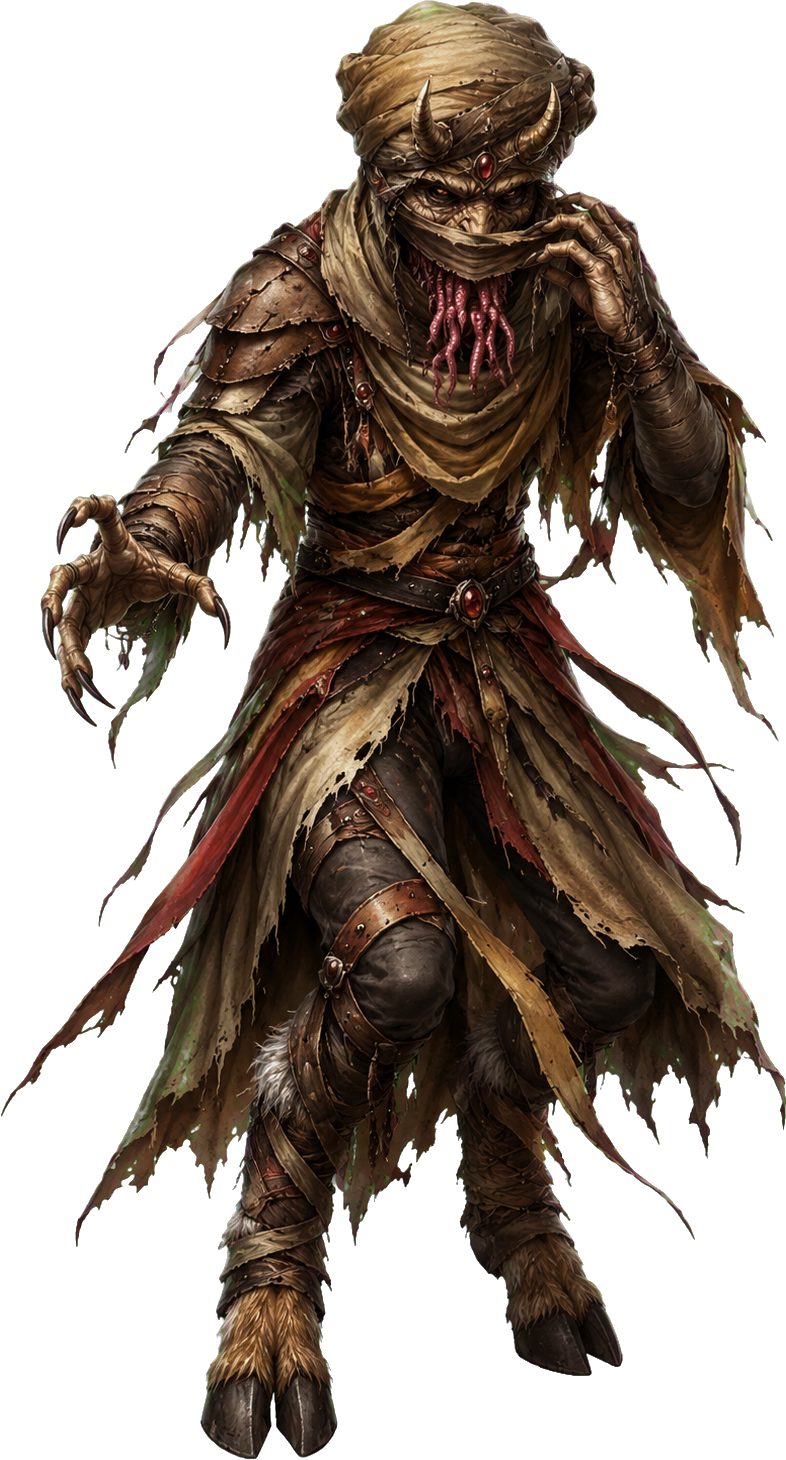
These eerie denizens travel the universe from their strange homeland of Leng, walking uncontested only when they disguise themselves as humans by wearing loose-fitting robes and wrappings about the head and face. Under these disguises, they have horned brows, clawed fingers, mouths full of tentacles, and crooked goatish legs with cloven hooves. Many scholars have argued over where the otherworldly realm of Leng lies— some believe it can be found among the Outer Planes, while others are convinced it can only be reached via a dimension of dreams. The denizens of Leng can travel to other planes freely, and often do so in strange, black ships, constantly seeking new breeds of slaves or trading rubies for unusual services or magical treasures. At other times, their visits are much more violent, focusing on abducting victims for use as slaves or worse. On Leng, these denizens have long fought a war against that realm’s monstrous spiders, a war that sometimes spills over into other worlds. A denizen of Leng weighs 200 pounds and stands roughly 5-1/2 feet tall.
CE Medium (, , )
An outsider is at least partially composed of the essence (but not necessarily the material) of some plane other than the Material Plane. Some creatures start out as some other type and become outsiders when they attain a higher (or lower) state of spiritual existence. An outsider has the following traits:
• Darkvision 60 feet.
• Unlike most living creatures, an outsider does not have a dual nature—its soul and body form one unit. When an outsider is slain, no soul is set loose. Spells that restore souls to their bodies, such as raise dead, reincarnate, and resurrection, don’t work on an outsider. It takes a different magical effect, such as limited wish, wish, miracle, or true resurrection to restore it to life.
• Proficient with all simple and martial weapons and any weapons mentioned in its entry.
• Proficient with whatever type of armor (light, medium, or heavy) it is described as wearing, as well as all lighter types. Outsiders not indicated as wearing armor are not proficient with armor. Outsiders are proficient with shields if they are proficient with any form of armor.
• Outsiders breathe, but do not need to eat or sleep (although they can do so if they wish).
The Chaotic subtype is usually applied to outsiders native to the chaotic-aligned Outer Planes. Most creatures that have this subtype also have chaotic alignments; however, if their alignments change, they still retain the subtype. Any effect that depends on alignment affects a creature with this subtype as if the creature had a chaotic alignment, no matter what its alignment actually is. The creature also suffers effects according to its actual alignment. A creature with the chaotic subtype overcomes damage reduction as if its natural weapons and any weapons it wields were chaotic-aligned.
The Evil subtype is usually applied to outsiders native to the evil-aligned Outer Planes. Evil outsiders are also called fiends. Most creatures that have this subtype also have evil alignments; however, if their alignments change, they still retain the subtype. Any effect that depends on alignment affects a creature with this subtype as if the creature had an evil alignment, no matter what its alignment actually is. The creature also suffers effects according to its actual alignment. A creature with the evil subtype overcomes damage reduction as if its natural weapons and any weapons it wields were evil-aligned.
The Extraplanar subtype is applied to any creature when it is on a plane other than its native plane. A creature that travels the planes can gain or lose this subtype as it goes from plane to plane. Monster entries assume that encounters with creatures take place on the Material Plane, and every creature whose native plane is not the Material Plane has the extraplanar subtype (but would not have it when on its home plane). Creatures not labeled as extraplanar are natives of the Material Plane, and they gain the extraplanar subtype if they leave the Material Plane. No creature has the extraplanar subtype when it is on a Transitive Plane (the Astral Plane, the Ethereal Plane, or the Plane of Shadow).
Init +4; Senses 60 ft.; Perception +16
Darkvision is the extraordinary ability to see with no light source at all, out to a range specified. Darkvision is black-and-white only (colors cannot be discerned). It does not allow creatures to see anything that they could not see otherwise—invisible objects are still invisible, and illusions are still visible as what they seem to be. Likewise, darkvision subjects a creature to gaze attacks normally. The presence of light does not spoil darkvision.
DEFENSE
AC 21, touch 15, flat-footed 16 (+4 Dex, +1 dodge, +6 natural)
hp 95 (10d10+40); planar 5
Fast Healing (Ex) This creature regains hit points swiftly, usually 1 or more per round, as given in the creature’s entry. Except as noted below, fast healing is just like natural healing. Fast healing does not restore hit points lost from starvation, suffocation, or thirst, nor does it allow a creature to regrow lost body parts. Unless otherwise stated, it does not allow lost body parts to be reattached. Fast healing continues to function (even at negative hit points) until a creature dies, at which point the effects of fast healing end immediately.
Fort +11, Ref +11, Will +6
Defensive Abilities no breath, ; poison; cold 30, electricity 30; 19
Immunity (Ex or Su) A creature with immunities takes no damage from listed sources. Immunities can also apply to afflictions, conditions, spells (based on level, save type, or school), and other effects. A creature does not suffer any secondary effects that would normally be triggered by an effect it is immune to.
Resistance (Ex) This creature ignores some damage of the indicated type each time it takes damage of that kind, commonly acid, cold, electricity, or fire. The entry indicates the amount and type of damage ignored. Resistance is not immunity, and it applies whether the damage has a mundane or magical source. When resistance completely negates damage from an energy attack, that attack does not disrupt spellcasting. This resistance does not stack with resistance provided by a spell.
A creature with Spell Resistance has the extraordinary ability to avoid the effects of spells and spell-like abilities that directly affect it. To determine if a spell or spell-like ability works against a creature with spell resistance, the caster must make a caster level check (1d20 + caster level). If the result equals or exceeds the creature’s spell resistance, the spell works normally, although the creature is still allowed a saving throw.
OFFENSE
Speed 40 ft.
Melee bite +14 (1d6+2 plus 1d6 ), 2 claws +14 (1d4+2)
Special Attacks +5d6
Sneak Attack If this creature catches an opponent unable to defend itself effectively from its attack, it can strike a vital spot for extra damage. Its attacks deal the listed sneak attack damage any time its target would be denied a Dexterity bonus to AC (whether the target actually has a Dexterity bonus or not), or when this creature flanks its target. Sneak attack damage is precision damage and is not multiplied on a critical hit. Ranged attacks count as sneak attacks only if the target is within 30 feet. With a weapon that deals nonlethal damage (such as a sap, whip, or unarmed strike), this creature can deal nonlethal sneak attack damage instead of lethal damage. It cannot use a weapon that deals lethal damage to deal nonlethal sneak attack damage, even with the usual –4 penalty. This creature must be able to see the target well enough to pick out a vital spot and must be able to reach that spot. It cannot sneak attack a creature with concealment.
(CL 10th; concentration +15)
Spell-like abilities are magical and work just like spells (though they are not spells and so have no verbal, somatic, focus, or material components). They go away in an antimagic field and are subject to spell resistance if the spell the ability is based on would be subject to spell resistance.
A spell-like ability usually has a limit on how often it can be used. A constant spell-like ability or one that can be used at will has no use limit; unless otherwise stated, a creature can only use a constant spell-like ability on itself. Reactivating a constant spell-like ability is a swift action. Using all other spell-like abilities is a standard action unless noted otherwise, and doing so provokes attacks of opportunity. It is possible to make a concentration check to use a spell-like ability defensively and avoid provoking an attack of opportunity, just as when casting a spell. A spell-like ability can be disrupted just as a spell can be. Spell-like abilities cannot be used to counterspell, nor can they be counterspelled.
For creatures with spell-like abilities, a designated caster level determines how difficult it is to dispel their spell-like effects and defines any level-dependent variables (such as range and duration) the abilities might have. The creature’s caster level never affects which spell-like abilities the creature has; sometimes the given caster level is lower than the level a spellcasting character would need to cast the spell of the same name. If no caster level is specified, the caster level is equal to the creature’s Hit Dice. The saving throw (if any) against a spell-like ability is 10 + the level of the spell the ability resembles or duplicates + the creature’s Charisma modifier.
Some spell-like abilities duplicate spells that work differently when cast by characters of different classes. A monster’s spell-like abilities are presumed to be the sorcerer/wizard versions. If the spell in question is not a sorcerer/wizard spell, then default to cleric, druid, bard, paladin, and ranger, in that order.
Constant—tongues
3/day—detect thoughts (DC 17), hypnotic pattern (DC 17), levitate, minor image (DC 17)
1/day—locate object, plane shift (DC 20, self only)
STATISTICS
Str 14, Dex 18, Con 19, Int 18, Wis 17, Cha 21
Base Atk +10; +12; CMD 27
When performing a combat maneuver, you must use an action appropriate to the maneuver you are attempting to perform. While many combat maneuvers can be performed as part of an attack action, full-attack action, or attack of opportunity (in place of a melee attack), others require a specific action. Unless otherwise noted, performing a combat maneuver provokes an attack of opportunity from the target of the maneuver. If you are hit by the target, you take the damage normally and apply that amount as a penalty to the attack roll to perform the maneuver. If your target is immobilized, unconscious, or otherwise incapacitated, your maneuver automatically succeeds (treat as if you rolled a natural 20 on the attack roll). If your target is stunned, you receive a +4 bonus on your attack roll to perform a combat maneuver against it.
When you attempt to perform a combat maneuver, make an attack roll and add your CMB in place of your normal attack bonus. Add any bonuses you currently have on attack rolls due to spells, feats, and other effects. These bonuses must be applicable to the weapon or attack used to perform the maneuver. The DC of this maneuver is your target’s Combat Maneuver Defense. Combat maneuvers are attack rolls, so you must roll for concealment and take any other penalties that would normally apply to an attack roll.
If your attack roll equals or exceeds the CMD of the target, your maneuver is a success and has the listed effect. Some maneuvers, such as bull rush, have varying levels of success depending on how much your attack roll exceeds the target’s CMD. Rolling a natural 20 while attempting a combat maneuver is always a success (except when attempting to escape from bonds), while rolling a natural 1 is always a failure.
Feats , , , ,
Deceitful You get a +2 bonus on all Bluff and Disguise skill checks. If you have 10 or more ranks in one of these skills, the bonus increases to +4 for that skill.
Dodge You gain a +1 dodge bonus to your AC. A condition that makes you lose your Dex bonus to AC also makes you lose the benefits of this feat.
Mobility You get a +4 dodge bonus to Armor Class against attacks of opportunity caused when you move out of or within a threatened area. A condition that makes you lose your Dexterity bonus to Armor Class (if any) also makes you lose dodge bonuses.
Dodge bonuses stack with each other, unlike most types of bonuses.
Persuasive You get a +2 bonus on Diplomacy and Intimidate skill checks. If you have 10 or more ranks in one of these skills, the bonus increases to +4 for that skill.
Weapon Finesse With a light weapon, rapier, whip, or spiked chain made for a creature of your size category, you may use your Dexterity modifier instead of your Strength modifier on attack rolls. If you carry a shield, its armor check penalty applies to your attack rolls.
Special: Natural weapons are considered light weapons.
Skills Bluff +22, Diplomacy +7, Disable Device +14, Disguise +12 (+16 as humanoid), Intimidate +12, Knowledge (any one) +17, Perception +16, Profession (sailor) +8, Sense Motive +16, Sleight of Hand +17, Spellcraft +12, Stealth +17, Use Magic Device +18
Racial Modifiers +4 Disguise when disguised as a Medium humanoid
Languages Aklo; tongues
ECOLOGY
Environment any land
Organization solitary, gang (2–5), or crew (6–15)
Treasure double (500 to 2,000gp in rubies, other treasure)
SPECIAL ABILITIES
Dexterity Drain (Su) The otherworldly teeth and tongues of a denizen of Leng deal 1d6 points of Dexterity drain with a bite. Constructs, elementals, and other creatures that do not possess flesh are immune to this effect. A successful DC 19 Fortitude save reduces the Dexterity drain to 1 point. The save DC is Constitution-based.
Planar Fast Healing (Su) A denizen of Leng maintains a connection to Leng at all times, and when away from Leng, it has fast healing 5. It loses this ability on Leng or in areas where planar connections do not function. If killed, a denizen’s body dissolves into nothingness in 1d4 rounds, leaving behind its equipment. A slain denizen reforms in Leng, similar to a slain summoned creature; it can only be permanently killed if its fast healing is negated.
Unusual Anatomy (Ex) A denizen’s internal anatomy varies from individual to individual, and has a 50% chance to treat any critical hit or sneak attack against it as a normal hit.
Shantak
Larger than an elephant, this scaly, bird-like creature has a vaguely horse-like head and vast, slime-encrusted wings.
Shantaks speak in a shrill voice that sounds like glass grinding against stone. They are intelligent creatures and cannot be trained as mounts—a would-be shantak rider must use diplomacy or magic to secure a shantak’s cooperation as a mount, and even then, shantaks have a tendency to deliberately strand riders in dangerous areas. Many shantaks have a strange and irrational fear of certain creatures, such as the faceless nightgaunts said to dwell in certain remote mountains, or specific types of harpies or gargoyles in more civilized regions. A shantak avoids confrontations with these types of creatures if possible. A shantak’s ability to travel the gulfs of space ensures that these scaly, bird-like creatures can be found on numerous worlds. Yet despite this unique ability, shantaks are generally quite reluctant to seek out new worlds unless faced with no other option, for a shantak knows well that an attempt to fly to an unknown world could easily result in being lost forever in the gulfs of space.
CE Huge
Magical beasts are similar to animals but can have Intelligence scores higher than 2 (in which case the magical beast knows at least one language, but can’t necessarily speak). Magical beasts usually have supernatural or extraordinary abilities, but are sometimes merely bizarre in appearance or habits. A magical beast has the following traits (unless otherwise noted in a creature’s entry).
• Darkvision 60 feet and low-light vision.
• Proficient with its natural weapons only.
• Proficient with no armor.
• Magical beasts breathe, eat, and sleep.
Init +3; Senses 60 ft., ; Perception +3
Darkvision is the extraordinary ability to see with no light source at all, out to a range specified. Darkvision is black-and-white only (colors cannot be discerned). It does not allow creatures to see anything that they could not see otherwise—invisible objects are still invisible, and illusions are still visible as what they seem to be. Likewise, darkvision subjects a creature to gaze attacks normally. The presence of light does not spoil darkvision.
Low-Light Vision (Ex) A creature with low-light vision can see twice as far as a human in starlight, moonlight, torchlight, and similar conditions of dim light. It retains the ability to distinguish color and detail under these conditions.
DEFENSE
AC 21, touch 11, flat-footed 18 (+3 Dex, +10 natural, –2 size)
hp 104 (11d10+44)
Fort +11, Ref +10, Will +6
Defensive Abilities ; cold, disease
Immunity (Ex or Su) A creature with immunities takes no damage from listed sources. Immunities can also apply to afflictions, conditions, spells (based on level, save type, or school), and other effects. A creature does not suffer any secondary effects that would normally be triggered by an effect it is immune to.
OFFENSE
Speed 20 ft., 80 ft. (average)
A creature with a Fly speed can cease or resume flight as a free action on its turn. Without making a check, a flying creature can remain flying at the end of its turn so long as it moves a distance greater than half its speed. It can also turn up to 45 degrees during its turn by sacrificing 5 feet of movement, can rise at half speed at an angle of 45 degrees (ignoring the penalty for diagonal movement), and can descend at any angle at normal speed. At the beginning of its turn, a flying creature can move in a different direction than it did previously without needing a Fly check.
A creature with a natural fly speed receives a bonus (or penalty) on Fly skill checks depending on its maneuverability:
• Clumsy –8
• Poor –4
• Average +0
• Good +4
• Perfect +8
Creatures without a maneuverability rating are assumed to have average maneuverability and take no penalty on Fly checks. These modifiers are already included in the creature’s stat block.
Melee bite +17 (2d6+8), 2 talons +17 (1d8+8 plus )
Grab (Ex) If this creature hits with the indicated attack, it deals normal damage and attempts to start a as a free action without provoking an attack of opportunity. The creature has the option to conduct the grapple normally, or simply use the part of its body it used in the grab to hold the opponent. If it chooses to do the latter, it takes a –20 penalty on its CMB check to make and maintain the grapple, but does not gain the grappled condition itself. A successful hold does not deal any extra damage unless the creature also has the constrict special attack. If the creature does not constrict, each successful grapple check it makes during successive rounds automatically deals the damage indicated for the attack that established the hold. Otherwise, it deals constriction damage as well (the amount is given in the creature’s descriptive text).
Creatures with the grab special attack receive a +4 bonus on combat maneuver checks made to start and maintain a grapple.
Unless otherwise noted, grab can only be used against targets of a size equal to or smaller than the creature with this ability. If the creature can use grab on creatures of other sizes, it is noted in the creature’s Special Attacks line.
A grappled creature is restrained by a creature, trap, or effect. Grappled creatures cannot move and take a –4 penalty to Dexterity. A grappled creature takes a –2 penalty on all attack rolls and combat maneuver checks, except those made to grapple or escape a grapple. In addition, grappled creatures can take no action that requires two hands to perform. A grappled character who attempts to cast a spell or use a spell-like ability must make a concentration check (DC 10 + grappler’s CMB + spell level), or lose the spell. Grappled creatures cannot make attacks of opportunity.
A grappled creature cannot use Stealth to hide from the creature grappling it, even if a special ability, such as hide in plain sight, would normally allow it to do so. If a grappled creature becomes invisible, through a spell or other ability, it gains a +2 circumstance bonus on its CMD to avoid being grappled, but receives no other benefit.
Space 15 ft.; Reach 15 ft.
STATISTICS
Str 26, Dex 17, Con 19, Int 8, Wis 17, Cha 10
Base Atk +11; +21 (+25 grapple); CMD 34 (42 vs. grapple)
When performing a combat maneuver, you must use an action appropriate to the maneuver you are attempting to perform. While many combat maneuvers can be performed as part of an attack action, full-attack action, or attack of opportunity (in place of a melee attack), others require a specific action. Unless otherwise noted, performing a combat maneuver provokes an attack of opportunity from the target of the maneuver. If you are hit by the target, you take the damage normally and apply that amount as a penalty to the attack roll to perform the maneuver. If your target is immobilized, unconscious, or otherwise incapacitated, your maneuver automatically succeeds (treat as if you rolled a natural 20 on the attack roll). If your target is stunned, you receive a +4 bonus on your attack roll to perform a combat maneuver against it.
When you attempt to perform a combat maneuver, make an attack roll and add your CMB in place of your normal attack bonus. Add any bonuses you currently have on attack rolls due to spells, feats, and other effects. These bonuses must be applicable to the weapon or attack used to perform the maneuver. The DC of this maneuver is your target’s Combat Maneuver Defense. Combat maneuvers are attack rolls, so you must roll for concealment and take any other penalties that would normally apply to an attack roll.
If your attack roll equals or exceeds the CMD of the target, your maneuver is a success and has the listed effect. Some maneuvers, such as bull rush, have varying levels of success depending on how much your attack roll exceeds the target’s CMD. Rolling a natural 20 while attempting a combat maneuver is always a success (except when attempting to escape from bonds), while rolling a natural 1 is always a failure.
Feats , , , , ,
Awesome Blow As a standard action, the creature may perform an awesome blow combat maneuver. If the creature’s maneuver succeeds against a corporeal opponent smaller than itself, its opponent takes damage (typically slam damage plus Strength bonus) and is knocked flying 10 feet in a direction of the attacking creature’s choice and falls . The attacking creature can only push the opponent in a straight line, and the opponent can’t move closer to the attacking creature than the square it started in. If an obstacle prevents the completion of the opponent’s move, the opponent and the obstacle each take 1d6 points of damage, and the opponent is knocked in the space adjacent to the obstacle.
The character is lying on the ground. A prone attacker has a –4 penalty on melee attack rolls and cannot use a ranged weapon (except for a crossbow). A prone defender gains a +4 bonus to Armor Class against ranged attacks, but takes a –4 penalty to AC against melee attacks. Standing up is a move-equivalent action that provokes an attack of opportunity.
Flyby Attack When flying, the creature can take a move action and another standard action at any point during the move. The creature cannot take a second move action during a round when it makes a flyby attack.
Normal: Without this feat, the creature takes a standard action either before or after its move.
Hover A creature with this feat can halt its movement while flying, allowing it to hover without needing to make a Fly skill check.
If a creature of size Large or larger with this feat hovers within 20 feet of the ground in an area with lots of loose debris, the draft from its wings creates a hemispherical cloud with a radius of 60 feet. The winds generated can snuff torches, small campfires, exposed lanterns, and other small, open flames of non-magical origin. Clear vision within the cloud is limited to 10 feet. Creatures have concealment at 15 to 20 feet (20% miss chance). At 25 feet or more, creatures have total concealment (50% miss chance, and opponents cannot use sight to locate the creature).
Normal: Without this feat, a creature must make a Fly skill check to hover and the creature does not create a cloud of debris while hovering.
Improved Bull Rush You do not provoke an attack of opportunity when performing a bull rush combat maneuver. In addition, you receive a +2 bonus on checks made to bull rush a foe. You also receive a +2 bonus to your Combat Maneuver Defense whenever an opponent tries to bull rush you.
Normal: You provoke an attack of opportunity when performing a bull rush combat maneuver.
Power Attack You can choose to take a –1 penalty on all melee attack rolls and combat maneuver checks to gain a +2 bonus on all melee damage rolls. This bonus to damage is increased by half (+50%) if you are making an attack with a two-handed weapon, a one-handed weapon using two hands, or a primary natural weapon that adds 1-1/2 times your Strength modifier on damage rolls. This bonus to damage is halved (–50%) if you are making an attack with an off-hand weapon or secondary natural weapon. When your base attack bonus reaches +4, and every 4 points thereafter, the penalty increases by –1 and the bonus to damage increases by +2. You must choose to use this feat before making an attack roll, and its effects last until your next turn. The bonus damage does not apply to touch attacks or effects that do not deal hit point damage.
Wingover Once each round, a creature with this feat can turn up to 180 degrees as a free action without making a Fly skill check. This free turn does not consume any additional movement from the creature.
Normal: A flying creature can turn up to 90 degrees by making a DC 15 Fly skill check and expending 5 feet of movement. A flying creature can turn up to 180 degrees by making a DC 20 Fly skill check and expending 10 feet of movement.
Skills Escape Artist +11, Fly +13
Racial Modifiers +8 Escape Artist
Languages Aklo
SQ , ,
No Breath (Ex) This monster does not breathe, and is immune to effects that require breathing (such as inhaled poison). This does not give immunity to cloud or gas attacks that do not require breathing.
ECOLOGY
Environment cold mountains
Organization solitary, pair, or flock (3–12)
Treasure none
SPECIAL ABILITIES
Share Defenses (Su) As a free action, a shantak can extend its no breath ability and cold immunity to a single creature touching it. It can withdraw this protection as a free action.
Slippery (Ex) A shantak’s scales seep slippery slime. This grants the creature a +8 bonus on all Escape Artist checks and to its CMD against grapples, and imparts a –5 penalty on all Ride checks made by creatures attempting to ride a shantak.
Starflight (Su) A shantak can survive in the void of outer space. It flies through space at an incredible speed. Although exact travel times vary, a trip within a single solar system should take 3d20 hours, while a trip beyond should take 3d20 days (or more, at the GM’s discretion)—provided the shantak knows the way to its destination.
Yaddithian
This insectile biped has a tapir-like snout and is unmistakably alien in appearance, despite its vaguely humanoid shape.
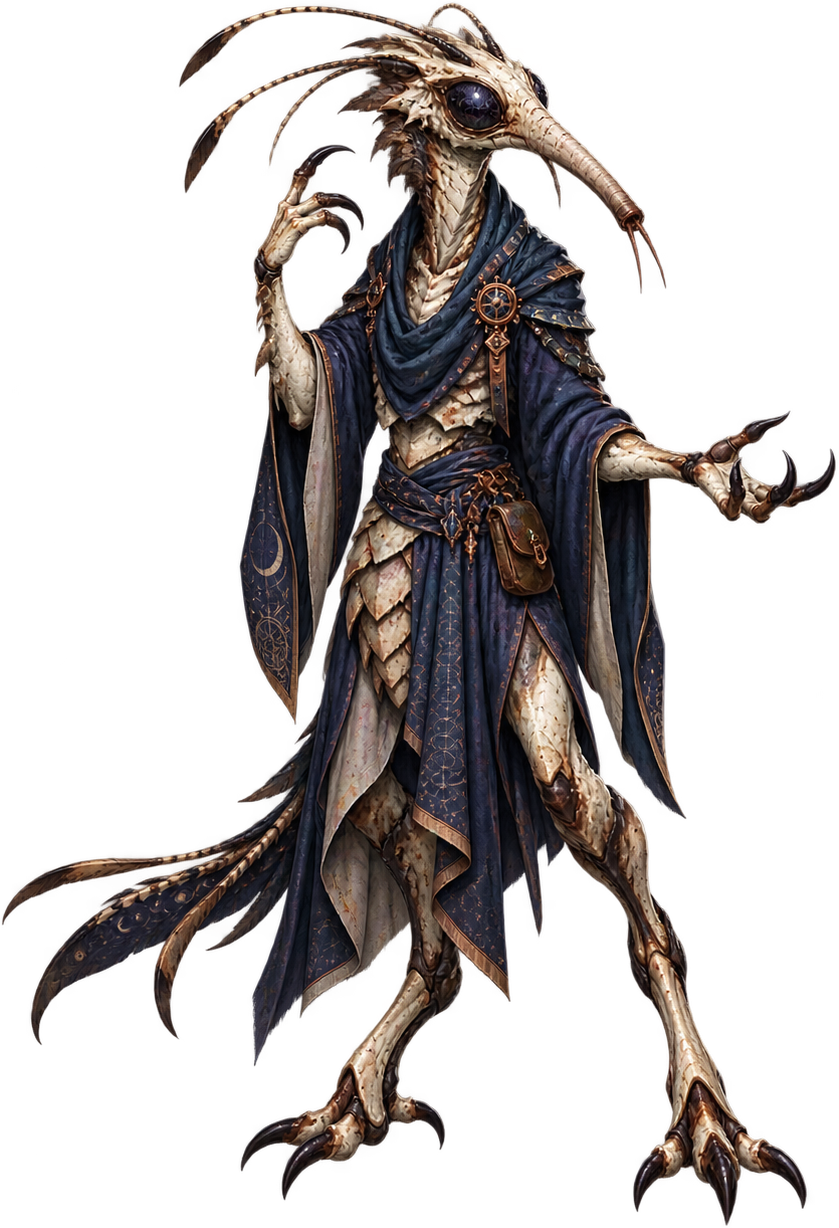
Yaddithians are an ancient race of scholarly starfarers. Bholes consumed their home planet long ago; the survivors fled to other worlds across the universe. It is rare to find a yaddithian less powerful than the wizard above.
Yaddithian wizard 9
N Medium
An aberration has a bizarre anatomy, strange abilities, an alien mindset, or any combination of the three. They possess the following traits:
• Darkvision 60 feet.
• Proficient with its natural weapons. If generally humanoid in form, proficient with all simple weapons and any weapon it is described as using.
• Proficient with whatever type of armor (light, medium, or heavy) it is described as wearing, as well as all lighter types. Aberrations not indicated as wearing armor are not proficient with armor. Aberrations are proficient with shields if they are proficient with any form of armor.
• Aberrations breathe, eat, and sleep.
Init +2; Senses 60 ft.; Perception +11
Darkvision is the extraordinary ability to see with no light source at all, out to a range specified. Darkvision is black-and-white only (colors cannot be discerned). It does not allow creatures to see anything that they could not see otherwise—invisible objects are still invisible, and illusions are still visible as what they seem to be. Likewise, darkvision subjects a creature to gaze attacks normally. The presence of light does not spoil darkvision.
DEFENSE
AC 15, touch 13, flat-footed 13 (+1 deflection, +2 Dex, +2 natural)
hp 61 (9d6+27)
Fort +5, Ref +5, Will +5
cold 5
Resistance (Ex) This creature ignores some damage of the indicated type each time it takes damage of that kind, commonly acid, cold, electricity, or fire. The entry indicates the amount and type of damage ignored. Resistance is not immunity, and it applies whether the damage has a mundane or magical source. When resistance completely negates damage from an energy attack, that attack does not disrupt spellcasting. This resistance does not stack with resistance provided by a spell.
OFFENSE
Speed 20 ft.
Melee +1 dagger +6 (1d4+2), claw +0 (1d4)
Ranged +1 dagger +7 (1d4+2)
Special Attacks hand of the apprentice (7/day)
(CL 9th; concentration +13)
Spells This creature casts spells as a member of the spellcasting class named in its entry. It counts as a member of that class for effects and abilities that depend on its spellcasting, can use spell-completion and spell-trigger items appropriate to that class, and can benefit from items that affect that class or its spellcasting. If the creature also has actual levels in that class, those class levels stack with its innate spellcasting level unless its entry says otherwise. The creature’s entry explains any other class-related abilities it gains or any unusual spellcasting abilities unavailable to ordinary members of the class.
5th—feeblemind (DC 19)
4th—detect scrying, dimension door, scrying (DC 18)
3rd—displacement, fly, lightning bolt (DC 17), sleet storm
2nd—alter self, blindness/deafness (3, DC 16), mirror image
1st—mage armor, magic missile (2), shield, ventriloquism (DC 15)
0 (at will)—arcane mark, daze (DC 14), detect magic, read magic
STATISTICS
Str 12, Dex 14, Con 15, Int 19, Wis 8, Cha 8
Base Atk +4; +5; CMD 18
When performing a combat maneuver, you must use an action appropriate to the maneuver you are attempting to perform. While many combat maneuvers can be performed as part of an attack action, full-attack action, or attack of opportunity (in place of a melee attack), others require a specific action. Unless otherwise noted, performing a combat maneuver provokes an attack of opportunity from the target of the maneuver. If you are hit by the target, you take the damage normally and apply that amount as a penalty to the attack roll to perform the maneuver. If your target is immobilized, unconscious, or otherwise incapacitated, your maneuver automatically succeeds (treat as if you rolled a natural 20 on the attack roll). If your target is stunned, you receive a +4 bonus on your attack roll to perform a combat maneuver against it.
When you attempt to perform a combat maneuver, make an attack roll and add your CMB in place of your normal attack bonus. Add any bonuses you currently have on attack rolls due to spells, feats, and other effects. These bonuses must be applicable to the weapon or attack used to perform the maneuver. The DC of this maneuver is your target’s Combat Maneuver Defense. Combat maneuvers are attack rolls, so you must roll for concealment and take any other penalties that would normally apply to an attack roll.
If your attack roll equals or exceeds the CMD of the target, your maneuver is a success and has the listed effect. Some maneuvers, such as bull rush, have varying levels of success depending on how much your attack roll exceeds the target’s CMD. Rolling a natural 20 while attempting a combat maneuver is always a success (except when attempting to escape from bonds), while rolling a natural 1 is always a failure.
Feats , , , , , (Perception),
Combat Casting You get a +4 bonus on concentration checks made to cast a spell or use a spell-like ability when casting on the defensive or while .
A grappled creature is restrained by a creature, trap, or effect. Grappled creatures cannot move and take a –4 penalty to Dexterity. A grappled creature takes a –2 penalty on all attack rolls and combat maneuver checks, except those made to grapple or escape a grapple. In addition, grappled creatures can take no action that requires two hands to perform. A grappled character who attempts to cast a spell or use a spell-like ability must make a concentration check (DC 10 + grappler’s CMB + spell level), or lose the spell. Grappled creatures cannot make attacks of opportunity.
A grappled creature cannot use Stealth to hide from the creature grappling it, even if a special ability, such as hide in plain sight, would normally allow it to do so. If a grappled creature becomes invisible, through a spell or other ability, it gains a +2 circumstance bonus on its CMD to avoid being grappled, but receives no other benefit.
Craft Wondrous Item You can create a wide variety of magic wondrous items. Crafting a wondrous item takes 1 day for each 1,000 gp in its price. To create a wondrous item, you must use up raw materials costing half of its base price. See the magic item creation rules in Magic Items for more information.
You can also mend a wondrous item if it is one that you could make. Doing so costs half the raw materials and half the time it would take to craft that item.
An item with hit points equal to or lower than half its maximum hit points gains the broken condition. A broken weapon takes a –2 penalty on attack and damage rolls and scores a critical hit only on a natural 20, dealing only ×2 damage. A broken suit of armor or shield provides only half its normal AC bonus, rounded down, and its armor check penalty is doubled. A broken tool imposes a –2 penalty on skill checks made with it. A broken wand or staff uses twice the normal number of charges when activated. Other broken items may have no additional game effect unless their descriptions say otherwise. A broken item is normally worth 75% of its normal value.
Magic can repair a broken item with mending or make whole only if the caster level is at least as high as the item’s caster level; the broken condition is removed once the item is restored above half its original hit points. A nonmagical item can be repaired with the appropriate Craft skill, typically DC 20 and requiring 1 hour of work per point of damage repaired. Repairing an item normally costs one-tenth of the item’s price.
Eschew Materials You can cast any spell with a material component costing 1 gp or less without needing that component. The casting of the spell still provokes attacks of opportunity as normal. If the spell requires a material component that costs more than 1 gp, you must have the material component on hand to cast the spell, as normal.
Scribe Scroll You can create a scroll of any spell that you know. Scribing a scroll takes 2 hours if its base price is 250 gp or less, otherwise scribing a scroll takes 1 day for each 1,000 gp in its base price. To scribe a scroll, you must use up raw materials costing half of this base price. See the magic item creation rules in Magic Items for more information.
Silent Spell A silent spell can be cast with no verbal components. Spells without verbal components are not affected. A silent spell uses up a spell slot one level higher than the spell’s actual level.
Special: Bard spells cannot be enhanced by this feat.
Skill Focus (Perception) You get a +3 bonus on all checks involving the chosen skill. If you have 10 or more ranks in that skill, this bonus increases to +6.
Spell Penetration You get a +2 bonus on caster level checks (1d20 + caster level) made to overcome a creature’s spell resistance.
Skills Knowledge (arcana, dungeoneering, history, planes) +18, Perception +11, Spellcraft +18
Racial Modifiers +2 Knowledge (all), +2 Spellcraft
Languages Aklo, Elder Thing, Mi-go, Yaddithian, Yithian
SQ arcane bond (amulet), arcane school (universalist), , , metamagic mastery (1/day),
No Breath (Ex) This monster does not breathe, and is immune to effects that require breathing (such as inhaled poison). This does not give immunity to cloud or gas attacks that do not require breathing.
ECOLOGY
Environment any
Organization solitary, pair, or conclave (3–16)
Treasure NPC gear (+1 dagger, amulet of natural armor +1, handy haversack, ring of protection +1, wand of acid arrow[50 charges], other treasure)
SPECIAL ABILITIES
Cosmic Mind (Ex) A Yaddithian gets a +2 racial bonus on Knowledge and Spellcraft checks. A yaddithian spellcaster who would store spells in a spellbook or familiar instead stores those spells in its mind (but must expend the normal resources to learn new spells).
Long-Lived (Ex) Yaddithians live for thousands of years; they gain no benefit or penalty from aging and are immune to magical aging effects.
YADDITHIAN CHARACTERS
Yaddithians are defined by their class levels—they don’t have racial Hit Dice. They have the following racial traits.
+2 Constitution, +2 Intelligence, –2 Wisdom.
Slow: Yaddithians have a land speed of 20 feet.
Darkvision: Yaddithians can see in the dark up to 60 feet.
Defensive Abilities: Yaddithians have cold resistance 5 and the no breath ability.
Claws: A Yaddithian has two claws that deal 1d4 points of damage each.
Rugose: A Yaddithian gains a +1 natural armor bonus.
Cosmic Mind: A Yaddithian gets a +2 racial bonus on Knowledge and Spellcraft checks. A yaddithian spellcaster who would store spells in a spellbook or familiar instead stores those spells in its mind (but must expend the normal resources to learn new spells).
Long-Lived: Yaddithians live for thousands of years; they gain no benefit or penalty from aging and are immune to magical aging effects.
Languages: Yaddithians begin play speaking Yaddithian. Those with high Intelligence scores can choose any language as a bonus language.
Yangethe
This six-eyed horror is vaguely shaped like a dead tree, but one with claws and tentacles and spidery legs.
One of the countless creatures bred and engineered by eldritch horrors from beyond the stars, yangethes have, over the eons, developed keen intellects and desires of their own. Unless slain by violence, a yangethe is immortal.
CE Large
An aberration has a bizarre anatomy, strange abilities, an alien mindset, or any combination of the three. They possess the following traits:
• Darkvision 60 feet.
• Proficient with its natural weapons. If generally humanoid in form, proficient with all simple weapons and any weapon it is described as using.
• Proficient with whatever type of armor (light, medium, or heavy) it is described as wearing, as well as all lighter types. Aberrations not indicated as wearing armor are not proficient with armor. Aberrations are proficient with shields if they are proficient with any form of armor.
• Aberrations breathe, eat, and sleep.
Init +4; Senses 120 ft., 60 ft.; Perception +19
Blindsense (Ex) A creature with blindsense notices things it cannot see. The creature usually does not need to succeed at Perception checks to pinpoint the location of a creature within range of its blindsense ability, provided that it has line of effect to that creature. Any opponent the creature with blindsense cannot see still has total concealment from the creature, and the creature still has the normal miss chance when attacking foes that have concealment. Visibility still affects the movement of a creature with blindsense. A creature with blindsense is still denied its Dexterity bonus to Armor Class against attacks from creatures it cannot see.
Darkvision is the extraordinary ability to see with no light source at all, out to a range specified. Darkvision is black-and-white only (colors cannot be discerned). It does not allow creatures to see anything that they could not see otherwise—invisible objects are still invisible, and illusions are still visible as what they seem to be. Likewise, darkvision subjects a creature to gaze attacks normally. The presence of light does not spoil darkvision.
DEFENSE
AC 23, touch 13, flat-footed 19 (+4 Dex, +10 natural, –1 size)
hp 115 (11d8+66)
Fort +9, Ref +9, Will +12
10/slashing or piercing; cold, fear, mind-affecting effects; 20
Damage Reduction (Ex or Su) The creature ignores damage from most weapons and natural attacks. Wounds heal immediately, or the weapon bounces off harmlessly; in either case, the opponent knows the attack was ineffective. The creature takes normal damage from energy attacks, including nonmagical ones, spells, spell-like abilities, and supernatural abilities. A certain kind of weapon can sometimes damage the creature normally, as described below.
The entry indicates the amount of damage ignored, usually 5 to 15 points, and the type of weapon that negates the ability. Some monsters are vulnerable to bludgeoning, piercing, or slashing damage. Others are vulnerable to materials such as adamantine, cold iron, or silver. Attacks from weapons that are not the correct type or material have their damage reduced, although a high enhancement bonus can overcome some forms of damage reduction.
Whenever damage reduction completely negates the damage from an attack, it also negates most special effects that accompany the attack, such as injury poison, injury disease, and effects delivered only when the attack deals damage. Damage reduction does not negate touch attacks, energy damage dealt along with an attack, or energy drain, and it does not affect poisons or diseases delivered by contact, ingestion, or inhalation. If damage reduction completely negates an attack’s damage, that attack does not disrupt a spell being cast.
Damage reduction does not stack with itself. When a creature has more than one form, apply the single form that gives the greatest reduction against the attack; the attacker must overcome only the qualities required by the form being applied.
Some monsters are vulnerable to magic weapons. A weapon with at least a +1 magical enhancement bonus on attack and damage rolls overcomes this damage reduction; the +1 attack bonus from a masterwork weapon does not count as a magical enhancement bonus. Such creatures’ natural weapons, but not their attacks with manufactured weapons, are treated as magic weapons for overcoming damage reduction. Ammunition fired from a projectile weapon with at least a +1 enhancement bonus is treated as magic for overcoming damage reduction.
A few powerful monsters are vulnerable only to epic weapons—magic weapons with at least a +6 enhancement bonus. Such creatures’ natural weapons are also treated as epic weapons for overcoming damage reduction.
Some monsters are vulnerable to chaotic-, evil-, good-, or lawful-aligned weapons. When a cleric casts align weapon, affected weapons might gain one or more of these properties; certain magic weapons also have them. A creature with a chaotic, evil, good, or lawful alignment subtype overcomes matching damage reduction with its natural weapons and wielded weapons as though those attacks had the alignment or alignments matching its subtype. Ammunition fired from an aligned projectile weapon is treated as having that alignment for overcoming damage reduction.
A weapon with a +3 enhancement bonus overcomes damage reduction as though it were made of cold iron and silver. A weapon with a +4 enhancement bonus also overcomes damage reduction as though it were adamantine, but this does not allow it to ignore hardness. A weapon with a +5 enhancement bonus also overcomes alignment-based damage reduction. These equivalences are cumulative with the weapon’s actual material and alignment qualities.
When a damage reduction entry has a — after the slash, no weapon negates it.
If either of two listed attack types can overcome the reduction, a weapon that deals either type does so. If a listed combination is required, the weapon must have every listed type or quality; a weapon with only one remains subject to the damage reduction.
Immunity (Ex or Su) A creature with immunities takes no damage from listed sources. Immunities can also apply to afflictions, conditions, spells (based on level, save type, or school), and other effects. A creature does not suffer any secondary effects that would normally be triggered by an effect it is immune to.
A creature with Spell Resistance has the extraordinary ability to avoid the effects of spells and spell-like abilities that directly affect it. To determine if a spell or spell-like ability works against a creature with spell resistance, the caster must make a caster level check (1d20 + caster level). If the result equals or exceeds the creature’s spell resistance, the spell works normally, although the creature is still allowed a saving throw.
OFFENSE
Speed 40 ft.
Melee 2 claws +14 (1d6+7), 4 tentacles +13 (1d6+3 plus )
Grab (Ex) If this creature hits with the indicated attack, it deals normal damage and attempts to start a as a free action without provoking an attack of opportunity. The creature has the option to conduct the grapple normally, or simply use the part of its body it used in the grab to hold the opponent. If it chooses to do the latter, it takes a –20 penalty on its CMB check to make and maintain the grapple, but does not gain the grappled condition itself. A successful hold does not deal any extra damage unless the creature also has the constrict special attack. If the creature does not constrict, each successful grapple check it makes during successive rounds automatically deals the damage indicated for the attack that established the hold. Otherwise, it deals constriction damage as well (the amount is given in the creature’s descriptive text).
Creatures with the grab special attack receive a +4 bonus on combat maneuver checks made to start and maintain a grapple.
Unless otherwise noted, grab can only be used against targets of a size equal to or smaller than the creature with this ability. If the creature can use grab on creatures of other sizes, it is noted in the creature’s Special Attacks line.
A grappled creature is restrained by a creature, trap, or effect. Grappled creatures cannot move and take a –4 penalty to Dexterity. A grappled creature takes a –2 penalty on all attack rolls and combat maneuver checks, except those made to grapple or escape a grapple. In addition, grappled creatures can take no action that requires two hands to perform. A grappled character who attempts to cast a spell or use a spell-like ability must make a concentration check (DC 10 + grappler’s CMB + spell level), or lose the spell. Grappled creatures cannot make attacks of opportunity.
A grappled creature cannot use Stealth to hide from the creature grappling it, even if a special ability, such as hide in plain sight, would normally allow it to do so. If a grappled creature becomes invisible, through a spell or other ability, it gains a +2 circumstance bonus on its CMD to avoid being grappled, but receives no other benefit.
Space 10 ft.; Reach 10 ft.
Special Attacks ,
(CL 10th; concentration +13)
Spell-like abilities are magical and work just like spells (though they are not spells and so have no verbal, somatic, focus, or material components). They go away in an antimagic field and are subject to spell resistance if the spell the ability is based on would be subject to spell resistance.
A spell-like ability usually has a limit on how often it can be used. A constant spell-like ability or one that can be used at will has no use limit; unless otherwise stated, a creature can only use a constant spell-like ability on itself. Reactivating a constant spell-like ability is a swift action. Using all other spell-like abilities is a standard action unless noted otherwise, and doing so provokes attacks of opportunity. It is possible to make a concentration check to use a spell-like ability defensively and avoid provoking an attack of opportunity, just as when casting a spell. A spell-like ability can be disrupted just as a spell can be. Spell-like abilities cannot be used to counterspell, nor can they be counterspelled.
For creatures with spell-like abilities, a designated caster level determines how difficult it is to dispel their spell-like effects and defines any level-dependent variables (such as range and duration) the abilities might have. The creature’s caster level never affects which spell-like abilities the creature has; sometimes the given caster level is lower than the level a spellcasting character would need to cast the spell of the same name. If no caster level is specified, the caster level is equal to the creature’s Hit Dice. The saving throw (if any) against a spell-like ability is 10 + the level of the spell the ability resembles or duplicates + the creature’s Charisma modifier.
Some spell-like abilities duplicate spells that work differently when cast by characters of different classes. A monster’s spell-like abilities are presumed to be the sorcerer/wizard versions. If the spell in question is not a sorcerer/wizard spell, then default to cleric, druid, bard, paladin, and ranger, in that order.
Constant—air walk
At will—darkness, telekinesis (DC 18), tree shape
1/year—interplanetary teleport (self plus 50 lbs. of objects only)
(CL 10th; concentration +13)
A creature with this ability can use the power of its mind to cast certain spells. Each spell cast using psychic magic consumes an amount of psychic energy. The creature has a maximum amount of psychic energy (PE) per day that refreshes after a night’s rest. A creature with this ability can cast any of the spells listed in this entry as long as it has enough psychic energy remaining to pay the spell’s PE cost. The DC for any of these spells is equal to 10 + the amount of psychic energy used to cast the spell + the creature’s Charisma or Intelligence modifier (whichever is higher). Creatures that gain access to undercast spells via this ability can cast an undercast version of the spell by spending 1 PE fewer for each level lower that the spell is cast. A psychic magic spell with a PE cost of 0 can be cast any number of times, and can be cast even if the creature has 0 PE remaining. The psychic magic granted by this ability has the same thought and emotion components as psychic spells. The monster can apply metamagic feats to these spells by spending an amount of additional PE equal to the level increase of the metamagic feat and by increasing the casting time as normal for spontaneously casting a metamagic spell. Because this ability grants psychic spellcasting, it also allows the creature to use occult skill unlocks.
20 PE—control summoned creature (4 PE, DC 17), demand (8 PE, DC 21), fear (4 PE, DC 17), quickened true strike (1 PE)
STATISTICS
Str 24, Dex 18, Con 22, Int 17, Wis 21, Cha 17
Base Atk +8; +16 (+20 grapple); CMD 30 (can’t be tripped)
When performing a combat maneuver, you must use an action appropriate to the maneuver you are attempting to perform. While many combat maneuvers can be performed as part of an attack action, full-attack action, or attack of opportunity (in place of a melee attack), others require a specific action. Unless otherwise noted, performing a combat maneuver provokes an attack of opportunity from the target of the maneuver. If you are hit by the target, you take the damage normally and apply that amount as a penalty to the attack roll to perform the maneuver. If your target is immobilized, unconscious, or otherwise incapacitated, your maneuver automatically succeeds (treat as if you rolled a natural 20 on the attack roll). If your target is stunned, you receive a +4 bonus on your attack roll to perform a combat maneuver against it.
When you attempt to perform a combat maneuver, make an attack roll and add your CMB in place of your normal attack bonus. Add any bonuses you currently have on attack rolls due to spells, feats, and other effects. These bonuses must be applicable to the weapon or attack used to perform the maneuver. The DC of this maneuver is your target’s Combat Maneuver Defense. Combat maneuvers are attack rolls, so you must roll for concealment and take any other penalties that would normally apply to an attack roll.
If your attack roll equals or exceeds the CMD of the target, your maneuver is a success and has the listed effect. Some maneuvers, such as bull rush, have varying levels of success depending on how much your attack roll exceeds the target’s CMD. Rolling a natural 20 while attempting a combat maneuver is always a success (except when attempting to escape from bonds), while rolling a natural 1 is always a failure.
Feats , , , , (true strike), (tentacles)
Combat Casting You get a +4 bonus on concentration checks made to cast a spell or use a spell-like ability when casting on the defensive or while .
A grappled creature is restrained by a creature, trap, or effect. Grappled creatures cannot move and take a –4 penalty to Dexterity. A grappled creature takes a –2 penalty on all attack rolls and combat maneuver checks, except those made to grapple or escape a grapple. In addition, grappled creatures can take no action that requires two hands to perform. A grappled character who attempts to cast a spell or use a spell-like ability must make a concentration check (DC 10 + grappler’s CMB + spell level), or lose the spell. Grappled creatures cannot make attacks of opportunity.
A grappled creature cannot use Stealth to hide from the creature grappling it, even if a special ability, such as hide in plain sight, would normally allow it to do so. If a grappled creature becomes invisible, through a spell or other ability, it gains a +2 circumstance bonus on its CMD to avoid being grappled, but receives no other benefit.
Combat Expertise You can choose to take a –1 penalty on melee attack rolls and combat maneuver checks to gain a +1 dodge bonus to your Armor Class. When your base attack bonus reaches +4, and every +4 thereafter, the penalty increases by –1 and the dodge bonus increases by +1. You can only choose to use this feat when you declare that you are making an attack or a full-attack action with a melee weapon. The effects of this feat last until your next turn.
Lightning Reflexes You get a +2 bonus on all Reflex saving throws.
Multiattack The creature’s secondary attacks with natural weapons take only a –2 penalty.
Normal: Without this feat, the creature’s secondary attacks with natural weapons take a –5 penalty.
Quicken Spell-Like Ability (true strike) Choose one of the creature’s spell-like abilities, subject to the restrictions described in this feat. The creature can use the chosen spell-like ability as a quickened spell-like ability three times per day (or less, if the ability is normally usable only once or twice per day).
Using a quickened spell-like ability is a swift action that does not provoke an attack of opportunity. The creature can perform another action—including the use of another spell-like ability (but not another swift action)—in the same round that it uses a quickened spell-like ability. The creature may use only one quickened spell-like ability per round.
The creature can only select a spell-like ability duplicating a spell with a level less than or equal to 1/2 its caster level (round down) – 4. For a summary, see the table below.
A spell-like ability that duplicates a spell with a casting time greater than 1 full round cannot be quickened.
| Spell Level | Caster Level to Empower | Caster Level to Quicken |
| 0 | 4th | 8th |
| 1st | 6th | 10th |
| 2nd | 8th | 12th |
| 3rd | 10th | 14th |
| 4th | 12th | 16th |
| 5th | 14th | 18th |
| 6th | 16th | 20th |
| 7th | 18th | — |
| 8th | 20th | — |
| 9th | — | — |
Weapon Focus (tentacles) You gain a +1 bonus on all attack rolls you make using the selected weapon.
Skills Knowledge (arcana, geography) +14, Knowledge (engineering) +17, Perception +19, Sense Motive +16, Spellcraft +17, Use Magic Device +14
Languages Aklo; 60 ft.
Telepathy (Su) This creature can mentally communicate with any other creature within a certain range (specified in the creature’s entry, usually 100 feet) that has a language. It is possible to address multiple creatures at once telepathically, although maintaining a telepathic conversation with more than one creature at a time is just as difficult as simultaneously speaking and listening to multiple people at the same time.
SQ
No Breath (Ex) This monster does not breathe, and is immune to effects that require breathing (such as inhaled poison). This does not give immunity to cloud or gas attacks that do not require breathing.
ECOLOGY
Environment cold forests or vacuum
Organization solitary, pair, or cluster (3–8)
Treasure standard
SPECIAL ABILITIES
Feeding Tentacles (Su) As a standard action, a yangethe can use its mouth tentacles to feed on a creature or a creature it is currently grappling. In this case, if the yangethe hits with a melee touch attack, the feeding tentacles wrap around the target’s body and riddle it with thousands of tiny filaments that siphon away the victim’s emotions. This attack deals 1d4 points of Charisma drain. The yangethe heals 5 points of damage for every point of Charisma it drains in this manner. As long as a creature continues to suffer any of this Charisma drain, each time it attempts to sleep, it is affected by a nightmare spell (CL 10th, DC 20) and has terrifying dreams wherein the experience of being fed upon by the yangethe takes on greater and greater levels of horror. All effects from the feeding tentacles are mind-affecting effects.
A helpless character is paralyzed, held, bound, sleeping, unconscious, or otherwise completely at an opponent’s mercy. A helpless target is treated as having a Dexterity of 0 (–5 modifier). Melee attacks against a helpless target get a +4 bonus (equivalent to attacking a prone target). Ranged attacks get no special bonus against helpless targets. Rogues can sneak attack helpless targets.
As a full-round action, an enemy can use a melee weapon to deliver a coup de grace to a helpless foe. An enemy can also use a bow or crossbow, provided he is adjacent to the target. The attacker automatically hits and scores a critical hit. (A rogue also gets his sneak attack damage bonus against a helpless foe when delivering a coup de grace.) If the defender survives, he must make a Fortitude save (DC 10 + damage dealt) or die. Delivering a coup de grace provokes attacks of opportunity.
Creatures that are immune to critical hits do not take critical damage, nor do they need to make Fortitude saves to avoid being killed by a coup de grace.
Psychic Blast (Su) Once per day as a standard action, a yangethe can emit a blast of psychic energy from its mind in a 30-foot-radius burst centered on itself. All creatures in this area take 6d6 points of nonlethal damage from the intense pain and are for 1d6 rounds. A successful DC 18 Will save halves the damage and negates the confusion. This is a mind-affecting effect. The save DC is Charisma-based.
A confused creature is mentally befuddled and cannot act normally. A confused creature cannot tell the difference between ally and foe, treating all creatures as enemies. Allies wishing to cast a beneficial spell that requires a touch on a confused creature must succeed on a melee touch attack. If a confused creature is attacked, it retaliates by attacking the creature that last attacked it until that creature is dead or out of sight.
If the confused creature is not retaliating, roll on the following table at the beginning of each confused subject’s turn each round to see what the subject does in that round:
• 01–25 Act normally.
• 26–50 Do nothing but babble incoherently.
• 51–75 Deal 1d8 points of damage + Str modifier to self with item in hand.
• 76–100 Attack nearest creature (excluding subject’s own familiar).
A confused creature who can’t carry out the indicated action does nothing but babble incoherently. Attackers are not at any special advantage when attacking a confused creature. Any confused creature who is attacked automatically attacks its attackers on its next turn, as long as it is still confused when its turn comes. Note that a confused creature will not make attacks of opportunity against anything that it is not already devoted to attacking (either because of its most recent action or because it is retaliating).
(Note: The italicized text is unofficial but added to provide additional clarity.)
Shining Child
Surrounded by a nimbus of near-blinding light, this strange creature looks something like an emaciated child with clawed hands.
Creatures of burning light and strange geometry, shining children are a terror to behold. Beyond the flares of energy that constantly burst from their forms (particularly in beam-like gouts from their eyes and mouths), the creatures are vaguely humanoid, with strange hands that each bear four fingers. Occasionally summoned by powerful wizards in search of rare arcane knowledge, the shining children (who disdain individual names) communicate via telepathy, a psychic roar like metal tearing that sometimes resolves into strained and raspy words. Though they harbor many secrets, their greatest secret may be their own origin. Numerous theories abound—that the shining children are beings from another dimension, avatars of a dying star grown sentient, or creatures of light battling living darkness at the edge of reality. A shining child stands just over 4-1/2 feet tall and weighs 85 pounds.
CE Medium (, )
An outsider is at least partially composed of the essence (but not necessarily the material) of some plane other than the Material Plane. Some creatures start out as some other type and become outsiders when they attain a higher (or lower) state of spiritual existence. An outsider has the following traits:
• Darkvision 60 feet.
• Unlike most living creatures, an outsider does not have a dual nature—its soul and body form one unit. When an outsider is slain, no soul is set loose. Spells that restore souls to their bodies, such as raise dead, reincarnate, and resurrection, don’t work on an outsider. It takes a different magical effect, such as limited wish, wish, miracle, or true resurrection to restore it to life.
• Proficient with all simple and martial weapons and any weapons mentioned in its entry.
• Proficient with whatever type of armor (light, medium, or heavy) it is described as wearing, as well as all lighter types. Outsiders not indicated as wearing armor are not proficient with armor. Outsiders are proficient with shields if they are proficient with any form of armor.
• Outsiders breathe, but do not need to eat or sleep (although they can do so if they wish).
The Evil subtype is usually applied to outsiders native to the evil-aligned Outer Planes. Evil outsiders are also called fiends. Most creatures that have this subtype also have evil alignments; however, if their alignments change, they still retain the subtype. Any effect that depends on alignment affects a creature with this subtype as if the creature had an evil alignment, no matter what its alignment actually is. The creature also suffers effects according to its actual alignment. A creature with the evil subtype overcomes damage reduction as if its natural weapons and any weapons it wields were evil-aligned.
The Extraplanar subtype is applied to any creature when it is on a plane other than its native plane. A creature that travels the planes can gain or lose this subtype as it goes from plane to plane. Monster entries assume that encounters with creatures take place on the Material Plane, and every creature whose native plane is not the Material Plane has the extraplanar subtype (but would not have it when on its home plane). Creatures not labeled as extraplanar are natives of the Material Plane, and they gain the extraplanar subtype if they leave the Material Plane. No creature has the extraplanar subtype when it is on a Transitive Plane (the Astral Plane, the Ethereal Plane, or the Plane of Shadow).
Init +7; Senses 120 ft.; Perception +25
Darkvision is the extraordinary ability to see with no light source at all, out to a range specified. Darkvision is black-and-white only (colors cannot be discerned). It does not allow creatures to see anything that they could not see otherwise—invisible objects are still invisible, and illusions are still visible as what they seem to be. Likewise, darkvision subjects a creature to gaze attacks normally. The presence of light does not spoil darkvision.
Aura (60 feet)
DEFENSE
AC 28, touch 21, flat-footed 24 (+7 deflection, +3 Dex, +1 dodge, +7 natural)
hp 152 (16d10+64)
Fort +14, Ref +10, Will +10
blindness, fire, poison; cold 10, sonic 10
Immunity (Ex or Su) A creature with immunities takes no damage from listed sources. Immunities can also apply to afflictions, conditions, spells (based on level, save type, or school), and other effects. A creature does not suffer any secondary effects that would normally be triggered by an effect it is immune to.
Resistance (Ex) This creature ignores some damage of the indicated type each time it takes damage of that kind, commonly acid, cold, electricity, or fire. The entry indicates the amount and type of damage ignored. Resistance is not immunity, and it applies whether the damage has a mundane or magical source. When resistance completely negates damage from an energy attack, that attack does not disrupt spellcasting. This resistance does not stack with resistance provided by a spell.
OFFENSE
Speed 30 ft., 50 ft. (perfect)
A creature with a Fly speed can cease or resume flight as a free action on its turn. Without making a check, a flying creature can remain flying at the end of its turn so long as it moves a distance greater than half its speed. It can also turn up to 45 degrees during its turn by sacrificing 5 feet of movement, can rise at half speed at an angle of 45 degrees (ignoring the penalty for diagonal movement), and can descend at any angle at normal speed. At the beginning of its turn, a flying creature can move in a different direction than it did previously without needing a Fly check.
A creature with a natural fly speed receives a bonus (or penalty) on Fly skill checks depending on its maneuverability:
• Clumsy –8
• Poor –4
• Average +0
• Good +4
• Perfect +8
Creatures without a maneuverability rating are assumed to have average maneuverability and take no penalty on Fly checks. These modifiers are already included in the creature’s stat block.
Melee 2 touches +19 (4d10 fire plus )
Ranged +19 touch (10d6 fire)
(CL 12th; concentration +19)
Spell-like abilities are magical and work just like spells (though they are not spells and so have no verbal, somatic, focus, or material components). They go away in an antimagic field and are subject to spell resistance if the spell the ability is based on would be subject to spell resistance.
A spell-like ability usually has a limit on how often it can be used. A constant spell-like ability or one that can be used at will has no use limit; unless otherwise stated, a creature can only use a constant spell-like ability on itself. Reactivating a constant spell-like ability is a swift action. Using all other spell-like abilities is a standard action unless noted otherwise, and doing so provokes attacks of opportunity. It is possible to make a concentration check to use a spell-like ability defensively and avoid provoking an attack of opportunity, just as when casting a spell. A spell-like ability can be disrupted just as a spell can be. Spell-like abilities cannot be used to counterspell, nor can they be counterspelled.
For creatures with spell-like abilities, a designated caster level determines how difficult it is to dispel their spell-like effects and defines any level-dependent variables (such as range and duration) the abilities might have. The creature’s caster level never affects which spell-like abilities the creature has; sometimes the given caster level is lower than the level a spellcasting character would need to cast the spell of the same name. If no caster level is specified, the caster level is equal to the creature’s Hit Dice. The saving throw (if any) against a spell-like ability is 10 + the level of the spell the ability resembles or duplicates + the creature’s Charisma modifier.
Some spell-like abilities duplicate spells that work differently when cast by characters of different classes. A monster’s spell-like abilities are presumed to be the sorcerer/wizard versions. If the spell in question is not a sorcerer/wizard spell, then default to cleric, druid, bard, paladin, and ranger, in that order.
At will—greater teleport (self plus 50 lbs. of objects only), light, major image (DC 20)
3/day—greater dispel magic, mirage arcana (DC 20), rainbow pattern (DC 22), spell turning, sunbeam, wall of force
1/day—scintillating pattern (DC 25), screen (DC 25), symbol of insanity (DC 25)
STATISTICS
Str 10, Dex 17, Con 18, Int 15, Wis 11, Cha 24
Base Atk +16; +16; CMD 37
When performing a combat maneuver, you must use an action appropriate to the maneuver you are attempting to perform. While many combat maneuvers can be performed as part of an attack action, full-attack action, or attack of opportunity (in place of a melee attack), others require a specific action. Unless otherwise noted, performing a combat maneuver provokes an attack of opportunity from the target of the maneuver. If you are hit by the target, you take the damage normally and apply that amount as a penalty to the attack roll to perform the maneuver. If your target is immobilized, unconscious, or otherwise incapacitated, your maneuver automatically succeeds (treat as if you rolled a natural 20 on the attack roll). If your target is stunned, you receive a +4 bonus on your attack roll to perform a combat maneuver against it.
When you attempt to perform a combat maneuver, make an attack roll and add your CMB in place of your normal attack bonus. Add any bonuses you currently have on attack rolls due to spells, feats, and other effects. These bonuses must be applicable to the weapon or attack used to perform the maneuver. The DC of this maneuver is your target’s Combat Maneuver Defense. Combat maneuvers are attack rolls, so you must roll for concealment and take any other penalties that would normally apply to an attack roll.
If your attack roll equals or exceeds the CMD of the target, your maneuver is a success and has the listed effect. Some maneuvers, such as bull rush, have varying levels of success depending on how much your attack roll exceeds the target’s CMD. Rolling a natural 20 while attempting a combat maneuver is always a success (except when attempting to escape from bonds), while rolling a natural 1 is always a failure.
Feats (blinding light), , , , , (Perception), ,
Ability Focus (blinding light) Choose one of the creature’s special attacks. Add +2 to the DC for all saving throws against the special attack on which the creature focuses.
Dodge You gain a +1 dodge bonus to your AC. A condition that makes you lose your Dex bonus to AC also makes you lose the benefits of this feat.
Improved Initiative You get a +4 bonus on initiative checks.
Lightning Reflexes You get a +2 bonus on all Reflex saving throws.
Mobility You get a +4 dodge bonus to Armor Class against attacks of opportunity caused when you move out of or within a threatened area. A condition that makes you lose your Dexterity bonus to Armor Class (if any) also makes you lose dodge bonuses.
Dodge bonuses stack with each other, unlike most types of bonuses.
Skill Focus (Perception) You get a +3 bonus on all checks involving the chosen skill. If you have 10 or more ranks in that skill, this bonus increases to +6.
Spring Attack As a full-round action, you can move up to your speed and make a single melee attack without provoking any attacks of opportunity from the target of your attack. You can move both before and after the attack, but you must move at least 10 feet before the attack and the total distance that you move cannot be greater than your speed. You cannot use this ability to attack a foe that is adjacent to you at the start of your turn.
Normal: You cannot move before and after an attack.
Weapon Finesse With a light weapon, rapier, whip, or spiked chain made for a creature of your size category, you may use your Dexterity modifier instead of your Strength modifier on attack rolls. If you carry a shield, its armor check penalty applies to your attack rolls.
Special: Natural weapons are considered light weapons.
Skills Bluff +26, Diplomacy +23, Fly +11, Intimidate +26, Knowledge (arcana) +21, Knowledge (planes) +21, Perception +25, Spellcraft +21, Use Magic Device +26
Languages 120 ft.
Telepathy (Su) This creature can mentally communicate with any other creature within a certain range (specified in the creature’s entry, usually 100 feet) that has a language. It is possible to address multiple creatures at once telepathically, although maintaining a telepathic conversation with more than one creature at a time is just as difficult as simultaneously speaking and listening to multiple people at the same time.
SQ
ECOLOGY
Environment any land ()
Organization solitary, visitation (2–9), or incursion (11–20)
Treasure none
SPECIAL ABILITIES
Blinding Light (Ex) A shining child can radiate a 60-foot-radius aura of blinding light as a free action. Creatures within the affected area must succeed on a DC 25 Fortitude save or be permanently . A creature that successfully saves cannot be affected again by the same shining child’s aura for 24 hours. The save is Constitution-based.
A blinded creature cannot see. It takes a –2 penalty to Armor Class, loses its Dexterity bonus to AC (if any), and takes a –4 penalty on most Strength– and Dexterity-based skill checks and on opposed Perception skill checks. All checks and activities that rely on vision (such as reading and Perception checks based on sight) automatically fail. All opponents are considered to have total concealment (50% miss chance) against the blinded character. Blinded creatures must make a DC 10 Acrobatics skill check to move faster than half speed. Creatures that fail this check fall prone. Characters who remain blinded for a long time grow accustomed to these drawbacks and can overcome some of them.
Burning Touch (Su) A shining child corrupts the positive energy within a living creature into an unnatural burning light. For the next 5 rounds after a successful touch attack by a shining child, the target takes 2d6 points of fire damage. The burning light can be “extinguished” by casting darkness or deeper darkness on the target, or by entering an area of natural darkness (not counting the light from the burning target).
Radiant Armor (Su) The light that surrounds a shining child grants a deflection bonus to its AC equal to its Charisma bonus. The bonus is negated as long as the shining child is in the area of effect of a spell with the darkness descriptor that is at least 3rd level.
Searing Ray (Su) A shining child’s primary attack is a ray of searing light. This attack has a range of 120 feet. The ray deals double damage to undead creatures.
Somalcygot
Four long antennae stretch from the face of this giant, multi-eyed flatworm. From its spiny, chitinous body emerge four tentacles.
Somalcygots are incredibly territorial; each claims roughly a mile-radius patch of desolate surface on a moon, asteroid, or similar airless terrestrial environment as its chosen hunting ground, and enters another’s territory only to mate. Somalcygots can digest nearly any organic matter, but because they usually live on barren terrain, they often go for long intervals without a meal. In order to preserve energy between meals, a somalcygot enters a trancelike hibernation during which it burrows in circles beneath the surface of its territory with unthinking repetition. When it detects another creature nearby, the somalcygot awakens and enters a frenzy to capitalize on the rare meal, fighting relentlessly until the prey either dies or escapes. Only rarely do somalcygots pursue prey beyond the boundaries of their claimed hunting grounds, a tendency that serves both to preserve the creature’s energy and to avoid needless conflict with other somalcygots that claim neighboring regions. A typical adult somalcygot is 16 feet long and weighs 1,500 pounds.
NE Large
An aberration has a bizarre anatomy, strange abilities, an alien mindset, or any combination of the three. They possess the following traits:
• Darkvision 60 feet.
• Proficient with its natural weapons. If generally humanoid in form, proficient with all simple weapons and any weapon it is described as using.
• Proficient with whatever type of armor (light, medium, or heavy) it is described as wearing, as well as all lighter types. Aberrations not indicated as wearing armor are not proficient with armor. Aberrations are proficient with shields if they are proficient with any form of armor.
• Aberrations breathe, eat, and sleep.
Init +7; Senses 60 ft., 60 ft.; Perception +26
Darkvision is the extraordinary ability to see with no light source at all, out to a range specified. Darkvision is black-and-white only (colors cannot be discerned). It does not allow creatures to see anything that they could not see otherwise—invisible objects are still invisible, and illusions are still visible as what they seem to be. Likewise, darkvision subjects a creature to gaze attacks normally. The presence of light does not spoil darkvision.
Tremorsense (Ex) A creature with tremorsense is sensitive to vibrations in the ground and can automatically pinpoint the location of anything that is in contact with the ground. Aquatic creatures with tremorsense can also sense the location of creatures moving through water. This does not allow the creature to ignore any miss chance for concealment that would otherwise apply.
DEFENSE
AC 27, touch 13, flat-footed 23 (+3 Dex, +1 dodge, +14 natural, –1 size)
hp 189 (14d8+126)
Fort +15, Ref +11, Will +14
Defensive Abilities ; 10/slashing; acid, cold
Damage Reduction (Ex or Su) The creature ignores damage from most weapons and natural attacks. Wounds heal immediately, or the weapon bounces off harmlessly; in either case, the opponent knows the attack was ineffective. The creature takes normal damage from energy attacks, including nonmagical ones, spells, spell-like abilities, and supernatural abilities. A certain kind of weapon can sometimes damage the creature normally, as described below.
The entry indicates the amount of damage ignored, usually 5 to 15 points, and the type of weapon that negates the ability. Some monsters are vulnerable to bludgeoning, piercing, or slashing damage. Others are vulnerable to materials such as adamantine, cold iron, or silver. Attacks from weapons that are not the correct type or material have their damage reduced, although a high enhancement bonus can overcome some forms of damage reduction.
Whenever damage reduction completely negates the damage from an attack, it also negates most special effects that accompany the attack, such as injury poison, injury disease, and effects delivered only when the attack deals damage. Damage reduction does not negate touch attacks, energy damage dealt along with an attack, or energy drain, and it does not affect poisons or diseases delivered by contact, ingestion, or inhalation. If damage reduction completely negates an attack’s damage, that attack does not disrupt a spell being cast.
Damage reduction does not stack with itself. When a creature has more than one form, apply the single form that gives the greatest reduction against the attack; the attacker must overcome only the qualities required by the form being applied.
Some monsters are vulnerable to magic weapons. A weapon with at least a +1 magical enhancement bonus on attack and damage rolls overcomes this damage reduction; the +1 attack bonus from a masterwork weapon does not count as a magical enhancement bonus. Such creatures’ natural weapons, but not their attacks with manufactured weapons, are treated as magic weapons for overcoming damage reduction. Ammunition fired from a projectile weapon with at least a +1 enhancement bonus is treated as magic for overcoming damage reduction.
A few powerful monsters are vulnerable only to epic weapons—magic weapons with at least a +6 enhancement bonus. Such creatures’ natural weapons are also treated as epic weapons for overcoming damage reduction.
Some monsters are vulnerable to chaotic-, evil-, good-, or lawful-aligned weapons. When a cleric casts align weapon, affected weapons might gain one or more of these properties; certain magic weapons also have them. A creature with a chaotic, evil, good, or lawful alignment subtype overcomes matching damage reduction with its natural weapons and wielded weapons as though those attacks had the alignment or alignments matching its subtype. Ammunition fired from an aligned projectile weapon is treated as having that alignment for overcoming damage reduction.
A weapon with a +3 enhancement bonus overcomes damage reduction as though it were made of cold iron and silver. A weapon with a +4 enhancement bonus also overcomes damage reduction as though it were adamantine, but this does not allow it to ignore hardness. A weapon with a +5 enhancement bonus also overcomes alignment-based damage reduction. These equivalences are cumulative with the weapon’s actual material and alignment qualities.
When a damage reduction entry has a — after the slash, no weapon negates it.
If either of two listed attack types can overcome the reduction, a weapon that deals either type does so. If a listed combination is required, the weapon must have every listed type or quality; a weapon with only one remains subject to the damage reduction.
Immunity (Ex or Su) A creature with immunities takes no damage from listed sources. Immunities can also apply to afflictions, conditions, spells (based on level, save type, or school), and other effects. A creature does not suffer any secondary effects that would normally be triggered by an effect it is immune to.
Weaknesses to sonic
Vulnerability (Ex) A creature with vulnerabilities takes half again as much damage (+50%) from a specific energy type, regardless of whether a saving throw is allowed or if the save is a success or failure. Creatures with a vulnerability that is not an energy type instead take a –4 penalty on saves against spells and effects that cause or use the listed vulnerability (such as spells with the light descriptor). Some creatures might suffer additional effects, as noted in their descriptions.
OFFENSE
Speed 40 ft., 20 ft.
A creature with a Burrow speed can tunnel through dirt, but not through rock unless the descriptive text says otherwise. Creatures cannot charge or run while burrowing. Most burrowing creatures do not leave behind tunnels other creatures can use (either because the material they tunnel through fills in behind them or because they do not actually dislocate any material when burrowing).
Melee bite +21 (2d6+12 plus 4d6 acid), 4 tentacles +19 (1d8+6 plus )
Grab (Ex) If this creature hits with the indicated attack, it deals normal damage and attempts to start a as a free action without provoking an attack of opportunity. The creature has the option to conduct the grapple normally, or simply use the part of its body it used in the grab to hold the opponent. If it chooses to do the latter, it takes a –20 penalty on its CMB check to make and maintain the grapple, but does not gain the grappled condition itself. A successful hold does not deal any extra damage unless the creature also has the constrict special attack. If the creature does not constrict, each successful grapple check it makes during successive rounds automatically deals the damage indicated for the attack that established the hold. Otherwise, it deals constriction damage as well (the amount is given in the creature’s descriptive text).
Creatures with the grab special attack receive a +4 bonus on combat maneuver checks made to start and maintain a grapple.
Unless otherwise noted, grab can only be used against targets of a size equal to or smaller than the creature with this ability. If the creature can use grab on creatures of other sizes, it is noted in the creature’s Special Attacks line.
A grappled creature is restrained by a creature, trap, or effect. Grappled creatures cannot move and take a –4 penalty to Dexterity. A grappled creature takes a –2 penalty on all attack rolls and combat maneuver checks, except those made to grapple or escape a grapple. In addition, grappled creatures can take no action that requires two hands to perform. A grappled character who attempts to cast a spell or use a spell-like ability must make a concentration check (DC 10 + grappler’s CMB + spell level), or lose the spell. Grappled creatures cannot make attacks of opportunity.
A grappled creature cannot use Stealth to hide from the creature grappling it, even if a special ability, such as hide in plain sight, would normally allow it to do so. If a grappled creature becomes invisible, through a spell or other ability, it gains a +2 circumstance bonus on its CMD to avoid being grappled, but receives no other benefit.
Space 10 ft.; Reach 10 ft. (15 ft. with tentacles)
Special Attacks , (1d8+6)
Constrict (Ex) This creature can crush an opponent when it makes a successful check, dealing bludgeoning damage in addition to any other effects caused by a successful check, including additional damage. The amount of damage is given in the creature’s entry and is typically equal to the amount of damage caused by the creature’s melee attack.
A grappled creature is restrained by a creature, trap, or effect. Grappled creatures cannot move and take a –4 penalty to Dexterity. A grappled creature takes a –2 penalty on all attack rolls and combat maneuver checks, except those made to grapple or escape a grapple. In addition, grappled creatures can take no action that requires two hands to perform. A grappled character who attempts to cast a spell or use a spell-like ability must make a concentration check (DC 10 + grappler’s CMB + spell level), or lose the spell. Grappled creatures cannot make attacks of opportunity.
A grappled creature cannot use Stealth to hide from the creature grappling it, even if a special ability, such as hide in plain sight, would normally allow it to do so. If a grappled creature becomes invisible, through a spell or other ability, it gains a +2 circumstance bonus on its CMD to avoid being grappled, but receives no other benefit.
STATISTICS
Str 34, Dex 17, Con 28, Int 12, Wis 17, Cha 11
Base Atk +10; +23 (+27 grapple); CMD 37 (can’t be tripped)
When performing a combat maneuver, you must use an action appropriate to the maneuver you are attempting to perform. While many combat maneuvers can be performed as part of an attack action, full-attack action, or attack of opportunity (in place of a melee attack), others require a specific action. Unless otherwise noted, performing a combat maneuver provokes an attack of opportunity from the target of the maneuver. If you are hit by the target, you take the damage normally and apply that amount as a penalty to the attack roll to perform the maneuver. If your target is immobilized, unconscious, or otherwise incapacitated, your maneuver automatically succeeds (treat as if you rolled a natural 20 on the attack roll). If your target is stunned, you receive a +4 bonus on your attack roll to perform a combat maneuver against it.
When you attempt to perform a combat maneuver, make an attack roll and add your CMB in place of your normal attack bonus. Add any bonuses you currently have on attack rolls due to spells, feats, and other effects. These bonuses must be applicable to the weapon or attack used to perform the maneuver. The DC of this maneuver is your target’s Combat Maneuver Defense. Combat maneuvers are attack rolls, so you must roll for concealment and take any other penalties that would normally apply to an attack roll.
If your attack roll equals or exceeds the CMD of the target, your maneuver is a success and has the listed effect. Some maneuvers, such as bull rush, have varying levels of success depending on how much your attack roll exceeds the target’s CMD. Rolling a natural 20 while attempting a combat maneuver is always a success (except when attempting to escape from bonds), while rolling a natural 1 is always a failure.
Feats , , , , , , (Perception)
Cleave As a standard action, you can make a single attack at your full base attack bonus against a foe within reach. If you hit, you deal damage normally and can make an additional attack (using your full base attack bonus) against a foe that is adjacent to the first and also within reach. You can only make one additional attack per round with this feat. When you use this feat, you take a –2 penalty to your Armor Class until your next turn.
Dodge You gain a +1 dodge bonus to your AC. A condition that makes you lose your Dex bonus to AC also makes you lose the benefits of this feat.
Improved Initiative You get a +4 bonus on initiative checks.
Lightning Reflexes You get a +2 bonus on all Reflex saving throws.
Multiattack The creature’s secondary attacks with natural weapons take only a –2 penalty.
Normal: Without this feat, the creature’s secondary attacks with natural weapons take a –5 penalty.
Power Attack You can choose to take a –1 penalty on all melee attack rolls and combat maneuver checks to gain a +2 bonus on all melee damage rolls. This bonus to damage is increased by half (+50%) if you are making an attack with a two-handed weapon, a one-handed weapon using two hands, or a primary natural weapon that adds 1-1/2 times your Strength modifier on damage rolls. This bonus to damage is halved (–50%) if you are making an attack with an off-hand weapon or secondary natural weapon. When your base attack bonus reaches +4, and every 4 points thereafter, the penalty increases by –1 and the bonus to damage increases by +2. You must choose to use this feat before making an attack roll, and its effects last until your next turn. The bonus damage does not apply to touch attacks or effects that do not deal hit point damage.
Skill Focus (Perception) You get a +3 bonus on all checks involving the chosen skill. If you have 10 or more ranks in that skill, this bonus increases to +6.
Skills Acrobatics +20 (+24 when jumping), Climb +29, Intimidate +17, Perception +26, Stealth +16
Languages Aklo; 60 ft.
Telepathy (Su) This creature can mentally communicate with any other creature within a certain range (specified in the creature’s entry, usually 100 feet) that has a language. It is possible to address multiple creatures at once telepathically, although maintaining a telepathic conversation with more than one creature at a time is just as difficult as simultaneously speaking and listening to multiple people at the same time.
SQ
No Breath (Ex) This monster does not breathe, and is immune to effects that require breathing (such as inhaled poison). This does not give immunity to cloud or gas attacks that do not require breathing.
ECOLOGY
Environment any (terrestrial vacuum)
Organization solitary, pairs, or clutch (3–6)
Treasure none
SPECIAL ABILITIES
Acid Spray (Ex) Every 1d4 rounds, a somalcygot can spit a 60-foot line of acid that deals 10d6 points of acid damage. The acid continues to burn, causing each affected creature to take an additional 5d6 points of acid damage on the following round. A successful DC 26 Reflex save halves the initial damage and negates the ongoing damage. The save DC is Constitution-based.
Resistant Evolution (Su) Somalcygots have evolved in the harsh, unforgiving vacuum of space and developed fortified resistances to the myriad threats found in their environment, granting them a +2 resistance bonus on all saving throws.
Vespergaunt
This amorphous mass of eyes, tentacles, and protoplasm exudes thick, roiling clouds of green vapor.
Often called “heresy oozes,” vespergaunts are emissaries of the horrible god-things of deep space and are found primarily on befouled, remote planets. A vespergaunt is 8 feet tall and 6 feet wide, and weighs just 50 pounds.
NE Medium
An ooze is an amorphous or mutable creature, usually mindless. An ooze has the following traits (unless otherwise noted in a creature’s entry).
• Blindsight.
• Ooze Traits (Ex) The dedicated ooze traits popup under Immune contains the ooze’s Mindless rules, blindness and sight-based immunities, poison/sleep/paralysis/polymorph/stun immunities, and protection from critical hits, flanking, and precision damage.
• Some oozes can inflict acid damage on objects.
• Proficient with its natural weapons only.
• Proficient with no armor.
• Oozes eat and breathe, but do not sleep.
Init +9; Senses 60 ft., true seeing; Perception +19
Blindsight (Ex) Using nonvisual senses, such as sensitivity to vibrations, keen smell, acute hearing, or echolocation, a creature with blindsight can maneuver and fight as well as a sighted creature. Invisibility, darkness, and most kinds of concealment are irrelevant, though a creature with blindsight must have line of effect to an object or another creature to discern that object or creature. The ability’s range is specified in the creature’s descriptive text. The creature usually does not need to succeed at Perception checks to notice creatures within range of its blindsight ability. Unless noted otherwise, blindsight is continuous, and the creature doesn’t need to do anything to use it. Some forms of blindsight, however, must be triggered as a free action. If so, this is noted in the creature’s description. If a creature must trigger its blindsight ability, it gains the benefits of blindsight only during its turn.
Aura (60 ft., DC 21)
DEFENSE
AC 24, touch 16, flat-footed 18 (+5 Dex, +1 dodge, +8 natural)
hp 195 (17d8+119)
Fort +14, Ref +12, Will +9
Defensive Abilities , ; 10/aligned; cold,
Amorphous (Ex) This creature is malleable. It is immune to precision damage (like sneak attacks) and critical hits.
Damage Reduction (Ex or Su) The creature ignores damage from most weapons and natural attacks. Wounds heal immediately, or the weapon bounces off harmlessly; in either case, the opponent knows the attack was ineffective. The creature takes normal damage from energy attacks, including nonmagical ones, spells, spell-like abilities, and supernatural abilities. A certain kind of weapon can sometimes damage the creature normally, as described below.
The entry indicates the amount of damage ignored, usually 5 to 15 points, and the type of weapon that negates the ability. Some monsters are vulnerable to bludgeoning, piercing, or slashing damage. Others are vulnerable to materials such as adamantine, cold iron, or silver. Attacks from weapons that are not the correct type or material have their damage reduced, although a high enhancement bonus can overcome some forms of damage reduction.
Whenever damage reduction completely negates the damage from an attack, it also negates most special effects that accompany the attack, such as injury poison, injury disease, and effects delivered only when the attack deals damage. Damage reduction does not negate touch attacks, energy damage dealt along with an attack, or energy drain, and it does not affect poisons or diseases delivered by contact, ingestion, or inhalation. If damage reduction completely negates an attack’s damage, that attack does not disrupt a spell being cast.
Damage reduction does not stack with itself. When a creature has more than one form, apply the single form that gives the greatest reduction against the attack; the attacker must overcome only the qualities required by the form being applied.
Some monsters are vulnerable to magic weapons. A weapon with at least a +1 magical enhancement bonus on attack and damage rolls overcomes this damage reduction; the +1 attack bonus from a masterwork weapon does not count as a magical enhancement bonus. Such creatures’ natural weapons, but not their attacks with manufactured weapons, are treated as magic weapons for overcoming damage reduction. Ammunition fired from a projectile weapon with at least a +1 enhancement bonus is treated as magic for overcoming damage reduction.
A few powerful monsters are vulnerable only to epic weapons—magic weapons with at least a +6 enhancement bonus. Such creatures’ natural weapons are also treated as epic weapons for overcoming damage reduction.
Some monsters are vulnerable to chaotic-, evil-, good-, or lawful-aligned weapons. When a cleric casts align weapon, affected weapons might gain one or more of these properties; certain magic weapons also have them. A creature with a chaotic, evil, good, or lawful alignment subtype overcomes matching damage reduction with its natural weapons and wielded weapons as though those attacks had the alignment or alignments matching its subtype. Ammunition fired from an aligned projectile weapon is treated as having that alignment for overcoming damage reduction.
A weapon with a +3 enhancement bonus overcomes damage reduction as though it were made of cold iron and silver. A weapon with a +4 enhancement bonus also overcomes damage reduction as though it were adamantine, but this does not allow it to ignore hardness. A weapon with a +5 enhancement bonus also overcomes alignment-based damage reduction. These equivalences are cumulative with the weapon’s actual material and alignment qualities.
When a damage reduction entry has a — after the slash, no weapon negates it.
If either of two listed attack types can overcome the reduction, a weapon that deals either type does so. If a listed combination is required, the weapon must have every listed type or quality; a weapon with only one remains subject to the damage reduction.
Immunity (Ex or Su) A creature with immunities takes no damage from listed sources. Immunities can also apply to afflictions, conditions, spells (based on level, save type, or school), and other effects. A creature does not suffer any secondary effects that would normally be triggered by an effect it is immune to.
Ooze Traits (Ex)
• Mindless: No Intelligence score, and immunity to all mind-affecting effects (charms, compulsions, phantasms, patterns, and morale effects). An ooze with an Intelligence score loses this trait.
• Blind (but have the blindsight special quality), with immunity to gaze attacks, visual effects, illusions, and other attack forms that rely on sight.
• Immunity to poison, sleep effects, paralysis, polymorph, and stunning.
• Not subject to critical hits or flanking. Does not take additional damage from precision-based attacks, such as sneak attack.
All-Around Vision (Ex) This creature sees in all directions at once. It cannot be flanked.
Weaknesses
Creatures with light sensitivity are in areas of bright sunlight or within the radius of a daylight spell (they take a –1 penalty on attack rolls and sight-based Perception checks).
The creature is unable to see well because of over-stimulation of the eyes. A dazzled creature takes a –1 penalty on attack rolls and sight-based Perception checks.
OFFENSE
Speed 10 ft., 60 ft. (perfect)
A creature with a Fly speed can cease or resume flight as a free action on its turn. Without making a check, a flying creature can remain flying at the end of its turn so long as it moves a distance greater than half its speed. It can also turn up to 45 degrees during its turn by sacrificing 5 feet of movement, can rise at half speed at an angle of 45 degrees (ignoring the penalty for diagonal movement), and can descend at any angle at normal speed. At the beginning of its turn, a flying creature can move in a different direction than it did previously without needing a Fly check.
A creature with a natural fly speed receives a bonus (or penalty) on Fly skill checks depending on its maneuverability:
• Clumsy –8
• Poor –4
• Average +0
• Good +4
• Perfect +8
Creatures without a maneuverability rating are assumed to have average maneuverability and take no penalty on Fly checks. These modifiers are already included in the creature’s stat block.
Melee 2 slams +21 (2d8+8 plus )
Space 5 ft.; Reach 10 ft.
(CL 17th; concentration +20)
Spell-like abilities are magical and work just like spells (though they are not spells and so have no verbal, somatic, focus, or material components). They go away in an antimagic field and are subject to spell resistance if the spell the ability is based on would be subject to spell resistance.
A spell-like ability usually has a limit on how often it can be used. A constant spell-like ability or one that can be used at will has no use limit; unless otherwise stated, a creature can only use a constant spell-like ability on itself. Reactivating a constant spell-like ability is a swift action. Using all other spell-like abilities is a standard action unless noted otherwise, and doing so provokes attacks of opportunity. It is possible to make a concentration check to use a spell-like ability defensively and avoid provoking an attack of opportunity, just as when casting a spell. A spell-like ability can be disrupted just as a spell can be. Spell-like abilities cannot be used to counterspell, nor can they be counterspelled.
For creatures with spell-like abilities, a designated caster level determines how difficult it is to dispel their spell-like effects and defines any level-dependent variables (such as range and duration) the abilities might have. The creature’s caster level never affects which spell-like abilities the creature has; sometimes the given caster level is lower than the level a spellcasting character would need to cast the spell of the same name. If no caster level is specified, the caster level is equal to the creature’s Hit Dice. The saving throw (if any) against a spell-like ability is 10 + the level of the spell the ability resembles or duplicates + the creature’s Charisma modifier.
Some spell-like abilities duplicate spells that work differently when cast by characters of different classes. A monster’s spell-like abilities are presumed to be the sorcerer/wizard versions. If the spell in question is not a sorcerer/wizard spell, then default to cleric, druid, bard, paladin, and ranger, in that order.
Constant—tongues, true seeing
At will—deeper darkness
3/day—contact other plane
1/month—wish
STATISTICS
Str 27, Dex 20, Con 24, Int 15, Wis 15, Cha 16
Base Atk +12; +20; CMD 36
When performing a combat maneuver, you must use an action appropriate to the maneuver you are attempting to perform. While many combat maneuvers can be performed as part of an attack action, full-attack action, or attack of opportunity (in place of a melee attack), others require a specific action. Unless otherwise noted, performing a combat maneuver provokes an attack of opportunity from the target of the maneuver. If you are hit by the target, you take the damage normally and apply that amount as a penalty to the attack roll to perform the maneuver. If your target is immobilized, unconscious, or otherwise incapacitated, your maneuver automatically succeeds (treat as if you rolled a natural 20 on the attack roll). If your target is stunned, you receive a +4 bonus on your attack roll to perform a combat maneuver against it.
When you attempt to perform a combat maneuver, make an attack roll and add your CMB in place of your normal attack bonus. Add any bonuses you currently have on attack rolls due to spells, feats, and other effects. These bonuses must be applicable to the weapon or attack used to perform the maneuver. The DC of this maneuver is your target’s Combat Maneuver Defense. Combat maneuvers are attack rolls, so you must roll for concealment and take any other penalties that would normally apply to an attack roll.
If your attack roll equals or exceeds the CMD of the target, your maneuver is a success and has the listed effect. Some maneuvers, such as bull rush, have varying levels of success depending on how much your attack roll exceeds the target’s CMD. Rolling a natural 20 while attempting a combat maneuver is always a success (except when attempting to escape from bonds), while rolling a natural 1 is always a failure.
Feats , , , , , , , , (slam)
Combat Reflexes You may make a number of additional attacks of opportunity per round equal to your Dexterity bonus. With this feat, you may also make attacks of opportunity while .
Normal: A character without this feat can make only one attack of opportunity per round and can’t make attacks of opportunity while .
Special: The Combat Reflexes feat does not allow a rogue to use her opportunist ability more than once per round.
A creature that has not yet acted during a combat is flat-footed, unable to react normally to the situation. A flat-footed creature cannot take immediate actions and loses their Dexterity bonus to AC and CMD (if any). The creature cannot make attacks of opportunity unless they have the Combat Reflexes feat or Uncanny Dodge class ability.
Dodge You gain a +1 dodge bonus to your AC. A condition that makes you lose your Dex bonus to AC also makes you lose the benefits of this feat.
Great Fortitude You get a +2 bonus on all Fortitude saving throws.
Improved Initiative You get a +4 bonus on initiative checks.
Iron Will You get a +2 bonus on all Will saving throws.
Lightning Reflexes You get a +2 bonus on all Reflex saving throws.
Persuasive You get a +2 bonus on Diplomacy and Intimidate skill checks. If you have 10 or more ranks in one of these skills, the bonus increases to +4 for that skill.
Power Attack You can choose to take a –1 penalty on all melee attack rolls and combat maneuver checks to gain a +2 bonus on all melee damage rolls. This bonus to damage is increased by half (+50%) if you are making an attack with a two-handed weapon, a one-handed weapon using two hands, or a primary natural weapon that adds 1-1/2 times your Strength modifier on damage rolls. This bonus to damage is halved (–50%) if you are making an attack with an off-hand weapon or secondary natural weapon. When your base attack bonus reaches +4, and every 4 points thereafter, the penalty increases by –1 and the bonus to damage increases by +2. You must choose to use this feat before making an attack roll, and its effects last until your next turn. The bonus damage does not apply to touch attacks or effects that do not deal hit point damage.
Weapon Focus (slam) You gain a +1 bonus on all attack rolls you make using the selected weapon.
Skills Diplomacy +10, Fly +17, Intimidate +17, Knowledge (geography) +7, Knowledge (planes) +12, Perception +19, Sense Motive +12, Stealth +15
Languages 100 ft.; tongues
Telepathy (Su) This creature can mentally communicate with any other creature within a certain range (specified in the creature’s entry, usually 100 feet) that has a language. It is possible to address multiple creatures at once telepathically, although maintaining a telepathic conversation with more than one creature at a time is just as difficult as simultaneously speaking and listening to multiple people at the same time.
SQ
No Breath (Ex) This monster does not breathe, and is immune to effects that require breathing (such as inhaled poison). This does not give immunity to cloud or gas attacks that do not require breathing.
ECOLOGY
Environment any (outer space)
Organization solitary or convocation (2–4)
Treasure none
SPECIAL ABILITIES
Aura of Madness (Su) Once per round, any creature within a 60-foot radius of the vespergaunt must succeed at a DC 21 Will save or be for 1d4 rounds. Once a creature successfully saves, it cannot be affected by the same vespergaunt’s aura again for 24 hours. As a free action, the vespergaunt can suppress its aura. This is a mind-affecting effect. The save DC is Charisma-based.
A confused creature is mentally befuddled and cannot act normally. A confused creature cannot tell the difference between ally and foe, treating all creatures as enemies. Allies wishing to cast a beneficial spell that requires a touch on a confused creature must succeed on a melee touch attack. If a confused creature is attacked, it retaliates by attacking the creature that last attacked it until that creature is dead or out of sight.
If the confused creature is not retaliating, roll on the following table at the beginning of each confused subject’s turn each round to see what the subject does in that round:
• 01–25 Act normally.
• 26–50 Do nothing but babble incoherently.
• 51–75 Deal 1d8 points of damage + Str modifier to self with item in hand.
• 76–100 Attack nearest creature (excluding subject’s own familiar).
A confused creature who can’t carry out the indicated action does nothing but babble incoherently. Attackers are not at any special advantage when attacking a confused creature. Any confused creature who is attacked automatically attacks its attackers on its next turn, as long as it is still confused when its turn comes. Note that a confused creature will not make attacks of opportunity against anything that it is not already devoted to attacking (either because of its most recent action or because it is retaliating).
(Note: The italicized text is unofficial but added to provide additional clarity.)
Damage Reduction (Su) Weapons that are chaotic-, evil-, good-, or lawful-aligned overcome a vespergaunt’s damage reduction.
Siphon Spirit (Su) Any creature struck by a vespergaunt must succeed at a DC 21 Will save or gain 1 negative level as the vespergaunt rips away a portion of its soul. A divine spellcaster gains an additional negative level with each failed save. A creature killed by this attack disintegrates except for its eyes and strands of brain matter, which become part of the vespergaunt. Only powerful magic such as miracle, true resurrection, or wish can resurrect a creature slain in this manner. The save DC is Charisma-based.
Lunar Dragon
A shimmering halo surrounds this regal dragon’s spine-crowned head, and its vast wings ripple like milky gossamer lit by the moon.
Lunar dragons frequently interact with mortals, spending long hours watching the activities occurring on planets that interest them.
CR 5 XP 1,6007 XP 3,2009 XP 6,40010 XP 9,60012 XP 19,20013 XP 25,60014 XP 38,40016 XP 76,80017 XP 102,40018 XP 153,60019 XP 204,80021 XP 409,600
CN SmallMediumLargeLargeHugeHugeHugeGargantuanGargantuanGargantuanGargantuanColossal
A dragon is a reptile-like creature, usually winged, with magical or unusual abilities. A dragon possesses the following traits (unless otherwise noted in a creature’s entry).
• Darkvision 60 feet and low-light vision.
• Immunity to magic sleep effects and paralysis effects.
• Proficient with its natural weapons only unless humanoid in form (or capable of assuming humanoid form), in which case proficient with all simple weapons and any weapons mentioned in its entry.
• Proficient with no armor.
• Dragons breathe, eat, and sleep.
Init +1+0+0+0–1+3+3+2+2+2+1+1; Senses , ; Perception +121517202225273032353740
Dragons have 120 ft. and 60 ft. They see four times as well as a human in dim light and twice as well in normal light.
Darkvision is the extraordinary ability to see with no light source at all, out to a range specified. Darkvision is black-and-white only (colors cannot be discerned). It does not allow creatures to see anything that they could not see otherwise—invisible objects are still invisible, and illusions are still visible as what they seem to be. Likewise, darkvision subjects a creature to gaze attacks normally. The presence of light does not spoil darkvision.
Using extraordinary nonvisual senses, such as acute smell or hearing, a creature with blindsense notices things it cannot see. The creature usually does not need to make Perception checks to pinpoint the location of a creature within range of its blindsense ability, provided that it has line of effect to that creature. Any opponent the creature cannot see still has total concealment against the creature with blindsense, and the creature still has the normal miss chance when attacking foes that have concealment. Visibility still affects the movement of a creature with blindsense. A creature with blindsense is still denied its Dexterity bonus to Armor Class against attacks from creatures it cannot see.
See in Darkness (Su) This creature can see perfectly in darkness of any kind, including that created by deeper darkness.
Aura (120 ft., DC 20)
Alien Presence (Su) A lunar dragon’s alien presence affects opponents that fail their saves as touch of idiocy (or as feeblemind for creatures with 4 or fewer Hit Dice) for 5d6 rounds. This is a mind-affecting compulsion effect. The save DC is Charisma-based.
Aura (150 ft., DC 21)
Alien Presence (Su) A lunar dragon’s alien presence affects opponents that fail their saves as touch of idiocy (or as feeblemind for creatures with 4 or fewer Hit Dice) for 5d6 rounds. This is a mind-affecting compulsion effect. The save DC is Charisma-based.
Aura (180 ft., DC 23)
Alien Presence (Su) A lunar dragon’s alien presence affects opponents that fail their saves as touch of idiocy (or as feeblemind for creatures with 4 or fewer Hit Dice) for 5d6 rounds. This is a mind-affecting compulsion effect. The save DC is Charisma-based.
Aura (210 ft., DC 24)
Alien Presence (Su) A lunar dragon’s alien presence affects opponents that fail their saves as touch of idiocy (or as feeblemind for creatures with 4 or fewer Hit Dice) for 5d6 rounds. This is a mind-affecting compulsion effect. The save DC is Charisma-based.
Aura (240 ft., DC 26)
Alien Presence (Su) A lunar dragon’s alien presence affects opponents that fail their saves as touch of idiocy (or as feeblemind for creatures with 4 or fewer Hit Dice) for 5d6 rounds. This is a mind-affecting compulsion effect. The save DC is Charisma-based.
Aura (270 ft., DC 27)
Alien Presence (Su) A lunar dragon’s alien presence affects opponents that fail their saves as touch of idiocy (or as feeblemind for creatures with 4 or fewer Hit Dice) for 5d6 rounds. This is a mind-affecting compulsion effect. The save DC is Charisma-based.
Aura (300 ft., DC 29)
Alien Presence (Su) A lunar dragon’s alien presence affects opponents that fail their saves as touch of idiocy (or as feeblemind for creatures with 4 or fewer Hit Dice) for 5d6 rounds. This is a mind-affecting compulsion effect. The save DC is Charisma-based.
Aura (330 ft., DC 30)
Alien Presence (Su) A lunar dragon’s alien presence affects opponents that fail their saves as touch of idiocy (or as feeblemind for creatures with 4 or fewer Hit Dice) for 5d6 rounds. This is a mind-affecting compulsion effect. The save DC is Charisma-based.
Aura (360 ft., DC 32)
Alien Presence (Su) A lunar dragon’s alien presence affects opponents that fail their saves as touch of idiocy (or as feeblemind for creatures with 4 or fewer Hit Dice) for 5d6 rounds. This is a mind-affecting compulsion effect. The save DC is Charisma-based.
DEFENSE
AC 17, touch 12, flat-footed 16 (+1 Dex, +5 natural, +1 size)19, touch 10, flat-footed 19 (+9 natural)22, touch 9, flat-footed 22 (+13 natural, –1 size)25, touch 9, flat-footed 25 (+16 natural, –1 size)27, touch 7, flat-footed 27 (+20 natural, –2 size)30, touch 7, flat-footed 30 (+23 natural, –2 size)33, touch 7, flat-footed 33 (+26 natural, –2 size)34, touch 4, flat-footed 34 (+30 natural, –4 size)37, touch 4, flat-footed 37 (+33 natural, –4 size)40, touch 4, flat-footed 40 (+36 natural, –4 size)43, touch 3, flat-footed 43 (–1 Dex, +40 natural, –4 size)44, touch –1, flat-footed 44 (–1 Dex, +45 natural, –8 size)
hp 52 (7d12+7)76 (9d12+18)105 (10d12+40)136 (13d12+52)161 (14d12+70)200 (16d12+96)225 (18d12+108)270 (20d12+140)297 (22d12+154)348 (24d12+192)377 (26d12+208)434 (28d12+252)
Fort +6811121416171920222325, Ref +6678811121213141415, Will +81011131416171920222325
Defensive Abilities ; Defensive Abilities , ; 5/magic;
A dragon with DR ignores damage from most weapons and natural attacks. Wounds heal immediately, or the weapon bounces off harmlessly (in either case, the opponent knows the attack was ineffective). The dragon takes normal damage from energy attacks (even nonmagical ones), spells, spell-like abilities, and supernatural abilities. A certain kind of weapon can sometimes damage the dragon normally, as noted below.
The entry indicates the amount of damage ignored and the type of weapon that negates the ability.
Some dragons are vulnerable to piercing, bludgeoning, or slashing damage. Others are vulnerable to certain materials, such as adamantine, alchemical silver, or cold-forged iron. Attacks from weapons that are not of the correct type or made of the correct material have their damage reduced, although a high enhancement bonus can overcome some forms of damage reduction.
Some dragons are vulnerable to magic weapons. Any weapon with at least a +1 magical enhancement bonus on attack and damage rolls overcomes the damage reduction of these dragons. Such dragons’ natural weapons (but not their attacks with weapons) are treated as magic weapons for the purpose of overcoming damage reduction.
A few very powerful dragons are vulnerable only to epic weapons—that is, magic weapons with at least a +6 enhancement bonus. Such dragons’ natural weapons are also treated as epic weapons for the purpose of overcoming damage reduction.
Some dragons are vulnerable to good-, evil-, chaotically, or lawfully aligned weapons. When a cleric or inquisitor casts align weapon, affected weapons might gain one or more of these properties, and certain magic weapons have these properties as well. A dragon with an alignment subtype (chaotic, evil, good, or lawful) can overcome this type of damage reduction with its natural weapons and weapons it wields as if the weapons or natural weapons had an alignment (or alignments) that matched the subtype(s) of the dragon.
When a damage reduction entry has a — after the slash, no weapon negates the damage reduction.
A few dragons are harmed by more than one kind of weapon. A weapon that inflicts damage of either type overcomes this damage reduction.
A few other dragons require combinations of different types of attacks to overcome their damage reduction, and a weapon must be both types to overcome this type of damage reduction. A weapon that is only one type is still subject to damage reduction. 5/magic;
A dragon with DR ignores damage from most weapons and natural attacks. Wounds heal immediately, or the weapon bounces off harmlessly (in either case, the opponent knows the attack was ineffective). The dragon takes normal damage from energy attacks (even nonmagical ones), spells, spell-like abilities, and supernatural abilities. A certain kind of weapon can sometimes damage the dragon normally, as noted below.
The entry indicates the amount of damage ignored and the type of weapon that negates the ability.
Some dragons are vulnerable to piercing, bludgeoning, or slashing damage. Others are vulnerable to certain materials, such as adamantine, alchemical silver, or cold-forged iron. Attacks from weapons that are not of the correct type or made of the correct material have their damage reduced, although a high enhancement bonus can overcome some forms of damage reduction.
Some dragons are vulnerable to magic weapons. Any weapon with at least a +1 magical enhancement bonus on attack and damage rolls overcomes the damage reduction of these dragons. Such dragons’ natural weapons (but not their attacks with weapons) are treated as magic weapons for the purpose of overcoming damage reduction.
A few very powerful dragons are vulnerable only to epic weapons—that is, magic weapons with at least a +6 enhancement bonus. Such dragons’ natural weapons are also treated as epic weapons for the purpose of overcoming damage reduction.
Some dragons are vulnerable to good-, evil-, chaotically, or lawfully aligned weapons. When a cleric or inquisitor casts align weapon, affected weapons might gain one or more of these properties, and certain magic weapons have these properties as well. A dragon with an alignment subtype (chaotic, evil, good, or lawful) can overcome this type of damage reduction with its natural weapons and weapons it wields as if the weapons or natural weapons had an alignment (or alignments) that matched the subtype(s) of the dragon.
When a damage reduction entry has a — after the slash, no weapon negates the damage reduction.
A few dragons are harmed by more than one kind of weapon. A weapon that inflicts damage of either type overcomes this damage reduction.
A few other dragons require combinations of different types of attacks to overcome their damage reduction, and a weapon must be both types to overcome this type of damage reduction. A weapon that is only one type is still subject to damage reduction. 10/magic;
A dragon with DR ignores damage from most weapons and natural attacks. Wounds heal immediately, or the weapon bounces off harmlessly (in either case, the opponent knows the attack was ineffective). The dragon takes normal damage from energy attacks (even nonmagical ones), spells, spell-like abilities, and supernatural abilities. A certain kind of weapon can sometimes damage the dragon normally, as noted below.
The entry indicates the amount of damage ignored and the type of weapon that negates the ability.
Some dragons are vulnerable to piercing, bludgeoning, or slashing damage. Others are vulnerable to certain materials, such as adamantine, alchemical silver, or cold-forged iron. Attacks from weapons that are not of the correct type or made of the correct material have their damage reduced, although a high enhancement bonus can overcome some forms of damage reduction.
Some dragons are vulnerable to magic weapons. Any weapon with at least a +1 magical enhancement bonus on attack and damage rolls overcomes the damage reduction of these dragons. Such dragons’ natural weapons (but not their attacks with weapons) are treated as magic weapons for the purpose of overcoming damage reduction.
A few very powerful dragons are vulnerable only to epic weapons—that is, magic weapons with at least a +6 enhancement bonus. Such dragons’ natural weapons are also treated as epic weapons for the purpose of overcoming damage reduction.
Some dragons are vulnerable to good-, evil-, chaotically, or lawfully aligned weapons. When a cleric or inquisitor casts align weapon, affected weapons might gain one or more of these properties, and certain magic weapons have these properties as well. A dragon with an alignment subtype (chaotic, evil, good, or lawful) can overcome this type of damage reduction with its natural weapons and weapons it wields as if the weapons or natural weapons had an alignment (or alignments) that matched the subtype(s) of the dragon.
When a damage reduction entry has a — after the slash, no weapon negates the damage reduction.
A few dragons are harmed by more than one kind of weapon. A weapon that inflicts damage of either type overcomes this damage reduction.
A few other dragons require combinations of different types of attacks to overcome their damage reduction, and a weapon must be both types to overcome this type of damage reduction. A weapon that is only one type is still subject to damage reduction. 10/magic;
A dragon with DR ignores damage from most weapons and natural attacks. Wounds heal immediately, or the weapon bounces off harmlessly (in either case, the opponent knows the attack was ineffective). The dragon takes normal damage from energy attacks (even nonmagical ones), spells, spell-like abilities, and supernatural abilities. A certain kind of weapon can sometimes damage the dragon normally, as noted below.
The entry indicates the amount of damage ignored and the type of weapon that negates the ability.
Some dragons are vulnerable to piercing, bludgeoning, or slashing damage. Others are vulnerable to certain materials, such as adamantine, alchemical silver, or cold-forged iron. Attacks from weapons that are not of the correct type or made of the correct material have their damage reduced, although a high enhancement bonus can overcome some forms of damage reduction.
Some dragons are vulnerable to magic weapons. Any weapon with at least a +1 magical enhancement bonus on attack and damage rolls overcomes the damage reduction of these dragons. Such dragons’ natural weapons (but not their attacks with weapons) are treated as magic weapons for the purpose of overcoming damage reduction.
A few very powerful dragons are vulnerable only to epic weapons—that is, magic weapons with at least a +6 enhancement bonus. Such dragons’ natural weapons are also treated as epic weapons for the purpose of overcoming damage reduction.
Some dragons are vulnerable to good-, evil-, chaotically, or lawfully aligned weapons. When a cleric or inquisitor casts align weapon, affected weapons might gain one or more of these properties, and certain magic weapons have these properties as well. A dragon with an alignment subtype (chaotic, evil, good, or lawful) can overcome this type of damage reduction with its natural weapons and weapons it wields as if the weapons or natural weapons had an alignment (or alignments) that matched the subtype(s) of the dragon.
When a damage reduction entry has a — after the slash, no weapon negates the damage reduction.
A few dragons are harmed by more than one kind of weapon. A weapon that inflicts damage of either type overcomes this damage reduction.
A few other dragons require combinations of different types of attacks to overcome their damage reduction, and a weapon must be both types to overcome this type of damage reduction. A weapon that is only one type is still subject to damage reduction. 15/magic;
A dragon with DR ignores damage from most weapons and natural attacks. Wounds heal immediately, or the weapon bounces off harmlessly (in either case, the opponent knows the attack was ineffective). The dragon takes normal damage from energy attacks (even nonmagical ones), spells, spell-like abilities, and supernatural abilities. A certain kind of weapon can sometimes damage the dragon normally, as noted below.
The entry indicates the amount of damage ignored and the type of weapon that negates the ability.
Some dragons are vulnerable to piercing, bludgeoning, or slashing damage. Others are vulnerable to certain materials, such as adamantine, alchemical silver, or cold-forged iron. Attacks from weapons that are not of the correct type or made of the correct material have their damage reduced, although a high enhancement bonus can overcome some forms of damage reduction.
Some dragons are vulnerable to magic weapons. Any weapon with at least a +1 magical enhancement bonus on attack and damage rolls overcomes the damage reduction of these dragons. Such dragons’ natural weapons (but not their attacks with weapons) are treated as magic weapons for the purpose of overcoming damage reduction.
A few very powerful dragons are vulnerable only to epic weapons—that is, magic weapons with at least a +6 enhancement bonus. Such dragons’ natural weapons are also treated as epic weapons for the purpose of overcoming damage reduction.
Some dragons are vulnerable to good-, evil-, chaotically, or lawfully aligned weapons. When a cleric or inquisitor casts align weapon, affected weapons might gain one or more of these properties, and certain magic weapons have these properties as well. A dragon with an alignment subtype (chaotic, evil, good, or lawful) can overcome this type of damage reduction with its natural weapons and weapons it wields as if the weapons or natural weapons had an alignment (or alignments) that matched the subtype(s) of the dragon.
When a damage reduction entry has a — after the slash, no weapon negates the damage reduction.
A few dragons are harmed by more than one kind of weapon. A weapon that inflicts damage of either type overcomes this damage reduction.
A few other dragons require combinations of different types of attacks to overcome their damage reduction, and a weapon must be both types to overcome this type of damage reduction. A weapon that is only one type is still subject to damage reduction. 15/magic;
A dragon with DR ignores damage from most weapons and natural attacks. Wounds heal immediately, or the weapon bounces off harmlessly (in either case, the opponent knows the attack was ineffective). The dragon takes normal damage from energy attacks (even nonmagical ones), spells, spell-like abilities, and supernatural abilities. A certain kind of weapon can sometimes damage the dragon normally, as noted below.
The entry indicates the amount of damage ignored and the type of weapon that negates the ability.
Some dragons are vulnerable to piercing, bludgeoning, or slashing damage. Others are vulnerable to certain materials, such as adamantine, alchemical silver, or cold-forged iron. Attacks from weapons that are not of the correct type or made of the correct material have their damage reduced, although a high enhancement bonus can overcome some forms of damage reduction.
Some dragons are vulnerable to magic weapons. Any weapon with at least a +1 magical enhancement bonus on attack and damage rolls overcomes the damage reduction of these dragons. Such dragons’ natural weapons (but not their attacks with weapons) are treated as magic weapons for the purpose of overcoming damage reduction.
A few very powerful dragons are vulnerable only to epic weapons—that is, magic weapons with at least a +6 enhancement bonus. Such dragons’ natural weapons are also treated as epic weapons for the purpose of overcoming damage reduction.
Some dragons are vulnerable to good-, evil-, chaotically, or lawfully aligned weapons. When a cleric or inquisitor casts align weapon, affected weapons might gain one or more of these properties, and certain magic weapons have these properties as well. A dragon with an alignment subtype (chaotic, evil, good, or lawful) can overcome this type of damage reduction with its natural weapons and weapons it wields as if the weapons or natural weapons had an alignment (or alignments) that matched the subtype(s) of the dragon.
When a damage reduction entry has a — after the slash, no weapon negates the damage reduction.
A few dragons are harmed by more than one kind of weapon. A weapon that inflicts damage of either type overcomes this damage reduction.
A few other dragons require combinations of different types of attacks to overcome their damage reduction, and a weapon must be both types to overcome this type of damage reduction. A weapon that is only one type is still subject to damage reduction. 20/magic;
A dragon with DR ignores damage from most weapons and natural attacks. Wounds heal immediately, or the weapon bounces off harmlessly (in either case, the opponent knows the attack was ineffective). The dragon takes normal damage from energy attacks (even nonmagical ones), spells, spell-like abilities, and supernatural abilities. A certain kind of weapon can sometimes damage the dragon normally, as noted below.
The entry indicates the amount of damage ignored and the type of weapon that negates the ability.
Some dragons are vulnerable to piercing, bludgeoning, or slashing damage. Others are vulnerable to certain materials, such as adamantine, alchemical silver, or cold-forged iron. Attacks from weapons that are not of the correct type or made of the correct material have their damage reduced, although a high enhancement bonus can overcome some forms of damage reduction.
Some dragons are vulnerable to magic weapons. Any weapon with at least a +1 magical enhancement bonus on attack and damage rolls overcomes the damage reduction of these dragons. Such dragons’ natural weapons (but not their attacks with weapons) are treated as magic weapons for the purpose of overcoming damage reduction.
A few very powerful dragons are vulnerable only to epic weapons—that is, magic weapons with at least a +6 enhancement bonus. Such dragons’ natural weapons are also treated as epic weapons for the purpose of overcoming damage reduction.
Some dragons are vulnerable to good-, evil-, chaotically, or lawfully aligned weapons. When a cleric or inquisitor casts align weapon, affected weapons might gain one or more of these properties, and certain magic weapons have these properties as well. A dragon with an alignment subtype (chaotic, evil, good, or lawful) can overcome this type of damage reduction with its natural weapons and weapons it wields as if the weapons or natural weapons had an alignment (or alignments) that matched the subtype(s) of the dragon.
When a damage reduction entry has a — after the slash, no weapon negates the damage reduction.
A few dragons are harmed by more than one kind of weapon. A weapon that inflicts damage of either type overcomes this damage reduction.
A few other dragons require combinations of different types of attacks to overcome their damage reduction, and a weapon must be both types to overcome this type of damage reduction. A weapon that is only one type is still subject to damage reduction. 20/magic;
A dragon with DR ignores damage from most weapons and natural attacks. Wounds heal immediately, or the weapon bounces off harmlessly (in either case, the opponent knows the attack was ineffective). The dragon takes normal damage from energy attacks (even nonmagical ones), spells, spell-like abilities, and supernatural abilities. A certain kind of weapon can sometimes damage the dragon normally, as noted below.
The entry indicates the amount of damage ignored and the type of weapon that negates the ability.
Some dragons are vulnerable to piercing, bludgeoning, or slashing damage. Others are vulnerable to certain materials, such as adamantine, alchemical silver, or cold-forged iron. Attacks from weapons that are not of the correct type or made of the correct material have their damage reduced, although a high enhancement bonus can overcome some forms of damage reduction.
Some dragons are vulnerable to magic weapons. Any weapon with at least a +1 magical enhancement bonus on attack and damage rolls overcomes the damage reduction of these dragons. Such dragons’ natural weapons (but not their attacks with weapons) are treated as magic weapons for the purpose of overcoming damage reduction.
A few very powerful dragons are vulnerable only to epic weapons—that is, magic weapons with at least a +6 enhancement bonus. Such dragons’ natural weapons are also treated as epic weapons for the purpose of overcoming damage reduction.
Some dragons are vulnerable to good-, evil-, chaotically, or lawfully aligned weapons. When a cleric or inquisitor casts align weapon, affected weapons might gain one or more of these properties, and certain magic weapons have these properties as well. A dragon with an alignment subtype (chaotic, evil, good, or lawful) can overcome this type of damage reduction with its natural weapons and weapons it wields as if the weapons or natural weapons had an alignment (or alignments) that matched the subtype(s) of the dragon.
When a damage reduction entry has a — after the slash, no weapon negates the damage reduction.
A few dragons are harmed by more than one kind of weapon. A weapon that inflicts damage of either type overcomes this damage reduction.
A few other dragons require combinations of different types of attacks to overcome their damage reduction, and a weapon must be both types to overcome this type of damage reduction. A weapon that is only one type is still subject to damage reduction. cold, paralysis, sleep; 23
A dragon with Spell Resistance has the extraordinary ability to avoid the effects of spells and spell-like abilities that directly affect it. To determine if a spell or spell-like ability works against a dragon with spell resistance, the caster must make a caster level check (1d20 + caster level). If the result equals or exceeds the dragon’s spell resistance, the spell works normally, although the dragon is still allowed a saving throw.; 24
A dragon with Spell Resistance has the extraordinary ability to avoid the effects of spells and spell-like abilities that directly affect it. To determine if a spell or spell-like ability works against a dragon with spell resistance, the caster must make a caster level check (1d20 + caster level). If the result equals or exceeds the dragon’s spell resistance, the spell works normally, although the dragon is still allowed a saving throw.; 25
A dragon with Spell Resistance has the extraordinary ability to avoid the effects of spells and spell-like abilities that directly affect it. To determine if a spell or spell-like ability works against a dragon with spell resistance, the caster must make a caster level check (1d20 + caster level). If the result equals or exceeds the dragon’s spell resistance, the spell works normally, although the dragon is still allowed a saving throw.; 27
A dragon with Spell Resistance has the extraordinary ability to avoid the effects of spells and spell-like abilities that directly affect it. To determine if a spell or spell-like ability works against a dragon with spell resistance, the caster must make a caster level check (1d20 + caster level). If the result equals or exceeds the dragon’s spell resistance, the spell works normally, although the dragon is still allowed a saving throw.; 28
A dragon with Spell Resistance has the extraordinary ability to avoid the effects of spells and spell-like abilities that directly affect it. To determine if a spell or spell-like ability works against a dragon with spell resistance, the caster must make a caster level check (1d20 + caster level). If the result equals or exceeds the dragon’s spell resistance, the spell works normally, although the dragon is still allowed a saving throw.; 29
A dragon with Spell Resistance has the extraordinary ability to avoid the effects of spells and spell-like abilities that directly affect it. To determine if a spell or spell-like ability works against a dragon with spell resistance, the caster must make a caster level check (1d20 + caster level). If the result equals or exceeds the dragon’s spell resistance, the spell works normally, although the dragon is still allowed a saving throw.; 30
A dragon with Spell Resistance has the extraordinary ability to avoid the effects of spells and spell-like abilities that directly affect it. To determine if a spell or spell-like ability works against a dragon with spell resistance, the caster must make a caster level check (1d20 + caster level). If the result equals or exceeds the dragon’s spell resistance, the spell works normally, although the dragon is still allowed a saving throw.; 32
A dragon with Spell Resistance has the extraordinary ability to avoid the effects of spells and spell-like abilities that directly affect it. To determine if a spell or spell-like ability works against a dragon with spell resistance, the caster must make a caster level check (1d20 + caster level). If the result equals or exceeds the dragon’s spell resistance, the spell works normally, although the dragon is still allowed a saving throw.
A dragon with immunities takes no damage from listed sources. Immunities can also apply to afflictions, conditions, spells (based on school, level, or save type), and other effects. A dragon that is immune does not suffer from these effects, or any secondary effects that are triggered due to an immune effect.
OFFENSE
Speed 40 ft., 20 ft., 150 ft. (average)150 ft. (average)200 ft. (poor)200 ft. (poor)200 ft. (poor)200 ft. (poor)200 ft. (poor)250 ft. (clumsy)250 ft. (clumsy)250 ft. (clumsy)250 ft. (clumsy)250 ft. (clumsy)
A creature with a Burrow speed can tunnel through dirt, but not through rock unless the descriptive text says otherwise. Creatures cannot charge or run while burrowing. Most burrowing creatures do not leave behind tunnels other creatures can use (either because the material they tunnel through fills in behind them or because they do not actually dislocate any material when burrowing).
A dragon with a Fly speed can cease or resume flight as a free action on their turn. Without making a check, a flying dragon can remain flying at the end of its turn so long as it moves a distance greater than half its speed. It can also turn up to 45 degrees during its turn by sacrificing 5 feet of movement, can rise at half speed at an angle of 45 degrees (ignoring the penalty for diagonal movement), and can descend at any angle at normal speed. At the beginning of their turn a flying dragon can move in a different direction than it did previously without needing a Fly check.
A dragon with a natural fly speed receives a bonus (or penalty) on Fly skill checks depending on its maneuverability:
• Clumsy –8
• Poor –4
• Average +0
• Good +4
• Perfect +8
Dragons without a maneuverability rating are assumed to have average maneuverability and take no penalty on Fly checks. These modifiers are already included in the dragon’s statblock.
Melee bite +7 (1d6+1), 2 claws +7 (1d4+1)bite +11 (1d8+4), 2 claws +11 (1d6+2), 2 wings +6 (1d4+1)bite +14 (2d6+7), 2 claws +14 (1d8+5), 2 wings +12 (1d6+2), tail slap +12 (1d8+7)bite +17 (2d6+9), 2 claws +17 (1d8+6), 2 wings +15 (1d6+3), tail slap +15 (1d8+9)bite +19 (2d8+10), 2 claws +19 (2d6+7), 2 wings +17 (1d8+3), tail slap +17 (2d6+10)bite +22 (2d8+12), 2 claws +22 (2d6+8), 2 wings +20 (2d6+4), tail slap +20 (2d8+12)bite +25 (2d8+13), 2 claws +25 (2d6+9), 2 wings +23 (1d8+4), tail slap +23 (2d6+13)bite +27 (4d6+15), 2 claws +27 (2d8+10), 2 wings +25 (2d6+5), tail slap +25 (2d8+15)bite +30 (4d6+16), 2 claws +30 (2d8+11), 2 wings +28 (2d6+5), tail slap +28 (2d8+16)bite +32 (4d6+18), 2 claws +32 (2d8+12), 2 wings +30 (2d8+6), tail slap +30 (2d8+18)bite +35 (4d6+19), 2 claws +35 (2d8+13), 2 wings +33 (2d6+6), tail slap +33 (2d8+19)bite +34 (4d8+21), 2 claws +34 (4d6+14), 2 wings +32 (2d8+7), tail slap +32 (4d6+21)
Space 5510101515152020202030 ft.; Reach 5 ft.5 ft. (10 ft. with bite)5 ft. (10 ft. with bite)5 ft. (10 ft. with bite)10 ft. (15 ft. with bite)10 ft. (15 ft. with bite)10 ft. (15 ft. with bite)15 ft. (20 ft. with bite)15 ft. (20 ft. with bite)15 ft. (20 ft. with bite)15 ft. (20 ft. with bite)20 ft. (30 ft. with bite)
Special Attacks (40-ft. line, 2d8 cold, Reflex DC 14 half)(60-ft. line, 4d8 cold, Reflex DC 16 half)(80-ft. line, 6d8 cold, Reflex DC 18 half)(80-ft. line, 8d8 cold, Reflex DC 20 half)(100-ft. line, 10d8 cold, Reflex DC 21 half), (Small creatures, DC 21, 2d8+10)
Crush (Ex) A flying or jumping Huge or larger dragon can land on foes as a standard action, using its whole body to crush them. Crush attacks are effective only against opponents three or more size categories smaller than the dragon. A crush attack affects as many creatures as fit in the dragon’s space. Creatures in the affected area must succeed on a Reflex save (DC equal to that of the dragon’s breath weapon) or be pinned, automatically taking bludgeoning damage during the next round unless the dragon moves off them. If the dragon chooses to maintain the pin, it must succeed at a combat maneuver check as normal. Pinned foes take damage from the crush each round if they don’t escape. A crush attack deals the indicated damage plus 1-1/2 times the dragon’s Strength bonus.(100-ft. line, 12d8 cold, Reflex DC 23 half), (Small creatures, DC 23, 2d8+12)
Crush (Ex) A flying or jumping Huge or larger dragon can land on foes as a standard action, using its whole body to crush them. Crush attacks are effective only against opponents three or more size categories smaller than the dragon. A crush attack affects as many creatures as fit in the dragon’s space. Creatures in the affected area must succeed on a Reflex save (DC equal to that of the dragon’s breath weapon) or be pinned, automatically taking bludgeoning damage during the next round unless the dragon moves off them. If the dragon chooses to maintain the pin, it must succeed at a combat maneuver check as normal. Pinned foes take damage from the crush each round if they don’t escape. A crush attack deals the indicated damage plus 1-1/2 times the dragon’s Strength bonus.(100-ft. line, 14d8 cold, Reflex DC 24 half), (Small creatures, DC 24, 2d8+13)
Crush (Ex) A flying or jumping Huge or larger dragon can land on foes as a standard action, using its whole body to crush them. Crush attacks are effective only against opponents three or more size categories smaller than the dragon. A crush attack affects as many creatures as fit in the dragon’s space. Creatures in the affected area must succeed on a Reflex save (DC equal to that of the dragon’s breath weapon) or be pinned, automatically taking bludgeoning damage during the next round unless the dragon moves off them. If the dragon chooses to maintain the pin, it must succeed at a combat maneuver check as normal. Pinned foes take damage from the crush each round if they don’t escape. A crush attack deals the indicated damage plus 1-1/2 times the dragon’s Strength bonus.(120-ft. line, 16d8 cold, Reflex DC 26 half), (Medium creatures, DC 26, 4d6+15), (30-ft., 2d6+15, DC 26)
Crush (Ex) A flying or jumping Huge or larger dragon can land on foes as a standard action, using its whole body to crush them. Crush attacks are effective only against opponents three or more size categories smaller than the dragon. A crush attack affects as many creatures as fit in the dragon’s space. Creatures in the affected area must succeed on a Reflex save (DC equal to that of the dragon’s breath weapon) or be pinned, automatically taking bludgeoning damage during the next round unless the dragon moves off them. If the dragon chooses to maintain the pin, it must succeed at a combat maneuver check as normal. Pinned foes take damage from the crush each round if they don’t escape. A crush attack deals the indicated damage plus 1-1/2 times the dragon’s Strength bonus.
Tail Sweep (Ex) This allows a Gargantuan or larger dragon to sweep with its tail as a standard action. The sweep affects a half-circle with a radius of 30 feet (or 40 feet for a Colossal dragon), extending from an intersection on the edge of the dragon’s space in any direction. Creatures within the swept area are affected if they are four or more size categories smaller than the dragon. A tail sweep automatically deals the indicated damage plus 1-1/2 times the dragon’s Strength bonus (round down). Affected creatures can attempt Reflex saves to take half damage (DC equal to that of the dragon’s breath weapon).(120-ft. line, 18d8 cold, Reflex DC 27 half), (Medium creatures, DC 27, 4d6+16), (30-ft., 2d6+16, DC 27)
Crush (Ex) A flying or jumping Huge or larger dragon can land on foes as a standard action, using its whole body to crush them. Crush attacks are effective only against opponents three or more size categories smaller than the dragon. A crush attack affects as many creatures as fit in the dragon’s space. Creatures in the affected area must succeed on a Reflex save (DC equal to that of the dragon’s breath weapon) or be pinned, automatically taking bludgeoning damage during the next round unless the dragon moves off them. If the dragon chooses to maintain the pin, it must succeed at a combat maneuver check as normal. Pinned foes take damage from the crush each round if they don’t escape. A crush attack deals the indicated damage plus 1-1/2 times the dragon’s Strength bonus.
Tail Sweep (Ex) This allows a Gargantuan or larger dragon to sweep with its tail as a standard action. The sweep affects a half-circle with a radius of 30 feet (or 40 feet for a Colossal dragon), extending from an intersection on the edge of the dragon’s space in any direction. Creatures within the swept area are affected if they are four or more size categories smaller than the dragon. A tail sweep automatically deals the indicated damage plus 1-1/2 times the dragon’s Strength bonus (round down). Affected creatures can attempt Reflex saves to take half damage (DC equal to that of the dragon’s breath weapon).(120-ft. line, 20d8 cold, Reflex DC 29 half), (Medium creatures, DC 29, 4d6+18), (30-ft., 2d6+18, DC 29)
Crush (Ex) A flying or jumping Huge or larger dragon can land on foes as a standard action, using its whole body to crush them. Crush attacks are effective only against opponents three or more size categories smaller than the dragon. A crush attack affects as many creatures as fit in the dragon’s space. Creatures in the affected area must succeed on a Reflex save (DC equal to that of the dragon’s breath weapon) or be pinned, automatically taking bludgeoning damage during the next round unless the dragon moves off them. If the dragon chooses to maintain the pin, it must succeed at a combat maneuver check as normal. Pinned foes take damage from the crush each round if they don’t escape. A crush attack deals the indicated damage plus 1-1/2 times the dragon’s Strength bonus.
Tail Sweep (Ex) This allows a Gargantuan or larger dragon to sweep with its tail as a standard action. The sweep affects a half-circle with a radius of 30 feet (or 40 feet for a Colossal dragon), extending from an intersection on the edge of the dragon’s space in any direction. Creatures within the swept area are affected if they are four or more size categories smaller than the dragon. A tail sweep automatically deals the indicated damage plus 1-1/2 times the dragon’s Strength bonus (round down). Affected creatures can attempt Reflex saves to take half damage (DC equal to that of the dragon’s breath weapon).(120-ft. line, 22d8 cold, Reflex DC 30 half), (Medium creatures, DC 30, 4d6+19), (30-ft., 2d6+19, DC 30)
Crush (Ex) A flying or jumping Huge or larger dragon can land on foes as a standard action, using its whole body to crush them. Crush attacks are effective only against opponents three or more size categories smaller than the dragon. A crush attack affects as many creatures as fit in the dragon’s space. Creatures in the affected area must succeed on a Reflex save (DC equal to that of the dragon’s breath weapon) or be pinned, automatically taking bludgeoning damage during the next round unless the dragon moves off them. If the dragon chooses to maintain the pin, it must succeed at a combat maneuver check as normal. Pinned foes take damage from the crush each round if they don’t escape. A crush attack deals the indicated damage plus 1-1/2 times the dragon’s Strength bonus.
Tail Sweep (Ex) This allows a Gargantuan or larger dragon to sweep with its tail as a standard action. The sweep affects a half-circle with a radius of 30 feet (or 40 feet for a Colossal dragon), extending from an intersection on the edge of the dragon’s space in any direction. Creatures within the swept area are affected if they are four or more size categories smaller than the dragon. A tail sweep automatically deals the indicated damage plus 1-1/2 times the dragon’s Strength bonus (round down). Affected creatures can attempt Reflex saves to take half damage (DC equal to that of the dragon’s breath weapon).(140-ft. line, 24d8 cold, Reflex DC 32 half), (Large creatures, DC 32, 4d8+21), (40-ft., 2d8+21, DC 32)
Crush (Ex) A flying or jumping Huge or larger dragon can land on foes as a standard action, using its whole body to crush them. Crush attacks are effective only against opponents three or more size categories smaller than the dragon. A crush attack affects as many creatures as fit in the dragon’s space. Creatures in the affected area must succeed on a Reflex save (DC equal to that of the dragon’s breath weapon) or be pinned, automatically taking bludgeoning damage during the next round unless the dragon moves off them. If the dragon chooses to maintain the pin, it must succeed at a combat maneuver check as normal. Pinned foes take damage from the crush each round if they don’t escape. A crush attack deals the indicated damage plus 1-1/2 times the dragon’s Strength bonus.
Tail Sweep (Ex) This allows a Gargantuan or larger dragon to sweep with its tail as a standard action. The sweep affects a half-circle with a radius of 30 feet (or 40 feet for a Colossal dragon), extending from an intersection on the edge of the dragon’s space in any direction. Creatures within the swept area are affected if they are four or more size categories smaller than the dragon. A tail sweep automatically deals the indicated damage plus 1-1/2 times the dragon’s Strength bonus (round down). Affected creatures can attempt Reflex saves to take half damage (DC equal to that of the dragon’s breath weapon)., ,
Breath Weapon (Su) Dragons have the ability to exhale a cone, line, or cloud of energy or other magical effect. A breath weapon attack usually deals damage and is often based on some type of energy. Breath weapons allow a Reflex save for half damage (DC 10 + 1/2 breathing dragon’s racial HD + Con modifier; the exact DC is given in the dragon’s descriptive text). A dragon is immune to its own breath weapon unless otherwise noted. Some breath weapons allow a Fortitude save or a Will save instead of a Reflex save. Using a breath weapon is a standard action. A dragon can use its breath weapon once every 1d4 rounds, even if it possesses more than one breath weapon.
(CL 10th; concentration +13)
Spell-like abilities are magical and work just like spells (though they are not spells and so have no verbal, somatic, focus, or material components). They go away in an antimagic field and are subject to spell resistance if the spell the ability is based on would be subject to spell resistance.
A spell-like ability usually has a limit on how often it can be used. A constant spell-like ability or one that can be used at will has no use limit; unless otherwise stated, a creature can only use a constant spell-like ability on itself. Reactivating a constant spell-like ability is a swift action. Using all other spell-like abilities is a standard action unless noted otherwise, and doing so provokes attacks of opportunity. It is possible to make a concentration check to use a spell-like ability defensively and avoid provoking an attack of opportunity, just as when casting a spell. A spell-like ability can be disrupted just as a spell can be. Spell-like abilities cannot be used to counterspell, nor can they be counterspelled.
For creatures with spell-like abilities, a designated caster level determines how difficult it is to dispel their spell-like effects and defines any level-dependent variables (such as range and duration) the abilities might have. The creature’s caster level never affects which spell-like abilities the creature has; sometimes the given caster level is lower than the level a spellcasting character would need to cast the spell of the same name. If no caster level is specified, the caster level is equal to the creature’s Hit Dice. The saving throw (if any) against a spell-like ability is 10 + the level of the spell the ability resembles or duplicates + the creature’s Charisma modifier unless the creature’s entry explicitly declares another ability-score basis; that individual declaration governs its block and is not overridden by this generic popup.
Some spell-like abilities duplicate spells that work differently when cast by characters of different classes. A monster’s spell-like abilities are presumed to be the sorcerer/wizard versions. If the spell in question is not a sorcerer/wizard spell, then default to cleric, druid, bard, paladin, and ranger, in that order.
At will—dancing lights
(CL 12th; concentration +16)
Spell-like abilities are magical and work just like spells (though they are not spells and so have no verbal, somatic, focus, or material components). They go away in an antimagic field and are subject to spell resistance if the spell the ability is based on would be subject to spell resistance.
A spell-like ability usually has a limit on how often it can be used. A constant spell-like ability or one that can be used at will has no use limit; unless otherwise stated, a creature can only use a constant spell-like ability on itself. Reactivating a constant spell-like ability is a swift action. Using all other spell-like abilities is a standard action unless noted otherwise, and doing so provokes attacks of opportunity. It is possible to make a concentration check to use a spell-like ability defensively and avoid provoking an attack of opportunity, just as when casting a spell. A spell-like ability can be disrupted just as a spell can be. Spell-like abilities cannot be used to counterspell, nor can they be counterspelled.
For creatures with spell-like abilities, a designated caster level determines how difficult it is to dispel their spell-like effects and defines any level-dependent variables (such as range and duration) the abilities might have. The creature’s caster level never affects which spell-like abilities the creature has; sometimes the given caster level is lower than the level a spellcasting character would need to cast the spell of the same name. If no caster level is specified, the caster level is equal to the creature’s Hit Dice. The saving throw (if any) against a spell-like ability is 10 + the level of the spell the ability resembles or duplicates + the creature’s Charisma modifier unless the creature’s entry explicitly declares another ability-score basis; that individual declaration governs its block and is not overridden by this generic popup.
Some spell-like abilities duplicate spells that work differently when cast by characters of different classes. A monster’s spell-like abilities are presumed to be the sorcerer/wizard versions. If the spell in question is not a sorcerer/wizard spell, then default to cleric, druid, bard, paladin, and ranger, in that order.
At will—dancing lights, life bubble
(CL 14th; concentration +18)
Spell-like abilities are magical and work just like spells (though they are not spells and so have no verbal, somatic, focus, or material components). They go away in an antimagic field and are subject to spell resistance if the spell the ability is based on would be subject to spell resistance.
A spell-like ability usually has a limit on how often it can be used. A constant spell-like ability or one that can be used at will has no use limit; unless otherwise stated, a creature can only use a constant spell-like ability on itself. Reactivating a constant spell-like ability is a swift action. Using all other spell-like abilities is a standard action unless noted otherwise, and doing so provokes attacks of opportunity. It is possible to make a concentration check to use a spell-like ability defensively and avoid provoking an attack of opportunity, just as when casting a spell. A spell-like ability can be disrupted just as a spell can be. Spell-like abilities cannot be used to counterspell, nor can they be counterspelled.
For creatures with spell-like abilities, a designated caster level determines how difficult it is to dispel their spell-like effects and defines any level-dependent variables (such as range and duration) the abilities might have. The creature’s caster level never affects which spell-like abilities the creature has; sometimes the given caster level is lower than the level a spellcasting character would need to cast the spell of the same name. If no caster level is specified, the caster level is equal to the creature’s Hit Dice. The saving throw (if any) against a spell-like ability is 10 + the level of the spell the ability resembles or duplicates + the creature’s Charisma modifier unless the creature’s entry explicitly declares another ability-score basis; that individual declaration governs its block and is not overridden by this generic popup.
Some spell-like abilities duplicate spells that work differently when cast by characters of different classes. A monster’s spell-like abilities are presumed to be the sorcerer/wizard versions. If the spell in question is not a sorcerer/wizard spell, then default to cleric, druid, bard, paladin, and ranger, in that order.
At will—dancing lights, life bubble
(CL 16th; concentration +21)
Spell-like abilities are magical and work just like spells (though they are not spells and so have no verbal, somatic, focus, or material components). They go away in an antimagic field and are subject to spell resistance if the spell the ability is based on would be subject to spell resistance.
A spell-like ability usually has a limit on how often it can be used. A constant spell-like ability or one that can be used at will has no use limit; unless otherwise stated, a creature can only use a constant spell-like ability on itself. Reactivating a constant spell-like ability is a swift action. Using all other spell-like abilities is a standard action unless noted otherwise, and doing so provokes attacks of opportunity. It is possible to make a concentration check to use a spell-like ability defensively and avoid provoking an attack of opportunity, just as when casting a spell. A spell-like ability can be disrupted just as a spell can be. Spell-like abilities cannot be used to counterspell, nor can they be counterspelled.
For creatures with spell-like abilities, a designated caster level determines how difficult it is to dispel their spell-like effects and defines any level-dependent variables (such as range and duration) the abilities might have. The creature’s caster level never affects which spell-like abilities the creature has; sometimes the given caster level is lower than the level a spellcasting character would need to cast the spell of the same name. If no caster level is specified, the caster level is equal to the creature’s Hit Dice. The saving throw (if any) against a spell-like ability is 10 + the level of the spell the ability resembles or duplicates + the creature’s Charisma modifier unless the creature’s entry explicitly declares another ability-score basis; that individual declaration governs its block and is not overridden by this generic popup.
Some spell-like abilities duplicate spells that work differently when cast by characters of different classes. A monster’s spell-like abilities are presumed to be the sorcerer/wizard versions. If the spell in question is not a sorcerer/wizard spell, then default to cleric, druid, bard, paladin, and ranger, in that order.
At will—dancing lights, life bubble, moonstruck
(CL 18th; concentration +23)
Spell-like abilities are magical and work just like spells (though they are not spells and so have no verbal, somatic, focus, or material components). They go away in an antimagic field and are subject to spell resistance if the spell the ability is based on would be subject to spell resistance.
A spell-like ability usually has a limit on how often it can be used. A constant spell-like ability or one that can be used at will has no use limit; unless otherwise stated, a creature can only use a constant spell-like ability on itself. Reactivating a constant spell-like ability is a swift action. Using all other spell-like abilities is a standard action unless noted otherwise, and doing so provokes attacks of opportunity. It is possible to make a concentration check to use a spell-like ability defensively and avoid provoking an attack of opportunity, just as when casting a spell. A spell-like ability can be disrupted just as a spell can be. Spell-like abilities cannot be used to counterspell, nor can they be counterspelled.
For creatures with spell-like abilities, a designated caster level determines how difficult it is to dispel their spell-like effects and defines any level-dependent variables (such as range and duration) the abilities might have. The creature’s caster level never affects which spell-like abilities the creature has; sometimes the given caster level is lower than the level a spellcasting character would need to cast the spell of the same name. If no caster level is specified, the caster level is equal to the creature’s Hit Dice. The saving throw (if any) against a spell-like ability is 10 + the level of the spell the ability resembles or duplicates + the creature’s Charisma modifier unless the creature’s entry explicitly declares another ability-score basis; that individual declaration governs its block and is not overridden by this generic popup.
Some spell-like abilities duplicate spells that work differently when cast by characters of different classes. A monster’s spell-like abilities are presumed to be the sorcerer/wizard versions. If the spell in question is not a sorcerer/wizard spell, then default to cleric, druid, bard, paladin, and ranger, in that order.
At will—dancing lights, life bubble, moonstruck
(CL 20th; concentration +26)
Spell-like abilities are magical and work just like spells (though they are not spells and so have no verbal, somatic, focus, or material components). They go away in an antimagic field and are subject to spell resistance if the spell the ability is based on would be subject to spell resistance.
A spell-like ability usually has a limit on how often it can be used. A constant spell-like ability or one that can be used at will has no use limit; unless otherwise stated, a creature can only use a constant spell-like ability on itself. Reactivating a constant spell-like ability is a swift action. Using all other spell-like abilities is a standard action unless noted otherwise, and doing so provokes attacks of opportunity. It is possible to make a concentration check to use a spell-like ability defensively and avoid provoking an attack of opportunity, just as when casting a spell. A spell-like ability can be disrupted just as a spell can be. Spell-like abilities cannot be used to counterspell, nor can they be counterspelled.
For creatures with spell-like abilities, a designated caster level determines how difficult it is to dispel their spell-like effects and defines any level-dependent variables (such as range and duration) the abilities might have. The creature’s caster level never affects which spell-like abilities the creature has; sometimes the given caster level is lower than the level a spellcasting character would need to cast the spell of the same name. If no caster level is specified, the caster level is equal to the creature’s Hit Dice. The saving throw (if any) against a spell-like ability is 10 + the level of the spell the ability resembles or duplicates + the creature’s Charisma modifier unless the creature’s entry explicitly declares another ability-score basis; that individual declaration governs its block and is not overridden by this generic popup.
Some spell-like abilities duplicate spells that work differently when cast by characters of different classes. A monster’s spell-like abilities are presumed to be the sorcerer/wizard versions. If the spell in question is not a sorcerer/wizard spell, then default to cleric, druid, bard, paladin, and ranger, in that order.
At will—dancing lights, life bubble, moonstruck, scrying
(CL 22nd; concentration +28)
Spell-like abilities are magical and work just like spells (though they are not spells and so have no verbal, somatic, focus, or material components). They go away in an antimagic field and are subject to spell resistance if the spell the ability is based on would be subject to spell resistance.
A spell-like ability usually has a limit on how often it can be used. A constant spell-like ability or one that can be used at will has no use limit; unless otherwise stated, a creature can only use a constant spell-like ability on itself. Reactivating a constant spell-like ability is a swift action. Using all other spell-like abilities is a standard action unless noted otherwise, and doing so provokes attacks of opportunity. It is possible to make a concentration check to use a spell-like ability defensively and avoid provoking an attack of opportunity, just as when casting a spell. A spell-like ability can be disrupted just as a spell can be. Spell-like abilities cannot be used to counterspell, nor can they be counterspelled.
For creatures with spell-like abilities, a designated caster level determines how difficult it is to dispel their spell-like effects and defines any level-dependent variables (such as range and duration) the abilities might have. The creature’s caster level never affects which spell-like abilities the creature has; sometimes the given caster level is lower than the level a spellcasting character would need to cast the spell of the same name. If no caster level is specified, the caster level is equal to the creature’s Hit Dice. The saving throw (if any) against a spell-like ability is 10 + the level of the spell the ability resembles or duplicates + the creature’s Charisma modifier unless the creature’s entry explicitly declares another ability-score basis; that individual declaration governs its block and is not overridden by this generic popup.
Some spell-like abilities duplicate spells that work differently when cast by characters of different classes. A monster’s spell-like abilities are presumed to be the sorcerer/wizard versions. If the spell in question is not a sorcerer/wizard spell, then default to cleric, druid, bard, paladin, and ranger, in that order.
At will—dancing lights, life bubble, moonstruck, scrying
(CL 24th; concentration +31)
Spell-like abilities are magical and work just like spells (though they are not spells and so have no verbal, somatic, focus, or material components). They go away in an antimagic field and are subject to spell resistance if the spell the ability is based on would be subject to spell resistance.
A spell-like ability usually has a limit on how often it can be used. A constant spell-like ability or one that can be used at will has no use limit; unless otherwise stated, a creature can only use a constant spell-like ability on itself. Reactivating a constant spell-like ability is a swift action. Using all other spell-like abilities is a standard action unless noted otherwise, and doing so provokes attacks of opportunity. It is possible to make a concentration check to use a spell-like ability defensively and avoid provoking an attack of opportunity, just as when casting a spell. A spell-like ability can be disrupted just as a spell can be. Spell-like abilities cannot be used to counterspell, nor can they be counterspelled.
For creatures with spell-like abilities, a designated caster level determines how difficult it is to dispel their spell-like effects and defines any level-dependent variables (such as range and duration) the abilities might have. The creature’s caster level never affects which spell-like abilities the creature has; sometimes the given caster level is lower than the level a spellcasting character would need to cast the spell of the same name. If no caster level is specified, the caster level is equal to the creature’s Hit Dice. The saving throw (if any) against a spell-like ability is 10 + the level of the spell the ability resembles or duplicates + the creature’s Charisma modifier unless the creature’s entry explicitly declares another ability-score basis; that individual declaration governs its block and is not overridden by this generic popup.
Some spell-like abilities duplicate spells that work differently when cast by characters of different classes. A monster’s spell-like abilities are presumed to be the sorcerer/wizard versions. If the spell in question is not a sorcerer/wizard spell, then default to cleric, druid, bard, paladin, and ranger, in that order.
At will—dancing lights, life bubble, moonstruck, scrying
3/day—quickened moonstruck
(CL 26th; concentration +33)
Spell-like abilities are magical and work just like spells (though they are not spells and so have no verbal, somatic, focus, or material components). They go away in an antimagic field and are subject to spell resistance if the spell the ability is based on would be subject to spell resistance.
A spell-like ability usually has a limit on how often it can be used. A constant spell-like ability or one that can be used at will has no use limit; unless otherwise stated, a creature can only use a constant spell-like ability on itself. Reactivating a constant spell-like ability is a swift action. Using all other spell-like abilities is a standard action unless noted otherwise, and doing so provokes attacks of opportunity. It is possible to make a concentration check to use a spell-like ability defensively and avoid provoking an attack of opportunity, just as when casting a spell. A spell-like ability can be disrupted just as a spell can be. Spell-like abilities cannot be used to counterspell, nor can they be counterspelled.
For creatures with spell-like abilities, a designated caster level determines how difficult it is to dispel their spell-like effects and defines any level-dependent variables (such as range and duration) the abilities might have. The creature’s caster level never affects which spell-like abilities the creature has; sometimes the given caster level is lower than the level a spellcasting character would need to cast the spell of the same name. If no caster level is specified, the caster level is equal to the creature’s Hit Dice. The saving throw (if any) against a spell-like ability is 10 + the level of the spell the ability resembles or duplicates + the creature’s Charisma modifier unless the creature’s entry explicitly declares another ability-score basis; that individual declaration governs its block and is not overridden by this generic popup.
Some spell-like abilities duplicate spells that work differently when cast by characters of different classes. A monster’s spell-like abilities are presumed to be the sorcerer/wizard versions. If the spell in question is not a sorcerer/wizard spell, then default to cleric, druid, bard, paladin, and ranger, in that order.
At will—dancing lights, life bubble, moonstruck, scrying
3/day—quickened moonstruck
(CL 28th; concentration +36)
Spell-like abilities are magical and work just like spells (though they are not spells and so have no verbal, somatic, focus, or material components). They go away in an antimagic field and are subject to spell resistance if the spell the ability is based on would be subject to spell resistance.
A spell-like ability usually has a limit on how often it can be used. A constant spell-like ability or one that can be used at will has no use limit; unless otherwise stated, a creature can only use a constant spell-like ability on itself. Reactivating a constant spell-like ability is a swift action. Using all other spell-like abilities is a standard action unless noted otherwise, and doing so provokes attacks of opportunity. It is possible to make a concentration check to use a spell-like ability defensively and avoid provoking an attack of opportunity, just as when casting a spell. A spell-like ability can be disrupted just as a spell can be. Spell-like abilities cannot be used to counterspell, nor can they be counterspelled.
For creatures with spell-like abilities, a designated caster level determines how difficult it is to dispel their spell-like effects and defines any level-dependent variables (such as range and duration) the abilities might have. The creature’s caster level never affects which spell-like abilities the creature has; sometimes the given caster level is lower than the level a spellcasting character would need to cast the spell of the same name. If no caster level is specified, the caster level is equal to the creature’s Hit Dice. The saving throw (if any) against a spell-like ability is 10 + the level of the spell the ability resembles or duplicates + the creature’s Charisma modifier unless the creature’s entry explicitly declares another ability-score basis; that individual declaration governs its block and is not overridden by this generic popup.
Some spell-like abilities duplicate spells that work differently when cast by characters of different classes. A monster’s spell-like abilities are presumed to be the sorcerer/wizard versions. If the spell in question is not a sorcerer/wizard spell, then default to cleric, druid, bard, paladin, and ranger, in that order.
At will—dancing lights, life bubble, moonstruck, scrying, greater scrying
3/day—quickened moonstruck
1/day—polar midnight
(CL 1st; concentration +4)
Spells This creature casts spells as a member of the spellcasting class named in its entry. It counts as a member of that class for effects and abilities that depend on its spellcasting, can use spell-completion and spell-trigger items appropriate to that class, and can benefit from items that affect that class or its spellcasting. If the creature also has actual levels in that class, those class levels stack with its innate spellcasting level unless its entry says otherwise. The creature’s entry explains any other class-related abilities it gains or any unusual spellcasting abilities unavailable to ordinary members of the class.
1st (4/day)—comprehend languages, mage armor
0 (at will)—detect magic, light, mage hand, read magic
(CL 3rd; concentration +7)
Spells This creature casts spells as a member of the spellcasting class named in its entry. It counts as a member of that class for effects and abilities that depend on its spellcasting, can use spell-completion and spell-trigger items appropriate to that class, and can benefit from items that affect that class or its spellcasting. If the creature also has actual levels in that class, those class levels stack with its innate spellcasting level unless its entry says otherwise. The creature’s entry explains any other class-related abilities it gains or any unusual spellcasting abilities unavailable to ordinary members of the class.
1st (6/day)—comprehend languages, mage armor, protection from evil
0 (at will)—detect magic, light, mage hand, prestidigitation, read magic
(CL 5th; concentration +9)
Spells This creature casts spells as a member of the spellcasting class named in its entry. It counts as a member of that class for effects and abilities that depend on its spellcasting, can use spell-completion and spell-trigger items appropriate to that class, and can benefit from items that affect that class or its spellcasting. If the creature also has actual levels in that class, those class levels stack with its innate spellcasting level unless its entry says otherwise. The creature’s entry explains any other class-related abilities it gains or any unusual spellcasting abilities unavailable to ordinary members of the class.
2nd (5/day)—blur, mirror image
1st (7/day)—comprehend languages, mage armor, protection from evil, shocking grasp, vanish
0 (at will)—arcane mark, detect magic, light, mage hand, prestidigitation, read magic
(CL 7th; concentration +12)
Spells This creature casts spells as a member of the spellcasting class named in its entry. It counts as a member of that class for effects and abilities that depend on its spellcasting, can use spell-completion and spell-trigger items appropriate to that class, and can benefit from items that affect that class or its spellcasting. If the creature also has actual levels in that class, those class levels stack with its innate spellcasting level unless its entry says otherwise. The creature’s entry explains any other class-related abilities it gains or any unusual spellcasting abilities unavailable to ordinary members of the class.
3rd (3/day)—haste, heroism
2nd (5/day)—blur, hypnotic pattern (DC 17), mirror image
1st (7/day)—comprehend languages, mage armor, protection from evil, shocking grasp, vanish
0 (at will)—arcane mark, detect magic, light, mage hand, prestidigitation, read magic, resistance
(CL 9th; concentration +14)
Spells This creature casts spells as a member of the spellcasting class named in its entry. It counts as a member of that class for effects and abilities that depend on its spellcasting, can use spell-completion and spell-trigger items appropriate to that class, and can benefit from items that affect that class or its spellcasting. If the creature also has actual levels in that class, those class levels stack with its innate spellcasting level unless its entry says otherwise. The creature’s entry explains any other class-related abilities it gains or any unusual spellcasting abilities unavailable to ordinary members of the class.
4th (5/day)—charm monster (DC 19), greater invisibility
3rd (7/day)—haste, heroism, tongues
2nd (7/day)—blur, hypnotic pattern (DC 17), mirror image, see invisibility
1st (8/day)—comprehend languages, mage armor, protection from evil, shocking grasp, vanish
0 (at will)—arcane mark, detect magic, light, mage hand, prestidigitation, read magic, resistance
(CL 11th; concentration +17)
Spells This creature casts spells as a member of the spellcasting class named in its entry. It counts as a member of that class for effects and abilities that depend on its spellcasting, can use spell-completion and spell-trigger items appropriate to that class, and can benefit from items that affect that class or its spellcasting. If the creature also has actual levels in that class, those class levels stack with its innate spellcasting level unless its entry says otherwise. The creature’s entry explains any other class-related abilities it gains or any unusual spellcasting abilities unavailable to ordinary members of the class.
5th (5/day)—dominate person (DC 20), feeblemind (DC 20)
4th (7/day)—charm monster (DC 19), greater invisibility, lesser globe of invulnerability
3rd (7/day)—haste, heroism, tongues, vampiric touch
2nd (7/day)—blur, hypnotic pattern (DC 17), mirror image, see invisibility
1st (8/day)—comprehend languages, mage armor, protection from evil, shocking grasp, vanish
0 (at will)—arcane mark, detect magic, light, mage hand, prestidigitation, read magic, resistance
(CL 13th; concentration +19)
Spells This creature casts spells as a member of the spellcasting class named in its entry. It counts as a member of that class for effects and abilities that depend on its spellcasting, can use spell-completion and spell-trigger items appropriate to that class, and can benefit from items that affect that class or its spellcasting. If the creature also has actual levels in that class, those class levels stack with its innate spellcasting level unless its entry says otherwise. The creature’s entry explains any other class-related abilities it gains or any unusual spellcasting abilities unavailable to ordinary members of the class.
6th (5/day)—greater dispel magic, true seeing
5th (7/day)—dominate person (DC 20), feeblemind (DC 20), mage’s private sanctum
4th (7/day)—charm monster (DC 19), greater invisibility, lesser globe of invulnerability
3rd (7/day)—haste, heroism, tongues, vampiric touch
2nd (8/day)—blur, hypnotic pattern (DC 17), mirror image, see invisibility
1st (8/day)—comprehend languages, mage armor, protection from evil, shocking grasp, vanish
0 (at will)—arcane mark, detect magic, light, mage hand, prestidigitation, read magic, resistance
(CL 15th; concentration +22)
Spells This creature casts spells as a member of the spellcasting class named in its entry. It counts as a member of that class for effects and abilities that depend on its spellcasting, can use spell-completion and spell-trigger items appropriate to that class, and can benefit from items that affect that class or its spellcasting. If the creature also has actual levels in that class, those class levels stack with its innate spellcasting level unless its entry says otherwise. The creature’s entry explains any other class-related abilities it gains or any unusual spellcasting abilities unavailable to ordinary members of the class.
7th (5/day)—greater teleport, waves of exhaustion
6th (7/day)—cold ice strike (DC 23), greater dispel magic, true seeing
5th (7/day)—dominate person (DC 22), feeblemind (DC 22), fire snake (DC 22), mage’s private sanctum
4th (7/day)—charm monster (DC 21), fire shield, greater invisibility, lesser globe of invulnerability
3rd (8/day)—haste, heroism, tongues, vampiric touch
2nd (8/day)—bear’s endurance, detect thoughts (DC 19), hypnotic pattern (DC 19), minor image (DC 19), mirror image
1st (8/day)—comprehend languages, mage armor, protection from evil, shocking grasp, vanish
0 (at will)—detect magic, light, read magic, and others
(CL 17th; concentration +24)
Spells This creature casts spells as a member of the spellcasting class named in its entry. It counts as a member of that class for effects and abilities that depend on its spellcasting, can use spell-completion and spell-trigger items appropriate to that class, and can benefit from items that affect that class or its spellcasting. If the creature also has actual levels in that class, those class levels stack with its innate spellcasting level unless its entry says otherwise. The creature’s entry explains any other class-related abilities it gains or any unusual spellcasting abilities unavailable to ordinary members of the class.
8th (4/day)—polar ray, greater shout
7th (7/day)—greater teleport, waves of exhaustion, spell turning
6th (7/day)—cold ice strike (DC 23), greater dispel magic, true seeing
5th (7/day)—dominate person (DC 22), feeblemind (DC 22), fire snake (DC 22), mage’s private sanctum
4th (7/day)—charm monster (DC 21), fire shield, greater invisibility, lesser globe of invulnerability
3rd (8/day)—haste, heroism, tongues, vampiric touch
2nd (8/day)—bear’s endurance, detect thoughts (DC 19), hypnotic pattern (DC 19), minor image (DC 19), mirror image
1st (8/day)—comprehend languages, mage armor, protection from evil, shocking grasp, vanish
0 (at will)—detect magic, light, read magic, and others
(CL 19th; concentration +27)
Spells This creature casts spells as a member of the spellcasting class named in its entry. It counts as a member of that class for effects and abilities that depend on its spellcasting, can use spell-completion and spell-trigger items appropriate to that class, and can benefit from items that affect that class or its spellcasting. If the creature also has actual levels in that class, those class levels stack with its innate spellcasting level unless its entry says otherwise. The creature’s entry explains any other class-related abilities it gains or any unusual spellcasting abilities unavailable to ordinary members of the class.
9th (4/day)—meteor swarm, wish
8th (7/day)—polar ray, greater shout, mind blank
7th (7/day)—greater teleport, waves of exhaustion, spell turning
6th (7/day)—cold ice strike (DC 24), greater dispel magic, true seeing
5th (7/day)—dominate person (DC 23), feeblemind (DC 23), fire snake (DC 23), mage’s private sanctum
4th (7/day)—charm monster (DC 22), fire shield, greater invisibility, lesser globe of invulnerability
3rd (8/day)—haste, heroism, tongues, vampiric touch
2nd (8/day)—bear’s endurance, detect thoughts (DC 20), hypnotic pattern (DC 20), minor image (DC 20), mirror image
1st (8/day)—comprehend languages, mage armor, protection from evil, shocking grasp, vanish
0 (at will)—detect magic, light, read magic, and others
STATISTICS
Str 131721232527293133353739, Dex 1311111199977755, Con 121416181820202222242426, Int 141616181820202222242426, Wis 161818202022222424262628, Cha 151717191921212323252527
Base Atk +6810121416182022242628; +61116192326293437404350; CMD 17 (21 vs. trip)21 (25 vs. trip)26 (30 vs. trip)29 (33 vs. trip)32 (36 vs. trip)35 (39 vs. trip)38 (42 vs. trip)42 (46 vs. trip)45 (49 vs. trip)48 (52 vs. trip)50 (54 vs. trip)57 (61 vs. trip)
When performing a combat maneuver, you must use an action appropriate to the maneuver you are attempting to perform. While many combat maneuvers can be performed as part of an attack action, full-attack action, or attack of opportunity (in place of a melee attack), others require a specific action. Unless otherwise noted, performing a combat maneuver provokes an attack of opportunity from the target of the maneuver. If you are hit by the target, you take the damage normally and apply that amount as a penalty to the attack roll to perform the maneuver. If your target is immobilized, unconscious, or otherwise incapacitated, your maneuver automatically succeeds (treat as if you rolled a natural 20 on the attack roll). If your target is stunned, you receive a +4 bonus on your attack roll to perform a combat maneuver against it.
When you attempt to perform a combat maneuver, make an attack roll and add your CMB in place of your normal attack bonus. Add any bonuses you currently have on attack rolls due to spells, feats, and other effects. These bonuses must be applicable to the weapon or attack used to perform the maneuver. The DC of this maneuver is your target’s Combat Maneuver Defense. Combat maneuvers are attack rolls, so you must roll for concealment and take any other penalties that would normally apply to an attack roll.
If your attack roll equals or exceeds the CMD of the target, your maneuver is a success and has the listed effect. Some maneuvers, such as bull rush, have varying levels of success depending on how much your attack roll exceeds the target’s CMD. Rolling a natural 20 while attempting a combat maneuver is always a success (except when attempting to escape from bonds), while rolling a natural 1 is always a failure.
Feats , (Diplomacy),
Power Attack You can choose to take a –1 penalty on all melee attack rolls and combat maneuver checks to gain a +2 bonus on all melee damage rolls. This bonus to damage is increased by half (+50%) if you are making an attack with a two-handed weapon, a one-handed weapon using two hands, or a primary natural weapon that adds 1-1/2 times your Strength modifier on damage rolls. This bonus to damage is halved (–50%) if you are making an attack with an off-hand weapon or secondary natural weapon. When your base attack bonus reaches +4, and every 4 points thereafter, the penalty increases by –1 and the bonus to damage increases by +2. You must choose to use this feat before making an attack roll, and its effects last until your next turn. The bonus damage does not apply to touch attacks or effects that do not deal hit point damage.
Skill Focus (Diplomacy) You get a +3 bonus on all checks involving the chosen skill. If you have 10 or more ranks in that skill, this bonus increases to +6.
Toughness You gain +3 hit points. For every Hit Die you possess beyond 3, you gain an additional +1 hit point. If you have more than 3 Hit Dice, you gain +1 hit points whenever you gain a Hit Die (such as when you gain a level)., , (Diplomacy),
Flyby Attack When flying, the creature can take a move action and another standard action at any point during the move. The creature cannot take a second move action during a round when it makes a flyby attack.
Normal: Without this feat, the creature takes a standard action either before or after its move.
Power Attack You can choose to take a –1 penalty on all melee attack rolls and combat maneuver checks to gain a +2 bonus on all melee damage rolls. This bonus to damage is increased by half (+50%) if you are making an attack with a two-handed weapon, a one-handed weapon using two hands, or a primary natural weapon that adds 1-1/2 times your Strength modifier on damage rolls. This bonus to damage is halved (–50%) if you are making an attack with an off-hand weapon or secondary natural weapon. When your base attack bonus reaches +4, and every 4 points thereafter, the penalty increases by –1 and the bonus to damage increases by +2. You must choose to use this feat before making an attack roll, and its effects last until your next turn. The bonus damage does not apply to touch attacks or effects that do not deal hit point damage.
Skill Focus (Diplomacy) You get a +3 bonus on all checks involving the chosen skill. If you have 10 or more ranks in that skill, this bonus increases to +6.
Toughness You gain +3 hit points. For every Hit Die you possess beyond 3, you gain an additional +1 hit point. If you have more than 3 Hit Dice, you gain +1 hit points whenever you gain a Hit Die (such as when you gain a level)., , , ,
Flyby Attack When flying, the creature can take a move action and another standard action at any point during the move. The creature cannot take a second move action during a round when it makes a flyby attack.
Normal: Without this feat, the creature takes a standard action either before or after its move.
Multiattack The creature’s secondary attacks with natural weapons take only a –2 penalty.
Normal: Without this feat, the creature’s secondary attacks with natural weapons take a –5 penalty.
Power Attack You can choose to take a –1 penalty on all melee attack rolls and combat maneuver checks to gain a +2 bonus on all melee damage rolls. This bonus to damage is increased by half (+50%) if you are making an attack with a two-handed weapon, a one-handed weapon using two hands, or a primary natural weapon that adds 1-1/2 times your Strength modifier on damage rolls. This bonus to damage is halved (–50%) if you are making an attack with an off-hand weapon or secondary natural weapon. When your base attack bonus reaches +4, and every 4 points thereafter, the penalty increases by –1 and the bonus to damage increases by +2. You must choose to use this feat before making an attack roll, and its effects last until your next turn. The bonus damage does not apply to touch attacks or effects that do not deal hit point damage.
Step Up Whenever an adjacent foe attempts to take a 5-foot step away from you, you may also make a 5-foot step as an immediate action so long as you end up adjacent to the foe that triggered this ability. If you take this step, you cannot take a 5-foot step during your next turn. If you take an action to move during your next turn, subtract 5 feet from your total movement.
Toughness You gain +3 hit points. For every Hit Die you possess beyond 3, you gain an additional +1 hit point. If you have more than 3 Hit Dice, you gain +1 hit points whenever you gain a Hit Die (such as when you gain a level)., , , , , (bite)
Flyby Attack When flying, the creature can take a move action and another standard action at any point during the move. The creature cannot take a second move action during a round when it makes a flyby attack.
Normal: Without this feat, the creature takes a standard action either before or after its move.
Multiattack The creature’s secondary attacks with natural weapons take only a –2 penalty.
Normal: Without this feat, the creature’s secondary attacks with natural weapons take a –5 penalty.
Power Attack You can choose to take a –1 penalty on all melee attack rolls and combat maneuver checks to gain a +2 bonus on all melee damage rolls. This bonus to damage is increased by half (+50%) if you are making an attack with a two-handed weapon, a one-handed weapon using two hands, or a primary natural weapon that adds 1-1/2 times your Strength modifier on damage rolls. This bonus to damage is halved (–50%) if you are making an attack with an off-hand weapon or secondary natural weapon. When your base attack bonus reaches +4, and every 4 points thereafter, the penalty increases by –1 and the bonus to damage increases by +2. You must choose to use this feat before making an attack roll, and its effects last until your next turn. The bonus damage does not apply to touch attacks or effects that do not deal hit point damage.
Step Up Whenever an adjacent foe attempts to take a 5-foot step away from you, you may also make a 5-foot step as an immediate action so long as you end up adjacent to the foe that triggered this ability. If you take this step, you cannot take a 5-foot step during your next turn. If you take an action to move during your next turn, subtract 5 feet from your total movement.
Toughness You gain +3 hit points. For every Hit Die you possess beyond 3, you gain an additional +1 hit point. If you have more than 3 Hit Dice, you gain +1 hit points whenever you gain a Hit Die (such as when you gain a level).
Weapon Focus (bite) You gain a +1 bonus on all attack rolls you make using the selected weapon., , , , , ,
Arcane Strike As a swift action, you can imbue your weapons with a fraction of your power. For 1 round, your weapons deal +1 damage and are treated as magic for the purpose of overcoming damage reduction. For every five caster levels you possess, this bonus increases by +1, to a maximum of +5 at 20th level.
Flyby Attack When flying, the creature can take a move action and another standard action at any point during the move. The creature cannot take a second move action during a round when it makes a flyby attack.
Normal: Without this feat, the creature takes a standard action either before or after its move.
Improved Initiative You get a +4 bonus on initiative checks.
Multiattack The creature’s secondary attacks with natural weapons take only a –2 penalty.
Normal: Without this feat, the creature’s secondary attacks with natural weapons take a –5 penalty.
Power Attack You can choose to take a –1 penalty on all melee attack rolls and combat maneuver checks to gain a +2 bonus on all melee damage rolls. This bonus to damage is increased by half (+50%) if you are making an attack with a two-handed weapon, a one-handed weapon using two hands, or a primary natural weapon that adds 1-1/2 times your Strength modifier on damage rolls. This bonus to damage is halved (–50%) if you are making an attack with an off-hand weapon or secondary natural weapon. When your base attack bonus reaches +4, and every 4 points thereafter, the penalty increases by –1 and the bonus to damage increases by +2. You must choose to use this feat before making an attack roll, and its effects last until your next turn. The bonus damage does not apply to touch attacks or effects that do not deal hit point damage.
Step Up Whenever an adjacent foe attempts to take a 5-foot step away from you, you may also make a 5-foot step as an immediate action so long as you end up adjacent to the foe that triggered this ability. If you take this step, you cannot take a 5-foot step during your next turn. If you take an action to move during your next turn, subtract 5 feet from your total movement.
Toughness You gain +3 hit points. For every Hit Die you possess beyond 3, you gain an additional +1 hit point. If you have more than 3 Hit Dice, you gain +1 hit points whenever you gain a Hit Die (such as when you gain a level)., , , , , , ,
Arcane Strike As a swift action, you can imbue your weapons with a fraction of your power. For 1 round, your weapons deal +1 damage and are treated as magic for the purpose of overcoming damage reduction. For every five caster levels you possess, this bonus increases by +1, to a maximum of +5 at 20th level.
Dazing Assault You can choose to take a –5 penalty on all melee attack rolls and combat maneuver checks to opponents you hit with your melee attacks for 1 round, in addition to the normal damage dealt by the attack. A successful Fortitude save negates the effect. The DC of this save is 10 + your base attack bonus. You must choose to use this feat before making the attack roll, and its effects last until your next turn.
The creature is unable to act normally. A dazed creature can take no actions, but has no penalty to AC. A dazed condition typically lasts 1 round.
Flyby Attack When flying, the creature can take a move action and another standard action at any point during the move. The creature cannot take a second move action during a round when it makes a flyby attack.
Normal: Without this feat, the creature takes a standard action either before or after its move.
Improved Initiative You get a +4 bonus on initiative checks.
Multiattack The creature’s secondary attacks with natural weapons take only a –2 penalty.
Normal: Without this feat, the creature’s secondary attacks with natural weapons take a –5 penalty.
Power Attack You can choose to take a –1 penalty on all melee attack rolls and combat maneuver checks to gain a +2 bonus on all melee damage rolls. This bonus to damage is increased by half (+50%) if you are making an attack with a two-handed weapon, a one-handed weapon using two hands, or a primary natural weapon that adds 1-1/2 times your Strength modifier on damage rolls. This bonus to damage is halved (–50%) if you are making an attack with an off-hand weapon or secondary natural weapon. When your base attack bonus reaches +4, and every 4 points thereafter, the penalty increases by –1 and the bonus to damage increases by +2. You must choose to use this feat before making an attack roll, and its effects last until your next turn. The bonus damage does not apply to touch attacks or effects that do not deal hit point damage.
Toughness You gain +3 hit points. For every Hit Die you possess beyond 3, you gain an additional +1 hit point. If you have more than 3 Hit Dice, you gain +1 hit points whenever you gain a Hit Die (such as when you gain a level).
Wingover Once each round, a creature with this feat can turn up to 180 degrees as a free action without making a Fly skill check. This free turn does not consume any additional movement from the creature.
Normal: A flying creature can turn up to 90 degrees by making a DC 15 Fly skill check and expending 5 feet of movement. A flying creature can turn up to 180 degrees by making a DC 20 Fly skill check and expending 10 feet of movement., , , , , , , (bite),
Arcane Strike As a swift action, you can imbue your weapons with a fraction of your power. For 1 round, your weapons deal +1 damage and are treated as magic for the purpose of overcoming damage reduction. For every five caster levels you possess, this bonus increases by +1, to a maximum of +5 at 20th level.
Dazing Assault You can choose to take a –5 penalty on all melee attack rolls and combat maneuver checks to opponents you hit with your melee attacks for 1 round, in addition to the normal damage dealt by the attack. A successful Fortitude save negates the effect. The DC of this save is 10 + your base attack bonus. You must choose to use this feat before making the attack roll, and its effects last until your next turn.
The creature is unable to act normally. A dazed creature can take no actions, but has no penalty to AC. A dazed condition typically lasts 1 round.
Flyby Attack When flying, the creature can take a move action and another standard action at any point during the move. The creature cannot take a second move action during a round when it makes a flyby attack.
Normal: Without this feat, the creature takes a standard action either before or after its move.
Improved Initiative You get a +4 bonus on initiative checks.
Multiattack The creature’s secondary attacks with natural weapons take only a –2 penalty.
Normal: Without this feat, the creature’s secondary attacks with natural weapons take a –5 penalty.
Power Attack You can choose to take a –1 penalty on all melee attack rolls and combat maneuver checks to gain a +2 bonus on all melee damage rolls. This bonus to damage is increased by half (+50%) if you are making an attack with a two-handed weapon, a one-handed weapon using two hands, or a primary natural weapon that adds 1-1/2 times your Strength modifier on damage rolls. This bonus to damage is halved (–50%) if you are making an attack with an off-hand weapon or secondary natural weapon. When your base attack bonus reaches +4, and every 4 points thereafter, the penalty increases by –1 and the bonus to damage increases by +2. You must choose to use this feat before making an attack roll, and its effects last until your next turn. The bonus damage does not apply to touch attacks or effects that do not deal hit point damage.
Toughness You gain +3 hit points. For every Hit Die you possess beyond 3, you gain an additional +1 hit point. If you have more than 3 Hit Dice, you gain +1 hit points whenever you gain a Hit Die (such as when you gain a level).
Weapon Focus (bite) You gain a +1 bonus on all attack rolls you make using the selected weapon.
Wingover Once each round, a creature with this feat can turn up to 180 degrees as a free action without making a Fly skill check. This free turn does not consume any additional movement from the creature.
Normal: A flying creature can turn up to 90 degrees by making a DC 15 Fly skill check and expending 5 feet of movement. A flying creature can turn up to 180 degrees by making a DC 20 Fly skill check and expending 10 feet of movement., , , , , , , ,
Arcane Strike As a swift action, you can imbue your weapons with a fraction of your power. For 1 round, your weapons deal +1 damage and are treated as magic for the purpose of overcoming damage reduction. For every five caster levels you possess, this bonus increases by +1, to a maximum of +5 at 20th level.
Combat Casting You get a +4 bonus on concentration checks made to cast a spell or use a spell-like ability when casting on the defensive or while .
A grappled creature is restrained by a creature, trap, or effect. Grappled creatures cannot move and take a –4 penalty to Dexterity. A grappled creature takes a –2 penalty on all attack rolls and combat maneuver checks, except those made to grapple or escape a grapple. In addition, grappled creatures can take no action that requires two hands to perform. A grappled character who attempts to cast a spell or use a spell-like ability must make a concentration check (DC 10 + grappler’s CMB + spell level), or lose the spell. Grappled creatures cannot make attacks of opportunity.
A grappled creature cannot use Stealth to hide from the creature grappling it, even if a special ability, such as hide in plain sight, would normally allow it to do so. If a grappled creature becomes invisible, through a spell or other ability, it gains a +2 circumstance bonus on its CMD to avoid being grappled, but receives no other benefit.
Dazing Assault You can choose to take a –5 penalty on all melee attack rolls and combat maneuver checks to opponents you hit with your melee attacks for 1 round, in addition to the normal damage dealt by the attack. A successful Fortitude save negates the effect. The DC of this save is 10 + your base attack bonus. You must choose to use this feat before making the attack roll, and its effects last until your next turn.
The creature is unable to act normally. A dazed creature can take no actions, but has no penalty to AC. A dazed condition typically lasts 1 round.
Flyby Attack When flying, the creature can take a move action and another standard action at any point during the move. The creature cannot take a second move action during a round when it makes a flyby attack.
Normal: Without this feat, the creature takes a standard action either before or after its move.
Improved Initiative You get a +4 bonus on initiative checks.
Multiattack The creature’s secondary attacks with natural weapons take only a –2 penalty.
Normal: Without this feat, the creature’s secondary attacks with natural weapons take a –5 penalty.
Power Attack You can choose to take a –1 penalty on all melee attack rolls and combat maneuver checks to gain a +2 bonus on all melee damage rolls. This bonus to damage is increased by half (+50%) if you are making an attack with a two-handed weapon, a one-handed weapon using two hands, or a primary natural weapon that adds 1-1/2 times your Strength modifier on damage rolls. This bonus to damage is halved (–50%) if you are making an attack with an off-hand weapon or secondary natural weapon. When your base attack bonus reaches +4, and every 4 points thereafter, the penalty increases by –1 and the bonus to damage increases by +2. You must choose to use this feat before making an attack roll, and its effects last until your next turn. The bonus damage does not apply to touch attacks or effects that do not deal hit point damage.
Toughness You gain +3 hit points. For every Hit Die you possess beyond 3, you gain an additional +1 hit point. If you have more than 3 Hit Dice, you gain +1 hit points whenever you gain a Hit Die (such as when you gain a level).
Wingover Once each round, a creature with this feat can turn up to 180 degrees as a free action without making a Fly skill check. This free turn does not consume any additional movement from the creature.
Normal: A flying creature can turn up to 90 degrees by making a DC 15 Fly skill check and expending 5 feet of movement. A flying creature can turn up to 180 degrees by making a DC 20 Fly skill check and expending 10 feet of movement., , , , , , , , ,
Arcane Strike As a swift action, you can imbue your weapons with a fraction of your power. For 1 round, your weapons deal +1 damage and are treated as magic for the purpose of overcoming damage reduction. For every five caster levels you possess, this bonus increases by +1, to a maximum of +5 at 20th level.
Combat Casting You get a +4 bonus on concentration checks made to cast a spell or use a spell-like ability when casting on the defensive or while .
A grappled creature is restrained by a creature, trap, or effect. Grappled creatures cannot move and take a –4 penalty to Dexterity. A grappled creature takes a –2 penalty on all attack rolls and combat maneuver checks, except those made to grapple or escape a grapple. In addition, grappled creatures can take no action that requires two hands to perform. A grappled character who attempts to cast a spell or use a spell-like ability must make a concentration check (DC 10 + grappler’s CMB + spell level), or lose the spell. Grappled creatures cannot make attacks of opportunity.
A grappled creature cannot use Stealth to hide from the creature grappling it, even if a special ability, such as hide in plain sight, would normally allow it to do so. If a grappled creature becomes invisible, through a spell or other ability, it gains a +2 circumstance bonus on its CMD to avoid being grappled, but receives no other benefit.
Dazing Assault You can choose to take a –5 penalty on all melee attack rolls and combat maneuver checks to opponents you hit with your melee attacks for 1 round, in addition to the normal damage dealt by the attack. A successful Fortitude save negates the effect. The DC of this save is 10 + your base attack bonus. You must choose to use this feat before making the attack roll, and its effects last until your next turn.
The creature is unable to act normally. A dazed creature can take no actions, but has no penalty to AC. A dazed condition typically lasts 1 round.
Flyby Attack When flying, the creature can take a move action and another standard action at any point during the move. The creature cannot take a second move action during a round when it makes a flyby attack.
Normal: Without this feat, the creature takes a standard action either before or after its move.
Improved Initiative You get a +4 bonus on initiative checks.
Improved Vital Strike When you use the attack action, you can make one attack at your highest base attack bonus that deals additional damage. Roll the weapon’s damage dice for the attack three times and add the results together before adding bonuses from Strength, weapon abilities (such as flaming), precision-based damage, and other damage bonuses. These extra weapon damage dice are not multiplied on a critical hit, but are added to the total.
Multiattack The creature’s secondary attacks with natural weapons take only a –2 penalty.
Normal: Without this feat, the creature’s secondary attacks with natural weapons take a –5 penalty.
Power Attack You can choose to take a –1 penalty on all melee attack rolls and combat maneuver checks to gain a +2 bonus on all melee damage rolls. This bonus to damage is increased by half (+50%) if you are making an attack with a two-handed weapon, a one-handed weapon using two hands, or a primary natural weapon that adds 1-1/2 times your Strength modifier on damage rolls. This bonus to damage is halved (–50%) if you are making an attack with an off-hand weapon or secondary natural weapon. When your base attack bonus reaches +4, and every 4 points thereafter, the penalty increases by –1 and the bonus to damage increases by +2. You must choose to use this feat before making an attack roll, and its effects last until your next turn. The bonus damage does not apply to touch attacks or effects that do not deal hit point damage.
Toughness You gain +3 hit points. For every Hit Die you possess beyond 3, you gain an additional +1 hit point. If you have more than 3 Hit Dice, you gain +1 hit points whenever you gain a Hit Die (such as when you gain a level).
Wingover Once each round, a creature with this feat can turn up to 180 degrees as a free action without making a Fly skill check. This free turn does not consume any additional movement from the creature.
Normal: A flying creature can turn up to 90 degrees by making a DC 15 Fly skill check and expending 5 feet of movement. A flying creature can turn up to 180 degrees by making a DC 20 Fly skill check and expending 10 feet of movement., , , , , , , , (moonstruck), , ,
Arcane Strike As a swift action, you can imbue your weapons with a fraction of your power. For 1 round, your weapons deal +1 damage and are treated as magic for the purpose of overcoming damage reduction. For every five caster levels you possess, this bonus increases by +1, to a maximum of +5 at 20th level.
Combat Casting You get a +4 bonus on concentration checks made to cast a spell or use a spell-like ability when casting on the defensive or while .
A grappled creature is restrained by a creature, trap, or effect. Grappled creatures cannot move and take a –4 penalty to Dexterity. A grappled creature takes a –2 penalty on all attack rolls and combat maneuver checks, except those made to grapple or escape a grapple. In addition, grappled creatures can take no action that requires two hands to perform. A grappled character who attempts to cast a spell or use a spell-like ability must make a concentration check (DC 10 + grappler’s CMB + spell level), or lose the spell. Grappled creatures cannot make attacks of opportunity.
A grappled creature cannot use Stealth to hide from the creature grappling it, even if a special ability, such as hide in plain sight, would normally allow it to do so. If a grappled creature becomes invisible, through a spell or other ability, it gains a +2 circumstance bonus on its CMD to avoid being grappled, but receives no other benefit.
Dazing Assault You can choose to take a –5 penalty on all melee attack rolls and combat maneuver checks to opponents you hit with your melee attacks for 1 round, in addition to the normal damage dealt by the attack. A successful Fortitude save negates the effect. The DC of this save is 10 + your base attack bonus. You must choose to use this feat before making the attack roll, and its effects last until your next turn.
The creature is unable to act normally. A dazed creature can take no actions, but has no penalty to AC. A dazed condition typically lasts 1 round.
Flyby Attack When flying, the creature can take a move action and another standard action at any point during the move. The creature cannot take a second move action during a round when it makes a flyby attack.
Normal: Without this feat, the creature takes a standard action either before or after its move.
Improved Initiative You get a +4 bonus on initiative checks.
Improved Vital Strike When you use the attack action, you can make one attack at your highest base attack bonus that deals additional damage. Roll the weapon’s damage dice for the attack three times and add the results together before adding bonuses from Strength, weapon abilities (such as flaming), precision-based damage, and other damage bonuses. These extra weapon damage dice are not multiplied on a critical hit, but are added to the total.
Multiattack The creature’s secondary attacks with natural weapons take only a –2 penalty.
Normal: Without this feat, the creature’s secondary attacks with natural weapons take a –5 penalty.
Power Attack You can choose to take a –1 penalty on all melee attack rolls and combat maneuver checks to gain a +2 bonus on all melee damage rolls. This bonus to damage is increased by half (+50%) if you are making an attack with a two-handed weapon, a one-handed weapon using two hands, or a primary natural weapon that adds 1-1/2 times your Strength modifier on damage rolls. This bonus to damage is halved (–50%) if you are making an attack with an off-hand weapon or secondary natural weapon. When your base attack bonus reaches +4, and every 4 points thereafter, the penalty increases by –1 and the bonus to damage increases by +2. You must choose to use this feat before making an attack roll, and its effects last until your next turn. The bonus damage does not apply to touch attacks or effects that do not deal hit point damage.
Quicken Spell-Like Ability (moonstruck) Choose one of the creature’s spell-like abilities, subject to the restrictions described in this feat. The creature can use the chosen spell-like ability as a quickened spell-like ability three times per day (or less, if the ability is normally usable only once or twice per day).
Using a quickened spell-like ability is a swift action that does not provoke an attack of opportunity. The creature can perform another action—including the use of another spell-like ability (but not another swift action)—in the same round that it uses a quickened spell-like ability. The creature may use only one quickened spell-like ability per round.
The creature can only select a spell-like ability duplicating a spell with a level less than or equal to 1/2 its caster level (round down) – 4. For a summary, see the table below.
A spell-like ability that duplicates a spell with a casting time greater than 1 full round cannot be quickened.
| Spell Level | Caster Level to Empower | Caster Level to Quicken |
| 0 | 4th | 8th |
| 1st | 6th | 10th |
| 2nd | 8th | 12th |
| 3rd | 10th | 14th |
| 4th | 12th | 16th |
| 5th | 14th | 18th |
| 6th | 16th | 20th |
| 7th | 18th | — |
| 8th | 20th | — |
| 9th | — | — |
Toughness You gain +3 hit points. For every Hit Die you possess beyond 3, you gain an additional +1 hit point. If you have more than 3 Hit Dice, you gain +1 hit points whenever you gain a Hit Die (such as when you gain a level).
Vital Strike When you use the attack action, you can make one attack at your highest base attack bonus that deals additional damage. Roll the weapon’s damage dice for the attack twice and add the results together before adding bonuses from Strength, weapon abilities (such as flaming), precision-based damage, and other damage bonuses. These extra weapon damage dice are not multiplied on a critical hit, but are added to the total.
Wingover Once each round, a creature with this feat can turn up to 180 degrees as a free action without making a Fly skill check. This free turn does not consume any additional movement from the creature.
Normal: A flying creature can turn up to 90 degrees by making a DC 15 Fly skill check and expending 5 feet of movement. A flying creature can turn up to 180 degrees by making a DC 20 Fly skill check and expending 10 feet of movement., , , , , , , , (moonstruck), , , ,
Arcane Strike As a swift action, you can imbue your weapons with a fraction of your power. For 1 round, your weapons deal +1 damage and are treated as magic for the purpose of overcoming damage reduction. For every five caster levels you possess, this bonus increases by +1, to a maximum of +5 at 20th level.
Combat Casting You get a +4 bonus on concentration checks made to cast a spell or use a spell-like ability when casting on the defensive or while .
A grappled creature is restrained by a creature, trap, or effect. Grappled creatures cannot move and take a –4 penalty to Dexterity. A grappled creature takes a –2 penalty on all attack rolls and combat maneuver checks, except those made to grapple or escape a grapple. In addition, grappled creatures can take no action that requires two hands to perform. A grappled character who attempts to cast a spell or use a spell-like ability must make a concentration check (DC 10 + grappler’s CMB + spell level), or lose the spell. Grappled creatures cannot make attacks of opportunity.
A grappled creature cannot use Stealth to hide from the creature grappling it, even if a special ability, such as hide in plain sight, would normally allow it to do so. If a grappled creature becomes invisible, through a spell or other ability, it gains a +2 circumstance bonus on its CMD to avoid being grappled, but receives no other benefit.
Dazing Assault You can choose to take a –5 penalty on all melee attack rolls and combat maneuver checks to opponents you hit with your melee attacks for 1 round, in addition to the normal damage dealt by the attack. A successful Fortitude save negates the effect. The DC of this save is 10 + your base attack bonus. You must choose to use this feat before making the attack roll, and its effects last until your next turn.
The creature is unable to act normally. A dazed creature can take no actions, but has no penalty to AC. A dazed condition typically lasts 1 round.
Flyby Attack When flying, the creature can take a move action and another standard action at any point during the move. The creature cannot take a second move action during a round when it makes a flyby attack.
Normal: Without this feat, the creature takes a standard action either before or after its move.
Improved Initiative You get a +4 bonus on initiative checks.
Improved Vital Strike When you use the attack action, you can make one attack at your highest base attack bonus that deals additional damage. Roll the weapon’s damage dice for the attack three times and add the results together before adding bonuses from Strength, weapon abilities (such as flaming), precision-based damage, and other damage bonuses. These extra weapon damage dice are not multiplied on a critical hit, but are added to the total.
Multiattack The creature’s secondary attacks with natural weapons take only a –2 penalty.
Normal: Without this feat, the creature’s secondary attacks with natural weapons take a –5 penalty.
Power Attack You can choose to take a –1 penalty on all melee attack rolls and combat maneuver checks to gain a +2 bonus on all melee damage rolls. This bonus to damage is increased by half (+50%) if you are making an attack with a two-handed weapon, a one-handed weapon using two hands, or a primary natural weapon that adds 1-1/2 times your Strength modifier on damage rolls. This bonus to damage is halved (–50%) if you are making an attack with an off-hand weapon or secondary natural weapon. When your base attack bonus reaches +4, and every 4 points thereafter, the penalty increases by –1 and the bonus to damage increases by +2. You must choose to use this feat before making an attack roll, and its effects last until your next turn. The bonus damage does not apply to touch attacks or effects that do not deal hit point damage.
Quicken Spell-Like Ability (moonstruck) Choose one of the creature’s spell-like abilities, subject to the restrictions described in this feat. The creature can use the chosen spell-like ability as a quickened spell-like ability three times per day (or less, if the ability is normally usable only once or twice per day).
Using a quickened spell-like ability is a swift action that does not provoke an attack of opportunity. The creature can perform another action—including the use of another spell-like ability (but not another swift action)—in the same round that it uses a quickened spell-like ability. The creature may use only one quickened spell-like ability per round.
The creature can only select a spell-like ability duplicating a spell with a level less than or equal to 1/2 its caster level (round down) – 4. For a summary, see the table below.
A spell-like ability that duplicates a spell with a casting time greater than 1 full round cannot be quickened.
| Spell Level | Caster Level to Empower | Caster Level to Quicken |
| 0 | 4th | 8th |
| 1st | 6th | 10th |
| 2nd | 8th | 12th |
| 3rd | 10th | 14th |
| 4th | 12th | 16th |
| 5th | 14th | 18th |
| 6th | 16th | 20th |
| 7th | 18th | — |
| 8th | 20th | — |
| 9th | — | — |
Snatch The creature can start a grapple when it hits with a claw or bite attack, as though it had the ability. If it grapples a creature three or more sizes smaller, it squeezes each round for automatic bite or claw damage with a successful grapple check. A snatched opponent held in the creature’s mouth is not allowed a Reflex save against the creature’s , if it has one.
The creature can drop a creature it has snatched as a free action or use a standard action to fling it aside. A flung creature travels 1d6 × 10 feet, and takes 1d6 points of damage per 10 feet traveled. If the creature flings a snatched opponent while flying, the opponent takes this amount or falling damage, whichever is greater.
Grab (Ex) If this creature hits with the indicated attack, it deals normal damage and attempts to start a as a free action without provoking an attack of opportunity. The creature has the option to conduct the grapple normally, or simply use the part of its body it used in the grab to hold the opponent. If it chooses to do the latter, it takes a –20 penalty on its CMB check to make and maintain the grapple, but does not gain the grappled condition itself. A successful hold does not deal any extra damage unless the creature also has the constrict special attack. If the creature does not constrict, each successful grapple check it makes during successive rounds automatically deals the damage indicated for the attack that established the hold. Otherwise, it deals constriction damage as well (the amount is given in the creature’s descriptive text).
Creatures with the grab special attack receive a +4 bonus on combat maneuver checks made to start and maintain a grapple.
Unless otherwise noted, grab can only be used against targets of a size equal to or smaller than the creature with this ability. If the creature can use grab on creatures of other sizes, it is noted in the creature’s Special Attacks line.
A grappled creature is restrained by a creature, trap, or effect. Grappled creatures cannot move and take a –4 penalty to Dexterity. A grappled creature takes a –2 penalty on all attack rolls and combat maneuver checks, except those made to grapple or escape a grapple. In addition, grappled creatures can take no action that requires two hands to perform. A grappled character who attempts to cast a spell or use a spell-like ability must make a concentration check (DC 10 + grappler’s CMB + spell level), or lose the spell. Grappled creatures cannot make attacks of opportunity.
A grappled creature cannot use Stealth to hide from the creature grappling it, even if a special ability, such as hide in plain sight, would normally allow it to do so. If a grappled creature becomes invisible, through a spell or other ability, it gains a +2 circumstance bonus on its CMD to avoid being grappled, but receives no other benefit.
Breath Weapon (Su) This creature has the ability to exhale a cone, line, or cloud of energy or other magical effect. A breath weapon attack usually deals damage and is often based on some type of energy. Breath weapons allow a Reflex save for half damage (DC 10 + 1/2 breathing creature’s racial HD + Con modifier; the exact DC is given in the creature’s descriptive text). A creature is immune to its own breath weapon unless otherwise noted. Some breath weapons allow a Fortitude save or a Will save instead of a Reflex save. Each breath weapon also specifies how often it can be used, including any per-day limit.
Toughness You gain +3 hit points. For every Hit Die you possess beyond 3, you gain an additional +1 hit point. If you have more than 3 Hit Dice, you gain +1 hit points whenever you gain a Hit Die (such as when you gain a level).
Vital Strike When you use the attack action, you can make one attack at your highest base attack bonus that deals additional damage. Roll the weapon’s damage dice for the attack twice and add the results together before adding bonuses from Strength, weapon abilities (such as flaming), precision-based damage, and other damage bonuses. These extra weapon damage dice are not multiplied on a critical hit, but are added to the total.
Wingover Once each round, a creature with this feat can turn up to 180 degrees as a free action without making a Fly skill check. This free turn does not consume any additional movement from the creature.
Normal: A flying creature can turn up to 90 degrees by making a DC 15 Fly skill check and expending 5 feet of movement. A flying creature can turn up to 180 degrees by making a DC 20 Fly skill check and expending 10 feet of movement., , , , , , , , , (moonstruck), , , ,
Arcane Strike As a swift action, you can imbue your weapons with a fraction of your power. For 1 round, your weapons deal +1 damage and are treated as magic for the purpose of overcoming damage reduction. For every five caster levels you possess, this bonus increases by +1, to a maximum of +5 at 20th level.
Combat Casting You get a +4 bonus on concentration checks made to cast a spell or use a spell-like ability when casting on the defensive or while .
A grappled creature is restrained by a creature, trap, or effect. Grappled creatures cannot move and take a –4 penalty to Dexterity. A grappled creature takes a –2 penalty on all attack rolls and combat maneuver checks, except those made to grapple or escape a grapple. In addition, grappled creatures can take no action that requires two hands to perform. A grappled character who attempts to cast a spell or use a spell-like ability must make a concentration check (DC 10 + grappler’s CMB + spell level), or lose the spell. Grappled creatures cannot make attacks of opportunity.
A grappled creature cannot use Stealth to hide from the creature grappling it, even if a special ability, such as hide in plain sight, would normally allow it to do so. If a grappled creature becomes invisible, through a spell or other ability, it gains a +2 circumstance bonus on its CMD to avoid being grappled, but receives no other benefit.
Dazing Assault You can choose to take a –5 penalty on all melee attack rolls and combat maneuver checks to opponents you hit with your melee attacks for 1 round, in addition to the normal damage dealt by the attack. A successful Fortitude save negates the effect. The DC of this save is 10 + your base attack bonus. You must choose to use this feat before making the attack roll, and its effects last until your next turn.
The creature is unable to act normally. A dazed creature can take no actions, but has no penalty to AC. A dazed condition typically lasts 1 round.
Flyby Attack When flying, the creature can take a move action and another standard action at any point during the move. The creature cannot take a second move action during a round when it makes a flyby attack.
Normal: Without this feat, the creature takes a standard action either before or after its move.
Hover A creature with this feat can halt its movement while flying, allowing it to hover without needing to make a Fly skill check.
If a creature of size Large or larger with this feat hovers within 20 feet of the ground in an area with lots of loose debris, the draft from its wings creates a hemispherical cloud with a radius of 60 feet. The winds generated can snuff torches, small campfires, exposed lanterns, and other small, open flames of non-magical origin. Clear vision within the cloud is limited to 10 feet. Creatures have concealment at 15 to 20 feet (20% miss chance). At 25 feet or more, creatures have total concealment (50% miss chance, and opponents cannot use sight to locate the creature).
Normal: Without this feat, a creature must make a Fly skill check to hover and the creature does not create a cloud of debris while hovering.
Improved Initiative You get a +4 bonus on initiative checks.
Improved Vital Strike When you use the attack action, you can make one attack at your highest base attack bonus that deals additional damage. Roll the weapon’s damage dice for the attack three times and add the results together before adding bonuses from Strength, weapon abilities (such as flaming), precision-based damage, and other damage bonuses. These extra weapon damage dice are not multiplied on a critical hit, but are added to the total.
Multiattack The creature’s secondary attacks with natural weapons take only a –2 penalty.
Normal: Without this feat, the creature’s secondary attacks with natural weapons take a –5 penalty.
Power Attack You can choose to take a –1 penalty on all melee attack rolls and combat maneuver checks to gain a +2 bonus on all melee damage rolls. This bonus to damage is increased by half (+50%) if you are making an attack with a two-handed weapon, a one-handed weapon using two hands, or a primary natural weapon that adds 1-1/2 times your Strength modifier on damage rolls. This bonus to damage is halved (–50%) if you are making an attack with an off-hand weapon or secondary natural weapon. When your base attack bonus reaches +4, and every 4 points thereafter, the penalty increases by –1 and the bonus to damage increases by +2. You must choose to use this feat before making an attack roll, and its effects last until your next turn. The bonus damage does not apply to touch attacks or effects that do not deal hit point damage.
Quicken Spell-Like Ability (moonstruck) Choose one of the creature’s spell-like abilities, subject to the restrictions described in this feat. The creature can use the chosen spell-like ability as a quickened spell-like ability three times per day (or less, if the ability is normally usable only once or twice per day).
Using a quickened spell-like ability is a swift action that does not provoke an attack of opportunity. The creature can perform another action—including the use of another spell-like ability (but not another swift action)—in the same round that it uses a quickened spell-like ability. The creature may use only one quickened spell-like ability per round.
The creature can only select a spell-like ability duplicating a spell with a level less than or equal to 1/2 its caster level (round down) – 4. For a summary, see the table below.
A spell-like ability that duplicates a spell with a casting time greater than 1 full round cannot be quickened.
| Spell Level | Caster Level to Empower | Caster Level to Quicken |
| 0 | 4th | 8th |
| 1st | 6th | 10th |
| 2nd | 8th | 12th |
| 3rd | 10th | 14th |
| 4th | 12th | 16th |
| 5th | 14th | 18th |
| 6th | 16th | 20th |
| 7th | 18th | — |
| 8th | 20th | — |
| 9th | — | — |
Snatch The creature can start a grapple when it hits with a claw or bite attack, as though it had the ability. If it grapples a creature three or more sizes smaller, it squeezes each round for automatic bite or claw damage with a successful grapple check. A snatched opponent held in the creature’s mouth is not allowed a Reflex save against the creature’s , if it has one.
The creature can drop a creature it has snatched as a free action or use a standard action to fling it aside. A flung creature travels 1d6 × 10 feet, and takes 1d6 points of damage per 10 feet traveled. If the creature flings a snatched opponent while flying, the opponent takes this amount or falling damage, whichever is greater.
Grab (Ex) If this creature hits with the indicated attack, it deals normal damage and attempts to start a as a free action without provoking an attack of opportunity. The creature has the option to conduct the grapple normally, or simply use the part of its body it used in the grab to hold the opponent. If it chooses to do the latter, it takes a –20 penalty on its CMB check to make and maintain the grapple, but does not gain the grappled condition itself. A successful hold does not deal any extra damage unless the creature also has the constrict special attack. If the creature does not constrict, each successful grapple check it makes during successive rounds automatically deals the damage indicated for the attack that established the hold. Otherwise, it deals constriction damage as well (the amount is given in the creature’s descriptive text).
Creatures with the grab special attack receive a +4 bonus on combat maneuver checks made to start and maintain a grapple.
Unless otherwise noted, grab can only be used against targets of a size equal to or smaller than the creature with this ability. If the creature can use grab on creatures of other sizes, it is noted in the creature’s Special Attacks line.
A grappled creature is restrained by a creature, trap, or effect. Grappled creatures cannot move and take a –4 penalty to Dexterity. A grappled creature takes a –2 penalty on all attack rolls and combat maneuver checks, except those made to grapple or escape a grapple. In addition, grappled creatures can take no action that requires two hands to perform. A grappled character who attempts to cast a spell or use a spell-like ability must make a concentration check (DC 10 + grappler’s CMB + spell level), or lose the spell. Grappled creatures cannot make attacks of opportunity.
A grappled creature cannot use Stealth to hide from the creature grappling it, even if a special ability, such as hide in plain sight, would normally allow it to do so. If a grappled creature becomes invisible, through a spell or other ability, it gains a +2 circumstance bonus on its CMD to avoid being grappled, but receives no other benefit.
Breath Weapon (Su) This creature has the ability to exhale a cone, line, or cloud of energy or other magical effect. A breath weapon attack usually deals damage and is often based on some type of energy. Breath weapons allow a Reflex save for half damage (DC 10 + 1/2 breathing creature’s racial HD + Con modifier; the exact DC is given in the creature’s descriptive text). A creature is immune to its own breath weapon unless otherwise noted. Some breath weapons allow a Fortitude save or a Will save instead of a Reflex save. Each breath weapon also specifies how often it can be used, including any per-day limit.
Toughness You gain +3 hit points. For every Hit Die you possess beyond 3, you gain an additional +1 hit point. If you have more than 3 Hit Dice, you gain +1 hit points whenever you gain a Hit Die (such as when you gain a level).
Vital Strike When you use the attack action, you can make one attack at your highest base attack bonus that deals additional damage. Roll the weapon’s damage dice for the attack twice and add the results together before adding bonuses from Strength, weapon abilities (such as flaming), precision-based damage, and other damage bonuses. These extra weapon damage dice are not multiplied on a critical hit, but are added to the total.
Wingover Once each round, a creature with this feat can turn up to 180 degrees as a free action without making a Fly skill check. This free turn does not consume any additional movement from the creature.
Normal: A flying creature can turn up to 90 degrees by making a DC 15 Fly skill check and expending 5 feet of movement. A flying creature can turn up to 180 degrees by making a DC 20 Fly skill check and expending 10 feet of movement.
Skills Diplomacy +11, Fly +10, Intimidate +11, Knowledge (arcana) +11, Perception +12, Sense Motive +12, Spellcraft +11, Use Magic Device +11Diplomacy +14, Fly +9, Intimidate +14, Knowledge (arcana, geography) +13, Perception +15, Sense Motive +15, Spellcraft +13, Use Magic Device +13Diplomacy +16, Fly +7, Intimidate +16, Knowledge (arcana, geography, history, local, nature) +10, Perception +17, Sense Motive +17, Spellcraft +16, Use Magic Device +16Diplomacy +19, Fly +9, Intimidate +19, Knowledge (arcana, geography, history, local, nature) +15, Perception +20, Sense Motive +20, Spellcraft +19, Use Magic Device +19Diplomacy +21, Fly +8, Intimidate +21, Knowledge (arcana, geography, history, local, nature) +17, Perception +22, Sense Motive +22, Spellcraft +21, Use Magic Device +21Bluff +12, Diplomacy +24, Fly +10, Intimidate +24, Knowledge (arcana, geography, history, local, nature) +20, Perception +25, Sense Motive +25, Spellcraft +24, Use Magic Device +24Bluff +14, Diplomacy +26, Fly +12, Intimidate +26, Knowledge (arcana, geography, history, local, nature) +22, Perception +27, Sense Motive +27, Spellcraft +26, Use Magic Device +26Bluff +28, Diplomacy +28, Fly +7, Intimidate +28, Knowledge (arcana, geography, history, local, nature, planes) +25, Perception +30, Sense Motive +30, Spellcraft +28, Use Magic Device +28Bluff +30, Diplomacy +30, Fly +9, Intimidate +30, Knowledge (arcana, geography, history, local, nature, planes) +27, Perception +32, Sense Motive +32, Spellcraft +30, Use Magic Device +30Bluff +34, Diplomacy +34, Fly +11, Intimidate +34, Knowledge (arcana, geography, history, local, nature, planes) +30, Perception +35, Sense Motive +35, Spellcraft +34, Use Magic Device +34Bluff +36, Diplomacy +36, Fly +12, Intimidate +36, Knowledge (arcana, geography, history, local, nature, planes) +32, Perception +37, Sense Motive +37, Spellcraft +36, Use Magic Device +36Bluff +39, Diplomacy +39, Fly +12, Intimidate +39, Knowledge (arcana, geography, history, local, nature, planes) +35, Perception +40, Sense Motive +40, Spellcraft +39, Use Magic Device +39
Languages Aklo, DraconicAklo, Auran, DraconicAklo, Auran, Common, DraconicAklo, Auran, Common, DraconicAklo, Auran, Common, DraconicAklo, Aquan, Auran, Common, Draconic, IgnanAklo, Aquan, Auran, Common, Draconic, IgnanAklo, Aquan, Auran, Common, Draconic, Ignan, TerranAklo, Aquan, Auran, Common, Draconic, Ignan, TerranAklo, Aquan, Auran, Common, Draconic, Ignan, TerranAklo, Aquan, Auran, Common, Draconic, Ignan, TerranAklo, Aquan, Auran, Common, Draconic, Ignan, Terran
SQ ,
No Breath (Ex) This monster does not breathe, and is immune to effects that require breathing (such as inhaled poison). This does not give immunity to cloud or gas attacks that do not require breathing.
In outer space, an outer dragon can survive in the void and fly at incredible speed. Travel times vary, but a trip within a single solar system should take 3d20 hours, and a trip beyond should take 3d20 days or more if the dragon knows the way to its destination. An outer dragon can carry one rider of one size category smaller than itself, four passengers two sizes smaller, eight passengers three sizes smaller, or 16 passengers four or more sizes smaller. Passengers are protected from the void of outer space.
ECOLOGY
Environment vacuum
Organization solitary
Treasure triple
SPECIAL ABILITIES
Absolute Cold (Su) An old or older lunar dragon’s breath weapon can affect creatures immune to cold damage. A creature immune to cold damage still takes half damage from the breath weapon (no damage with a successful saving throw). Resistant creatures’ cold resistance is treated as 10 less than normal.
Bewildering Breath (Su) A creature that fails its saving throw against a lunar dragon’s breath weapon emits light (as faerie fire) and is for 1d4 rounds. If the lunar dragon is adult or older, the creature is also for 1d4 rounds.
The creature is unable to see well because of over-stimulation of the eyes. A dazzled creature takes a –1 penalty on attack rolls and sight-based Perception checks.
A confused creature is mentally befuddled and cannot act normally. A confused creature cannot tell the difference between ally and foe, treating all creatures as enemies. Allies wishing to cast a beneficial spell that requires a touch on a confused creature must succeed on a melee touch attack. If a confused creature is attacked, it retaliates by attacking the creature that last attacked it until that creature is dead or out of sight.
If the confused creature is not retaliating, roll on the following table at the beginning of each confused subject’s turn each round to see what the subject does in that round:
• 01–25 Act normally.
• 26–50 Do nothing but babble incoherently.
• 51–75 Deal 1d8 points of damage + Str modifier to self with item in hand.
• 76–100 Attack nearest creature (excluding subject’s own familiar).
A confused creature who can’t carry out the indicated action does nothing but babble incoherently. Attackers are not at any special advantage when attacking a confused creature. Any confused creature who is attacked automatically attacks its attackers on its next turn, as long as it is still confused when its turn comes. Note that a confused creature will not make attacks of opportunity against anything that it is not already devoted to attacking (either because of its most recent action or because it is retaliating).
(Note: The italicized text is unofficial but added to provide additional clarity.)
Moonsilver (Ex) A lunar dragon’s natural weapons are treated as silver for the purpose of overcoming damage reduction.
Reflect Rays (Su) Rays and ranged touch effects that strike an ancient or older lunar dragon but fail to overcome its spell resistance are reflected back at their source, using the original attack roll to determine whether they hit.
Reflected Light (Ex) A very young or older lunar dragon can’t be or by bright light or patterns.
A blinded creature cannot see. It takes a –2 penalty to Armor Class, loses its Dexterity bonus to AC (if any), and takes a –4 penalty on most Strength– and Dexterity-based skill checks and on opposed Perception skill checks. All checks and activities that rely on vision (such as reading and Perception checks based on sight) automatically fail. All opponents are considered to have total concealment (50% miss chance) against the blinded character. Blinded creatures must make a DC 10 Acrobatics skill check to move faster than half speed. Creatures that fail this check fall prone. Characters who remain blinded for a long time grow accustomed to these drawbacks and can overcome some of them.
The creature is unable to see well because of over-stimulation of the eyes. A dazzled creature takes a –1 penalty on attack rolls and sight-based Perception checks.
Solar Dragon
This regal dragon glows like the sun. Its burnished wings shimmer the color of flames, and a crown of horns decorates its head.
Arrogant and proud, solar dragons see themselves as the originators of light and life in the vastness of space. They treat all living creatures as their own creations.
CR 5 XP 1,6007 XP 3,2009 XP 6,40010 XP 9,60012 XP 19,20013 XP 25,60014 XP 38,40016 XP 76,80017 XP 102,40018 XP 153,60019 XP 204,80021 XP 409,600
LN SmallMediumLargeLargeHugeHugeHugeGargantuanGargantuanGargantuanGargantuanColossal ()
A dragon is a reptile-like creature, usually winged, with magical or unusual abilities. A dragon possesses the following traits (unless otherwise noted in a creature’s entry).
• Darkvision 60 feet and low-light vision.
• Immunity to magic sleep effects and paralysis effects.
• Proficient with its natural weapons only unless humanoid in form (or capable of assuming humanoid form), in which case proficient with all simple weapons and any weapons mentioned in its entry.
• Proficient with no armor.
• Dragons breathe, eat, and sleep.
A creature with the fire subtype has immunity to fire. It has vulnerability to cold, which means it takes half again as much (+50%) damage from cold, regardless of whether a saving throw is allowed or if the save is a success or failure.
Init +7+6+6+6+5+5+5+4+4+4+3+3; Senses , ; Perception +101315182023252830394144
Dragons have 120 ft. and 60 ft. They see four times as well as a human in dim light and twice as well in normal light.
Darkvision is the extraordinary ability to see with no light source at all, out to a range specified. Darkvision is black-and-white only (colors cannot be discerned). It does not allow creatures to see anything that they could not see otherwise—invisible objects are still invisible, and illusions are still visible as what they seem to be. Likewise, darkvision subjects a creature to gaze attacks normally. The presence of light does not spoil darkvision.
Using extraordinary nonvisual senses, such as acute smell or hearing, a creature with blindsense notices things it cannot see. The creature usually does not need to make Perception checks to pinpoint the location of a creature within range of its blindsense ability, provided that it has line of effect to that creature. Any opponent the creature cannot see still has total concealment against the creature with blindsense, and the creature still has the normal miss chance when attacking foes that have concealment. Visibility still affects the movement of a creature with blindsense. A creature with blindsense is still denied its Dexterity bonus to Armor Class against attacks from creatures it cannot see.
See in Darkness (Su) This creature can see perfectly in darkness of any kind, including that created by deeper darkness.
Aura (120 ft., DC 20)
Alien Presence (Su) A creature that fails its saving throw against a solar dragon’s alien presence is for 5d6 rounds (or permanently if it has 4 Hit Dice or fewer). This is a mind-affecting effect. The save DC is Charisma-based.
A blinded creature cannot see. It takes a –2 penalty to Armor Class, loses its Dexterity bonus to AC (if any), and takes a –4 penalty on most Strength– and Dexterity-based skill checks and on opposed Perception skill checks. All checks and activities that rely on vision (such as reading and Perception checks based on sight) automatically fail. All opponents are considered to have total concealment (50% miss chance) against the blinded character. Blinded creatures must make a DC 10 Acrobatics skill check to move faster than half speed. Creatures that fail this check fall prone. Characters who remain blinded for a long time grow accustomed to these drawbacks and can overcome some of them.
Aura (150 ft., DC 21)
Alien Presence (Su) A creature that fails its saving throw against a solar dragon’s alien presence is for 5d6 rounds (or permanently if it has 4 Hit Dice or fewer). This is a mind-affecting effect. The save DC is Charisma-based.
A blinded creature cannot see. It takes a –2 penalty to Armor Class, loses its Dexterity bonus to AC (if any), and takes a –4 penalty on most Strength– and Dexterity-based skill checks and on opposed Perception skill checks. All checks and activities that rely on vision (such as reading and Perception checks based on sight) automatically fail. All opponents are considered to have total concealment (50% miss chance) against the blinded character. Blinded creatures must make a DC 10 Acrobatics skill check to move faster than half speed. Creatures that fail this check fall prone. Characters who remain blinded for a long time grow accustomed to these drawbacks and can overcome some of them.
Aura (180 ft., DC 23)
Alien Presence (Su) A creature that fails its saving throw against a solar dragon’s alien presence is for 5d6 rounds (or permanently if it has 4 Hit Dice or fewer). This is a mind-affecting effect. The save DC is Charisma-based.
A blinded creature cannot see. It takes a –2 penalty to Armor Class, loses its Dexterity bonus to AC (if any), and takes a –4 penalty on most Strength– and Dexterity-based skill checks and on opposed Perception skill checks. All checks and activities that rely on vision (such as reading and Perception checks based on sight) automatically fail. All opponents are considered to have total concealment (50% miss chance) against the blinded character. Blinded creatures must make a DC 10 Acrobatics skill check to move faster than half speed. Creatures that fail this check fall prone. Characters who remain blinded for a long time grow accustomed to these drawbacks and can overcome some of them.
Aura (210 ft., DC 24)
Alien Presence (Su) A creature that fails its saving throw against a solar dragon’s alien presence is for 5d6 rounds (or permanently if it has 4 Hit Dice or fewer). This is a mind-affecting effect. The save DC is Charisma-based.
A blinded creature cannot see. It takes a –2 penalty to Armor Class, loses its Dexterity bonus to AC (if any), and takes a –4 penalty on most Strength– and Dexterity-based skill checks and on opposed Perception skill checks. All checks and activities that rely on vision (such as reading and Perception checks based on sight) automatically fail. All opponents are considered to have total concealment (50% miss chance) against the blinded character. Blinded creatures must make a DC 10 Acrobatics skill check to move faster than half speed. Creatures that fail this check fall prone. Characters who remain blinded for a long time grow accustomed to these drawbacks and can overcome some of them.
Aura (240 ft., DC 26)
Alien Presence (Su) A creature that fails its saving throw against a solar dragon’s alien presence is for 5d6 rounds (or permanently if it has 4 Hit Dice or fewer). This is a mind-affecting effect. The save DC is Charisma-based.
A blinded creature cannot see. It takes a –2 penalty to Armor Class, loses its Dexterity bonus to AC (if any), and takes a –4 penalty on most Strength– and Dexterity-based skill checks and on opposed Perception skill checks. All checks and activities that rely on vision (such as reading and Perception checks based on sight) automatically fail. All opponents are considered to have total concealment (50% miss chance) against the blinded character. Blinded creatures must make a DC 10 Acrobatics skill check to move faster than half speed. Creatures that fail this check fall prone. Characters who remain blinded for a long time grow accustomed to these drawbacks and can overcome some of them.
Aura (270 ft., DC 27)
Alien Presence (Su) A creature that fails its saving throw against a solar dragon’s alien presence is for 5d6 rounds (or permanently if it has 4 Hit Dice or fewer). This is a mind-affecting effect. The save DC is Charisma-based.
A blinded creature cannot see. It takes a –2 penalty to Armor Class, loses its Dexterity bonus to AC (if any), and takes a –4 penalty on most Strength– and Dexterity-based skill checks and on opposed Perception skill checks. All checks and activities that rely on vision (such as reading and Perception checks based on sight) automatically fail. All opponents are considered to have total concealment (50% miss chance) against the blinded character. Blinded creatures must make a DC 10 Acrobatics skill check to move faster than half speed. Creatures that fail this check fall prone. Characters who remain blinded for a long time grow accustomed to these drawbacks and can overcome some of them.
Aura (300 ft., DC 29)
Alien Presence (Su) A creature that fails its saving throw against a solar dragon’s alien presence is for 5d6 rounds (or permanently if it has 4 Hit Dice or fewer). This is a mind-affecting effect. The save DC is Charisma-based.
A blinded creature cannot see. It takes a –2 penalty to Armor Class, loses its Dexterity bonus to AC (if any), and takes a –4 penalty on most Strength– and Dexterity-based skill checks and on opposed Perception skill checks. All checks and activities that rely on vision (such as reading and Perception checks based on sight) automatically fail. All opponents are considered to have total concealment (50% miss chance) against the blinded character. Blinded creatures must make a DC 10 Acrobatics skill check to move faster than half speed. Creatures that fail this check fall prone. Characters who remain blinded for a long time grow accustomed to these drawbacks and can overcome some of them.
Aura (330 ft., DC 30)
Alien Presence (Su) A creature that fails its saving throw against a solar dragon’s alien presence is for 5d6 rounds (or permanently if it has 4 Hit Dice or fewer). This is a mind-affecting effect. The save DC is Charisma-based.
A blinded creature cannot see. It takes a –2 penalty to Armor Class, loses its Dexterity bonus to AC (if any), and takes a –4 penalty on most Strength– and Dexterity-based skill checks and on opposed Perception skill checks. All checks and activities that rely on vision (such as reading and Perception checks based on sight) automatically fail. All opponents are considered to have total concealment (50% miss chance) against the blinded character. Blinded creatures must make a DC 10 Acrobatics skill check to move faster than half speed. Creatures that fail this check fall prone. Characters who remain blinded for a long time grow accustomed to these drawbacks and can overcome some of them.
Aura (360 ft., DC 32)
Alien Presence (Su) A creature that fails its saving throw against a solar dragon’s alien presence is for 5d6 rounds (or permanently if it has 4 Hit Dice or fewer). This is a mind-affecting effect. The save DC is Charisma-based.
A blinded creature cannot see. It takes a –2 penalty to Armor Class, loses its Dexterity bonus to AC (if any), and takes a –4 penalty on most Strength– and Dexterity-based skill checks and on opposed Perception skill checks. All checks and activities that rely on vision (such as reading and Perception checks based on sight) automatically fail. All opponents are considered to have total concealment (50% miss chance) against the blinded character. Blinded creatures must make a DC 10 Acrobatics skill check to move faster than half speed. Creatures that fail this check fall prone. Characters who remain blinded for a long time grow accustomed to these drawbacks and can overcome some of them.
DEFENSE
AC 18, touch 14, flat-footed 15 (+3 Dex, +4 natural, +1 size)19, touch 12, flat-footed 17 (+2 Dex, +7 natural)21, touch 11, flat-footed 19 (+2 Dex, +10 natural, –1 size)24, touch 11, flat-footed 22 (+2 Dex, +13 natural, –1 size)25, touch 9, flat-footed 24 (+1 Dex, +16 natural, –2 size)28, touch 9, flat-footed 27 (+1 Dex, +19 natural, –2 size)31, touch 9, flat-footed 30 (+1 Dex, +22 natural, –2 size)31, touch 6, flat-footed 31 (+25 natural, –4 size)34, touch 6, flat-footed 34 (+28 natural, –4 size)37, touch 6, flat-footed 36 (+31 natural, –4 size)39, touch 4, flat-footed 39 (–1 Dex, +34 natural, –4 size)39, touch 0, flat-footed 39 (–1 Dex, +37 natural, –8 size)
hp 52 (7d12+7)76 (9d12+18)115 (11d12+44)149 (13d12+65)178 (15d12+75)212 (17d12+102)237 (19d12+114)283 (21d12+147)310 (23d12+161)362 (25d12+200)391 (27d12+216)449 (29d12+261)
Fort +6810121315161819212224, Ref +8811121213141415161617, Will +5710121315161819212224
5/magic;
A dragon with DR ignores damage from most weapons and natural attacks. Wounds heal immediately, or the weapon bounces off harmlessly (in either case, the opponent knows the attack was ineffective). The dragon takes normal damage from energy attacks (even nonmagical ones), spells, spell-like abilities, and supernatural abilities. A certain kind of weapon can sometimes damage the dragon normally, as noted below.
The entry indicates the amount of damage ignored and the type of weapon that negates the ability.
Some dragons are vulnerable to piercing, bludgeoning, or slashing damage. Others are vulnerable to certain materials, such as adamantine, alchemical silver, or cold-forged iron. Attacks from weapons that are not of the correct type or made of the correct material have their damage reduced, although a high enhancement bonus can overcome some forms of damage reduction.
Some dragons are vulnerable to magic weapons. Any weapon with at least a +1 magical enhancement bonus on attack and damage rolls overcomes the damage reduction of these dragons. Such dragons’ natural weapons (but not their attacks with weapons) are treated as magic weapons for the purpose of overcoming damage reduction.
A few very powerful dragons are vulnerable only to epic weapons—that is, magic weapons with at least a +6 enhancement bonus. Such dragons’ natural weapons are also treated as epic weapons for the purpose of overcoming damage reduction.
Some dragons are vulnerable to good-, evil-, chaotically, or lawfully aligned weapons. When a cleric or inquisitor casts align weapon, affected weapons might gain one or more of these properties, and certain magic weapons have these properties as well. A dragon with an alignment subtype (chaotic, evil, good, or lawful) can overcome this type of damage reduction with its natural weapons and weapons it wields as if the weapons or natural weapons had an alignment (or alignments) that matched the subtype(s) of the dragon.
When a damage reduction entry has a — after the slash, no weapon negates the damage reduction.
A few dragons are harmed by more than one kind of weapon. A weapon that inflicts damage of either type overcomes this damage reduction.
A few other dragons require combinations of different types of attacks to overcome their damage reduction, and a weapon must be both types to overcome this type of damage reduction. A weapon that is only one type is still subject to damage reduction. 5/magic;
A dragon with DR ignores damage from most weapons and natural attacks. Wounds heal immediately, or the weapon bounces off harmlessly (in either case, the opponent knows the attack was ineffective). The dragon takes normal damage from energy attacks (even nonmagical ones), spells, spell-like abilities, and supernatural abilities. A certain kind of weapon can sometimes damage the dragon normally, as noted below.
The entry indicates the amount of damage ignored and the type of weapon that negates the ability.
Some dragons are vulnerable to piercing, bludgeoning, or slashing damage. Others are vulnerable to certain materials, such as adamantine, alchemical silver, or cold-forged iron. Attacks from weapons that are not of the correct type or made of the correct material have their damage reduced, although a high enhancement bonus can overcome some forms of damage reduction.
Some dragons are vulnerable to magic weapons. Any weapon with at least a +1 magical enhancement bonus on attack and damage rolls overcomes the damage reduction of these dragons. Such dragons’ natural weapons (but not their attacks with weapons) are treated as magic weapons for the purpose of overcoming damage reduction.
A few very powerful dragons are vulnerable only to epic weapons—that is, magic weapons with at least a +6 enhancement bonus. Such dragons’ natural weapons are also treated as epic weapons for the purpose of overcoming damage reduction.
Some dragons are vulnerable to good-, evil-, chaotically, or lawfully aligned weapons. When a cleric or inquisitor casts align weapon, affected weapons might gain one or more of these properties, and certain magic weapons have these properties as well. A dragon with an alignment subtype (chaotic, evil, good, or lawful) can overcome this type of damage reduction with its natural weapons and weapons it wields as if the weapons or natural weapons had an alignment (or alignments) that matched the subtype(s) of the dragon.
When a damage reduction entry has a — after the slash, no weapon negates the damage reduction.
A few dragons are harmed by more than one kind of weapon. A weapon that inflicts damage of either type overcomes this damage reduction.
A few other dragons require combinations of different types of attacks to overcome their damage reduction, and a weapon must be both types to overcome this type of damage reduction. A weapon that is only one type is still subject to damage reduction. 10/magic;
A dragon with DR ignores damage from most weapons and natural attacks. Wounds heal immediately, or the weapon bounces off harmlessly (in either case, the opponent knows the attack was ineffective). The dragon takes normal damage from energy attacks (even nonmagical ones), spells, spell-like abilities, and supernatural abilities. A certain kind of weapon can sometimes damage the dragon normally, as noted below.
The entry indicates the amount of damage ignored and the type of weapon that negates the ability.
Some dragons are vulnerable to piercing, bludgeoning, or slashing damage. Others are vulnerable to certain materials, such as adamantine, alchemical silver, or cold-forged iron. Attacks from weapons that are not of the correct type or made of the correct material have their damage reduced, although a high enhancement bonus can overcome some forms of damage reduction.
Some dragons are vulnerable to magic weapons. Any weapon with at least a +1 magical enhancement bonus on attack and damage rolls overcomes the damage reduction of these dragons. Such dragons’ natural weapons (but not their attacks with weapons) are treated as magic weapons for the purpose of overcoming damage reduction.
A few very powerful dragons are vulnerable only to epic weapons—that is, magic weapons with at least a +6 enhancement bonus. Such dragons’ natural weapons are also treated as epic weapons for the purpose of overcoming damage reduction.
Some dragons are vulnerable to good-, evil-, chaotically, or lawfully aligned weapons. When a cleric or inquisitor casts align weapon, affected weapons might gain one or more of these properties, and certain magic weapons have these properties as well. A dragon with an alignment subtype (chaotic, evil, good, or lawful) can overcome this type of damage reduction with its natural weapons and weapons it wields as if the weapons or natural weapons had an alignment (or alignments) that matched the subtype(s) of the dragon.
When a damage reduction entry has a — after the slash, no weapon negates the damage reduction.
A few dragons are harmed by more than one kind of weapon. A weapon that inflicts damage of either type overcomes this damage reduction.
A few other dragons require combinations of different types of attacks to overcome their damage reduction, and a weapon must be both types to overcome this type of damage reduction. A weapon that is only one type is still subject to damage reduction. 10/magic;
A dragon with DR ignores damage from most weapons and natural attacks. Wounds heal immediately, or the weapon bounces off harmlessly (in either case, the opponent knows the attack was ineffective). The dragon takes normal damage from energy attacks (even nonmagical ones), spells, spell-like abilities, and supernatural abilities. A certain kind of weapon can sometimes damage the dragon normally, as noted below.
The entry indicates the amount of damage ignored and the type of weapon that negates the ability.
Some dragons are vulnerable to piercing, bludgeoning, or slashing damage. Others are vulnerable to certain materials, such as adamantine, alchemical silver, or cold-forged iron. Attacks from weapons that are not of the correct type or made of the correct material have their damage reduced, although a high enhancement bonus can overcome some forms of damage reduction.
Some dragons are vulnerable to magic weapons. Any weapon with at least a +1 magical enhancement bonus on attack and damage rolls overcomes the damage reduction of these dragons. Such dragons’ natural weapons (but not their attacks with weapons) are treated as magic weapons for the purpose of overcoming damage reduction.
A few very powerful dragons are vulnerable only to epic weapons—that is, magic weapons with at least a +6 enhancement bonus. Such dragons’ natural weapons are also treated as epic weapons for the purpose of overcoming damage reduction.
Some dragons are vulnerable to good-, evil-, chaotically, or lawfully aligned weapons. When a cleric or inquisitor casts align weapon, affected weapons might gain one or more of these properties, and certain magic weapons have these properties as well. A dragon with an alignment subtype (chaotic, evil, good, or lawful) can overcome this type of damage reduction with its natural weapons and weapons it wields as if the weapons or natural weapons had an alignment (or alignments) that matched the subtype(s) of the dragon.
When a damage reduction entry has a — after the slash, no weapon negates the damage reduction.
A few dragons are harmed by more than one kind of weapon. A weapon that inflicts damage of either type overcomes this damage reduction.
A few other dragons require combinations of different types of attacks to overcome their damage reduction, and a weapon must be both types to overcome this type of damage reduction. A weapon that is only one type is still subject to damage reduction. 15/magic;
A dragon with DR ignores damage from most weapons and natural attacks. Wounds heal immediately, or the weapon bounces off harmlessly (in either case, the opponent knows the attack was ineffective). The dragon takes normal damage from energy attacks (even nonmagical ones), spells, spell-like abilities, and supernatural abilities. A certain kind of weapon can sometimes damage the dragon normally, as noted below.
The entry indicates the amount of damage ignored and the type of weapon that negates the ability.
Some dragons are vulnerable to piercing, bludgeoning, or slashing damage. Others are vulnerable to certain materials, such as adamantine, alchemical silver, or cold-forged iron. Attacks from weapons that are not of the correct type or made of the correct material have their damage reduced, although a high enhancement bonus can overcome some forms of damage reduction.
Some dragons are vulnerable to magic weapons. Any weapon with at least a +1 magical enhancement bonus on attack and damage rolls overcomes the damage reduction of these dragons. Such dragons’ natural weapons (but not their attacks with weapons) are treated as magic weapons for the purpose of overcoming damage reduction.
A few very powerful dragons are vulnerable only to epic weapons—that is, magic weapons with at least a +6 enhancement bonus. Such dragons’ natural weapons are also treated as epic weapons for the purpose of overcoming damage reduction.
Some dragons are vulnerable to good-, evil-, chaotically, or lawfully aligned weapons. When a cleric or inquisitor casts align weapon, affected weapons might gain one or more of these properties, and certain magic weapons have these properties as well. A dragon with an alignment subtype (chaotic, evil, good, or lawful) can overcome this type of damage reduction with its natural weapons and weapons it wields as if the weapons or natural weapons had an alignment (or alignments) that matched the subtype(s) of the dragon.
When a damage reduction entry has a — after the slash, no weapon negates the damage reduction.
A few dragons are harmed by more than one kind of weapon. A weapon that inflicts damage of either type overcomes this damage reduction.
A few other dragons require combinations of different types of attacks to overcome their damage reduction, and a weapon must be both types to overcome this type of damage reduction. A weapon that is only one type is still subject to damage reduction. 15/magic;
A dragon with DR ignores damage from most weapons and natural attacks. Wounds heal immediately, or the weapon bounces off harmlessly (in either case, the opponent knows the attack was ineffective). The dragon takes normal damage from energy attacks (even nonmagical ones), spells, spell-like abilities, and supernatural abilities. A certain kind of weapon can sometimes damage the dragon normally, as noted below.
The entry indicates the amount of damage ignored and the type of weapon that negates the ability.
Some dragons are vulnerable to piercing, bludgeoning, or slashing damage. Others are vulnerable to certain materials, such as adamantine, alchemical silver, or cold-forged iron. Attacks from weapons that are not of the correct type or made of the correct material have their damage reduced, although a high enhancement bonus can overcome some forms of damage reduction.
Some dragons are vulnerable to magic weapons. Any weapon with at least a +1 magical enhancement bonus on attack and damage rolls overcomes the damage reduction of these dragons. Such dragons’ natural weapons (but not their attacks with weapons) are treated as magic weapons for the purpose of overcoming damage reduction.
A few very powerful dragons are vulnerable only to epic weapons—that is, magic weapons with at least a +6 enhancement bonus. Such dragons’ natural weapons are also treated as epic weapons for the purpose of overcoming damage reduction.
Some dragons are vulnerable to good-, evil-, chaotically, or lawfully aligned weapons. When a cleric or inquisitor casts align weapon, affected weapons might gain one or more of these properties, and certain magic weapons have these properties as well. A dragon with an alignment subtype (chaotic, evil, good, or lawful) can overcome this type of damage reduction with its natural weapons and weapons it wields as if the weapons or natural weapons had an alignment (or alignments) that matched the subtype(s) of the dragon.
When a damage reduction entry has a — after the slash, no weapon negates the damage reduction.
A few dragons are harmed by more than one kind of weapon. A weapon that inflicts damage of either type overcomes this damage reduction.
A few other dragons require combinations of different types of attacks to overcome their damage reduction, and a weapon must be both types to overcome this type of damage reduction. A weapon that is only one type is still subject to damage reduction. 20/magic;
A dragon with DR ignores damage from most weapons and natural attacks. Wounds heal immediately, or the weapon bounces off harmlessly (in either case, the opponent knows the attack was ineffective). The dragon takes normal damage from energy attacks (even nonmagical ones), spells, spell-like abilities, and supernatural abilities. A certain kind of weapon can sometimes damage the dragon normally, as noted below.
The entry indicates the amount of damage ignored and the type of weapon that negates the ability.
Some dragons are vulnerable to piercing, bludgeoning, or slashing damage. Others are vulnerable to certain materials, such as adamantine, alchemical silver, or cold-forged iron. Attacks from weapons that are not of the correct type or made of the correct material have their damage reduced, although a high enhancement bonus can overcome some forms of damage reduction.
Some dragons are vulnerable to magic weapons. Any weapon with at least a +1 magical enhancement bonus on attack and damage rolls overcomes the damage reduction of these dragons. Such dragons’ natural weapons (but not their attacks with weapons) are treated as magic weapons for the purpose of overcoming damage reduction.
A few very powerful dragons are vulnerable only to epic weapons—that is, magic weapons with at least a +6 enhancement bonus. Such dragons’ natural weapons are also treated as epic weapons for the purpose of overcoming damage reduction.
Some dragons are vulnerable to good-, evil-, chaotically, or lawfully aligned weapons. When a cleric or inquisitor casts align weapon, affected weapons might gain one or more of these properties, and certain magic weapons have these properties as well. A dragon with an alignment subtype (chaotic, evil, good, or lawful) can overcome this type of damage reduction with its natural weapons and weapons it wields as if the weapons or natural weapons had an alignment (or alignments) that matched the subtype(s) of the dragon.
When a damage reduction entry has a — after the slash, no weapon negates the damage reduction.
A few dragons are harmed by more than one kind of weapon. A weapon that inflicts damage of either type overcomes this damage reduction.
A few other dragons require combinations of different types of attacks to overcome their damage reduction, and a weapon must be both types to overcome this type of damage reduction. A weapon that is only one type is still subject to damage reduction. 20/magic;
A dragon with DR ignores damage from most weapons and natural attacks. Wounds heal immediately, or the weapon bounces off harmlessly (in either case, the opponent knows the attack was ineffective). The dragon takes normal damage from energy attacks (even nonmagical ones), spells, spell-like abilities, and supernatural abilities. A certain kind of weapon can sometimes damage the dragon normally, as noted below.
The entry indicates the amount of damage ignored and the type of weapon that negates the ability.
Some dragons are vulnerable to piercing, bludgeoning, or slashing damage. Others are vulnerable to certain materials, such as adamantine, alchemical silver, or cold-forged iron. Attacks from weapons that are not of the correct type or made of the correct material have their damage reduced, although a high enhancement bonus can overcome some forms of damage reduction.
Some dragons are vulnerable to magic weapons. Any weapon with at least a +1 magical enhancement bonus on attack and damage rolls overcomes the damage reduction of these dragons. Such dragons’ natural weapons (but not their attacks with weapons) are treated as magic weapons for the purpose of overcoming damage reduction.
A few very powerful dragons are vulnerable only to epic weapons—that is, magic weapons with at least a +6 enhancement bonus. Such dragons’ natural weapons are also treated as epic weapons for the purpose of overcoming damage reduction.
Some dragons are vulnerable to good-, evil-, chaotically, or lawfully aligned weapons. When a cleric or inquisitor casts align weapon, affected weapons might gain one or more of these properties, and certain magic weapons have these properties as well. A dragon with an alignment subtype (chaotic, evil, good, or lawful) can overcome this type of damage reduction with its natural weapons and weapons it wields as if the weapons or natural weapons had an alignment (or alignments) that matched the subtype(s) of the dragon.
When a damage reduction entry has a — after the slash, no weapon negates the damage reduction.
A few dragons are harmed by more than one kind of weapon. A weapon that inflicts damage of either type overcomes this damage reduction.
A few other dragons require combinations of different types of attacks to overcome their damage reduction, and a weapon must be both types to overcome this type of damage reduction. A weapon that is only one type is still subject to damage reduction. fire, paralysis, sleep; 23
A dragon with Spell Resistance has the extraordinary ability to avoid the effects of spells and spell-like abilities that directly affect it. To determine if a spell or spell-like ability works against a dragon with spell resistance, the caster must make a caster level check (1d20 + caster level). If the result equals or exceeds the dragon’s spell resistance, the spell works normally, although the dragon is still allowed a saving throw.; 24
A dragon with Spell Resistance has the extraordinary ability to avoid the effects of spells and spell-like abilities that directly affect it. To determine if a spell or spell-like ability works against a dragon with spell resistance, the caster must make a caster level check (1d20 + caster level). If the result equals or exceeds the dragon’s spell resistance, the spell works normally, although the dragon is still allowed a saving throw.; 25
A dragon with Spell Resistance has the extraordinary ability to avoid the effects of spells and spell-like abilities that directly affect it. To determine if a spell or spell-like ability works against a dragon with spell resistance, the caster must make a caster level check (1d20 + caster level). If the result equals or exceeds the dragon’s spell resistance, the spell works normally, although the dragon is still allowed a saving throw.; 27
A dragon with Spell Resistance has the extraordinary ability to avoid the effects of spells and spell-like abilities that directly affect it. To determine if a spell or spell-like ability works against a dragon with spell resistance, the caster must make a caster level check (1d20 + caster level). If the result equals or exceeds the dragon’s spell resistance, the spell works normally, although the dragon is still allowed a saving throw.; 28
A dragon with Spell Resistance has the extraordinary ability to avoid the effects of spells and spell-like abilities that directly affect it. To determine if a spell or spell-like ability works against a dragon with spell resistance, the caster must make a caster level check (1d20 + caster level). If the result equals or exceeds the dragon’s spell resistance, the spell works normally, although the dragon is still allowed a saving throw.; 29
A dragon with Spell Resistance has the extraordinary ability to avoid the effects of spells and spell-like abilities that directly affect it. To determine if a spell or spell-like ability works against a dragon with spell resistance, the caster must make a caster level check (1d20 + caster level). If the result equals or exceeds the dragon’s spell resistance, the spell works normally, although the dragon is still allowed a saving throw.; 30
A dragon with Spell Resistance has the extraordinary ability to avoid the effects of spells and spell-like abilities that directly affect it. To determine if a spell or spell-like ability works against a dragon with spell resistance, the caster must make a caster level check (1d20 + caster level). If the result equals or exceeds the dragon’s spell resistance, the spell works normally, although the dragon is still allowed a saving throw.; 32
A dragon with Spell Resistance has the extraordinary ability to avoid the effects of spells and spell-like abilities that directly affect it. To determine if a spell or spell-like ability works against a dragon with spell resistance, the caster must make a caster level check (1d20 + caster level). If the result equals or exceeds the dragon’s spell resistance, the spell works normally, although the dragon is still allowed a saving throw.
Weaknesses
A dragon with immunities takes no damage from listed sources. Immunities can also apply to afflictions, conditions, spells (based on school, level, or save type), and other effects. A dragon that is immune does not suffer from these effects, or any secondary effects that are triggered due to an immune effect.
A creature with vulnerabilities takes half again as much damage (+50%) from a specific energy type, regardless of whether a saving throw is allowed or if the save is a success or failure. Creatures with a vulnerability that is not an energy type instead take a –4 penalty on saves against spells and effects that cause or use the listed vulnerability. Some creatures might suffer additional effects, as noted in their descriptions.
OFFENSE
Speed 50 ft., 150 ft. (average)150 ft. (average)200 ft. (poor)200 ft. (poor)200 ft. (poor)200 ft. (poor)200 ft. (poor)250 ft. (clumsy)250 ft. (clumsy)250 ft. (clumsy)250 ft. (clumsy)250 ft. (clumsy)
A dragon with a Fly speed can cease or resume flight as a free action on their turn. Without making a check, a flying dragon can remain flying at the end of its turn so long as it moves a distance greater than half its speed. It can also turn up to 45 degrees during its turn by sacrificing 5 feet of movement, can rise at half speed at an angle of 45 degrees (ignoring the penalty for diagonal movement), and can descend at any angle at normal speed. At the beginning of their turn a flying dragon can move in a different direction than it did previously without needing a Fly check.
A dragon with a natural fly speed receives a bonus (or penalty) on Fly skill checks depending on its maneuverability:
• Clumsy –8
• Poor –4
• Average +0
• Good +4
• Perfect +8
Dragons without a maneuverability rating are assumed to have average maneuverability and take no penalty on Fly checks. These modifiers are already included in the dragon’s statblock.
Melee bite +9 (1d6+2), 2 claws +9 (1d4+2)bite +13 (1d8+6), 2 claws +13 (1d6+4), 2 wings +11 (1d4+2)bite +16 (1d8+9), 2 claws +16 (1d6+6), 2 wings +14 (1d6+3)bite +19 (2d6+10), 2 claws +19 (1d8+7), 2 wings +17 (1d6+3), tail slap +17 (1d8+10)bite +22 (2d8+12), 2 claws +22 (2d6+8), 2 wings +20 (1d8+4), tail slap +20 (2d6+12)bite +24 (2d8+13), 2 claws +24 (2d6+9), 2 wings +22 (1d8+4), tail slap +22 (2d6+13)bite +27 (2d8+15), 2 claws +27 (2d6+10), 2 wings +25 (1d8+5), tail slap +25 (2d6+15)bite +30 (4d6+16), 2 claws +30 (2d8+11), 2 wings +28 (2d6+5), tail slap +28 (2d8+16)bite +33 (4d6+18), 2 claws +33 (2d8+12), 2 wings +31 (2d6+6), tail slap +31 (2d8+18)bite +34 (4d6+19), 2 claws +34 (2d8+13), 2 wings +32 (2d6+6), tail slap +32 (2d8+19)bite +37 (4d6+21), 2 claws +37 (2d8+14), 2 wings +35 (2d6+7), tail slap +35 (2d8+21)bite +39 (4d8+22), 2 claws +39 (4d6+15), 2 wings +37 (2d8+7), tail slap +37 (4d6+22)
Space 5510101515152020202030 ft.; Reach 5 ft.5 ft. (10 ft. with bite)5 ft. (10 ft. with bite)5 ft. (10 ft. with bite)10 ft. (15 ft. with bite)10 ft. (15 ft. with bite)10 ft. (15 ft. with bite)15 ft. (20 ft. with bite)15 ft. (20 ft. with bite)15 ft. (20 ft. with bite)15 ft. (20 ft. with bite)20 ft. (30 ft. with bite)
Special Attacks (40-ft. line, 2d10 fire, Reflex DC 14 half)(60-ft. line, 4d10 fire, Reflex DC 16 half)(80-ft. line, 6d10 fire, Reflex DC 18 half)(80-ft. line, 8d10 fire, Reflex DC 20 half)(100-ft. line, 10d10 fire, Reflex DC 21 half), (Small creatures, DC 21, 2d8+12)
Crush (Ex) A flying or jumping Huge or larger dragon can land on foes as a standard action, using its whole body to crush them. Crush attacks are effective only against opponents three or more size categories smaller than the dragon. A crush attack affects as many creatures as fit in the dragon’s space. Creatures in the affected area must succeed on a Reflex save (DC equal to that of the dragon’s breath weapon) or be pinned, automatically taking bludgeoning damage during the next round unless the dragon moves off them. If the dragon chooses to maintain the pin, it must succeed at a combat maneuver check as normal. Pinned foes take damage from the crush each round if they don’t escape. A crush attack deals the indicated damage plus 1-1/2 times the dragon’s Strength bonus.(100-ft. line, 12d10 fire, Reflex DC 23 half), (Small creatures, DC 23, 2d8+13)
Crush (Ex) A flying or jumping Huge or larger dragon can land on foes as a standard action, using its whole body to crush them. Crush attacks are effective only against opponents three or more size categories smaller than the dragon. A crush attack affects as many creatures as fit in the dragon’s space. Creatures in the affected area must succeed on a Reflex save (DC equal to that of the dragon’s breath weapon) or be pinned, automatically taking bludgeoning damage during the next round unless the dragon moves off them. If the dragon chooses to maintain the pin, it must succeed at a combat maneuver check as normal. Pinned foes take damage from the crush each round if they don’t escape. A crush attack deals the indicated damage plus 1-1/2 times the dragon’s Strength bonus.(100-ft. line, 14d10 fire, Reflex DC 24 half), (Small creatures, DC 24, 2d8+15)
Crush (Ex) A flying or jumping Huge or larger dragon can land on foes as a standard action, using its whole body to crush them. Crush attacks are effective only against opponents three or more size categories smaller than the dragon. A crush attack affects as many creatures as fit in the dragon’s space. Creatures in the affected area must succeed on a Reflex save (DC equal to that of the dragon’s breath weapon) or be pinned, automatically taking bludgeoning damage during the next round unless the dragon moves off them. If the dragon chooses to maintain the pin, it must succeed at a combat maneuver check as normal. Pinned foes take damage from the crush each round if they don’t escape. A crush attack deals the indicated damage plus 1-1/2 times the dragon’s Strength bonus.(120-ft. line, 16d10 fire, Reflex DC 26 half), (Medium creatures, DC 26, 4d6+16), (30-ft., 2d6+16, DC 26)
Crush (Ex) A flying or jumping Huge or larger dragon can land on foes as a standard action, using its whole body to crush them. Crush attacks are effective only against opponents three or more size categories smaller than the dragon. A crush attack affects as many creatures as fit in the dragon’s space. Creatures in the affected area must succeed on a Reflex save (DC equal to that of the dragon’s breath weapon) or be pinned, automatically taking bludgeoning damage during the next round unless the dragon moves off them. If the dragon chooses to maintain the pin, it must succeed at a combat maneuver check as normal. Pinned foes take damage from the crush each round if they don’t escape. A crush attack deals the indicated damage plus 1-1/2 times the dragon’s Strength bonus.
Tail Sweep (Ex) This allows a Gargantuan or larger dragon to sweep with its tail as a standard action. The sweep affects a half-circle with a radius of 30 feet (or 40 feet for a Colossal dragon), extending from an intersection on the edge of the dragon’s space in any direction. Creatures within the swept area are affected if they are four or more size categories smaller than the dragon. A tail sweep automatically deals the indicated damage plus 1-1/2 times the dragon’s Strength bonus (round down). Affected creatures can attempt Reflex saves to take half damage (DC equal to that of the dragon’s breath weapon).(120-ft. line, 18d10 fire, Reflex DC 27 half), (Medium creatures, DC 27, 4d6+18), (30-ft., 2d6+18, DC 27)
Crush (Ex) A flying or jumping Huge or larger dragon can land on foes as a standard action, using its whole body to crush them. Crush attacks are effective only against opponents three or more size categories smaller than the dragon. A crush attack affects as many creatures as fit in the dragon’s space. Creatures in the affected area must succeed on a Reflex save (DC equal to that of the dragon’s breath weapon) or be pinned, automatically taking bludgeoning damage during the next round unless the dragon moves off them. If the dragon chooses to maintain the pin, it must succeed at a combat maneuver check as normal. Pinned foes take damage from the crush each round if they don’t escape. A crush attack deals the indicated damage plus 1-1/2 times the dragon’s Strength bonus.
Tail Sweep (Ex) This allows a Gargantuan or larger dragon to sweep with its tail as a standard action. The sweep affects a half-circle with a radius of 30 feet (or 40 feet for a Colossal dragon), extending from an intersection on the edge of the dragon’s space in any direction. Creatures within the swept area are affected if they are four or more size categories smaller than the dragon. A tail sweep automatically deals the indicated damage plus 1-1/2 times the dragon’s Strength bonus (round down). Affected creatures can attempt Reflex saves to take half damage (DC equal to that of the dragon’s breath weapon).(120-ft. line, 20d10 fire, Reflex DC 29 half), (Medium creatures, DC 29, 4d6+19), (30-ft., 2d6+19, DC 29)
Crush (Ex) A flying or jumping Huge or larger dragon can land on foes as a standard action, using its whole body to crush them. Crush attacks are effective only against opponents three or more size categories smaller than the dragon. A crush attack affects as many creatures as fit in the dragon’s space. Creatures in the affected area must succeed on a Reflex save (DC equal to that of the dragon’s breath weapon) or be pinned, automatically taking bludgeoning damage during the next round unless the dragon moves off them. If the dragon chooses to maintain the pin, it must succeed at a combat maneuver check as normal. Pinned foes take damage from the crush each round if they don’t escape. A crush attack deals the indicated damage plus 1-1/2 times the dragon’s Strength bonus.
Tail Sweep (Ex) This allows a Gargantuan or larger dragon to sweep with its tail as a standard action. The sweep affects a half-circle with a radius of 30 feet (or 40 feet for a Colossal dragon), extending from an intersection on the edge of the dragon’s space in any direction. Creatures within the swept area are affected if they are four or more size categories smaller than the dragon. A tail sweep automatically deals the indicated damage plus 1-1/2 times the dragon’s Strength bonus (round down). Affected creatures can attempt Reflex saves to take half damage (DC equal to that of the dragon’s breath weapon).(120-ft. line, 22d10 fire, Reflex DC 30 half), (Medium creatures, DC 30, 4d6+21), (30-ft., 2d6+21, DC 30)
Crush (Ex) A flying or jumping Huge or larger dragon can land on foes as a standard action, using its whole body to crush them. Crush attacks are effective only against opponents three or more size categories smaller than the dragon. A crush attack affects as many creatures as fit in the dragon’s space. Creatures in the affected area must succeed on a Reflex save (DC equal to that of the dragon’s breath weapon) or be pinned, automatically taking bludgeoning damage during the next round unless the dragon moves off them. If the dragon chooses to maintain the pin, it must succeed at a combat maneuver check as normal. Pinned foes take damage from the crush each round if they don’t escape. A crush attack deals the indicated damage plus 1-1/2 times the dragon’s Strength bonus.
Tail Sweep (Ex) This allows a Gargantuan or larger dragon to sweep with its tail as a standard action. The sweep affects a half-circle with a radius of 30 feet (or 40 feet for a Colossal dragon), extending from an intersection on the edge of the dragon’s space in any direction. Creatures within the swept area are affected if they are four or more size categories smaller than the dragon. A tail sweep automatically deals the indicated damage plus 1-1/2 times the dragon’s Strength bonus (round down). Affected creatures can attempt Reflex saves to take half damage (DC equal to that of the dragon’s breath weapon).(140-ft. line, 24d10 fire, Reflex DC 32 half), (Large creatures, DC 32, 4d8+22), (40-ft., 2d8+22, DC 32)
Crush (Ex) A flying or jumping Huge or larger dragon can land on foes as a standard action, using its whole body to crush them. Crush attacks are effective only against opponents three or more size categories smaller than the dragon. A crush attack affects as many creatures as fit in the dragon’s space. Creatures in the affected area must succeed on a Reflex save (DC equal to that of the dragon’s breath weapon) or be pinned, automatically taking bludgeoning damage during the next round unless the dragon moves off them. If the dragon chooses to maintain the pin, it must succeed at a combat maneuver check as normal. Pinned foes take damage from the crush each round if they don’t escape. A crush attack deals the indicated damage plus 1-1/2 times the dragon’s Strength bonus.
Tail Sweep (Ex) This allows a Gargantuan or larger dragon to sweep with its tail as a standard action. The sweep affects a half-circle with a radius of 30 feet (or 40 feet for a Colossal dragon), extending from an intersection on the edge of the dragon’s space in any direction. Creatures within the swept area are affected if they are four or more size categories smaller than the dragon. A tail sweep automatically deals the indicated damage plus 1-1/2 times the dragon’s Strength bonus (round down). Affected creatures can attempt Reflex saves to take half damage (DC equal to that of the dragon’s breath weapon)., (5/day)(6/day)(6/day)(7/day)(7/day)(8/day)(8/day)(9/day)(9/day)(10/day)(10/day)(11/day), , (DC 26), (DC 27), (DC 29), (DC 30), (DC 32),
Breath Weapon (Su) Dragons have the ability to exhale a cone, line, or cloud of energy or other magical effect. A breath weapon attack usually deals damage and is often based on some type of energy. Breath weapons allow a Reflex save for half damage (DC 10 + 1/2 breathing dragon’s racial HD + Con modifier; the exact DC is given in the dragon’s descriptive text). A dragon is immune to its own breath weapon unless otherwise noted. Some breath weapons allow a Fortitude save or a Will save instead of a Reflex save. Using a breath weapon is a standard action. A dragon can use its breath weapon once every 1d4 rounds, even if it possesses more than one breath weapon.
(CL 11th; concentration +14)
Spell-like abilities are magical and work just like spells (though they are not spells and so have no verbal, somatic, focus, or material components). They go away in an antimagic field and are subject to spell resistance if the spell the ability is based on would be subject to spell resistance.
A spell-like ability usually has a limit on how often it can be used. A constant spell-like ability or one that can be used at will has no use limit; unless otherwise stated, a creature can only use a constant spell-like ability on itself. Reactivating a constant spell-like ability is a swift action. Using all other spell-like abilities is a standard action unless noted otherwise, and doing so provokes attacks of opportunity. It is possible to make a concentration check to use a spell-like ability defensively and avoid provoking an attack of opportunity, just as when casting a spell. A spell-like ability can be disrupted just as a spell can be. Spell-like abilities cannot be used to counterspell, nor can they be counterspelled.
For creatures with spell-like abilities, a designated caster level determines how difficult it is to dispel their spell-like effects and defines any level-dependent variables (such as range and duration) the abilities might have. The creature’s caster level never affects which spell-like abilities the creature has; sometimes the given caster level is lower than the level a spellcasting character would need to cast the spell of the same name. If no caster level is specified, the caster level is equal to the creature’s Hit Dice. The saving throw (if any) against a spell-like ability is 10 + the level of the spell the ability resembles or duplicates + the creature’s Charisma modifier unless the creature’s entry explicitly declares another ability-score basis; that individual declaration governs its block and is not overridden by this generic popup.
Some spell-like abilities duplicate spells that work differently when cast by characters of different classes. A monster’s spell-like abilities are presumed to be the sorcerer/wizard versions. If the spell in question is not a sorcerer/wizard spell, then default to cleric, druid, bard, paladin, and ranger, in that order.
At will—detect magic
(CL 13th; concentration +17)
Spell-like abilities are magical and work just like spells (though they are not spells and so have no verbal, somatic, focus, or material components). They go away in an antimagic field and are subject to spell resistance if the spell the ability is based on would be subject to spell resistance.
A spell-like ability usually has a limit on how often it can be used. A constant spell-like ability or one that can be used at will has no use limit; unless otherwise stated, a creature can only use a constant spell-like ability on itself. Reactivating a constant spell-like ability is a swift action. Using all other spell-like abilities is a standard action unless noted otherwise, and doing so provokes attacks of opportunity. It is possible to make a concentration check to use a spell-like ability defensively and avoid provoking an attack of opportunity, just as when casting a spell. A spell-like ability can be disrupted just as a spell can be. Spell-like abilities cannot be used to counterspell, nor can they be counterspelled.
For creatures with spell-like abilities, a designated caster level determines how difficult it is to dispel their spell-like effects and defines any level-dependent variables (such as range and duration) the abilities might have. The creature’s caster level never affects which spell-like abilities the creature has; sometimes the given caster level is lower than the level a spellcasting character would need to cast the spell of the same name. If no caster level is specified, the caster level is equal to the creature’s Hit Dice. The saving throw (if any) against a spell-like ability is 10 + the level of the spell the ability resembles or duplicates + the creature’s Charisma modifier unless the creature’s entry explicitly declares another ability-score basis; that individual declaration governs its block and is not overridden by this generic popup.
Some spell-like abilities duplicate spells that work differently when cast by characters of different classes. A monster’s spell-like abilities are presumed to be the sorcerer/wizard versions. If the spell in question is not a sorcerer/wizard spell, then default to cleric, druid, bard, paladin, and ranger, in that order.
At will—detect magic, searing light
(CL 15th; concentration +19)
Spell-like abilities are magical and work just like spells (though they are not spells and so have no verbal, somatic, focus, or material components). They go away in an antimagic field and are subject to spell resistance if the spell the ability is based on would be subject to spell resistance.
A spell-like ability usually has a limit on how often it can be used. A constant spell-like ability or one that can be used at will has no use limit; unless otherwise stated, a creature can only use a constant spell-like ability on itself. Reactivating a constant spell-like ability is a swift action. Using all other spell-like abilities is a standard action unless noted otherwise, and doing so provokes attacks of opportunity. It is possible to make a concentration check to use a spell-like ability defensively and avoid provoking an attack of opportunity, just as when casting a spell. A spell-like ability can be disrupted just as a spell can be. Spell-like abilities cannot be used to counterspell, nor can they be counterspelled.
For creatures with spell-like abilities, a designated caster level determines how difficult it is to dispel their spell-like effects and defines any level-dependent variables (such as range and duration) the abilities might have. The creature’s caster level never affects which spell-like abilities the creature has; sometimes the given caster level is lower than the level a spellcasting character would need to cast the spell of the same name. If no caster level is specified, the caster level is equal to the creature’s Hit Dice. The saving throw (if any) against a spell-like ability is 10 + the level of the spell the ability resembles or duplicates + the creature’s Charisma modifier unless the creature’s entry explicitly declares another ability-score basis; that individual declaration governs its block and is not overridden by this generic popup.
Some spell-like abilities duplicate spells that work differently when cast by characters of different classes. A monster’s spell-like abilities are presumed to be the sorcerer/wizard versions. If the spell in question is not a sorcerer/wizard spell, then default to cleric, druid, bard, paladin, and ranger, in that order.
At will—detect magic, searing light
(CL 17th; concentration +22)
Spell-like abilities are magical and work just like spells (though they are not spells and so have no verbal, somatic, focus, or material components). They go away in an antimagic field and are subject to spell resistance if the spell the ability is based on would be subject to spell resistance.
A spell-like ability usually has a limit on how often it can be used. A constant spell-like ability or one that can be used at will has no use limit; unless otherwise stated, a creature can only use a constant spell-like ability on itself. Reactivating a constant spell-like ability is a swift action. Using all other spell-like abilities is a standard action unless noted otherwise, and doing so provokes attacks of opportunity. It is possible to make a concentration check to use a spell-like ability defensively and avoid provoking an attack of opportunity, just as when casting a spell. A spell-like ability can be disrupted just as a spell can be. Spell-like abilities cannot be used to counterspell, nor can they be counterspelled.
For creatures with spell-like abilities, a designated caster level determines how difficult it is to dispel their spell-like effects and defines any level-dependent variables (such as range and duration) the abilities might have. The creature’s caster level never affects which spell-like abilities the creature has; sometimes the given caster level is lower than the level a spellcasting character would need to cast the spell of the same name. If no caster level is specified, the caster level is equal to the creature’s Hit Dice. The saving throw (if any) against a spell-like ability is 10 + the level of the spell the ability resembles or duplicates + the creature’s Charisma modifier unless the creature’s entry explicitly declares another ability-score basis; that individual declaration governs its block and is not overridden by this generic popup.
Some spell-like abilities duplicate spells that work differently when cast by characters of different classes. A monster’s spell-like abilities are presumed to be the sorcerer/wizard versions. If the spell in question is not a sorcerer/wizard spell, then default to cleric, druid, bard, paladin, and ranger, in that order.
At will—cup of dust, detect magic, searing light
(CL 19th; concentration +24)
Spell-like abilities are magical and work just like spells (though they are not spells and so have no verbal, somatic, focus, or material components). They go away in an antimagic field and are subject to spell resistance if the spell the ability is based on would be subject to spell resistance.
A spell-like ability usually has a limit on how often it can be used. A constant spell-like ability or one that can be used at will has no use limit; unless otherwise stated, a creature can only use a constant spell-like ability on itself. Reactivating a constant spell-like ability is a swift action. Using all other spell-like abilities is a standard action unless noted otherwise, and doing so provokes attacks of opportunity. It is possible to make a concentration check to use a spell-like ability defensively and avoid provoking an attack of opportunity, just as when casting a spell. A spell-like ability can be disrupted just as a spell can be. Spell-like abilities cannot be used to counterspell, nor can they be counterspelled.
For creatures with spell-like abilities, a designated caster level determines how difficult it is to dispel their spell-like effects and defines any level-dependent variables (such as range and duration) the abilities might have. The creature’s caster level never affects which spell-like abilities the creature has; sometimes the given caster level is lower than the level a spellcasting character would need to cast the spell of the same name. If no caster level is specified, the caster level is equal to the creature’s Hit Dice. The saving throw (if any) against a spell-like ability is 10 + the level of the spell the ability resembles or duplicates + the creature’s Charisma modifier unless the creature’s entry explicitly declares another ability-score basis; that individual declaration governs its block and is not overridden by this generic popup.
Some spell-like abilities duplicate spells that work differently when cast by characters of different classes. A monster’s spell-like abilities are presumed to be the sorcerer/wizard versions. If the spell in question is not a sorcerer/wizard spell, then default to cleric, druid, bard, paladin, and ranger, in that order.
At will—cup of dust, detect magic, searing light
(CL 21st; concentration +27)
Spell-like abilities are magical and work just like spells (though they are not spells and so have no verbal, somatic, focus, or material components). They go away in an antimagic field and are subject to spell resistance if the spell the ability is based on would be subject to spell resistance.
A spell-like ability usually has a limit on how often it can be used. A constant spell-like ability or one that can be used at will has no use limit; unless otherwise stated, a creature can only use a constant spell-like ability on itself. Reactivating a constant spell-like ability is a swift action. Using all other spell-like abilities is a standard action unless noted otherwise, and doing so provokes attacks of opportunity. It is possible to make a concentration check to use a spell-like ability defensively and avoid provoking an attack of opportunity, just as when casting a spell. A spell-like ability can be disrupted just as a spell can be. Spell-like abilities cannot be used to counterspell, nor can they be counterspelled.
For creatures with spell-like abilities, a designated caster level determines how difficult it is to dispel their spell-like effects and defines any level-dependent variables (such as range and duration) the abilities might have. The creature’s caster level never affects which spell-like abilities the creature has; sometimes the given caster level is lower than the level a spellcasting character would need to cast the spell of the same name. If no caster level is specified, the caster level is equal to the creature’s Hit Dice. The saving throw (if any) against a spell-like ability is 10 + the level of the spell the ability resembles or duplicates + the creature’s Charisma modifier unless the creature’s entry explicitly declares another ability-score basis; that individual declaration governs its block and is not overridden by this generic popup.
Some spell-like abilities duplicate spells that work differently when cast by characters of different classes. A monster’s spell-like abilities are presumed to be the sorcerer/wizard versions. If the spell in question is not a sorcerer/wizard spell, then default to cleric, druid, bard, paladin, and ranger, in that order.
At will—blight, cup of dust, detect magic, searing light
(CL 23rd; concentration +29)
Spell-like abilities are magical and work just like spells (though they are not spells and so have no verbal, somatic, focus, or material components). They go away in an antimagic field and are subject to spell resistance if the spell the ability is based on would be subject to spell resistance.
A spell-like ability usually has a limit on how often it can be used. A constant spell-like ability or one that can be used at will has no use limit; unless otherwise stated, a creature can only use a constant spell-like ability on itself. Reactivating a constant spell-like ability is a swift action. Using all other spell-like abilities is a standard action unless noted otherwise, and doing so provokes attacks of opportunity. It is possible to make a concentration check to use a spell-like ability defensively and avoid provoking an attack of opportunity, just as when casting a spell. A spell-like ability can be disrupted just as a spell can be. Spell-like abilities cannot be used to counterspell, nor can they be counterspelled.
For creatures with spell-like abilities, a designated caster level determines how difficult it is to dispel their spell-like effects and defines any level-dependent variables (such as range and duration) the abilities might have. The creature’s caster level never affects which spell-like abilities the creature has; sometimes the given caster level is lower than the level a spellcasting character would need to cast the spell of the same name. If no caster level is specified, the caster level is equal to the creature’s Hit Dice. The saving throw (if any) against a spell-like ability is 10 + the level of the spell the ability resembles or duplicates + the creature’s Charisma modifier unless the creature’s entry explicitly declares another ability-score basis; that individual declaration governs its block and is not overridden by this generic popup.
Some spell-like abilities duplicate spells that work differently when cast by characters of different classes. A monster’s spell-like abilities are presumed to be the sorcerer/wizard versions. If the spell in question is not a sorcerer/wizard spell, then default to cleric, druid, bard, paladin, and ranger, in that order.
At will—blight, cup of dust, detect magic, searing light
(CL 25th; concentration +32)
Spell-like abilities are magical and work just like spells (though they are not spells and so have no verbal, somatic, focus, or material components). They go away in an antimagic field and are subject to spell resistance if the spell the ability is based on would be subject to spell resistance.
A spell-like ability usually has a limit on how often it can be used. A constant spell-like ability or one that can be used at will has no use limit; unless otherwise stated, a creature can only use a constant spell-like ability on itself. Reactivating a constant spell-like ability is a swift action. Using all other spell-like abilities is a standard action unless noted otherwise, and doing so provokes attacks of opportunity. It is possible to make a concentration check to use a spell-like ability defensively and avoid provoking an attack of opportunity, just as when casting a spell. A spell-like ability can be disrupted just as a spell can be. Spell-like abilities cannot be used to counterspell, nor can they be counterspelled.
For creatures with spell-like abilities, a designated caster level determines how difficult it is to dispel their spell-like effects and defines any level-dependent variables (such as range and duration) the abilities might have. The creature’s caster level never affects which spell-like abilities the creature has; sometimes the given caster level is lower than the level a spellcasting character would need to cast the spell of the same name. If no caster level is specified, the caster level is equal to the creature’s Hit Dice. The saving throw (if any) against a spell-like ability is 10 + the level of the spell the ability resembles or duplicates + the creature’s Charisma modifier unless the creature’s entry explicitly declares another ability-score basis; that individual declaration governs its block and is not overridden by this generic popup.
Some spell-like abilities duplicate spells that work differently when cast by characters of different classes. A monster’s spell-like abilities are presumed to be the sorcerer/wizard versions. If the spell in question is not a sorcerer/wizard spell, then default to cleric, druid, bard, paladin, and ranger, in that order.
At will—animate plants, blight, cup of dust, detect magic, major creation, searing light
(CL 27th; concentration +34)
Spell-like abilities are magical and work just like spells (though they are not spells and so have no verbal, somatic, focus, or material components). They go away in an antimagic field and are subject to spell resistance if the spell the ability is based on would be subject to spell resistance.
A spell-like ability usually has a limit on how often it can be used. A constant spell-like ability or one that can be used at will has no use limit; unless otherwise stated, a creature can only use a constant spell-like ability on itself. Reactivating a constant spell-like ability is a swift action. Using all other spell-like abilities is a standard action unless noted otherwise, and doing so provokes attacks of opportunity. It is possible to make a concentration check to use a spell-like ability defensively and avoid provoking an attack of opportunity, just as when casting a spell. A spell-like ability can be disrupted just as a spell can be. Spell-like abilities cannot be used to counterspell, nor can they be counterspelled.
For creatures with spell-like abilities, a designated caster level determines how difficult it is to dispel their spell-like effects and defines any level-dependent variables (such as range and duration) the abilities might have. The creature’s caster level never affects which spell-like abilities the creature has; sometimes the given caster level is lower than the level a spellcasting character would need to cast the spell of the same name. If no caster level is specified, the caster level is equal to the creature’s Hit Dice. The saving throw (if any) against a spell-like ability is 10 + the level of the spell the ability resembles or duplicates + the creature’s Charisma modifier unless the creature’s entry explicitly declares another ability-score basis; that individual declaration governs its block and is not overridden by this generic popup.
Some spell-like abilities duplicate spells that work differently when cast by characters of different classes. A monster’s spell-like abilities are presumed to be the sorcerer/wizard versions. If the spell in question is not a sorcerer/wizard spell, then default to cleric, druid, bard, paladin, and ranger, in that order.
At will—animate plants, blight, cup of dust, detect magic, major creation, searing light
(CL 29th; concentration +37)
Spell-like abilities are magical and work just like spells (though they are not spells and so have no verbal, somatic, focus, or material components). They go away in an antimagic field and are subject to spell resistance if the spell the ability is based on would be subject to spell resistance.
A spell-like ability usually has a limit on how often it can be used. A constant spell-like ability or one that can be used at will has no use limit; unless otherwise stated, a creature can only use a constant spell-like ability on itself. Reactivating a constant spell-like ability is a swift action. Using all other spell-like abilities is a standard action unless noted otherwise, and doing so provokes attacks of opportunity. It is possible to make a concentration check to use a spell-like ability defensively and avoid provoking an attack of opportunity, just as when casting a spell. A spell-like ability can be disrupted just as a spell can be. Spell-like abilities cannot be used to counterspell, nor can they be counterspelled.
For creatures with spell-like abilities, a designated caster level determines how difficult it is to dispel their spell-like effects and defines any level-dependent variables (such as range and duration) the abilities might have. The creature’s caster level never affects which spell-like abilities the creature has; sometimes the given caster level is lower than the level a spellcasting character would need to cast the spell of the same name. If no caster level is specified, the caster level is equal to the creature’s Hit Dice. The saving throw (if any) against a spell-like ability is 10 + the level of the spell the ability resembles or duplicates + the creature’s Charisma modifier unless the creature’s entry explicitly declares another ability-score basis; that individual declaration governs its block and is not overridden by this generic popup.
Some spell-like abilities duplicate spells that work differently when cast by characters of different classes. A monster’s spell-like abilities are presumed to be the sorcerer/wizard versions. If the spell in question is not a sorcerer/wizard spell, then default to cleric, druid, bard, paladin, and ranger, in that order.
At will—animate plants, blight, control plants, cup of dust, detect magic, major creation, searing light
(CL 1st; concentration +4)
Spells This creature casts spells as a member of the spellcasting class named in its entry. It counts as a member of that class for effects and abilities that depend on its spellcasting, can use spell-completion and spell-trigger items appropriate to that class, and can benefit from items that affect that class or its spellcasting. If the creature also has actual levels in that class, those class levels stack with its innate spellcasting level unless its entry says otherwise. The creature’s entry explains any other class-related abilities it gains or any unusual spellcasting abilities unavailable to ordinary members of the class.
1st (4/day)—color spray (DC 14), mage armor
0 (at will)—bleed (DC 13), detect poison, flare (DC 13), read magic
(CL 3rd; concentration +7)
Spells This creature casts spells as a member of the spellcasting class named in its entry. It counts as a member of that class for effects and abilities that depend on its spellcasting, can use spell-completion and spell-trigger items appropriate to that class, and can benefit from items that affect that class or its spellcasting. If the creature also has actual levels in that class, those class levels stack with its innate spellcasting level unless its entry says otherwise. The creature’s entry explains any other class-related abilities it gains or any unusual spellcasting abilities unavailable to ordinary members of the class.
1st (6/day)—color spray (DC 15), mage armor, shield
0 (at will)—bleed (DC 14), detect poison, flare (DC 14), light, read magic
(CL 5th; concentration +9)
Spells This creature casts spells as a member of the spellcasting class named in its entry. It counts as a member of that class for effects and abilities that depend on its spellcasting, can use spell-completion and spell-trigger items appropriate to that class, and can benefit from items that affect that class or its spellcasting. If the creature also has actual levels in that class, those class levels stack with its innate spellcasting level unless its entry says otherwise. The creature’s entry explains any other class-related abilities it gains or any unusual spellcasting abilities unavailable to ordinary members of the class.
2nd (5/day)—invisibility, scorching ray
1st (7/day)—charm person (DC 16), color spray (DC 16), mage armor, magic missile, shield
0 (at will)—bleed (DC 15), detect poison, flare (DC 15), light, mage hand, read magic
(CL 7th; concentration +12)
Spells This creature casts spells as a member of the spellcasting class named in its entry. It counts as a member of that class for effects and abilities that depend on its spellcasting, can use spell-completion and spell-trigger items appropriate to that class, and can benefit from items that affect that class or its spellcasting. If the creature also has actual levels in that class, those class levels stack with its innate spellcasting level unless its entry says otherwise. The creature’s entry explains any other class-related abilities it gains or any unusual spellcasting abilities unavailable to ordinary members of the class.
3rd (5/day)—dispel magic, tongues
2nd (7/day)—invisibility, resist energy, scorching ray
1st (8/day)—charm person (DC 16), color spray (DC 16), mage armor, magic missile, shield
0 (at will)—bleed (DC 15), detect poison, flare (DC 15), light, mage hand, prestidigitation, read magic
(CL 9th; concentration +14)
Spells This creature casts spells as a member of the spellcasting class named in its entry. It counts as a member of that class for effects and abilities that depend on its spellcasting, can use spell-completion and spell-trigger items appropriate to that class, and can benefit from items that affect that class or its spellcasting. If the creature also has actual levels in that class, those class levels stack with its innate spellcasting level unless its entry says otherwise. The creature’s entry explains any other class-related abilities it gains or any unusual spellcasting abilities unavailable to ordinary members of the class.
4th (5/day)—dimension door, greater invisibility
3rd (7/day)—dispel magic, fireball (DC 18), tongues
2nd (7/day)—invisibility, resist energy, scorching ray, see invisibility
1st (8/day)—charm person (DC 16), color spray (DC 16), mage armor, magic missile, shield
0 (at will)—bleed (DC 15), detect poison, flare (DC 15), light, mage hand, prestidigitation, read magic
(CL 11th; concentration +17)
Spells This creature casts spells as a member of the spellcasting class named in its entry. It counts as a member of that class for effects and abilities that depend on its spellcasting, can use spell-completion and spell-trigger items appropriate to that class, and can benefit from items that affect that class or its spellcasting. If the creature also has actual levels in that class, those class levels stack with its innate spellcasting level unless its entry says otherwise. The creature’s entry explains any other class-related abilities it gains or any unusual spellcasting abilities unavailable to ordinary members of the class.
5th (5/day)—wall of force, teleport
4th (7/day)—dimension door, greater invisibility, fear (DC 20)
3rd (7/day)—dispel magic, fireball (DC 19), protection from energy, tongues
2nd (8/day)—continual flame, invisibility, resist energy, scorching ray, see invisibility
1st (8/day)—charm person (DC 17), color spray (DC 17), mage armor, magic missile, shield
0 (at will)—bleed (DC 16), detect poison, flare (DC 16), light, mage hand, prestidigitation, read magic
(CL 13th; concentration +19)
Spells This creature casts spells as a member of the spellcasting class named in its entry. It counts as a member of that class for effects and abilities that depend on its spellcasting, can use spell-completion and spell-trigger items appropriate to that class, and can benefit from items that affect that class or its spellcasting. If the creature also has actual levels in that class, those class levels stack with its innate spellcasting level unless its entry says otherwise. The creature’s entry explains any other class-related abilities it gains or any unusual spellcasting abilities unavailable to ordinary members of the class.
6th (5/day)—chain lightning (DC 22), disintegrate (DC 22)
5th (7/day)—break enchantment, dominate person (DC 22), wall of force
4th (7/day)—charm monster (DC 21), dimension door, fear (DC 20), greater invisibility
3rd (7/day)—dispel magic, fireball (DC 19), lightning bolt (DC 19), protection from energy
2nd (8/day)—continual flame, resist energy, scorching ray, see invisibility, shatter (DC 18)
1st (8/day)—charm person (DC 18), color spray (DC 17), mage armor, magic missile, shield
0 (at will)—bleed (DC 16), dancing lights, detect poison, flare (DC 16), light, mage hand, prestidigitation, read magic, touch of fatigue
(CL 15th; concentration +22)
Spells This creature casts spells as a member of the spellcasting class named in its entry. It counts as a member of that class for effects and abilities that depend on its spellcasting, can use spell-completion and spell-trigger items appropriate to that class, and can benefit from items that affect that class or its spellcasting. If the creature also has actual levels in that class, those class levels stack with its innate spellcasting level unless its entry says otherwise. The creature’s entry explains any other class-related abilities it gains or any unusual spellcasting abilities unavailable to ordinary members of the class.
7th (5/day)—control weather, plane shift (DC 24)
6th (7/day)—chain lightning (DC 23), greater dispel magic, mislead
5th (7/day)—break enchantment, dismissal (DC 22), dominate person (DC 23), wall of force
4th (7/day)—charm monster (DC 22), dimension door, fear (DC 21), greater invisibility
3rd (8/day)—dispel magic, lightning bolt (DC 20), protection from energy, tongues
2nd (8/day)—continual flame, invisibility, resist energy, scorching ray, see invisibility
1st (8/day)—charm person (DC 19), color spray (DC 18), mage armor, magic missile, shield
0 (at will)—bleed (DC 17), dancing lights, detect poison, flare (DC 17), light, mage hand, prestidigitation, read magic, touch of fatigue
(CL 17th; concentration +24)
Spells This creature casts spells as a member of the spellcasting class named in its entry. It counts as a member of that class for effects and abilities that depend on its spellcasting, can use spell-completion and spell-trigger items appropriate to that class, and can benefit from items that affect that class or its spellcasting. If the creature also has actual levels in that class, those class levels stack with its innate spellcasting level unless its entry says otherwise. The creature’s entry explains any other class-related abilities it gains or any unusual spellcasting abilities unavailable to ordinary members of the class.
8th (4/day)—sunburst (DC 25), polar ray
7th (7/day)—control weather, plane shift (DC 24), spell turning
6th (7/day)—chain lightning (DC 23), greater dispel magic, mislead
5th (7/day)—break enchantment, dismissal (DC 22), dominate person (DC 23), wall of force
4th (7/day)—charm monster (DC 22), dimension door, fear (DC 21), greater invisibility
3rd (8/day)—dispel magic, lightning bolt (DC 20), protection from energy, tongues
2nd (8/day)—continual flame, invisibility, resist energy, scorching ray, see invisibility
1st (8/day)—charm person (DC 19), color spray (DC 18), mage armor, magic missile, shield
0 (at will)—bleed (DC 17), dancing lights, detect poison, flare (DC 17), light, mage hand, prestidigitation, read magic, touch of fatigue
(CL 19th; concentration +27)
Spells This creature casts spells as a member of the spellcasting class named in its entry. It counts as a member of that class for effects and abilities that depend on its spellcasting, can use spell-completion and spell-trigger items appropriate to that class, and can benefit from items that affect that class or its spellcasting. If the creature also has actual levels in that class, those class levels stack with its innate spellcasting level unless its entry says otherwise. The creature’s entry explains any other class-related abilities it gains or any unusual spellcasting abilities unavailable to ordinary members of the class.
9th (4/day)—meteor swarm, wish
8th (7/day)—sunburst (DC 26), polar ray, power word stun
7th (7/day)—control weather, plane shift (DC 25), spell turning
6th (7/day)—chain lightning (DC 24), greater dispel magic, mislead
5th (8/day)—break enchantment, dismissal (DC 23), dominate person (DC 24), wall of force
4th (8/day)—charm monster (DC 23), dimension door, fear (DC 22), greater invisibility
3rd (8/day)—dispel magic, lightning bolt (DC 21), protection from energy, tongues
2nd (8/day)—continual flame, invisibility, resist energy, scorching ray, see invisibility
1st (8/day)—charm person (DC 20), color spray (DC 19), mage armor, magic missile, shield
0 (at will)—bleed (DC 18), dancing lights, detect poison, flare (DC 18), light, mage hand, prestidigitation, read magic, touch of fatigue
STATISTICS
Str 141822242628303234363840, Dex 1715151513131311111199, Con 121416181820202222242426, Int 131515171719192121232325, Wis 101212141416161818202022, Cha 151717191921212323252527
Base Atk +7911131517192123252729; +81318212528313539424553; CMD 21 (25 vs. trip)25 (29 vs. trip)30 (34 vs. trip)33 (37 vs. trip)36 (40 vs. trip)39 (43 vs. trip)42 (46 vs. trip)45 (49 vs. trip)49 (53 vs. trip)52 (56 vs. trip)54 (58 vs. trip)62 (66 vs. trip)
When performing a combat maneuver, you must use an action appropriate to the maneuver you are attempting to perform. While many combat maneuvers can be performed as part of an attack action, full-attack action, or attack of opportunity (in place of a melee attack), others require a specific action. Unless otherwise noted, performing a combat maneuver provokes an attack of opportunity from the target of the maneuver. If you are hit by the target, you take the damage normally and apply that amount as a penalty to the attack roll to perform the maneuver. If your target is immobilized, unconscious, or otherwise incapacitated, your maneuver automatically succeeds (treat as if you rolled a natural 20 on the attack roll). If your target is stunned, you receive a +4 bonus on your attack roll to perform a combat maneuver against it.
When you attempt to perform a combat maneuver, make an attack roll and add your CMB in place of your normal attack bonus. Add any bonuses you currently have on attack rolls due to spells, feats, and other effects. These bonuses must be applicable to the weapon or attack used to perform the maneuver. The DC of this maneuver is your target’s Combat Maneuver Defense. Combat maneuvers are attack rolls, so you must roll for concealment and take any other penalties that would normally apply to an attack roll.
If your attack roll equals or exceeds the CMD of the target, your maneuver is a success and has the listed effect. Some maneuvers, such as bull rush, have varying levels of success depending on how much your attack roll exceeds the target’s CMD. Rolling a natural 20 while attempting a combat maneuver is always a success (except when attempting to escape from bonds), while rolling a natural 1 is always a failure.
Feats ,
Improved Initiative You get a +4 bonus on initiative checks.
Toughness You gain +3 hit points. For every Hit Die you possess beyond 3, you gain an additional +1 hit point. If you have more than 3 Hit Dice, you gain +1 hit points whenever you gain a Hit Die (such as when you gain a level)., ,
Improved Initiative You get a +4 bonus on initiative checks.
Iron Will You get a +2 bonus on all Will saving throws.
Toughness You gain +3 hit points. For every Hit Die you possess beyond 3, you gain an additional +1 hit point. If you have more than 3 Hit Dice, you gain +1 hit points whenever you gain a Hit Die (such as when you gain a level)., , , , ,
Improved Initiative You get a +4 bonus on initiative checks.
Iron Will You get a +2 bonus on all Will saving throws.
Lightning Reflexes You get a +2 bonus on all Reflex saving throws.
Multiattack The creature’s secondary attacks with natural weapons take only a –2 penalty.
Normal: Without this feat, the creature’s secondary attacks with natural weapons take a –5 penalty.
Quick Channel You may channel energy as a move action by spending 2 daily uses of that ability.
Toughness You gain +3 hit points. For every Hit Die you possess beyond 3, you gain an additional +1 hit point. If you have more than 3 Hit Dice, you gain +1 hit points whenever you gain a Hit Die (such as when you gain a level)., , , , , ,
Improved Initiative You get a +4 bonus on initiative checks.
Iron Will You get a +2 bonus on all Will saving throws.
Lightning Reflexes You get a +2 bonus on all Reflex saving throws.
Multiattack The creature’s secondary attacks with natural weapons take only a –2 penalty.
Normal: Without this feat, the creature’s secondary attacks with natural weapons take a –5 penalty.
Power Attack You can choose to take a –1 penalty on all melee attack rolls and combat maneuver checks to gain a +2 bonus on all melee damage rolls. This bonus to damage is increased by half (+50%) if you are making an attack with a two-handed weapon, a one-handed weapon using two hands, or a primary natural weapon that adds 1-1/2 times your Strength modifier on damage rolls. This bonus to damage is halved (–50%) if you are making an attack with an off-hand weapon or secondary natural weapon. When your base attack bonus reaches +4, and every 4 points thereafter, the penalty increases by –1 and the bonus to damage increases by +2. You must choose to use this feat before making an attack roll, and its effects last until your next turn. The bonus damage does not apply to touch attacks or effects that do not deal hit point damage.
Quick Channel You may channel energy as a move action by spending 2 daily uses of that ability.
Toughness You gain +3 hit points. For every Hit Die you possess beyond 3, you gain an additional +1 hit point. If you have more than 3 Hit Dice, you gain +1 hit points whenever you gain a Hit Die (such as when you gain a level)., , , , , , ,
Improved Initiative You get a +4 bonus on initiative checks.
Iron Will You get a +2 bonus on all Will saving throws.
Lightning Reflexes You get a +2 bonus on all Reflex saving throws.
Multiattack The creature’s secondary attacks with natural weapons take only a –2 penalty.
Normal: Without this feat, the creature’s secondary attacks with natural weapons take a –5 penalty.
Power Attack You can choose to take a –1 penalty on all melee attack rolls and combat maneuver checks to gain a +2 bonus on all melee damage rolls. This bonus to damage is increased by half (+50%) if you are making an attack with a two-handed weapon, a one-handed weapon using two hands, or a primary natural weapon that adds 1-1/2 times your Strength modifier on damage rolls. This bonus to damage is halved (–50%) if you are making an attack with an off-hand weapon or secondary natural weapon. When your base attack bonus reaches +4, and every 4 points thereafter, the penalty increases by –1 and the bonus to damage increases by +2. You must choose to use this feat before making an attack roll, and its effects last until your next turn. The bonus damage does not apply to touch attacks or effects that do not deal hit point damage.
Quick Channel You may channel energy as a move action by spending 2 daily uses of that ability.
Selective Channeling When you channel energy, you can choose a number of targets in the area up to your Charisma modifier. These targets are not affected by your channeled energy.
Normal: All targets in a 30-foot burst are affected when you channel energy. You can only choose whether or not you are affected.
Toughness You gain +3 hit points. For every Hit Die you possess beyond 3, you gain an additional +1 hit point. If you have more than 3 Hit Dice, you gain +1 hit points whenever you gain a Hit Die (such as when you gain a level)., , , , , , , ,
Improved Initiative You get a +4 bonus on initiative checks.
Iron Will You get a +2 bonus on all Will saving throws.
Lightning Reflexes You get a +2 bonus on all Reflex saving throws.
Multiattack The creature’s secondary attacks with natural weapons take only a –2 penalty.
Normal: Without this feat, the creature’s secondary attacks with natural weapons take a –5 penalty.
Power Attack You can choose to take a –1 penalty on all melee attack rolls and combat maneuver checks to gain a +2 bonus on all melee damage rolls. This bonus to damage is increased by half (+50%) if you are making an attack with a two-handed weapon, a one-handed weapon using two hands, or a primary natural weapon that adds 1-1/2 times your Strength modifier on damage rolls. This bonus to damage is halved (–50%) if you are making an attack with an off-hand weapon or secondary natural weapon. When your base attack bonus reaches +4, and every 4 points thereafter, the penalty increases by –1 and the bonus to damage increases by +2. You must choose to use this feat before making an attack roll, and its effects last until your next turn. The bonus damage does not apply to touch attacks or effects that do not deal hit point damage.
Quick Channel You may channel energy as a move action by spending 2 daily uses of that ability.
Selective Channeling When you channel energy, you can choose a number of targets in the area up to your Charisma modifier. These targets are not affected by your channeled energy.
Normal: All targets in a 30-foot burst are affected when you channel energy. You can only choose whether or not you are affected.
Silent Spell A silent spell can be cast with no verbal components. Spells without verbal components are not affected. A silent spell uses up a spell slot one level higher than the spell’s actual level.
Special: Bard spells cannot be enhanced by this feat.
Toughness You gain +3 hit points. For every Hit Die you possess beyond 3, you gain an additional +1 hit point. If you have more than 3 Hit Dice, you gain +1 hit points whenever you gain a Hit Die (such as when you gain a level)., , , , , , , ,
Improved Initiative You get a +4 bonus on initiative checks.
Iron Will You get a +2 bonus on all Will saving throws.
Lightning Reflexes You get a +2 bonus on all Reflex saving throws.
Multiattack The creature’s secondary attacks with natural weapons take only a –2 penalty.
Normal: Without this feat, the creature’s secondary attacks with natural weapons take a –5 penalty.
Power Attack You can choose to take a –1 penalty on all melee attack rolls and combat maneuver checks to gain a +2 bonus on all melee damage rolls. This bonus to damage is increased by half (+50%) if you are making an attack with a two-handed weapon, a one-handed weapon using two hands, or a primary natural weapon that adds 1-1/2 times your Strength modifier on damage rolls. This bonus to damage is halved (–50%) if you are making an attack with an off-hand weapon or secondary natural weapon. When your base attack bonus reaches +4, and every 4 points thereafter, the penalty increases by –1 and the bonus to damage increases by +2. You must choose to use this feat before making an attack roll, and its effects last until your next turn. The bonus damage does not apply to touch attacks or effects that do not deal hit point damage.
Quick Channel You may channel energy as a move action by spending 2 daily uses of that ability.
Selective Channeling When you channel energy, you can choose a number of targets in the area up to your Charisma modifier. These targets are not affected by your channeled energy.
Normal: All targets in a 30-foot burst are affected when you channel energy. You can only choose whether or not you are affected.
Silent Spell A silent spell can be cast with no verbal components. Spells without verbal components are not affected. A silent spell uses up a spell slot one level higher than the spell’s actual level.
Special: Bard spells cannot be enhanced by this feat.
Toughness You gain +3 hit points. For every Hit Die you possess beyond 3, you gain an additional +1 hit point. If you have more than 3 Hit Dice, you gain +1 hit points whenever you gain a Hit Die (such as when you gain a level)., , , , , , , , ,
Improved Initiative You get a +4 bonus on initiative checks.
Iron Will You get a +2 bonus on all Will saving throws.
Lightning Reflexes You get a +2 bonus on all Reflex saving throws.
Maximize Spell All variable, numeric effects of a spell modified by this feat are maximized. Saving throws and opposed rolls are not affected, nor are spells without random variables. A maximized spell uses up a spell slot three levels higher than the spell’s actual level.
An empowered, maximized spell gains the separate benefits of each feat: the maximum result plus half the normally rolled result.
Multiattack The creature’s secondary attacks with natural weapons take only a –2 penalty.
Normal: Without this feat, the creature’s secondary attacks with natural weapons take a –5 penalty.
Power Attack You can choose to take a –1 penalty on all melee attack rolls and combat maneuver checks to gain a +2 bonus on all melee damage rolls. This bonus to damage is increased by half (+50%) if you are making an attack with a two-handed weapon, a one-handed weapon using two hands, or a primary natural weapon that adds 1-1/2 times your Strength modifier on damage rolls. This bonus to damage is halved (–50%) if you are making an attack with an off-hand weapon or secondary natural weapon. When your base attack bonus reaches +4, and every 4 points thereafter, the penalty increases by –1 and the bonus to damage increases by +2. You must choose to use this feat before making an attack roll, and its effects last until your next turn. The bonus damage does not apply to touch attacks or effects that do not deal hit point damage.
Quick Channel You may channel energy as a move action by spending 2 daily uses of that ability.
Selective Channeling When you channel energy, you can choose a number of targets in the area up to your Charisma modifier. These targets are not affected by your channeled energy.
Normal: All targets in a 30-foot burst are affected when you channel energy. You can only choose whether or not you are affected.
Silent Spell A silent spell can be cast with no verbal components. Spells without verbal components are not affected. A silent spell uses up a spell slot one level higher than the spell’s actual level.
Special: Bard spells cannot be enhanced by this feat.
Toughness You gain +3 hit points. For every Hit Die you possess beyond 3, you gain an additional +1 hit point. If you have more than 3 Hit Dice, you gain +1 hit points whenever you gain a Hit Die (such as when you gain a level)., , , , , , , , ,
Improved Initiative You get a +4 bonus on initiative checks.
Iron Will You get a +2 bonus on all Will saving throws.
Lightning Reflexes You get a +2 bonus on all Reflex saving throws.
Maximize Spell All variable, numeric effects of a spell modified by this feat are maximized. Saving throws and opposed rolls are not affected, nor are spells without random variables. A maximized spell uses up a spell slot three levels higher than the spell’s actual level.
An empowered, maximized spell gains the separate benefits of each feat: the maximum result plus half the normally rolled result.
Multiattack The creature’s secondary attacks with natural weapons take only a –2 penalty.
Normal: Without this feat, the creature’s secondary attacks with natural weapons take a –5 penalty.
Power Attack You can choose to take a –1 penalty on all melee attack rolls and combat maneuver checks to gain a +2 bonus on all melee damage rolls. This bonus to damage is increased by half (+50%) if you are making an attack with a two-handed weapon, a one-handed weapon using two hands, or a primary natural weapon that adds 1-1/2 times your Strength modifier on damage rolls. This bonus to damage is halved (–50%) if you are making an attack with an off-hand weapon or secondary natural weapon. When your base attack bonus reaches +4, and every 4 points thereafter, the penalty increases by –1 and the bonus to damage increases by +2. You must choose to use this feat before making an attack roll, and its effects last until your next turn. The bonus damage does not apply to touch attacks or effects that do not deal hit point damage.
Quick Channel You may channel energy as a move action by spending 2 daily uses of that ability.
Selective Channeling When you channel energy, you can choose a number of targets in the area up to your Charisma modifier. These targets are not affected by your channeled energy.
Normal: All targets in a 30-foot burst are affected when you channel energy. You can only choose whether or not you are affected.
Silent Spell A silent spell can be cast with no verbal components. Spells without verbal components are not affected. A silent spell uses up a spell slot one level higher than the spell’s actual level.
Special: Bard spells cannot be enhanced by this feat.
Toughness You gain +3 hit points. For every Hit Die you possess beyond 3, you gain an additional +1 hit point. If you have more than 3 Hit Dice, you gain +1 hit points whenever you gain a Hit Die (such as when you gain a level)., , , , , , , , , , (Perception), (enchantment),
Improved Initiative You get a +4 bonus on initiative checks.
Iron Will You get a +2 bonus on all Will saving throws.
Lightning Reflexes You get a +2 bonus on all Reflex saving throws.
Maximize Spell All variable, numeric effects of a spell modified by this feat are maximized. Saving throws and opposed rolls are not affected, nor are spells without random variables. A maximized spell uses up a spell slot three levels higher than the spell’s actual level.
An empowered, maximized spell gains the separate benefits of each feat: the maximum result plus half the normally rolled result.
Multiattack The creature’s secondary attacks with natural weapons take only a –2 penalty.
Normal: Without this feat, the creature’s secondary attacks with natural weapons take a –5 penalty.
Power Attack You can choose to take a –1 penalty on all melee attack rolls and combat maneuver checks to gain a +2 bonus on all melee damage rolls. This bonus to damage is increased by half (+50%) if you are making an attack with a two-handed weapon, a one-handed weapon using two hands, or a primary natural weapon that adds 1-1/2 times your Strength modifier on damage rolls. This bonus to damage is halved (–50%) if you are making an attack with an off-hand weapon or secondary natural weapon. When your base attack bonus reaches +4, and every 4 points thereafter, the penalty increases by –1 and the bonus to damage increases by +2. You must choose to use this feat before making an attack roll, and its effects last until your next turn. The bonus damage does not apply to touch attacks or effects that do not deal hit point damage.
Quick Channel You may channel energy as a move action by spending 2 daily uses of that ability.
Quicken Spell Casting a quickened spell is a swift action. You can perform another action, even casting another spell, in the same round as you cast a quickened spell. A spell whose casting time is more than 1 round or 1 full-round action cannot be quickened.
A quickened spell uses up a spell slot four levels higher than the spell’s actual level. Casting a quickened spell doesn’t provoke an attack of opportunity.
Special: You can apply the effects of this feat to a spell cast spontaneously, so long as it has a casting time that is not more than 1 full-round action, without increasing the spell’s casting time.
Selective Channeling When you channel energy, you can choose a number of targets in the area up to your Charisma modifier. These targets are not affected by your channeled energy.
Normal: All targets in a 30-foot burst are affected when you channel energy. You can only choose whether or not you are affected.
Silent Spell A silent spell can be cast with no verbal components. Spells without verbal components are not affected. A silent spell uses up a spell slot one level higher than the spell’s actual level.
Special: Bard spells cannot be enhanced by this feat.
Skill Focus (Perception) You get a +3 bonus on all checks involving the chosen skill. If you have 10 or more ranks in that skill, this bonus increases to +6.
Spell Focus (enchantment) Add +1 to the Difficulty Class for all saving throws against spells from the school of magic you select.
Toughness You gain +3 hit points. For every Hit Die you possess beyond 3, you gain an additional +1 hit point. If you have more than 3 Hit Dice, you gain +1 hit points whenever you gain a Hit Die (such as when you gain a level)., , , , , , , , , , (Perception), (enchantment),
Improved Initiative You get a +4 bonus on initiative checks.
Iron Will You get a +2 bonus on all Will saving throws.
Lightning Reflexes You get a +2 bonus on all Reflex saving throws.
Maximize Spell All variable, numeric effects of a spell modified by this feat are maximized. Saving throws and opposed rolls are not affected, nor are spells without random variables. A maximized spell uses up a spell slot three levels higher than the spell’s actual level.
An empowered, maximized spell gains the separate benefits of each feat: the maximum result plus half the normally rolled result.
Multiattack The creature’s secondary attacks with natural weapons take only a –2 penalty.
Normal: Without this feat, the creature’s secondary attacks with natural weapons take a –5 penalty.
Power Attack You can choose to take a –1 penalty on all melee attack rolls and combat maneuver checks to gain a +2 bonus on all melee damage rolls. This bonus to damage is increased by half (+50%) if you are making an attack with a two-handed weapon, a one-handed weapon using two hands, or a primary natural weapon that adds 1-1/2 times your Strength modifier on damage rolls. This bonus to damage is halved (–50%) if you are making an attack with an off-hand weapon or secondary natural weapon. When your base attack bonus reaches +4, and every 4 points thereafter, the penalty increases by –1 and the bonus to damage increases by +2. You must choose to use this feat before making an attack roll, and its effects last until your next turn. The bonus damage does not apply to touch attacks or effects that do not deal hit point damage.
Quick Channel You may channel energy as a move action by spending 2 daily uses of that ability.
Quicken Spell Casting a quickened spell is a swift action. You can perform another action, even casting another spell, in the same round as you cast a quickened spell. A spell whose casting time is more than 1 round or 1 full-round action cannot be quickened.
A quickened spell uses up a spell slot four levels higher than the spell’s actual level. Casting a quickened spell doesn’t provoke an attack of opportunity.
Special: You can apply the effects of this feat to a spell cast spontaneously, so long as it has a casting time that is not more than 1 full-round action, without increasing the spell’s casting time.
Selective Channeling When you channel energy, you can choose a number of targets in the area up to your Charisma modifier. These targets are not affected by your channeled energy.
Normal: All targets in a 30-foot burst are affected when you channel energy. You can only choose whether or not you are affected.
Silent Spell A silent spell can be cast with no verbal components. Spells without verbal components are not affected. A silent spell uses up a spell slot one level higher than the spell’s actual level.
Special: Bard spells cannot be enhanced by this feat.
Skill Focus (Perception) You get a +3 bonus on all checks involving the chosen skill. If you have 10 or more ranks in that skill, this bonus increases to +6.
Spell Focus (enchantment) Add +1 to the Difficulty Class for all saving throws against spells from the school of magic you select.
Toughness You gain +3 hit points. For every Hit Die you possess beyond 3, you gain an additional +1 hit point. If you have more than 3 Hit Dice, you gain +1 hit points whenever you gain a Hit Die (such as when you gain a level)., , , , , , , , , , (Perception), (enchantment),
Improved Initiative You get a +4 bonus on initiative checks.
Iron Will You get a +2 bonus on all Will saving throws.
Lightning Reflexes You get a +2 bonus on all Reflex saving throws.
Maximize Spell All variable, numeric effects of a spell modified by this feat are maximized. Saving throws and opposed rolls are not affected, nor are spells without random variables. A maximized spell uses up a spell slot three levels higher than the spell’s actual level.
An empowered, maximized spell gains the separate benefits of each feat: the maximum result plus half the normally rolled result.
Multiattack The creature’s secondary attacks with natural weapons take only a –2 penalty.
Normal: Without this feat, the creature’s secondary attacks with natural weapons take a –5 penalty.
Power Attack You can choose to take a –1 penalty on all melee attack rolls and combat maneuver checks to gain a +2 bonus on all melee damage rolls. This bonus to damage is increased by half (+50%) if you are making an attack with a two-handed weapon, a one-handed weapon using two hands, or a primary natural weapon that adds 1-1/2 times your Strength modifier on damage rolls. This bonus to damage is halved (–50%) if you are making an attack with an off-hand weapon or secondary natural weapon. When your base attack bonus reaches +4, and every 4 points thereafter, the penalty increases by –1 and the bonus to damage increases by +2. You must choose to use this feat before making an attack roll, and its effects last until your next turn. The bonus damage does not apply to touch attacks or effects that do not deal hit point damage.
Quick Channel You may channel energy as a move action by spending 2 daily uses of that ability.
Quicken Spell Casting a quickened spell is a swift action. You can perform another action, even casting another spell, in the same round as you cast a quickened spell. A spell whose casting time is more than 1 round or 1 full-round action cannot be quickened.
A quickened spell uses up a spell slot four levels higher than the spell’s actual level. Casting a quickened spell doesn’t provoke an attack of opportunity.
Special: You can apply the effects of this feat to a spell cast spontaneously, so long as it has a casting time that is not more than 1 full-round action, without increasing the spell’s casting time.
Selective Channeling When you channel energy, you can choose a number of targets in the area up to your Charisma modifier. These targets are not affected by your channeled energy.
Normal: All targets in a 30-foot burst are affected when you channel energy. You can only choose whether or not you are affected.
Silent Spell A silent spell can be cast with no verbal components. Spells without verbal components are not affected. A silent spell uses up a spell slot one level higher than the spell’s actual level.
Special: Bard spells cannot be enhanced by this feat.
Skill Focus (Perception) You get a +3 bonus on all checks involving the chosen skill. If you have 10 or more ranks in that skill, this bonus increases to +6.
Spell Focus (enchantment) Add +1 to the Difficulty Class for all saving throws against spells from the school of magic you select.
Toughness You gain +3 hit points. For every Hit Die you possess beyond 3, you gain an additional +1 hit point. If you have more than 3 Hit Dice, you gain +1 hit points whenever you gain a Hit Die (such as when you gain a level).
Skills Diplomacy +12, Fly +13, Knowledge (arcana, history, nature, planes) +11, Perception +10, Sense Motive +10Diplomacy +15, Fly +12, Knowledge (arcana, history, nature, planes) +14, Perception +13, Sense Motive +13Diplomacy +17, Fly +10, Knowledge (arcana, history, nature, planes) +16, Perception +15, Sense Motive +15Diplomacy +20, Fly +12, Knowledge (arcana, history, nature, planes) +19, Perception +18, Sense Motive +18Diplomacy +22, Fly +11, Heal +18, Knowledge (arcana, history, nature, planes, religion) +21, Linguistics +7, Perception +20, Sense Motive +20Diplomacy +25, Fly +13, Heal +21, Knowledge (arcana, history, nature, planes, religion) +24, Linguistics +9, Perception +23, Sense Motive +23Diplomacy +27, Fly +13, Heal +23, Knowledge (arcana, history, nature, planes, religion) +26, Linguistics +9, Perception +25, Sense Motive +25Diplomacy +30, Fly +12, Heal +26, Knowledge (arcana, geography, history, nature, planes, religion) +29, Linguistics +10, Perception +28, Sense Motive +28Diplomacy +32, Fly +12, Heal +28, Knowledge (arcana, geography, history, nature, planes, religion) +31, Linguistics +10, Perception +30, Sense Motive +30Diplomacy +35, Fly +14, Heal +31, Knowledge (arcana, geography, history, local, nature, planes, religion) +34, Linguistics +11, Perception +39, Sense Motive +33Diplomacy +37, Fly +13, Heal +33, Knowledge (arcana, geography, history, local, nature, planes, religion) +36, Linguistics +11, Perception +41, Sense Motive +35Diplomacy +40, Fly +11, Heal +36, Knowledge (arcana, geography, history, local, nature, planes, religion) +39, Linguistics +12, Perception +44, Sense Motive +38
Languages Celestial, Common, DraconicCelestial, Common, DraconicCelestial, Common, DraconicCelestial, Common, Draconic, IgnanAuran, Celestial, Common, Draconic, Ignan, SylvanAuran, Celestial, Common, Draconic, Ignan, Sylvan, TerranAuran, Celestial, Common, Draconic, Ignan, Sylvan, TerranAuran, Celestial, Common, Draconic, Elven, Ignan, Sylvan, TerranAuran, Celestial, Common, Draconic, Elven, Ignan, Sylvan, TerranAuran, Celestial, Common, Draconic, Elven, Gnome, Ignan, Sylvan, TerranAuran, Celestial, Common, Draconic, Elven, Gnome, Ignan, Sylvan, TerranAuran, Celestial, Common, Draconic, Elven, Gnome, Ignan, Sylvan, Terran
SQ ,
No Breath (Ex) This monster does not breathe, and is immune to effects that require breathing (such as inhaled poison). This does not give immunity to cloud or gas attacks that do not require breathing.
In outer space, an outer dragon can survive in the void and fly at incredible speed. Travel times vary, but a trip within a single solar system should take 3d20 hours, and a trip beyond should take 3d20 days or more if the dragon knows the way to its destination. An outer dragon can carry one rider of one size category smaller than itself, four passengers two sizes smaller, eight passengers three sizes smaller, or 16 passengers four or more sizes smaller. Passengers are protected from the void of outer space.
ECOLOGY
Environment vacuum
Organization solitary
Treasure triple
SPECIAL ABILITIES
Beam of Light (Su) A great wyrm solar dragon can transform itself into a beam of pure light and travel to any location it can see as a move action. This travel must be in a straight line, but otherwise the dragon can travel anywhere that light can enter.
Channel Life (Su) A solar dragon can channel positive energy a number of times per day equal to 3 + its Charisma modifier, using its age category + 2 as its cleric level. This energy can be used only to heal living creatures.
Channel Radiation (Su) An old or older solar dragon can use its channel life ability to instead channel radiation that deals an equal amount of damage to living creatures. A living creature that succeeds at a Fortitude save takes half damage. The save DC is Charisma-based.
Primal Fire (Su) A very young or older solar dragon’s breath weapon can affect creatures normally immune or resistant to fire damage. A creature immune to fire damage still takes half damage from the breath weapon (no damage with a successful saving throw). A resistant creature’s fire resistance is treated as 10 less than normal.
Void Dragon
This dragon’s ebony scales and horns are flecked with a substance that glows an eerie green. The folds of its wings reflect a starry sky.
Void dragons have been tainted by long exposure to the terrible alien entities that dwell in deep space. Though some continue to struggle against the inevitable tide of annihilation, many have embraced the encroaching void and exist only to feed and destroy.
CR 5 XP 1,6007 XP 3,2009 XP 6,40010 XP 9,60012 XP 19,20013 XP 25,60014 XP 38,40016 XP 76,80017 XP 102,40018 XP 153,60019 XP 204,80021 XP 409,600
NE SmallMediumLargeLargeHugeHugeHugeGargantuanGargantuanGargantuanGargantuanColossal
A dragon is a reptile-like creature, usually winged, with magical or unusual abilities. A dragon possesses the following traits (unless otherwise noted in a creature’s entry).
• Darkvision 60 feet and low-light vision.
• Immunity to magic sleep effects and paralysis effects.
• Proficient with its natural weapons only unless humanoid in form (or capable of assuming humanoid form), in which case proficient with all simple weapons and any weapons mentioned in its entry.
• Proficient with no armor.
• Dragons breathe, eat, and sleep.
Init +7+6+2+2+1+5+5+4+4+4+3+3; Senses , ; Perception +121414172022252831384043
Dragons have 120 ft. and 60 ft. They see four times as well as a human in dim light and twice as well in normal light.
Darkvision is the extraordinary ability to see with no light source at all, out to a range specified. Darkvision is black-and-white only (colors cannot be discerned). It does not allow creatures to see anything that they could not see otherwise—invisible objects are still invisible, and illusions are still visible as what they seem to be. Likewise, darkvision subjects a creature to gaze attacks normally. The presence of light does not spoil darkvision.
Using extraordinary nonvisual senses, such as acute smell or hearing, a creature with blindsense notices things it cannot see. The creature usually does not need to make Perception checks to pinpoint the location of a creature within range of its blindsense ability, provided that it has line of effect to that creature. Any opponent the creature cannot see still has total concealment against the creature with blindsense, and the creature still has the normal miss chance when attacking foes that have concealment. Visibility still affects the movement of a creature with blindsense. A creature with blindsense is still denied its Dexterity bonus to Armor Class against attacks from creatures it cannot see.
See in Darkness (Su) This creature can see perfectly in darkness of any kind, including that created by deeper darkness.
Aura (120 ft., DC 20)
Alien Presence (Su) A void dragon’s alien presence causes an opponent that fails its save to be overcome with dizziness, becoming (or if the target has 4 or fewer Hit Dice) for 5d6 rounds. This is a mind-affecting effect. The save DC is Charisma-based.
A sickened character takes a –2 penalty on all attack rolls, weapon damage rolls, saving throws, skill checks, and ability checks.
Creatures with the nauseated condition experience stomach distress. Nauseated creatures are unable to attack, cast spells, concentrate on spells, or do anything else requiring attention. The only action such a character can take is a single move action per turn.
Aura (150 ft., DC 21)
Alien Presence (Su) A void dragon’s alien presence causes an opponent that fails its save to be overcome with dizziness, becoming (or if the target has 4 or fewer Hit Dice) for 5d6 rounds. This is a mind-affecting effect. The save DC is Charisma-based.
A sickened character takes a –2 penalty on all attack rolls, weapon damage rolls, saving throws, skill checks, and ability checks.
Creatures with the nauseated condition experience stomach distress. Nauseated creatures are unable to attack, cast spells, concentrate on spells, or do anything else requiring attention. The only action such a character can take is a single move action per turn.
Aura (180 ft., DC 23)
Alien Presence (Su) A void dragon’s alien presence causes an opponent that fails its save to be overcome with dizziness, becoming (or if the target has 4 or fewer Hit Dice) for 5d6 rounds. This is a mind-affecting effect. The save DC is Charisma-based.
A sickened character takes a –2 penalty on all attack rolls, weapon damage rolls, saving throws, skill checks, and ability checks.
Creatures with the nauseated condition experience stomach distress. Nauseated creatures are unable to attack, cast spells, concentrate on spells, or do anything else requiring attention. The only action such a character can take is a single move action per turn.
Aura (210 ft., DC 24)
Alien Presence (Su) A void dragon’s alien presence causes an opponent that fails its save to be overcome with dizziness, becoming (or if the target has 4 or fewer Hit Dice) for 5d6 rounds. This is a mind-affecting effect. The save DC is Charisma-based.
A sickened character takes a –2 penalty on all attack rolls, weapon damage rolls, saving throws, skill checks, and ability checks.
Creatures with the nauseated condition experience stomach distress. Nauseated creatures are unable to attack, cast spells, concentrate on spells, or do anything else requiring attention. The only action such a character can take is a single move action per turn.
Aura (240 ft., DC 26)
Alien Presence (Su) A void dragon’s alien presence causes an opponent that fails its save to be overcome with dizziness, becoming (or if the target has 4 or fewer Hit Dice) for 5d6 rounds. This is a mind-affecting effect. The save DC is Charisma-based.
A sickened character takes a –2 penalty on all attack rolls, weapon damage rolls, saving throws, skill checks, and ability checks.
Creatures with the nauseated condition experience stomach distress. Nauseated creatures are unable to attack, cast spells, concentrate on spells, or do anything else requiring attention. The only action such a character can take is a single move action per turn.
Aura (270 ft., DC 27)
Alien Presence (Su) A void dragon’s alien presence causes an opponent that fails its save to be overcome with dizziness, becoming (or if the target has 4 or fewer Hit Dice) for 5d6 rounds. This is a mind-affecting effect. The save DC is Charisma-based.
A sickened character takes a –2 penalty on all attack rolls, weapon damage rolls, saving throws, skill checks, and ability checks.
Creatures with the nauseated condition experience stomach distress. Nauseated creatures are unable to attack, cast spells, concentrate on spells, or do anything else requiring attention. The only action such a character can take is a single move action per turn.
Aura (300 ft., DC 29)
Alien Presence (Su) A void dragon’s alien presence causes an opponent that fails its save to be overcome with dizziness, becoming (or if the target has 4 or fewer Hit Dice) for 5d6 rounds. This is a mind-affecting effect. The save DC is Charisma-based.
A sickened character takes a –2 penalty on all attack rolls, weapon damage rolls, saving throws, skill checks, and ability checks.
Creatures with the nauseated condition experience stomach distress. Nauseated creatures are unable to attack, cast spells, concentrate on spells, or do anything else requiring attention. The only action such a character can take is a single move action per turn.
Aura (330 ft., DC 30)
Alien Presence (Su) A void dragon’s alien presence causes an opponent that fails its save to be overcome with dizziness, becoming (or if the target has 4 or fewer Hit Dice) for 5d6 rounds. This is a mind-affecting effect. The save DC is Charisma-based.
A sickened character takes a –2 penalty on all attack rolls, weapon damage rolls, saving throws, skill checks, and ability checks.
Creatures with the nauseated condition experience stomach distress. Nauseated creatures are unable to attack, cast spells, concentrate on spells, or do anything else requiring attention. The only action such a character can take is a single move action per turn.
Aura (360 ft., DC 32)
Alien Presence (Su) A void dragon’s alien presence causes an opponent that fails its save to be overcome with dizziness, becoming (or if the target has 4 or fewer Hit Dice) for 5d6 rounds. This is a mind-affecting effect. The save DC is Charisma-based.
A sickened character takes a –2 penalty on all attack rolls, weapon damage rolls, saving throws, skill checks, and ability checks.
Creatures with the nauseated condition experience stomach distress. Nauseated creatures are unable to attack, cast spells, concentrate on spells, or do anything else requiring attention. The only action such a character can take is a single move action per turn.
DEFENSE
AC 18, touch 14, flat-footed 15 (+3 Dex, +5 natural, +1 size)20, touch 12, flat-footed 18 (+2 Dex, +8 natural)22, touch 11, flat-footed 20 (+2 Dex, +11 natural, –1 size)25, touch 11, flat-footed 23 (+2 Dex, +14 natural, –1 size)27, touch 9, flat-footed 26 (+1 Dex, +17 natural, –2 size)29, touch 9, flat-footed 28 (+1 Dex, +20 natural, –2 size)32, touch 9, flat-footed 31 (+1 Dex, +23 natural, –2 size)33, touch 6, flat-footed 33 (+27 natural, –4 size)36, touch 6, flat-footed 36 (+30 natural, –4 size)38, touch 6, flat-footed 38 (+32 natural, –4 size)41, touch 5, flat-footed 41 (–1 Dex, +35 natural, –4 size)42, touch 1, flat-footed 42 (–1 Dex, +38 natural, –8 size)
hp 45 (6d12+6)68 (8d12+16)95 (10d12+30)126 (12d12+48)161 (14d12+70)184 (16d12+80)225 (18d12+108)270 (20d12+140)297 (22d12+154)324 (24d12+168)377 (26d12+208)434 (28d12+252)
Fort +6810121415171920212325, Ref +889101011121215161617, Will +5710121315161819212224
5/magic;
A dragon with DR ignores damage from most weapons and natural attacks. Wounds heal immediately, or the weapon bounces off harmlessly (in either case, the opponent knows the attack was ineffective). The dragon takes normal damage from energy attacks (even nonmagical ones), spells, spell-like abilities, and supernatural abilities. A certain kind of weapon can sometimes damage the dragon normally, as noted below.
The entry indicates the amount of damage ignored and the type of weapon that negates the ability.
Some dragons are vulnerable to piercing, bludgeoning, or slashing damage. Others are vulnerable to certain materials, such as adamantine, alchemical silver, or cold-forged iron. Attacks from weapons that are not of the correct type or made of the correct material have their damage reduced, although a high enhancement bonus can overcome some forms of damage reduction.
Some dragons are vulnerable to magic weapons. Any weapon with at least a +1 magical enhancement bonus on attack and damage rolls overcomes the damage reduction of these dragons. Such dragons’ natural weapons (but not their attacks with weapons) are treated as magic weapons for the purpose of overcoming damage reduction.
A few very powerful dragons are vulnerable only to epic weapons—that is, magic weapons with at least a +6 enhancement bonus. Such dragons’ natural weapons are also treated as epic weapons for the purpose of overcoming damage reduction.
Some dragons are vulnerable to good-, evil-, chaotically, or lawfully aligned weapons. When a cleric or inquisitor casts align weapon, affected weapons might gain one or more of these properties, and certain magic weapons have these properties as well. A dragon with an alignment subtype (chaotic, evil, good, or lawful) can overcome this type of damage reduction with its natural weapons and weapons it wields as if the weapons or natural weapons had an alignment (or alignments) that matched the subtype(s) of the dragon.
When a damage reduction entry has a — after the slash, no weapon negates the damage reduction.
A few dragons are harmed by more than one kind of weapon. A weapon that inflicts damage of either type overcomes this damage reduction.
A few other dragons require combinations of different types of attacks to overcome their damage reduction, and a weapon must be both types to overcome this type of damage reduction. A weapon that is only one type is still subject to damage reduction. 5/magic;
A dragon with DR ignores damage from most weapons and natural attacks. Wounds heal immediately, or the weapon bounces off harmlessly (in either case, the opponent knows the attack was ineffective). The dragon takes normal damage from energy attacks (even nonmagical ones), spells, spell-like abilities, and supernatural abilities. A certain kind of weapon can sometimes damage the dragon normally, as noted below.
The entry indicates the amount of damage ignored and the type of weapon that negates the ability.
Some dragons are vulnerable to piercing, bludgeoning, or slashing damage. Others are vulnerable to certain materials, such as adamantine, alchemical silver, or cold-forged iron. Attacks from weapons that are not of the correct type or made of the correct material have their damage reduced, although a high enhancement bonus can overcome some forms of damage reduction.
Some dragons are vulnerable to magic weapons. Any weapon with at least a +1 magical enhancement bonus on attack and damage rolls overcomes the damage reduction of these dragons. Such dragons’ natural weapons (but not their attacks with weapons) are treated as magic weapons for the purpose of overcoming damage reduction.
A few very powerful dragons are vulnerable only to epic weapons—that is, magic weapons with at least a +6 enhancement bonus. Such dragons’ natural weapons are also treated as epic weapons for the purpose of overcoming damage reduction.
Some dragons are vulnerable to good-, evil-, chaotically, or lawfully aligned weapons. When a cleric or inquisitor casts align weapon, affected weapons might gain one or more of these properties, and certain magic weapons have these properties as well. A dragon with an alignment subtype (chaotic, evil, good, or lawful) can overcome this type of damage reduction with its natural weapons and weapons it wields as if the weapons or natural weapons had an alignment (or alignments) that matched the subtype(s) of the dragon.
When a damage reduction entry has a — after the slash, no weapon negates the damage reduction.
A few dragons are harmed by more than one kind of weapon. A weapon that inflicts damage of either type overcomes this damage reduction.
A few other dragons require combinations of different types of attacks to overcome their damage reduction, and a weapon must be both types to overcome this type of damage reduction. A weapon that is only one type is still subject to damage reduction. 10/magic;
A dragon with DR ignores damage from most weapons and natural attacks. Wounds heal immediately, or the weapon bounces off harmlessly (in either case, the opponent knows the attack was ineffective). The dragon takes normal damage from energy attacks (even nonmagical ones), spells, spell-like abilities, and supernatural abilities. A certain kind of weapon can sometimes damage the dragon normally, as noted below.
The entry indicates the amount of damage ignored and the type of weapon that negates the ability.
Some dragons are vulnerable to piercing, bludgeoning, or slashing damage. Others are vulnerable to certain materials, such as adamantine, alchemical silver, or cold-forged iron. Attacks from weapons that are not of the correct type or made of the correct material have their damage reduced, although a high enhancement bonus can overcome some forms of damage reduction.
Some dragons are vulnerable to magic weapons. Any weapon with at least a +1 magical enhancement bonus on attack and damage rolls overcomes the damage reduction of these dragons. Such dragons’ natural weapons (but not their attacks with weapons) are treated as magic weapons for the purpose of overcoming damage reduction.
A few very powerful dragons are vulnerable only to epic weapons—that is, magic weapons with at least a +6 enhancement bonus. Such dragons’ natural weapons are also treated as epic weapons for the purpose of overcoming damage reduction.
Some dragons are vulnerable to good-, evil-, chaotically, or lawfully aligned weapons. When a cleric or inquisitor casts align weapon, affected weapons might gain one or more of these properties, and certain magic weapons have these properties as well. A dragon with an alignment subtype (chaotic, evil, good, or lawful) can overcome this type of damage reduction with its natural weapons and weapons it wields as if the weapons or natural weapons had an alignment (or alignments) that matched the subtype(s) of the dragon.
When a damage reduction entry has a — after the slash, no weapon negates the damage reduction.
A few dragons are harmed by more than one kind of weapon. A weapon that inflicts damage of either type overcomes this damage reduction.
A few other dragons require combinations of different types of attacks to overcome their damage reduction, and a weapon must be both types to overcome this type of damage reduction. A weapon that is only one type is still subject to damage reduction. 10/magic;
A dragon with DR ignores damage from most weapons and natural attacks. Wounds heal immediately, or the weapon bounces off harmlessly (in either case, the opponent knows the attack was ineffective). The dragon takes normal damage from energy attacks (even nonmagical ones), spells, spell-like abilities, and supernatural abilities. A certain kind of weapon can sometimes damage the dragon normally, as noted below.
The entry indicates the amount of damage ignored and the type of weapon that negates the ability.
Some dragons are vulnerable to piercing, bludgeoning, or slashing damage. Others are vulnerable to certain materials, such as adamantine, alchemical silver, or cold-forged iron. Attacks from weapons that are not of the correct type or made of the correct material have their damage reduced, although a high enhancement bonus can overcome some forms of damage reduction.
Some dragons are vulnerable to magic weapons. Any weapon with at least a +1 magical enhancement bonus on attack and damage rolls overcomes the damage reduction of these dragons. Such dragons’ natural weapons (but not their attacks with weapons) are treated as magic weapons for the purpose of overcoming damage reduction.
A few very powerful dragons are vulnerable only to epic weapons—that is, magic weapons with at least a +6 enhancement bonus. Such dragons’ natural weapons are also treated as epic weapons for the purpose of overcoming damage reduction.
Some dragons are vulnerable to good-, evil-, chaotically, or lawfully aligned weapons. When a cleric or inquisitor casts align weapon, affected weapons might gain one or more of these properties, and certain magic weapons have these properties as well. A dragon with an alignment subtype (chaotic, evil, good, or lawful) can overcome this type of damage reduction with its natural weapons and weapons it wields as if the weapons or natural weapons had an alignment (or alignments) that matched the subtype(s) of the dragon.
When a damage reduction entry has a — after the slash, no weapon negates the damage reduction.
A few dragons are harmed by more than one kind of weapon. A weapon that inflicts damage of either type overcomes this damage reduction.
A few other dragons require combinations of different types of attacks to overcome their damage reduction, and a weapon must be both types to overcome this type of damage reduction. A weapon that is only one type is still subject to damage reduction. 15/magic;
A dragon with DR ignores damage from most weapons and natural attacks. Wounds heal immediately, or the weapon bounces off harmlessly (in either case, the opponent knows the attack was ineffective). The dragon takes normal damage from energy attacks (even nonmagical ones), spells, spell-like abilities, and supernatural abilities. A certain kind of weapon can sometimes damage the dragon normally, as noted below.
The entry indicates the amount of damage ignored and the type of weapon that negates the ability.
Some dragons are vulnerable to piercing, bludgeoning, or slashing damage. Others are vulnerable to certain materials, such as adamantine, alchemical silver, or cold-forged iron. Attacks from weapons that are not of the correct type or made of the correct material have their damage reduced, although a high enhancement bonus can overcome some forms of damage reduction.
Some dragons are vulnerable to magic weapons. Any weapon with at least a +1 magical enhancement bonus on attack and damage rolls overcomes the damage reduction of these dragons. Such dragons’ natural weapons (but not their attacks with weapons) are treated as magic weapons for the purpose of overcoming damage reduction.
A few very powerful dragons are vulnerable only to epic weapons—that is, magic weapons with at least a +6 enhancement bonus. Such dragons’ natural weapons are also treated as epic weapons for the purpose of overcoming damage reduction.
Some dragons are vulnerable to good-, evil-, chaotically, or lawfully aligned weapons. When a cleric or inquisitor casts align weapon, affected weapons might gain one or more of these properties, and certain magic weapons have these properties as well. A dragon with an alignment subtype (chaotic, evil, good, or lawful) can overcome this type of damage reduction with its natural weapons and weapons it wields as if the weapons or natural weapons had an alignment (or alignments) that matched the subtype(s) of the dragon.
When a damage reduction entry has a — after the slash, no weapon negates the damage reduction.
A few dragons are harmed by more than one kind of weapon. A weapon that inflicts damage of either type overcomes this damage reduction.
A few other dragons require combinations of different types of attacks to overcome their damage reduction, and a weapon must be both types to overcome this type of damage reduction. A weapon that is only one type is still subject to damage reduction. 15/magic;
A dragon with DR ignores damage from most weapons and natural attacks. Wounds heal immediately, or the weapon bounces off harmlessly (in either case, the opponent knows the attack was ineffective). The dragon takes normal damage from energy attacks (even nonmagical ones), spells, spell-like abilities, and supernatural abilities. A certain kind of weapon can sometimes damage the dragon normally, as noted below.
The entry indicates the amount of damage ignored and the type of weapon that negates the ability.
Some dragons are vulnerable to piercing, bludgeoning, or slashing damage. Others are vulnerable to certain materials, such as adamantine, alchemical silver, or cold-forged iron. Attacks from weapons that are not of the correct type or made of the correct material have their damage reduced, although a high enhancement bonus can overcome some forms of damage reduction.
Some dragons are vulnerable to magic weapons. Any weapon with at least a +1 magical enhancement bonus on attack and damage rolls overcomes the damage reduction of these dragons. Such dragons’ natural weapons (but not their attacks with weapons) are treated as magic weapons for the purpose of overcoming damage reduction.
A few very powerful dragons are vulnerable only to epic weapons—that is, magic weapons with at least a +6 enhancement bonus. Such dragons’ natural weapons are also treated as epic weapons for the purpose of overcoming damage reduction.
Some dragons are vulnerable to good-, evil-, chaotically, or lawfully aligned weapons. When a cleric or inquisitor casts align weapon, affected weapons might gain one or more of these properties, and certain magic weapons have these properties as well. A dragon with an alignment subtype (chaotic, evil, good, or lawful) can overcome this type of damage reduction with its natural weapons and weapons it wields as if the weapons or natural weapons had an alignment (or alignments) that matched the subtype(s) of the dragon.
When a damage reduction entry has a — after the slash, no weapon negates the damage reduction.
A few dragons are harmed by more than one kind of weapon. A weapon that inflicts damage of either type overcomes this damage reduction.
A few other dragons require combinations of different types of attacks to overcome their damage reduction, and a weapon must be both types to overcome this type of damage reduction. A weapon that is only one type is still subject to damage reduction. 20/magic;
A dragon with DR ignores damage from most weapons and natural attacks. Wounds heal immediately, or the weapon bounces off harmlessly (in either case, the opponent knows the attack was ineffective). The dragon takes normal damage from energy attacks (even nonmagical ones), spells, spell-like abilities, and supernatural abilities. A certain kind of weapon can sometimes damage the dragon normally, as noted below.
The entry indicates the amount of damage ignored and the type of weapon that negates the ability.
Some dragons are vulnerable to piercing, bludgeoning, or slashing damage. Others are vulnerable to certain materials, such as adamantine, alchemical silver, or cold-forged iron. Attacks from weapons that are not of the correct type or made of the correct material have their damage reduced, although a high enhancement bonus can overcome some forms of damage reduction.
Some dragons are vulnerable to magic weapons. Any weapon with at least a +1 magical enhancement bonus on attack and damage rolls overcomes the damage reduction of these dragons. Such dragons’ natural weapons (but not their attacks with weapons) are treated as magic weapons for the purpose of overcoming damage reduction.
A few very powerful dragons are vulnerable only to epic weapons—that is, magic weapons with at least a +6 enhancement bonus. Such dragons’ natural weapons are also treated as epic weapons for the purpose of overcoming damage reduction.
Some dragons are vulnerable to good-, evil-, chaotically, or lawfully aligned weapons. When a cleric or inquisitor casts align weapon, affected weapons might gain one or more of these properties, and certain magic weapons have these properties as well. A dragon with an alignment subtype (chaotic, evil, good, or lawful) can overcome this type of damage reduction with its natural weapons and weapons it wields as if the weapons or natural weapons had an alignment (or alignments) that matched the subtype(s) of the dragon.
When a damage reduction entry has a — after the slash, no weapon negates the damage reduction.
A few dragons are harmed by more than one kind of weapon. A weapon that inflicts damage of either type overcomes this damage reduction.
A few other dragons require combinations of different types of attacks to overcome their damage reduction, and a weapon must be both types to overcome this type of damage reduction. A weapon that is only one type is still subject to damage reduction. 20/magic;
A dragon with DR ignores damage from most weapons and natural attacks. Wounds heal immediately, or the weapon bounces off harmlessly (in either case, the opponent knows the attack was ineffective). The dragon takes normal damage from energy attacks (even nonmagical ones), spells, spell-like abilities, and supernatural abilities. A certain kind of weapon can sometimes damage the dragon normally, as noted below.
The entry indicates the amount of damage ignored and the type of weapon that negates the ability.
Some dragons are vulnerable to piercing, bludgeoning, or slashing damage. Others are vulnerable to certain materials, such as adamantine, alchemical silver, or cold-forged iron. Attacks from weapons that are not of the correct type or made of the correct material have their damage reduced, although a high enhancement bonus can overcome some forms of damage reduction.
Some dragons are vulnerable to magic weapons. Any weapon with at least a +1 magical enhancement bonus on attack and damage rolls overcomes the damage reduction of these dragons. Such dragons’ natural weapons (but not their attacks with weapons) are treated as magic weapons for the purpose of overcoming damage reduction.
A few very powerful dragons are vulnerable only to epic weapons—that is, magic weapons with at least a +6 enhancement bonus. Such dragons’ natural weapons are also treated as epic weapons for the purpose of overcoming damage reduction.
Some dragons are vulnerable to good-, evil-, chaotically, or lawfully aligned weapons. When a cleric or inquisitor casts align weapon, affected weapons might gain one or more of these properties, and certain magic weapons have these properties as well. A dragon with an alignment subtype (chaotic, evil, good, or lawful) can overcome this type of damage reduction with its natural weapons and weapons it wields as if the weapons or natural weapons had an alignment (or alignments) that matched the subtype(s) of the dragon.
When a damage reduction entry has a — after the slash, no weapon negates the damage reduction.
A few dragons are harmed by more than one kind of weapon. A weapon that inflicts damage of either type overcomes this damage reduction.
A few other dragons require combinations of different types of attacks to overcome their damage reduction, and a weapon must be both types to overcome this type of damage reduction. A weapon that is only one type is still subject to damage reduction. cold, confusion, insanity effects, paralysis, sleep; 23
A dragon with Spell Resistance has the extraordinary ability to avoid the effects of spells and spell-like abilities that directly affect it. To determine if a spell or spell-like ability works against a dragon with spell resistance, the caster must make a caster level check (1d20 + caster level). If the result equals or exceeds the dragon’s spell resistance, the spell works normally, although the dragon is still allowed a saving throw.; 24
A dragon with Spell Resistance has the extraordinary ability to avoid the effects of spells and spell-like abilities that directly affect it. To determine if a spell or spell-like ability works against a dragon with spell resistance, the caster must make a caster level check (1d20 + caster level). If the result equals or exceeds the dragon’s spell resistance, the spell works normally, although the dragon is still allowed a saving throw.; 25
A dragon with Spell Resistance has the extraordinary ability to avoid the effects of spells and spell-like abilities that directly affect it. To determine if a spell or spell-like ability works against a dragon with spell resistance, the caster must make a caster level check (1d20 + caster level). If the result equals or exceeds the dragon’s spell resistance, the spell works normally, although the dragon is still allowed a saving throw.; 27
A dragon with Spell Resistance has the extraordinary ability to avoid the effects of spells and spell-like abilities that directly affect it. To determine if a spell or spell-like ability works against a dragon with spell resistance, the caster must make a caster level check (1d20 + caster level). If the result equals or exceeds the dragon’s spell resistance, the spell works normally, although the dragon is still allowed a saving throw.; 28
A dragon with Spell Resistance has the extraordinary ability to avoid the effects of spells and spell-like abilities that directly affect it. To determine if a spell or spell-like ability works against a dragon with spell resistance, the caster must make a caster level check (1d20 + caster level). If the result equals or exceeds the dragon’s spell resistance, the spell works normally, although the dragon is still allowed a saving throw.; 29
A dragon with Spell Resistance has the extraordinary ability to avoid the effects of spells and spell-like abilities that directly affect it. To determine if a spell or spell-like ability works against a dragon with spell resistance, the caster must make a caster level check (1d20 + caster level). If the result equals or exceeds the dragon’s spell resistance, the spell works normally, although the dragon is still allowed a saving throw.; 30
A dragon with Spell Resistance has the extraordinary ability to avoid the effects of spells and spell-like abilities that directly affect it. To determine if a spell or spell-like ability works against a dragon with spell resistance, the caster must make a caster level check (1d20 + caster level). If the result equals or exceeds the dragon’s spell resistance, the spell works normally, although the dragon is still allowed a saving throw.; 32
A dragon with Spell Resistance has the extraordinary ability to avoid the effects of spells and spell-like abilities that directly affect it. To determine if a spell or spell-like ability works against a dragon with spell resistance, the caster must make a caster level check (1d20 + caster level). If the result equals or exceeds the dragon’s spell resistance, the spell works normally, although the dragon is still allowed a saving throw.
A dragon with immunities takes no damage from listed sources. Immunities can also apply to afflictions, conditions, spells (based on school, level, or save type), and other effects. A dragon that is immune does not suffer from these effects, or any secondary effects that are triggered due to an immune effect.
OFFENSE
Speed 40 ft., 150 ft. (good)150 ft. (good)200 ft. (good)200 ft. (good)200 ft. (good)200 ft. (good)200 ft. (good)250 ft. (good)250 ft. (good)250 ft. (good)250 ft. (good)250 ft. (good)
A dragon with a Fly speed can cease or resume flight as a free action on their turn. Without making a check, a flying dragon can remain flying at the end of its turn so long as it moves a distance greater than half its speed. It can also turn up to 45 degrees during its turn by sacrificing 5 feet of movement, can rise at half speed at an angle of 45 degrees (ignoring the penalty for diagonal movement), and can descend at any angle at normal speed. At the beginning of their turn a flying dragon can move in a different direction than it did previously without needing a Fly check.
A dragon with a natural fly speed receives a bonus (or penalty) on Fly skill checks depending on its maneuverability:
• Clumsy –8
• Poor –4
• Average +0
• Good +4
• Perfect +8
Void dragons have the Agile special quality and therefore always possess good maneuverability regardless of age or size. These modifiers are already included in the dragon’s statblock.
Melee bite +8 (1d6+1), 2 claws +8 (1d4+1)bite +11 (1d8+4), 2 claws +11 (1d6+2), 2 wings +6 (1d4+1)bite +15 (2d6+7 plus obliterate), 2 claws +14 (1d8+5), 2 wings +12 (1d6+2), tail slap +12 (1d8+7)bite +18 (2d6+9 plus obliterate), 2 claws +17 (1d8+6), 2 wings +15 (1d6+3), tail slap +15 (1d8+9)bite +20 (2d8+10 plus obliterate), 2 claws +20 (2d6+7), 2 wings +18 (1d8+3), tail slap +18 (2d6+10)bite +23 (2d8+12/19–20 plus obliterate), 2 claws +22 (2d6+8), 2 wings +20 (1d8+4), tail slap +20 (2d6+12)bite +26 (2d8+13/19–20 plus obliterate), 2 claws +25 (2d6+9), 2 wings +23 (1d8+4), tail slap +23 (2d6+13)bite +28 (4d6+15/19–20 plus obliterate), 2 claws +27 (2d8+10), 2 wings +25 (2d6+5), tail slap +25 (2d8+15)bite +31 (4d6+16/19–20 plus obliterate), 2 claws +30 (2d8+11), 2 wings +28 (2d6+5), tail slap +28 (2d8+16)bite +33 (4d6+18/19–20 plus obliterate), 2 claws +32 (2d8+12), 2 wings +30 (2d6+6), tail slap +30 (2d8+18)bite +36 (4d6+19/19–20 plus obliterate), 2 claws +35 (2d8+13), 2 wings +33 (2d6+6), tail slap +33 (2d8+19)bite +35 (4d8+21/19–20 plus obliterate), 2 claws +34 (4d6+14), 2 wings +32 (2d8+7), tail slap +32 (4d6+21)
Space 5510101515152020202030 ft.; Reach 5 ft.5 ft. (10 ft. with bite)5 ft. (10 ft. with bite)5 ft. (10 ft. with bite)10 ft. (15 ft. with bite)10 ft. (15 ft. with bite)10 ft. (15 ft. with bite)15 ft. (20 ft. with bite)15 ft. (20 ft. with bite)15 ft. (20 ft. with bite)15 ft. (20 ft. with bite)20 ft. (30 ft. with bite)
Special Attacks (30-ft. cone, 2d8 cold, Reflex DC 14 half)(30-ft. cone, 4d8 cold, Reflex DC 16 half), (DC 16)(40-ft. cone, 6d8 cold, Reflex DC 18 half), (DC 18), (DC 18)(40-ft. cone, 8d8 cold, Reflex DC 20 half), (DC 20), (DC 20)(50-ft. cone, 10d8 cold, Reflex DC 21 half), (Small creatures, DC 21, 2d8+10), (DC 21), (DC 21)
Crush (Ex) A flying or jumping Huge or larger dragon can land on foes as a standard action, using its whole body to crush them. Crush attacks are effective only against opponents three or more size categories smaller than the dragon. A crush attack affects as many creatures as fit in the dragon’s space. Creatures in the affected area must succeed on a Reflex save (DC equal to that of the dragon’s breath weapon) or be pinned, automatically taking bludgeoning damage during the next round unless the dragon moves off them. If the dragon chooses to maintain the pin, it must succeed at a combat maneuver check as normal. Pinned foes take damage from the crush each round if they don’t escape. A crush attack deals the indicated damage plus 1-1/2 times the dragon’s Strength bonus.(50-ft. cone, 12d8 cold, Reflex DC 23 half), (Small creatures, DC 23, 2d8+12), (DC 23), (DC 23), (DC 23)
Crush (Ex) A flying or jumping Huge or larger dragon can land on foes as a standard action, using its whole body to crush them. Crush attacks are effective only against opponents three or more size categories smaller than the dragon. A crush attack affects as many creatures as fit in the dragon’s space. Creatures in the affected area must succeed on a Reflex save (DC equal to that of the dragon’s breath weapon) or be pinned, automatically taking bludgeoning damage during the next round unless the dragon moves off them. If the dragon chooses to maintain the pin, it must succeed at a combat maneuver check as normal. Pinned foes take damage from the crush each round if they don’t escape. A crush attack deals the indicated damage plus 1-1/2 times the dragon’s Strength bonus.(50-ft. cone, 14d8 cold, Reflex DC 24 half), (Small creatures, DC 24, 2d8+13), (DC 24), (DC 24), (DC 24)
Crush (Ex) A flying or jumping Huge or larger dragon can land on foes as a standard action, using its whole body to crush them. Crush attacks are effective only against opponents three or more size categories smaller than the dragon. A crush attack affects as many creatures as fit in the dragon’s space. Creatures in the affected area must succeed on a Reflex save (DC equal to that of the dragon’s breath weapon) or be pinned, automatically taking bludgeoning damage during the next round unless the dragon moves off them. If the dragon chooses to maintain the pin, it must succeed at a combat maneuver check as normal. Pinned foes take damage from the crush each round if they don’t escape. A crush attack deals the indicated damage plus 1-1/2 times the dragon’s Strength bonus.(60-ft. cone, 16d8 cold, Reflex DC 26 half), (Medium creatures, DC 26, 4d6+15), (30-ft., 2d6+15, DC 26), (DC 26), (DC 26), (DC 26)
Crush (Ex) A flying or jumping Huge or larger dragon can land on foes as a standard action, using its whole body to crush them. Crush attacks are effective only against opponents three or more size categories smaller than the dragon. A crush attack affects as many creatures as fit in the dragon’s space. Creatures in the affected area must succeed on a Reflex save (DC equal to that of the dragon’s breath weapon) or be pinned, automatically taking bludgeoning damage during the next round unless the dragon moves off them. If the dragon chooses to maintain the pin, it must succeed at a combat maneuver check as normal. Pinned foes take damage from the crush each round if they don’t escape. A crush attack deals the indicated damage plus 1-1/2 times the dragon’s Strength bonus.
Tail Sweep (Ex) This allows a Gargantuan or larger dragon to sweep with its tail as a standard action. The sweep affects a half-circle with a radius of 30 feet (or 40 feet for a Colossal dragon), extending from an intersection on the edge of the dragon’s space in any direction. Creatures within the swept area are affected if they are four or more size categories smaller than the dragon. A tail sweep automatically deals the indicated damage plus 1-1/2 times the dragon’s Strength bonus (round down). Affected creatures can attempt Reflex saves to take half damage (DC equal to that of the dragon’s breath weapon).(60-ft. cone, 18d8 cold, Reflex DC 27 half), (Medium creatures, DC 27, 4d6+16), (30-ft., 2d6+16, DC 27), (DC 27), (DC 27), (DC 27)
Crush (Ex) A flying or jumping Huge or larger dragon can land on foes as a standard action, using its whole body to crush them. Crush attacks are effective only against opponents three or more size categories smaller than the dragon. A crush attack affects as many creatures as fit in the dragon’s space. Creatures in the affected area must succeed on a Reflex save (DC equal to that of the dragon’s breath weapon) or be pinned, automatically taking bludgeoning damage during the next round unless the dragon moves off them. If the dragon chooses to maintain the pin, it must succeed at a combat maneuver check as normal. Pinned foes take damage from the crush each round if they don’t escape. A crush attack deals the indicated damage plus 1-1/2 times the dragon’s Strength bonus.
Tail Sweep (Ex) This allows a Gargantuan or larger dragon to sweep with its tail as a standard action. The sweep affects a half-circle with a radius of 30 feet (or 40 feet for a Colossal dragon), extending from an intersection on the edge of the dragon’s space in any direction. Creatures within the swept area are affected if they are four or more size categories smaller than the dragon. A tail sweep automatically deals the indicated damage plus 1-1/2 times the dragon’s Strength bonus (round down). Affected creatures can attempt Reflex saves to take half damage (DC equal to that of the dragon’s breath weapon).(60-ft. cone, 20d8 cold, Reflex DC 29 half), (Medium creatures, DC 29, 4d6+18), (30-ft., 2d6+18, DC 29), (DC 29), (DC 29), (DC 29)
Crush (Ex) A flying or jumping Huge or larger dragon can land on foes as a standard action, using its whole body to crush them. Crush attacks are effective only against opponents three or more size categories smaller than the dragon. A crush attack affects as many creatures as fit in the dragon’s space. Creatures in the affected area must succeed on a Reflex save (DC equal to that of the dragon’s breath weapon) or be pinned, automatically taking bludgeoning damage during the next round unless the dragon moves off them. If the dragon chooses to maintain the pin, it must succeed at a combat maneuver check as normal. Pinned foes take damage from the crush each round if they don’t escape. A crush attack deals the indicated damage plus 1-1/2 times the dragon’s Strength bonus.
Tail Sweep (Ex) This allows a Gargantuan or larger dragon to sweep with its tail as a standard action. The sweep affects a half-circle with a radius of 30 feet (or 40 feet for a Colossal dragon), extending from an intersection on the edge of the dragon’s space in any direction. Creatures within the swept area are affected if they are four or more size categories smaller than the dragon. A tail sweep automatically deals the indicated damage plus 1-1/2 times the dragon’s Strength bonus (round down). Affected creatures can attempt Reflex saves to take half damage (DC equal to that of the dragon’s breath weapon).(60-ft. cone, 22d8 cold, Reflex DC 30 half), (Medium creatures, DC 30, 4d6+19), (30-ft., 2d6+19, DC 30), (DC 30), (DC 30), (DC 30)
Crush (Ex) A flying or jumping Huge or larger dragon can land on foes as a standard action, using its whole body to crush them. Crush attacks are effective only against opponents three or more size categories smaller than the dragon. A crush attack affects as many creatures as fit in the dragon’s space. Creatures in the affected area must succeed on a Reflex save (DC equal to that of the dragon’s breath weapon) or be pinned, automatically taking bludgeoning damage during the next round unless the dragon moves off them. If the dragon chooses to maintain the pin, it must succeed at a combat maneuver check as normal. Pinned foes take damage from the crush each round if they don’t escape. A crush attack deals the indicated damage plus 1-1/2 times the dragon’s Strength bonus.
Tail Sweep (Ex) This allows a Gargantuan or larger dragon to sweep with its tail as a standard action. The sweep affects a half-circle with a radius of 30 feet (or 40 feet for a Colossal dragon), extending from an intersection on the edge of the dragon’s space in any direction. Creatures within the swept area are affected if they are four or more size categories smaller than the dragon. A tail sweep automatically deals the indicated damage plus 1-1/2 times the dragon’s Strength bonus (round down). Affected creatures can attempt Reflex saves to take half damage (DC equal to that of the dragon’s breath weapon).(70-ft. cone, 24d8 cold, Reflex DC 32 half), (Large creatures, DC 32, 4d8+21), (40-ft., 2d8+21, DC 32), (DC 32), (DC 32), (DC 32)
Crush (Ex) A flying or jumping Huge or larger dragon can land on foes as a standard action, using its whole body to crush them. Crush attacks are effective only against opponents three or more size categories smaller than the dragon. A crush attack affects as many creatures as fit in the dragon’s space. Creatures in the affected area must succeed on a Reflex save (DC equal to that of the dragon’s breath weapon) or be pinned, automatically taking bludgeoning damage during the next round unless the dragon moves off them. If the dragon chooses to maintain the pin, it must succeed at a combat maneuver check as normal. Pinned foes take damage from the crush each round if they don’t escape. A crush attack deals the indicated damage plus 1-1/2 times the dragon’s Strength bonus.
Tail Sweep (Ex) This allows a Gargantuan or larger dragon to sweep with its tail as a standard action. The sweep affects a half-circle with a radius of 30 feet (or 40 feet for a Colossal dragon), extending from an intersection on the edge of the dragon’s space in any direction. Creatures within the swept area are affected if they are four or more size categories smaller than the dragon. A tail sweep automatically deals the indicated damage plus 1-1/2 times the dragon’s Strength bonus (round down). Affected creatures can attempt Reflex saves to take half damage (DC equal to that of the dragon’s breath weapon).
Breath Weapon (Su) Dragons have the ability to exhale a cone, line, or cloud of energy or other magical effect. A breath weapon attack usually deals damage and is often based on some type of energy. Breath weapons allow a Reflex save for half damage (DC 10 + 1/2 breathing dragon’s racial HD + Con modifier; the exact DC is given in the dragon’s descriptive text). A dragon is immune to its own breath weapon unless otherwise noted. Some breath weapons allow a Fortitude save or a Will save instead of a Reflex save. Using a breath weapon is a standard action. A dragon can use its breath weapon once every 1d4 rounds, even if it possesses more than one breath weapon.
(CL 10th; concentration +13)
Spell-like abilities are magical and work just like spells (though they are not spells and so have no verbal, somatic, focus, or material components). They go away in an antimagic field and are subject to spell resistance if the spell the ability is based on would be subject to spell resistance.
A spell-like ability usually has a limit on how often it can be used. A constant spell-like ability or one that can be used at will has no use limit; unless otherwise stated, a creature can only use a constant spell-like ability on itself. Reactivating a constant spell-like ability is a swift action. Using all other spell-like abilities is a standard action unless noted otherwise, and doing so provokes attacks of opportunity. It is possible to make a concentration check to use a spell-like ability defensively and avoid provoking an attack of opportunity, just as when casting a spell. A spell-like ability can be disrupted just as a spell can be. Spell-like abilities cannot be used to counterspell, nor can they be counterspelled.
For creatures with spell-like abilities, a designated caster level determines how difficult it is to dispel their spell-like effects and defines any level-dependent variables (such as range and duration) the abilities might have. The creature’s caster level never affects which spell-like abilities the creature has; sometimes the given caster level is lower than the level a spellcasting character would need to cast the spell of the same name. If no caster level is specified, the caster level is equal to the creature’s Hit Dice. The saving throw (if any) against a spell-like ability is 10 + the level of the spell the ability resembles or duplicates + the creature’s Charisma modifier unless the creature’s entry explicitly declares another ability-score basis; that individual declaration governs its block and is not overridden by this generic popup.
Some spell-like abilities duplicate spells that work differently when cast by characters of different classes. A monster’s spell-like abilities are presumed to be the sorcerer/wizard versions. If the spell in question is not a sorcerer/wizard spell, then default to cleric, druid, bard, paladin, and ranger, in that order.
At will—ray of enfeeblement (DC 14)
(CL 12th; concentration +16)
Spell-like abilities are magical and work just like spells (though they are not spells and so have no verbal, somatic, focus, or material components). They go away in an antimagic field and are subject to spell resistance if the spell the ability is based on would be subject to spell resistance.
A spell-like ability usually has a limit on how often it can be used. A constant spell-like ability or one that can be used at will has no use limit; unless otherwise stated, a creature can only use a constant spell-like ability on itself. Reactivating a constant spell-like ability is a swift action. Using all other spell-like abilities is a standard action unless noted otherwise, and doing so provokes attacks of opportunity. It is possible to make a concentration check to use a spell-like ability defensively and avoid provoking an attack of opportunity, just as when casting a spell. A spell-like ability can be disrupted just as a spell can be. Spell-like abilities cannot be used to counterspell, nor can they be counterspelled.
For creatures with spell-like abilities, a designated caster level determines how difficult it is to dispel their spell-like effects and defines any level-dependent variables (such as range and duration) the abilities might have. The creature’s caster level never affects which spell-like abilities the creature has; sometimes the given caster level is lower than the level a spellcasting character would need to cast the spell of the same name. If no caster level is specified, the caster level is equal to the creature’s Hit Dice. The saving throw (if any) against a spell-like ability is 10 + the level of the spell the ability resembles or duplicates + the creature’s Charisma modifier unless the creature’s entry explicitly declares another ability-score basis; that individual declaration governs its block and is not overridden by this generic popup.
Some spell-like abilities duplicate spells that work differently when cast by characters of different classes. A monster’s spell-like abilities are presumed to be the sorcerer/wizard versions. If the spell in question is not a sorcerer/wizard spell, then default to cleric, druid, bard, paladin, and ranger, in that order.
At will—blur, ray of enfeeblement (DC 15)
(CL 14th; concentration +18)
Spell-like abilities are magical and work just like spells (though they are not spells and so have no verbal, somatic, focus, or material components). They go away in an antimagic field and are subject to spell resistance if the spell the ability is based on would be subject to spell resistance.
A spell-like ability usually has a limit on how often it can be used. A constant spell-like ability or one that can be used at will has no use limit; unless otherwise stated, a creature can only use a constant spell-like ability on itself. Reactivating a constant spell-like ability is a swift action. Using all other spell-like abilities is a standard action unless noted otherwise, and doing so provokes attacks of opportunity. It is possible to make a concentration check to use a spell-like ability defensively and avoid provoking an attack of opportunity, just as when casting a spell. A spell-like ability can be disrupted just as a spell can be. Spell-like abilities cannot be used to counterspell, nor can they be counterspelled.
For creatures with spell-like abilities, a designated caster level determines how difficult it is to dispel their spell-like effects and defines any level-dependent variables (such as range and duration) the abilities might have. The creature’s caster level never affects which spell-like abilities the creature has; sometimes the given caster level is lower than the level a spellcasting character would need to cast the spell of the same name. If no caster level is specified, the caster level is equal to the creature’s Hit Dice. The saving throw (if any) against a spell-like ability is 10 + the level of the spell the ability resembles or duplicates + the creature’s Charisma modifier unless the creature’s entry explicitly declares another ability-score basis; that individual declaration governs its block and is not overridden by this generic popup.
Some spell-like abilities duplicate spells that work differently when cast by characters of different classes. A monster’s spell-like abilities are presumed to be the sorcerer/wizard versions. If the spell in question is not a sorcerer/wizard spell, then default to cleric, druid, bard, paladin, and ranger, in that order.
At will—blur, ray of enfeeblement (DC 15)
(CL 16th; concentration +21)
Spell-like abilities are magical and work just like spells (though they are not spells and so have no verbal, somatic, focus, or material components). They go away in an antimagic field and are subject to spell resistance if the spell the ability is based on would be subject to spell resistance.
A spell-like ability usually has a limit on how often it can be used. A constant spell-like ability or one that can be used at will has no use limit; unless otherwise stated, a creature can only use a constant spell-like ability on itself. Reactivating a constant spell-like ability is a swift action. Using all other spell-like abilities is a standard action unless noted otherwise, and doing so provokes attacks of opportunity. It is possible to make a concentration check to use a spell-like ability defensively and avoid provoking an attack of opportunity, just as when casting a spell. A spell-like ability can be disrupted just as a spell can be. Spell-like abilities cannot be used to counterspell, nor can they be counterspelled.
For creatures with spell-like abilities, a designated caster level determines how difficult it is to dispel their spell-like effects and defines any level-dependent variables (such as range and duration) the abilities might have. The creature’s caster level never affects which spell-like abilities the creature has; sometimes the given caster level is lower than the level a spellcasting character would need to cast the spell of the same name. If no caster level is specified, the caster level is equal to the creature’s Hit Dice. The saving throw (if any) against a spell-like ability is 10 + the level of the spell the ability resembles or duplicates + the creature’s Charisma modifier unless the creature’s entry explicitly declares another ability-score basis; that individual declaration governs its block and is not overridden by this generic popup.
Some spell-like abilities duplicate spells that work differently when cast by characters of different classes. A monster’s spell-like abilities are presumed to be the sorcerer/wizard versions. If the spell in question is not a sorcerer/wizard spell, then default to cleric, druid, bard, paladin, and ranger, in that order.
At will—blur, ray of enfeeblement (DC 16), ray of exhaustion (DC 18)
(CL 18th; concentration +23)
Spell-like abilities are magical and work just like spells (though they are not spells and so have no verbal, somatic, focus, or material components). They go away in an antimagic field and are subject to spell resistance if the spell the ability is based on would be subject to spell resistance.
A spell-like ability usually has a limit on how often it can be used. A constant spell-like ability or one that can be used at will has no use limit; unless otherwise stated, a creature can only use a constant spell-like ability on itself. Reactivating a constant spell-like ability is a swift action. Using all other spell-like abilities is a standard action unless noted otherwise, and doing so provokes attacks of opportunity. It is possible to make a concentration check to use a spell-like ability defensively and avoid provoking an attack of opportunity, just as when casting a spell. A spell-like ability can be disrupted just as a spell can be. Spell-like abilities cannot be used to counterspell, nor can they be counterspelled.
For creatures with spell-like abilities, a designated caster level determines how difficult it is to dispel their spell-like effects and defines any level-dependent variables (such as range and duration) the abilities might have. The creature’s caster level never affects which spell-like abilities the creature has; sometimes the given caster level is lower than the level a spellcasting character would need to cast the spell of the same name. If no caster level is specified, the caster level is equal to the creature’s Hit Dice. The saving throw (if any) against a spell-like ability is 10 + the level of the spell the ability resembles or duplicates + the creature’s Charisma modifier unless the creature’s entry explicitly declares another ability-score basis; that individual declaration governs its block and is not overridden by this generic popup.
Some spell-like abilities duplicate spells that work differently when cast by characters of different classes. A monster’s spell-like abilities are presumed to be the sorcerer/wizard versions. If the spell in question is not a sorcerer/wizard spell, then default to cleric, druid, bard, paladin, and ranger, in that order.
At will—blur, ray of enfeeblement (DC 16), ray of exhaustion (DC 18)
(CL 20th; concentration +26)
Spell-like abilities are magical and work just like spells (though they are not spells and so have no verbal, somatic, focus, or material components). They go away in an antimagic field and are subject to spell resistance if the spell the ability is based on would be subject to spell resistance.
A spell-like ability usually has a limit on how often it can be used. A constant spell-like ability or one that can be used at will has no use limit; unless otherwise stated, a creature can only use a constant spell-like ability on itself. Reactivating a constant spell-like ability is a swift action. Using all other spell-like abilities is a standard action unless noted otherwise, and doing so provokes attacks of opportunity. It is possible to make a concentration check to use a spell-like ability defensively and avoid provoking an attack of opportunity, just as when casting a spell. A spell-like ability can be disrupted just as a spell can be. Spell-like abilities cannot be used to counterspell, nor can they be counterspelled.
For creatures with spell-like abilities, a designated caster level determines how difficult it is to dispel their spell-like effects and defines any level-dependent variables (such as range and duration) the abilities might have. The creature’s caster level never affects which spell-like abilities the creature has; sometimes the given caster level is lower than the level a spellcasting character would need to cast the spell of the same name. If no caster level is specified, the caster level is equal to the creature’s Hit Dice. The saving throw (if any) against a spell-like ability is 10 + the level of the spell the ability resembles or duplicates + the creature’s Charisma modifier unless the creature’s entry explicitly declares another ability-score basis; that individual declaration governs its block and is not overridden by this generic popup.
Some spell-like abilities duplicate spells that work differently when cast by characters of different classes. A monster’s spell-like abilities are presumed to be the sorcerer/wizard versions. If the spell in question is not a sorcerer/wizard spell, then default to cleric, druid, bard, paladin, and ranger, in that order.
At will—blur, dimension door, ray of enfeeblement (DC 17), ray of exhaustion (DC 19)
(CL 22nd; concentration +28)
Spell-like abilities are magical and work just like spells (though they are not spells and so have no verbal, somatic, focus, or material components). They go away in an antimagic field and are subject to spell resistance if the spell the ability is based on would be subject to spell resistance.
A spell-like ability usually has a limit on how often it can be used. A constant spell-like ability or one that can be used at will has no use limit; unless otherwise stated, a creature can only use a constant spell-like ability on itself. Reactivating a constant spell-like ability is a swift action. Using all other spell-like abilities is a standard action unless noted otherwise, and doing so provokes attacks of opportunity. It is possible to make a concentration check to use a spell-like ability defensively and avoid provoking an attack of opportunity, just as when casting a spell. A spell-like ability can be disrupted just as a spell can be. Spell-like abilities cannot be used to counterspell, nor can they be counterspelled.
For creatures with spell-like abilities, a designated caster level determines how difficult it is to dispel their spell-like effects and defines any level-dependent variables (such as range and duration) the abilities might have. The creature’s caster level never affects which spell-like abilities the creature has; sometimes the given caster level is lower than the level a spellcasting character would need to cast the spell of the same name. If no caster level is specified, the caster level is equal to the creature’s Hit Dice. The saving throw (if any) against a spell-like ability is 10 + the level of the spell the ability resembles or duplicates + the creature’s Charisma modifier unless the creature’s entry explicitly declares another ability-score basis; that individual declaration governs its block and is not overridden by this generic popup.
Some spell-like abilities duplicate spells that work differently when cast by characters of different classes. A monster’s spell-like abilities are presumed to be the sorcerer/wizard versions. If the spell in question is not a sorcerer/wizard spell, then default to cleric, druid, bard, paladin, and ranger, in that order.
At will—blur, dimension door, ray of enfeeblement (DC 17), ray of exhaustion (DC 19)
(CL 24th; concentration +31)
Spell-like abilities are magical and work just like spells (though they are not spells and so have no verbal, somatic, focus, or material components). They go away in an antimagic field and are subject to spell resistance if the spell the ability is based on would be subject to spell resistance.
A spell-like ability usually has a limit on how often it can be used. A constant spell-like ability or one that can be used at will has no use limit; unless otherwise stated, a creature can only use a constant spell-like ability on itself. Reactivating a constant spell-like ability is a swift action. Using all other spell-like abilities is a standard action unless noted otherwise, and doing so provokes attacks of opportunity. It is possible to make a concentration check to use a spell-like ability defensively and avoid provoking an attack of opportunity, just as when casting a spell. A spell-like ability can be disrupted just as a spell can be. Spell-like abilities cannot be used to counterspell, nor can they be counterspelled.
For creatures with spell-like abilities, a designated caster level determines how difficult it is to dispel their spell-like effects and defines any level-dependent variables (such as range and duration) the abilities might have. The creature’s caster level never affects which spell-like abilities the creature has; sometimes the given caster level is lower than the level a spellcasting character would need to cast the spell of the same name. If no caster level is specified, the caster level is equal to the creature’s Hit Dice. The saving throw (if any) against a spell-like ability is 10 + the level of the spell the ability resembles or duplicates + the creature’s Charisma modifier unless the creature’s entry explicitly declares another ability-score basis; that individual declaration governs its block and is not overridden by this generic popup.
Some spell-like abilities duplicate spells that work differently when cast by characters of different classes. A monster’s spell-like abilities are presumed to be the sorcerer/wizard versions. If the spell in question is not a sorcerer/wizard spell, then default to cleric, druid, bard, paladin, and ranger, in that order.
At will—blur, dimension door, ray of enfeeblement (DC 18), ray of exhaustion (DC 20)
1/day—nightmare (DC 22)
(CL 26th; concentration +33)
Spell-like abilities are magical and work just like spells (though they are not spells and so have no verbal, somatic, focus, or material components). They go away in an antimagic field and are subject to spell resistance if the spell the ability is based on would be subject to spell resistance.
A spell-like ability usually has a limit on how often it can be used. A constant spell-like ability or one that can be used at will has no use limit; unless otherwise stated, a creature can only use a constant spell-like ability on itself. Reactivating a constant spell-like ability is a swift action. Using all other spell-like abilities is a standard action unless noted otherwise, and doing so provokes attacks of opportunity. It is possible to make a concentration check to use a spell-like ability defensively and avoid provoking an attack of opportunity, just as when casting a spell. A spell-like ability can be disrupted just as a spell can be. Spell-like abilities cannot be used to counterspell, nor can they be counterspelled.
For creatures with spell-like abilities, a designated caster level determines how difficult it is to dispel their spell-like effects and defines any level-dependent variables (such as range and duration) the abilities might have. The creature’s caster level never affects which spell-like abilities the creature has; sometimes the given caster level is lower than the level a spellcasting character would need to cast the spell of the same name. If no caster level is specified, the caster level is equal to the creature’s Hit Dice. The saving throw (if any) against a spell-like ability is 10 + the level of the spell the ability resembles or duplicates + the creature’s Charisma modifier unless the creature’s entry explicitly declares another ability-score basis; that individual declaration governs its block and is not overridden by this generic popup.
Some spell-like abilities duplicate spells that work differently when cast by characters of different classes. A monster’s spell-like abilities are presumed to be the sorcerer/wizard versions. If the spell in question is not a sorcerer/wizard spell, then default to cleric, druid, bard, paladin, and ranger, in that order.
At will—blur, dimension door, ray of enfeeblement (DC 18), ray of exhaustion (DC 20)
1/day—nightmare (DC 22)
(CL 28th; concentration +36)
Spell-like abilities are magical and work just like spells (though they are not spells and so have no verbal, somatic, focus, or material components). They go away in an antimagic field and are subject to spell resistance if the spell the ability is based on would be subject to spell resistance.
A spell-like ability usually has a limit on how often it can be used. A constant spell-like ability or one that can be used at will has no use limit; unless otherwise stated, a creature can only use a constant spell-like ability on itself. Reactivating a constant spell-like ability is a swift action. Using all other spell-like abilities is a standard action unless noted otherwise, and doing so provokes attacks of opportunity. It is possible to make a concentration check to use a spell-like ability defensively and avoid provoking an attack of opportunity, just as when casting a spell. A spell-like ability can be disrupted just as a spell can be. Spell-like abilities cannot be used to counterspell, nor can they be counterspelled.
For creatures with spell-like abilities, a designated caster level determines how difficult it is to dispel their spell-like effects and defines any level-dependent variables (such as range and duration) the abilities might have. The creature’s caster level never affects which spell-like abilities the creature has; sometimes the given caster level is lower than the level a spellcasting character would need to cast the spell of the same name. If no caster level is specified, the caster level is equal to the creature’s Hit Dice. The saving throw (if any) against a spell-like ability is 10 + the level of the spell the ability resembles or duplicates + the creature’s Charisma modifier unless the creature’s entry explicitly declares another ability-score basis; that individual declaration governs its block and is not overridden by this generic popup.
Some spell-like abilities duplicate spells that work differently when cast by characters of different classes. A monster’s spell-like abilities are presumed to be the sorcerer/wizard versions. If the spell in question is not a sorcerer/wizard spell, then default to cleric, druid, bard, paladin, and ranger, in that order.
At will—blur, dimension door, ray of enfeeblement (DC 19), ray of exhaustion (DC 21)
1/day—gate, nightmare (DC 23), insanity (DC 23)
(CL 1st; concentration +4)
Spells This creature casts spells as a member of the spellcasting class named in its entry. It counts as a member of that class for effects and abilities that depend on its spellcasting, can use spell-completion and spell-trigger items appropriate to that class, and can benefit from items that affect that class or its spellcasting. If the creature also has actual levels in that class, those class levels stack with its innate spellcasting level unless its entry says otherwise. The creature’s entry explains any other class-related abilities it gains or any unusual spellcasting abilities unavailable to ordinary members of the class.
1st (4/day)—hypnotism (DC 15), mage armor
0 (at will)—detect magic, mage hand, message, read magic
(CL 3rd; concentration +7)
Spells This creature casts spells as a member of the spellcasting class named in its entry. It counts as a member of that class for effects and abilities that depend on its spellcasting, can use spell-completion and spell-trigger items appropriate to that class, and can benefit from items that affect that class or its spellcasting. If the creature also has actual levels in that class, those class levels stack with its innate spellcasting level unless its entry says otherwise. The creature’s entry explains any other class-related abilities it gains or any unusual spellcasting abilities unavailable to ordinary members of the class.
1st (6/day)—hypnotism (DC 16), mage armor, protection from good
0 (at will)—detect magic, mage hand, message, prestidigitation, read magic
(CL 5th; concentration +9)
Spells This creature casts spells as a member of the spellcasting class named in its entry. It counts as a member of that class for effects and abilities that depend on its spellcasting, can use spell-completion and spell-trigger items appropriate to that class, and can benefit from items that affect that class or its spellcasting. If the creature also has actual levels in that class, those class levels stack with its innate spellcasting level unless its entry says otherwise. The creature’s entry explains any other class-related abilities it gains or any unusual spellcasting abilities unavailable to ordinary members of the class.
2nd (5/day)—invisibility, resist energy
1st (7/day)—alarm, cause fear (DC 16), hypnotism (DC 16), mage armor, obscuring mist
0 (at will)—arcane mark, detect magic, mage hand, message, prestidigitation, read magic
(CL 7th; concentration +12)
Spells This creature casts spells as a member of the spellcasting class named in its entry. It counts as a member of that class for effects and abilities that depend on its spellcasting, can use spell-completion and spell-trigger items appropriate to that class, and can benefit from items that affect that class or its spellcasting. If the creature also has actual levels in that class, those class levels stack with its innate spellcasting level unless its entry says otherwise. The creature’s entry explains any other class-related abilities it gains or any unusual spellcasting abilities unavailable to ordinary members of the class.
3rd (5/day)—dispel magic, lightning bolt (DC 18)
2nd (7/day)—invisibility, resist energy, touch of idiocy (DC 17)
1st (8/day)—alarm, cause fear (DC 17), hypnotism (DC 17), mage armor, obscuring mist
0 (at will)—arcane mark, detect magic, mage hand, message, prestidigitation, read magic, resistance
(CL 9th; concentration +14)
Spells This creature casts spells as a member of the spellcasting class named in its entry. It counts as a member of that class for effects and abilities that depend on its spellcasting, can use spell-completion and spell-trigger items appropriate to that class, and can benefit from items that affect that class or its spellcasting. If the creature also has actual levels in that class, those class levels stack with its innate spellcasting level unless its entry says otherwise. The creature’s entry explains any other class-related abilities it gains or any unusual spellcasting abilities unavailable to ordinary members of the class.
4th (5/day)—charm monster (DC 19), greater invisibility
3rd (7/day)—dispel magic, haste, lightning bolt (DC 18)
2nd (7/day)—invisibility, resist energy, touch of idiocy (DC 17), see invisibility
1st (8/day)—alarm, cause fear (DC 17), hypnotism (DC 17), mage armor, obscuring mist
0 (at will)—arcane mark, detect magic, mage hand, message, prestidigitation, read magic, resistance
(CL 11th; concentration +17)
Spells This creature casts spells as a member of the spellcasting class named in its entry. It counts as a member of that class for effects and abilities that depend on its spellcasting, can use spell-completion and spell-trigger items appropriate to that class, and can benefit from items that affect that class or its spellcasting. If the creature also has actual levels in that class, those class levels stack with its innate spellcasting level unless its entry says otherwise. The creature’s entry explains any other class-related abilities it gains or any unusual spellcasting abilities unavailable to ordinary members of the class.
5th (5/day)—dominate person (DC 20), feeblemind (DC 20)
4th (7/day)—charm monster (DC 19), greater invisibility, lesser globe of invulnerability
3rd (7/day)—dispel magic, haste, lightning bolt (DC 18), vampiric touch
2nd (7/day)—invisibility, resist energy, touch of idiocy (DC 17), see invisibility
1st (8/day)—alarm, cause fear (DC 17), hypnotism (DC 17), mage armor, obscuring mist
0 (at will)—arcane mark, detect magic, mage hand, message, prestidigitation, read magic, resistance
(CL 13th; concentration +19)
Spells This creature casts spells as a member of the spellcasting class named in its entry. It counts as a member of that class for effects and abilities that depend on its spellcasting, can use spell-completion and spell-trigger items appropriate to that class, and can benefit from items that affect that class or its spellcasting. If the creature also has actual levels in that class, those class levels stack with its innate spellcasting level unless its entry says otherwise. The creature’s entry explains any other class-related abilities it gains or any unusual spellcasting abilities unavailable to ordinary members of the class.
6th (5/day)—greater dispel magic, true seeing
5th (7/day)—dominate person (DC 20), feeblemind (DC 20), mage’s private sanctum
4th (7/day)—charm monster (DC 19), greater invisibility, lesser globe of invulnerability
3rd (7/day)—dispel magic, haste, lightning bolt (DC 18), vampiric touch
2nd (8/day)—invisibility, resist energy, touch of idiocy (DC 17), see invisibility
1st (8/day)—alarm, cause fear (DC 17), hypnotism (DC 17), mage armor, obscuring mist
0 (at will)—arcane mark, detect magic, mage hand, message, prestidigitation, read magic, resistance
(CL 15th; concentration +22)
Spells This creature casts spells as a member of the spellcasting class named in its entry. It counts as a member of that class for effects and abilities that depend on its spellcasting, can use spell-completion and spell-trigger items appropriate to that class, and can benefit from items that affect that class or its spellcasting. If the creature also has actual levels in that class, those class levels stack with its innate spellcasting level unless its entry says otherwise. The creature’s entry explains any other class-related abilities it gains or any unusual spellcasting abilities unavailable to ordinary members of the class.
7th (5/day)—prismatic spray (DC 24), vision
6th (7/day)—disintegrate (DC 23), eyebite (DC 23), shadow walk
5th (7/day)—break enchantment, dismissal (DC 22), dominate person (DC 22), feeblemind (DC 22)
4th (7/day)—charm monster (DC 21), confusion (DC 21), dimensional anchor, scrying (DC 21)
3rd (8/day)—dispel magic, haste, heroism, lightning bolt (DC 20)
2nd (7/day)—invisibility, locate object, resist energy, touch of idiocy (DC 19), share memory (DC 19)
1st (8/day)—alarm, cause fear (DC 18), hypnotism (DC 18), mage armor, obscuring mist
0 (at will)—detect magic, mage hand, read magic, and others
(CL 17th; concentration +24)
Spells This creature casts spells as a member of the spellcasting class named in its entry. It counts as a member of that class for effects and abilities that depend on its spellcasting, can use spell-completion and spell-trigger items appropriate to that class, and can benefit from items that affect that class or its spellcasting. If the creature also has actual levels in that class, those class levels stack with its innate spellcasting level unless its entry says otherwise. The creature’s entry explains any other class-related abilities it gains or any unusual spellcasting abilities unavailable to ordinary members of the class.
8th (4/day)—polar ray, greater shout
7th (7/day)—prismatic spray (DC 24), vision, spell turning
6th (7/day)—disintegrate (DC 23), eyebite (DC 23), shadow walk
5th (7/day)—break enchantment, dismissal (DC 22), dominate person (DC 22), feeblemind (DC 22)
4th (7/day)—charm monster (DC 21), confusion (DC 21), dimensional anchor, scrying (DC 21)
3rd (8/day)—dispel magic, haste, heroism, lightning bolt (DC 20)
2nd (8/day)—invisibility, locate object, resist energy, touch of idiocy (DC 19), share memory (DC 19)
1st (8/day)—alarm, cause fear (DC 18), hypnotism (DC 18), mage armor, obscuring mist
0 (at will)—detect magic, mage hand, read magic, and others
(CL 19th; concentration +27)
Spells This creature casts spells as a member of the spellcasting class named in its entry. It counts as a member of that class for effects and abilities that depend on its spellcasting, can use spell-completion and spell-trigger items appropriate to that class, and can benefit from items that affect that class or its spellcasting. If the creature also has actual levels in that class, those class levels stack with its innate spellcasting level unless its entry says otherwise. The creature’s entry explains any other class-related abilities it gains or any unusual spellcasting abilities unavailable to ordinary members of the class.
9th (4/day)—meteor swarm, wish
8th (7/day)—polar ray, greater shout, mind blank
7th (7/day)—prismatic spray (DC 25), vision, spell turning
6th (7/day)—disintegrate (DC 24), eyebite (DC 24), shadow walk
5th (7/day)—break enchantment, dismissal (DC 23), dominate person (DC 23), feeblemind (DC 23)
4th (7/day)—charm monster (DC 22), confusion (DC 22), dimensional anchor, scrying (DC 22)
3rd (8/day)—dispel magic, haste, heroism, lightning bolt (DC 21)
2nd (8/day)—invisibility, locate object, resist energy, touch of idiocy (DC 20), share memory (DC 20)
1st (8/day)—alarm, cause fear (DC 19), hypnotism (DC 19), mage armor, obscuring mist
0 (at will)—detect magic, mage hand, read magic, and others
STATISTICS
Str 131721232527293133353739, Dex 1614141412121210101088, Con 131517192121232525252729, Int 141616181820202222242426, Wis 111313151517171919212123, Cha 141616181820202222242426
Base Atk +6810121416182022242628; +61116192326293437404350; CMD 19 (23 vs. trip)23 (27 vs. trip)28 (32 vs. trip)31 (35 vs. trip)34 (38 vs. trip)37 (41 vs. trip)40 (44 vs. trip)44 (48 vs. trip)47 (51 vs. trip)50 (54 vs. trip)52 (56 vs. trip)59 (63 vs. trip)
When performing a combat maneuver, you must use an action appropriate to the maneuver you are attempting to perform. While many combat maneuvers can be performed as part of an attack action, full-attack action, or attack of opportunity (in place of a melee attack), others require a specific action. Unless otherwise noted, performing a combat maneuver provokes an attack of opportunity from the target of the maneuver. If you are hit by the target, you take the damage normally and apply that amount as a penalty to the attack roll to perform the maneuver. If your target is immobilized, unconscious, or otherwise incapacitated, your maneuver automatically succeeds (treat as if you rolled a natural 20 on the attack roll). If your target is stunned, you receive a +4 bonus on your attack roll to perform a combat maneuver against it.
When you attempt to perform a combat maneuver, make an attack roll and add your CMB in place of your normal attack bonus. Add any bonuses you currently have on attack rolls due to spells, feats, and other effects. These bonuses must be applicable to the weapon or attack used to perform the maneuver. The DC of this maneuver is your target’s Combat Maneuver Defense. Combat maneuvers are attack rolls, so you must roll for concealment and take any other penalties that would normally apply to an attack roll.
If your attack roll equals or exceeds the CMD of the target, your maneuver is a success and has the listed effect. Some maneuvers, such as bull rush, have varying levels of success depending on how much your attack roll exceeds the target’s CMD. Rolling a natural 20 while attempting a combat maneuver is always a success (except when attempting to escape from bonds), while rolling a natural 1 is always a failure.
Feats , (Perception),
Improved Initiative You get a +4 bonus on initiative checks.
Skill Focus (Perception) You get a +3 bonus on all checks involving the chosen skill. If you have 10 or more ranks in that skill, this bonus increases to +6.
Toughness You gain +3 hit points. For every Hit Die you possess beyond 3, you gain an additional +1 hit point. If you have more than 3 Hit Dice, you gain +1 hit points whenever you gain a Hit Die (such as when you gain a level)., , (Perception),
Flyby Attack When flying, the creature can take a move action and another standard action at any point during the move. The creature cannot take a second move action during a round when it makes a flyby attack.
Normal: Without this feat, the creature takes a standard action either before or after its move.
Improved Initiative You get a +4 bonus on initiative checks.
Skill Focus (Perception) You get a +3 bonus on all checks involving the chosen skill. If you have 10 or more ranks in that skill, this bonus increases to +6.
Toughness You gain +3 hit points. For every Hit Die you possess beyond 3, you gain an additional +1 hit point. If you have more than 3 Hit Dice, you gain +1 hit points whenever you gain a Hit Die (such as when you gain a level)., , , (bite),
Flyby Attack When flying, the creature can take a move action and another standard action at any point during the move. The creature cannot take a second move action during a round when it makes a flyby attack.
Normal: Without this feat, the creature takes a standard action either before or after its move.
Iron Will You get a +2 bonus on all Will saving throws.
Multiattack The creature’s secondary attacks with natural weapons take only a –2 penalty.
Normal: Without this feat, the creature’s secondary attacks with natural weapons take a –5 penalty.
Weapon Focus (bite) You gain a +1 bonus on all attack rolls you make using the selected weapon.
Wingover Once each round, a creature with this feat can turn up to 180 degrees as a free action without making a Fly skill check. This free turn does not consume any additional movement from the creature.
Normal: A flying creature can turn up to 90 degrees by making a DC 15 Fly skill check and expending 5 feet of movement. A flying creature can turn up to 180 degrees by making a DC 20 Fly skill check and expending 10 feet of movement., , , , (bite),
Flyby Attack When flying, the creature can take a move action and another standard action at any point during the move. The creature cannot take a second move action during a round when it makes a flyby attack.
Normal: Without this feat, the creature takes a standard action either before or after its move.
Iron Will You get a +2 bonus on all Will saving throws.
Multiattack The creature’s secondary attacks with natural weapons take only a –2 penalty.
Normal: Without this feat, the creature’s secondary attacks with natural weapons take a –5 penalty.
Power Attack You can choose to take a –1 penalty on all melee attack rolls and combat maneuver checks to gain a +2 bonus on all melee damage rolls. This bonus to damage is increased by half (+50%) if you are making an attack with a two-handed weapon, a one-handed weapon using two hands, or a primary natural weapon that adds 1-1/2 times your Strength modifier on damage rolls. This bonus to damage is halved (–50%) if you are making an attack with an off-hand weapon or secondary natural weapon. When your base attack bonus reaches +4, and every 4 points thereafter, the penalty increases by –1 and the bonus to damage increases by +2. You must choose to use this feat before making an attack roll, and its effects last until your next turn. The bonus damage does not apply to touch attacks or effects that do not deal hit point damage.
Weapon Focus (bite) You gain a +1 bonus on all attack rolls you make using the selected weapon.
Wingover Once each round, a creature with this feat can turn up to 180 degrees as a free action without making a Fly skill check. This free turn does not consume any additional movement from the creature.
Normal: A flying creature can turn up to 90 degrees by making a DC 15 Fly skill check and expending 5 feet of movement. A flying creature can turn up to 180 degrees by making a DC 20 Fly skill check and expending 10 feet of movement., , , , , (bite),
Flyby Attack When flying, the creature can take a move action and another standard action at any point during the move. The creature cannot take a second move action during a round when it makes a flyby attack.
Normal: Without this feat, the creature takes a standard action either before or after its move.
Hover A creature with this feat can halt its movement while flying, allowing it to hover without needing to make a Fly skill check.
If a creature of size Large or larger with this feat hovers within 20 feet of the ground in an area with lots of loose debris, the draft from its wings creates a hemispherical cloud with a radius of 60 feet. The winds generated can snuff torches, small campfires, exposed lanterns, and other small, open flames of non-magical origin. Clear vision within the cloud is limited to 10 feet. Creatures have concealment at 15 to 20 feet (20% miss chance). At 25 feet or more, creatures have total concealment (50% miss chance, and opponents cannot use sight to locate the creature).
Normal: Without this feat, a creature must make a Fly skill check to hover and the creature does not create a cloud of debris while hovering.
Iron Will You get a +2 bonus on all Will saving throws.
Multiattack The creature’s secondary attacks with natural weapons take only a –2 penalty.
Normal: Without this feat, the creature’s secondary attacks with natural weapons take a –5 penalty.
Power Attack You can choose to take a –1 penalty on all melee attack rolls and combat maneuver checks to gain a +2 bonus on all melee damage rolls. This bonus to damage is increased by half (+50%) if you are making an attack with a two-handed weapon, a one-handed weapon using two hands, or a primary natural weapon that adds 1-1/2 times your Strength modifier on damage rolls. This bonus to damage is halved (–50%) if you are making an attack with an off-hand weapon or secondary natural weapon. When your base attack bonus reaches +4, and every 4 points thereafter, the penalty increases by –1 and the bonus to damage increases by +2. You must choose to use this feat before making an attack roll, and its effects last until your next turn. The bonus damage does not apply to touch attacks or effects that do not deal hit point damage.
Weapon Focus (bite) You gain a +1 bonus on all attack rolls you make using the selected weapon.
Wingover Once each round, a creature with this feat can turn up to 180 degrees as a free action without making a Fly skill check. This free turn does not consume any additional movement from the creature.
Normal: A flying creature can turn up to 90 degrees by making a DC 15 Fly skill check and expending 5 feet of movement. A flying creature can turn up to 180 degrees by making a DC 20 Fly skill check and expending 10 feet of movement., , (bite), , , , (bite),
Flyby Attack When flying, the creature can take a move action and another standard action at any point during the move. The creature cannot take a second move action during a round when it makes a flyby attack.
Normal: Without this feat, the creature takes a standard action either before or after its move.
Hover A creature with this feat can halt its movement while flying, allowing it to hover without needing to make a Fly skill check.
If a creature of size Large or larger with this feat hovers within 20 feet of the ground in an area with lots of loose debris, the draft from its wings creates a hemispherical cloud with a radius of 60 feet. The winds generated can snuff torches, small campfires, exposed lanterns, and other small, open flames of non-magical origin. Clear vision within the cloud is limited to 10 feet. Creatures have concealment at 15 to 20 feet (20% miss chance). At 25 feet or more, creatures have total concealment (50% miss chance, and opponents cannot use sight to locate the creature).
Normal: Without this feat, a creature must make a Fly skill check to hover and the creature does not create a cloud of debris while hovering.
Improved Critical (bite) When using the weapon you selected, your threat range is doubled.
Special: This effect doesn’t stack with any other effect that expands the threat range of a weapon.
Improved Initiative You get a +4 bonus on initiative checks.
Iron Will You get a +2 bonus on all Will saving throws.
Multiattack The creature’s secondary attacks with natural weapons take only a –2 penalty.
Normal: Without this feat, the creature’s secondary attacks with natural weapons take a –5 penalty.
Weapon Focus (bite) You gain a +1 bonus on all attack rolls you make using the selected weapon.
Wingover Once each round, a creature with this feat can turn up to 180 degrees as a free action without making a Fly skill check. This free turn does not consume any additional movement from the creature.
Normal: A flying creature can turn up to 90 degrees by making a DC 15 Fly skill check and expending 5 feet of movement. A flying creature can turn up to 180 degrees by making a DC 20 Fly skill check and expending 10 feet of movement., , (bite), , , , , (bite),
Flyby Attack When flying, the creature can take a move action and another standard action at any point during the move. The creature cannot take a second move action during a round when it makes a flyby attack.
Normal: Without this feat, the creature takes a standard action either before or after its move.
Hover A creature with this feat can halt its movement while flying, allowing it to hover without needing to make a Fly skill check.
If a creature of size Large or larger with this feat hovers within 20 feet of the ground in an area with lots of loose debris, the draft from its wings creates a hemispherical cloud with a radius of 60 feet. The winds generated can snuff torches, small campfires, exposed lanterns, and other small, open flames of non-magical origin. Clear vision within the cloud is limited to 10 feet. Creatures have concealment at 15 to 20 feet (20% miss chance). At 25 feet or more, creatures have total concealment (50% miss chance, and opponents cannot use sight to locate the creature).
Normal: Without this feat, a creature must make a Fly skill check to hover and the creature does not create a cloud of debris while hovering.
Improved Critical (bite) When using the weapon you selected, your threat range is doubled.
Special: This effect doesn’t stack with any other effect that expands the threat range of a weapon.
Improved Initiative You get a +4 bonus on initiative checks.
Iron Will You get a +2 bonus on all Will saving throws.
Multiattack The creature’s secondary attacks with natural weapons take only a –2 penalty.
Normal: Without this feat, the creature’s secondary attacks with natural weapons take a –5 penalty.
Power Attack You can choose to take a –1 penalty on all melee attack rolls and combat maneuver checks to gain a +2 bonus on all melee damage rolls. This bonus to damage is increased by half (+50%) if you are making an attack with a two-handed weapon, a one-handed weapon using two hands, or a primary natural weapon that adds 1-1/2 times your Strength modifier on damage rolls. This bonus to damage is halved (–50%) if you are making an attack with an off-hand weapon or secondary natural weapon. When your base attack bonus reaches +4, and every 4 points thereafter, the penalty increases by –1 and the bonus to damage increases by +2. You must choose to use this feat before making an attack roll, and its effects last until your next turn. The bonus damage does not apply to touch attacks or effects that do not deal hit point damage.
Weapon Focus (bite) You gain a +1 bonus on all attack rolls you make using the selected weapon.
Wingover Once each round, a creature with this feat can turn up to 180 degrees as a free action without making a Fly skill check. This free turn does not consume any additional movement from the creature.
Normal: A flying creature can turn up to 90 degrees by making a DC 15 Fly skill check and expending 5 feet of movement. A flying creature can turn up to 180 degrees by making a DC 20 Fly skill check and expending 10 feet of movement., , , (bite), , , , , (bite),
Combat Casting You get a +4 bonus on concentration checks made to cast a spell or use a spell-like ability when casting on the defensive or while .
A grappled creature is restrained by a creature, trap, or effect. Grappled creatures cannot move and take a –4 penalty to Dexterity. A grappled creature takes a –2 penalty on all attack rolls and combat maneuver checks, except those made to grapple or escape a grapple. In addition, grappled creatures can take no action that requires two hands to perform. A grappled character who attempts to cast a spell or use a spell-like ability must make a concentration check (DC 10 + grappler’s CMB + spell level), or lose the spell. Grappled creatures cannot make attacks of opportunity.
A grappled creature cannot use Stealth to hide from the creature grappling it, even if a special ability, such as hide in plain sight, would normally allow it to do so. If a grappled creature becomes invisible, through a spell or other ability, it gains a +2 circumstance bonus on its CMD to avoid being grappled, but receives no other benefit.
Flyby Attack When flying, the creature can take a move action and another standard action at any point during the move. The creature cannot take a second move action during a round when it makes a flyby attack.
Normal: Without this feat, the creature takes a standard action either before or after its move.
Hover A creature with this feat can halt its movement while flying, allowing it to hover without needing to make a Fly skill check.
If a creature of size Large or larger with this feat hovers within 20 feet of the ground in an area with lots of loose debris, the draft from its wings creates a hemispherical cloud with a radius of 60 feet. The winds generated can snuff torches, small campfires, exposed lanterns, and other small, open flames of non-magical origin. Clear vision within the cloud is limited to 10 feet. Creatures have concealment at 15 to 20 feet (20% miss chance). At 25 feet or more, creatures have total concealment (50% miss chance, and opponents cannot use sight to locate the creature).
Normal: Without this feat, a creature must make a Fly skill check to hover and the creature does not create a cloud of debris while hovering.
Improved Critical (bite) When using the weapon you selected, your threat range is doubled.
Special: This effect doesn’t stack with any other effect that expands the threat range of a weapon.
Improved Initiative You get a +4 bonus on initiative checks.
Iron Will You get a +2 bonus on all Will saving throws.
Multiattack The creature’s secondary attacks with natural weapons take only a –2 penalty.
Normal: Without this feat, the creature’s secondary attacks with natural weapons take a –5 penalty.
Power Attack You can choose to take a –1 penalty on all melee attack rolls and combat maneuver checks to gain a +2 bonus on all melee damage rolls. This bonus to damage is increased by half (+50%) if you are making an attack with a two-handed weapon, a one-handed weapon using two hands, or a primary natural weapon that adds 1-1/2 times your Strength modifier on damage rolls. This bonus to damage is halved (–50%) if you are making an attack with an off-hand weapon or secondary natural weapon. When your base attack bonus reaches +4, and every 4 points thereafter, the penalty increases by –1 and the bonus to damage increases by +2. You must choose to use this feat before making an attack roll, and its effects last until your next turn. The bonus damage does not apply to touch attacks or effects that do not deal hit point damage.
Weapon Focus (bite) You gain a +1 bonus on all attack rolls you make using the selected weapon.
Wingover Once each round, a creature with this feat can turn up to 180 degrees as a free action without making a Fly skill check. This free turn does not consume any additional movement from the creature.
Normal: A flying creature can turn up to 90 degrees by making a DC 15 Fly skill check and expending 5 feet of movement. A flying creature can turn up to 180 degrees by making a DC 20 Fly skill check and expending 10 feet of movement., , , (bite), , , , , , (bite),
Combat Casting You get a +4 bonus on concentration checks made to cast a spell or use a spell-like ability when casting on the defensive or while .
A grappled creature is restrained by a creature, trap, or effect. Grappled creatures cannot move and take a –4 penalty to Dexterity. A grappled creature takes a –2 penalty on all attack rolls and combat maneuver checks, except those made to grapple or escape a grapple. In addition, grappled creatures can take no action that requires two hands to perform. A grappled character who attempts to cast a spell or use a spell-like ability must make a concentration check (DC 10 + grappler’s CMB + spell level), or lose the spell. Grappled creatures cannot make attacks of opportunity.
A grappled creature cannot use Stealth to hide from the creature grappling it, even if a special ability, such as hide in plain sight, would normally allow it to do so. If a grappled creature becomes invisible, through a spell or other ability, it gains a +2 circumstance bonus on its CMD to avoid being grappled, but receives no other benefit.
Flyby Attack When flying, the creature can take a move action and another standard action at any point during the move. The creature cannot take a second move action during a round when it makes a flyby attack.
Normal: Without this feat, the creature takes a standard action either before or after its move.
Hover A creature with this feat can halt its movement while flying, allowing it to hover without needing to make a Fly skill check.
If a creature of size Large or larger with this feat hovers within 20 feet of the ground in an area with lots of loose debris, the draft from its wings creates a hemispherical cloud with a radius of 60 feet. The winds generated can snuff torches, small campfires, exposed lanterns, and other small, open flames of non-magical origin. Clear vision within the cloud is limited to 10 feet. Creatures have concealment at 15 to 20 feet (20% miss chance). At 25 feet or more, creatures have total concealment (50% miss chance, and opponents cannot use sight to locate the creature).
Normal: Without this feat, a creature must make a Fly skill check to hover and the creature does not create a cloud of debris while hovering.
Improved Critical (bite) When using the weapon you selected, your threat range is doubled.
Special: This effect doesn’t stack with any other effect that expands the threat range of a weapon.
Improved Initiative You get a +4 bonus on initiative checks.
Iron Will You get a +2 bonus on all Will saving throws.
Lightning Reflexes You get a +2 bonus on all Reflex saving throws.
Multiattack The creature’s secondary attacks with natural weapons take only a –2 penalty.
Normal: Without this feat, the creature’s secondary attacks with natural weapons take a –5 penalty.
Power Attack You can choose to take a –1 penalty on all melee attack rolls and combat maneuver checks to gain a +2 bonus on all melee damage rolls. This bonus to damage is increased by half (+50%) if you are making an attack with a two-handed weapon, a one-handed weapon using two hands, or a primary natural weapon that adds 1-1/2 times your Strength modifier on damage rolls. This bonus to damage is halved (–50%) if you are making an attack with an off-hand weapon or secondary natural weapon. When your base attack bonus reaches +4, and every 4 points thereafter, the penalty increases by –1 and the bonus to damage increases by +2. You must choose to use this feat before making an attack roll, and its effects last until your next turn. The bonus damage does not apply to touch attacks or effects that do not deal hit point damage.
Weapon Focus (bite) You gain a +1 bonus on all attack rolls you make using the selected weapon.
Wingover Once each round, a creature with this feat can turn up to 180 degrees as a free action without making a Fly skill check. This free turn does not consume any additional movement from the creature.
Normal: A flying creature can turn up to 90 degrees by making a DC 15 Fly skill check and expending 5 feet of movement. A flying creature can turn up to 180 degrees by making a DC 20 Fly skill check and expending 10 feet of movement., , , (bite), , , , , , (Perception), (bite),
Combat Casting You get a +4 bonus on concentration checks made to cast a spell or use a spell-like ability when casting on the defensive or while .
A grappled creature is restrained by a creature, trap, or effect. Grappled creatures cannot move and take a –4 penalty to Dexterity. A grappled creature takes a –2 penalty on all attack rolls and combat maneuver checks, except those made to grapple or escape a grapple. In addition, grappled creatures can take no action that requires two hands to perform. A grappled character who attempts to cast a spell or use a spell-like ability must make a concentration check (DC 10 + grappler’s CMB + spell level), or lose the spell. Grappled creatures cannot make attacks of opportunity.
A grappled creature cannot use Stealth to hide from the creature grappling it, even if a special ability, such as hide in plain sight, would normally allow it to do so. If a grappled creature becomes invisible, through a spell or other ability, it gains a +2 circumstance bonus on its CMD to avoid being grappled, but receives no other benefit.
Flyby Attack When flying, the creature can take a move action and another standard action at any point during the move. The creature cannot take a second move action during a round when it makes a flyby attack.
Normal: Without this feat, the creature takes a standard action either before or after its move.
Hover A creature with this feat can halt its movement while flying, allowing it to hover without needing to make a Fly skill check.
If a creature of size Large or larger with this feat hovers within 20 feet of the ground in an area with lots of loose debris, the draft from its wings creates a hemispherical cloud with a radius of 60 feet. The winds generated can snuff torches, small campfires, exposed lanterns, and other small, open flames of non-magical origin. Clear vision within the cloud is limited to 10 feet. Creatures have concealment at 15 to 20 feet (20% miss chance). At 25 feet or more, creatures have total concealment (50% miss chance, and opponents cannot use sight to locate the creature).
Normal: Without this feat, a creature must make a Fly skill check to hover and the creature does not create a cloud of debris while hovering.
Improved Critical (bite) When using the weapon you selected, your threat range is doubled.
Special: This effect doesn’t stack with any other effect that expands the threat range of a weapon.
Improved Initiative You get a +4 bonus on initiative checks.
Iron Will You get a +2 bonus on all Will saving throws.
Lightning Reflexes You get a +2 bonus on all Reflex saving throws.
Multiattack The creature’s secondary attacks with natural weapons take only a –2 penalty.
Normal: Without this feat, the creature’s secondary attacks with natural weapons take a –5 penalty.
Quicken Spell Casting a quickened spell is a swift action. You can perform another action, even casting another spell, in the same round as you cast a quickened spell. A spell whose casting time is more than 1 round or 1 full-round action cannot be quickened.
A quickened spell uses up a spell slot four levels higher than the spell’s actual level. Casting a quickened spell doesn’t provoke an attack of opportunity.
Special: You can apply the effects of this feat to a spell cast spontaneously, so long as it has a casting time that is not more than 1 full-round action, without increasing the spell’s casting time.
Skill Focus (Perception) You get a +3 bonus on all checks involving the chosen skill. If you have 10 or more ranks in that skill, this bonus increases to +6.
Weapon Focus (bite) You gain a +1 bonus on all attack rolls you make using the selected weapon.
Wingover Once each round, a creature with this feat can turn up to 180 degrees as a free action without making a Fly skill check. This free turn does not consume any additional movement from the creature.
Normal: A flying creature can turn up to 90 degrees by making a DC 15 Fly skill check and expending 5 feet of movement. A flying creature can turn up to 180 degrees by making a DC 20 Fly skill check and expending 10 feet of movement., , , (bite), , , , , , (Perception), , (bite),
Combat Casting You get a +4 bonus on concentration checks made to cast a spell or use a spell-like ability when casting on the defensive or while .
A grappled creature is restrained by a creature, trap, or effect. Grappled creatures cannot move and take a –4 penalty to Dexterity. A grappled creature takes a –2 penalty on all attack rolls and combat maneuver checks, except those made to grapple or escape a grapple. In addition, grappled creatures can take no action that requires two hands to perform. A grappled character who attempts to cast a spell or use a spell-like ability must make a concentration check (DC 10 + grappler’s CMB + spell level), or lose the spell. Grappled creatures cannot make attacks of opportunity.
A grappled creature cannot use Stealth to hide from the creature grappling it, even if a special ability, such as hide in plain sight, would normally allow it to do so. If a grappled creature becomes invisible, through a spell or other ability, it gains a +2 circumstance bonus on its CMD to avoid being grappled, but receives no other benefit.
Flyby Attack When flying, the creature can take a move action and another standard action at any point during the move. The creature cannot take a second move action during a round when it makes a flyby attack.
Normal: Without this feat, the creature takes a standard action either before or after its move.
Hover A creature with this feat can halt its movement while flying, allowing it to hover without needing to make a Fly skill check.
If a creature of size Large or larger with this feat hovers within 20 feet of the ground in an area with lots of loose debris, the draft from its wings creates a hemispherical cloud with a radius of 60 feet. The winds generated can snuff torches, small campfires, exposed lanterns, and other small, open flames of non-magical origin. Clear vision within the cloud is limited to 10 feet. Creatures have concealment at 15 to 20 feet (20% miss chance). At 25 feet or more, creatures have total concealment (50% miss chance, and opponents cannot use sight to locate the creature).
Normal: Without this feat, a creature must make a Fly skill check to hover and the creature does not create a cloud of debris while hovering.
Improved Critical (bite) When using the weapon you selected, your threat range is doubled.
Special: This effect doesn’t stack with any other effect that expands the threat range of a weapon.
Improved Initiative You get a +4 bonus on initiative checks.
Iron Will You get a +2 bonus on all Will saving throws.
Lightning Reflexes You get a +2 bonus on all Reflex saving throws.
Multiattack The creature’s secondary attacks with natural weapons take only a –2 penalty.
Normal: Without this feat, the creature’s secondary attacks with natural weapons take a –5 penalty.
Quicken Spell Casting a quickened spell is a swift action. You can perform another action, even casting another spell, in the same round as you cast a quickened spell. A spell whose casting time is more than 1 round or 1 full-round action cannot be quickened.
A quickened spell uses up a spell slot four levels higher than the spell’s actual level. Casting a quickened spell doesn’t provoke an attack of opportunity.
Special: You can apply the effects of this feat to a spell cast spontaneously, so long as it has a casting time that is not more than 1 full-round action, without increasing the spell’s casting time.
Skill Focus (Perception) You get a +3 bonus on all checks involving the chosen skill. If you have 10 or more ranks in that skill, this bonus increases to +6.
Snatch The creature can start a grapple when it hits with a claw or bite attack, as though it had the ability. If it grapples a creature three or more sizes smaller, it squeezes each round for automatic bite or claw damage with a successful grapple check. A snatched opponent held in the creature’s mouth is not allowed a Reflex save against the creature’s , if it has one.
The creature can drop a creature it has snatched as a free action or use a standard action to fling it aside. A flung creature travels 1d6 × 10 feet, and takes 1d6 points of damage per 10 feet traveled. If the creature flings a snatched opponent while flying, the opponent takes this amount or falling damage, whichever is greater.
Grab (Ex) If this creature hits with the indicated attack, it deals normal damage and attempts to start a as a free action without provoking an attack of opportunity. The creature has the option to conduct the grapple normally, or simply use the part of its body it used in the grab to hold the opponent. If it chooses to do the latter, it takes a –20 penalty on its CMB check to make and maintain the grapple, but does not gain the grappled condition itself. A successful hold does not deal any extra damage unless the creature also has the constrict special attack. If the creature does not constrict, each successful grapple check it makes during successive rounds automatically deals the damage indicated for the attack that established the hold. Otherwise, it deals constriction damage as well (the amount is given in the creature’s descriptive text).
Creatures with the grab special attack receive a +4 bonus on combat maneuver checks made to start and maintain a grapple.
Unless otherwise noted, grab can only be used against targets of a size equal to or smaller than the creature with this ability. If the creature can use grab on creatures of other sizes, it is noted in the creature’s Special Attacks line.
A grappled creature is restrained by a creature, trap, or effect. Grappled creatures cannot move and take a –4 penalty to Dexterity. A grappled creature takes a –2 penalty on all attack rolls and combat maneuver checks, except those made to grapple or escape a grapple. In addition, grappled creatures can take no action that requires two hands to perform. A grappled character who attempts to cast a spell or use a spell-like ability must make a concentration check (DC 10 + grappler’s CMB + spell level), or lose the spell. Grappled creatures cannot make attacks of opportunity.
A grappled creature cannot use Stealth to hide from the creature grappling it, even if a special ability, such as hide in plain sight, would normally allow it to do so. If a grappled creature becomes invisible, through a spell or other ability, it gains a +2 circumstance bonus on its CMD to avoid being grappled, but receives no other benefit.
Breath Weapon (Su) This creature has the ability to exhale a cone, line, or cloud of energy or other magical effect. A breath weapon attack usually deals damage and is often based on some type of energy. Breath weapons allow a Reflex save for half damage (DC 10 + 1/2 breathing creature’s racial HD + Con modifier; the exact DC is given in the creature’s descriptive text). A creature is immune to its own breath weapon unless otherwise noted. Some breath weapons allow a Fortitude save or a Will save instead of a Reflex save. Each breath weapon also specifies how often it can be used, including any per-day limit.
Weapon Focus (bite) You gain a +1 bonus on all attack rolls you make using the selected weapon.
Wingover Once each round, a creature with this feat can turn up to 180 degrees as a free action without making a Fly skill check. This free turn does not consume any additional movement from the creature.
Normal: A flying creature can turn up to 90 degrees by making a DC 15 Fly skill check and expending 5 feet of movement. A flying creature can turn up to 180 degrees by making a DC 20 Fly skill check and expending 10 feet of movement., , , (bite), , , , , , (Perception), , , (bite),
Combat Casting You get a +4 bonus on concentration checks made to cast a spell or use a spell-like ability when casting on the defensive or while .
A grappled creature is restrained by a creature, trap, or effect. Grappled creatures cannot move and take a –4 penalty to Dexterity. A grappled creature takes a –2 penalty on all attack rolls and combat maneuver checks, except those made to grapple or escape a grapple. In addition, grappled creatures can take no action that requires two hands to perform. A grappled character who attempts to cast a spell or use a spell-like ability must make a concentration check (DC 10 + grappler’s CMB + spell level), or lose the spell. Grappled creatures cannot make attacks of opportunity.
A grappled creature cannot use Stealth to hide from the creature grappling it, even if a special ability, such as hide in plain sight, would normally allow it to do so. If a grappled creature becomes invisible, through a spell or other ability, it gains a +2 circumstance bonus on its CMD to avoid being grappled, but receives no other benefit.
Flyby Attack When flying, the creature can take a move action and another standard action at any point during the move. The creature cannot take a second move action during a round when it makes a flyby attack.
Normal: Without this feat, the creature takes a standard action either before or after its move.
Hover A creature with this feat can halt its movement while flying, allowing it to hover without needing to make a Fly skill check.
If a creature of size Large or larger with this feat hovers within 20 feet of the ground in an area with lots of loose debris, the draft from its wings creates a hemispherical cloud with a radius of 60 feet. The winds generated can snuff torches, small campfires, exposed lanterns, and other small, open flames of non-magical origin. Clear vision within the cloud is limited to 10 feet. Creatures have concealment at 15 to 20 feet (20% miss chance). At 25 feet or more, creatures have total concealment (50% miss chance, and opponents cannot use sight to locate the creature).
Normal: Without this feat, a creature must make a Fly skill check to hover and the creature does not create a cloud of debris while hovering.
Improved Critical (bite) When using the weapon you selected, your threat range is doubled.
Special: This effect doesn’t stack with any other effect that expands the threat range of a weapon.
Improved Initiative You get a +4 bonus on initiative checks.
Iron Will You get a +2 bonus on all Will saving throws.
Lightning Reflexes You get a +2 bonus on all Reflex saving throws.
Multiattack The creature’s secondary attacks with natural weapons take only a –2 penalty.
Normal: Without this feat, the creature’s secondary attacks with natural weapons take a –5 penalty.
Quicken Spell Casting a quickened spell is a swift action. You can perform another action, even casting another spell, in the same round as you cast a quickened spell. A spell whose casting time is more than 1 round or 1 full-round action cannot be quickened.
A quickened spell uses up a spell slot four levels higher than the spell’s actual level. Casting a quickened spell doesn’t provoke an attack of opportunity.
Special: You can apply the effects of this feat to a spell cast spontaneously, so long as it has a casting time that is not more than 1 full-round action, without increasing the spell’s casting time.
Skill Focus (Perception) You get a +3 bonus on all checks involving the chosen skill. If you have 10 or more ranks in that skill, this bonus increases to +6.
Snatch The creature can start a grapple when it hits with a claw or bite attack, as though it had the ability. If it grapples a creature three or more sizes smaller, it squeezes each round for automatic bite or claw damage with a successful grapple check. A snatched opponent held in the creature’s mouth is not allowed a Reflex save against the creature’s , if it has one.
The creature can drop a creature it has snatched as a free action or use a standard action to fling it aside. A flung creature travels 1d6 × 10 feet, and takes 1d6 points of damage per 10 feet traveled. If the creature flings a snatched opponent while flying, the opponent takes this amount or falling damage, whichever is greater.
Grab (Ex) If this creature hits with the indicated attack, it deals normal damage and attempts to start a as a free action without provoking an attack of opportunity. The creature has the option to conduct the grapple normally, or simply use the part of its body it used in the grab to hold the opponent. If it chooses to do the latter, it takes a –20 penalty on its CMB check to make and maintain the grapple, but does not gain the grappled condition itself. A successful hold does not deal any extra damage unless the creature also has the constrict special attack. If the creature does not constrict, each successful grapple check it makes during successive rounds automatically deals the damage indicated for the attack that established the hold. Otherwise, it deals constriction damage as well (the amount is given in the creature’s descriptive text).
Creatures with the grab special attack receive a +4 bonus on combat maneuver checks made to start and maintain a grapple.
Unless otherwise noted, grab can only be used against targets of a size equal to or smaller than the creature with this ability. If the creature can use grab on creatures of other sizes, it is noted in the creature’s Special Attacks line.
A grappled creature is restrained by a creature, trap, or effect. Grappled creatures cannot move and take a –4 penalty to Dexterity. A grappled creature takes a –2 penalty on all attack rolls and combat maneuver checks, except those made to grapple or escape a grapple. In addition, grappled creatures can take no action that requires two hands to perform. A grappled character who attempts to cast a spell or use a spell-like ability must make a concentration check (DC 10 + grappler’s CMB + spell level), or lose the spell. Grappled creatures cannot make attacks of opportunity.
A grappled creature cannot use Stealth to hide from the creature grappling it, even if a special ability, such as hide in plain sight, would normally allow it to do so. If a grappled creature becomes invisible, through a spell or other ability, it gains a +2 circumstance bonus on its CMD to avoid being grappled, but receives no other benefit.
Breath Weapon (Su) This creature has the ability to exhale a cone, line, or cloud of energy or other magical effect. A breath weapon attack usually deals damage and is often based on some type of energy. Breath weapons allow a Reflex save for half damage (DC 10 + 1/2 breathing creature’s racial HD + Con modifier; the exact DC is given in the creature’s descriptive text). A creature is immune to its own breath weapon unless otherwise noted. Some breath weapons allow a Fortitude save or a Will save instead of a Reflex save. Each breath weapon also specifies how often it can be used, including any per-day limit.
Toughness You gain +3 hit points. For every Hit Die you possess beyond 3, you gain an additional +1 hit point. If you have more than 3 Hit Dice, you gain +1 hit points whenever you gain a Hit Die (such as when you gain a level).
Weapon Focus (bite) You gain a +1 bonus on all attack rolls you make using the selected weapon.
Wingover Once each round, a creature with this feat can turn up to 180 degrees as a free action without making a Fly skill check. This free turn does not consume any additional movement from the creature.
Normal: A flying creature can turn up to 90 degrees by making a DC 15 Fly skill check and expending 5 feet of movement. A flying creature can turn up to 180 degrees by making a DC 20 Fly skill check and expending 10 feet of movement.
Skills Acrobatics +9, Bluff +11, Fly +14, Intimidate +11, Knowledge (arcana) +11, Perception +12, Sense Motive +9, Spellcraft +11, Stealth +13Acrobatics +10, Bluff +14, Fly +15, Intimidate +14, Knowledge (arcana, planes) +13, Perception +14, Sense Motive +11, Spellcraft +13, Stealth +12Acrobatics +12, Bluff +16, Diplomacy +13, Fly +19, Intimidate +16, Knowledge (arcana, planes) +13, Perception +14, Sense Motive +14, Spellcraft +11, Stealth +11, Survival +8Acrobatics +14, Bluff +19, Diplomacy +16, Fly +19, Intimidate +19, Knowledge (arcana, planes) +17, Perception +17, Sense Motive +17, Spellcraft +17, Stealth +13, Survival +11Acrobatics +15, Bluff +21, Diplomacy +18, Fly +18, Intimidate +21, Knowledge (arcana, planes) +19, Perception +20, Sense Motive +20, Spellcraft +19, Stealth +10, Survival +13Acrobatics +17, Bluff +24, Diplomacy +18, Fly +20, Intimidate +22, Knowledge (arcana, planes) +24, Perception +22, Sense Motive +22, Spellcraft +20, Stealth +12, Survival +14, Use Magic Device +16Acrobatics +19, Bluff +26, Diplomacy +20, Fly +20, Intimidate +24, Knowledge (arcana, planes) +26, Perception +25, Sense Motive +25, Spellcraft +22, Stealth +13, Survival +16, Use Magic Device +18Acrobatics +20, Bluff +29, Diplomacy +23, Fly +21, Intimidate +27, Knowledge (arcana, planes) +29, Perception +28, Sense Motive +28, Spellcraft +29, Stealth +11, Survival +18, Use Magic Device +21Acrobatics +22, Bluff +31, Diplomacy +25, Fly +23, Intimidate +29, Knowledge (arcana, planes) +31, Perception +31, Sense Motive +30, Spellcraft +31, Stealth +13, Survival +20, Use Magic Device +23Acrobatics +24, Appraise +16, Bluff +34, Diplomacy +25, Fly +25, Intimidate +34, Knowledge (arcana, planes, religion) +34, Perception +38, Sense Motive +32, Spellcraft +34, Stealth +15, Survival +20, Use Magic Device +25Acrobatics +25, Appraise +18, Bluff +36, Diplomacy +27, Fly +26, Intimidate +36, Knowledge (arcana, planes, religion) +36, Perception +40, Sense Motive +34, Spellcraft +36, Stealth +14, Survival +22, Use Magic Device +27Acrobatics +27, Appraise +20, Bluff +39, Diplomacy +30, Fly +27, Intimidate +39, Knowledge (arcana, planes, religion) +39, Perception +43, Sense Motive +37, Spellcraft +39, Stealth +12, Survival +25, Use Magic Device +30
Languages Abyssal, Aklo, DraconicAbyssal, Aklo, Draconic, InfernalAbyssal, Aklo, Draconic, InfernalAbyssal, Aklo, Celestial, Draconic, InfernalAbyssal, Aklo, Celestial, Draconic, InfernalAbyssal, Aklo, Celestial, Draconic, Ignan, InfernalAbyssal, Aklo, Celestial, Draconic, Ignan, InfernalAbyssal, Aklo, Auran, Celestial, Draconic, Ignan, InfernalAbyssal, Aklo, Auran, Celestial, Draconic, Ignan, InfernalAbyssal, Aklo, Auran, Celestial, Draconic, Ignan, Infernal, TerranAbyssal, Aklo, Auran, Celestial, Draconic, Ignan, Infernal, TerranAbyssal, Aklo, Auran, Celestial, Draconic, Ignan, Infernal, Terran
SQ , ,
No Breath (Ex) This monster does not breathe, and is immune to effects that require breathing (such as inhaled poison). This does not give immunity to cloud or gas attacks that do not require breathing.
In outer space, an outer dragon can survive in the void and fly at incredible speed. Travel times vary, but a trip within a single solar system should take 3d20 hours, and a trip beyond should take 3d20 days or more if the dragon knows the way to its destination. An outer dragon can carry one rider of one size category smaller than itself, four passengers two sizes smaller, eight passengers three sizes smaller, or 16 passengers four or more sizes smaller. Passengers are protected from the void of outer space.
ECOLOGY
Environment vacuum
Organization solitary
Treasure triple
SPECIAL ABILITIES
Agile (Ex) Void dragons have good aerial maneuverability regardless of their age or size.
Obliterate (Su) A young or older void dragon’s bite deals an additional 2d6 points of negative energy damage. A creature reduced to 0 or fewer hit points by this attack must succeed at a Fortitude save or be immediately slain and reduced to ashes (as the disintegrate spell). The save DC is Constitution-based.
Suffocating Breath (Su) Instead of dealing cold damage, a very young or older void dragon can breathe a cone-shaped suffocation effect. An air-dependent creature that fails its Fortitude save
A character who has no air to breathe can hold her breath for 2 rounds per point of Constitution. If a character takes a standard or full-round action, the remaining duration that the character can hold her breath is reduced by 1 round. After this period of time, the character must make a DC 10 Constitution check in order to continue holding her breath. The check must be repeated each round, with the DC increasing by +1 for each previous success. When the character fails one of these Constitution checks, she begins to suffocate. In the first round, she falls (0 hit points). In the following round, she drops to –1 hit points and is dying. In the third round, she suffocates and dies.
Unconscious creatures are knocked out and . Unconsciousness can result from having negative hit points (but not more than the creature’s Constitution score), or from nonlethal damage in excess of current hit points.
A helpless character is paralyzed, held, bound, sleeping, unconscious, or otherwise completely at an opponent’s mercy. A helpless target is treated as having a Dexterity of 0 (–5 modifier). Melee attacks against a helpless target get a +4 bonus (equivalent to attacking a prone target). Ranged attacks get no special bonus against helpless targets. Rogues can sneak attack helpless targets.
As a full-round action, an enemy can use a melee weapon to deliver a coup de grace to a helpless foe. An enemy can also use a bow or crossbow, provided he is adjacent to the target. The attacker automatically hits and scores a critical hit. (A rogue also gets his sneak attack damage bonus against a helpless foe when delivering a coup de grace.) If the defender survives, he must make a Fortitude save (DC 10 + damage dealt) or die. Delivering a coup de grace provokes attacks of opportunity.
Creatures that are immune to critical hits do not take critical damage, nor do they need to make Fortitude saves to avoid being killed by a coup de grace. for a number of rounds equal to the dragon’s age category. The save DC is Constitution-based.
Void Gaze (Su) A creature within 30 feet of an adult or older void dragon must succeed at a Will save or become for 1d6 rounds. This gaze attack is a mind-affecting effect. The save DC is Charisma-based.
A confused creature is mentally befuddled and cannot act normally. A confused creature cannot tell the difference between ally and foe, treating all creatures as enemies. Allies wishing to cast a beneficial spell that requires a touch on a confused creature must succeed on a melee touch attack. If a confused creature is attacked, it retaliates by attacking the creature that last attacked it until that creature is dead or out of sight.
If the confused creature is not retaliating, roll on the following table at the beginning of each confused subject’s turn each round to see what the subject does in that round:
• 01–25 Act normally.
• 26–50 Do nothing but babble incoherently.
• 51–75 Deal 1d8 points of damage + Str modifier to self with item in hand.
• 76–100 Attack nearest creature (excluding subject’s own familiar).
A confused creature who can’t carry out the indicated action does nothing but babble incoherently. Attackers are not at any special advantage when attacking a confused creature. Any confused creature who is attacked automatically attacks its attackers on its next turn, as long as it is still confused when its turn comes. Note that a confused creature will not make attacks of opportunity against anything that it is not already devoted to attacking (either because of its most recent action or because it is retaliating).
(Note: The italicized text is unofficial but added to provide additional clarity.)
Vortex Dragon
This dragon twists and whips with near untraceable speed. Its horns, crests along its neck, and wings emit a glow like starlight.
Vortex dragons are the undisputed masters of travel across the galaxies, serving as messengers and observers for the greatest outer dragons and godlike entities in the great beyond.
CR 6 XP 2,4008 XP 4,80010 XP 9,60011 XP 12,80013 XP 25,60014 XP 38,40015 XP 51,20017 XP 102,40018 XP 153,60019 XP 204,80020 XP 307,20022 XP 614,400
LN SmallMediumLargeLargeHugeHugeHugeGargantuanGargantuanGargantuanGargantuanColossal ()
A dragon is a reptile-like creature, usually winged, with magical or unusual abilities. A dragon possesses the following traits (unless otherwise noted in a creature’s entry).
• Darkvision 60 feet and low-light vision.
• Immunity to magic sleep effects and paralysis effects.
• Proficient with its natural weapons only unless humanoid in form (or capable of assuming humanoid form), in which case proficient with all simple weapons and any weapons mentioned in its entry.
• Proficient with no armor.
• Dragons breathe, eat, and sleep.
A creature with the fire subtype has immunity to fire. In addition, a creature with the fire subtype has vulnerability to cold.
Init +7+6+6+6+5+5+5+4+4+4+3+3; Senses , ; Perception +101316192124262931343639
Dragons have 120 ft. and 60 ft. They see four times as well as a human in dim light and twice as well in normal light.
Darkvision is the extraordinary ability to see with no light source at all, out to a range specified. Darkvision is black-and-white only (colors cannot be discerned). It does not allow creatures to see anything that they could not see otherwise—invisible objects are still invisible, and illusions are still visible as what they seem to be. Likewise, darkvision subjects a creature to gaze attacks normally. The presence of light does not spoil darkvision.
Using extraordinary nonvisual senses, such as acute smell or hearing, a creature with blindsense notices things it cannot see. The creature usually does not need to make Perception checks to pinpoint the location of a creature within range of its blindsense ability, provided that it has line of effect to that creature. Any opponent the creature cannot see still has total concealment against the creature with blindsense, and the creature still has the normal miss chance when attacking foes that have concealment. Visibility still affects the movement of a creature with blindsense. A creature with blindsense is still denied its Dexterity bonus to Armor Class against attacks from creatures it cannot see.
See in Darkness (Su) This creature can see perfectly in darkness of any kind, including that created by deeper darkness.
Aura (120 ft., DC 20)
Alien Presence (Su) A vortex dragon’s alien presence bends space. A creature that fails its saving throw treats all other creatures as if they were under the effects of blur (or displacement if the target has 4 or fewer Hit Dice) for 5d6 rounds. This is a mind-affecting effect. The save DC is Charisma-based.
Aura (150 ft., DC 21)
Alien Presence (Su) A vortex dragon’s alien presence bends space. A creature that fails its saving throw treats all other creatures as if they were under the effects of blur (or displacement if the target has 4 or fewer Hit Dice) for 5d6 rounds. This is a mind-affecting effect. The save DC is Charisma-based.
Aura (180 ft., DC 23)
Alien Presence (Su) A vortex dragon’s alien presence bends space. A creature that fails its saving throw treats all other creatures as if they were under the effects of blur (or displacement if the target has 4 or fewer Hit Dice) for 5d6 rounds. This is a mind-affecting effect. The save DC is Charisma-based.
Aura (210 ft., DC 24)
Alien Presence (Su) A vortex dragon’s alien presence bends space. A creature that fails its saving throw treats all other creatures as if they were under the effects of blur (or displacement if the target has 4 or fewer Hit Dice) for 5d6 rounds. This is a mind-affecting effect. The save DC is Charisma-based.
Aura (240 ft., DC 26)
Alien Presence (Su) A vortex dragon’s alien presence bends space. A creature that fails its saving throw treats all other creatures as if they were under the effects of blur (or displacement if the target has 4 or fewer Hit Dice) for 5d6 rounds. This is a mind-affecting effect. The save DC is Charisma-based.
Aura (270 ft., DC 27)
Alien Presence (Su) A vortex dragon’s alien presence bends space. A creature that fails its saving throw treats all other creatures as if they were under the effects of blur (or displacement if the target has 4 or fewer Hit Dice) for 5d6 rounds. This is a mind-affecting effect. The save DC is Charisma-based.
Aura (300 ft., DC 29)
Alien Presence (Su) A vortex dragon’s alien presence bends space. A creature that fails its saving throw treats all other creatures as if they were under the effects of blur (or displacement if the target has 4 or fewer Hit Dice) for 5d6 rounds. This is a mind-affecting effect. The save DC is Charisma-based.
Aura (330 ft., DC 30)
Alien Presence (Su) A vortex dragon’s alien presence bends space. A creature that fails its saving throw treats all other creatures as if they were under the effects of blur (or displacement if the target has 4 or fewer Hit Dice) for 5d6 rounds. This is a mind-affecting effect. The save DC is Charisma-based.
Aura (360 ft., DC 32)
Alien Presence (Su) A vortex dragon’s alien presence bends space. A creature that fails its saving throw treats all other creatures as if they were under the effects of blur (or displacement if the target has 4 or fewer Hit Dice) for 5d6 rounds. This is a mind-affecting effect. The save DC is Charisma-based.
DEFENSE
AC 20, touch 14, flat-footed 17 (+3 Dex, +6 natural, +1 size)21, touch 12, flat-footed 19 (+2 Dex, +9 natural)23, touch 11, flat-footed 21 (+2 Dex, +12 natural, –1 size)26, touch 11, flat-footed 24 (+2 Dex, +15 natural, –1 size)27, touch 8, flat-footed 26 (+1 Dex, +18 natural, –2 size)30, touch 9, flat-footed 29 (+1 Dex, +21 natural, –2 size)33, touch 9, flat-footed 32 (+1 Dex, +24 natural, –2 size)33, touch 6, flat-footed 33 (+27 natural, –4 size)36, touch 6, flat-footed 36 (+30 natural, –4 size)39, touch 6, flat-footed 39 (+33 natural, –4 size)41, touch 5, flat-footed 41 (–1 Dex, +36 natural, –4 size)40, touch 1, flat-footed 40 (–1 Dex, +39 natural, –8 size)
hp 52 (7d12+7)76 (9d12+18)104 (11d12+33)136 (13d12+52)157 (15d12+60)195 (17d12+85)218 (19d12+95)262 (21d12+126)287 (23d12+138)337 (25d12+175)364 (27d12+189)420 (29d12+232)
Fort +6812141517182021232426, Ref +888101213141415161617, Will +6810121314151718202123
5/magic;
A dragon with DR ignores damage from most weapons and natural attacks. Wounds heal immediately, or the weapon bounces off harmlessly (in either case, the opponent knows the attack was ineffective). The dragon takes normal damage from energy attacks (even nonmagical ones), spells, spell-like abilities, and supernatural abilities. A certain kind of weapon can sometimes damage the dragon normally, as noted below.
The entry indicates the amount of damage ignored and the type of weapon that negates the ability.
Some dragons are vulnerable to piercing, bludgeoning, or slashing damage. Others are vulnerable to certain materials, such as adamantine, alchemical silver, or cold-forged iron. Attacks from weapons that are not of the correct type or made of the correct material have their damage reduced, although a high enhancement bonus can overcome some forms of damage reduction.
Some dragons are vulnerable to magic weapons. Any weapon with at least a +1 magical enhancement bonus on attack and damage rolls overcomes the damage reduction of these dragons. Such dragons’ natural weapons (but not their attacks with weapons) are treated as magic weapons for the purpose of overcoming damage reduction.
A few very powerful dragons are vulnerable only to epic weapons—that is, magic weapons with at least a +6 enhancement bonus. Such dragons’ natural weapons are also treated as epic weapons for the purpose of overcoming damage reduction.
Some dragons are vulnerable to good-, evil-, chaotically, or lawfully aligned weapons. When a cleric or inquisitor casts align weapon, affected weapons might gain one or more of these properties, and certain magic weapons have these properties as well. A dragon with an alignment subtype (chaotic, evil, good, or lawful) can overcome this type of damage reduction with its natural weapons and weapons it wields as if the weapons or natural weapons had an alignment (or alignments) that matched the subtype(s) of the dragon.
When a damage reduction entry has a — after the slash, no weapon negates the damage reduction.
A few dragons are harmed by more than one kind of weapon. A weapon that inflicts damage of either type overcomes this damage reduction.
A few other dragons require combinations of different types of attacks to overcome their damage reduction, and a weapon must be both types to overcome this type of damage reduction. A weapon that is only one type is still subject to damage reduction. 5/magic;
A dragon with DR ignores damage from most weapons and natural attacks. Wounds heal immediately, or the weapon bounces off harmlessly (in either case, the opponent knows the attack was ineffective). The dragon takes normal damage from energy attacks (even nonmagical ones), spells, spell-like abilities, and supernatural abilities. A certain kind of weapon can sometimes damage the dragon normally, as noted below.
The entry indicates the amount of damage ignored and the type of weapon that negates the ability.
Some dragons are vulnerable to piercing, bludgeoning, or slashing damage. Others are vulnerable to certain materials, such as adamantine, alchemical silver, or cold-forged iron. Attacks from weapons that are not of the correct type or made of the correct material have their damage reduced, although a high enhancement bonus can overcome some forms of damage reduction.
Some dragons are vulnerable to magic weapons. Any weapon with at least a +1 magical enhancement bonus on attack and damage rolls overcomes the damage reduction of these dragons. Such dragons’ natural weapons (but not their attacks with weapons) are treated as magic weapons for the purpose of overcoming damage reduction.
A few very powerful dragons are vulnerable only to epic weapons—that is, magic weapons with at least a +6 enhancement bonus. Such dragons’ natural weapons are also treated as epic weapons for the purpose of overcoming damage reduction.
Some dragons are vulnerable to good-, evil-, chaotically, or lawfully aligned weapons. When a cleric or inquisitor casts align weapon, affected weapons might gain one or more of these properties, and certain magic weapons have these properties as well. A dragon with an alignment subtype (chaotic, evil, good, or lawful) can overcome this type of damage reduction with its natural weapons and weapons it wields as if the weapons or natural weapons had an alignment (or alignments) that matched the subtype(s) of the dragon.
When a damage reduction entry has a — after the slash, no weapon negates the damage reduction.
A few dragons are harmed by more than one kind of weapon. A weapon that inflicts damage of either type overcomes this damage reduction.
A few other dragons require combinations of different types of attacks to overcome their damage reduction, and a weapon must be both types to overcome this type of damage reduction. A weapon that is only one type is still subject to damage reduction. 10/magic;
A dragon with DR ignores damage from most weapons and natural attacks. Wounds heal immediately, or the weapon bounces off harmlessly (in either case, the opponent knows the attack was ineffective). The dragon takes normal damage from energy attacks (even nonmagical ones), spells, spell-like abilities, and supernatural abilities. A certain kind of weapon can sometimes damage the dragon normally, as noted below.
The entry indicates the amount of damage ignored and the type of weapon that negates the ability.
Some dragons are vulnerable to piercing, bludgeoning, or slashing damage. Others are vulnerable to certain materials, such as adamantine, alchemical silver, or cold-forged iron. Attacks from weapons that are not of the correct type or made of the correct material have their damage reduced, although a high enhancement bonus can overcome some forms of damage reduction.
Some dragons are vulnerable to magic weapons. Any weapon with at least a +1 magical enhancement bonus on attack and damage rolls overcomes the damage reduction of these dragons. Such dragons’ natural weapons (but not their attacks with weapons) are treated as magic weapons for the purpose of overcoming damage reduction.
A few very powerful dragons are vulnerable only to epic weapons—that is, magic weapons with at least a +6 enhancement bonus. Such dragons’ natural weapons are also treated as epic weapons for the purpose of overcoming damage reduction.
Some dragons are vulnerable to good-, evil-, chaotically, or lawfully aligned weapons. When a cleric or inquisitor casts align weapon, affected weapons might gain one or more of these properties, and certain magic weapons have these properties as well. A dragon with an alignment subtype (chaotic, evil, good, or lawful) can overcome this type of damage reduction with its natural weapons and weapons it wields as if the weapons or natural weapons had an alignment (or alignments) that matched the subtype(s) of the dragon.
When a damage reduction entry has a — after the slash, no weapon negates the damage reduction.
A few dragons are harmed by more than one kind of weapon. A weapon that inflicts damage of either type overcomes this damage reduction.
A few other dragons require combinations of different types of attacks to overcome their damage reduction, and a weapon must be both types to overcome this type of damage reduction. A weapon that is only one type is still subject to damage reduction. 10/magic;
A dragon with DR ignores damage from most weapons and natural attacks. Wounds heal immediately, or the weapon bounces off harmlessly (in either case, the opponent knows the attack was ineffective). The dragon takes normal damage from energy attacks (even nonmagical ones), spells, spell-like abilities, and supernatural abilities. A certain kind of weapon can sometimes damage the dragon normally, as noted below.
The entry indicates the amount of damage ignored and the type of weapon that negates the ability.
Some dragons are vulnerable to piercing, bludgeoning, or slashing damage. Others are vulnerable to certain materials, such as adamantine, alchemical silver, or cold-forged iron. Attacks from weapons that are not of the correct type or made of the correct material have their damage reduced, although a high enhancement bonus can overcome some forms of damage reduction.
Some dragons are vulnerable to magic weapons. Any weapon with at least a +1 magical enhancement bonus on attack and damage rolls overcomes the damage reduction of these dragons. Such dragons’ natural weapons (but not their attacks with weapons) are treated as magic weapons for the purpose of overcoming damage reduction.
A few very powerful dragons are vulnerable only to epic weapons—that is, magic weapons with at least a +6 enhancement bonus. Such dragons’ natural weapons are also treated as epic weapons for the purpose of overcoming damage reduction.
Some dragons are vulnerable to good-, evil-, chaotically, or lawfully aligned weapons. When a cleric or inquisitor casts align weapon, affected weapons might gain one or more of these properties, and certain magic weapons have these properties as well. A dragon with an alignment subtype (chaotic, evil, good, or lawful) can overcome this type of damage reduction with its natural weapons and weapons it wields as if the weapons or natural weapons had an alignment (or alignments) that matched the subtype(s) of the dragon.
When a damage reduction entry has a — after the slash, no weapon negates the damage reduction.
A few dragons are harmed by more than one kind of weapon. A weapon that inflicts damage of either type overcomes this damage reduction.
A few other dragons require combinations of different types of attacks to overcome their damage reduction, and a weapon must be both types to overcome this type of damage reduction. A weapon that is only one type is still subject to damage reduction. 15/magic;
A dragon with DR ignores damage from most weapons and natural attacks. Wounds heal immediately, or the weapon bounces off harmlessly (in either case, the opponent knows the attack was ineffective). The dragon takes normal damage from energy attacks (even nonmagical ones), spells, spell-like abilities, and supernatural abilities. A certain kind of weapon can sometimes damage the dragon normally, as noted below.
The entry indicates the amount of damage ignored and the type of weapon that negates the ability.
Some dragons are vulnerable to piercing, bludgeoning, or slashing damage. Others are vulnerable to certain materials, such as adamantine, alchemical silver, or cold-forged iron. Attacks from weapons that are not of the correct type or made of the correct material have their damage reduced, although a high enhancement bonus can overcome some forms of damage reduction.
Some dragons are vulnerable to magic weapons. Any weapon with at least a +1 magical enhancement bonus on attack and damage rolls overcomes the damage reduction of these dragons. Such dragons’ natural weapons (but not their attacks with weapons) are treated as magic weapons for the purpose of overcoming damage reduction.
A few very powerful dragons are vulnerable only to epic weapons—that is, magic weapons with at least a +6 enhancement bonus. Such dragons’ natural weapons are also treated as epic weapons for the purpose of overcoming damage reduction.
Some dragons are vulnerable to good-, evil-, chaotically, or lawfully aligned weapons. When a cleric or inquisitor casts align weapon, affected weapons might gain one or more of these properties, and certain magic weapons have these properties as well. A dragon with an alignment subtype (chaotic, evil, good, or lawful) can overcome this type of damage reduction with its natural weapons and weapons it wields as if the weapons or natural weapons had an alignment (or alignments) that matched the subtype(s) of the dragon.
When a damage reduction entry has a — after the slash, no weapon negates the damage reduction.
A few dragons are harmed by more than one kind of weapon. A weapon that inflicts damage of either type overcomes this damage reduction.
A few other dragons require combinations of different types of attacks to overcome their damage reduction, and a weapon must be both types to overcome this type of damage reduction. A weapon that is only one type is still subject to damage reduction. 15/magic;
A dragon with DR ignores damage from most weapons and natural attacks. Wounds heal immediately, or the weapon bounces off harmlessly (in either case, the opponent knows the attack was ineffective). The dragon takes normal damage from energy attacks (even nonmagical ones), spells, spell-like abilities, and supernatural abilities. A certain kind of weapon can sometimes damage the dragon normally, as noted below.
The entry indicates the amount of damage ignored and the type of weapon that negates the ability.
Some dragons are vulnerable to piercing, bludgeoning, or slashing damage. Others are vulnerable to certain materials, such as adamantine, alchemical silver, or cold-forged iron. Attacks from weapons that are not of the correct type or made of the correct material have their damage reduced, although a high enhancement bonus can overcome some forms of damage reduction.
Some dragons are vulnerable to magic weapons. Any weapon with at least a +1 magical enhancement bonus on attack and damage rolls overcomes the damage reduction of these dragons. Such dragons’ natural weapons (but not their attacks with weapons) are treated as magic weapons for the purpose of overcoming damage reduction.
A few very powerful dragons are vulnerable only to epic weapons—that is, magic weapons with at least a +6 enhancement bonus. Such dragons’ natural weapons are also treated as epic weapons for the purpose of overcoming damage reduction.
Some dragons are vulnerable to good-, evil-, chaotically, or lawfully aligned weapons. When a cleric or inquisitor casts align weapon, affected weapons might gain one or more of these properties, and certain magic weapons have these properties as well. A dragon with an alignment subtype (chaotic, evil, good, or lawful) can overcome this type of damage reduction with its natural weapons and weapons it wields as if the weapons or natural weapons had an alignment (or alignments) that matched the subtype(s) of the dragon.
When a damage reduction entry has a — after the slash, no weapon negates the damage reduction.
A few dragons are harmed by more than one kind of weapon. A weapon that inflicts damage of either type overcomes this damage reduction.
A few other dragons require combinations of different types of attacks to overcome their damage reduction, and a weapon must be both types to overcome this type of damage reduction. A weapon that is only one type is still subject to damage reduction. 20/magic;
A dragon with DR ignores damage from most weapons and natural attacks. Wounds heal immediately, or the weapon bounces off harmlessly (in either case, the opponent knows the attack was ineffective). The dragon takes normal damage from energy attacks (even nonmagical ones), spells, spell-like abilities, and supernatural abilities. A certain kind of weapon can sometimes damage the dragon normally, as noted below.
The entry indicates the amount of damage ignored and the type of weapon that negates the ability.
Some dragons are vulnerable to piercing, bludgeoning, or slashing damage. Others are vulnerable to certain materials, such as adamantine, alchemical silver, or cold-forged iron. Attacks from weapons that are not of the correct type or made of the correct material have their damage reduced, although a high enhancement bonus can overcome some forms of damage reduction.
Some dragons are vulnerable to magic weapons. Any weapon with at least a +1 magical enhancement bonus on attack and damage rolls overcomes the damage reduction of these dragons. Such dragons’ natural weapons (but not their attacks with weapons) are treated as magic weapons for the purpose of overcoming damage reduction.
A few very powerful dragons are vulnerable only to epic weapons—that is, magic weapons with at least a +6 enhancement bonus. Such dragons’ natural weapons are also treated as epic weapons for the purpose of overcoming damage reduction.
Some dragons are vulnerable to good-, evil-, chaotically, or lawfully aligned weapons. When a cleric or inquisitor casts align weapon, affected weapons might gain one or more of these properties, and certain magic weapons have these properties as well. A dragon with an alignment subtype (chaotic, evil, good, or lawful) can overcome this type of damage reduction with its natural weapons and weapons it wields as if the weapons or natural weapons had an alignment (or alignments) that matched the subtype(s) of the dragon.
When a damage reduction entry has a — after the slash, no weapon negates the damage reduction.
A few dragons are harmed by more than one kind of weapon. A weapon that inflicts damage of either type overcomes this damage reduction.
A few other dragons require combinations of different types of attacks to overcome their damage reduction, and a weapon must be both types to overcome this type of damage reduction. A weapon that is only one type is still subject to damage reduction. 20/magic;
A dragon with DR ignores damage from most weapons and natural attacks. Wounds heal immediately, or the weapon bounces off harmlessly (in either case, the opponent knows the attack was ineffective). The dragon takes normal damage from energy attacks (even nonmagical ones), spells, spell-like abilities, and supernatural abilities. A certain kind of weapon can sometimes damage the dragon normally, as noted below.
The entry indicates the amount of damage ignored and the type of weapon that negates the ability.
Some dragons are vulnerable to piercing, bludgeoning, or slashing damage. Others are vulnerable to certain materials, such as adamantine, alchemical silver, or cold-forged iron. Attacks from weapons that are not of the correct type or made of the correct material have their damage reduced, although a high enhancement bonus can overcome some forms of damage reduction.
Some dragons are vulnerable to magic weapons. Any weapon with at least a +1 magical enhancement bonus on attack and damage rolls overcomes the damage reduction of these dragons. Such dragons’ natural weapons (but not their attacks with weapons) are treated as magic weapons for the purpose of overcoming damage reduction.
A few very powerful dragons are vulnerable only to epic weapons—that is, magic weapons with at least a +6 enhancement bonus. Such dragons’ natural weapons are also treated as epic weapons for the purpose of overcoming damage reduction.
Some dragons are vulnerable to good-, evil-, chaotically, or lawfully aligned weapons. When a cleric or inquisitor casts align weapon, affected weapons might gain one or more of these properties, and certain magic weapons have these properties as well. A dragon with an alignment subtype (chaotic, evil, good, or lawful) can overcome this type of damage reduction with its natural weapons and weapons it wields as if the weapons or natural weapons had an alignment (or alignments) that matched the subtype(s) of the dragon.
When a damage reduction entry has a — after the slash, no weapon negates the damage reduction.
A few dragons are harmed by more than one kind of weapon. A weapon that inflicts damage of either type overcomes this damage reduction.
A few other dragons require combinations of different types of attacks to overcome their damage reduction, and a weapon must be both types to overcome this type of damage reduction. A weapon that is only one type is still subject to damage reduction. fire, paralysis, sleep; 24
A dragon with Spell Resistance has the extraordinary ability to avoid the effects of spells and spell-like abilities that directly affect it. To determine if a spell or spell-like ability works against a dragon with spell resistance, the caster must make a caster level check (1d20 + caster level). If the result equals or exceeds the dragon’s spell resistance, the spell works normally, although the dragon is still allowed a saving throw.; 25
A dragon with Spell Resistance has the extraordinary ability to avoid the effects of spells and spell-like abilities that directly affect it. To determine if a spell or spell-like ability works against a dragon with spell resistance, the caster must make a caster level check (1d20 + caster level). If the result equals or exceeds the dragon’s spell resistance, the spell works normally, although the dragon is still allowed a saving throw.; 26
A dragon with Spell Resistance has the extraordinary ability to avoid the effects of spells and spell-like abilities that directly affect it. To determine if a spell or spell-like ability works against a dragon with spell resistance, the caster must make a caster level check (1d20 + caster level). If the result equals or exceeds the dragon’s spell resistance, the spell works normally, although the dragon is still allowed a saving throw.; 28
A dragon with Spell Resistance has the extraordinary ability to avoid the effects of spells and spell-like abilities that directly affect it. To determine if a spell or spell-like ability works against a dragon with spell resistance, the caster must make a caster level check (1d20 + caster level). If the result equals or exceeds the dragon’s spell resistance, the spell works normally, although the dragon is still allowed a saving throw.; 29
A dragon with Spell Resistance has the extraordinary ability to avoid the effects of spells and spell-like abilities that directly affect it. To determine if a spell or spell-like ability works against a dragon with spell resistance, the caster must make a caster level check (1d20 + caster level). If the result equals or exceeds the dragon’s spell resistance, the spell works normally, although the dragon is still allowed a saving throw.; 30
A dragon with Spell Resistance has the extraordinary ability to avoid the effects of spells and spell-like abilities that directly affect it. To determine if a spell or spell-like ability works against a dragon with spell resistance, the caster must make a caster level check (1d20 + caster level). If the result equals or exceeds the dragon’s spell resistance, the spell works normally, although the dragon is still allowed a saving throw.; 31
A dragon with Spell Resistance has the extraordinary ability to avoid the effects of spells and spell-like abilities that directly affect it. To determine if a spell or spell-like ability works against a dragon with spell resistance, the caster must make a caster level check (1d20 + caster level). If the result equals or exceeds the dragon’s spell resistance, the spell works normally, although the dragon is still allowed a saving throw.; 33
A dragon with Spell Resistance has the extraordinary ability to avoid the effects of spells and spell-like abilities that directly affect it. To determine if a spell or spell-like ability works against a dragon with spell resistance, the caster must make a caster level check (1d20 + caster level). If the result equals or exceeds the dragon’s spell resistance, the spell works normally, although the dragon is still allowed a saving throw.
Weaknesses
A dragon with immunities takes no damage from listed sources. Immunities can also apply to afflictions, conditions, spells (based on school, level, or save type), and other effects. A dragon that is immune does not suffer from these effects, or any secondary effects that are triggered due to an immune effect.
A creature with vulnerabilities takes half again as much damage (+50%) from a specific energy type, regardless of whether a saving throw is allowed or if the save is a success or failure. Creatures with a vulnerability that is not an energy type instead take a –4 penalty on saves against spells and effects that cause or use the listed vulnerability. Some creatures might suffer additional effects, as noted in their descriptions.
OFFENSE
Speed 60 ft., 150 ft. (good)150 ft. (good)200 ft. (good)200 ft. (good)200 ft. (good)200 ft. (good)200 ft. (good)250 ft. (good)250 ft. (good)250 ft. (good)250 ft. (good)250 ft. (good)
A dragon with a Fly speed can cease or resume flight as a free action on their turn. Without making a check, a flying dragon can remain flying at the end of its turn so long as it moves a distance greater than half its speed. It can also turn up to 45 degrees during its turn by sacrificing 5 feet of movement, can rise at half speed at an angle of 45 degrees (ignoring the penalty for diagonal movement), and can descend at any angle at normal speed. At the beginning of their turn a flying dragon can move in a different direction than it did previously without needing a Fly check.
A dragon with a natural fly speed receives a bonus (or penalty) on Fly skill checks depending on its maneuverability:
• Clumsy –8
• Poor –4
• Average +0
• Good +4
• Perfect +8
Dragons without a maneuverability rating are assumed to have average maneuverability and take no penalty on Fly checks. These modifiers are already included in the dragon’s statblock. Vortex dragons always have good maneuverability due to the Agile ability.
Melee bite +9 (1d6+1), 2 claws +9 (1d4+1)bite +12 (1d8+4), 2 claws +12 (1d6+3), 2 wings +10 (1d4+1)bite +15 (2d6+7), 2 claws +15 (1d8+5), 2 wings +13 (1d6+2), tail slap +13 (1d8+7)bite +19 (2d6+9), 2 claws +18 (1d8+6), 2 wings +16 (1d6+3), tail slap +16 (1d8+9)bite +21 (2d8+10), 2 claws +20 (2d6+7), 2 wings +18 (1d8+3), tail slap +18 (2d6+10)bite +23 (2d8+12/19–20), 2 claws +23 (2d6+8), 2 wings +21 (1d8+4), tail slap +21 (2d6+12)bite +26 (2d8+13/19–20), 2 claws +27 (2d6+9), 2 wings +24 (1d8+4), tail slap +24 (2d6+13)bite +27 (4d6+15/19–20), 2 claws +27 (2d8+10), 2 wings +25 (2d6+5), tail slap +25 (2d8+15)bite +30 (4d6+16/19–20), 2 claws +30 (2d8+11/19–20), 2 wings +28 (2d6+5), tail slap +28 (2d8+16)bite +33 (4d6+18/19–20), 2 claws +33 (2d8+12/19–20), 2 wings +31 (2d6+6), tail slap +31 (2d8+18)bite +36 (4d6+19/19–20), 2 claws +36 (2d8+13/19–20), 2 wings +34 (2d6+6), tail slap +34 (2d8+19)bite +35 (4d8+21/19–20), 2 claws +35 (4d6+14/19–20), 2 wings +33 (2d8+7), tail slap +33 (4d6+21)
Space 5510101515152020202030 ft.; Reach 5 ft.5 ft. (10 ft. with bite)5 ft. (10 ft. with bite)5 ft. (10 ft. with bite)10 ft. (15 ft. with bite)10 ft. (15 ft. with bite)10 ft. (15 ft. with bite)15 ft. (20 ft. with bite)15 ft. (20 ft. with bite)15 ft. (20 ft. with bite)15 ft. (20 ft. with bite)20 ft. (30 ft. with bite)
Special Attacks (30-ft. cone, 2d8 fire, Reflex DC 14 half)(30-ft. cone, 4d8 fire, Reflex DC 16 half)(40-ft. cone, 6d8 fire, Reflex DC 18 half)(40-ft. cone, 8d8 fire, Reflex DC 20 half)(50-ft. cone, 10d8 fire, Reflex DC 21 half), (Small creatures, DC 21, 2d8+10)
Crush (Ex) A flying or jumping Huge or larger dragon can land on foes as a standard action, using its whole body to crush them. Crush attacks are effective only against opponents three or more size categories smaller than the dragon. A crush attack affects as many creatures as fit in the dragon’s space. Creatures in the affected area must succeed on a Reflex save (DC equal to that of the dragon’s breath weapon) or be pinned, automatically taking bludgeoning damage during the next round unless the dragon moves off them. If the dragon chooses to maintain the pin, it must succeed at a combat maneuver check as normal. Pinned foes take damage from the crush each round if they don’t escape. A crush attack deals the indicated damage plus 1-1/2 times the dragon’s Strength bonus.(50-ft. cone, 12d8 fire, Reflex DC 23 half), (Small creatures, DC 23, 2d8+12),
Crush (Ex) A flying or jumping Huge or larger dragon can land on foes as a standard action, using its whole body to crush them. Crush attacks are effective only against opponents three or more size categories smaller than the dragon. A crush attack affects as many creatures as fit in the dragon’s space. Creatures in the affected area must succeed on a Reflex save (DC equal to that of the dragon’s breath weapon) or be pinned, automatically taking bludgeoning damage during the next round unless the dragon moves off them. If the dragon chooses to maintain the pin, it must succeed at a combat maneuver check as normal. Pinned foes take damage from the crush each round if they don’t escape. A crush attack deals the indicated damage plus 1-1/2 times the dragon’s Strength bonus.(50-ft. cone, 14d8 fire, Reflex DC 24 half), (Small creatures, DC 24, 2d8+13),
Crush (Ex) A flying or jumping Huge or larger dragon can land on foes as a standard action, using its whole body to crush them. Crush attacks are effective only against opponents three or more size categories smaller than the dragon. A crush attack affects as many creatures as fit in the dragon’s space. Creatures in the affected area must succeed on a Reflex save (DC equal to that of the dragon’s breath weapon) or be pinned, automatically taking bludgeoning damage during the next round unless the dragon moves off them. If the dragon chooses to maintain the pin, it must succeed at a combat maneuver check as normal. Pinned foes take damage from the crush each round if they don’t escape. A crush attack deals the indicated damage plus 1-1/2 times the dragon’s Strength bonus.(60-ft. cone, 16d8 fire, Reflex DC 26 half), (Medium creatures, DC 26, 4d6+15), (30-ft., 2d6+15, DC 26),
Crush (Ex) A flying or jumping Huge or larger dragon can land on foes as a standard action, using its whole body to crush them. Crush attacks are effective only against opponents three or more size categories smaller than the dragon. A crush attack affects as many creatures as fit in the dragon’s space. Creatures in the affected area must succeed on a Reflex save (DC equal to that of the dragon’s breath weapon) or be pinned, automatically taking bludgeoning damage during the next round unless the dragon moves off them. If the dragon chooses to maintain the pin, it must succeed at a combat maneuver check as normal. Pinned foes take damage from the crush each round if they don’t escape. A crush attack deals the indicated damage plus 1-1/2 times the dragon’s Strength bonus.
Tail Sweep (Ex) This allows a Gargantuan or larger dragon to sweep with its tail as a standard action. The sweep affects a half-circle with a radius of 30 feet (or 40 feet for a Colossal dragon), extending from an intersection on the edge of the dragon’s space in any direction. Creatures within the swept area are affected if they are four or more size categories smaller than the dragon. A tail sweep automatically deals the indicated damage plus 1-1/2 times the dragon’s Strength bonus (round down). Affected creatures can attempt Reflex saves to take half damage (DC equal to that of the dragon’s breath weapon).(60-ft. cone, 18d8 fire, Reflex DC 27 half), (Medium creatures, DC 27, 4d6+16), (30-ft., 2d6+16, DC 27),
Crush (Ex) A flying or jumping Huge or larger dragon can land on foes as a standard action, using its whole body to crush them. Crush attacks are effective only against opponents three or more size categories smaller than the dragon. A crush attack affects as many creatures as fit in the dragon’s space. Creatures in the affected area must succeed on a Reflex save (DC equal to that of the dragon’s breath weapon) or be pinned, automatically taking bludgeoning damage during the next round unless the dragon moves off them. If the dragon chooses to maintain the pin, it must succeed at a combat maneuver check as normal. Pinned foes take damage from the crush each round if they don’t escape. A crush attack deals the indicated damage plus 1-1/2 times the dragon’s Strength bonus.
Tail Sweep (Ex) This allows a Gargantuan or larger dragon to sweep with its tail as a standard action. The sweep affects a half-circle with a radius of 30 feet (or 40 feet for a Colossal dragon), extending from an intersection on the edge of the dragon’s space in any direction. Creatures within the swept area are affected if they are four or more size categories smaller than the dragon. A tail sweep automatically deals the indicated damage plus 1-1/2 times the dragon’s Strength bonus (round down). Affected creatures can attempt Reflex saves to take half damage (DC equal to that of the dragon’s breath weapon).(60-ft. cone, 20d8 fire, Reflex DC 29 half), (DC 29), (Medium creatures, DC 29, 4d6+18), (30-ft., 2d6+18, DC 29),
Crush (Ex) A flying or jumping Huge or larger dragon can land on foes as a standard action, using its whole body to crush them. Crush attacks are effective only against opponents three or more size categories smaller than the dragon. A crush attack affects as many creatures as fit in the dragon’s space. Creatures in the affected area must succeed on a Reflex save (DC equal to that of the dragon’s breath weapon) or be pinned, automatically taking bludgeoning damage during the next round unless the dragon moves off them. If the dragon chooses to maintain the pin, it must succeed at a combat maneuver check as normal. Pinned foes take damage from the crush each round if they don’t escape. A crush attack deals the indicated damage plus 1-1/2 times the dragon’s Strength bonus.
Tail Sweep (Ex) This allows a Gargantuan or larger dragon to sweep with its tail as a standard action. The sweep affects a half-circle with a radius of 30 feet (or 40 feet for a Colossal dragon), extending from an intersection on the edge of the dragon’s space in any direction. Creatures within the swept area are affected if they are four or more size categories smaller than the dragon. A tail sweep automatically deals the indicated damage plus 1-1/2 times the dragon’s Strength bonus (round down). Affected creatures can attempt Reflex saves to take half damage (DC equal to that of the dragon’s breath weapon).(60-ft. cone, 22d8 fire, Reflex DC 30 half), (DC 30), (Medium creatures, DC 30, 4d6+19), (30-ft., 2d6+19, DC 30),
Crush (Ex) A flying or jumping Huge or larger dragon can land on foes as a standard action, using its whole body to crush them. Crush attacks are effective only against opponents three or more size categories smaller than the dragon. A crush attack affects as many creatures as fit in the dragon’s space. Creatures in the affected area must succeed on a Reflex save (DC equal to that of the dragon’s breath weapon) or be pinned, automatically taking bludgeoning damage during the next round unless the dragon moves off them. If the dragon chooses to maintain the pin, it must succeed at a combat maneuver check as normal. Pinned foes take damage from the crush each round if they don’t escape. A crush attack deals the indicated damage plus 1-1/2 times the dragon’s Strength bonus.
Tail Sweep (Ex) This allows a Gargantuan or larger dragon to sweep with its tail as a standard action. The sweep affects a half-circle with a radius of 30 feet (or 40 feet for a Colossal dragon), extending from an intersection on the edge of the dragon’s space in any direction. Creatures within the swept area are affected if they are four or more size categories smaller than the dragon. A tail sweep automatically deals the indicated damage plus 1-1/2 times the dragon’s Strength bonus (round down). Affected creatures can attempt Reflex saves to take half damage (DC equal to that of the dragon’s breath weapon).(70-ft. cone, 24d8 fire, Reflex DC 32 half), (DC 32), (Large creatures, DC 32, 4d8+21), (40-ft., 2d8+21, DC 32),
Crush (Ex) A flying or jumping Huge or larger dragon can land on foes as a standard action, using its whole body to crush them. Crush attacks are effective only against opponents three or more size categories smaller than the dragon. A crush attack affects as many creatures as fit in the dragon’s space. Creatures in the affected area must succeed on a Reflex save (DC equal to that of the dragon’s breath weapon) or be pinned, automatically taking bludgeoning damage during the next round unless the dragon moves off them. If the dragon chooses to maintain the pin, it must succeed at a combat maneuver check as normal. Pinned foes take damage from the crush each round if they don’t escape. A crush attack deals the indicated damage plus 1-1/2 times the dragon’s Strength bonus.
Tail Sweep (Ex) This allows a Gargantuan or larger dragon to sweep with its tail as a standard action. The sweep affects a half-circle with a radius of 30 feet (or 40 feet for a Colossal dragon), extending from an intersection on the edge of the dragon’s space in any direction. Creatures within the swept area are affected if they are four or more size categories smaller than the dragon. A tail sweep automatically deals the indicated damage plus 1-1/2 times the dragon’s Strength bonus (round down). Affected creatures can attempt Reflex saves to take half damage (DC equal to that of the dragon’s breath weapon).
Breath Weapon (Su) Dragons have the ability to exhale a cone, line, or cloud of energy or other magical effect. A breath weapon attack usually deals damage and is often based on some type of energy. Breath weapons allow a Reflex save for half damage (DC 10 + 1/2 breathing dragon’s racial HD + Con modifier; the exact DC is given in the dragon’s descriptive text). A dragon is immune to its own breath weapon unless otherwise noted. Some breath weapons allow a Fortitude save or a Will save instead of a Reflex save. Using a breath weapon is a standard action. A dragon can use its breath weapon once every 1d4 rounds, even if it possesses more than one breath weapon.
(CL 9th; concentration +12)
Spell-like abilities are magical and work just like spells (though they are not spells and so have no verbal, somatic, focus, or material components). They go away in an antimagic field and are subject to spell resistance if the spell the ability is based on would be subject to spell resistance.
A spell-like ability usually has a limit on how often it can be used. A constant spell-like ability or one that can be used at will has no use limit; unless otherwise stated, a creature can only use a constant spell-like ability on itself. Reactivating a constant spell-like ability is a swift action. Using all other spell-like abilities is a standard action unless noted otherwise, and doing so provokes attacks of opportunity. It is possible to make a concentration check to use a spell-like ability defensively and avoid provoking an attack of opportunity, just as when casting a spell. A spell-like ability can be disrupted just as a spell can be. Spell-like abilities cannot be used to counterspell, nor can they be counterspelled.
For creatures with spell-like abilities, a designated caster level determines how difficult it is to dispel their spell-like effects and defines any level-dependent variables (such as range and duration) the abilities might have. The creature’s caster level never affects which spell-like abilities the creature has; sometimes the given caster level is lower than the level a spellcasting character would need to cast the spell of the same name. If no caster level is specified, the caster level is equal to the creature’s Hit Dice. The saving throw (if any) against a spell-like ability is 10 + the level of the spell the ability resembles or duplicates + the creature’s Charisma modifier unless the creature’s entry explicitly declares another ability-score basis; that individual declaration governs its block and is not overridden by this generic popup.
Some spell-like abilities duplicate spells that work differently when cast by characters of different classes. A monster’s spell-like abilities are presumed to be the sorcerer/wizard versions. If the spell in question is not a sorcerer/wizard spell, then default to cleric, druid, bard, paladin, and ranger, in that order.
At will—anticipate peril
(CL 11th; concentration +14)
Spell-like abilities are magical and work just like spells (though they are not spells and so have no verbal, somatic, focus, or material components). They go away in an antimagic field and are subject to spell resistance if the spell the ability is based on would be subject to spell resistance.
A spell-like ability usually has a limit on how often it can be used. A constant spell-like ability or one that can be used at will has no use limit; unless otherwise stated, a creature can only use a constant spell-like ability on itself. Reactivating a constant spell-like ability is a swift action. Using all other spell-like abilities is a standard action unless noted otherwise, and doing so provokes attacks of opportunity. It is possible to make a concentration check to use a spell-like ability defensively and avoid provoking an attack of opportunity, just as when casting a spell. A spell-like ability can be disrupted just as a spell can be. Spell-like abilities cannot be used to counterspell, nor can they be counterspelled.
For creatures with spell-like abilities, a designated caster level determines how difficult it is to dispel their spell-like effects and defines any level-dependent variables (such as range and duration) the abilities might have. The creature’s caster level never affects which spell-like abilities the creature has; sometimes the given caster level is lower than the level a spellcasting character would need to cast the spell of the same name. If no caster level is specified, the caster level is equal to the creature’s Hit Dice. The saving throw (if any) against a spell-like ability is 10 + the level of the spell the ability resembles or duplicates + the creature’s Charisma modifier unless the creature’s entry explicitly declares another ability-score basis; that individual declaration governs its block and is not overridden by this generic popup.
Some spell-like abilities duplicate spells that work differently when cast by characters of different classes. A monster’s spell-like abilities are presumed to be the sorcerer/wizard versions. If the spell in question is not a sorcerer/wizard spell, then default to cleric, druid, bard, paladin, and ranger, in that order.
At will—anticipate peril
(CL 13th; concentration +17)
Spell-like abilities are magical and work just like spells (though they are not spells and so have no verbal, somatic, focus, or material components). They go away in an antimagic field and are subject to spell resistance if the spell the ability is based on would be subject to spell resistance.
A spell-like ability usually has a limit on how often it can be used. A constant spell-like ability or one that can be used at will has no use limit; unless otherwise stated, a creature can only use a constant spell-like ability on itself. Reactivating a constant spell-like ability is a swift action. Using all other spell-like abilities is a standard action unless noted otherwise, and doing so provokes attacks of opportunity. It is possible to make a concentration check to use a spell-like ability defensively and avoid provoking an attack of opportunity, just as when casting a spell. A spell-like ability can be disrupted just as a spell can be. Spell-like abilities cannot be used to counterspell, nor can they be counterspelled.
For creatures with spell-like abilities, a designated caster level determines how difficult it is to dispel their spell-like effects and defines any level-dependent variables (such as range and duration) the abilities might have. The creature’s caster level never affects which spell-like abilities the creature has; sometimes the given caster level is lower than the level a spellcasting character would need to cast the spell of the same name. If no caster level is specified, the caster level is equal to the creature’s Hit Dice. The saving throw (if any) against a spell-like ability is 10 + the level of the spell the ability resembles or duplicates + the creature’s Charisma modifier unless the creature’s entry explicitly declares another ability-score basis; that individual declaration governs its block and is not overridden by this generic popup.
Some spell-like abilities duplicate spells that work differently when cast by characters of different classes. A monster’s spell-like abilities are presumed to be the sorcerer/wizard versions. If the spell in question is not a sorcerer/wizard spell, then default to cleric, druid, bard, paladin, and ranger, in that order.
At will—anticipate peril, entropic shield
(CL 15th; concentration +19)
Spell-like abilities are magical and work just like spells (though they are not spells and so have no verbal, somatic, focus, or material components). They go away in an antimagic field and are subject to spell resistance if the spell the ability is based on would be subject to spell resistance.
A spell-like ability usually has a limit on how often it can be used. A constant spell-like ability or one that can be used at will has no use limit; unless otherwise stated, a creature can only use a constant spell-like ability on itself. Reactivating a constant spell-like ability is a swift action. Using all other spell-like abilities is a standard action unless noted otherwise, and doing so provokes attacks of opportunity. It is possible to make a concentration check to use a spell-like ability defensively and avoid provoking an attack of opportunity, just as when casting a spell. A spell-like ability can be disrupted just as a spell can be. Spell-like abilities cannot be used to counterspell, nor can they be counterspelled.
For creatures with spell-like abilities, a designated caster level determines how difficult it is to dispel their spell-like effects and defines any level-dependent variables (such as range and duration) the abilities might have. The creature’s caster level never affects which spell-like abilities the creature has; sometimes the given caster level is lower than the level a spellcasting character would need to cast the spell of the same name. If no caster level is specified, the caster level is equal to the creature’s Hit Dice. The saving throw (if any) against a spell-like ability is 10 + the level of the spell the ability resembles or duplicates + the creature’s Charisma modifier unless the creature’s entry explicitly declares another ability-score basis; that individual declaration governs its block and is not overridden by this generic popup.
Some spell-like abilities duplicate spells that work differently when cast by characters of different classes. A monster’s spell-like abilities are presumed to be the sorcerer/wizard versions. If the spell in question is not a sorcerer/wizard spell, then default to cleric, druid, bard, paladin, and ranger, in that order.
At will—anticipate peril, entropic shield
(CL 17th; concentration +22)
Spell-like abilities are magical and work just like spells (though they are not spells and so have no verbal, somatic, focus, or material components). They go away in an antimagic field and are subject to spell resistance if the spell the ability is based on would be subject to spell resistance.
A spell-like ability usually has a limit on how often it can be used. A constant spell-like ability or one that can be used at will has no use limit; unless otherwise stated, a creature can only use a constant spell-like ability on itself. Reactivating a constant spell-like ability is a swift action. Using all other spell-like abilities is a standard action unless noted otherwise, and doing so provokes attacks of opportunity. It is possible to make a concentration check to use a spell-like ability defensively and avoid provoking an attack of opportunity, just as when casting a spell. A spell-like ability can be disrupted just as a spell can be. Spell-like abilities cannot be used to counterspell, nor can they be counterspelled.
For creatures with spell-like abilities, a designated caster level determines how difficult it is to dispel their spell-like effects and defines any level-dependent variables (such as range and duration) the abilities might have. The creature’s caster level never affects which spell-like abilities the creature has; sometimes the given caster level is lower than the level a spellcasting character would need to cast the spell of the same name. If no caster level is specified, the caster level is equal to the creature’s Hit Dice. The saving throw (if any) against a spell-like ability is 10 + the level of the spell the ability resembles or duplicates + the creature’s Charisma modifier unless the creature’s entry explicitly declares another ability-score basis; that individual declaration governs its block and is not overridden by this generic popup.
Some spell-like abilities duplicate spells that work differently when cast by characters of different classes. A monster’s spell-like abilities are presumed to be the sorcerer/wizard versions. If the spell in question is not a sorcerer/wizard spell, then default to cleric, druid, bard, paladin, and ranger, in that order.
At will—anticipate peril, entropic shield
(CL 19th; concentration +24)
Spell-like abilities are magical and work just like spells (though they are not spells and so have no verbal, somatic, focus, or material components). They go away in an antimagic field and are subject to spell resistance if the spell the ability is based on would be subject to spell resistance.
A spell-like ability usually has a limit on how often it can be used. A constant spell-like ability or one that can be used at will has no use limit; unless otherwise stated, a creature can only use a constant spell-like ability on itself. Reactivating a constant spell-like ability is a swift action. Using all other spell-like abilities is a standard action unless noted otherwise, and doing so provokes attacks of opportunity. It is possible to make a concentration check to use a spell-like ability defensively and avoid provoking an attack of opportunity, just as when casting a spell. A spell-like ability can be disrupted just as a spell can be. Spell-like abilities cannot be used to counterspell, nor can they be counterspelled.
For creatures with spell-like abilities, a designated caster level determines how difficult it is to dispel their spell-like effects and defines any level-dependent variables (such as range and duration) the abilities might have. The creature’s caster level never affects which spell-like abilities the creature has; sometimes the given caster level is lower than the level a spellcasting character would need to cast the spell of the same name. If no caster level is specified, the caster level is equal to the creature’s Hit Dice. The saving throw (if any) against a spell-like ability is 10 + the level of the spell the ability resembles or duplicates + the creature’s Charisma modifier unless the creature’s entry explicitly declares another ability-score basis; that individual declaration governs its block and is not overridden by this generic popup.
Some spell-like abilities duplicate spells that work differently when cast by characters of different classes. A monster’s spell-like abilities are presumed to be the sorcerer/wizard versions. If the spell in question is not a sorcerer/wizard spell, then default to cleric, druid, bard, paladin, and ranger, in that order.
At will—anticipate peril, entropic shield
(CL 21st; concentration +27)
Spell-like abilities are magical and work just like spells (though they are not spells and so have no verbal, somatic, focus, or material components). They go away in an antimagic field and are subject to spell resistance if the spell the ability is based on would be subject to spell resistance.
A spell-like ability usually has a limit on how often it can be used. A constant spell-like ability or one that can be used at will has no use limit; unless otherwise stated, a creature can only use a constant spell-like ability on itself. Reactivating a constant spell-like ability is a swift action. Using all other spell-like abilities is a standard action unless noted otherwise, and doing so provokes attacks of opportunity. It is possible to make a concentration check to use a spell-like ability defensively and avoid provoking an attack of opportunity, just as when casting a spell. A spell-like ability can be disrupted just as a spell can be. Spell-like abilities cannot be used to counterspell, nor can they be counterspelled.
For creatures with spell-like abilities, a designated caster level determines how difficult it is to dispel their spell-like effects and defines any level-dependent variables (such as range and duration) the abilities might have. The creature’s caster level never affects which spell-like abilities the creature has; sometimes the given caster level is lower than the level a spellcasting character would need to cast the spell of the same name. If no caster level is specified, the caster level is equal to the creature’s Hit Dice. The saving throw (if any) against a spell-like ability is 10 + the level of the spell the ability resembles or duplicates + the creature’s Charisma modifier unless the creature’s entry explicitly declares another ability-score basis; that individual declaration governs its block and is not overridden by this generic popup.
Some spell-like abilities duplicate spells that work differently when cast by characters of different classes. A monster’s spell-like abilities are presumed to be the sorcerer/wizard versions. If the spell in question is not a sorcerer/wizard spell, then default to cleric, druid, bard, paladin, and ranger, in that order.
At will—anticipate peril, dimension door, entropic shield
(CL 23rd; concentration +29)
Spell-like abilities are magical and work just like spells (though they are not spells and so have no verbal, somatic, focus, or material components). They go away in an antimagic field and are subject to spell resistance if the spell the ability is based on would be subject to spell resistance.
A spell-like ability usually has a limit on how often it can be used. A constant spell-like ability or one that can be used at will has no use limit; unless otherwise stated, a creature can only use a constant spell-like ability on itself. Reactivating a constant spell-like ability is a swift action. Using all other spell-like abilities is a standard action unless noted otherwise, and doing so provokes attacks of opportunity. It is possible to make a concentration check to use a spell-like ability defensively and avoid provoking an attack of opportunity, just as when casting a spell. A spell-like ability can be disrupted just as a spell can be. Spell-like abilities cannot be used to counterspell, nor can they be counterspelled.
For creatures with spell-like abilities, a designated caster level determines how difficult it is to dispel their spell-like effects and defines any level-dependent variables (such as range and duration) the abilities might have. The creature’s caster level never affects which spell-like abilities the creature has; sometimes the given caster level is lower than the level a spellcasting character would need to cast the spell of the same name. If no caster level is specified, the caster level is equal to the creature’s Hit Dice. The saving throw (if any) against a spell-like ability is 10 + the level of the spell the ability resembles or duplicates + the creature’s Charisma modifier unless the creature’s entry explicitly declares another ability-score basis; that individual declaration governs its block and is not overridden by this generic popup.
Some spell-like abilities duplicate spells that work differently when cast by characters of different classes. A monster’s spell-like abilities are presumed to be the sorcerer/wizard versions. If the spell in question is not a sorcerer/wizard spell, then default to cleric, druid, bard, paladin, and ranger, in that order.
At will—anticipate peril, dimension door, entropic shield
(CL 25th; concentration +32)
Spell-like abilities are magical and work just like spells (though they are not spells and so have no verbal, somatic, focus, or material components). They go away in an antimagic field and are subject to spell resistance if the spell the ability is based on would be subject to spell resistance.
A spell-like ability usually has a limit on how often it can be used. A constant spell-like ability or one that can be used at will has no use limit; unless otherwise stated, a creature can only use a constant spell-like ability on itself. Reactivating a constant spell-like ability is a swift action. Using all other spell-like abilities is a standard action unless noted otherwise, and doing so provokes attacks of opportunity. It is possible to make a concentration check to use a spell-like ability defensively and avoid provoking an attack of opportunity, just as when casting a spell. A spell-like ability can be disrupted just as a spell can be. Spell-like abilities cannot be used to counterspell, nor can they be counterspelled.
For creatures with spell-like abilities, a designated caster level determines how difficult it is to dispel their spell-like effects and defines any level-dependent variables (such as range and duration) the abilities might have. The creature’s caster level never affects which spell-like abilities the creature has; sometimes the given caster level is lower than the level a spellcasting character would need to cast the spell of the same name. If no caster level is specified, the caster level is equal to the creature’s Hit Dice. The saving throw (if any) against a spell-like ability is 10 + the level of the spell the ability resembles or duplicates + the creature’s Charisma modifier unless the creature’s entry explicitly declares another ability-score basis; that individual declaration governs its block and is not overridden by this generic popup.
Some spell-like abilities duplicate spells that work differently when cast by characters of different classes. A monster’s spell-like abilities are presumed to be the sorcerer/wizard versions. If the spell in question is not a sorcerer/wizard spell, then default to cleric, druid, bard, paladin, and ranger, in that order.
At will—anticipate peril, dimension door, entropic shield, greater teleport
(CL 27th; concentration +34)
Spell-like abilities are magical and work just like spells (though they are not spells and so have no verbal, somatic, focus, or material components). They go away in an antimagic field and are subject to spell resistance if the spell the ability is based on would be subject to spell resistance.
A spell-like ability usually has a limit on how often it can be used. A constant spell-like ability or one that can be used at will has no use limit; unless otherwise stated, a creature can only use a constant spell-like ability on itself. Reactivating a constant spell-like ability is a swift action. Using all other spell-like abilities is a standard action unless noted otherwise, and doing so provokes attacks of opportunity. It is possible to make a concentration check to use a spell-like ability defensively and avoid provoking an attack of opportunity, just as when casting a spell. A spell-like ability can be disrupted just as a spell can be. Spell-like abilities cannot be used to counterspell, nor can they be counterspelled.
For creatures with spell-like abilities, a designated caster level determines how difficult it is to dispel their spell-like effects and defines any level-dependent variables (such as range and duration) the abilities might have. The creature’s caster level never affects which spell-like abilities the creature has; sometimes the given caster level is lower than the level a spellcasting character would need to cast the spell of the same name. If no caster level is specified, the caster level is equal to the creature’s Hit Dice. The saving throw (if any) against a spell-like ability is 10 + the level of the spell the ability resembles or duplicates + the creature’s Charisma modifier unless the creature’s entry explicitly declares another ability-score basis; that individual declaration governs its block and is not overridden by this generic popup.
Some spell-like abilities duplicate spells that work differently when cast by characters of different classes. A monster’s spell-like abilities are presumed to be the sorcerer/wizard versions. If the spell in question is not a sorcerer/wizard spell, then default to cleric, druid, bard, paladin, and ranger, in that order.
At will—anticipate peril, dimension door, entropic shield, greater teleport
(CL 29th; concentration +37)
Spell-like abilities are magical and work just like spells (though they are not spells and so have no verbal, somatic, focus, or material components). They go away in an antimagic field and are subject to spell resistance if the spell the ability is based on would be subject to spell resistance.
A spell-like ability usually has a limit on how often it can be used. A constant spell-like ability or one that can be used at will has no use limit; unless otherwise stated, a creature can only use a constant spell-like ability on itself. Reactivating a constant spell-like ability is a swift action. Using all other spell-like abilities is a standard action unless noted otherwise, and doing so provokes attacks of opportunity. It is possible to make a concentration check to use a spell-like ability defensively and avoid provoking an attack of opportunity, just as when casting a spell. A spell-like ability can be disrupted just as a spell can be. Spell-like abilities cannot be used to counterspell, nor can they be counterspelled.
For creatures with spell-like abilities, a designated caster level determines how difficult it is to dispel their spell-like effects and defines any level-dependent variables (such as range and duration) the abilities might have. The creature’s caster level never affects which spell-like abilities the creature has; sometimes the given caster level is lower than the level a spellcasting character would need to cast the spell of the same name. If no caster level is specified, the caster level is equal to the creature’s Hit Dice. The saving throw (if any) against a spell-like ability is 10 + the level of the spell the ability resembles or duplicates + the creature’s Charisma modifier unless the creature’s entry explicitly declares another ability-score basis; that individual declaration governs its block and is not overridden by this generic popup.
Some spell-like abilities duplicate spells that work differently when cast by characters of different classes. A monster’s spell-like abilities are presumed to be the sorcerer/wizard versions. If the spell in question is not a sorcerer/wizard spell, then default to cleric, druid, bard, paladin, and ranger, in that order.
At will—anticipate peril, dimension door, entropic shield, greater teleport
1/day—interplanetary teleport
(CL 1st; concentration +4)
Spells This creature casts spells as a member of the spellcasting class named in its entry. It counts as a member of that class for effects and abilities that depend on its spellcasting, can use spell-completion and spell-trigger items appropriate to that class, and can benefit from items that affect that class or its spellcasting. If the creature also has actual levels in that class, those class levels stack with its innate spellcasting level unless its entry says otherwise. The creature’s entry explains any other class-related abilities it gains or any unusual spellcasting abilities unavailable to ordinary members of the class.
1st (4/day)—feather fall, true strike
0 (at will)—arcane mark, detect magic, message, read magic
(CL 3rd; concentration +7)
Spells This creature casts spells as a member of the spellcasting class named in its entry. It counts as a member of that class for effects and abilities that depend on its spellcasting, can use spell-completion and spell-trigger items appropriate to that class, and can benefit from items that affect that class or its spellcasting. If the creature also has actual levels in that class, those class levels stack with its innate spellcasting level unless its entry says otherwise. The creature’s entry explains any other class-related abilities it gains or any unusual spellcasting abilities unavailable to ordinary members of the class.
1st (6/day)—feather fall, true strike, magic missile
0 (at will)—arcane mark, detect magic, message, prestidigitation, read magic
(CL 5th; concentration +9)
Spells This creature casts spells as a member of the spellcasting class named in its entry. It counts as a member of that class for effects and abilities that depend on its spellcasting, can use spell-completion and spell-trigger items appropriate to that class, and can benefit from items that affect that class or its spellcasting. If the creature also has actual levels in that class, those class levels stack with its innate spellcasting level unless its entry says otherwise. The creature’s entry explains any other class-related abilities it gains or any unusual spellcasting abilities unavailable to ordinary members of the class.
2nd (5/day)—mirror image, scorching ray
1st (7/day)—feather fall, magic missile, obscuring mist, true strike
0 (at will)—arcane mark, detect magic, light, message, prestidigitation, read magic
(CL 7th; concentration +12)
Spells This creature casts spells as a member of the spellcasting class named in its entry. It counts as a member of that class for effects and abilities that depend on its spellcasting, can use spell-completion and spell-trigger items appropriate to that class, and can benefit from items that affect that class or its spellcasting. If the creature also has actual levels in that class, those class levels stack with its innate spellcasting level unless its entry says otherwise. The creature’s entry explains any other class-related abilities it gains or any unusual spellcasting abilities unavailable to ordinary members of the class.
3rd (5/day)—displacement, protection from energy
2nd (7/day)—mirror image, resist energy, scorching ray
1st (8/day)—comprehend languages, feather fall, magic missile, obscuring mist, true strike
0 (at will)—detect magic, light, message, read magic, and others
(CL 9th; concentration +14)
Spells This creature casts spells as a member of the spellcasting class named in its entry. It counts as a member of that class for effects and abilities that depend on its spellcasting, can use spell-completion and spell-trigger items appropriate to that class, and can benefit from items that affect that class or its spellcasting. If the creature also has actual levels in that class, those class levels stack with its innate spellcasting level unless its entry says otherwise. The creature’s entry explains any other class-related abilities it gains or any unusual spellcasting abilities unavailable to ordinary members of the class.
4th (5/day)—dimension door, stoneskin
3rd (7/day)—displacement, haste, protection from energy
2nd (7/day)—mirror image, resist energy, scorching ray, see invisibility
1st (8/day)—comprehend languages, feather fall, magic missile, obscuring mist, true strike
0 (at will)—detect magic, light, message, read magic, and others
(CL 11th; concentration +17)
Spells This creature casts spells as a member of the spellcasting class named in its entry. It counts as a member of that class for effects and abilities that depend on its spellcasting, can use spell-completion and spell-trigger items appropriate to that class, and can benefit from items that affect that class or its spellcasting. If the creature also has actual levels in that class, those class levels stack with its innate spellcasting level unless its entry says otherwise. The creature’s entry explains any other class-related abilities it gains or any unusual spellcasting abilities unavailable to ordinary members of the class.
5th (5/day)—teleport, wall of force
4th (7/day)—dimension door, greater invisibility, stoneskin
3rd (7/day)—displacement, haste, protection from energy, tongues
2nd (7/day)—mirror image, resist energy, scorching ray, see invisibility
1st (8/day)—comprehend languages, feather fall, magic missile, obscuring mist, true strike
0 (at will)—detect magic, light, message, read magic, and others
(CL 13th; concentration +19)
Spells This creature casts spells as a member of the spellcasting class named in its entry. It counts as a member of that class for effects and abilities that depend on its spellcasting, can use spell-completion and spell-trigger items appropriate to that class, and can benefit from items that affect that class or its spellcasting. If the creature also has actual levels in that class, those class levels stack with its innate spellcasting level unless its entry says otherwise. The creature’s entry explains any other class-related abilities it gains or any unusual spellcasting abilities unavailable to ordinary members of the class.
6th (5/day)—disintegrate (DC 22), true seeing
5th (7/day)—teleport, wall of force, telekinesis
4th (7/day)—dimension door, greater invisibility, stoneskin, scrying (DC 20)
3rd (7/day)—displacement, haste, protection from energy, tongues
2nd (8/day)—mirror image, resist energy, scorching ray, see invisibility
1st (8/day)—comprehend languages, feather fall, magic missile, obscuring mist, true strike
0 (at will)—detect magic, light, message, read magic, and others
(CL 15th; concentration +22)
Spells This creature casts spells as a member of the spellcasting class named in its entry. It counts as a member of that class for effects and abilities that depend on its spellcasting, can use spell-completion and spell-trigger items appropriate to that class, and can benefit from items that affect that class or its spellcasting. If the creature also has actual levels in that class, those class levels stack with its innate spellcasting level unless its entry says otherwise. The creature’s entry explains any other class-related abilities it gains or any unusual spellcasting abilities unavailable to ordinary members of the class.
7th (5/day)—forcecage (DC 24), spell turning
6th (7/day)—forceful hand, shadow walk (DC 23), true seeing
5th (7/day)—dream, passwall, telekinesis, wall of force
4th (7/day)—fear (DC 21), scrying (DC 21), solid fog, stoneskin
3rd (8/day)—dispel magic, haste, nondetection, tongues
2nd (8/day)—cat’s grace, mirror image, obscure object, resist energy, scorching ray
1st (8/day)—feather fall, identify, mage armor, magic missile, true strike
0 (at will)—detect magic, light, message, read magic, and others
(CL 17th; concentration +24)
Spells This creature casts spells as a member of the spellcasting class named in its entry. It counts as a member of that class for effects and abilities that depend on its spellcasting, can use spell-completion and spell-trigger items appropriate to that class, and can benefit from items that affect that class or its spellcasting. If the creature also has actual levels in that class, those class levels stack with its innate spellcasting level unless its entry says otherwise. The creature’s entry explains any other class-related abilities it gains or any unusual spellcasting abilities unavailable to ordinary members of the class.
8th (4/day)—maze, mind blank
7th (7/day)—forcecage (DC 24), spell turning, greater teleport
6th (7/day)—forceful hand, shadow walk (DC 23), true seeing
5th (7/day)—dream, passwall, telekinesis, wall of force
4th (7/day)—fear (DC 21), scrying (DC 21), solid fog, stoneskin
3rd (8/day)—dispel magic, haste, nondetection, tongues
2nd (8/day)—cat’s grace, mirror image, obscure object, resist energy, scorching ray
1st (8/day)—feather fall, identify, mage armor, magic missile, true strike
0 (at will)—detect magic, light, message, read magic, and others
(CL 19th; concentration +27)
Spells This creature casts spells as a member of the spellcasting class named in its entry. It counts as a member of that class for effects and abilities that depend on its spellcasting, can use spell-completion and spell-trigger items appropriate to that class, and can benefit from items that affect that class or its spellcasting. If the creature also has actual levels in that class, those class levels stack with its innate spellcasting level unless its entry says otherwise. The creature’s entry explains any other class-related abilities it gains or any unusual spellcasting abilities unavailable to ordinary members of the class.
9th (4/day)—gate, wish
8th (7/day)—maze, mind blank, greater shout
7th (7/day)—forcecage (DC 25), spell turning, greater teleport
6th (7/day)—forceful hand, shadow walk (DC 24), true seeing
5th (7/day)—dream, passwall, telekinesis, wall of force
4th (7/day)—fear (DC 22), scrying (DC 22), solid fog, stoneskin
3rd (8/day)—dispel magic, haste, nondetection, tongues
2nd (8/day)—cat’s grace, mirror image, obscure object, resist energy, scorching ray
1st (8/day)—feather fall, identify, mage armor, magic missile, true strike
0 (at will)—detect magic, light, message, read magic, and others
STATISTICS
Str 131721232527293133353739, Dex 1614141412121210101088, Con 131517191921212323252527, Int 141616181820202222242426, Wis 131515171719192121232325, Cha 141616181820202222242426
Base Atk +7911131517192123252729; +71217202427303538414451; CMD 20 (24 vs. trip)24 (28 vs. trip)29 (33 vs. trip)32 (36 vs. trip)35 (39 vs. trip)38 (42 vs. trip)41 (45 vs. trip)45 (49 vs. trip)48 (52 vs. trip)51 (55 vs. trip)53 (57 vs. trip)60 (64 vs. trip)
When performing a combat maneuver, you must use an action appropriate to the maneuver you are attempting to perform. While many combat maneuvers can be performed as part of an attack action, full-attack action, or attack of opportunity (in place of a melee attack), others require a specific action. Unless otherwise noted, performing a combat maneuver provokes an attack of opportunity from the target of the maneuver. If you are hit by the target, you take the damage normally and apply that amount as a penalty to the attack roll to perform the maneuver. If your target is immobilized, unconscious, or otherwise incapacitated, your maneuver automatically succeeds (treat as if you rolled a natural 20 on the attack roll). If your target is stunned, you receive a +4 bonus on your attack roll to perform a combat maneuver against it.
When you attempt to perform a combat maneuver, make an attack roll and add your CMB in place of your normal attack bonus. Add any bonuses you currently have on attack rolls due to spells, feats, and other effects. These bonuses must be applicable to the weapon or attack used to perform the maneuver. The DC of this maneuver is your target’s Combat Maneuver Defense. Combat maneuvers are attack rolls, so you must roll for concealment and take any other penalties that would normally apply to an attack roll.
If your attack roll equals or exceeds the CMD of the target, your maneuver is a success and has the listed effect. Some maneuvers, such as bull rush, have varying levels of success depending on how much your attack roll exceeds the target’s CMD. Rolling a natural 20 while attempting a combat maneuver is always a success (except when attempting to escape from bonds), while rolling a natural 1 is always a failure.
Feats , ,
Improved Initiative You get a +4 bonus on initiative checks.
Power Attack You can choose to take a –1 penalty on all melee attack rolls and combat maneuver checks to gain a +2 bonus on all melee damage rolls. This bonus to damage is increased by half (+50%) if you are making an attack with a two-handed weapon, a one-handed weapon using two hands, or a primary natural weapon that adds 1-1/2 times your Strength modifier on damage rolls. This bonus to damage is halved (–50%) if you are making an attack with an off-hand weapon or secondary natural weapon. When your base attack bonus reaches +4, and every 4 points thereafter, the penalty increases by –1 and the bonus to damage increases by +2. You must choose to use this feat before making an attack roll, and its effects last until your next turn. The bonus damage does not apply to touch attacks or effects that do not deal hit point damage.
Toughness You gain +3 hit points. For every Hit Die you possess beyond 3, you gain an additional +1 hit point. If you have more than 3 Hit Dice, you gain +1 hit points whenever you gain a Hit Die (such as when you gain a level)., , , ,
Flyby Attack When flying, the creature can take a move action and another standard action at any point during the move. The creature cannot take a second move action during a round when it makes a flyby attack.
Normal: Without this feat, the creature takes a standard action either before or after its move.
Improved Initiative You get a +4 bonus on initiative checks.
Multiattack The creature’s secondary attacks with natural weapons take only a –2 penalty.
Normal: Without this feat, the creature’s secondary attacks with natural weapons take a –5 penalty.
Power Attack You can choose to take a –1 penalty on all melee attack rolls and combat maneuver checks to gain a +2 bonus on all melee damage rolls. This bonus to damage is increased by half (+50%) if you are making an attack with a two-handed weapon, a one-handed weapon using two hands, or a primary natural weapon that adds 1-1/2 times your Strength modifier on damage rolls. This bonus to damage is halved (–50%) if you are making an attack with an off-hand weapon or secondary natural weapon. When your base attack bonus reaches +4, and every 4 points thereafter, the penalty increases by –1 and the bonus to damage increases by +2. You must choose to use this feat before making an attack roll, and its effects last until your next turn. The bonus damage does not apply to touch attacks or effects that do not deal hit point damage.
Wingover Once each round, a creature with this feat can turn up to 180 degrees as a free action without making a Fly skill check. This free turn does not consume any additional movement from the creature.
Normal: A flying creature can turn up to 90 degrees by making a DC 15 Fly skill check and expending 5 feet of movement. A flying creature can turn up to 180 degrees by making a DC 20 Fly skill check and expending 10 feet of movement., , , , ,
Flyby Attack When flying, the creature can take a move action and another standard action at any point during the move. The creature cannot take a second move action during a round when it makes a flyby attack.
Normal: Without this feat, the creature takes a standard action either before or after its move.
Great Fortitude You get a +2 bonus on all Fortitude saving throws.
Improved Initiative You get a +4 bonus on initiative checks.
Multiattack The creature’s secondary attacks with natural weapons take only a –2 penalty.
Normal: Without this feat, the creature’s secondary attacks with natural weapons take a –5 penalty.
Power Attack You can choose to take a –1 penalty on all melee attack rolls and combat maneuver checks to gain a +2 bonus on all melee damage rolls. This bonus to damage is increased by half (+50%) if you are making an attack with a two-handed weapon, a one-handed weapon using two hands, or a primary natural weapon that adds 1-1/2 times your Strength modifier on damage rolls. This bonus to damage is halved (–50%) if you are making an attack with an off-hand weapon or secondary natural weapon. When your base attack bonus reaches +4, and every 4 points thereafter, the penalty increases by –1 and the bonus to damage increases by +2. You must choose to use this feat before making an attack roll, and its effects last until your next turn. The bonus damage does not apply to touch attacks or effects that do not deal hit point damage.
Wingover Once each round, a creature with this feat can turn up to 180 degrees as a free action without making a Fly skill check. This free turn does not consume any additional movement from the creature.
Normal: A flying creature can turn up to 90 degrees by making a DC 15 Fly skill check and expending 5 feet of movement. A flying creature can turn up to 180 degrees by making a DC 20 Fly skill check and expending 10 feet of movement., , , , , (bite),
Flyby Attack When flying, the creature can take a move action and another standard action at any point during the move. The creature cannot take a second move action during a round when it makes a flyby attack.
Normal: Without this feat, the creature takes a standard action either before or after its move.
Great Fortitude You get a +2 bonus on all Fortitude saving throws.
Improved Initiative You get a +4 bonus on initiative checks.
Multiattack The creature’s secondary attacks with natural weapons take only a –2 penalty.
Normal: Without this feat, the creature’s secondary attacks with natural weapons take a –5 penalty.
Power Attack You can choose to take a –1 penalty on all melee attack rolls and combat maneuver checks to gain a +2 bonus on all melee damage rolls. This bonus to damage is increased by half (+50%) if you are making an attack with a two-handed weapon, a one-handed weapon using two hands, or a primary natural weapon that adds 1-1/2 times your Strength modifier on damage rolls. This bonus to damage is halved (–50%) if you are making an attack with an off-hand weapon or secondary natural weapon. When your base attack bonus reaches +4, and every 4 points thereafter, the penalty increases by –1 and the bonus to damage increases by +2. You must choose to use this feat before making an attack roll, and its effects last until your next turn. The bonus damage does not apply to touch attacks or effects that do not deal hit point damage.
Weapon Focus (bite) You gain a +1 bonus on all attack rolls you make using the selected weapon.
Wingover Once each round, a creature with this feat can turn up to 180 degrees as a free action without making a Fly skill check. This free turn does not consume any additional movement from the creature.
Normal: A flying creature can turn up to 90 degrees by making a DC 15 Fly skill check and expending 5 feet of movement. A flying creature can turn up to 180 degrees by making a DC 20 Fly skill check and expending 10 feet of movement., , , , , , (bite),
Flyby Attack When flying, the creature can take a move action and another standard action at any point during the move. The creature cannot take a second move action during a round when it makes a flyby attack.
Normal: Without this feat, the creature takes a standard action either before or after its move.
Great Fortitude You get a +2 bonus on all Fortitude saving throws.
Improved Initiative You get a +4 bonus on initiative checks.
Lightning Reflexes You get a +2 bonus on all Reflex saving throws.
Multiattack The creature’s secondary attacks with natural weapons take only a –2 penalty.
Normal: Without this feat, the creature’s secondary attacks with natural weapons take a –5 penalty.
Power Attack You can choose to take a –1 penalty on all melee attack rolls and combat maneuver checks to gain a +2 bonus on all melee damage rolls. This bonus to damage is increased by half (+50%) if you are making an attack with a two-handed weapon, a one-handed weapon using two hands, or a primary natural weapon that adds 1-1/2 times your Strength modifier on damage rolls. This bonus to damage is halved (–50%) if you are making an attack with an off-hand weapon or secondary natural weapon. When your base attack bonus reaches +4, and every 4 points thereafter, the penalty increases by –1 and the bonus to damage increases by +2. You must choose to use this feat before making an attack roll, and its effects last until your next turn. The bonus damage does not apply to touch attacks or effects that do not deal hit point damage.
Weapon Focus (bite) You gain a +1 bonus on all attack rolls you make using the selected weapon.
Wingover Once each round, a creature with this feat can turn up to 180 degrees as a free action without making a Fly skill check. This free turn does not consume any additional movement from the creature.
Normal: A flying creature can turn up to 90 degrees by making a DC 15 Fly skill check and expending 5 feet of movement. A flying creature can turn up to 180 degrees by making a DC 20 Fly skill check and expending 10 feet of movement., , (bite), , , , , ,
Flyby Attack When flying, the creature can take a move action and another standard action at any point during the move. The creature cannot take a second move action during a round when it makes a flyby attack.
Normal: Without this feat, the creature takes a standard action either before or after its move.
Great Fortitude You get a +2 bonus on all Fortitude saving throws.
Improved Critical (bite) When using the weapon you selected, your threat range is doubled.
Special: This effect doesn’t stack with any other effect that expands the threat range of a weapon.
Improved Initiative You get a +4 bonus on initiative checks.
Lightning Reflexes You get a +2 bonus on all Reflex saving throws.
Multiattack The creature’s secondary attacks with natural weapons take only a –2 penalty.
Normal: Without this feat, the creature’s secondary attacks with natural weapons take a –5 penalty.
Power Attack You can choose to take a –1 penalty on all melee attack rolls and combat maneuver checks to gain a +2 bonus on all melee damage rolls. This bonus to damage is increased by half (+50%) if you are making an attack with a two-handed weapon, a one-handed weapon using two hands, or a primary natural weapon that adds 1-1/2 times your Strength modifier on damage rolls. This bonus to damage is halved (–50%) if you are making an attack with an off-hand weapon or secondary natural weapon. When your base attack bonus reaches +4, and every 4 points thereafter, the penalty increases by –1 and the bonus to damage increases by +2. You must choose to use this feat before making an attack roll, and its effects last until your next turn. The bonus damage does not apply to touch attacks or effects that do not deal hit point damage.
Snatch The creature can start a grapple when it hits with a claw or bite attack, as though it had the ability. If it grapples a creature three or more sizes smaller, it squeezes each round for automatic bite or claw damage with a successful grapple check. A snatched opponent held in the creature’s mouth is not allowed a Reflex save against the creature’s , if it has one.
The creature can drop a creature it has snatched as a free action or use a standard action to fling it aside. A flung creature travels 1d6 × 10 feet, and takes 1d6 points of damage per 10 feet traveled. If the creature flings a snatched opponent while flying, the opponent takes this amount or falling damage, whichever is greater.
Grab (Ex) If this creature hits with the indicated attack, it deals normal damage and attempts to start a as a free action without provoking an attack of opportunity. The creature has the option to conduct the grapple normally, or simply use the part of its body it used in the grab to hold the opponent. If it chooses to do the latter, it takes a –20 penalty on its CMB check to make and maintain the grapple, but does not gain the grappled condition itself. A successful hold does not deal any extra damage unless the creature also has the constrict special attack. If the creature does not constrict, each successful grapple check it makes during successive rounds automatically deals the damage indicated for the attack that established the hold. Otherwise, it deals constriction damage as well (the amount is given in the creature’s descriptive text).
Creatures with the grab special attack receive a +4 bonus on combat maneuver checks made to start and maintain a grapple.
Unless otherwise noted, grab can only be used against targets of a size equal to or smaller than the creature with this ability. If the creature can use grab on creatures of other sizes, it is noted in the creature’s Special Attacks line.
A grappled creature is restrained by a creature, trap, or effect. Grappled creatures cannot move and take a –4 penalty to Dexterity. A grappled creature takes a –2 penalty on all attack rolls and combat maneuver checks, except those made to grapple or escape a grapple. In addition, grappled creatures can take no action that requires two hands to perform. A grappled character who attempts to cast a spell or use a spell-like ability must make a concentration check (DC 10 + grappler’s CMB + spell level), or lose the spell. Grappled creatures cannot make attacks of opportunity.
A grappled creature cannot use Stealth to hide from the creature grappling it, even if a special ability, such as hide in plain sight, would normally allow it to do so. If a grappled creature becomes invisible, through a spell or other ability, it gains a +2 circumstance bonus on its CMD to avoid being grappled, but receives no other benefit.
Breath Weapon (Su) This creature has the ability to exhale a cone, line, or cloud of energy or other magical effect. A breath weapon attack usually deals damage and is often based on some type of energy. Breath weapons allow a Reflex save for half damage (DC 10 + 1/2 breathing creature’s racial HD + Con modifier; the exact DC is given in the creature’s descriptive text). A creature is immune to its own breath weapon unless otherwise noted. Some breath weapons allow a Fortitude save or a Will save instead of a Reflex save. Each breath weapon also specifies how often it can be used, including any per-day limit.
Wingover Once each round, a creature with this feat can turn up to 180 degrees as a free action without making a Fly skill check. This free turn does not consume any additional movement from the creature.
Normal: A flying creature can turn up to 90 degrees by making a DC 15 Fly skill check and expending 5 feet of movement. A flying creature can turn up to 180 degrees by making a DC 20 Fly skill check and expending 10 feet of movement., , (bite), , , , , , (claw),
Flyby Attack When flying, the creature can take a move action and another standard action at any point during the move. The creature cannot take a second move action during a round when it makes a flyby attack.
Normal: Without this feat, the creature takes a standard action either before or after its move.
Great Fortitude You get a +2 bonus on all Fortitude saving throws.
Improved Critical (bite) When using the weapon you selected, your threat range is doubled.
Special: This effect doesn’t stack with any other effect that expands the threat range of a weapon.
Improved Initiative You get a +4 bonus on initiative checks.
Lightning Reflexes You get a +2 bonus on all Reflex saving throws.
Multiattack The creature’s secondary attacks with natural weapons take only a –2 penalty.
Normal: Without this feat, the creature’s secondary attacks with natural weapons take a –5 penalty.
Power Attack You can choose to take a –1 penalty on all melee attack rolls and combat maneuver checks to gain a +2 bonus on all melee damage rolls. This bonus to damage is increased by half (+50%) if you are making an attack with a two-handed weapon, a one-handed weapon using two hands, or a primary natural weapon that adds 1-1/2 times your Strength modifier on damage rolls. This bonus to damage is halved (–50%) if you are making an attack with an off-hand weapon or secondary natural weapon. When your base attack bonus reaches +4, and every 4 points thereafter, the penalty increases by –1 and the bonus to damage increases by +2. You must choose to use this feat before making an attack roll, and its effects last until your next turn. The bonus damage does not apply to touch attacks or effects that do not deal hit point damage.
Snatch The creature can start a grapple when it hits with a claw or bite attack, as though it had the ability. If it grapples a creature three or more sizes smaller, it squeezes each round for automatic bite or claw damage with a successful grapple check. A snatched opponent held in the creature’s mouth is not allowed a Reflex save against the creature’s , if it has one.
The creature can drop a creature it has snatched as a free action or use a standard action to fling it aside. A flung creature travels 1d6 × 10 feet, and takes 1d6 points of damage per 10 feet traveled. If the creature flings a snatched opponent while flying, the opponent takes this amount or falling damage, whichever is greater.
Grab (Ex) If this creature hits with the indicated attack, it deals normal damage and attempts to start a as a free action without provoking an attack of opportunity. The creature has the option to conduct the grapple normally, or simply use the part of its body it used in the grab to hold the opponent. If it chooses to do the latter, it takes a –20 penalty on its CMB check to make and maintain the grapple, but does not gain the grappled condition itself. A successful hold does not deal any extra damage unless the creature also has the constrict special attack. If the creature does not constrict, each successful grapple check it makes during successive rounds automatically deals the damage indicated for the attack that established the hold. Otherwise, it deals constriction damage as well (the amount is given in the creature’s descriptive text).
Creatures with the grab special attack receive a +4 bonus on combat maneuver checks made to start and maintain a grapple.
Unless otherwise noted, grab can only be used against targets of a size equal to or smaller than the creature with this ability. If the creature can use grab on creatures of other sizes, it is noted in the creature’s Special Attacks line.
A grappled creature is restrained by a creature, trap, or effect. Grappled creatures cannot move and take a –4 penalty to Dexterity. A grappled creature takes a –2 penalty on all attack rolls and combat maneuver checks, except those made to grapple or escape a grapple. In addition, grappled creatures can take no action that requires two hands to perform. A grappled character who attempts to cast a spell or use a spell-like ability must make a concentration check (DC 10 + grappler’s CMB + spell level), or lose the spell. Grappled creatures cannot make attacks of opportunity.
A grappled creature cannot use Stealth to hide from the creature grappling it, even if a special ability, such as hide in plain sight, would normally allow it to do so. If a grappled creature becomes invisible, through a spell or other ability, it gains a +2 circumstance bonus on its CMD to avoid being grappled, but receives no other benefit.
Breath Weapon (Su) This creature has the ability to exhale a cone, line, or cloud of energy or other magical effect. A breath weapon attack usually deals damage and is often based on some type of energy. Breath weapons allow a Reflex save for half damage (DC 10 + 1/2 breathing creature’s racial HD + Con modifier; the exact DC is given in the creature’s descriptive text). A creature is immune to its own breath weapon unless otherwise noted. Some breath weapons allow a Fortitude save or a Will save instead of a Reflex save. Each breath weapon also specifies how often it can be used, including any per-day limit.
Weapon Focus (claw) You gain a +1 bonus on all attack rolls you make using the selected weapon.
Wingover Once each round, a creature with this feat can turn up to 180 degrees as a free action without making a Fly skill check. This free turn does not consume any additional movement from the creature.
Normal: A flying creature can turn up to 90 degrees by making a DC 15 Fly skill check and expending 5 feet of movement. A flying creature can turn up to 180 degrees by making a DC 20 Fly skill check and expending 10 feet of movement., , , (bite), , , , , ,
Critical Focus You receive a +4 circumstance bonus on attack rolls made to confirm critical hits.
Flyby Attack When flying, the creature can take a move action and another standard action at any point during the move. The creature cannot take a second move action during a round when it makes a flyby attack.
Normal: Without this feat, the creature takes a standard action either before or after its move.
Great Fortitude You get a +2 bonus on all Fortitude saving throws.
Improved Critical (bite) When using the weapon you selected, your threat range is doubled.
Special: This effect doesn’t stack with any other effect that expands the threat range of a weapon.
Improved Initiative You get a +4 bonus on initiative checks.
Lightning Reflexes You get a +2 bonus on all Reflex saving throws.
Multiattack The creature’s secondary attacks with natural weapons take only a –2 penalty.
Normal: Without this feat, the creature’s secondary attacks with natural weapons take a –5 penalty.
Power Attack You can choose to take a –1 penalty on all melee attack rolls and combat maneuver checks to gain a +2 bonus on all melee damage rolls. This bonus to damage is increased by half (+50%) if you are making an attack with a two-handed weapon, a one-handed weapon using two hands, or a primary natural weapon that adds 1-1/2 times your Strength modifier on damage rolls. This bonus to damage is halved (–50%) if you are making an attack with an off-hand weapon or secondary natural weapon. When your base attack bonus reaches +4, and every 4 points thereafter, the penalty increases by –1 and the bonus to damage increases by +2. You must choose to use this feat before making an attack roll, and its effects last until your next turn. The bonus damage does not apply to touch attacks or effects that do not deal hit point damage.
Snatch The creature can start a grapple when it hits with a claw or bite attack, as though it had the ability. If it grapples a creature three or more sizes smaller, it squeezes each round for automatic bite or claw damage with a successful grapple check. A snatched opponent held in the creature’s mouth is not allowed a Reflex save against the creature’s , if it has one.
The creature can drop a creature it has snatched as a free action or use a standard action to fling it aside. A flung creature travels 1d6 × 10 feet, and takes 1d6 points of damage per 10 feet traveled. If the creature flings a snatched opponent while flying, the opponent takes this amount or falling damage, whichever is greater.
Grab (Ex) If this creature hits with the indicated attack, it deals normal damage and attempts to start a as a free action without provoking an attack of opportunity. The creature has the option to conduct the grapple normally, or simply use the part of its body it used in the grab to hold the opponent. If it chooses to do the latter, it takes a –20 penalty on its CMB check to make and maintain the grapple, but does not gain the grappled condition itself. A successful hold does not deal any extra damage unless the creature also has the constrict special attack. If the creature does not constrict, each successful grapple check it makes during successive rounds automatically deals the damage indicated for the attack that established the hold. Otherwise, it deals constriction damage as well (the amount is given in the creature’s descriptive text).
Creatures with the grab special attack receive a +4 bonus on combat maneuver checks made to start and maintain a grapple.
Unless otherwise noted, grab can only be used against targets of a size equal to or smaller than the creature with this ability. If the creature can use grab on creatures of other sizes, it is noted in the creature’s Special Attacks line.
A grappled creature is restrained by a creature, trap, or effect. Grappled creatures cannot move and take a –4 penalty to Dexterity. A grappled creature takes a –2 penalty on all attack rolls and combat maneuver checks, except those made to grapple or escape a grapple. In addition, grappled creatures can take no action that requires two hands to perform. A grappled character who attempts to cast a spell or use a spell-like ability must make a concentration check (DC 10 + grappler’s CMB + spell level), or lose the spell. Grappled creatures cannot make attacks of opportunity.
A grappled creature cannot use Stealth to hide from the creature grappling it, even if a special ability, such as hide in plain sight, would normally allow it to do so. If a grappled creature becomes invisible, through a spell or other ability, it gains a +2 circumstance bonus on its CMD to avoid being grappled, but receives no other benefit.
Breath Weapon (Su) This creature has the ability to exhale a cone, line, or cloud of energy or other magical effect. A breath weapon attack usually deals damage and is often based on some type of energy. Breath weapons allow a Reflex save for half damage (DC 10 + 1/2 breathing creature’s racial HD + Con modifier; the exact DC is given in the creature’s descriptive text). A creature is immune to its own breath weapon unless otherwise noted. Some breath weapons allow a Fortitude save or a Will save instead of a Reflex save. Each breath weapon also specifies how often it can be used, including any per-day limit.
Wingover Once each round, a creature with this feat can turn up to 180 degrees as a free action without making a Fly skill check. This free turn does not consume any additional movement from the creature.
Normal: A flying creature can turn up to 90 degrees by making a DC 15 Fly skill check and expending 5 feet of movement. A flying creature can turn up to 180 degrees by making a DC 20 Fly skill check and expending 10 feet of movement., , , (bite, claw), , , , , ,
Critical Focus You receive a +4 circumstance bonus on attack rolls made to confirm critical hits.
Flyby Attack When flying, the creature can take a move action and another standard action at any point during the move. The creature cannot take a second move action during a round when it makes a flyby attack.
Normal: Without this feat, the creature takes a standard action either before or after its move.
Great Fortitude You get a +2 bonus on all Fortitude saving throws.
Improved Critical (bite, claw) When using the weapon you selected, your threat range is doubled.
Special: This effect doesn’t stack with any other effect that expands the threat range of a weapon.
Improved Initiative You get a +4 bonus on initiative checks.
Lightning Reflexes You get a +2 bonus on all Reflex saving throws.
Multiattack The creature’s secondary attacks with natural weapons take only a –2 penalty.
Normal: Without this feat, the creature’s secondary attacks with natural weapons take a –5 penalty.
Power Attack You can choose to take a –1 penalty on all melee attack rolls and combat maneuver checks to gain a +2 bonus on all melee damage rolls. This bonus to damage is increased by half (+50%) if you are making an attack with a two-handed weapon, a one-handed weapon using two hands, or a primary natural weapon that adds 1-1/2 times your Strength modifier on damage rolls. This bonus to damage is halved (–50%) if you are making an attack with an off-hand weapon or secondary natural weapon. When your base attack bonus reaches +4, and every 4 points thereafter, the penalty increases by –1 and the bonus to damage increases by +2. You must choose to use this feat before making an attack roll, and its effects last until your next turn. The bonus damage does not apply to touch attacks or effects that do not deal hit point damage.
Snatch The creature can start a grapple when it hits with a claw or bite attack, as though it had the ability. If it grapples a creature three or more sizes smaller, it squeezes each round for automatic bite or claw damage with a successful grapple check. A snatched opponent held in the creature’s mouth is not allowed a Reflex save against the creature’s , if it has one.
The creature can drop a creature it has snatched as a free action or use a standard action to fling it aside. A flung creature travels 1d6 × 10 feet, and takes 1d6 points of damage per 10 feet traveled. If the creature flings a snatched opponent while flying, the opponent takes this amount or falling damage, whichever is greater.
Grab (Ex) If this creature hits with the indicated attack, it deals normal damage and attempts to start a as a free action without provoking an attack of opportunity. The creature has the option to conduct the grapple normally, or simply use the part of its body it used in the grab to hold the opponent. If it chooses to do the latter, it takes a –20 penalty on its CMB check to make and maintain the grapple, but does not gain the grappled condition itself. A successful hold does not deal any extra damage unless the creature also has the constrict special attack. If the creature does not constrict, each successful grapple check it makes during successive rounds automatically deals the damage indicated for the attack that established the hold. Otherwise, it deals constriction damage as well (the amount is given in the creature’s descriptive text).
Creatures with the grab special attack receive a +4 bonus on combat maneuver checks made to start and maintain a grapple.
Unless otherwise noted, grab can only be used against targets of a size equal to or smaller than the creature with this ability. If the creature can use grab on creatures of other sizes, it is noted in the creature’s Special Attacks line.
A grappled creature is restrained by a creature, trap, or effect. Grappled creatures cannot move and take a –4 penalty to Dexterity. A grappled creature takes a –2 penalty on all attack rolls and combat maneuver checks, except those made to grapple or escape a grapple. In addition, grappled creatures can take no action that requires two hands to perform. A grappled character who attempts to cast a spell or use a spell-like ability must make a concentration check (DC 10 + grappler’s CMB + spell level), or lose the spell. Grappled creatures cannot make attacks of opportunity.
A grappled creature cannot use Stealth to hide from the creature grappling it, even if a special ability, such as hide in plain sight, would normally allow it to do so. If a grappled creature becomes invisible, through a spell or other ability, it gains a +2 circumstance bonus on its CMD to avoid being grappled, but receives no other benefit.
Breath Weapon (Su) This creature has the ability to exhale a cone, line, or cloud of energy or other magical effect. A breath weapon attack usually deals damage and is often based on some type of energy. Breath weapons allow a Reflex save for half damage (DC 10 + 1/2 breathing creature’s racial HD + Con modifier; the exact DC is given in the creature’s descriptive text). A creature is immune to its own breath weapon unless otherwise noted. Some breath weapons allow a Fortitude save or a Will save instead of a Reflex save. Each breath weapon also specifies how often it can be used, including any per-day limit.
Wingover Once each round, a creature with this feat can turn up to 180 degrees as a free action without making a Fly skill check. This free turn does not consume any additional movement from the creature.
Normal: A flying creature can turn up to 90 degrees by making a DC 15 Fly skill check and expending 5 feet of movement. A flying creature can turn up to 180 degrees by making a DC 20 Fly skill check and expending 10 feet of movement., , , (bite, claw), , , , , , , ,
Critical Focus You receive a +4 circumstance bonus on attack rolls made to confirm critical hits.
Flyby Attack When flying, the creature can take a move action and another standard action at any point during the move. The creature cannot take a second move action during a round when it makes a flyby attack.
Normal: Without this feat, the creature takes a standard action either before or after its move.
Great Fortitude You get a +2 bonus on all Fortitude saving throws.
Improved Critical (bite, claw) When using the weapon you selected, your threat range is doubled.
Special: This effect doesn’t stack with any other effect that expands the threat range of a weapon.
Improved Initiative You get a +4 bonus on initiative checks.
Lightning Reflexes You get a +2 bonus on all Reflex saving throws.
Multiattack The creature’s secondary attacks with natural weapons take only a –2 penalty.
Normal: Without this feat, the creature’s secondary attacks with natural weapons take a –5 penalty.
Power Attack You can choose to take a –1 penalty on all melee attack rolls and combat maneuver checks to gain a +2 bonus on all melee damage rolls. This bonus to damage is increased by half (+50%) if you are making an attack with a two-handed weapon, a one-handed weapon using two hands, or a primary natural weapon that adds 1-1/2 times your Strength modifier on damage rolls. This bonus to damage is halved (–50%) if you are making an attack with an off-hand weapon or secondary natural weapon. When your base attack bonus reaches +4, and every 4 points thereafter, the penalty increases by –1 and the bonus to damage increases by +2. You must choose to use this feat before making an attack roll, and its effects last until your next turn. The bonus damage does not apply to touch attacks or effects that do not deal hit point damage.
Quicken Spell Casting a quickened spell is a swift action. You can perform another action, even casting another spell, in the same round as you cast a quickened spell. A spell whose casting time is more than 1 round or 1 full-round action cannot be quickened.
A quickened spell uses up a spell slot four levels higher than the spell’s actual level. Casting a quickened spell doesn’t provoke an attack of opportunity.
Special: You can apply the effects of this feat to a spell cast spontaneously, so long as it has a casting time that is not more than 1 full-round action, without increasing the spell’s casting time.
Snatch The creature can start a grapple when it hits with a claw or bite attack, as though it had the ability. If it grapples a creature three or more sizes smaller, it squeezes each round for automatic bite or claw damage with a successful grapple check. A snatched opponent held in the creature’s mouth is not allowed a Reflex save against the creature’s , if it has one.
The creature can drop a creature it has snatched as a free action or use a standard action to fling it aside. A flung creature travels 1d6 × 10 feet, and takes 1d6 points of damage per 10 feet traveled. If the creature flings a snatched opponent while flying, the opponent takes this amount or falling damage, whichever is greater.
Grab (Ex) If this creature hits with the indicated attack, it deals normal damage and attempts to start a as a free action without provoking an attack of opportunity. The creature has the option to conduct the grapple normally, or simply use the part of its body it used in the grab to hold the opponent. If it chooses to do the latter, it takes a –20 penalty on its CMB check to make and maintain the grapple, but does not gain the grappled condition itself. A successful hold does not deal any extra damage unless the creature also has the constrict special attack. If the creature does not constrict, each successful grapple check it makes during successive rounds automatically deals the damage indicated for the attack that established the hold. Otherwise, it deals constriction damage as well (the amount is given in the creature’s descriptive text).
Creatures with the grab special attack receive a +4 bonus on combat maneuver checks made to start and maintain a grapple.
Unless otherwise noted, grab can only be used against targets of a size equal to or smaller than the creature with this ability. If the creature can use grab on creatures of other sizes, it is noted in the creature’s Special Attacks line.
A grappled creature is restrained by a creature, trap, or effect. Grappled creatures cannot move and take a –4 penalty to Dexterity. A grappled creature takes a –2 penalty on all attack rolls and combat maneuver checks, except those made to grapple or escape a grapple. In addition, grappled creatures can take no action that requires two hands to perform. A grappled character who attempts to cast a spell or use a spell-like ability must make a concentration check (DC 10 + grappler’s CMB + spell level), or lose the spell. Grappled creatures cannot make attacks of opportunity.
A grappled creature cannot use Stealth to hide from the creature grappling it, even if a special ability, such as hide in plain sight, would normally allow it to do so. If a grappled creature becomes invisible, through a spell or other ability, it gains a +2 circumstance bonus on its CMD to avoid being grappled, but receives no other benefit.
Breath Weapon (Su) This creature has the ability to exhale a cone, line, or cloud of energy or other magical effect. A breath weapon attack usually deals damage and is often based on some type of energy. Breath weapons allow a Reflex save for half damage (DC 10 + 1/2 breathing creature’s racial HD + Con modifier; the exact DC is given in the creature’s descriptive text). A creature is immune to its own breath weapon unless otherwise noted. Some breath weapons allow a Fortitude save or a Will save instead of a Reflex save. Each breath weapon also specifies how often it can be used, including any per-day limit.
Staggering Critical Whenever you score a critical hit, your opponent becomes for 1d4+1 rounds. A successful Fortitude save reduces the duration to 1 round. The DC of this Fortitude save is equal to 10 + your base attack bonus. The effects of this feat do not stack. Additional hits instead add to the duration.
Special: You can only apply the effects of one critical feat to a given critical hit unless you possess Critical Mastery.
A staggered creature may take a single move action or standard action each round (but not both, nor can it take full-round actions). A staggered creature can still take free, swift, and immediate actions. A creature with nonlethal damage exactly equal to its current hit points gains the staggered condition.
Wingover Once each round, a creature with this feat can turn up to 180 degrees as a free action without making a Fly skill check. This free turn does not consume any additional movement from the creature.
Normal: A flying creature can turn up to 90 degrees by making a DC 15 Fly skill check and expending 5 feet of movement. A flying creature can turn up to 180 degrees by making a DC 20 Fly skill check and expending 10 feet of movement., , , (bite, claw), , , , , , , , ,
Critical Focus You receive a +4 circumstance bonus on attack rolls made to confirm critical hits.
Flyby Attack When flying, the creature can take a move action and another standard action at any point during the move. The creature cannot take a second move action during a round when it makes a flyby attack.
Normal: Without this feat, the creature takes a standard action either before or after its move.
Great Fortitude You get a +2 bonus on all Fortitude saving throws.
Improved Critical (bite, claw) When using the weapon you selected, your threat range is doubled.
Special: This effect doesn’t stack with any other effect that expands the threat range of a weapon.
Improved Initiative You get a +4 bonus on initiative checks.
Lightning Reflexes You get a +2 bonus on all Reflex saving throws.
Multiattack The creature’s secondary attacks with natural weapons take only a –2 penalty.
Normal: Without this feat, the creature’s secondary attacks with natural weapons take a –5 penalty.
Power Attack You can choose to take a –1 penalty on all melee attack rolls and combat maneuver checks to gain a +2 bonus on all melee damage rolls. This bonus to damage is increased by half (+50%) if you are making an attack with a two-handed weapon, a one-handed weapon using two hands, or a primary natural weapon that adds 1-1/2 times your Strength modifier on damage rolls. This bonus to damage is halved (–50%) if you are making an attack with an off-hand weapon or secondary natural weapon. When your base attack bonus reaches +4, and every 4 points thereafter, the penalty increases by –1 and the bonus to damage increases by +2. You must choose to use this feat before making an attack roll, and its effects last until your next turn. The bonus damage does not apply to touch attacks or effects that do not deal hit point damage.
Quicken Spell Casting a quickened spell is a swift action. You can perform another action, even casting another spell, in the same round as you cast a quickened spell. A spell whose casting time is more than 1 round or 1 full-round action cannot be quickened.
A quickened spell uses up a spell slot four levels higher than the spell’s actual level. Casting a quickened spell doesn’t provoke an attack of opportunity.
Special: You can apply the effects of this feat to a spell cast spontaneously, so long as it has a casting time that is not more than 1 full-round action, without increasing the spell’s casting time.
Snatch The creature can start a grapple when it hits with a claw or bite attack, as though it had the ability. If it grapples a creature three or more sizes smaller, it squeezes each round for automatic bite or claw damage with a successful grapple check. A snatched opponent held in the creature’s mouth is not allowed a Reflex save against the creature’s , if it has one.
The creature can drop a creature it has snatched as a free action or use a standard action to fling it aside. A flung creature travels 1d6 × 10 feet, and takes 1d6 points of damage per 10 feet traveled. If the creature flings a snatched opponent while flying, the opponent takes this amount or falling damage, whichever is greater.
Grab (Ex) If this creature hits with the indicated attack, it deals normal damage and attempts to start a as a free action without provoking an attack of opportunity. The creature has the option to conduct the grapple normally, or simply use the part of its body it used in the grab to hold the opponent. If it chooses to do the latter, it takes a –20 penalty on its CMB check to make and maintain the grapple, but does not gain the grappled condition itself. A successful hold does not deal any extra damage unless the creature also has the constrict special attack. If the creature does not constrict, each successful grapple check it makes during successive rounds automatically deals the damage indicated for the attack that established the hold. Otherwise, it deals constriction damage as well (the amount is given in the creature’s descriptive text).
Creatures with the grab special attack receive a +4 bonus on combat maneuver checks made to start and maintain a grapple.
Unless otherwise noted, grab can only be used against targets of a size equal to or smaller than the creature with this ability. If the creature can use grab on creatures of other sizes, it is noted in the creature’s Special Attacks line.
A grappled creature is restrained by a creature, trap, or effect. Grappled creatures cannot move and take a –4 penalty to Dexterity. A grappled creature takes a –2 penalty on all attack rolls and combat maneuver checks, except those made to grapple or escape a grapple. In addition, grappled creatures can take no action that requires two hands to perform. A grappled character who attempts to cast a spell or use a spell-like ability must make a concentration check (DC 10 + grappler’s CMB + spell level), or lose the spell. Grappled creatures cannot make attacks of opportunity.
A grappled creature cannot use Stealth to hide from the creature grappling it, even if a special ability, such as hide in plain sight, would normally allow it to do so. If a grappled creature becomes invisible, through a spell or other ability, it gains a +2 circumstance bonus on its CMD to avoid being grappled, but receives no other benefit.
Breath Weapon (Su) This creature has the ability to exhale a cone, line, or cloud of energy or other magical effect. A breath weapon attack usually deals damage and is often based on some type of energy. Breath weapons allow a Reflex save for half damage (DC 10 + 1/2 breathing creature’s racial HD + Con modifier; the exact DC is given in the creature’s descriptive text). A creature is immune to its own breath weapon unless otherwise noted. Some breath weapons allow a Fortitude save or a Will save instead of a Reflex save. Each breath weapon also specifies how often it can be used, including any per-day limit.
Staggering Critical Whenever you score a critical hit, your opponent becomes for 1d4+1 rounds. A successful Fortitude save reduces the duration to 1 round. The DC of this Fortitude save is equal to 10 + your base attack bonus. The effects of this feat do not stack. Additional hits instead add to the duration.
Special: You can only apply the effects of one critical feat to a given critical hit unless you possess Critical Mastery.
A staggered creature may take a single move action or standard action each round (but not both, nor can it take full-round actions). A staggered creature can still take free, swift, and immediate actions. A creature with nonlethal damage exactly equal to its current hit points gains the staggered condition.
Vital Strike When you use the attack action, you can make one attack at your highest base attack bonus that deals additional damage. Roll the weapon’s damage dice for the attack twice and add the results together before adding bonuses from Strength, weapon abilities (such as flaming), precision-based damage, and other damage bonuses. These extra weapon damage dice are not multiplied on a critical hit, but are added to the total.
Wingover Once each round, a creature with this feat can turn up to 180 degrees as a free action without making a Fly skill check. This free turn does not consume any additional movement from the creature.
Normal: A flying creature can turn up to 90 degrees by making a DC 15 Fly skill check and expending 5 feet of movement. A flying creature can turn up to 180 degrees by making a DC 20 Fly skill check and expending 10 feet of movement., , , , (bite, claw), , , , , , , , ,
Critical Focus You receive a +4 circumstance bonus on attack rolls made to confirm critical hits.
Flyby Attack When flying, the creature can take a move action and another standard action at any point during the move. The creature cannot take a second move action during a round when it makes a flyby attack.
Normal: Without this feat, the creature takes a standard action either before or after its move.
Great Fortitude You get a +2 bonus on all Fortitude saving throws.
Hover A creature with this feat can halt its movement while flying, allowing it to hover without needing to make a Fly skill check.
If a creature of size Large or larger with this feat hovers within 20 feet of the ground in an area with lots of loose debris, the draft from its wings creates a hemispherical cloud with a radius of 60 feet. The winds generated can snuff torches, small campfires, exposed lanterns, and other small, open flames of non-magical origin. Clear vision within the cloud is limited to 10 feet. Creatures have concealment at 15 to 20 feet (20% miss chance). At 25 feet or more, creatures have total concealment (50% miss chance, and opponents cannot use sight to locate the creature).
Normal: Without this feat, a creature must make a Fly skill check to hover and the creature does not create a cloud of debris while hovering.
Improved Critical (bite, claw) When using the weapon you selected, your threat range is doubled.
Special: This effect doesn’t stack with any other effect that expands the threat range of a weapon.
Improved Initiative You get a +4 bonus on initiative checks.
Lightning Reflexes You get a +2 bonus on all Reflex saving throws.
Multiattack The creature’s secondary attacks with natural weapons take only a –2 penalty.
Normal: Without this feat, the creature’s secondary attacks with natural weapons take a –5 penalty.
Power Attack You can choose to take a –1 penalty on all melee attack rolls and combat maneuver checks to gain a +2 bonus on all melee damage rolls. This bonus to damage is increased by half (+50%) if you are making an attack with a two-handed weapon, a one-handed weapon using two hands, or a primary natural weapon that adds 1-1/2 times your Strength modifier on damage rolls. This bonus to damage is halved (–50%) if you are making an attack with an off-hand weapon or secondary natural weapon. When your base attack bonus reaches +4, and every 4 points thereafter, the penalty increases by –1 and the bonus to damage increases by +2. You must choose to use this feat before making an attack roll, and its effects last until your next turn. The bonus damage does not apply to touch attacks or effects that do not deal hit point damage.
Quicken Spell Casting a quickened spell is a swift action. You can perform another action, even casting another spell, in the same round as you cast a quickened spell. A spell whose casting time is more than 1 round or 1 full-round action cannot be quickened.
A quickened spell uses up a spell slot four levels higher than the spell’s actual level. Casting a quickened spell doesn’t provoke an attack of opportunity.
Special: You can apply the effects of this feat to a spell cast spontaneously, so long as it has a casting time that is not more than 1 full-round action, without increasing the spell’s casting time.
Snatch The creature can start a grapple when it hits with a claw or bite attack, as though it had the ability. If it grapples a creature three or more sizes smaller, it squeezes each round for automatic bite or claw damage with a successful grapple check. A snatched opponent held in the creature’s mouth is not allowed a Reflex save against the creature’s , if it has one.
The creature can drop a creature it has snatched as a free action or use a standard action to fling it aside. A flung creature travels 1d6 × 10 feet, and takes 1d6 points of damage per 10 feet traveled. If the creature flings a snatched opponent while flying, the opponent takes this amount or falling damage, whichever is greater.
Grab (Ex) If this creature hits with the indicated attack, it deals normal damage and attempts to start a as a free action without provoking an attack of opportunity. The creature has the option to conduct the grapple normally, or simply use the part of its body it used in the grab to hold the opponent. If it chooses to do the latter, it takes a –20 penalty on its CMB check to make and maintain the grapple, but does not gain the grappled condition itself. A successful hold does not deal any extra damage unless the creature also has the constrict special attack. If the creature does not constrict, each successful grapple check it makes during successive rounds automatically deals the damage indicated for the attack that established the hold. Otherwise, it deals constriction damage as well (the amount is given in the creature’s descriptive text).
Creatures with the grab special attack receive a +4 bonus on combat maneuver checks made to start and maintain a grapple.
Unless otherwise noted, grab can only be used against targets of a size equal to or smaller than the creature with this ability. If the creature can use grab on creatures of other sizes, it is noted in the creature’s Special Attacks line.
A grappled creature is restrained by a creature, trap, or effect. Grappled creatures cannot move and take a –4 penalty to Dexterity. A grappled creature takes a –2 penalty on all attack rolls and combat maneuver checks, except those made to grapple or escape a grapple. In addition, grappled creatures can take no action that requires two hands to perform. A grappled character who attempts to cast a spell or use a spell-like ability must make a concentration check (DC 10 + grappler’s CMB + spell level), or lose the spell. Grappled creatures cannot make attacks of opportunity.
A grappled creature cannot use Stealth to hide from the creature grappling it, even if a special ability, such as hide in plain sight, would normally allow it to do so. If a grappled creature becomes invisible, through a spell or other ability, it gains a +2 circumstance bonus on its CMD to avoid being grappled, but receives no other benefit.
Breath Weapon (Su) This creature has the ability to exhale a cone, line, or cloud of energy or other magical effect. A breath weapon attack usually deals damage and is often based on some type of energy. Breath weapons allow a Reflex save for half damage (DC 10 + 1/2 breathing creature’s racial HD + Con modifier; the exact DC is given in the creature’s descriptive text). A creature is immune to its own breath weapon unless otherwise noted. Some breath weapons allow a Fortitude save or a Will save instead of a Reflex save. Each breath weapon also specifies how often it can be used, including any per-day limit.
Staggering Critical Whenever you score a critical hit, your opponent becomes for 1d4+1 rounds. A successful Fortitude save reduces the duration to 1 round. The DC of this Fortitude save is equal to 10 + your base attack bonus. The effects of this feat do not stack. Additional hits instead add to the duration.
Special: You can only apply the effects of one critical feat to a given critical hit unless you possess Critical Mastery.
A staggered creature may take a single move action or standard action each round (but not both, nor can it take full-round actions). A staggered creature can still take free, swift, and immediate actions. A creature with nonlethal damage exactly equal to its current hit points gains the staggered condition.
Vital Strike When you use the attack action, you can make one attack at your highest base attack bonus that deals additional damage. Roll the weapon’s damage dice for the attack twice and add the results together before adding bonuses from Strength, weapon abilities (such as flaming), precision-based damage, and other damage bonuses. These extra weapon damage dice are not multiplied on a critical hit, but are added to the total.
Wingover Once each round, a creature with this feat can turn up to 180 degrees as a free action without making a Fly skill check. This free turn does not consume any additional movement from the creature.
Normal: A flying creature can turn up to 90 degrees by making a DC 15 Fly skill check and expending 5 feet of movement. A flying creature can turn up to 180 degrees by making a DC 20 Fly skill check and expending 10 feet of movement.
Skills Bluff +12, Diplomacy +12, Fly +15, Intimidate +12, Knowledge (arcana, planes) +12, Perception +10, Sense Motive +10, Spellcraft +12Bluff +15, Diplomacy +15, Fly +14, Intimidate +15, Knowledge (arcana, planes) +15, Perception +13, Sense Motive +13, Spellcraft +15Bluff +17, Diplomacy +17, Fly +18, Intimidate +17, Knowledge (arcana, planes) +17, Perception +16, Sense Motive +16, Spellcraft +17Bluff +20, Diplomacy +20, Fly +18, Intimidate +20, Knowledge (arcana, planes) +20, Perception +19, Sense Motive +19, Spellcraft +20Bluff +22, Diplomacy +22, Fly +15, Intimidate +22, Knowledge (arcana, geography, planes) +22, Perception +21, Sense Motive +21, Spellcraft +22Bluff +25, Diplomacy +25, Fly +21, Intimidate +25, Knowledge (arcana, geography, planes, religion) +25, Perception +24, Sense Motive +24, Spellcraft +25Bluff +27, Diplomacy +27, Fly +21, Intimidate +27, Knowledge (arcana, geography, planes, religion) +27, Perception +26, Sense Motive +26, Spellcraft +27Bluff +30, Diplomacy +30, Fly +20, Intimidate +30, Knowledge (arcana, geography, history, planes, religion) +30, Perception +29, Sense Motive +29, Spellcraft +30Bluff +32, Diplomacy +32, Fly +22, Intimidate +32, Knowledge (arcana, geography, history, planes, religion) +32, Perception +31, Sense Motive +31, Spellcraft +32Bluff +35, Diplomacy +35, Fly +26, Intimidate +35, Knowledge (arcana, geography, history, nature, planes, religion) +35, Perception +34, Sense Motive +34, Spellcraft +35Bluff +37, Diplomacy +37, Fly +26, Intimidate +37, Knowledge (arcana, geography, history, nature, planes, religion) +37, Perception +36, Sense Motive +36, Spellcraft +37Bluff +40, Diplomacy +40, Fly +24, Intimidate +40, Knowledge (arcana, geography, history, nature, planes, religion) +40, Perception +39, Sense Motive +39, Spellcraft +40
Languages Common, DraconicCommon, Draconic, CelestialAbyssal, Celestial, Common, Draconic, InfernalAbyssal, Celestial, Common, Draconic, InfernalAbyssal, Auran, Celestial, Common, Draconic, InfernalAbyssal, Auran, Celestial, Common, Draconic, InfernalAbyssal, Auran, Celestial, Common, Draconic, InfernalAbyssal, Auran, Celestial, Common, Draconic, Infernal, TerranAbyssal, Auran, Celestial, Common, Draconic, Infernal, TerranAbyssal, Auran, Celestial, Common, Draconic, Dwarven, Elven, InfernalAbyssal, Auran, Celestial, Common, Draconic, Dwarven, Elven, InfernalAbyssal, Auran, Celestial, Common, Draconic, Dwarven, Elven, Infernal, Protean
SQ , , ,
No Breath (Ex) This monster does not breathe, and is immune to effects that require breathing (such as inhaled poison). This does not give immunity to cloud or gas attacks that do not require breathing.
In outer space, an outer dragon can survive in the void and fly at incredible speed. Travel times vary, but a trip within a single solar system should take 3d20 hours, and a trip beyond should take 3d20 days or more if the dragon knows the way to its destination. An outer dragon can carry one rider of one size category smaller than itself, four passengers two sizes smaller, eight passengers three sizes smaller, or 16 passengers four or more sizes smaller. Passengers are protected from the void of outer space.
ECOLOGY
Environment vacuum
Organization solitary
Treasure triple
SPECIAL ABILITIES
Agile (Ex) Vortex dragons have good maneuverability when flying regardless of their age or size.
Collapsing Breath (Su) Instead of a cone of fire, an ancient or older vortex dragon can suck a single target into its maw. If the target fails its Reflex save (DC equal to breath weapon), it is
A swallowed creature keeps the grappled condition, while the creature that swallowed it does not. A swallowed creature can try to cut its way free with a light slashing or piercing weapon, or it can try to escape the grapple. Collapsing Breath specifies the required cutting damage and the Armor Class of the dragon’s interior. If a swallowed creature cuts its way out, the dragon cannot use this swallowing ability again until the damage is healed. If the swallowed creature escapes the grapple, success puts it back in the dragon’s mouth, where it can be bitten or swallowed again. and takes 6d6 points of bludgeoning damage per round. A creature can cut itself out by dealing 30 points of damage with a light or one-handed piercing or slashing weapon. A vortex dragon’s interior has an AC of 26. A swallowed creature is considered .
A grappled creature is restrained by a creature, trap, or effect. Grappled creatures cannot move and take a –4 penalty to Dexterity. A grappled creature takes a –2 penalty on all attack rolls and combat maneuver checks, except those made to grapple or escape a grapple. In addition, grappled creatures can take no action that requires two hands to perform. A grappled character who attempts to cast a spell or use a spell-like ability must make a concentration check (DC 10 + grappler’s CMB + spell level), or lose the spell. Grappled creatures cannot make attacks of opportunity.
A grappled creature cannot use Stealth to hide from the creature grappling it, even if a special ability, such as hide in plain sight, would normally allow it to do so. If a grappled creature becomes invisible, through a spell or other ability, it gains a +2 circumstance bonus on its CMD to avoid being grappled, but receives no other benefit.
Fragmented Strike (Su) An adult or older vortex dragon can strike with its bite through a rift in space. This allows it to make its bite attack against a target anywhere within the radius of its alien presence as long as the dragon can see the creature. This doesn’t apply to attacks of opportunity.
Galactic Emissary (Su) A young or older vortex dragon halves the time of any starflight journey. In addition, it is immune to any effect that bars extradimensional travel.
Time Dragon
This dragon’s cracked scales creak with frightening, patient power. Some of its horns are ancient and brittle, others new and pristine.
Guardians of history, time dragons are the most powerful of the outer dragons. Watchers and waiters, time dragons guard the universe against those that would interfere with the natural temporal order.
CR 7 XP 3,2009 XP 6,40011 XP 12,80012 XP 19,20014 XP 38,40015 XP 51,20016 XP 76,80018 XP 153,60019 XP 204,80020 XP 307,20021 XP 409,60023 XP 819,200
N SmallMediumLargeLargeHugeHugeHugeGargantuanGargantuanGargantuanGargantuanColossal
A dragon is a reptile-like creature, usually winged, with magical or unusual abilities. A dragon possesses the following traits (unless otherwise noted in a creature’s entry).
• Darkvision 60 feet and low-light vision.
• Immunity to magic sleep effects and paralysis effects.
• Proficient with its natural weapons only unless humanoid in form (or capable of assuming humanoid form), in which case proficient with all simple weapons and any weapons mentioned in its entry.
• Proficient with no armor.
• Dragons breathe, eat, and sleep.
Init +8+8+9+10+10+11+12+12+13+14+14+15; Senses , , detect magic; Perception +131618212326283133363841
Dragons have 120 ft. and 60 ft. They see four times as well as a human in dim light and twice as well in normal light.
Darkvision is the extraordinary ability to see with no light source at all, out to a range specified. Darkvision is black-and-white only (colors cannot be discerned). It does not allow creatures to see anything that they could not see otherwise—invisible objects are still invisible, and illusions are still visible as what they seem to be. Likewise, darkvision subjects a creature to gaze attacks normally. The presence of light does not spoil darkvision.
Using extraordinary nonvisual senses, such as acute smell or hearing, a creature with blindsense notices things it cannot see. The creature usually does not need to make Perception checks to pinpoint the location of a creature within range of its blindsense ability, provided that it has line of effect to that creature. Any opponent the creature cannot see still has total concealment against the creature with blindsense, and the creature still has the normal miss chance when attacking foes that have concealment. Visibility still affects the movement of a creature with blindsense. A creature with blindsense is still denied its Dexterity bonus to Armor Class against attacks from creatures it cannot see.
See in Darkness (Su) This creature can see perfectly in darkness of any kind, including that created by deeper darkness.
Aura (120 ft., DC 20)
Alien Presence (Su) A creature that fails its saving throw against a time dragon’s alien presence is for 5d6 rounds (or if it has 4 Hit Dice or fewer). This is a mind-affecting effect. The save DC is Charisma-based.
A staggered creature may take a single move action or standard action each round (but not both, nor can it take full-round actions). A staggered creature can still take free, swift, and immediate actions. A creature with nonlethal damage exactly equal to its current hit points gains the staggered condition.
A stunned creature drops everything held, can’t take actions, takes a –2 penalty to AC, and loses its Dexterity bonus to AC (if any). Attackers receive a +4 bonus on attack rolls to perform combat maneuvers against a stunned opponent.
Aura (150 ft., DC 21)
Alien Presence (Su) A creature that fails its saving throw against a time dragon’s alien presence is for 5d6 rounds (or if it has 4 Hit Dice or fewer). This is a mind-affecting effect. The save DC is Charisma-based.
A staggered creature may take a single move action or standard action each round (but not both, nor can it take full-round actions). A staggered creature can still take free, swift, and immediate actions. A creature with nonlethal damage exactly equal to its current hit points gains the staggered condition.
A stunned creature drops everything held, can’t take actions, takes a –2 penalty to AC, and loses its Dexterity bonus to AC (if any). Attackers receive a +4 bonus on attack rolls to perform combat maneuvers against a stunned opponent.
Aura (180 ft., DC 23)
Alien Presence (Su) A creature that fails its saving throw against a time dragon’s alien presence is for 5d6 rounds (or if it has 4 Hit Dice or fewer). This is a mind-affecting effect. The save DC is Charisma-based.
A staggered creature may take a single move action or standard action each round (but not both, nor can it take full-round actions). A staggered creature can still take free, swift, and immediate actions. A creature with nonlethal damage exactly equal to its current hit points gains the staggered condition.
A stunned creature drops everything held, can’t take actions, takes a –2 penalty to AC, and loses its Dexterity bonus to AC (if any). Attackers receive a +4 bonus on attack rolls to perform combat maneuvers against a stunned opponent.
Aura (210 ft., DC 24)
Alien Presence (Su) A creature that fails its saving throw against a time dragon’s alien presence is for 5d6 rounds (or if it has 4 Hit Dice or fewer). This is a mind-affecting effect. The save DC is Charisma-based.
A staggered creature may take a single move action or standard action each round (but not both, nor can it take full-round actions). A staggered creature can still take free, swift, and immediate actions. A creature with nonlethal damage exactly equal to its current hit points gains the staggered condition.
A stunned creature drops everything held, can’t take actions, takes a –2 penalty to AC, and loses its Dexterity bonus to AC (if any). Attackers receive a +4 bonus on attack rolls to perform combat maneuvers against a stunned opponent.
Aura (240 ft., DC 26)
Alien Presence (Su) A creature that fails its saving throw against a time dragon’s alien presence is for 5d6 rounds (or if it has 4 Hit Dice or fewer). This is a mind-affecting effect. The save DC is Charisma-based.
A staggered creature may take a single move action or standard action each round (but not both, nor can it take full-round actions). A staggered creature can still take free, swift, and immediate actions. A creature with nonlethal damage exactly equal to its current hit points gains the staggered condition.
A stunned creature drops everything held, can’t take actions, takes a –2 penalty to AC, and loses its Dexterity bonus to AC (if any). Attackers receive a +4 bonus on attack rolls to perform combat maneuvers against a stunned opponent.
Aura (270 ft., DC 27)
Alien Presence (Su) A creature that fails its saving throw against a time dragon’s alien presence is for 5d6 rounds (or if it has 4 Hit Dice or fewer). This is a mind-affecting effect. The save DC is Charisma-based.
A staggered creature may take a single move action or standard action each round (but not both, nor can it take full-round actions). A staggered creature can still take free, swift, and immediate actions. A creature with nonlethal damage exactly equal to its current hit points gains the staggered condition.
A stunned creature drops everything held, can’t take actions, takes a –2 penalty to AC, and loses its Dexterity bonus to AC (if any). Attackers receive a +4 bonus on attack rolls to perform combat maneuvers against a stunned opponent.
Aura (300 ft., DC 29)
Alien Presence (Su) A creature that fails its saving throw against a time dragon’s alien presence is for 5d6 rounds (or if it has 4 Hit Dice or fewer). This is a mind-affecting effect. The save DC is Charisma-based.
A staggered creature may take a single move action or standard action each round (but not both, nor can it take full-round actions). A staggered creature can still take free, swift, and immediate actions. A creature with nonlethal damage exactly equal to its current hit points gains the staggered condition.
A stunned creature drops everything held, can’t take actions, takes a –2 penalty to AC, and loses its Dexterity bonus to AC (if any). Attackers receive a +4 bonus on attack rolls to perform combat maneuvers against a stunned opponent.
Aura (330 ft., DC 30)
Alien Presence (Su) A creature that fails its saving throw against a time dragon’s alien presence is for 5d6 rounds (or if it has 4 Hit Dice or fewer). This is a mind-affecting effect. The save DC is Charisma-based.
A staggered creature may take a single move action or standard action each round (but not both, nor can it take full-round actions). A staggered creature can still take free, swift, and immediate actions. A creature with nonlethal damage exactly equal to its current hit points gains the staggered condition.
A stunned creature drops everything held, can’t take actions, takes a –2 penalty to AC, and loses its Dexterity bonus to AC (if any). Attackers receive a +4 bonus on attack rolls to perform combat maneuvers against a stunned opponent.
Aura (360 ft., DC 32)
Alien Presence (Su) A creature that fails its saving throw against a time dragon’s alien presence is for 5d6 rounds (or if it has 4 Hit Dice or fewer). This is a mind-affecting effect. The save DC is Charisma-based.
A staggered creature may take a single move action or standard action each round (but not both, nor can it take full-round actions). A staggered creature can still take free, swift, and immediate actions. A creature with nonlethal damage exactly equal to its current hit points gains the staggered condition.
A stunned creature drops everything held, can’t take actions, takes a –2 penalty to AC, and loses its Dexterity bonus to AC (if any). Attackers receive a +4 bonus on attack rolls to perform combat maneuvers against a stunned opponent.
DEFENSE
AC 18, touch 14, flat-footed 15 (+3 Dex, +4 natural, +1 size)19, touch 12, flat-footed 17 (+2 Dex, +7 natural)21, touch 11, flat-footed 19 (+2 Dex, +10 natural, –1 size)24, touch 11, flat-footed 22 (+2 Dex, +13 natural, –1 size)25, touch 9, flat-footed 24 (+1 Dex, +16 natural, –2 size)28, touch 9, flat-footed 27 (+1 Dex, +19 natural, –2 size)31, touch 9, flat-footed 30 (+1 Dex, +22 natural, –2 size)31, touch 6, flat-footed 31 (+25 natural, –4 size)34, touch 6, flat-footed 34 (+28 natural, –4 size)37, touch 6, flat-footed 37 (+31 natural, –4 size)39, touch 5, flat-footed 39 (–1 Dex, +34 natural, –4 size)38, touch 1, flat-footed 38 (–1 Dex, +37 natural, –8 size)
hp 85 (9d12+27)115 (11d12+44)149 (13d12+65)187 (15d12+90)212 (17d12+102)256 (19d12+133)283 (21d12+147)333 (23d12+184)362 (25d12+200)418 (27d12+243)449 (29d12+261)511 (31d12+310)
Fort +91113151618192122242527, Ref +9910111112131314171516, Will +7910121315161819212224
5/magic;
A dragon with DR ignores damage from most weapons and natural attacks. Wounds heal immediately, or the weapon bounces off harmlessly (in either case, the opponent knows the attack was ineffective). The dragon takes normal damage from energy attacks (even nonmagical ones), spells, spell-like abilities, and supernatural abilities. A certain kind of weapon can sometimes damage the dragon normally, as noted below.
The entry indicates the amount of damage ignored and the type of weapon that negates the ability.
Some dragons are vulnerable to piercing, bludgeoning, or slashing damage. Others are vulnerable to certain materials, such as adamantine, alchemical silver, or cold-forged iron. Attacks from weapons that are not of the correct type or made of the correct material have their damage reduced, although a high enhancement bonus can overcome some forms of damage reduction.
Some dragons are vulnerable to magic weapons. Any weapon with at least a +1 magical enhancement bonus on attack and damage rolls overcomes the damage reduction of these dragons. Such dragons’ natural weapons (but not their attacks with weapons) are treated as magic weapons for the purpose of overcoming damage reduction.
A few very powerful dragons are vulnerable only to epic weapons—that is, magic weapons with at least a +6 enhancement bonus. Such dragons’ natural weapons are also treated as epic weapons for the purpose of overcoming damage reduction.
Some dragons are vulnerable to good-, evil-, chaotically, or lawfully aligned weapons. When a cleric or inquisitor casts align weapon, affected weapons might gain one or more of these properties, and certain magic weapons have these properties as well. A dragon with an alignment subtype (chaotic, evil, good, or lawful) can overcome this type of damage reduction with its natural weapons and weapons it wields as if the weapons or natural weapons had an alignment (or alignments) that matched the subtype(s) of the dragon.
When a damage reduction entry has a — after the slash, no weapon negates the damage reduction.
A few dragons are harmed by more than one kind of weapon. A weapon that inflicts damage of either type overcomes this damage reduction.
A few other dragons require combinations of different types of attacks to overcome their damage reduction, and a weapon must be both types to overcome this type of damage reduction. A weapon that is only one type is still subject to damage reduction. 5/magic;
A dragon with DR ignores damage from most weapons and natural attacks. Wounds heal immediately, or the weapon bounces off harmlessly (in either case, the opponent knows the attack was ineffective). The dragon takes normal damage from energy attacks (even nonmagical ones), spells, spell-like abilities, and supernatural abilities. A certain kind of weapon can sometimes damage the dragon normally, as noted below.
The entry indicates the amount of damage ignored and the type of weapon that negates the ability.
Some dragons are vulnerable to piercing, bludgeoning, or slashing damage. Others are vulnerable to certain materials, such as adamantine, alchemical silver, or cold-forged iron. Attacks from weapons that are not of the correct type or made of the correct material have their damage reduced, although a high enhancement bonus can overcome some forms of damage reduction.
Some dragons are vulnerable to magic weapons. Any weapon with at least a +1 magical enhancement bonus on attack and damage rolls overcomes the damage reduction of these dragons. Such dragons’ natural weapons (but not their attacks with weapons) are treated as magic weapons for the purpose of overcoming damage reduction.
A few very powerful dragons are vulnerable only to epic weapons—that is, magic weapons with at least a +6 enhancement bonus. Such dragons’ natural weapons are also treated as epic weapons for the purpose of overcoming damage reduction.
Some dragons are vulnerable to good-, evil-, chaotically, or lawfully aligned weapons. When a cleric or inquisitor casts align weapon, affected weapons might gain one or more of these properties, and certain magic weapons have these properties as well. A dragon with an alignment subtype (chaotic, evil, good, or lawful) can overcome this type of damage reduction with its natural weapons and weapons it wields as if the weapons or natural weapons had an alignment (or alignments) that matched the subtype(s) of the dragon.
When a damage reduction entry has a — after the slash, no weapon negates the damage reduction.
A few dragons are harmed by more than one kind of weapon. A weapon that inflicts damage of either type overcomes this damage reduction.
A few other dragons require combinations of different types of attacks to overcome their damage reduction, and a weapon must be both types to overcome this type of damage reduction. A weapon that is only one type is still subject to damage reduction. 10/magic;
A dragon with DR ignores damage from most weapons and natural attacks. Wounds heal immediately, or the weapon bounces off harmlessly (in either case, the opponent knows the attack was ineffective). The dragon takes normal damage from energy attacks (even nonmagical ones), spells, spell-like abilities, and supernatural abilities. A certain kind of weapon can sometimes damage the dragon normally, as noted below.
The entry indicates the amount of damage ignored and the type of weapon that negates the ability.
Some dragons are vulnerable to piercing, bludgeoning, or slashing damage. Others are vulnerable to certain materials, such as adamantine, alchemical silver, or cold-forged iron. Attacks from weapons that are not of the correct type or made of the correct material have their damage reduced, although a high enhancement bonus can overcome some forms of damage reduction.
Some dragons are vulnerable to magic weapons. Any weapon with at least a +1 magical enhancement bonus on attack and damage rolls overcomes the damage reduction of these dragons. Such dragons’ natural weapons (but not their attacks with weapons) are treated as magic weapons for the purpose of overcoming damage reduction.
A few very powerful dragons are vulnerable only to epic weapons—that is, magic weapons with at least a +6 enhancement bonus. Such dragons’ natural weapons are also treated as epic weapons for the purpose of overcoming damage reduction.
Some dragons are vulnerable to good-, evil-, chaotically, or lawfully aligned weapons. When a cleric or inquisitor casts align weapon, affected weapons might gain one or more of these properties, and certain magic weapons have these properties as well. A dragon with an alignment subtype (chaotic, evil, good, or lawful) can overcome this type of damage reduction with its natural weapons and weapons it wields as if the weapons or natural weapons had an alignment (or alignments) that matched the subtype(s) of the dragon.
When a damage reduction entry has a — after the slash, no weapon negates the damage reduction.
A few dragons are harmed by more than one kind of weapon. A weapon that inflicts damage of either type overcomes this damage reduction.
A few other dragons require combinations of different types of attacks to overcome their damage reduction, and a weapon must be both types to overcome this type of damage reduction. A weapon that is only one type is still subject to damage reduction. 10/magic;
A dragon with DR ignores damage from most weapons and natural attacks. Wounds heal immediately, or the weapon bounces off harmlessly (in either case, the opponent knows the attack was ineffective). The dragon takes normal damage from energy attacks (even nonmagical ones), spells, spell-like abilities, and supernatural abilities. A certain kind of weapon can sometimes damage the dragon normally, as noted below.
The entry indicates the amount of damage ignored and the type of weapon that negates the ability.
Some dragons are vulnerable to piercing, bludgeoning, or slashing damage. Others are vulnerable to certain materials, such as adamantine, alchemical silver, or cold-forged iron. Attacks from weapons that are not of the correct type or made of the correct material have their damage reduced, although a high enhancement bonus can overcome some forms of damage reduction.
Some dragons are vulnerable to magic weapons. Any weapon with at least a +1 magical enhancement bonus on attack and damage rolls overcomes the damage reduction of these dragons. Such dragons’ natural weapons (but not their attacks with weapons) are treated as magic weapons for the purpose of overcoming damage reduction.
A few very powerful dragons are vulnerable only to epic weapons—that is, magic weapons with at least a +6 enhancement bonus. Such dragons’ natural weapons are also treated as epic weapons for the purpose of overcoming damage reduction.
Some dragons are vulnerable to good-, evil-, chaotically, or lawfully aligned weapons. When a cleric or inquisitor casts align weapon, affected weapons might gain one or more of these properties, and certain magic weapons have these properties as well. A dragon with an alignment subtype (chaotic, evil, good, or lawful) can overcome this type of damage reduction with its natural weapons and weapons it wields as if the weapons or natural weapons had an alignment (or alignments) that matched the subtype(s) of the dragon.
When a damage reduction entry has a — after the slash, no weapon negates the damage reduction.
A few dragons are harmed by more than one kind of weapon. A weapon that inflicts damage of either type overcomes this damage reduction.
A few other dragons require combinations of different types of attacks to overcome their damage reduction, and a weapon must be both types to overcome this type of damage reduction. A weapon that is only one type is still subject to damage reduction. 15/magic;
A dragon with DR ignores damage from most weapons and natural attacks. Wounds heal immediately, or the weapon bounces off harmlessly (in either case, the opponent knows the attack was ineffective). The dragon takes normal damage from energy attacks (even nonmagical ones), spells, spell-like abilities, and supernatural abilities. A certain kind of weapon can sometimes damage the dragon normally, as noted below.
The entry indicates the amount of damage ignored and the type of weapon that negates the ability.
Some dragons are vulnerable to piercing, bludgeoning, or slashing damage. Others are vulnerable to certain materials, such as adamantine, alchemical silver, or cold-forged iron. Attacks from weapons that are not of the correct type or made of the correct material have their damage reduced, although a high enhancement bonus can overcome some forms of damage reduction.
Some dragons are vulnerable to magic weapons. Any weapon with at least a +1 magical enhancement bonus on attack and damage rolls overcomes the damage reduction of these dragons. Such dragons’ natural weapons (but not their attacks with weapons) are treated as magic weapons for the purpose of overcoming damage reduction.
A few very powerful dragons are vulnerable only to epic weapons—that is, magic weapons with at least a +6 enhancement bonus. Such dragons’ natural weapons are also treated as epic weapons for the purpose of overcoming damage reduction.
Some dragons are vulnerable to good-, evil-, chaotically, or lawfully aligned weapons. When a cleric or inquisitor casts align weapon, affected weapons might gain one or more of these properties, and certain magic weapons have these properties as well. A dragon with an alignment subtype (chaotic, evil, good, or lawful) can overcome this type of damage reduction with its natural weapons and weapons it wields as if the weapons or natural weapons had an alignment (or alignments) that matched the subtype(s) of the dragon.
When a damage reduction entry has a — after the slash, no weapon negates the damage reduction.
A few dragons are harmed by more than one kind of weapon. A weapon that inflicts damage of either type overcomes this damage reduction.
A few other dragons require combinations of different types of attacks to overcome their damage reduction, and a weapon must be both types to overcome this type of damage reduction. A weapon that is only one type is still subject to damage reduction. 15/magic;
A dragon with DR ignores damage from most weapons and natural attacks. Wounds heal immediately, or the weapon bounces off harmlessly (in either case, the opponent knows the attack was ineffective). The dragon takes normal damage from energy attacks (even nonmagical ones), spells, spell-like abilities, and supernatural abilities. A certain kind of weapon can sometimes damage the dragon normally, as noted below.
The entry indicates the amount of damage ignored and the type of weapon that negates the ability.
Some dragons are vulnerable to piercing, bludgeoning, or slashing damage. Others are vulnerable to certain materials, such as adamantine, alchemical silver, or cold-forged iron. Attacks from weapons that are not of the correct type or made of the correct material have their damage reduced, although a high enhancement bonus can overcome some forms of damage reduction.
Some dragons are vulnerable to magic weapons. Any weapon with at least a +1 magical enhancement bonus on attack and damage rolls overcomes the damage reduction of these dragons. Such dragons’ natural weapons (but not their attacks with weapons) are treated as magic weapons for the purpose of overcoming damage reduction.
A few very powerful dragons are vulnerable only to epic weapons—that is, magic weapons with at least a +6 enhancement bonus. Such dragons’ natural weapons are also treated as epic weapons for the purpose of overcoming damage reduction.
Some dragons are vulnerable to good-, evil-, chaotically, or lawfully aligned weapons. When a cleric or inquisitor casts align weapon, affected weapons might gain one or more of these properties, and certain magic weapons have these properties as well. A dragon with an alignment subtype (chaotic, evil, good, or lawful) can overcome this type of damage reduction with its natural weapons and weapons it wields as if the weapons or natural weapons had an alignment (or alignments) that matched the subtype(s) of the dragon.
When a damage reduction entry has a — after the slash, no weapon negates the damage reduction.
A few dragons are harmed by more than one kind of weapon. A weapon that inflicts damage of either type overcomes this damage reduction.
A few other dragons require combinations of different types of attacks to overcome their damage reduction, and a weapon must be both types to overcome this type of damage reduction. A weapon that is only one type is still subject to damage reduction. 20/magic;
A dragon with DR ignores damage from most weapons and natural attacks. Wounds heal immediately, or the weapon bounces off harmlessly (in either case, the opponent knows the attack was ineffective). The dragon takes normal damage from energy attacks (even nonmagical ones), spells, spell-like abilities, and supernatural abilities. A certain kind of weapon can sometimes damage the dragon normally, as noted below.
The entry indicates the amount of damage ignored and the type of weapon that negates the ability.
Some dragons are vulnerable to piercing, bludgeoning, or slashing damage. Others are vulnerable to certain materials, such as adamantine, alchemical silver, or cold-forged iron. Attacks from weapons that are not of the correct type or made of the correct material have their damage reduced, although a high enhancement bonus can overcome some forms of damage reduction.
Some dragons are vulnerable to magic weapons. Any weapon with at least a +1 magical enhancement bonus on attack and damage rolls overcomes the damage reduction of these dragons. Such dragons’ natural weapons (but not their attacks with weapons) are treated as magic weapons for the purpose of overcoming damage reduction.
A few very powerful dragons are vulnerable only to epic weapons—that is, magic weapons with at least a +6 enhancement bonus. Such dragons’ natural weapons are also treated as epic weapons for the purpose of overcoming damage reduction.
Some dragons are vulnerable to good-, evil-, chaotically, or lawfully aligned weapons. When a cleric or inquisitor casts align weapon, affected weapons might gain one or more of these properties, and certain magic weapons have these properties as well. A dragon with an alignment subtype (chaotic, evil, good, or lawful) can overcome this type of damage reduction with its natural weapons and weapons it wields as if the weapons or natural weapons had an alignment (or alignments) that matched the subtype(s) of the dragon.
When a damage reduction entry has a — after the slash, no weapon negates the damage reduction.
A few dragons are harmed by more than one kind of weapon. A weapon that inflicts damage of either type overcomes this damage reduction.
A few other dragons require combinations of different types of attacks to overcome their damage reduction, and a weapon must be both types to overcome this type of damage reduction. A weapon that is only one type is still subject to damage reduction. 20/magic;
A dragon with DR ignores damage from most weapons and natural attacks. Wounds heal immediately, or the weapon bounces off harmlessly (in either case, the opponent knows the attack was ineffective). The dragon takes normal damage from energy attacks (even nonmagical ones), spells, spell-like abilities, and supernatural abilities. A certain kind of weapon can sometimes damage the dragon normally, as noted below.
The entry indicates the amount of damage ignored and the type of weapon that negates the ability.
Some dragons are vulnerable to piercing, bludgeoning, or slashing damage. Others are vulnerable to certain materials, such as adamantine, alchemical silver, or cold-forged iron. Attacks from weapons that are not of the correct type or made of the correct material have their damage reduced, although a high enhancement bonus can overcome some forms of damage reduction.
Some dragons are vulnerable to magic weapons. Any weapon with at least a +1 magical enhancement bonus on attack and damage rolls overcomes the damage reduction of these dragons. Such dragons’ natural weapons (but not their attacks with weapons) are treated as magic weapons for the purpose of overcoming damage reduction.
A few very powerful dragons are vulnerable only to epic weapons—that is, magic weapons with at least a +6 enhancement bonus. Such dragons’ natural weapons are also treated as epic weapons for the purpose of overcoming damage reduction.
Some dragons are vulnerable to good-, evil-, chaotically, or lawfully aligned weapons. When a cleric or inquisitor casts align weapon, affected weapons might gain one or more of these properties, and certain magic weapons have these properties as well. A dragon with an alignment subtype (chaotic, evil, good, or lawful) can overcome this type of damage reduction with its natural weapons and weapons it wields as if the weapons or natural weapons had an alignment (or alignments) that matched the subtype(s) of the dragon.
When a damage reduction entry has a — after the slash, no weapon negates the damage reduction.
A few dragons are harmed by more than one kind of weapon. A weapon that inflicts damage of either type overcomes this damage reduction.
A few other dragons require combinations of different types of attacks to overcome their damage reduction, and a weapon must be both types to overcome this type of damage reduction. A weapon that is only one type is still subject to damage reduction. cold, paralysis, sleep, ; 25
A dragon with Spell Resistance has the extraordinary ability to avoid the effects of spells and spell-like abilities that directly affect it. To determine if a spell or spell-like ability works against a dragon with spell resistance, the caster must make a caster level check (1d20 + caster level). If the result equals or exceeds the dragon’s spell resistance, the spell works normally, although the dragon is still allowed a saving throw.; 26
A dragon with Spell Resistance has the extraordinary ability to avoid the effects of spells and spell-like abilities that directly affect it. To determine if a spell or spell-like ability works against a dragon with spell resistance, the caster must make a caster level check (1d20 + caster level). If the result equals or exceeds the dragon’s spell resistance, the spell works normally, although the dragon is still allowed a saving throw.; 27
A dragon with Spell Resistance has the extraordinary ability to avoid the effects of spells and spell-like abilities that directly affect it. To determine if a spell or spell-like ability works against a dragon with spell resistance, the caster must make a caster level check (1d20 + caster level). If the result equals or exceeds the dragon’s spell resistance, the spell works normally, although the dragon is still allowed a saving throw.; 29
A dragon with Spell Resistance has the extraordinary ability to avoid the effects of spells and spell-like abilities that directly affect it. To determine if a spell or spell-like ability works against a dragon with spell resistance, the caster must make a caster level check (1d20 + caster level). If the result equals or exceeds the dragon’s spell resistance, the spell works normally, although the dragon is still allowed a saving throw.; 30
A dragon with Spell Resistance has the extraordinary ability to avoid the effects of spells and spell-like abilities that directly affect it. To determine if a spell or spell-like ability works against a dragon with spell resistance, the caster must make a caster level check (1d20 + caster level). If the result equals or exceeds the dragon’s spell resistance, the spell works normally, although the dragon is still allowed a saving throw.; 31
A dragon with Spell Resistance has the extraordinary ability to avoid the effects of spells and spell-like abilities that directly affect it. To determine if a spell or spell-like ability works against a dragon with spell resistance, the caster must make a caster level check (1d20 + caster level). If the result equals or exceeds the dragon’s spell resistance, the spell works normally, although the dragon is still allowed a saving throw.; 32
A dragon with Spell Resistance has the extraordinary ability to avoid the effects of spells and spell-like abilities that directly affect it. To determine if a spell or spell-like ability works against a dragon with spell resistance, the caster must make a caster level check (1d20 + caster level). If the result equals or exceeds the dragon’s spell resistance, the spell works normally, although the dragon is still allowed a saving throw.; 34
A dragon with Spell Resistance has the extraordinary ability to avoid the effects of spells and spell-like abilities that directly affect it. To determine if a spell or spell-like ability works against a dragon with spell resistance, the caster must make a caster level check (1d20 + caster level). If the result equals or exceeds the dragon’s spell resistance, the spell works normally, although the dragon is still allowed a saving throw.
A dragon with immunities takes no damage from listed sources. Immunities can also apply to afflictions, conditions, spells (based on school, level, or save type), and other effects. A dragon that is immune does not suffer from these effects, or any secondary effects that are triggered due to an immune effect.
A staggered creature may take a single move action or standard action each round (but not both, nor can it take full-round actions). A staggered creature can still take free, swift, and immediate actions. A creature with nonlethal damage exactly equal to its current hit points gains the staggered condition.
OFFENSE
Speed 50 ft., 150 ft. (average)150 ft. (average)200 ft. (poor)200 ft. (poor)200 ft. (poor)200 ft. (poor)200 ft. (poor)250 ft. (clumsy)250 ft. (clumsy)250 ft. (clumsy)250 ft. (clumsy)250 ft. (clumsy)
A dragon with a Fly speed can cease or resume flight as a free action on their turn. Without making a check, a flying dragon can remain flying at the end of its turn so long as it moves a distance greater than half its speed. It can also turn up to 45 degrees during its turn by sacrificing 5 feet of movement, can rise at half speed at an angle of 45 degrees (ignoring the penalty for diagonal movement), and can descend at any angle at normal speed. At the beginning of their turn a flying dragon can move in a different direction than it did previously without needing a Fly check.
A dragon with a natural fly speed receives a bonus (or penalty) on Fly skill checks depending on its maneuverability:
• Clumsy –8
• Poor –4
• Average +0
• Good +4
• Perfect +8
Dragons without a maneuverability rating are assumed to have average maneuverability and take no penalty on Fly checks. These modifiers are already included in the dragon’s statblock.
Melee bite +14 (1d6+4), 2 claws +13 (1d4+3)bite +17 (1d8+7), 2 claws +16 (1d6+5), 2 wings +14 (1d4+2)bite +20 (2d6+10), 2 claws +20 (1d8+7), 2 wings +17 (1d6+3), tail slap +17 (1d8+10)bite +23 (2d6+12), 2 claws +23 (1d8+8), 2 wings +20 (1d6+4), tail slap +20 (1d8+12)bite +25 (2d8+13), 2 claws +25 (2d6+9), 2 wings +22 (1d8+4), tail slap +22 (2d6+13)bite +28 (2d8+15), 2 claws +28 (2d6+10/19–20), 2 wings +25 (1d8+5), tail slap +25 (2d6+15)bite +31 (2d8+16), 2 claws +31 (2d6+11/19–20), 2 wings +28 (1d8+5), tail slap +28 (2d6+16)bite +32 (4d6+18), 2 claws +32 (2d8+12/19–20), 2 wings +29 (2d6+6), tail slap +29 (2d8+18)bite +35 (4d6+19), 2 claws +35 (2d8+13/19–20), 2 wings +32 (2d6+6), tail slap +32 (2d8+19)bite +38 (4d6+21), 2 claws +38 (2d8+14/19–20), 2 wings +35 (2d6+7), tail slap +35 (2d8+21)bite +41 (4d6+22), 2 claws +41 (2d8+15/19–20), 2 wings +38 (2d6+7), tail slap +38 (2d8+22)bite +40 (4d8+24), 2 claws +40 (4d6+16/19–20), 2 wings +37 (2d8+8), tail slap +37 (4d6+24)
Space 5510101515152020202030 ft.; Reach 5 ft.5 ft. (10 ft. with bite)5 ft. (10 ft. with bite)5 ft. (10 ft. with bite)10 ft. (15 ft. with bite)10 ft. (15 ft. with bite)10 ft. (15 ft. with bite)15 ft. (20 ft. with bite)15 ft. (20 ft. with bite)15 ft. (20 ft. with bite)15 ft. (20 ft. with bite)20 ft. (30 ft. with bite)
Special Attacks (30-ft. cone, 2d10 electricity, Reflex DC 17 half)(30-ft. cone, 4d10 electricity, Reflex DC 19 half)(40-ft. cone, 6d10 electricity, Reflex DC 21 half)(40-ft. cone, 8d10 electricity, Reflex DC 23 half)(50-ft. cone, 10d10 electricity, Reflex DC 24 half), (Small creatures, DC 24, 2d8+13)
Crush (Ex) A flying or jumping Huge or larger dragon can land on foes as a standard action, using its whole body to crush them. Crush attacks are effective only against opponents three or more size categories smaller than the dragon. A crush attack affects as many creatures as fit in the dragon’s space. Creatures in the affected area must succeed on a Reflex save (DC equal to that of the dragon’s breath weapon) or be pinned, automatically taking bludgeoning damage during the next round unless the dragon moves off them. If the dragon chooses to maintain the pin, it must succeed at a combat maneuver check as normal. Pinned foes take damage from the crush each round if they don’t escape. A crush attack deals the indicated damage plus 1-1/2 times the dragon’s Strength bonus.(50-ft. cone, 12d10 electricity, Reflex DC 26 half), (Small creatures, DC 26, 2d8+15)
Crush (Ex) A flying or jumping Huge or larger dragon can land on foes as a standard action, using its whole body to crush them. Crush attacks are effective only against opponents three or more size categories smaller than the dragon. A crush attack affects as many creatures as fit in the dragon’s space. Creatures in the affected area must succeed on a Reflex save (DC equal to that of the dragon’s breath weapon) or be pinned, automatically taking bludgeoning damage during the next round unless the dragon moves off them. If the dragon chooses to maintain the pin, it must succeed at a combat maneuver check as normal. Pinned foes take damage from the crush each round if they don’t escape. A crush attack deals the indicated damage plus 1-1/2 times the dragon’s Strength bonus.(50-ft. cone, 14d10 electricity, Reflex DC 27 half), (Small creatures, DC 27, 2d8+16)
Crush (Ex) A flying or jumping Huge or larger dragon can land on foes as a standard action, using its whole body to crush them. Crush attacks are effective only against opponents three or more size categories smaller than the dragon. A crush attack affects as many creatures as fit in the dragon’s space. Creatures in the affected area must succeed on a Reflex save (DC equal to that of the dragon’s breath weapon) or be pinned, automatically taking bludgeoning damage during the next round unless the dragon moves off them. If the dragon chooses to maintain the pin, it must succeed at a combat maneuver check as normal. Pinned foes take damage from the crush each round if they don’t escape. A crush attack deals the indicated damage plus 1-1/2 times the dragon’s Strength bonus.(60-ft. cone, 16d10 electricity, Reflex DC 29 half), (Medium creatures, DC 29, 4d6+18), (30-ft., 2d6+18, DC 29), (4 rounds)
Crush (Ex) A flying or jumping Huge or larger dragon can land on foes as a standard action, using its whole body to crush them. Crush attacks are effective only against opponents three or more size categories smaller than the dragon. A crush attack affects as many creatures as fit in the dragon’s space. Creatures in the affected area must succeed on a Reflex save (DC equal to that of the dragon’s breath weapon) or be pinned, automatically taking bludgeoning damage during the next round unless the dragon moves off them. If the dragon chooses to maintain the pin, it must succeed at a combat maneuver check as normal. Pinned foes take damage from the crush each round if they don’t escape. A crush attack deals the indicated damage plus 1-1/2 times the dragon’s Strength bonus.
Tail Sweep (Ex) This allows a Gargantuan or larger dragon to sweep with its tail as a standard action. The sweep affects a half-circle with a radius of 30 feet (or 40 feet for a Colossal dragon), extending from an intersection on the edge of the dragon’s space in any direction. Creatures within the swept area are affected if they are four or more size categories smaller than the dragon. A tail sweep automatically deals the indicated damage plus 1-1/2 times the dragon’s Strength bonus (round down). Affected creatures can attempt Reflex saves to take half damage (DC equal to that of the dragon’s breath weapon).(60-ft. cone, 18d10 electricity, Reflex DC 30 half), (Medium creatures, DC 30, 4d6+19), (30-ft., 2d6+19, DC 30), (4 rounds)
Crush (Ex) A flying or jumping Huge or larger dragon can land on foes as a standard action, using its whole body to crush them. Crush attacks are effective only against opponents three or more size categories smaller than the dragon. A crush attack affects as many creatures as fit in the dragon’s space. Creatures in the affected area must succeed on a Reflex save (DC equal to that of the dragon’s breath weapon) or be pinned, automatically taking bludgeoning damage during the next round unless the dragon moves off them. If the dragon chooses to maintain the pin, it must succeed at a combat maneuver check as normal. Pinned foes take damage from the crush each round if they don’t escape. A crush attack deals the indicated damage plus 1-1/2 times the dragon’s Strength bonus.
Tail Sweep (Ex) This allows a Gargantuan or larger dragon to sweep with its tail as a standard action. The sweep affects a half-circle with a radius of 30 feet (or 40 feet for a Colossal dragon), extending from an intersection on the edge of the dragon’s space in any direction. Creatures within the swept area are affected if they are four or more size categories smaller than the dragon. A tail sweep automatically deals the indicated damage plus 1-1/2 times the dragon’s Strength bonus (round down). Affected creatures can attempt Reflex saves to take half damage (DC equal to that of the dragon’s breath weapon).(60-ft. cone, 20d10 electricity, Reflex DC 32 half), (Medium creatures, DC 32, 4d6+21), (30-ft., 2d6+21, DC 32), (5 rounds),
Crush (Ex) A flying or jumping Huge or larger dragon can land on foes as a standard action, using its whole body to crush them. Crush attacks are effective only against opponents three or more size categories smaller than the dragon. A crush attack affects as many creatures as fit in the dragon’s space. Creatures in the affected area must succeed on a Reflex save (DC equal to that of the dragon’s breath weapon) or be pinned, automatically taking bludgeoning damage during the next round unless the dragon moves off them. If the dragon chooses to maintain the pin, it must succeed at a combat maneuver check as normal. Pinned foes take damage from the crush each round if they don’t escape. A crush attack deals the indicated damage plus 1-1/2 times the dragon’s Strength bonus.
Tail Sweep (Ex) This allows a Gargantuan or larger dragon to sweep with its tail as a standard action. The sweep affects a half-circle with a radius of 30 feet (or 40 feet for a Colossal dragon), extending from an intersection on the edge of the dragon’s space in any direction. Creatures within the swept area are affected if they are four or more size categories smaller than the dragon. A tail sweep automatically deals the indicated damage plus 1-1/2 times the dragon’s Strength bonus (round down). Affected creatures can attempt Reflex saves to take half damage (DC equal to that of the dragon’s breath weapon).(60-ft. cone, 22d10 electricity, Reflex DC 33 half), (Medium creatures, DC 33, 4d6+22), (30-ft., 2d6+22, DC 33), (5 rounds),
Crush (Ex) A flying or jumping Huge or larger dragon can land on foes as a standard action, using its whole body to crush them. Crush attacks are effective only against opponents three or more size categories smaller than the dragon. A crush attack affects as many creatures as fit in the dragon’s space. Creatures in the affected area must succeed on a Reflex save (DC equal to that of the dragon’s breath weapon) or be pinned, automatically taking bludgeoning damage during the next round unless the dragon moves off them. If the dragon chooses to maintain the pin, it must succeed at a combat maneuver check as normal. Pinned foes take damage from the crush each round if they don’t escape. A crush attack deals the indicated damage plus 1-1/2 times the dragon’s Strength bonus.
Tail Sweep (Ex) This allows a Gargantuan or larger dragon to sweep with its tail as a standard action. The sweep affects a half-circle with a radius of 30 feet (or 40 feet for a Colossal dragon), extending from an intersection on the edge of the dragon’s space in any direction. Creatures within the swept area are affected if they are four or more size categories smaller than the dragon. A tail sweep automatically deals the indicated damage plus 1-1/2 times the dragon’s Strength bonus (round down). Affected creatures can attempt Reflex saves to take half damage (DC equal to that of the dragon’s breath weapon).(70-ft. cone, 24d10 electricity, Reflex DC 35 half), (Large creatures, DC 35, 4d8+24), (40-ft., 2d8+24, DC 35), (6 rounds), , time stop (3/day)
Crush (Ex) A flying or jumping Huge or larger dragon can land on foes as a standard action, using its whole body to crush them. Crush attacks are effective only against opponents three or more size categories smaller than the dragon. A crush attack affects as many creatures as fit in the dragon’s space. Creatures in the affected area must succeed on a Reflex save (DC equal to that of the dragon’s breath weapon) or be pinned, automatically taking bludgeoning damage during the next round unless the dragon moves off them. If the dragon chooses to maintain the pin, it must succeed at a combat maneuver check as normal. Pinned foes take damage from the crush each round if they don’t escape. A crush attack deals the indicated damage plus 1-1/2 times the dragon’s Strength bonus.
Tail Sweep (Ex) This allows a Gargantuan or larger dragon to sweep with its tail as a standard action. The sweep affects a half-circle with a radius of 30 feet (or 40 feet for a Colossal dragon), extending from an intersection on the edge of the dragon’s space in any direction. Creatures within the swept area are affected if they are four or more size categories smaller than the dragon. A tail sweep automatically deals the indicated damage plus 1-1/2 times the dragon’s Strength bonus (round down). Affected creatures can attempt Reflex saves to take half damage (DC equal to that of the dragon’s breath weapon).
Breath Weapon (Su) Dragons have the ability to exhale a cone, line, or cloud of energy or other magical effect. A breath weapon attack usually deals damage and is often based on some type of energy. Breath weapons allow a Reflex save for half damage (DC 10 + 1/2 breathing dragon’s racial HD + Con modifier; the exact DC is given in the dragon’s descriptive text). A dragon is immune to its own breath weapon unless otherwise noted. Some breath weapons allow a Fortitude save or a Will save instead of a Reflex save. Using a breath weapon is a standard action. A dragon can use its breath weapon once every 1d4 rounds, even if it possesses more than one breath weapon.
(CL 11th; concentration +13)
Spell-like abilities are magical and work just like spells (though they are not spells and so have no verbal, somatic, focus, or material components). They go away in an antimagic field and are subject to spell resistance if the spell the ability is based on would be subject to spell resistance.
A spell-like ability usually has a limit on how often it can be used. A constant spell-like ability or one that can be used at will has no use limit; unless otherwise stated, a creature can only use a constant spell-like ability on itself. Reactivating a constant spell-like ability is a swift action. Using all other spell-like abilities is a standard action unless noted otherwise, and doing so provokes attacks of opportunity. It is possible to make a concentration check to use a spell-like ability defensively and avoid provoking an attack of opportunity, just as when casting a spell. A spell-like ability can be disrupted just as a spell can be. Spell-like abilities cannot be used to counterspell, nor can they be counterspelled.
For creatures with spell-like abilities, a designated caster level determines how difficult it is to dispel their spell-like effects and defines any level-dependent variables (such as range and duration) the abilities might have. The creature’s caster level never affects which spell-like abilities the creature has; sometimes the given caster level is lower than the level a spellcasting character would need to cast the spell of the same name. If no caster level is specified, the caster level is equal to the creature’s Hit Dice. The saving throw (if any) against a spell-like ability is 10 + the level of the spell the ability resembles or duplicates + the creature’s Charisma modifier unless the creature’s entry explicitly declares another ability-score basis; that individual declaration governs its block and is not overridden by this generic popup.
Some spell-like abilities duplicate spells that work differently when cast by characters of different classes. A monster’s spell-like abilities are presumed to be the sorcerer/wizard versions. If the spell in question is not a sorcerer/wizard spell, then default to cleric, druid, bard, paladin, and ranger, in that order.
Constant—detect magic
(CL 13th; concentration +15)
Spell-like abilities are magical and work just like spells (though they are not spells and so have no verbal, somatic, focus, or material components). They go away in an antimagic field and are subject to spell resistance if the spell the ability is based on would be subject to spell resistance.
A spell-like ability usually has a limit on how often it can be used. A constant spell-like ability or one that can be used at will has no use limit; unless otherwise stated, a creature can only use a constant spell-like ability on itself. Reactivating a constant spell-like ability is a swift action. Using all other spell-like abilities is a standard action unless noted otherwise, and doing so provokes attacks of opportunity. It is possible to make a concentration check to use a spell-like ability defensively and avoid provoking an attack of opportunity, just as when casting a spell. A spell-like ability can be disrupted just as a spell can be. Spell-like abilities cannot be used to counterspell, nor can they be counterspelled.
For creatures with spell-like abilities, a designated caster level determines how difficult it is to dispel their spell-like effects and defines any level-dependent variables (such as range and duration) the abilities might have. The creature’s caster level never affects which spell-like abilities the creature has; sometimes the given caster level is lower than the level a spellcasting character would need to cast the spell of the same name. If no caster level is specified, the caster level is equal to the creature’s Hit Dice. The saving throw (if any) against a spell-like ability is 10 + the level of the spell the ability resembles or duplicates + the creature’s Charisma modifier unless the creature’s entry explicitly declares another ability-score basis; that individual declaration governs its block and is not overridden by this generic popup.
Some spell-like abilities duplicate spells that work differently when cast by characters of different classes. A monster’s spell-like abilities are presumed to be the sorcerer/wizard versions. If the spell in question is not a sorcerer/wizard spell, then default to cleric, druid, bard, paladin, and ranger, in that order.
Constant—detect magic
At will—share memory
(CL 15th; concentration +18)
Spell-like abilities are magical and work just like spells (though they are not spells and so have no verbal, somatic, focus, or material components). They go away in an antimagic field and are subject to spell resistance if the spell the ability is based on would be subject to spell resistance.
A spell-like ability usually has a limit on how often it can be used. A constant spell-like ability or one that can be used at will has no use limit; unless otherwise stated, a creature can only use a constant spell-like ability on itself. Reactivating a constant spell-like ability is a swift action. Using all other spell-like abilities is a standard action unless noted otherwise, and doing so provokes attacks of opportunity. It is possible to make a concentration check to use a spell-like ability defensively and avoid provoking an attack of opportunity, just as when casting a spell. A spell-like ability can be disrupted just as a spell can be. Spell-like abilities cannot be used to counterspell, nor can they be counterspelled.
For creatures with spell-like abilities, a designated caster level determines how difficult it is to dispel their spell-like effects and defines any level-dependent variables (such as range and duration) the abilities might have. The creature’s caster level never affects which spell-like abilities the creature has; sometimes the given caster level is lower than the level a spellcasting character would need to cast the spell of the same name. If no caster level is specified, the caster level is equal to the creature’s Hit Dice. The saving throw (if any) against a spell-like ability is 10 + the level of the spell the ability resembles or duplicates + the creature’s Charisma modifier unless the creature’s entry explicitly declares another ability-score basis; that individual declaration governs its block and is not overridden by this generic popup.
Some spell-like abilities duplicate spells that work differently when cast by characters of different classes. A monster’s spell-like abilities are presumed to be the sorcerer/wizard versions. If the spell in question is not a sorcerer/wizard spell, then default to cleric, druid, bard, paladin, and ranger, in that order.
Constant—detect magic
At will—share memory
(CL 17th; concentration +20)
Spell-like abilities are magical and work just like spells (though they are not spells and so have no verbal, somatic, focus, or material components). They go away in an antimagic field and are subject to spell resistance if the spell the ability is based on would be subject to spell resistance.
A spell-like ability usually has a limit on how often it can be used. A constant spell-like ability or one that can be used at will has no use limit; unless otherwise stated, a creature can only use a constant spell-like ability on itself. Reactivating a constant spell-like ability is a swift action. Using all other spell-like abilities is a standard action unless noted otherwise, and doing so provokes attacks of opportunity. It is possible to make a concentration check to use a spell-like ability defensively and avoid provoking an attack of opportunity, just as when casting a spell. A spell-like ability can be disrupted just as a spell can be. Spell-like abilities cannot be used to counterspell, nor can they be counterspelled.
For creatures with spell-like abilities, a designated caster level determines how difficult it is to dispel their spell-like effects and defines any level-dependent variables (such as range and duration) the abilities might have. The creature’s caster level never affects which spell-like abilities the creature has; sometimes the given caster level is lower than the level a spellcasting character would need to cast the spell of the same name. If no caster level is specified, the caster level is equal to the creature’s Hit Dice. The saving throw (if any) against a spell-like ability is 10 + the level of the spell the ability resembles or duplicates + the creature’s Charisma modifier unless the creature’s entry explicitly declares another ability-score basis; that individual declaration governs its block and is not overridden by this generic popup.
Some spell-like abilities duplicate spells that work differently when cast by characters of different classes. A monster’s spell-like abilities are presumed to be the sorcerer/wizard versions. If the spell in question is not a sorcerer/wizard spell, then default to cleric, druid, bard, paladin, and ranger, in that order.
Constant—detect magic
At will—share memory
(CL 19th; concentration +23)
Spell-like abilities are magical and work just like spells (though they are not spells and so have no verbal, somatic, focus, or material components). They go away in an antimagic field and are subject to spell resistance if the spell the ability is based on would be subject to spell resistance.
A spell-like ability usually has a limit on how often it can be used. A constant spell-like ability or one that can be used at will has no use limit; unless otherwise stated, a creature can only use a constant spell-like ability on itself. Reactivating a constant spell-like ability is a swift action. Using all other spell-like abilities is a standard action unless noted otherwise, and doing so provokes attacks of opportunity. It is possible to make a concentration check to use a spell-like ability defensively and avoid provoking an attack of opportunity, just as when casting a spell. A spell-like ability can be disrupted just as a spell can be. Spell-like abilities cannot be used to counterspell, nor can they be counterspelled.
For creatures with spell-like abilities, a designated caster level determines how difficult it is to dispel their spell-like effects and defines any level-dependent variables (such as range and duration) the abilities might have. The creature’s caster level never affects which spell-like abilities the creature has; sometimes the given caster level is lower than the level a spellcasting character would need to cast the spell of the same name. If no caster level is specified, the caster level is equal to the creature’s Hit Dice. The saving throw (if any) against a spell-like ability is 10 + the level of the spell the ability resembles or duplicates + the creature’s Charisma modifier unless the creature’s entry explicitly declares another ability-score basis; that individual declaration governs its block and is not overridden by this generic popup.
Some spell-like abilities duplicate spells that work differently when cast by characters of different classes. A monster’s spell-like abilities are presumed to be the sorcerer/wizard versions. If the spell in question is not a sorcerer/wizard spell, then default to cleric, druid, bard, paladin, and ranger, in that order.
Constant—detect magic
At will—clairaudience/clairvoyance, share memory
(CL 21st; concentration +25)
Spell-like abilities are magical and work just like spells (though they are not spells and so have no verbal, somatic, focus, or material components). They go away in an antimagic field and are subject to spell resistance if the spell the ability is based on would be subject to spell resistance.
A spell-like ability usually has a limit on how often it can be used. A constant spell-like ability or one that can be used at will has no use limit; unless otherwise stated, a creature can only use a constant spell-like ability on itself. Reactivating a constant spell-like ability is a swift action. Using all other spell-like abilities is a standard action unless noted otherwise, and doing so provokes attacks of opportunity. It is possible to make a concentration check to use a spell-like ability defensively and avoid provoking an attack of opportunity, just as when casting a spell. A spell-like ability can be disrupted just as a spell can be. Spell-like abilities cannot be used to counterspell, nor can they be counterspelled.
For creatures with spell-like abilities, a designated caster level determines how difficult it is to dispel their spell-like effects and defines any level-dependent variables (such as range and duration) the abilities might have. The creature’s caster level never affects which spell-like abilities the creature has; sometimes the given caster level is lower than the level a spellcasting character would need to cast the spell of the same name. If no caster level is specified, the caster level is equal to the creature’s Hit Dice. The saving throw (if any) against a spell-like ability is 10 + the level of the spell the ability resembles or duplicates + the creature’s Charisma modifier unless the creature’s entry explicitly declares another ability-score basis; that individual declaration governs its block and is not overridden by this generic popup.
Some spell-like abilities duplicate spells that work differently when cast by characters of different classes. A monster’s spell-like abilities are presumed to be the sorcerer/wizard versions. If the spell in question is not a sorcerer/wizard spell, then default to cleric, druid, bard, paladin, and ranger, in that order.
Constant—detect magic
At will—clairaudience/clairvoyance, share memory
(CL 23rd; concentration +28)
Spell-like abilities are magical and work just like spells (though they are not spells and so have no verbal, somatic, focus, or material components). They go away in an antimagic field and are subject to spell resistance if the spell the ability is based on would be subject to spell resistance.
A spell-like ability usually has a limit on how often it can be used. A constant spell-like ability or one that can be used at will has no use limit; unless otherwise stated, a creature can only use a constant spell-like ability on itself. Reactivating a constant spell-like ability is a swift action. Using all other spell-like abilities is a standard action unless noted otherwise, and doing so provokes attacks of opportunity. It is possible to make a concentration check to use a spell-like ability defensively and avoid provoking an attack of opportunity, just as when casting a spell. A spell-like ability can be disrupted just as a spell can be. Spell-like abilities cannot be used to counterspell, nor can they be counterspelled.
For creatures with spell-like abilities, a designated caster level determines how difficult it is to dispel their spell-like effects and defines any level-dependent variables (such as range and duration) the abilities might have. The creature’s caster level never affects which spell-like abilities the creature has; sometimes the given caster level is lower than the level a spellcasting character would need to cast the spell of the same name. If no caster level is specified, the caster level is equal to the creature’s Hit Dice. The saving throw (if any) against a spell-like ability is 10 + the level of the spell the ability resembles or duplicates + the creature’s Charisma modifier unless the creature’s entry explicitly declares another ability-score basis; that individual declaration governs its block and is not overridden by this generic popup.
Some spell-like abilities duplicate spells that work differently when cast by characters of different classes. A monster’s spell-like abilities are presumed to be the sorcerer/wizard versions. If the spell in question is not a sorcerer/wizard spell, then default to cleric, druid, bard, paladin, and ranger, in that order.
Constant—detect magic
At will—clairaudience/clairvoyance, locate creature, share memory
(CL 25th; concentration +30)
Spell-like abilities are magical and work just like spells (though they are not spells and so have no verbal, somatic, focus, or material components). They go away in an antimagic field and are subject to spell resistance if the spell the ability is based on would be subject to spell resistance.
A spell-like ability usually has a limit on how often it can be used. A constant spell-like ability or one that can be used at will has no use limit; unless otherwise stated, a creature can only use a constant spell-like ability on itself. Reactivating a constant spell-like ability is a swift action. Using all other spell-like abilities is a standard action unless noted otherwise, and doing so provokes attacks of opportunity. It is possible to make a concentration check to use a spell-like ability defensively and avoid provoking an attack of opportunity, just as when casting a spell. A spell-like ability can be disrupted just as a spell can be. Spell-like abilities cannot be used to counterspell, nor can they be counterspelled.
For creatures with spell-like abilities, a designated caster level determines how difficult it is to dispel their spell-like effects and defines any level-dependent variables (such as range and duration) the abilities might have. The creature’s caster level never affects which spell-like abilities the creature has; sometimes the given caster level is lower than the level a spellcasting character would need to cast the spell of the same name. If no caster level is specified, the caster level is equal to the creature’s Hit Dice. The saving throw (if any) against a spell-like ability is 10 + the level of the spell the ability resembles or duplicates + the creature’s Charisma modifier unless the creature’s entry explicitly declares another ability-score basis; that individual declaration governs its block and is not overridden by this generic popup.
Some spell-like abilities duplicate spells that work differently when cast by characters of different classes. A monster’s spell-like abilities are presumed to be the sorcerer/wizard versions. If the spell in question is not a sorcerer/wizard spell, then default to cleric, druid, bard, paladin, and ranger, in that order.
Constant—detect magic
At will—clairaudience/clairvoyance, locate creature, share memory
(CL 27th; concentration +33)
Spell-like abilities are magical and work just like spells (though they are not spells and so have no verbal, somatic, focus, or material components). They go away in an antimagic field and are subject to spell resistance if the spell the ability is based on would be subject to spell resistance.
A spell-like ability usually has a limit on how often it can be used. A constant spell-like ability or one that can be used at will has no use limit; unless otherwise stated, a creature can only use a constant spell-like ability on itself. Reactivating a constant spell-like ability is a swift action. Using all other spell-like abilities is a standard action unless noted otherwise, and doing so provokes attacks of opportunity. It is possible to make a concentration check to use a spell-like ability defensively and avoid provoking an attack of opportunity, just as when casting a spell. A spell-like ability can be disrupted just as a spell can be. Spell-like abilities cannot be used to counterspell, nor can they be counterspelled.
For creatures with spell-like abilities, a designated caster level determines how difficult it is to dispel their spell-like effects and defines any level-dependent variables (such as range and duration) the abilities might have. The creature’s caster level never affects which spell-like abilities the creature has; sometimes the given caster level is lower than the level a spellcasting character would need to cast the spell of the same name. If no caster level is specified, the caster level is equal to the creature’s Hit Dice. The saving throw (if any) against a spell-like ability is 10 + the level of the spell the ability resembles or duplicates + the creature’s Charisma modifier unless the creature’s entry explicitly declares another ability-score basis; that individual declaration governs its block and is not overridden by this generic popup.
Some spell-like abilities duplicate spells that work differently when cast by characters of different classes. A monster’s spell-like abilities are presumed to be the sorcerer/wizard versions. If the spell in question is not a sorcerer/wizard spell, then default to cleric, druid, bard, paladin, and ranger, in that order.
Constant—detect magic
At will—clairaudience/clairvoyance, legend lore, locate creature, share memory
(CL 29th; concentration +35)
Spell-like abilities are magical and work just like spells (though they are not spells and so have no verbal, somatic, focus, or material components). They go away in an antimagic field and are subject to spell resistance if the spell the ability is based on would be subject to spell resistance.
A spell-like ability usually has a limit on how often it can be used. A constant spell-like ability or one that can be used at will has no use limit; unless otherwise stated, a creature can only use a constant spell-like ability on itself. Reactivating a constant spell-like ability is a swift action. Using all other spell-like abilities is a standard action unless noted otherwise, and doing so provokes attacks of opportunity. It is possible to make a concentration check to use a spell-like ability defensively and avoid provoking an attack of opportunity, just as when casting a spell. A spell-like ability can be disrupted just as a spell can be. Spell-like abilities cannot be used to counterspell, nor can they be counterspelled.
For creatures with spell-like abilities, a designated caster level determines how difficult it is to dispel their spell-like effects and defines any level-dependent variables (such as range and duration) the abilities might have. The creature’s caster level never affects which spell-like abilities the creature has; sometimes the given caster level is lower than the level a spellcasting character would need to cast the spell of the same name. If no caster level is specified, the caster level is equal to the creature’s Hit Dice. The saving throw (if any) against a spell-like ability is 10 + the level of the spell the ability resembles or duplicates + the creature’s Charisma modifier unless the creature’s entry explicitly declares another ability-score basis; that individual declaration governs its block and is not overridden by this generic popup.
Some spell-like abilities duplicate spells that work differently when cast by characters of different classes. A monster’s spell-like abilities are presumed to be the sorcerer/wizard versions. If the spell in question is not a sorcerer/wizard spell, then default to cleric, druid, bard, paladin, and ranger, in that order.
Constant—detect magic
At will—clairaudience/clairvoyance, legend lore, locate creature, share memory
(CL 31st; concentration +38)
Spell-like abilities are magical and work just like spells (though they are not spells and so have no verbal, somatic, focus, or material components). They go away in an antimagic field and are subject to spell resistance if the spell the ability is based on would be subject to spell resistance.
A spell-like ability usually has a limit on how often it can be used. A constant spell-like ability or one that can be used at will has no use limit; unless otherwise stated, a creature can only use a constant spell-like ability on itself. Reactivating a constant spell-like ability is a swift action. Using all other spell-like abilities is a standard action unless noted otherwise, and doing so provokes attacks of opportunity. It is possible to make a concentration check to use a spell-like ability defensively and avoid provoking an attack of opportunity, just as when casting a spell. A spell-like ability can be disrupted just as a spell can be. Spell-like abilities cannot be used to counterspell, nor can they be counterspelled.
For creatures with spell-like abilities, a designated caster level determines how difficult it is to dispel their spell-like effects and defines any level-dependent variables (such as range and duration) the abilities might have. The creature’s caster level never affects which spell-like abilities the creature has; sometimes the given caster level is lower than the level a spellcasting character would need to cast the spell of the same name. If no caster level is specified, the caster level is equal to the creature’s Hit Dice. The saving throw (if any) against a spell-like ability is 10 + the level of the spell the ability resembles or duplicates + the creature’s Charisma modifier unless the creature’s entry explicitly declares another ability-score basis; that individual declaration governs its block and is not overridden by this generic popup.
Some spell-like abilities duplicate spells that work differently when cast by characters of different classes. A monster’s spell-like abilities are presumed to be the sorcerer/wizard versions. If the spell in question is not a sorcerer/wizard spell, then default to cleric, druid, bard, paladin, and ranger, in that order.
Constant—detect magic
At will—clairaudience/clairvoyance, legend lore, locate creature, share memory
3/day—time stop
(CL 1st; concentration +3)
Spells This creature casts spells as a member of the spellcasting class named in its entry. It counts as a member of that class for effects and abilities that depend on its spellcasting, can use spell-completion and spell-trigger items appropriate to that class, and can benefit from items that affect that class or its spellcasting. If the creature also has actual levels in that class, those class levels stack with its innate spellcasting level unless its entry says otherwise. The creature’s entry explains any other class-related abilities it gains or any unusual spellcasting abilities unavailable to ordinary members of the class.
1st (4/day)—erase, mage armor
0 (at will)—mage hand, message, read magic, resistance
(CL 3rd; concentration +6)
Spells This creature casts spells as a member of the spellcasting class named in its entry. It counts as a member of that class for effects and abilities that depend on its spellcasting, can use spell-completion and spell-trigger items appropriate to that class, and can benefit from items that affect that class or its spellcasting. If the creature also has actual levels in that class, those class levels stack with its innate spellcasting level unless its entry says otherwise. The creature’s entry explains any other class-related abilities it gains or any unusual spellcasting abilities unavailable to ordinary members of the class.
1st (6/day)—erase, mage armor, protection from chaos
0 (at will)—detect magic, mage hand, message, prestidigitation, read magic
(CL 5th; concentration +8)
Spells This creature casts spells as a member of the spellcasting class named in its entry. It counts as a member of that class for effects and abilities that depend on its spellcasting, can use spell-completion and spell-trigger items appropriate to that class, and can benefit from items that affect that class or its spellcasting. If the creature also has actual levels in that class, those class levels stack with its innate spellcasting level unless its entry says otherwise. The creature’s entry explains any other class-related abilities it gains or any unusual spellcasting abilities unavailable to ordinary members of the class.
2nd (5/day)—blur, detect thoughts (DC 15)
1st (7/day)—erase, feather fall, identify, mage armor, magic missile
0 (at will)—light, mage hand, message, read magic, resistance, arcane mark
(CL 7th; concentration +11)
Spells This creature casts spells as a member of the spellcasting class named in its entry. It counts as a member of that class for effects and abilities that depend on its spellcasting, can use spell-completion and spell-trigger items appropriate to that class, and can benefit from items that affect that class or its spellcasting. If the creature also has actual levels in that class, those class levels stack with its innate spellcasting level unless its entry says otherwise. The creature’s entry explains any other class-related abilities it gains or any unusual spellcasting abilities unavailable to ordinary members of the class.
3rd (5/day)—dispel magic, slow (DC 17)
2nd (7/day)—arcane lock, blur, detect thoughts (DC 16)
1st (7/day)—erase, feather fall, identify, mage armor, magic missile
0 (at will)—light, mage hand, message, read magic, and others
(CL 9th; concentration +13)
Spells This creature casts spells as a member of the spellcasting class named in its entry. It counts as a member of that class for effects and abilities that depend on its spellcasting, can use spell-completion and spell-trigger items appropriate to that class, and can benefit from items that affect that class or its spellcasting. If the creature also has actual levels in that class, those class levels stack with its innate spellcasting level unless its entry says otherwise. The creature’s entry explains any other class-related abilities it gains or any unusual spellcasting abilities unavailable to ordinary members of the class.
4th (5/day)—greater invisibility, scrying (DC 18)
3rd (7/day)—dispel magic, slow (DC 17), tongues
2nd (7/day)—arcane lock, blur, detect thoughts (DC 16), see invisibility
1st (8/day)—erase, feather fall, identify, mage armor, magic missile
0 (at will)—light, mage hand, message, read magic, and others
(CL 11th; concentration +16)
Spells This creature casts spells as a member of the spellcasting class named in its entry. It counts as a member of that class for effects and abilities that depend on its spellcasting, can use spell-completion and spell-trigger items appropriate to that class, and can benefit from items that affect that class or its spellcasting. If the creature also has actual levels in that class, those class levels stack with its innate spellcasting level unless its entry says otherwise. The creature’s entry explains any other class-related abilities it gains or any unusual spellcasting abilities unavailable to ordinary members of the class.
5th (5/day)—teleport, feeblemind (DC 20)
4th (7/day)—greater invisibility, scrying (DC 19), stoneskin
3rd (7/day)—dispel magic, slow (DC 18), tongues, blink
2nd (7/day)—arcane lock, blur, detect thoughts (DC 17), see invisibility
1st (8/day)—erase, feather fall, identify, mage armor, magic missile
0 (at will)—light, mage hand, message, read magic, and others
(CL 13th; concentration +18)
Spells This creature casts spells as a member of the spellcasting class named in its entry. It counts as a member of that class for effects and abilities that depend on its spellcasting, can use spell-completion and spell-trigger items appropriate to that class, and can benefit from items that affect that class or its spellcasting. If the creature also has actual levels in that class, those class levels stack with its innate spellcasting level unless its entry says otherwise. The creature’s entry explains any other class-related abilities it gains or any unusual spellcasting abilities unavailable to ordinary members of the class.
6th (5/day)—greater dispel magic, true seeing
5th (7/day)—teleport, feeblemind (DC 20), telepathic bond
4th (7/day)—greater invisibility, scrying (DC 19), stoneskin, fear (DC 19)
3rd (7/day)—dispel magic, slow (DC 18), tongues, blink
2nd (8/day)—arcane lock, blur, detect thoughts (DC 17), see invisibility, memory lapse (DC 17)
1st (8/day)—erase, feather fall, identify, mage armor, magic missile
0 (at will)—light, mage hand, message, read magic, and others
(CL 15th; concentration +21)
Spells This creature casts spells as a member of the spellcasting class named in its entry. It counts as a member of that class for effects and abilities that depend on its spellcasting, can use spell-completion and spell-trigger items appropriate to that class, and can benefit from items that affect that class or its spellcasting. If the creature also has actual levels in that class, those class levels stack with its innate spellcasting level unless its entry says otherwise. The creature’s entry explains any other class-related abilities it gains or any unusual spellcasting abilities unavailable to ordinary members of the class.
7th (4/day)—plane shift (DC 23), sequester
6th (7/day)—disintegrate (DC 22), greater dispel magic, true seeing
5th (7/day)—dominate person (DC 21), feeblemind (DC 21), telepathic bond, teleport
4th (7/day)—fear (DC 20), scrying (DC 20), stone shape, stoneskin
3rd (7/day)—blink, dispel magic, slow (DC 19), tongues
2nd (8/day)—arcane lock, blindness/deafness (DC 18), blur, detect thoughts (DC 18), memory lapse (DC 18)
1st (8/day)—erase, feather fall, identify, mage armor, magic missile
0 (at will)—light, mage hand, message, read magic, and others
(CL 17th; concentration +23)
Spells This creature casts spells as a member of the spellcasting class named in its entry. It counts as a member of that class for effects and abilities that depend on its spellcasting, can use spell-completion and spell-trigger items appropriate to that class, and can benefit from items that affect that class or its spellcasting. If the creature also has actual levels in that class, those class levels stack with its innate spellcasting level unless its entry says otherwise. The creature’s entry explains any other class-related abilities it gains or any unusual spellcasting abilities unavailable to ordinary members of the class.
8th (4/day)—mind blank, polar ray
7th (7/day)—plane shift (DC 23), sequester, spell turning
6th (7/day)—disintegrate (DC 22), greater dispel magic, true seeing
5th (7/day)—dominate person (DC 21), feeblemind (DC 21), telepathic bond, teleport
4th (7/day)—fear (DC 20), scrying (DC 20), stone shape, stoneskin
3rd (8/day)—blink, dispel magic, slow (DC 19), tongues
2nd (8/day)—arcane lock, blindness/deafness (DC 18), blur, detect thoughts (DC 18), memory lapse (DC 18)
1st (8/day)—erase, feather fall, identify, mage armor, magic missile
0 (at will)—light, mage hand, message, read magic, and others
(CL 19th; concentration +26)
Spells This creature casts spells as a member of the spellcasting class named in its entry. It counts as a member of that class for effects and abilities that depend on its spellcasting, can use spell-completion and spell-trigger items appropriate to that class, and can benefit from items that affect that class or its spellcasting. If the creature also has actual levels in that class, those class levels stack with its innate spellcasting level unless its entry says otherwise. The creature’s entry explains any other class-related abilities it gains or any unusual spellcasting abilities unavailable to ordinary members of the class.
9th (4/day)—wish, time stop
8th (7/day)—mind blank, polar ray, greater shout
7th (7/day)—plane shift (DC 24), sequester, spell turning
6th (7/day)—disintegrate (DC 23), greater dispel magic, true seeing
5th (7/day)—dominate person (DC 22), feeblemind (DC 22), telepathic bond, teleport
4th (7/day)—fear (DC 21), scrying (DC 21), stone shape, stoneskin
3rd (8/day)—blink, dispel magic, slow (DC 20), tongues
2nd (8/day)—arcane lock, blindness/deafness (DC 19), blur, detect thoughts (DC 19), memory lapse (DC 19)
1st (8/day)—erase, feather fall, identify, mage armor, magic missile
0 (at will)—light, mage hand, message, read magic, and others
STATISTICS
Str 162024262830323436384042, Dex 1715151513131311111199, Con 161820222224242626282830, Int 131515171719192121232325, Wis 121414161618182020222224, Cha 131515171719192121232325
Base Atk +91113151719212325272931; +111621242831343942454855; CMD 24 (28 vs. trip)28 (32 vs. trip)33 (37 vs. trip)36 (40 vs. trip)39 (43 vs. trip)44 (48 vs. trip)45 (49 vs. trip)49 (53 vs. trip)52 (56 vs. trip)57 (61 vs. trip)57 (61 vs. trip)64 (68 vs. trip)
When performing a combat maneuver, you must use an action appropriate to the maneuver you are attempting to perform. While many combat maneuvers can be performed as part of an attack action, full-attack action, or attack of opportunity (in place of a melee attack), others require a specific action. Unless otherwise noted, performing a combat maneuver provokes an attack of opportunity from the target of the maneuver. If you are hit by the target, you take the damage normally and apply that amount as a penalty to the attack roll to perform the maneuver. If your target is immobilized, unconscious, or otherwise incapacitated, your maneuver automatically succeeds (treat as if you rolled a natural 20 on the attack roll). If your target is stunned, you receive a +4 bonus on your attack roll to perform a combat maneuver against it.
When you attempt to perform a combat maneuver, make an attack roll and add your CMB in place of your normal attack bonus. Add any bonuses you currently have on attack rolls due to spells, feats, and other effects. These bonuses must be applicable to the weapon or attack used to perform the maneuver. The DC of this maneuver is your target’s Combat Maneuver Defense. Combat maneuvers are attack rolls, so you must roll for concealment and take any other penalties that would normally apply to an attack roll.
If your attack roll equals or exceeds the CMD of the target, your maneuver is a success and has the listed effect. Some maneuvers, such as bull rush, have varying levels of success depending on how much your attack roll exceeds the target’s CMD. Rolling a natural 20 while attempting a combat maneuver is always a success (except when attempting to escape from bonds), while rolling a natural 1 is always a failure.
Feats , , , (Knowledge [history]), (bite)
Cleave As a standard action, you can make a single attack at your full base attack bonus against a foe within reach. If you hit, you deal damage normally and can make an additional attack (using your full base attack bonus) against a foe that is adjacent to the first and also within reach. You can only make one additional attack per round with this feat. When you use this feat, you take a –2 penalty to your Armor Class until your next turn.
Improved Initiative You get a +4 bonus on initiative checks.
Power Attack You can choose to take a –1 penalty on all melee attack rolls and combat maneuver checks to gain a +2 bonus on all melee damage rolls. This bonus to damage is increased by half (+50%) if you are making an attack with a two-handed weapon, a one-handed weapon using two hands, or a primary natural weapon that adds 1-1/2 times your Strength modifier on damage rolls. This bonus to damage is halved (–50%) if you are making an attack with an off-hand weapon or secondary natural weapon. When your base attack bonus reaches +4, and every 4 points thereafter, the penalty increases by –1 and the bonus to damage increases by +2. You must choose to use this feat before making an attack roll, and its effects last until your next turn. The bonus damage does not apply to touch attacks or effects that do not deal hit point damage.
Skill Focus (Knowledge [history]) You get a +3 bonus on all checks involving the chosen skill. If you have 10 or more ranks in that skill, this bonus increases to +6.
Weapon Focus (bite) You gain a +1 bonus on all attack rolls you make using the selected weapon., , , , (Knowledge [history]), (bite)
Cleave As a standard action, you can make a single attack at your full base attack bonus against a foe within reach. If you hit, you deal damage normally and can make an additional attack (using your full base attack bonus) against a foe that is adjacent to the first and also within reach. You can only make one additional attack per round with this feat. When you use this feat, you take a –2 penalty to your Armor Class until your next turn.
Improved Initiative You get a +4 bonus on initiative checks.
Multiattack The creature’s secondary attacks with natural weapons take only a –2 penalty.
Normal: Without this feat, the creature’s secondary attacks with natural weapons take a –5 penalty.
Power Attack You can choose to take a –1 penalty on all melee attack rolls and combat maneuver checks to gain a +2 bonus on all melee damage rolls. This bonus to damage is increased by half (+50%) if you are making an attack with a two-handed weapon, a one-handed weapon using two hands, or a primary natural weapon that adds 1-1/2 times your Strength modifier on damage rolls. This bonus to damage is halved (–50%) if you are making an attack with an off-hand weapon or secondary natural weapon. When your base attack bonus reaches +4, and every 4 points thereafter, the penalty increases by –1 and the bonus to damage increases by +2. You must choose to use this feat before making an attack roll, and its effects last until your next turn. The bonus damage does not apply to touch attacks or effects that do not deal hit point damage.
Skill Focus (Knowledge [history]) You get a +3 bonus on all checks involving the chosen skill. If you have 10 or more ranks in that skill, this bonus increases to +6.
Weapon Focus (bite) You gain a +1 bonus on all attack rolls you make using the selected weapon., , , , (Knowledge [history]), (bite, claw)
Cleave As a standard action, you can make a single attack at your full base attack bonus against a foe within reach. If you hit, you deal damage normally and can make an additional attack (using your full base attack bonus) against a foe that is adjacent to the first and also within reach. You can only make one additional attack per round with this feat. When you use this feat, you take a –2 penalty to your Armor Class until your next turn.
Improved Initiative You get a +4 bonus on initiative checks.
Multiattack The creature’s secondary attacks with natural weapons take only a –2 penalty.
Normal: Without this feat, the creature’s secondary attacks with natural weapons take a –5 penalty.
Power Attack You can choose to take a –1 penalty on all melee attack rolls and combat maneuver checks to gain a +2 bonus on all melee damage rolls. This bonus to damage is increased by half (+50%) if you are making an attack with a two-handed weapon, a one-handed weapon using two hands, or a primary natural weapon that adds 1-1/2 times your Strength modifier on damage rolls. This bonus to damage is halved (–50%) if you are making an attack with an off-hand weapon or secondary natural weapon. When your base attack bonus reaches +4, and every 4 points thereafter, the penalty increases by –1 and the bonus to damage increases by +2. You must choose to use this feat before making an attack roll, and its effects last until your next turn. The bonus damage does not apply to touch attacks or effects that do not deal hit point damage.
Skill Focus (Knowledge [history]) You get a +3 bonus on all checks involving the chosen skill. If you have 10 or more ranks in that skill, this bonus increases to +6.
Weapon Focus (bite, claw) You gain a +1 bonus on all attack rolls you make using the selected weapon., , , , (Knowledge [history]), , (bite, claw)
Cleave As a standard action, you can make a single attack at your full base attack bonus against a foe within reach. If you hit, you deal damage normally and can make an additional attack (using your full base attack bonus) against a foe that is adjacent to the first and also within reach. You can only make one additional attack per round with this feat. When you use this feat, you take a –2 penalty to your Armor Class until your next turn.
Improved Initiative You get a +4 bonus on initiative checks.
Multiattack The creature’s secondary attacks with natural weapons take only a –2 penalty.
Normal: Without this feat, the creature’s secondary attacks with natural weapons take a –5 penalty.
Power Attack You can choose to take a –1 penalty on all melee attack rolls and combat maneuver checks to gain a +2 bonus on all melee damage rolls. This bonus to damage is increased by half (+50%) if you are making an attack with a two-handed weapon, a one-handed weapon using two hands, or a primary natural weapon that adds 1-1/2 times your Strength modifier on damage rolls. This bonus to damage is halved (–50%) if you are making an attack with an off-hand weapon or secondary natural weapon. When your base attack bonus reaches +4, and every 4 points thereafter, the penalty increases by –1 and the bonus to damage increases by +2. You must choose to use this feat before making an attack roll, and its effects last until your next turn. The bonus damage does not apply to touch attacks or effects that do not deal hit point damage.
Skill Focus (Knowledge [history]) You get a +3 bonus on all checks involving the chosen skill. If you have 10 or more ranks in that skill, this bonus increases to +6.
Step Up Whenever an adjacent foe attempts to take a 5-foot step away from you, you may also make a 5-foot step as an immediate action so long as you end up adjacent to the foe that triggered this ability. If you take this step, you cannot take a 5-foot step during your next turn. If you take an action to move during your next turn, subtract 5 feet from your total movement.
Weapon Focus (bite, claw) You gain a +1 bonus on all attack rolls you make using the selected weapon., , , , , (Knowledge [history]), , (bite, claw)
Cleave As a standard action, you can make a single attack at your full base attack bonus against a foe within reach. If you hit, you deal damage normally and can make an additional attack (using your full base attack bonus) against a foe that is adjacent to the first and also within reach. You can only make one additional attack per round with this feat. When you use this feat, you take a –2 penalty to your Armor Class until your next turn.
Great Cleave As a standard action, you can make a single attack at your full base attack bonus against a foe within reach. If you hit, you deal damage normally and can make an additional attack (using your full base attack bonus) against a foe that is adjacent to the previous foe and also within reach. If you hit, you can continue to make attacks against foes adjacent to the previous foe, so long as they are within your reach. You cannot attack an individual foe more than once during this attack action. When you use this feat, you take a –2 penalty to your Armor Class until your next turn.
Improved Initiative You get a +4 bonus on initiative checks.
Multiattack The creature’s secondary attacks with natural weapons take only a –2 penalty.
Normal: Without this feat, the creature’s secondary attacks with natural weapons take a –5 penalty.
Power Attack You can choose to take a –1 penalty on all melee attack rolls and combat maneuver checks to gain a +2 bonus on all melee damage rolls. This bonus to damage is increased by half (+50%) if you are making an attack with a two-handed weapon, a one-handed weapon using two hands, or a primary natural weapon that adds 1-1/2 times your Strength modifier on damage rolls. This bonus to damage is halved (–50%) if you are making an attack with an off-hand weapon or secondary natural weapon. When your base attack bonus reaches +4, and every 4 points thereafter, the penalty increases by –1 and the bonus to damage increases by +2. You must choose to use this feat before making an attack roll, and its effects last until your next turn. The bonus damage does not apply to touch attacks or effects that do not deal hit point damage.
Skill Focus (Knowledge [history]) You get a +3 bonus on all checks involving the chosen skill. If you have 10 or more ranks in that skill, this bonus increases to +6.
Step Up Whenever an adjacent foe attempts to take a 5-foot step away from you, you may also make a 5-foot step as an immediate action so long as you end up adjacent to the foe that triggered this ability. If you take this step, you cannot take a 5-foot step during your next turn. If you take an action to move during your next turn, subtract 5 feet from your total movement.
Weapon Focus (bite, claw) You gain a +1 bonus on all attack rolls you make using the selected weapon., , (claw), , , , (Knowledge [history]), , (bite, claw)
Cleave As a standard action, you can make a single attack at your full base attack bonus against a foe within reach. If you hit, you deal damage normally and can make an additional attack (using your full base attack bonus) against a foe that is adjacent to the first and also within reach. You can only make one additional attack per round with this feat. When you use this feat, you take a –2 penalty to your Armor Class until your next turn.
Great Cleave As a standard action, you can make a single attack at your full base attack bonus against a foe within reach. If you hit, you deal damage normally and can make an additional attack (using your full base attack bonus) against a foe that is adjacent to the previous foe and also within reach. If you hit, you can continue to make attacks against foes adjacent to the previous foe, so long as they are within your reach. You cannot attack an individual foe more than once during this attack action. When you use this feat, you take a –2 penalty to your Armor Class until your next turn.
Improved Critical (claw) When using the weapon you selected, your threat range is doubled.
Special: This effect doesn’t stack with any other effect that expands the threat range of a weapon.
Improved Initiative You get a +4 bonus on initiative checks.
Multiattack The creature’s secondary attacks with natural weapons take only a –2 penalty.
Normal: Without this feat, the creature’s secondary attacks with natural weapons take a –5 penalty.
Power Attack You can choose to take a –1 penalty on all melee attack rolls and combat maneuver checks to gain a +2 bonus on all melee damage rolls. This bonus to damage is increased by half (+50%) if you are making an attack with a two-handed weapon, a one-handed weapon using two hands, or a primary natural weapon that adds 1-1/2 times your Strength modifier on damage rolls. This bonus to damage is halved (–50%) if you are making an attack with an off-hand weapon or secondary natural weapon. When your base attack bonus reaches +4, and every 4 points thereafter, the penalty increases by –1 and the bonus to damage increases by +2. You must choose to use this feat before making an attack roll, and its effects last until your next turn. The bonus damage does not apply to touch attacks or effects that do not deal hit point damage.
Skill Focus (Knowledge [history]) You get a +3 bonus on all checks involving the chosen skill. If you have 10 or more ranks in that skill, this bonus increases to +6.
Step Up Whenever an adjacent foe attempts to take a 5-foot step away from you, you may also make a 5-foot step as an immediate action so long as you end up adjacent to the foe that triggered this ability. If you take this step, you cannot take a 5-foot step during your next turn. If you take an action to move during your next turn, subtract 5 feet from your total movement.
Weapon Focus (bite, claw) You gain a +1 bonus on all attack rolls you make using the selected weapon., , (claw), , , , , (Knowledge [history]), , (bite, claw)
Cleave As a standard action, you can make a single attack at your full base attack bonus against a foe within reach. If you hit, you deal damage normally and can make an additional attack (using your full base attack bonus) against a foe that is adjacent to the first and also within reach. You can only make one additional attack per round with this feat. When you use this feat, you take a –2 penalty to your Armor Class until your next turn.
Great Cleave As a standard action, you can make a single attack at your full base attack bonus against a foe within reach. If you hit, you deal damage normally and can make an additional attack (using your full base attack bonus) against a foe that is adjacent to the previous foe and also within reach. If you hit, you can continue to make attacks against foes adjacent to the previous foe, so long as they are within your reach. You cannot attack an individual foe more than once during this attack action. When you use this feat, you take a –2 penalty to your Armor Class until your next turn.
Improved Critical (claw) When using the weapon you selected, your threat range is doubled.
Special: This effect doesn’t stack with any other effect that expands the threat range of a weapon.
Improved Initiative You get a +4 bonus on initiative checks.
Improved Vital Strike When you use the attack action, you can make one attack at your highest base attack bonus that deals additional damage. Roll the weapon’s damage dice for the attack three times and add the results together before adding bonuses from Strength, weapon abilities (such as flaming), precision-based damage, and other damage bonuses. These extra weapon damage dice are not multiplied on a critical hit, but are added to the total.
Multiattack The creature’s secondary attacks with natural weapons take only a –2 penalty.
Normal: Without this feat, the creature’s secondary attacks with natural weapons take a –5 penalty.
Power Attack You can choose to take a –1 penalty on all melee attack rolls and combat maneuver checks to gain a +2 bonus on all melee damage rolls. This bonus to damage is increased by half (+50%) if you are making an attack with a two-handed weapon, a one-handed weapon using two hands, or a primary natural weapon that adds 1-1/2 times your Strength modifier on damage rolls. This bonus to damage is halved (–50%) if you are making an attack with an off-hand weapon or secondary natural weapon. When your base attack bonus reaches +4, and every 4 points thereafter, the penalty increases by –1 and the bonus to damage increases by +2. You must choose to use this feat before making an attack roll, and its effects last until your next turn. The bonus damage does not apply to touch attacks or effects that do not deal hit point damage.
Skill Focus (Knowledge [history]) You get a +3 bonus on all checks involving the chosen skill. If you have 10 or more ranks in that skill, this bonus increases to +6.
Step Up Whenever an adjacent foe attempts to take a 5-foot step away from you, you may also make a 5-foot step as an immediate action so long as you end up adjacent to the foe that triggered this ability. If you take this step, you cannot take a 5-foot step during your next turn. If you take an action to move during your next turn, subtract 5 feet from your total movement.
Weapon Focus (bite, claw) You gain a +1 bonus on all attack rolls you make using the selected weapon., , (claw), , , , , (Knowledge [history]), , , (bite, claw)
Cleave As a standard action, you can make a single attack at your full base attack bonus against a foe within reach. If you hit, you deal damage normally and can make an additional attack (using your full base attack bonus) against a foe that is adjacent to the first and also within reach. You can only make one additional attack per round with this feat. When you use this feat, you take a –2 penalty to your Armor Class until your next turn.
Great Cleave As a standard action, you can make a single attack at your full base attack bonus against a foe within reach. If you hit, you deal damage normally and can make an additional attack (using your full base attack bonus) against a foe that is adjacent to the previous foe and also within reach. If you hit, you can continue to make attacks against foes adjacent to the previous foe, so long as they are within your reach. You cannot attack an individual foe more than once during this attack action. When you use this feat, you take a –2 penalty to your Armor Class until your next turn.
Improved Critical (claw) When using the weapon you selected, your threat range is doubled.
Special: This effect doesn’t stack with any other effect that expands the threat range of a weapon.
Improved Initiative You get a +4 bonus on initiative checks.
Improved Vital Strike When you use the attack action, you can make one attack at your highest base attack bonus that deals additional damage. Roll the weapon’s damage dice for the attack three times and add the results together before adding bonuses from Strength, weapon abilities (such as flaming), precision-based damage, and other damage bonuses. These extra weapon damage dice are not multiplied on a critical hit, but are added to the total.
Multiattack The creature’s secondary attacks with natural weapons take only a –2 penalty.
Normal: Without this feat, the creature’s secondary attacks with natural weapons take a –5 penalty.
Power Attack You can choose to take a –1 penalty on all melee attack rolls and combat maneuver checks to gain a +2 bonus on all melee damage rolls. This bonus to damage is increased by half (+50%) if you are making an attack with a two-handed weapon, a one-handed weapon using two hands, or a primary natural weapon that adds 1-1/2 times your Strength modifier on damage rolls. This bonus to damage is halved (–50%) if you are making an attack with an off-hand weapon or secondary natural weapon. When your base attack bonus reaches +4, and every 4 points thereafter, the penalty increases by –1 and the bonus to damage increases by +2. You must choose to use this feat before making an attack roll, and its effects last until your next turn. The bonus damage does not apply to touch attacks or effects that do not deal hit point damage.
Skill Focus (Knowledge [history]) You get a +3 bonus on all checks involving the chosen skill. If you have 10 or more ranks in that skill, this bonus increases to +6.
Snatch The creature can start a grapple when it hits with a claw or bite attack, as though it had the ability. If it grapples a creature three or more sizes smaller, it squeezes each round for automatic bite or claw damage with a successful grapple check. A snatched opponent held in the creature’s mouth is not allowed a Reflex save against the creature’s , if it has one.
The creature can drop a creature it has snatched as a free action or use a standard action to fling it aside. A flung creature travels 1d6 × 10 feet, and takes 1d6 points of damage per 10 feet traveled. If the creature flings a snatched opponent while flying, the opponent takes this amount or falling damage, whichever is greater.
Grab (Ex) If this creature hits with the indicated attack, it deals normal damage and attempts to start a as a free action without provoking an attack of opportunity. The creature has the option to conduct the grapple normally, or simply use the part of its body it used in the grab to hold the opponent. If it chooses to do the latter, it takes a –20 penalty on its CMB check to make and maintain the grapple, but does not gain the grappled condition itself. A successful hold does not deal any extra damage unless the creature also has the constrict special attack. If the creature does not constrict, each successful grapple check it makes during successive rounds automatically deals the damage indicated for the attack that established the hold. Otherwise, it deals constriction damage as well (the amount is given in the creature’s descriptive text).
Creatures with the grab special attack receive a +4 bonus on combat maneuver checks made to start and maintain a grapple.
Unless otherwise noted, grab can only be used against targets of a size equal to or smaller than the creature with this ability. If the creature can use grab on creatures of other sizes, it is noted in the creature’s Special Attacks line.
A grappled creature is restrained by a creature, trap, or effect. Grappled creatures cannot move and take a –4 penalty to Dexterity. A grappled creature takes a –2 penalty on all attack rolls and combat maneuver checks, except those made to grapple or escape a grapple. In addition, grappled creatures can take no action that requires two hands to perform. A grappled character who attempts to cast a spell or use a spell-like ability must make a concentration check (DC 10 + grappler’s CMB + spell level), or lose the spell. Grappled creatures cannot make attacks of opportunity.
A grappled creature cannot use Stealth to hide from the creature grappling it, even if a special ability, such as hide in plain sight, would normally allow it to do so. If a grappled creature becomes invisible, through a spell or other ability, it gains a +2 circumstance bonus on its CMD to avoid being grappled, but receives no other benefit.
Breath Weapon (Su) This creature has the ability to exhale a cone, line, or cloud of energy or other magical effect. A breath weapon attack usually deals damage and is often based on some type of energy. Breath weapons allow a Reflex save for half damage (DC 10 + 1/2 breathing creature’s racial HD + Con modifier; the exact DC is given in the creature’s descriptive text). A creature is immune to its own breath weapon unless otherwise noted. Some breath weapons allow a Fortitude save or a Will save instead of a Reflex save. Each breath weapon also specifies how often it can be used, including any per-day limit.
Step Up Whenever an adjacent foe attempts to take a 5-foot step away from you, you may also make a 5-foot step as an immediate action so long as you end up adjacent to the foe that triggered this ability. If you take this step, you cannot take a 5-foot step during your next turn. If you take an action to move during your next turn, subtract 5 feet from your total movement.
Weapon Focus (bite, claw) You gain a +1 bonus on all attack rolls you make using the selected weapon., , (claw), , , , , (Knowledge [history]), , , , (bite, claw)
Cleave As a standard action, you can make a single attack at your full base attack bonus against a foe within reach. If you hit, you deal damage normally and can make an additional attack (using your full base attack bonus) against a foe that is adjacent to the first and also within reach. You can only make one additional attack per round with this feat. When you use this feat, you take a –2 penalty to your Armor Class until your next turn.
Great Cleave As a standard action, you can make a single attack at your full base attack bonus against a foe within reach. If you hit, you deal damage normally and can make an additional attack (using your full base attack bonus) against a foe that is adjacent to the previous foe and also within reach. If you hit, you can continue to make attacks against foes adjacent to the previous foe, so long as they are within your reach. You cannot attack an individual foe more than once during this attack action. When you use this feat, you take a –2 penalty to your Armor Class until your next turn.
Improved Critical (claw) When using the weapon you selected, your threat range is doubled.
Special: This effect doesn’t stack with any other effect that expands the threat range of a weapon.
Improved Initiative You get a +4 bonus on initiative checks.
Improved Vital Strike When you use the attack action, you can make one attack at your highest base attack bonus that deals additional damage. Roll the weapon’s damage dice for the attack three times and add the results together before adding bonuses from Strength, weapon abilities (such as flaming), precision-based damage, and other damage bonuses. These extra weapon damage dice are not multiplied on a critical hit, but are added to the total.
Multiattack The creature’s secondary attacks with natural weapons take only a –2 penalty.
Normal: Without this feat, the creature’s secondary attacks with natural weapons take a –5 penalty.
Power Attack You can choose to take a –1 penalty on all melee attack rolls and combat maneuver checks to gain a +2 bonus on all melee damage rolls. This bonus to damage is increased by half (+50%) if you are making an attack with a two-handed weapon, a one-handed weapon using two hands, or a primary natural weapon that adds 1-1/2 times your Strength modifier on damage rolls. This bonus to damage is halved (–50%) if you are making an attack with an off-hand weapon or secondary natural weapon. When your base attack bonus reaches +4, and every 4 points thereafter, the penalty increases by –1 and the bonus to damage increases by +2. You must choose to use this feat before making an attack roll, and its effects last until your next turn. The bonus damage does not apply to touch attacks or effects that do not deal hit point damage.
Skill Focus (Knowledge [history]) You get a +3 bonus on all checks involving the chosen skill. If you have 10 or more ranks in that skill, this bonus increases to +6.
Snatch The creature can start a grapple when it hits with a claw or bite attack, as though it had the ability. If it grapples a creature three or more sizes smaller, it squeezes each round for automatic bite or claw damage with a successful grapple check. A snatched opponent held in the creature’s mouth is not allowed a Reflex save against the creature’s , if it has one.
The creature can drop a creature it has snatched as a free action or use a standard action to fling it aside. A flung creature travels 1d6 × 10 feet, and takes 1d6 points of damage per 10 feet traveled. If the creature flings a snatched opponent while flying, the opponent takes this amount or falling damage, whichever is greater.
Grab (Ex) If this creature hits with the indicated attack, it deals normal damage and attempts to start a as a free action without provoking an attack of opportunity. The creature has the option to conduct the grapple normally, or simply use the part of its body it used in the grab to hold the opponent. If it chooses to do the latter, it takes a –20 penalty on its CMB check to make and maintain the grapple, but does not gain the grappled condition itself. A successful hold does not deal any extra damage unless the creature also has the constrict special attack. If the creature does not constrict, each successful grapple check it makes during successive rounds automatically deals the damage indicated for the attack that established the hold. Otherwise, it deals constriction damage as well (the amount is given in the creature’s descriptive text).
Creatures with the grab special attack receive a +4 bonus on combat maneuver checks made to start and maintain a grapple.
Unless otherwise noted, grab can only be used against targets of a size equal to or smaller than the creature with this ability. If the creature can use grab on creatures of other sizes, it is noted in the creature’s Special Attacks line.
A grappled creature is restrained by a creature, trap, or effect. Grappled creatures cannot move and take a –4 penalty to Dexterity. A grappled creature takes a –2 penalty on all attack rolls and combat maneuver checks, except those made to grapple or escape a grapple. In addition, grappled creatures can take no action that requires two hands to perform. A grappled character who attempts to cast a spell or use a spell-like ability must make a concentration check (DC 10 + grappler’s CMB + spell level), or lose the spell. Grappled creatures cannot make attacks of opportunity.
A grappled creature cannot use Stealth to hide from the creature grappling it, even if a special ability, such as hide in plain sight, would normally allow it to do so. If a grappled creature becomes invisible, through a spell or other ability, it gains a +2 circumstance bonus on its CMD to avoid being grappled, but receives no other benefit.
Breath Weapon (Su) This creature has the ability to exhale a cone, line, or cloud of energy or other magical effect. A breath weapon attack usually deals damage and is often based on some type of energy. Breath weapons allow a Reflex save for half damage (DC 10 + 1/2 breathing creature’s racial HD + Con modifier; the exact DC is given in the creature’s descriptive text). A creature is immune to its own breath weapon unless otherwise noted. Some breath weapons allow a Fortitude save or a Will save instead of a Reflex save. Each breath weapon also specifies how often it can be used, including any per-day limit.
Step Up Whenever an adjacent foe attempts to take a 5-foot step away from you, you may also make a 5-foot step as an immediate action so long as you end up adjacent to the foe that triggered this ability. If you take this step, you cannot take a 5-foot step during your next turn. If you take an action to move during your next turn, subtract 5 feet from your total movement.
Vital Strike When you use the attack action, you can make one attack at your highest base attack bonus that deals additional damage. Roll the weapon’s damage dice for the attack twice and add the results together before adding bonuses from Strength, weapon abilities (such as flaming), precision-based damage, and other damage bonuses. These extra weapon damage dice are not multiplied on a critical hit, but are added to the total.
Weapon Focus (bite, claw) You gain a +1 bonus on all attack rolls you make using the selected weapon., , (claw), , , , , (share memory), (Knowledge [history]), , , , (bite, claw)
Cleave As a standard action, you can make a single attack at your full base attack bonus against a foe within reach. If you hit, you deal damage normally and can make an additional attack (using your full base attack bonus) against a foe that is adjacent to the first and also within reach. You can only make one additional attack per round with this feat. When you use this feat, you take a –2 penalty to your Armor Class until your next turn.
Great Cleave As a standard action, you can make a single attack at your full base attack bonus against a foe within reach. If you hit, you deal damage normally and can make an additional attack (using your full base attack bonus) against a foe that is adjacent to the previous foe and also within reach. If you hit, you can continue to make attacks against foes adjacent to the previous foe, so long as they are within your reach. You cannot attack an individual foe more than once during this attack action. When you use this feat, you take a –2 penalty to your Armor Class until your next turn.
Improved Critical (claw) When using the weapon you selected, your threat range is doubled.
Special: This effect doesn’t stack with any other effect that expands the threat range of a weapon.
Improved Initiative You get a +4 bonus on initiative checks.
Improved Vital Strike When you use the attack action, you can make one attack at your highest base attack bonus that deals additional damage. Roll the weapon’s damage dice for the attack three times and add the results together before adding bonuses from Strength, weapon abilities (such as flaming), precision-based damage, and other damage bonuses. These extra weapon damage dice are not multiplied on a critical hit, but are added to the total.
Multiattack The creature’s secondary attacks with natural weapons take only a –2 penalty.
Normal: Without this feat, the creature’s secondary attacks with natural weapons take a –5 penalty.
Power Attack You can choose to take a –1 penalty on all melee attack rolls and combat maneuver checks to gain a +2 bonus on all melee damage rolls. This bonus to damage is increased by half (+50%) if you are making an attack with a two-handed weapon, a one-handed weapon using two hands, or a primary natural weapon that adds 1-1/2 times your Strength modifier on damage rolls. This bonus to damage is halved (–50%) if you are making an attack with an off-hand weapon or secondary natural weapon. When your base attack bonus reaches +4, and every 4 points thereafter, the penalty increases by –1 and the bonus to damage increases by +2. You must choose to use this feat before making an attack roll, and its effects last until your next turn. The bonus damage does not apply to touch attacks or effects that do not deal hit point damage.
Quicken Spell-Like Ability (share memory) Choose one of the creature’s spell-like abilities, subject to the restrictions described in this feat. The creature can use the chosen spell-like ability as a quickened spell-like ability three times per day (or less, if the ability is normally usable only once or twice per day).
Using a quickened spell-like ability is a swift action that does not provoke an attack of opportunity. The creature can perform another action—including the use of another spell-like ability (but not another swift action)—in the same round that it uses a quickened spell-like ability. The creature may use only one quickened spell-like ability per round.
The creature can only select a spell-like ability duplicating a spell with a level less than or equal to 1/2 its caster level (round down) – 4. For a summary, see the table below.
A spell-like ability that duplicates a spell with a casting time greater than 1 full round cannot be quickened.
| Spell Level | Caster Level to Empower | Caster Level to Quicken |
| 0 | 4th | 8th |
| 1st | 6th | 10th |
| 2nd | 8th | 12th |
| 3rd | 10th | 14th |
| 4th | 12th | 16th |
| 5th | 14th | 18th |
| 6th | 16th | 20th |
| 7th | 18th | — |
| 8th | 20th | — |
| 9th | — | — |
Skill Focus (Knowledge [history]) You get a +3 bonus on all checks involving the chosen skill. If you have 10 or more ranks in that skill, this bonus increases to +6.
Snatch The creature can start a grapple when it hits with a claw or bite attack, as though it had the ability. If it grapples a creature three or more sizes smaller, it squeezes each round for automatic bite or claw damage with a successful grapple check. A snatched opponent held in the creature’s mouth is not allowed a Reflex save against the creature’s , if it has one.
The creature can drop a creature it has snatched as a free action or use a standard action to fling it aside. A flung creature travels 1d6 × 10 feet, and takes 1d6 points of damage per 10 feet traveled. If the creature flings a snatched opponent while flying, the opponent takes this amount or falling damage, whichever is greater.
Grab (Ex) If this creature hits with the indicated attack, it deals normal damage and attempts to start a as a free action without provoking an attack of opportunity. The creature has the option to conduct the grapple normally, or simply use the part of its body it used in the grab to hold the opponent. If it chooses to do the latter, it takes a –20 penalty on its CMB check to make and maintain the grapple, but does not gain the grappled condition itself. A successful hold does not deal any extra damage unless the creature also has the constrict special attack. If the creature does not constrict, each successful grapple check it makes during successive rounds automatically deals the damage indicated for the attack that established the hold. Otherwise, it deals constriction damage as well (the amount is given in the creature’s descriptive text).
Creatures with the grab special attack receive a +4 bonus on combat maneuver checks made to start and maintain a grapple.
Unless otherwise noted, grab can only be used against targets of a size equal to or smaller than the creature with this ability. If the creature can use grab on creatures of other sizes, it is noted in the creature’s Special Attacks line.
A grappled creature is restrained by a creature, trap, or effect. Grappled creatures cannot move and take a –4 penalty to Dexterity. A grappled creature takes a –2 penalty on all attack rolls and combat maneuver checks, except those made to grapple or escape a grapple. In addition, grappled creatures can take no action that requires two hands to perform. A grappled character who attempts to cast a spell or use a spell-like ability must make a concentration check (DC 10 + grappler’s CMB + spell level), or lose the spell. Grappled creatures cannot make attacks of opportunity.
A grappled creature cannot use Stealth to hide from the creature grappling it, even if a special ability, such as hide in plain sight, would normally allow it to do so. If a grappled creature becomes invisible, through a spell or other ability, it gains a +2 circumstance bonus on its CMD to avoid being grappled, but receives no other benefit.
Breath Weapon (Su) This creature has the ability to exhale a cone, line, or cloud of energy or other magical effect. A breath weapon attack usually deals damage and is often based on some type of energy. Breath weapons allow a Reflex save for half damage (DC 10 + 1/2 breathing creature’s racial HD + Con modifier; the exact DC is given in the creature’s descriptive text). A creature is immune to its own breath weapon unless otherwise noted. Some breath weapons allow a Fortitude save or a Will save instead of a Reflex save. Each breath weapon also specifies how often it can be used, including any per-day limit.
Step Up Whenever an adjacent foe attempts to take a 5-foot step away from you, you may also make a 5-foot step as an immediate action so long as you end up adjacent to the foe that triggered this ability. If you take this step, you cannot take a 5-foot step during your next turn. If you take an action to move during your next turn, subtract 5 feet from your total movement.
Vital Strike When you use the attack action, you can make one attack at your highest base attack bonus that deals additional damage. Roll the weapon’s damage dice for the attack twice and add the results together before adding bonuses from Strength, weapon abilities (such as flaming), precision-based damage, and other damage bonuses. These extra weapon damage dice are not multiplied on a critical hit, but are added to the total.
Weapon Focus (bite, claw) You gain a +1 bonus on all attack rolls you make using the selected weapon., , , (claw), , , , , (share memory), (Knowledge [history]), , , , (bite, claw)
Cleave As a standard action, you can make a single attack at your full base attack bonus against a foe within reach. If you hit, you deal damage normally and can make an additional attack (using your full base attack bonus) against a foe that is adjacent to the first and also within reach. You can only make one additional attack per round with this feat. When you use this feat, you take a –2 penalty to your Armor Class until your next turn.
Great Cleave As a standard action, you can make a single attack at your full base attack bonus against a foe within reach. If you hit, you deal damage normally and can make an additional attack (using your full base attack bonus) against a foe that is adjacent to the previous foe and also within reach. If you hit, you can continue to make attacks against foes adjacent to the previous foe, so long as they are within your reach. You cannot attack an individual foe more than once during this attack action. When you use this feat, you take a –2 penalty to your Armor Class until your next turn.
Hover A creature with this feat can halt its movement while flying, allowing it to hover without needing to make a Fly skill check.
If a creature of size Large or larger with this feat hovers within 20 feet of the ground in an area with lots of loose debris, the draft from its wings creates a hemispherical cloud with a radius of 60 feet. The winds generated can snuff torches, small campfires, exposed lanterns, and other small, open flames of non-magical origin. Clear vision within the cloud is limited to 10 feet. Creatures have concealment at 15 to 20 feet (20% miss chance). At 25 feet or more, creatures have total concealment (50% miss chance, and opponents cannot use sight to locate the creature).
Normal: Without this feat, a creature must make a Fly skill check to hover and the creature does not create a cloud of debris while hovering.
Improved Critical (claw) When using the weapon you selected, your threat range is doubled.
Special: This effect doesn’t stack with any other effect that expands the threat range of a weapon.
Improved Initiative You get a +4 bonus on initiative checks.
Improved Vital Strike When you use the attack action, you can make one attack at your highest base attack bonus that deals additional damage. Roll the weapon’s damage dice for the attack three times and add the results together before adding bonuses from Strength, weapon abilities (such as flaming), precision-based damage, and other damage bonuses. These extra weapon damage dice are not multiplied on a critical hit, but are added to the total.
Multiattack The creature’s secondary attacks with natural weapons take only a –2 penalty.
Normal: Without this feat, the creature’s secondary attacks with natural weapons take a –5 penalty.
Power Attack You can choose to take a –1 penalty on all melee attack rolls and combat maneuver checks to gain a +2 bonus on all melee damage rolls. This bonus to damage is increased by half (+50%) if you are making an attack with a two-handed weapon, a one-handed weapon using two hands, or a primary natural weapon that adds 1-1/2 times your Strength modifier on damage rolls. This bonus to damage is halved (–50%) if you are making an attack with an off-hand weapon or secondary natural weapon. When your base attack bonus reaches +4, and every 4 points thereafter, the penalty increases by –1 and the bonus to damage increases by +2. You must choose to use this feat before making an attack roll, and its effects last until your next turn. The bonus damage does not apply to touch attacks or effects that do not deal hit point damage.
Quicken Spell-Like Ability (share memory) Choose one of the creature’s spell-like abilities, subject to the restrictions described in this feat. The creature can use the chosen spell-like ability as a quickened spell-like ability three times per day (or less, if the ability is normally usable only once or twice per day).
Using a quickened spell-like ability is a swift action that does not provoke an attack of opportunity. The creature can perform another action—including the use of another spell-like ability (but not another swift action)—in the same round that it uses a quickened spell-like ability. The creature may use only one quickened spell-like ability per round.
The creature can only select a spell-like ability duplicating a spell with a level less than or equal to 1/2 its caster level (round down) – 4. For a summary, see the table below.
A spell-like ability that duplicates a spell with a casting time greater than 1 full round cannot be quickened.
| Spell Level | Caster Level to Empower | Caster Level to Quicken |
| 0 | 4th | 8th |
| 1st | 6th | 10th |
| 2nd | 8th | 12th |
| 3rd | 10th | 14th |
| 4th | 12th | 16th |
| 5th | 14th | 18th |
| 6th | 16th | 20th |
| 7th | 18th | — |
| 8th | 20th | — |
| 9th | — | — |
Skill Focus (Knowledge [history]) You get a +3 bonus on all checks involving the chosen skill. If you have 10 or more ranks in that skill, this bonus increases to +6.
Snatch The creature can start a grapple when it hits with a claw or bite attack, as though it had the ability. If it grapples a creature three or more sizes smaller, it squeezes each round for automatic bite or claw damage with a successful grapple check. A snatched opponent held in the creature’s mouth is not allowed a Reflex save against the creature’s , if it has one.
The creature can drop a creature it has snatched as a free action or use a standard action to fling it aside. A flung creature travels 1d6 × 10 feet, and takes 1d6 points of damage per 10 feet traveled. If the creature flings a snatched opponent while flying, the opponent takes this amount or falling damage, whichever is greater.
Grab (Ex) If this creature hits with the indicated attack, it deals normal damage and attempts to start a as a free action without provoking an attack of opportunity. The creature has the option to conduct the grapple normally, or simply use the part of its body it used in the grab to hold the opponent. If it chooses to do the latter, it takes a –20 penalty on its CMB check to make and maintain the grapple, but does not gain the grappled condition itself. A successful hold does not deal any extra damage unless the creature also has the constrict special attack. If the creature does not constrict, each successful grapple check it makes during successive rounds automatically deals the damage indicated for the attack that established the hold. Otherwise, it deals constriction damage as well (the amount is given in the creature’s descriptive text).
Creatures with the grab special attack receive a +4 bonus on combat maneuver checks made to start and maintain a grapple.
Unless otherwise noted, grab can only be used against targets of a size equal to or smaller than the creature with this ability. If the creature can use grab on creatures of other sizes, it is noted in the creature’s Special Attacks line.
A grappled creature is restrained by a creature, trap, or effect. Grappled creatures cannot move and take a –4 penalty to Dexterity. A grappled creature takes a –2 penalty on all attack rolls and combat maneuver checks, except those made to grapple or escape a grapple. In addition, grappled creatures can take no action that requires two hands to perform. A grappled character who attempts to cast a spell or use a spell-like ability must make a concentration check (DC 10 + grappler’s CMB + spell level), or lose the spell. Grappled creatures cannot make attacks of opportunity.
A grappled creature cannot use Stealth to hide from the creature grappling it, even if a special ability, such as hide in plain sight, would normally allow it to do so. If a grappled creature becomes invisible, through a spell or other ability, it gains a +2 circumstance bonus on its CMD to avoid being grappled, but receives no other benefit.
Breath Weapon (Su) This creature has the ability to exhale a cone, line, or cloud of energy or other magical effect. A breath weapon attack usually deals damage and is often based on some type of energy. Breath weapons allow a Reflex save for half damage (DC 10 + 1/2 breathing creature’s racial HD + Con modifier; the exact DC is given in the creature’s descriptive text). A creature is immune to its own breath weapon unless otherwise noted. Some breath weapons allow a Fortitude save or a Will save instead of a Reflex save. Each breath weapon also specifies how often it can be used, including any per-day limit.
Step Up Whenever an adjacent foe attempts to take a 5-foot step away from you, you may also make a 5-foot step as an immediate action so long as you end up adjacent to the foe that triggered this ability. If you take this step, you cannot take a 5-foot step during your next turn. If you take an action to move during your next turn, subtract 5 feet from your total movement.
Vital Strike When you use the attack action, you can make one attack at your highest base attack bonus that deals additional damage. Roll the weapon’s damage dice for the attack twice and add the results together before adding bonuses from Strength, weapon abilities (such as flaming), precision-based damage, and other damage bonuses. These extra weapon damage dice are not multiplied on a critical hit, but are added to the total.
Weapon Focus (bite, claw) You gain a +1 bonus on all attack rolls you make using the selected weapon., , , , (claw), , , , , (share memory), (Knowledge [history]), , , , (bite, claw)
Cleave As a standard action, you can make a single attack at your full base attack bonus against a foe within reach. If you hit, you deal damage normally and can make an additional attack (using your full base attack bonus) against a foe that is adjacent to the first and also within reach. You can only make one additional attack per round with this feat. When you use this feat, you take a –2 penalty to your Armor Class until your next turn.
Flyby Attack When flying, the creature can take a move action and another standard action at any point during the move. The creature cannot take a second move action during a round when it makes a flyby attack.
Normal: Without this feat, the creature takes a standard action either before or after its move.
Great Cleave As a standard action, you can make a single attack at your full base attack bonus against a foe within reach. If you hit, you deal damage normally and can make an additional attack (using your full base attack bonus) against a foe that is adjacent to the previous foe and also within reach. If you hit, you can continue to make attacks against foes adjacent to the previous foe, so long as they are within your reach. You cannot attack an individual foe more than once during this attack action. When you use this feat, you take a –2 penalty to your Armor Class until your next turn.
Hover A creature with this feat can halt its movement while flying, allowing it to hover without needing to make a Fly skill check.
If a creature of size Large or larger with this feat hovers within 20 feet of the ground in an area with lots of loose debris, the draft from its wings creates a hemispherical cloud with a radius of 60 feet. The winds generated can snuff torches, small campfires, exposed lanterns, and other small, open flames of non-magical origin. Clear vision within the cloud is limited to 10 feet. Creatures have concealment at 15 to 20 feet (20% miss chance). At 25 feet or more, creatures have total concealment (50% miss chance, and opponents cannot use sight to locate the creature).
Normal: Without this feat, a creature must make a Fly skill check to hover and the creature does not create a cloud of debris while hovering.
Improved Critical (claw) When using the weapon you selected, your threat range is doubled.
Special: This effect doesn’t stack with any other effect that expands the threat range of a weapon.
Improved Initiative You get a +4 bonus on initiative checks.
Improved Vital Strike When you use the attack action, you can make one attack at your highest base attack bonus that deals additional damage. Roll the weapon’s damage dice for the attack three times and add the results together before adding bonuses from Strength, weapon abilities (such as flaming), precision-based damage, and other damage bonuses. These extra weapon damage dice are not multiplied on a critical hit, but are added to the total.
Multiattack The creature’s secondary attacks with natural weapons take only a –2 penalty.
Normal: Without this feat, the creature’s secondary attacks with natural weapons take a –5 penalty.
Power Attack You can choose to take a –1 penalty on all melee attack rolls and combat maneuver checks to gain a +2 bonus on all melee damage rolls. This bonus to damage is increased by half (+50%) if you are making an attack with a two-handed weapon, a one-handed weapon using two hands, or a primary natural weapon that adds 1-1/2 times your Strength modifier on damage rolls. This bonus to damage is halved (–50%) if you are making an attack with an off-hand weapon or secondary natural weapon. When your base attack bonus reaches +4, and every 4 points thereafter, the penalty increases by –1 and the bonus to damage increases by +2. You must choose to use this feat before making an attack roll, and its effects last until your next turn. The bonus damage does not apply to touch attacks or effects that do not deal hit point damage.
Quicken Spell-Like Ability (share memory) Choose one of the creature’s spell-like abilities, subject to the restrictions described in this feat. The creature can use the chosen spell-like ability as a quickened spell-like ability three times per day (or less, if the ability is normally usable only once or twice per day).
Using a quickened spell-like ability is a swift action that does not provoke an attack of opportunity. The creature can perform another action—including the use of another spell-like ability (but not another swift action)—in the same round that it uses a quickened spell-like ability. The creature may use only one quickened spell-like ability per round.
The creature can only select a spell-like ability duplicating a spell with a level less than or equal to 1/2 its caster level (round down) – 4. For a summary, see the table below.
A spell-like ability that duplicates a spell with a casting time greater than 1 full round cannot be quickened.
| Spell Level | Caster Level to Empower | Caster Level to Quicken |
| 0 | 4th | 8th |
| 1st | 6th | 10th |
| 2nd | 8th | 12th |
| 3rd | 10th | 14th |
| 4th | 12th | 16th |
| 5th | 14th | 18th |
| 6th | 16th | 20th |
| 7th | 18th | — |
| 8th | 20th | — |
| 9th | — | — |
Skill Focus (Knowledge [history]) You get a +3 bonus on all checks involving the chosen skill. If you have 10 or more ranks in that skill, this bonus increases to +6.
Snatch The creature can start a grapple when it hits with a claw or bite attack, as though it had the ability. If it grapples a creature three or more sizes smaller, it squeezes each round for automatic bite or claw damage with a successful grapple check. A snatched opponent held in the creature’s mouth is not allowed a Reflex save against the creature’s , if it has one.
The creature can drop a creature it has snatched as a free action or use a standard action to fling it aside. A flung creature travels 1d6 × 10 feet, and takes 1d6 points of damage per 10 feet traveled. If the creature flings a snatched opponent while flying, the opponent takes this amount or falling damage, whichever is greater.
Grab (Ex) If this creature hits with the indicated attack, it deals normal damage and attempts to start a as a free action without provoking an attack of opportunity. The creature has the option to conduct the grapple normally, or simply use the part of its body it used in the grab to hold the opponent. If it chooses to do the latter, it takes a –20 penalty on its CMB check to make and maintain the grapple, but does not gain the grappled condition itself. A successful hold does not deal any extra damage unless the creature also has the constrict special attack. If the creature does not constrict, each successful grapple check it makes during successive rounds automatically deals the damage indicated for the attack that established the hold. Otherwise, it deals constriction damage as well (the amount is given in the creature’s descriptive text).
Creatures with the grab special attack receive a +4 bonus on combat maneuver checks made to start and maintain a grapple.
Unless otherwise noted, grab can only be used against targets of a size equal to or smaller than the creature with this ability. If the creature can use grab on creatures of other sizes, it is noted in the creature’s Special Attacks line.
A grappled creature is restrained by a creature, trap, or effect. Grappled creatures cannot move and take a –4 penalty to Dexterity. A grappled creature takes a –2 penalty on all attack rolls and combat maneuver checks, except those made to grapple or escape a grapple. In addition, grappled creatures can take no action that requires two hands to perform. A grappled character who attempts to cast a spell or use a spell-like ability must make a concentration check (DC 10 + grappler’s CMB + spell level), or lose the spell. Grappled creatures cannot make attacks of opportunity.
A grappled creature cannot use Stealth to hide from the creature grappling it, even if a special ability, such as hide in plain sight, would normally allow it to do so. If a grappled creature becomes invisible, through a spell or other ability, it gains a +2 circumstance bonus on its CMD to avoid being grappled, but receives no other benefit.
Breath Weapon (Su) This creature has the ability to exhale a cone, line, or cloud of energy or other magical effect. A breath weapon attack usually deals damage and is often based on some type of energy. Breath weapons allow a Reflex save for half damage (DC 10 + 1/2 breathing creature’s racial HD + Con modifier; the exact DC is given in the creature’s descriptive text). A creature is immune to its own breath weapon unless otherwise noted. Some breath weapons allow a Fortitude save or a Will save instead of a Reflex save. Each breath weapon also specifies how often it can be used, including any per-day limit.
Step Up Whenever an adjacent foe attempts to take a 5-foot step away from you, you may also make a 5-foot step as an immediate action so long as you end up adjacent to the foe that triggered this ability. If you take this step, you cannot take a 5-foot step during your next turn. If you take an action to move during your next turn, subtract 5 feet from your total movement.
Vital Strike When you use the attack action, you can make one attack at your highest base attack bonus that deals additional damage. Roll the weapon’s damage dice for the attack twice and add the results together before adding bonuses from Strength, weapon abilities (such as flaming), precision-based damage, and other damage bonuses. These extra weapon damage dice are not multiplied on a critical hit, but are added to the total.
Weapon Focus (bite, claw) You gain a +1 bonus on all attack rolls you make using the selected weapon.
Skills Diplomacy +13, Fly +15, Knowledge (arcana) +13, Knowledge (history) +16, Perception +13, Spellcraft +13Diplomacy +16, Fly +14, Knowledge (arcana) +16, Knowledge (history) +19, Perception +16, Spellcraft +16Diplomacy +18, Fly +12, Knowledge (arcana, planes, religion) +18, Knowledge (history) +24, Perception +18, Spellcraft +18Diplomacy +21, Fly +14, Knowledge (arcana, planes, religion) +21, Knowledge (history) +27, Perception +21, Spellcraft +21Diplomacy +23, Fly +13, Knowledge (arcana, planes, religion) +23, Knowledge (history) +29, Perception +23, Spellcraft +23Diplomacy +26, Fly +15, Knowledge (arcana, geography, planes, religion) +26, Knowledge (history) +32, Perception +26, Sense Motive +26, Spellcraft +26Diplomacy +28, Fly +17, Knowledge (arcana, geography, planes, religion) +28, Knowledge (history) +34, Perception +28, Sense Motive +28, Spellcraft +28Diplomacy +31, Fly +12, Knowledge (arcana, geography, planes, religion) +31, Knowledge (history) +37, Perception +31, Sense Motive +31, Spellcraft +31Diplomacy +33, Fly +14, Knowledge (arcana, geography, planes, religion) +33, Knowledge (history) +39, Perception +33, Sense Motive +33, Spellcraft +33Diplomacy +36, Fly +15, Knowledge (arcana, geography, planes, religion) +36, Knowledge (history) +42, Perception +36, Sense Motive +36, Spellcraft +36Diplomacy +38, Fly +16, Knowledge (arcana, geography, planes, religion) +38, Knowledge (history) +44, Perception +38, Sense Motive +38, Spellcraft +38Diplomacy +41, Fly +12, Knowledge (arcana, geography, planes, religion) +41, Knowledge (history) +47, Perception +41, Sense Motive +41, Spellcraft +41
Languages Common, DraconicCommon, Draconic, ElvenCommon, Draconic, ElvenCommon, Draconic, Elven, SylvanCommon, Draconic, Elven, SylvanCommon, Draconic, Dwarven, Elven, SylvanCommon, Draconic, Dwarven, Elven, SylvanCommon, Draconic, Dwarven, Elven, Sylvan, CelestialCommon, Draconic, Dwarven, Elven, Sylvan, CelestialCommon, Draconic, Dwarven, Elven, Sylvan, Celestial, InfernalCommon, Draconic, Dwarven, Elven, Sylvan, Celestial, InfernalCommon, Draconic, Dwarven, Elven, Sylvan, Celestial, Infernal, Abyssal
SQ , , ,
No Breath (Ex) This monster does not breathe, and is immune to effects that require breathing (such as inhaled poison). This does not give immunity to cloud or gas attacks that do not require breathing.
In outer space, an outer dragon can survive in the void and fly at incredible speed. Travel times vary, but a trip within a single solar system should take 3d20 hours, and a trip beyond should take 3d20 days or more if the dragon knows the way to its destination. An outer dragon can carry one rider of one size category smaller than itself, four passengers two sizes smaller, eight passengers three sizes smaller, or 16 passengers four or more sizes smaller. Passengers are protected from the void of outer space.
ECOLOGY
Environment vacuum
Organization solitary
Treasure triple
SPECIAL ABILITIES
Immortal (Ex) Time dragons age, but don’t die from old age.
Read the Threads (Su) A time dragon gains a racial bonus on initiative checks equal to its age category. In addition, a time dragon is immune to the condition.
A staggered creature may take a single move action or standard action each round (but not both, nor can it take full-round actions). A staggered creature can still take free, swift, and immediate actions. A creature with nonlethal damage exactly equal to its current hit points gains the staggered condition.
Second Chance (Su) Three times per day as an immediate action, an ancient or older time dragon can force a creature (including itself) to reroll any d20 roll. The target must use the result of the second roll.
Shifting Breath (Su) Instead of a cone of electricity, an old or older time dragon can use its breath weapon to displace creatures in time. Each creature in the cone must succeed at a Will save or be shifted forward in time a number of rounds equal to 1/2 the dragon’s age category (DC equal to breath weapon). For an affected creature, it’s as if no time passed. Creatures that succeed at their saves are for 1 round.
A staggered creature may take a single move action or standard action each round (but not both, nor can it take full-round actions). A staggered creature can still take free, swift, and immediate actions. A creature with nonlethal damage exactly equal to its current hit points gains the staggered condition.
Time Travel (Su) Up to three times in its life, a great wyrm time dragon can travel to any point in time, taking with it a number of willing creatures equal to its Charisma modifier.
Oma
This whale-like creature floats ponderously, arcs of brilliant energy filling its mouth and rolling down its body.
Oma soar through gas giants and the vast gulfs between planets on magical electromagnetic fields, feeding on cosmic materials strained from planetary rings and atmospheres with their energy baleen. Anything ingested by an oma is eventually sequestered in a surprisingly habitable second stomach before being excreted, and some alien creatures use oma as living starships, using telepathy to guide the colossi through the void. A typical oma is 150 feet long and weighs 250 tons.
N Colossal
Magical beasts are similar to animals but can have Intelligence scores higher than 2 (in which case the magical beast knows at least one language, but can’t necessarily speak). Magical beasts usually have supernatural or extraordinary abilities, but are sometimes merely bizarre in appearance or habits. A magical beast has the following traits (unless otherwise noted in a creature’s entry).
• Darkvision 60 feet and low-light vision.
• Proficient with its natural weapons only.
• Proficient with no armor.
• Magical beasts breathe, eat, and sleep.
Init –2; Senses 60 ft., ; Perception +24
Darkvision is the extraordinary ability to see with no light source at all, out to a range specified. Darkvision is black-and-white only (colors cannot be discerned). It does not allow creatures to see anything that they could not see otherwise—invisible objects are still invisible, and illusions are still visible as what they seem to be. Likewise, darkvision subjects a creature to gaze attacks normally. The presence of light does not spoil darkvision.
Low-Light Vision (Ex) A creature with low-light vision can see twice as far as a human in starlight, moonlight, torchlight, and similar conditions of dim light. It retains the ability to distinguish color and detail under these conditions.
DEFENSE
AC 30, touch 0, flat-footed 30 (–2 Dex, +30 natural, –8 size)
hp 290 (20d10+180)
Fort +23, Ref +10, Will +7
cold, electricity, fire
Immunity (Ex or Su) A creature with immunities takes no damage from listed sources. Immunities can also apply to afflictions, conditions, spells (based on level, save type, or school), and other effects. A creature does not suffer any secondary effects that would normally be triggered by an effect it is immune to.
OFFENSE
Speed 200 ft. (average)
A creature with a Fly speed can cease or resume flight as a free action on its turn. Without making a check, a flying creature can remain flying at the end of its turn so long as it moves a distance greater than half its speed. It can also turn up to 45 degrees during its turn by sacrificing 5 feet of movement, can rise at half speed at an angle of 45 degrees (ignoring the penalty for diagonal movement), and can descend at any angle at normal speed. At the beginning of its turn, a flying creature can move in a different direction than it did previously without needing a Fly check.
A creature with a natural fly speed receives a bonus (or penalty) on Fly skill checks depending on its maneuverability:
• Clumsy –8
• Poor –4
• Average +0
• Good +4
• Perfect +8
Creatures without a maneuverability rating are assumed to have average maneuverability and take no penalty on Fly checks. These modifiers are already included in the creature’s stat block.
Melee bite +33 (4d6+21 plus 2d6 electricity and ), tail slap +28 (4d6+10)
Grab (Ex) If this creature hits with the indicated attack, it deals normal damage and attempts to start a as a free action without provoking an attack of opportunity. The creature has the option to conduct the grapple normally, or simply use the part of its body it used in the grab to hold the opponent. If it chooses to do the latter, it takes a –20 penalty on its CMB check to make and maintain the grapple, but does not gain the grappled condition itself. A successful hold does not deal any extra damage unless the creature also has the constrict special attack. If the creature does not constrict, each successful grapple check it makes during successive rounds automatically deals the damage indicated for the attack that established the hold. Otherwise, it deals constriction damage as well (the amount is given in the creature’s descriptive text).
Creatures with the grab special attack receive a +4 bonus on combat maneuver checks made to start and maintain a grapple.
Unless otherwise noted, grab can only be used against targets of a size equal to or smaller than the creature with this ability. If the creature can use grab on creatures of other sizes, it is noted in the creature’s Special Attacks line.
A grappled creature is restrained by a creature, trap, or effect. Grappled creatures cannot move and take a –4 penalty to Dexterity. A grappled creature takes a –2 penalty on all attack rolls and combat maneuver checks, except those made to grapple or escape a grapple. In addition, grappled creatures can take no action that requires two hands to perform. A grappled character who attempts to cast a spell or use a spell-like ability must make a concentration check (DC 10 + grappler’s CMB + spell level), or lose the spell. Grappled creatures cannot make attacks of opportunity.
A grappled creature cannot use Stealth to hide from the creature grappling it, even if a special ability, such as hide in plain sight, would normally allow it to do so. If a grappled creature becomes invisible, through a spell or other ability, it gains a +2 circumstance bonus on its CMD to avoid being grappled, but receives no other benefit.
Space 30 ft.; Reach 30 ft.
Special Attacks , (6d6 acid damage, AC 25, 29 hp)
Capsize (Ex) This creature can attempt to capsize a boat or a ship by ramming it as a charge attack and making a combat maneuver check. The DC of this check is 25, or the result of the captain’s Profession (sailor) check, whichever is higher. For each size category the ship is larger than the creature attempting to capsize it, the creature attempting to capsize the ship takes a cumulative –10 penalty on its combat maneuver check.
Swallow Whole (Ex) If this creature begins its turn with an opponent grappled in its mouth (see ), it can attempt a new combat maneuver check (as though attempting to pin the opponent). If it succeeds, it swallows its prey, and the opponent takes bite damage. Unless otherwise noted, the opponent can be up to one size category smaller than the swallowing creature. Being swallowed causes a creature to take damage each round. The amount and type of damage vary and are given in the creature’s statistics. A swallowed creature keeps the grappled condition, while the creature that did the swallowing does not. A swallowed creature can try to cut its way free with any light slashing or piercing weapon (the amount of cutting damage required to get free is equal to 1/10 the creature’s total hit points), or it can just try to escape the grapple. The Armor Class of the interior of a creature that swallows whole is normally 10 + 1/2 its natural armor bonus, with no modifiers for size or Dexterity. If a swallowed creature cuts its way out, the swallowing creature cannot use swallow whole again until the damage is healed. If the swallowed creature escapes the grapple, success puts it back in the attacker’s mouth, where it may be bitten or swallowed again.
If this creature hits with the indicated attack, it deals normal damage and attempts to start a as a free action without provoking an attack of opportunity. The creature has the option to conduct the grapple normally, or simply use the part of its body it used in the grab to hold the opponent. If it chooses to do the latter, it takes a –20 penalty on its CMB check to make and maintain the grapple, but does not gain the grappled condition itself. A successful hold does not deal any extra damage unless the creature also has the constrict special attack. If the creature does not constrict, each successful grapple check it makes during successive rounds automatically deals the damage indicated for the attack that established the hold. Otherwise, it deals constriction damage as well (the amount is given in the creature’s descriptive text).
Creatures with the grab special attack receive a +4 bonus on combat maneuver checks made to start and maintain a grapple.
Unless otherwise noted, grab can only be used against targets of a size equal to or smaller than the creature with this ability. If the creature can use grab on creatures of other sizes, it is noted in the creature’s Special Attacks line.
A grappled creature is restrained by a creature, trap, or effect. Grappled creatures cannot move and take a –4 penalty to Dexterity. A grappled creature takes a –2 penalty on all attack rolls and combat maneuver checks, except those made to grapple or escape a grapple. In addition, grappled creatures can take no action that requires two hands to perform. A grappled character who attempts to cast a spell or use a spell-like ability must make a concentration check (DC 10 + grappler’s CMB + spell level), or lose the spell. Grappled creatures cannot make attacks of opportunity.
A grappled creature cannot use Stealth to hide from the creature grappling it, even if a special ability, such as hide in plain sight, would normally allow it to do so. If a grappled creature becomes invisible, through a spell or other ability, it gains a +2 circumstance bonus on its CMD to avoid being grappled, but receives no other benefit.
STATISTICS
Str 52, Dex 7, Con 29, Int 2, Wis 12, Cha 5
Base Atk +20; +49 (+51 bull rush, +53 grapple); CMD 57 (59 vs. bull rush, can’t be tripped)
When performing a combat maneuver, you must use an action appropriate to the maneuver you are attempting to perform. While many combat maneuvers can be performed as part of an attack action, full-attack action, or attack of opportunity (in place of a melee attack), others require a specific action. Unless otherwise noted, performing a combat maneuver provokes an attack of opportunity from the target of the maneuver. If you are hit by the target, you take the damage normally and apply that amount as a penalty to the attack roll to perform the maneuver. If your target is immobilized, unconscious, or otherwise incapacitated, your maneuver automatically succeeds (treat as if you rolled a natural 20 on the attack roll). If your target is stunned, you receive a +4 bonus on your attack roll to perform a combat maneuver against it.
When you attempt to perform a combat maneuver, make an attack roll and add your CMB in place of your normal attack bonus. Add any bonuses you currently have on attack rolls due to spells, feats, and other effects. These bonuses must be applicable to the weapon or attack used to perform the maneuver. The DC of this maneuver is your target’s Combat Maneuver Defense. Combat maneuvers are attack rolls, so you must roll for concealment and take any other penalties that would normally apply to an attack roll.
If your attack roll equals or exceeds the CMD of the target, your maneuver is a success and has the listed effect. Some maneuvers, such as bull rush, have varying levels of success depending on how much your attack roll exceeds the target’s CMD. Rolling a natural 20 while attempting a combat maneuver is always a success (except when attempting to escape from bonds), while rolling a natural 1 is always a failure.
Feats , , , , , , , , ,
Awesome Blow As a standard action, the creature may perform an awesome blow combat maneuver. If the creature’s maneuver succeeds against a corporeal opponent smaller than itself, its opponent takes damage (typically slam damage plus Strength bonus) and is knocked flying 10 feet in a direction of the attacking creature’s choice and falls . The attacking creature can only push the opponent in a straight line, and the opponent can’t move closer to the attacking creature than the square it started in. If an obstacle prevents the completion of the opponent’s move, the opponent and the obstacle each take 1d6 points of damage, and the opponent is knocked in the space adjacent to the obstacle.
The character is lying on the ground. A prone attacker has a –4 penalty on melee attack rolls and cannot use a ranged weapon (except for a crossbow). A prone defender gains a +4 bonus to Armor Class against ranged attacks, but takes a –4 penalty to AC against melee attacks. Standing up is a move-equivalent action that provokes an attack of opportunity.
Critical Focus You receive a +4 circumstance bonus on attack rolls made to confirm critical hits.
Diehard When your hit point total is below 0, but you are not , you automatically . You do not need to make a Constitution check each round to avoid losing additional hit points. You may choose to act as if you were , rather than . You must make this decision as soon as you are reduced to negative hit points (even if it isn’t your turn). If you do not choose to act as if you were , you immediately fall .
When using this feat, you are . You can take a move action without further injuring yourself, but if you perform any standard action (or any other action deemed as strenuous, including some swift actions, such as casting a quickened spell) you take 1 point of damage after completing the act. If your negative hit points are equal to or greater than your Constitution score, you immediately die.
Normal: A character without this feat who is reduced to negative hit points is and .
A creature is dead when its current hit points fall to a negative amount equal to its Constitution score, when its Constitution score is reduced to 0, or when an effect kills it outright. When a creature dies, its soul leaves its body. Dead creatures cannot benefit from normal or magical healing, although magic that restores life can return them to life. A dead body decays normally unless preserved. Resurrection magic restores the body and the creature according to the spell or ability used; ordinary concerns such as rigor mortis and decomposition do not prevent such magic from functioning when its requirements are otherwise met.
A character who was dying but who has stopped losing hit points each round and still has negative hit points is stable. The character is no longer dying, but is still . If the character has become stable because of aid from another character (such as a Heal check or magical healing), then the character no longer loses hit points. The character can make a DC 10 Constitution check each hour to become conscious and disabled (even though his hit points are still negative). The character takes a penalty on this roll equal to his negative hit point total.
If a character has become stable on his own and hasn’t had help, he is still at risk of losing hit points. Each hour he can make a Constitution check to become stable (as a character that has received aid), but each failed check causes him to lose 1 hit point.
Unconscious creatures are knocked out and . Unconsciousness can result from having negative hit points (but not more than the creature’s Constitution score), or from nonlethal damage in excess of current hit points.
A helpless character is paralyzed, held, bound, sleeping, unconscious, or otherwise completely at an opponent’s mercy. A helpless target is treated as having a Dexterity of 0 (–5 modifier). Melee attacks against a helpless target get a +4 bonus (equivalent to attacking a prone target). Ranged attacks get no special bonus against helpless targets. Rogues can sneak attack helpless targets.
As a full-round action, an enemy can use a melee weapon to deliver a coup de grace to a helpless foe. An enemy can also use a bow or crossbow, provided he is adjacent to the target. The attacker automatically hits and scores a critical hit. (A rogue also gets his sneak attack damage bonus against a helpless foe when delivering a coup de grace.) If the defender survives, he must make a Fortitude save (DC 10 + damage dealt) or die. Delivering a coup de grace provokes attacks of opportunity.
Creatures that are immune to critical hits do not take critical damage, nor do they need to make Fortitude saves to avoid being killed by a coup de grace.
A character with 0 hit points, or one who has negative hit points but has become and conscious, is disabled. A disabled character may take a single move action or standard action each round (but not both, nor can he take full-round actions, but he can still take swift, immediate, and free actions). He moves at half speed. Taking move actions doesn’t risk further injury, but performing any standard action (or any other action the GM deems strenuous, including some free actions such as casting a quickened spell) deals 1 point of damage after the completion of the act. Unless the action increased the disabled character’s hit points, he is now in negative hit points and dying.
A disabled character with negative hit points recovers hit points naturally if he is being helped. Otherwise, each day he can attempt a DC 10 Constitution check after resting for 8 hours, to begin recovering hit points naturally. The character takes a penalty on this roll equal to his negative hit point total. Failing this check causes the character to lose 1 hit point, but this does not cause the character to become unconscious. Once a character makes this check, he continues to heal naturally and is no longer in danger of losing hit points naturally.
A character who was dying but who has stopped losing hit points each round and still has negative hit points is stable. The character is no longer dying, but is still . If the character has become stable because of aid from another character (such as a Heal check or magical healing), then the character no longer loses hit points. The character can make a DC 10 Constitution check each hour to become conscious and disabled (even though his hit points are still negative). The character takes a penalty on this roll equal to his negative hit point total.
If a character has become stable on his own and hasn’t had help, he is still at risk of losing hit points. Each hour he can make a Constitution check to become stable (as a character that has received aid), but each failed check causes him to lose 1 hit point.
Unconscious creatures are knocked out and . Unconsciousness can result from having negative hit points (but not more than the creature’s Constitution score), or from nonlethal damage in excess of current hit points.
A helpless character is paralyzed, held, bound, sleeping, unconscious, or otherwise completely at an opponent’s mercy. A helpless target is treated as having a Dexterity of 0 (–5 modifier). Melee attacks against a helpless target get a +4 bonus (equivalent to attacking a prone target). Ranged attacks get no special bonus against helpless targets. Rogues can sneak attack helpless targets.
As a full-round action, an enemy can use a melee weapon to deliver a coup de grace to a helpless foe. An enemy can also use a bow or crossbow, provided he is adjacent to the target. The attacker automatically hits and scores a critical hit. (A rogue also gets his sneak attack damage bonus against a helpless foe when delivering a coup de grace.) If the defender survives, he must make a Fortitude save (DC 10 + damage dealt) or die. Delivering a coup de grace provokes attacks of opportunity.
Creatures that are immune to critical hits do not take critical damage, nor do they need to make Fortitude saves to avoid being killed by a coup de grace.
A dying creature is and near death. Creatures that have negative hit points and have not stabilized are dying. A dying creature can take no actions. On the character’s next turn, after being reduced to negative hit points (but not dead), and on all subsequent turns, the character must make a DC 10 Constitution check to become stable. The character takes a penalty on this roll equal to his negative hit point total. A character that is stable does not need to make this check. A natural 20 on this check is an automatic success. If the character fails this check, he loses 1 hit point. If a dying creature has an amount of negative hit points equal to its Constitution score, it dies.
Unconscious creatures are knocked out and . Unconsciousness can result from having negative hit points (but not more than the creature’s Constitution score), or from nonlethal damage in excess of current hit points.
A helpless character is paralyzed, held, bound, sleeping, unconscious, or otherwise completely at an opponent’s mercy. A helpless target is treated as having a Dexterity of 0 (–5 modifier). Melee attacks against a helpless target get a +4 bonus (equivalent to attacking a prone target). Ranged attacks get no special bonus against helpless targets. Rogues can sneak attack helpless targets.
As a full-round action, an enemy can use a melee weapon to deliver a coup de grace to a helpless foe. An enemy can also use a bow or crossbow, provided he is adjacent to the target. The attacker automatically hits and scores a critical hit. (A rogue also gets his sneak attack damage bonus against a helpless foe when delivering a coup de grace.) If the defender survives, he must make a Fortitude save (DC 10 + damage dealt) or die. Delivering a coup de grace provokes attacks of opportunity.
Creatures that are immune to critical hits do not take critical damage, nor do they need to make Fortitude saves to avoid being killed by a coup de grace.
Unconscious creatures are knocked out and . Unconsciousness can result from having negative hit points (but not more than the creature’s Constitution score), or from nonlethal damage in excess of current hit points.
A helpless character is paralyzed, held, bound, sleeping, unconscious, or otherwise completely at an opponent’s mercy. A helpless target is treated as having a Dexterity of 0 (–5 modifier). Melee attacks against a helpless target get a +4 bonus (equivalent to attacking a prone target). Ranged attacks get no special bonus against helpless targets. Rogues can sneak attack helpless targets.
As a full-round action, an enemy can use a melee weapon to deliver a coup de grace to a helpless foe. An enemy can also use a bow or crossbow, provided he is adjacent to the target. The attacker automatically hits and scores a critical hit. (A rogue also gets his sneak attack damage bonus against a helpless foe when delivering a coup de grace.) If the defender survives, he must make a Fortitude save (DC 10 + damage dealt) or die. Delivering a coup de grace provokes attacks of opportunity.
Creatures that are immune to critical hits do not take critical damage, nor do they need to make Fortitude saves to avoid being killed by a coup de grace.
A staggered creature may take a single move action or standard action each round (but not both, nor can it take full-round actions). A staggered creature can still take free, swift, and immediate actions. A creature with nonlethal damage exactly equal to its current hit points gains the staggered condition.
Endurance You gain a +4 bonus on the following checks and saves: Swim checks made to resist nonlethal damage from ; Constitution checks made to continue running; Constitution checks made to avoid nonlethal damage from a forced march; Constitution checks made to ; Constitution checks made to avoid nonlethal damage from starvation or thirst; Fortitude saves made to avoid nonlethal damage from hot or cold environments; and Fortitude saves made to resist damage from .
You may sleep in light or medium armor without becoming .
Normal: A character without this feat who sleeps in medium or heavier armor is the next day.
An exhausted character moves at half speed, cannot run or charge, and takes a –6 penalty to Strength and Dexterity. After 1 hour of complete rest, an exhausted character becomes . A fatigued character becomes exhausted by doing something else that would normally cause fatigue.
A fatigued character can neither run nor charge and takes a –2 penalty to Strength and Dexterity. Doing anything that would normally cause fatigue causes the fatigued character to become exhausted. After 8 hours of complete rest, fatigued characters are no longer fatigued. A character who has no air to breathe can hold her breath for 2 rounds per point of Constitution. If a character takes a standard or full-round action, the remaining duration that the character can hold her breath is reduced by 1 round. After this period of time, the character must make a DC 10 Constitution check in order to continue holding her breath. The check must be repeated each round, with the DC increasing by +1 for each previous success. When the character fails one of these Constitution checks, she begins to suffocate. In the first round, she falls (0 hit points). In the following round, she drops to –1 hit points and is dying. In the third round, she suffocates and dies.
Unconscious creatures are knocked out and . Unconsciousness can result from having negative hit points (but not more than the creature’s Constitution score), or from nonlethal damage in excess of current hit points.
A helpless character is paralyzed, held, bound, sleeping, unconscious, or otherwise completely at an opponent’s mercy. A helpless target is treated as having a Dexterity of 0 (–5 modifier). Melee attacks against a helpless target get a +4 bonus (equivalent to attacking a prone target). Ranged attacks get no special bonus against helpless targets. Rogues can sneak attack helpless targets.
As a full-round action, an enemy can use a melee weapon to deliver a coup de grace to a helpless foe. An enemy can also use a bow or crossbow, provided he is adjacent to the target. The attacker automatically hits and scores a critical hit. (A rogue also gets his sneak attack damage bonus against a helpless foe when delivering a coup de grace.) If the defender survives, he must make a Fortitude save (DC 10 + damage dealt) or die. Delivering a coup de grace provokes attacks of opportunity.
Creatures that are immune to critical hits do not take critical damage, nor do they need to make Fortitude saves to avoid being killed by a coup de grace.
A fatigued character can neither run nor charge and takes a –2 penalty to Strength and Dexterity. Doing anything that would normally cause fatigue causes the fatigued character to become . After 8 hours of complete rest, fatigued characters are no longer fatigued.
An exhausted character moves at half speed, cannot run or charge, and takes a –6 penalty to Strength and Dexterity. After 1 hour of complete rest, an exhausted character becomes fatigued. A fatigued character becomes exhausted by doing something else that would normally cause fatigue.
Flyby Attack When flying, the creature can take a move action and another standard action at any point during the move. The creature cannot take a second move action during a round when it makes a flyby attack.
Normal: Without this feat, the creature takes a standard action either before or after its move.
Great Fortitude You get a +2 bonus on all Fortitude saving throws.
Improved Bull Rush You do not provoke an attack of opportunity when performing a bull rush combat maneuver. In addition, you receive a +2 bonus on checks made to bull rush a foe. You also receive a +2 bonus to your Combat Maneuver Defense whenever an opponent tries to bull rush you.
Normal: You provoke an attack of opportunity when performing a bull rush combat maneuver.
Power Attack You can choose to take a –1 penalty on all melee attack rolls and combat maneuver checks to gain a +2 bonus on all melee damage rolls. This bonus to damage is increased by half (+50%) if you are making an attack with a two-handed weapon, a one-handed weapon using two hands, or a primary natural weapon that adds 1-1/2 times your Strength modifier on damage rolls. This bonus to damage is halved (–50%) if you are making an attack with an off-hand weapon or secondary natural weapon. When your base attack bonus reaches +4, and every 4 points thereafter, the penalty increases by –1 and the bonus to damage increases by +2. You must choose to use this feat before making an attack roll, and its effects last until your next turn. The bonus damage does not apply to touch attacks or effects that do not deal hit point damage.
Staggering Critical Whenever you score a critical hit, your opponent becomes for 1d4+1 rounds. A successful Fortitude save reduces the duration to 1 round. The DC of this Fortitude save is equal to 10 + your base attack bonus. The effects of this feat do not stack. Additional hits instead add to the duration.
Special: You can only apply the effects of one critical feat to a given critical hit unless you possess Critical Mastery.
A staggered creature may take a single move action or standard action each round (but not both, nor can it take full-round actions). A staggered creature can still take free, swift, and immediate actions. A creature with nonlethal damage exactly equal to its current hit points gains the staggered condition.
Vital Strike When you use the attack action, you can make one attack at your highest base attack bonus that deals additional damage. Roll the weapon’s damage dice for the attack twice and add the results together before adding bonuses from Strength, weapon abilities (such as flaming), precision-based damage, and other damage bonuses. These extra weapon damage dice are not multiplied on a critical hit, but are added to the total.
Skills Fly –10, Perception +24
SQ , ,
No Breath (Ex) This monster does not breathe, and is immune to effects that require breathing (such as inhaled poison). This does not give immunity to cloud or gas attacks that do not require breathing.
ECOLOGY
Environment gas giants or vacuum
Organization solitary, pair, or pod (3–6)
Treasure incidental
SPECIAL ABILITIES
Capsize (Ex) An oma can attempt to capsize a ship or other vehicle by ramming it as a charge attack and attempting a combat maneuver check. The DC of this check is 25, or the result of the captain’s Profession (sailor) check, whichever is higher. For each size category the ship is larger than the oma, the oma takes a cumulative –10 penalty on this combat maneuver check.
Carrier (Ex) A creature swallowed whole by an oma can forgo attempts to cut itself out and instead attempt a DC 20 Reflex save on its turn. Success allows the creature to move into the creature’s larger second stomach, where it can ride safely for an indefinite period without taking damage. When a passenger wishes to leave, it can cut its way free using the normal rules, or attempt an additional DC 20 Reflex save to be safely excreted in a square adjacent to the oma. An oma’s carrier stomach can hold up to one Gargantuan creature (or twice as many creatures of the next smallest size: two Huge creatures, four Large, and so on). At its option, an oma can choose to forgo the normal bite damage of swallowing whole, but not the acid damage of the first stomach.
Starflight (Ex) An oma can survive in the void of outer space, and soars through vacuum at incredible speed. Although exact travel times vary, a trip between two planets within a solar system should take 3d20 days, while one to another system should take 3d20 weeks (or more, at the GM’s discretion), provided the oma knows the way to its destination.
Star-Spawn of Cthulhu
A mountainous form, this hideous creature is humanoid in general shape, but its hateful face is a writhing mass of tentacles.
Of all the strange and malefic denizens of the void between the stars, few cause the same terror as this titanic race. They hail from a mad star whose light cannot be seen by conventional telescopes, and the smallest of these behemoths stand nearly 30 feet in height. Humanoid in shape, their immense bodies have rubbery flesh that seems to wriggle and seethe like a half-solidified ooze. Tremendous draconic wings, murderous taloned hands, and a tentacled visage that evokes the alien gaze of an octopus complete the being’s monstrous shape.
This malevolent race has a name, yet it is no name known to the sane. Among mortal scholars, they are known merely by the name of their greatest priest—they are the star-spawn of Cthulhu. The star-spawn of Cthulhu have a strange, mutable anatomy—their form is not fixed. They can absorb parts of their bodies or enlarge others at will, a trait they often use on their claws or tentacles to dramatically extend their reach in combat beyond what might normally be possible for a creature of the same shape and size. Despite this mutable shape, the star-spawn’s forms generally don’t deviate far from that of an octopus-headed, winged humanoid, likely because of the powerful links their otherworldly minds have to their overlord and master, who lies dead but dreaming in the lost city of R’lyeh. Although they typically appear as immense humanoid creatures with rubbery hides and octopoid heads, the star-spawn of Cthulhu are not any more aquatic in nature than they are terrestrial—that they’re often associated with a planet’s oceans lies more in the simple fact that oceans often cover the majority of a planet’s surface. The creatures themselves, being equally at home on land, at sea, or in the depths of space, make no real distinction between such regions, choosing them as the sites of their cities and temples for purposes only they can know.
Servants of the alien gods of the void, they work upon the worlds they invade to wipe them clean of indigenous life in preparation for the eventual time when the deep void expands to replace all that exists with its strange realities. The star-spawn of Cthulhu hold little malice toward indigenous life—they simply can’t proceed with their plans for a world while such life exists. Just as a human might move into a house thinking it to be abandoned, only to discover colonies of ants dwelling within the building’s walls, the star-spawn work to eradicate indigenous infestations. Their methods seldom vary from world to world—those whose intellects they can influence via dreams and nightmares they besiege as the victims sleep, seeding the growth of destructive cults and societies. These groups in turn further the star-spawn’s agenda, preparing the world and bringing it to the brink of destruction. When such worlds are poised to tear themselves apart from within through unrest, civil war, excessive pollution, or genocide, the star-spawn mobilize their cults to end all things. The only reward such cults may receive for their (sometimes unwitting) aid is the dubious honor of being among the final few to be eradicated, for the star-spawn have no interest in and feel no responsibility toward their pawns.
The fact that the star-spawn’s plans to bring about the eradication of life span centuries or even millennia should not be mistaken for sloth or lassitude—the star-spawn are inhumanly patient, and the preparation of the universe’s worlds must precisely follow an unknowable schedule, for only when the exact cosmic convergences are in place and the stars are right can they make their final moves to end all things. This time frame does give some worlds a chance to discover the star-spawn’s influence and to delay or even defeat their world’s star spawned doom, but such tales of triumph are rare in the face of the void’s relentless tides.
The star-spawn of Cthulhu war with many other strange races out of time and space, including elder things and the servitors of other Great Old Ones. They have also been known to use these creatures—and other races such as the mi-go—as pawns, slaves, or minions to promote their immortal agenda. Though the star-spawn themselves hail from a distant world deep in the void and can be found on countless other realms as gods and monsters, their lord Cthulhu dwells upon a distant planet far removed from any commonly visited world. Yet while Cthulhu lies imprisoned in the corpse-city of R’lyeh deep under a great ocean, his dreams resonate still in the minds of his star spawn, and from there touch upon the dreams of many slumbering poets and philosophers on countless worlds. Guided by their knowledge of their master’s great plan, and updated by his far-reaching dreams, the star-spawn of Cthulhu proceed inevitably toward their goals.
CE Huge
An aberration has a bizarre anatomy, strange abilities, an alien mindset, or any combination of the three. They possess the following traits:
• Darkvision 60 feet.
• Proficient with its natural weapons. If generally humanoid in form, proficient with all simple weapons and any weapon it is described as using.
• Proficient with whatever type of armor (light, medium, or heavy) it is described as wearing, as well as all lighter types. Aberrations not indicated as wearing armor are not proficient with armor. Aberrations are proficient with shields if they are proficient with any form of armor.
• Aberrations breathe, eat, and sleep.
Init +5; Senses 30 ft., 60 ft.; Perception +37
Blindsight (Ex) Using nonvisual senses, such as sensitivity to vibrations, keen smell, acute hearing, or echolocation, a creature with blindsight can maneuver and fight as well as a sighted creature. Invisibility, darkness, and most kinds of concealment are irrelevant, though a creature with blindsight must have line of effect to an object or another creature to discern that object or creature. The ability’s range is specified in the creature’s descriptive text. The creature usually does not need to succeed at Perception checks to notice creatures within range of its blindsight ability. Unless noted otherwise, blindsight is continuous, and the creature doesn’t need to do anything to use it. Some forms of blindsight, however, must be triggered as a free action. If so, this is noted in the creature’s description. If a creature must trigger its blindsight ability, it gains the benefits of blindsight only during its turn.
Darkvision is the extraordinary ability to see with no light source at all, out to a range specified. Darkvision is black-and-white only (colors cannot be discerned). It does not allow creatures to see anything that they could not see otherwise—invisible objects are still invisible, and illusions are still visible as what they seem to be. Likewise, darkvision subjects a creature to gaze attacks normally. The presence of light does not spoil darkvision.
Aura (150 ft., DC 29)
Frightful Presence (Ex) This special quality makes a creature’s very presence unsettling to foes. Activating this ability is a free action that is usually part of an attack or charge. This ability can only be used once per turn. Opponents within range who witness the action may become , , or . Unless specified otherwise, the range is 30 feet and the duration is 5d6 rounds. This ability affects only opponents with fewer Hit Dice than the creature has. An opponent can resist the effects with a successful Will save (DC 10 + 1/2 the frightful creature’s racial HD + the frightful creature’s Cha modifier; the exact DC is given in the creature’s descriptive text). An opponent that succeeds on the saving throw is immune to further effects from that same creature’s frightful presence for 24 hours. On a failed save, the opponent is , or if it is already shaken. A frightened opponent who fails their save becomes instead, and any creature with 4 Hit Dice or fewer automatically becomes panicked on any failed save. Frightful presence is a mind-affecting fear effect.
A shaken character takes a –2 penalty on attack rolls, saving throws, skill checks, and ability checks.
A frightened creature flees from the source of its fear as best it can. If unable to flee, it may fight. A frightened creature takes a –2 penalty on all attack rolls, saving throws, skill checks, and ability checks. A frightened creature can use special abilities, including spells, to flee; indeed, the creature must use such means if they are the only way to escape. Frightened is like shaken, except that the creature must flee if possible.
A panicked creature must drop anything it holds and flee at top speed from the source of its fear, as well as any other dangers it encounters, along a random path. It can’t take any other actions. In addition, the creature takes a –2 penalty on all saving throws, skill checks, and ability checks. If cornered, a panicked creature and does not attack, typically using the total defense action in combat. A panicked creature can use special abilities, including spells, to flee; indeed, the creature must use such means if they are the only way to escape. Panicked is a more extreme state of fear than shaken or frightened.
The character is frozen in fear and can take no actions. A cowering character takes a –2 penalty to Armor Class and loses their Dexterity bonus (if any).
DEFENSE
AC 36, touch 9, flat-footed 35 (+1 Dex, +27 natural, –2 size)
hp 362 (25d8+250); 15 (fire)
Regeneration (Ex) Regeneration is an extraordinary ability which makes a creature difficult to kill. Creatures with regeneration heal damage to themselves at a fixed rate, as with fast healing, but they cannot die as long as their regeneration is still functioning, although they still fall unconscious when their hit points are below 0. Certain damage types, typically acid and fire, cause regeneration to stop functioning on the round following the attack. During that round, the creature does not heal damage and can die normally. The creature’s descriptive text identifies the damage types that suppress its regeneration.
Attacks that do not deal hit point damage are not healed by regeneration. Regeneration also does not restore hit points lost from starvation, suffocation, or thirst. Regenerating creatures can regrow lost body parts and can reattach severed limbs or body parts if they are brought together within 1 hour of severing. Severed parts that are not reattached wither and die normally.
A creature must have a Constitution score to have regeneration.
Fort +18, Ref +9, Will +25; +8 vs. divination and mind-affecting
Defensive Abilities , ; cold, disease, poison; 31
Immunity (Ex or Su) A creature with immunities takes no damage from listed sources. Immunities can also apply to afflictions, conditions, spells (based on level, save type, or school), and other effects. A creature does not suffer any secondary effects that would normally be triggered by an effect it is immune to.
A creature with Spell Resistance has the extraordinary ability to avoid the effects of spells and spell-like abilities that directly affect it. To determine if a spell or spell-like ability works against a creature with spell resistance, the caster must make a caster level check (1d20 + caster level). If the result equals or exceeds the creature’s spell resistance, the spell works normally, although the creature is still allowed a saving throw.
OFFENSE
Speed 40 ft., 60 ft. (average), 40 ft.
A creature with a Fly speed can cease or resume flight as a free action on its turn. Without making a check, a flying creature can remain flying at the end of its turn so long as it moves a distance greater than half its speed. It can also turn up to 45 degrees during its turn by sacrificing 5 feet of movement, can rise at half speed at an angle of 45 degrees (ignoring the penalty for diagonal movement), and can descend at any angle at normal speed. At the beginning of its turn, a flying creature can move in a different direction than it did previously without needing a Fly check.
A creature with a natural fly speed receives a bonus (or penalty) on Fly skill checks depending on its maneuverability:
• Clumsy –8
• Poor –4
• Average +0
• Good +4
• Perfect +8
Creatures without a maneuverability rating are assumed to have average maneuverability and take no penalty on Fly checks. These modifiers are already included in the creature’s stat block.
A creature with a Swim speed can move through water at its indicated speed without making Swim checks. It gains a +8 racial bonus on any Swim check to perform a special action or avoid a hazard. The creature can always choose to take 10 on a Swim check, even if distracted or endangered when swimming. Such a creature can use the run action while swimming, provided that it swims in a straight line.
Melee 2 claws +32 (2d6+16/19–20), 6 tentacles +27 (1d8+8/19–20 plus )
Grab (Ex) If this creature hits with the indicated attack, it deals normal damage and attempts to start a as a free action without provoking an attack of opportunity. The creature has the option to conduct the grapple normally, or simply use the part of its body it used in the grab to hold the opponent. If it chooses to do the latter, it takes a –20 penalty on its CMB check to make and maintain the grapple, but does not gain the grappled condition itself. A successful hold does not deal any extra damage unless the creature also has the constrict special attack. If the creature does not constrict, each successful grapple check it makes during successive rounds automatically deals the damage indicated for the attack that established the hold. Otherwise, it deals constriction damage as well (the amount is given in the creature’s descriptive text).
Creatures with the grab special attack receive a +4 bonus on combat maneuver checks made to start and maintain a grapple.
Unless otherwise noted, grab can only be used against targets of a size equal to or smaller than the creature with this ability. If the creature can use grab on creatures of other sizes, it is noted in the creature’s Special Attacks line.
A grappled creature is restrained by a creature, trap, or effect. Grappled creatures cannot move and take a –4 penalty to Dexterity. A grappled creature takes a –2 penalty on all attack rolls and combat maneuver checks, except those made to grapple or escape a grapple. In addition, grappled creatures can take no action that requires two hands to perform. A grappled character who attempts to cast a spell or use a spell-like ability must make a concentration check (DC 10 + grappler’s CMB + spell level), or lose the spell. Grappled creatures cannot make attacks of opportunity.
A grappled creature cannot use Stealth to hide from the creature grappling it, even if a special ability, such as hide in plain sight, would normally allow it to do so. If a grappled creature becomes invisible, through a spell or other ability, it gains a +2 circumstance bonus on its CMD to avoid being grappled, but receives no other benefit.
Space 15 ft.; Reach 30 ft.
Special Attacks (1d8+8), overwhelming mind
Constrict (Ex) This creature can crush an opponent when it makes a successful check, dealing bludgeoning damage in addition to any other effects caused by a successful check, including additional damage. The amount of damage is given in the creature’s entry and is typically equal to the amount of damage caused by the creature’s melee attack.
A grappled creature is restrained by a creature, trap, or effect. Grappled creatures cannot move and take a –4 penalty to Dexterity. A grappled creature takes a –2 penalty on all attack rolls and combat maneuver checks, except those made to grapple or escape a grapple. In addition, grappled creatures can take no action that requires two hands to perform. A grappled character who attempts to cast a spell or use a spell-like ability must make a concentration check (DC 10 + grappler’s CMB + spell level), or lose the spell. Grappled creatures cannot make attacks of opportunity.
A grappled creature cannot use Stealth to hide from the creature grappling it, even if a special ability, such as hide in plain sight, would normally allow it to do so. If a grappled creature becomes invisible, through a spell or other ability, it gains a +2 circumstance bonus on its CMD to avoid being grappled, but receives no other benefit.
(CL 20th; concentration +27)
Spell-like abilities are magical and work just like spells (though they are not spells and so have no verbal, somatic, focus, or material components). They go away in an antimagic field and are subject to spell resistance if the spell the ability is based on would be subject to spell resistance.
A spell-like ability usually has a limit on how often it can be used. A constant spell-like ability or one that can be used at will has no use limit; unless otherwise stated, a creature can only use a constant spell-like ability on itself. Reactivating a constant spell-like ability is a swift action. Using all other spell-like abilities is a standard action unless noted otherwise, and doing so provokes attacks of opportunity. It is possible to make a concentration check to use a spell-like ability defensively and avoid provoking an attack of opportunity, just as when casting a spell. A spell-like ability can be disrupted just as a spell can be. Spell-like abilities cannot be used to counterspell, nor can they be counterspelled.
For creatures with spell-like abilities, a designated caster level determines how difficult it is to dispel their spell-like effects and defines any level-dependent variables (such as range and duration) the abilities might have. The creature’s caster level never affects which spell-like abilities the creature has; sometimes the given caster level is lower than the level a spellcasting character would need to cast the spell of the same name. If no caster level is specified, the caster level is equal to the creature’s Hit Dice. The saving throw (if any) against a spell-like ability is 10 + the level of the spell the ability resembles or duplicates + the creature’s Charisma modifier.
Some spell-like abilities duplicate spells that work differently when cast by characters of different classes. A monster’s spell-like abilities are presumed to be the sorcerer/wizard versions. If the spell in question is not a sorcerer/wizard spell, then default to cleric, druid, bard, paladin, and ranger, in that order.
Constant—mind blank
At will—dream, insanity (DC 24), nightmare (DC 22), sending
3/day—demand (DC 25)
1/day—gate
STATISTICS
Str 42, Dex 13, Con 30, Int 23, Wis 29, Cha 24
Base Atk +18; +36 (+38 bull rush, +40 grapple); CMD 47 (49 vs. bull rush)
When performing a combat maneuver, you must use an action appropriate to the maneuver you are attempting to perform. While many combat maneuvers can be performed as part of an attack action, full-attack action, or attack of opportunity (in place of a melee attack), others require a specific action. Unless otherwise noted, performing a combat maneuver provokes an attack of opportunity from the target of the maneuver. If you are hit by the target, you take the damage normally and apply that amount as a penalty to the attack roll to perform the maneuver. If your target is immobilized, unconscious, or otherwise incapacitated, your maneuver automatically succeeds (treat as if you rolled a natural 20 on the attack roll). If your target is stunned, you receive a +4 bonus on your attack roll to perform a combat maneuver against it.
When you attempt to perform a combat maneuver, make an attack roll and add your CMB in place of your normal attack bonus. Add any bonuses you currently have on attack rolls due to spells, feats, and other effects. These bonuses must be applicable to the weapon or attack used to perform the maneuver. The DC of this maneuver is your target’s Combat Maneuver Defense. Combat maneuvers are attack rolls, so you must roll for concealment and take any other penalties that would normally apply to an attack roll.
If your attack roll equals or exceeds the CMD of the target, your maneuver is a success and has the listed effect. Some maneuvers, such as bull rush, have varying levels of success depending on how much your attack roll exceeds the target’s CMD. Rolling a natural 20 while attempting a combat maneuver is always a success (except when attempting to escape from bonds), while rolling a natural 1 is always a failure.
Feats , , , , (claw), (tentacle), , , , , , ,
Awesome Blow As a standard action, the creature may perform an awesome blow combat maneuver. If the creature’s maneuver succeeds against a corporeal opponent smaller than itself, its opponent takes damage (typically slam damage plus Strength bonus) and is knocked flying 10 feet in a direction of the attacking creature’s choice and falls . The attacking creature can only push the opponent in a straight line, and the opponent can’t move closer to the attacking creature than the square it started in. If an obstacle prevents the completion of the opponent’s move, the opponent and the obstacle each take 1d6 points of damage, and the opponent is knocked in the space adjacent to the obstacle.
The character is lying on the ground. A prone attacker has a –4 penalty on melee attack rolls and cannot use a ranged weapon (except for a crossbow). A prone defender gains a +4 bonus to Armor Class against ranged attacks, but takes a –4 penalty to AC against melee attacks. Standing up is a move-equivalent action that provokes an attack of opportunity.
Critical Focus You receive a +4 circumstance bonus on attack rolls made to confirm critical hits.
Greater Vital Strike When you use the attack action, you can make one attack at your highest base attack bonus that deals additional damage. Roll the weapon’s damage dice for the attack four times and add the results together before adding bonuses from Strength, weapon abilities (such as flaming), precision-based damage, and other damage bonuses. These extra weapon damage dice are not multiplied on a critical hit, but are added to the total.
Improved Bull Rush You do not provoke an attack of opportunity when performing a bull rush combat maneuver. In addition, you receive a +2 bonus on checks made to bull rush a foe. You also receive a +2 bonus to your Combat Maneuver Defense whenever an opponent tries to bull rush you.
Normal: You provoke an attack of opportunity when performing a bull rush combat maneuver.
Improved Critical (claw) When using the weapon you selected, your threat range is doubled.
Special: This effect doesn’t stack with any other effect that expands the threat range of a weapon.
Improved Critical (tentacle) When using the weapon you selected, your threat range is doubled.
Special: This effect doesn’t stack with any other effect that expands the threat range of a weapon.
Improved Initiative You get a +4 bonus on initiative checks.
Improved Iron Will Once per day, you may reroll a Will save. You must decide to use this ability before the results are revealed. You must take the second roll, even if it is worse.
Improved Vital Strike When you use the attack action, you can make one attack at your highest base attack bonus that deals additional damage. Roll the weapon’s damage dice for the attack three times and add the results together before adding bonuses from Strength, weapon abilities (such as flaming), precision-based damage, and other damage bonuses. These extra weapon damage dice are not multiplied on a critical hit, but are added to the total.
Iron Will You get a +2 bonus on all Will saving throws.
Power Attack You can choose to take a –1 penalty on all melee attack rolls and combat maneuver checks to gain a +2 bonus on all melee damage rolls. This bonus to damage is increased by half (+50%) if you are making an attack with a two-handed weapon, a one-handed weapon using two hands, or a primary natural weapon that adds 1-1/2 times your Strength modifier on damage rolls. This bonus to damage is halved (–50%) if you are making an attack with an off-hand weapon or secondary natural weapon. When your base attack bonus reaches +4, and every 4 points thereafter, the penalty increases by –1 and the bonus to damage increases by +2. You must choose to use this feat before making an attack roll, and its effects last until your next turn. The bonus damage does not apply to touch attacks or effects that do not deal hit point damage.
Staggering Critical Whenever you score a critical hit, your opponent becomes for 1d4+1 rounds. A successful Fortitude save reduces the duration to 1 round. The DC of this Fortitude save is equal to 10 + your base attack bonus. The effects of this feat do not stack. Additional hits instead add to the duration.
Special: You can only apply the effects of one critical feat to a given critical hit unless you possess Critical Mastery.
A staggered creature may take a single move action or standard action each round (but not both, nor can it take full-round actions). A staggered creature can still take free, swift, and immediate actions. A creature with nonlethal damage exactly equal to its current hit points gains the staggered condition.
Vital Strike When you use the attack action, you can make one attack at your highest base attack bonus that deals additional damage. Roll the weapon’s damage dice for the attack twice and add the results together before adding bonuses from Strength, weapon abilities (such as flaming), precision-based damage, and other damage bonuses. These extra weapon damage dice are not multiplied on a critical hit, but are added to the total.
Skills Fly +25, Intimidate +35, Knowledge (arcana, geography, planes) +31, Perception +37, Sense Motive +34, Spellcraft +34, Swim +52, Use Magic Device +32
Languages Aklo; 300 ft.
Telepathy (Su) This creature can mentally communicate with any other creature within a certain range (specified in the creature’s entry, usually 100 feet) that has a language. It is possible to address multiple creatures at once telepathically, although maintaining a telepathic conversation with more than one creature at a time is just as difficult as simultaneously speaking and listening to multiple people at the same time.
SQ , ,
Compression (Ex) This creature can move through an area as small as one-quarter its space without squeezing, or one-eighth its space when squeezing.
No Breath (Ex) This monster does not breathe, and is immune to effects that require breathing (such as inhaled poison). This does not give immunity to cloud or gas attacks that do not require breathing.
ECOLOGY
Environment any
Organization solitary, pair, or cult (3–6)
Treasure standard
SPECIAL ABILITIES
Immortality (Ex) A star-spawn of Cthulhu does not age, nor does it need to eat or breathe. Only violence can bring about the death of one of these creatures.
Limited Starflight (Ex) A star-spawn of Cthulhu can survive in the void of outer space, and its wings allow it to use its fly speed in outer space despite the lack of air. Unlike full starflight, a star-spawn of Cthulhu’s ability to fly in outer space does not allow it to reach unusual speeds. When it wishes to fly to another world, the creature relies entirely upon its immortality and patience to complete the journey. When speed is required, it instead uses its gate ability to make the journey quickly.
Overwhelming Mind (Ex) A star-spawn of Cthulhu’s mind is overwhelming in its power and alien structure. The first time a creature other than an outsider (excluding native outsiders) or aberration makes mental contact with a star-spawn of Cthulhu, it must succeed at a DC 29 Will save or be for 1d4 rounds. On a successful save, the creature is merely for 1 round. This effect can occur whether the star-spawn of Cthulhu initiates mental contact (such as via a demand, dream, nightmare, or sending spell-like ability, or once per round merely by telepathic communication) or another creature attempts to do so (such as via detect thoughts or dominate monster). Once a creature is exposed to a specific star-spawn of Cthulhu’s overwhelming mind, it is immune to this effect from all star-spawn of Cthulhu for 24 hours. This is a mind-affecting effect. The save DC is Charisma-based.
A staggered creature may take a single move action or standard action each round (but not both, nor can it take full-round actions). A staggered creature can still take free, swift, and immediate actions. A creature with nonlethal damage exactly equal to its current hit points gains the staggered condition.
A stunned creature drops everything held, can’t take actions, takes a –2 penalty to AC, and loses its Dexterity bonus to AC (if any). Attackers receive a +4 bonus on attack rolls to perform combat maneuvers against a stunned opponent.
Yarthoon
This immense pale blue worm raises one end of its body like a serpent, its many-toothed maw opening amid a ring of glowing eyes.
Yarthoon is among the least powerful of the kaiju, yet even she is of staggering size and capable of unleashing devastation on an apocalyptic scale. Known as the Moon Grub to kaiju scholars, Yarthoon does indeed dwell upon the moon itself, where she spends much of her time in a frozen reach of ice and snow, created, in part, by her presence and the effects of her freezing breath over the course of centuries. (Note that although Yarthoon’s exhalations fill the region with freezing mist, the Moon Grub herself has no need to breathe and can exist comfortably in the vacuum of space.)
Were Yarthoon content to remain upon the moon, there would be little known about the frozen kaiju; unfortunately, the larger world her home orbits is a constant fascination for her. Indeed, certain events have been known to specifically attract Yarthoon’s attention, whether they’re intentional calls such as powerful rituals led by apocalyptic cultists, or accidental lures that occur when powerful effects of magical cold occur. The exact nature of these attractions varies, and even the most learned scholars argue over what exactly it is that draws Yarthoon to visit the world. None, however, dispute the devastation Yarthoon unleashes, if unintentionally, when she visits the world. Unlike many kaiju, Yarthoon seems not to purposefully seek out civilizations to destroy, but her immense size and her freezing breath wreak havoc nonetheless. Fortunately, Yarthoon’s visits to the world typically last for only a few days before she slithers off into the sky like an eel swimming through water to return to her den on the moon.
Yarthoon has a complex relationship with Mogaru, the Final King. Often, Mogaru’s devastation on a region is enough to lure Yarthoon down from the moon, in which case she often clashes with the more powerful kaiju. Likewise, Mogaru’s ability to sense kaiju often results in him coming to investigate a region that Yarthoon has decided to visit. Yet the two kaiju never seem willing to finish a fight against the other, and rather than deliver a death blow when the chance rises, each seems content to let the other flee. The one thing that seems to unite the two kaiju is their shared hatred of Lord Varklops, and the two kaiju have teamed up several times to drive off the three-headed fiend more than once.
Although Yarthoon is the least powerful of the known kaiju, the Moon Grub has been remarkably resilient. Time and time again, Yarthoon has returned after suffering what seemed to be a complete defeat, at either the hands of powerful heroes or the claws and fangs of fellow kaiju. Scholars of these immense monsters have theorized that Yarthoon may not be a unique creature, and that in its hidden lair on the moon, multiple Moon Grubs writhe and dream. Others posit that Yarthoon is but the larval stage of a kaiju, and that while only one may live at any time, numerous other eggs lie in a hidden crèche on the moon, waiting to hatch and release replacement Moon Grubs as needed.
Yarthoon is 250 feet long from head to tail and weighs 14,000 tons.
CN Colossal (, )
Magical beasts are similar to animals but can have Intelligence scores higher than 2 (in which case the magical beast knows at least one language, but can’t necessarily speak). Magical beasts usually have supernatural or extraordinary abilities, but are sometimes merely bizarre in appearance or habits. A magical beast has the following traits (unless otherwise noted in a creature’s entry).
• Darkvision 60 feet and low-light vision.
• Proficient with its natural weapons only.
• Proficient with no armor.
• Magical beasts breathe, eat, and sleep.
The air subtype is usually used for outsiders with a connection to the Elemental Plane of Air. Air creatures always have fly speeds and usually have perfect maneuverability. Air creatures treat Fly as a class skill.
Kaiju are Colossal creatures of immense destructive power.
• Their natural attacks count as epic and magic for overcoming damage reduction.
• DR 20/epic, darkvision 600 feet, and fast healing 30.
• Immunity to ability damage, ability drain, death effects, disease, energy drain, and fear effects.
• Resistance 30 to acid, cold, electricity, fire, negative energy, and sonic damage.
• Ferocity (Ex) A kaiju continues fighting while below 0 hit points as described by the ferocity ability.
• Hurl Foe (Ex) When a kaiju damages a Huge or smaller creature with a natural attack, it can attempt a combat maneuver to hurl that creature. A success knocks the target back 10 feet plus 10 feet for every 5 by which the check exceeds CMD and leaves the target prone. If the target strikes a solid obstacle before traveling the full distance, both the target and obstacle take 1d6 damage for every 10 feet of movement that remained, and the target falls prone adjacent to the obstacle.
• Massive (Ex) A kaiju ignores many normal battlefield impediments associated with lesser terrain and creatures, and its entry supplies the special movement, attack-of-opportunity, flanking, high-ground, and climbing rules associated with its enormous size.
• Recovery (Ex) When a kaiju fails a saving throw against a mind-affecting effect, paralysis, petrification, polymorph, or another effect that would immobilize it, including effects such as binding or temporal stasis but not imprisonment, it attempts another save at the end of its turn. It can attempt this recovery against only one effect per round. Once per year, if damage would kill it by reducing it to a negative hit point total equal to its Constitution score, that damage instead heals twice that amount; the kaiju becomes nauseated and retreats toward its lair, and taking external damage before reaching safety ends that forced retreat.
Init +13; Senses , , , 300 ft.; Perception +28
Low-Light Vision (Ex) A creature with low-light vision can see twice as far as a human in starlight, moonlight, torchlight, and similar conditions of dim light. It retains the ability to distinguish color and detail under these conditions.
Mistsight (Ex) The monster can see through fog, mist, and murky water as if they were perfectly clear, ignoring the miss chance for these obstructions, up to its normal range of vision.
See in Darkness (Su) This creature can see perfectly in darkness of any kind, including that created by deeper darkness.
Tremorsense (Ex) A creature with tremorsense is sensitive to vibrations in the ground and can automatically pinpoint the location of anything that is in contact with the ground. Aquatic creatures with tremorsense can also sense the location of creatures moving through water. This does not allow the creature to ignore any miss chance for concealment that would otherwise apply.
DEFENSE
AC 44, touch 12, flat-footed 34 (+9 Dex, +1 dodge, +32 natural, –8 size)
hp 565 (29d10+406); 30
Fast Healing (Ex) This creature regains hit points swiftly, usually 1 or more per round, as given in the creature’s entry. Except as noted below, fast healing is just like natural healing. Fast healing does not restore hit points lost from starvation, suffocation, or thirst, nor does it allow a creature to regrow lost body parts. Unless otherwise stated, it does not allow lost body parts to be reattached. Fast healing continues to function (even at negative hit points) until a creature dies, at which point the effects of fast healing end immediately.
Fort +30, Ref +25, Will +19
Defensive Abilities , recovery; 20/epic; ability damage, ability drain, cold, death effects, disease, energy drain, fear; acid 30, electricity 30, fire 30, negative energy 30, sonic 30
Ferocity (Ex) This creature remains conscious and can continue fighting even if its hit point total is below 0. The creature is still and loses 1 hit point each round. A creature with ferocity still dies when its hit point total reaches a negative amount equal to its Constitution score.
A staggered creature may take a single move action or standard action each round (but not both, nor can it take full-round actions). A staggered creature can still take free, swift, and immediate actions. A creature with nonlethal damage exactly equal to its current hit points gains the staggered condition.
Damage Reduction (Ex or Su) The creature ignores damage from most weapons and natural attacks. Wounds heal immediately, or the weapon bounces off harmlessly; in either case, the opponent knows the attack was ineffective. The creature takes normal damage from energy attacks, including nonmagical ones, spells, spell-like abilities, and supernatural abilities. A certain kind of weapon can sometimes damage the creature normally, as described below.
The entry indicates the amount of damage ignored, usually 5 to 15 points, and the type of weapon that negates the ability. Some monsters are vulnerable to bludgeoning, piercing, or slashing damage. Others are vulnerable to materials such as adamantine, cold iron, or silver. Attacks from weapons that are not the correct type or material have their damage reduced, although a high enhancement bonus can overcome some forms of damage reduction.
Whenever damage reduction completely negates the damage from an attack, it also negates most special effects that accompany the attack, such as injury poison, injury disease, and effects delivered only when the attack deals damage. Damage reduction does not negate touch attacks, energy damage dealt along with an attack, or energy drain, and it does not affect poisons or diseases delivered by contact, ingestion, or inhalation. If damage reduction completely negates an attack’s damage, that attack does not disrupt a spell being cast.
Damage reduction does not stack with itself. When a creature has more than one form, apply the single form that gives the greatest reduction against the attack; the attacker must overcome only the qualities required by the form being applied.
Some monsters are vulnerable to magic weapons. A weapon with at least a +1 magical enhancement bonus on attack and damage rolls overcomes this damage reduction; the +1 attack bonus from a masterwork weapon does not count as a magical enhancement bonus. Such creatures’ natural weapons, but not their attacks with manufactured weapons, are treated as magic weapons for overcoming damage reduction. Ammunition fired from a projectile weapon with at least a +1 enhancement bonus is treated as magic for overcoming damage reduction.
A few powerful monsters are vulnerable only to epic weapons—magic weapons with at least a +6 enhancement bonus. Such creatures’ natural weapons are also treated as epic weapons for overcoming damage reduction.
Some monsters are vulnerable to chaotic-, evil-, good-, or lawful-aligned weapons. When a cleric casts align weapon, affected weapons might gain one or more of these properties; certain magic weapons also have them. A creature with a chaotic, evil, good, or lawful alignment subtype overcomes matching damage reduction with its natural weapons and wielded weapons as though those attacks had the alignment or alignments matching its subtype. Ammunition fired from an aligned projectile weapon is treated as having that alignment for overcoming damage reduction.
A weapon with a +3 enhancement bonus overcomes damage reduction as though it were made of cold iron and silver. A weapon with a +4 enhancement bonus also overcomes damage reduction as though it were adamantine, but this does not allow it to ignore hardness. A weapon with a +5 enhancement bonus also overcomes alignment-based damage reduction. These equivalences are cumulative with the weapon’s actual material and alignment qualities.
When a damage reduction entry has a — after the slash, no weapon negates it.
If either of two listed attack types can overcome the reduction, a weapon that deals either type does so. If a listed combination is required, the weapon must have every listed type or quality; a weapon with only one remains subject to the damage reduction.
Immunity (Ex or Su) A creature with immunities takes no damage from listed sources. Immunities can also apply to afflictions, conditions, spells (based on level, save type, or school), and other effects. A creature does not suffer any secondary effects that would normally be triggered by an effect it is immune to.
Resistance (Ex) This creature ignores some damage of the indicated type each time it takes damage of that kind, commonly acid, cold, electricity, or fire. The entry indicates the amount and type of damage ignored. Resistance is not immunity, and it applies whether the damage has a mundane or magical source. When resistance completely negates damage from an energy attack, that attack does not disrupt spellcasting. This resistance does not stack with resistance provided by a spell.
OFFENSE
Speed 60 ft., 100 ft., 100 ft. (average), 100 ft.
A creature with a Burrow speed can tunnel through dirt, but not through rock unless the descriptive text says otherwise. Creatures cannot charge or run while burrowing. Most burrowing creatures do not leave behind tunnels other creatures can use (either because the material they tunnel through fills in behind them or because they do not actually dislocate any material when burrowing).
A creature with a Fly speed can cease or resume flight as a free action on its turn. Without making a check, a flying creature can remain flying at the end of its turn so long as it moves a distance greater than half its speed. It can also turn up to 45 degrees during its turn by sacrificing 5 feet of movement, can rise at half speed at an angle of 45 degrees (ignoring the penalty for diagonal movement), and can descend at any angle at normal speed. At the beginning of its turn, a flying creature can move in a different direction than it did previously without needing a Fly check.
A creature with a natural fly speed receives a bonus (or penalty) on Fly skill checks depending on its maneuverability:
• Clumsy –8
• Poor –4
• Average +0
• Good +4
• Perfect +8
Creatures without a maneuverability rating are assumed to have average maneuverability and take no penalty on Fly checks. These modifiers are already included in the creature’s stat block.
A creature with a Swim speed can move through water at its indicated speed without making Swim checks. It gains a +8 racial bonus on any Swim check to perform a special action or avoid a hazard. The creature can always choose to take 10 on a Swim check, even if distracted or endangered when swimming. Such a creature can use the run action while swimming, provided that it swims in a straight line.
Melee 2 bites +39 (4d6+27/19–20 plus 4d6 cold and ), slam +39 (4d8+27/19–20 plus 4d6 cold and )
Grab (Ex) If this creature hits with the indicated attack, it deals normal damage and attempts to start a as a free action without provoking an attack of opportunity. The creature has the option to conduct the grapple normally, or simply use the part of its body it used in the grab to hold the opponent. If it chooses to do the latter, it takes a –20 penalty on its CMB check to make and maintain the grapple, but does not gain the grappled condition itself. A successful hold does not deal any extra damage unless the creature also has the constrict special attack. If the creature does not constrict, each successful grapple check it makes during successive rounds automatically deals the damage indicated for the attack that established the hold. Otherwise, it deals constriction damage as well (the amount is given in the creature’s descriptive text).
Creatures with the grab special attack receive a +4 bonus on combat maneuver checks made to start and maintain a grapple.
Unless otherwise noted, grab can only be used against targets of a size equal to or smaller than the creature with this ability. If the creature can use grab on creatures of other sizes, it is noted in the creature’s Special Attacks line.
A grappled creature is restrained by a creature, trap, or effect. Grappled creatures cannot move and take a –4 penalty to Dexterity. A grappled creature takes a –2 penalty on all attack rolls and combat maneuver checks, except those made to grapple or escape a grapple. In addition, grappled creatures can take no action that requires two hands to perform. A grappled character who attempts to cast a spell or use a spell-like ability must make a concentration check (DC 10 + grappler’s CMB + spell level), or lose the spell. Grappled creatures cannot make attacks of opportunity.
A grappled creature cannot use Stealth to hide from the creature grappling it, even if a special ability, such as hide in plain sight, would normally allow it to do so. If a grappled creature becomes invisible, through a spell or other ability, it gains a +2 circumstance bonus on its CMD to avoid being grappled, but receives no other benefit.
Space 30 ft.; Reach 30 ft.
Special Attacks , , , , hurl foe, , (6d6 bludgeoning and 6d6 cold damage, AC 26, 56 hp),
Fast Swallow (Ex) This creature can use its swallow whole ability as a free action at any time during its turn, not just at the start of its turn.
Swallow Whole (Ex) If this creature begins its turn with an opponent grappled in its mouth (see ), it can attempt a new combat maneuver check (as though attempting to pin the opponent). If it succeeds, it swallows its prey, and the opponent takes bite damage. Unless otherwise noted, the opponent can be up to one size category smaller than the swallowing creature. Being swallowed causes a creature to take damage each round. The amount and type of damage vary and are given in the creature’s statistics. A swallowed creature keeps the grappled condition, while the creature that did the swallowing does not. A swallowed creature can try to cut its way free with any light slashing or piercing weapon (the amount of cutting damage required to get free is equal to 1/10 the creature’s total hit points), or it can just try to escape the grapple. The Armor Class of the interior of a creature that swallows whole is normally 10 + 1/2 its natural armor bonus, with no modifiers for size or Dexterity. If a swallowed creature cuts its way out, the swallowing creature cannot use swallow whole again until the damage is healed. If the swallowed creature escapes the grapple, success puts it back in the attacker’s mouth, where it may be bitten or swallowed again.
If this creature hits with the indicated attack, it deals normal damage and attempts to start a as a free action without provoking an attack of opportunity. The creature has the option to conduct the grapple normally, or simply use the part of its body it used in the grab to hold the opponent. If it chooses to do the latter, it takes a –20 penalty on its CMB check to make and maintain the grapple, but does not gain the grappled condition itself. A successful hold does not deal any extra damage unless the creature also has the constrict special attack. If the creature does not constrict, each successful grapple check it makes during successive rounds automatically deals the damage indicated for the attack that established the hold. Otherwise, it deals constriction damage as well (the amount is given in the creature’s descriptive text).
Creatures with the grab special attack receive a +4 bonus on combat maneuver checks made to start and maintain a grapple.
Unless otherwise noted, grab can only be used against targets of a size equal to or smaller than the creature with this ability. If the creature can use grab on creatures of other sizes, it is noted in the creature’s Special Attacks line.
A grappled creature is restrained by a creature, trap, or effect. Grappled creatures cannot move and take a –4 penalty to Dexterity. A grappled creature takes a –2 penalty on all attack rolls and combat maneuver checks, except those made to grapple or escape a grapple. In addition, grappled creatures can take no action that requires two hands to perform. A grappled character who attempts to cast a spell or use a spell-like ability must make a concentration check (DC 10 + grappler’s CMB + spell level), or lose the spell. Grappled creatures cannot make attacks of opportunity.
A grappled creature cannot use Stealth to hide from the creature grappling it, even if a special ability, such as hide in plain sight, would normally allow it to do so. If a grappled creature becomes invisible, through a spell or other ability, it gains a +2 circumstance bonus on its CMD to avoid being grappled, but receives no other benefit.
STATISTICS
Str 46, Dex 29, Con 38, Int 3, Wis 26, Cha 21
Base Atk +29; +55 (+59 overrun); CMD 75 (77 vs. overrun, can’t be tripped)
When performing a combat maneuver, you must use an action appropriate to the maneuver you are attempting to perform. While many combat maneuvers can be performed as part of an attack action, full-attack action, or attack of opportunity (in place of a melee attack), others require a specific action. Unless otherwise noted, performing a combat maneuver provokes an attack of opportunity from the target of the maneuver. If you are hit by the target, you take the damage normally and apply that amount as a penalty to the attack roll to perform the maneuver. If your target is immobilized, unconscious, or otherwise incapacitated, your maneuver automatically succeeds (treat as if you rolled a natural 20 on the attack roll). If your target is stunned, you receive a +4 bonus on your attack roll to perform a combat maneuver against it.
When you attempt to perform a combat maneuver, make an attack roll and add your CMB in place of your normal attack bonus. Add any bonuses you currently have on attack rolls due to spells, feats, and other effects. These bonuses must be applicable to the weapon or attack used to perform the maneuver. The DC of this maneuver is your target’s Combat Maneuver Defense. Combat maneuvers are attack rolls, so you must roll for concealment and take any other penalties that would normally apply to an attack roll.
If your attack roll equals or exceeds the CMD of the target, your maneuver is a success and has the listed effect. Some maneuvers, such as bull rush, have varying levels of success depending on how much your attack roll exceeds the target’s CMD. Rolling a natural 20 while attempting a combat maneuver is always a success (except when attempting to escape from bonds), while rolling a natural 1 is always a failure.
Feats , , , , (bite, slam), , , , , , , , ,
Critical Focus You receive a +4 circumstance bonus on attack rolls made to confirm critical hits.
Dodge You gain a +1 dodge bonus to your AC. A condition that makes you lose your Dex bonus to AC also makes you lose the benefits of this feat.
Flyby Attack When flying, the creature can take a move action and another standard action at any point during the move. The creature cannot take a second move action during a round when it makes a flyby attack.
Normal: Without this feat, the creature takes a standard action either before or after its move.
Greater Overrun You receive a +2 bonus on checks made to overrun a foe. This bonus stacks with the bonus granted by Improved Overrun. Whenever you overrun opponents, they provoke attacks of opportunity if they are knocked by your overrun.
Normal: Creatures knocked by your overrun do not provoke an attack of opportunity.
The character is lying on the ground. A prone attacker has a –4 penalty on melee attack rolls and cannot use a ranged weapon (except for a crossbow). A prone defender gains a +4 bonus to Armor Class against ranged attacks, but takes a –4 penalty to AC against melee attacks. Standing up is a move-equivalent action that provokes an attack of opportunity.
Improved Critical (bite, slam) When using the weapon you selected, your threat range is doubled.
Special: This effect doesn’t stack with any other effect that expands the threat range of a weapon.
Improved Initiative You get a +4 bonus on initiative checks.
Improved Iron Will Once per day, you may reroll a Will save. You must decide to use this ability before the results are revealed. You must take the second roll, even if it is worse.
Improved Overrun You do not provoke an attack of opportunity when performing an overrun combat maneuver. In addition, you receive a +2 bonus on checks made to overrun a foe. You also receive a +2 bonus to your Combat Maneuver Defense whenever an opponent tries to overrun you. Targets of your overrun attempt may not choose to avoid you.
Normal: You provoke an attack of opportunity when performing an overrun combat maneuver.
Improved Vital Strike When you use the attack action, you can make one attack at your highest base attack bonus that deals additional damage. Roll the weapon’s damage dice for the attack three times and add the results together before adding bonuses from Strength, weapon abilities (such as flaming), precision-based damage, and other damage bonuses. These extra weapon damage dice are not multiplied on a critical hit, but are added to the total.
Iron Will You get a +2 bonus on all Will saving throws.
Power Attack You can choose to take a –1 penalty on all melee attack rolls and combat maneuver checks to gain a +2 bonus on all melee damage rolls. This bonus to damage is increased by half (+50%) if you are making an attack with a two-handed weapon, a one-handed weapon using two hands, or a primary natural weapon that adds 1-1/2 times your Strength modifier on damage rolls. This bonus to damage is halved (–50%) if you are making an attack with an off-hand weapon or secondary natural weapon. When your base attack bonus reaches +4, and every 4 points thereafter, the penalty increases by –1 and the bonus to damage increases by +2. You must choose to use this feat before making an attack roll, and its effects last until your next turn. The bonus damage does not apply to touch attacks or effects that do not deal hit point damage.
Staggering Critical Whenever you score a critical hit, your opponent becomes for 1d4+1 rounds. A successful Fortitude save reduces the duration to 1 round. The DC of this Fortitude save is equal to 10 + your base attack bonus. The effects of this feat do not stack. Additional hits instead add to the duration.
Special: You can only apply the effects of one critical feat to a given critical hit unless you possess Critical Mastery.
A staggered creature may take a single move action or standard action each round (but not both, nor can it take full-round actions). A staggered creature can still take free, swift, and immediate actions. A creature with nonlethal damage exactly equal to its current hit points gains the staggered condition.
Vital Strike When you use the attack action, you can make one attack at your highest base attack bonus that deals additional damage. Roll the weapon’s damage dice for the attack twice and add the results together before adding bonuses from Strength, weapon abilities (such as flaming), precision-based damage, and other damage bonuses. These extra weapon damage dice are not multiplied on a critical hit, but are added to the total.
Wingover Once each round, a creature with this feat can turn up to 180 degrees as a free action without making a Fly skill check. This free turn does not consume any additional movement from the creature.
Normal: A flying creature can turn up to 90 degrees by making a DC 15 Fly skill check and expending 5 feet of movement. A flying creature can turn up to 180 degrees by making a DC 20 Fly skill check and expending 10 feet of movement.
Skills Fly +32, Perception +28, Swim +26
Racial Modifiers +16 Perception
Languages Auran (can’t speak)
SQ massive, , (bite, slam),
No Breath (Ex) This monster does not breathe, and is immune to effects that require breathing (such as inhaled poison). This does not give immunity to cloud or gas attacks that do not require breathing.
Powerful Blows (Ex) The attack specified in this creature’s entry adds 1-1/2 times the creature’s Strength modifier to damage instead of the amount of Strength normally added to that attack.
ECOLOGY
Environment any cold (the world’s moon or outer space)
Organization solitary (unique)
Treasure incidental
SPECIAL ABILITIES
Clinging Frost (Su) Whenever a creature takes cold damage from Yarthoon (including from her freezing mist), the creature becomes encrusted with a layer of clinging frost for 1 round. The duration of this clinging frost stacks with multiple instances of cold damage from Yarthoon. As long as a creature has at least 1 round of clinging frost remaining, it takes a –2 penalty on all Reflex saving throws and Dexterity-based skill checks. As long as a creature has at least 2 rounds of clinging frost remaining, it is . Freedom of movement negates the effects of clinging frost, and if a creature activates a fire-based supernatural ability on its turn, it reduces the number of rounds remaining by 1d4. Creatures with the fire subtype, the heat ability, or any similar ability to shed significant warmth are immune to clinging frost.
A staggered creature may take a single move action or standard action each round (but not both, nor can it take full-round actions). A staggered creature can still take free, swift, and immediate actions. A creature with nonlethal damage exactly equal to its current hit points gains the staggered condition.
Eye Beams (Su) Once every 4 rounds as a standard action, Yarthoon can emit several beams of freezing energy from her eyes. When Yarthoon uses this attack, she can choose to fire all of the beams in one direction to create a single line 1,200 feet long, or she can instead fire eight separate beams as ranged touch attacks with a range of 1,200 feet. If she chooses to fire them in a line, all creatures within the area of effect take 20d6 points of cold damage (Reflex DC 38 half). If she fires the beams as ranged touch attacks, she has a +30 attack bonus but can target a single creature with no more than two eye beams at a time (though she can fire the beams in any direction to attack multiple targets in range). A single eye beam deals 8d6 points of cold damage on a hit (no save). The save DC for the line-based attack is Constitution-based.
Freezing Mist (Su) Once per day as a swift action, Yarthoon can exhale a cloud of freezing mist, filling a 200-foot-radius sphere surrounding her. This mist obscures vision as per obscuring mist and persists for 10 rounds, and is not dispersed by moderate wind. A strong wind (21+ mph) disperses the mist in 2d4 rounds, while fireball, flame strike, or similar spells burn away the mist in the spell’s area. Any creature within the area of the mist when Yarthoon creates it takes 8d6 points of cold damage (Reflex DC 38 half). A creature that begins its turn within the mist takes 4d6 points of cold damage (no save) at the start of its turn. The save DC is Constitution-based.
Penetrating Cold (Su) When Yarthoon deals cold damage, the damage ignores the first 30 points of cold resistance the target has.
Staggering Strike (Ex) If Yarthoon hits a Gargantuan or smaller foe that’s standing on the ground with her slam attack, the target struck must succeed at a DC 42 Reflex save or be knocked and become for 1d6 rounds. If she hits a Gargantuan or smaller flying foe, the creature is for 1d6 rounds and must succeed at a DC 42 Fly check or lose 30 feet of altitude (a winged flying creature loses 60 feet of altitude instead; this replaces the normal rule for being attacked while flying for winged creatures). A Colossal creature struck by Yarthoon’s slam must succeed at a DC 42 Reflex save to resist being for 1 round, but is not knocked or forced to lose altitude. The save DC is Strength-based.
The character is lying on the ground. A prone attacker has a –4 penalty on melee attack rolls and cannot use a ranged weapon (except for a crossbow). A prone defender gains a +4 bonus to Armor Class against ranged attacks, but takes a –4 penalty to AC against melee attacks. Standing up is a move-equivalent action that provokes an attack of opportunity.
Starflight (Su) Yarthoon can survive in the void of outer space. She flies through space at incredible speeds, but generally only does so to travel between the moon and the world below when her attention is caught or her curiosity piqued. It takes Yarthoon only 2d4 hours to travel from the moon to the world below. If she were to travel to a more distant point in the same solar system, she requires only 3d6 days to make the journey, while trips beyond this range generally take her 3d6 weeks.
Swift Bite (Ex) Yarthoon strikes with astonishing speed when she attacks with her bite. Whenever Yarthoon makes a bite attack on her turn, she can attack two times, either as a standard action to bite twice, or as part of a full attack to bite two times in addition to making one slam attack. She can make any number of attacks of opportunity with her bite attack, but does not get to bite more than once when she does so.
Great Old One, Yig
This green-scaled humanoid has a long, serpentine neck and head, and its brow is marked by a distinctive crescent shape.
Of all the Great Old Ones, Yig is without a doubt the most benign. Yet those so foolish as to expect kindness from the so-called Father of Serpents would do well to think again, for Yig does not suffer fools and is as likely to devour those who beseech him for help as he is to provide aid. Even his most devout worshipers realize he may simply wish to feed at times, and on these occasions no amount of devotion can protect a supplicant from death. Yig appears as a scaled, humanoid creature with a serpent’s head and lashing tail, but he can appear as any serpentine creature if he so wills. In his true form, Yig stands 14 feet tall and weighs 1,100 pounds.
YIG’S CULT
Yig is primarily worshiped by nomadic societies and those who live with a close connection to the land; veneration of him is all but unknown in urban areas. Although Yig often makes his presence known through the actions of serpents, serpentfolk rarely worship him, preferring their own, more sinister deity. Yig’s cult is associated with cycles (the cycle of seasons, the cycle of birth and death, and other manifestations of repetition in the natural world), procreation, and serpents, and his sacred symbol is a coiled rattlesnake with a crescent-shaped mark upon its head. His temples rarely take the form of constructed buildings and are often nothing more than a forest clearing, a ring of standing stones, or the mouth of a large cave. Unlike most of the Great Old Ones, Yig tends to take notice of those who worship him. This is, however, as much a bane as it is a boon for those who offer the Father of Serpents worship, for just as he may protect his flock when they are endangered, his retribution for slights is swift, and communities that fail to properly worship him often find their crops failing, their livestock sickened, and their children born with crippling deformities. You can model such unfortunate creatures by applying the mutant creature template. In addition to the normal changes wrought by this template, such mutants invariably bear a unique birthmark somewhere on their body—the crescent moon shape that all of those touched by Yig bear. Yig’s clerics have access to the domains of Chaos, Community, Protection, and Scalykind, and to the subdomains of Defense, Dragon, Revelry, and Venom. His favored weapon is the punching dagger.
CN Large (, , )
Monstrous humanoids are similar to humanoids, but with monstrous or animalistic features. They often have magical abilities as well. A monstrous humanoid has the following traits (unless otherwise noted in a creature’s entry).
• Darkvision 60 feet.
• Proficient with all simple weapons and any weapons mentioned in its entry.
• Proficient with whatever type of armor (light, medium, or heavy) it is described as wearing, as well as all lighter types. Monstrous humanoids not indicated as wearing armor are not proficient with armor. Monstrous humanoids are proficient with shields if they are proficient with any form of armor.
• Monstrous humanoids breathe, eat, and sleep.
The Chaotic subtype is usually applied to outsiders native to the chaotic-aligned Outer Planes. Most creatures that have this subtype also have chaotic alignments; however, if their alignments change, they still retain the subtype. Any effect that depends on alignment affects a creature with this subtype as if the creature had a chaotic alignment, no matter what its alignment actually is. The creature also suffers effects according to its actual alignment. A creature with the chaotic subtype overcomes damage reduction as if its natural weapons and any weapons it wields were chaotic-aligned.
Great Old Ones are immensely powerful alien entities. All are chaotic and most are evil; they can belong to different creature types.
• Natural weapons and wielded weapons count as chaotic, epic, and mythic for overcoming damage reduction.
• Each grants a creature-specific set of domains, subdomains, and favored weapon to worshipers.
• Immortality (Ex) Does not need to eat, drink, or breathe and does not age. Slaying one normally forces it into a prolonged creature-specific dormancy rather than permanently destroying it.
• Immunity to ability damage, ability drain, aging, cold, death effects, disease, energy drain, mind-affecting effects, paralysis, and petrification.
• Insanity (Ex) A creature that directly interacts with the Great Old One’s thoughts must succeed at a Will save (DC 10 + 1/2 the Great Old One’s Hit Dice + its Charisma modifier) or become permanently insane. Its own telepathic communication triggers this only when it deliberately focuses its mind on one opponent as a standard action. This is mind-affecting.
• Mythic (Su) Counts as a 10th-rank mythic creature, has mythic power 10/day and surge +1d12, and can expend mythic power to use mythic or augmented versions of its spell-like abilities when such versions exist.
• Otherworldly Insight (Ex) +10 insight bonus on Initiative checks and to AC.
• Unspeakable Presence (Su) A 300-foot mind-affecting aura whose exact effect varies by Great Old One; the Will save DC is 10 + 1/2 Hit Dice + Charisma modifier.
A shapechanger has the supernatural ability to assume one or more alternate forms. Many magical effects allow some kind of shapeshifting, and not every creature that can change shapes has the shapechanger subtype. A shapechanger possesses the following traits (unless otherwise noted in a creature’s entry).
• Proficient with its natural weapons, with simple weapons, and with any weapons mentioned in the creature’s description.
• Proficient with any armor mentioned in the creature’s description, as well as all lighter forms. If no form of armor is mentioned, the shapechanger is not proficient with armor. A shapechanger is proficient with shields if it is proficient with any type of armor.
Init +25; Senses 60 ft., , ; Perception +45
Darkvision is the extraordinary ability to see with no light source at all, out to a range specified. Darkvision is black-and-white only (colors cannot be discerned). It does not allow creatures to see anything that they could not see otherwise—invisible objects are still invisible, and illusions are still visible as what they seem to be. Likewise, darkvision subjects a creature to gaze attacks normally. The presence of light does not spoil darkvision.
Low-Light Vision (Ex) A creature with low-light vision can see twice as far as a human in starlight, moonlight, torchlight, and similar conditions of dim light. It retains the ability to distinguish color and detail under these conditions.
Scent (Ex) Scent allows a creature to detect approaching enemies, sniff out hidden foes, and track by sense of smell. Creatures with the scent ability can identify familiar odors just as humans do familiar sights.
The creature can detect opponents within 30 feet by sense of smell. If the opponent is upwind, the range increases to 60 feet; if downwind, it drops to 15 feet. Strong scents, such as smoke or rotting garbage, can be detected at twice the ranges noted above. Overpowering scents, such as skunk musk or troglodyte stench, can be detected at triple normal range.
When a creature detects a scent, the exact location of the source is not revealed—only its presence somewhere within range. The creature can take a move action to note the direction of the scent. When the creature is within 5 feet of the source, it pinpoints the source’s location. This does not allow the creature to ignore any miss chance for concealment that would otherwise apply.
A creature with the scent ability can follow tracks by smell, making a Wisdom (or Survival) check to find or follow a track. The typical DC for a fresh trail is 10 (no matter what kind of surface holds the scent). This DC increases or decreases depending on how strong the quarry’s odor is, the number of creatures, and the age of the trail. For each hour that the trail is cold, the DC increases by 2. The ability otherwise follows the rules for the Survival skill. Creatures tracking by scent ignore the effects of surface conditions and poor visibility.
Aura (300 ft., DC 35)
DEFENSE
AC 45, touch 30, flat-footed 34 (+11 Dex, +10 insight, +15 natural, –1 size)
hp 635 (31d10+465); 20
Fast Healing (Ex) This creature regains hit points swiftly, usually 1 or more per round, as given in the creature’s entry. Except as noted below, fast healing is just like natural healing. Fast healing does not restore hit points lost from starvation, suffocation, or thirst, nor does it allow a creature to regrow lost body parts. Unless otherwise stated, it does not allow lost body parts to be reattached. Fast healing continues to function (even at negative hit points) until a creature dies, at which point the effects of fast healing end immediately.
Fort +27, Ref +28, Will +28
Defensive Abilities freedom of movement, , insanity (DC 35); 15/epic and lawful; ability damage, ability drain, aging, cold, death effects, disease, energy drain, mind-affecting effects, paralysis, petrification, poison; acid 30, fire 30; 38
Damage Reduction (Ex or Su) The creature ignores damage from most weapons and natural attacks. Wounds heal immediately, or the weapon bounces off harmlessly; in either case, the opponent knows the attack was ineffective. The creature takes normal damage from energy attacks, including nonmagical ones, spells, spell-like abilities, and supernatural abilities. A certain kind of weapon can sometimes damage the creature normally, as described below.
The entry indicates the amount of damage ignored, usually 5 to 15 points, and the type of weapon that negates the ability. Some monsters are vulnerable to bludgeoning, piercing, or slashing damage. Others are vulnerable to materials such as adamantine, cold iron, or silver. Attacks from weapons that are not the correct type or material have their damage reduced, although a high enhancement bonus can overcome some forms of damage reduction.
Whenever damage reduction completely negates the damage from an attack, it also negates most special effects that accompany the attack, such as injury poison, injury disease, and effects delivered only when the attack deals damage. Damage reduction does not negate touch attacks, energy damage dealt along with an attack, or energy drain, and it does not affect poisons or diseases delivered by contact, ingestion, or inhalation. If damage reduction completely negates an attack’s damage, that attack does not disrupt a spell being cast.
Damage reduction does not stack with itself. When a creature has more than one form, apply the single form that gives the greatest reduction against the attack; the attacker must overcome only the qualities required by the form being applied.
Some monsters are vulnerable to magic weapons. A weapon with at least a +1 magical enhancement bonus on attack and damage rolls overcomes this damage reduction; the +1 attack bonus from a masterwork weapon does not count as a magical enhancement bonus. Such creatures’ natural weapons, but not their attacks with manufactured weapons, are treated as magic weapons for overcoming damage reduction. Ammunition fired from a projectile weapon with at least a +1 enhancement bonus is treated as magic for overcoming damage reduction.
A few powerful monsters are vulnerable only to epic weapons—magic weapons with at least a +6 enhancement bonus. Such creatures’ natural weapons are also treated as epic weapons for overcoming damage reduction.
Some monsters are vulnerable to chaotic-, evil-, good-, or lawful-aligned weapons. When a cleric casts align weapon, affected weapons might gain one or more of these properties; certain magic weapons also have them. A creature with a chaotic, evil, good, or lawful alignment subtype overcomes matching damage reduction with its natural weapons and wielded weapons as though those attacks had the alignment or alignments matching its subtype. Ammunition fired from an aligned projectile weapon is treated as having that alignment for overcoming damage reduction.
A weapon with a +3 enhancement bonus overcomes damage reduction as though it were made of cold iron and silver. A weapon with a +4 enhancement bonus also overcomes damage reduction as though it were adamantine, but this does not allow it to ignore hardness. A weapon with a +5 enhancement bonus also overcomes alignment-based damage reduction. These equivalences are cumulative with the weapon’s actual material and alignment qualities.
When a damage reduction entry has a — after the slash, no weapon negates it.
If either of two listed attack types can overcome the reduction, a weapon that deals either type does so. If a listed combination is required, the weapon must have every listed type or quality; a weapon with only one remains subject to the damage reduction.
Immunity (Ex or Su) A creature with immunities takes no damage from listed sources. Immunities can also apply to afflictions, conditions, spells (based on level, save type, or school), and other effects. A creature does not suffer any secondary effects that would normally be triggered by an effect it is immune to.
Resistance (Ex) This creature ignores some damage of the indicated type each time it takes damage of that kind, commonly acid, cold, electricity, or fire. The entry indicates the amount and type of damage ignored. Resistance is not immunity, and it applies whether the damage has a mundane or magical source. When resistance completely negates damage from an energy attack, that attack does not disrupt spellcasting. This resistance does not stack with resistance provided by a spell.
A creature with Spell Resistance has the extraordinary ability to avoid the effects of spells and spell-like abilities that directly affect it. To determine if a spell or spell-like ability works against a creature with spell resistance, the caster must make a caster level check (1d20 + caster level). If the result equals or exceeds the creature’s spell resistance, the spell works normally, although the creature is still allowed a saving throw.
OFFENSE
Speed 60 ft., 60 ft., 60 ft.; air walk
A creature with a Climb speed has a +8 racial bonus on all Climb checks. The creature must make a Climb check to climb any wall or slope with a DC higher than 0, but it can always choose to take 10, even if rushed or threatened while climbing. If a creature with a climb speed chooses an accelerated climb, it moves at double its climb speed (or at its land speed, whichever is slower) and makes a single Climb check at a –5 penalty. Such a creature retains its Dexterity bonus to Armor Class (if any) while climbing, and opponents get no special bonus to their attacks against it. It cannot, however, use the run action while climbing.
A creature with a Swim speed can move through water at its indicated speed without making Swim checks. It gains a +8 racial bonus on any Swim check to perform a special action or avoid a hazard. The creature can always choose to take 10 on a Swim check, even if distracted or endangered when swimming. Such a creature can use the run action while swimming, provided that it swims in a straight line.
Melee bite +44 (6d10+21/19–20 plus ), 2 claws +44 (4d8+21/19–20), tail slap +44 (4d10+21/19–20 plus )
Grab (Ex) If this creature hits with the indicated attack, it deals normal damage and attempts to start a as a free action without provoking an attack of opportunity. The creature has the option to conduct the grapple normally, or simply use the part of its body it used in the grab to hold the opponent. If it chooses to do the latter, it takes a –20 penalty on its CMB check to make and maintain the grapple, but does not gain the grappled condition itself. A successful hold does not deal any extra damage unless the creature also has the constrict special attack. If the creature does not constrict, each successful grapple check it makes during successive rounds automatically deals the damage indicated for the attack that established the hold. Otherwise, it deals constriction damage as well (the amount is given in the creature’s descriptive text).
Creatures with the grab special attack receive a +4 bonus on combat maneuver checks made to start and maintain a grapple.
Unless otherwise noted, grab can only be used against targets of a size equal to or smaller than the creature with this ability. If the creature can use grab on creatures of other sizes, it is noted in the creature’s Special Attacks line.
A grappled creature is restrained by a creature, trap, or effect. Grappled creatures cannot move and take a –4 penalty to Dexterity. A grappled creature takes a –2 penalty on all attack rolls and combat maneuver checks, except those made to grapple or escape a grapple. In addition, grappled creatures can take no action that requires two hands to perform. A grappled character who attempts to cast a spell or use a spell-like ability must make a concentration check (DC 10 + grappler’s CMB + spell level), or lose the spell. Grappled creatures cannot make attacks of opportunity.
A grappled creature cannot use Stealth to hide from the creature grappling it, even if a special ability, such as hide in plain sight, would normally allow it to do so. If a grappled creature becomes invisible, through a spell or other ability, it gains a +2 circumstance bonus on its CMD to avoid being grappled, but receives no other benefit.
Poison (Ex or Su) This creature can deliver poison by the method specified in its entry. The entry gives the poison’s save, frequency, effect, and cure. When no other formula is given, the save is usually Fortitude DC 10 + 1/2 the creature’s racial Hit Dice + its Constitution modifier. Neutralize poison and similar effects remove poison normally.
Space 10 ft.; Reach 10 ft. (20 ft. with tail slap)
Special Attacks (4d10+21), , 10/day, +1d12), (2 claws, 4d8+21),
Constrict (Ex) This creature can crush an opponent when it makes a successful check, dealing bludgeoning damage in addition to any other effects caused by a successful check, including additional damage. The amount of damage is given in the creature’s entry and is typically equal to the amount of damage caused by the creature’s melee attack.
A grappled creature is restrained by a creature, trap, or effect. Grappled creatures cannot move and take a –4 penalty to Dexterity. A grappled creature takes a –2 penalty on all attack rolls and combat maneuver checks, except those made to grapple or escape a grapple. In addition, grappled creatures can take no action that requires two hands to perform. A grappled character who attempts to cast a spell or use a spell-like ability must make a concentration check (DC 10 + grappler’s CMB + spell level), or lose the spell. Grappled creatures cannot make attacks of opportunity.
A grappled creature cannot use Stealth to hide from the creature grappling it, even if a special ability, such as hide in plain sight, would normally allow it to do so. If a grappled creature becomes invisible, through a spell or other ability, it gains a +2 circumstance bonus on its CMD to avoid being grappled, but receives no other benefit.
Mythic Power (Su) The Mythic monster can draw upon a wellspring of power to accomplish amazing deeds and cheat fate. Each day, it can expend a number of uses of Mythic Power equal to its Mythic Rank. This amount is its maximum amount of Mythic Power. If an ability allows it to regain Mythic Power, it can never gain more than this amount. The monster automatically has the Surge ability, and can use this Mythic Power to activate it. It may have other abilities that rely on Mythic Power.
Surge (Su) This creature can call upon its Mythic Power to overcome difficult challenges. It can expend one use of Mythic Power to increase any d20 roll it just made by rolling a die and adding it to the result. Using this ability is an immediate action taken after the original roll is made and the results are revealed. The bonus die depends on the creature’s Mythic Rank. The monster can use this ability even if it’s mindless or of animal-level intelligence.
Rend (Ex) If it hits with two or more natural attacks in 1 round, this creature causes tremendous damage by latching onto the opponent’s body and tearing flesh. This automatically deals the listed additional damage, but no more than once per round. The type of attacks that must hit and the additional damage are included in the creature’s description.
(CL 27th; concentration +37)
Spell-like abilities are magical and work just like spells (though they are not spells and so have no verbal, somatic, focus, or material components). They go away in an antimagic field and are subject to spell resistance if the spell the ability is based on would be subject to spell resistance.
A spell-like ability usually has a limit on how often it can be used. A constant spell-like ability or one that can be used at will has no use limit; unless otherwise stated, a creature can only use a constant spell-like ability on itself. Reactivating a constant spell-like ability is a swift action. Using all other spell-like abilities is a standard action unless noted otherwise, and doing so provokes attacks of opportunity. It is possible to make a concentration check to use a spell-like ability defensively and avoid provoking an attack of opportunity, just as when casting a spell. A spell-like ability can be disrupted just as a spell can be. Spell-like abilities cannot be used to counterspell, nor can they be counterspelled.
For creatures with spell-like abilities, a designated caster level determines how difficult it is to dispel their spell-like effects and defines any level-dependent variables (such as range and duration) the abilities might have. The creature’s caster level never affects which spell-like abilities the creature has; sometimes the given caster level is lower than the level a spellcasting character would need to cast the spell of the same name. If no caster level is specified, the caster level is equal to the creature’s Hit Dice. The saving throw (if any) against a spell-like ability is 10 + the level of the spell the ability resembles or duplicates + the creature’s Charisma modifier.
Some spell-like abilities duplicate spells that work differently when cast by characters of different classes. A monster’s spell-like abilities are presumed to be the sorcerer/wizard versions. If the spell in question is not a sorcerer/wizard spell, then default to cleric, druid, bard, paladin, and ranger, in that order.
Constant—air walk, freedom of movement, speak with animals (reptiles only)
At will—awaken (snakes only), baleful polymorphM (DC 25, into harmless snakes only), commune with nature, dimension doorM, dreamM, greater dispel magic, nightmareM (DC 25), transport via plants
3/day—demand, quickened feeblemind (DC 25), healM, quickened poison (DC 24)
1/day—control weatherM, symbol of persuasion (DC 26), true resurrection
STATISTICS
Str 38, Dex 33, Con 41, Int 30, Wis 33, Cha 30
Base Atk +31; +46 (+50 sunder); CMD 77 (79 vs. sunder)
When performing a combat maneuver, you must use an action appropriate to the maneuver you are attempting to perform. While many combat maneuvers can be performed as part of an attack action, full-attack action, or attack of opportunity (in place of a melee attack), others require a specific action. Unless otherwise noted, performing a combat maneuver provokes an attack of opportunity from the target of the maneuver. If you are hit by the target, you take the damage normally and apply that amount as a penalty to the attack roll to perform the maneuver. If your target is immobilized, unconscious, or otherwise incapacitated, your maneuver automatically succeeds (treat as if you rolled a natural 20 on the attack roll). If your target is stunned, you receive a +4 bonus on your attack roll to perform a combat maneuver against it.
When you attempt to perform a combat maneuver, make an attack roll and add your CMB in place of your normal attack bonus. Add any bonuses you currently have on attack rolls due to spells, feats, and other effects. These bonuses must be applicable to the weapon or attack used to perform the maneuver. The DC of this maneuver is your target’s Combat Maneuver Defense. Combat maneuvers are attack rolls, so you must roll for concealment and take any other penalties that would normally apply to an attack roll.
If your attack roll equals or exceeds the CMD of the target, your maneuver is a success and has the listed effect. Some maneuvers, such as bull rush, have varying levels of success depending on how much your attack roll exceeds the target’s CMD. Rolling a natural 20 while attempting a combat maneuver is always a success (except when attempting to escape from bonds), while rolling a natural 1 is always a failure.
Feats , , , , , , (bite, claw, tail slap), , , , , (feeblemind, poison),
Bleeding Critical Whenever you score a critical hit with a slashing or piercing weapon, your opponent takes 2d6 points of damage (see Conditions) each round on his turn, in addition to the damage dealt by the critical hit. damage can be stopped by a DC 15 Heal skill check or through any magical healing. The effects of this feat stack.
Special: You can only apply the effects of one critical feat to a given critical hit unless you possess Critical Mastery.
A creature that is taking bleed damage takes the listed amount of damage at the beginning of its turn. If bleed damage is expressed as a die roll, the damage is rerolled for each round. Bleeding can be stopped by a DC 15 Heal check or through the application of any spell that cures hit point damage (even if the bleed is ability damage). Some bleed effects cause ability damage or even ability drain. Bleed effects do not stack with each other unless they deal different kinds of damage. When two or more bleed effects deal the same kind of damage, take the worse effect. In this case, ability drain is worse than ability damage.
Combat Reflexes You may make a number of additional attacks of opportunity per round equal to your Dexterity bonus. With this feat, you may also make attacks of opportunity while .
Normal: A character without this feat can make only one attack of opportunity per round and can’t make attacks of opportunity while .
Special: The Combat Reflexes feat does not allow a rogue to use her opportunist ability more than once per round.
A creature that has not yet acted during a combat is flat-footed, unable to react normally to the situation. A flat-footed creature cannot take immediate actions and loses their Dexterity bonus to AC and CMD (if any). The creature cannot make attacks of opportunity unless they have the Combat Reflexes feat or Uncanny Dodge class ability.
Critical Focus You receive a +4 circumstance bonus on attack rolls made to confirm critical hits.
Great Fortitude You get a +2 bonus on all Fortitude saving throws.
Greater Sunder You receive a +2 bonus on checks made to sunder an item. This bonus stacks with the bonus granted by Improved Sunder. Whenever you sunder to destroy a weapon, shield, or suit of armor, any excess damage is applied to the item’s wielder. No damage is transferred if you decide to leave the item with 1 hit point.
Greater Vital Strike When you use the attack action, you can make one attack at your highest base attack bonus that deals additional damage. Roll the weapon’s damage dice for the attack four times and add the results together before adding bonuses from Strength, weapon abilities (such as flaming), precision-based damage, and other damage bonuses. These extra weapon damage dice are not multiplied on a critical hit, but are added to the total.
Improved Critical (bite, claw, tail slap) When using the weapon you selected, your threat range is doubled.
Special: This effect doesn’t stack with any other effect that expands the threat range of a weapon.
Improved Initiative You get a +4 bonus on initiative checks.
Improved Sunder You do not provoke an attack of opportunity when performing a sunder combat maneuver. In addition, you receive a +2 bonus on checks made to sunder an item. You also receive a +2 bonus to your Combat Maneuver Defense whenever an opponent tries to sunder your gear.
Normal: You provoke an attack of opportunity when performing a sunder combat maneuver.
Improved Vital Strike When you use the attack action, you can make one attack at your highest base attack bonus that deals additional damage. Roll the weapon’s damage dice for the attack three times and add the results together before adding bonuses from Strength, weapon abilities (such as flaming), precision-based damage, and other damage bonuses. These extra weapon damage dice are not multiplied on a critical hit, but are added to the total.
Power Attack You can choose to take a –1 penalty on all melee attack rolls and combat maneuver checks to gain a +2 bonus on all melee damage rolls. This bonus to damage is increased by half (+50%) if you are making an attack with a two-handed weapon, a one-handed weapon using two hands, or a primary natural weapon that adds 1-1/2 times your Strength modifier on damage rolls. This bonus to damage is halved (–50%) if you are making an attack with an off-hand weapon or secondary natural weapon. When your base attack bonus reaches +4, and every 4 points thereafter, the penalty increases by –1 and the bonus to damage increases by +2. You must choose to use this feat before making an attack roll, and its effects last until your next turn. The bonus damage does not apply to touch attacks or effects that do not deal hit point damage.
Quicken Spell-Like Ability (feeblemind, poison) Choose one of the creature’s spell-like abilities, subject to the restrictions described in this feat. The creature can use the chosen spell-like ability as a quickened spell-like ability three times per day (or less, if the ability is normally usable only once or twice per day).
Using a quickened spell-like ability is a swift action that does not provoke an attack of opportunity. The creature can perform another action—including the use of another spell-like ability (but not another swift action)—in the same round that it uses a quickened spell-like ability. The creature may use only one quickened spell-like ability per round.
The creature can only select a spell-like ability duplicating a spell with a level less than or equal to 1/2 its caster level (round down) – 4. For a summary, see the table below.
A spell-like ability that duplicates a spell with a casting time greater than 1 full round cannot be quickened.
| Spell Level | Caster Level to Empower | Caster Level to Quicken |
| 0 | 4th | 8th |
| 1st | 6th | 10th |
| 2nd | 8th | 12th |
| 3rd | 10th | 14th |
| 4th | 12th | 16th |
| 5th | 14th | 18th |
| 6th | 16th | 20th |
| 7th | 18th | — |
| 8th | 20th | — |
| 9th | — | — |
Vital Strike When you use the attack action, you can make one attack at your highest base attack bonus that deals additional damage. Roll the weapon’s damage dice for the attack twice and add the results together before adding bonuses from Strength, weapon abilities (such as flaming), precision-based damage, and other damage bonuses. These extra weapon damage dice are not multiplied on a critical hit, but are added to the total.
Skills Acrobatics +42, Climb +56, Handle Animal +41, Heal +42, Intimidate +44, Knowledge (nature, religion) +41, Perception +45, Sense Motive +42, Spellcraft +41, Stealth +41, Survival +45, Swim +56, Use Magic Device +41
Languages Aklo, Common, Draconic, Undercommon; speak with animals (reptiles only); 100 ft.
Telepathy (Su) This creature can mentally communicate with any other creature within a certain range (specified in the creature’s entry, usually 100 feet) that has a language. It is possible to address multiple creatures at once telepathically, although maintaining a telepathic conversation with more than one creature at a time is just as difficult as simultaneously speaking and listening to multiple people at the same time.
SQ (any serpentine form; shapechange), , otherworldly insight
Change Shape (Su) A creature with this special quality has the ability to assume the appearance of a specific creature or type of creature (usually a humanoid), but retains most of its own physical qualities. A creature cannot change shape to a form more than one size category smaller or larger than its original form. This ability functions as a polymorph spell, the type of which is listed in the creature’s description, but the creature does not adjust its ability scores (although it gains any other abilities of the creature it mimics). Unless otherwise stated, it can remain in an alternate form indefinitely. Some creatures, such as lycanthropes, can transform into unique forms with special modifiers and abilities. These creatures do adjust their ability scores, as noted in their description.
ECOLOGY
Environment any
Organization solitary (unique)
Treasure triple
SPECIAL ABILITIES
Curse of Yig (Su) Once per round as a free action when he touches or damages a creature with any natural attack, Yig can target that creature with a potent curse. The target must succeed at a DC 35 Will save or it takes a –6 penalty on all saving throws against poison effects and loses the ability to recover from poison effects naturally (though magical effects that remove poison effects still work). The cursed creature cannot gain the benefit of immunity to poison, be it from a class or racial ability, a magic item, or any other source. As long as it suffers under the curse of Yig, the victim becomes for 1d6 rounds whenever it fails a saving throw against a mind-affecting or poison effect, and any offspring sired or birthed are deformed in some hideous (but mostly cosmetic) fashion. This is a curse effect. The save DC is Charisma-based.
A staggered creature may take a single move action or standard action each round (but not both, nor can it take full-round actions). A staggered creature can still take free, swift, and immediate actions. A creature with nonlethal damage exactly equal to its current hit points gains the staggered condition.
Devastating (Ex) All of Yig’s natural attacks are primary attacks that add 1-1/2 × his Strength modifier to their damage. Yig ignores hardness less than 20 for any object he strikes.
Immortality (Ex) If Yig is slain, his body decays as normal, but he does not stay dead for long. He is reborn 3 months after his death, hatching from the egg of a venomous serpent (although not necessarily on the same planet on which his previous incarnation was slain). He spends a year in the form of a venomous (but otherwise normal) snake, after which he sheds his skin and emerges once again as Yig. Typically, Yig does not hold grudges against those who slew him, but this is not always the case.
Poison (Ex) Bite—injury; save Fort DC 40; frequency 1/round for 6 rounds; effect 1d6 Constitution drain plus for 1 round; cure 3 consecutive saves. The save DC is Constitution-based.
Creatures with the nauseated condition experience stomach distress. Nauseated creatures are unable to attack, cast spells, concentrate on spells, or do anything else requiring attention. The only action such a character can take is a single move action per turn.
Serpentine Dreams (Su) Any creature that has ever willfully harmed a snake, has suffered the effects of the curse of Yig, or has slain one of Yig’s clerics can be targeted by the Great Old One’s serpentine dreams, regardless of the distance between the creature and Yig—even across planar boundaries. In order to use serpentine dreams against a target, Yig must first successfully affect the target with his nightmare spell-like ability. If the victim fails its save against nightmare, it must succeed at a DC 35 Will save or take 2d6 points of Intelligence drain in addition to the normal effects of nightmare. When this Intelligence drain would reduce the victim’s Intelligence score below 2, the victim is instead transformed (as if via baleful polymorph) into a Tiny venomous snake. This is a mind-affecting polymorph effect. The save DC is Charisma-based.
Unspeakable Presence (Ex) Failing a DC 35 Will save against Yig’s unspeakable presence causes the victim to become more susceptible to curse effects. The victim takes a –6 penalty on all saving throws against curse effects, and the effective DC to remove a curse from such a victim increases by 6. A creature normally immune to curses that is affected by Yig’s unspeakable presence can now be affected by curses (but takes no further penalty against curses as a result of the Great Old One’s unspeakable presence). This effect lasts for 1 year or until removed by a miracle or wish. If a creature suffering from this effect dies and is brought back to life, there is a 50% chance the effect persists upon the creature’s restoration to life.
Empyreal Lord, Black Butterfly
This living silhouette of a graceful woman has white hair and eyes. Her butterfly wings shimmer with twinkling stars.
Black Butterfly, the Silence Between, arose from the spaces between the stars. Solemn and serene, she never acts rashly, relying on the wisdom of the cosmos to guide her to the appropriate solution. She believes that the true nature of the multiverse lies in the gaps and silences between thoughts and ideas, so she never focuses on one topic or idea for too long, lest in narrowing her view she should lose sight of the space beyond the idea’s edge. On Elysium, Black Butterfly’s hidden realm is nestled in the constellation that leads to Desna’s palace. Her realm is relatively simple for an empyreal lord, with no grand palace or bright colors. Instead, it is a quiet respite from a plane of riotous passions, a gentle void, breathable by creatures of all sorts, with pockets of solid shadow for those who prefer ground beneath their feet and dotted with simple shelters. Her realm is so difficult to find that even planar scholars and other residents of Elysium can’t agree exactly where it lies, though travelers through silence and darkness, even on other planes, sometimes make their way into her realm in times of desperation, able to find momentary succor so long as they are respectful and quiet. While few beings can match her knowledge of the alien monstrosities that dwell in the deepest reaches of interstellar space, Black Butterfly refuses to share much of it, as she worries that widespread knowledge of her greatest nemeses, the Outer Gods and the Great Old Ones, would serve their interests rather than hers. She often journeys from her home in Elysium to subtly battle the interests of these foes and other forces of evil, or to assist those in need without revealing her presence.
BLACK BUTTERFLY’S FAITH
Black Butterfly is the patron of distance, silence, and space. The Silence Between’s worshipers include those for whom distances are essential, such as parted lovers or explorers (particularly those who brave the unfathomable depths of outer space), as well as those who appreciate her connection to silence, such as the deaf and the mute. Worshipers of Black Butterfly are encouraged to perform anonymous acts of charity without speaking to the recipient of their kindness, for the reason that such unseen gifts help foster the perception that good things sometimes happen to good people for no other reason than that they deserve it. Black Butterfly’s most sacred spaces are isolated monasteries and shrines high atop mountain peaks, deep underground, or even floating on asteroids in the void of space—these latter redoubts typically have potent magic to enable her worshipers to live and breathe with ease. She teaches her followers that the greatest good lies in performing quiet anonymous acts, and her faith abhors loud spectacles on holy days. Black Butterfly’s holy symbol is a black-winged butterfly with a white star for a body on a field of purple. Her favored weapon is the starknife. She grants access to the domains of Chaos, Good, Liberation, and Void, and access to the subdomains of Azata, Freedom, Revolution, and Stars.
CG Large (, , , )
An outsider is at least partially composed of the essence (but not necessarily the material) of some plane other than the Material Plane. Some creatures start out as some other type and become outsiders when they attain a higher (or lower) state of spiritual existence. An outsider has the following traits:
• Darkvision 60 feet.
• Unlike most living creatures, an outsider does not have a dual nature—its soul and body form one unit. When an outsider is slain, no soul is set loose. Spells that restore souls to their bodies, such as raise dead, reincarnate, and resurrection, don’t work on an outsider. It takes a different magical effect, such as limited wish, wish, miracle, or true resurrection to restore it to life.
• Proficient with all simple and martial weapons and any weapons mentioned in its entry.
• Proficient with whatever type of armor (light, medium, or heavy) it is described as wearing, as well as all lighter types. Outsiders not indicated as wearing armor are not proficient with armor. Outsiders are proficient with shields if they are proficient with any form of armor.
• Outsiders breathe, but do not need to eat or sleep (although they can do so if they wish).
Azatas are celestials native to chaotic good-aligned Outer Planes.
• Darkvision 60 feet and low-light vision.
• Immunity to electricity and petrification.
• Resistance to cold 10 and fire 10.
• Truespeech (Su) Can speak with any creature that has a language as though using tongues; this ability is always active.
The Chaotic subtype is usually applied to outsiders native to the chaotic-aligned Outer Planes. Most creatures that have this subtype also have chaotic alignments; however, if their alignments change, they still retain the subtype. Any effect that depends on alignment affects a creature with this subtype as if the creature had a chaotic alignment, no matter what its alignment actually is. The creature also suffers effects according to its actual alignment. A creature with the chaotic subtype overcomes damage reduction as if its natural weapons and any weapons it wields were chaotic-aligned.
The Extraplanar subtype is applied to any creature when it is on a plane other than its native plane. A creature that travels the planes can gain or lose this subtype as it goes from plane to plane. Monster entries assume that encounters with creatures take place on the Material Plane, and every creature whose native plane is not the Material Plane has the extraplanar subtype (but would not have it when on its home plane). Creatures not labeled as extraplanar are natives of the Material Plane, and they gain the extraplanar subtype if they leave the Material Plane. No creature has the extraplanar subtype when it is on a Transitive Plane (the Astral Plane, the Ethereal Plane, or the Plane of Shadow).
The Good subtype is usually applied to outsiders native to the good-aligned Outer Planes. Most creatures that have this subtype also have good alignments; however, if their alignments change, they still retain the subtype. Any effect that depends on alignment affects a creature with this subtype as if the creature had a good alignment, no matter what its alignment actually is. The creature also suffers effects according to its actual alignment. A creature with the good subtype overcomes damage reduction as if its natural weapons and any weapons it wields were good-aligned.
Within the Stair of Stars?
Init +19 (+29 in Stair of Stars); Senses 60 ft., 60 ft., detect aberration, detect evil, detect law, , , true seeing; Perception +50 (+60 in Stair of Stars)
Blindsense (Ex) A creature with blindsense notices things it cannot see. The creature usually does not need to succeed at Perception checks to pinpoint the location of a creature within range of its blindsense ability, provided that it has line of effect to that creature. Any opponent the creature with blindsense cannot see still has total concealment from the creature, and the creature still has the normal miss chance when attacking foes that have concealment. Visibility still affects the movement of a creature with blindsense. A creature with blindsense is still denied its Dexterity bonus to Armor Class against attacks from creatures it cannot see.
Darkvision is the extraordinary ability to see with no light source at all, out to a range specified. Darkvision is black-and-white only (colors cannot be discerned). It does not allow creatures to see anything that they could not see otherwise—invisible objects are still invisible, and illusions are still visible as what they seem to be. Likewise, darkvision subjects a creature to gaze attacks normally. The presence of light does not spoil darkvision.
Low-Light Vision (Ex) A creature with low-light vision can see twice as far as a human in starlight, moonlight, torchlight, and similar conditions of dim light. It retains the ability to distinguish color and detail under these conditions.
See in Darkness (Su) This creature can see perfectly in darkness of any kind, including that created by deeper darkness.
Aura (30 ft.)
DEFENSE
AC 46, touch 34, flat-footed 31 (+4 armor, +15 Dex, +10 insight, +8 natural, –1 size)
hp 676 (33d10+495); 30 (deific or mythic)
Regeneration (Ex) Regeneration is an extraordinary ability which makes a creature difficult to kill. Creatures with regeneration heal damage to themselves at a fixed rate, as with fast healing, but they cannot die as long as their regeneration is still functioning, although they still fall unconscious when their hit points are below 0. Certain damage types, typically acid and fire, cause regeneration to stop functioning on the round following the attack. During that round, the creature does not heal damage and can die normally. The creature’s descriptive text identifies the damage types that suppress its regeneration.
Attacks that do not deal hit point damage are not healed by regeneration. Regeneration also does not restore hit points lost from starvation, suffocation, or thirst. Regenerating creatures can regrow lost body parts and can reattach severed limbs or body parts if they are brought together within 1 hour of severing. Severed parts that are not reattached wither and die normally.
A creature must have a Constitution score to have regeneration.
Fort +26, Ref +33, Will +28; +8 vs. mind-affecting effects
Defensive Abilities freedom of movement, mind blank; 20/epic and evil; ability damage, ability drain, charm effects, cold, compulsion effects, death effects, electricity, energy drain, petrification; fire 30, sonic 30; 39
Damage Reduction (Ex or Su) The creature ignores damage from most weapons and natural attacks. Wounds heal immediately, or the weapon bounces off harmlessly; in either case, the opponent knows the attack was ineffective. The creature takes normal damage from energy attacks, including nonmagical ones, spells, spell-like abilities, and supernatural abilities. A certain kind of weapon can sometimes damage the creature normally, as described below.
The entry indicates the amount of damage ignored, usually 5 to 15 points, and the type of weapon that negates the ability. Some monsters are vulnerable to bludgeoning, piercing, or slashing damage. Others are vulnerable to materials such as adamantine, cold iron, or silver. Attacks from weapons that are not the correct type or material have their damage reduced, although a high enhancement bonus can overcome some forms of damage reduction.
Whenever damage reduction completely negates the damage from an attack, it also negates most special effects that accompany the attack, such as injury poison, injury disease, and effects delivered only when the attack deals damage. Damage reduction does not negate touch attacks, energy damage dealt along with an attack, or energy drain, and it does not affect poisons or diseases delivered by contact, ingestion, or inhalation. If damage reduction completely negates an attack’s damage, that attack does not disrupt a spell being cast.
Damage reduction does not stack with itself. When a creature has more than one form, apply the single form that gives the greatest reduction against the attack; the attacker must overcome only the qualities required by the form being applied.
Some monsters are vulnerable to magic weapons. A weapon with at least a +1 magical enhancement bonus on attack and damage rolls overcomes this damage reduction; the +1 attack bonus from a masterwork weapon does not count as a magical enhancement bonus. Such creatures’ natural weapons, but not their attacks with manufactured weapons, are treated as magic weapons for overcoming damage reduction. Ammunition fired from a projectile weapon with at least a +1 enhancement bonus is treated as magic for overcoming damage reduction.
A few powerful monsters are vulnerable only to epic weapons—magic weapons with at least a +6 enhancement bonus. Such creatures’ natural weapons are also treated as epic weapons for overcoming damage reduction.
Some monsters are vulnerable to chaotic-, evil-, good-, or lawful-aligned weapons. When a cleric casts align weapon, affected weapons might gain one or more of these properties; certain magic weapons also have them. A creature with a chaotic, evil, good, or lawful alignment subtype overcomes matching damage reduction with its natural weapons and wielded weapons as though those attacks had the alignment or alignments matching its subtype. Ammunition fired from an aligned projectile weapon is treated as having that alignment for overcoming damage reduction.
A weapon with a +3 enhancement bonus overcomes damage reduction as though it were made of cold iron and silver. A weapon with a +4 enhancement bonus also overcomes damage reduction as though it were adamantine, but this does not allow it to ignore hardness. A weapon with a +5 enhancement bonus also overcomes alignment-based damage reduction. These equivalences are cumulative with the weapon’s actual material and alignment qualities.
When a damage reduction entry has a — after the slash, no weapon negates it.
If either of two listed attack types can overcome the reduction, a weapon that deals either type does so. If a listed combination is required, the weapon must have every listed type or quality; a weapon with only one remains subject to the damage reduction.
Immunity (Ex or Su) A creature with immunities takes no damage from listed sources. Immunities can also apply to afflictions, conditions, spells (based on level, save type, or school), and other effects. A creature does not suffer any secondary effects that would normally be triggered by an effect it is immune to.
Resistance (Ex) This creature ignores some damage of the indicated type each time it takes damage of that kind, commonly acid, cold, electricity, or fire. The entry indicates the amount and type of damage ignored. Resistance is not immunity, and it applies whether the damage has a mundane or magical source. When resistance completely negates damage from an energy attack, that attack does not disrupt spellcasting. This resistance does not stack with resistance provided by a spell.
A creature with Spell Resistance has the extraordinary ability to avoid the effects of spells and spell-like abilities that directly affect it. To determine if a spell or spell-like ability works against a creature with spell resistance, the caster must make a caster level check (1d20 + caster level). If the result equals or exceeds the creature’s spell resistance, the spell works normally, although the creature is still allowed a saving throw.
OFFENSE
Speed 40 ft., 150 ft. (perfect)
A creature with a Fly speed can cease or resume flight as a free action on its turn. Without making a check, a flying creature can remain flying at the end of its turn so long as it moves a distance greater than half its speed. It can also turn up to 45 degrees during its turn by sacrificing 5 feet of movement, can rise at half speed at an angle of 45 degrees (ignoring the penalty for diagonal movement), and can descend at any angle at normal speed. At the beginning of its turn, a flying creature can move in a different direction than it did previously without needing a Fly check.
A creature with a natural fly speed receives a bonus (or penalty) on Fly skill checks depending on its maneuverability:
• Clumsy –8
• Poor –4
• Average +0
• Good +4
• Perfect +8
Creatures without a maneuverability rating are assumed to have average maneuverability and take no penalty on Fly checks. These modifiers are already included in the creature’s stat block.
Melee Voidsedge +52/+47/+42/+37 (1d6+20/19–20/×3 plus 2d6 fire and 2d6 cold), touch +42 touch (10d6 cold plus )
Ranged Voidsedge +52/+47/+42/+37 (1d6+20/19–20/×3 plus 2d6 fire and 2d6 cold)
Space 10 ft.; Reach 10 ft.
Special Attacks
(CL 28th; concentration +39)
Spell-like abilities are magical and work just like spells (though they are not spells and so have no verbal, somatic, focus, or material components). They go away in an antimagic field and are subject to spell resistance if the spell the ability is based on would be subject to spell resistance.
A spell-like ability usually has a limit on how often it can be used. A constant spell-like ability or one that can be used at will has no use limit; unless otherwise stated, a creature can only use a constant spell-like ability on itself. Reactivating a constant spell-like ability is a swift action. Using all other spell-like abilities is a standard action unless noted otherwise, and doing so provokes attacks of opportunity. It is possible to make a concentration check to use a spell-like ability defensively and avoid provoking an attack of opportunity, just as when casting a spell. A spell-like ability can be disrupted just as a spell can be. Spell-like abilities cannot be used to counterspell, nor can they be counterspelled.
For creatures with spell-like abilities, a designated caster level determines how difficult it is to dispel their spell-like effects and defines any level-dependent variables (such as range and duration) the abilities might have. The creature’s caster level never affects which spell-like abilities the creature has; sometimes the given caster level is lower than the level a spellcasting character would need to cast the spell of the same name. If no caster level is specified, the caster level is equal to the creature’s Hit Dice. The saving throw (if any) against a spell-like ability is 10 + the level of the spell the ability resembles or duplicates + the creature’s Charisma modifier unless the creature’s entry explicitly declares another ability-score basis; that individual declaration governs its block and is not overridden by this generic popup.
Some spell-like abilities duplicate spells that work differently when cast by characters of different classes. A monster’s spell-like abilities are presumed to be the sorcerer/wizard versions. If the spell in question is not a sorcerer/wizard spell, then default to cleric, druid, bard, paladin, and ranger, in that order.
Constant—detect aberration, detect evil, detect law, freedom of movement, mind blank, true seeing
At will—break enchantment, deeper darkness, demand, dimensional anchor, discern location, fabricate, greater dispel magic, greater teleport, hasteM, holy smiteM (DC 25), holy wordM (DC 28), interplanetary teleport, major creation, wandering star motes (DC 25)
3/day—antimagic fieldM, quickened healM, reverse gravityM, quickened wandering star motes (DC 25)
1/day—dimensional lockM, gate, implosion (DC 30), mage’s disjunctionM, miracle (limited to physical effects that manipulate the Stair of Stars or to effects that are relevant to Black Butterfly’s areas of concern), moment of prescience, power word stunM, time stopM
*M Black Butterfly can use this ability’s mythic version in the Stair of Stars. This is limited to her daily use of mythic power (usually 10/day).
STATISTICS
Str 28, Dex 40, Con 40, Int 27, Wis 30, Cha 33
Base Atk +33; +43; CMD 78
When performing a combat maneuver, you must use an action appropriate to the maneuver you are attempting to perform. While many combat maneuvers can be performed as part of an attack action, full-attack action, or attack of opportunity (in place of a melee attack), others require a specific action. Unless otherwise noted, performing a combat maneuver provokes an attack of opportunity from the target of the maneuver. If you are hit by the target, you take the damage normally and apply that amount as a penalty to the attack roll to perform the maneuver. If your target is immobilized, unconscious, or otherwise incapacitated, your maneuver automatically succeeds (treat as if you rolled a natural 20 on the attack roll). If your target is stunned, you receive a +4 bonus on your attack roll to perform a combat maneuver against it.
When you attempt to perform a combat maneuver, make an attack roll and add your CMB in place of your normal attack bonus. Add any bonuses you currently have on attack rolls due to spells, feats, and other effects. These bonuses must be applicable to the weapon or attack used to perform the maneuver. The DC of this maneuver is your target’s Combat Maneuver Defense. Combat maneuvers are attack rolls, so you must roll for concealment and take any other penalties that would normally apply to an attack roll.
If your attack roll equals or exceeds the CMD of the target, your maneuver is a success and has the listed effect. Some maneuvers, such as bull rush, have varying levels of success depending on how much your attack roll exceeds the target’s CMD. Rolling a natural 20 while attempting a combat maneuver is always a success (except when attempting to escape from bonds), while rolling a natural 1 is always a failure.
Feats , , , , , , , (starknife), , , , , , (heal, wandering star motes), (Stealth),
Alertness You get a +2 bonus on Perception and Sense Motive skill checks. If you have 10 or more ranks in one of these skills, the bonus increases to +4 for that skill.
Blinding Critical Whenever you score a critical hit, your opponent is permanently . A successful Fortitude save reduces this to for 1d4 rounds. The DC of this Fortitude save is equal to 10 + your base attack bonus. This feat has no effect on creatures that do not rely on eyes for sight or creatures with more than two eyes (although multiple critical hits might cause , at the GM’s discretion). can be cured by heal, regeneration, remove blindness, or similar abilities.
Special: You can only apply the effects of one critical feat to a given critical hit unless you possess Critical Mastery.
A blinded creature cannot see. It takes a –2 penalty to Armor Class, loses its Dexterity bonus to AC (if any), and takes a –4 penalty on most Strength– and Dexterity-based skill checks and on opposed Perception skill checks. All checks and activities that rely on vision (such as reading and Perception checks based on sight) automatically fail. All opponents are considered to have total concealment (50% miss chance) against the blinded character. Blinded creatures must make a DC 10 Acrobatics skill check to move faster than half speed. Creatures that fail this check fall prone. Characters who remain blinded for a long time grow accustomed to these drawbacks and can overcome some of them.
The creature is unable to see well because of over-stimulation of the eyes. A dazzled creature takes a –1 penalty on attack rolls and sight-based Perception checks.
Combat Expertise You can choose to take a –1 penalty on melee attack rolls and combat maneuver checks to gain a +1 dodge bonus to your Armor Class. When your base attack bonus reaches +4, and every +4 thereafter, the penalty increases by –1 and the dodge bonus increases by +1. You can only choose to use this feat when you declare that you are making an attack or a full-attack action with a melee weapon. The effects of this feat last until your next turn.
Combat Reflexes You may make a number of additional attacks of opportunity per round equal to your Dexterity bonus. With this feat, you may also make attacks of opportunity while .
Normal: A character without this feat can make only one attack of opportunity per round and can’t make attacks of opportunity while .
Special: The Combat Reflexes feat does not allow a rogue to use her opportunist ability more than once per round.
A creature that has not yet acted during a combat is flat-footed, unable to react normally to the situation. A flat-footed creature cannot take immediate actions and loses their Dexterity bonus to AC and CMD (if any). The creature cannot make attacks of opportunity unless they have the Combat Reflexes feat or Uncanny Dodge class ability.
Critical Focus You receive a +4 circumstance bonus on attack rolls made to confirm critical hits.
Deadly Aim You can choose to take a –1 penalty on all ranged attack rolls to gain a +2 bonus on all ranged damage rolls. When your base attack bonus reaches +4, and every +4 thereafter, the penalty increases by –1 and the bonus to damage increases by +2. You must choose to use this feat before making an attack roll and its effects last until your next turn. The bonus damage does not apply to touch attacks or effects that do not deal hit point damage.
Flyby Attack When flying, the creature can take a move action and another standard action at any point during the move. The creature cannot take a second move action during a round when it makes a flyby attack.
Normal: Without this feat, the creature takes a standard action either before or after its move.
Improved Critical (starknife) When using the weapon you selected, your threat range is doubled.
Special: This effect doesn’t stack with any other effect that expands the threat range of a weapon.
Improved Initiative You get a +4 bonus on initiative checks.
Improved Precise Shot Your ranged attacks ignore the AC bonus granted to targets by anything less than total cover, and the miss chance granted to targets by anything less than total concealment. Total cover and total concealment provide their normal benefits against your ranged attacks.
Normal: See the normal rules on the effects of cover and concealment in Combat.
Point-Blank Shot You get a +1 bonus on attack and damage rolls with ranged weapons at ranges of up to 30 feet.
Power Attack You can choose to take a –1 penalty on all melee attack rolls and combat maneuver checks to gain a +2 bonus on all melee damage rolls. This bonus to damage is increased by half (+50%) if you are making an attack with a two-handed weapon, a one-handed weapon using two hands, or a primary natural weapon that adds 1-1/2 times your Strength modifier on damage rolls. This bonus to damage is halved (–50%) if you are making an attack with an off-hand weapon or secondary natural weapon. When your base attack bonus reaches +4, and every 4 points thereafter, the penalty increases by –1 and the bonus to damage increases by +2. You must choose to use this feat before making an attack roll, and its effects last until your next turn. The bonus damage does not apply to touch attacks or effects that do not deal hit point damage.
Precise Shot You can shoot or throw ranged weapons at an opponent engaged in melee without taking the standard –4 penalty on your attack roll.
Quicken Spell-Like Ability (heal, wandering star motes) Choose one of the creature’s spell-like abilities, subject to the restrictions described in this feat. The creature can use the chosen spell-like ability as a quickened spell-like ability three times per day (or less, if the ability is normally usable only once or twice per day).
Using a quickened spell-like ability is a swift action that does not provoke an attack of opportunity. The creature can perform another action—including the use of another spell-like ability (but not another swift action)—in the same round that it uses a quickened spell-like ability. The creature may use only one quickened spell-like ability per round.
The creature can only select a spell-like ability duplicating a spell with a level less than or equal to 1/2 its caster level (round down) – 4. For a summary, see the table below.
A spell-like ability that duplicates a spell with a casting time greater than 1 full round cannot be quickened.
| Spell Level | Caster Level to Empower | Caster Level to Quicken |
| 0 | 4th | 8th |
| 1st | 6th | 10th |
| 2nd | 8th | 12th |
| 3rd | 10th | 14th |
| 4th | 12th | 16th |
| 5th | 14th | 18th |
| 6th | 16th | 20th |
| 7th | 18th | — |
| 8th | 20th | — |
| 9th | — | — |
Skill Focus (Stealth) You get a +3 bonus on all checks involving the chosen skill. If you have 10 or more ranks in that skill, this bonus increases to +6.
Weapon Finesse With a light weapon, rapier, whip, or spiked chain made for a creature of your size category, you may use your Dexterity modifier instead of your Strength modifier on attack rolls. If you carry a shield, its armor check penalty applies to your attack rolls.
Special: Natural weapons are considered light weapons.
Skills Acrobatics +51, Bluff +47, Diplomacy +44, Fly +57, Intimidate +44, Knowledge (arcana, nature, religion) +41, Knowledge (geography) +44, Perception +50, Sense Motive +50, Spellcraft +44, Stealth +53, Use Magic Device +47
Languages Aklo, Celestial, Common; 300 ft.;
Telepathy (Su) This creature can mentally communicate with any other creature within a certain range (specified in the creature’s entry, usually 100 feet) that has a language. It is possible to address multiple creatures at once telepathically, although maintaining a telepathic conversation with more than one creature at a time is just as difficult as simultaneously speaking and listening to multiple people at the same time.
Truespeech (Su) This creature can speak with any creature that has a language, as though using a tongues spell (caster level equal to creature’s Hit Dice). This ability is always active.
SQ , , , , , , ,
No Breath (Ex) This monster does not breathe, and is immune to effects that require breathing (such as inhaled poison). This does not give immunity to cloud or gas attacks that do not require breathing.
ECOLOGY
Environment any (Elysium)
Organization solitary (unique)
Treasure triple (Voidsedge, other treasure)
SPECIAL ABILITIES
Celestial Grace (Ex) Black Butterfly adds her Dexterity modifier instead of her Strength modifier to her damage rolls with all melee and ranged weapons. She gains an insight bonus to her Armor Class equal to her Wisdom modifier. She ignores any effect that would reduce her movement speed or prevent her from taking a 5-foot step.
Heightened Awareness (Ex) Black Butterfly gains a +10 insight bonus on Perception checks and Initiative checks while in her own realm.
Interstellar Mastery (Ex) Black Butterfly never suffers any harmful environmental effects from outer space. She gains a +4 sacred bonus on attack rolls and saving throws when in such an environment, as well as the benefits of a ranger’s favored terrain (+10 bonus).
Mythic Realm (Ex) An empyreal lord functions as a 10th-rank mythic creature while within its realm. This includes having the ability (10/day, +1d12). It can expend uses of mythic power to use the mythic versions of any spell-like ability denoted with a M just as if the ability were a mythic spell.
Mythic Power (Su) The Mythic monster can draw upon a wellspring of power to accomplish amazing deeds and cheat fate. Each day, it can expend a number of uses of Mythic Power equal to its Mythic Rank. This amount is its maximum amount of Mythic Power. If an ability allows it to regain Mythic Power, it can never gain more than this amount. The monster automatically has the Surge ability, and can use this Mythic Power to activate it. It may have other abilities that rely on Mythic Power.
Surge (Su) This creature can call upon its Mythic Power to overcome difficult challenges. It can expend one use of Mythic Power to increase any d20 roll it just made by rolling a die and adding it to the result. Using this ability is an immediate action taken after the original roll is made and the results are revealed. The bonus die depends on the creature’s Mythic Rank. The monster can use this ability even if it’s mindless or of animal-level intelligence.
Primal Aura (Su) No sounds pass through Black Butterfly’s primal aura except those she allows, and even then, she can choose to block a sound in some portions of her aura while allowing it to pass through other portions. When blocking sound, this aura functions similarly to silence. This ability is suppressed for 1d4 rounds whenever Black Butterfly is affected by a vision-based effect created by an evil creature.
Seed of Life (Sp) An empyreal lord can touch a willing creature and imbue it with magical healing power. The target radiates an aura of good as if it were an outsider and gains a +2 insight bonus on all saving throws against negative energy and death effects. As a standard action, the target can release this energy, turning it inward as a heal spell upon itself or outward as a mass cure serious wounds spell on allies within 30 feet (caster level 15th). If not released, the energy dissipates harmlessly after 24 hours. The empyreal lord can use this ability 5 times per day, but only on other creatures.
Silence Between (Ex) When Black Butterfly takes a 5-foot step, instead of moving 5 feet, she can ride the spaces in between breaths and thoughts, disappearing and rematerializing anywhere within 150 feet and attempting a Stealth check to hide as a free action. She can hide even when being directly observed, and her Stealth can defeat any sense (for example blindsight, lifesense, and tremorsense) as long as the result of the check exceeds the result of the observer’s Perception check. She gains an additional +20 bonus on Stealth checks (+40 when immobile), which doesn’t stack with the bonuses from invisibility, and she can’t be outlined by spells like faerie fire or glitterdust. If she is hidden when she begins a full attack, any creature that wasn’t observing her is denied its Dexterity bonus to AC against all attacks in the full attack, not just the first attack. Black Butterfly loses access to her silence between ability when she is in an area of bright light.
Starflight (Su) Although she can use interplanetary teleport at will, Black Butterfly enjoys flying between the stars. When she does so, she travels at an incredible speed. Although exact travel times vary, a trip within a single solar system should take 3d20 hours, while a trip beyond should take 3d20 days (or more, at the GM’s discretion). Black Butterfly knows the routes to all destinations among the stars.
Steal Breath (Su) Black Butterfly’s touch attack deals 10d6 points of cold damage and draws the breath from the target’s lungs as she subjects the creature to the racking conditions of deep space. The creature struck can resist having its breath drawn out with a successful DC 37 Fortitude save; otherwise, the target is knocked by the sudden loss of oxygen. Steal breath does not harm creatures that do not breathe, but her touch attack can still deal cold damage. The save DC is Charisma-based.
Unconscious creatures are knocked out and . Unconsciousness can result from having negative hit points (but not more than the creature’s Constitution score), or from nonlethal damage in excess of current hit points.
A helpless character is paralyzed, held, bound, sleeping, unconscious, or otherwise completely at an opponent’s mercy. A helpless target is treated as having a Dexterity of 0 (–5 modifier). Melee attacks against a helpless target get a +4 bonus (equivalent to attacking a prone target). Ranged attacks get no special bonus against helpless targets. Rogues can sneak attack helpless targets.
As a full-round action, an enemy can use a melee weapon to deliver a coup de grace to a helpless foe. An enemy can also use a bow or crossbow, provided he is adjacent to the target. The attacker automatically hits and scores a critical hit. (A rogue also gets his sneak attack damage bonus against a helpless foe when delivering a coup de grace.) If the defender survives, he must make a Fortitude save (DC 10 + damage dealt) or die. Delivering a coup de grace provokes attacks of opportunity.
Creatures that are immune to critical hits do not take critical damage, nor do they need to make Fortitude saves to avoid being killed by a coup de grace.
Voidsedge Bond (Ex) Voidsedge is a +5 aberration-bane ghost touch holy starknife that exists as one of the stars in Black Butterfly’s wings until she calls it to her hand as a free action. When she throws Voidsedge, it returns to her hand instantly upon striking a target, allowing her to make iterative thrown attacks. Her range increment with Voidsedge is 120 feet. Attacks with Voidsedge deal an additional 2d6 points of fire damage and 2d6 points of cold damage on a hit when Black Butterfly wields the weapon.
Great Old One, Rhan-Tegoth
This six-legged, spiderlike monstrosity has a bloated abdomen and a hideous face from which three bulbous eyes glare.
The strange and silent Great Old One known as the Herald of the End Times has spent most of its existence in hibernation, waking for short periods of time after his worshipers rouse him or as the result of singular cosmic events. These periods of wakefulness never last for long, but ancient texts speak of a time when Rhan-Tegoth shall waken fully from his slumber, heralding the dawn of the end of all worlds. While records of Rhan-Tegoth’s waking periods and his activities during those times are rare and unreliable, rumors still persist of certain chants and rituals that are capable of temporarily waking the Great Old One from his slumber. What reasons might exist for stirring Rhan-Tegoth from his sleep can only be guessed at, for the Great Old One will usually simply consume any foolish enough to rouse him from slumber. Rhan-Tegoth appears as an aquatic arthropod in shape, yet closer inspection leaves no doubt in the viewer’s mind of the Great Old One’s truly alien nature. His body measures 10 feet from tip to tip, and his legs span 24 feet. The Great Old One weighs 2,000 pounds, but this weight increases to 10 times this amount when he is in statue form. The fact that countless statues of Rhan-Tegoth exist makes it difficult to determine which of them is in fact the actual slumbering god, so care should be taken in proximity of any depiction of the Herald of the End Times.
RHAN-TEGOTH’S CULT
Rhan-Tegoth is worshiped by primitive tribespeople who do not understand the strange terrors caused by the unusual statue they have stumbled across, but he is just as often venerated by fanatics who know full well the creature’s significance. Cultists take delight in placing the hibernating Great Old One in public venues for display— this act eventually ends in disaster for the region and Rhan-Tegoth transitioning to other realms, leaving behind desolation and madness as a reminder of his visitation. Rhan-Tegoth’s clerics have access to the domains of Chaos, Evil, Repose, and Void, and to the subdomains of Ancestors, Dark Tapestry, Entropy, and Stars. His favored weapon is the sickle.
CE Large (, , , )
An aberration has a bizarre anatomy, strange abilities, an alien mindset, or any combination of the three. They possess the following traits:
• Darkvision 60 feet.
• Proficient with its natural weapons. If generally humanoid in form, proficient with all simple weapons and any weapon it is described as using.
• Proficient with whatever type of armor (light, medium, or heavy) it is described as wearing, as well as all lighter types. Aberrations not indicated as wearing armor are not proficient with armor. Aberrations are proficient with shields if they are proficient with any form of armor.
• Aberrations breathe, eat, and sleep.
Aquatic creatures always have swim speeds and can move in water without making Swim checks. An aquatic creature can breathe water. It cannot breathe air unless it has the amphibious special quality. Aquatic creatures always treat Swim as a class skill.
The Chaotic subtype is usually applied to outsiders native to the chaotic-aligned Outer Planes. Most creatures that have this subtype also have chaotic alignments; however, if their alignments change, they still retain the subtype. Any effect that depends on alignment affects a creature with this subtype as if the creature had a chaotic alignment, no matter what its alignment actually is. The creature also suffers effects according to its actual alignment. A creature with the chaotic subtype overcomes damage reduction as if its natural weapons and any weapons it wields were chaotic-aligned.
The Evil subtype is usually applied to outsiders native to the evil-aligned Outer Planes. Evil outsiders are also called fiends. Most creatures that have this subtype also have evil alignments; however, if their alignments change, they still retain the subtype. Any effect that depends on alignment affects a creature with this subtype as if the creature had an evil alignment, no matter what its alignment actually is. The creature also suffers effects according to its actual alignment. A creature with the evil subtype overcomes damage reduction as if its natural weapons and any weapons it wields were evil-aligned.
Great Old Ones are immensely powerful alien entities. All are chaotic and most are evil; they can belong to different creature types.
• Natural weapons and wielded weapons count as chaotic, epic, and mythic for overcoming damage reduction.
• Each grants a creature-specific set of domains, subdomains, and favored weapon to worshipers.
• Immortality (Ex) Does not need to eat, drink, or breathe and does not age. Slaying one normally forces it into a prolonged creature-specific dormancy rather than permanently destroying it.
• Immunity to ability damage, ability drain, aging, cold, death effects, disease, energy drain, mind-affecting effects, paralysis, and petrification.
• Insanity (Ex) A creature that directly interacts with the Great Old One’s thoughts must succeed at a Will save (DC 10 + 1/2 the Great Old One’s Hit Dice + its Charisma modifier) or become permanently insane. Its own telepathic communication triggers this only when it deliberately focuses its mind on one opponent as a standard action. This is mind-affecting.
• Mythic (Su) Counts as a 10th-rank mythic creature, has mythic power 10/day and surge +1d12, and can expend mythic power to use mythic or augmented versions of its spell-like abilities when such versions exist.
• Otherworldly Insight (Ex) +10 insight bonus on Initiative checks and to AC.
• Unspeakable Presence (Su) A 300-foot mind-affecting aura whose exact effect varies by Great Old One; the Will save DC is 10 + 1/2 Hit Dice + Charisma modifier.
Init +24; Senses 60 ft., , 120 ft. (640 ft. when in statue form), true seeing; Perception +47
Darkvision is the extraordinary ability to see with no light source at all, out to a range specified. Darkvision is black-and-white only (colors cannot be discerned). It does not allow creatures to see anything that they could not see otherwise—invisible objects are still invisible, and illusions are still visible as what they seem to be. Likewise, darkvision subjects a creature to gaze attacks normally. The presence of light does not spoil darkvision.
Low-Light Vision (Ex) A creature with low-light vision can see twice as far as a human in starlight, moonlight, torchlight, and similar conditions of dim light. It retains the ability to distinguish color and detail under these conditions.
Tremorsense (Ex) A creature with tremorsense is sensitive to vibrations in the ground and can automatically pinpoint the location of anything that is in contact with the ground. Aquatic creatures with tremorsense can also sense the location of creatures moving through water. This does not allow the creature to ignore any miss chance for concealment that would otherwise apply.
Aura (300 ft., DC 35)
DEFENSE
AC 46, touch 30, flat-footed 35 (+10 Dex, +1 dodge, +10 insight, +16 natural, –1 size)
hp 676 (33d8+528); 25
Fast Healing (Ex) This creature regains hit points swiftly, usually 1 or more per round, as given in the creature’s entry. Except as noted below, fast healing is just like natural healing. Fast healing does not restore hit points lost from starvation, suffocation, or thirst, nor does it allow a creature to regrow lost body parts. Unless otherwise stated, it does not allow lost body parts to be reattached. Fast healing continues to function (even at negative hit points) until a creature dies, at which point the effects of fast healing end immediately.
Fort +29, Ref +23, Will +31
Defensive Abilities , insanity (DC 35); 15/epic and lawful; ability damage, ability drain, aging, cold, death effects, disease, energy drain, mind-affecting effects, paralysis, petrification, poison; fire 30, sonic 30; 39
Damage Reduction (Ex or Su) The creature ignores damage from most weapons and natural attacks. Wounds heal immediately, or the weapon bounces off harmlessly; in either case, the opponent knows the attack was ineffective. The creature takes normal damage from energy attacks, including nonmagical ones, spells, spell-like abilities, and supernatural abilities. A certain kind of weapon can sometimes damage the creature normally, as described below.
The entry indicates the amount of damage ignored, usually 5 to 15 points, and the type of weapon that negates the ability. Some monsters are vulnerable to bludgeoning, piercing, or slashing damage. Others are vulnerable to materials such as adamantine, cold iron, or silver. Attacks from weapons that are not the correct type or material have their damage reduced, although a high enhancement bonus can overcome some forms of damage reduction.
Whenever damage reduction completely negates the damage from an attack, it also negates most special effects that accompany the attack, such as injury poison, injury disease, and effects delivered only when the attack deals damage. Damage reduction does not negate touch attacks, energy damage dealt along with an attack, or energy drain, and it does not affect poisons or diseases delivered by contact, ingestion, or inhalation. If damage reduction completely negates an attack’s damage, that attack does not disrupt a spell being cast.
Damage reduction does not stack with itself. When a creature has more than one form, apply the single form that gives the greatest reduction against the attack; the attacker must overcome only the qualities required by the form being applied.
Some monsters are vulnerable to magic weapons. A weapon with at least a +1 magical enhancement bonus on attack and damage rolls overcomes this damage reduction; the +1 attack bonus from a masterwork weapon does not count as a magical enhancement bonus. Such creatures’ natural weapons, but not their attacks with manufactured weapons, are treated as magic weapons for overcoming damage reduction. Ammunition fired from a projectile weapon with at least a +1 enhancement bonus is treated as magic for overcoming damage reduction.
A few powerful monsters are vulnerable only to epic weapons—magic weapons with at least a +6 enhancement bonus. Such creatures’ natural weapons are also treated as epic weapons for overcoming damage reduction.
Some monsters are vulnerable to chaotic-, evil-, good-, or lawful-aligned weapons. When a cleric casts align weapon, affected weapons might gain one or more of these properties; certain magic weapons also have them. A creature with a chaotic, evil, good, or lawful alignment subtype overcomes matching damage reduction with its natural weapons and wielded weapons as though those attacks had the alignment or alignments matching its subtype. Ammunition fired from an aligned projectile weapon is treated as having that alignment for overcoming damage reduction.
A weapon with a +3 enhancement bonus overcomes damage reduction as though it were made of cold iron and silver. A weapon with a +4 enhancement bonus also overcomes damage reduction as though it were adamantine, but this does not allow it to ignore hardness. A weapon with a +5 enhancement bonus also overcomes alignment-based damage reduction. These equivalences are cumulative with the weapon’s actual material and alignment qualities.
When a damage reduction entry has a — after the slash, no weapon negates it.
If either of two listed attack types can overcome the reduction, a weapon that deals either type does so. If a listed combination is required, the weapon must have every listed type or quality; a weapon with only one remains subject to the damage reduction.
Immunity (Ex or Su) A creature with immunities takes no damage from listed sources. Immunities can also apply to afflictions, conditions, spells (based on level, save type, or school), and other effects. A creature does not suffer any secondary effects that would normally be triggered by an effect it is immune to.
Resistance (Ex) This creature ignores some damage of the indicated type each time it takes damage of that kind, commonly acid, cold, electricity, or fire. The entry indicates the amount and type of damage ignored. Resistance is not immunity, and it applies whether the damage has a mundane or magical source. When resistance completely negates damage from an energy attack, that attack does not disrupt spellcasting. This resistance does not stack with resistance provided by a spell.
A creature with Spell Resistance has the extraordinary ability to avoid the effects of spells and spell-like abilities that directly affect it. To determine if a spell or spell-like ability works against a creature with spell resistance, the caster must make a caster level check (1d20 + caster level). If the result equals or exceeds the creature’s spell resistance, the spell works normally, although the creature is still allowed a saving throw.
OFFENSE
Speed 60 ft., 60 ft.; air walk
A creature with a Swim speed can move through water at its indicated speed without making Swim checks. It gains a +8 racial bonus on any Swim check to perform a special action or avoid a hazard. The creature can always choose to take 10 on a Swim check, even if distracted or endangered when swimming. Such a creature can use the run action while swimming, provided that it swims in a straight line.
Melee bite +41 (4d6+18/19–20 plus ), 6 claws +41 (2d8+18/19–20 plus )
Grab (Ex) If this creature hits with the indicated attack, it deals normal damage and attempts to start a as a free action without provoking an attack of opportunity. The creature has the option to conduct the grapple normally, or simply use the part of its body it used in the grab to hold the opponent. If it chooses to do the latter, it takes a –20 penalty on its CMB check to make and maintain the grapple, but does not gain the grappled condition itself. A successful hold does not deal any extra damage unless the creature also has the constrict special attack. If the creature does not constrict, each successful grapple check it makes during successive rounds automatically deals the damage indicated for the attack that established the hold. Otherwise, it deals constriction damage as well (the amount is given in the creature’s descriptive text).
Creatures with the grab special attack receive a +4 bonus on combat maneuver checks made to start and maintain a grapple.
Unless otherwise noted, grab can only be used against targets of a size equal to or smaller than the creature with this ability. If the creature can use grab on creatures of other sizes, it is noted in the creature’s Special Attacks line.
A grappled creature is restrained by a creature, trap, or effect. Grappled creatures cannot move and take a –4 penalty to Dexterity. A grappled creature takes a –2 penalty on all attack rolls and combat maneuver checks, except those made to grapple or escape a grapple. In addition, grappled creatures can take no action that requires two hands to perform. A grappled character who attempts to cast a spell or use a spell-like ability must make a concentration check (DC 10 + grappler’s CMB + spell level), or lose the spell. Grappled creatures cannot make attacks of opportunity.
A grappled creature cannot use Stealth to hide from the creature grappling it, even if a special ability, such as hide in plain sight, would normally allow it to do so. If a grappled creature becomes invisible, through a spell or other ability, it gains a +2 circumstance bonus on its CMD to avoid being grappled, but receives no other benefit.
Space 10 ft.; Reach 10 ft.
Special Attacks , (2d8+18), , (Huge), 10/day, +1d12),
Constrict (Ex) This creature can crush an opponent when it makes a successful check, dealing bludgeoning damage in addition to any other effects caused by a successful check, including additional damage. The amount of damage is given in the creature’s entry and is typically equal to the amount of damage caused by the creature’s melee attack.
A grappled creature is restrained by a creature, trap, or effect. Grappled creatures cannot move and take a –4 penalty to Dexterity. A grappled creature takes a –2 penalty on all attack rolls and combat maneuver checks, except those made to grapple or escape a grapple. In addition, grappled creatures can take no action that requires two hands to perform. A grappled character who attempts to cast a spell or use a spell-like ability must make a concentration check (DC 10 + grappler’s CMB + spell level), or lose the spell. Grappled creatures cannot make attacks of opportunity.
A grappled creature cannot use Stealth to hide from the creature grappling it, even if a special ability, such as hide in plain sight, would normally allow it to do so. If a grappled creature becomes invisible, through a spell or other ability, it gains a +2 circumstance bonus on its CMD to avoid being grappled, but receives no other benefit.
Mythic Power (Su) The Mythic monster can draw upon a wellspring of power to accomplish amazing deeds and cheat fate. Each day, it can expend a number of uses of Mythic Power equal to its Mythic Rank. This amount is its maximum amount of Mythic Power. If an ability allows it to regain Mythic Power, it can never gain more than this amount. The monster automatically has the Surge ability, and can use this Mythic Power to activate it. It may have other abilities that rely on Mythic Power.
Surge (Su) This creature can call upon its Mythic Power to overcome difficult challenges. It can expend one use of Mythic Power to increase any d20 roll it just made by rolling a die and adding it to the result. Using this ability is an immediate action taken after the original roll is made and the results are revealed. The bonus die depends on the creature’s Mythic Rank. The monster can use this ability even if it’s mindless or of animal-level intelligence.
Pounce (Ex) When this creature makes a charge, it can make a full attack with any weapons it has (including rake attacks if the creature also has the rake ability). It maintains this ability even when subject to the slow spell, and the full attack on a pounce still receives the extra attack from haste.
(CL 28th; concentration +37)
Spell-like abilities are magical and work just like spells (though they are not spells and so have no verbal, somatic, focus, or material components). They go away in an antimagic field and are subject to spell resistance if the spell the ability is based on would be subject to spell resistance.
A spell-like ability usually has a limit on how often it can be used. A constant spell-like ability or one that can be used at will has no use limit; unless otherwise stated, a creature can only use a constant spell-like ability on itself. Reactivating a constant spell-like ability is a swift action. Using all other spell-like abilities is a standard action unless noted otherwise, and doing so provokes attacks of opportunity. It is possible to make a concentration check to use a spell-like ability defensively and avoid provoking an attack of opportunity, just as when casting a spell. A spell-like ability can be disrupted just as a spell can be. Spell-like abilities cannot be used to counterspell, nor can they be counterspelled.
For creatures with spell-like abilities, a designated caster level determines how difficult it is to dispel their spell-like effects and defines any level-dependent variables (such as range and duration) the abilities might have. The creature’s caster level never affects which spell-like abilities the creature has; sometimes the given caster level is lower than the level a spellcasting character would need to cast the spell of the same name. If no caster level is specified, the caster level is equal to the creature’s Hit Dice. The saving throw (if any) against a spell-like ability is 10 + the level of the spell the ability resembles or duplicates + the creature’s Charisma modifier.
Some spell-like abilities duplicate spells that work differently when cast by characters of different classes. A monster’s spell-like abilities are presumed to be the sorcerer/wizard versions. If the spell in question is not a sorcerer/wizard spell, then default to cleric, druid, bard, paladin, and ranger, in that order.
Constant—air walk, true seeing
At will—clairaudience/clairvoyance, dimension doorM, dreamM, greater dispel magic, nightmareM, statue (DC 26), sympathetic vibration
3/day—demand (DC 27), quickened feeblemind (DC 24), quickened flesh to stoneM (DC 25), stone to flesh
1/day—earthquakeM, imprisonment (DC 28), symbol of strife (DC 28)
STATISTICS
Str 46, Dex 30, Con 43, Int 29, Wis 32, Cha 29
Base Atk +24; +43 (+47 grapple); CMD 74 (82 vs. trip)
When performing a combat maneuver, you must use an action appropriate to the maneuver you are attempting to perform. While many combat maneuvers can be performed as part of an attack action, full-attack action, or attack of opportunity (in place of a melee attack), others require a specific action. Unless otherwise noted, performing a combat maneuver provokes an attack of opportunity from the target of the maneuver. If you are hit by the target, you take the damage normally and apply that amount as a penalty to the attack roll to perform the maneuver. If your target is immobilized, unconscious, or otherwise incapacitated, your maneuver automatically succeeds (treat as if you rolled a natural 20 on the attack roll). If your target is stunned, you receive a +4 bonus on your attack roll to perform a combat maneuver against it.
When you attempt to perform a combat maneuver, make an attack roll and add your CMB in place of your normal attack bonus. Add any bonuses you currently have on attack rolls due to spells, feats, and other effects. These bonuses must be applicable to the weapon or attack used to perform the maneuver. The DC of this maneuver is your target’s Combat Maneuver Defense. Combat maneuvers are attack rolls, so you must roll for concealment and take any other penalties that would normally apply to an attack roll.
If your attack roll equals or exceeds the CMD of the target, your maneuver is a success and has the listed effect. Some maneuvers, such as bull rush, have varying levels of success depending on how much your attack roll exceeds the target’s CMD. Rolling a natural 20 while attempting a combat maneuver is always a success (except when attempting to escape from bonds), while rolling a natural 1 is always a failure.
Feats , , , , , , (bite, claw), , , , , , , (feeblemind, flesh to stone),
Bleeding Critical Whenever you score a critical hit with a slashing or piercing weapon, your opponent takes 2d6 points of damage (see Conditions) each round on his turn, in addition to the damage dealt by the critical hit. damage can be stopped by a DC 15 Heal skill check or through any magical healing. The effects of this feat stack.
Special: You can only apply the effects of one critical feat to a given critical hit unless you possess Critical Mastery.
A creature that is taking bleed damage takes the listed amount of damage at the beginning of its turn. If bleed damage is expressed as a die roll, the damage is rerolled for each round. Bleeding can be stopped by a DC 15 Heal check or through the application of any spell that cures hit point damage (even if the bleed is ability damage). Some bleed effects cause ability damage or even ability drain. Bleed effects do not stack with each other unless they deal different kinds of damage. When two or more bleed effects deal the same kind of damage, take the worse effect. In this case, ability drain is worse than ability damage.
Combat Reflexes You may make a number of additional attacks of opportunity per round equal to your Dexterity bonus. With this feat, you may also make attacks of opportunity while .
Normal: A character without this feat can make only one attack of opportunity per round and can’t make attacks of opportunity while .
Special: The Combat Reflexes feat does not allow a rogue to use her opportunist ability more than once per round.
A creature that has not yet acted during a combat is flat-footed, unable to react normally to the situation. A flat-footed creature cannot take immediate actions and loses their Dexterity bonus to AC and CMD (if any). The creature cannot make attacks of opportunity unless they have the Combat Reflexes feat or Uncanny Dodge class ability.
Critical Focus You receive a +4 circumstance bonus on attack rolls made to confirm critical hits.
Dodge You gain a +1 dodge bonus to your AC. A condition that makes you lose your Dex bonus to AC also makes you lose the benefits of this feat.
Great Fortitude You get a +2 bonus on all Fortitude saving throws.
Greater Vital Strike When you use the attack action, you can make one attack at your highest base attack bonus that deals additional damage. Roll the weapon’s damage dice for the attack four times and add the results together before adding bonuses from Strength, weapon abilities (such as flaming), precision-based damage, and other damage bonuses. These extra weapon damage dice are not multiplied on a critical hit, but are added to the total.
Improved Critical (bite, claw) When using the weapon you selected, your threat range is doubled.
Special: This effect doesn’t stack with any other effect that expands the threat range of a weapon.
Improved Initiative You get a +4 bonus on initiative checks.
Improved Vital Strike When you use the attack action, you can make one attack at your highest base attack bonus that deals additional damage. Roll the weapon’s damage dice for the attack three times and add the results together before adding bonuses from Strength, weapon abilities (such as flaming), precision-based damage, and other damage bonuses. These extra weapon damage dice are not multiplied on a critical hit, but are added to the total.
Iron Will You get a +2 bonus on all Will saving throws.
Lightning Reflexes You get a +2 bonus on all Reflex saving throws.
Mobility You get a +4 dodge bonus to Armor Class against attacks of opportunity caused when you move out of or within a threatened area. A condition that makes you lose your Dexterity bonus to Armor Class (if any) also makes you lose dodge bonuses.
Dodge bonuses stack with each other, unlike most types of bonuses.
Power Attack You can choose to take a –1 penalty on all melee attack rolls and combat maneuver checks to gain a +2 bonus on all melee damage rolls. This bonus to damage is increased by half (+50%) if you are making an attack with a two-handed weapon, a one-handed weapon using two hands, or a primary natural weapon that adds 1-1/2 times your Strength modifier on damage rolls. This bonus to damage is halved (–50%) if you are making an attack with an off-hand weapon or secondary natural weapon. When your base attack bonus reaches +4, and every 4 points thereafter, the penalty increases by –1 and the bonus to damage increases by +2. You must choose to use this feat before making an attack roll, and its effects last until your next turn. The bonus damage does not apply to touch attacks or effects that do not deal hit point damage.
Quicken Spell-Like Ability (feeblemind, flesh to stone) Choose one of the creature’s spell-like abilities, subject to the restrictions described in this feat. The creature can use the chosen spell-like ability as a quickened spell-like ability three times per day (or less, if the ability is normally usable only once or twice per day).
Using a quickened spell-like ability is a swift action that does not provoke an attack of opportunity. The creature can perform another action—including the use of another spell-like ability (but not another swift action)—in the same round that it uses a quickened spell-like ability. The creature may use only one quickened spell-like ability per round.
The creature can only select a spell-like ability duplicating a spell with a level less than or equal to 1/2 its caster level (round down) – 4. For a summary, see the table below.
A spell-like ability that duplicates a spell with a casting time greater than 1 full round cannot be quickened.
| Spell Level | Caster Level to Empower | Caster Level to Quicken |
| 0 | 4th | 8th |
| 1st | 6th | 10th |
| 2nd | 8th | 12th |
| 3rd | 10th | 14th |
| 4th | 12th | 16th |
| 5th | 14th | 18th |
| 6th | 16th | 20th |
| 7th | 18th | — |
| 8th | 20th | — |
| 9th | — | — |
Vital Strike When you use the attack action, you can make one attack at your highest base attack bonus that deals additional damage. Roll the weapon’s damage dice for the attack twice and add the results together before adding bonuses from Strength, weapon abilities (such as flaming), precision-based damage, and other damage bonuses. These extra weapon damage dice are not multiplied on a critical hit, but are added to the total.
Skills Acrobatics +46, Knowledge (arcana, dungeoneering, geography, history, nature, religion) +42, Perception +47, Sense Motive +44, Spellcraft +45, Stealth +42, Swim +62, Use Magic Device +42
Languages Aklo; 300 ft.
Telepathy (Su) This creature can mentally communicate with any other creature within a certain range (specified in the creature’s entry, usually 100 feet) that has a language. It is possible to address multiple creatures at once telepathically, although maintaining a telepathic conversation with more than one creature at a time is just as difficult as simultaneously speaking and listening to multiple people at the same time.
SQ , , , , otherworldly insight
Amphibious (Ex) Creatures with the amphibious special quality have the subtype, but they can survive indefinitely on land.
Aquatic creatures always have swim speeds and can move in water without making Swim checks. An aquatic creature can breathe water. It cannot breathe air unless it has the amphibious special quality. Aquatic creatures always treat Swim as a class skill.
Compression (Ex) This creature can move through an area as small as one-quarter its space without squeezing, or one-eighth its space when squeezing.
ECOLOGY
Environment any
Organization solitary (unique)
Treasure triple
SPECIAL ABILITIES
Always Watching (Ex) Rhan-Tegoth remains constantly aware of his surroundings, even when he is hibernating in statue form (see Immortality). When he is in statue form as a result of his statue spell-like ability, Rhan-Tegoth can still use his spell-like abilities and the range of his tremorsense increases to 640 feet. Once per day, he can activate his unspeakable presence while in statue form.
Apocalyptic Dreams (Su) When Rhan-Tegoth uses his nightmare spell-like ability, he can target any creature that has touched him (even if the touch occurred while Rhan-Tegoth was hibernating), has been affected by any of his other spell-like abilities, or has sacrificed a living creature to an image of him, regardless of the distance between himself and the target. In addition to the normal effects of nightmare, the target must succeed at a DC 35 Will save or become convinced that the horrific visions of the end of the world experienced in the nightmare are in fact visions of the very near future. Such a victim becomes overwhelmed with despair and loss, and is so distracted by the conviction that its doom is imminent that it cannot take swift or immediate actions, cannot concentrate to maintain spells with concentration durations, and takes a –10 penalty on concentration checks to cast spells and on Wisdom-based skill checks. Whenever the victim attempts a saving throw against fear effects, it must roll twice and take the worse result. This fear effect lasts for 2d4 days, after which (assuming the world doesn’t end after all) the effect ends. The effect also ends automatically if the victim voluntarily sacrifices a living, sentient creature to Rhan-Tegoth (this is a chaotic evil act)—although in most cases, a creature that performs such a sacrifice finds itself targeted with apocalyptic dreams soon thereafter, again and again. This is a mind-affecting fear effect. The save DC is Charisma-based.
Eternal Statue (Sp) When Rhan-Tegoth uses his statue spell-like ability, the duration of the effect lasts until the creature under the effect decides to return to flesh.
Feed (Su) Once per round when Rhan-Tegoth successfully bites a creature he is grappling, his proboscis feeds on the victim and siphons away bodily fluids at an alarming rate. This attack deals 2d4 points of Constitution drain to the victim unless the victim succeeds at a DC 42 Fortitude save, in which case the feeding instead deals 1d4 points of Constitution damage. For every point of Constitution drain dealt in this way, Rhan-Tegoth regains 10 hit points, and for every point of Constitution damage dealt in this way, he regains 5 hit points. In addition, if Rhan-Tegoth drains more than 4 points of Constitution in this way in a single round, he gains the effects of a haste spell for the following round. A creature that is slain by this Constitution drain or damage is reduced to a shriveled corpse riddled with deep, dry holes, and can be restored to life only via miracle, true resurrection, or wish. The save DC is Constitution-based.
Immortality (Ex) If Rhan-Tegoth is slain, he merely petrifies into a statue. He remains in statue form, in hibernation, until a living, sentient creature is sacrificed adjacent to the hibernating Great Old One, at which point Rhan-Tegoth is immediately restored to life (as if via true resurrection). If no such sacrifice is performed, Rhan-Tegoth can remain in hibernation in this form forever—though certain rare cosmological events can rouse him from his slumber. In this statue form, he has hardness 30 and 300 hp. If the statue of the hibernating Great Old One is destroyed, it crumbles to dust but immediately affects all creatures within 300 feet with Rhan-Tegoth’s unspeakable presence, and Rhan-Tegoth’s consciousness is transplanted into a different statue of the Great Old One (typically one on another world). If no such statues remain in existence at the time of destruction, his consciousness is instead transplanted into a statue in the past or future to await eventual awakening.
Unspeakable Presence (Su) Failing a DC 35 Will save against Rhan-Tegoth’s unspeakable presence fills the victim with an irresistible urge to sacrifice a living, sentient creature to the Great Old One. Treat this as a geas/quest spell (CL 28th) that ends the moment the affected creature kills a living, sentient creature in Rhan-Tegoth’s name (this is a chaotic evil act). This is a mind-affecting curse effect. The save DC is Charisma-based.
Great Old One, Hastur
This entity appears to be a skeletal human form hidden under tattered yellow robes, but it moves with unsettling, inhuman grace.
Hastur is the most mysterious of the Great Old Ones. In fact, the entity known as Hastur might actually be an Outer God. The physical manifestation of this entity is known as the King in Yellow, and though most consider this creature—a vaguely human-shaped figure draped in a yellow cloak—to be synonymous with Hastur himself, many scholars believe that the King in Yellow is nothing more than an avatar used by the true Hastur to move among the denizens of the physical world. Hastur himself is said to dwell upon a distant world called Carcosa on the shores of the monstrous Lake of Hali, and his power on a planet is strongest when the baleful light of Carcosa’s star is visible in that planet’s night sky.
HASTUR’S CULT
Hastur’s cult is primarily composed of decadent nobles, playwrights, and aristocrats who have grown bored with life and have sought out increasingly deviant, bizarre, and self-destructive methods of achieving gratification in life. His temples are opulent and excessive—opera houses, manors, and the like that contain hidden chambers for pastimes best indulged in secret. His cultists are particularly eager to bring innocents into their fold, exposing them to the Yellow Sign so that their bodies and minds can serve as portals through which the King in Yellow may walk the world. Hastur’s cult is associated with decadence, disorder, and nihilism, and its symbol is the Yellow Sign. The least varieties of these symbols are nonmagical—and somewhat inaccurate—representations of the sigil, though the more powerful cults possess methods by which they can craft fully functional Yellow Signs. Unlike those created by Hastur, a cult-created Yellow Sign can be resisted with a successful DC 23 Will save (as if it were a 9th-level spell). Hastur’s clerics have access to the domains of Chaos, Evil, Rune, and Void, and to the subdomains of Dark Tapestry, Language, Stars, and Wards. Hastur’s favored weapon is the rapier.
CE Medium (, , )
An aberration has a bizarre anatomy, strange abilities, an alien mindset, or any combination of the three. They possess the following traits:
• Darkvision 60 feet.
• Proficient with its natural weapons. If generally humanoid in form, proficient with all simple weapons and any weapon it is described as using.
• Proficient with whatever type of armor (light, medium, or heavy) it is described as wearing, as well as all lighter types. Aberrations not indicated as wearing armor are not proficient with armor. Aberrations are proficient with shields if they are proficient with any form of armor.
• Aberrations breathe, eat, and sleep.
The Chaotic subtype is usually applied to outsiders native to the chaotic-aligned Outer Planes. Most creatures that have this subtype also have chaotic alignments; however, if their alignments change, they still retain the subtype. Any effect that depends on alignment affects a creature with this subtype as if the creature had a chaotic alignment, no matter what its alignment actually is. The creature also suffers effects according to its actual alignment. A creature with the chaotic subtype overcomes damage reduction as if its natural weapons and any weapons it wields were chaotic-aligned.
The Evil subtype is usually applied to outsiders native to the evil-aligned Outer Planes. Evil outsiders are also called fiends. Most creatures that have this subtype also have evil alignments; however, if their alignments change, they still retain the subtype. Any effect that depends on alignment affects a creature with this subtype as if the creature had an evil alignment, no matter what its alignment actually is. The creature also suffers effects according to its actual alignment. A creature with the evil subtype overcomes damage reduction as if its natural weapons and any weapons it wields were evil-aligned.
Great Old Ones are immensely powerful alien entities. All are chaotic and most are evil; they can belong to different creature types.
• Natural weapons and wielded weapons count as chaotic, epic, and mythic for overcoming damage reduction.
• Each grants a creature-specific set of domains, subdomains, and favored weapon to worshipers.
• Immortality (Ex) Does not need to eat, drink, or breathe and does not age. Slaying one normally forces it into a prolonged creature-specific dormancy rather than permanently destroying it.
• Immunity to ability damage, ability drain, aging, cold, death effects, disease, energy drain, mind-affecting effects, paralysis, and petrification.
• Insanity (Ex) A creature that directly interacts with the Great Old One’s thoughts must succeed at a Will save (DC 10 + 1/2 the Great Old One’s Hit Dice + its Charisma modifier) or become permanently insane. Its own telepathic communication triggers this only when it deliberately focuses its mind on one opponent as a standard action. This is mind-affecting.
• Mythic (Su) Counts as a 10th-rank mythic creature, has mythic power 10/day and surge +1d12, and can expend mythic power to use mythic or augmented versions of its spell-like abilities when such versions exist.
• Otherworldly Insight (Ex) +10 insight bonus on Initiative checks and to AC.
• Unspeakable Presence (Su) A 300-foot mind-affecting aura whose exact effect varies by Great Old One; the Will save DC is 10 + 1/2 Hit Dice + Charisma modifier.
Init +26; Senses 60 ft., true seeing; Perception +47
Darkvision is the extraordinary ability to see with no light source at all, out to a range specified. Darkvision is black-and-white only (colors cannot be discerned). It does not allow creatures to see anything that they could not see otherwise—invisible objects are still invisible, and illusions are still visible as what they seem to be. Likewise, darkvision subjects a creature to gaze attacks normally. The presence of light does not spoil darkvision.
Aura (300 ft., DC 40)
DEFENSE
AC 48, touch 37, flat-footed 31 (+16 Dex, +1 dodge, +10 insight, +11 natural)
hp 731 (34d8+578); 25
Fast Healing (Ex) This creature regains hit points swiftly, usually 1 or more per round, as given in the creature’s entry. Except as noted below, fast healing is just like natural healing. Fast healing does not restore hit points lost from starvation, suffocation, or thirst, nor does it allow a creature to regrow lost body parts. Unless otherwise stated, it does not allow lost body parts to be reattached. Fast healing continues to function (even at negative hit points) until a creature dies, at which point the effects of fast healing end immediately.
Fort +28, Ref +27, Will +29
Defensive Abilities freedom of movement, , insanity (DC 40); 15/epic and lawful; ability damage, ability drain, aging, cold, death effects, disease, energy drain, mind-affecting effects, paralysis, petrification, sonic; acid 30, electricity 30, fire 30; 40
Damage Reduction (Ex or Su) The creature ignores damage from most weapons and natural attacks. Wounds heal immediately, or the weapon bounces off harmlessly; in either case, the opponent knows the attack was ineffective. The creature takes normal damage from energy attacks, including nonmagical ones, spells, spell-like abilities, and supernatural abilities. A certain kind of weapon can sometimes damage the creature normally, as described below.
The entry indicates the amount of damage ignored, usually 5 to 15 points, and the type of weapon that negates the ability. Some monsters are vulnerable to bludgeoning, piercing, or slashing damage. Others are vulnerable to materials such as adamantine, cold iron, or silver. Attacks from weapons that are not the correct type or material have their damage reduced, although a high enhancement bonus can overcome some forms of damage reduction.
Whenever damage reduction completely negates the damage from an attack, it also negates most special effects that accompany the attack, such as injury poison, injury disease, and effects delivered only when the attack deals damage. Damage reduction does not negate touch attacks, energy damage dealt along with an attack, or energy drain, and it does not affect poisons or diseases delivered by contact, ingestion, or inhalation. If damage reduction completely negates an attack’s damage, that attack does not disrupt a spell being cast.
Damage reduction does not stack with itself. When a creature has more than one form, apply the single form that gives the greatest reduction against the attack; the attacker must overcome only the qualities required by the form being applied.
Some monsters are vulnerable to magic weapons. A weapon with at least a +1 magical enhancement bonus on attack and damage rolls overcomes this damage reduction; the +1 attack bonus from a masterwork weapon does not count as a magical enhancement bonus. Such creatures’ natural weapons, but not their attacks with manufactured weapons, are treated as magic weapons for overcoming damage reduction. Ammunition fired from a projectile weapon with at least a +1 enhancement bonus is treated as magic for overcoming damage reduction.
A few powerful monsters are vulnerable only to epic weapons—magic weapons with at least a +6 enhancement bonus. Such creatures’ natural weapons are also treated as epic weapons for overcoming damage reduction.
Some monsters are vulnerable to chaotic-, evil-, good-, or lawful-aligned weapons. When a cleric casts align weapon, affected weapons might gain one or more of these properties; certain magic weapons also have them. A creature with a chaotic, evil, good, or lawful alignment subtype overcomes matching damage reduction with its natural weapons and wielded weapons as though those attacks had the alignment or alignments matching its subtype. Ammunition fired from an aligned projectile weapon is treated as having that alignment for overcoming damage reduction.
A weapon with a +3 enhancement bonus overcomes damage reduction as though it were made of cold iron and silver. A weapon with a +4 enhancement bonus also overcomes damage reduction as though it were adamantine, but this does not allow it to ignore hardness. A weapon with a +5 enhancement bonus also overcomes alignment-based damage reduction. These equivalences are cumulative with the weapon’s actual material and alignment qualities.
When a damage reduction entry has a — after the slash, no weapon negates it.
If either of two listed attack types can overcome the reduction, a weapon that deals either type does so. If a listed combination is required, the weapon must have every listed type or quality; a weapon with only one remains subject to the damage reduction.
Immunity (Ex or Su) A creature with immunities takes no damage from listed sources. Immunities can also apply to afflictions, conditions, spells (based on level, save type, or school), and other effects. A creature does not suffer any secondary effects that would normally be triggered by an effect it is immune to.
Resistance (Ex) This creature ignores some damage of the indicated type each time it takes damage of that kind, commonly acid, cold, electricity, or fire. The entry indicates the amount and type of damage ignored. Resistance is not immunity, and it applies whether the damage has a mundane or magical source. When resistance completely negates damage from an energy attack, that attack does not disrupt spellcasting. This resistance does not stack with resistance provided by a spell.
A creature with Spell Resistance has the extraordinary ability to avoid the effects of spells and spell-like abilities that directly affect it. To determine if a spell or spell-like ability works against a creature with spell resistance, the caster must make a caster level check (1d20 + caster level). If the result equals or exceeds the creature’s spell resistance, the spell works normally, although the creature is still allowed a saving throw.
OFFENSE
Speed 80 ft.; air walk
Melee 4 +41 (2d8+7 plus bleed)
Space 5 ft.; Reach 40 ft.
Special Attacks (1d6), , 10/day, +1d12), , sneak attack +10d6,
Bleed (Ex) This creature causes wounds that continue to , inflicting additional damage each round at the start of the affected creature’s turn. The amount of damage each round is determined in the creature’s entry.
A creature that is taking bleed damage takes the listed amount of damage at the beginning of its turn. If bleed damage is expressed as a die roll, the damage is rerolled for each round. Bleeding can be stopped by a DC 15 Heal check or through the application of any spell that cures hit point damage (even if the bleed is ability damage). Some bleed effects cause ability damage or even ability drain. Bleed effects do not stack with each other unless they deal different kinds of damage. When two or more bleed effects deal the same kind of damage, take the worse effect. In this case, ability drain is worse than ability damage.
Mythic Power (Su) The Mythic monster can draw upon a wellspring of power to accomplish amazing deeds and cheat fate. Each day, it can expend a number of uses of Mythic Power equal to its Mythic Rank. This amount is its maximum amount of Mythic Power. If an ability allows it to regain Mythic Power, it can never gain more than this amount. The monster automatically has the Surge ability, and can use this Mythic Power to activate it. It may have other abilities that rely on Mythic Power.
Surge (Su) This creature can call upon its Mythic Power to overcome difficult challenges. It can expend one use of Mythic Power to increase any d20 roll it just made by rolling a die and adding it to the result. Using this ability is an immediate action taken after the original roll is made and the results are revealed. The bonus die depends on the creature’s Mythic Rank. The monster can use this ability even if it’s mindless or of animal-level intelligence.
(CL 29th; concentration +42)
Spell-like abilities are magical and work just like spells (though they are not spells and so have no verbal, somatic, focus, or material components). They go away in an antimagic field and are subject to spell resistance if the spell the ability is based on would be subject to spell resistance.
A spell-like ability usually has a limit on how often it can be used. A constant spell-like ability or one that can be used at will has no use limit; unless otherwise stated, a creature can only use a constant spell-like ability on itself. Reactivating a constant spell-like ability is a swift action. Using all other spell-like abilities is a standard action unless noted otherwise, and doing so provokes attacks of opportunity. It is possible to make a concentration check to use a spell-like ability defensively and avoid provoking an attack of opportunity, just as when casting a spell. A spell-like ability can be disrupted just as a spell can be. Spell-like abilities cannot be used to counterspell, nor can they be counterspelled.
For creatures with spell-like abilities, a designated caster level determines how difficult it is to dispel their spell-like effects and defines any level-dependent variables (such as range and duration) the abilities might have. The creature’s caster level never affects which spell-like abilities the creature has; sometimes the given caster level is lower than the level a spellcasting character would need to cast the spell of the same name. If no caster level is specified, the caster level is equal to the creature’s Hit Dice. The saving throw (if any) against a spell-like ability is 10 + the level of the spell the ability resembles or duplicates + the creature’s Charisma modifier.
Some spell-like abilities duplicate spells that work differently when cast by characters of different classes. A monster’s spell-like abilities are presumed to be the sorcerer/wizard versions. If the spell in question is not a sorcerer/wizard spell, then default to cleric, druid, bard, paladin, and ranger, in that order.
Constant—air walk, freedom of movement, tongues, true seeing
At will—astral projection, dimension doorM, dreamM, enervationM, greater dispel magic, insanity (DC 30), mirage arcana (DC 28), nightmareM (DC 28), sendingM, veil, wishM
3/day—demand (DC 31), quickened feeblemind, interplanetary teleport, mass suggestion (DC 29), project image (DC 30)
1/day—symbol of death (DC 31), symbol of fear (DC 29), symbol of insanity (DC 31), symbol of pain (DC 28), symbol of persuasion (DC 29), symbol of strife (DC 32), symbol of stunning (DC 30), symbol of weakness (DC 30)
STATISTICS
Str 24, Dex 43, Con 44, Int 35, Wis 31, Cha 36
Base Atk +25; +41; CMD 69 (can’t be tripped)
When performing a combat maneuver, you must use an action appropriate to the maneuver you are attempting to perform. While many combat maneuvers can be performed as part of an attack action, full-attack action, or attack of opportunity (in place of a melee attack), others require a specific action. Unless otherwise noted, performing a combat maneuver provokes an attack of opportunity from the target of the maneuver. If you are hit by the target, you take the damage normally and apply that amount as a penalty to the attack roll to perform the maneuver. If your target is immobilized, unconscious, or otherwise incapacitated, your maneuver automatically succeeds (treat as if you rolled a natural 20 on the attack roll). If your target is stunned, you receive a +4 bonus on your attack roll to perform a combat maneuver against it.
When you attempt to perform a combat maneuver, make an attack roll and add your CMB in place of your normal attack bonus. Add any bonuses you currently have on attack rolls due to spells, feats, and other effects. These bonuses must be applicable to the weapon or attack used to perform the maneuver. The DC of this maneuver is your target’s Combat Maneuver Defense. Combat maneuvers are attack rolls, so you must roll for concealment and take any other penalties that would normally apply to an attack roll.
If your attack roll equals or exceeds the CMD of the target, your maneuver is a success and has the listed effect. Some maneuvers, such as bull rush, have varying levels of success depending on how much your attack roll exceeds the target’s CMD. Rolling a natural 20 while attempting a combat maneuver is always a success (except when attempting to escape from bonds), while rolling a natural 1 is always a failure.
Feats , , , , , , , (tattered lash), , , , (feeblemind), , , , ,
Agile Maneuvers You add your Dexterity bonus to your base attack bonus and size bonus when determining your Combat Maneuver Bonus (see Combat) instead of your Strength bonus.
Normal: You add your Strength bonus to your base attack bonus and size bonus when determining your Combat Maneuver Bonus.
Combat Expertise You can choose to take a –1 penalty on melee attack rolls and combat maneuver checks to gain a +1 dodge bonus to your Armor Class. When your base attack bonus reaches +4, and every +4 thereafter, the penalty increases by –1 and the dodge bonus increases by +1. You can only choose to use this feat when you declare that you are making an attack or a full-attack action with a melee weapon. The effects of this feat last until your next turn.
Combat Reflexes You may make a number of additional attacks of opportunity per round equal to your Dexterity bonus. With this feat, you may also make attacks of opportunity while .
Normal: A character without this feat can make only one attack of opportunity per round and can’t make attacks of opportunity while .
Special: The Combat Reflexes feat does not allow a rogue to use her opportunist ability more than once per round.
A creature that has not yet acted during a combat is flat-footed, unable to react normally to the situation. A flat-footed creature cannot take immediate actions and loses their Dexterity bonus to AC and CMD (if any). The creature cannot make attacks of opportunity unless they have the Combat Reflexes feat or Uncanny Dodge class ability.
Critical Focus You receive a +4 circumstance bonus on attack rolls made to confirm critical hits.
Dodge You gain a +1 dodge bonus to your AC. A condition that makes you lose your Dex bonus to AC also makes you lose the benefits of this feat.
Greater Feint Whenever you use feint to cause an opponent to lose his Dexterity bonus, he loses that bonus until the beginning of your next turn, in addition to losing his Dexterity bonus against your next attack.
Normal: A creature you feint loses its Dexterity bonus against your next attack.
Greater Vital Strike When you use the attack action, you can make one attack at your highest base attack bonus that deals additional damage. Roll the weapon’s damage dice for the attack four times and add the results together before adding bonuses from Strength, weapon abilities (such as flaming), precision-based damage, and other damage bonuses. These extra weapon damage dice are not multiplied on a critical hit, but are added to the total.
Improved Critical (tattered lash) When using the weapon you selected, your threat range is doubled.
Special: This effect doesn’t stack with any other effect that expands the threat range of a weapon.
Improved Feint You can make a Bluff check to feint in combat as a move action.
Normal: Feinting in combat is a standard action.
Improved Vital Strike When you use the attack action, you can make one attack at your highest base attack bonus that deals additional damage. Roll the weapon’s damage dice for the attack three times and add the results together before adding bonuses from Strength, weapon abilities (such as flaming), precision-based damage, and other damage bonuses. These extra weapon damage dice are not multiplied on a critical hit, but are added to the total.
Mobility You get a +4 dodge bonus to Armor Class against attacks of opportunity caused when you move out of or within a threatened area. A condition that makes you lose your Dexterity bonus to Armor Class (if any) also makes you lose dodge bonuses.
Dodge bonuses stack with each other, unlike most types of bonuses.
Quicken Spell-Like Ability (feeblemind) Choose one of the creature’s spell-like abilities, subject to the restrictions described in this feat. The creature can use the chosen spell-like ability as a quickened spell-like ability three times per day (or less, if the ability is normally usable only once or twice per day).
Using a quickened spell-like ability is a swift action that does not provoke an attack of opportunity. The creature can perform another action—including the use of another spell-like ability (but not another swift action)—in the same round that it uses a quickened spell-like ability. The creature may use only one quickened spell-like ability per round.
The creature can only select a spell-like ability duplicating a spell with a level less than or equal to 1/2 its caster level (round down) – 4. For a summary, see the table below.
A spell-like ability that duplicates a spell with a casting time greater than 1 full round cannot be quickened.
| Spell Level | Caster Level to Empower | Caster Level to Quicken |
| 0 | 4th | 8th |
| 1st | 6th | 10th |
| 2nd | 8th | 12th |
| 3rd | 10th | 14th |
| 4th | 12th | 16th |
| 5th | 14th | 18th |
| 6th | 16th | 20th |
| 7th | 18th | — |
| 8th | 20th | — |
| 9th | — | — |
Spring Attack As a full-round action, you can move up to your speed and make a single melee attack without provoking any attacks of opportunity from the target of your attack. You can move both before and after the attack, but you must move at least 10 feet before the attack and the total distance that you move cannot be greater than your speed. You cannot use this ability to attack a foe that is adjacent to you at the start of your turn.
Normal: You cannot move before and after an attack.
Staggering Critical Whenever you score a critical hit, your opponent becomes for 1d4+1 rounds. A successful Fortitude save reduces the duration to 1 round. The DC of this Fortitude save is equal to 10 + your base attack bonus. The effects of this feat do not stack. Additional hits instead add to the duration.
Special: You can only apply the effects of one critical feat to a given critical hit unless you possess Critical Mastery.
A staggered creature may take a single move action or standard action each round (but not both, nor can it take full-round actions). A staggered creature can still take free, swift, and immediate actions. A creature with nonlethal damage exactly equal to its current hit points gains the staggered condition.
Vital Strike When you use the attack action, you can make one attack at your highest base attack bonus that deals additional damage. Roll the weapon’s damage dice for the attack twice and add the results together before adding bonuses from Strength, weapon abilities (such as flaming), precision-based damage, and other damage bonuses. These extra weapon damage dice are not multiplied on a critical hit, but are added to the total.
Weapon Finesse With a light weapon, rapier, whip, or spiked chain made for a creature of your size category, you may use your Dexterity modifier instead of your Strength modifier on attack rolls. If you carry a shield, its armor check penalty applies to your attack rolls.
Special: Natural weapons are considered light weapons.
Whirlwind Attack When you use the full-attack action, you can give up your regular attacks and instead make one melee attack at your highest base attack bonus against each opponent within reach. You must make a separate attack roll against each opponent.
When you use the Whirlwind Attack feat, you also forfeit any bonus or extra attacks granted by other feats, spells, or abilities.
Skills Acrobatics +53 (+73 when jumping), Bluff +47, Disguise +47, Intimidate +50, Knowledge (arcana, geography, history, local) +46, Knowledge (nobility) +49, Perception +47, Perform (act) +47, Sense Motive +44, Sleight of Hand +50, Spellcraft +49, Stealth +53, Use Magic Device +47
Racial Modifiers +20 Acrobatics when jumping
Languages Aklo; 100 ft., tongues
Telepathy (Su) This creature can mentally communicate with any other creature within a certain range (specified in the creature’s entry, usually 100 feet) that has a language. It is possible to address multiple creatures at once telepathically, although maintaining a telepathic conversation with more than one creature at a time is just as difficult as simultaneously speaking and listening to multiple people at the same time.
SQ otherworldly insight
ECOLOGY
Environment any
Organization solitary (unique)
Treasure triple
SPECIAL ABILITIES
Fulvous Dreams (Su) When Hastur uses his nightmare spell-like ability on a creature that has seen the Yellow Sign, he also afflicts that creature with horrifying dreams tinted with a nauseating yellow color and thick with overwhelming sensations of decadence, shame, and entropic disorder. In addition to the effect of nightmare, the target must also succeed at a DC 40 Will save or be compelled to seek out a Yellow Sign, throwing all of his resources and actions into the obsession. While obsessed, the target takes a –4 penalty on Will saving throws, saving throws against symbol spells, concentration checks, and Wisdom-based skill checks. This obsession effect ends immediately if the victim looks upon the Yellow Sign. This is a mind-affecting curse effect. The save DC is Charisma-based.
Immortality (Ex) If Hastur is slain, the robes that drape his frame suddenly drop to the ground as if whatever shape supported them had suddenly ceased to exist. The robes themselves remain inanimate on the ground, but any humanoid creature that touches them must succeed at a DC 40 Will save to resist a sudden urge to put the robes on. Doing so is a full-round action that provokes attacks of opportunity. Once it has donned Hastur’s robes, the creature immediately perishes and its body is destroyed. In its place, Hastur lives again, as if brought back via true resurrection. If the discarded robes are not donned within 24 hours, they fade away, leaving behind a faint yellow stain. In this case, Hastur can’t manifest a physical body again until the conditions are right, or until an unwitting cultist or fool calls him forth once again. The save DC is Charisma-based.
Reveal Visage (Su) As a swift action, Hastur may reveal to one adjacent creature the true shape beneath his robes. The creature must succeed at DC 40 Will save or be paralyzed for 1d4 rounds and take 1d4 points of Wisdom drain at the end of its turn each round the paralysis lasts, though the revelation is too awful for memory to retain. This is a mind-affecting fear effect. The save DC is Charisma-based.
Tattered Lash (Ex) Hastur attacks with long strips of his tattered yellow robes. These strips have a reach of 40 feet and are primary natural slashing attacks. Bleed damage from the strips stacks with itself (up to 10d6 points of bleed damage). Hastur treats insane targets as if they were flat-footed when he attacks with these weapons.
Unspeakable Presence (Su) Failing a DC 40 Will save against Hastur’s unspeakable presence afflicts a creature with a random insanity. A creature that is already insane instead becomes for as long as it remains in the area. The save DC is Charisma-based.
A confused creature is mentally befuddled and cannot act normally. A confused creature cannot tell the difference between ally and foe, treating all creatures as enemies. Allies wishing to cast a beneficial spell that requires a touch on a confused creature must succeed on a melee touch attack. If a confused creature is attacked, it retaliates by attacking the creature that last attacked it until that creature is dead or out of sight.
If the confused creature is not retaliating, roll on the following table at the beginning of each confused subject’s turn each round to see what the subject does in that round:
• 01–25 Act normally.
• 26–50 Do nothing but babble incoherently.
• 51–75 Deal 1d8 points of damage + Str modifier to self with item in hand.
• 76–100 Attack nearest creature (excluding subject’s own familiar).
A confused creature who can’t carry out the indicated action does nothing but babble incoherently. Attackers are not at any special advantage when attacking a confused creature. Any confused creature who is attacked automatically attacks its attackers on its next turn, as long as it is still confused when its turn comes. Note that a confused creature will not make attacks of opportunity against anything that it is not already devoted to attacking (either because of its most recent action or because it is retaliating).
(Note: The italicized text is unofficial but added to provide additional clarity.)
Wish (Sp) Although Hastur may use wish as a spell-like ability at will, he can do so only to grant the wishes of other creatures, and only once per creature. Invariably, the results of these wishes serve somehow to advance Hastur’s agenda.
Yellow Sign (Su) Once per day as a free action, Hastur can touch any solid surface and inscribe the Yellow Sign upon it. Once inscribed, the Yellow Sign remains for a year, but is active only on certain nights when the light from Hastur’s distant world shines in the night sky as a star. Any creature that looks upon an active Yellow Sign must succeed at a DC 40 Will save to avoid becoming dominated by Hastur (as dominate monster); whether or not the save is successful, the creature doesn’t have to save against that Yellow Sign again for 24 hours. While the creature is under this domination effect, if the creature’s Charisma drain plus Charisma damage ever equal its Charisma score, it immediately dies and allows Hastur to manifest physically at the location of its corpse, as if the victim had donned Hastur’s tattered robes (see immortality). A Yellow Sign can be removed with dispel chaos, dispel evil, or erase, any of which requires the caster to succeed at a DC 35 caster level check. Mage’s disjunction automatically removes a Yellow Sign. This is a mind-affecting effect. The save DC is Charisma-based.
Great Old One, Cthulhu
This towering impossibility, neither quite octopus nor dragon nor giant but something far worse, must surely herald the end of times.
Known to some as the Dreamer in the Deep, Great Cthulhu is the mightiest of the Great Old Ones. Cthulhu is represented often in artwork—particularly in sculpture, painting, and poetry, for his influence is particularly strong among such sensitive and creative minds. In these eldritch works of art, he is depicted or described as having a vaguely humanoid frame, but with immense draconic wings and an octopus-shaped head. His actual form is somewhat fluid—the Great Old One can shift and reshape his exact countenance as he wills, allowing him to occupy a smaller space than one might expect for a creature that stands over 100 feet tall. It is fortunate indeed that Cthulhu is currently imprisoned on a distant planet within the sunken city of R’lyeh. There, the Great Old One slumbers away the eons in a state neither quite dead nor living, held in stasis by ancient magic and the potency of the Elder Sign, yet at times the city rises from the sea and the doors to his tomb open, granting Cthulhu limited mobility before he must return to his tomb.
CTHULHU’S CULT
Although Cthulhu is imprisoned on a far-f lung world, his dreams span the gulfs of existence and are capable of touching upon the sleeping minds of sensitive or artistic souls, inspiring them with insane visions and driving the creation of all manner of eldritch artistry. In such ways, his cult spreads like a night-borne virus of the dreaming mind across all worlds on which sapient life dwells. Cthulhu is worshiped by various aquatic races and folk who dwell along coasts, but also among certain decadent or fringe societies of artists, poets, and philosophers. When they form, his cults are secretive and careful to hide their allegiance to the Great Old One, meeting only in desolate and otherwise abandoned locales hidden from society’s notice. Central among his cult’s beliefs is the prophecy that one day, the stars will be right and Great Cthulhu shall rise from his corpse-city to usher in the end times, wiping clean all worlds to make them ready for his kind. The cultists believe they might be spared this fate through proper obeisance and fealty, when in truth Cthulhu is unlikely to notice the difference between those who worship him and anyone else. Cthulhu’s cult is associated with cataclysms, dreams, and the stars, and his sacred symbol is a complex rune surrounding an open eye. Cthulhu’s temples are monolithic structures of a stark and cyclopean architectural style, but most of his faithful lack the resources to build such temples and instead make do with what they can, hiding away personal shrines in underground chambers or in shacks or glades in the remote wilderness. Cthulhu’s clerics have access to the domains of Chaos, Evil, Madness, and Void, and to the subdomains of Dark Tapestry, Insanity, Nightmare, and Stars. His favored weapon is the dagger—often one with a curving blade.
CE Colossal (, , )
An aberration has a bizarre anatomy, strange abilities, an alien mindset, or any combination of the three. They possess the following traits:
• Darkvision 60 feet.
• Proficient with its natural weapons. If generally humanoid in form, proficient with all simple weapons and any weapon it is described as using.
• Proficient with whatever type of armor (light, medium, or heavy) it is described as wearing, as well as all lighter types. Aberrations not indicated as wearing armor are not proficient with armor. Aberrations are proficient with shields if they are proficient with any form of armor.
• Aberrations breathe, eat, and sleep.
The Chaotic subtype is usually applied to outsiders native to the chaotic-aligned Outer Planes. Most creatures that have this subtype also have chaotic alignments; however, if their alignments change, they still retain the subtype. Any effect that depends on alignment affects a creature with this subtype as if the creature had a chaotic alignment, no matter what its alignment actually is. The creature also suffers effects according to its actual alignment. A creature with the chaotic subtype overcomes damage reduction as if its natural weapons and any weapons it wields were chaotic-aligned.
The Evil subtype is usually applied to outsiders native to the evil-aligned Outer Planes. Evil outsiders are also called fiends. Most creatures that have this subtype also have evil alignments; however, if their alignments change, they still retain the subtype. Any effect that depends on alignment affects a creature with this subtype as if the creature had an evil alignment, no matter what its alignment actually is. The creature also suffers effects according to its actual alignment. A creature with the evil subtype overcomes damage reduction as if its natural weapons and any weapons it wields were evil-aligned.
Great Old Ones are immensely powerful alien entities. All are chaotic and most are evil; they can belong to different creature types.
• Natural weapons and wielded weapons count as chaotic, epic, and mythic for overcoming damage reduction.
• Each grants a creature-specific set of domains, subdomains, and favored weapon to worshipers.
• Immortality (Ex) Does not need to eat, drink, or breathe and does not age. Slaying one normally forces it into a prolonged creature-specific dormancy rather than permanently destroying it.
• Immunity to ability damage, ability drain, aging, cold, death effects, disease, energy drain, mind-affecting effects, paralysis, and petrification.
• Insanity (Ex) A creature that directly interacts with the Great Old One’s thoughts must succeed at a Will save (DC 10 + 1/2 the Great Old One’s Hit Dice + its Charisma modifier) or become permanently insane. Its own telepathic communication triggers this only when it deliberately focuses its mind on one opponent as a standard action. This is mind-affecting.
• Mythic (Su) Counts as a 10th-rank mythic creature, has mythic power 10/day and surge +1d12, and can expend mythic power to use mythic or augmented versions of its spell-like abilities when such versions exist.
• Otherworldly Insight (Ex) +10 insight bonus on Initiative checks and to AC.
• Unspeakable Presence (Su) A 300-foot mind-affecting aura whose exact effect varies by Great Old One; the Will save DC is 10 + 1/2 Hit Dice + Charisma modifier.
Init +15; Senses 60 ft., true seeing; Perception +52
Darkvision is the extraordinary ability to see with no light source at all, out to a range specified. Darkvision is black-and-white only (colors cannot be discerned). It does not allow creatures to see anything that they could not see otherwise—invisible objects are still invisible, and illusions are still visible as what they seem to be. Likewise, darkvision subjects a creature to gaze attacks normally. The presence of light does not spoil darkvision.
Aura (300 ft., DC 40)
DEFENSE
AC 49, touch 29, flat-footed 44 (+12 deflection, +5 Dex, +10 insight, +20 natural, –8 size)
hp 774 (36d8+612); 30
Fast Healing (Ex) This creature regains hit points swiftly, usually 1 or more per round, as given in the creature’s entry. Except as noted below, fast healing is just like natural healing. Fast healing does not restore hit points lost from starvation, suffocation, or thirst, nor does it allow a creature to regrow lost body parts. Unless otherwise stated, it does not allow lost body parts to be reattached. Fast healing continues to function (even at negative hit points) until a creature dies, at which point the effects of fast healing end immediately.
Fort +29, Ref +29, Will +33
Defensive Abilities freedom of movement, , insanity (DC 40), ; 20/epic and lawful; ability damage, ability drain, aging, cold, death effects, disease, energy drain, mind-affecting effects, paralysis, and petrification; acid 30, electricity 30, fire 30, sonic 30; 41
Damage Reduction (Ex or Su) The creature ignores damage from most weapons and natural attacks. Wounds heal immediately, or the weapon bounces off harmlessly; in either case, the opponent knows the attack was ineffective. The creature takes normal damage from energy attacks, including nonmagical ones, spells, spell-like abilities, and supernatural abilities. A certain kind of weapon can sometimes damage the creature normally, as described below.
The entry indicates the amount of damage ignored, usually 5 to 15 points, and the type of weapon that negates the ability. Some monsters are vulnerable to bludgeoning, piercing, or slashing damage. Others are vulnerable to materials such as adamantine, cold iron, or silver. Attacks from weapons that are not the correct type or material have their damage reduced, although a high enhancement bonus can overcome some forms of damage reduction.
Whenever damage reduction completely negates the damage from an attack, it also negates most special effects that accompany the attack, such as injury poison, injury disease, and effects delivered only when the attack deals damage. Damage reduction does not negate touch attacks, energy damage dealt along with an attack, or energy drain, and it does not affect poisons or diseases delivered by contact, ingestion, or inhalation. If damage reduction completely negates an attack’s damage, that attack does not disrupt a spell being cast.
Damage reduction does not stack with itself. When a creature has more than one form, apply the single form that gives the greatest reduction against the attack; the attacker must overcome only the qualities required by the form being applied.
Some monsters are vulnerable to magic weapons. A weapon with at least a +1 magical enhancement bonus on attack and damage rolls overcomes this damage reduction; the +1 attack bonus from a masterwork weapon does not count as a magical enhancement bonus. Such creatures’ natural weapons, but not their attacks with manufactured weapons, are treated as magic weapons for overcoming damage reduction. Ammunition fired from a projectile weapon with at least a +1 enhancement bonus is treated as magic for overcoming damage reduction.
A few powerful monsters are vulnerable only to epic weapons—magic weapons with at least a +6 enhancement bonus. Such creatures’ natural weapons are also treated as epic weapons for overcoming damage reduction.
Some monsters are vulnerable to chaotic-, evil-, good-, or lawful-aligned weapons. When a cleric casts align weapon, affected weapons might gain one or more of these properties; certain magic weapons also have them. A creature with a chaotic, evil, good, or lawful alignment subtype overcomes matching damage reduction with its natural weapons and wielded weapons as though those attacks had the alignment or alignments matching its subtype. Ammunition fired from an aligned projectile weapon is treated as having that alignment for overcoming damage reduction.
A weapon with a +3 enhancement bonus overcomes damage reduction as though it were made of cold iron and silver. A weapon with a +4 enhancement bonus also overcomes damage reduction as though it were adamantine, but this does not allow it to ignore hardness. A weapon with a +5 enhancement bonus also overcomes alignment-based damage reduction. These equivalences are cumulative with the weapon’s actual material and alignment qualities.
When a damage reduction entry has a — after the slash, no weapon negates it.
If either of two listed attack types can overcome the reduction, a weapon that deals either type does so. If a listed combination is required, the weapon must have every listed type or quality; a weapon with only one remains subject to the damage reduction.
Immunity (Ex or Su) A creature with immunities takes no damage from listed sources. Immunities can also apply to afflictions, conditions, spells (based on level, save type, or school), and other effects. A creature does not suffer any secondary effects that would normally be triggered by an effect it is immune to.
Resistance (Ex) This creature ignores some damage of the indicated type each time it takes damage of that kind, commonly acid, cold, electricity, or fire. The entry indicates the amount and type of damage ignored. Resistance is not immunity, and it applies whether the damage has a mundane or magical source. When resistance completely negates damage from an energy attack, that attack does not disrupt spellcasting. This resistance does not stack with resistance provided by a spell.
A creature with Spell Resistance has the extraordinary ability to avoid the effects of spells and spell-like abilities that directly affect it. To determine if a spell or spell-like ability works against a creature with spell resistance, the caster must make a caster level check (1d20 + caster level). If the result equals or exceeds the creature’s spell resistance, the spell works normally, although the creature is still allowed a saving throw.
OFFENSE
Speed 60 ft., 200 ft. (average), 60 ft.
A creature with a Fly speed can cease or resume flight as a free action on its turn. Without making a check, a flying creature can remain flying at the end of its turn so long as it moves a distance greater than half its speed. It can also turn up to 45 degrees during its turn by sacrificing 5 feet of movement, can rise at half speed at an angle of 45 degrees (ignoring the penalty for diagonal movement), and can descend at any angle at normal speed. At the beginning of its turn, a flying creature can move in a different direction than it did previously without needing a Fly check.
A creature with a natural fly speed receives a bonus (or penalty) on Fly skill checks depending on its maneuverability:
• Clumsy –8
• Poor –4
• Average +0
• Good +4
• Perfect +8
Creatures without a maneuverability rating are assumed to have average maneuverability and take no penalty on Fly checks. These modifiers are already included in the creature’s stat block.
A creature with a Swim speed can move through water at its indicated speed without making Swim checks. It gains a +8 racial bonus on any Swim check to perform a special action or avoid a hazard. The creature can always choose to take 10 on a Swim check, even if distracted or endangered when swimming. Such a creature can use the run action while swimming, provided that it swims in a straight line.
Melee 2 claws +42 (4d6+23/19–20 plus ), 4 +42 (2d10+34/19–20 plus )
Grab (Ex) If this creature hits with the indicated attack, it deals normal damage and attempts to start a as a free action without provoking an attack of opportunity. The creature has the option to conduct the grapple normally, or simply use the part of its body it used in the grab to hold the opponent. If it chooses to do the latter, it takes a –20 penalty on its CMB check to make and maintain the grapple, but does not gain the grappled condition itself. A successful hold does not deal any extra damage unless the creature also has the constrict special attack. If the creature does not constrict, each successful grapple check it makes during successive rounds automatically deals the damage indicated for the attack that established the hold. Otherwise, it deals constriction damage as well (the amount is given in the creature’s descriptive text).
Creatures with the grab special attack receive a +4 bonus on combat maneuver checks made to start and maintain a grapple.
Unless otherwise noted, grab can only be used against targets of a size equal to or smaller than the creature with this ability. If the creature can use grab on creatures of other sizes, it is noted in the creature’s Special Attacks line.
A grappled creature is restrained by a creature, trap, or effect. Grappled creatures cannot move and take a –4 penalty to Dexterity. A grappled creature takes a –2 penalty on all attack rolls and combat maneuver checks, except those made to grapple or escape a grapple. In addition, grappled creatures can take no action that requires two hands to perform. A grappled character who attempts to cast a spell or use a spell-like ability must make a concentration check (DC 10 + grappler’s CMB + spell level), or lose the spell. Grappled creatures cannot make attacks of opportunity.
A grappled creature cannot use Stealth to hide from the creature grappling it, even if a special ability, such as hide in plain sight, would normally allow it to do so. If a grappled creature becomes invisible, through a spell or other ability, it gains a +2 circumstance bonus on its CMD to avoid being grappled, but receives no other benefit.
Space 40 ft.; Reach 40 ft.
Special Attacks , (3d6+23), , 10/day, +1d12), (tentacle), tentacles, (2d8+30, DC 51)
Constrict (Ex) This creature can crush an opponent when it makes a successful check, dealing bludgeoning damage in addition to any other effects caused by a successful check, including additional damage. The amount of damage is given in the creature’s entry and is typically equal to the amount of damage caused by the creature’s melee attack.
A grappled creature is restrained by a creature, trap, or effect. Grappled creatures cannot move and take a –4 penalty to Dexterity. A grappled creature takes a –2 penalty on all attack rolls and combat maneuver checks, except those made to grapple or escape a grapple. In addition, grappled creatures can take no action that requires two hands to perform. A grappled character who attempts to cast a spell or use a spell-like ability must make a concentration check (DC 10 + grappler’s CMB + spell level), or lose the spell. Grappled creatures cannot make attacks of opportunity.
A grappled creature cannot use Stealth to hide from the creature grappling it, even if a special ability, such as hide in plain sight, would normally allow it to do so. If a grappled creature becomes invisible, through a spell or other ability, it gains a +2 circumstance bonus on its CMD to avoid being grappled, but receives no other benefit.
Mythic Power (Su) The Mythic monster can draw upon a wellspring of power to accomplish amazing deeds and cheat fate. Each day, it can expend a number of uses of Mythic Power equal to its Mythic Rank. This amount is its maximum amount of Mythic Power. If an ability allows it to regain Mythic Power, it can never gain more than this amount. The monster automatically has the Surge ability, and can use this Mythic Power to activate it. It may have other abilities that rely on Mythic Power.
Surge (Su) This creature can call upon its Mythic Power to overcome difficult challenges. It can expend one use of Mythic Power to increase any d20 roll it just made by rolling a die and adding it to the result. Using this ability is an immediate action taken after the original roll is made and the results are revealed. The bonus die depends on the creature’s Mythic Rank. The monster can use this ability even if it’s mindless or of animal-level intelligence.
Trample (Ex) As a full-round action, this creature can attempt to overrun any creature that is at least one size category smaller than itself. This works like the overrun combat maneuver, but the trampling creature does not attempt a check; it merely moves over opponents in its path. Targets take damage equal to the trampling creature’s slam damage + 1-1/2 times its Strength modifier. A target can make an attack of opportunity at a –4 penalty. If it forgoes that attack, it can attempt a Reflex save to avoid the trampling creature and take half damage. The save DC is 10 + 1/2 the creature’s Hit Dice + its Strength modifier; the exact DC appears in the creature’s descriptive text. A trampling creature deals trample damage to each target only once per round, regardless of how many times it moves over that target, and can move up to twice its land speed as part of the trample.
Powerful Blows (Ex) The attack specified in this creature’s entry adds 1-1/2 times the creature’s Strength modifier to damage instead of the amount of Strength normally added to that attack.
(CL 30th; concentration +42)
Spell-like abilities are magical and work just like spells (though they are not spells and so have no verbal, somatic, focus, or material components). They go away in an antimagic field and are subject to spell resistance if the spell the ability is based on would be subject to spell resistance.
A spell-like ability usually has a limit on how often it can be used. A constant spell-like ability or one that can be used at will has no use limit; unless otherwise stated, a creature can only use a constant spell-like ability on itself. Reactivating a constant spell-like ability is a swift action. Using all other spell-like abilities is a standard action unless noted otherwise, and doing so provokes attacks of opportunity. It is possible to make a concentration check to use a spell-like ability defensively and avoid provoking an attack of opportunity, just as when casting a spell. A spell-like ability can be disrupted just as a spell can be. Spell-like abilities cannot be used to counterspell, nor can they be counterspelled.
For creatures with spell-like abilities, a designated caster level determines how difficult it is to dispel their spell-like effects and defines any level-dependent variables (such as range and duration) the abilities might have. The creature’s caster level never affects which spell-like abilities the creature has; sometimes the given caster level is lower than the level a spellcasting character would need to cast the spell of the same name. If no caster level is specified, the caster level is equal to the creature’s Hit Dice. The saving throw (if any) against a spell-like ability is 10 + the level of the spell the ability resembles or duplicates + the creature’s Charisma modifier.
Some spell-like abilities duplicate spells that work differently when cast by characters of different classes. A monster’s spell-like abilities are presumed to be the sorcerer/wizard versions. If the spell in question is not a sorcerer/wizard spell, then default to cleric, druid, bard, paladin, and ranger, in that order.
Constant—freedom of movement, true seeing
At will—astral projection, control weatherM, dreamM, greater dispel magic, greater teleport, insanity (DC 29), nightmareM (DC 29), sendingM
3/day—antipathy (DC 30), demand (DC 30), quickened feeblemind, gate, weird (DC 31)
1/day—implosion (DC 31), (level 9, 2d4 star-spawn of Cthulhu 100%), symbol of insanity (DC 30), wishM
A creature with the Summon SLA can summon other specific creatures of its kind much as though casting a summon monster spell, but it usually has only a limited chance of success (as specified in the creature’s entry). Roll d%: On a failure, no creature answers the summons. Summoned creatures automatically return whence they came after 1 hour. A creature summoned in this way cannot use any spells or spell-like abilities that require material components costing more than 1 gp unless those components are supplied, nor can it use its own summon ability for 1 hour. An appropriate spell level is given for each summoning ability for purposes of Will saves, caster level checks, and concentration checks. No experience points are awarded for defeating summoned monsters.
STATISTICS
Str 56, Dex 21, Con 45, Int 31, Wis 36, Cha 34
Base Atk +27; +58 (+60 bull rush, +62 grapple or sunder); CMD 97 (99 vs. bull rush or sunder)
When performing a combat maneuver, you must use an action appropriate to the maneuver you are attempting to perform. While many combat maneuvers can be performed as part of an attack action, full-attack action, or attack of opportunity (in place of a melee attack), others require a specific action. Unless otherwise noted, performing a combat maneuver provokes an attack of opportunity from the target of the maneuver. If you are hit by the target, you take the damage normally and apply that amount as a penalty to the attack roll to perform the maneuver. If your target is immobilized, unconscious, or otherwise incapacitated, your maneuver automatically succeeds (treat as if you rolled a natural 20 on the attack roll). If your target is stunned, you receive a +4 bonus on your attack roll to perform a combat maneuver against it.
When you attempt to perform a combat maneuver, make an attack roll and add your CMB in place of your normal attack bonus. Add any bonuses you currently have on attack rolls due to spells, feats, and other effects. These bonuses must be applicable to the weapon or attack used to perform the maneuver. The DC of this maneuver is your target’s Combat Maneuver Defense. Combat maneuvers are attack rolls, so you must roll for concealment and take any other penalties that would normally apply to an attack roll.
If your attack roll equals or exceeds the CMD of the target, your maneuver is a success and has the listed effect. Some maneuvers, such as bull rush, have varying levels of success depending on how much your attack roll exceeds the target’s CMD. Rolling a natural 20 while attempting a combat maneuver is always a success (except when attempting to escape from bonds), while rolling a natural 1 is always a failure.
Feats (nightmare), , , , , , , , , , (claw), (tentacle), , , , (feeblemind), ,
Ability Focus (nightmare) Choose one of the creature’s special attacks. Add +2 to the DC for all saving throws against the special attack on which the creature focuses.
Awesome Blow As a standard action, the creature may perform an awesome blow combat maneuver. If the creature’s maneuver succeeds against a corporeal opponent smaller than itself, its opponent takes damage (typically slam damage plus Strength bonus) and is knocked flying 10 feet in a direction of the attacking creature’s choice and falls . The attacking creature can only push the opponent in a straight line, and the opponent can’t move closer to the attacking creature than the square it started in. If an obstacle prevents the completion of the opponent’s move, the opponent and the obstacle each take 1d6 points of damage, and the opponent is knocked in the space adjacent to the obstacle.
The character is lying on the ground. A prone attacker has a –4 penalty on melee attack rolls and cannot use a ranged weapon (except for a crossbow). A prone defender gains a +4 bonus to Armor Class against ranged attacks, but takes a –4 penalty to AC against melee attacks. Standing up is a move-equivalent action that provokes an attack of opportunity.
Combat Reflexes You may make a number of additional attacks of opportunity per round equal to your Dexterity bonus. With this feat, you may also make attacks of opportunity while .
Normal: A character without this feat can make only one attack of opportunity per round and can’t make attacks of opportunity while .
Special: The Combat Reflexes feat does not allow a rogue to use her opportunist ability more than once per round.
A creature that has not yet acted during a combat is flat-footed, unable to react normally to the situation. A flat-footed creature cannot take immediate actions and loses their Dexterity bonus to AC and CMD (if any). The creature cannot make attacks of opportunity unless they have the Combat Reflexes feat or Uncanny Dodge class ability.
Craft Wondrous Item You can create a wide variety of magic wondrous items. Crafting a wondrous item takes 1 day for each 1,000 gp in its price. To create a wondrous item, you must use up raw materials costing half of its base price. See the magic item creation rules in Magic Items for more information.
You can also mend a wondrous item if it is one that you could make. Doing so costs half the raw materials and half the time it would take to craft that item.
An item with hit points equal to or lower than half its maximum hit points gains the broken condition. A broken weapon takes a –2 penalty on attack and damage rolls and scores a critical hit only on a natural 20, dealing only ×2 damage. A broken suit of armor or shield provides only half its normal AC bonus, rounded down, and its armor check penalty is doubled. A broken tool imposes a –2 penalty on skill checks made with it. A broken wand or staff uses twice the normal number of charges when activated. Other broken items may have no additional game effect unless their descriptions say otherwise. A broken item is normally worth 75% of its normal value.
Magic can repair a broken item with mending or make whole only if the caster level is at least as high as the item’s caster level; the broken condition is removed once the item is restored above half its original hit points. A nonmagical item can be repaired with the appropriate Craft skill, typically DC 20 and requiring 1 hour of work per point of damage repaired. Repairing an item normally costs one-tenth of the item’s price.
Critical Focus You receive a +4 circumstance bonus on attack rolls made to confirm critical hits.
Flyby Attack When flying, the creature can take a move action and another standard action at any point during the move. The creature cannot take a second move action during a round when it makes a flyby attack.
Normal: Without this feat, the creature takes a standard action either before or after its move.
Greater Sunder You receive a +2 bonus on checks made to sunder an item. This bonus stacks with the bonus granted by Improved Sunder. Whenever you sunder to destroy a weapon, shield, or suit of armor, any excess damage is applied to the item’s wielder. No damage is transferred if you decide to leave the item with 1 hit point.
Greater Vital Strike When you use the attack action, you can make one attack at your highest base attack bonus that deals additional damage. Roll the weapon’s damage dice for the attack four times and add the results together before adding bonuses from Strength, weapon abilities (such as flaming), precision-based damage, and other damage bonuses. These extra weapon damage dice are not multiplied on a critical hit, but are added to the total.
Hover A creature with this feat can halt its movement while flying, allowing it to hover without needing to make a Fly skill check.
If a creature of size Large or larger with this feat hovers within 20 feet of the ground in an area with lots of loose debris, the draft from its wings creates a hemispherical cloud with a radius of 60 feet. The winds generated can snuff torches, small campfires, exposed lanterns, and other small, open flames of non-magical origin. Clear vision within the cloud is limited to 10 feet. Creatures have concealment at 15 to 20 feet (20% miss chance). At 25 feet or more, creatures have total concealment (50% miss chance, and opponents cannot use sight to locate the creature).
Normal: Without this feat, a creature must make a Fly skill check to hover and the creature does not create a cloud of debris while hovering.
Improved Bull Rush You do not provoke an attack of opportunity when performing a bull rush combat maneuver. In addition, you receive a +2 bonus on checks made to bull rush a foe. You also receive a +2 bonus to your Combat Maneuver Defense whenever an opponent tries to bull rush you.
Normal: You provoke an attack of opportunity when performing a bull rush combat maneuver.
Improved Critical (claw) When using the weapon you selected, your threat range is doubled.
Special: This effect doesn’t stack with any other effect that expands the threat range of a weapon.
Improved Critical (tentacle) When using the weapon you selected, your threat range is doubled.
Special: This effect doesn’t stack with any other effect that expands the threat range of a weapon.
Improved Sunder You do not provoke an attack of opportunity when performing a sunder combat maneuver. In addition, you receive a +2 bonus on checks made to sunder an item. You also receive a +2 bonus to your Combat Maneuver Defense whenever an opponent tries to sunder your gear.
Normal: You provoke an attack of opportunity when performing a sunder combat maneuver.
Improved Vital Strike When you use the attack action, you can make one attack at your highest base attack bonus that deals additional damage. Roll the weapon’s damage dice for the attack three times and add the results together before adding bonuses from Strength, weapon abilities (such as flaming), precision-based damage, and other damage bonuses. These extra weapon damage dice are not multiplied on a critical hit, but are added to the total.
Power Attack You can choose to take a –1 penalty on all melee attack rolls and combat maneuver checks to gain a +2 bonus on all melee damage rolls. This bonus to damage is increased by half (+50%) if you are making an attack with a two-handed weapon, a one-handed weapon using two hands, or a primary natural weapon that adds 1-1/2 times your Strength modifier on damage rolls. This bonus to damage is halved (–50%) if you are making an attack with an off-hand weapon or secondary natural weapon. When your base attack bonus reaches +4, and every 4 points thereafter, the penalty increases by –1 and the bonus to damage increases by +2. You must choose to use this feat before making an attack roll, and its effects last until your next turn. The bonus damage does not apply to touch attacks or effects that do not deal hit point damage.
Quicken Spell-Like Ability (feeblemind) Choose one of the creature’s spell-like abilities, subject to the restrictions described in this feat. The creature can use the chosen spell-like ability as a quickened spell-like ability three times per day (or less, if the ability is normally usable only once or twice per day).
Using a quickened spell-like ability is a swift action that does not provoke an attack of opportunity. The creature can perform another action—including the use of another spell-like ability (but not another swift action)—in the same round that it uses a quickened spell-like ability. The creature may use only one quickened spell-like ability per round.
The creature can only select a spell-like ability duplicating a spell with a level less than or equal to 1/2 its caster level (round down) – 4. For a summary, see the table below.
A spell-like ability that duplicates a spell with a casting time greater than 1 full round cannot be quickened.
| Spell Level | Caster Level to Empower | Caster Level to Quicken |
| 0 | 4th | 8th |
| 1st | 6th | 10th |
| 2nd | 8th | 12th |
| 3rd | 10th | 14th |
| 4th | 12th | 16th |
| 5th | 14th | 18th |
| 6th | 16th | 20th |
| 7th | 18th | — |
| 8th | 20th | — |
| 9th | — | — |
Staggering Critical Whenever you score a critical hit, your opponent becomes for 1d4+1 rounds. A successful Fortitude save reduces the duration to 1 round. The DC of this Fortitude save is equal to 10 + your base attack bonus. The effects of this feat do not stack. Additional hits instead add to the duration.
Special: You can only apply the effects of one critical feat to a given critical hit unless you possess Critical Mastery.
A staggered creature may take a single move action or standard action each round (but not both, nor can it take full-round actions). A staggered creature can still take free, swift, and immediate actions. A creature with nonlethal damage exactly equal to its current hit points gains the staggered condition.
Vital Strike When you use the attack action, you can make one attack at your highest base attack bonus that deals additional damage. Roll the weapon’s damage dice for the attack twice and add the results together before adding bonuses from Strength, weapon abilities (such as flaming), precision-based damage, and other damage bonuses. These extra weapon damage dice are not multiplied on a critical hit, but are added to the total.
Skills Fly +36, Knowledge (arcana) +49, Knowledge (dungeoneering, engineering, geography, history, nature, planes, religion) +46, Perception +52, Sense Motive +49, Spellcraft +49, Swim +70, Use Magic Device +48
Languages Aklo; 300 ft.
Telepathy (Su) This creature can mentally communicate with any other creature within a certain range (specified in the creature’s entry, usually 100 feet) that has a language. It is possible to address multiple creatures at once telepathically, although maintaining a telepathic conversation with more than one creature at a time is just as difficult as simultaneously speaking and listening to multiple people at the same time.
SQ , , otherworldly insight
Compression (Ex) This creature can move through an area as small as one-quarter its space without squeezing, or one-eighth its space when squeezing.
ECOLOGY
Environment any (R’lyeh)
Organization solitary (unique)
Treasure triple
SPECIAL ABILITIES
Cleaving Claws (Ex) A single attack from one of Cthulhu’s claws can target all creatures in a 10-foot square. Make one attack roll; any creature in the area whose AC is equal to or lower than the result takes damage from the claw.
Dreams of Madness (Su) When Cthulhu uses his nightmare spell-like ability on a creature with one or more ranks in a Craft or Perform skill, he also afflicts the creature with maddening dreams. In addition to the effect of nightmare, the target must succeed at a DC 40 Will save or contract a random insanity. This is a mind-affecting effect. A creature that already has an insanity is immune to this ability. The save DC is Charisma-based.
Greater Starflight (Su) Cthulhu can survive in the void of outer space, and flies through outer space at incredible speeds. Although the exact travel time will vary from one trip to the next, a trip within a solar system normally takes Cthulhu 2d6 hours, and a trip beyond normally takes 2d6 days (or more, at the GM’s discretion).
Immortality (Ex) If Cthulhu is killed, his body immediately fades away into a noxious cloud of otherworldly vapor that fills an area out to his reach. This cloud blocks vision as obscuring mist, but can’t be dispersed by any amount of wind. Any creature in this area must succeed at a DC 45 Fortitude save or be for as long as it remains in the cloud and for an additional 1d10 rounds after it leaves the area. Cthulhu returns to life after 2d6 rounds, manifesting from the cloud and restored to life via true resurrection, but is for 2d6 rounds (nothing can remove this effect). If slain again while he is from this effect, Cthulhu reverts to vapor form again and his essence fades away after 2d6 rounds, returning to his tomb in R’lyeh until he is released again. The save DC is Constitution-based.
Creatures with the nauseated condition experience stomach distress. Nauseated creatures are unable to attack, cast spells, concentrate on spells, or do anything else requiring attention. The only action such a character can take is a single move action per turn.
A staggered creature may take a single move action or standard action each round (but not both, nor can it take full-round actions). A staggered creature can still take free, swift, and immediate actions. A creature with nonlethal damage exactly equal to its current hit points gains the staggered condition.
Non-Euclidean (Ex) Cthulhu does not exist wholly in the physical world, and space and time strain against his presence. This grants Cthulhu a deflection bonus to AC and a racial bonus on Reflex saves equal to his Charisma modifier (+12). His apparent and actual position are never quite the same, granting him a 50% miss chance against all attacks. True seeing can defeat this miss chance, but any creature that looks upon Cthulhu while under the effects of true seeing must succeed at a DC 40 Will save or be afflicted by a random insanity (this is a mind-affecting effect). The save DC is Charisma-based.
Tentacles (Ex) Cthulhu’s tentacles are a primary attack.
Unspeakable Presence (Su) Failing a DC 40 Will save against Cthulhu’s unspeakable presence causes the victim to immediately die of fright. This is a death and fear effect. A creature immune to fear that fails its save against Cthulhu’s unspeakable presence is for 1d6 rounds instead of killed. The save DC is Charisma-based.
Great Old One, Tawil at’Umr
A gray robe and veil obscure this humanoid’s form, save for a foaming mass of bubbles and tentacles extending from below.
Tawil at’Umr is unusual among the Great Old Ones, for it is a physical projection of the will of one of the most powerful of the Outer Gods—Yog-Sothoth. As a sort of avatar of this deity, Tawil at’Umr pursues its own goals throughout the Material Plane and dimensions that intersect it in ways mortals can never fully understand. Tawil at’Umr is just as likely to react to attacks against it with its formidable combat prowess as it is to ignore its attackers or simply relocate to another point in the multiverse—its reasons for doing so are as inscrutable as its plans for reality. Some scholars theorize that Tawil at’Umr is little more than a side effect of Yog-Sothoth’s presence upon reality when the Outer God brushes up against this universe. Even if this is the case, Tawil at’Umr’s knowledge of reality is vast, and many have sought the avatar out to learn its secrets. Tawil at’Umr appears as a cloaked figure of approximately the same shape as the observer, yet larger— when viewed by a humanoid, it stands 12 feet tall. When it casts its cloak aside, it is revealed as a seething mass of protoplasm capable of taking many shapes and forms, several of which should not be able to exist.
TAWIL AT’UMR’S CULT
Very few even know about the existence of Tawil at’Umr, much less worship this Great Old One. Most who would venerate it instead worship it in its true form, Yog- Sothoth. Those who choose to exalt this less-powerful but highly-focused avatar tend to do so as individuals, and no organized cult to Tawil at’Umr is known to exist. Those who specifically seek to devote themselves to Tawil at’Umr typically do so out of a mistaken impression that worship matters to the avatar. Tawil at’Umr’s symbol is a black spiral inside of a hexagon, and his favored weapon is the dagger. The Great Old One grants access to the domains of Chaos, Knowledge, Travel, and Void, and to the subdomains of Dark Tapestry, Exploration, Night, and Stars.
CN Large (, , )
An outsider is at least partially composed of the essence (but not necessarily the material) of some plane other than the Material Plane. Some creatures start out as some other type and become outsiders when they attain a higher (or lower) state of spiritual existence. An outsider has the following traits:
• Darkvision 60 feet.
• Unlike most living creatures, an outsider does not have a dual nature—its soul and body form one unit. When an outsider is slain, no soul is set loose. Spells that restore souls to their bodies, such as raise dead, reincarnate, and resurrection, don’t work on an outsider. It takes a different magical effect, such as limited wish, wish, miracle, or true resurrection to restore it to life.
• Proficient with all simple and martial weapons and any weapons mentioned in its entry.
• Proficient with whatever type of armor (light, medium, or heavy) it is described as wearing, as well as all lighter types. Outsiders not indicated as wearing armor are not proficient with armor. Outsiders are proficient with shields if they are proficient with any form of armor.
• Outsiders breathe, but do not need to eat or sleep (although they can do so if they wish).
The Chaotic subtype is usually applied to outsiders native to the chaotic-aligned Outer Planes. Most creatures that have this subtype also have chaotic alignments; however, if their alignments change, they still retain the subtype. Any effect that depends on alignment affects a creature with this subtype as if the creature had a chaotic alignment, no matter what its alignment actually is. The creature also suffers effects according to its actual alignment. A creature with the chaotic subtype overcomes damage reduction as if its natural weapons and any weapons it wields were chaotic-aligned.
The Extraplanar subtype is applied to any creature when it is on a plane other than its native plane. A creature that travels the planes can gain or lose this subtype as it goes from plane to plane. Monster entries assume that encounters with creatures take place on the Material Plane, and every creature whose native plane is not the Material Plane has the extraplanar subtype (but would not have it when on its home plane). Creatures not labeled as extraplanar are natives of the Material Plane, and they gain the extraplanar subtype if they leave the Material Plane. No creature has the extraplanar subtype when it is on a Transitive Plane (the Astral Plane, the Ethereal Plane, or the Plane of Shadow).
Great Old Ones are immensely powerful alien entities. All are chaotic and most are evil; they can belong to different creature types.
• Natural weapons and wielded weapons count as chaotic, epic, and mythic for overcoming damage reduction.
• Each grants a creature-specific set of domains, subdomains, and favored weapon to worshipers.
• Immortality (Ex) Does not need to eat, drink, or breathe and does not age. Slaying one normally forces it into a prolonged creature-specific dormancy rather than permanently destroying it.
• Immunity to ability damage, ability drain, aging, cold, death effects, disease, energy drain, mind-affecting effects, paralysis, and petrification.
• Insanity (Ex) A creature that directly interacts with the Great Old One’s thoughts must succeed at a Will save (DC 10 + 1/2 the Great Old One’s Hit Dice + its Charisma modifier) or become permanently insane. Its own telepathic communication triggers this only when it deliberately focuses its mind on one opponent as a standard action. This is mind-affecting.
• Mythic (Su) Counts as a 10th-rank mythic creature, has mythic power 10/day and surge +1d12, and can expend mythic power to use mythic or augmented versions of its spell-like abilities when such versions exist.
• Otherworldly Insight (Ex) +10 insight bonus on Initiative checks and to AC.
• Unspeakable Presence (Su) A 300-foot mind-affecting aura whose exact effect varies by Great Old One; the Will save DC is 10 + 1/2 Hit Dice + Charisma modifier.
Init +27; Senses 60 ft., , true seeing; Perception +49
Darkvision is the extraordinary ability to see with no light source at all, out to a range specified. Darkvision is black-and-white only (colors cannot be discerned). It does not allow creatures to see anything that they could not see otherwise—invisible objects are still invisible, and illusions are still visible as what they seem to be. Likewise, darkvision subjects a creature to gaze attacks normally. The presence of light does not spoil darkvision.
See in Darkness (Su) This creature can see perfectly in darkness of any kind, including that created by deeper darkness.
Aura cloak of chaos (DC 30), (300 ft., DC 39)
DEFENSE
AC 49, touch 37, flat-footed 35 (+4 deflection, +13 Dex, +1 dodge, +10 insight, +12 natural, –1 size)
hp 752 (35d10+560); 30
Fast Healing (Ex) This creature regains hit points swiftly, usually 1 or more per round, as given in the creature’s entry. Except as noted below, fast healing is just like natural healing. Fast healing does not restore hit points lost from starvation, suffocation, or thirst, nor does it allow a creature to regrow lost body parts. Unless otherwise stated, it does not allow lost body parts to be reattached. Fast healing continues to function (even at negative hit points) until a creature dies, at which point the effects of fast healing end immediately.
Fort +31, Ref +36, Will +34
Defensive Abilities , , freedom of movement, , insanity (DC 39); ability damage, ability drain, aging, cold, death effects, disease, energy drain, mind-affecting effects, paralysis, petrification, sonic; acid 30, electricity 30, fire 30; 41
Amorphous (Ex) This creature is malleable. It is immune to precision damage (like sneak attacks) and critical hits.
Immunity (Ex or Su) A creature with immunities takes no damage from listed sources. Immunities can also apply to afflictions, conditions, spells (based on level, save type, or school), and other effects. A creature does not suffer any secondary effects that would normally be triggered by an effect it is immune to.
Resistance (Ex) This creature ignores some damage of the indicated type each time it takes damage of that kind, commonly acid, cold, electricity, or fire. The entry indicates the amount and type of damage ignored. Resistance is not immunity, and it applies whether the damage has a mundane or magical source. When resistance completely negates damage from an energy attack, that attack does not disrupt spellcasting. This resistance does not stack with resistance provided by a spell.
A creature with Spell Resistance has the extraordinary ability to avoid the effects of spells and spell-like abilities that directly affect it. To determine if a spell or spell-like ability works against a creature with spell resistance, the caster must make a caster level check (1d20 + caster level). If the result equals or exceeds the creature’s spell resistance, the spell works normally, although the creature is still allowed a saving throw.
OFFENSE
Speed 60 ft., 120 ft. (perfect)
A creature with a Fly speed can cease or resume flight as a free action on its turn. Without making a check, a flying creature can remain flying at the end of its turn so long as it moves a distance greater than half its speed. It can also turn up to 45 degrees during its turn by sacrificing 5 feet of movement, can rise at half speed at an angle of 45 degrees (ignoring the penalty for diagonal movement), and can descend at any angle at normal speed. At the beginning of its turn, a flying creature can move in a different direction than it did previously without needing a Fly check.
A creature with a natural fly speed receives a bonus (or penalty) on Fly skill checks depending on its maneuverability:
• Clumsy –8
• Poor –4
• Average +0
• Good +4
• Perfect +8
Creatures without a maneuverability rating are assumed to have average maneuverability and take no penalty on Fly checks. These modifiers are already included in the creature’s stat block.
Melee 2 slams +51 (2d8+17 plus ), 4 tentacles +49 (6d6+8/19–20 plus )
Grab (Ex) If this creature hits with the indicated attack, it deals normal damage and attempts to start a as a free action without provoking an attack of opportunity. The creature has the option to conduct the grapple normally, or simply use the part of its body it used in the grab to hold the opponent. If it chooses to do the latter, it takes a –20 penalty on its CMB check to make and maintain the grapple, but does not gain the grappled condition itself. A successful hold does not deal any extra damage unless the creature also has the constrict special attack. If the creature does not constrict, each successful grapple check it makes during successive rounds automatically deals the damage indicated for the attack that established the hold. Otherwise, it deals constriction damage as well (the amount is given in the creature’s descriptive text).
Creatures with the grab special attack receive a +4 bonus on combat maneuver checks made to start and maintain a grapple.
Unless otherwise noted, grab can only be used against targets of a size equal to or smaller than the creature with this ability. If the creature can use grab on creatures of other sizes, it is noted in the creature’s Special Attacks line.
A grappled creature is restrained by a creature, trap, or effect. Grappled creatures cannot move and take a –4 penalty to Dexterity. A grappled creature takes a –2 penalty on all attack rolls and combat maneuver checks, except those made to grapple or escape a grapple. In addition, grappled creatures can take no action that requires two hands to perform. A grappled character who attempts to cast a spell or use a spell-like ability must make a concentration check (DC 10 + grappler’s CMB + spell level), or lose the spell. Grappled creatures cannot make attacks of opportunity.
A grappled creature cannot use Stealth to hide from the creature grappling it, even if a special ability, such as hide in plain sight, would normally allow it to do so. If a grappled creature becomes invisible, through a spell or other ability, it gains a +2 circumstance bonus on its CMD to avoid being grappled, but receives no other benefit.
Space 10 ft.; Reach 10 ft. (30 ft. with tentacles)
Special Attacks , (6d6+25), , , 10/day, +1d12),
Constrict (Ex) This creature can crush an opponent when it makes a successful check, dealing bludgeoning damage in addition to any other effects caused by a successful check, including additional damage. The amount of damage is given in the creature’s entry and is typically equal to the amount of damage caused by the creature’s melee attack.
A grappled creature is restrained by a creature, trap, or effect. Grappled creatures cannot move and take a –4 penalty to Dexterity. A grappled creature takes a –2 penalty on all attack rolls and combat maneuver checks, except those made to grapple or escape a grapple. In addition, grappled creatures can take no action that requires two hands to perform. A grappled character who attempts to cast a spell or use a spell-like ability must make a concentration check (DC 10 + grappler’s CMB + spell level), or lose the spell. Grappled creatures cannot make attacks of opportunity.
A grappled creature cannot use Stealth to hide from the creature grappling it, even if a special ability, such as hide in plain sight, would normally allow it to do so. If a grappled creature becomes invisible, through a spell or other ability, it gains a +2 circumstance bonus on its CMD to avoid being grappled, but receives no other benefit.
Mythic Power (Su) The Mythic monster can draw upon a wellspring of power to accomplish amazing deeds and cheat fate. Each day, it can expend a number of uses of Mythic Power equal to its Mythic Rank. This amount is its maximum amount of Mythic Power. If an ability allows it to regain Mythic Power, it can never gain more than this amount. The monster automatically has the Surge ability, and can use this Mythic Power to activate it. It may have other abilities that rely on Mythic Power.
Surge (Su) This creature can call upon its Mythic Power to overcome difficult challenges. It can expend one use of Mythic Power to increase any d20 roll it just made by rolling a die and adding it to the result. Using this ability is an immediate action taken after the original roll is made and the results are revealed. The bonus die depends on the creature’s Mythic Rank. The monster can use this ability even if it’s mindless or of animal-level intelligence.
(CL 30th; concentration +42)
Spell-like abilities are magical and work just like spells (though they are not spells and so have no verbal, somatic, focus, or material components). They go away in an antimagic field and are subject to spell resistance if the spell the ability is based on would be subject to spell resistance.
A spell-like ability usually has a limit on how often it can be used. A constant spell-like ability or one that can be used at will has no use limit; unless otherwise stated, a creature can only use a constant spell-like ability on itself. Reactivating a constant spell-like ability is a swift action. Using all other spell-like abilities is a standard action unless noted otherwise, and doing so provokes attacks of opportunity. It is possible to make a concentration check to use a spell-like ability defensively and avoid provoking an attack of opportunity, just as when casting a spell. A spell-like ability can be disrupted just as a spell can be. Spell-like abilities cannot be used to counterspell, nor can they be counterspelled.
For creatures with spell-like abilities, a designated caster level determines how difficult it is to dispel their spell-like effects and defines any level-dependent variables (such as range and duration) the abilities might have. The creature’s caster level never affects which spell-like abilities the creature has; sometimes the given caster level is lower than the level a spellcasting character would need to cast the spell of the same name. If no caster level is specified, the caster level is equal to the creature’s Hit Dice. The saving throw (if any) against a spell-like ability is 10 + the level of the spell the ability resembles or duplicates + the creature’s Charisma modifier.
Some spell-like abilities duplicate spells that work differently when cast by characters of different classes. A monster’s spell-like abilities are presumed to be the sorcerer/wizard versions. If the spell in question is not a sorcerer/wizard spell, then default to cleric, druid, bard, paladin, and ranger, in that order.
Constant—cloak of chaos (DC 30), freedom of movement, tongues, true seeing
At will—astral projection, dimensional lockM, dreamM, greater dispel magic, interplanetary teleport, nightmareM, plane shiftM (DC 29), sendingM, teleport object (DC 29)
3/day—demand (DC 30), quickened disintegrateM (DC 28), quickened feeblemind (DC 27), quickened misleadM (DC 28)
1/day—gate, microcosm (DC 31), (level 9, 2 ancient ones 100%), time stopM, wishM
A creature with the Summon SLA can summon other specific creatures of its kind much as though casting a summon monster spell, but it usually has only a limited chance of success (as specified in the creature’s entry). Roll d%: On a failure, no creature answers the summons. Summoned creatures automatically return whence they came after 1 hour. A creature summoned in this way cannot use any spells or spell-like abilities that require material components costing more than 1 gp unless those components are supplied, nor can it use its own summon ability for 1 hour. An appropriate spell level is given for each summoning ability for purposes of Will saves, caster level checks, and concentration checks. No experience points are awarded for defeating summoned monsters.
STATISTICS
Str 44, Dex 36, Con 43, Int 35, Wis 32, Cha 35
Base Atk +35; +53; CMD 91 (can’t be tripped)
When performing a combat maneuver, you must use an action appropriate to the maneuver you are attempting to perform. While many combat maneuvers can be performed as part of an attack action, full-attack action, or attack of opportunity (in place of a melee attack), others require a specific action. Unless otherwise noted, performing a combat maneuver provokes an attack of opportunity from the target of the maneuver. If you are hit by the target, you take the damage normally and apply that amount as a penalty to the attack roll to perform the maneuver. If your target is immobilized, unconscious, or otherwise incapacitated, your maneuver automatically succeeds (treat as if you rolled a natural 20 on the attack roll). If your target is stunned, you receive a +4 bonus on your attack roll to perform a combat maneuver against it.
When you attempt to perform a combat maneuver, make an attack roll and add your CMB in place of your normal attack bonus. Add any bonuses you currently have on attack rolls due to spells, feats, and other effects. These bonuses must be applicable to the weapon or attack used to perform the maneuver. The DC of this maneuver is your target’s Combat Maneuver Defense. Combat maneuvers are attack rolls, so you must roll for concealment and take any other penalties that would normally apply to an attack roll.
If your attack roll equals or exceeds the CMD of the target, your maneuver is a success and has the listed effect. Some maneuvers, such as bull rush, have varying levels of success depending on how much your attack roll exceeds the target’s CMD. Rolling a natural 20 while attempting a combat maneuver is always a success (except when attempting to escape from bonds), while rolling a natural 1 is always a failure.
Feats , , , , , , , (tentacle), , , , , , , (disintegrate, feeblemind, mislead),
Combat Expertise You can choose to take a –1 penalty on melee attack rolls and combat maneuver checks to gain a +1 dodge bonus to your Armor Class. When your base attack bonus reaches +4, and every +4 thereafter, the penalty increases by –1 and the dodge bonus increases by +1. You can only choose to use this feat when you declare that you are making an attack or a full-attack action with a melee weapon. The effects of this feat last until your next turn.
Combat Reflexes You may make a number of additional attacks of opportunity per round equal to your Dexterity bonus. With this feat, you may also make attacks of opportunity while .
Normal: A character without this feat can make only one attack of opportunity per round and can’t make attacks of opportunity while .
Special: The Combat Reflexes feat does not allow a rogue to use her opportunist ability more than once per round.
A creature that has not yet acted during a combat is flat-footed, unable to react normally to the situation. A flat-footed creature cannot take immediate actions and loses their Dexterity bonus to AC and CMD (if any). The creature cannot make attacks of opportunity unless they have the Combat Reflexes feat or Uncanny Dodge class ability.
Critical Focus You receive a +4 circumstance bonus on attack rolls made to confirm critical hits.
Dodge You gain a +1 dodge bonus to your AC. A condition that makes you lose your Dex bonus to AC also makes you lose the benefits of this feat.
Flyby Attack When flying, the creature can take a move action and another standard action at any point during the move. The creature cannot take a second move action during a round when it makes a flyby attack.
Normal: Without this feat, the creature takes a standard action either before or after its move.
Greater Disarm You receive a +2 bonus on checks made to disarm a foe. This bonus stacks with the bonus granted by Improved Disarm. Whenever you successfully disarm an opponent, the weapon lands 15 feet away from its previous wielder, in a random direction.
Normal: Disarmed weapons and gear land at the feet of the disarmed creature.
Greater Sunder You receive a +2 bonus on checks made to sunder an item. This bonus stacks with the bonus granted by Improved Sunder. Whenever you sunder to destroy a weapon, shield, or suit of armor, any excess damage is applied to the item’s wielder. No damage is transferred if you decide to leave the item with 1 hit point.
Improved Critical (tentacle) When using the weapon you selected, your threat range is doubled.
Special: This effect doesn’t stack with any other effect that expands the threat range of a weapon.
Improved Disarm You do not provoke an attack of opportunity when performing a disarm combat maneuver. In addition, you receive a +2 bonus on checks made to disarm a foe. You also receive a +2 bonus to your Combat Maneuver Defense whenever an opponent tries to disarm you.
Normal: You provoke an attack of opportunity when performing a disarm combat maneuver.
Improved Initiative You get a +4 bonus on initiative checks.
Improved Sunder You do not provoke an attack of opportunity when performing a sunder combat maneuver. In addition, you receive a +2 bonus on checks made to sunder an item. You also receive a +2 bonus to your Combat Maneuver Defense whenever an opponent tries to sunder your gear.
Normal: You provoke an attack of opportunity when performing a sunder combat maneuver.
Mobility You get a +4 dodge bonus to Armor Class against attacks of opportunity caused when you move out of or within a threatened area. A condition that makes you lose your Dexterity bonus to Armor Class (if any) also makes you lose dodge bonuses.
Dodge bonuses stack with each other, unlike most types of bonuses.
Multiattack The creature’s secondary attacks with natural weapons take only a –2 penalty.
Normal: Without this feat, the creature’s secondary attacks with natural weapons take a –5 penalty.
Power Attack You can choose to take a –1 penalty on all melee attack rolls and combat maneuver checks to gain a +2 bonus on all melee damage rolls. This bonus to damage is increased by half (+50%) if you are making an attack with a two-handed weapon, a one-handed weapon using two hands, or a primary natural weapon that adds 1-1/2 times your Strength modifier on damage rolls. This bonus to damage is halved (–50%) if you are making an attack with an off-hand weapon or secondary natural weapon. When your base attack bonus reaches +4, and every 4 points thereafter, the penalty increases by –1 and the bonus to damage increases by +2. You must choose to use this feat before making an attack roll, and its effects last until your next turn. The bonus damage does not apply to touch attacks or effects that do not deal hit point damage.
Quicken Spell-Like Ability (disintegrate, feeblemind, mislead) Choose one of the creature’s spell-like abilities, subject to the restrictions described in this feat. The creature can use the chosen spell-like ability as a quickened spell-like ability three times per day (or less, if the ability is normally usable only once or twice per day).
Using a quickened spell-like ability is a swift action that does not provoke an attack of opportunity. The creature can perform another action—including the use of another spell-like ability (but not another swift action)—in the same round that it uses a quickened spell-like ability. The creature may use only one quickened spell-like ability per round.
The creature can only select a spell-like ability duplicating a spell with a level less than or equal to 1/2 its caster level (round down) – 4. For a summary, see the table below.
A spell-like ability that duplicates a spell with a casting time greater than 1 full round cannot be quickened.
| Spell Level | Caster Level to Empower | Caster Level to Quicken |
| 0 | 4th | 8th |
| 1st | 6th | 10th |
| 2nd | 8th | 12th |
| 3rd | 10th | 14th |
| 4th | 12th | 16th |
| 5th | 14th | 18th |
| 6th | 16th | 20th |
| 7th | 18th | — |
| 8th | 20th | — |
| 9th | — | — |
Staggering Critical Whenever you score a critical hit, your opponent becomes for 1d4+1 rounds. A successful Fortitude save reduces the duration to 1 round. The DC of this Fortitude save is equal to 10 + your base attack bonus. The effects of this feat do not stack. Additional hits instead add to the duration.
Special: You can only apply the effects of one critical feat to a given critical hit unless you possess Critical Mastery.
A staggered creature may take a single move action or standard action each round (but not both, nor can it take full-round actions). A staggered creature can still take free, swift, and immediate actions. A creature with nonlethal damage exactly equal to its current hit points gains the staggered condition.
Skills Acrobatics +48, Bluff +50, Diplomacy +47, Disguise +47, Fly +57, Intimidate +47, Knowledge (arcana, engineering, geography, history, nature, religion) +47, Knowledge (planes) +50, Perception +49, Sense Motive +49, Spellcraft +47, Stealth +47, Use Magic Device +47
Languages Aklo; 1 mile; tongues
Telepathy (Su) This creature can mentally communicate with any other creature within a certain range (specified in the creature’s entry, usually 100 feet) that has a language. It is possible to address multiple creatures at once telepathically, although maintaining a telepathic conversation with more than one creature at a time is just as difficult as simultaneously speaking and listening to multiple people at the same time.
SQ otherworldly insight
ECOLOGY
Environment any
Organization solitary (unique)
Treasure triple
SPECIAL ABILITIES
Command the Ancient Ones (Su) Tawil at’Umr commands the obedience of a race of lesser immortals known as the ancient ones, creatures akin to itself but of inferior power. An ancient one is a hundun with the invincible mythic simple template that is native to the Material Plane. In addition to Tawil at’Umr being able to summon ancient ones to its side, any command spoken or telepathically sent from it to an ancient one (but not to a normal hundun) must be obeyed without question (and with no save).
Dimensional Dreams (Su) When Tawil at’Umr uses its nightmare spell-like ability, it can target any creature it has affected with its spell-like or supernatural abilities, or any creature that has ever traveled via a gate spell, regardless of distance. In addition to the effects of nightmare, the target must succeed at a DC 39 Will save or die, only to be reincarnated a moment later into a new body on another world. This is a mind-affecting death effect. The save DC is Charisma-based.
Dimensional Fortification (Ex) Tawil at’Umr cannot be forced to travel via teleportation effects unless it so chooses.
Immortality (Ex) If Tawil at’Umr is killed, Yog-Sothoth can create a new avatar immediately. The replacement Tawil at’Umr typically does not reappear where it was killed, and it usually does not seek revenge against those who slew its predecessor. Usually.
Merge Lives (Su) Once per day as a full-round action, Tawil at’Umr can cause a touched creature’s mind (the target) to merge with any other creature (the host) that Tawil at’Umr has affected via dimensional dreams. The target can resist this effect with a successful DC 39 Will save. If the creature fails its save, its body vanishes (leaving behind any gear it may have carried) and its mind becomes trapped in the host creature’s mind. The target can observe the world through the host creature but cannot control the host creature’s actions. In time, or under certain conditions, the target can eventually take control of the host’s actions, but these developments are rare and require hundreds of years to occur (usually, the host creature dies long before the target can exert such influence). To others, it is rarely apparent which body throughout the countless worlds Tawil at’Umr has seen was chosen as a host for the target’s mind. This is a mind-affecting curse effect. The save DC is Charisma-based.
Portal Mastery (Su) Tawil at’Umr senses when a creature is about to teleport into its vicinity (within range of its unspeakable presence), or when a portal is about to open in that same area. If it wishes, Tawil at’Umr can block the teleportation or portal effect from occurring as an immediate action. The creator of the effect must succeed at a caster level check against Tawil at’Umr’s spell resistance or the effect is countered.
Temporal Displacement (Su) A creature struck by one of Tawil at’Umr’s slam attacks must succeed at a DC 39 Fortitude save or enter a state of suspended animation like that created by temporal stasis. This condition cannot be removed via dispel magic, nor does freedom of movement offer protection. Freedom can immediately end this effect, as can Tawil at’Umr’s touch. Once every 24 hours, a displaced creature can attempt a new DC 39 Fortitude save to end the effect, but otherwise this effect is permanent. The save DCs are Charisma-based.
Unspeakable Presence (Su) As long as it remains shrouded in its cloak, Tawil at’Umr’s unspeakable presence is suppressed, but as soon as it attacks or otherwise reveals its true form, any creature within range that fails a DC 39 Will save is placed in its own subjective reality, as if under the effects of a microcosm spell. A creature immune to mind-affecting effects that fails its save against this effect is instead for 1d6 rounds. This is a mind-affecting phantasm effect. The save DC is Charisma-based.
A staggered creature may take a single move action or standard action each round (but not both, nor can it take full-round actions). A staggered creature can still take free, swift, and immediate actions. A creature with nonlethal damage exactly equal to its current hit points gains the staggered condition.