

Tripurasura
This tiny monstrosity has the body of a well-muscled man, a crown of frilled horns, and eyes that glow like rubies.
Tripurasuras, or sly ones, are among the weakest asuras, manifestations not of divine mistakes but instead creations of the most powerful of asuras exhibiting their loathing of the gods by creating blasphemous mockeries of their creations. A newly created tripurasura most commonly exists for one of two reasons: to give an asurendra sage the raw materials it needs to create more powerful asuras, or to seek out mortals—especially mortal spellcasters—to recruit into the asura cause. Using its power to assume a pleasing or innocuous form, a tripurasura wanders the world, seeking pious mortals to corrupt. When it encounters a promising spellcaster (typically one who has some sort of link to a church or religion, but not necessarily a divine spellcaster), the tripurasura presents itself as an apprentice, pilgrim, or other type of curious student eager to learn from the spellcaster. The tripurasura keeps its true nature and its powers hidden, and seeks opportunities to steer its “master” away from decisions it might have made in good conscience to acts that promote the collapse of religious belief, faith, and society. When, as it inevitably does, the wayward spellcaster runs afoul of justice or is confronted by those seeking revenge, the tripurasura fades away to watch the final stage of the spellcaster’s fall from grace, then seeks a new victim in another city or region. Some spellcasters, on the other hand, actually seek out these tiny fiends to employ as familiars. A tripurasura greatly values these opportunities, since it need not abandon its master once its work is done and can continue to spread its agenda for as long as its master survives. A spellcaster must be lawful evil, at least 7th level, and have the Improved Familiar feat to gain a tripurasura as a familiar.
LE Tiny (, , , )
An outsider is at least partially composed of the essence (but not necessarily the material) of some plane other than the Material Plane. Some creatures start out as some other type and become outsiders when they attain a higher (or lower) state of spiritual existence. An outsider has the following traits:
• Darkvision 60 feet.
• Unlike most living creatures, an outsider does not have a dual nature—its soul and body form one unit. When an outsider is slain, no soul is set loose. Spells that restore souls to their bodies, such as raise dead, reincarnate, and resurrection, don’t work on an outsider. It takes a different magical effect, such as limited wish, wish, miracle, or true resurrection to restore it to life.
• Proficient with all simple and martial weapons and any weapons mentioned in its entry.
• Proficient with whatever type of armor (light, medium, or heavy) it is described as wearing, as well as all lighter types. Outsiders not indicated as wearing armor are not proficient with armor. Outsiders are proficient with shields if they are proficient with any form of armor.
• Outsiders breathe, but do not need to eat or sleep (although they can do so if they wish).
The Evil subtype is usually applied to outsiders native to the evil-aligned Outer Planes. Evil outsiders are also called fiends. Most creatures that have this subtype also have evil alignments; however, if their alignments change, they still retain the subtype. Any effect that depends on alignment affects a creature with this subtype as if the creature had an evil alignment, no matter what its alignment actually is. The creature also suffers effects according to its actual alignment. A creature with the evil subtype overcomes damage reduction as if its natural weapons and any weapons it wields were evil-aligned.
The Extraplanar subtype is applied to any creature when it is on a plane other than its native plane. A creature that travels the planes can gain or lose this subtype as it goes from plane to plane. Monster entries assume that encounters with creatures take place on the Material Plane, and every creature whose native plane is not the Material Plane has the extraplanar subtype (but would not have it when on its home plane). Creatures not labeled as extraplanar are natives of the Material Plane, and they gain the extraplanar subtype if they leave the Material Plane. No creature has the extraplanar subtype when it is on a Transitive Plane (the Astral Plane, the Ethereal Plane, or the Plane of Shadow).
The Lawful subtype is usually applied to outsiders native to the lawful-aligned Outer Planes. Most creatures that have this subtype also have lawful alignments; however, if their alignments change, they still retain the subtype. Any effect that depends on alignment affects a creature with this subtype as if the creature had a lawful alignment, no matter what its alignment actually is. The creature also suffers effects according to its actual alignment. A creature with the lawful subtype overcomes damage reduction as if its natural weapons and any weapons it wields were lawful-aligned.
Asuras are lawful evil outsiders with the following default traits.
• Immunity to curse effects, disease, and poison.
• Resistance to acid 10 and electricity 10.
• +2 racial bonus on saving throws against enchantment spells.
• Telepathy.
• Elusive Aura (Su) All but the least asuras surround themselves with an aura functioning as nondetection; the caster-level check to divine a creature inside the aura is 15 + the asura’s spell-like ability caster level.
• Regeneration (Ex) Regeneration varies by asura; good weapons and good spells suppress it.
• Most asuras have spell resistance equal to 11 + CR.
• Summon (Sp) Most can summon one or more asuras as specified by the creature.
• Natural weapons and wielded weapons count as lawful and evil for overcoming damage reduction.
• +6 racial bonus on Escape Artist and +4 racial bonus on Perception.
Init +2; Senses 60 ft., detect magic; Perception +10
Darkvision is the extraordinary ability to see with no light source at all, out to a range specified. Darkvision is black-and-white only (colors cannot be discerned). It does not allow creatures to see anything that they could not see otherwise—invisible objects are still invisible, and illusions are still visible as what they seem to be. Likewise, darkvision subjects a creature to gaze attacks normally. The presence of light does not spoil darkvision.
DEFENSE
AC 16, touch 16, flat-footed 13 (+2 Dex, +1 dodge, +1 insight, +2 size)
hp 19 (3d10+3); 2
Fast Healing (Ex) This creature regains hit points swiftly, usually 1 or more per round, as given in the creature’s entry. Except as noted below, fast healing is just like natural healing. Fast healing does not restore hit points lost from starvation, suffocation, or thirst, nor does it allow a creature to regrow lost body parts. Unless otherwise stated, it does not allow lost body parts to be reattached. Fast healing continues to function (even at negative hit points) until a creature dies, at which point the effects of fast healing end immediately.
Fort +4, Ref +3, Will +5; +2 vs. enchantments
5/cold iron or good; curse effects, disease, ; acid 10, electricity 10
Damage Reduction (Ex or Su) The creature ignores damage from most weapons and natural attacks. Wounds heal immediately, or the weapon bounces off harmlessly; in either case, the opponent knows the attack was ineffective. The creature takes normal damage from energy attacks, including nonmagical ones, spells, spell-like abilities, and supernatural abilities. A certain kind of weapon can sometimes damage the creature normally, as described below.
The entry indicates the amount of damage ignored, usually 5 to 15 points, and the type of weapon that negates the ability. Some monsters are vulnerable to bludgeoning, piercing, or slashing damage. Others are vulnerable to materials such as adamantine, cold iron, or silver. Attacks from weapons that are not the correct type or material have their damage reduced, although a high enhancement bonus can overcome some forms of damage reduction.
Whenever damage reduction completely negates the damage from an attack, it also negates most special effects that accompany the attack, such as injury poison, injury disease, and effects delivered only when the attack deals damage. Damage reduction does not negate touch attacks, energy damage dealt along with an attack, or energy drain, and it does not affect poisons or diseases delivered by contact, ingestion, or inhalation. If damage reduction completely negates an attack’s damage, that attack does not disrupt a spell being cast.
Damage reduction does not stack with itself. When a creature has more than one form, apply the single form that gives the greatest reduction against the attack; the attacker must overcome only the qualities required by the form being applied.
Some monsters are vulnerable to magic weapons. A weapon with at least a +1 magical enhancement bonus on attack and damage rolls overcomes this damage reduction; the +1 attack bonus from a masterwork weapon does not count as a magical enhancement bonus. Such creatures’ natural weapons, but not their attacks with manufactured weapons, are treated as magic weapons for overcoming damage reduction. Ammunition fired from a projectile weapon with at least a +1 enhancement bonus is treated as magic for overcoming damage reduction.
A few powerful monsters are vulnerable only to epic weapons—magic weapons with at least a +6 enhancement bonus. Such creatures’ natural weapons are also treated as epic weapons for overcoming damage reduction.
Some monsters are vulnerable to chaotic-, evil-, good-, or lawful-aligned weapons. When a cleric casts align weapon, affected weapons might gain one or more of these properties; certain magic weapons also have them. A creature with a chaotic, evil, good, or lawful alignment subtype overcomes matching damage reduction with its natural weapons and wielded weapons as though those attacks had the alignment or alignments matching its subtype. Ammunition fired from an aligned projectile weapon is treated as having that alignment for overcoming damage reduction.
A weapon with a +3 enhancement bonus overcomes damage reduction as though it were made of cold iron and silver. A weapon with a +4 enhancement bonus also overcomes damage reduction as though it were adamantine, but this does not allow it to ignore hardness. A weapon with a +5 enhancement bonus also overcomes alignment-based damage reduction. These equivalences are cumulative with the weapon’s actual material and alignment qualities.
When a damage reduction entry has a — after the slash, no weapon negates it.
If either of two listed attack types can overcome the reduction, a weapon that deals either type does so. If a listed combination is required, the weapon must have every listed type or quality; a weapon with only one remains subject to the damage reduction.
Immunity (Ex or Su) A creature with immunities takes no damage from listed sources. Immunities can also apply to afflictions, conditions, spells (based on level, save type, or school), and other effects. A creature does not suffer any secondary effects that would normally be triggered by an effect it is immune to.
Resistance (Ex) This creature ignores some damage of the indicated type each time it takes damage of that kind, commonly acid, cold, electricity, or fire. The entry indicates the amount and type of damage ignored. Resistance is not immunity, and it applies whether the damage has a mundane or magical source. When resistance completely negates damage from an energy attack, that attack does not disrupt spellcasting. This resistance does not stack with resistance provided by a spell.
Poison (Ex or Su) This creature can deliver poison by the method specified in its entry. The entry gives the poison’s save, frequency, effect, and cure. When no other formula is given, the save is usually Fortitude DC 10 + 1/2 the creature’s racial Hit Dice + its Constitution modifier. Neutralize poison and similar effects remove poison normally.
OFFENSE
Speed 20 ft.
Melee sting +7 (1d4–1 plus poison)
(CL 6th; concentration +7)
Spell-like abilities are magical and work just like spells (though they are not spells and so have no verbal, somatic, focus, or material components). They go away in an antimagic field and are subject to spell resistance if the spell the ability is based on would be subject to spell resistance.
A spell-like ability usually has a limit on how often it can be used. A constant spell-like ability or one that can be used at will has no use limit; unless otherwise stated, a creature can only use a constant spell-like ability on itself. Reactivating a constant spell-like ability is a swift action. Using all other spell-like abilities is a standard action unless noted otherwise, and doing so provokes attacks of opportunity. It is possible to make a concentration check to use a spell-like ability defensively and avoid provoking an attack of opportunity, just as when casting a spell. A spell-like ability can be disrupted just as a spell can be. Spell-like abilities cannot be used to counterspell, nor can they be counterspelled.
For creatures with spell-like abilities, a designated caster level determines how difficult it is to dispel their spell-like effects and defines any level-dependent variables (such as range and duration) the abilities might have. The creature’s caster level never affects which spell-like abilities the creature has; sometimes the given caster level is lower than the level a spellcasting character would need to cast the spell of the same name. If no caster level is specified, the caster level is equal to the creature’s Hit Dice. The saving throw (if any) against a spell-like ability is 10 + the level of the spell the ability resembles or duplicates + the creature’s Charisma modifier.
Some spell-like abilities duplicate spells that work differently when cast by characters of different classes. A monster’s spell-like abilities are presumed to be the sorcerer/wizard versions. If the spell in question is not a sorcerer/wizard spell, then default to cleric, druid, bard, paladin, and ranger, in that order.
Constant—detect magic
At will—feather fall
3/day—levitate, locate object, spider climb
1/week—commune (6 questions, CL 12th)
STATISTICS
Str 8, Dex 14, Con 12, Int 13, Wis 15, Cha 13
Base Atk +3; +3; CMD 14
When performing a combat maneuver, you must use an action appropriate to the maneuver you are attempting to perform. While many combat maneuvers can be performed as part of an attack action, full-attack action, or attack of opportunity (in place of a melee attack), others require a specific action. Unless otherwise noted, performing a combat maneuver provokes an attack of opportunity from the target of the maneuver. If you are hit by the target, you take the damage normally and apply that amount as a penalty to the attack roll to perform the maneuver. If your target is immobilized, , or otherwise incapacitated, your maneuver automatically succeeds (treat as if you rolled a natural 20 on the attack roll). If your target is , you receive a +4 bonus on your attack roll to perform a combat maneuver against it.
When you attempt to perform a combat maneuver, make an attack roll and add your CMB in place of your normal attack bonus. Add any bonuses you currently have on attack rolls due to spells, feats, and other effects. These bonuses must be applicable to the weapon or attack used to perform the maneuver. The DC of this maneuver is your target’s Combat Maneuver Defense. Combat maneuvers are attack rolls, so you must roll for concealment and take any other penalties that would normally apply to an attack roll.
If your attack roll equals or exceeds the CMD of the target, your maneuver is a success and has the listed effect. Some maneuvers, such as bull rush, have varying levels of success depending on how much your attack roll exceeds the target’s CMD. Rolling a natural 20 while attempting a combat maneuver is always a success (except when attempting to escape from bonds), while rolling a natural 1 is always a failure.
Unconscious creatures are knocked out and . Unconsciousness can result from having negative hit points (but not more than the creature’s Constitution score), or from nonlethal damage in excess of current hit points.
A helpless character is paralyzed, held, bound, sleeping, unconscious, or otherwise completely at an opponent’s mercy. A helpless target is treated as having a Dexterity of 0 (–5 modifier). Melee attacks against a helpless target get a +4 bonus (equivalent to attacking a prone target). Ranged attacks get no special bonus against helpless targets. Rogues can sneak attack helpless targets.
As a full-round action, an enemy can use a melee weapon to deliver a coup de grace to a helpless foe. An enemy can also use a bow or crossbow, provided he is adjacent to the target. The attacker automatically hits and scores a critical hit. (A rogue also gets his sneak attack damage bonus against a helpless foe when delivering a coup de grace.) If the defender survives, he must make a Fortitude save (DC 10 + damage dealt) or die. Delivering a coup de grace provokes attacks of opportunity.
Creatures that are immune to critical hits do not take critical damage, nor do they need to make Fortitude saves to avoid being killed by a coup de grace.
A stunned creature drops everything held, can’t take actions, takes a –2 penalty to AC, and loses its Dexterity bonus to AC (if any). Attackers receive a +4 bonus on attack rolls to perform combat maneuvers against a stunned opponent.
Feats ,
Dodge You gain a +1 dodge bonus to your AC. A condition that makes you lose your Dex bonus to AC also makes you lose the benefits of this feat.
Weapon Finesse With a light weapon, rapier, whip, or spiked chain made for a creature of your size category, you may use your Dexterity modifier instead of your Strength modifier on attack rolls. If you carry a shield, its armor check penalty applies to your attack rolls.
Special: Natural weapons are considered light weapons.
Skills Acrobatics +8 (+4 when jumping), Appraise +4, Bluff +7, Escape Artist +8, Knowledge (arcana) +4, Knowledge (planes) +7, Perception +10, Perform (dance) +5, Spellcraft +4, Stealth +14
Racial Modifiers +6 Escape Artist, +4 Perception
Languages Common, Infernal
SQ (any Small humanoid; alter self),
Change Shape (Su) A creature with this special quality has the ability to assume the appearance of a specific creature or type of creature (usually a humanoid), but retains most of its own physical qualities. A creature cannot change shape to a form more than one size category smaller or larger than its original form. This ability functions as a polymorph spell, the type of which is listed in the creature’s description, but the creature does not adjust its ability scores (although it gains any other abilities of the creature it mimics). Unless otherwise stated, it can remain in an alternate form indefinitely. Some creatures, such as lycanthropes, can transform into unique forms with special modifiers and abilities. These creatures do adjust their ability scores, as noted in their description.
ECOLOGY
Environment any (Hell)
Organization solitary, pair, or gang (3–10)
Treasure standard
SPECIAL ABILITIES
Change Shape (Su) The tripurasura has only one alternative form—when it uses change shape, it always appears as the same Small humanoid. Most take the form of gnomes or human children.
Elusive (Su) The tripurasura and items it carries are considered to be under the effects of a nondetection spell. A caster must succeed at a DC 14 caster level check to overcome this effect.
Poison (Ex) Tongue—injury; save Fort DC 12; frequency 1/round for 6 rounds; effect 1d2 Wis damage; cure 1 save.
Hell Hound
This creature resembles a thin, lanky wolf with reddish-brown fur, white claws, and burning, fiery red eyes.
A typical hell hound stands 4–5 feet tall at the shoulder and weighs 120 pounds. Efficient hunters, a favorite pack tactic is to surround prey quietly, then attack with one or two hounds, driving prey toward the rest of the pack with their fiery breath. If the prey doesn’t run, the pack closes in. Hell hounds track fleeing creatures relentlessly. Hell hounds are particularly favored by fire giants, as the creatures are immune to fire and share the fire giant’s sense of cruelty when it comes to handling intruders. Only when a fire giant goes too far toward treating a relatively intelligent hell hound like a pet do such alliances begin to falter.
LE Medium (, , , )
An outsider is at least partially composed of the essence (but not necessarily the material) of some plane other than the Material Plane. Some creatures start out as some other type and become outsiders when they attain a higher (or lower) state of spiritual existence. An outsider has the following traits:
• Darkvision 60 feet.
• Unlike most living creatures, an outsider does not have a dual nature—its soul and body form one unit. When an outsider is slain, no soul is set loose. Spells that restore souls to their bodies, such as raise dead, reincarnate, and resurrection, don’t work on an outsider. It takes a different magical effect, such as limited wish, wish, miracle, or true resurrection to restore it to life.
• Proficient with all simple and martial weapons and any weapons mentioned in its entry.
• Proficient with whatever type of armor (light, medium, or heavy) it is described as wearing, as well as all lighter types. Outsiders not indicated as wearing armor are not proficient with armor. Outsiders are proficient with shields if they are proficient with any form of armor.
• Outsiders breathe, but do not need to eat or sleep (although they can do so if they wish).
The Evil subtype is usually applied to outsiders native to the evil-aligned Outer Planes. Evil outsiders are also called fiends. Most creatures that have this subtype also have evil alignments; however, if their alignments change, they still retain the subtype. Any effect that depends on alignment affects a creature with this subtype as if the creature had an evil alignment, no matter what its alignment actually is. The creature also suffers effects according to its actual alignment. A creature with the evil subtype overcomes damage reduction as if its natural weapons and any weapons it wields were evil-aligned.
The Extraplanar subtype is applied to any creature when it is on a plane other than its native plane. A creature that travels the planes can gain or lose this subtype as it goes from plane to plane. Monster entries assume that encounters with creatures take place on the Material Plane, and every creature whose native plane is not the Material Plane has the extraplanar subtype (but would not have it when on its home plane). Creatures not labeled as extraplanar are natives of the Material Plane, and they gain the extraplanar subtype if they leave the Material Plane. No creature has the extraplanar subtype when it is on a Transitive Plane (the Astral Plane, the Ethereal Plane, or the Plane of Shadow).
A creature with the fire subtype has immunity to fire and vulnerability to cold.
The Lawful subtype is usually applied to outsiders native to the lawful-aligned Outer Planes. Most creatures that have this subtype also have lawful alignments; however, if their alignments change, they still retain the subtype. Any effect that depends on alignment affects a creature with this subtype as if the creature had a lawful alignment, no matter what its alignment actually is. The creature also suffers effects according to its actual alignment. A creature with the lawful subtype overcomes damage reduction as if its natural weapons and any weapons it wields were lawful-aligned.
Init +5; Senses 60 ft., ; Perception +7
Darkvision is the extraordinary ability to see with no light source at all, out to a range specified. Darkvision is black-and-white only (colors cannot be discerned). It does not allow creatures to see anything that they could not see otherwise—invisible objects are still invisible, and illusions are still visible as what they seem to be. Likewise, darkvision subjects a creature to gaze attacks normally. The presence of light does not spoil darkvision.
Scent (Ex) Scent allows a creature to detect approaching enemies, sniff out hidden foes, and track by sense of smell. Creatures with the scent ability can identify familiar odors just as humans do familiar sights.
The creature can detect opponents within 30 feet by sense of smell. If the opponent is upwind, the range increases to 60 feet; if downwind, it drops to 15 feet. Strong scents, such as smoke or rotting garbage, can be detected at twice the ranges noted above. Overpowering scents, such as skunk musk or troglodyte stench, can be detected at triple normal range.
When a creature detects a scent, the exact location of the source is not revealed—only its presence somewhere within range. The creature can take a move action to note the direction of the scent. When the creature is within 5 feet of the source, it pinpoints the source’s location. This does not allow the creature to ignore any miss chance for concealment that would otherwise apply.
A creature with the scent ability can follow tracks by smell, making a Wisdom (or Survival) check to find or follow a track. The typical DC for a fresh trail is 10 (no matter what kind of surface holds the scent). This DC increases or decreases depending on how strong the quarry’s odor is, the number of creatures, and the age of the trail. For each hour that the trail is cold, the DC increases by 2. The ability otherwise follows the rules for the Survival skill. Creatures tracking by scent ignore the effects of surface conditions and poor visibility.
DEFENSE
AC 16, touch 11, flat-footed 15 (+1 Dex, +5 natural)
hp 30 (4d10+8)
Fort +6, Ref +5, Will +1
fire
Immunity (Ex or Su) A creature with immunities takes no damage from listed sources. Immunities can also apply to afflictions, conditions, spells (based on level, save type, or school), and other effects. A creature does not suffer any secondary effects that would normally be triggered by an effect it is immune to.
Weaknesses to cold
Vulnerability (Ex) A creature with vulnerabilities takes half again as much damage (+50%) from a specific energy type, regardless of whether a saving throw is allowed or if the save is a success or failure. Creatures with a vulnerability that is not an energy type instead take a –4 penalty on saves against spells and effects that cause or use the listed vulnerability (such as spells with the light descriptor). Some creatures might suffer additional effects, as noted in their descriptions.
OFFENSE
Speed 40 ft.
Melee bite +5 (1d8+1 plus 1d6 fire)
Special Attacks (10-ft. cone, once every 2d4 rounds, 2d6 fire damage, Reflex DC 14 for half)
Breath Weapon (Su) This creature has the ability to exhale a cone, line, or cloud of energy or other magical effect. A breath weapon attack usually deals damage and is often based on some type of energy. Breath weapons allow a Reflex save for half damage (DC 10 + 1/2 breathing creature’s racial HD + Con modifier; the exact DC is given in the creature’s descriptive text). A creature is immune to its own breath weapon unless otherwise noted. Some breath weapons allow a Fortitude save or a Will save instead of a Reflex save. Each breath weapon also specifies how often it can be used, including any per-day limit.
STATISTICS
Str 13, Dex 13, Con 15, Int 6, Wis 10, Cha 6
Base Atk +4; +5; CMD 16 (20 vs. trip)
When performing a combat maneuver, you must use an action appropriate to the maneuver you are attempting to perform. While many combat maneuvers can be performed as part of an attack action, full-attack action, or attack of opportunity (in place of a melee attack), others require a specific action. Unless otherwise noted, performing a combat maneuver provokes an attack of opportunity from the target of the maneuver. If you are hit by the target, you take the damage normally and apply that amount as a penalty to the attack roll to perform the maneuver. If your target is immobilized, , or otherwise incapacitated, your maneuver automatically succeeds (treat as if you rolled a natural 20 on the attack roll). If your target is , you receive a +4 bonus on your attack roll to perform a combat maneuver against it.
When you attempt to perform a combat maneuver, make an attack roll and add your CMB in place of your normal attack bonus. Add any bonuses you currently have on attack rolls due to spells, feats, and other effects. These bonuses must be applicable to the weapon or attack used to perform the maneuver. The DC of this maneuver is your target’s Combat Maneuver Defense. Combat maneuvers are attack rolls, so you must roll for concealment and take any other penalties that would normally apply to an attack roll.
If your attack roll equals or exceeds the CMD of the target, your maneuver is a success and has the listed effect. Some maneuvers, such as bull rush, have varying levels of success depending on how much your attack roll exceeds the target’s CMD. Rolling a natural 20 while attempting a combat maneuver is always a success (except when attempting to escape from bonds), while rolling a natural 1 is always a failure.
Unconscious creatures are knocked out and . Unconsciousness can result from having negative hit points (but not more than the creature’s Constitution score), or from nonlethal damage in excess of current hit points.
A helpless character is paralyzed, held, bound, sleeping, unconscious, or otherwise completely at an opponent’s mercy. A helpless target is treated as having a Dexterity of 0 (–5 modifier). Melee attacks against a helpless target get a +4 bonus (equivalent to attacking a prone target). Ranged attacks get no special bonus against helpless targets. Rogues can sneak attack helpless targets.
As a full-round action, an enemy can use a melee weapon to deliver a coup de grace to a helpless foe. An enemy can also use a bow or crossbow, provided he is adjacent to the target. The attacker automatically hits and scores a critical hit. (A rogue also gets his sneak attack damage bonus against a helpless foe when delivering a coup de grace.) If the defender survives, he must make a Fortitude save (DC 10 + damage dealt) or die. Delivering a coup de grace provokes attacks of opportunity.
Creatures that are immune to critical hits do not take critical damage, nor do they need to make Fortitude saves to avoid being killed by a coup de grace.
A stunned creature drops everything held, can’t take actions, takes a –2 penalty to AC, and loses its Dexterity bonus to AC (if any). Attackers receive a +4 bonus on attack rolls to perform combat maneuvers against a stunned opponent.
Feats ,
Improved Initiative You get a +4 bonus on initiative checks.
Run When running, you move five times your normal speed (if wearing medium, light, or no armor and carrying no more than a medium load) or four times your speed (if wearing heavy armor or carrying a heavy load). If you make a jump after a running start (see the Acrobatics skill description), you gain a +4 bonus on your Acrobatics check. While running, you retain your Dexterity bonus to your Armor Class.
Normal: You move four times your speed while running (if wearing medium, light, or no armor and carrying no more than a medium load) or three times your speed (if wearing heavy armor or carrying a heavy load), and you lose your Dexterity bonus to AC.
Skills Acrobatics +8, Perception +7, Stealth +13, Survival +7
Racial Modifiers +5 Stealth
Languages Infernal (cannot speak)
ECOLOGY
Environment any (Hell)
Organization solitary, pair, or pack (3–12)
Treasure incidental
Barghest
This snarling, canine beast pads forward on all fours, its slender front limbs looking more like hands than a wolf’s paws.
Said to be fiendish relations of all goblinoid races, the hateful barghests come to the Material Plane to feed. As they consume the bodies of innocents, they grow increasingly powerful. A barghest eventually sheds its skin to transform into a greater barghest, at which point it often seeks out a tribe of goblins or other creatures to rule.
LE Medium (, , , )
An outsider is at least partially composed of the essence (but not necessarily the material) of some plane other than the Material Plane. Some creatures start out as some other type and become outsiders when they attain a higher (or lower) state of spiritual existence. An outsider has the following traits:
• Darkvision 60 feet.
• Unlike most living creatures, an outsider does not have a dual nature—its soul and body form one unit. When an outsider is slain, no soul is set loose. Spells that restore souls to their bodies, such as raise dead, reincarnate, and resurrection, don’t work on an outsider. It takes a different magical effect, such as limited wish, wish, miracle, or true resurrection to restore it to life.
• Proficient with all simple and martial weapons and any weapons mentioned in its entry.
• Proficient with whatever type of armor (light, medium, or heavy) it is described as wearing, as well as all lighter types. Outsiders not indicated as wearing armor are not proficient with armor. Outsiders are proficient with shields if they are proficient with any form of armor.
• Outsiders breathe, but do not need to eat or sleep (although they can do so if they wish).
The Evil subtype is usually applied to outsiders native to the evil-aligned Outer Planes. Evil outsiders are also called fiends. Most creatures that have this subtype also have evil alignments; however, if their alignments change, they still retain the subtype. Any effect that depends on alignment affects a creature with this subtype as if the creature had an evil alignment, no matter what its alignment actually is. The creature also suffers effects according to its actual alignment. A creature with the evil subtype overcomes damage reduction as if its natural weapons and any weapons it wields were evil-aligned.
The Extraplanar subtype is applied to any creature when it is on a plane other than its native plane. A creature that travels the planes can gain or lose this subtype as it goes from plane to plane. Monster entries assume that encounters with creatures take place on the Material Plane, and every creature whose native plane is not the Material Plane has the extraplanar subtype (but would not have it when on its home plane). Creatures not labeled as extraplanar are natives of the Material Plane, and they gain the extraplanar subtype if they leave the Material Plane. No creature has the extraplanar subtype when it is on a Transitive Plane (the Astral Plane, the Ethereal Plane, or the Plane of Shadow).
The Lawful subtype is usually applied to outsiders native to the lawful-aligned Outer Planes. Most creatures that have this subtype also have lawful alignments; however, if their alignments change, they still retain the subtype. Any effect that depends on alignment affects a creature with this subtype as if the creature had a lawful alignment, no matter what its alignment actually is. The creature also suffers effects according to its actual alignment. A creature with the lawful subtype overcomes damage reduction as if its natural weapons and any weapons it wields were lawful-aligned.
A shapechanger has the supernatural ability to assume one or more alternate forms. Many magical effects allow some kind of shapeshifting, and not every creature that can change shapes has the shapechanger subtype. A shapechanger possesses the following traits (unless otherwise noted in a creature’s entry).
• Proficient with its natural weapons, with simple weapons, and with any weapons mentioned in the creature’s description.
• Proficient with any armor mentioned in the creature’s description, as well as all lighter forms. If no form of armor is mentioned, the shapechanger is not proficient with armor. A shapechanger is proficient with shields if it is proficient with any type of armor.
Init +6; Senses 60 ft., ; Perception +11
Darkvision is the extraordinary ability to see with no light source at all, out to a range specified. Darkvision is black-and-white only (colors cannot be discerned). It does not allow creatures to see anything that they could not see otherwise—invisible objects are still invisible, and illusions are still visible as what they seem to be. Likewise, darkvision subjects a creature to gaze attacks normally. The presence of light does not spoil darkvision.
Scent (Ex) Scent allows a creature to detect approaching enemies, sniff out hidden foes, and track by sense of smell. Creatures with the scent ability can identify familiar odors just as humans do familiar sights.
The creature can detect opponents within 30 feet by sense of smell. If the opponent is upwind, the range increases to 60 feet; if downwind, it drops to 15 feet. Strong scents, such as smoke or rotting garbage, can be detected at twice the ranges noted above. Overpowering scents, such as skunk musk or troglodyte stench, can be detected at triple normal range.
When a creature detects a scent, the exact location of the source is not revealed—only its presence somewhere within range. The creature can take a move action to note the direction of the scent. When the creature is within 5 feet of the source, it pinpoints the source’s location. This does not allow the creature to ignore any miss chance for concealment that would otherwise apply.
A creature with the scent ability can follow tracks by smell, making a Wisdom (or Survival) check to find or follow a track. The typical DC for a fresh trail is 10 (no matter what kind of surface holds the scent). This DC increases or decreases depending on how strong the quarry’s odor is, the number of creatures, and the age of the trail. For each hour that the trail is cold, the DC increases by 2. The ability otherwise follows the rules for the Survival skill. Creatures tracking by scent ignore the effects of surface conditions and poor visibility.
DEFENSE
AC 17, touch 12, flat-footed 15 (+2 Dex, +5 natural)
hp 45 (6d10+12)
Fort +6, Ref +7, Will +7
5/magic
Damage Reduction (Ex or Su) The creature ignores damage from most weapons and natural attacks. Wounds heal immediately, or the weapon bounces off harmlessly; in either case, the opponent knows the attack was ineffective. The creature takes normal damage from energy attacks, including nonmagical ones, spells, spell-like abilities, and supernatural abilities. A certain kind of weapon can sometimes damage the creature normally, as described below.
The entry indicates the amount of damage ignored, usually 5 to 15 points, and the type of weapon that negates the ability. Some monsters are vulnerable to bludgeoning, piercing, or slashing damage. Others are vulnerable to materials such as adamantine, cold iron, or silver. Attacks from weapons that are not the correct type or material have their damage reduced, although a high enhancement bonus can overcome some forms of damage reduction.
Whenever damage reduction completely negates the damage from an attack, it also negates most special effects that accompany the attack, such as injury poison, injury disease, and effects delivered only when the attack deals damage. Damage reduction does not negate touch attacks, energy damage dealt along with an attack, or energy drain, and it does not affect poisons or diseases delivered by contact, ingestion, or inhalation. If damage reduction completely negates an attack’s damage, that attack does not disrupt a spell being cast.
Damage reduction does not stack with itself. When a creature has more than one form, apply the single form that gives the greatest reduction against the attack; the attacker must overcome only the qualities required by the form being applied.
Some monsters are vulnerable to magic weapons. A weapon with at least a +1 magical enhancement bonus on attack and damage rolls overcomes this damage reduction; the +1 attack bonus from a masterwork weapon does not count as a magical enhancement bonus. Such creatures’ natural weapons, but not their attacks with manufactured weapons, are treated as magic weapons for overcoming damage reduction. Ammunition fired from a projectile weapon with at least a +1 enhancement bonus is treated as magic for overcoming damage reduction.
A few powerful monsters are vulnerable only to epic weapons—magic weapons with at least a +6 enhancement bonus. Such creatures’ natural weapons are also treated as epic weapons for overcoming damage reduction.
Some monsters are vulnerable to chaotic-, evil-, good-, or lawful-aligned weapons. When a cleric casts align weapon, affected weapons might gain one or more of these properties; certain magic weapons also have them. A creature with a chaotic, evil, good, or lawful alignment subtype overcomes matching damage reduction with its natural weapons and wielded weapons as though those attacks had the alignment or alignments matching its subtype. Ammunition fired from an aligned projectile weapon is treated as having that alignment for overcoming damage reduction.
A weapon with a +3 enhancement bonus overcomes damage reduction as though it were made of cold iron and silver. A weapon with a +4 enhancement bonus also overcomes damage reduction as though it were adamantine, but this does not allow it to ignore hardness. A weapon with a +5 enhancement bonus also overcomes alignment-based damage reduction. These equivalences are cumulative with the weapon’s actual material and alignment qualities.
When a damage reduction entry has a — after the slash, no weapon negates it.
If either of two listed attack types can overcome the reduction, a weapon that deals either type does so. If a listed combination is required, the weapon must have every listed type or quality; a weapon with only one remains subject to the damage reduction.
OFFENSE
Speed 30 ft.
Melee bite +10 (1d6+4), 2 claws +10 (1d4+4)
Special Attacks
(CL 6th; concentration +8)
Spell-like abilities are magical and work just like spells (though they are not spells and so have no verbal, somatic, focus, or material components). They go away in an antimagic field and are subject to spell resistance if the spell the ability is based on would be subject to spell resistance.
A spell-like ability usually has a limit on how often it can be used. A constant spell-like ability or one that can be used at will has no use limit; unless otherwise stated, a creature can only use a constant spell-like ability on itself. Reactivating a constant spell-like ability is a swift action. Using all other spell-like abilities is a standard action unless noted otherwise, and doing so provokes attacks of opportunity. It is possible to make a concentration check to use a spell-like ability defensively and avoid provoking an attack of opportunity, just as when casting a spell. A spell-like ability can be disrupted just as a spell can be. Spell-like abilities cannot be used to counterspell, nor can they be counterspelled.
For creatures with spell-like abilities, a designated caster level determines how difficult it is to dispel their spell-like effects and defines any level-dependent variables (such as range and duration) the abilities might have. The creature’s caster level never affects which spell-like abilities the creature has; sometimes the given caster level is lower than the level a spellcasting character would need to cast the spell of the same name. If no caster level is specified, the caster level is equal to the creature’s Hit Dice. The saving throw (if any) against a spell-like ability is 10 + the level of the spell the ability resembles or duplicates + the creature’s Charisma modifier unless the creature’s entry explicitly declares another ability-score basis; that individual declaration governs its block and is not overridden by this generic popup.
Some spell-like abilities duplicate spells that work differently when cast by characters of different classes. A monster’s spell-like abilities are presumed to be the sorcerer/wizard versions. If the spell in question is not a sorcerer/wizard spell, then default to cleric, druid, bard, paladin, and ranger, in that order.
At will—blink, levitate, misdirection
1/day—charm monster (DC 16), crushing despair (DC 16), dimension door
STATISTICS
Str 19, Dex 15, Con 15, Int 14, Wis 14, Cha 14
Base Atk +6; +10; CMD 22 (24 vs. trip)
When performing a combat maneuver, you must use an action appropriate to the maneuver you are attempting to perform. While many combat maneuvers can be performed as part of an attack action, full-attack action, or attack of opportunity (in place of a melee attack), others require a specific action. Unless otherwise noted, performing a combat maneuver provokes an attack of opportunity from the target of the maneuver. If you are hit by the target, you take the damage normally and apply that amount as a penalty to the attack roll to perform the maneuver. If your target is immobilized, , or otherwise incapacitated, your maneuver automatically succeeds (treat as if you rolled a natural 20 on the attack roll). If your target is , you receive a +4 bonus on your attack roll to perform a combat maneuver against it.
When you attempt to perform a combat maneuver, make an attack roll and add your CMB in place of your normal attack bonus. Add any bonuses you currently have on attack rolls due to spells, feats, and other effects. These bonuses must be applicable to the weapon or attack used to perform the maneuver. The DC of this maneuver is your target’s Combat Maneuver Defense. Combat maneuvers are attack rolls, so you must roll for concealment and take any other penalties that would normally apply to an attack roll.
If your attack roll equals or exceeds the CMD of the target, your maneuver is a success and has the listed effect. Some maneuvers, such as bull rush, have varying levels of success depending on how much your attack roll exceeds the target’s CMD. Rolling a natural 20 while attempting a combat maneuver is always a success (except when attempting to escape from bonds), while rolling a natural 1 is always a failure.
Unconscious creatures are knocked out and . Unconsciousness can result from having negative hit points (but not more than the creature’s Constitution score), or from nonlethal damage in excess of current hit points.
A helpless character is paralyzed, held, bound, sleeping, unconscious, or otherwise completely at an opponent’s mercy. A helpless target is treated as having a Dexterity of 0 (–5 modifier). Melee attacks against a helpless target get a +4 bonus (equivalent to attacking a prone target). Ranged attacks get no special bonus against helpless targets. Rogues can sneak attack helpless targets.
As a full-round action, an enemy can use a melee weapon to deliver a coup de grace to a helpless foe. An enemy can also use a bow or crossbow, provided he is adjacent to the target. The attacker automatically hits and scores a critical hit. (A rogue also gets his sneak attack damage bonus against a helpless foe when delivering a coup de grace.) If the defender survives, he must make a Fortitude save (DC 10 + damage dealt) or die. Delivering a coup de grace provokes attacks of opportunity.
Creatures that are immune to critical hits do not take critical damage, nor do they need to make Fortitude saves to avoid being killed by a coup de grace.
A stunned creature drops everything held, can’t take actions, takes a –2 penalty to AC, and loses its Dexterity bonus to AC (if any). Attackers receive a +4 bonus on attack rolls to perform combat maneuvers against a stunned opponent.
Feats , ,
Combat Reflexes You may make a number of additional attacks of opportunity per round equal to your Dexterity bonus. With this feat, you may also make attacks of opportunity while .
Normal: A character without this feat can make only one attack of opportunity per round and can’t make attacks of opportunity while .
Special: The Combat Reflexes feat does not allow a rogue to use her opportunist ability more than once per round.
A creature that has not yet acted during a combat is flat-footed, unable to react normally to the situation. A flat-footed creature cannot take immediate actions and loses their Dexterity bonus to AC and CMD (if any). The creature cannot make attacks of opportunity unless they have the Combat Reflexes feat or Uncanny Dodge class ability.
Great Fortitude You get a +2 bonus on all Fortitude saving throws.
Improved Initiative You get a +4 bonus on initiative checks.
Skills Acrobatics +11, Bluff +11, Diplomacy +11, Intimidate +11, Perception +11, Sense Motive +11, Stealth +11, Survival +11
Languages Common, Goblin, Infernal
SQ (goblin or wolf, polymorph)
Change Shape (Su) A creature with this special quality has the ability to assume the appearance of a specific creature or type of creature (usually a humanoid), but retains most of its own physical qualities. A creature cannot change shape to a form more than one size category smaller or larger than its original form. This ability functions as a polymorph spell, the type of which is listed in the creature’s description, but the creature does not adjust its ability scores (although it gains any other abilities of the creature it mimics). Unless otherwise stated, it can remain in an alternate form indefinitely. Some creatures, such as lycanthropes, can transform into unique forms with special modifiers and abilities. These creatures do adjust their ability scores, as noted in their description.
ECOLOGY
Environment any
Organization solitary or cult (1 plus goblin tribe)
Treasure standard
SPECIAL ABILITIES
Feed (Su) Once per month, a barghest can devour a nonevil humanoid’s corpse as a full-round action to gain a growth point. It gains a bonus equal to its growth point total on attack rolls, CMB rolls, saving throws, and skill checks. Its maximum hit points increase by 5 for each growth point it gains. For every 2 growth points, a barghest’s caster level for its spell-like abilities and its CR increase by +1. When a barghest reaches 4 growth points, it sheds its skin and becomes a greater barghest, losing all of its growth points (and bonuses) but gaining the statistics in the Greater Barghest stat block.
GREATER BARGHEST
CR 7 XP 3,200
LE Large (, , , )
An outsider is at least partially composed of the essence (but not necessarily the material) of some plane other than the Material Plane. Some creatures start out as some other type and become outsiders when they attain a higher (or lower) state of spiritual existence. An outsider has the following traits:
• Darkvision 60 feet.
• Unlike most living creatures, an outsider does not have a dual nature—its soul and body form one unit. When an outsider is slain, no soul is set loose. Spells that restore souls to their bodies, such as raise dead, reincarnate, and resurrection, don’t work on an outsider. It takes a different magical effect, such as limited wish, wish, miracle, or true resurrection to restore it to life.
• Proficient with all simple and martial weapons and any weapons mentioned in its entry.
• Proficient with whatever type of armor (light, medium, or heavy) it is described as wearing, as well as all lighter types. Outsiders not indicated as wearing armor are not proficient with armor. Outsiders are proficient with shields if they are proficient with any form of armor.
• Outsiders breathe, but do not need to eat or sleep (although they can do so if they wish).
The Evil subtype is usually applied to outsiders native to the evil-aligned Outer Planes. Evil outsiders are also called fiends. Most creatures that have this subtype also have evil alignments; however, if their alignments change, they still retain the subtype. Any effect that depends on alignment affects a creature with this subtype as if the creature had an evil alignment, no matter what its alignment actually is. The creature also suffers effects according to its actual alignment. A creature with the evil subtype overcomes damage reduction as if its natural weapons and any weapons it wields were evil-aligned.
The Extraplanar subtype is applied to any creature when it is on a plane other than its native plane. A creature that travels the planes can gain or lose this subtype as it goes from plane to plane. Monster entries assume that encounters with creatures take place on the Material Plane, and every creature whose native plane is not the Material Plane has the extraplanar subtype (but would not have it when on its home plane). Creatures not labeled as extraplanar are natives of the Material Plane, and they gain the extraplanar subtype if they leave the Material Plane. No creature has the extraplanar subtype when it is on a Transitive Plane (the Astral Plane, the Ethereal Plane, or the Plane of Shadow).
The Lawful subtype is usually applied to outsiders native to the lawful-aligned Outer Planes. Most creatures that have this subtype also have lawful alignments; however, if their alignments change, they still retain the subtype. Any effect that depends on alignment affects a creature with this subtype as if the creature had a lawful alignment, no matter what its alignment actually is. The creature also suffers effects according to its actual alignment. A creature with the lawful subtype overcomes damage reduction as if its natural weapons and any weapons it wields were lawful-aligned.
A shapechanger has the supernatural ability to assume one or more alternate forms. Many magical effects allow some kind of shapeshifting, and not every creature that can change shapes has the shapechanger subtype. A shapechanger possesses the following traits (unless otherwise noted in a creature’s entry).
• Proficient with its natural weapons, with simple weapons, and with any weapons mentioned in the creature’s description.
• Proficient with any armor mentioned in the creature’s description, as well as all lighter forms. If no form of armor is mentioned, the shapechanger is not proficient with armor. A shapechanger is proficient with shields if it is proficient with any type of armor.
Init +6; Senses 60 ft., ; Perception +16
Darkvision is the extraordinary ability to see with no light source at all, out to a range specified. Darkvision is black-and-white only (colors cannot be discerned). It does not allow creatures to see anything that they could not see otherwise—invisible objects are still invisible, and illusions are still visible as what they seem to be. Likewise, darkvision subjects a creature to gaze attacks normally. The presence of light does not spoil darkvision.
Scent (Ex) Scent allows a creature to detect approaching enemies, sniff out hidden foes, and track by sense of smell. Creatures with the scent ability can identify familiar odors just as humans do familiar sights.
The creature can detect opponents within 30 feet by sense of smell. If the opponent is upwind, the range increases to 60 feet; if downwind, it drops to 15 feet. Strong scents, such as smoke or rotting garbage, can be detected at twice the ranges noted above. Overpowering scents, such as skunk musk or troglodyte stench, can be detected at triple normal range.
When a creature detects a scent, the exact location of the source is not revealed—only its presence somewhere within range. The creature can take a move action to note the direction of the scent. When the creature is within 5 feet of the source, it pinpoints the source’s location. This does not allow the creature to ignore any miss chance for concealment that would otherwise apply.
A creature with the scent ability can follow tracks by smell, making a Wisdom (or Survival) check to find or follow a track. The typical DC for a fresh trail is 10 (no matter what kind of surface holds the scent). This DC increases or decreases depending on how strong the quarry’s odor is, the number of creatures, and the age of the trail. For each hour that the trail is cold, the DC increases by 2. The ability otherwise follows the rules for the Survival skill. Creatures tracking by scent ignore the effects of surface conditions and poor visibility.
DEFENSE
AC 20, touch 11, flat-footed 18 (+2 Dex, +9 natural, –1 size)
hp 85 (9d10+36)
Fort +9, Ref +10, Will +10
10/magic
Damage Reduction (Ex or Su) The creature ignores damage from most weapons and natural attacks. Wounds heal immediately, or the weapon bounces off harmlessly; in either case, the opponent knows the attack was ineffective. The creature takes normal damage from energy attacks, including nonmagical ones, spells, spell-like abilities, and supernatural abilities. A certain kind of weapon can sometimes damage the creature normally, as described below.
The entry indicates the amount of damage ignored, usually 5 to 15 points, and the type of weapon that negates the ability. Some monsters are vulnerable to bludgeoning, piercing, or slashing damage. Others are vulnerable to materials such as adamantine, cold iron, or silver. Attacks from weapons that are not the correct type or material have their damage reduced, although a high enhancement bonus can overcome some forms of damage reduction.
Whenever damage reduction completely negates the damage from an attack, it also negates most special effects that accompany the attack, such as injury poison, injury disease, and effects delivered only when the attack deals damage. Damage reduction does not negate touch attacks, energy damage dealt along with an attack, or energy drain, and it does not affect poisons or diseases delivered by contact, ingestion, or inhalation. If damage reduction completely negates an attack’s damage, that attack does not disrupt a spell being cast.
Damage reduction does not stack with itself. When a creature has more than one form, apply the single form that gives the greatest reduction against the attack; the attacker must overcome only the qualities required by the form being applied.
Some monsters are vulnerable to magic weapons. A weapon with at least a +1 magical enhancement bonus on attack and damage rolls overcomes this damage reduction; the +1 attack bonus from a masterwork weapon does not count as a magical enhancement bonus. Such creatures’ natural weapons, but not their attacks with manufactured weapons, are treated as magic weapons for overcoming damage reduction. Ammunition fired from a projectile weapon with at least a +1 enhancement bonus is treated as magic for overcoming damage reduction.
A few powerful monsters are vulnerable only to epic weapons—magic weapons with at least a +6 enhancement bonus. Such creatures’ natural weapons are also treated as epic weapons for overcoming damage reduction.
Some monsters are vulnerable to chaotic-, evil-, good-, or lawful-aligned weapons. When a cleric casts align weapon, affected weapons might gain one or more of these properties; certain magic weapons also have them. A creature with a chaotic, evil, good, or lawful alignment subtype overcomes matching damage reduction with its natural weapons and wielded weapons as though those attacks had the alignment or alignments matching its subtype. Ammunition fired from an aligned projectile weapon is treated as having that alignment for overcoming damage reduction.
A weapon with a +3 enhancement bonus overcomes damage reduction as though it were made of cold iron and silver. A weapon with a +4 enhancement bonus also overcomes damage reduction as though it were adamantine, but this does not allow it to ignore hardness. A weapon with a +5 enhancement bonus also overcomes alignment-based damage reduction. These equivalences are cumulative with the weapon’s actual material and alignment qualities.
When a damage reduction entry has a — after the slash, no weapon negates it.
If either of two listed attack types can overcome the reduction, a weapon that deals either type does so. If a listed combination is required, the weapon must have every listed type or quality; a weapon with only one remains subject to the damage reduction.
OFFENSE
Speed 40 ft.
Melee bite +14 (1d8+6), 2 claws +14 (1d6+6)
(CL 9th; concentration +13)
Spell-like abilities are magical and work just like spells (though they are not spells and so have no verbal, somatic, focus, or material components). They go away in an antimagic field and are subject to spell resistance if the spell the ability is based on would be subject to spell resistance.
A spell-like ability usually has a limit on how often it can be used. A constant spell-like ability or one that can be used at will has no use limit; unless otherwise stated, a creature can only use a constant spell-like ability on itself. Reactivating a constant spell-like ability is a swift action. Using all other spell-like abilities is a standard action unless noted otherwise, and doing so provokes attacks of opportunity. It is possible to make a concentration check to use a spell-like ability defensively and avoid provoking an attack of opportunity, just as when casting a spell. A spell-like ability can be disrupted just as a spell can be. Spell-like abilities cannot be used to counterspell, nor can they be counterspelled.
For creatures with spell-like abilities, a designated caster level determines how difficult it is to dispel their spell-like effects and defines any level-dependent variables (such as range and duration) the abilities might have. The creature’s caster level never affects which spell-like abilities the creature has; sometimes the given caster level is lower than the level a spellcasting character would need to cast the spell of the same name. If no caster level is specified, the caster level is equal to the creature’s Hit Dice. The saving throw (if any) against a spell-like ability is 10 + the level of the spell the ability resembles or duplicates + the creature’s Charisma modifier unless the creature’s entry explicitly declares another ability-score basis; that individual declaration governs its block and is not overridden by this generic popup.
Some spell-like abilities duplicate spells that work differently when cast by characters of different classes. A monster’s spell-like abilities are presumed to be the sorcerer/wizard versions. If the spell in question is not a sorcerer/wizard spell, then default to cleric, druid, bard, paladin, and ranger, in that order.
At will—blink, invisibility sphere, levitate, misdirection
1/day—charm monster (DC 18), crushing despair (DC 18), dimension door, mass bull’s strength, mass enlarge person
STATISTICS
Str 23, Dex 15, Con 19, Int 18, Wis 18, Cha 18
Base Atk +9; +16; CMD 28 (32 vs. trip)
When performing a combat maneuver, you must use an action appropriate to the maneuver you are attempting to perform. While many combat maneuvers can be performed as part of an attack action, full-attack action, or attack of opportunity (in place of a melee attack), others require a specific action. Unless otherwise noted, performing a combat maneuver provokes an attack of opportunity from the target of the maneuver. If you are hit by the target, you take the damage normally and apply that amount as a penalty to the attack roll to perform the maneuver. If your target is immobilized, , or otherwise incapacitated, your maneuver automatically succeeds (treat as if you rolled a natural 20 on the attack roll). If your target is , you receive a +4 bonus on your attack roll to perform a combat maneuver against it.
When you attempt to perform a combat maneuver, make an attack roll and add your CMB in place of your normal attack bonus. Add any bonuses you currently have on attack rolls due to spells, feats, and other effects. These bonuses must be applicable to the weapon or attack used to perform the maneuver. The DC of this maneuver is your target’s Combat Maneuver Defense. Combat maneuvers are attack rolls, so you must roll for concealment and take any other penalties that would normally apply to an attack roll.
If your attack roll equals or exceeds the CMD of the target, your maneuver is a success and has the listed effect. Some maneuvers, such as bull rush, have varying levels of success depending on how much your attack roll exceeds the target’s CMD. Rolling a natural 20 while attempting a combat maneuver is always a success (except when attempting to escape from bonds), while rolling a natural 1 is always a failure.
Unconscious creatures are knocked out and . Unconsciousness can result from having negative hit points (but not more than the creature’s Constitution score), or from nonlethal damage in excess of current hit points.
A helpless character is paralyzed, held, bound, sleeping, unconscious, or otherwise completely at an opponent’s mercy. A helpless target is treated as having a Dexterity of 0 (–5 modifier). Melee attacks against a helpless target get a +4 bonus (equivalent to attacking a prone target). Ranged attacks get no special bonus against helpless targets. Rogues can sneak attack helpless targets.
As a full-round action, an enemy can use a melee weapon to deliver a coup de grace to a helpless foe. An enemy can also use a bow or crossbow, provided he is adjacent to the target. The attacker automatically hits and scores a critical hit. (A rogue also gets his sneak attack damage bonus against a helpless foe when delivering a coup de grace.) If the defender survives, he must make a Fortitude save (DC 10 + damage dealt) or die. Delivering a coup de grace provokes attacks of opportunity.
Creatures that are immune to critical hits do not take critical damage, nor do they need to make Fortitude saves to avoid being killed by a coup de grace.
A stunned creature drops everything held, can’t take actions, takes a –2 penalty to AC, and loses its Dexterity bonus to AC (if any). Attackers receive a +4 bonus on attack rolls to perform combat maneuvers against a stunned opponent.
Feats , , , ,
Combat Casting You get a +4 bonus on concentration checks made to cast a spell or use a spell-like ability when casting on the defensive or while .
A grappled creature is restrained by a creature, trap, or effect. Grappled creatures cannot move and take a –4 penalty to Dexterity. A grappled creature takes a –2 penalty on all attack rolls and combat maneuver checks, except those made to grapple or escape a grapple. In addition, grappled creatures can take no action that requires two hands to perform. A grappled character who attempts to cast a spell or use a spell-like ability must make a concentration check (DC 10 + grappler’s CMB + spell level), or lose the spell. Grappled creatures cannot make attacks of opportunity.
A grappled creature cannot use Stealth to hide from the creature grappling it, even if a special ability, such as hide in plain sight, would normally allow it to do so. If a grappled creature becomes invisible, through a spell or other ability, it gains a +2 circumstance bonus on its CMD to avoid being grappled, but receives no other benefit.
Combat Reflexes You may make a number of additional attacks of opportunity per round equal to your Dexterity bonus. With this feat, you may also make attacks of opportunity while .
Normal: A character without this feat can make only one attack of opportunity per round and can’t make attacks of opportunity while .
Special: The Combat Reflexes feat does not allow a rogue to use her opportunist ability more than once per round.
A creature that has not yet acted during a combat is flat-footed, unable to react normally to the situation. A flat-footed creature cannot take immediate actions and loses their Dexterity bonus to AC and CMD (if any). The creature cannot make attacks of opportunity unless they have the Combat Reflexes feat or Uncanny Dodge class ability.
Great Fortitude You get a +2 bonus on all Fortitude saving throws.
Improved Initiative You get a +4 bonus on initiative checks.
Lightning Reflexes You get a +2 bonus on all Reflex saving throws.
Skills Acrobatics +14, Bluff +16, Climb +15, Diplomacy +16, Intimidate +16, Perception +16, Sense Motive +16, Stealth +10, Survival +16, Swim +15
Languages Common, Goblin, Infernal
SQ (goblin or wolf, polymorph)
Change Shape (Su) A creature with this special quality has the ability to assume the appearance of a specific creature or type of creature (usually a humanoid), but retains most of its own physical qualities. A creature cannot change shape to a form more than one size category smaller or larger than its original form. This ability functions as a polymorph spell, the type of which is listed in the creature’s description, but the creature does not adjust its ability scores (although it gains any other abilities of the creature it mimics). Unless otherwise stated, it can remain in an alternate form indefinitely. Some creatures, such as lycanthropes, can transform into unique forms with special modifiers and abilities. These creatures do adjust their ability scores, as noted in their description.
Achaierai
This bird-like beast is mostly head, lunging forward on four scaly legs. Wisps of noxious black vapor trail from its hooked beak.
An achaierai is a predator and scavenger of the lower planes that looks like a 15-foot-tall flightless bird, though its head and body are fused into one large unit, with four legs and atrophied wings. The thick, oily plumage covering its body all but conceals these tiny wings. An adult achaierai weighs roughly 750 pounds. Though not devils themselves, achaierais live and hunt on the scorched and blasted plains of Hell, where they make excellent use of their long, stilt-like legs in running down any lost souls or lesser devils who stumble into their feeding grounds. Once it has closed with its target, an achaierai attacks with its two front legs, punching or slashing, as well as biting with its powerful beak. Far smarter than their animalistic form might suggest, achaierais prefer to hunt in shrieking packs and use their prey’s confusion and their own reach to their advantage, circling their quarry and darting in to attack as soon as the victim becomes distracted, then retreating again before the prey has a chance to retaliate. They have been known to wander through battlefields in the lower planes, picking over dying and regenerating creatures and souls, which has earned them the nickname “Hell’s vultures.” As achaierais are immune to the toxic clouds of others of their kind, they often work in conjunction to use these clouds to herd or scatter enemies, form long lines of black clouds to protect their retreat, or merely panic opponents in large melees. Achaierais are fond of disemboweling their targets and feasting on the hot entrails while their mortally wounded prey screams itself to death. Of course, as outsiders, achaierais have no need to eat, and their elaborate hunting routines are simply the bird-beasts’ sick form of entertainment.
LE Large (, , )
An outsider is at least partially composed of the essence (but not necessarily the material) of some plane other than the Material Plane. Some creatures start out as some other type and become outsiders when they attain a higher (or lower) state of spiritual existence. An outsider has the following traits:
• Darkvision 60 feet.
• Unlike most living creatures, an outsider does not have a dual nature—its soul and body form one unit. When an outsider is slain, no soul is set loose. Spells that restore souls to their bodies, such as raise dead, reincarnate, and resurrection, don’t work on an outsider. It takes a different magical effect, such as limited wish, wish, miracle, or true resurrection to restore it to life.
• Proficient with all simple and martial weapons and any weapons mentioned in its entry.
• Proficient with whatever type of armor (light, medium, or heavy) it is described as wearing, as well as all lighter types. Outsiders not indicated as wearing armor are not proficient with armor. Outsiders are proficient with shields if they are proficient with any form of armor.
• Outsiders breathe, but do not need to eat or sleep (although they can do so if they wish).
The Evil subtype is usually applied to outsiders native to the evil-aligned Outer Planes. Evil outsiders are also called fiends. Most creatures that have this subtype also have evil alignments; however, if their alignments change, they still retain the subtype. Any effect that depends on alignment affects a creature with this subtype as if the creature had an evil alignment, no matter what its alignment actually is. The creature also suffers effects according to its actual alignment. A creature with the evil subtype overcomes damage reduction as if its natural weapons and any weapons it wields were evil-aligned.
The Extraplanar subtype is applied to any creature when it is on a plane other than its native plane. A creature that travels the planes can gain or lose this subtype as it goes from plane to plane. Monster entries assume that encounters with creatures take place on the Material Plane, and every creature whose native plane is not the Material Plane has the extraplanar subtype (but would not have it when on its home plane). Creatures not labeled as extraplanar are natives of the Material Plane, and they gain the extraplanar subtype if they leave the Material Plane. No creature has the extraplanar subtype when it is on a Transitive Plane (the Astral Plane, the Ethereal Plane, or the Plane of Shadow).
The Lawful subtype is usually applied to outsiders native to the lawful-aligned Outer Planes. Most creatures that have this subtype also have lawful alignments; however, if their alignments change, they still retain the subtype. Any effect that depends on alignment affects a creature with this subtype as if the creature had a lawful alignment, no matter what its alignment actually is. The creature also suffers effects according to its actual alignment. A creature with the lawful subtype overcomes damage reduction as if its natural weapons and any weapons it wields were lawful-aligned.
Init +1; Senses 60 ft.; Perception +12
Darkvision is the extraordinary ability to see with no light source at all, out to a range specified. Darkvision is black-and-white only (colors cannot be discerned). It does not allow creatures to see anything that they could not see otherwise—invisible objects are still invisible, and illusions are still visible as what they seem to be. Likewise, darkvision subjects a creature to gaze attacks normally. The presence of light does not spoil darkvision.
DEFENSE
AC 20, touch 11, flat-footed 18 (+1 Dex, +1 dodge, +9 natural, –1 size)
hp 52 (7d10+14)
Fort +7, Ref +6, Will +4
20
A creature with Spell Resistance has the extraordinary ability to avoid the effects of spells and spell-like abilities that directly affect it. To determine if a spell or spell-like ability works against a creature with spell resistance, the caster must make a caster level check (1d20 + caster level). If the result equals or exceeds the creature’s spell resistance, the spell works normally, although the creature is still allowed a saving throw.
OFFENSE
Speed 50 ft.
Melee bite +10 (2d6+4), 2 claws +10 (1d6+4)
Space 10 ft.; Reach 10 ft. with claw
Special Attacks
STATISTICS
Str 19, Dex 13, Con 14, Int 11, Wis 14, Cha 16
Base Atk +7; +12; CMD 24 (28 vs. trip)
When performing a combat maneuver, you must use an action appropriate to the maneuver you are attempting to perform. While many combat maneuvers can be performed as part of an attack action, full-attack action, or attack of opportunity (in place of a melee attack), others require a specific action. Unless otherwise noted, performing a combat maneuver provokes an attack of opportunity from the target of the maneuver. If you are hit by the target, you take the damage normally and apply that amount as a penalty to the attack roll to perform the maneuver. If your target is immobilized, , or otherwise incapacitated, your maneuver automatically succeeds (treat as if you rolled a natural 20 on the attack roll). If your target is , you receive a +4 bonus on your attack roll to perform a combat maneuver against it.
When you attempt to perform a combat maneuver, make an attack roll and add your CMB in place of your normal attack bonus. Add any bonuses you currently have on attack rolls due to spells, feats, and other effects. These bonuses must be applicable to the weapon or attack used to perform the maneuver. The DC of this maneuver is your target’s Combat Maneuver Defense. Combat maneuvers are attack rolls, so you must roll for concealment and take any other penalties that would normally apply to an attack roll.
If your attack roll equals or exceeds the CMD of the target, your maneuver is a success and has the listed effect. Some maneuvers, such as bull rush, have varying levels of success depending on how much your attack roll exceeds the target’s CMD. Rolling a natural 20 while attempting a combat maneuver is always a success (except when attempting to escape from bonds), while rolling a natural 1 is always a failure.
Unconscious creatures are knocked out and . Unconsciousness can result from having negative hit points (but not more than the creature’s Constitution score), or from nonlethal damage in excess of current hit points.
A helpless character is paralyzed, held, bound, sleeping, unconscious, or otherwise completely at an opponent’s mercy. A helpless target is treated as having a Dexterity of 0 (–5 modifier). Melee attacks against a helpless target get a +4 bonus (equivalent to attacking a prone target). Ranged attacks get no special bonus against helpless targets. Rogues can sneak attack helpless targets.
As a full-round action, an enemy can use a melee weapon to deliver a coup de grace to a helpless foe. An enemy can also use a bow or crossbow, provided he is adjacent to the target. The attacker automatically hits and scores a critical hit. (A rogue also gets his sneak attack damage bonus against a helpless foe when delivering a coup de grace.) If the defender survives, he must make a Fortitude save (DC 10 + damage dealt) or die. Delivering a coup de grace provokes attacks of opportunity.
Creatures that are immune to critical hits do not take critical damage, nor do they need to make Fortitude saves to avoid being killed by a coup de grace.
A stunned creature drops everything held, can’t take actions, takes a –2 penalty to AC, and loses its Dexterity bonus to AC (if any). Attackers receive a +4 bonus on attack rolls to perform combat maneuvers against a stunned opponent.
Feats , , ,
Combat Reflexes You may make a number of additional attacks of opportunity per round equal to your Dexterity bonus. With this feat, you may also make attacks of opportunity while .
Normal: A character without this feat can make only one attack of opportunity per round and can’t make attacks of opportunity while .
Special: The Combat Reflexes feat does not allow a rogue to use her opportunist ability more than once per round.
A creature that has not yet acted during a combat is flat-footed, unable to react normally to the situation. A flat-footed creature cannot take immediate actions and loses their Dexterity bonus to AC and CMD (if any). The creature cannot make attacks of opportunity unless they have the Combat Reflexes feat or Uncanny Dodge class ability.
Dodge You gain a +1 dodge bonus to your AC. A condition that makes you lose your Dex bonus to AC also makes you lose the benefits of this feat.
Mobility You get a +4 dodge bonus to Armor Class against attacks of opportunity caused when you move out of or within a threatened area. A condition that makes you lose your Dexterity bonus to Armor Class (if any) also makes you lose dodge bonuses.
Dodge bonuses stack with each other, unlike most types of bonuses.
Spring Attack As a full-round action, you can move up to your speed and make a single melee attack without provoking any attacks of opportunity from the target of your attack. You can move both before and after the attack, but you must move at least 10 feet before the attack and the total distance that you move cannot be greater than your speed. You cannot use this ability to attack a foe that is adjacent to you at the start of your turn.
Normal: You cannot move before and after an attack.
Skills Acrobatics +11 (+19 jump), Climb +14, Perception +12, Sense Motive +12, Stealth +7, Swim +14
Languages Infernal
ECOLOGY
Environment any land (Hell)
Organization solitary or flock (5–8)
Treasure standard
SPECIAL ABILITIES
Black Cloud (Su) An achaierai can exhale a cloud of choking, toxic smoke three times per day. All creatures within 10 feet of the achaierai immediately take 2d6 points of damage as their flesh melts and rots away. The cloud erodes sanity as well as flesh, and anyone who takes damage from the black cloud must also make a DC 15 Fortitude save or become . Every round, the victim may attempt another DC 15 Fortitude save to recover from the confusion; otherwise it persists, lasting indefinitely until the condition is removed or the victim eventually makes her saving throw. The confusion element of a black cloud is a mind-affecting effect. The save DC is Constitution-based. This is a poison effect. Achaierais are immune to this ability.
A confused creature is mentally befuddled and cannot act normally. A confused creature cannot tell the difference between ally and foe, treating all creatures as enemies. Allies wishing to cast a beneficial spell that requires a touch on a confused creature must succeed on a melee touch attack. If a confused creature is attacked, it retaliates by attacking the creature that last attacked it until that creature is dead or out of sight.
If the confused creature is not retaliating, roll on the following table at the beginning of each confused subject’s turn each round to see what the subject does in that round:
• 01–25 Act normally.
• 26–50 Do nothing but babble incoherently.
• 51–75 Deal 1d8 points of damage + Str modifier to self with item in hand.
• 76–100 Attack nearest creature (excluding subject’s own familiar).
A confused creature who can’t carry out the indicated action does nothing but babble incoherently. Attackers are not at any special advantage when attacking a confused creature. Any confused creature who is attacked automatically attacks its attackers on its next turn, as long as it is still confused when its turn comes. Note that a confused creature will not make attacks of opportunity against anything that it is not already devoted to attacking (either because of its most recent action or because it is retaliating).
(Note: The italicized text is unofficial but added to provide additional clarity.)
Cerberi
Every strip of this three-headed hound’s hide has been peeled away, leaving wet sinew and bulging tendons exposed.
The mythical watchdogs of Hell, cerberi bear the bodies of terrible, powerful hounds combined with the essences of fiends. Relied upon by villains and frightful beings as guardians and jailers, these three-headed canine abominations possess far greater cunning than their flensed, bestial appearances would suggest—a terrible intellect they pour largely into malice and enjoyment of their victims’ tormented ends. Cerberi draw upon a legendary pedigree, all reputedly tracing their lineage to a single primordial evil beast said to still guard the foundations of some forsaken, deathly realm. Brethren to hell hounds, cerberi loathe their distant kin, viciously attacking such hellspawn if not kept at heel by a tyrannical master. In their natural infernal environments, cerberi might be found anywhere powerful fiends have need for guardians. Cerberi’s incredible ability to trap victims on planes and track the dead make them highly coveted servants across the multiverse. The hounds’ bestial appearances and love of slaughter often cause those who consider themselves cerberi owners to forget the deviousness of their allies, a development that often ends poorly, if not bloodily, for the unwary and the weak. Outside of the devil-tamed reaches of Hell and other foul extraplanar wildernesses, small groups of cerberi gather in harsh, packlike communities. Typically dominated by the strongest or wiliest member, such packs form swift and deadly throngs, stalking trespassers upon their vast hunting grounds and doggedly pursuing any scent of lost souls. Although cerberi gain no sustenance from attacking the dead, all gain a vicious satisfaction at the feeling of an immortal essence discorporating forever within their deadly jaws, as befits their infernal nature. A typical cerberi stands a broad 4 feet tall and weighs over 200 pounds.
LE Medium (, , )
An outsider is at least partially composed of the essence (but not necessarily the material) of some plane other than the Material Plane. Some creatures start out as some other type and become outsiders when they attain a higher (or lower) state of spiritual existence. An outsider has the following traits:
• Darkvision 60 feet.
• Unlike most living creatures, an outsider does not have a dual nature—its soul and body form one unit. When an outsider is slain, no soul is set loose. Spells that restore souls to their bodies, such as raise dead, reincarnate, and resurrection, don’t work on an outsider. It takes a different magical effect, such as limited wish, wish, miracle, or true resurrection to restore it to life.
• Proficient with all simple and martial weapons and any weapons mentioned in its entry.
• Proficient with whatever type of armor (light, medium, or heavy) it is described as wearing, as well as all lighter types. Outsiders not indicated as wearing armor are not proficient with armor. Outsiders are proficient with shields if they are proficient with any form of armor.
• Outsiders breathe, but do not need to eat or sleep (although they can do so if they wish).
The Evil subtype is usually applied to outsiders native to the evil-aligned Outer Planes. Evil outsiders are also called fiends. Most creatures that have this subtype also have evil alignments; however, if their alignments change, they still retain the subtype. Any effect that depends on alignment affects a creature with this subtype as if the creature had an evil alignment, no matter what its alignment actually is. The creature also suffers effects according to its actual alignment. A creature with the evil subtype overcomes damage reduction as if its natural weapons and any weapons it wields were evil-aligned.
The Extraplanar subtype is applied to any creature when it is on a plane other than its native plane. A creature that travels the planes can gain or lose this subtype as it goes from plane to plane. Monster entries assume that encounters with creatures take place on the Material Plane, and every creature whose native plane is not the Material Plane has the extraplanar subtype (but would not have it when on its home plane). Creatures not labeled as extraplanar are natives of the Material Plane, and they gain the extraplanar subtype if they leave the Material Plane. No creature has the extraplanar subtype when it is on a Transitive Plane (the Astral Plane, the Ethereal Plane, or the Plane of Shadow).
The Lawful subtype is usually applied to outsiders native to the lawful-aligned Outer Planes. Most creatures that have this subtype also have lawful alignments; however, if their alignments change, they still retain the subtype. Any effect that depends on alignment affects a creature with this subtype as if the creature had a lawful alignment, no matter what its alignment actually is. The creature also suffers effects according to its actual alignment. A creature with the lawful subtype overcomes damage reduction as if its natural weapons and any weapons it wields were lawful-aligned.
Init +6; Senses 60 ft., soul ; Perception +15
Darkvision is the extraordinary ability to see with no light source at all, out to a range specified. Darkvision is black-and-white only (colors cannot be discerned). It does not allow creatures to see anything that they could not see otherwise—invisible objects are still invisible, and illusions are still visible as what they seem to be. Likewise, darkvision subjects a creature to gaze attacks normally. The presence of light does not spoil darkvision.
Scent (Ex) Scent allows a creature to detect approaching enemies, sniff out hidden foes, and track by sense of smell. Creatures with the scent ability can identify familiar odors just as humans do familiar sights.
The creature can detect opponents within 30 feet by sense of smell. If the opponent is upwind, the range increases to 60 feet; if downwind, it drops to 15 feet. Strong scents, such as smoke or rotting garbage, can be detected at twice the ranges noted above. Overpowering scents, such as skunk musk or troglodyte stench, can be detected at triple normal range.
When a creature detects a scent, the exact location of the source is not revealed—only its presence somewhere within range. The creature can take a move action to note the direction of the scent. When the creature is within 5 feet of the source, it pinpoints the source’s location. This does not allow the creature to ignore any miss chance for concealment that would otherwise apply.
A creature with the scent ability can follow tracks by smell, making a Wisdom (or Survival) check to find or follow a track. The typical DC for a fresh trail is 10 (no matter what kind of surface holds the scent). This DC increases or decreases depending on how strong the quarry’s odor is, the number of creatures, and the age of the trail. For each hour that the trail is cold, the DC increases by 2. The ability otherwise follows the rules for the Survival skill. Creatures tracking by scent ignore the effects of surface conditions and poor visibility.
DEFENSE
AC 18, touch 12, flat-footed 16 (+2 Dex, +6 natural)
hp 76 (8d10+32)
Fort +10, Ref +8, Will +4
OFFENSE
Speed 40 ft.
Melee 3 bites +11 (1d6+3 plus )
Special Attacks (2 bites, 1d6+4 or 3 bites, 1d6+8)
Rend (Ex) If it hits with two or more natural attacks in 1 round, this creature causes tremendous damage by latching onto the opponent’s body and tearing flesh. This automatically deals the listed additional damage, but no more than once per round. The type of attacks that must hit and the additional damage are included in the creature’s description.
STATISTICS
Str 16, Dex 14, Con 19, Int 6, Wis 15, Cha 9
Base Atk +8; +11; CMD 23 (27 vs. trip)
When performing a combat maneuver, you must use an action appropriate to the maneuver you are attempting to perform. While many combat maneuvers can be performed as part of an attack action, full-attack action, or attack of opportunity (in place of a melee attack), others require a specific action. Unless otherwise noted, performing a combat maneuver provokes an attack of opportunity from the target of the maneuver. If you are hit by the target, you take the damage normally and apply that amount as a penalty to the attack roll to perform the maneuver. If your target is immobilized, , or otherwise incapacitated, your maneuver automatically succeeds (treat as if you rolled a natural 20 on the attack roll). If your target is , you receive a +4 bonus on your attack roll to perform a combat maneuver against it.
When you attempt to perform a combat maneuver, make an attack roll and add your CMB in place of your normal attack bonus. Add any bonuses you currently have on attack rolls due to spells, feats, and other effects. These bonuses must be applicable to the weapon or attack used to perform the maneuver. The DC of this maneuver is your target’s Combat Maneuver Defense. Combat maneuvers are attack rolls, so you must roll for concealment and take any other penalties that would normally apply to an attack roll.
If your attack roll equals or exceeds the CMD of the target, your maneuver is a success and has the listed effect. Some maneuvers, such as bull rush, have varying levels of success depending on how much your attack roll exceeds the target’s CMD. Rolling a natural 20 while attempting a combat maneuver is always a success (except when attempting to escape from bonds), while rolling a natural 1 is always a failure.
Unconscious creatures are knocked out and . Unconsciousness can result from having negative hit points (but not more than the creature’s Constitution score), or from nonlethal damage in excess of current hit points.
A helpless character is paralyzed, held, bound, sleeping, unconscious, or otherwise completely at an opponent’s mercy. A helpless target is treated as having a Dexterity of 0 (–5 modifier). Melee attacks against a helpless target get a +4 bonus (equivalent to attacking a prone target). Ranged attacks get no special bonus against helpless targets. Rogues can sneak attack helpless targets.
As a full-round action, an enemy can use a melee weapon to deliver a coup de grace to a helpless foe. An enemy can also use a bow or crossbow, provided he is adjacent to the target. The attacker automatically hits and scores a critical hit. (A rogue also gets his sneak attack damage bonus against a helpless foe when delivering a coup de grace.) If the defender survives, he must make a Fortitude save (DC 10 + damage dealt) or die. Delivering a coup de grace provokes attacks of opportunity.
Creatures that are immune to critical hits do not take critical damage, nor do they need to make Fortitude saves to avoid being killed by a coup de grace.
A stunned creature drops everything held, can’t take actions, takes a –2 penalty to AC, and loses its Dexterity bonus to AC (if any). Attackers receive a +4 bonus on attack rolls to perform combat maneuvers against a stunned opponent.
Feats , , ,
Alertness You get a +2 bonus on Perception and Sense Motive skill checks. If you have 10 or more ranks in one of these skills, the bonus increases to +4 for that skill.
Combat Reflexes You may make a number of additional attacks of opportunity per round equal to your Dexterity bonus. With this feat, you may also make attacks of opportunity while .
Normal: A character without this feat can make only one attack of opportunity per round and can’t make attacks of opportunity while .
Special: The Combat Reflexes feat does not allow a rogue to use her opportunist ability more than once per round.
A creature that has not yet acted during a combat is flat-footed, unable to react normally to the situation. A flat-footed creature cannot take immediate actions and loses their Dexterity bonus to AC and CMD (if any). The creature cannot make attacks of opportunity unless they have the Combat Reflexes feat or Uncanny Dodge class ability.
Improved Initiative You get a +4 bonus on initiative checks.
Stand Still When a foe provokes an attack of opportunity due to moving through your adjacent squares, you can make a combat maneuver check as your attack of opportunity. If successful, the enemy cannot move for the rest of his turn. An enemy can still take the rest of his action, but cannot move. This feat also applies to any creature that attempts to move from a square that is adjacent to you if such movement provokes an attack of opportunity.
Skills Acrobatics +13 (+17 when jumping), Perception +15, Sense Motive +4, Stealth +13, Survival +10 (+14 when tracking undead)
Racial Modifiers +4 Survival when tracking undead
Languages Infernal (cannot speak)
ECOLOGY
Environment any (Hell)
Organization solitary, pair, or pack (3–9)
Treasure standard
SPECIAL ABILITIES
Cerberus’s Jaws (Su) Curse—bite; save Fort DC 18; effect dimensional anchoring. A creature affected by this curse cannot utilize extradimensional travel such as teleport, as if it were under the effect of a dimensional anchor spell. The save DC is Constitution-based.
Soul Scent (Su) This ability functions as the scent ability, save that it also grants the cerberi a +4 racial bonus on Survival checks made to track undead. This ability even allows a cerberi to track the passage of an incorporeal creature.
Adhukait
A pair of spiked fiends, interwoven through bodily cavities and impaling limbs, spin in a dance with their twin curved knives.
Known also as the twinned ones, adhukaits are warrior asuras, specialized at quick raids designed for theft, assassination, or kidnapping. An adhukait is adept at infiltration and escape. In killing, the fiend is brutally efficient unless it wishes to prolong pain to demoralize or enrage its enemies. Although an adhukait appears to be two connected creatures, it is one entity with two minds. The creature’s personality and purpose is as unified as its bizarre form. An adhukait is 6 feet tall. It weighs 330 pounds. Adhukaits prefer desolate spots as lairs, especially those that recall past terror or sorrow. In such dens, they keep trophies from their engagements as focuses for meditation and objects of study. Adhukaits also keep treasures stolen from temples and holy places. While at rest, adhukaits remain near any ill-gotten items to ensure no meddling magician can locate the lost objects. Legend holds that the first adhukaits emerged from the shattered remains of two godlike brigands. These burglars, their names long since lost to history, attempted to raid a celestial hall. The resident deity and his or her servants slew the thieves, crushed their bodies together into one, and hurled their remains to the earth. As their crumbling, entwined bodies struck the world, they caused terrible earthquakes and tsunamis that slew thousands of innocents—including many worshipers of the headstrong deity who accidentally caused the devastation. The first adhukaits grew from the shattered, mingled remains of these brigands, rising from the blasted crater to serve the asuras as elite soldiers.
LE Medium (, , , )
An outsider is at least partially composed of the essence (but not necessarily the material) of some plane other than the Material Plane. Some creatures start out as some other type and become outsiders when they attain a higher (or lower) state of spiritual existence. An outsider has the following traits:
• Darkvision 60 feet.
• Unlike most living creatures, an outsider does not have a dual nature—its soul and body form one unit. When an outsider is slain, no soul is set loose. Spells that restore souls to their bodies, such as raise dead, reincarnate, and resurrection, don’t work on an outsider. It takes a different magical effect, such as limited wish, wish, miracle, or true resurrection to restore it to life.
• Proficient with all simple and martial weapons and any weapons mentioned in its entry.
• Proficient with whatever type of armor (light, medium, or heavy) it is described as wearing, as well as all lighter types. Outsiders not indicated as wearing armor are not proficient with armor. Outsiders are proficient with shields if they are proficient with any form of armor.
• Outsiders breathe, but do not need to eat or sleep (although they can do so if they wish).
Asuras are lawful evil outsiders with the following default traits.
• Immunity to curse effects, disease, and poison.
• Resistance to acid 10 and electricity 10.
• +2 racial bonus on saving throws against enchantment spells.
• Telepathy.
• Elusive Aura (Su) All but the least asuras surround themselves with an aura functioning as nondetection; the caster-level check to divine a creature inside the aura is 15 + the asura’s spell-like ability caster level.
• Regeneration (Ex) Regeneration varies by asura; good weapons and good spells suppress it.
• Most asuras have spell resistance equal to 11 + CR.
• Summon (Sp) Most can summon one or more asuras as specified by the creature.
• Natural weapons and wielded weapons count as lawful and evil for overcoming damage reduction.
• +6 racial bonus on Escape Artist and +4 racial bonus on Perception.
The Evil subtype is usually applied to outsiders native to the evil-aligned Outer Planes. Evil outsiders are also called fiends. Most creatures that have this subtype also have evil alignments; however, if their alignments change, they still retain the subtype. Any effect that depends on alignment affects a creature with this subtype as if the creature had an evil alignment, no matter what its alignment actually is. The creature also suffers effects according to its actual alignment. A creature with the evil subtype overcomes damage reduction as if its natural weapons and any weapons it wields were evil-aligned.
The Extraplanar subtype is applied to any creature when it is on a plane other than its native plane. A creature that travels the planes can gain or lose this subtype as it goes from plane to plane. Monster entries assume that encounters with creatures take place on the Material Plane, and every creature whose native plane is not the Material Plane has the extraplanar subtype (but would not have it when on its home plane). Creatures not labeled as extraplanar are natives of the Material Plane, and they gain the extraplanar subtype if they leave the Material Plane. No creature has the extraplanar subtype when it is on a Transitive Plane (the Astral Plane, the Ethereal Plane, or the Plane of Shadow).
The Lawful subtype is usually applied to outsiders native to the lawful-aligned Outer Planes. Most creatures that have this subtype also have lawful alignments; however, if their alignments change, they still retain the subtype. Any effect that depends on alignment affects a creature with this subtype as if the creature had a lawful alignment, no matter what its alignment actually is. The creature also suffers effects according to its actual alignment. A creature with the lawful subtype overcomes damage reduction as if its natural weapons and any weapons it wields were lawful-aligned.
Init +3; Senses , 60 ft.; Perception +19
All-Around Vision (Ex) This creature sees in all directions at once. It cannot be flanked.
Darkvision is the extraordinary ability to see with no light source at all, out to a range specified. Darkvision is black-and-white only (colors cannot be discerned). It does not allow creatures to see anything that they could not see otherwise—invisible objects are still invisible, and illusions are still visible as what they seem to be. Likewise, darkvision subjects a creature to gaze attacks normally. The presence of light does not spoil darkvision.
Aura elusive (30 ft.)
DEFENSE
AC 20, touch 14, flat-footed 16 (+3 Dex, +1 dodge, +6 natural)
hp 76 (9d10+27); 5 (good weapons, good spells)
Regeneration (Ex) Regeneration is an extraordinary ability which makes a creature difficult to kill. Creatures with regeneration heal damage to themselves at a fixed rate, as with fast healing, but they cannot die as long as their regeneration is still functioning, although they still fall unconscious when their hit points are below 0. Certain damage types, typically acid and fire, cause regeneration to stop functioning on the round following the attack. During that round, the creature does not heal damage and can die normally. The creature’s descriptive text identifies the damage types that suppress its regeneration.
Attacks that do not deal hit point damage are not healed by regeneration. Regeneration also does not restore hit points lost from starvation, suffocation, or thirst. Regenerating creatures can regrow lost body parts and can reattach severed limbs or body parts if they are brought together within 1 hour of severing. Severed parts that are not reattached wither and die normally.
A creature must have a Constitution score to have regeneration.
Fort +6, Ref +11, Will +9; , +2 vs. enchantments
5/good; curse effects, disease, flanking, poison; acid 10, electricity 10; 18
Damage Reduction (Ex or Su) The creature ignores damage from most weapons and natural attacks. Wounds heal immediately, or the weapon bounces off harmlessly; in either case, the opponent knows the attack was ineffective. The creature takes normal damage from energy attacks, including nonmagical ones, spells, spell-like abilities, and supernatural abilities. A certain kind of weapon can sometimes damage the creature normally, as described below.
The entry indicates the amount of damage ignored, usually 5 to 15 points, and the type of weapon that negates the ability. Some monsters are vulnerable to bludgeoning, piercing, or slashing damage. Others are vulnerable to materials such as adamantine, cold iron, or silver. Attacks from weapons that are not the correct type or material have their damage reduced, although a high enhancement bonus can overcome some forms of damage reduction.
Whenever damage reduction completely negates the damage from an attack, it also negates most special effects that accompany the attack, such as injury poison, injury disease, and effects delivered only when the attack deals damage. Damage reduction does not negate touch attacks, energy damage dealt along with an attack, or energy drain, and it does not affect poisons or diseases delivered by contact, ingestion, or inhalation. If damage reduction completely negates an attack’s damage, that attack does not disrupt a spell being cast.
Damage reduction does not stack with itself. When a creature has more than one form, apply the single form that gives the greatest reduction against the attack; the attacker must overcome only the qualities required by the form being applied.
Some monsters are vulnerable to magic weapons. A weapon with at least a +1 magical enhancement bonus on attack and damage rolls overcomes this damage reduction; the +1 attack bonus from a masterwork weapon does not count as a magical enhancement bonus. Such creatures’ natural weapons, but not their attacks with manufactured weapons, are treated as magic weapons for overcoming damage reduction. Ammunition fired from a projectile weapon with at least a +1 enhancement bonus is treated as magic for overcoming damage reduction.
A few powerful monsters are vulnerable only to epic weapons—magic weapons with at least a +6 enhancement bonus. Such creatures’ natural weapons are also treated as epic weapons for overcoming damage reduction.
Some monsters are vulnerable to chaotic-, evil-, good-, or lawful-aligned weapons. When a cleric casts align weapon, affected weapons might gain one or more of these properties; certain magic weapons also have them. A creature with a chaotic, evil, good, or lawful alignment subtype overcomes matching damage reduction with its natural weapons and wielded weapons as though those attacks had the alignment or alignments matching its subtype. Ammunition fired from an aligned projectile weapon is treated as having that alignment for overcoming damage reduction.
A weapon with a +3 enhancement bonus overcomes damage reduction as though it were made of cold iron and silver. A weapon with a +4 enhancement bonus also overcomes damage reduction as though it were adamantine, but this does not allow it to ignore hardness. A weapon with a +5 enhancement bonus also overcomes alignment-based damage reduction. These equivalences are cumulative with the weapon’s actual material and alignment qualities.
When a damage reduction entry has a — after the slash, no weapon negates it.
If either of two listed attack types can overcome the reduction, a weapon that deals either type does so. If a listed combination is required, the weapon must have every listed type or quality; a weapon with only one remains subject to the damage reduction.
Immunity (Ex or Su) A creature with immunities takes no damage from listed sources. Immunities can also apply to afflictions, conditions, spells (based on level, save type, or school), and other effects. A creature does not suffer any secondary effects that would normally be triggered by an effect it is immune to.
Resistance (Ex) This creature ignores some damage of the indicated type each time it takes damage of that kind, commonly acid, cold, electricity, or fire. The entry indicates the amount and type of damage ignored. Resistance is not immunity, and it applies whether the damage has a mundane or magical source. When resistance completely negates damage from an energy attack, that attack does not disrupt spellcasting. This resistance does not stack with resistance provided by a spell.
A creature with Spell Resistance has the extraordinary ability to avoid the effects of spells and spell-like abilities that directly affect it. To determine if a spell or spell-like ability works against a creature with spell resistance, the caster must make a caster level check (1d20 + caster level). If the result equals or exceeds the creature’s spell resistance, the spell works normally, although the creature is still allowed a saving throw.
OFFENSE
Speed 40 ft.
Melee 2 mwk kukris +15/+10 (1d4+5/18–20), 2 claws +9 (1d4+2)
Special Attacks
(CL 6th; concentration +9)
Spell-like abilities are magical and work just like spells (though they are not spells and so have no verbal, somatic, focus, or material components). They go away in an antimagic field and are subject to spell resistance if the spell the ability is based on would be subject to spell resistance.
A spell-like ability usually has a limit on how often it can be used. A constant spell-like ability or one that can be used at will has no use limit; unless otherwise stated, a creature can only use a constant spell-like ability on itself. Reactivating a constant spell-like ability is a swift action. Using all other spell-like abilities is a standard action unless noted otherwise, and doing so provokes attacks of opportunity. It is possible to make a concentration check to use a spell-like ability defensively and avoid provoking an attack of opportunity, just as when casting a spell. A spell-like ability can be disrupted just as a spell can be. Spell-like abilities cannot be used to counterspell, nor can they be counterspelled.
For creatures with spell-like abilities, a designated caster level determines how difficult it is to dispel their spell-like effects and defines any level-dependent variables (such as range and duration) the abilities might have. The creature’s caster level never affects which spell-like abilities the creature has; sometimes the given caster level is lower than the level a spellcasting character would need to cast the spell of the same name. If no caster level is specified, the caster level is equal to the creature’s Hit Dice. The saving throw (if any) against a spell-like ability is 10 + the level of the spell the ability resembles or duplicates + the creature’s Charisma modifier unless the creature’s entry explicitly declares another ability-score basis; that individual declaration governs its block and is not overridden by this generic popup.
Some spell-like abilities duplicate spells that work differently when cast by characters of different classes. A monster’s spell-like abilities are presumed to be the sorcerer/wizard versions. If the spell in question is not a sorcerer/wizard spell, then default to cleric, druid, bard, paladin, and ranger, in that order.
At will—feather fall, greater teleport (self plus 50 lbs. of objects only), spider climb
3/day—blink, blur, mirror image, spike growth
1/day— (level 4, 1 adhukait 35%)
A creature with the Summon SLA can summon other specific creatures of its kind much as though casting a summon monster spell, but it usually has only a limited chance of success (as specified in the creature’s entry). Roll d%: On a failure, no creature answers the summons. Summoned creatures automatically return whence they came after 1 hour. A creature summoned in this way cannot use any spells or spell-like abilities that require material components costing more than 1 gp unless those components are supplied, nor can it use its own summon ability for 1 hour. An appropriate spell level is given for each summoning ability for purposes of Will saves, caster level checks, and concentration checks. No experience points are awarded for defeating summoned monsters.
STATISTICS
Str 20, Dex 17, Con 17, Int 13, Wis 16, Cha 16
Base Atk +9; +14; CMD 28
When performing a combat maneuver, you must use an action appropriate to the maneuver you are attempting to perform. While many combat maneuvers can be performed as part of an attack action, full-attack action, or attack of opportunity (in place of a melee attack), others require a specific action. Unless otherwise noted, performing a combat maneuver provokes an attack of opportunity from the target of the maneuver. If you are hit by the target, you take the damage normally and apply that amount as a penalty to the attack roll to perform the maneuver. If your target is immobilized, unconscious, or otherwise incapacitated, your maneuver automatically succeeds (treat as if you rolled a natural 20 on the attack roll). If your target is stunned, you receive a +4 bonus on your attack roll to perform a combat maneuver against it.
When you attempt to perform a combat maneuver, make an attack roll and add your CMB in place of your normal attack bonus. Add any bonuses you currently have on attack rolls due to spells, feats, and other effects. These bonuses must be applicable to the weapon or attack used to perform the maneuver. The DC of this maneuver is your target’s Combat Maneuver Defense. Combat maneuvers are attack rolls, so you must roll for concealment and take any other penalties that would normally apply to an attack roll.
If your attack roll equals or exceeds the CMD of the target, your maneuver is a success and has the listed effect. Some maneuvers, such as bull rush, have varying levels of success depending on how much your attack roll exceeds the target’s CMD. Rolling a natural 20 while attempting a combat maneuver is always a success (except when attempting to escape from bonds), while rolling a natural 1 is always a failure.
Feats , , , ,
Combat Reflexes You may make a number of additional attacks of opportunity per round equal to your Dexterity bonus. With this feat, you may also make attacks of opportunity while .
Normal: A character without this feat can make only one attack of opportunity per round and can’t make attacks of opportunity while .
Special: The Combat Reflexes feat does not allow a rogue to use her opportunist ability more than once per round.
A creature that has not yet acted during a combat is flat-footed, unable to react normally to the situation. A flat-footed creature cannot take immediate actions and loses their Dexterity bonus to AC and CMD (if any). The creature cannot make attacks of opportunity unless they have the Combat Reflexes feat or Uncanny Dodge class ability.
Dodge You gain a +1 dodge bonus to your AC. A condition that makes you lose your Dex bonus to AC also makes you lose the benefits of this feat.
Lightning Reflexes You get a +2 bonus on all Reflex saving throws.
Mobility You get a +4 dodge bonus to Armor Class against attacks of opportunity caused when you move out of or within a threatened area. A condition that makes you lose your Dexterity bonus to Armor Class (if any) also makes you lose dodge bonuses.
Dodge bonuses stack with each other, unlike most types of bonuses.
Nimble Moves Whenever you move, you may move through 5 feet of difficult terrain each round as if it were normal terrain. This feat allows you to take a 5-foot step into difficult terrain.
Skills Acrobatics +15 (+19 when jumping), Bluff +15, Escape Artist +21, Intimidate +11, Knowledge (planes) +9, Perception +19, Perform (dance) +14, Stealth +15
Racial Modifiers +6 Escape Artist, +4 Perception
Languages Common, Infernal; 100 ft.
Telepathy (Su) This creature can mentally communicate with any other creature within a certain range (specified in the creature’s entry, usually 100 feet) that has a language. It is possible to address multiple creatures at once telepathically, although maintaining a telepathic conversation with more than one creature at a time is just as difficult as simultaneously speaking and listening to multiple people at the same time.
ECOLOGY
Environment any (Hell)
Organization solitary, pair, or band (3–12)
Treasure standard (2 masterwork kukris, other treasure)
SPECIAL ABILITIES
Dance of Disaster (Su) Whenever an adhukait hits with a melee attack during a full-attack action, it can move 10 feet before making its next attack. The adhukait’s normal speed does not limit this movement—it can move 10 feet after any successful hit among its four attacks, as long as it has another attack to make.
Dual Mind (Su) An adhukait is a single creature with two distinct minds, so it can attempt two saving throws against mind-affecting effects. If either saving throw succeeds, the mind-affecting effect fails to affect the adhukait.
Hellcat
This eerie beast appears to be the animated skeleton of a huge fanged cat, its bones glowing with fire and seething with smoke.
The hellcat is a devious predator native to the fiery pits of Hell. While the hellcat is not a devil itself, it often acts as a guardian or mount for devils. Some might assume that hellcats serve devils as pets, but since hellcats are as intelligent as humans, they take offense to the idea that they might be anyone’s pet. On its own, a hellcat prefers to spend its time hunting and stalking prey. While the hellcat, as an outsider, need not eat to survive, it does enjoy eating for pleasure, often leaving significant portions of its kills behind for others to find. A hellcat that enters into an alliance with a devil is often used as a sort of hunter as a result. Human mortals can use spells like planar ally or planar binding to conjure hellcats for similar purposes. Those who do so are well advised to treat the hellcat with respect, for should any master prove too haughty with his hellcat or treat it as a dumb animal, the hellcat nurtures a lasting grudge. In such instances, the hellcat goes to great lengths to plan and coordinate revenge on the spellcaster, hoping to satisfy its own pride and to provide a lesson and example to all those who would deal with their kind. Though incapable of speech themselves, hellcats understand the Infernal tongue of their home plane, and can communicate by telepathy with any creature capable of speech. Hellcats are quick to retreat if they are clearly overmatched or up against foes they cannot reach, but they never forget prey that escapes them, and will often track potential victims and try to lead allies (including other hellcats) to them in order to make coordinated attacks or ambushes. The hellcat is only clearly visible in dim light, at these times appearing as a skeletal dire tiger with hellish flames burning and flickering along the surface of its bones. Despite this eerie appearance, the hellcat is neither undead nor an elemental creature. The “fires” are actually its blood coursing through transparent flesh. In bright light, the hellcat’s entire body fades away into obscurity, while in darkness its glowing blood is muted. Hellcats are as large as tigers, measuring 9 feet long and weighing 900 pounds.
LE Large (, , )
An outsider is at least partially composed of the essence (but not necessarily the material) of some plane other than the Material Plane. Some creatures start out as some other type and become outsiders when they attain a higher (or lower) state of spiritual existence. An outsider has the following traits:
• Darkvision 60 feet.
• Unlike most living creatures, an outsider does not have a dual nature—its soul and body form one unit. When an outsider is slain, no soul is set loose. Spells that restore souls to their bodies, such as raise dead, reincarnate, and resurrection, don’t work on an outsider. It takes a different magical effect, such as limited wish, wish, miracle, or true resurrection to restore it to life.
• Proficient with all simple and martial weapons and any weapons mentioned in its entry.
• Proficient with whatever type of armor (light, medium, or heavy) it is described as wearing, as well as all lighter types. Outsiders not indicated as wearing armor are not proficient with armor. Outsiders are proficient with shields if they are proficient with any form of armor.
• Outsiders breathe, but do not need to eat or sleep (although they can do so if they wish).
The Evil subtype is usually applied to outsiders native to the evil-aligned Outer Planes. Evil outsiders are also called fiends. Most creatures that have this subtype also have evil alignments; however, if their alignments change, they still retain the subtype. Any effect that depends on alignment affects a creature with this subtype as if the creature had an evil alignment, no matter what its alignment actually is. The creature also suffers effects according to its actual alignment. A creature with the evil subtype overcomes damage reduction as if its natural weapons and any weapons it wields were evil-aligned.
The Extraplanar subtype is applied to any creature when it is on a plane other than its native plane. A creature that travels the planes can gain or lose this subtype as it goes from plane to plane. Monster entries assume that encounters with creatures take place on the Material Plane, and every creature whose native plane is not the Material Plane has the extraplanar subtype (but would not have it when on its home plane). Creatures not labeled as extraplanar are natives of the Material Plane, and they gain the extraplanar subtype if they leave the Material Plane. No creature has the extraplanar subtype when it is on a Transitive Plane (the Astral Plane, the Ethereal Plane, or the Plane of Shadow).
The Lawful subtype is usually applied to outsiders native to the lawful-aligned Outer Planes. Most creatures that have this subtype also have lawful alignments; however, if their alignments change, they still retain the subtype. Any effect that depends on alignment affects a creature with this subtype as if the creature had a lawful alignment, no matter what its alignment actually is. The creature also suffers effects according to its actual alignment. A creature with the lawful subtype overcomes damage reduction as if its natural weapons and any weapons it wields were lawful-aligned.
Init +9; Senses 60 ft., ; Perception +18
Darkvision is the extraordinary ability to see with no light source at all, out to a range specified. Darkvision is black-and-white only (colors cannot be discerned). It does not allow creatures to see anything that they could not see otherwise—invisible objects are still invisible, and illusions are still visible as what they seem to be. Likewise, darkvision subjects a creature to gaze attacks normally. The presence of light does not spoil darkvision.
Scent (Ex) Scent allows a creature to detect approaching enemies, sniff out hidden foes, and track by sense of smell. Creatures with the scent ability can identify familiar odors just as humans do familiar sights.
The creature can detect opponents within 30 feet by sense of smell. If the opponent is upwind, the range increases to 60 feet; if downwind, it drops to 15 feet. Strong scents, such as smoke or rotting garbage, can be detected at twice the ranges noted above. Overpowering scents, such as skunk musk or troglodyte stench, can be detected at triple normal range.
When a creature detects a scent, the exact location of the source is not revealed—only its presence somewhere within range. The creature can take a move action to note the direction of the scent. When the creature is within 5 feet of the source, it pinpoints the source’s location. This does not allow the creature to ignore any miss chance for concealment that would otherwise apply.
A creature with the scent ability can follow tracks by smell, making a Wisdom (or Survival) check to find or follow a track. The typical DC for a fresh trail is 10 (no matter what kind of surface holds the scent). This DC increases or decreases depending on how strong the quarry’s odor is, the number of creatures, and the age of the trail. For each hour that the trail is cold, the DC increases by 2. The ability otherwise follows the rules for the Survival skill. Creatures tracking by scent ignore the effects of surface conditions and poor visibility.
DEFENSE
AC 21, touch 15, flat-footed 15 (+5 Dex, +1 dodge, +6 natural, –1 size)
hp 85 (9d10+36)
Fort +10, Ref +13, Will +5
Defensive Abilities ; 5/good; fire 10; 18
Damage Reduction (Ex or Su) The creature ignores damage from most weapons and natural attacks. Wounds heal immediately, or the weapon bounces off harmlessly; in either case, the opponent knows the attack was ineffective. The creature takes normal damage from energy attacks, including nonmagical ones, spells, spell-like abilities, and supernatural abilities. A certain kind of weapon can sometimes damage the creature normally, as described below.
The entry indicates the amount of damage ignored, usually 5 to 15 points, and the type of weapon that negates the ability. Some monsters are vulnerable to bludgeoning, piercing, or slashing damage. Others are vulnerable to materials such as adamantine, cold iron, or silver. Attacks from weapons that are not the correct type or material have their damage reduced, although a high enhancement bonus can overcome some forms of damage reduction.
Whenever damage reduction completely negates the damage from an attack, it also negates most special effects that accompany the attack, such as injury poison, injury disease, and effects delivered only when the attack deals damage. Damage reduction does not negate touch attacks, energy damage dealt along with an attack, or energy drain, and it does not affect poisons or diseases delivered by contact, ingestion, or inhalation. If damage reduction completely negates an attack’s damage, that attack does not disrupt a spell being cast.
Damage reduction does not stack with itself. When a creature has more than one form, apply the single form that gives the greatest reduction against the attack; the attacker must overcome only the qualities required by the form being applied.
Some monsters are vulnerable to magic weapons. A weapon with at least a +1 magical enhancement bonus on attack and damage rolls overcomes this damage reduction; the +1 attack bonus from a masterwork weapon does not count as a magical enhancement bonus. Such creatures’ natural weapons, but not their attacks with manufactured weapons, are treated as magic weapons for overcoming damage reduction. Ammunition fired from a projectile weapon with at least a +1 enhancement bonus is treated as magic for overcoming damage reduction.
A few powerful monsters are vulnerable only to epic weapons—magic weapons with at least a +6 enhancement bonus. Such creatures’ natural weapons are also treated as epic weapons for overcoming damage reduction.
Some monsters are vulnerable to chaotic-, evil-, good-, or lawful-aligned weapons. When a cleric casts align weapon, affected weapons might gain one or more of these properties; certain magic weapons also have them. A creature with a chaotic, evil, good, or lawful alignment subtype overcomes matching damage reduction with its natural weapons and wielded weapons as though those attacks had the alignment or alignments matching its subtype. Ammunition fired from an aligned projectile weapon is treated as having that alignment for overcoming damage reduction.
A weapon with a +3 enhancement bonus overcomes damage reduction as though it were made of cold iron and silver. A weapon with a +4 enhancement bonus also overcomes damage reduction as though it were adamantine, but this does not allow it to ignore hardness. A weapon with a +5 enhancement bonus also overcomes alignment-based damage reduction. These equivalences are cumulative with the weapon’s actual material and alignment qualities.
When a damage reduction entry has a — after the slash, no weapon negates it.
If either of two listed attack types can overcome the reduction, a weapon that deals either type does so. If a listed combination is required, the weapon must have every listed type or quality; a weapon with only one remains subject to the damage reduction.
Resistance (Ex) This creature ignores some damage of the indicated type each time it takes damage of that kind, commonly acid, cold, electricity, or fire. The entry indicates the amount and type of damage ignored. Resistance is not immunity, and it applies whether the damage has a mundane or magical source. When resistance completely negates damage from an energy attack, that attack does not disrupt spellcasting. This resistance does not stack with resistance provided by a spell.
A creature with Spell Resistance has the extraordinary ability to avoid the effects of spells and spell-like abilities that directly affect it. To determine if a spell or spell-like ability works against a creature with spell resistance, the caster must make a caster level check (1d20 + caster level). If the result equals or exceeds the creature’s spell resistance, the spell works normally, although the creature is still allowed a saving throw.
OFFENSE
Speed 40 ft.
Melee bite +13 (1d8+5), 2 claws +13 (1d6+5/19–20 plus )
Grab (Ex) If this creature hits with the indicated attack, it deals normal damage and attempts to start a as a free action without provoking an attack of opportunity. The creature has the option to conduct the grapple normally, or simply use the part of its body it used in the grab to hold the opponent. If it chooses to do the latter, it takes a –20 penalty on its CMB check to make and maintain the grapple, but does not gain the grappled condition itself. A successful hold does not deal any extra damage unless the creature also has the constrict special attack. If the creature does not constrict, each successful grapple check it makes during successive rounds automatically deals the damage indicated for the attack that established the hold. Otherwise, it deals constriction damage as well (the amount is given in the creature’s descriptive text).
Creatures with the grab special attack receive a +4 bonus on combat maneuver checks made to start and maintain a grapple.
Unless otherwise noted, grab can only be used against targets of a size equal to or smaller than the creature with this ability. If the creature can use grab on creatures of other sizes, it is noted in the creature’s Special Attacks line.
A grappled creature is restrained by a creature, trap, or effect. Grappled creatures cannot move and take a –4 penalty to Dexterity. A grappled creature takes a –2 penalty on all attack rolls and combat maneuver checks, except those made to grapple or escape a grapple. In addition, grappled creatures can take no action that requires two hands to perform. A grappled character who attempts to cast a spell or use a spell-like ability must make a concentration check (DC 10 + grappler’s CMB + spell level), or lose the spell. Grappled creatures cannot make attacks of opportunity.
A grappled creature cannot use Stealth to hide from the creature grappling it, even if a special ability, such as hide in plain sight, would normally allow it to do so. If a grappled creature becomes invisible, through a spell or other ability, it gains a +2 circumstance bonus on its CMD to avoid being grappled, but receives no other benefit.
Space 10 ft.; Reach 5 ft.
Special Attacks , (2 claws +13, 1d6+5/19–20)
Pounce (Ex) When this creature makes a charge, it can make a full attack with any weapons it has (including rake attacks if the creature also has the rake ability). It maintains this ability even when subject to the slow spell, and the full attack on a pounce still receives the extra attack from haste.
Rake (Ex) This creature gains extra natural attacks under certain conditions, typically when it its foe. In addition to the options available to all grapplers, a monster with the rake ability gains two free claw attacks that it can use only against a grappled foe. The attack bonus and damage for these attacks are included in the creature’s description. A monster with the rake ability must begin its turn already grappling to use its rake—it can’t begin a grapple and rake in the same turn.
A grappled creature is restrained by a creature, trap, or effect. Grappled creatures cannot move and take a –4 penalty to Dexterity. A grappled creature takes a –2 penalty on all attack rolls and combat maneuver checks, except those made to grapple or escape a grapple. In addition, grappled creatures can take no action that requires two hands to perform. A grappled character who attempts to cast a spell or use a spell-like ability must make a concentration check (DC 10 + grappler’s CMB + spell level), or lose the spell. Grappled creatures cannot make attacks of opportunity.
A grappled creature cannot use Stealth to hide from the creature grappling it, even if a special ability, such as hide in plain sight, would normally allow it to do so. If a grappled creature becomes invisible, through a spell or other ability, it gains a +2 circumstance bonus on its CMD to avoid being grappled, but receives no other benefit.
STATISTICS
Str 21, Dex 21, Con 19, Int 10, Wis 14, Cha 10
Base Atk +9; +15 (+19 grapple); CMD 31 (35 vs. trip)
When performing a combat maneuver, you must use an action appropriate to the maneuver you are attempting to perform. While many combat maneuvers can be performed as part of an attack action, full-attack action, or attack of opportunity (in place of a melee attack), others require a specific action. Unless otherwise noted, performing a combat maneuver provokes an attack of opportunity from the target of the maneuver. If you are hit by the target, you take the damage normally and apply that amount as a penalty to the attack roll to perform the maneuver. If your target is immobilized, , or otherwise incapacitated, your maneuver automatically succeeds (treat as if you rolled a natural 20 on the attack roll). If your target is , you receive a +4 bonus on your attack roll to perform a combat maneuver against it.
When you attempt to perform a combat maneuver, make an attack roll and add your CMB in place of your normal attack bonus. Add any bonuses you currently have on attack rolls due to spells, feats, and other effects. These bonuses must be applicable to the weapon or attack used to perform the maneuver. The DC of this maneuver is your target’s Combat Maneuver Defense. Combat maneuvers are attack rolls, so you must roll for concealment and take any other penalties that would normally apply to an attack roll.
If your attack roll equals or exceeds the CMD of the target, your maneuver is a success and has the listed effect. Some maneuvers, such as bull rush, have varying levels of success depending on how much your attack roll exceeds the target’s CMD. Rolling a natural 20 while attempting a combat maneuver is always a success (except when attempting to escape from bonds), while rolling a natural 1 is always a failure.
Unconscious creatures are knocked out and . Unconsciousness can result from having negative hit points (but not more than the creature’s Constitution score), or from nonlethal damage in excess of current hit points.
A helpless character is paralyzed, held, bound, sleeping, unconscious, or otherwise completely at an opponent’s mercy. A helpless target is treated as having a Dexterity of 0 (–5 modifier). Melee attacks against a helpless target get a +4 bonus (equivalent to attacking a prone target). Ranged attacks get no special bonus against helpless targets. Rogues can sneak attack helpless targets.
As a full-round action, an enemy can use a melee weapon to deliver a coup de grace to a helpless foe. An enemy can also use a bow or crossbow, provided he is adjacent to the target. The attacker automatically hits and scores a critical hit. (A rogue also gets his sneak attack damage bonus against a helpless foe when delivering a coup de grace.) If the defender survives, he must make a Fortitude save (DC 10 + damage dealt) or die. Delivering a coup de grace provokes attacks of opportunity.
Creatures that are immune to critical hits do not take critical damage, nor do they need to make Fortitude saves to avoid being killed by a coup de grace.
A stunned creature drops everything held, can’t take actions, takes a –2 penalty to AC, and loses its Dexterity bonus to AC (if any). Attackers receive a +4 bonus on attack rolls to perform combat maneuvers against a stunned opponent.
Feats , , , ,
Combat Reflexes You may make a number of additional attacks of opportunity per round equal to your Dexterity bonus. With this feat, you may also make attacks of opportunity while .
Normal: A character without this feat can make only one attack of opportunity per round and can’t make attacks of opportunity while .
Special: The Combat Reflexes feat does not allow a rogue to use her opportunist ability more than once per round.
A creature that has not yet acted during a combat is flat-footed, unable to react normally to the situation. A flat-footed creature cannot take immediate actions and loses their Dexterity bonus to AC and CMD (if any). The creature cannot make attacks of opportunity unless they have the Combat Reflexes feat or Uncanny Dodge class ability.
Dodge You gain a +1 dodge bonus to your AC. A condition that makes you lose your Dex bonus to AC also makes you lose the benefits of this feat.
Improved Initiative You get a +4 bonus on initiative checks.
Lightning Reflexes You get a +2 bonus on all Reflex saving throws.
Mobility You get a +4 dodge bonus to Armor Class against attacks of opportunity caused when you move out of or within a threatened area. A condition that makes you lose your Dexterity bonus to Armor Class (if any) also makes you lose dodge bonuses.
Dodge bonuses stack with each other, unlike most types of bonuses.
Skills Acrobatics +17 (+21 jump), Climb +17, Perception +18, Stealth +17, Survival +14, Swim +17
Racial Modifiers +4 Perception, +4 Stealth
Languages Infernal (can’t speak); 100 ft.
Telepathy (Su) This creature can mentally communicate with any other creature within a certain range (specified in the creature’s entry, usually 100 feet) that has a language. It is possible to address multiple creatures at once telepathically, although maintaining a telepathic conversation with more than one creature at a time is just as difficult as simultaneously speaking and listening to multiple people at the same time.
ECOLOGY
Environment any land (Hell)
Organization solitary, pair, or pack (3–8)
Treasure standard
SPECIAL ABILITIES
Invisible in Light (Su) In bright light, a hellcat has natural invisibility. In normal light, a hellcat has partial concealment (20% miss chance). In dim light, it has no concealment. In darkness, a hellcat’s flickering glow limits it to partial concealment, unless the darkness is magical in nature.
Hellwasp Swarm
This hideous, buzzing cloud of insects is comprised of black and yellow wasps with hungry red eyes.
Even Hell’s fiendish inhabitants know to stay clear of the maddening buzz of hellwasp swarms. While individual hellwasps are mindless, when swarmed together they gain a hive mind that torments the living and the dead alike. Sages and diabolists argue as to why this happens, but a favored explanation is that all hellwasps contain the dispersed soul of some greater devil, scattered and imprisoned by his rivals for infractions lost to mortal knowledge. Though intelligent, these swarms are often difficult to understand and reason with. A hellwasp swarm can speak in a fashion with its myriad droning wings. The chatter is often little more than repetitive mantras of insults and the voicing of the twisted and base desires of the swarm. A hellwasp swarm has little use for reason, diplomacy, or discourse in other circumstances, for its desires are as savage as its home plane.
LE Diminutive (, )
Vermin includes insects, arachnids, other arthropods, worms, and similar invertebrates. Vermin have the following traits (unless otherwise noted in a creature’s entry).
• Darkvision 60 feet.
• Mindless: No Intelligence score, and immunity to all mind-affecting effects (charms, compulsions, morale effects, patterns, and phantasms).
• Proficient with its natural weapons only.
• Proficient with no armor.
• Vermin breathe, eat, and sleep.
The Extraplanar subtype is applied to any creature when it is on a plane other than its native plane. A creature that travels the planes can gain or lose this subtype as it goes from plane to plane. Monster entries assume that encounters with creatures take place on the Material Plane, and every creature whose native plane is not the Material Plane has the extraplanar subtype (but would not have it when on its home plane). Creatures not labeled as extraplanar are natives of the Material Plane, and they gain the extraplanar subtype if they leave the Material Plane. No creature has the extraplanar subtype when it is on a Transitive Plane (the Astral Plane, the Ethereal Plane, or the Plane of Shadow).
A swarm is a collection of Fine, Diminutive, or Tiny creatures that acts as a single creature. A swarm has the characteristics of its type, except as noted here. A swarm has a single pool of Hit Dice and hit points, a single initiative modifier, a single speed, and a single Armor Class. A swarm makes saving throws as a single creature. A single swarm occupies a square (if it is made up of nonflying creatures) or a cube (of flying creatures) 10 feet on a side, but its reach is 0 feet, like its component creatures. In order to attack, it moves into an opponent’s space, which provokes an attack of opportunity. It can occupy the same space as a creature of any size, since it crawls all over its prey. A swarm can move through squares occupied by enemies and vice versa without impediment, although the swarm provokes an attack of opportunity if it does so. A swarm can move through cracks or holes large enough for its component creatures.
A swarm of Tiny creatures consists of 300 nonflying creatures or 1,000 flying creatures. A swarm of Diminutive creatures consists of 1,500 nonflying creatures or 5,000 flying creatures. A swarm of Fine creatures consists of 10,000 creatures, whether they are flying or not. Swarms of nonflying creatures include many more creatures than could normally fit in a 10-foot square based on their normal space, because creatures in a swarm are packed tightly together and generally crawl over each other and their prey when moving or attacking. Larger swarms are represented by multiples of single swarms. The area occupied by a large swarm is completely shapeable, though the swarm usually remains in contiguous squares.
• Swarm Traits (Ex) The dedicated swarm traits popup under DEFENSE contains the swarm’s weapon-damage, targeting, area-effect, maneuver, and dispersal rules.
• Swarm Attack (Ex) A swarm attacks creatures whose spaces it occupies without making an ordinary attack roll; the complete automatic-damage rule belongs at its top-level offensive occurrence.
• Distraction (Ex) A living creature vulnerable to a swarm’s distraction can become nauseated when it begins its turn in the swarm; the complete rule belongs at its top-level Special Attacks occurrence.
Init +10; Senses 60 ft.; Perception +4
Darkvision is the extraordinary ability to see with no light source at all, out to a range specified. Darkvision is black-and-white only (colors cannot be discerned). It does not allow creatures to see anything that they could not see otherwise—invisible objects are still invisible, and illusions are still visible as what they seem to be. Likewise, darkvision subjects a creature to gaze attacks normally. The presence of light does not spoil darkvision.
DEFENSE
AC 21, touch 21, flat-footed 14 (+6 Dex, +1 dodge, +4 size)
hp 90 (12d8+36)
Fort +10, Ref +10, Will +7
10/good; , weapon damage; fire 10
Damage Reduction (Ex or Su) The creature ignores damage from most weapons and natural attacks. Wounds heal immediately, or the weapon bounces off harmlessly; in either case, the opponent knows the attack was ineffective. The creature takes normal damage from energy attacks, including nonmagical ones, spells, spell-like abilities, and supernatural abilities. A certain kind of weapon can sometimes damage the creature normally, as described below.
The entry indicates the amount of damage ignored, usually 5 to 15 points, and the type of weapon that negates the ability. Some monsters are vulnerable to bludgeoning, piercing, or slashing damage. Others are vulnerable to materials such as adamantine, cold iron, or silver. Attacks from weapons that are not the correct type or material have their damage reduced, although a high enhancement bonus can overcome some forms of damage reduction.
Whenever damage reduction completely negates the damage from an attack, it also negates most special effects that accompany the attack, such as injury poison, injury disease, and effects delivered only when the attack deals damage. Damage reduction does not negate touch attacks, energy damage dealt along with an attack, or energy drain, and it does not affect poisons or diseases delivered by contact, ingestion, or inhalation. If damage reduction completely negates an attack’s damage, that attack does not disrupt a spell being cast.
Damage reduction does not stack with itself. When a creature has more than one form, apply the single form that gives the greatest reduction against the attack; the attacker must overcome only the qualities required by the form being applied.
Some monsters are vulnerable to magic weapons. A weapon with at least a +1 magical enhancement bonus on attack and damage rolls overcomes this damage reduction; the +1 attack bonus from a masterwork weapon does not count as a magical enhancement bonus. Such creatures’ natural weapons, but not their attacks with manufactured weapons, are treated as magic weapons for overcoming damage reduction. Ammunition fired from a projectile weapon with at least a +1 enhancement bonus is treated as magic for overcoming damage reduction.
A few powerful monsters are vulnerable only to epic weapons—magic weapons with at least a +6 enhancement bonus. Such creatures’ natural weapons are also treated as epic weapons for overcoming damage reduction.
Some monsters are vulnerable to chaotic-, evil-, good-, or lawful-aligned weapons. When a cleric casts align weapon, affected weapons might gain one or more of these properties; certain magic weapons also have them. A creature with a chaotic, evil, good, or lawful alignment subtype overcomes matching damage reduction with its natural weapons and wielded weapons as though those attacks had the alignment or alignments matching its subtype. Ammunition fired from an aligned projectile weapon is treated as having that alignment for overcoming damage reduction.
A weapon with a +3 enhancement bonus overcomes damage reduction as though it were made of cold iron and silver. A weapon with a +4 enhancement bonus also overcomes damage reduction as though it were adamantine, but this does not allow it to ignore hardness. A weapon with a +5 enhancement bonus also overcomes alignment-based damage reduction. These equivalences are cumulative with the weapon’s actual material and alignment qualities.
When a damage reduction entry has a — after the slash, no weapon negates it.
If either of two listed attack types can overcome the reduction, a weapon that deals either type does so. If a listed combination is required, the weapon must have every listed type or quality; a weapon with only one remains subject to the damage reduction.
Immunity (Ex or Su) A creature with immunities takes no damage from listed sources. Immunities can also apply to afflictions, conditions, spells (based on level, save type, or school), and other effects. A creature does not suffer any secondary effects that would normally be triggered by an effect it is immune to.
Swarm Traits (Ex) A swarm has no clear front or back and no discernible anatomy, so it is not subject to critical hits or flanking. A swarm made up of Tiny creatures takes half damage from slashing and piercing weapons. A swarm composed of Fine or Diminutive creatures is immune to all weapon damage. Reducing a swarm to 0 hit points or less causes it to break up, though damage taken until that point does not degrade its ability to attack or resist attack. Swarms are never staggered or reduced to a dying state by damage. Also, they cannot be tripped, grappled, or bull rushed, and they cannot grapple an opponent.
A swarm is immune to any spell or effect that targets a specific number of creatures (including single-target spells such as disintegrate), with the exception of mind-affecting effects (charms, compulsions, morale effects, patterns, and phantasms) if the swarm has an Intelligence score and a hive mind. A swarm takes half again as much damage (+50%) from spells or effects that affect an area, such as splash weapons and many evocation spells.
Swarms made up of Diminutive or Fine creatures are susceptible to high winds, such as those created by a gust of wind spell. For purposes of determining the effects of wind on a swarm, treat the swarm as a creature of the same size as its constituent creatures. A swarm rendered unconscious by means of nonlethal damage becomes disorganized and dispersed, and does not reform until its hit points exceed its nonlethal damage.
Resistance (Ex) This creature ignores some damage of the indicated type each time it takes damage of that kind, commonly acid, cold, electricity, or fire. The entry indicates the amount and type of damage ignored. Resistance is not immunity, and it applies whether the damage has a mundane or magical source. When resistance completely negates damage from an energy attack, that attack does not disrupt spellcasting. This resistance does not stack with resistance provided by a spell.
OFFENSE
Speed 5 ft., 40 ft. (good)
A creature with a Fly speed can cease or resume flight as a free action on its turn. Without making a check, a flying creature can remain flying at the end of its turn so long as it moves a distance greater than half its speed. It can also turn up to 45 degrees during its turn by sacrificing 5 feet of movement, can rise at half speed at an angle of 45 degrees (ignoring the penalty for diagonal movement), and can descend at any angle at normal speed. At the beginning of its turn, a flying creature can move in a different direction than it did previously without needing a Fly check.
A creature with a natural fly speed receives a bonus (or penalty) on Fly skill checks depending on its maneuverability:
• Clumsy –8
• Poor –4
• Average +0
• Good +4
• Perfect +8
Creatures without a maneuverability rating are assumed to have average maneuverability and take no penalty on Fly checks. These modifiers are already included in the creature’s stat block.
Melee (3d6 plus distraction and )
Swarm Attack (Ex) Creatures with the Swarm subtype don’t make standard melee attacks. Instead, they deal automatic damage to any creature whose space they occupy at the end of their move, with no attack roll needed. Swarm attacks are not subject to a miss chance for concealment or cover.
A swarm’s attacks are nonmagical, unless the swarm’s description states otherwise. Damage reduction sufficient to reduce a swarm attack’s damage to 0, being incorporeal, or other special abilities usually give a creature immunity (or at least resistance) to damage from a swarm. Some swarms also have acid, blood drain, poison, or other special attacks in addition to normal damage.
Swarms do not threaten creatures, and do not make attacks of opportunity with their swarm attack. However, they distract foes whose squares they occupy.
Poison (Ex or Su) This creature can deliver poison by the method specified in its entry. The entry gives the poison’s save, frequency, effect, and cure. When no other formula is given, the save is usually Fortitude DC 10 + 1/2 the creature’s racial Hit Dice + its Constitution modifier. Neutralize poison and similar effects remove poison normally.
Space 10 ft.; Reach 0 ft.
Special Attacks (DC 18),
Distraction (Ex) This creature can the creatures that it damages. Any living creature that takes damage from a creature with the distraction ability is nauseated for 1 round; a Fortitude save (DC 10 + 1/2 creature’s HD + creature’s Con modifier) negates the effect.
Creatures with the nauseated condition experience stomach distress. Nauseated creatures are unable to attack, cast spells, concentrate on spells, or do anything else requiring attention. The only action such a character can take is a single move action per turn.
STATISTICS
Str 1, Dex 22, Con 14, Int 6, Wis 13, Cha 9
Base Atk +9; —; CMD —
When performing a combat maneuver, you must use an action appropriate to the maneuver you are attempting to perform. While many combat maneuvers can be performed as part of an attack action, full-attack action, or attack of opportunity (in place of a melee attack), others require a specific action. Unless otherwise noted, performing a combat maneuver provokes an attack of opportunity from the target of the maneuver. If you are hit by the target, you take the damage normally and apply that amount as a penalty to the attack roll to perform the maneuver. If your target is immobilized, , or otherwise incapacitated, your maneuver automatically succeeds (treat as if you rolled a natural 20 on the attack roll). If your target is , you receive a +4 bonus on your attack roll to perform a combat maneuver against it.
When you attempt to perform a combat maneuver, make an attack roll and add your CMB in place of your normal attack bonus. Add any bonuses you currently have on attack rolls due to spells, feats, and other effects. These bonuses must be applicable to the weapon or attack used to perform the maneuver. The DC of this maneuver is your target’s Combat Maneuver Defense. Combat maneuvers are attack rolls, so you must roll for concealment and take any other penalties that would normally apply to an attack roll.
If your attack roll equals or exceeds the CMD of the target, your maneuver is a success and has the listed effect. Some maneuvers, such as bull rush, have varying levels of success depending on how much your attack roll exceeds the target’s CMD. Rolling a natural 20 while attempting a combat maneuver is always a success (except when attempting to escape from bonds), while rolling a natural 1 is always a failure.
Unconscious creatures are knocked out and . Unconsciousness can result from having negative hit points (but not more than the creature’s Constitution score), or from nonlethal damage in excess of current hit points.
A helpless character is paralyzed, held, bound, sleeping, unconscious, or otherwise completely at an opponent’s mercy. A helpless target is treated as having a Dexterity of 0 (–5 modifier). Melee attacks against a helpless target get a +4 bonus (equivalent to attacking a prone target). Ranged attacks get no special bonus against helpless targets. Rogues can sneak attack helpless targets.
As a full-round action, an enemy can use a melee weapon to deliver a coup de grace to a helpless foe. An enemy can also use a bow or crossbow, provided he is adjacent to the target. The attacker automatically hits and scores a critical hit. (A rogue also gets his sneak attack damage bonus against a helpless foe when delivering a coup de grace.) If the defender survives, he must make a Fortitude save (DC 10 + damage dealt) or die. Delivering a coup de grace provokes attacks of opportunity.
Creatures that are immune to critical hits do not take critical damage, nor do they need to make Fortitude saves to avoid being killed by a coup de grace.
A stunned creature drops everything held, can’t take actions, takes a –2 penalty to AC, and loses its Dexterity bonus to AC (if any). Attackers receive a +4 bonus on attack rolls to perform combat maneuvers against a stunned opponent.
Feats (poison), , , , (Perception),
Ability Focus (poison) Choose one of the creature’s special attacks. Add +2 to the DC for all saving throws against the special attack on which the creature focuses.
Dodge You gain a +1 dodge bonus to your AC. A condition that makes you lose your Dex bonus to AC also makes you lose the benefits of this feat.
Improved Initiative You get a +4 bonus on initiative checks.
Iron Will You get a +2 bonus on all Will saving throws.
Skill Focus (Perception) You get a +3 bonus on all checks involving the chosen skill. If you have 10 or more ranks in that skill, this bonus increases to +6.
Toughness You gain +3 hit points. For every Hit Die you possess beyond 3, you gain an additional +1 hit point. If you have more than 3 Hit Dice, you gain +1 hit points whenever you gain a Hit Die (such as when you gain a level).
Skills Fly +25, Perception +4, Stealth +24
Languages Infernal
ECOLOGY
Environment any (Hell)
Organization solitary, pair, or infestation (3–6)
Treasure incidental
SPECIAL ABILITIES
Inhabit (Ex) A hellwasp swarm can enter the body of a or dead creature by crawling into its mouth and other orifices. Inhabiting a body requires 1 minute, and the victim must be Small, Medium, or Large. The swarm can abandon the body at any time as a full-round action. Any attack against the host deals half damage to the hellwasp swarm as well, although the swarm’s DR, resistances, and immunities may negate some or all of this damage. When a hellwasp swarm inhabits a dead body, it effectively transforms the corpse into a zombie of the appropriate size under the swarm’s control. If a hellwasp swarm inhabits a living victim, it can neutralize the effects of its own poison and control the victim’s movement and actions as if using dominate monster. Hellwasps quickly consume a living victim, dealing 2d4 points of Constitution damage per hour. A hellwasp-inhabited creature is easy to spot, since its skin crawls with the forms of the insects inside. A swarm can attempt a Disguise check to conceal its inhabitation of a host, with a –4 penalty if currently inhabiting a Small host. A remove disease or heal spell cast on an inhabited victim forces the hellwasp swarm to abandon its host.
A helpless character is paralyzed, held, bound, sleeping, unconscious, or otherwise completely at an opponent’s mercy. A helpless target is treated as having a Dexterity of 0 (–5 modifier). Melee attacks against a helpless target get a +4 bonus (equivalent to attacking a prone target). Ranged attacks get no special bonus against helpless targets. Rogues can sneak attack helpless targets.
As a full-round action, an enemy can use a melee weapon to deliver a coup de grace to a helpless foe. An enemy can also use a bow or crossbow, provided he is adjacent to the target. The attacker automatically hits and scores a critical hit. (A rogue also gets his sneak attack damage bonus against a helpless foe when delivering a coup de grace.) If the defender survives, he must make a Fortitude save (DC 10 + damage dealt) or die. Delivering a coup de grace provokes attacks of opportunity.
Creatures that are immune to critical hits do not take critical damage, nor do they need to make Fortitude saves to avoid being killed by a coup de grace.
Poison (Ex) Swarm—injury; save Fort DC 20; frequency 1/round for 6 rounds; effect 1d6 Dex; cure 2 consecutive saves.
Upasunda
This six-armed woman has three fanged faces on her head. She wears colorful robes, and her hands wield several exotic weapons.
Upasundas, also called beatific ones, are asuras who devote themselves to martial meditations and physical perfection. Upasundas seek monklike poise and skill, and through it, the ability to deal flawless destruction wherever they go. Their nickname suggests purity, and indeed, each beatific one is an expression of asura purity through devotion to the ideal of annihilation. It is believed that the first upasundas were created from the jealous followers of a man who achieved divinity through his own force of will. Those of his followers who felt abandoned when this new deity ascended to the Great Beyond sought other ways to achieve immortality, and fell pray to one of the asura ranas, who granted them their desire by transforming them into beatific ones. Upasundas never surrender to foes in combat and rarely flee from battle. They hope to increase in skill and wisdom or to die in battle. On either path lies evolution toward a greater understanding of destruction in its countless forms. An upasunda is 7 feet tall and weighs 240 pounds.
LE Medium (, , , )
An outsider is at least partially composed of the essence (but not necessarily the material) of some plane other than the Material Plane. Some creatures start out as some other type and become outsiders when they attain a higher (or lower) state of spiritual existence. An outsider has the following traits:
• Darkvision 60 feet.
• Unlike most living creatures, an outsider does not have a dual nature—its soul and body form one unit. When an outsider is slain, no soul is set loose. Spells that restore souls to their bodies, such as raise dead, reincarnate, and resurrection, don’t work on an outsider. It takes a different magical effect, such as limited wish, wish, miracle, or true resurrection to restore it to life.
• Proficient with all simple and martial weapons and any weapons mentioned in its entry.
• Proficient with whatever type of armor (light, medium, or heavy) it is described as wearing, as well as all lighter types. Outsiders not indicated as wearing armor are not proficient with armor. Outsiders are proficient with shields if they are proficient with any form of armor.
• Outsiders breathe, but do not need to eat or sleep (although they can do so if they wish).
Asuras are lawful evil outsiders with the following default traits.
• Immunity to curse effects, disease, and poison.
• Resistance to acid 10 and electricity 10.
• +2 racial bonus on saving throws against enchantment spells.
• Telepathy.
• Elusive Aura (Su) All but the least asuras surround themselves with an aura functioning as nondetection; the caster-level check to divine a creature inside the aura is 15 + the asura’s spell-like ability caster level.
• Regeneration (Ex) Regeneration varies by asura; good weapons and good spells suppress it.
• Most asuras have spell resistance equal to 11 + CR.
• Summon (Sp) Most can summon one or more asuras as specified by the creature.
• Natural weapons and wielded weapons count as lawful and evil for overcoming damage reduction.
• +6 racial bonus on Escape Artist and +4 racial bonus on Perception.
The Evil subtype is usually applied to outsiders native to the evil-aligned Outer Planes. Evil outsiders are also called fiends. Most creatures that have this subtype also have evil alignments; however, if their alignments change, they still retain the subtype. Any effect that depends on alignment affects a creature with this subtype as if the creature had an evil alignment, no matter what its alignment actually is. The creature also suffers effects according to its actual alignment. A creature with the evil subtype overcomes damage reduction as if its natural weapons and any weapons it wields were evil-aligned.
The Extraplanar subtype is applied to any creature when it is on a plane other than its native plane. A creature that travels the planes can gain or lose this subtype as it goes from plane to plane. Monster entries assume that encounters with creatures take place on the Material Plane, and every creature whose native plane is not the Material Plane has the extraplanar subtype (but would not have it when on its home plane). Creatures not labeled as extraplanar are natives of the Material Plane, and they gain the extraplanar subtype if they leave the Material Plane. No creature has the extraplanar subtype when it is on a Transitive Plane (the Astral Plane, the Ethereal Plane, or the Plane of Shadow).
The Lawful subtype is usually applied to outsiders native to the lawful-aligned Outer Planes. Most creatures that have this subtype also have lawful alignments; however, if their alignments change, they still retain the subtype. Any effect that depends on alignment affects a creature with this subtype as if the creature had a lawful alignment, no matter what its alignment actually is. The creature also suffers effects according to its actual alignment. A creature with the lawful subtype overcomes damage reduction as if its natural weapons and any weapons it wields were lawful-aligned.
Init +7; Senses , 60 ft.; Perception +23
All-Around Vision (Ex) This creature sees in all directions at once. It cannot be flanked.
Darkvision is the extraordinary ability to see with no light source at all, out to a range specified. Darkvision is black-and-white only (colors cannot be discerned). It does not allow creatures to see anything that they could not see otherwise—invisible objects are still invisible, and illusions are still visible as what they seem to be. Likewise, darkvision subjects a creature to gaze attacks normally. The presence of light does not spoil darkvision.
Aura elusive (50 ft.)
DEFENSE
AC 24, touch 21, flat-footed 16 (+7 Dex, +1 dodge, +3 insight, +3 natural)
hp 114 (12d10+48); 5 (good weapons, good spells)
Regeneration (Ex) Regeneration is an extraordinary ability which makes a creature difficult to kill. Creatures with regeneration heal damage to themselves at a fixed rate, as with fast healing, but they cannot die as long as their regeneration is still functioning, although they still fall unconscious when their hit points are below 0. Certain damage types, typically acid and fire, cause regeneration to stop functioning on the round following the attack. During that round, the creature does not heal damage and can die normally. The creature’s descriptive text identifies the damage types that suppress its regeneration.
Attacks that do not deal hit point damage are not healed by regeneration. Regeneration also does not restore hit points lost from starvation, suffocation, or thirst. Regenerating creatures can regrow lost body parts and can reattach severed limbs or body parts if they are brought together within 1 hour of severing. Severed parts that are not reattached wither and die normally.
A creature must have a Constitution score to have regeneration.
Fort +12, Ref +11, Will +15
Defensive Abilities improved evasion; 10/good; curse effects, disease, flanking, poison; acid 10, electricity 10; 20
Damage Reduction (Ex or Su) The creature ignores damage from most weapons and natural attacks. Wounds heal immediately, or the weapon bounces off harmlessly; in either case, the opponent knows the attack was ineffective. The creature takes normal damage from energy attacks, including nonmagical ones, spells, spell-like abilities, and supernatural abilities. A certain kind of weapon can sometimes damage the creature normally, as described below.
The entry indicates the amount of damage ignored, usually 5 to 15 points, and the type of weapon that negates the ability. Some monsters are vulnerable to bludgeoning, piercing, or slashing damage. Others are vulnerable to materials such as adamantine, cold iron, or silver. Attacks from weapons that are not the correct type or material have their damage reduced, although a high enhancement bonus can overcome some forms of damage reduction.
Whenever damage reduction completely negates the damage from an attack, it also negates most special effects that accompany the attack, such as injury poison, injury disease, and effects delivered only when the attack deals damage. Damage reduction does not negate touch attacks, energy damage dealt along with an attack, or energy drain, and it does not affect poisons or diseases delivered by contact, ingestion, or inhalation. If damage reduction completely negates an attack’s damage, that attack does not disrupt a spell being cast.
Damage reduction does not stack with itself. When a creature has more than one form, apply the single form that gives the greatest reduction against the attack; the attacker must overcome only the qualities required by the form being applied.
Some monsters are vulnerable to magic weapons. A weapon with at least a +1 magical enhancement bonus on attack and damage rolls overcomes this damage reduction; the +1 attack bonus from a masterwork weapon does not count as a magical enhancement bonus. Such creatures’ natural weapons, but not their attacks with manufactured weapons, are treated as magic weapons for overcoming damage reduction. Ammunition fired from a projectile weapon with at least a +1 enhancement bonus is treated as magic for overcoming damage reduction.
A few powerful monsters are vulnerable only to epic weapons—magic weapons with at least a +6 enhancement bonus. Such creatures’ natural weapons are also treated as epic weapons for overcoming damage reduction.
Some monsters are vulnerable to chaotic-, evil-, good-, or lawful-aligned weapons. When a cleric casts align weapon, affected weapons might gain one or more of these properties; certain magic weapons also have them. A creature with a chaotic, evil, good, or lawful alignment subtype overcomes matching damage reduction with its natural weapons and wielded weapons as though those attacks had the alignment or alignments matching its subtype. Ammunition fired from an aligned projectile weapon is treated as having that alignment for overcoming damage reduction.
A weapon with a +3 enhancement bonus overcomes damage reduction as though it were made of cold iron and silver. A weapon with a +4 enhancement bonus also overcomes damage reduction as though it were adamantine, but this does not allow it to ignore hardness. A weapon with a +5 enhancement bonus also overcomes alignment-based damage reduction. These equivalences are cumulative with the weapon’s actual material and alignment qualities.
When a damage reduction entry has a — after the slash, no weapon negates it.
If either of two listed attack types can overcome the reduction, a weapon that deals either type does so. If a listed combination is required, the weapon must have every listed type or quality; a weapon with only one remains subject to the damage reduction.
Immunity (Ex or Su) A creature with immunities takes no damage from listed sources. Immunities can also apply to afflictions, conditions, spells (based on level, save type, or school), and other effects. A creature does not suffer any secondary effects that would normally be triggered by an effect it is immune to.
Resistance (Ex) This creature ignores some damage of the indicated type each time it takes damage of that kind, commonly acid, cold, electricity, or fire. The entry indicates the amount and type of damage ignored. Resistance is not immunity, and it applies whether the damage has a mundane or magical source. When resistance completely negates damage from an energy attack, that attack does not disrupt spellcasting. This resistance does not stack with resistance provided by a spell.
A creature with Spell Resistance has the extraordinary ability to avoid the effects of spells and spell-like abilities that directly affect it. To determine if a spell or spell-like ability works against a creature with spell resistance, the caster must make a caster level check (1d20 + caster level). If the result equals or exceeds the creature’s spell resistance, the spell works normally, although the creature is still allowed a saving throw.
OFFENSE
Speed 50 ft.
Melee mwk longsword +19/+14/+9 (1d8+6/19–20), mwk spear +19 (1d8+9/×3), mwk kukri +19 (1d4+6/18–20), 2 slams +13 (1d4+3) or 6 slams +18 (1d4+6)
Special Attacks ,
Multiweapon Mastery (Ex) This creature takes no penalties on attack rolls for fighting with multiple weapons.
(CL 9th; concentration +13)
Spell-like abilities are magical and work just like spells (though they are not spells and so have no verbal, somatic, focus, or material components). They go away in an antimagic field and are subject to spell resistance if the spell the ability is based on would be subject to spell resistance.
A spell-like ability usually has a limit on how often it can be used. A constant spell-like ability or one that can be used at will has no use limit; unless otherwise stated, a creature can only use a constant spell-like ability on itself. Reactivating a constant spell-like ability is a swift action. Using all other spell-like abilities is a standard action unless noted otherwise, and doing so provokes attacks of opportunity. It is possible to make a concentration check to use a spell-like ability defensively and avoid provoking an attack of opportunity, just as when casting a spell. A spell-like ability can be disrupted just as a spell can be. Spell-like abilities cannot be used to counterspell, nor can they be counterspelled.
For creatures with spell-like abilities, a designated caster level determines how difficult it is to dispel their spell-like effects and defines any level-dependent variables (such as range and duration) the abilities might have. The creature’s caster level never affects which spell-like abilities the creature has; sometimes the given caster level is lower than the level a spellcasting character would need to cast the spell of the same name. If no caster level is specified, the caster level is equal to the creature’s Hit Dice. The saving throw (if any) against a spell-like ability is 10 + the level of the spell the ability resembles or duplicates + the creature’s Charisma modifier unless the creature’s entry explicitly declares another ability-score basis; that individual declaration governs its block and is not overridden by this generic popup.
Some spell-like abilities duplicate spells that work differently when cast by characters of different classes. A monster’s spell-like abilities are presumed to be the sorcerer/wizard versions. If the spell in question is not a sorcerer/wizard spell, then default to cleric, druid, bard, paladin, and ranger, in that order.
At will—disguise self, greater teleport (self plus 50 lbs. of objects only), feather fall, see invisibility, spider climb
3/day—deeper darkness, levitate, rainbow pattern (DC 18)
1/day—haste, hold monster (DC 19), (level 4, 2 adhukaits 45% or 1 upasunda 20%)
A creature with the Summon SLA can summon other specific creatures of its kind much as though casting a summon monster spell, but it usually has only a limited chance of success (as specified in the creature’s entry). Roll d%: On a failure, no creature answers the summons. Summoned creatures automatically return whence they came after 1 hour. A creature summoned in this way cannot use any spells or spell-like abilities that require material components costing more than 1 gp unless those components are supplied, nor can it use its own summon ability for 1 hour. An appropriate spell level is given for each summoning ability for purposes of Will saves, caster level checks, and concentration checks. No experience points are awarded for defeating summoned monsters.
STATISTICS
Str 22, Dex 24, Con 19, Int 15, Wis 24, Cha 19
Base Atk +12; +18 (+20 grapple); CMD 39 (41 vs. grapple)
When performing a combat maneuver, you must use an action appropriate to the maneuver you are attempting to perform. While many combat maneuvers can be performed as part of an attack action, full-attack action, or attack of opportunity (in place of a melee attack), others require a specific action. Unless otherwise noted, performing a combat maneuver provokes an attack of opportunity from the target of the maneuver. If you are hit by the target, you take the damage normally and apply that amount as a penalty to the attack roll to perform the maneuver. If your target is immobilized, , or otherwise incapacitated, your maneuver automatically succeeds (treat as if you rolled a natural 20 on the attack roll). If your target is , you receive a +4 bonus on your attack roll to perform a combat maneuver against it.
When you attempt to perform a combat maneuver, make an attack roll and add your CMB in place of your normal attack bonus. Add any bonuses you currently have on attack rolls due to spells, feats, and other effects. These bonuses must be applicable to the weapon or attack used to perform the maneuver. The DC of this maneuver is your target’s Combat Maneuver Defense. Combat maneuvers are attack rolls, so you must roll for concealment and take any other penalties that would normally apply to an attack roll.
If your attack roll equals or exceeds the CMD of the target, your maneuver is a success and has the listed effect. Some maneuvers, such as bull rush, have varying levels of success depending on how much your attack roll exceeds the target’s CMD. Rolling a natural 20 while attempting a combat maneuver is always a success (except when attempting to escape from bonds), while rolling a natural 1 is always a failure.
Unconscious creatures are knocked out and . Unconsciousness can result from having negative hit points (but not more than the creature’s Constitution score), or from nonlethal damage in excess of current hit points.
A helpless character is paralyzed, held, bound, sleeping, unconscious, or otherwise completely at an opponent’s mercy. A helpless target is treated as having a Dexterity of 0 (–5 modifier). Melee attacks against a helpless target get a +4 bonus (equivalent to attacking a prone target). Ranged attacks get no special bonus against helpless targets. Rogues can sneak attack helpless targets.
As a full-round action, an enemy can use a melee weapon to deliver a coup de grace to a helpless foe. An enemy can also use a bow or crossbow, provided he is adjacent to the target. The attacker automatically hits and scores a critical hit. (A rogue also gets his sneak attack damage bonus against a helpless foe when delivering a coup de grace.) If the defender survives, he must make a Fortitude save (DC 10 + damage dealt) or die. Delivering a coup de grace provokes attacks of opportunity.
Creatures that are immune to critical hits do not take critical damage, nor do they need to make Fortitude saves to avoid being killed by a coup de grace.
A stunned creature drops everything held, can’t take actions, takes a –2 penalty to AC, and loses its Dexterity bonus to AC (if any). Attackers receive a +4 bonus on attack rolls to perform combat maneuvers against a stunned opponent.
Feats , , , , , , , ,
Cleave As a standard action, you can make a single attack at your full base attack bonus against a foe within reach. If you hit, you deal damage normally and can make an additional attack (using your full base attack bonus) against a foe that is adjacent to the first and also within reach. You can only make one additional attack per round with this feat. When you use this feat, you take a –2 penalty to your Armor Class until your next turn.
Combat Reflexes You may make a number of additional attacks of opportunity per round equal to your Dexterity bonus. With this feat, you may also make attacks of opportunity while .
Normal: A character without this feat can make only one attack of opportunity per round and can’t make attacks of opportunity while .
Special: The Combat Reflexes feat does not allow a rogue to use her opportunist ability more than once per round.
A creature that has not yet acted during a combat is flat-footed, unable to react normally to the situation. A flat-footed creature cannot take immediate actions and loses their Dexterity bonus to AC and CMD (if any). The creature cannot make attacks of opportunity unless they have the Combat Reflexes feat or Uncanny Dodge class ability.
Deflect Arrows You must have at least one hand free (holding nothing) to use this feat. Once per round when you would normally be hit with an attack from a ranged weapon, you may deflect it so that you take no damage from it. You must be aware of the attack and not . Attempting to deflect a ranged attack doesn’t count as an action. Unusually massive ranged weapons (such as boulders or ballista bolts) and ranged attacks generated by or spell effects can’t be deflected.
A creature that has not yet acted during a combat is flat-footed, unable to react normally to the situation. A flat-footed creature cannot take immediate actions and loses their Dexterity bonus to AC and CMD (if any). The creature cannot make attacks of opportunity unless they have the Combat Reflexes feat or Uncanny Dodge class ability.
Natural Attacks Natural attacks are made with a creature’s body rather than with manufactured weapons. A primary natural attack uses the creature’s full base attack bonus and adds its full Strength modifier to damage. A secondary natural attack is made at a –5 penalty and adds only half the creature’s Strength modifier to damage. If a creature has only one natural attack, it normally adds 1-1/2 times its Strength modifier to damage; this does not apply merely because a creature with several natural weapons chooses to use only one of them. If a creature has multiple attacks of only one natural-weapon type, those attacks are primary unless stated otherwise. A creature’s entry can override these defaults.
When a creature combines manufactured-weapon attacks with natural attacks in the same full attack, it cannot use a natural attack associated with a limb that is occupied by a manufactured weapon. Manufactured-weapon attacks use their normal attack bonuses; all remaining natural attacks are treated as secondary for that full attack. A natural attack that lists more than one damage type counts as all listed types for overcoming damage reduction. A creature with no natural weapons can make unarmed strikes, but those are treated as weapon attacks; using both hands for unarmed strikes follows the normal two-weapon fighting rules.
• Bite Fine 1; Diminutive 1d2; Tiny 1d3; Small 1d4; Medium 1d6; Large 1d8; Huge 2d6; Gargantuan 2d8; Colossal 4d6. Damage B/S/P; primary.
• Claw Fine —; Diminutive 1; Tiny 1d2; Small 1d3; Medium 1d4; Large 1d6; Huge 1d8; Gargantuan 2d6; Colossal 2d8. Damage B/S; primary.
• Gore Fine 1; Diminutive 1d2; Tiny 1d3; Small 1d4; Medium 1d6; Large 1d8; Huge 2d6; Gargantuan 2d8; Colossal 4d6. Damage P; primary.
• Hoof, Tentacle, or Wing Fine —; Diminutive 1; Tiny 1d2; Small 1d3; Medium 1d4; Large 1d6; Huge 1d8; Gargantuan 2d6; Colossal 2d8. Damage B; secondary.
• Pincers or Tail Slap Fine 1; Diminutive 1d2; Tiny 1d3; Small 1d4; Medium 1d6; Large 1d8; Huge 2d6; Gargantuan 2d8; Colossal 4d6. Damage B; secondary.
• Slam Fine —; Diminutive 1; Tiny 1d2; Small 1d3; Medium 1d4; Large 1d6; Huge 1d8; Gargantuan 2d6; Colossal 2d8. Damage B; primary.
• Sting Fine —; Diminutive 1; Tiny 1d2; Small 1d3; Medium 1d4; Large 1d6; Huge 1d8; Gargantuan 2d6; Colossal 2d8. Damage P; primary.
• Talons Fine —; Diminutive 1; Tiny 1d2; Small 1d3; Medium 1d4; Large 1d6; Huge 1d8; Gargantuan 2d6; Colossal 2d8. Damage S; primary.
• Other Fine —; Diminutive 1; Tiny 1d2; Small 1d3; Medium 1d4; Large 1d6; Huge 1d8; Gargantuan 2d6; Colossal 2d8. Damage B/S/P; secondary.
Dodge You gain a +1 dodge bonus to your AC. A condition that makes you lose your Dex bonus to AC also makes you lose the benefits of this feat.
Great Cleave As a standard action, you can make a single attack at your full base attack bonus against a foe within reach. If you hit, you deal damage normally and can make an additional attack (using your full base attack bonus) against a foe that is adjacent to the previous foe and also within reach. If you hit, you can continue to make attacks against foes adjacent to the previous foe, so long as they are within your reach. You cannot attack an individual foe more than once during this attack action. When you use this feat, you take a –2 penalty to your Armor Class until your next turn.
Improved Grapple You do not provoke an attack of opportunity when performing a grapple combat maneuver. In addition, you receive a +2 bonus on checks made to grapple a foe. You also receive a +2 bonus to your Combat Maneuver Defense whenever an opponent tries to grapple you.
Normal: You provoke an attack of opportunity when performing a grapple combat maneuver.
Mobility You get a +4 dodge bonus to Armor Class against attacks of opportunity caused when you move out of or within a threatened area. A condition that makes you lose your Dexterity bonus to Armor Class (if any) also makes you lose dodge bonuses.
Dodge bonuses stack with each other, unlike most types of bonuses.
Power Attack You can choose to take a –1 penalty on all melee attack rolls and combat maneuver checks to gain a +2 bonus on all melee damage rolls. This bonus to damage is increased by half (+50%) if you are making an attack with a two-handed weapon, a one-handed weapon using two hands, or a primary natural weapon that adds 1-1/2 times your Strength modifier on damage rolls. This bonus to damage is halved (–50%) if you are making an attack with an off-hand weapon or secondary natural weapon. When your base attack bonus reaches +4, and every 4 points thereafter, the penalty increases by –1 and the bonus to damage increases by +2. You must choose to use this feat before making an attack roll, and its effects last until your next turn. The bonus damage does not apply to touch attacks or effects that do not deal hit point damage.
Spring Attack As a full-round action, you can move up to your speed and make a single melee attack without provoking any attacks of opportunity from the target of your attack. You can move both before and after the attack, but you must move at least 10 feet before the attack and the total distance that you move cannot be greater than your speed. You cannot use this ability to attack a foe that is adjacent to you at the start of your turn.
Normal: You cannot move before and after an attack.
Skills Acrobatics +19 (+27 when jumping), Bluff +16, Diplomacy +13, Escape Artist +25, Intimidate +16, Knowledge (arcana) +8, Knowledge (planes) +14, Perception +23, Perform (dance) +16, Sense Motive +19, Stealth +19
Racial Modifiers +6 Escape Artist, +4 Perception
Languages Common, Infernal; 100 ft.
Telepathy (Su) This creature can mentally communicate with any other creature within a certain range (specified in the creature’s entry, usually 100 feet) that has a language. It is possible to address multiple creatures at once telepathically, although maintaining a telepathic conversation with more than one creature at a time is just as difficult as simultaneously speaking and listening to multiple people at the same time.
ECOLOGY
Environment any (Hell)
Organization solitary, pair, or squad (3–6)
Treasure standard (weapons from its stat block plus other treasure)
SPECIAL ABILITIES
Infused Weapons (Su) In addition to being evil and lawful, weapons an upasunda wields are considered to be magic for the purposes of overcoming damage reduction.
Multiweapon Mastery (Ex) An upasunda takes no penalties when fighting with multiple weapons.
Nessian Warhound
This creature resembles a powerfully built wolf the size of a large draft horse, with ebony fur and burning, fiery red eyes.
Asmodeus, the Prince of Darkness, keeps vast kennels of these brutal warhounds beneath his palace in Nessus. All are fitted with shirts of fire-scorched barding, and the loyal beasts obey their master perfectly. Nessian warhounds are tireless and relentless trackers, pursuing enemies of Asmodeus to the far corners of Hell and beyond. Once Asmodeus sets them to a task, they do not quit until either the task is complete or they are dead. They are fearsome, snarling horrors in combat.
LE Large (, , , )
An outsider is at least partially composed of the essence (but not necessarily the material) of some plane other than the Material Plane. Some creatures start out as some other type and become outsiders when they attain a higher (or lower) state of spiritual existence. An outsider has the following traits:
• Darkvision 60 feet.
• Unlike most living creatures, an outsider does not have a dual nature—its soul and body form one unit. When an outsider is slain, no soul is set loose. Spells that restore souls to their bodies, such as raise dead, reincarnate, and resurrection, don’t work on an outsider. It takes a different magical effect, such as limited wish, wish, miracle, or true resurrection to restore it to life.
• Proficient with all simple and martial weapons and any weapons mentioned in its entry.
• Proficient with whatever type of armor (light, medium, or heavy) it is described as wearing, as well as all lighter types. Outsiders not indicated as wearing armor are not proficient with armor. Outsiders are proficient with shields if they are proficient with any form of armor.
• Outsiders breathe, but do not need to eat or sleep (although they can do so if they wish).
The Evil subtype is usually applied to outsiders native to the evil-aligned Outer Planes. Evil outsiders are also called fiends. Most creatures that have this subtype also have evil alignments; however, if their alignments change, they still retain the subtype. Any effect that depends on alignment affects a creature with this subtype as if the creature had an evil alignment, no matter what its alignment actually is. The creature also suffers effects according to its actual alignment. A creature with the evil subtype overcomes damage reduction as if its natural weapons and any weapons it wields were evil-aligned.
The Extraplanar subtype is applied to any creature when it is on a plane other than its native plane. A creature that travels the planes can gain or lose this subtype as it goes from plane to plane. Monster entries assume that encounters with creatures take place on the Material Plane, and every creature whose native plane is not the Material Plane has the extraplanar subtype (but would not have it when on its home plane). Creatures not labeled as extraplanar are natives of the Material Plane, and they gain the extraplanar subtype if they leave the Material Plane. No creature has the extraplanar subtype when it is on a Transitive Plane (the Astral Plane, the Ethereal Plane, or the Plane of Shadow).
A creature with the fire subtype has immunity to fire and vulnerability to cold.
The Lawful subtype is usually applied to outsiders native to the lawful-aligned Outer Planes. Most creatures that have this subtype also have lawful alignments; however, if their alignments change, they still retain the subtype. Any effect that depends on alignment affects a creature with this subtype as if the creature had a lawful alignment, no matter what its alignment actually is. The creature also suffers effects according to its actual alignment. A creature with the lawful subtype overcomes damage reduction as if its natural weapons and any weapons it wields were lawful-aligned.
Init +6; Senses 60 ft., ; Perception +12
Darkvision is the extraordinary ability to see with no light source at all, out to a range specified. Darkvision is black-and-white only (colors cannot be discerned). It does not allow creatures to see anything that they could not see otherwise—invisible objects are still invisible, and illusions are still visible as what they seem to be. Likewise, darkvision subjects a creature to gaze attacks normally. The presence of light does not spoil darkvision.
Scent (Ex) Scent allows a creature to detect approaching enemies, sniff out hidden foes, and track by sense of smell. Creatures with the scent ability can identify familiar odors just as humans do familiar sights.
The creature can detect opponents within 30 feet by sense of smell. If the opponent is upwind, the range increases to 60 feet; if downwind, it drops to 15 feet. Strong scents, such as smoke or rotting garbage, can be detected at twice the ranges noted above. Overpowering scents, such as skunk musk or troglodyte stench, can be detected at triple normal range.
When a creature detects a scent, the exact location of the source is not revealed—only its presence somewhere within range. The creature can take a move action to note the direction of the scent. When the creature is within 5 feet of the source, it pinpoints the source’s location. This does not allow the creature to ignore any miss chance for concealment that would otherwise apply.
A creature with the scent ability can follow tracks by smell, making a Wisdom (or Survival) check to find or follow a track. The typical DC for a fresh trail is 10 (no matter what kind of surface holds the scent). This DC increases or decreases depending on how strong the quarry’s odor is, the number of creatures, and the age of the trail. For each hour that the trail is cold, the DC increases by 2. The ability otherwise follows the rules for the Survival skill. Creatures tracking by scent ignore the effects of surface conditions and poor visibility.
DEFENSE
AC 24, touch 11, flat-footed 22 (+6 armor, +2 Dex, +7 natural, –1 size)
hp 126 (12d10+60)
Fort +13, Ref +10, Will +5
fire
Immunity (Ex or Su) A creature with immunities takes no damage from listed sources. Immunities can also apply to afflictions, conditions, spells (based on level, save type, or school), and other effects. A creature does not suffer any secondary effects that would normally be triggered by an effect it is immune to.
Weaknesses to cold
Vulnerability (Ex) A creature with vulnerabilities takes half again as much damage (+50%) from a specific energy type, regardless of whether a saving throw is allowed or if the save is a success or failure. Creatures with a vulnerability that is not an energy type instead take a –4 penalty on saves against spells and effects that cause or use the listed vulnerability (such as spells with the light descriptor). Some creatures might suffer additional effects, as noted in their descriptions.
OFFENSE
Speed 40 ft.
Melee bite +20 (2d6+12/19–20 plus 2d6 fire)
Space 10 ft.; Reach 10 ft.
Special Attacks (30-ft. cone, once every 1d4 rounds, 10d6 fire damage, Reflex DC 21 half)
Breath Weapon (Su) This creature has the ability to exhale a cone, line, or cloud of energy or other magical effect. A breath weapon attack usually deals damage and is often based on some type of energy. Breath weapons allow a Reflex save for half damage (DC 10 + 1/2 breathing creature’s racial HD + Con modifier; the exact DC is given in the creature’s descriptive text). A creature is immune to its own breath weapon unless otherwise noted. Some breath weapons allow a Fortitude save or a Will save instead of a Reflex save. Each breath weapon also specifies how often it can be used, including any per-day limit.
STATISTICS
Str 27, Dex 15, Con 21, Int 4, Wis 12, Cha 6
Base Atk +12; +21; CMD 33 (37 vs. trip)
When performing a combat maneuver, you must use an action appropriate to the maneuver you are attempting to perform. While many combat maneuvers can be performed as part of an attack action, full-attack action, or attack of opportunity (in place of a melee attack), others require a specific action. Unless otherwise noted, performing a combat maneuver provokes an attack of opportunity from the target of the maneuver. If you are hit by the target, you take the damage normally and apply that amount as a penalty to the attack roll to perform the maneuver. If your target is immobilized, , or otherwise incapacitated, your maneuver automatically succeeds (treat as if you rolled a natural 20 on the attack roll). If your target is , you receive a +4 bonus on your attack roll to perform a combat maneuver against it.
When you attempt to perform a combat maneuver, make an attack roll and add your CMB in place of your normal attack bonus. Add any bonuses you currently have on attack rolls due to spells, feats, and other effects. These bonuses must be applicable to the weapon or attack used to perform the maneuver. The DC of this maneuver is your target’s Combat Maneuver Defense. Combat maneuvers are attack rolls, so you must roll for concealment and take any other penalties that would normally apply to an attack roll.
If your attack roll equals or exceeds the CMD of the target, your maneuver is a success and has the listed effect. Some maneuvers, such as bull rush, have varying levels of success depending on how much your attack roll exceeds the target’s CMD. Rolling a natural 20 while attempting a combat maneuver is always a success (except when attempting to escape from bonds), while rolling a natural 1 is always a failure.
Unconscious creatures are knocked out and . Unconsciousness can result from having negative hit points (but not more than the creature’s Constitution score), or from nonlethal damage in excess of current hit points.
A helpless character is paralyzed, held, bound, sleeping, unconscious, or otherwise completely at an opponent’s mercy. A helpless target is treated as having a Dexterity of 0 (–5 modifier). Melee attacks against a helpless target get a +4 bonus (equivalent to attacking a prone target). Ranged attacks get no special bonus against helpless targets. Rogues can sneak attack helpless targets.
As a full-round action, an enemy can use a melee weapon to deliver a coup de grace to a helpless foe. An enemy can also use a bow or crossbow, provided he is adjacent to the target. The attacker automatically hits and scores a critical hit. (A rogue also gets his sneak attack damage bonus against a helpless foe when delivering a coup de grace.) If the defender survives, he must make a Fortitude save (DC 10 + damage dealt) or die. Delivering a coup de grace provokes attacks of opportunity.
Creatures that are immune to critical hits do not take critical damage, nor do they need to make Fortitude saves to avoid being killed by a coup de grace.
A stunned creature drops everything held, can’t take actions, takes a –2 penalty to AC, and loses its Dexterity bonus to AC (if any). Attackers receive a +4 bonus on attack rolls to perform combat maneuvers against a stunned opponent.
Feats , (bite), , (Stealth, Survival), (bite)
Alertness You get a +2 bonus on Perception and Sense Motive skill checks. If you have 10 or more ranks in one of these skills, the bonus increases to +4 for that skill.
Improved Critical (bite) When using the weapon you selected, your threat range is doubled.
Special: This effect doesn’t stack with any other effect that expands the threat range of a weapon.
Improved Initiative You get a +4 bonus on initiative checks.
Skill Focus (Stealth, Survival) You get a +3 bonus on all checks involving the chosen skill. If you have 10 or more ranks in that skill, this bonus increases to +6.
Weapon Focus (bite) You gain a +1 bonus on all attack rolls you make using the selected weapon.
Skills Acrobatics +16, Perception +12, Stealth +21, Survival +18
Racial Modifiers +5 Stealth
Languages Infernal
ECOLOGY
Environment any (Hell)
Organization solitary, pair, or pack (3–6)
Treasure standard (+2 chain shirt barding)
Aghasura
This immense creature looks like a horned rattlesnake, save for its two muscular arms, each of which wields a scimitar.
Aghasuras, or the poison ones, are massive fiends who have perfected the art of ambush and hold to duties of guardianship and butchery. It is said that these frightful ophidian monsters came into being when a deity granted free will to her favorite serpent pets, but when these pets were left to their own devices, they slipped into the deity’s favored temple and slew all of her greatest priests. The serpents who survived the deity’s wrath became the first aghasuras. An aghasura is 30 feet long and weighs nearly 7 tons.
LE Huge (, , , )
An outsider is at least partially composed of the essence (but not necessarily the material) of some plane other than the Material Plane. Some creatures start out as some other type and become outsiders when they attain a higher (or lower) state of spiritual existence. An outsider has the following traits:
• Darkvision 60 feet.
• Unlike most living creatures, an outsider does not have a dual nature—its soul and body form one unit. When an outsider is slain, no soul is set loose. Spells that restore souls to their bodies, such as raise dead, reincarnate, and resurrection, don’t work on an outsider. It takes a different magical effect, such as limited wish, wish, miracle, or true resurrection to restore it to life.
• Proficient with all simple and martial weapons and any weapons mentioned in its entry.
• Proficient with whatever type of armor (light, medium, or heavy) it is described as wearing, as well as all lighter types. Outsiders not indicated as wearing armor are not proficient with armor. Outsiders are proficient with shields if they are proficient with any form of armor.
• Outsiders breathe, but do not need to eat or sleep (although they can do so if they wish).
Asuras are lawful evil outsiders with the following default traits.
• Immunity to curse effects, disease, and poison.
• Resistance to acid 10 and electricity 10.
• +2 racial bonus on saving throws against enchantment spells.
• Telepathy.
• Elusive Aura (Su) All but the least asuras surround themselves with an aura functioning as nondetection; the caster-level check to divine a creature inside the aura is 15 + the asura’s spell-like ability caster level.
• Regeneration (Ex) Regeneration varies by asura; good weapons and good spells suppress it.
• Most asuras have spell resistance equal to 11 + CR.
• Summon (Sp) Most can summon one or more asuras as specified by the creature.
• Natural weapons and wielded weapons count as lawful and evil for overcoming damage reduction.
• +6 racial bonus on Escape Artist and +4 racial bonus on Perception.
The Evil subtype is usually applied to outsiders native to the evil-aligned Outer Planes. Evil outsiders are also called fiends. Most creatures that have this subtype also have evil alignments; however, if their alignments change, they still retain the subtype. Any effect that depends on alignment affects a creature with this subtype as if the creature had an evil alignment, no matter what its alignment actually is. The creature also suffers effects according to its actual alignment. A creature with the evil subtype overcomes damage reduction as if its natural weapons and any weapons it wields were evil-aligned.
The Extraplanar subtype is applied to any creature when it is on a plane other than its native plane. A creature that travels the planes can gain or lose this subtype as it goes from plane to plane. Monster entries assume that encounters with creatures take place on the Material Plane, and every creature whose native plane is not the Material Plane has the extraplanar subtype (but would not have it when on its home plane). Creatures not labeled as extraplanar are natives of the Material Plane, and they gain the extraplanar subtype if they leave the Material Plane. No creature has the extraplanar subtype when it is on a Transitive Plane (the Astral Plane, the Ethereal Plane, or the Plane of Shadow).
The Lawful subtype is usually applied to outsiders native to the lawful-aligned Outer Planes. Most creatures that have this subtype also have lawful alignments; however, if their alignments change, they still retain the subtype. Any effect that depends on alignment affects a creature with this subtype as if the creature had a lawful alignment, no matter what its alignment actually is. The creature also suffers effects according to its actual alignment. A creature with the lawful subtype overcomes damage reduction as if its natural weapons and any weapons it wields were lawful-aligned.
Init +3; Senses 60 ft., ; Perception +19
Darkvision is the extraordinary ability to see with no light source at all, out to a range specified. Darkvision is black-and-white only (colors cannot be discerned). It does not allow creatures to see anything that they could not see otherwise—invisible objects are still invisible, and illusions are still visible as what they seem to be. Likewise, darkvision subjects a creature to gaze attacks normally. The presence of light does not spoil darkvision.
Scent (Ex) Scent allows a creature to detect approaching enemies, sniff out hidden foes, and track by sense of smell. Creatures with the scent ability can identify familiar odors just as humans do familiar sights.
The creature can detect opponents within 30 feet by sense of smell. If the opponent is upwind, the range increases to 60 feet; if downwind, it drops to 15 feet. Strong scents, such as smoke or rotting garbage, can be detected at twice the ranges noted above. Overpowering scents, such as skunk musk or troglodyte stench, can be detected at triple normal range.
When a creature detects a scent, the exact location of the source is not revealed—only its presence somewhere within range. The creature can take a move action to note the direction of the scent. When the creature is within 5 feet of the source, it pinpoints the source’s location. This does not allow the creature to ignore any miss chance for concealment that would otherwise apply.
A creature with the scent ability can follow tracks by smell, making a Wisdom (or Survival) check to find or follow a track. The typical DC for a fresh trail is 10 (no matter what kind of surface holds the scent). This DC increases or decreases depending on how strong the quarry’s odor is, the number of creatures, and the age of the trail. For each hour that the trail is cold, the DC increases by 2. The ability otherwise follows the rules for the Survival skill. Creatures tracking by scent ignore the effects of surface conditions and poor visibility.
Aura (50 ft.), elusive (75 ft.)
DEFENSE
AC 23, touch 11, flat-footed 20 (+6 armor, +3 Dex, +6 natural, –2 size)
hp 161 (14d10+84); 5 (good weapons, good spells)
Regeneration (Ex) Regeneration is an extraordinary ability which makes a creature difficult to kill. Creatures with regeneration heal damage to themselves at a fixed rate, as with fast healing, but they cannot die as long as their regeneration is still functioning, although they still fall unconscious when their hit points are below 0. Certain damage types, typically acid and fire, cause regeneration to stop functioning on the round following the attack. During that round, the creature does not heal damage and can die normally. The creature’s descriptive text identifies the damage types that suppress its regeneration.
Attacks that do not deal hit point damage are not healed by regeneration. Regeneration also does not restore hit points lost from starvation, suffocation, or thirst. Regenerating creatures can regrow lost body parts and can reattach severed limbs or body parts if they are brought together within 1 hour of severing. Severed parts that are not reattached wither and die normally.
A creature must have a Constitution score to have regeneration.
Fort +15, Ref +9, Will +11; +2 vs. enchantment spells
10/good; curse effects, disease, ; acid 10, electricity 10; 22
Damage Reduction (Ex or Su) The creature ignores damage from most weapons and natural attacks. Wounds heal immediately, or the weapon bounces off harmlessly; in either case, the opponent knows the attack was ineffective. The creature takes normal damage from energy attacks, including nonmagical ones, spells, spell-like abilities, and supernatural abilities. A certain kind of weapon can sometimes damage the creature normally, as described below.
The entry indicates the amount of damage ignored, usually 5 to 15 points, and the type of weapon that negates the ability. Some monsters are vulnerable to bludgeoning, piercing, or slashing damage. Others are vulnerable to materials such as adamantine, cold iron, or silver. Attacks from weapons that are not the correct type or material have their damage reduced, although a high enhancement bonus can overcome some forms of damage reduction.
Whenever damage reduction completely negates the damage from an attack, it also negates most special effects that accompany the attack, such as injury poison, injury disease, and effects delivered only when the attack deals damage. Damage reduction does not negate touch attacks, energy damage dealt along with an attack, or energy drain, and it does not affect poisons or diseases delivered by contact, ingestion, or inhalation. If damage reduction completely negates an attack’s damage, that attack does not disrupt a spell being cast.
Damage reduction does not stack with itself. When a creature has more than one form, apply the single form that gives the greatest reduction against the attack; the attacker must overcome only the qualities required by the form being applied.
Some monsters are vulnerable to magic weapons. A weapon with at least a +1 magical enhancement bonus on attack and damage rolls overcomes this damage reduction; the +1 attack bonus from a masterwork weapon does not count as a magical enhancement bonus. Such creatures’ natural weapons, but not their attacks with manufactured weapons, are treated as magic weapons for overcoming damage reduction. Ammunition fired from a projectile weapon with at least a +1 enhancement bonus is treated as magic for overcoming damage reduction.
A few powerful monsters are vulnerable only to epic weapons—magic weapons with at least a +6 enhancement bonus. Such creatures’ natural weapons are also treated as epic weapons for overcoming damage reduction.
Some monsters are vulnerable to chaotic-, evil-, good-, or lawful-aligned weapons. When a cleric casts align weapon, affected weapons might gain one or more of these properties; certain magic weapons also have them. A creature with a chaotic, evil, good, or lawful alignment subtype overcomes matching damage reduction with its natural weapons and wielded weapons as though those attacks had the alignment or alignments matching its subtype. Ammunition fired from an aligned projectile weapon is treated as having that alignment for overcoming damage reduction.
A weapon with a +3 enhancement bonus overcomes damage reduction as though it were made of cold iron and silver. A weapon with a +4 enhancement bonus also overcomes damage reduction as though it were adamantine, but this does not allow it to ignore hardness. A weapon with a +5 enhancement bonus also overcomes alignment-based damage reduction. These equivalences are cumulative with the weapon’s actual material and alignment qualities.
When a damage reduction entry has a — after the slash, no weapon negates it.
If either of two listed attack types can overcome the reduction, a weapon that deals either type does so. If a listed combination is required, the weapon must have every listed type or quality; a weapon with only one remains subject to the damage reduction.
Immunity (Ex or Su) A creature with immunities takes no damage from listed sources. Immunities can also apply to afflictions, conditions, spells (based on level, save type, or school), and other effects. A creature does not suffer any secondary effects that would normally be triggered by an effect it is immune to.
Poison (Ex or Su) This creature can deliver poison by the method specified in its entry. The entry gives the poison’s save, frequency, effect, and cure. When no other formula is given, the save is usually Fortitude DC 10 + 1/2 the creature’s racial Hit Dice + its Constitution modifier. Neutralize poison and similar effects remove poison normally.
Resistance (Ex) This creature ignores some damage of the indicated type each time it takes damage of that kind, commonly acid, cold, electricity, or fire. The entry indicates the amount and type of damage ignored. Resistance is not immunity, and it applies whether the damage has a mundane or magical source. When resistance completely negates damage from an energy attack, that attack does not disrupt spellcasting. This resistance does not stack with resistance provided by a spell.
A creature with Spell Resistance has the extraordinary ability to avoid the effects of spells and spell-like abilities that directly affect it. To determine if a spell or spell-like ability works against a creature with spell resistance, the caster must make a caster level check (1d20 + caster level). If the result equals or exceeds the creature’s spell resistance, the spell works normally, although the creature is still allowed a saving throw.
OFFENSE
Speed 50 ft., 30 ft. (35 ft., 20 ft. in armor)
A creature with a Swim speed can move through water at its indicated speed without making Swim checks. It gains a +8 racial bonus on any Swim check to perform a special action or avoid a hazard. The creature can always choose to take 10 on a Swim check, even if distracted or endangered when swimming. Such a creature can use the run action while swimming, provided that it swims in a straight line.
Melee mwk scimitar +26/+21/+16 (2d6+12/15–20 plus poison), mwk scimitar +26 (2d6+12/15–20 plus poison), bite +19 (2d8+6 plus and poison)
Grab (Ex) If this creature hits with the indicated attack, it deals normal damage and attempts to start a as a free action without provoking an attack of opportunity. The creature has the option to conduct the grapple normally, or simply use the part of its body it used in the grab to hold the opponent. If it chooses to do the latter, it takes a –20 penalty on its CMB check to make and maintain the grapple, but does not gain the grappled condition itself. A successful hold does not deal any extra damage unless the creature also has the constrict special attack. If the creature does not constrict, each successful grapple check it makes during successive rounds automatically deals the damage indicated for the attack that established the hold. Otherwise, it deals constriction damage as well (the amount is given in the creature’s descriptive text).
Creatures with the grab special attack receive a +4 bonus on combat maneuver checks made to start and maintain a grapple.
Unless otherwise noted, grab can only be used against targets of a size equal to or smaller than the creature with this ability. If the creature can use grab on creatures of other sizes, it is noted in the creature’s Special Attacks line.
A grappled creature is restrained by a creature, trap, or effect. Grappled creatures cannot move and take a –4 penalty to Dexterity. A grappled creature takes a –2 penalty on all attack rolls and combat maneuver checks, except those made to grapple or escape a grapple. In addition, grappled creatures can take no action that requires two hands to perform. A grappled character who attempts to cast a spell or use a spell-like ability must make a concentration check (DC 10 + grappler’s CMB + spell level), or lose the spell. Grappled creatures cannot make attacks of opportunity.
A grappled creature cannot use Stealth to hide from the creature grappling it, even if a special ability, such as hide in plain sight, would normally allow it to do so. If a grappled creature becomes invisible, through a spell or other ability, it gains a +2 circumstance bonus on its CMD to avoid being grappled, but receives no other benefit.
Space 15 ft.; Reach 15 ft.
Special Attacks , , (2d6+12 acid damage, AC 13, 16 hp)
Swallow Whole (Ex) If this creature begins its turn with an opponent grappled in its mouth (see ), it can attempt a new combat maneuver check (as though attempting to pin the opponent). If it succeeds, it swallows its prey, and the opponent takes bite damage. Unless otherwise noted, the opponent can be up to one size category smaller than the swallowing creature. Being swallowed causes a creature to take damage each round. The amount and type of damage vary and are given in the creature’s statistics. A swallowed creature keeps the grappled condition, while the creature that did the swallowing does not. A swallowed creature can try to cut its way free with any light slashing or piercing weapon (the amount of cutting damage required to get free is equal to 1/10 the creature’s total hit points), or it can just try to escape the grapple. The Armor Class of the interior of a creature that swallows whole is normally 10 + 1/2 its natural armor bonus, with no modifiers for size or Dexterity. If a swallowed creature cuts its way out, the swallowing creature cannot use swallow whole again until the damage is healed. If the swallowed creature escapes the grapple, success puts it back in the attacker’s mouth, where it may be bitten or swallowed again.
If this creature hits with the indicated attack, it deals normal damage and attempts to start a as a free action without provoking an attack of opportunity. The creature has the option to conduct the grapple normally, or simply use the part of its body it used in the grab to hold the opponent. If it chooses to do the latter, it takes a –20 penalty on its CMB check to make and maintain the grapple, but does not gain the grappled condition itself. A successful hold does not deal any extra damage unless the creature also has the constrict special attack. If the creature does not constrict, each successful grapple check it makes during successive rounds automatically deals the damage indicated for the attack that established the hold. Otherwise, it deals constriction damage as well (the amount is given in the creature’s descriptive text).
Creatures with the grab special attack receive a +4 bonus on combat maneuver checks made to start and maintain a grapple.
Unless otherwise noted, grab can only be used against targets of a size equal to or smaller than the creature with this ability. If the creature can use grab on creatures of other sizes, it is noted in the creature’s Special Attacks line.
A grappled creature is restrained by a creature, trap, or effect. Grappled creatures cannot move and take a –4 penalty to Dexterity. A grappled creature takes a –2 penalty on all attack rolls and combat maneuver checks, except those made to grapple or escape a grapple. In addition, grappled creatures can take no action that requires two hands to perform. A grappled character who attempts to cast a spell or use a spell-like ability must make a concentration check (DC 10 + grappler’s CMB + spell level), or lose the spell. Grappled creatures cannot make attacks of opportunity.
A grappled creature cannot use Stealth to hide from the creature grappling it, even if a special ability, such as hide in plain sight, would normally allow it to do so. If a grappled creature becomes invisible, through a spell or other ability, it gains a +2 circumstance bonus on its CMD to avoid being grappled, but receives no other benefit.
(CL 11th; concentration +15)
Spell-like abilities are magical and work just like spells (though they are not spells and so have no verbal, somatic, focus, or material components). They go away in an antimagic field and are subject to spell resistance if the spell the ability is based on would be subject to spell resistance.
A spell-like ability usually has a limit on how often it can be used. A constant spell-like ability or one that can be used at will has no use limit; unless otherwise stated, a creature can only use a constant spell-like ability on itself. Reactivating a constant spell-like ability is a swift action. Using all other spell-like abilities is a standard action unless noted otherwise, and doing so provokes attacks of opportunity. It is possible to make a concentration check to use a spell-like ability defensively and avoid provoking an attack of opportunity, just as when casting a spell. A spell-like ability can be disrupted just as a spell can be. Spell-like abilities cannot be used to counterspell, nor can they be counterspelled.
For creatures with spell-like abilities, a designated caster level determines how difficult it is to dispel their spell-like effects and defines any level-dependent variables (such as range and duration) the abilities might have. The creature’s caster level never affects which spell-like abilities the creature has; sometimes the given caster level is lower than the level a spellcasting character would need to cast the spell of the same name. If no caster level is specified, the caster level is equal to the creature’s Hit Dice. The saving throw (if any) against a spell-like ability is 10 + the level of the spell the ability resembles or duplicates + the creature’s Charisma modifier unless the creature’s entry explicitly declares another ability-score basis; that individual declaration governs its block and is not overridden by this generic popup.
Some spell-like abilities duplicate spells that work differently when cast by characters of different classes. A monster’s spell-like abilities are presumed to be the sorcerer/wizard versions. If the spell in question is not a sorcerer/wizard spell, then default to cleric, druid, bard, paladin, and ranger, in that order.
At will—greater teleport (self plus 50 lbs. of objects only)
3/day—deeper darkness
1/day—cloudkill (DC 19), (level 4, 1d4+1 adhukaits, 45%, or 1 aghasura, 20%)
A creature with the Summon SLA can summon other specific creatures of its kind much as though casting a summon monster spell, but it usually has only a limited chance of success (as specified in the creature’s entry). Roll d%: On a failure, no creature answers the summons. Summoned creatures automatically return whence they came after 1 hour. A creature summoned in this way cannot use any spells or spell-like abilities that require material components costing more than 1 gp unless those components are supplied, nor can it use its own summon ability for 1 hour. An appropriate spell level is given for each summoning ability for purposes of Will saves, caster level checks, and concentration checks. No experience points are awarded for defeating summoned monsters.
STATISTICS
Str 34, Dex 17, Con 23, Int 11, Wis 14, Cha 18
Base Atk +14; +28 (+32 grapple); CMD 41 (can’t be tripped)
When performing a combat maneuver, you must use an action appropriate to the maneuver you are attempting to perform. While many combat maneuvers can be performed as part of an attack action, full-attack action, or attack of opportunity (in place of a melee attack), others require a specific action. Unless otherwise noted, performing a combat maneuver provokes an attack of opportunity from the target of the maneuver. If you are hit by the target, you take the damage normally and apply that amount as a penalty to the attack roll to perform the maneuver. If your target is immobilized, , or otherwise incapacitated, your maneuver automatically succeeds (treat as if you rolled a natural 20 on the attack roll). If your target is , you receive a +4 bonus on your attack roll to perform a combat maneuver against it.
When you attempt to perform a combat maneuver, make an attack roll and add your CMB in place of your normal attack bonus. Add any bonuses you currently have on attack rolls due to spells, feats, and other effects. These bonuses must be applicable to the weapon or attack used to perform the maneuver. The DC of this maneuver is your target’s Combat Maneuver Defense. Combat maneuvers are attack rolls, so you must roll for concealment and take any other penalties that would normally apply to an attack roll.
If your attack roll equals or exceeds the CMD of the target, your maneuver is a success and has the listed effect. Some maneuvers, such as bull rush, have varying levels of success depending on how much your attack roll exceeds the target’s CMD. Rolling a natural 20 while attempting a combat maneuver is always a success (except when attempting to escape from bonds), while rolling a natural 1 is always a failure.
Unconscious creatures are knocked out and . Unconsciousness can result from having negative hit points (but not more than the creature’s Constitution score), or from nonlethal damage in excess of current hit points.
A helpless character is paralyzed, held, bound, sleeping, unconscious, or otherwise completely at an opponent’s mercy. A helpless target is treated as having a Dexterity of 0 (–5 modifier). Melee attacks against a helpless target get a +4 bonus (equivalent to attacking a prone target). Ranged attacks get no special bonus against helpless targets. Rogues can sneak attack helpless targets.
As a full-round action, an enemy can use a melee weapon to deliver a coup de grace to a helpless foe. An enemy can also use a bow or crossbow, provided he is adjacent to the target. The attacker automatically hits and scores a critical hit. (A rogue also gets his sneak attack damage bonus against a helpless foe when delivering a coup de grace.) If the defender survives, he must make a Fortitude save (DC 10 + damage dealt) or die. Delivering a coup de grace provokes attacks of opportunity.
Creatures that are immune to critical hits do not take critical damage, nor do they need to make Fortitude saves to avoid being killed by a coup de grace.
A stunned creature drops everything held, can’t take actions, takes a –2 penalty to AC, and loses its Dexterity bonus to AC (if any). Attackers receive a +4 bonus on attack rolls to perform combat maneuvers against a stunned opponent.
Feats , , , (scimitar), , , (scimitar)
Cleave As a standard action, you can make a single attack at your full base attack bonus against a foe within reach. If you hit, you deal damage normally and can make an additional attack (using your full base attack bonus) against a foe that is adjacent to the first and also within reach. You can only make one additional attack per round with this feat. When you use this feat, you take a –2 penalty to your Armor Class until your next turn.
Critical Focus You receive a +4 circumstance bonus on attack rolls made to confirm critical hits.
Great Cleave As a standard action, you can make a single attack at your full base attack bonus against a foe within reach. If you hit, you deal damage normally and can make an additional attack (using your full base attack bonus) against a foe that is adjacent to the previous foe and also within reach. If you hit, you can continue to make attacks against foes adjacent to the previous foe, so long as they are within your reach. You cannot attack an individual foe more than once during this attack action. When you use this feat, you take a –2 penalty to your Armor Class until your next turn.
Improved Critical (scimitar) When using the weapon you selected, your threat range is doubled.
Special: This effect doesn’t stack with any other effect that expands the threat range of a weapon.
Lightning Reflexes You get a +2 bonus on all Reflex saving throws.
Power Attack You can choose to take a –1 penalty on all melee attack rolls and combat maneuver checks to gain a +2 bonus on all melee damage rolls. This bonus to damage is increased by half (+50%) if you are making an attack with a two-handed weapon, a one-handed weapon using two hands, or a primary natural weapon that adds 1-1/2 times your Strength modifier on damage rolls. This bonus to damage is halved (–50%) if you are making an attack with an off-hand weapon or secondary natural weapon. When your base attack bonus reaches +4, and every 4 points thereafter, the penalty increases by –1 and the bonus to damage increases by +2. You must choose to use this feat before making an attack roll, and its effects last until your next turn. The bonus damage does not apply to touch attacks or effects that do not deal hit point damage.
Weapon Focus (scimitar) You gain a +1 bonus on all attack rolls you make using the selected weapon.
Skills Acrobatics +17, Bluff +19, Escape Artist +6, Intimidate +17, Knowledge (planes) +13, Perception +19, Sense Motive +19, Stealth +9, Swim +17
Racial Modifiers +6 Escape Artist, +4 Perception
Languages Common, Infernal; 100 ft.
Telepathy (Su) This creature can mentally communicate with any other creature within a certain range (specified in the creature’s entry, usually 100 feet) that has a language. It is possible to address multiple creatures at once telepathically, although maintaining a telepathic conversation with more than one creature at a time is just as difficult as simultaneously speaking and listening to multiple people at the same time.
ECOLOGY
Environment any (Hell)
Organization solitary or troop (2–9)
Treasure standard (masterwork breastplate, 2 masterwork scimitars, other treasure)
SPECIAL ABILITIES
Attraction Aura (Su) An aghasura exudes a 50-foot aura whenever it remains motionless for at least 1 round. All nonevil creatures that enter this area must make a DC 21 Will save to avoid being compelled to move toward the aghasura’s location. If the aghasura moves, the effect ends for all currently affected creatures. This is a mind-affecting compulsion. The save DC is Charisma-based.
Dual Wielder (Ex) An aghasura does not take a penalty on attack or damage rolls when attacking with two weapons.
Infused Weapons (Su) Weapons an aghasura wields are considered to be magic for the purposes of overcoming damage reduction. In addition, such weapons gain the ability to deliver the aghasura’s poison on a successful attack.
Poison (Ex) Bite or weapon—injury; save Fort DC 23; frequency 1/round for 6 rounds; effect 1d4 Con damage; cure 2 consecutive saves.
Nikaramsa
This muscular giant has two ferocious lion heads, each with a long, black, lashing tongue.
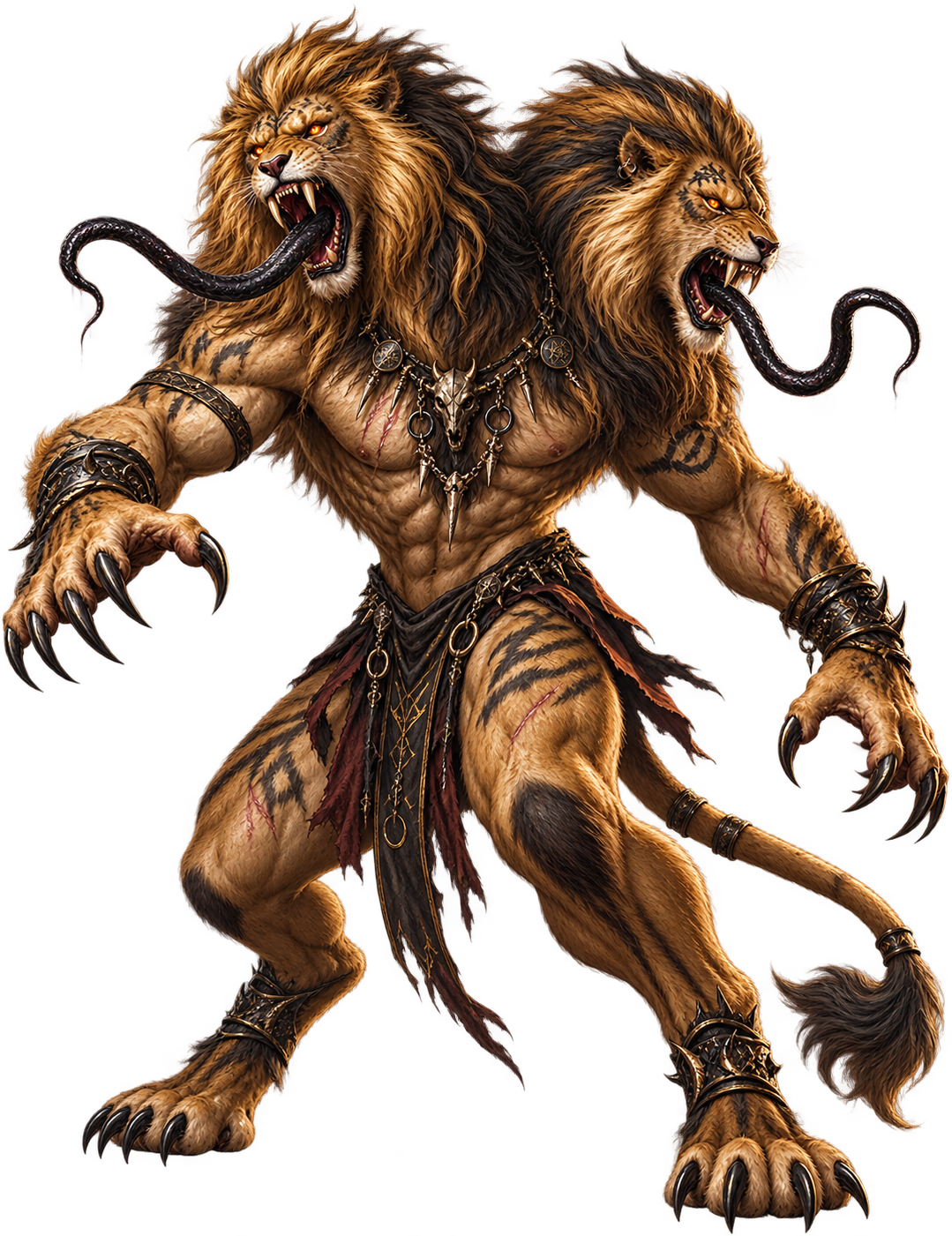
A nikaramsa exploits the hubris and awe of mortal priests by disguising itself as a deity’s chosen messenger and granting divine boons to a congregation, confusing believers by imparting more and more heretical lessons as gospel truths. The nikaramsa then corrupts the faith’s blessings, causing the religion to collapse in the wake of its own clergy’s atrocities.
LE Large (, , , )
An outsider is at least partially composed of the essence (but not necessarily the material) of some plane other than the Material Plane. Some creatures start out as some other type and become outsiders when they attain a higher (or lower) state of spiritual existence. An outsider has the following traits:
• Darkvision 60 feet.
• Unlike most living creatures, an outsider does not have a dual nature—its soul and body form one unit. When an outsider is slain, no soul is set loose. Spells that restore souls to their bodies, such as raise dead, reincarnate, and resurrection, don’t work on an outsider. It takes a different magical effect, such as limited wish, wish, miracle, or true resurrection to restore it to life.
• Proficient with all simple and martial weapons and any weapons mentioned in its entry.
• Proficient with whatever type of armor (light, medium, or heavy) it is described as wearing, as well as all lighter types. Outsiders not indicated as wearing armor are not proficient with armor. Outsiders are proficient with shields if they are proficient with any form of armor.
• Outsiders breathe, but do not need to eat or sleep (although they can do so if they wish).
Asuras are lawful evil outsiders with the following default traits.
• Immunity to curse effects, disease, and poison.
• Resistance to acid 10 and electricity 10.
• +2 racial bonus on saving throws against enchantment spells.
• Telepathy.
• Elusive Aura (Su) All but the least asuras surround themselves with an aura functioning as nondetection; the caster-level check to divine a creature inside the aura is 15 + the asura’s spell-like ability caster level.
• Regeneration (Ex) Regeneration varies by asura; good weapons and good spells suppress it.
• Most asuras have spell resistance equal to 11 + CR.
• Summon (Sp) Most can summon one or more asuras as specified by the creature.
• Natural weapons and wielded weapons count as lawful and evil for overcoming damage reduction.
• +6 racial bonus on Escape Artist and +4 racial bonus on Perception.
The Evil subtype is usually applied to outsiders native to the evil-aligned Outer Planes. Evil outsiders are also called fiends. Most creatures that have this subtype also have evil alignments; however, if their alignments change, they still retain the subtype. Any effect that depends on alignment affects a creature with this subtype as if the creature had an evil alignment, no matter what its alignment actually is. The creature also suffers effects according to its actual alignment. A creature with the evil subtype overcomes damage reduction as if its natural weapons and any weapons it wields were evil-aligned.
The Extraplanar subtype is applied to any creature when it is on a plane other than its native plane. A creature that travels the planes can gain or lose this subtype as it goes from plane to plane. Monster entries assume that encounters with creatures take place on the Material Plane, and every creature whose native plane is not the Material Plane has the extraplanar subtype (but would not have it when on its home plane). Creatures not labeled as extraplanar are natives of the Material Plane, and they gain the extraplanar subtype if they leave the Material Plane. No creature has the extraplanar subtype when it is on a Transitive Plane (the Astral Plane, the Ethereal Plane, or the Plane of Shadow).
The Lawful subtype is usually applied to outsiders native to the lawful-aligned Outer Planes. Most creatures that have this subtype also have lawful alignments; however, if their alignments change, they still retain the subtype. Any effect that depends on alignment affects a creature with this subtype as if the creature had a lawful alignment, no matter what its alignment actually is. The creature also suffers effects according to its actual alignment. A creature with the lawful subtype overcomes damage reduction as if its natural weapons and any weapons it wields were lawful-aligned.
Init +11; Senses 60 ft., detect chaos, detect evil, detect good, detect law, see invisibility; Perception +30
Darkvision is the extraordinary ability to see with no light source at all, out to a range specified. Darkvision is black-and-white only (colors cannot be discerned). It does not allow creatures to see anything that they could not see otherwise—invisible objects are still invisible, and illusions are still visible as what they seem to be. Likewise, darkvision subjects a creature to gaze attacks normally. The presence of light does not spoil darkvision.
Aura elusive (75 ft.)
DEFENSE
AC 29, touch 17, flat-footed 21 (+7 Dex, +1 dodge, +12 natural, –1 size)
hp 200 (16d10+112); 10 (good)
Regeneration (Ex) Regeneration is an extraordinary ability which makes a creature difficult to kill. Creatures with regeneration heal damage to themselves at a fixed rate, as with fast healing, but they cannot die as long as their regeneration is still functioning, although they still fall unconscious when their hit points are below 0. Certain damage types, typically acid and fire, cause regeneration to stop functioning on the round following the attack. During that round, the creature does not heal damage and can die normally. The creature’s descriptive text identifies the damage types that suppress its regeneration.
Attacks that do not deal hit point damage are not healed by regeneration. Regeneration also does not restore hit points lost from starvation, suffocation, or thirst. Regenerating creatures can regrow lost body parts and can reattach severed limbs or body parts if they are brought together within 1 hour of severing. Severed parts that are not reattached wither and die normally.
A creature must have a Constitution score to have regeneration.
Fort +14, Ref +17, Will +17; +2 vs. enchant.
10/good; curses, disease, poison; acid 10, electricity 10; 25
Damage Reduction (Ex or Su) The creature ignores damage from most weapons and natural attacks. Wounds heal immediately, or the weapon bounces off harmlessly; in either case, the opponent knows the attack was ineffective. The creature takes normal damage from energy attacks, including nonmagical ones, spells, spell-like abilities, and supernatural abilities. A certain kind of weapon can sometimes damage the creature normally, as described below.
The entry indicates the amount of damage ignored, usually 5 to 15 points, and the type of weapon that negates the ability. Some monsters are vulnerable to bludgeoning, piercing, or slashing damage. Others are vulnerable to materials such as adamantine, cold iron, or silver. Attacks from weapons that are not the correct type or material have their damage reduced, although a high enhancement bonus can overcome some forms of damage reduction.
Whenever damage reduction completely negates the damage from an attack, it also negates most special effects that accompany the attack, such as injury poison, injury disease, and effects delivered only when the attack deals damage. Damage reduction does not negate touch attacks, energy damage dealt along with an attack, or energy drain, and it does not affect poisons or diseases delivered by contact, ingestion, or inhalation. If damage reduction completely negates an attack’s damage, that attack does not disrupt a spell being cast.
Damage reduction does not stack with itself. When a creature has more than one form, apply the single form that gives the greatest reduction against the attack; the attacker must overcome only the qualities required by the form being applied.
Some monsters are vulnerable to magic weapons. A weapon with at least a +1 magical enhancement bonus on attack and damage rolls overcomes this damage reduction; the +1 attack bonus from a masterwork weapon does not count as a magical enhancement bonus. Such creatures’ natural weapons, but not their attacks with manufactured weapons, are treated as magic weapons for overcoming damage reduction. Ammunition fired from a projectile weapon with at least a +1 enhancement bonus is treated as magic for overcoming damage reduction.
A few powerful monsters are vulnerable only to epic weapons—magic weapons with at least a +6 enhancement bonus. Such creatures’ natural weapons are also treated as epic weapons for overcoming damage reduction.
Some monsters are vulnerable to chaotic-, evil-, good-, or lawful-aligned weapons. When a cleric casts align weapon, affected weapons might gain one or more of these properties; certain magic weapons also have them. A creature with a chaotic, evil, good, or lawful alignment subtype overcomes matching damage reduction with its natural weapons and wielded weapons as though those attacks had the alignment or alignments matching its subtype. Ammunition fired from an aligned projectile weapon is treated as having that alignment for overcoming damage reduction.
A weapon with a +3 enhancement bonus overcomes damage reduction as though it were made of cold iron and silver. A weapon with a +4 enhancement bonus also overcomes damage reduction as though it were adamantine, but this does not allow it to ignore hardness. A weapon with a +5 enhancement bonus also overcomes alignment-based damage reduction. These equivalences are cumulative with the weapon’s actual material and alignment qualities.
When a damage reduction entry has a — after the slash, no weapon negates it.
If either of two listed attack types can overcome the reduction, a weapon that deals either type does so. If a listed combination is required, the weapon must have every listed type or quality; a weapon with only one remains subject to the damage reduction.
Immunity (Ex or Su) A creature with immunities takes no damage from listed sources. Immunities can also apply to afflictions, conditions, spells (based on level, save type, or school), and other effects. A creature does not suffer any secondary effects that would normally be triggered by an effect it is immune to.
Resistance (Ex) This creature ignores some damage of the indicated type each time it takes damage of that kind, commonly acid, cold, electricity, or fire. The entry indicates the amount and type of damage ignored. Resistance is not immunity, and it applies whether the damage has a mundane or magical source. When resistance completely negates damage from an energy attack, that attack does not disrupt spellcasting. This resistance does not stack with resistance provided by a spell.
A creature with Spell Resistance has the extraordinary ability to avoid the effects of spells and spell-like abilities that directly affect it. To determine if a spell or spell-like ability works against a creature with spell resistance, the caster must make a caster level check (1d20 + caster level). If the result equals or exceeds the creature’s spell resistance, the spell works normally, although the creature is still allowed a saving throw.
OFFENSE
Speed 50 ft., 50 ft. (perfect)
A creature with a Fly speed can cease or resume flight as a free action on its turn. Without making a check, a flying creature can remain flying at the end of its turn so long as it moves a distance greater than half its speed. It can also turn up to 45 degrees during its turn by sacrificing 5 feet of movement, can rise at half speed at an angle of 45 degrees (ignoring the penalty for diagonal movement), and can descend at any angle at normal speed. At the beginning of its turn, a flying creature can move in a different direction than it did previously without needing a Fly check.
A creature with a natural fly speed receives a bonus (or penalty) on Fly skill checks depending on its maneuverability:
• Clumsy –8
• Poor –4
• Average +0
• Good +4
• Perfect +8
Creatures without a maneuverability rating are assumed to have average maneuverability and take no penalty on Fly checks. These modifiers are already included in the creature’s stat block.
Melee 2 bites +20 (1d8+5), 2 claws +20 (1d6+5), 2 tongues +20 (1d6+5 plus trip)
Space 10 ft.; Reach 10 ft. (20 ft. with tongues)
Special Attacks , (2 tongues, 1d6+7)
Rend (Ex) If it hits with two or more natural attacks in 1 round, this creature causes tremendous damage by latching onto the opponent’s body and tearing flesh. This automatically deals the listed additional damage, but no more than once per round. The type of attacks that must hit and the additional damage are included in the creature’s description.
(CL 14th; concentration +19)
Spell-like abilities are magical and work just like spells (though they are not spells and so have no verbal, somatic, focus, or material components). They go away in an antimagic field and are subject to spell resistance if the spell the ability is based on would be subject to spell resistance.
A spell-like ability usually has a limit on how often it can be used. A constant spell-like ability or one that can be used at will has no use limit; unless otherwise stated, a creature can only use a constant spell-like ability on itself. Reactivating a constant spell-like ability is a swift action. Using all other spell-like abilities is a standard action unless noted otherwise, and doing so provokes attacks of opportunity. It is possible to make a concentration check to use a spell-like ability defensively and avoid provoking an attack of opportunity, just as when casting a spell. A spell-like ability can be disrupted just as a spell can be. Spell-like abilities cannot be used to counterspell, nor can they be counterspelled.
For creatures with spell-like abilities, a designated caster level determines how difficult it is to dispel their spell-like effects and defines any level-dependent variables (such as range and duration) the abilities might have. The creature’s caster level never affects which spell-like abilities the creature has; sometimes the given caster level is lower than the level a spellcasting character would need to cast the spell of the same name. If no caster level is specified, the caster level is equal to the creature’s Hit Dice. The saving throw (if any) against a spell-like ability is 10 + the level of the spell the ability resembles or duplicates + the creature’s Charisma modifier unless the creature’s entry explicitly declares another ability-score basis; that individual declaration governs its block and is not overridden by this generic popup.
Some spell-like abilities duplicate spells that work differently when cast by characters of different classes. A monster’s spell-like abilities are presumed to be the sorcerer/wizard versions. If the spell in question is not a sorcerer/wizard spell, then default to cleric, druid, bard, paladin, and ranger, in that order.
Constant—detect chaos, detect evil, detect good, detect law, see invisibility
At will—greater teleport (self plus 50 lbs. of objects only), invisibility, magic aura, veil (self only), ventriloquism (DC 16)
3/day—bless, cure serious wounds, good hope, neutralize poison, remove blindness/deafness, remove curse, remove disease
1/day—blasphemy (DC 22), dream, limited wish, (level 6, 1d3 upasundas 50%)
A creature with the Summon SLA can summon other specific creatures of its kind much as though casting a summon monster spell, but it usually has only a limited chance of success (as specified in the creature’s entry). Roll d%: On a failure, no creature answers the summons. Summoned creatures automatically return whence they came after 1 hour. A creature summoned in this way cannot use any spells or spell-like abilities that require material components costing more than 1 gp unless those components are supplied, nor can it use its own summon ability for 1 hour. An appropriate spell level is given for each summoning ability for purposes of Will saves, caster level checks, and concentration checks. No experience points are awarded for defeating summoned monsters.
STATISTICS
Str 20, Dex 25, Con 25, Int 18, Wis 25, Cha 20
Base Atk +16; +22 (+24 trip); CMD 40 (42 vs. trip)
When performing a combat maneuver, you must use an action appropriate to the maneuver you are attempting to perform. While many combat maneuvers can be performed as part of an attack action, full-attack action, or attack of opportunity (in place of a melee attack), others require a specific action. Unless otherwise noted, performing a combat maneuver provokes an attack of opportunity from the target of the maneuver. If you are hit by the target, you take the damage normally and apply that amount as a penalty to the attack roll to perform the maneuver. If your target is immobilized, , or otherwise incapacitated, your maneuver automatically succeeds (treat as if you rolled a natural 20 on the attack roll). If your target is , you receive a +4 bonus on your attack roll to perform a combat maneuver against it.
When you attempt to perform a combat maneuver, make an attack roll and add your CMB in place of your normal attack bonus. Add any bonuses you currently have on attack rolls due to spells, feats, and other effects. These bonuses must be applicable to the weapon or attack used to perform the maneuver. The DC of this maneuver is your target’s Combat Maneuver Defense. Combat maneuvers are attack rolls, so you must roll for concealment and take any other penalties that would normally apply to an attack roll.
If your attack roll equals or exceeds the CMD of the target, your maneuver is a success and has the listed effect. Some maneuvers, such as bull rush, have varying levels of success depending on how much your attack roll exceeds the target’s CMD. Rolling a natural 20 while attempting a combat maneuver is always a success (except when attempting to escape from bonds), while rolling a natural 1 is always a failure.
Unconscious creatures are knocked out and . Unconsciousness can result from having negative hit points (but not more than the creature’s Constitution score), or from nonlethal damage in excess of current hit points.
A helpless character is paralyzed, held, bound, sleeping, unconscious, or otherwise completely at an opponent’s mercy. A helpless target is treated as having a Dexterity of 0 (–5 modifier). Melee attacks against a helpless target get a +4 bonus (equivalent to attacking a prone target). Ranged attacks get no special bonus against helpless targets. Rogues can sneak attack helpless targets.
As a full-round action, an enemy can use a melee weapon to deliver a coup de grace to a helpless foe. An enemy can also use a bow or crossbow, provided he is adjacent to the target. The attacker automatically hits and scores a critical hit. (A rogue also gets his sneak attack damage bonus against a helpless foe when delivering a coup de grace.) If the defender survives, he must make a Fortitude save (DC 10 + damage dealt) or die. Delivering a coup de grace provokes attacks of opportunity.
Creatures that are immune to critical hits do not take critical damage, nor do they need to make Fortitude saves to avoid being killed by a coup de grace.
A stunned creature drops everything held, can’t take actions, takes a –2 penalty to AC, and loses its Dexterity bonus to AC (if any). Attackers receive a +4 bonus on attack rolls to perform combat maneuvers against a stunned opponent.
Feats , , , , , , , ,
Combat Expertise You can choose to take a –1 penalty on melee attack rolls and combat maneuver checks to gain a +1 dodge bonus to your Armor Class. When your base attack bonus reaches +4, and every +4 thereafter, the penalty increases by –1 and the dodge bonus increases by +1. You can only choose to use this feat when you declare that you are making an attack or a full-attack action with a melee weapon. The effects of this feat last until your next turn.
Combat Reflexes You may make a number of additional attacks of opportunity per round equal to your Dexterity bonus. With this feat, you may also make attacks of opportunity while .
Normal: A character without this feat can make only one attack of opportunity per round and can’t make attacks of opportunity while .
Special: The Combat Reflexes feat does not allow a rogue to use her opportunist ability more than once per round.
A creature that has not yet acted during a combat is flat-footed, unable to react normally to the situation. A flat-footed creature cannot take immediate actions and loses their Dexterity bonus to AC and CMD (if any). The creature cannot make attacks of opportunity unless they have the Combat Reflexes feat or Uncanny Dodge class ability.
Deflect Arrows You must have at least one hand free (holding nothing) to use this feat. Once per round when you would normally be hit with an attack from a ranged weapon, you may deflect it so that you take no damage from it. You must be aware of the attack and not . Attempting to deflect a ranged attack doesn’t count as an action. Unusually massive ranged weapons (such as boulders or ballista bolts) and ranged attacks generated by or spell effects can’t be deflected.
A creature that has not yet acted during a combat is flat-footed, unable to react normally to the situation. A flat-footed creature cannot take immediate actions and loses their Dexterity bonus to AC and CMD (if any). The creature cannot make attacks of opportunity unless they have the Combat Reflexes feat or Uncanny Dodge class ability.
Natural Attacks Natural attacks are made with a creature’s body rather than with manufactured weapons. A primary natural attack uses the creature’s full base attack bonus and adds its full Strength modifier to damage. A secondary natural attack is made at a –5 penalty and adds only half the creature’s Strength modifier to damage. If a creature has only one natural attack, it normally adds 1-1/2 times its Strength modifier to damage; this does not apply merely because a creature with several natural weapons chooses to use only one of them. If a creature has multiple attacks of only one natural-weapon type, those attacks are primary unless stated otherwise. A creature’s entry can override these defaults.
When a creature combines manufactured-weapon attacks with natural attacks in the same full attack, it cannot use a natural attack associated with a limb that is occupied by a manufactured weapon. Manufactured-weapon attacks use their normal attack bonuses; all remaining natural attacks are treated as secondary for that full attack. A natural attack that lists more than one damage type counts as all listed types for overcoming damage reduction. A creature with no natural weapons can make unarmed strikes, but those are treated as weapon attacks; using both hands for unarmed strikes follows the normal two-weapon fighting rules.
• Bite Fine 1; Diminutive 1d2; Tiny 1d3; Small 1d4; Medium 1d6; Large 1d8; Huge 2d6; Gargantuan 2d8; Colossal 4d6. Damage B/S/P; primary.
• Claw Fine —; Diminutive 1; Tiny 1d2; Small 1d3; Medium 1d4; Large 1d6; Huge 1d8; Gargantuan 2d6; Colossal 2d8. Damage B/S; primary.
• Gore Fine 1; Diminutive 1d2; Tiny 1d3; Small 1d4; Medium 1d6; Large 1d8; Huge 2d6; Gargantuan 2d8; Colossal 4d6. Damage P; primary.
• Hoof, Tentacle, or Wing Fine —; Diminutive 1; Tiny 1d2; Small 1d3; Medium 1d4; Large 1d6; Huge 1d8; Gargantuan 2d6; Colossal 2d8. Damage B; secondary.
• Pincers or Tail Slap Fine 1; Diminutive 1d2; Tiny 1d3; Small 1d4; Medium 1d6; Large 1d8; Huge 2d6; Gargantuan 2d8; Colossal 4d6. Damage B; secondary.
• Slam Fine —; Diminutive 1; Tiny 1d2; Small 1d3; Medium 1d4; Large 1d6; Huge 1d8; Gargantuan 2d6; Colossal 2d8. Damage B; primary.
• Sting Fine —; Diminutive 1; Tiny 1d2; Small 1d3; Medium 1d4; Large 1d6; Huge 1d8; Gargantuan 2d6; Colossal 2d8. Damage P; primary.
• Talons Fine —; Diminutive 1; Tiny 1d2; Small 1d3; Medium 1d4; Large 1d6; Huge 1d8; Gargantuan 2d6; Colossal 2d8. Damage S; primary.
• Other Fine —; Diminutive 1; Tiny 1d2; Small 1d3; Medium 1d4; Large 1d6; Huge 1d8; Gargantuan 2d6; Colossal 2d8. Damage B/S/P; secondary.
Dodge You gain a +1 dodge bonus to your AC. A condition that makes you lose your Dex bonus to AC also makes you lose the benefits of this feat.
Great Fortitude You get a +2 bonus on all Fortitude saving throws.
Improved Initiative You get a +4 bonus on initiative checks.
Improved Trip You do not provoke an attack of opportunity when performing a trip combat maneuver. In addition, you receive a +2 bonus on checks made to trip a foe. You also receive a +2 bonus to your Combat Maneuver Defense whenever an opponent tries to trip you.
Normal: You provoke an attack of opportunity when performing a trip combat maneuver.
Mobility You get a +4 dodge bonus to Armor Class against attacks of opportunity caused when you move out of or within a threatened area. A condition that makes you lose your Dexterity bonus to Armor Class (if any) also makes you lose dodge bonuses.
Dodge bonuses stack with each other, unlike most types of bonuses.
Spring Attack As a full-round action, you can move up to your speed and make a single melee attack without provoking any attacks of opportunity from the target of your attack. You can move both before and after the attack, but you must move at least 10 feet before the attack and the total distance that you move cannot be greater than your speed. You cannot use this ability to attack a foe that is adjacent to you at the start of your turn.
Normal: You cannot move before and after an attack.
Skills Bluff +24, Disguise +24, Escape Artist +32, Fly +24, Knowledge (planes, religion) +19, Perception +30, Sense Motive +26, Spellcraft +20, Stealth +22, Use Magic Device +24
Racial Modifiers +6 Escape Artist, +4 Perception
Languages Common, Infernal; 100 ft.
Telepathy (Su) This creature can mentally communicate with any other creature within a certain range (specified in the creature’s entry, usually 100 feet) that has a language. It is possible to address multiple creatures at once telepathically, although maintaining a telepathic conversation with more than one creature at a time is just as difficult as simultaneously speaking and listening to multiple people at the same time.
SQ
ECOLOGY
Environment any (Hell)
Organization solitary or perversion (2–5)
Treasure standard
SPECIAL ABILITIES
Pervert Miracle (Su) As an immediate action, when a creature within 60 feet either casts a spell that a nikaramsa can use as a spell-like ability three times per day or casts a spell that would counter or remove one of those spells (i.e., bane, bestow curse, blindness/deafness, contagion, crushing despair, inflict serious wounds, or poison), the nikaramsa can attempt an opposed Charisma check against the caster. If successful, the nikaramsa converts the spell into its opposite against each original target as it’s cast.
Savor Heresy (Su) A nikaramsa gains a +2 profane bonus on attack rolls and a +5 profane bonus on damage rolls against any creature that has committed an act of heresy or changed its alignment in the last year. Furthermore, the asura’s natural attacks also ignore such a creature’s damage reduction.
Infernal Dragon
Cruel horns frame this dragon’s head. Its body glows faintly with malicious heat.
Infernal dragons delight in recruiting large entourages of overly ambitious mortals who gladly debase themselves in exchange for influence.
CR 8 XP 4,80010 XP 9,60012 XP 19,20013 XP 25,60015 XP 51,20016 XP 76,80017 XP 102,40019 XP 204,80020 XP 307,20021 XP 409,60022 XP 614,40024 XP 1,228,800
LE SmallMediumLargeLargeHugeHugeHugeGargantuanGargantuanGargantuanGargantuanColossal (, , )
A dragon is a reptile-like creature, usually winged, with magical or unusual abilities. A dragon possesses the following traits (unless otherwise noted in a creature’s entry).
• Darkvision 60 feet and low-light vision.
• Immunity to magic sleep effects and paralysis effects.
• Proficient with its natural weapons only unless humanoid in form (or capable of assuming humanoid form), in which case proficient with all simple weapons and any weapons mentioned in its entry.
• Proficient with no armor.
• Dragons breathe, eat, and sleep.
The Evil subtype is usually applied to outsiders native to the evil-aligned Outer Planes. Evil outsiders are also called fiends. Most creatures that have this subtype also have evil alignments; however, if their alignments change, they still retain the subtype. Any effect that depends on alignment affects a creature with this subtype as if the creature had an evil alignment, no matter what its alignment actually is. The creature also suffers effects according to its actual alignment. A creature with the evil subtype overcomes damage reduction as if its natural weapons and any weapons it wields were evil-aligned.
The Extraplanar subtype is applied to any creature when it is on a plane other than its native plane. A creature that travels the planes can gain or lose this subtype as it goes from plane to plane. Monster entries assume that encounters with creatures take place on the Material Plane, and every creature whose native plane is not the Material Plane has the extraplanar subtype (but would not have it when on its home plane). Creatures not labeled as extraplanar are natives of the Material Plane, and they gain the extraplanar subtype if they leave the Material Plane. No creature has the extraplanar subtype when it is on a Transitive Plane (the Astral Plane, the Ethereal Plane, or the Plane of Shadow).
The Lawful subtype is usually applied to outsiders native to the lawful-aligned Outer Planes. Most creatures that have this subtype also have lawful alignments; however, if their alignments change, they still retain the subtype. Any effect that depends on alignment affects a creature with this subtype as if the creature had a lawful alignment, no matter what its alignment actually is. The creature also suffers effects according to its actual alignment. A creature with the lawful subtype overcomes damage reduction as if its natural weapons and any weapons it wields were lawful-aligned.
Init +5+4+4+4+3+3+3+2+2+2+1+1; Senses ; Perception +151820232528303335384043
Dragons have 120 ft. and 60 ft. They see four times as well as a human in dim light and twice as well in normal light.
Darkvision is the extraordinary ability to see with no light source at all, out to a range specified. Darkvision is black-and-white only (colors cannot be discerned). It does not allow creatures to see anything that they could not see otherwise—invisible objects are still invisible, and illusions are still visible as what they seem to be. Likewise, darkvision subjects a creature to gaze attacks normally. The presence of light does not spoil darkvision.
Using extraordinary nonvisual senses, such as acute smell or hearing, a creature with blindsense notices things it cannot see. The creature usually does not need to make Perception checks to pinpoint the location of a creature within range of its blindsense ability, provided that it has line of effect to that creature. Any opponent the creature cannot see still has total concealment against the creature with blindsense, and the creature still has the normal miss chance when attacking foes that have concealment. Visibility still affects the movement of a creature with blindsense. A creature with blindsense is still denied its Dexterity bonus to Armor Class against attacks from creatures it cannot see.
Aura (120 ft., DC 20)
Frightful Presence (Ex) This special quality makes a creature’s very presence unsettling to foes. Activating this ability is a free action that is usually part of an attack or charge. This ability can only be used once per turn. Opponents within range who witness the action may become , , or . Unless specified otherwise, the range is 30 feet and the duration is 5d6 rounds. This ability affects only opponents with fewer Hit Dice than the creature has. An opponent can resist the effects with a successful Will save (DC 10 + 1/2 the frightful creature’s racial HD + the frightful creature’s Cha modifier; the exact DC is given in the creature’s descriptive text). An opponent that succeeds on the saving throw is immune to further effects from that same creature’s frightful presence for 24 hours. On a failed save, the opponent is , or if it is already shaken. A frightened opponent who fails their save becomes instead, and any creature with 4 Hit Dice or fewer automatically becomes panicked on any failed save. Frightful presence is a mind-affecting fear effect.
A shaken character takes a –2 penalty on attack rolls, saving throws, skill checks, and ability checks.
A frightened creature flees from the source of its fear as best it can. If unable to flee, it may fight. A frightened creature takes a –2 penalty on all attack rolls, saving throws, skill checks, and ability checks. A frightened creature can use special abilities, including spells, to flee; indeed, the creature must use such means if they are the only way to escape. Frightened is like shaken, except that the creature must flee if possible.
A panicked creature must drop anything it holds and flee at top speed from the source of its fear, as well as any other dangers it encounters, along a random path. It can’t take any other actions. In addition, the creature takes a –2 penalty on all saving throws, skill checks, and ability checks. If cornered, a panicked creature and does not attack, typically using the total defense action in combat. A panicked creature can use special abilities, including spells, to flee; indeed, the creature must use such means if they are the only way to escape. Panicked is a more extreme state of fear than shaken or frightened.
The character is frozen in fear and can take no actions. A cowering character takes a –2 penalty to Armor Class and loses their Dexterity bonus (if any).
Aura (150 ft., DC 22)
Frightful Presence (Ex) This special quality makes a creature’s very presence unsettling to foes. Activating this ability is a free action that is usually part of an attack or charge. This ability can only be used once per turn. Opponents within range who witness the action may become , , or . Unless specified otherwise, the range is 30 feet and the duration is 5d6 rounds. This ability affects only opponents with fewer Hit Dice than the creature has. An opponent can resist the effects with a successful Will save (DC 10 + 1/2 the frightful creature’s racial HD + the frightful creature’s Cha modifier; the exact DC is given in the creature’s descriptive text). An opponent that succeeds on the saving throw is immune to further effects from that same creature’s frightful presence for 24 hours. On a failed save, the opponent is , or if it is already shaken. A frightened opponent who fails their save becomes instead, and any creature with 4 Hit Dice or fewer automatically becomes panicked on any failed save. Frightful presence is a mind-affecting fear effect.
A shaken character takes a –2 penalty on attack rolls, saving throws, skill checks, and ability checks.
A frightened creature flees from the source of its fear as best it can. If unable to flee, it may fight. A frightened creature takes a –2 penalty on all attack rolls, saving throws, skill checks, and ability checks. A frightened creature can use special abilities, including spells, to flee; indeed, the creature must use such means if they are the only way to escape. Frightened is like shaken, except that the creature must flee if possible.
A panicked creature must drop anything it holds and flee at top speed from the source of its fear, as well as any other dangers it encounters, along a random path. It can’t take any other actions. In addition, the creature takes a –2 penalty on all saving throws, skill checks, and ability checks. If cornered, a panicked creature and does not attack, typically using the total defense action in combat. A panicked creature can use special abilities, including spells, to flee; indeed, the creature must use such means if they are the only way to escape. Panicked is a more extreme state of fear than shaken or frightened.
The character is frozen in fear and can take no actions. A cowering character takes a –2 penalty to Armor Class and loses their Dexterity bonus (if any).
Aura (180 ft., DC 25)
Frightful Presence (Ex) This special quality makes a creature’s very presence unsettling to foes. Activating this ability is a free action that is usually part of an attack or charge. This ability can only be used once per turn. Opponents within range who witness the action may become , , or . Unless specified otherwise, the range is 30 feet and the duration is 5d6 rounds. This ability affects only opponents with fewer Hit Dice than the creature has. An opponent can resist the effects with a successful Will save (DC 10 + 1/2 the frightful creature’s racial HD + the frightful creature’s Cha modifier; the exact DC is given in the creature’s descriptive text). An opponent that succeeds on the saving throw is immune to further effects from that same creature’s frightful presence for 24 hours. On a failed save, the opponent is , or if it is already shaken. A frightened opponent who fails their save becomes instead, and any creature with 4 Hit Dice or fewer automatically becomes panicked on any failed save. Frightful presence is a mind-affecting fear effect.
A shaken character takes a –2 penalty on attack rolls, saving throws, skill checks, and ability checks.
A frightened creature flees from the source of its fear as best it can. If unable to flee, it may fight. A frightened creature takes a –2 penalty on all attack rolls, saving throws, skill checks, and ability checks. A frightened creature can use special abilities, including spells, to flee; indeed, the creature must use such means if they are the only way to escape. Frightened is like shaken, except that the creature must flee if possible.
A panicked creature must drop anything it holds and flee at top speed from the source of its fear, as well as any other dangers it encounters, along a random path. It can’t take any other actions. In addition, the creature takes a –2 penalty on all saving throws, skill checks, and ability checks. If cornered, a panicked creature and does not attack, typically using the total defense action in combat. A panicked creature can use special abilities, including spells, to flee; indeed, the creature must use such means if they are the only way to escape. Panicked is a more extreme state of fear than shaken or frightened.
The character is frozen in fear and can take no actions. A cowering character takes a –2 penalty to Armor Class and loses their Dexterity bonus (if any).
Aura (210 ft., DC 26)
Frightful Presence (Ex) This special quality makes a creature’s very presence unsettling to foes. Activating this ability is a free action that is usually part of an attack or charge. This ability can only be used once per turn. Opponents within range who witness the action may become , , or . Unless specified otherwise, the range is 30 feet and the duration is 5d6 rounds. This ability affects only opponents with fewer Hit Dice than the creature has. An opponent can resist the effects with a successful Will save (DC 10 + 1/2 the frightful creature’s racial HD + the frightful creature’s Cha modifier; the exact DC is given in the creature’s descriptive text). An opponent that succeeds on the saving throw is immune to further effects from that same creature’s frightful presence for 24 hours. On a failed save, the opponent is , or if it is already shaken. A frightened opponent who fails their save becomes instead, and any creature with 4 Hit Dice or fewer automatically becomes panicked on any failed save. Frightful presence is a mind-affecting fear effect.
A shaken character takes a –2 penalty on attack rolls, saving throws, skill checks, and ability checks.
A frightened creature flees from the source of its fear as best it can. If unable to flee, it may fight. A frightened creature takes a –2 penalty on all attack rolls, saving throws, skill checks, and ability checks. A frightened creature can use special abilities, including spells, to flee; indeed, the creature must use such means if they are the only way to escape. Frightened is like shaken, except that the creature must flee if possible.
A panicked creature must drop anything it holds and flee at top speed from the source of its fear, as well as any other dangers it encounters, along a random path. It can’t take any other actions. In addition, the creature takes a –2 penalty on all saving throws, skill checks, and ability checks. If cornered, a panicked creature and does not attack, typically using the total defense action in combat. A panicked creature can use special abilities, including spells, to flee; indeed, the creature must use such means if they are the only way to escape. Panicked is a more extreme state of fear than shaken or frightened.
The character is frozen in fear and can take no actions. A cowering character takes a –2 penalty to Armor Class and loses their Dexterity bonus (if any).
Aura (240 ft., DC 28)
Frightful Presence (Ex) This special quality makes a creature’s very presence unsettling to foes. Activating this ability is a free action that is usually part of an attack or charge. This ability can only be used once per turn. Opponents within range who witness the action may become , , or . Unless specified otherwise, the range is 30 feet and the duration is 5d6 rounds. This ability affects only opponents with fewer Hit Dice than the creature has. An opponent can resist the effects with a successful Will save (DC 10 + 1/2 the frightful creature’s racial HD + the frightful creature’s Cha modifier; the exact DC is given in the creature’s descriptive text). An opponent that succeeds on the saving throw is immune to further effects from that same creature’s frightful presence for 24 hours. On a failed save, the opponent is , or if it is already shaken. A frightened opponent who fails their save becomes instead, and any creature with 4 Hit Dice or fewer automatically becomes panicked on any failed save. Frightful presence is a mind-affecting fear effect.
A shaken character takes a –2 penalty on attack rolls, saving throws, skill checks, and ability checks.
A frightened creature flees from the source of its fear as best it can. If unable to flee, it may fight. A frightened creature takes a –2 penalty on all attack rolls, saving throws, skill checks, and ability checks. A frightened creature can use special abilities, including spells, to flee; indeed, the creature must use such means if they are the only way to escape. Frightened is like shaken, except that the creature must flee if possible.
A panicked creature must drop anything it holds and flee at top speed from the source of its fear, as well as any other dangers it encounters, along a random path. It can’t take any other actions. In addition, the creature takes a –2 penalty on all saving throws, skill checks, and ability checks. If cornered, a panicked creature and does not attack, typically using the total defense action in combat. A panicked creature can use special abilities, including spells, to flee; indeed, the creature must use such means if they are the only way to escape. Panicked is a more extreme state of fear than shaken or frightened.
The character is frozen in fear and can take no actions. A cowering character takes a –2 penalty to Armor Class and loses their Dexterity bonus (if any).
Aura (270 ft., DC 29)
Frightful Presence (Ex) This special quality makes a creature’s very presence unsettling to foes. Activating this ability is a free action that is usually part of an attack or charge. This ability can only be used once per turn. Opponents within range who witness the action may become , , or . Unless specified otherwise, the range is 30 feet and the duration is 5d6 rounds. This ability affects only opponents with fewer Hit Dice than the creature has. An opponent can resist the effects with a successful Will save (DC 10 + 1/2 the frightful creature’s racial HD + the frightful creature’s Cha modifier; the exact DC is given in the creature’s descriptive text). An opponent that succeeds on the saving throw is immune to further effects from that same creature’s frightful presence for 24 hours. On a failed save, the opponent is , or if it is already shaken. A frightened opponent who fails their save becomes instead, and any creature with 4 Hit Dice or fewer automatically becomes panicked on any failed save. Frightful presence is a mind-affecting fear effect.
A shaken character takes a –2 penalty on attack rolls, saving throws, skill checks, and ability checks.
A frightened creature flees from the source of its fear as best it can. If unable to flee, it may fight. A frightened creature takes a –2 penalty on all attack rolls, saving throws, skill checks, and ability checks. A frightened creature can use special abilities, including spells, to flee; indeed, the creature must use such means if they are the only way to escape. Frightened is like shaken, except that the creature must flee if possible.
A panicked creature must drop anything it holds and flee at top speed from the source of its fear, as well as any other dangers it encounters, along a random path. It can’t take any other actions. In addition, the creature takes a –2 penalty on all saving throws, skill checks, and ability checks. If cornered, a panicked creature and does not attack, typically using the total defense action in combat. A panicked creature can use special abilities, including spells, to flee; indeed, the creature must use such means if they are the only way to escape. Panicked is a more extreme state of fear than shaken or frightened.
The character is frozen in fear and can take no actions. A cowering character takes a –2 penalty to Armor Class and loses their Dexterity bonus (if any).
Aura (300 ft., DC 31)
Frightful Presence (Ex) This special quality makes a creature’s very presence unsettling to foes. Activating this ability is a free action that is usually part of an attack or charge. This ability can only be used once per turn. Opponents within range who witness the action may become , , or . Unless specified otherwise, the range is 30 feet and the duration is 5d6 rounds. This ability affects only opponents with fewer Hit Dice than the creature has. An opponent can resist the effects with a successful Will save (DC 10 + 1/2 the frightful creature’s racial HD + the frightful creature’s Cha modifier; the exact DC is given in the creature’s descriptive text). An opponent that succeeds on the saving throw is immune to further effects from that same creature’s frightful presence for 24 hours. On a failed save, the opponent is , or if it is already shaken. A frightened opponent who fails their save becomes instead, and any creature with 4 Hit Dice or fewer automatically becomes panicked on any failed save. Frightful presence is a mind-affecting fear effect.
A shaken character takes a –2 penalty on attack rolls, saving throws, skill checks, and ability checks.
A frightened creature flees from the source of its fear as best it can. If unable to flee, it may fight. A frightened creature takes a –2 penalty on all attack rolls, saving throws, skill checks, and ability checks. A frightened creature can use special abilities, including spells, to flee; indeed, the creature must use such means if they are the only way to escape. Frightened is like shaken, except that the creature must flee if possible.
A panicked creature must drop anything it holds and flee at top speed from the source of its fear, as well as any other dangers it encounters, along a random path. It can’t take any other actions. In addition, the creature takes a –2 penalty on all saving throws, skill checks, and ability checks. If cornered, a panicked creature and does not attack, typically using the total defense action in combat. A panicked creature can use special abilities, including spells, to flee; indeed, the creature must use such means if they are the only way to escape. Panicked is a more extreme state of fear than shaken or frightened.
The character is frozen in fear and can take no actions. A cowering character takes a –2 penalty to Armor Class and loses their Dexterity bonus (if any).
Aura (330 ft., DC 32)
Frightful Presence (Ex) This special quality makes a creature’s very presence unsettling to foes. Activating this ability is a free action that is usually part of an attack or charge. This ability can only be used once per turn. Opponents within range who witness the action may become , , or . Unless specified otherwise, the range is 30 feet and the duration is 5d6 rounds. This ability affects only opponents with fewer Hit Dice than the creature has. An opponent can resist the effects with a successful Will save (DC 10 + 1/2 the frightful creature’s racial HD + the frightful creature’s Cha modifier; the exact DC is given in the creature’s descriptive text). An opponent that succeeds on the saving throw is immune to further effects from that same creature’s frightful presence for 24 hours. On a failed save, the opponent is , or if it is already shaken. A frightened opponent who fails their save becomes instead, and any creature with 4 Hit Dice or fewer automatically becomes panicked on any failed save. Frightful presence is a mind-affecting fear effect.
A shaken character takes a –2 penalty on attack rolls, saving throws, skill checks, and ability checks.
A frightened creature flees from the source of its fear as best it can. If unable to flee, it may fight. A frightened creature takes a –2 penalty on all attack rolls, saving throws, skill checks, and ability checks. A frightened creature can use special abilities, including spells, to flee; indeed, the creature must use such means if they are the only way to escape. Frightened is like shaken, except that the creature must flee if possible.
A panicked creature must drop anything it holds and flee at top speed from the source of its fear, as well as any other dangers it encounters, along a random path. It can’t take any other actions. In addition, the creature takes a –2 penalty on all saving throws, skill checks, and ability checks. If cornered, a panicked creature and does not attack, typically using the total defense action in combat. A panicked creature can use special abilities, including spells, to flee; indeed, the creature must use such means if they are the only way to escape. Panicked is a more extreme state of fear than shaken or frightened.
The character is frozen in fear and can take no actions. A cowering character takes a –2 penalty to Armor Class and loses their Dexterity bonus (if any).
Aura (360 ft., DC 34)
Frightful Presence (Ex) This special quality makes a creature’s very presence unsettling to foes. Activating this ability is a free action that is usually part of an attack or charge. This ability can only be used once per turn. Opponents within range who witness the action may become , , or . Unless specified otherwise, the range is 30 feet and the duration is 5d6 rounds. This ability affects only opponents with fewer Hit Dice than the creature has. An opponent can resist the effects with a successful Will save (DC 10 + 1/2 the frightful creature’s racial HD + the frightful creature’s Cha modifier; the exact DC is given in the creature’s descriptive text). An opponent that succeeds on the saving throw is immune to further effects from that same creature’s frightful presence for 24 hours. On a failed save, the opponent is , or if it is already shaken. A frightened opponent who fails their save becomes instead, and any creature with 4 Hit Dice or fewer automatically becomes panicked on any failed save. Frightful presence is a mind-affecting fear effect.
A shaken character takes a –2 penalty on attack rolls, saving throws, skill checks, and ability checks.
A frightened creature flees from the source of its fear as best it can. If unable to flee, it may fight. A frightened creature takes a –2 penalty on all attack rolls, saving throws, skill checks, and ability checks. A frightened creature can use special abilities, including spells, to flee; indeed, the creature must use such means if they are the only way to escape. Frightened is like shaken, except that the creature must flee if possible.
A panicked creature must drop anything it holds and flee at top speed from the source of its fear, as well as any other dangers it encounters, along a random path. It can’t take any other actions. In addition, the creature takes a –2 penalty on all saving throws, skill checks, and ability checks. If cornered, a panicked creature and does not attack, typically using the total defense action in combat. A panicked creature can use special abilities, including spells, to flee; indeed, the creature must use such means if they are the only way to escape. Panicked is a more extreme state of fear than shaken or frightened.
The character is frozen in fear and can take no actions. A cowering character takes a –2 penalty to Armor Class and loses their Dexterity bonus (if any).
DEFENSE
AC 20, touch 12, flat-footed 19 (+1 Dex, +9 natural, +1 size)22, touch 10, flat-footed 22 (+12 natural)24, touch 9, flat-footed 24 (+15 natural, –1 size)27, touch 9, flat-footed 27 (+18 natural, –1 size)28, touch 7, flat-footed 28 (–1 Dex, +21 natural, –2 size)31, touch 7, flat-footed 31 (–1 Dex, +24 natural, –2 size)34, touch 7, flat-footed 34 (–1 Dex, +27 natural, –2 size)34, touch 4, flat-footed 34 (–2 Dex, +30 natural, –4 size)37, touch 4, flat-footed 37 (–2 Dex, +33 natural, –4 size)40, touch 4, flat-footed 40 (–2 Dex, +36 natural, –4 size)42, touch 2, flat-footed 42 (–3 Dex, +39 natural, –4 size)41, touch –1, flat-footed 41 (–3 Dex, +42 natural, –8 size)
hp 75 (10d12+20)102 (12d12+36)147 (14d12+56)184 (16d12+80)207 (18d12+90)250 (20d12+120)275 (22d12+132)324 (24d12+168)351 (26d12+182)406 (28d12+224)435 (30d12+240)496 (32d12+288)
Fort +91113151618192122242527, Ref +889101011121213161415, Will +91114161719202223252628; +23456789101112 vs. divination
5/chaotic;
Damage Reduction (Ex or Su) The creature ignores damage from most weapons and natural attacks. Wounds heal immediately, or the weapon bounces off harmlessly; in either case, the opponent knows the attack was ineffective. The creature takes normal damage from energy attacks, including nonmagical ones, spells, spell-like abilities, and supernatural abilities. A certain kind of weapon can sometimes damage the creature normally, as described below.
The entry indicates the amount of damage ignored, usually 5 to 15 points, and the type of weapon that negates the ability. Some monsters are vulnerable to bludgeoning, piercing, or slashing damage. Others are vulnerable to materials such as adamantine, cold iron, or silver. Attacks from weapons that are not the correct type or material have their damage reduced, although a high enhancement bonus can overcome some forms of damage reduction.
Whenever damage reduction completely negates the damage from an attack, it also negates most special effects that accompany the attack, such as injury poison, injury disease, and effects delivered only when the attack deals damage. Damage reduction does not negate touch attacks, energy damage dealt along with an attack, or energy drain, and it does not affect poisons or diseases delivered by contact, ingestion, or inhalation. If damage reduction completely negates an attack’s damage, that attack does not disrupt a spell being cast.
Damage reduction does not stack with itself. When a creature has more than one form, apply the single form that gives the greatest reduction against the attack; the attacker must overcome only the qualities required by the form being applied.
Some monsters are vulnerable to magic weapons. A weapon with at least a +1 magical enhancement bonus on attack and damage rolls overcomes this damage reduction; the +1 attack bonus from a masterwork weapon does not count as a magical enhancement bonus. Such creatures’ natural weapons, but not their attacks with manufactured weapons, are treated as magic weapons for overcoming damage reduction. Ammunition fired from a projectile weapon with at least a +1 enhancement bonus is treated as magic for overcoming damage reduction.
A few powerful monsters are vulnerable only to epic weapons—magic weapons with at least a +6 enhancement bonus. Such creatures’ natural weapons are also treated as epic weapons for overcoming damage reduction.
Some monsters are vulnerable to chaotic-, evil-, good-, or lawful-aligned weapons. When a cleric casts align weapon, affected weapons might gain one or more of these properties; certain magic weapons also have them. A creature with a chaotic, evil, good, or lawful alignment subtype overcomes matching damage reduction with its natural weapons and wielded weapons as though those attacks had the alignment or alignments matching its subtype. Ammunition fired from an aligned projectile weapon is treated as having that alignment for overcoming damage reduction.
A weapon with a +3 enhancement bonus overcomes damage reduction as though it were made of cold iron and silver. A weapon with a +4 enhancement bonus also overcomes damage reduction as though it were adamantine, but this does not allow it to ignore hardness. A weapon with a +5 enhancement bonus also overcomes alignment-based damage reduction. These equivalences are cumulative with the weapon’s actual material and alignment qualities.
When a damage reduction entry has a — after the slash, no weapon negates it.
If either of two listed attack types can overcome the reduction, a weapon that deals either type does so. If a listed combination is required, the weapon must have every listed type or quality; a weapon with only one remains subject to the damage reduction. 5/chaotic;
Damage Reduction (Ex or Su) The creature ignores damage from most weapons and natural attacks. Wounds heal immediately, or the weapon bounces off harmlessly; in either case, the opponent knows the attack was ineffective. The creature takes normal damage from energy attacks, including nonmagical ones, spells, spell-like abilities, and supernatural abilities. A certain kind of weapon can sometimes damage the creature normally, as described below.
The entry indicates the amount of damage ignored, usually 5 to 15 points, and the type of weapon that negates the ability. Some monsters are vulnerable to bludgeoning, piercing, or slashing damage. Others are vulnerable to materials such as adamantine, cold iron, or silver. Attacks from weapons that are not the correct type or material have their damage reduced, although a high enhancement bonus can overcome some forms of damage reduction.
Whenever damage reduction completely negates the damage from an attack, it also negates most special effects that accompany the attack, such as injury poison, injury disease, and effects delivered only when the attack deals damage. Damage reduction does not negate touch attacks, energy damage dealt along with an attack, or energy drain, and it does not affect poisons or diseases delivered by contact, ingestion, or inhalation. If damage reduction completely negates an attack’s damage, that attack does not disrupt a spell being cast.
Damage reduction does not stack with itself. When a creature has more than one form, apply the single form that gives the greatest reduction against the attack; the attacker must overcome only the qualities required by the form being applied.
Some monsters are vulnerable to magic weapons. A weapon with at least a +1 magical enhancement bonus on attack and damage rolls overcomes this damage reduction; the +1 attack bonus from a masterwork weapon does not count as a magical enhancement bonus. Such creatures’ natural weapons, but not their attacks with manufactured weapons, are treated as magic weapons for overcoming damage reduction. Ammunition fired from a projectile weapon with at least a +1 enhancement bonus is treated as magic for overcoming damage reduction.
A few powerful monsters are vulnerable only to epic weapons—magic weapons with at least a +6 enhancement bonus. Such creatures’ natural weapons are also treated as epic weapons for overcoming damage reduction.
Some monsters are vulnerable to chaotic-, evil-, good-, or lawful-aligned weapons. When a cleric casts align weapon, affected weapons might gain one or more of these properties; certain magic weapons also have them. A creature with a chaotic, evil, good, or lawful alignment subtype overcomes matching damage reduction with its natural weapons and wielded weapons as though those attacks had the alignment or alignments matching its subtype. Ammunition fired from an aligned projectile weapon is treated as having that alignment for overcoming damage reduction.
A weapon with a +3 enhancement bonus overcomes damage reduction as though it were made of cold iron and silver. A weapon with a +4 enhancement bonus also overcomes damage reduction as though it were adamantine, but this does not allow it to ignore hardness. A weapon with a +5 enhancement bonus also overcomes alignment-based damage reduction. These equivalences are cumulative with the weapon’s actual material and alignment qualities.
When a damage reduction entry has a — after the slash, no weapon negates it.
If either of two listed attack types can overcome the reduction, a weapon that deals either type does so. If a listed combination is required, the weapon must have every listed type or quality; a weapon with only one remains subject to the damage reduction. 10/chaotic;
Damage Reduction (Ex or Su) The creature ignores damage from most weapons and natural attacks. Wounds heal immediately, or the weapon bounces off harmlessly; in either case, the opponent knows the attack was ineffective. The creature takes normal damage from energy attacks, including nonmagical ones, spells, spell-like abilities, and supernatural abilities. A certain kind of weapon can sometimes damage the creature normally, as described below.
The entry indicates the amount of damage ignored, usually 5 to 15 points, and the type of weapon that negates the ability. Some monsters are vulnerable to bludgeoning, piercing, or slashing damage. Others are vulnerable to materials such as adamantine, cold iron, or silver. Attacks from weapons that are not the correct type or material have their damage reduced, although a high enhancement bonus can overcome some forms of damage reduction.
Whenever damage reduction completely negates the damage from an attack, it also negates most special effects that accompany the attack, such as injury poison, injury disease, and effects delivered only when the attack deals damage. Damage reduction does not negate touch attacks, energy damage dealt along with an attack, or energy drain, and it does not affect poisons or diseases delivered by contact, ingestion, or inhalation. If damage reduction completely negates an attack’s damage, that attack does not disrupt a spell being cast.
Damage reduction does not stack with itself. When a creature has more than one form, apply the single form that gives the greatest reduction against the attack; the attacker must overcome only the qualities required by the form being applied.
Some monsters are vulnerable to magic weapons. A weapon with at least a +1 magical enhancement bonus on attack and damage rolls overcomes this damage reduction; the +1 attack bonus from a masterwork weapon does not count as a magical enhancement bonus. Such creatures’ natural weapons, but not their attacks with manufactured weapons, are treated as magic weapons for overcoming damage reduction. Ammunition fired from a projectile weapon with at least a +1 enhancement bonus is treated as magic for overcoming damage reduction.
A few powerful monsters are vulnerable only to epic weapons—magic weapons with at least a +6 enhancement bonus. Such creatures’ natural weapons are also treated as epic weapons for overcoming damage reduction.
Some monsters are vulnerable to chaotic-, evil-, good-, or lawful-aligned weapons. When a cleric casts align weapon, affected weapons might gain one or more of these properties; certain magic weapons also have them. A creature with a chaotic, evil, good, or lawful alignment subtype overcomes matching damage reduction with its natural weapons and wielded weapons as though those attacks had the alignment or alignments matching its subtype. Ammunition fired from an aligned projectile weapon is treated as having that alignment for overcoming damage reduction.
A weapon with a +3 enhancement bonus overcomes damage reduction as though it were made of cold iron and silver. A weapon with a +4 enhancement bonus also overcomes damage reduction as though it were adamantine, but this does not allow it to ignore hardness. A weapon with a +5 enhancement bonus also overcomes alignment-based damage reduction. These equivalences are cumulative with the weapon’s actual material and alignment qualities.
When a damage reduction entry has a — after the slash, no weapon negates it.
If either of two listed attack types can overcome the reduction, a weapon that deals either type does so. If a listed combination is required, the weapon must have every listed type or quality; a weapon with only one remains subject to the damage reduction. 10/chaotic;
Damage Reduction (Ex or Su) The creature ignores damage from most weapons and natural attacks. Wounds heal immediately, or the weapon bounces off harmlessly; in either case, the opponent knows the attack was ineffective. The creature takes normal damage from energy attacks, including nonmagical ones, spells, spell-like abilities, and supernatural abilities. A certain kind of weapon can sometimes damage the creature normally, as described below.
The entry indicates the amount of damage ignored, usually 5 to 15 points, and the type of weapon that negates the ability. Some monsters are vulnerable to bludgeoning, piercing, or slashing damage. Others are vulnerable to materials such as adamantine, cold iron, or silver. Attacks from weapons that are not the correct type or material have their damage reduced, although a high enhancement bonus can overcome some forms of damage reduction.
Whenever damage reduction completely negates the damage from an attack, it also negates most special effects that accompany the attack, such as injury poison, injury disease, and effects delivered only when the attack deals damage. Damage reduction does not negate touch attacks, energy damage dealt along with an attack, or energy drain, and it does not affect poisons or diseases delivered by contact, ingestion, or inhalation. If damage reduction completely negates an attack’s damage, that attack does not disrupt a spell being cast.
Damage reduction does not stack with itself. When a creature has more than one form, apply the single form that gives the greatest reduction against the attack; the attacker must overcome only the qualities required by the form being applied.
Some monsters are vulnerable to magic weapons. A weapon with at least a +1 magical enhancement bonus on attack and damage rolls overcomes this damage reduction; the +1 attack bonus from a masterwork weapon does not count as a magical enhancement bonus. Such creatures’ natural weapons, but not their attacks with manufactured weapons, are treated as magic weapons for overcoming damage reduction. Ammunition fired from a projectile weapon with at least a +1 enhancement bonus is treated as magic for overcoming damage reduction.
A few powerful monsters are vulnerable only to epic weapons—magic weapons with at least a +6 enhancement bonus. Such creatures’ natural weapons are also treated as epic weapons for overcoming damage reduction.
Some monsters are vulnerable to chaotic-, evil-, good-, or lawful-aligned weapons. When a cleric casts align weapon, affected weapons might gain one or more of these properties; certain magic weapons also have them. A creature with a chaotic, evil, good, or lawful alignment subtype overcomes matching damage reduction with its natural weapons and wielded weapons as though those attacks had the alignment or alignments matching its subtype. Ammunition fired from an aligned projectile weapon is treated as having that alignment for overcoming damage reduction.
A weapon with a +3 enhancement bonus overcomes damage reduction as though it were made of cold iron and silver. A weapon with a +4 enhancement bonus also overcomes damage reduction as though it were adamantine, but this does not allow it to ignore hardness. A weapon with a +5 enhancement bonus also overcomes alignment-based damage reduction. These equivalences are cumulative with the weapon’s actual material and alignment qualities.
When a damage reduction entry has a — after the slash, no weapon negates it.
If either of two listed attack types can overcome the reduction, a weapon that deals either type does so. If a listed combination is required, the weapon must have every listed type or quality; a weapon with only one remains subject to the damage reduction. 15/chaotic;
Damage Reduction (Ex or Su) The creature ignores damage from most weapons and natural attacks. Wounds heal immediately, or the weapon bounces off harmlessly; in either case, the opponent knows the attack was ineffective. The creature takes normal damage from energy attacks, including nonmagical ones, spells, spell-like abilities, and supernatural abilities. A certain kind of weapon can sometimes damage the creature normally, as described below.
The entry indicates the amount of damage ignored, usually 5 to 15 points, and the type of weapon that negates the ability. Some monsters are vulnerable to bludgeoning, piercing, or slashing damage. Others are vulnerable to materials such as adamantine, cold iron, or silver. Attacks from weapons that are not the correct type or material have their damage reduced, although a high enhancement bonus can overcome some forms of damage reduction.
Whenever damage reduction completely negates the damage from an attack, it also negates most special effects that accompany the attack, such as injury poison, injury disease, and effects delivered only when the attack deals damage. Damage reduction does not negate touch attacks, energy damage dealt along with an attack, or energy drain, and it does not affect poisons or diseases delivered by contact, ingestion, or inhalation. If damage reduction completely negates an attack’s damage, that attack does not disrupt a spell being cast.
Damage reduction does not stack with itself. When a creature has more than one form, apply the single form that gives the greatest reduction against the attack; the attacker must overcome only the qualities required by the form being applied.
Some monsters are vulnerable to magic weapons. A weapon with at least a +1 magical enhancement bonus on attack and damage rolls overcomes this damage reduction; the +1 attack bonus from a masterwork weapon does not count as a magical enhancement bonus. Such creatures’ natural weapons, but not their attacks with manufactured weapons, are treated as magic weapons for overcoming damage reduction. Ammunition fired from a projectile weapon with at least a +1 enhancement bonus is treated as magic for overcoming damage reduction.
A few powerful monsters are vulnerable only to epic weapons—magic weapons with at least a +6 enhancement bonus. Such creatures’ natural weapons are also treated as epic weapons for overcoming damage reduction.
Some monsters are vulnerable to chaotic-, evil-, good-, or lawful-aligned weapons. When a cleric casts align weapon, affected weapons might gain one or more of these properties; certain magic weapons also have them. A creature with a chaotic, evil, good, or lawful alignment subtype overcomes matching damage reduction with its natural weapons and wielded weapons as though those attacks had the alignment or alignments matching its subtype. Ammunition fired from an aligned projectile weapon is treated as having that alignment for overcoming damage reduction.
A weapon with a +3 enhancement bonus overcomes damage reduction as though it were made of cold iron and silver. A weapon with a +4 enhancement bonus also overcomes damage reduction as though it were adamantine, but this does not allow it to ignore hardness. A weapon with a +5 enhancement bonus also overcomes alignment-based damage reduction. These equivalences are cumulative with the weapon’s actual material and alignment qualities.
When a damage reduction entry has a — after the slash, no weapon negates it.
If either of two listed attack types can overcome the reduction, a weapon that deals either type does so. If a listed combination is required, the weapon must have every listed type or quality; a weapon with only one remains subject to the damage reduction. 15/chaotic;
Damage Reduction (Ex or Su) The creature ignores damage from most weapons and natural attacks. Wounds heal immediately, or the weapon bounces off harmlessly; in either case, the opponent knows the attack was ineffective. The creature takes normal damage from energy attacks, including nonmagical ones, spells, spell-like abilities, and supernatural abilities. A certain kind of weapon can sometimes damage the creature normally, as described below.
The entry indicates the amount of damage ignored, usually 5 to 15 points, and the type of weapon that negates the ability. Some monsters are vulnerable to bludgeoning, piercing, or slashing damage. Others are vulnerable to materials such as adamantine, cold iron, or silver. Attacks from weapons that are not the correct type or material have their damage reduced, although a high enhancement bonus can overcome some forms of damage reduction.
Whenever damage reduction completely negates the damage from an attack, it also negates most special effects that accompany the attack, such as injury poison, injury disease, and effects delivered only when the attack deals damage. Damage reduction does not negate touch attacks, energy damage dealt along with an attack, or energy drain, and it does not affect poisons or diseases delivered by contact, ingestion, or inhalation. If damage reduction completely negates an attack’s damage, that attack does not disrupt a spell being cast.
Damage reduction does not stack with itself. When a creature has more than one form, apply the single form that gives the greatest reduction against the attack; the attacker must overcome only the qualities required by the form being applied.
Some monsters are vulnerable to magic weapons. A weapon with at least a +1 magical enhancement bonus on attack and damage rolls overcomes this damage reduction; the +1 attack bonus from a masterwork weapon does not count as a magical enhancement bonus. Such creatures’ natural weapons, but not their attacks with manufactured weapons, are treated as magic weapons for overcoming damage reduction. Ammunition fired from a projectile weapon with at least a +1 enhancement bonus is treated as magic for overcoming damage reduction.
A few powerful monsters are vulnerable only to epic weapons—magic weapons with at least a +6 enhancement bonus. Such creatures’ natural weapons are also treated as epic weapons for overcoming damage reduction.
Some monsters are vulnerable to chaotic-, evil-, good-, or lawful-aligned weapons. When a cleric casts align weapon, affected weapons might gain one or more of these properties; certain magic weapons also have them. A creature with a chaotic, evil, good, or lawful alignment subtype overcomes matching damage reduction with its natural weapons and wielded weapons as though those attacks had the alignment or alignments matching its subtype. Ammunition fired from an aligned projectile weapon is treated as having that alignment for overcoming damage reduction.
A weapon with a +3 enhancement bonus overcomes damage reduction as though it were made of cold iron and silver. A weapon with a +4 enhancement bonus also overcomes damage reduction as though it were adamantine, but this does not allow it to ignore hardness. A weapon with a +5 enhancement bonus also overcomes alignment-based damage reduction. These equivalences are cumulative with the weapon’s actual material and alignment qualities.
When a damage reduction entry has a — after the slash, no weapon negates it.
If either of two listed attack types can overcome the reduction, a weapon that deals either type does so. If a listed combination is required, the weapon must have every listed type or quality; a weapon with only one remains subject to the damage reduction. 20/chaotic;
Damage Reduction (Ex or Su) The creature ignores damage from most weapons and natural attacks. Wounds heal immediately, or the weapon bounces off harmlessly; in either case, the opponent knows the attack was ineffective. The creature takes normal damage from energy attacks, including nonmagical ones, spells, spell-like abilities, and supernatural abilities. A certain kind of weapon can sometimes damage the creature normally, as described below.
The entry indicates the amount of damage ignored, usually 5 to 15 points, and the type of weapon that negates the ability. Some monsters are vulnerable to bludgeoning, piercing, or slashing damage. Others are vulnerable to materials such as adamantine, cold iron, or silver. Attacks from weapons that are not the correct type or material have their damage reduced, although a high enhancement bonus can overcome some forms of damage reduction.
Whenever damage reduction completely negates the damage from an attack, it also negates most special effects that accompany the attack, such as injury poison, injury disease, and effects delivered only when the attack deals damage. Damage reduction does not negate touch attacks, energy damage dealt along with an attack, or energy drain, and it does not affect poisons or diseases delivered by contact, ingestion, or inhalation. If damage reduction completely negates an attack’s damage, that attack does not disrupt a spell being cast.
Damage reduction does not stack with itself. When a creature has more than one form, apply the single form that gives the greatest reduction against the attack; the attacker must overcome only the qualities required by the form being applied.
Some monsters are vulnerable to magic weapons. A weapon with at least a +1 magical enhancement bonus on attack and damage rolls overcomes this damage reduction; the +1 attack bonus from a masterwork weapon does not count as a magical enhancement bonus. Such creatures’ natural weapons, but not their attacks with manufactured weapons, are treated as magic weapons for overcoming damage reduction. Ammunition fired from a projectile weapon with at least a +1 enhancement bonus is treated as magic for overcoming damage reduction.
A few powerful monsters are vulnerable only to epic weapons—magic weapons with at least a +6 enhancement bonus. Such creatures’ natural weapons are also treated as epic weapons for overcoming damage reduction.
Some monsters are vulnerable to chaotic-, evil-, good-, or lawful-aligned weapons. When a cleric casts align weapon, affected weapons might gain one or more of these properties; certain magic weapons also have them. A creature with a chaotic, evil, good, or lawful alignment subtype overcomes matching damage reduction with its natural weapons and wielded weapons as though those attacks had the alignment or alignments matching its subtype. Ammunition fired from an aligned projectile weapon is treated as having that alignment for overcoming damage reduction.
A weapon with a +3 enhancement bonus overcomes damage reduction as though it were made of cold iron and silver. A weapon with a +4 enhancement bonus also overcomes damage reduction as though it were adamantine, but this does not allow it to ignore hardness. A weapon with a +5 enhancement bonus also overcomes alignment-based damage reduction. These equivalences are cumulative with the weapon’s actual material and alignment qualities.
When a damage reduction entry has a — after the slash, no weapon negates it.
If either of two listed attack types can overcome the reduction, a weapon that deals either type does so. If a listed combination is required, the weapon must have every listed type or quality; a weapon with only one remains subject to the damage reduction. 20/chaotic;
Damage Reduction (Ex or Su) The creature ignores damage from most weapons and natural attacks. Wounds heal immediately, or the weapon bounces off harmlessly; in either case, the opponent knows the attack was ineffective. The creature takes normal damage from energy attacks, including nonmagical ones, spells, spell-like abilities, and supernatural abilities. A certain kind of weapon can sometimes damage the creature normally, as described below.
The entry indicates the amount of damage ignored, usually 5 to 15 points, and the type of weapon that negates the ability. Some monsters are vulnerable to bludgeoning, piercing, or slashing damage. Others are vulnerable to materials such as adamantine, cold iron, or silver. Attacks from weapons that are not the correct type or material have their damage reduced, although a high enhancement bonus can overcome some forms of damage reduction.
Whenever damage reduction completely negates the damage from an attack, it also negates most special effects that accompany the attack, such as injury poison, injury disease, and effects delivered only when the attack deals damage. Damage reduction does not negate touch attacks, energy damage dealt along with an attack, or energy drain, and it does not affect poisons or diseases delivered by contact, ingestion, or inhalation. If damage reduction completely negates an attack’s damage, that attack does not disrupt a spell being cast.
Damage reduction does not stack with itself. When a creature has more than one form, apply the single form that gives the greatest reduction against the attack; the attacker must overcome only the qualities required by the form being applied.
Some monsters are vulnerable to magic weapons. A weapon with at least a +1 magical enhancement bonus on attack and damage rolls overcomes this damage reduction; the +1 attack bonus from a masterwork weapon does not count as a magical enhancement bonus. Such creatures’ natural weapons, but not their attacks with manufactured weapons, are treated as magic weapons for overcoming damage reduction. Ammunition fired from a projectile weapon with at least a +1 enhancement bonus is treated as magic for overcoming damage reduction.
A few powerful monsters are vulnerable only to epic weapons—magic weapons with at least a +6 enhancement bonus. Such creatures’ natural weapons are also treated as epic weapons for overcoming damage reduction.
Some monsters are vulnerable to chaotic-, evil-, good-, or lawful-aligned weapons. When a cleric casts align weapon, affected weapons might gain one or more of these properties; certain magic weapons also have them. A creature with a chaotic, evil, good, or lawful alignment subtype overcomes matching damage reduction with its natural weapons and wielded weapons as though those attacks had the alignment or alignments matching its subtype. Ammunition fired from an aligned projectile weapon is treated as having that alignment for overcoming damage reduction.
A weapon with a +3 enhancement bonus overcomes damage reduction as though it were made of cold iron and silver. A weapon with a +4 enhancement bonus also overcomes damage reduction as though it were adamantine, but this does not allow it to ignore hardness. A weapon with a +5 enhancement bonus also overcomes alignment-based damage reduction. These equivalences are cumulative with the weapon’s actual material and alignment qualities.
When a damage reduction entry has a — after the slash, no weapon negates it.
If either of two listed attack types can overcome the reduction, a weapon that deals either type does so. If a listed combination is required, the weapon must have every listed type or quality; a weapon with only one remains subject to the damage reduction. fire, hellfire, mind-affecting effects, paralysis, sleep; 26
A creature with Spell Resistance has the extraordinary ability to avoid the effects of spells and spell-like abilities that directly affect it. To determine if a spell or spell-like ability works against a creature with spell resistance, the caster must make a caster level check (1d20 + caster level). If the result equals or exceeds the creature’s spell resistance, the spell works normally, although the creature is still allowed a saving throw.; 27
A creature with Spell Resistance has the extraordinary ability to avoid the effects of spells and spell-like abilities that directly affect it. To determine if a spell or spell-like ability works against a creature with spell resistance, the caster must make a caster level check (1d20 + caster level). If the result equals or exceeds the creature’s spell resistance, the spell works normally, although the creature is still allowed a saving throw.; 28
A creature with Spell Resistance has the extraordinary ability to avoid the effects of spells and spell-like abilities that directly affect it. To determine if a spell or spell-like ability works against a creature with spell resistance, the caster must make a caster level check (1d20 + caster level). If the result equals or exceeds the creature’s spell resistance, the spell works normally, although the creature is still allowed a saving throw.; 30
A creature with Spell Resistance has the extraordinary ability to avoid the effects of spells and spell-like abilities that directly affect it. To determine if a spell or spell-like ability works against a creature with spell resistance, the caster must make a caster level check (1d20 + caster level). If the result equals or exceeds the creature’s spell resistance, the spell works normally, although the creature is still allowed a saving throw.; 31
A creature with Spell Resistance has the extraordinary ability to avoid the effects of spells and spell-like abilities that directly affect it. To determine if a spell or spell-like ability works against a creature with spell resistance, the caster must make a caster level check (1d20 + caster level). If the result equals or exceeds the creature’s spell resistance, the spell works normally, although the creature is still allowed a saving throw.; 32
A creature with Spell Resistance has the extraordinary ability to avoid the effects of spells and spell-like abilities that directly affect it. To determine if a spell or spell-like ability works against a creature with spell resistance, the caster must make a caster level check (1d20 + caster level). If the result equals or exceeds the creature’s spell resistance, the spell works normally, although the creature is still allowed a saving throw.; 33
A creature with Spell Resistance has the extraordinary ability to avoid the effects of spells and spell-like abilities that directly affect it. To determine if a spell or spell-like ability works against a creature with spell resistance, the caster must make a caster level check (1d20 + caster level). If the result equals or exceeds the creature’s spell resistance, the spell works normally, although the creature is still allowed a saving throw.; 35
A creature with Spell Resistance has the extraordinary ability to avoid the effects of spells and spell-like abilities that directly affect it. To determine if a spell or spell-like ability works against a creature with spell resistance, the caster must make a caster level check (1d20 + caster level). If the result equals or exceeds the creature’s spell resistance, the spell works normally, although the creature is still allowed a saving throw.
Immunity (Ex or Su) A creature with immunities takes no damage from listed sources. Immunities can also apply to afflictions, conditions, spells (based on level, save type, or school), and other effects. A creature does not suffer any secondary effects that would normally be triggered by an effect it is immune to.
OFFENSE
Speed 60 ft., 150 ft. (average)150 ft. (average)200 ft. (poor)200 ft. (poor)200 ft. (poor)200 ft. (poor)200 ft. (poor)250 ft. (clumsy)250 ft. (clumsy)250 ft. (clumsy)250 ft. (clumsy)250 ft. (clumsy)
A creature with a Fly speed can cease or resume flight as a free action on its turn. Without making a check, a flying creature can remain flying at the end of its turn so long as it moves a distance greater than half its speed. It can also turn up to 45 degrees during its turn by sacrificing 5 feet of movement, can rise at half speed at an angle of 45 degrees (ignoring the penalty for diagonal movement), and can descend at any angle at normal speed. At the beginning of its turn, a flying creature can move in a different direction than it did previously without needing a Fly check.
A creature with a natural fly speed receives a bonus (or penalty) on Fly skill checks depending on its maneuverability:
• Clumsy –8
• Poor –4
• Average +0
• Good +4
• Perfect +8
Creatures without a maneuverability rating are assumed to have average maneuverability and take no penalty on Fly checks. These modifiers are already included in the creature’s stat block.
Melee bite +12 (1d6+2), 2 claws +12 (1d4+2)bite +16 (1d8+6), 2 claws +16 (1d6+4), 2 wings +11 (1d4+2)bite +21 (2d6+10), 2 claws +21 (1d8+7/19–20), tail slap +15 (1d8+10), 2 wings +15 (1d6+3)bite +24 (2d6+12), 2 claws +24 (1d8+8/19–20), tail slap +18 (1d8+12), 2 wings +18 (1d6+4)bite +27 (2d8+13/19–20), 2 claws +27 (2d6+9/19–20), tail slap +21 (2d6+13), 2 wings +21 (1d8+4)bite +29 (2d8+15/19–20), 2 claws +29 (2d6+10/19–20), tail slap +23 (2d6+15), 2 wings +23 (1d8+5)bite +32 (2d8+16/19–20), 2 claws +32 (2d6+11/19–20), tail slap +26 (2d6+16), 2 wings +26 (1d8+5)bite +34 (4d6+17/19–20), 2 claws +34 (2d8+12/19–20), tail slap +28 (2d8+17/19–20), 2 wings +28 (2d6+6)bite +37 (4d6+19/19–20), 2 claws +37 (2d8+13/19–20), tail slap +31 (2d8+19/19–20), 2 wings +31 (2d6+6)bite +39 (4d6+21/19–20), 2 claws +39 (2d8+14/19–20), tail slap +33 (2d8+21/19–20), 2 wings +33 (2d6+7)bite +42 (4d6+22/19–20), 2 claws +42 (2d8+15/19–20), tail slap +36 (2d8+22/19–20), 2 wings +36 (2d6+7)bite +44 (4d8+24/19–20), 2 claws +44 (4d6+16/19–20), tail slap +38 (4d6+24/19–20), 2 wings +38 (2d8+8)
Space 5510101515152020202030 ft.; Reach 5 ft.5 ft. (10 ft. with bite)5 ft. (10 ft. with bite)5 ft. (10 ft. with bite)10 ft. (15 ft. with bite)10 ft. (15 ft. with bite)10 ft. (15 ft. with bite)15 ft. (20 ft. with bite)15 ft. (20 ft. with bite)15 ft. (20 ft. with bite)15 ft. (20 ft. with bite)20 ft. (30 ft. with bite)
Special Attacks (40-ft. line, 2d10 , Reflex DC 17 half)
Hellfire (Su) Half of the damage from an infernal dragon’s breath weapon is fire damage, and half is unholy energy that bypasses fire resistance and immunity.(60-ft. line, 4d10 , Reflex DC 19 half)
Hellfire (Su) Half of the damage from an infernal dragon’s breath weapon is fire damage, and half is unholy energy that bypasses fire resistance and immunity.(80-ft. line, 6d10 , Reflex DC 21 half)
Hellfire (Su) Half of the damage from an infernal dragon’s breath weapon is fire damage, and half is unholy energy that bypasses fire resistance and immunity.(80-ft. line, 8d10 , Reflex DC 23 half)
Hellfire (Su) Half of the damage from an infernal dragon’s breath weapon is fire damage, and half is unholy energy that bypasses fire resistance and immunity.(100-ft. line, 10d10 , Reflex DC 24 half), (Small creatures, DC 24, 2d8+13)
Hellfire (Su) Half of the damage from an infernal dragon’s breath weapon is fire damage, and half is unholy energy that bypasses fire resistance and immunity.
Crush (Ex) A flying or jumping Huge or larger dragon can land on foes as a standard action, using its whole body to crush them. Crush attacks are effective only against opponents three or more size categories smaller than the dragon. A crush attack affects as many creatures as fit in the dragon’s space. Creatures in the affected area must succeed on a Reflex save (DC equal to that of the dragon’s breath weapon) or be pinned, automatically taking bludgeoning damage during the next round unless the dragon moves off them. If the dragon chooses to maintain the pin, it must succeed at a combat maneuver check as normal. Pinned foes take damage from the crush each round if they don’t escape. A crush attack deals the indicated damage plus 1-1/2 times the dragon’s Strength bonus.(100-ft. line, 12d10 , Reflex DC 26 half), (Small creatures, DC 26, 2d8+15)
Hellfire (Su) Half of the damage from an infernal dragon’s breath weapon is fire damage, and half is unholy energy that bypasses fire resistance and immunity.
Crush (Ex) A flying or jumping Huge or larger dragon can land on foes as a standard action, using its whole body to crush them. Crush attacks are effective only against opponents three or more size categories smaller than the dragon. A crush attack affects as many creatures as fit in the dragon’s space. Creatures in the affected area must succeed on a Reflex save (DC equal to that of the dragon’s breath weapon) or be pinned, automatically taking bludgeoning damage during the next round unless the dragon moves off them. If the dragon chooses to maintain the pin, it must succeed at a combat maneuver check as normal. Pinned foes take damage from the crush each round if they don’t escape. A crush attack deals the indicated damage plus 1-1/2 times the dragon’s Strength bonus.(100-ft. line, 14d10 , Reflex DC 27 half), (Small creatures, DC 27, 2d8+16)
Hellfire (Su) Half of the damage from an infernal dragon’s breath weapon is fire damage, and half is unholy energy that bypasses fire resistance and immunity.
Crush (Ex) A flying or jumping Huge or larger dragon can land on foes as a standard action, using its whole body to crush them. Crush attacks are effective only against opponents three or more size categories smaller than the dragon. A crush attack affects as many creatures as fit in the dragon’s space. Creatures in the affected area must succeed on a Reflex save (DC equal to that of the dragon’s breath weapon) or be pinned, automatically taking bludgeoning damage during the next round unless the dragon moves off them. If the dragon chooses to maintain the pin, it must succeed at a combat maneuver check as normal. Pinned foes take damage from the crush each round if they don’t escape. A crush attack deals the indicated damage plus 1-1/2 times the dragon’s Strength bonus.(120-ft. line, 16d10 , Reflex DC 29 half), (Medium creatures, DC 29, 4d6+17), (30-ft., 2d6+17, DC 29)
Hellfire (Su) Half of the damage from an infernal dragon’s breath weapon is fire damage, and half is unholy energy that bypasses fire resistance and immunity.
Crush (Ex) A flying or jumping Huge or larger dragon can land on foes as a standard action, using its whole body to crush them. Crush attacks are effective only against opponents three or more size categories smaller than the dragon. A crush attack affects as many creatures as fit in the dragon’s space. Creatures in the affected area must succeed on a Reflex save (DC equal to that of the dragon’s breath weapon) or be pinned, automatically taking bludgeoning damage during the next round unless the dragon moves off them. If the dragon chooses to maintain the pin, it must succeed at a combat maneuver check as normal. Pinned foes take damage from the crush each round if they don’t escape. A crush attack deals the indicated damage plus 1-1/2 times the dragon’s Strength bonus.
Tail Sweep (Ex) This allows a Gargantuan or larger dragon to sweep with its tail as a standard action. The sweep affects a half-circle with a radius of 30 feet (or 40 feet for a Colossal dragon), extending from an intersection on the edge of the dragon’s space in any direction. Creatures within the swept area are affected if they are four or more size categories smaller than the dragon. A tail sweep automatically deals the indicated damage plus 1-1/2 times the dragon’s Strength bonus (round down). Affected creatures can attempt Reflex saves to take half damage (DC equal to that of the dragon’s breath weapon).(120-ft. line, 18d10 , Reflex DC 30 half), (Medium creatures, DC 30, 4d6+19), (30-ft., 2d6+19, DC 30)
Hellfire (Su) Half of the damage from an infernal dragon’s breath weapon is fire damage, and half is unholy energy that bypasses fire resistance and immunity.
Crush (Ex) A flying or jumping Huge or larger dragon can land on foes as a standard action, using its whole body to crush them. Crush attacks are effective only against opponents three or more size categories smaller than the dragon. A crush attack affects as many creatures as fit in the dragon’s space. Creatures in the affected area must succeed on a Reflex save (DC equal to that of the dragon’s breath weapon) or be pinned, automatically taking bludgeoning damage during the next round unless the dragon moves off them. If the dragon chooses to maintain the pin, it must succeed at a combat maneuver check as normal. Pinned foes take damage from the crush each round if they don’t escape. A crush attack deals the indicated damage plus 1-1/2 times the dragon’s Strength bonus.
Tail Sweep (Ex) This allows a Gargantuan or larger dragon to sweep with its tail as a standard action. The sweep affects a half-circle with a radius of 30 feet (or 40 feet for a Colossal dragon), extending from an intersection on the edge of the dragon’s space in any direction. Creatures within the swept area are affected if they are four or more size categories smaller than the dragon. A tail sweep automatically deals the indicated damage plus 1-1/2 times the dragon’s Strength bonus (round down). Affected creatures can attempt Reflex saves to take half damage (DC equal to that of the dragon’s breath weapon).(120-ft. line, 20d10 , Reflex DC 32 half), (Medium creatures, DC 32, 4d6+21), (30-ft., 2d6+21, DC 32)
Hellfire (Su) Half of the damage from an infernal dragon’s breath weapon is fire damage, and half is unholy energy that bypasses fire resistance and immunity.
Crush (Ex) A flying or jumping Huge or larger dragon can land on foes as a standard action, using its whole body to crush them. Crush attacks are effective only against opponents three or more size categories smaller than the dragon. A crush attack affects as many creatures as fit in the dragon’s space. Creatures in the affected area must succeed on a Reflex save (DC equal to that of the dragon’s breath weapon) or be pinned, automatically taking bludgeoning damage during the next round unless the dragon moves off them. If the dragon chooses to maintain the pin, it must succeed at a combat maneuver check as normal. Pinned foes take damage from the crush each round if they don’t escape. A crush attack deals the indicated damage plus 1-1/2 times the dragon’s Strength bonus.
Tail Sweep (Ex) This allows a Gargantuan or larger dragon to sweep with its tail as a standard action. The sweep affects a half-circle with a radius of 30 feet (or 40 feet for a Colossal dragon), extending from an intersection on the edge of the dragon’s space in any direction. Creatures within the swept area are affected if they are four or more size categories smaller than the dragon. A tail sweep automatically deals the indicated damage plus 1-1/2 times the dragon’s Strength bonus (round down). Affected creatures can attempt Reflex saves to take half damage (DC equal to that of the dragon’s breath weapon).(120-ft. line, 22d10 , Reflex DC 33 half), (Medium creatures, DC 33, 4d6+22), (30-ft., 2d6+22, DC 33)
Hellfire (Su) Half of the damage from an infernal dragon’s breath weapon is fire damage, and half is unholy energy that bypasses fire resistance and immunity.
Crush (Ex) A flying or jumping Huge or larger dragon can land on foes as a standard action, using its whole body to crush them. Crush attacks are effective only against opponents three or more size categories smaller than the dragon. A crush attack affects as many creatures as fit in the dragon’s space. Creatures in the affected area must succeed on a Reflex save (DC equal to that of the dragon’s breath weapon) or be pinned, automatically taking bludgeoning damage during the next round unless the dragon moves off them. If the dragon chooses to maintain the pin, it must succeed at a combat maneuver check as normal. Pinned foes take damage from the crush each round if they don’t escape. A crush attack deals the indicated damage plus 1-1/2 times the dragon’s Strength bonus.
Tail Sweep (Ex) This allows a Gargantuan or larger dragon to sweep with its tail as a standard action. The sweep affects a half-circle with a radius of 30 feet (or 40 feet for a Colossal dragon), extending from an intersection on the edge of the dragon’s space in any direction. Creatures within the swept area are affected if they are four or more size categories smaller than the dragon. A tail sweep automatically deals the indicated damage plus 1-1/2 times the dragon’s Strength bonus (round down). Affected creatures can attempt Reflex saves to take half damage (DC equal to that of the dragon’s breath weapon).(140-ft. line, 24d10 , Reflex DC 35 half), (Large creatures, DC 35, 4d8+24), (40-ft., 2d8+24, DC 35)
Hellfire (Su) Half of the damage from an infernal dragon’s breath weapon is fire damage, and half is unholy energy that bypasses fire resistance and immunity.
Crush (Ex) A flying or jumping Huge or larger dragon can land on foes as a standard action, using its whole body to crush them. Crush attacks are effective only against opponents three or more size categories smaller than the dragon. A crush attack affects as many creatures as fit in the dragon’s space. Creatures in the affected area must succeed on a Reflex save (DC equal to that of the dragon’s breath weapon) or be pinned, automatically taking bludgeoning damage during the next round unless the dragon moves off them. If the dragon chooses to maintain the pin, it must succeed at a combat maneuver check as normal. Pinned foes take damage from the crush each round if they don’t escape. A crush attack deals the indicated damage plus 1-1/2 times the dragon’s Strength bonus.
Tail Sweep (Ex) This allows a Gargantuan or larger dragon to sweep with its tail as a standard action. The sweep affects a half-circle with a radius of 30 feet (or 40 feet for a Colossal dragon), extending from an intersection on the edge of the dragon’s space in any direction. Creatures within the swept area are affected if they are four or more size categories smaller than the dragon. A tail sweep automatically deals the indicated damage plus 1-1/2 times the dragon’s Strength bonus (round down). Affected creatures can attempt Reflex saves to take half damage (DC equal to that of the dragon’s breath weapon).
Breath Weapon (Su) This creature has the ability to exhale a cone, line, or cloud of energy or other magical effect. A breath weapon attack usually deals damage and is often based on some type of energy. Breath weapons allow a Reflex save for half damage (DC 10 + 1/2 breathing creature’s racial HD + Con modifier; the exact DC is given in the creature’s descriptive text). A creature is immune to its own breath weapon unless otherwise noted. Some breath weapons allow a Fortitude save or a Will save instead of a Reflex save. Each breath weapon also specifies how often it can be used, including any per-day limit.
(CL 1st; concentration +4)
Spells This creature casts spells as a member of the spellcasting class named in its entry. It counts as a member of that class for effects and abilities that depend on its spellcasting, can use spell-completion and spell-trigger items appropriate to that class, and can benefit from items that affect that class or its spellcasting. If the creature also has actual levels in that class, those class levels stack with its innate spellcasting level unless its entry says otherwise. The creature’s entry explains any other class-related abilities it gains or any unusual spellcasting abilities unavailable to ordinary members of the class.
1st (4/day)—bane (DC 14), command (DC 14)
0 (at will)—detect magic, guidance, read magic, spark (DC 13)
(CL 3rd; concentration +7)
Spells This creature casts spells as a member of the spellcasting class named in its entry. It counts as a member of that class for effects and abilities that depend on its spellcasting, can use spell-completion and spell-trigger items appropriate to that class, and can benefit from items that affect that class or its spellcasting. If the creature also has actual levels in that class, those class levels stack with its innate spellcasting level unless its entry says otherwise. The creature’s entry explains any other class-related abilities it gains or any unusual spellcasting abilities unavailable to ordinary members of the class.
1st (6/day)—bane (DC 15), command (DC 15), shield of faith
0 (at will)—detect magic, guidance, mending, read magic, spark (DC 14)
(CL 5th; concentration +9)
Spells This creature casts spells as a member of the spellcasting class named in its entry. It counts as a member of that class for effects and abilities that depend on its spellcasting, can use spell-completion and spell-trigger items appropriate to that class, and can benefit from items that affect that class or its spellcasting. If the creature also has actual levels in that class, those class levels stack with its innate spellcasting level unless its entry says otherwise. The creature’s entry explains any other class-related abilities it gains or any unusual spellcasting abilities unavailable to ordinary members of the class.
2nd (5/day)—cure moderate wounds, hold person (DC 17)
1st (7/day)—bane (DC 16), command (DC 16), forbid action (DC 16), sanctuary (DC 16), shield of faith
0 (at will)—bleed (DC 15), detect magic, guidance, mending, read magic, resistance, spark (DC 15)
(CL 7th; concentration +12)
Spells This creature casts spells as a member of the spellcasting class named in its entry. It counts as a member of that class for effects and abilities that depend on its spellcasting, can use spell-completion and spell-trigger items appropriate to that class, and can benefit from items that affect that class or its spellcasting. If the creature also has actual levels in that class, those class levels stack with its innate spellcasting level unless its entry says otherwise. The creature’s entry explains any other class-related abilities it gains or any unusual spellcasting abilities unavailable to ordinary members of the class.
3rd (5/day)—blindness/deafness (DC 18), vision of hell (DC 19)
2nd (7/day)—cure moderate wounds, darkness, hold person (DC 17)
1st (8/day)—bane (DC 16), command (DC 18), forbid action (DC 18), sanctuary (DC 16), shield of faith
0 (at will)—bleed (DC 15), detect magic, guidance, mending, read magic, resistance, spark (DC 15)
(CL 9th; concentration +14)
Spells This creature casts spells as a member of the spellcasting class named in its entry. It counts as a member of that class for effects and abilities that depend on its spellcasting, can use spell-completion and spell-trigger items appropriate to that class, and can benefit from items that affect that class or its spellcasting. If the creature also has actual levels in that class, those class levels stack with its innate spellcasting level unless its entry says otherwise. The creature’s entry explains any other class-related abilities it gains or any unusual spellcasting abilities unavailable to ordinary members of the class.
4th (5/day)—dismissal (DC 19), order’s wrath (DC 19)
3rd (7/day)—blindness/deafness (DC 18), bestow curse (DC 18), vision of hell (DC 19)
2nd (7/day)—cure moderate wounds, darkness, hold person (DC 17), silence (DC 17)
1st (8/day)—bane (DC 16), command (DC 18), forbid action (DC 18), sanctuary (DC 16), shield of faith
0 (at will)—bleed (DC 15), detect magic, guidance, mending, read magic, resistance, spark (DC 15)
(CL 11th; concentration +17)
Spells This creature casts spells as a member of the spellcasting class named in its entry. It counts as a member of that class for effects and abilities that depend on its spellcasting, can use spell-completion and spell-trigger items appropriate to that class, and can benefit from items that affect that class or its spellcasting. If the creature also has actual levels in that class, those class levels stack with its innate spellcasting level unless its entry says otherwise. The creature’s entry explains any other class-related abilities it gains or any unusual spellcasting abilities unavailable to ordinary members of the class.
5th (5/day)—greater command (DC 22), slay living (DC 20)
4th (7/day)—dimensional anchor, dismissal (DC 20), order’s wrath (DC 20), tongues
3rd (7/day)—blindness/deafness (DC 19), bestow curse (DC 19), invisibility purge, vision of hell (DC 20)
2nd (8/day)—cure moderate wounds, darkness, enthrall (DC 19), hold person (DC 18), silence (DC 18)
1st (8/day)—bane (DC 17), command (DC 19), forbid action (DC 19), sanctuary (DC 17), shield of faith
0 (at will)—bleed (DC 16), detect magic, detect poison, guidance, light, mending, read magic, resistance, spark (DC 16)
(CL 13th; concentration +19)
Spells This creature casts spells as a member of the spellcasting class named in its entry. It counts as a member of that class for effects and abilities that depend on its spellcasting, can use spell-completion and spell-trigger items appropriate to that class, and can benefit from items that affect that class or its spellcasting. If the creature also has actual levels in that class, those class levels stack with its innate spellcasting level unless its entry says otherwise. The creature’s entry explains any other class-related abilities it gains or any unusual spellcasting abilities unavailable to ordinary members of the class.
6th (5/day)—antilife shell, harm (DC 22)
5th (7/day)—greater command (DC 23), scrying (DC 21), slay living (DC 21), true seeing
4th (7/day)—dimensional anchor, dismissal (DC 21), order’s wrath (DC 21), tongues
3rd (8/day)—blindness/deafness (DC 20), bestow curse (DC 20), invisibility purge, vision of hell (DC 21)
2nd (8/day)—cure moderate wounds, darkness, enthrall (DC 20), hold person (DC 19), silence (DC 19)
1st (8/day)—bane (DC 18), command (DC 20), forbid action (DC 20), sanctuary (DC 18), shield of faith
0 (at will)—bleed (DC 17), detect magic, detect poison, guidance, light, mending, read magic, resistance, spark (DC 17)
(CL 15th; concentration +22)
Spells This creature casts spells as a member of the spellcasting class named in its entry. It counts as a member of that class for effects and abilities that depend on its spellcasting, can use spell-completion and spell-trigger items appropriate to that class, and can benefit from items that affect that class or its spellcasting. If the creature also has actual levels in that class, those class levels stack with its innate spellcasting level unless its entry says otherwise. The creature’s entry explains any other class-related abilities it gains or any unusual spellcasting abilities unavailable to ordinary members of the class.
7th (5/day)—dictum (DC 26), repulsion (DC 24)
6th (7/day)—antilife shell, dispel magic, harm (DC 23)
5th (7/day)—greater command (DC 24), scrying (DC 22), slay living (DC 22), true seeing
4th (7/day)—dimensional anchor, dismissal (DC 21), order’s wrath (DC 21), tongues
3rd (8/day)—blindness/deafness (DC 20), bestow curse (DC 20), invisibility purge, vision of hell (DC 21)
2nd (8/day)—cure moderate wounds, darkness, enthrall (DC 21), hold person (DC 19), silence (DC 19)
1st (8/day)—bane (DC 18), command (DC 20), forbid action (DC 20), sanctuary (DC 18), shield of faith
0 (at will)—bleed (DC 17), detect magic, detect poison, guidance, light, mending, read magic, resistance, spark (DC 17)
(CL 17th; concentration +24)
Spells This creature casts spells as a member of the spellcasting class named in its entry. It counts as a member of that class for effects and abilities that depend on its spellcasting, can use spell-completion and spell-trigger items appropriate to that class, and can benefit from items that affect that class or its spellcasting. If the creature also has actual levels in that class, those class levels stack with its innate spellcasting level unless its entry says otherwise. The creature’s entry explains any other class-related abilities it gains or any unusual spellcasting abilities unavailable to ordinary members of the class.
8th (4/day)—fire storm (DC 25), spell immunity
7th (7/day)—dictum (DC 27), repulsion (DC 25), blasphemy (DC 26)
6th (7/day)—antilife shell, dispel magic, harm (DC 24), mass inflict moderate wounds (DC 23)
5th (7/day)—greater command (DC 25), scrying (DC 23), slay living (DC 23), true seeing
4th (7/day)—dimensional anchor, dismissal (DC 22), order’s wrath (DC 22), tongues
3rd (8/day)—blindness/deafness (DC 21), bestow curse (DC 21), invisibility purge, vision of hell (DC 22)
2nd (8/day)—cure moderate wounds, darkness, enthrall (DC 22), hold person (DC 20), silence (DC 20)
1st (8/day)—bane (DC 19), command (DC 21), forbid action (DC 21), sanctuary (DC 19), shield of faith
0 (at will)—bleed (DC 18), detect magic, detect poison, guidance, light, mending, read magic, resistance, spark (DC 18)
(CL 19th; concentration +27)
Spells This creature casts spells as a member of the spellcasting class named in its entry. It counts as a member of that class for effects and abilities that depend on its spellcasting, can use spell-completion and spell-trigger items appropriate to that class, and can benefit from items that affect that class or its spellcasting. If the creature also has actual levels in that class, those class levels stack with its innate spellcasting level unless its entry says otherwise. The creature’s entry explains any other class-related abilities it gains or any unusual spellcasting abilities unavailable to ordinary members of the class.
9th (4/day)—energy drain (DC 28), miracle
8th (7/day)—fire storm (DC 26), spell immunity, unholy aura (DC 27)
7th (7/day)—dictum (DC 28), repulsion (DC 26), blasphemy (DC 27)
6th (7/day)—antilife shell, dispel magic, harm (DC 25), mass inflict moderate wounds (DC 24)
5th (8/day)—greater command (DC 26), scrying (DC 24), slay living (DC 24), true seeing
4th (8/day)—dimensional anchor, dismissal (DC 23), order’s wrath (DC 23), tongues
3rd (8/day)—blindness/deafness (DC 22), bestow curse (DC 22), invisibility purge, vision of hell (DC 23)
2nd (8/day)—cure moderate wounds, darkness, enthrall (DC 23), hold person (DC 21), silence (DC 21)
1st (8/day)—bane (DC 20), command (DC 22), forbid action (DC 22), sanctuary (DC 20), shield of faith
0 (at will)—bleed (DC 19), detect magic, detect poison, guidance, light, mending, read magic, resistance, spark (DC 19)
STATISTICS
Str 172125272931333537394143, Dex 1210101088866644, Con 151719212123232525272729, Int 182020222224242626282830, Wis 151717191921212323252527, Cha 141616181820202222242426
Base Atk +101214161820222426283032; +121622252932354043464956; CMD 23 (27 vs. trip)26 (30 vs. trip)32 (36 vs. trip)35 (39 vs. trip)38 (42 vs. trip)41 (45 vs. trip)44 (48 vs. trip)48 (52 vs. trip)51 (55 vs. trip)54 (58 vs. trip)56 (60 vs. trip)63 (67 vs. trip)
When performing a combat maneuver, you must use an action appropriate to the maneuver you are attempting to perform. While many combat maneuvers can be performed as part of an attack action, full-attack action, or attack of opportunity (in place of a melee attack), others require a specific action. Unless otherwise noted, performing a combat maneuver provokes an attack of opportunity from the target of the maneuver. If you are hit by the target, you take the damage normally and apply that amount as a penalty to the attack roll to perform the maneuver. If your target is immobilized, unconscious, or otherwise incapacitated, your maneuver automatically succeeds (treat as if you rolled a natural 20 on the attack roll). If your target is stunned, you receive a +4 bonus on your attack roll to perform a combat maneuver against it.
When you attempt to perform a combat maneuver, make an attack roll and add your CMB in place of your normal attack bonus. Add any bonuses you currently have on attack rolls due to spells, feats, and other effects. These bonuses must be applicable to the weapon or attack used to perform the maneuver. The DC of this maneuver is your target’s Combat Maneuver Defense. Combat maneuvers are attack rolls, so you must roll for concealment and take any other penalties that would normally apply to an attack roll.
If your attack roll equals or exceeds the CMD of the target, your maneuver is a success and has the listed effect. Some maneuvers, such as bull rush, have varying levels of success depending on how much your attack roll exceeds the target’s CMD. Rolling a natural 20 while attempting a combat maneuver is always a success (except when attempting to escape from bonds), while rolling a natural 1 is always a failure.
Feats , , , (bite, claw)
Improved Initiative You get a +4 bonus on initiative checks.
Iron Will You get a +2 bonus on all Will saving throws.
Power Attack You can choose to take a –1 penalty on all melee attack rolls and combat maneuver checks to gain a +2 bonus on all melee damage rolls. This bonus to damage is increased by half (+50%) if you are making an attack with a two-handed weapon, a one-handed weapon using two hands, or a primary natural weapon that adds 1-1/2 times your Strength modifier on damage rolls. This bonus to damage is halved (–50%) if you are making an attack with an off-hand weapon or secondary natural weapon. When your base attack bonus reaches +4, and every 4 points thereafter, the penalty increases by –1 and the bonus to damage increases by +2. You must choose to use this feat before making an attack roll, and its effects last until your next turn. The bonus damage does not apply to touch attacks or effects that do not deal hit point damage.
Weapon Focus (bite, claw) You gain a +1 bonus on all attack rolls you make using the selected weapon., , , , (bite, claw)
Combat Expertise You can choose to take a –1 penalty on melee attack rolls and combat maneuver checks to gain a +1 dodge bonus to your Armor Class. When your base attack bonus reaches +4, and every +4 thereafter, the penalty increases by –1 and the dodge bonus increases by +1. You can only choose to use this feat when you declare that you are making an attack or a full-attack action with a melee weapon. The effects of this feat last until your next turn.
Improved Initiative You get a +4 bonus on initiative checks.
Iron Will You get a +2 bonus on all Will saving throws.
Power Attack You can choose to take a –1 penalty on all melee attack rolls and combat maneuver checks to gain a +2 bonus on all melee damage rolls. This bonus to damage is increased by half (+50%) if you are making an attack with a two-handed weapon, a one-handed weapon using two hands, or a primary natural weapon that adds 1-1/2 times your Strength modifier on damage rolls. This bonus to damage is halved (–50%) if you are making an attack with an off-hand weapon or secondary natural weapon. When your base attack bonus reaches +4, and every 4 points thereafter, the penalty increases by –1 and the bonus to damage increases by +2. You must choose to use this feat before making an attack roll, and its effects last until your next turn. The bonus damage does not apply to touch attacks or effects that do not deal hit point damage.
Weapon Focus (bite, claw) You gain a +1 bonus on all attack rolls you make using the selected weapon., (claw), , , , (bite, claw)
Combat Expertise You can choose to take a –1 penalty on melee attack rolls and combat maneuver checks to gain a +1 dodge bonus to your Armor Class. When your base attack bonus reaches +4, and every +4 thereafter, the penalty increases by –1 and the dodge bonus increases by +1. You can only choose to use this feat when you declare that you are making an attack or a full-attack action with a melee weapon. The effects of this feat last until your next turn.
Improved Critical (claw) When using the weapon you selected, your threat range is doubled.
Special: This effect doesn’t stack with any other effect that expands the threat range of a weapon.
Improved Initiative You get a +4 bonus on initiative checks.
Iron Will You get a +2 bonus on all Will saving throws.
Power Attack You can choose to take a –1 penalty on all melee attack rolls and combat maneuver checks to gain a +2 bonus on all melee damage rolls. This bonus to damage is increased by half (+50%) if you are making an attack with a two-handed weapon, a one-handed weapon using two hands, or a primary natural weapon that adds 1-1/2 times your Strength modifier on damage rolls. This bonus to damage is halved (–50%) if you are making an attack with an off-hand weapon or secondary natural weapon. When your base attack bonus reaches +4, and every 4 points thereafter, the penalty increases by –1 and the bonus to damage increases by +2. You must choose to use this feat before making an attack roll, and its effects last until your next turn. The bonus damage does not apply to touch attacks or effects that do not deal hit point damage.
Weapon Focus (bite, claw) You gain a +1 bonus on all attack rolls you make using the selected weapon., (bite, claw), , , , (bite, claw)
Combat Expertise You can choose to take a –1 penalty on melee attack rolls and combat maneuver checks to gain a +1 dodge bonus to your Armor Class. When your base attack bonus reaches +4, and every +4 thereafter, the penalty increases by –1 and the dodge bonus increases by +1. You can only choose to use this feat when you declare that you are making an attack or a full-attack action with a melee weapon. The effects of this feat last until your next turn.
Improved Critical (bite, claw) When using the weapon you selected, your threat range is doubled.
Special: This effect doesn’t stack with any other effect that expands the threat range of a weapon.
Improved Initiative You get a +4 bonus on initiative checks.
Iron Will You get a +2 bonus on all Will saving throws.
Power Attack You can choose to take a –1 penalty on all melee attack rolls and combat maneuver checks to gain a +2 bonus on all melee damage rolls. This bonus to damage is increased by half (+50%) if you are making an attack with a two-handed weapon, a one-handed weapon using two hands, or a primary natural weapon that adds 1-1/2 times your Strength modifier on damage rolls. This bonus to damage is halved (–50%) if you are making an attack with an off-hand weapon or secondary natural weapon. When your base attack bonus reaches +4, and every 4 points thereafter, the penalty increases by –1 and the bonus to damage increases by +2. You must choose to use this feat before making an attack roll, and its effects last until your next turn. The bonus damage does not apply to touch attacks or effects that do not deal hit point damage.
Weapon Focus (bite, claw) You gain a +1 bonus on all attack rolls you make using the selected weapon., , , (bite, claw), , , , (bite, claw)
Bleeding Critical Whenever you score a critical hit with a slashing or piercing weapon, your opponent takes 2d6 points of damage (see Conditions) each round on his turn, in addition to the damage dealt by the critical hit. damage can be stopped by a DC 15 Heal skill check or through any magical healing. The effects of this feat stack.
Special: You can only apply the effects of one critical feat to a given critical hit unless you possess Critical Mastery.
A creature that is taking bleed damage takes the listed amount of damage at the beginning of its turn. If bleed damage is expressed as a die roll, the damage is rerolled for each round. Bleeding can be stopped by a DC 15 Heal check or through the application of any spell that cures hit point damage (even if the bleed is ability damage). Some bleed effects cause ability damage or even ability drain. Bleed effects do not stack with each other unless they deal different kinds of damage. When two or more bleed effects deal the same kind of damage, take the worse effect. In this case, ability drain is worse than ability damage.
Combat Expertise You can choose to take a –1 penalty on melee attack rolls and combat maneuver checks to gain a +1 dodge bonus to your Armor Class. When your base attack bonus reaches +4, and every +4 thereafter, the penalty increases by –1 and the dodge bonus increases by +1. You can only choose to use this feat when you declare that you are making an attack or a full-attack action with a melee weapon. The effects of this feat last until your next turn.
Critical Focus You receive a +4 circumstance bonus on attack rolls made to confirm critical hits.
Improved Critical (bite, claw) When using the weapon you selected, your threat range is doubled.
Special: This effect doesn’t stack with any other effect that expands the threat range of a weapon.
Improved Initiative You get a +4 bonus on initiative checks.
Iron Will You get a +2 bonus on all Will saving throws.
Power Attack You can choose to take a –1 penalty on all melee attack rolls and combat maneuver checks to gain a +2 bonus on all melee damage rolls. This bonus to damage is increased by half (+50%) if you are making an attack with a two-handed weapon, a one-handed weapon using two hands, or a primary natural weapon that adds 1-1/2 times your Strength modifier on damage rolls. This bonus to damage is halved (–50%) if you are making an attack with an off-hand weapon or secondary natural weapon. When your base attack bonus reaches +4, and every 4 points thereafter, the penalty increases by –1 and the bonus to damage increases by +2. You must choose to use this feat before making an attack roll, and its effects last until your next turn. The bonus damage does not apply to touch attacks or effects that do not deal hit point damage.
Weapon Focus (bite, claw) You gain a +1 bonus on all attack rolls you make using the selected weapon., , , (bite, claw), , , , (bite, claw)
Bleeding Critical Whenever you score a critical hit with a slashing or piercing weapon, your opponent takes 2d6 points of damage (see Conditions) each round on his turn, in addition to the damage dealt by the critical hit. damage can be stopped by a DC 15 Heal skill check or through any magical healing. The effects of this feat stack.
Special: You can only apply the effects of one critical feat to a given critical hit unless you possess Critical Mastery.
A creature that is taking bleed damage takes the listed amount of damage at the beginning of its turn. If bleed damage is expressed as a die roll, the damage is rerolled for each round. Bleeding can be stopped by a DC 15 Heal check or through the application of any spell that cures hit point damage (even if the bleed is ability damage). Some bleed effects cause ability damage or even ability drain. Bleed effects do not stack with each other unless they deal different kinds of damage. When two or more bleed effects deal the same kind of damage, take the worse effect. In this case, ability drain is worse than ability damage.
Combat Expertise You can choose to take a –1 penalty on melee attack rolls and combat maneuver checks to gain a +1 dodge bonus to your Armor Class. When your base attack bonus reaches +4, and every +4 thereafter, the penalty increases by –1 and the dodge bonus increases by +1. You can only choose to use this feat when you declare that you are making an attack or a full-attack action with a melee weapon. The effects of this feat last until your next turn.
Critical Focus You receive a +4 circumstance bonus on attack rolls made to confirm critical hits.
Improved Critical (bite, claw) When using the weapon you selected, your threat range is doubled.
Special: This effect doesn’t stack with any other effect that expands the threat range of a weapon.
Improved Initiative You get a +4 bonus on initiative checks.
Iron Will You get a +2 bonus on all Will saving throws.
Power Attack You can choose to take a –1 penalty on all melee attack rolls and combat maneuver checks to gain a +2 bonus on all melee damage rolls. This bonus to damage is increased by half (+50%) if you are making an attack with a two-handed weapon, a one-handed weapon using two hands, or a primary natural weapon that adds 1-1/2 times your Strength modifier on damage rolls. This bonus to damage is halved (–50%) if you are making an attack with an off-hand weapon or secondary natural weapon. When your base attack bonus reaches +4, and every 4 points thereafter, the penalty increases by –1 and the bonus to damage increases by +2. You must choose to use this feat before making an attack roll, and its effects last until your next turn. The bonus damage does not apply to touch attacks or effects that do not deal hit point damage.
Weapon Focus (bite, claw) You gain a +1 bonus on all attack rolls you make using the selected weapon., , , (bite, claw), , , , , (bite, claw)
Bleeding Critical Whenever you score a critical hit with a slashing or piercing weapon, your opponent takes 2d6 points of damage (see Conditions) each round on his turn, in addition to the damage dealt by the critical hit. damage can be stopped by a DC 15 Heal skill check or through any magical healing. The effects of this feat stack.
Special: You can only apply the effects of one critical feat to a given critical hit unless you possess Critical Mastery.
A creature that is taking bleed damage takes the listed amount of damage at the beginning of its turn. If bleed damage is expressed as a die roll, the damage is rerolled for each round. Bleeding can be stopped by a DC 15 Heal check or through the application of any spell that cures hit point damage (even if the bleed is ability damage). Some bleed effects cause ability damage or even ability drain. Bleed effects do not stack with each other unless they deal different kinds of damage. When two or more bleed effects deal the same kind of damage, take the worse effect. In this case, ability drain is worse than ability damage.
Combat Expertise You can choose to take a –1 penalty on melee attack rolls and combat maneuver checks to gain a +1 dodge bonus to your Armor Class. When your base attack bonus reaches +4, and every +4 thereafter, the penalty increases by –1 and the dodge bonus increases by +1. You can only choose to use this feat when you declare that you are making an attack or a full-attack action with a melee weapon. The effects of this feat last until your next turn.
Critical Focus You receive a +4 circumstance bonus on attack rolls made to confirm critical hits.
Improved Critical (bite, claw) When using the weapon you selected, your threat range is doubled.
Special: This effect doesn’t stack with any other effect that expands the threat range of a weapon.
Improved Initiative You get a +4 bonus on initiative checks.
Improved Iron Will Once per day, you may reroll a Will save. You must decide to use this ability before the results are revealed. You must take the second roll, even if it is worse.
Iron Will You get a +2 bonus on all Will saving throws.
Power Attack You can choose to take a –1 penalty on all melee attack rolls and combat maneuver checks to gain a +2 bonus on all melee damage rolls. This bonus to damage is increased by half (+50%) if you are making an attack with a two-handed weapon, a one-handed weapon using two hands, or a primary natural weapon that adds 1-1/2 times your Strength modifier on damage rolls. This bonus to damage is halved (–50%) if you are making an attack with an off-hand weapon or secondary natural weapon. When your base attack bonus reaches +4, and every 4 points thereafter, the penalty increases by –1 and the bonus to damage increases by +2. You must choose to use this feat before making an attack roll, and its effects last until your next turn. The bonus damage does not apply to touch attacks or effects that do not deal hit point damage.
Weapon Focus (bite, claw) You gain a +1 bonus on all attack rolls you make using the selected weapon., , , (bite, claw, tail slap), , , , , (bite, claw)
Bleeding Critical Whenever you score a critical hit with a slashing or piercing weapon, your opponent takes 2d6 points of damage (see Conditions) each round on his turn, in addition to the damage dealt by the critical hit. damage can be stopped by a DC 15 Heal skill check or through any magical healing. The effects of this feat stack.
Special: You can only apply the effects of one critical feat to a given critical hit unless you possess Critical Mastery.
A creature that is taking bleed damage takes the listed amount of damage at the beginning of its turn. If bleed damage is expressed as a die roll, the damage is rerolled for each round. Bleeding can be stopped by a DC 15 Heal check or through the application of any spell that cures hit point damage (even if the bleed is ability damage). Some bleed effects cause ability damage or even ability drain. Bleed effects do not stack with each other unless they deal different kinds of damage. When two or more bleed effects deal the same kind of damage, take the worse effect. In this case, ability drain is worse than ability damage.
Combat Expertise You can choose to take a –1 penalty on melee attack rolls and combat maneuver checks to gain a +1 dodge bonus to your Armor Class. When your base attack bonus reaches +4, and every +4 thereafter, the penalty increases by –1 and the dodge bonus increases by +1. You can only choose to use this feat when you declare that you are making an attack or a full-attack action with a melee weapon. The effects of this feat last until your next turn.
Critical Focus You receive a +4 circumstance bonus on attack rolls made to confirm critical hits.
Improved Critical (bite, claw, tail slap) When using the weapon you selected, your threat range is doubled.
Special: This effect doesn’t stack with any other effect that expands the threat range of a weapon.
Improved Initiative You get a +4 bonus on initiative checks.
Improved Iron Will Once per day, you may reroll a Will save. You must decide to use this ability before the results are revealed. You must take the second roll, even if it is worse.
Iron Will You get a +2 bonus on all Will saving throws.
Power Attack You can choose to take a –1 penalty on all melee attack rolls and combat maneuver checks to gain a +2 bonus on all melee damage rolls. This bonus to damage is increased by half (+50%) if you are making an attack with a two-handed weapon, a one-handed weapon using two hands, or a primary natural weapon that adds 1-1/2 times your Strength modifier on damage rolls. This bonus to damage is halved (–50%) if you are making an attack with an off-hand weapon or secondary natural weapon. When your base attack bonus reaches +4, and every 4 points thereafter, the penalty increases by –1 and the bonus to damage increases by +2. You must choose to use this feat before making an attack roll, and its effects last until your next turn. The bonus damage does not apply to touch attacks or effects that do not deal hit point damage.
Weapon Focus (bite, claw) You gain a +1 bonus on all attack rolls you make using the selected weapon., , , (bite, claw, tail slap), , , , , , (bite, claw)
Bleeding Critical Whenever you score a critical hit with a slashing or piercing weapon, your opponent takes 2d6 points of damage (see Conditions) each round on his turn, in addition to the damage dealt by the critical hit. damage can be stopped by a DC 15 Heal skill check or through any magical healing. The effects of this feat stack.
Special: You can only apply the effects of one critical feat to a given critical hit unless you possess Critical Mastery.
A creature that is taking bleed damage takes the listed amount of damage at the beginning of its turn. If bleed damage is expressed as a die roll, the damage is rerolled for each round. Bleeding can be stopped by a DC 15 Heal check or through the application of any spell that cures hit point damage (even if the bleed is ability damage). Some bleed effects cause ability damage or even ability drain. Bleed effects do not stack with each other unless they deal different kinds of damage. When two or more bleed effects deal the same kind of damage, take the worse effect. In this case, ability drain is worse than ability damage.
Combat Expertise You can choose to take a –1 penalty on melee attack rolls and combat maneuver checks to gain a +1 dodge bonus to your Armor Class. When your base attack bonus reaches +4, and every +4 thereafter, the penalty increases by –1 and the dodge bonus increases by +1. You can only choose to use this feat when you declare that you are making an attack or a full-attack action with a melee weapon. The effects of this feat last until your next turn.
Critical Focus You receive a +4 circumstance bonus on attack rolls made to confirm critical hits.
Improved Critical (bite, claw, tail slap) When using the weapon you selected, your threat range is doubled.
Special: This effect doesn’t stack with any other effect that expands the threat range of a weapon.
Improved Initiative You get a +4 bonus on initiative checks.
Improved Iron Will Once per day, you may reroll a Will save. You must decide to use this ability before the results are revealed. You must take the second roll, even if it is worse.
Iron Will You get a +2 bonus on all Will saving throws.
Lightning Reflexes You get a +2 bonus on all Reflex saving throws.
Power Attack You can choose to take a –1 penalty on all melee attack rolls and combat maneuver checks to gain a +2 bonus on all melee damage rolls. This bonus to damage is increased by half (+50%) if you are making an attack with a two-handed weapon, a one-handed weapon using two hands, or a primary natural weapon that adds 1-1/2 times your Strength modifier on damage rolls. This bonus to damage is halved (–50%) if you are making an attack with an off-hand weapon or secondary natural weapon. When your base attack bonus reaches +4, and every 4 points thereafter, the penalty increases by –1 and the bonus to damage increases by +2. You must choose to use this feat before making an attack roll, and its effects last until your next turn. The bonus damage does not apply to touch attacks or effects that do not deal hit point damage.
Weapon Focus (bite, claw) You gain a +1 bonus on all attack rolls you make using the selected weapon., , , (bite, claw, tail slap), , , , , , , (bite, claw)
Bleeding Critical Whenever you score a critical hit with a slashing or piercing weapon, your opponent takes 2d6 points of damage (see Conditions) each round on his turn, in addition to the damage dealt by the critical hit. damage can be stopped by a DC 15 Heal skill check or through any magical healing. The effects of this feat stack.
Special: You can only apply the effects of one critical feat to a given critical hit unless you possess Critical Mastery.
A creature that is taking bleed damage takes the listed amount of damage at the beginning of its turn. If bleed damage is expressed as a die roll, the damage is rerolled for each round. Bleeding can be stopped by a DC 15 Heal check or through the application of any spell that cures hit point damage (even if the bleed is ability damage). Some bleed effects cause ability damage or even ability drain. Bleed effects do not stack with each other unless they deal different kinds of damage. When two or more bleed effects deal the same kind of damage, take the worse effect. In this case, ability drain is worse than ability damage.
Combat Expertise You can choose to take a –1 penalty on melee attack rolls and combat maneuver checks to gain a +1 dodge bonus to your Armor Class. When your base attack bonus reaches +4, and every +4 thereafter, the penalty increases by –1 and the dodge bonus increases by +1. You can only choose to use this feat when you declare that you are making an attack or a full-attack action with a melee weapon. The effects of this feat last until your next turn.
Critical Focus You receive a +4 circumstance bonus on attack rolls made to confirm critical hits.
Improved Critical (bite, claw, tail slap) When using the weapon you selected, your threat range is doubled.
Special: This effect doesn’t stack with any other effect that expands the threat range of a weapon.
Improved Initiative You get a +4 bonus on initiative checks.
Improved Iron Will Once per day, you may reroll a Will save. You must decide to use this ability before the results are revealed. You must take the second roll, even if it is worse.
Iron Will You get a +2 bonus on all Will saving throws.
Lightning Reflexes You get a +2 bonus on all Reflex saving throws.
Power Attack You can choose to take a –1 penalty on all melee attack rolls and combat maneuver checks to gain a +2 bonus on all melee damage rolls. This bonus to damage is increased by half (+50%) if you are making an attack with a two-handed weapon, a one-handed weapon using two hands, or a primary natural weapon that adds 1-1/2 times your Strength modifier on damage rolls. This bonus to damage is halved (–50%) if you are making an attack with an off-hand weapon or secondary natural weapon. When your base attack bonus reaches +4, and every 4 points thereafter, the penalty increases by –1 and the bonus to damage increases by +2. You must choose to use this feat before making an attack roll, and its effects last until your next turn. The bonus damage does not apply to touch attacks or effects that do not deal hit point damage.
Quicken Spell Casting a quickened spell is a swift action. You can perform another action, even casting another spell, in the same round as you cast a quickened spell. A spell whose casting time is more than 1 round or 1 full-round action cannot be quickened.
A quickened spell uses up a spell slot four levels higher than the spell’s actual level. Casting a quickened spell doesn’t provoke an attack of opportunity.
Special: You can apply the effects of this feat to a spell cast spontaneously, so long as it has a casting time that is not more than 1 full-round action, without increasing the spell’s casting time.
Weapon Focus (bite, claw) You gain a +1 bonus on all attack rolls you make using the selected weapon., , , (bite, claw, tail slap), , , , , , , (bite, claw)
Bleeding Critical Whenever you score a critical hit with a slashing or piercing weapon, your opponent takes 2d6 points of damage (see Conditions) each round on his turn, in addition to the damage dealt by the critical hit. damage can be stopped by a DC 15 Heal skill check or through any magical healing. The effects of this feat stack.
Special: You can only apply the effects of one critical feat to a given critical hit unless you possess Critical Mastery.
A creature that is taking bleed damage takes the listed amount of damage at the beginning of its turn. If bleed damage is expressed as a die roll, the damage is rerolled for each round. Bleeding can be stopped by a DC 15 Heal check or through the application of any spell that cures hit point damage (even if the bleed is ability damage). Some bleed effects cause ability damage or even ability drain. Bleed effects do not stack with each other unless they deal different kinds of damage. When two or more bleed effects deal the same kind of damage, take the worse effect. In this case, ability drain is worse than ability damage.
Combat Expertise You can choose to take a –1 penalty on melee attack rolls and combat maneuver checks to gain a +1 dodge bonus to your Armor Class. When your base attack bonus reaches +4, and every +4 thereafter, the penalty increases by –1 and the dodge bonus increases by +1. You can only choose to use this feat when you declare that you are making an attack or a full-attack action with a melee weapon. The effects of this feat last until your next turn.
Critical Focus You receive a +4 circumstance bonus on attack rolls made to confirm critical hits.
Improved Critical (bite, claw, tail slap) When using the weapon you selected, your threat range is doubled.
Special: This effect doesn’t stack with any other effect that expands the threat range of a weapon.
Improved Initiative You get a +4 bonus on initiative checks.
Improved Iron Will Once per day, you may reroll a Will save. You must decide to use this ability before the results are revealed. You must take the second roll, even if it is worse.
Iron Will You get a +2 bonus on all Will saving throws.
Lightning Reflexes You get a +2 bonus on all Reflex saving throws.
Power Attack You can choose to take a –1 penalty on all melee attack rolls and combat maneuver checks to gain a +2 bonus on all melee damage rolls. This bonus to damage is increased by half (+50%) if you are making an attack with a two-handed weapon, a one-handed weapon using two hands, or a primary natural weapon that adds 1-1/2 times your Strength modifier on damage rolls. This bonus to damage is halved (–50%) if you are making an attack with an off-hand weapon or secondary natural weapon. When your base attack bonus reaches +4, and every 4 points thereafter, the penalty increases by –1 and the bonus to damage increases by +2. You must choose to use this feat before making an attack roll, and its effects last until your next turn. The bonus damage does not apply to touch attacks or effects that do not deal hit point damage.
Quicken Spell Casting a quickened spell is a swift action. You can perform another action, even casting another spell, in the same round as you cast a quickened spell. A spell whose casting time is more than 1 round or 1 full-round action cannot be quickened.
A quickened spell uses up a spell slot four levels higher than the spell’s actual level. Casting a quickened spell doesn’t provoke an attack of opportunity.
Special: You can apply the effects of this feat to a spell cast spontaneously, so long as it has a casting time that is not more than 1 full-round action, without increasing the spell’s casting time.
Weapon Focus (bite, claw) You gain a +1 bonus on all attack rolls you make using the selected weapon., , , (bite, claw, tail slap), , , , , , , (bite, claw)
Bleeding Critical Whenever you score a critical hit with a slashing or piercing weapon, your opponent takes 2d6 points of damage (see Conditions) each round on his turn, in addition to the damage dealt by the critical hit. damage can be stopped by a DC 15 Heal skill check or through any magical healing. The effects of this feat stack.
Special: You can only apply the effects of one critical feat to a given critical hit unless you possess Critical Mastery.
A creature that is taking bleed damage takes the listed amount of damage at the beginning of its turn. If bleed damage is expressed as a die roll, the damage is rerolled for each round. Bleeding can be stopped by a DC 15 Heal check or through the application of any spell that cures hit point damage (even if the bleed is ability damage). Some bleed effects cause ability damage or even ability drain. Bleed effects do not stack with each other unless they deal different kinds of damage. When two or more bleed effects deal the same kind of damage, take the worse effect. In this case, ability drain is worse than ability damage.
Combat Expertise You can choose to take a –1 penalty on melee attack rolls and combat maneuver checks to gain a +1 dodge bonus to your Armor Class. When your base attack bonus reaches +4, and every +4 thereafter, the penalty increases by –1 and the dodge bonus increases by +1. You can only choose to use this feat when you declare that you are making an attack or a full-attack action with a melee weapon. The effects of this feat last until your next turn.
Critical Focus You receive a +4 circumstance bonus on attack rolls made to confirm critical hits.
Improved Critical (bite, claw, tail slap) When using the weapon you selected, your threat range is doubled.
Special: This effect doesn’t stack with any other effect that expands the threat range of a weapon.
Improved Initiative You get a +4 bonus on initiative checks.
Improved Iron Will Once per day, you may reroll a Will save. You must decide to use this ability before the results are revealed. You must take the second roll, even if it is worse.
Iron Will You get a +2 bonus on all Will saving throws.
Lightning Reflexes You get a +2 bonus on all Reflex saving throws.
Power Attack You can choose to take a –1 penalty on all melee attack rolls and combat maneuver checks to gain a +2 bonus on all melee damage rolls. This bonus to damage is increased by half (+50%) if you are making an attack with a two-handed weapon, a one-handed weapon using two hands, or a primary natural weapon that adds 1-1/2 times your Strength modifier on damage rolls. This bonus to damage is halved (–50%) if you are making an attack with an off-hand weapon or secondary natural weapon. When your base attack bonus reaches +4, and every 4 points thereafter, the penalty increases by –1 and the bonus to damage increases by +2. You must choose to use this feat before making an attack roll, and its effects last until your next turn. The bonus damage does not apply to touch attacks or effects that do not deal hit point damage.
Quicken Spell Casting a quickened spell is a swift action. You can perform another action, even casting another spell, in the same round as you cast a quickened spell. A spell whose casting time is more than 1 round or 1 full-round action cannot be quickened.
A quickened spell uses up a spell slot four levels higher than the spell’s actual level. Casting a quickened spell doesn’t provoke an attack of opportunity.
Special: You can apply the effects of this feat to a spell cast spontaneously, so long as it has a casting time that is not more than 1 full-round action, without increasing the spell’s casting time.
Weapon Focus (bite, claw) You gain a +1 bonus on all attack rolls you make using the selected weapon.
Skills Appraise +17, Bluff +15, Diplomacy +15, Fly +14, Intimidate +15, Knowledge (history, planes) +17, Linguistics +17, Perception +15, Sense Motive +15, Spellcraft +17Appraise +20, Bluff +18, Diplomacy +18, Fly +11, Intimidate +18, Knowledge (history, local, planes) +20, Linguistics +20, Perception +18, Sense Motive +18, Spellcraft +20Appraise +22, Bluff +20, Diplomacy +20, Fly +11, Knowledge (history, local, planes) +22, Linguistics +22, Perception +20, Sense Motive +20, Spellcraft +22Appraise +25, Bluff +23, Diplomacy +23, Fly +12, Intimidate +23, Knowledge (history, local, nobility, planes) +25, Linguistics +25, Perception +23, Sense Motive +23, Spellcraft +25Appraise +27, Bluff +25, Diplomacy +25, Fly +10, Intimidate +25, Knowledge (history, local, nobility, planes) +27, Linguistics +27, Perception +25, Sense Motive +25, Spellcraft +27Appraise +30, Bluff +28, Diplomacy +28, Fly +14, Intimidate +28, Knowledge (history, local, nobility, planes) +30, Linguistics +30, Perception +28, Sense Motive +28, Spellcraft +30Appraise +32, Bluff +30, Diplomacy +30, Fly +15, Intimidate +30, Knowledge (history, local, nobility, planes) +32, Linguistics +32, Perception +30, Sense Motive +30, Spellcraft +32Appraise +35, Bluff +33, Diplomacy +33, Fly +11, Intimidate +33, Knowledge (history, local, nobility, planes, religion) +35, Linguistics +35, Perception +33, Sense Motive +33, Spellcraft +35Appraise +37, Bluff +35, Diplomacy +35, Fly +12, Intimidate +35, Knowledge (history, local, nobility, planes, religion) +37, Linguistics +37, Perception +35, Sense Motive +35, Spellcraft +37, Use Magic Device +35Appraise +40, Bluff +38, Diplomacy +38, Fly +15, Intimidate +38, Knowledge (history, local, nobility, planes, religion) +40, Linguistics +40, Perception +38, Sense Motive +38, Spellcraft +40, Use Magic Device +38Appraise +42, Bluff +40, Diplomacy +40, Fly +16, Intimidate +40, Knowledge (history, local, nobility, planes, religion) +42, Linguistics +42, Perception +40, Sense Motive +40, Spellcraft +42, Use Magic Device +40Appraise +45, Bluff +43, Diplomacy +43, Fly +13, Intimidate +43, Knowledge (history, local, nobility, planes, religion) +45, Linguistics +45, Perception +43, Sense Motive +43, Spellcraft +45, Use Magic Device +43
Languages Common, Draconic, Infernal, plus any 10 othersCommon, Draconic, Infernal, plus any 12 othersCommon, Draconic, Infernal, plus any 14 othersCommon, Draconic, Infernal, plus any 16 othersCommon, Draconic, Infernal, plus any 18 othersCommon, Draconic, Infernal, plus any 20 othersCommon, Draconic, Infernal, plus any 22 othersCommon, Draconic, Infernal, plus any 24 othersCommon, Draconic, Infernal, plus any 26 othersCommon, Draconic, Infernal, plus any 28 othersCommon, Draconic, Infernal, plus any 30 othersCommon, Draconic, Infernal, plus any 32 others
SQ (120150180210240270300330360 ft.)
ECOLOGY
Environment any (Hell)
Organization solitary
Treasure triple
SPECIAL ABILITIES
Commanding Voice (Su) An adult or older infernal dragon adds 2 to the DCs of saves against its spells with language-dependent or sonic descriptors.
Damnation Flames (Su) A great wyrm infernal dragon condemns those slain by its breath weapon to Hell. Anyone attempting to resurrect such a creature must succeed at a caster level check equal to 10 + the dragon’s CR, or the spell fails.
Infernal Aide (Sp) An old or older infernal dragon can summon a contract devil once per day as per summon monster IX with a duration of 1 hour.
Inscrutable (Ex) A very young or older infernal dragon gains a bonus on saves against divination spells and effects equal to its age category number.
Invoke Hell (Sp) An ancient or older infernal dragon can use fire storm and meteor swarm as spell-like abilities once per day each. All fire damage caused by these spell-like abilities functions as hellfire.
Oppressive Heat (Su) A young or older infernal dragon causes any creature that fails its save against its breath weapon to be unable to benefit from morale bonuses for 1 minute. If the creature fails another save against the breath weapon during this time, it is for 1 round.
A staggered creature may take a single move action or standard action each round (but not both, nor can it take full-round actions). A staggered creature can still take free, swift, and immediate actions. A creature with nonlethal damage exactly equal to its current hit points gains the staggered condition.
Planar Infusion (Su) A juvenile or older planar dragon can influence its surroundings as a full-round action, causing an area with a radius of 30 feet × the dragon’s age category number to be treated as an extension of its home plane (Hell). This imposes that plane’s strong lawful and evil alignment traits and grants the plane’s enhanced and impeded magic traits, affects whether a creature is treated as native or extraplanar for the purpose of spells like dismissal, and creates minor sensory effects evoking Hell. This effect is immobile and lasts for 10 days or until the dragon dies or uses this ability again.
Asurendra
This six-armed humanoid horror is garbed in golden armor and surrounded by a nimbus of floating, glowing weaponry.
With the notable exception of the unique asura ranas, asurendras are the mightiest of their kind. Although few asurendras possess anything resembling an extended realm, in Hell or elsewhere, these asuras are the “wise ones” of asura kind. Most dwell within shrinelike fortresses in which they can practice their ruinous mysticism and command lesser asuras who seek their teachings. To most asuras, an asurendra’s order is something akin to a deific edict. Each asurendra is a humanoid creature of immense proportions. Their exact appearance varies just as the appearances of humanoids vary, but all asurendras have six arms and multiple eyes and heads. An asurendra’s body is an example of physical perfection, athletically and gracefully built, but its face has monstrous or inhuman features, such as tusks or bizarrely placed features. Most asurendras are 19 feet tall and weigh 8,000 pounds. Few asurendras were born to their might—they achieve their power only over the course of countless lifetimes spent as lesser asuras. Throughout each incarnation, these tenacious asuras sought unity with some concept of destruction. Eventually, through dark meditation and vile action, the asuras ascended to a state of being united with some aspect of unmaking. They also gained power over their own being and slowly reshaped themselves into a vision of their perfect selves, instruments of annihilation ideally suited to fell gods and their divine works. In battle, an asurendra does its best to destroy all enemies, taking a moment to ensure death when any foe falls. Asurendras enjoy eating the bodies of fallen foes, and some can even use the flesh and bone of those they consume to create new asuras to serve them.
BLASPHEMOUS SAGES
Each asurendra follows its own bliss toward a specific method of vengeance against the divine. Like philosophers dispensing wisdom, they teach their ways to others so that more asuras might ascend into perfection. Listed here are some ideas of the vile ways asurendras might use their “enlightened” hatred.
Death: All living things can die. Instead of war, an asurendra can focus on the aftermath of war. Such an asurendra replaces quickened baleful polymorph with quickened slay living and quickened blade barrier with quickened circle of death. Its spirit blades deal negative energy damage, not force damage, and can thus be used to heal allied undead creatures as easily as they can serve as weapons against the living.
Sacrilege: Blasphemy is joy to any asura, but truly impious asurendras learn talents that mimic divine miracles. Cults to these asurendras, which almost always seem benevolent on first glance, turn people from the worship of real deities. These asurendras do not possess a spirit blade special attack, but can use miracle as a spell-like ability once per day as long as the miracle granted is in keeping with their blasphemous design.
Shaping: Some asurendras like to remake what the gods have created. Nothing escapes a shaper’s vision, and its enemies find their bodies, minds, and souls are like clay in a shaper’s hands. An asurendra sage of shaping lacks a spirit blade special attack, but gains the following special ability.
Create Asura (Su): As a full-round action, an asurendra can turn a creature that it has eaten within the last 24 hours into a tripurasura that it then excretes into existence. Such tripurasuras remain loyal to the asurendra that created them as long as they remain tripurasuras. If an asurendra has enough tripurasuras at hand, it can consume them as well and transform them into more powerful asuras using this ability. An asurendra can transform any tripurasuras it has eaten within the last 24 hours into a number of Hit Dice worth of other asuras equal to the number of tripurasuras it has consumed. An asurendra can create as many tripurasuras as it wishes with this ability, but can only create more powerful asuras by combining multiple tripurasuras once per day. An asurendra cannot create another asurendra with this ability. A newly formed asura considers the asurendra to be its master. Not all of a creature’s soul is consumed when it is used to create a tripurasura—beings swallowed and used to create asuras in this manner are dead, but can be restored to life as normal.
LE Huge (, , , )
An outsider is at least partially composed of the essence (but not necessarily the material) of some plane other than the Material Plane. Some creatures start out as some other type and become outsiders when they attain a higher (or lower) state of spiritual existence. An outsider has the following traits:
• Darkvision 60 feet.
• Unlike most living creatures, an outsider does not have a dual nature—its soul and body form one unit. When an outsider is slain, no soul is set loose. Spells that restore souls to their bodies, such as raise dead, reincarnate, and resurrection, don’t work on an outsider. It takes a different magical effect, such as limited wish, wish, miracle, or true resurrection to restore it to life.
• Proficient with all simple and martial weapons and any weapons mentioned in its entry.
• Proficient with whatever type of armor (light, medium, or heavy) it is described as wearing, as well as all lighter types. Outsiders not indicated as wearing armor are not proficient with armor. Outsiders are proficient with shields if they are proficient with any form of armor.
• Outsiders breathe, but do not need to eat or sleep (although they can do so if they wish).
Asuras are lawful evil outsiders with the following default traits.
• Immunity to curse effects, disease, and poison.
• Resistance to acid 10 and electricity 10.
• +2 racial bonus on saving throws against enchantment spells.
• Telepathy.
• Elusive Aura (Su) All but the least asuras surround themselves with an aura functioning as nondetection; the caster-level check to divine a creature inside the aura is 15 + the asura’s spell-like ability caster level.
• Regeneration (Ex) Regeneration varies by asura; good weapons and good spells suppress it.
• Most asuras have spell resistance equal to 11 + CR.
• Summon (Sp) Most can summon one or more asuras as specified by the creature.
• Natural weapons and wielded weapons count as lawful and evil for overcoming damage reduction.
• +6 racial bonus on Escape Artist and +4 racial bonus on Perception.
The Evil subtype is usually applied to outsiders native to the evil-aligned Outer Planes. Evil outsiders are also called fiends. Most creatures that have this subtype also have evil alignments; however, if their alignments change, they still retain the subtype. Any effect that depends on alignment affects a creature with this subtype as if the creature had an evil alignment, no matter what its alignment actually is. The creature also suffers effects according to its actual alignment. A creature with the evil subtype overcomes damage reduction as if its natural weapons and any weapons it wields were evil-aligned.
The Extraplanar subtype is applied to any creature when it is on a plane other than its native plane. A creature that travels the planes can gain or lose this subtype as it goes from plane to plane. Monster entries assume that encounters with creatures take place on the Material Plane, and every creature whose native plane is not the Material Plane has the extraplanar subtype (but would not have it when on its home plane). Creatures not labeled as extraplanar are natives of the Material Plane, and they gain the extraplanar subtype if they leave the Material Plane. No creature has the extraplanar subtype when it is on a Transitive Plane (the Astral Plane, the Ethereal Plane, or the Plane of Shadow).
The Lawful subtype is usually applied to outsiders native to the lawful-aligned Outer Planes. Most creatures that have this subtype also have lawful alignments; however, if their alignments change, they still retain the subtype. Any effect that depends on alignment affects a creature with this subtype as if the creature had a lawful alignment, no matter what its alignment actually is. The creature also suffers effects according to its actual alignment. A creature with the lawful subtype overcomes damage reduction as if its natural weapons and any weapons it wields were lawful-aligned.
Init +12; Senses , 60 ft., , , true seeing; Perception +34
All-Around Vision (Ex) This creature sees in all directions at once. It cannot be flanked.
Darkvision is the extraordinary ability to see with no light source at all, out to a range specified. Darkvision is black-and-white only (colors cannot be discerned). It does not allow creatures to see anything that they could not see otherwise—invisible objects are still invisible, and illusions are still visible as what they seem to be. Likewise, darkvision subjects a creature to gaze attacks normally. The presence of light does not spoil darkvision.
Low-Light Vision (Ex) A creature with low-light vision can see twice as far as a human in starlight, moonlight, torchlight, and similar conditions of dim light. It retains the ability to distinguish color and detail under these conditions.
Scent (Ex) Scent allows a creature to detect approaching enemies, sniff out hidden foes, and track by sense of smell. Creatures with the scent ability can identify familiar odors just as humans do familiar sights.
The creature can detect opponents within 30 feet by sense of smell. If the opponent is upwind, the range increases to 60 feet; if downwind, it drops to 15 feet. Strong scents, such as smoke or rotting garbage, can be detected at twice the ranges noted above. Overpowering scents, such as skunk musk or troglodyte stench, can be detected at triple normal range.
When a creature detects a scent, the exact location of the source is not revealed—only its presence somewhere within range. The creature can take a move action to note the direction of the scent. When the creature is within 5 feet of the source, it pinpoints the source’s location. This does not allow the creature to ignore any miss chance for concealment that would otherwise apply.
A creature with the scent ability can follow tracks by smell, making a Wisdom (or Survival) check to find or follow a track. The typical DC for a fresh trail is 10 (no matter what kind of surface holds the scent). This DC increases or decreases depending on how strong the quarry’s odor is, the number of creatures, and the age of the trail. For each hour that the trail is cold, the DC increases by 2. The ability otherwise follows the rules for the Survival skill. Creatures tracking by scent ignore the effects of surface conditions and poor visibility.
Aura dimensional lock (20 ft., enemies only), elusive (100 ft.)
DEFENSE
AC 35, touch 25, flat-footed 26 (+5 deflection, +8 Dex, +1 dodge, +3 insight, +10 natural, –2 size)
hp 385 (22d10+264); 10 (good weapons, good spells)
Regeneration (Ex) Regeneration is an extraordinary ability which makes a creature difficult to kill. Creatures with regeneration heal damage to themselves at a fixed rate, as with fast healing, but they cannot die as long as their regeneration is still functioning, although they still fall unconscious when their hit points are below 0. Certain damage types, typically acid and fire, cause regeneration to stop functioning on the round following the attack. During that round, the creature does not heal damage and can die normally. The creature’s descriptive text identifies the damage types that suppress its regeneration.
Attacks that do not deal hit point damage are not healed by regeneration. Regeneration also does not restore hit points lost from starvation, suffocation, or thirst. Regenerating creatures can regrow lost body parts and can reattach severed limbs or body parts if they are brought together within 1 hour of severing. Severed parts that are not reattached wither and die normally.
A creature must have a Constitution score to have regeneration.
Fort +25, Ref +17, Will +20; +2 vs. enchantment spells
15/chaotic and good; curse effects, disease, flanking, , polymorph; acid 10, electricity 10; 31
Damage Reduction (Ex or Su) The creature ignores damage from most weapons and natural attacks. Wounds heal immediately, or the weapon bounces off harmlessly; in either case, the opponent knows the attack was ineffective. The creature takes normal damage from energy attacks, including nonmagical ones, spells, spell-like abilities, and supernatural abilities. A certain kind of weapon can sometimes damage the creature normally, as described below.
The entry indicates the amount of damage ignored, usually 5 to 15 points, and the type of weapon that negates the ability. Some monsters are vulnerable to bludgeoning, piercing, or slashing damage. Others are vulnerable to materials such as adamantine, cold iron, or silver. Attacks from weapons that are not the correct type or material have their damage reduced, although a high enhancement bonus can overcome some forms of damage reduction.
Whenever damage reduction completely negates the damage from an attack, it also negates most special effects that accompany the attack, such as injury poison, injury disease, and effects delivered only when the attack deals damage. Damage reduction does not negate touch attacks, energy damage dealt along with an attack, or energy drain, and it does not affect poisons or diseases delivered by contact, ingestion, or inhalation. If damage reduction completely negates an attack’s damage, that attack does not disrupt a spell being cast.
Damage reduction does not stack with itself. When a creature has more than one form, apply the single form that gives the greatest reduction against the attack; the attacker must overcome only the qualities required by the form being applied.
Some monsters are vulnerable to magic weapons. A weapon with at least a +1 magical enhancement bonus on attack and damage rolls overcomes this damage reduction; the +1 attack bonus from a masterwork weapon does not count as a magical enhancement bonus. Such creatures’ natural weapons, but not their attacks with manufactured weapons, are treated as magic weapons for overcoming damage reduction. Ammunition fired from a projectile weapon with at least a +1 enhancement bonus is treated as magic for overcoming damage reduction.
A few powerful monsters are vulnerable only to epic weapons—magic weapons with at least a +6 enhancement bonus. Such creatures’ natural weapons are also treated as epic weapons for overcoming damage reduction.
Some monsters are vulnerable to chaotic-, evil-, good-, or lawful-aligned weapons. When a cleric casts align weapon, affected weapons might gain one or more of these properties; certain magic weapons also have them. A creature with a chaotic, evil, good, or lawful alignment subtype overcomes matching damage reduction with its natural weapons and wielded weapons as though those attacks had the alignment or alignments matching its subtype. Ammunition fired from an aligned projectile weapon is treated as having that alignment for overcoming damage reduction.
A weapon with a +3 enhancement bonus overcomes damage reduction as though it were made of cold iron and silver. A weapon with a +4 enhancement bonus also overcomes damage reduction as though it were adamantine, but this does not allow it to ignore hardness. A weapon with a +5 enhancement bonus also overcomes alignment-based damage reduction. These equivalences are cumulative with the weapon’s actual material and alignment qualities.
When a damage reduction entry has a — after the slash, no weapon negates it.
If either of two listed attack types can overcome the reduction, a weapon that deals either type does so. If a listed combination is required, the weapon must have every listed type or quality; a weapon with only one remains subject to the damage reduction.
Immunity (Ex or Su) A creature with immunities takes no damage from listed sources. Immunities can also apply to afflictions, conditions, spells (based on level, save type, or school), and other effects. A creature does not suffer any secondary effects that would normally be triggered by an effect it is immune to.
Poison (Ex or Su) This creature can deliver poison by the method specified in its entry. The entry gives the poison’s save, frequency, effect, and cure. When no other formula is given, the save is usually Fortitude DC 10 + 1/2 the creature’s racial Hit Dice + its Constitution modifier. Neutralize poison and similar effects remove poison normally.
Resistance (Ex) This creature ignores some damage of the indicated type each time it takes damage of that kind, commonly acid, cold, electricity, or fire. The entry indicates the amount and type of damage ignored. Resistance is not immunity, and it applies whether the damage has a mundane or magical source. When resistance completely negates damage from an energy attack, that attack does not disrupt spellcasting. This resistance does not stack with resistance provided by a spell.
A creature with Spell Resistance has the extraordinary ability to avoid the effects of spells and spell-like abilities that directly affect it. To determine if a spell or spell-like ability works against a creature with spell resistance, the caster must make a caster level check (1d20 + caster level). If the result equals or exceeds the creature’s spell resistance, the spell works normally, although the creature is still allowed a saving throw.
OFFENSE
Speed 50 ft., 50 ft., 50 ft. (perfect), 50 ft.
A creature with a Climb speed has a +8 racial bonus on all Climb checks. The creature must make a Climb check to climb any wall or slope with a DC higher than 0, but it can always choose to take 10, even if rushed or threatened while climbing. If a creature with a climb speed chooses an accelerated climb, it moves at double its climb speed (or at its land speed, whichever is slower) and makes a single Climb check at a –5 penalty. Such a creature retains its Dexterity bonus to Armor Class (if any) while climbing, and opponents get no special bonus to their attacks against it. It cannot, however, use the run action while climbing.
A creature with a Fly speed can cease or resume flight as a free action on its turn. Without making a check, a flying creature can remain flying at the end of its turn so long as it moves a distance greater than half its speed. It can also turn up to 45 degrees during its turn by sacrificing 5 feet of movement, can rise at half speed at an angle of 45 degrees (ignoring the penalty for diagonal movement), and can descend at any angle at normal speed. At the beginning of its turn, a flying creature can move in a different direction than it did previously without needing a Fly check.
A creature with a natural fly speed receives a bonus (or penalty) on Fly skill checks depending on its maneuverability:
• Clumsy –8
• Poor –4
• Average +0
• Good +4
• Perfect +8
Creatures without a maneuverability rating are assumed to have average maneuverability and take no penalty on Fly checks. These modifiers are already included in the creature’s stat block.
A creature with a Swim speed can move through water at its indicated speed without making Swim checks. It gains a +8 racial bonus on any Swim check to perform a special action or avoid a hazard. The creature can always choose to take 10 on a Swim check, even if distracted or endangered when swimming. Such a creature can use the run action while swimming, provided that it swims in a straight line.
Melee bite +33 (2d6+13 plus and poison), 6 claws +33 (2d6+13 plus curse)
Grab (Ex) If this creature hits with the indicated attack, it deals normal damage and attempts to start a as a free action without provoking an attack of opportunity. The creature has the option to conduct the grapple normally, or simply use the part of its body it used in the grab to hold the opponent. If it chooses to do the latter, it takes a –20 penalty on its CMB check to make and maintain the grapple, but does not gain the grappled condition itself. A successful hold does not deal any extra damage unless the creature also has the constrict special attack. If the creature does not constrict, each successful grapple check it makes during successive rounds automatically deals the damage indicated for the attack that established the hold. Otherwise, it deals constriction damage as well (the amount is given in the creature’s descriptive text).
Creatures with the grab special attack receive a +4 bonus on combat maneuver checks made to start and maintain a grapple.
Unless otherwise noted, grab can only be used against targets of a size equal to or smaller than the creature with this ability. If the creature can use grab on creatures of other sizes, it is noted in the creature’s Special Attacks line.
A grappled creature is restrained by a creature, trap, or effect. Grappled creatures cannot move and take a –4 penalty to Dexterity. A grappled creature takes a –2 penalty on all attack rolls and combat maneuver checks, except those made to grapple or escape a grapple. In addition, grappled creatures can take no action that requires two hands to perform. A grappled character who attempts to cast a spell or use a spell-like ability must make a concentration check (DC 10 + grappler’s CMB + spell level), or lose the spell. Grappled creatures cannot make attacks of opportunity.
A grappled creature cannot use Stealth to hide from the creature grappling it, even if a special ability, such as hide in plain sight, would normally allow it to do so. If a grappled creature becomes invisible, through a spell or other ability, it gains a +2 circumstance bonus on its CMD to avoid being grappled, but receives no other benefit.
Space 15 ft.; Reach 15 ft.
Special Attacks , (+29, 3d6+7/19–20), (4d6+19 bludgeoning plus 4d8+12 acid damage, AC 15, 38 hp)
Swallow Whole (Ex) If this creature begins its turn with an opponent grappled in its mouth (see ), it can attempt a new combat maneuver check (as though attempting to pin the opponent). If it succeeds, it swallows its prey, and the opponent takes bite damage. Unless otherwise noted, the opponent can be up to one size category smaller than the swallowing creature. Being swallowed causes a creature to take damage each round. The amount and type of damage vary and are given in the creature’s statistics. A swallowed creature keeps the grappled condition, while the creature that did the swallowing does not. A swallowed creature can try to cut its way free with any light slashing or piercing weapon (the amount of cutting damage required to get free is equal to 1/10 the creature’s total hit points), or it can just try to escape the grapple. The Armor Class of the interior of a creature that swallows whole is normally 10 + 1/2 its natural armor bonus, with no modifiers for size or Dexterity. If a swallowed creature cuts its way out, the swallowing creature cannot use swallow whole again until the damage is healed. If the swallowed creature escapes the grapple, success puts it back in the attacker’s mouth, where it may be bitten or swallowed again.
If this creature hits with the indicated attack, it deals normal damage and attempts to start a as a free action without provoking an attack of opportunity. The creature has the option to conduct the grapple normally, or simply use the part of its body it used in the grab to hold the opponent. If it chooses to do the latter, it takes a –20 penalty on its CMB check to make and maintain the grapple, but does not gain the grappled condition itself. A successful hold does not deal any extra damage unless the creature also has the constrict special attack. If the creature does not constrict, each successful grapple check it makes during successive rounds automatically deals the damage indicated for the attack that established the hold. Otherwise, it deals constriction damage as well (the amount is given in the creature’s descriptive text).
Creatures with the grab special attack receive a +4 bonus on combat maneuver checks made to start and maintain a grapple.
Unless otherwise noted, grab can only be used against targets of a size equal to or smaller than the creature with this ability. If the creature can use grab on creatures of other sizes, it is noted in the creature’s Special Attacks line.
A grappled creature is restrained by a creature, trap, or effect. Grappled creatures cannot move and take a –4 penalty to Dexterity. A grappled creature takes a –2 penalty on all attack rolls and combat maneuver checks, except those made to grapple or escape a grapple. In addition, grappled creatures can take no action that requires two hands to perform. A grappled character who attempts to cast a spell or use a spell-like ability must make a concentration check (DC 10 + grappler’s CMB + spell level), or lose the spell. Grappled creatures cannot make attacks of opportunity.
A grappled creature cannot use Stealth to hide from the creature grappling it, even if a special ability, such as hide in plain sight, would normally allow it to do so. If a grappled creature becomes invisible, through a spell or other ability, it gains a +2 circumstance bonus on its CMD to avoid being grappled, but receives no other benefit.
(CL 20th; concentration +30)
Spell-like abilities are magical and work just like spells (though they are not spells and so have no verbal, somatic, focus, or material components). They go away in an antimagic field and are subject to spell resistance if the spell the ability is based on would be subject to spell resistance.
A spell-like ability usually has a limit on how often it can be used. A constant spell-like ability or one that can be used at will has no use limit; unless otherwise stated, a creature can only use a constant spell-like ability on itself. Reactivating a constant spell-like ability is a swift action. Using all other spell-like abilities is a standard action unless noted otherwise, and doing so provokes attacks of opportunity. It is possible to make a concentration check to use a spell-like ability defensively and avoid provoking an attack of opportunity, just as when casting a spell. A spell-like ability can be disrupted just as a spell can be. Spell-like abilities cannot be used to counterspell, nor can they be counterspelled.
For creatures with spell-like abilities, a designated caster level determines how difficult it is to dispel their spell-like effects and defines any level-dependent variables (such as range and duration) the abilities might have. The creature’s caster level never affects which spell-like abilities the creature has; sometimes the given caster level is lower than the level a spellcasting character would need to cast the spell of the same name. If no caster level is specified, the caster level is equal to the creature’s Hit Dice. The saving throw (if any) against a spell-like ability is 10 + the level of the spell the ability resembles or duplicates + the creature’s Charisma modifier unless the creature’s entry explicitly declares another ability-score basis; that individual declaration governs its block and is not overridden by this generic popup.
Some spell-like abilities duplicate spells that work differently when cast by characters of different classes. A monster’s spell-like abilities are presumed to be the sorcerer/wizard versions. If the spell in question is not a sorcerer/wizard spell, then default to cleric, druid, bard, paladin, and ranger, in that order.
Constant—dimensional lock (enemies only), freedom of movement, tongues, true seeing
At will—death knell (DC 22), greater dispel magic, greater scrying, greater teleport (self plus 50 lbs. of objects only)
3/day—quickened baleful polymorph (DC 25), quickened blade barrier (DC 26), blasphemy (DC 27), quickened death knell (DC 22), deeper darkness, demand (DC 28)
1/day—power word stun, (level 9, any 1 CR 19 or lower asura 100%), time stop
A creature with the Summon SLA can summon other specific creatures of its kind much as though casting a summon monster spell, but it usually has only a limited chance of success (as specified in the creature’s entry). Roll d%: On a failure, no creature answers the summons. Summoned creatures automatically return whence they came after 1 hour. A creature summoned in this way cannot use any spells or spell-like abilities that require material components costing more than 1 gp unless those components are supplied, nor can it use its own summon ability for 1 hour. An appropriate spell level is given for each summoning ability for purposes of Will saves, caster level checks, and concentration checks. No experience points are awarded for defeating summoned monsters.
STATISTICS
Str 36, Dex 26, Con 34, Int 25, Wis 25, Cha 31
Base Atk +22; +37 (+41 grapple); CMD 64
When performing a combat maneuver, you must use an action appropriate to the maneuver you are attempting to perform. While many combat maneuvers can be performed as part of an attack action, full-attack action, or attack of opportunity (in place of a melee attack), others require a specific action. Unless otherwise noted, performing a combat maneuver provokes an attack of opportunity from the target of the maneuver. If you are hit by the target, you take the damage normally and apply that amount as a penalty to the attack roll to perform the maneuver. If your target is immobilized, , or otherwise incapacitated, your maneuver automatically succeeds (treat as if you rolled a natural 20 on the attack roll). If your target is , you receive a +4 bonus on your attack roll to perform a combat maneuver against it.
When you attempt to perform a combat maneuver, make an attack roll and add your CMB in place of your normal attack bonus. Add any bonuses you currently have on attack rolls due to spells, feats, and other effects. These bonuses must be applicable to the weapon or attack used to perform the maneuver. The DC of this maneuver is your target’s Combat Maneuver Defense. Combat maneuvers are attack rolls, so you must roll for concealment and take any other penalties that would normally apply to an attack roll.
If your attack roll equals or exceeds the CMD of the target, your maneuver is a success and has the listed effect. Some maneuvers, such as bull rush, have varying levels of success depending on how much your attack roll exceeds the target’s CMD. Rolling a natural 20 while attempting a combat maneuver is always a success (except when attempting to escape from bonds), while rolling a natural 1 is always a failure.
Unconscious creatures are knocked out and . Unconsciousness can result from having negative hit points (but not more than the creature’s Constitution score), or from nonlethal damage in excess of current hit points.
A helpless character is paralyzed, held, bound, sleeping, unconscious, or otherwise completely at an opponent’s mercy. A helpless target is treated as having a Dexterity of 0 (–5 modifier). Melee attacks against a helpless target get a +4 bonus (equivalent to attacking a prone target). Ranged attacks get no special bonus against helpless targets. Rogues can sneak attack helpless targets.
As a full-round action, an enemy can use a melee weapon to deliver a coup de grace to a helpless foe. An enemy can also use a bow or crossbow, provided he is adjacent to the target. The attacker automatically hits and scores a critical hit. (A rogue also gets his sneak attack damage bonus against a helpless foe when delivering a coup de grace.) If the defender survives, he must make a Fortitude save (DC 10 + damage dealt) or die. Delivering a coup de grace provokes attacks of opportunity.
Creatures that are immune to critical hits do not take critical damage, nor do they need to make Fortitude saves to avoid being killed by a coup de grace.
A stunned creature drops everything held, can’t take actions, takes a –2 penalty to AC, and loses its Dexterity bonus to AC (if any). Attackers receive a +4 bonus on attack rolls to perform combat maneuvers against a stunned opponent.
Feats , , , , , , , , , , , , (baleful polymorph, blade barrier, death knell), ,
Awesome Blow As a standard action, the creature may perform an awesome blow combat maneuver. If the creature’s maneuver succeeds against a corporeal opponent smaller than itself, its opponent takes damage (typically slam damage plus Strength bonus) and is knocked flying 10 feet in a direction of the attacking creature’s choice and falls . The attacking creature can only push the opponent in a straight line, and the opponent can’t move closer to the attacking creature than the square it started in. If an obstacle prevents the completion of the opponent’s move, the opponent and the obstacle each take 1d6 points of damage, and the opponent is knocked in the space adjacent to the obstacle.
The character is lying on the ground. A prone attacker has a –4 penalty on melee attack rolls and cannot use a ranged weapon (except for a crossbow). A prone defender gains a +4 bonus to Armor Class against ranged attacks, but takes a –4 penalty to AC against melee attacks. Standing up is a move-equivalent action that provokes an attack of opportunity.
Cleave As a standard action, you can make a single attack at your full base attack bonus against a foe within reach. If you hit, you deal damage normally and can make an additional attack (using your full base attack bonus) against a foe that is adjacent to the first and also within reach. You can only make one additional attack per round with this feat. When you use this feat, you take a –2 penalty to your Armor Class until your next turn.
Combat Reflexes You may make a number of additional attacks of opportunity per round equal to your Dexterity bonus. With this feat, you may also make attacks of opportunity while .
Normal: A character without this feat can make only one attack of opportunity per round and can’t make attacks of opportunity while .
Special: The Combat Reflexes feat does not allow a rogue to use her opportunist ability more than once per round.
A creature that has not yet acted during a combat is flat-footed, unable to react normally to the situation. A flat-footed creature cannot take immediate actions and loses their Dexterity bonus to AC and CMD (if any). The creature cannot make attacks of opportunity unless they have the Combat Reflexes feat or Uncanny Dodge class ability.
Critical Focus You receive a +4 circumstance bonus on attack rolls made to confirm critical hits.
Deflect Arrows You must have at least one hand free (holding nothing) to use this feat. Once per round when you would normally be hit with an attack from a ranged weapon, you may deflect it so that you take no damage from it. You must be aware of the attack and not . Attempting to deflect a ranged attack doesn’t count as an action. Unusually massive ranged weapons (such as boulders or ballista bolts) and ranged attacks generated by or spell effects can’t be deflected.
A creature that has not yet acted during a combat is flat-footed, unable to react normally to the situation. A flat-footed creature cannot take immediate actions and loses their Dexterity bonus to AC and CMD (if any). The creature cannot make attacks of opportunity unless they have the Combat Reflexes feat or Uncanny Dodge class ability.
Natural Attacks Natural attacks are made with a creature’s body rather than with manufactured weapons. A primary natural attack uses the creature’s full base attack bonus and adds its full Strength modifier to damage. A secondary natural attack is made at a –5 penalty and adds only half the creature’s Strength modifier to damage. If a creature has only one natural attack, it normally adds 1-1/2 times its Strength modifier to damage; this does not apply merely because a creature with several natural weapons chooses to use only one of them. If a creature has multiple attacks of only one natural-weapon type, those attacks are primary unless stated otherwise. A creature’s entry can override these defaults.
When a creature combines manufactured-weapon attacks with natural attacks in the same full attack, it cannot use a natural attack associated with a limb that is occupied by a manufactured weapon. Manufactured-weapon attacks use their normal attack bonuses; all remaining natural attacks are treated as secondary for that full attack. A natural attack that lists more than one damage type counts as all listed types for overcoming damage reduction. A creature with no natural weapons can make unarmed strikes, but those are treated as weapon attacks; using both hands for unarmed strikes follows the normal two-weapon fighting rules.
• Bite Fine 1; Diminutive 1d2; Tiny 1d3; Small 1d4; Medium 1d6; Large 1d8; Huge 2d6; Gargantuan 2d8; Colossal 4d6. Damage B/S/P; primary.
• Claw Fine —; Diminutive 1; Tiny 1d2; Small 1d3; Medium 1d4; Large 1d6; Huge 1d8; Gargantuan 2d6; Colossal 2d8. Damage B/S; primary.
• Gore Fine 1; Diminutive 1d2; Tiny 1d3; Small 1d4; Medium 1d6; Large 1d8; Huge 2d6; Gargantuan 2d8; Colossal 4d6. Damage P; primary.
• Hoof, Tentacle, or Wing Fine —; Diminutive 1; Tiny 1d2; Small 1d3; Medium 1d4; Large 1d6; Huge 1d8; Gargantuan 2d6; Colossal 2d8. Damage B; secondary.
• Pincers or Tail Slap Fine 1; Diminutive 1d2; Tiny 1d3; Small 1d4; Medium 1d6; Large 1d8; Huge 2d6; Gargantuan 2d8; Colossal 4d6. Damage B; secondary.
• Slam Fine —; Diminutive 1; Tiny 1d2; Small 1d3; Medium 1d4; Large 1d6; Huge 1d8; Gargantuan 2d6; Colossal 2d8. Damage B; primary.
• Sting Fine —; Diminutive 1; Tiny 1d2; Small 1d3; Medium 1d4; Large 1d6; Huge 1d8; Gargantuan 2d6; Colossal 2d8. Damage P; primary.
• Talons Fine —; Diminutive 1; Tiny 1d2; Small 1d3; Medium 1d4; Large 1d6; Huge 1d8; Gargantuan 2d6; Colossal 2d8. Damage S; primary.
• Other Fine —; Diminutive 1; Tiny 1d2; Small 1d3; Medium 1d4; Large 1d6; Huge 1d8; Gargantuan 2d6; Colossal 2d8. Damage B/S/P; secondary.
Dodge You gain a +1 dodge bonus to your AC. A condition that makes you lose your Dex bonus to AC also makes you lose the benefits of this feat.
Great Cleave As a standard action, you can make a single attack at your full base attack bonus against a foe within reach. If you hit, you deal damage normally and can make an additional attack (using your full base attack bonus) against a foe that is adjacent to the previous foe and also within reach. If you hit, you can continue to make attacks against foes adjacent to the previous foe, so long as they are within your reach. You cannot attack an individual foe more than once during this attack action. When you use this feat, you take a –2 penalty to your Armor Class until your next turn.
Improved Bull Rush You do not provoke an attack of opportunity when performing a bull rush combat maneuver. In addition, you receive a +2 bonus on checks made to bull rush a foe. You also receive a +2 bonus to your Combat Maneuver Defense whenever an opponent tries to bull rush you.
Normal: You provoke an attack of opportunity when performing a bull rush combat maneuver.
Improved Initiative You get a +4 bonus on initiative checks.
Lightning Reflexes You get a +2 bonus on all Reflex saving throws.
Mobility You get a +4 dodge bonus to Armor Class against attacks of opportunity caused when you move out of or within a threatened area. A condition that makes you lose your Dexterity bonus to Armor Class (if any) also makes you lose dodge bonuses.
Dodge bonuses stack with each other, unlike most types of bonuses.
Power Attack You can choose to take a –1 penalty on all melee attack rolls and combat maneuver checks to gain a +2 bonus on all melee damage rolls. This bonus to damage is increased by half (+50%) if you are making an attack with a two-handed weapon, a one-handed weapon using two hands, or a primary natural weapon that adds 1-1/2 times your Strength modifier on damage rolls. This bonus to damage is halved (–50%) if you are making an attack with an off-hand weapon or secondary natural weapon. When your base attack bonus reaches +4, and every 4 points thereafter, the penalty increases by –1 and the bonus to damage increases by +2. You must choose to use this feat before making an attack roll, and its effects last until your next turn. The bonus damage does not apply to touch attacks or effects that do not deal hit point damage.
Quicken Spell-Like Ability (baleful polymorph, blade barrier, death knell) Choose one of the creature’s spell-like abilities, subject to the restrictions described in this feat. The creature can use the chosen spell-like ability as a quickened spell-like ability three times per day (or less, if the ability is normally usable only once or twice per day).
Using a quickened spell-like ability is a swift action that does not provoke an attack of opportunity. The creature can perform another action—including the use of another spell-like ability (but not another swift action)—in the same round that it uses a quickened spell-like ability. The creature may use only one quickened spell-like ability per round.
The creature can only select a spell-like ability duplicating a spell with a level less than or equal to 1/2 its caster level (round down) – 4. For a summary, see the table below.
A spell-like ability that duplicates a spell with a casting time greater than 1 full round cannot be quickened.
| Spell Level | Caster Level to Empower | Caster Level to Quicken |
| 0 | 4th | 8th |
| 1st | 6th | 10th |
| 2nd | 8th | 12th |
| 3rd | 10th | 14th |
| 4th | 12th | 16th |
| 5th | 14th | 18th |
| 6th | 16th | 20th |
| 7th | 18th | — |
| 8th | 20th | — |
| 9th | — | — |
Snatch Arrows When using the Deflect Arrows feat you may choose to catch the weapon instead of just deflecting it. Thrown weapons can immediately be thrown back as an attack against the original attacker (even though it isn’t your turn) or kept for later use.
You must have at least one hand free (holding nothing) to use this feat.
Spring Attack As a full-round action, you can move up to your speed and make a single melee attack without provoking any attacks of opportunity from the target of your attack. You can move both before and after the attack, but you must move at least 10 feet before the attack and the total distance that you move cannot be greater than your speed. You cannot use this ability to attack a foe that is adjacent to you at the start of your turn.
Normal: You cannot move before and after an attack.
Skills Acrobatics +31 (+39 when jumping), Bluff +33, Climb +21, Diplomacy +30, Escape Artist +14, Fly +35, Intimidate +33, Knowledge (arcana) +27, Knowledge (history) +13, Knowledge (planes) +30, Knowledge (religion) +27, Perception +34, Perform (dance) +33, Sense Motive +30, Spellcraft +27, Stealth +23, Swim +21, Use Magic Device +30
Racial Modifiers +6 Escape Artist, +4 Perception
Languages Common, Infernal; tongues, 100 ft.
Telepathy (Su) This creature can mentally communicate with any other creature within a certain range (specified in the creature’s entry, usually 100 feet) that has a language. It is possible to address multiple creatures at once telepathically, although maintaining a telepathic conversation with more than one creature at a time is just as difficult as simultaneously speaking and listening to multiple people at the same time.
ECOLOGY
Environment any (Hell)
Organization solitary or pair
Treasure double
SPECIAL ABILITIES
Curse of False Wisdom (Su) Claw—contact; save Will DC 31; frequency 1 day; effect 1d6 Wis drain.
Poison (Ex) Bite—injury; save Fort DC 33; frequency 1/round for 6 rounds; effect 1d6 Con; cure 2 consecutive saves.
Spirit Blades (Su) As a swift action, an asurendra can call forth up to six longsword-shaped force effects that float near the asurendra until directed. The asurendra can use a standard action to direct one blade to attack a target up to a distance of 50 feet away, or use a full-attack action to cause all six blades to attack up to six different targets up to a distance of 50 feet away, each to a different location if desired. Once an asurendra directs a spirit blade to attack a foe, the blade continues to make a single attack against that foe each round on the asurendra’s turn until directed otherwise by the asurendra and as long as the foe remains within 50 feet of the asurendra. As a move action, the asurendra can direct all currently attacking blades to switch targets to new foes within 50 feet. These weapons attack using the asurendra’s base attack bonus modified by its Wisdom modifier (+29 for most asurendras), and deal 3d6 points of damage plus an amount of force damage equal to the asurendra’s Wisdom modifier (3d6+7 for most asurendras). Physical attacks do no affect these blades, but disintegrate, a sphere of annihilation, or a rod of cancellation (touch AC 25) causes them to vanish. If a spirit blade’s target dies or moves beyond a 50-foot range and the asurendra does not retarget that blade by the end of its turn, the blade vanishes. Likewise, any blades that are not within 50 feet of the asurendra at the end of its turn also vanish.