

Chosen Petitioner
This radiant figure, an idealized reflection of its mortal self, exudes genuine warmth and an otherworldly charm.
Petitioners are the souls of mortals brought to the Outer Planes after death in order to experience their ultimate punishment, reward, or fate. A petitioner retains fragments of its memories from life, and its appearance depends not only upon the shape it held in life but also upon the nature of the Outer Plane to which it has come.
Elysium, a realm brimming with vibrancy and joy, is the refuge for The Chosen. These petitioners are gifted with idealized versions of their earthly forms. Immersed in the plane's boundless pleasures, their souls are slowly uplifted. As they bask in the delights of Elysium, the chosen may eventually ascend, metamorphosing into the radiant azatas.
Human petitioner (Chosen)
CG Medium ()
An outsider is at least partially composed of the essence (but not necessarily the material) of some plane other than the Material Plane. Some creatures start out as some other type and become outsiders when they attain a higher (or lower) state of spiritual existence. An outsider has the following traits:
• Darkvision 60 feet.
• Unlike most living creatures, an outsider does not have a dual nature—its soul and body form one unit. When an outsider is slain, no soul is set loose. Spells that restore souls to their bodies, such as raise dead, reincarnate, and resurrection, don’t work on an outsider. It takes a different magical effect, such as limited wish, wish, miracle, or true resurrection to restore it to life.
• Proficient with all simple and martial weapons and any weapons mentioned in its entry.
• Proficient with whatever type of armor (light, medium, or heavy) it is described as wearing, as well as all lighter types. Outsiders not indicated as wearing armor are not proficient with armor. Outsiders are proficient with shields if they are proficient with any form of armor.
• Outsiders breathe, but do not need to eat or sleep (although they can do so if they wish).
The Extraplanar subtype is applied to any creature when it is on a plane other than its native plane. A creature that travels the planes can gain or lose this subtype as it goes from plane to plane. Monster entries assume that encounters with creatures take place on the Material Plane, and every creature whose native plane is not the Material Plane has the extraplanar subtype (but would not have it when on its home plane). Creatures not labeled as extraplanar are natives of the Material Plane, and they gain the extraplanar subtype if they leave the Material Plane. No creature has the extraplanar subtype when it is on a Transitive Plane (the Astral Plane, the Ethereal Plane, or the Plane of Shadow).
Init +0; Senses 60 ft., Perception +5
Darkvision is the extraordinary ability to see with no light source at all, out to a range specified. Darkvision is black-and-white only (colors cannot be discerned). It does not allow creatures to see anything that they could not see otherwise—invisible objects are still invisible, and illusions are still visible as what they seem to be. Likewise, darkvision subjects a creature to gaze attacks normally. The presence of light does not spoil darkvision.
DEFENSE
AC 10, touch 10, 10
A creature that has not yet acted during a combat is flat-footed, unable to react normally to the situation. A flat-footed creature cannot take immediate actions and loses their Dexterity bonus to AC and CMD (if any). The creature cannot make attacks of opportunity unless they have the Combat Reflexes feat or Uncanny Dodge class ability.
hp 16 (2d10+5)
Fort +4, Ref +3, Will +0
mind-affecting effects; cold 10, fire 10
Immunity (Ex or Su) A creature with immunities takes no damage from listed sources. Immunities can also apply to afflictions, conditions, spells (based on level, save type, or school), and other effects. A creature does not suffer any secondary effects that would normally be triggered by an effect it is immune to.
Resistance (Ex) This creature ignores some damage of the indicated type each time it takes damage of that kind, commonly acid, cold, electricity, or fire. The entry indicates the amount and type of damage ignored. Resistance is not immunity, and it applies whether the damage has a mundane or magical source. When resistance completely negates damage from an energy attack, that attack does not disrupt spellcasting. This resistance does not stack with resistance provided by a spell.
OFFENSE
Speed 30 ft.
Melee slam +2 (1d4)
STATISTICS
Str 11, Dex 10, Con 13, Int 10, Wis 11, Cha 12
Base Atk +2; +2; CMD 12
When performing a combat maneuver, you must use an action appropriate to the maneuver you are attempting to perform. While many combat maneuvers can be performed as part of an attack action, full-attack action, or attack of opportunity (in place of a melee attack), others require a specific action. Unless otherwise noted, performing a combat maneuver provokes an attack of opportunity from the target of the maneuver. If you are hit by the target, you take the damage normally and apply that amount as a penalty to the attack roll to perform the maneuver. If your target is immobilized, unconscious, or otherwise incapacitated, your maneuver automatically succeeds (treat as if you rolled a natural 20 on the attack roll). If your target is stunned, you receive a +4 bonus on your attack roll to perform a combat maneuver against it.
When you attempt to perform a combat maneuver, make an attack roll and add your CMB in place of your normal attack bonus. Add any bonuses you currently have on attack rolls due to spells, feats, and other effects. These bonuses must be applicable to the weapon or attack used to perform the maneuver. The DC of this maneuver is your target’s Combat Maneuver Defense. Combat maneuvers are attack rolls, so you must roll for concealment and take any other penalties that would normally apply to an attack roll.
If your attack roll equals or exceeds the CMD of the target, your maneuver is a success and has the listed effect. Some maneuvers, such as bull rush, have varying levels of success depending on how much your attack roll exceeds the target’s CMD. Rolling a natural 20 while attempting a combat maneuver is always a success (except when attempting to escape from bonds), while rolling a natural 1 is always a failure.
Feats
Toughness You gain +3 hit points. For every Hit Die you possess beyond 3, you gain an additional +1 hit point. If you have more than 3 Hit Dice, you gain +1 hit points whenever you gain a Hit Die (such as when you gain a level).
Skills Craft (any two) +5, Knowledge (planes) +5, Perception +5, Sense Motive +5, Stealth +5
Languages Common
ECOLOGY
Environment Elysium
Organization solitary, pair, group (3–12), or army (13 or more)
Treasure none
“Petitioner” is an acquired template that can be added to any creature whose soul migrates to one of the Outer Planes following its death (henceforth referred to as the base creature). The petitioner uses all of the base creature’s statistics and abilities except as noted below.
CR: A petitioner’s CR is 1. In some cases, at the GM’s discretion, particularly large or unusual petitioners with higher than normal ability scores may begin with a higher CR.
Alignment: A chosen petitioner’s alignment is Chaotic Good.
Size and Type: The creature’s type changes to outsider. It loses all subtypes. Its size does not change.
Senses: Petitioners lose any unusual senses they had, but gain darkvision 60 feet.
Armor Class: The petitioner loses all racial bonuses to its Armor Class.
Hit Dice: Petitioners lose all racial and class-based Hit Dice and gain 2d10 racial Hit Dice as outsiders.
Saves: Petitioners have good Fortitude and Reflex saves; a petitioner’s base saves are Fort +3, Ref +3, Will +0.
Defensive Abilities: Petitioners lose all the defensive abilities of the base creature. Petitioners are immune to mind-affecting effects.
Attacks: The creature’s BAB is +2, subject to modification for size and Strength. It loses all natural attacks and gains a slam attack as appropriate for a creature of its size.
Special Attacks: Petitioners lose all special attacks.
Abilities: Same as the base creature.
Feats: Petitioners lose all feats. As a 2 HD outsider, a petitioner gains one feat—typically Toughness.
Skills: Petitioners lose all skill ranks they possessed as mortals. As a 2 HD outsider, a petitioner has 12 skill ranks it can spend on skills (with a maximum of 2 ranks in any one skill), and gains bonus skill ranks as appropriate for its Intelligence. Unlike most outsiders, petitioners do not gain an additional 4 class skills beyond those available to all outsiders.
Special Qualities: Petitioners lose all special qualities, along with all abilities granted by class levels (including increases on saving throws and to HD and BAB).
THE CHOSEN
The “chosen” have idealized versions of their mortal bodies. In time, after experiencing the pleasures Elysium has to offer, the chosen become azatas. The chosen gain resistance to cold and fire 10 and a +2 bonus to Charisma.
Lyrakien
This tiny woman has a lithe form with delicate butterfly wings. She is surrounded by sparkling lights and gentle rainbow arcs.
Lyrakien are divine musicians and messengers, mainly in the employ of deities of travel and natural wonders. They love to explore and visit beautiful places, especially locations with excellent views of rainbows, moonlight, and the stars. Whimsical and joyous, they love contests of song, dance, and knowledge, and keep journeys happy by distracting their companions from weary feet and stale food. Mortals who please them with excellent tales and new songs may be rewarded with elaborate maps, forgotten shortcuts, or rambling directions to hidden locations that hold lost magic. Lyrakien are light-hearted creatures, but they are very protective of breathtaking natural locations. Often called “glistenwings” by gnomes and half lings, lyrakien are frequently mistaken for fey—while they are generally friendly with true fey, their origin is the plane of Elysium. Like other azatas, they grow restless if they stay in one place too long. A chaotic good 7th-level spellcaster can gain a lyrakien as a familiar if she has the Improved Familiar feat.
CG Tiny (, , , )
An outsider is at least partially composed of the essence (but not necessarily the material) of some plane other than the Material Plane. Some creatures start out as some other type and become outsiders when they attain a higher (or lower) state of spiritual existence. An outsider has the following traits:
• Darkvision 60 feet.
• Unlike most living creatures, an outsider does not have a dual nature—its soul and body form one unit. When an outsider is slain, no soul is set loose. Spells that restore souls to their bodies, such as raise dead, reincarnate, and resurrection, don’t work on an outsider. It takes a different magical effect, such as limited wish, wish, miracle, or true resurrection to restore it to life.
• Proficient with all simple and martial weapons and any weapons mentioned in its entry.
• Proficient with whatever type of armor (light, medium, or heavy) it is described as wearing, as well as all lighter types. Outsiders not indicated as wearing armor are not proficient with armor. Outsiders are proficient with shields if they are proficient with any form of armor.
• Outsiders breathe, but do not need to eat or sleep (although they can do so if they wish).
Azatas are celestials native to chaotic good-aligned Outer Planes.
• Darkvision 60 feet and low-light vision.
• Immunity to electricity and petrification.
• Resistance to cold 10 and fire 10.
• Truespeech (Su) Can speak with any creature that has a language as though using tongues; this ability is always active.
The Chaotic subtype is usually applied to outsiders native to the chaotic-aligned Outer Planes. Most creatures that have this subtype also have chaotic alignments; however, if their alignments change, they still retain the subtype. Any effect that depends on alignment affects a creature with this subtype as if the creature had a chaotic alignment, no matter what its alignment actually is. The creature also suffers effects according to its actual alignment. A creature with the chaotic subtype overcomes damage reduction as if its natural weapons and any weapons it wields were chaotic-aligned.
The Extraplanar subtype is applied to any creature when it is on a plane other than its native plane. A creature that travels the planes can gain or lose this subtype as it goes from plane to plane. Monster entries assume that encounters with creatures take place on the Material Plane, and every creature whose native plane is not the Material Plane has the extraplanar subtype (but would not have it when on its home plane). Creatures not labeled as extraplanar are natives of the Material Plane, and they gain the extraplanar subtype if they leave the Material Plane. No creature has the extraplanar subtype when it is on a Transitive Plane (the Astral Plane, the Ethereal Plane, or the Plane of Shadow).
The Good subtype is usually applied to outsiders native to the good-aligned Outer Planes. Most creatures that have this subtype also have good alignments; however, if their alignments change, they still retain the subtype. Any effect that depends on alignment affects a creature with this subtype as if the creature had a good alignment, no matter what its alignment actually is. The creature also suffers effects according to its actual alignment. A creature with the good subtype overcomes damage reduction as if its natural weapons and any weapons it wields were good-aligned.
Init +8; Senses 60 ft., detect evil, detect magic, ; Perception +9
Darkvision is the extraordinary ability to see with no light source at all, out to a range specified. Darkvision is black-and-white only (colors cannot be discerned). It does not allow creatures to see anything that they could not see otherwise—invisible objects are still invisible, and illusions are still visible as what they seem to be. Likewise, darkvision subjects a creature to gaze attacks normally. The presence of light does not spoil darkvision.
Low-Light Vision (Ex) A creature with low-light vision can see twice as far as a human in starlight, moonlight, torchlight, and similar conditions of dim light. It retains the ability to distinguish color and detail under these conditions.
DEFENSE
AC 16, touch 16, 12 (+4 Dex, +2 size)
A creature that has not yet acted during a combat is flat-footed, unable to react normally to the situation. A flat-footed creature cannot take immediate actions and loses their Dexterity bonus to AC and CMD (if any). The creature cannot make attacks of opportunity unless they have the Combat Reflexes feat or Uncanny Dodge class ability.
hp 19 (3d10+3)
Fort +2, Ref +7, Will +6
5/evil; electricity, petrification; cold 10, fire 10
Damage Reduction (Ex or Su) The creature ignores damage from most weapons and natural attacks. Wounds heal immediately, or the weapon bounces off harmlessly; in either case, the opponent knows the attack was ineffective. The creature takes normal damage from energy attacks, including nonmagical ones, spells, spell-like abilities, and supernatural abilities. A certain kind of weapon can sometimes damage the creature normally, as described below.
The entry indicates the amount of damage ignored, usually 5 to 15 points, and the type of weapon that negates the ability. Some monsters are vulnerable to bludgeoning, piercing, or slashing damage. Others are vulnerable to materials such as adamantine, cold iron, or silver. Attacks from weapons that are not the correct type or material have their damage reduced, although a high enhancement bonus can overcome some forms of damage reduction.
Whenever damage reduction completely negates the damage from an attack, it also negates most special effects that accompany the attack, such as injury poison, injury disease, and effects delivered only when the attack deals damage. Damage reduction does not negate touch attacks, energy damage dealt along with an attack, or energy drain, and it does not affect poisons or diseases delivered by contact, ingestion, or inhalation. If damage reduction completely negates an attack’s damage, that attack does not disrupt a spell being cast.
Damage reduction does not stack with itself. When a creature has more than one form, apply the single form that gives the greatest reduction against the attack; the attacker must overcome only the qualities required by the form being applied.
Some monsters are vulnerable to magic weapons. A weapon with at least a +1 magical enhancement bonus on attack and damage rolls overcomes this damage reduction; the +1 attack bonus from a masterwork weapon does not count as a magical enhancement bonus. Such creatures’ natural weapons, but not their attacks with manufactured weapons, are treated as magic weapons for overcoming damage reduction. Ammunition fired from a projectile weapon with at least a +1 enhancement bonus is treated as magic for overcoming damage reduction.
A few powerful monsters are vulnerable only to epic weapons—magic weapons with at least a +6 enhancement bonus. Such creatures’ natural weapons are also treated as epic weapons for overcoming damage reduction.
Some monsters are vulnerable to chaotic-, evil-, good-, or lawful-aligned weapons. When a cleric casts align weapon, affected weapons might gain one or more of these properties; certain magic weapons also have them. A creature with a chaotic, evil, good, or lawful alignment subtype overcomes matching damage reduction with its natural weapons and wielded weapons as though those attacks had the alignment or alignments matching its subtype. Ammunition fired from an aligned projectile weapon is treated as having that alignment for overcoming damage reduction.
A weapon with a +3 enhancement bonus overcomes damage reduction as though it were made of cold iron and silver. A weapon with a +4 enhancement bonus also overcomes damage reduction as though it were adamantine, but this does not allow it to ignore hardness. A weapon with a +5 enhancement bonus also overcomes alignment-based damage reduction. These equivalences are cumulative with the weapon’s actual material and alignment qualities.
When a damage reduction entry has a — after the slash, no weapon negates it.
If either of two listed attack types can overcome the reduction, a weapon that deals either type does so. If a listed combination is required, the weapon must have every listed type or quality; a weapon with only one remains subject to the damage reduction.
Immunity (Ex or Su) A creature with immunities takes no damage from listed sources. Immunities can also apply to afflictions, conditions, spells (based on level, save type, or school), and other effects. A creature does not suffer any secondary effects that would normally be triggered by an effect it is immune to.
Resistance (Ex) This creature ignores some damage of the indicated type each time it takes damage of that kind, commonly acid, cold, electricity, or fire. The entry indicates the amount and type of damage ignored. Resistance is not immunity, and it applies whether the damage has a mundane or magical source. When resistance completely negates damage from an energy attack, that attack does not disrupt spellcasting. This resistance does not stack with resistance provided by a spell.
OFFENSE
Speed 30 ft., 80 ft. (perfect)
A creature with a Fly speed can cease or resume flight as a free action on its turn. Without making a check, a flying creature can remain flying at the end of its turn so long as it moves a distance greater than half its speed. It can also turn up to 45 degrees during its turn by sacrificing 5 feet of movement, can rise at half speed at an angle of 45 degrees (ignoring the penalty for diagonal movement), and can descend at any angle at normal speed. At the beginning of its turn, a flying creature can move in a different direction than it did previously without needing a Fly check.
A creature with a natural fly speed receives a bonus (or penalty) on Fly skill checks depending on its maneuverability:
• Clumsy –8
• Poor –4
• Average +0
• Good +4
• Perfect +8
Creatures without a maneuverability rating are assumed to have average maneuverability and take no penalty on Fly checks. These modifiers are already included in the creature’s stat block.
Melee slam +2 (1d2–3)
Space 2-1/2 ft.; Reach 0 ft.
Special Attacks
(CL 3rd; concentration +8)
Spell-like abilities are magical and work just like spells (though they are not spells and so have no verbal, somatic, focus, or material components). They go away in an antimagic field and are subject to spell resistance if the spell the ability is based on would be subject to spell resistance.
A spell-like ability usually has a limit on how often it can be used. A constant spell-like ability or one that can be used at will has no use limit; unless otherwise stated, a creature can only use a constant spell-like ability on itself. Reactivating a constant spell-like ability is a swift action. Using all other spell-like abilities is a standard action unless noted otherwise, and doing so provokes attacks of opportunity. It is possible to make a concentration check to use a spell-like ability defensively and avoid provoking an attack of opportunity, just as when casting a spell. A spell-like ability can be disrupted just as a spell can be. Spell-like abilities cannot be used to counterspell, nor can they be counterspelled.
For creatures with spell-like abilities, a designated caster level determines how difficult it is to dispel their spell-like effects and defines any level-dependent variables (such as range and duration) the abilities might have. The creature’s caster level never affects which spell-like abilities the creature has; sometimes the given caster level is lower than the level a spellcasting character would need to cast the spell of the same name. If no caster level is specified, the caster level is equal to the creature’s Hit Dice. The saving throw (if any) against a spell-like ability is 10 + the level of the spell the ability resembles or duplicates + the creature’s Charisma modifier.
Some spell-like abilities duplicate spells that work differently when cast by characters of different classes. A monster’s spell-like abilities are presumed to be the sorcerer/wizard versions. If the spell in question is not a sorcerer/wizard spell, then default to cleric, druid, bard, paladin, and ranger, in that order.
Constant—detect evil, detect magic, freedom of movement
At will—dancing lights, daze (DC 15), summon instrument, ventriloquism (DC 16)
1/day—cure light wounds, lesser confusion (DC 16), silent image (DC 16)
1/week—commune (6 questions, CL 12th)
STATISTICS
Str 5, Dex 19, Con 12, Int 14, Wis 17, Cha 20
Base Atk +3; +5; CMD 12
When performing a combat maneuver, you must use an action appropriate to the maneuver you are attempting to perform. While many combat maneuvers can be performed as part of an attack action, full-attack action, or attack of opportunity (in place of a melee attack), others require a specific action. Unless otherwise noted, performing a combat maneuver provokes an attack of opportunity from the target of the maneuver. If you are hit by the target, you take the damage normally and apply that amount as a penalty to the attack roll to perform the maneuver. If your target is immobilized, unconscious, or otherwise incapacitated, your maneuver automatically succeeds (treat as if you rolled a natural 20 on the attack roll). If your target is stunned, you receive a +4 bonus on your attack roll to perform a combat maneuver against it.
When you attempt to perform a combat maneuver, make an attack roll and add your CMB in place of your normal attack bonus. Add any bonuses you currently have on attack rolls due to spells, feats, and other effects. These bonuses must be applicable to the weapon or attack used to perform the maneuver. The DC of this maneuver is your target’s Combat Maneuver Defense. Combat maneuvers are attack rolls, so you must roll for concealment and take any other penalties that would normally apply to an attack roll.
If your attack roll equals or exceeds the CMD of the target, your maneuver is a success and has the listed effect. Some maneuvers, such as bull rush, have varying levels of success depending on how much your attack roll exceeds the target’s CMD. Rolling a natural 20 while attempting a combat maneuver is always a success (except when attempting to escape from bonds), while rolling a natural 1 is always a failure.
Feats ,
Agile Maneuvers You add your Dexterity bonus to your base attack bonus and size bonus when determining your Combat Maneuver Bonus (see Combat) instead of your Strength bonus.
Normal: You add your Strength bonus to your base attack bonus and size bonus when determining your Combat Maneuver Bonus.
Improved Initiative You get a +4 bonus on initiative checks.
Skills Acrobatics +10, Bluff +11, Diplomacy +11, Fly +16, Knowledge (any one) +8, Perception +9, Perform (any one) +11, Spellcraft +5, Stealth +18
Languages Celestial, Draconic, Infernal;
Truespeech (Su) This creature can speak with any creature that has a language, as though using a tongues spell (caster level equal to creature’s Hit Dice). This ability is always active.
SQ
ECOLOGY
Environment any (Elysium)
Organization solitary, band (2–5), or company (6–24)
Treasure none
SPECIAL ABILITIES
Starlight Blast (Su) As a standard action once every 1d4 rounds, a lyrakien can tap into the divine power of Elysium, unleashing a blast of holy starlight in a 5-foot burst. All creatures in this area take 1d4 points of holy damage, plus 1 point for each step their alignment deviates from chaotic good. For example, a chaotic neutral or neutral good creature would take 1d4+1 points of damage, a neutral creature would take 1d4+2 points of damage, and a lawful evil creature would take 1d4+4 points of damage. A DC 12 Reflex save negates this damage. Chaotic good creatures are unaffected by this ability. The save DC is Constitution-based.
Traveler’s Friend (Su) The performances and company of a lyrakien ease the burden of travel. Once per day, a creature may spend a minute listening to a lyrakien’s performance—doing so removes the effects of and from the listener.
An exhausted character moves at half speed, cannot run or charge, and takes a –6 penalty to Strength and Dexterity. After 1 hour of complete rest, an exhausted character becomes . A fatigued character becomes exhausted by doing something else that would normally cause fatigue.
A fatigued character can neither run nor charge and takes a –2 penalty to Strength and Dexterity. Doing anything that would normally cause fatigue causes the fatigued character to become exhausted. After 8 hours of complete rest, fatigued characters are no longer fatigued.
A fatigued character can neither run nor charge and takes a –2 penalty to Strength and Dexterity. Doing anything that would normally cause fatigue causes the fatigued character to become . After 8 hours of complete rest, fatigued characters are no longer fatigued.
An exhausted character moves at half speed, cannot run or charge, and takes a –6 penalty to Strength and Dexterity. After 1 hour of complete rest, an exhausted character becomes fatigued. A fatigued character becomes exhausted by doing something else that would normally cause fatigue.
Sapphire Ooze
This glittering ooze suddenly flexes and bulges as portions of it begin to crystallize.
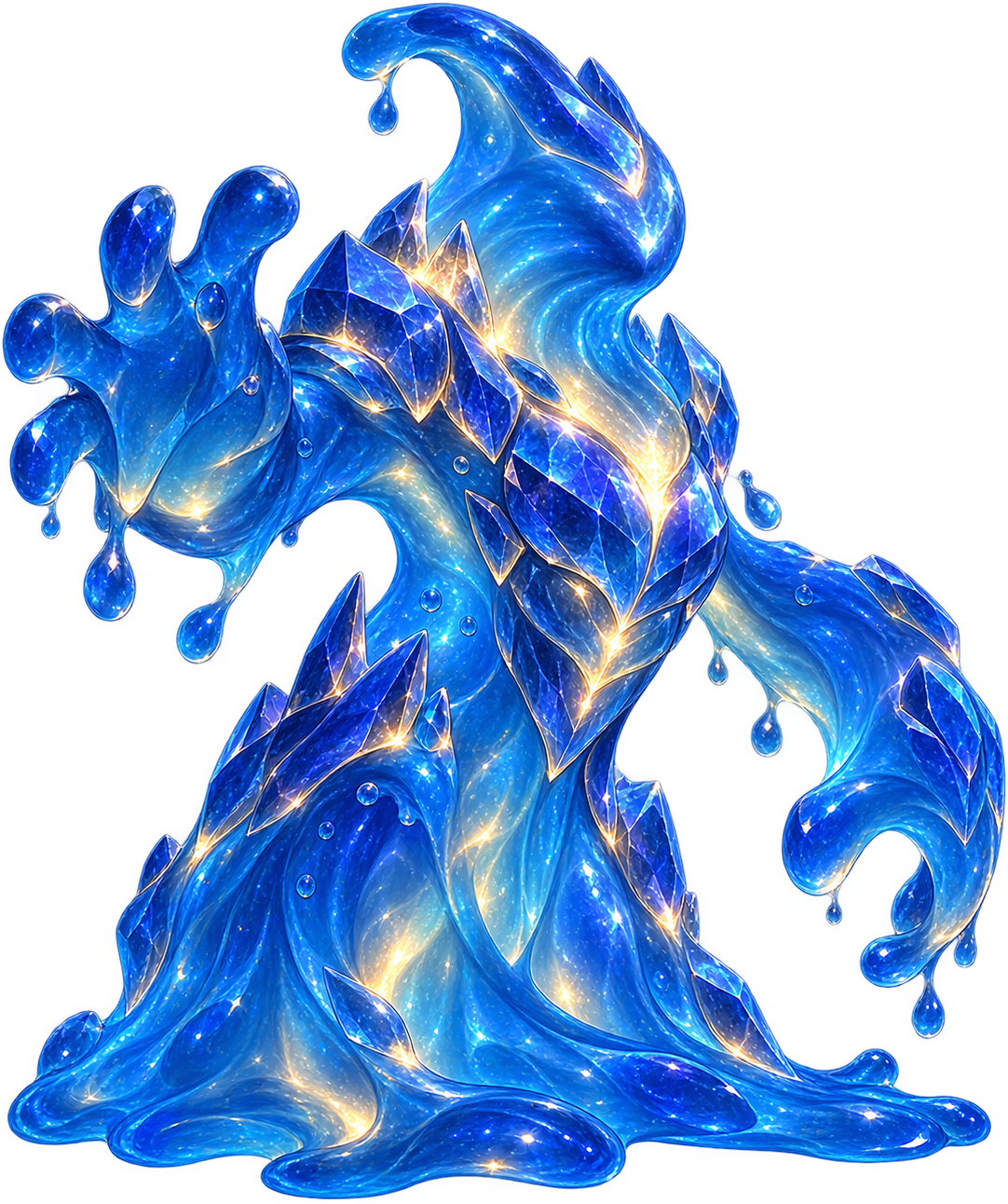
Sapphire oozes are a form of intelligent ooze native to Elysium. Steadfastly courageous and protective, sapphire oozes are proof that even the least of Elysium’s natives are heroic in their own right. These eager creatures have an intense and innocent curiosity about the world. This, combined with their unhesitating courage, renders sapphire oozes particularly vulnerable to the hazards of Elysium, as they have no qualms about wandering into any corner of the plane in search of adventure or vulnerable creatures in need of rescue. Of course, in most such cases, the sapphire oozes themselves must be rescued, whether by azatas or by visiting adventurers; wandering azatas are often alert for the bubbling sound of a sapphire ooze’s distress calls.
Sapphire oozes that find their way to the Material Plane usually do so by accident. In such cases, the ooze eagerly seeks out novice adventurers or aspiring heroes to share adventures with, using their abilities to protect their allies and inspire them to greatness. They are often quite surprised and confused when they encounter other oozes, which sapphire oozes never expect to be so mindless and such boring conversationalists.
CG Medium (, )
An ooze is an amorphous or mutable creature, usually mindless. An ooze has the following traits (unless otherwise noted in a creature’s entry).
• Blindsight.
• Ooze Traits (Ex) The dedicated ooze traits popup under Immune contains the ooze’s standard defensive traits. This sapphire ooze has an Intelligence score and therefore loses the Mindless trait.
• Some oozes can inflict acid damage on objects.
• Proficient with its natural weapons only.
• Proficient with no armor.
• Oozes eat and breathe, but do not sleep.
The Extraplanar subtype is applied to any creature when it is on a plane other than its native plane. A creature that travels the planes can gain or lose this subtype as it goes from plane to plane. Monster entries assume that encounters with creatures take place on the Material Plane, and every creature whose native plane is not the Material Plane has the extraplanar subtype (but would not have it when on its home plane). Creatures not labeled as extraplanar are natives of the Material Plane, and they gain the extraplanar subtype if they leave the Material Plane. No creature has the extraplanar subtype when it is on a Transitive Plane (the Astral Plane, the Ethereal Plane, or the Plane of Shadow).
A shapechanger has the supernatural ability to assume one or more alternate forms. Many magical effects allow some kind of shapeshifting, and not every creature that can change shapes has the shapechanger subtype. A shapechanger possesses the following traits (unless otherwise noted in a creature’s entry).
• Proficient with its natural weapons, with simple weapons, and with any weapons mentioned in the creature’s description.
• Proficient with any armor mentioned in the creature’s description, as well as all lighter forms. If no form of armor is mentioned, the shapechanger is not proficient with armor. A shapechanger is proficient with shields if it is proficient with any type of armor.
Init +3; Senses 30 ft.; Perception +3
Blindsight (Ex) Using nonvisual senses, such as sensitivity to vibrations, keen smell, acute hearing, or echolocation, a creature with blindsight can maneuver and fight as well as a sighted creature. Invisibility, darkness, and most kinds of concealment are irrelevant, though a creature with blindsight must have line of effect to an object or another creature to discern that object or creature. The ability’s range is specified in the creature’s descriptive text. The creature usually does not need to succeed at Perception checks to notice creatures within range of its blindsight ability. Unless noted otherwise, blindsight is continuous, and the creature doesn’t need to do anything to use it. Some forms of blindsight, however, must be triggered as a free action. If so, this is noted in the creature’s description. If a creature must trigger its blindsight ability, it gains the benefits of blindsight only during its turn.
DEFENSE
AC 14, touch 14, flat-footed 10 (+3 Dex, +1 dodge)
hp 22 (3d8+9)
Fort +4, Ref +4, Will +1
Defensive Abilities ; 5/bludgeoning; acid, mind-affecting effects,
All-Around Vision (Ex) This creature sees in all directions at once. It cannot be flanked.
Damage Reduction (Ex or Su) The creature ignores damage from most weapons and natural attacks. Wounds heal immediately, or the weapon bounces off harmlessly; in either case, the opponent knows the attack was ineffective. The creature takes normal damage from energy attacks, including nonmagical ones, spells, spell-like abilities, and supernatural abilities. A certain kind of weapon can sometimes damage the creature normally, as described below.
The entry indicates the amount of damage ignored, usually 5 to 15 points, and the type of weapon that negates the ability. Some monsters are vulnerable to bludgeoning, piercing, or slashing damage. Others are vulnerable to materials such as adamantine, cold iron, or silver. Attacks from weapons that are not the correct type or material have their damage reduced, although a high enhancement bonus can overcome some forms of damage reduction.
Whenever damage reduction completely negates the damage from an attack, it also negates most special effects that accompany the attack, such as injury poison, injury disease, and effects delivered only when the attack deals damage. Damage reduction does not negate touch attacks, energy damage dealt along with an attack, or energy drain, and it does not affect poisons or diseases delivered by contact, ingestion, or inhalation. If damage reduction completely negates an attack’s damage, that attack does not disrupt a spell being cast.
Damage reduction does not stack with itself. When a creature has more than one form, apply the single form that gives the greatest reduction against the attack; the attacker must overcome only the qualities required by the form being applied.
Some monsters are vulnerable to magic weapons. A weapon with at least a +1 magical enhancement bonus on attack and damage rolls overcomes this damage reduction; the +1 attack bonus from a masterwork weapon does not count as a magical enhancement bonus. Such creatures’ natural weapons, but not their attacks with manufactured weapons, are treated as magic weapons for overcoming damage reduction. Ammunition fired from a projectile weapon with at least a +1 enhancement bonus is treated as magic for overcoming damage reduction.
A few powerful monsters are vulnerable only to epic weapons—magic weapons with at least a +6 enhancement bonus. Such creatures’ natural weapons are also treated as epic weapons for overcoming damage reduction.
Some monsters are vulnerable to chaotic-, evil-, good-, or lawful-aligned weapons. When a cleric casts align weapon, affected weapons might gain one or more of these properties; certain magic weapons also have them. A creature with a chaotic, evil, good, or lawful alignment subtype overcomes matching damage reduction with its natural weapons and wielded weapons as though those attacks had the alignment or alignments matching its subtype. Ammunition fired from an aligned projectile weapon is treated as having that alignment for overcoming damage reduction.
A weapon with a +3 enhancement bonus overcomes damage reduction as though it were made of cold iron and silver. A weapon with a +4 enhancement bonus also overcomes damage reduction as though it were adamantine, but this does not allow it to ignore hardness. A weapon with a +5 enhancement bonus also overcomes alignment-based damage reduction. These equivalences are cumulative with the weapon’s actual material and alignment qualities.
When a damage reduction entry has a — after the slash, no weapon negates it.
If either of two listed attack types can overcome the reduction, a weapon that deals either type does so. If a listed combination is required, the weapon must have every listed type or quality; a weapon with only one remains subject to the damage reduction.
Immunity (Ex or Su) A creature with immunities takes no damage from listed sources. Immunities can also apply to afflictions, conditions, spells (based on level, save type, or school), and other effects. A creature does not suffer any secondary effects that would normally be triggered by an effect it is immune to.
Ooze Traits (Ex)
• Mindless: No Intelligence score, and immunity to all mind-affecting effects (charms, compulsions, phantasms, patterns, and morale effects). An ooze with an Intelligence score loses this trait.
• Blind (but have the blindsight special quality), with immunity to gaze attacks, visual effects, illusions, and other attack forms that rely on sight.
• Immunity to poison, sleep effects, paralysis, polymorph, and stunning.
• Not subject to critical hits or flanking. Does not take additional damage from precision-based attacks, such as sneak attack.
OFFENSE
Speed 20 ft., 20 ft., 20 ft.
A creature with a Climb speed has a +8 racial bonus on all Climb checks. The creature must make a Climb check to climb any wall or slope with a DC higher than 0, but it can always choose to take 10, even if rushed or threatened while climbing. If a creature with a climb speed chooses an accelerated climb, it moves at double its climb speed (or at its land speed, whichever is slower) and makes a single Climb check at a –5 penalty. Such a creature retains its Dexterity bonus to Armor Class (if any) while climbing, and opponents get no special bonus to their attacks against it. It cannot, however, use the run action while climbing.
A creature with a Swim speed can move through water at its indicated speed without making Swim checks. It gains a +8 racial bonus on any Swim check to perform a special action or avoid a hazard. The creature can always choose to take 10 on a Swim check, even if distracted or endangered when swimming. Such a creature can use the run action while swimming, provided that it swims in a straight line.
Melee 2 slams +4 (1d4+2)
Special Attacks
STATISTICS
Str 14, Dex 17, Con 16, Int 7, Wis 10, Cha 15
Base Atk +2; +4; CMD 18 (can’t be tripped)
When performing a combat maneuver, you must use an action appropriate to the maneuver you are attempting to perform. While many combat maneuvers can be performed as part of an attack action, full-attack action, or attack of opportunity (in place of a melee attack), others require a specific action. Unless otherwise noted, performing a combat maneuver provokes an attack of opportunity from the target of the maneuver. If you are hit by the target, you take the damage normally and apply that amount as a penalty to the attack roll to perform the maneuver. If your target is immobilized, , or otherwise incapacitated, your maneuver automatically succeeds (treat as if you rolled a natural 20 on the attack roll). If your target is , you receive a +4 bonus on your attack roll to perform a combat maneuver against it.
When you attempt to perform a combat maneuver, make an attack roll and add your CMB in place of your normal attack bonus. Add any bonuses you currently have on attack rolls due to spells, feats, and other effects. These bonuses must be applicable to the weapon or attack used to perform the maneuver. The DC of this maneuver is your target’s Combat Maneuver Defense. Combat maneuvers are attack rolls, so you must roll for concealment and take any other penalties that would normally apply to an attack roll.
If your attack roll equals or exceeds the CMD of the target, your maneuver is a success and has the listed effect. Some maneuvers, such as bull rush, have varying levels of success depending on how much your attack roll exceeds the target’s CMD. Rolling a natural 20 while attempting a combat maneuver is always a success (except when attempting to escape from bonds), while rolling a natural 1 is always a failure.
Unconscious creatures are knocked out and . Unconsciousness can result from having negative hit points (but not more than the creature’s Constitution score), or from nonlethal damage in excess of current hit points.
A helpless character is paralyzed, held, bound, sleeping, unconscious, or otherwise completely at an opponent’s mercy. A helpless target is treated as having a Dexterity of 0 (–5 modifier). Melee attacks against a helpless target get a +4 bonus (equivalent to attacking a prone target). Ranged attacks get no special bonus against helpless targets. Rogues can sneak attack helpless targets.
As a full-round action, an enemy can use a melee weapon to deliver a coup de grace to a helpless foe. An enemy can also use a bow or crossbow, provided he is adjacent to the target. The attacker automatically hits and scores a critical hit. (A rogue also gets his sneak attack damage bonus against a helpless foe when delivering a coup de grace.) If the defender survives, he must make a Fortitude save (DC 10 + damage dealt) or die. Delivering a coup de grace provokes attacks of opportunity.
Creatures that are immune to critical hits do not take critical damage, nor do they need to make Fortitude saves to avoid being killed by a coup de grace.
A stunned creature drops everything held, can’t take actions, takes a –2 penalty to AC, and loses its Dexterity bonus to AC (if any). Attackers receive a +4 bonus on attack rolls to perform combat maneuvers against a stunned opponent.
Feats , (Perception)
Dodge You gain a +1 dodge bonus to your AC. A condition that makes you lose your Dex bonus to AC also makes you lose the benefits of this feat.
Skill Focus (Perception) You get a +3 bonus on all checks involving the chosen skill. If you have 10 or more ranks in that skill, this bonus increases to +6.
Skills Climb +11, Diplomacy +3, Perception +3, Swim +11
Languages Celestial, Common
SQ ,
Compression (Ex) This creature can move through an area as small as one-quarter its space without squeezing, or one-eighth its space when squeezing.
ECOLOGY
Environment any (Elysium)
Organization solitary, pair, or colony (3–12)
Treasure incidental
SPECIAL ABILITIES
Amorphous Aegis (Ex) As a full-round action, a sapphire ooze can transform into wearable armor. This armor can be sized for creatures of the ooze’s size or one size category smaller, and the subject must be willing to wear the ooze as armor. While in its armor form, the ooze cannot take actions other than to use its hero’s infusion ability or to return to its true form as a full-round action. While the shape of the armor created can vary, it always appears to be made of glittering sapphire crystals and provides protection as if it were a mithral breastplate. While a sapphire ooze is worn, it takes 1d6 points of damage each time its host takes more than 5 points of damage from a single attack; this damage bypasses the sapphire ooze’s damage reduction and immunities. If this damage reduces the ooze to 0 hit points, it immediately reverts to its true form and falls to the ground.
Hero’s Infusion (Ex) Three times per day, a sapphire ooze can touch a creature as a standard action to grant it a +4 bonus on saves against fear for 1 round; an unwilling creature can attempt a DC 14 Fortitude save to resist. A sapphire ooze can use this ability as a swift action on a creature that is wearing it. This is a poison effect. The save DC is Constitution-based.
Gancanagh
This incredibly handsome man’s pointed ears and otherworldly grace betray an inhuman beauty.
Male azatas of extraordinary and radiant beauty, gancanaghs are Elysium’s knights-errant, but they are best known as inveterate wooers of mortals and immortals alike. While gancanaghs are incorrigible flirts, a gancanagh’s true attention tends to alight on one man or woman at a time, and he throws himself into wooing and courting his current target, into a brief but earnest fling before his quicksilver passions change yet again. Gancanaghs hate succubi and incubi more than anything else, as they feel that the mere existence of such creatures profanes the spirit of romance with the shadow of the demons’ seduction and violence, leading good people who share the gancanagh’s flirtatious and open nature to be compared to evil creatures. One can give a gancanagh no greater offense than to mistake him for an incubus, and more than one hotheaded gancanagh has challenged a misinformed paladin or other ally of good to a duel over such an insult. While many gancanaghs carry whimsical-looking pipes because they like the way they look, they can’t stand smoke, and so rarely make use of them. A gancanagh’s flute, on the other hand, is a cherished possession, as they enjoy both the beauty of the music and its ability to sway the heart. A typical gancanagh stands 6 feet tall but weighs only 130 pounds.
CG Medium (, , , )
An outsider is at least partially composed of the essence (but not necessarily the material) of some plane other than the Material Plane. Some creatures start out as some other type and become outsiders when they attain a higher (or lower) state of spiritual existence. An outsider has the following traits:
• Darkvision 60 feet.
• Unlike most living creatures, an outsider does not have a dual nature—its soul and body form one unit. When an outsider is slain, no soul is set loose. Spells that restore souls to their bodies, such as raise dead, reincarnate, and resurrection, don’t work on an outsider. It takes a different magical effect, such as limited wish, wish, miracle, or true resurrection to restore it to life.
• Proficient with all simple and martial weapons and any weapons mentioned in its entry.
• Proficient with whatever type of armor (light, medium, or heavy) it is described as wearing, as well as all lighter types. Outsiders not indicated as wearing armor are not proficient with armor. Outsiders are proficient with shields if they are proficient with any form of armor.
• Outsiders breathe, but do not need to eat or sleep (although they can do so if they wish).
Azatas are celestials native to chaotic good-aligned Outer Planes.
• Darkvision 60 feet and low-light vision.
• Immunity to electricity and petrification.
• Resistance to cold 10 and fire 10.
• Truespeech (Su) Can speak with any creature that has a language as though using tongues; this ability is always active.
The Chaotic subtype is usually applied to outsiders native to the chaotic-aligned Outer Planes. Most creatures that have this subtype also have chaotic alignments; however, if their alignments change, they still retain the subtype. Any effect that depends on alignment affects a creature with this subtype as if the creature had a chaotic alignment, no matter what its alignment actually is. The creature also suffers effects according to its actual alignment. A creature with the chaotic subtype overcomes damage reduction as if its natural weapons and any weapons it wields were chaotic-aligned.
The Extraplanar subtype is applied to any creature when it is on a plane other than its native plane. A creature that travels the planes can gain or lose this subtype as it goes from plane to plane. Monster entries assume that encounters with creatures take place on the Material Plane, and every creature whose native plane is not the Material Plane has the extraplanar subtype (but would not have it when on its home plane). Creatures not labeled as extraplanar are natives of the Material Plane, and they gain the extraplanar subtype if they leave the Material Plane. No creature has the extraplanar subtype when it is on a Transitive Plane (the Astral Plane, the Ethereal Plane, or the Plane of Shadow).
The Good subtype is usually applied to outsiders native to the good-aligned Outer Planes. Most creatures that have this subtype also have good alignments; however, if their alignments change, they still retain the subtype. Any effect that depends on alignment affects a creature with this subtype as if the creature had a good alignment, no matter what its alignment actually is. The creature also suffers effects according to its actual alignment. A creature with the good subtype overcomes damage reduction as if its natural weapons and any weapons it wields were good-aligned.
Init +5; Senses 60 ft., ; Perception +9
Darkvision is the extraordinary ability to see with no light source at all, out to a range specified. Darkvision is black-and-white only (colors cannot be discerned). It does not allow creatures to see anything that they could not see otherwise—invisible objects are still invisible, and illusions are still visible as what they seem to be. Likewise, darkvision subjects a creature to gaze attacks normally. The presence of light does not spoil darkvision.
Low-Light Vision (Ex) A creature with low-light vision can see twice as far as a human in starlight, moonlight, torchlight, and similar conditions of dim light. It retains the ability to distinguish color and detail under these conditions.
DEFENSE
AC 17, touch 15, 12 (+5 Dex, +2 natural)
A creature that has not yet acted during a combat is flat-footed, unable to react normally to the situation. A flat-footed creature cannot take immediate actions and loses their Dexterity bonus to AC and CMD (if any). The creature cannot make attacks of opportunity unless they have the Combat Reflexes feat or Uncanny Dodge class ability.
hp 42 (5d10+15)
Fort +4, Ref +9, Will +5
5/cold iron or evil; electricity, petrification; cold 10, fire 10
Damage Reduction (Ex or Su) The creature ignores damage from most weapons and natural attacks. Wounds heal immediately, or the weapon bounces off harmlessly; in either case, the opponent knows the attack was ineffective. The creature takes normal damage from energy attacks, including nonmagical ones, spells, spell-like abilities, and supernatural abilities. A certain kind of weapon can sometimes damage the creature normally, as described below.
The entry indicates the amount of damage ignored, usually 5 to 15 points, and the type of weapon that negates the ability. Some monsters are vulnerable to bludgeoning, piercing, or slashing damage. Others are vulnerable to materials such as adamantine, cold iron, or silver. Attacks from weapons that are not the correct type or material have their damage reduced, although a high enhancement bonus can overcome some forms of damage reduction.
Whenever damage reduction completely negates the damage from an attack, it also negates most special effects that accompany the attack, such as injury poison, injury disease, and effects delivered only when the attack deals damage. Damage reduction does not negate touch attacks, energy damage dealt along with an attack, or energy drain, and it does not affect poisons or diseases delivered by contact, ingestion, or inhalation. If damage reduction completely negates an attack’s damage, that attack does not disrupt a spell being cast.
Damage reduction does not stack with itself. When a creature has more than one form, apply the single form that gives the greatest reduction against the attack; the attacker must overcome only the qualities required by the form being applied.
Some monsters are vulnerable to magic weapons. A weapon with at least a +1 magical enhancement bonus on attack and damage rolls overcomes this damage reduction; the +1 attack bonus from a masterwork weapon does not count as a magical enhancement bonus. Such creatures’ natural weapons, but not their attacks with manufactured weapons, are treated as magic weapons for overcoming damage reduction. Ammunition fired from a projectile weapon with at least a +1 enhancement bonus is treated as magic for overcoming damage reduction.
A few powerful monsters are vulnerable only to epic weapons—magic weapons with at least a +6 enhancement bonus. Such creatures’ natural weapons are also treated as epic weapons for overcoming damage reduction.
Some monsters are vulnerable to chaotic-, evil-, good-, or lawful-aligned weapons. When a cleric casts align weapon, affected weapons might gain one or more of these properties; certain magic weapons also have them. A creature with a chaotic, evil, good, or lawful alignment subtype overcomes matching damage reduction with its natural weapons and wielded weapons as though those attacks had the alignment or alignments matching its subtype. Ammunition fired from an aligned projectile weapon is treated as having that alignment for overcoming damage reduction.
A weapon with a +3 enhancement bonus overcomes damage reduction as though it were made of cold iron and silver. A weapon with a +4 enhancement bonus also overcomes damage reduction as though it were adamantine, but this does not allow it to ignore hardness. A weapon with a +5 enhancement bonus also overcomes alignment-based damage reduction. These equivalences are cumulative with the weapon’s actual material and alignment qualities.
When a damage reduction entry has a — after the slash, no weapon negates it.
If either of two listed attack types can overcome the reduction, a weapon that deals either type does so. If a listed combination is required, the weapon must have every listed type or quality; a weapon with only one remains subject to the damage reduction.
Immunity (Ex or Su) A creature with immunities takes no damage from listed sources. Immunities can also apply to afflictions, conditions, spells (based on level, save type, or school), and other effects. A creature does not suffer any secondary effects that would normally be triggered by an effect it is immune to.
Resistance (Ex) This creature ignores some damage of the indicated type each time it takes damage of that kind, commonly acid, cold, electricity, or fire. The entry indicates the amount and type of damage ignored. Resistance is not immunity, and it applies whether the damage has a mundane or magical source. When resistance completely negates damage from an energy attack, that attack does not disrupt spellcasting. This resistance does not stack with resistance provided by a spell.
Weaknesses to smoke
Vulnerability (Ex) A creature with vulnerabilities takes half again as much damage (+50%) from a specific energy type, regardless of whether a saving throw is allowed or if the save is a success or failure. Creatures with a vulnerability that is not an energy type instead take a –4 penalty on saves against spells and effects that cause or use the listed vulnerability (such as spells with the light descriptor). Some creatures might suffer additional effects, as noted in their descriptions.
OFFENSE
Speed 40 ft.
Melee +1 mithral rapier +11 (1d6+6/18–20)
(CL 5th; concentration +10)
Spell-like abilities are magical and work just like spells (though they are not spells and so have no verbal, somatic, focus, or material components). They go away in an antimagic field and are subject to spell resistance if the spell the ability is based on would be subject to spell resistance.
A spell-like ability usually has a limit on how often it can be used. A constant spell-like ability or one that can be used at will has no use limit; unless otherwise stated, a creature can only use a constant spell-like ability on itself. Reactivating a constant spell-like ability is a swift action. Using all other spell-like abilities is a standard action unless noted otherwise, and doing so provokes attacks of opportunity. It is possible to make a concentration check to use a spell-like ability defensively and avoid provoking an attack of opportunity, just as when casting a spell. A spell-like ability can be disrupted just as a spell can be. Spell-like abilities cannot be used to counterspell, nor can they be counterspelled.
For creatures with spell-like abilities, a designated caster level determines how difficult it is to dispel their spell-like effects and defines any level-dependent variables (such as range and duration) the abilities might have. The creature’s caster level never affects which spell-like abilities the creature has; sometimes the given caster level is lower than the level a spellcasting character would need to cast the spell of the same name. If no caster level is specified, the caster level is equal to the creature’s Hit Dice. The saving throw (if any) against a spell-like ability is 10 + the level of the spell the ability resembles or duplicates + the creature’s Charisma modifier unless the creature’s entry explicitly declares another ability-score basis; that individual declaration governs its block and is not overridden by this generic popup.
Some spell-like abilities duplicate spells that work differently when cast by characters of different classes. A monster’s spell-like abilities are presumed to be the sorcerer/wizard versions. If the spell in question is not a sorcerer/wizard spell, then default to cleric, druid, bard, paladin, and ranger, in that order.
At will—charm person (DC 16), mirror image, suggestion (DC 17)
1/day—cure moderate wounds, good hope
STATISTICS
Str 12, Dex 21, Con 16, Int 15, Wis 12, Cha 21
Base Atk +5; +6; CMD 21
When performing a combat maneuver, you must use an action appropriate to the maneuver you are attempting to perform. While many combat maneuvers can be performed as part of an attack action, full-attack action, or attack of opportunity (in place of a melee attack), others require a specific action. Unless otherwise noted, performing a combat maneuver provokes an attack of opportunity from the target of the maneuver. If you are hit by the target, you take the damage normally and apply that amount as a penalty to the attack roll to perform the maneuver. If your target is immobilized, unconscious, or otherwise incapacitated, your maneuver automatically succeeds (treat as if you rolled a natural 20 on the attack roll). If your target is stunned, you receive a +4 bonus on your attack roll to perform a combat maneuver against it.
When you attempt to perform a combat maneuver, make an attack roll and add your CMB in place of your normal attack bonus. Add any bonuses you currently have on attack rolls due to spells, feats, and other effects. These bonuses must be applicable to the weapon or attack used to perform the maneuver. The DC of this maneuver is your target’s Combat Maneuver Defense. Combat maneuvers are attack rolls, so you must roll for concealment and take any other penalties that would normally apply to an attack roll.
If your attack roll equals or exceeds the CMD of the target, your maneuver is a success and has the listed effect. Some maneuvers, such as bull rush, have varying levels of success depending on how much your attack roll exceeds the target’s CMD. Rolling a natural 20 while attempting a combat maneuver is always a success (except when attempting to escape from bonds), while rolling a natural 1 is always a failure.
Feats , ,
Combat Reflexes You may make a number of additional attacks of opportunity per round equal to your Dexterity bonus. With this feat, you may also make attacks of opportunity while .
Normal: A character without this feat can make only one attack of opportunity per round and can’t make attacks of opportunity while .
Special: The Combat Reflexes feat does not allow a rogue to use her opportunist ability more than once per round.
A creature that has not yet acted during a combat is flat-footed, unable to react normally to the situation. A flat-footed creature cannot take immediate actions and loses their Dexterity bonus to AC and CMD (if any). The creature cannot make attacks of opportunity unless they have the Combat Reflexes feat or Uncanny Dodge class ability.
Persuasive You get a +2 bonus on Diplomacy and Intimidate skill checks. If you have 10 or more ranks in one of these skills, the bonus increases to +4 for that skill.
Weapon Finesse With a light weapon, rapier, whip, or spiked chain made for a creature of your size category, you may use your Dexterity modifier instead of your Strength modifier on attack rolls. If you carry a shield, its armor check penalty applies to your attack rolls.
Special: Natural weapons are considered light weapons.
Skills Bluff +13, Diplomacy +15, Disguise +13, Intimidate +15, Knowledge (planes) +6, Perception +9, Perform (wind instruments) +13, Sense Motive +7, Stealth +9, Use Magic Device +10
Languages Celestial, Infernal, Sylvan;
Truespeech (Su) This creature can speak with any creature that has a language, as though using a tongues spell (caster level equal to creature’s Hit Dice). This ability is always active.
SQ (Small or Medium humanoid; alter self), ,
Change Shape (Su) A creature with this special quality has the ability to assume the appearance of a specific creature or type of creature (usually a humanoid), but retains most of its own physical qualities. A creature cannot change shape to a form more than one size category smaller or larger than its original form. This ability functions as a polymorph spell, the type of which is listed in the creature’s description, but the creature does not adjust its ability scores (although it gains any other abilities of the creature it mimics). Unless otherwise stated, it can remain in an alternate form indefinitely. Some creatures, such as lycanthropes, can transform into unique forms with special modifiers and abilities. These creatures do adjust their ability scores, as noted in their description.
ECOLOGY
Environment any (Elysium)
Organization solitary
Treasure triple (+1 mithral rapier, other treasure)
SPECIAL ABILITIES
Gancanagh’s Grace (Su) A gancanagh’s otherworldly grace and flowing movement allow him to add his Dexterity modifier to damage rolls with his rapier in place of his Strength modifier.
Invigorating Passion (Su) A gancanagh’s passion has the power to raise those who receive it to great heights. Any creature who performs an act of passion with a gancanagh, such as a kiss, gains a +1 competence bonus on attack rolls, gains 1 bonus Hit Die (d10) with the commensurate number of temporary hit points (apply the target’s Constitution modifier, if any), and takes no penalties from the or conditions. These benefits last for 1 hour. At the end of that time, the creature must succeed at a DC 17 Fortitude save or become , or if it was already . This is a mind-affecting effect. The save DC is Charisma-based.
A fatigued character can neither run nor charge and takes a –2 penalty to Strength and Dexterity. Doing anything that would normally cause fatigue causes the fatigued character to become . After 8 hours of complete rest, fatigued characters are no longer fatigued.
An exhausted character moves at half speed, cannot run or charge, and takes a –6 penalty to Strength and Dexterity. After 1 hour of complete rest, an exhausted character becomes fatigued. A fatigued character becomes exhausted by doing something else that would normally cause fatigue.
An exhausted character moves at half speed, cannot run or charge, and takes a –6 penalty to Strength and Dexterity. After 1 hour of complete rest, an exhausted character becomes . A fatigued character becomes exhausted by doing something else that would normally cause fatigue.
A fatigued character can neither run nor charge and takes a –2 penalty to Strength and Dexterity. Doing anything that would normally cause fatigue causes the fatigued character to become exhausted. After 8 hours of complete rest, fatigued characters are no longer fatigued.
Vulnerable to Smoke (Ex) A gancanagh’s lungs can’t tolerate smoke. He takes a –4 penalty on all saving throws against smoke and cloud effects, such as stinking cloud and the smoke from pyrotechnics.
Yamah
This blue-skinned woman has blue-and-white butterfly wings. Her black hair sparkles like a starlit sky.
Yamahs travel throughout the planes promoting the ideals of freedom and fairness, using their unique talents to rob evildoers of their magic and turn it into a weapon for good. Yamahs harbor ill will toward anyone who would use magic for cruel or evil purposes, especially necromancers and creatures that use magic to trap souls and pervert life. Though yamahs often bear a stern countenance, they nonetheless enjoy lighthearted pranks and cheery jokes when appropriate. The white markings that cover their bodies may at first appear to be tattoos, but are actually natural sigils unique to each individual. The average yamah stands just over 6 feet tall and weighs 140 pounds. Yamahs can often be encountered during lunar eclipses and other significant celestial events in regions where worship of any chaotic good deity or demigod is strong. Legends among such faiths claim that yamahs sometimes accompany good spellcasters on crusades against otherworldly fiends, though every story inevitably ends with the yamah mysteriously departing after the deed is done, abandoning its mortal partner without a word.
CG Medium (, , , )
An outsider is at least partially composed of the essence (but not necessarily the material) of some plane other than the Material Plane. Some creatures start out as some other type and become outsiders when they attain a higher (or lower) state of spiritual existence. An outsider has the following traits:
• Darkvision 60 feet.
• Unlike most living creatures, an outsider does not have a dual nature—its soul and body form one unit. When an outsider is slain, no soul is set loose. Spells that restore souls to their bodies, such as raise dead, reincarnate, and resurrection, don’t work on an outsider. It takes a different magical effect, such as limited wish, wish, miracle, or true resurrection to restore it to life.
• Proficient with all simple and martial weapons and any weapons mentioned in its entry.
• Proficient with whatever type of armor (light, medium, or heavy) it is described as wearing, as well as all lighter types. Outsiders not indicated as wearing armor are not proficient with armor. Outsiders are proficient with shields if they are proficient with any form of armor.
• Outsiders breathe, but do not need to eat or sleep (although they can do so if they wish).
Azatas are celestials native to chaotic good-aligned Outer Planes.
• Darkvision 60 feet and low-light vision.
• Immunity to electricity and petrification.
• Resistance to cold 10 and fire 10.
• Truespeech (Su) Can speak with any creature that has a language as though using tongues; this ability is always active.
The Chaotic subtype is usually applied to outsiders native to the chaotic-aligned Outer Planes. Most creatures that have this subtype also have chaotic alignments; however, if their alignments change, they still retain the subtype. Any effect that depends on alignment affects a creature with this subtype as if the creature had a chaotic alignment, no matter what its alignment actually is. The creature also suffers effects according to its actual alignment. A creature with the chaotic subtype overcomes damage reduction as if its natural weapons and any weapons it wields were chaotic-aligned.
The Extraplanar subtype is applied to any creature when it is on a plane other than its native plane. A creature that travels the planes can gain or lose this subtype as it goes from plane to plane. Monster entries assume that encounters with creatures take place on the Material Plane, and every creature whose native plane is not the Material Plane has the extraplanar subtype (but would not have it when on its home plane). Creatures not labeled as extraplanar are natives of the Material Plane, and they gain the extraplanar subtype if they leave the Material Plane. No creature has the extraplanar subtype when it is on a Transitive Plane (the Astral Plane, the Ethereal Plane, or the Plane of Shadow).
The Good subtype is usually applied to outsiders native to the good-aligned Outer Planes. Most creatures that have this subtype also have good alignments; however, if their alignments change, they still retain the subtype. Any effect that depends on alignment affects a creature with this subtype as if the creature had a good alignment, no matter what its alignment actually is. The creature also suffers effects according to its actual alignment. A creature with the good subtype overcomes damage reduction as if its natural weapons and any weapons it wields were good-aligned.
Init +5; Senses 60 ft., detect evil, detect magic, ; Perception +12
Darkvision is the extraordinary ability to see with no light source at all, out to a range specified. Darkvision is black-and-white only (colors cannot be discerned). It does not allow creatures to see anything that they could not see otherwise—invisible objects are still invisible, and illusions are still visible as what they seem to be. Likewise, darkvision subjects a creature to gaze attacks normally. The presence of light does not spoil darkvision.
Low-Light Vision (Ex) A creature with low-light vision can see twice as far as a human in starlight, moonlight, torchlight, and similar conditions of dim light. It retains the ability to distinguish color and detail under these conditions.
DEFENSE
AC 19, touch 15, 14 (+5 Dex, +4 natural)
A creature that has not yet acted during a combat is flat-footed, unable to react normally to the situation. A flat-footed creature cannot take immediate actions and loses their Dexterity bonus to AC and CMD (if any). The creature cannot make attacks of opportunity unless they have the Combat Reflexes feat or Uncanny Dodge class ability.
hp 52 (7d10+14)
Fort +4, Ref +10, Will +7
5/cold iron or evil; electricity, petrification; cold 10, fire 10
Damage Reduction (Ex or Su) The creature ignores damage from most weapons and natural attacks. Wounds heal immediately, or the weapon bounces off harmlessly; in either case, the opponent knows the attack was ineffective. The creature takes normal damage from energy attacks, including nonmagical ones, spells, spell-like abilities, and supernatural abilities. A certain kind of weapon can sometimes damage the creature normally, as described below.
The entry indicates the amount of damage ignored, usually 5 to 15 points, and the type of weapon that negates the ability. Some monsters are vulnerable to bludgeoning, piercing, or slashing damage. Others are vulnerable to materials such as adamantine, cold iron, or silver. Attacks from weapons that are not the correct type or material have their damage reduced, although a high enhancement bonus can overcome some forms of damage reduction.
Whenever damage reduction completely negates the damage from an attack, it also negates most special effects that accompany the attack, such as injury poison, injury disease, and effects delivered only when the attack deals damage. Damage reduction does not negate touch attacks, energy damage dealt along with an attack, or energy drain, and it does not affect poisons or diseases delivered by contact, ingestion, or inhalation. If damage reduction completely negates an attack’s damage, that attack does not disrupt a spell being cast.
Damage reduction does not stack with itself. When a creature has more than one form, apply the single form that gives the greatest reduction against the attack; the attacker must overcome only the qualities required by the form being applied.
Some monsters are vulnerable to magic weapons. A weapon with at least a +1 magical enhancement bonus on attack and damage rolls overcomes this damage reduction; the +1 attack bonus from a masterwork weapon does not count as a magical enhancement bonus. Such creatures’ natural weapons, but not their attacks with manufactured weapons, are treated as magic weapons for overcoming damage reduction. Ammunition fired from a projectile weapon with at least a +1 enhancement bonus is treated as magic for overcoming damage reduction.
A few powerful monsters are vulnerable only to epic weapons—magic weapons with at least a +6 enhancement bonus. Such creatures’ natural weapons are also treated as epic weapons for overcoming damage reduction.
Some monsters are vulnerable to chaotic-, evil-, good-, or lawful-aligned weapons. When a cleric casts align weapon, affected weapons might gain one or more of these properties; certain magic weapons also have them. A creature with a chaotic, evil, good, or lawful alignment subtype overcomes matching damage reduction with its natural weapons and wielded weapons as though those attacks had the alignment or alignments matching its subtype. Ammunition fired from an aligned projectile weapon is treated as having that alignment for overcoming damage reduction.
A weapon with a +3 enhancement bonus overcomes damage reduction as though it were made of cold iron and silver. A weapon with a +4 enhancement bonus also overcomes damage reduction as though it were adamantine, but this does not allow it to ignore hardness. A weapon with a +5 enhancement bonus also overcomes alignment-based damage reduction. These equivalences are cumulative with the weapon’s actual material and alignment qualities.
When a damage reduction entry has a — after the slash, no weapon negates it.
If either of two listed attack types can overcome the reduction, a weapon that deals either type does so. If a listed combination is required, the weapon must have every listed type or quality; a weapon with only one remains subject to the damage reduction.
Immunity (Ex or Su) A creature with immunities takes no damage from listed sources. Immunities can also apply to afflictions, conditions, spells (based on level, save type, or school), and other effects. A creature does not suffer any secondary effects that would normally be triggered by an effect it is immune to.
Resistance (Ex) This creature ignores some damage of the indicated type each time it takes damage of that kind, commonly acid, cold, electricity, or fire. The entry indicates the amount and type of damage ignored. Resistance is not immunity, and it applies whether the damage has a mundane or magical source. When resistance completely negates damage from an energy attack, that attack does not disrupt spellcasting. This resistance does not stack with resistance provided by a spell.
OFFENSE
Speed 30 ft., 100 ft. (perfect)
A creature with a Fly speed can cease or resume flight as a free action on its turn. Without making a check, a flying creature can remain flying at the end of its turn so long as it moves a distance greater than half its speed. It can also turn up to 45 degrees during its turn by sacrificing 5 feet of movement, can rise at half speed at an angle of 45 degrees (ignoring the penalty for diagonal movement), and can descend at any angle at normal speed. At the beginning of its turn, a flying creature can move in a different direction than it did previously without needing a Fly check.
A creature with a natural fly speed receives a bonus (or penalty) on Fly skill checks depending on its maneuverability:
• Clumsy –8
• Poor –4
• Average +0
• Good +4
• Perfect +8
Creatures without a maneuverability rating are assumed to have average maneuverability and take no penalty on Fly checks. These modifiers are already included in the creature’s stat block.
Melee +2 returning starknife +14/+9 (1d4+5/×3)
Ranged +2 returning starknife +14 (1d4+5/×3)
Special Attacks , +1d6
Sneak Attack If this creature catches an opponent unable to defend itself effectively from its attack, it can strike a vital spot for extra damage. Its attacks deal the listed sneak attack damage any time its target would be denied a Dexterity bonus to AC (whether the target actually has a Dexterity bonus or not), or when this creature flanks its target. Sneak attack damage is precision damage and is not multiplied on a critical hit. Ranged attacks count as sneak attacks only if the target is within 30 feet. With a weapon that deals nonlethal damage (such as a sap, whip, or unarmed strike), this creature can deal nonlethal sneak attack damage instead of lethal damage. It cannot use a weapon that deals lethal damage to deal nonlethal sneak attack damage, even with the usual –4 penalty. This creature must be able to see the target well enough to pick out a vital spot and must be able to reach that spot. It cannot sneak attack a creature with concealment.
(CL 6th; concentration +11)
Spell-like abilities are magical and work just like spells (though they are not spells and so have no verbal, somatic, focus, or material components). They go away in an antimagic field and are subject to spell resistance if the spell the ability is based on would be subject to spell resistance.
A spell-like ability usually has a limit on how often it can be used. A constant spell-like ability or one that can be used at will has no use limit; unless otherwise stated, a creature can only use a constant spell-like ability on itself. Reactivating a constant spell-like ability is a swift action. Using all other spell-like abilities is a standard action unless noted otherwise, and doing so provokes attacks of opportunity. It is possible to make a concentration check to use a spell-like ability defensively and avoid provoking an attack of opportunity, just as when casting a spell. A spell-like ability can be disrupted just as a spell can be. Spell-like abilities cannot be used to counterspell, nor can they be counterspelled.
For creatures with spell-like abilities, a designated caster level determines how difficult it is to dispel their spell-like effects and defines any level-dependent variables (such as range and duration) the abilities might have. The creature’s caster level never affects which spell-like abilities the creature has; sometimes the given caster level is lower than the level a spellcasting character would need to cast the spell of the same name. If no caster level is specified, the caster level is equal to the creature’s Hit Dice. The saving throw (if any) against a spell-like ability is 10 + the level of the spell the ability resembles or duplicates + the creature’s Charisma modifier unless the creature’s entry explicitly declares another ability-score basis; that individual declaration governs its block and is not overridden by this generic popup.
Some spell-like abilities duplicate spells that work differently when cast by characters of different classes. A monster’s spell-like abilities are presumed to be the sorcerer/wizard versions. If the spell in question is not a sorcerer/wizard spell, then default to cleric, druid, bard, paladin, and ranger, in that order.
Constant—detect evil, detect magic
3/day—cure moderate wounds, invisibility
1/day—charm person (DC 16), remove paralysis
STATISTICS
Str 17, Dex 20, Con 14, Int 13, Wis 15, Cha 20
Base Atk +7; +10; CMD 25
When performing a combat maneuver, you must use an action appropriate to the maneuver you are attempting to perform. While many combat maneuvers can be performed as part of an attack action, full-attack action, or attack of opportunity (in place of a melee attack), others require a specific action. Unless otherwise noted, performing a combat maneuver provokes an attack of opportunity from the target of the maneuver. If you are hit by the target, you take the damage normally and apply that amount as a penalty to the attack roll to perform the maneuver. If your target is immobilized, unconscious, or otherwise incapacitated, your maneuver automatically succeeds (treat as if you rolled a natural 20 on the attack roll). If your target is stunned, you receive a +4 bonus on your attack roll to perform a combat maneuver against it.
When you attempt to perform a combat maneuver, make an attack roll and add your CMB in place of your normal attack bonus. Add any bonuses you currently have on attack rolls due to spells, feats, and other effects. These bonuses must be applicable to the weapon or attack used to perform the maneuver. The DC of this maneuver is your target’s Combat Maneuver Defense. Combat maneuvers are attack rolls, so you must roll for concealment and take any other penalties that would normally apply to an attack roll.
If your attack roll equals or exceeds the CMD of the target, your maneuver is a success and has the listed effect. Some maneuvers, such as bull rush, have varying levels of success depending on how much your attack roll exceeds the target’s CMD. Rolling a natural 20 while attempting a combat maneuver is always a success (except when attempting to escape from bonds), while rolling a natural 1 is always a failure.
Feats , , ,
Deadly Aim You can choose to take a –1 penalty on all ranged attack rolls to gain a +2 bonus on all ranged damage rolls. When your base attack bonus reaches +4, and every +4 thereafter, the penalty increases by –1 and the bonus to damage increases by +2. You must choose to use this feat before making an attack roll and its effects last until your next turn. The bonus damage does not apply to touch attacks or effects that do not deal hit point damage.
Point-Blank Shot You get a +1 bonus on attack and damage rolls with ranged weapons at ranges of up to 30 feet.
Precise Shot You can shoot or throw ranged weapons at an opponent engaged in melee without taking the standard –4 penalty on your attack roll.
Weapon Finesse With a light weapon, rapier, whip, or spiked chain made for a creature of your size category, you may use your Dexterity modifier instead of your Strength modifier on attack rolls. If you carry a shield, its armor check penalty applies to your attack rolls.
Special: Natural weapons are considered light weapons.
Skills Acrobatics +15, Bluff +15, Fly +23, Knowledge (planes) +11, Perception +12, Sense Motive +12, Stealth +15
Languages Celestial, Draconic, Infernal;
Truespeech (Su) This creature can speak with any creature that has a language, as though using a tongues spell (caster level equal to creature’s Hit Dice). This ability is always active.
SQ
ECOLOGY
Environment any (Elysium)
Organization solitary, pair, or crusade (3–10)
Treasure standard (mwk starknife, other treasure)
SPECIAL ABILITIES
Infused Weapon (Su) Any throwing weapon wielded by a yamah is treated as a +2 returning weapon. This special ability fades 1 minute after a yamah no longer wields the weapon.
Steal Magic (Su) As a standard action, a yamah can make a touch attack against a creature under the effects of a spell or spells and attempt to dispel the effects as per dispel magic (CL 6th). If successful, the yamah absorbs the magical energy and converts it into a bolt of force. A yamah can use a force bolt to make a ranged touch attack that deals 1d6 points of force damage for every spell level of the effect dispelled by the yamah (for example, if a yamah dispels a 2nd-level spell with its steal magic ability, the resulting force bolt deals 2d6 points of force damage; 0-level spells count as being 1st level for the purpose of this ability). These force bolts have a range of 100 feet. A yamah can only carry a number of force bolts equal to its Charisma bonus (5 for most yamahs), and any force bolts not used within 24 hours of being obtained disappear and are wasted.
Bralani
Silver-white hair the color of a lightning strike whips about this poised elf-like archer, his eyes swirling with vibrant colors.
Bralanis are among the fiercest and wildest of the azatas, living from moment to moment and always on the lookout for chances to test their skill in battle. In addition to their elf-like forms, they can take the shape of whirlwinds of dust, snow, or sand. In the mortal realm, they are often mistaken for djinn. They delight in violent weather, not for the destructive qualities of such events, but for the intensity and energy, and many tales describe bralani as spirits who laugh as they sail amid the strongest storms. Bralanis do not need to eat, but they enjoy doing so. Most prefer elven food, fiery human dishes, and spiced wine. Because of their similarities to elementals and fey, they sometimes act as intermediaries between mortals, elementals, and fey, though they prefer to arrange temporary truces that allow the interested parties to conduct their own negotiations on neutral ground. When taking the role of mediators—or whenever else such opportunities present themselves—bralani are quick to suggest friendly competitions or games to end disputes and enjoy creating challenges or complicated contests to test both physical and mental mortal prowess.
CG Medium (, , , , )
An outsider is at least partially composed of the essence (but not necessarily the material) of some plane other than the Material Plane. Some creatures start out as some other type and become outsiders when they attain a higher (or lower) state of spiritual existence. An outsider has the following traits:
• Darkvision 60 feet.
• Unlike most living creatures, an outsider does not have a dual nature—its soul and body form one unit. When an outsider is slain, no soul is set loose. Spells that restore souls to their bodies, such as raise dead, reincarnate, and resurrection, don’t work on an outsider. It takes a different magical effect, such as limited wish, wish, miracle, or true resurrection to restore it to life.
• Proficient with all simple and martial weapons and any weapons mentioned in its entry.
• Proficient with whatever type of armor (light, medium, or heavy) it is described as wearing, as well as all lighter types. Outsiders not indicated as wearing armor are not proficient with armor. Outsiders are proficient with shields if they are proficient with any form of armor.
• Outsiders breathe, but do not need to eat or sleep (although they can do so if they wish).
Azatas are celestials native to chaotic good-aligned Outer Planes.
• Darkvision 60 feet and low-light vision.
• Immunity to electricity and petrification.
• Resistance to cold 10 and fire 10.
• Truespeech (Su) Can speak with any creature that has a language as though using tongues; this ability is always active.
The Chaotic subtype is usually applied to outsiders native to the chaotic-aligned Outer Planes. Most creatures that have this subtype also have chaotic alignments; however, if their alignments change, they still retain the subtype. Any effect that depends on alignment affects a creature with this subtype as if the creature had a chaotic alignment, no matter what its alignment actually is. The creature also suffers effects according to its actual alignment. A creature with the chaotic subtype overcomes damage reduction as if its natural weapons and any weapons it wields were chaotic-aligned.
The Extraplanar subtype is applied to any creature when it is on a plane other than its native plane. A creature that travels the planes can gain or lose this subtype as it goes from plane to plane. Monster entries assume that encounters with creatures take place on the Material Plane, and every creature whose native plane is not the Material Plane has the extraplanar subtype (but would not have it when on its home plane). Creatures not labeled as extraplanar are natives of the Material Plane, and they gain the extraplanar subtype if they leave the Material Plane. No creature has the extraplanar subtype when it is on a Transitive Plane (the Astral Plane, the Ethereal Plane, or the Plane of Shadow).
The Good subtype is usually applied to outsiders native to the good-aligned Outer Planes. Most creatures that have this subtype also have good alignments; however, if their alignments change, they still retain the subtype. Any effect that depends on alignment affects a creature with this subtype as if the creature had a good alignment, no matter what its alignment actually is. The creature also suffers effects according to its actual alignment. A creature with the good subtype overcomes damage reduction as if its natural weapons and any weapons it wields were good-aligned.
A shapechanger has the supernatural ability to assume one or more alternate forms. Many magical effects allow some kind of shapeshifting, and not every creature that can change shapes has the shapechanger subtype. A shapechanger possesses the following traits (unless otherwise noted in a creature’s entry).
• Proficient with its natural weapons, with simple weapons, and with any weapons mentioned in the creature’s description.
• Proficient with any armor mentioned in the creature’s description, as well as all lighter forms. If no form of armor is mentioned, the shapechanger is not proficient with armor. A shapechanger is proficient with shields if it is proficient with any type of armor.
Init +8; Senses 60 ft., ; Perception +15
Darkvision is the extraordinary ability to see with no light source at all, out to a range specified. Darkvision is black-and-white only (colors cannot be discerned). It does not allow creatures to see anything that they could not see otherwise—invisible objects are still invisible, and illusions are still visible as what they seem to be. Likewise, darkvision subjects a creature to gaze attacks normally. The presence of light does not spoil darkvision.
Low-Light Vision (Ex) A creature with low-light vision can see twice as far as a human in starlight, moonlight, torchlight, and similar conditions of dim light. It retains the ability to distinguish color and detail under these conditions.
DEFENSE
AC 20, touch 14, 16 (+4 Dex, +6 natural)
A creature that has not yet acted during a combat is flat-footed, unable to react normally to the situation. A flat-footed creature cannot take immediate actions and loses their Dexterity bonus to AC and CMD (if any). The creature cannot make attacks of opportunity unless they have the Combat Reflexes feat or Uncanny Dodge class ability.
hp 66 (7d10+28)
Fort +9, Ref +9, Will +6
10/cold iron or evil; electricity, petrification; cold 10, fire 10; 17
Damage Reduction (Ex or Su) The creature ignores damage from most weapons and natural attacks. Wounds heal immediately, or the weapon bounces off harmlessly; in either case, the opponent knows the attack was ineffective. The creature takes normal damage from energy attacks, including nonmagical ones, spells, spell-like abilities, and supernatural abilities. A certain kind of weapon can sometimes damage the creature normally, as described below.
The entry indicates the amount of damage ignored, usually 5 to 15 points, and the type of weapon that negates the ability. Some monsters are vulnerable to bludgeoning, piercing, or slashing damage. Others are vulnerable to materials such as adamantine, cold iron, or silver. Attacks from weapons that are not the correct type or material have their damage reduced, although a high enhancement bonus can overcome some forms of damage reduction.
Whenever damage reduction completely negates the damage from an attack, it also negates most special effects that accompany the attack, such as injury poison, injury disease, and effects delivered only when the attack deals damage. Damage reduction does not negate touch attacks, energy damage dealt along with an attack, or energy drain, and it does not affect poisons or diseases delivered by contact, ingestion, or inhalation. If damage reduction completely negates an attack’s damage, that attack does not disrupt a spell being cast.
Damage reduction does not stack with itself. When a creature has more than one form, apply the single form that gives the greatest reduction against the attack; the attacker must overcome only the qualities required by the form being applied.
Some monsters are vulnerable to magic weapons. A weapon with at least a +1 magical enhancement bonus on attack and damage rolls overcomes this damage reduction; the +1 attack bonus from a masterwork weapon does not count as a magical enhancement bonus. Such creatures’ natural weapons, but not their attacks with manufactured weapons, are treated as magic weapons for overcoming damage reduction. Ammunition fired from a projectile weapon with at least a +1 enhancement bonus is treated as magic for overcoming damage reduction.
A few powerful monsters are vulnerable only to epic weapons—magic weapons with at least a +6 enhancement bonus. Such creatures’ natural weapons are also treated as epic weapons for overcoming damage reduction.
Some monsters are vulnerable to chaotic-, evil-, good-, or lawful-aligned weapons. When a cleric casts align weapon, affected weapons might gain one or more of these properties; certain magic weapons also have them. A creature with a chaotic, evil, good, or lawful alignment subtype overcomes matching damage reduction with its natural weapons and wielded weapons as though those attacks had the alignment or alignments matching its subtype. Ammunition fired from an aligned projectile weapon is treated as having that alignment for overcoming damage reduction.
A weapon with a +3 enhancement bonus overcomes damage reduction as though it were made of cold iron and silver. A weapon with a +4 enhancement bonus also overcomes damage reduction as though it were adamantine, but this does not allow it to ignore hardness. A weapon with a +5 enhancement bonus also overcomes alignment-based damage reduction. These equivalences are cumulative with the weapon’s actual material and alignment qualities.
When a damage reduction entry has a — after the slash, no weapon negates it.
If either of two listed attack types can overcome the reduction, a weapon that deals either type does so. If a listed combination is required, the weapon must have every listed type or quality; a weapon with only one remains subject to the damage reduction.
Immunity (Ex or Su) A creature with immunities takes no damage from listed sources. Immunities can also apply to afflictions, conditions, spells (based on level, save type, or school), and other effects. A creature does not suffer any secondary effects that would normally be triggered by an effect it is immune to.
Resistance (Ex) This creature ignores some damage of the indicated type each time it takes damage of that kind, commonly acid, cold, electricity, or fire. The entry indicates the amount and type of damage ignored. Resistance is not immunity, and it applies whether the damage has a mundane or magical source. When resistance completely negates damage from an energy attack, that attack does not disrupt spellcasting. This resistance does not stack with resistance provided by a spell.
A creature with Spell Resistance has the extraordinary ability to avoid the effects of spells and spell-like abilities that directly affect it. To determine if a spell or spell-like ability works against a creature with spell resistance, the caster must make a caster level check (1d20 + caster level). If the result equals or exceeds the creature’s spell resistance, the spell works normally, although the creature is still allowed a saving throw.
OFFENSE
Speed 40 ft., 100 ft. (perfect)
A creature with a Fly speed can cease or resume flight as a free action on its turn. Without making a check, a flying creature can remain flying at the end of its turn so long as it moves a distance greater than half its speed. It can also turn up to 45 degrees during its turn by sacrificing 5 feet of movement, can rise at half speed at an angle of 45 degrees (ignoring the penalty for diagonal movement), and can descend at any angle at normal speed. At the beginning of its turn, a flying creature can move in a different direction than it did previously without needing a Fly check.
A creature with a natural fly speed receives a bonus (or penalty) on Fly skill checks depending on its maneuverability:
• Clumsy –8
• Poor –4
• Average +0
• Good +4
• Perfect +8
Creatures without a maneuverability rating are assumed to have average maneuverability and take no penalty on Fly checks. These modifiers are already included in the creature’s stat block.
Melee +1 scimitar +13/+8 (1d6+8/18–20) or slam +12 (1d6+7)
Ranged +1 composite longbow +12/+7 (1d8+6/×3)
Special Attacks
(CL 6th; concentration +8)
Spell-like abilities are magical and work just like spells (though they are not spells and so have no verbal, somatic, focus, or material components). They go away in an antimagic field and are subject to spell resistance if the spell the ability is based on would be subject to spell resistance.
A spell-like ability usually has a limit on how often it can be used. A constant spell-like ability or one that can be used at will has no use limit; unless otherwise stated, a creature can only use a constant spell-like ability on itself. Reactivating a constant spell-like ability is a swift action. Using all other spell-like abilities is a standard action unless noted otherwise, and doing so provokes attacks of opportunity. It is possible to make a concentration check to use a spell-like ability defensively and avoid provoking an attack of opportunity, just as when casting a spell. A spell-like ability can be disrupted just as a spell can be. Spell-like abilities cannot be used to counterspell, nor can they be counterspelled.
For creatures with spell-like abilities, a designated caster level determines how difficult it is to dispel their spell-like effects and defines any level-dependent variables (such as range and duration) the abilities might have. The creature’s caster level never affects which spell-like abilities the creature has; sometimes the given caster level is lower than the level a spellcasting character would need to cast the spell of the same name. If no caster level is specified, the caster level is equal to the creature’s Hit Dice. The saving throw (if any) against a spell-like ability is 10 + the level of the spell the ability resembles or duplicates + the creature’s Charisma modifier unless the creature’s entry explicitly declares another ability-score basis; that individual declaration governs its block and is not overridden by this generic popup.
Some spell-like abilities duplicate spells that work differently when cast by characters of different classes. A monster’s spell-like abilities are presumed to be the sorcerer/wizard versions. If the spell in question is not a sorcerer/wizard spell, then default to cleric, druid, bard, paladin, and ranger, in that order.
At will—blur, charm person (DC 13), gust of wind (DC 14), mirror image, wind wall
2/day—lightning bolt (DC 15), cure serious wounds
STATISTICS
Str 20, Dex 18, Con 19, Int 13, Wis 14, Cha 15
Base Atk +7; +12; CMD 26
When performing a combat maneuver, you must use an action appropriate to the maneuver you are attempting to perform. While many combat maneuvers can be performed as part of an attack action, full-attack action, or attack of opportunity (in place of a melee attack), others require a specific action. Unless otherwise noted, performing a combat maneuver provokes an attack of opportunity from the target of the maneuver. If you are hit by the target, you take the damage normally and apply that amount as a penalty to the attack roll to perform the maneuver. If your target is immobilized, unconscious, or otherwise incapacitated, your maneuver automatically succeeds (treat as if you rolled a natural 20 on the attack roll). If your target is stunned, you receive a +4 bonus on your attack roll to perform a combat maneuver against it.
When you attempt to perform a combat maneuver, make an attack roll and add your CMB in place of your normal attack bonus. Add any bonuses you currently have on attack rolls due to spells, feats, and other effects. These bonuses must be applicable to the weapon or attack used to perform the maneuver. The DC of this maneuver is your target’s Combat Maneuver Defense. Combat maneuvers are attack rolls, so you must roll for concealment and take any other penalties that would normally apply to an attack roll.
If your attack roll equals or exceeds the CMD of the target, your maneuver is a success and has the listed effect. Some maneuvers, such as bull rush, have varying levels of success depending on how much your attack roll exceeds the target’s CMD. Rolling a natural 20 while attempting a combat maneuver is always a success (except when attempting to escape from bonds), while rolling a natural 1 is always a failure.
Feats , , , (Perception)
Blind-Fight In melee, every time you miss because of concealment (see Combat), you can reroll your miss chance percentile roll one time to see if you actually hit.
An attacker gets no advantages related to hitting you in melee. That is, you don’t lose your Dexterity bonus to Armor Class, and the attacker doesn’t get the usual +2 bonus for being . The attacker’s bonuses do still apply for ranged attacks, however.
You do not need to make Acrobatics skill checks to move at full speed while .
Normal: Regular attack roll modifiers for attackers trying to hit you apply, and you lose your Dexterity bonus to AC. The speed reduction for darkness and poor visibility also applies.
Special: The Blind-Fight feat is of no use against a character who is the subject of a blink spell.
Invisible creatures are visually undetectable. An invisible creature gains a +2 bonus on attack rolls against sighted opponents, and ignores its opponents’ Dexterity bonuses to AC (if any).
The ability to move about unseen is not foolproof. While they can’t be seen, invisible creatures can be heard, smelled, or felt. Invisibility makes a creature undetectable by vision, including darkvision.
Invisibility does not, by itself, make a creature immune to critical hits, but it does make the creature immune to extra damage from being a ranger’s favored enemy and from sneak attacks.
A creature can generally notice the presence of an active invisible creature within 30 feet with a DC 20 Perception check. The observer gains a hunch that “something’s there” but can’t see it or target it accurately with an attack. It’s practically impossible (+20 DC) to pinpoint an invisible creature’s location with a Perception check. Even once a character has pinpointed the square that contains an invisible creature, the creature still benefits from total concealment (50% miss chance). There are a number of modifiers that can be applied to this DC if the invisible creature is moving or engaged in a noisy activity.
• In combat or speaking –20
• Moving at half speed –5
• Moving at full speed –10
• Running or charging –20
• Not moving +20
• Using Stealth: Stealth check +20
• Some distance away +1 per 10 feet
• Behind an obstacle (door) +5
• Behind an obstacle (stone wall) +15
A creature can grope about to find an invisible creature. A character can make a touch attack with his hands or a weapon into two adjacent 5-foot squares using a standard action. If an invisible target is in the designated area, there is a 50% miss chance on the touch attack. If successful, the groping character deals no damage but has successfully pinpointed the invisible creature’s current location. If the invisible creature moves, its location, obviously, is once again unknown.
If an invisible creature strikes a character, the character struck knows the location of the creature that struck him (until, of course, the invisible creature moves). The only exception is if the invisible creature has a reach greater than 5 feet. In this case, the struck character knows the general location of the creature but has not pinpointed the exact location.
If a character tries to attack an invisible creature whose location he has pinpointed, he attacks normally, but the invisible creature still benefits from full concealment (and thus a 50% miss chance). A particularly large and slow invisible creature might get a smaller miss chance.
If a character tries to attack an invisible creature whose location he has not pinpointed, have the player choose the space where the character will direct the attack. If the invisible creature is there, conduct the attack normally. If the enemy’s not there, roll the miss chance as if it were there and tell him that the character has missed, regardless of the result. That way the player doesn’t know whether the attack missed because the enemy’s not there or because you successfully rolled the miss chance.
If an invisible character picks up a visible object, the object remains visible. An invisible creature can pick up a small visible item and hide it on his person (tucked in a pocket or behind a cloak) and render it effectively invisible. One could coat an invisible object with flour to at least keep track of its position (until the flour falls off or blows away).
Invisible creatures leave tracks. They can be tracked normally. Footprints in sand, mud, or other soft surfaces can give enemies clues to an invisible creature’s location.
An invisible creature in the water displaces water, revealing its location. The invisible creature, however, is still hard to see and benefits from concealment (20% miss chance).
A creature with the scent ability can detect an invisible creature as it would a visible one.
A creature with the Blind-Fight feat has a better chance to hit an invisible creature. Roll the miss chance twice, and he misses only if both rolls indicate a miss. (Alternatively, make one 25% miss chance roll rather than two 50% miss chance rolls.)
A creature with blindsight can attack (and otherwise interact with) creatures regardless of invisibility.
An invisible burning torch still gives off light, as does an invisible object with a light or similar spell cast upon it.
Ethereal creatures are invisible. Since ethereal creatures are not materially present, Perception checks, scent, Blind-Fight, and blindsight don’t help locate them. Incorporeal creatures are often invisible. Scent, Blind-Fight, and blindsight don’t help creatures find or attack invisible, incorporeal creatures, but Perception checks can help.
Invisible creatures cannot use gaze attacks.
Invisibility does not thwart divination spells.
Since some creatures can detect or even see invisible creatures, it is helpful to be able to hide even when invisible.
A blinded creature cannot see. It takes a –2 penalty to Armor Class, loses its Dexterity bonus to AC (if any), and takes a –4 penalty on most Strength– and Dexterity-based skill checks and on opposed Perception skill checks. All checks and activities that rely on vision (such as reading and Perception checks based on sight) automatically fail. All opponents are considered to have total concealment (50% miss chance) against the blinded character. Blinded creatures must make a DC 10 Acrobatics skill check to move faster than half speed. Creatures that fail this check fall prone. Characters who remain blinded for a long time grow accustomed to these drawbacks and can overcome some of them.
Improved Initiative You get a +4 bonus on initiative checks.
Iron Will You get a +2 bonus on all Will saving throws.
Skill Focus (Perception) You get a +3 bonus on all checks involving the chosen skill. If you have 10 or more ranks in that skill, this bonus increases to +6.
Skills Bluff +12, Fly +22, Handle Animal +12, Perception +15, Ride +14, Sense Motive +12, Stealth +14
Languages Celestial, Draconic, Infernal;
Truespeech (Su) This creature can speak with any creature that has a language, as though using a tongues spell (caster level equal to creature’s Hit Dice). This ability is always active.
SQ
ECOLOGY
Environment any (Elysium)
Organization solitary, pair, or squad (3–6)
Treasure double (+1 scimitar, +1 composite longbow[+5 Str])
SPECIAL ABILITIES
Whirlwind Blast (Su) When in wind form, a bralani can attack with a scouring blast of wind, dealing 3d6 points of damage in a 20-foot line (Reflex DC 17 half). The save DC is Constitution-based.
Wind Form (Su) A bralani can shift between its humanoid body and a body made of wind and mist as a standard action. In humanoid form, it cannot fly or use its whirlwind blast. In wind form, it functions as if under the effects of a wind walk spell. It can make slam attacks and use spell-like abilities in either form. A bralani remains in one form until it chooses to assume its other form. A change in form cannot be dispelled, nor does the bralani revert to any particular form when killed (both shapes are its true form). A true seeing spell reveals both forms simultaneously.
Lillend
This creature has the body of a seductive, winged elven woman from the waist up and that of a snake from the waist down.
Among the azatas, lillends are the tale-tellers and chroniclers, gathering lore and recording stories in the form of epic poems and songs. They are generally peaceful, though they are swift to act if they believe a piece of rare art or a talented artist is threatened. A lillend’s lower section is about 20 feet long, and a typical lillend weighs 3,800 pounds. Although they have no need of mortal nourishment, it is said that lillends sup on the joy of music, art, and performance. They also love unspoiled wilderness and seek out places in the mortal realm that remind them of the beauty of their home plane. From the lore of numerous races come tales of these muses, particularly those that have taken a vested interest in the training of a single talented prodigy or the ongoing creation of some fantastic work of art. Such legends sometimes prove true, as all lillends have their favorite works, creations, and artists, and often visit the Material Plane to enjoy their splendor and make sure they remain safe. In the defense of such beauty, lillends prove passionate foes, calling upon the might of nearby allies or crushing philistines in their striking but deadly coils.
CG Large (, , , )
An outsider is at least partially composed of the essence (but not necessarily the material) of some plane other than the Material Plane. Some creatures start out as some other type and become outsiders when they attain a higher (or lower) state of spiritual existence. An outsider has the following traits:
• Darkvision 60 feet.
• Unlike most living creatures, an outsider does not have a dual nature—its soul and body form one unit. When an outsider is slain, no soul is set loose. Spells that restore souls to their bodies, such as raise dead, reincarnate, and resurrection, don’t work on an outsider. It takes a different magical effect, such as limited wish, wish, miracle, or true resurrection to restore it to life.
• Proficient with all simple and martial weapons and any weapons mentioned in its entry.
• Proficient with whatever type of armor (light, medium, or heavy) it is described as wearing, as well as all lighter types. Outsiders not indicated as wearing armor are not proficient with armor. Outsiders are proficient with shields if they are proficient with any form of armor.
• Outsiders breathe, but do not need to eat or sleep (although they can do so if they wish).
Azatas are celestials native to chaotic good-aligned Outer Planes.
• Darkvision 60 feet and low-light vision.
• Immunity to electricity and petrification.
• Resistance to cold 10 and fire 10.
• Truespeech (Su) Can speak with any creature that has a language as though using tongues; this ability is always active.
The Chaotic subtype is usually applied to outsiders native to the chaotic-aligned Outer Planes. Most creatures that have this subtype also have chaotic alignments; however, if their alignments change, they still retain the subtype. Any effect that depends on alignment affects a creature with this subtype as if the creature had a chaotic alignment, no matter what its alignment actually is. The creature also suffers effects according to its actual alignment. A creature with the chaotic subtype overcomes damage reduction as if its natural weapons and any weapons it wields were chaotic-aligned.
The Extraplanar subtype is applied to any creature when it is on a plane other than its native plane. A creature that travels the planes can gain or lose this subtype as it goes from plane to plane. Monster entries assume that encounters with creatures take place on the Material Plane, and every creature whose native plane is not the Material Plane has the extraplanar subtype (but would not have it when on its home plane). Creatures not labeled as extraplanar are natives of the Material Plane, and they gain the extraplanar subtype if they leave the Material Plane. No creature has the extraplanar subtype when it is on a Transitive Plane (the Astral Plane, the Ethereal Plane, or the Plane of Shadow).
The Good subtype is usually applied to outsiders native to the good-aligned Outer Planes. Most creatures that have this subtype also have good alignments; however, if their alignments change, they still retain the subtype. Any effect that depends on alignment affects a creature with this subtype as if the creature had a good alignment, no matter what its alignment actually is. The creature also suffers effects according to its actual alignment. A creature with the good subtype overcomes damage reduction as if its natural weapons and any weapons it wields were good-aligned.
Init +3; Senses , 60 ft.; Perception +13
Low-Light Vision (Ex) A creature with low-light vision can see twice as far as a human in starlight, moonlight, torchlight, and similar conditions of dim light. It retains the ability to distinguish color and detail under these conditions.
Darkvision is the extraordinary ability to see with no light source at all, out to a range specified. Darkvision is black-and-white only (colors cannot be discerned). It does not allow creatures to see anything that they could not see otherwise—invisible objects are still invisible, and illusions are still visible as what they seem to be. Likewise, darkvision subjects a creature to gaze attacks normally. The presence of light does not spoil darkvision.
DEFENSE
AC 20, touch 12, 17 (+3 Dex, +8 natural, –1 size)
A creature that has not yet acted during a combat is flat-footed, unable to react normally to the situation. A flat-footed creature cannot take immediate actions and loses their Dexterity bonus to AC and CMD (if any). The creature cannot make attacks of opportunity unless they have the Combat Reflexes feat or Uncanny Dodge class ability.
hp 73 (7d10+35)
Fort +7, Ref +10, Will +10
electricity, petrification, poison; cold 10, fire 10
Immunity (Ex or Su) A creature with immunities takes no damage from listed sources. Immunities can also apply to afflictions, conditions, spells (based on level, save type, or school), and other effects. A creature does not suffer any secondary effects that would normally be triggered by an effect it is immune to.
Resistance (Ex) This creature ignores some damage of the indicated type each time it takes damage of that kind, commonly acid, cold, electricity, or fire. The entry indicates the amount and type of damage ignored. Resistance is not immunity, and it applies whether the damage has a mundane or magical source. When resistance completely negates damage from an energy attack, that attack does not disrupt spellcasting. This resistance does not stack with resistance provided by a spell.
OFFENSE
Speed 30 ft., 70 ft. (average)
A creature with a Fly speed can cease or resume flight as a free action on its turn. Without making a check, a flying creature can remain flying at the end of its turn so long as it moves a distance greater than half its speed. It can also turn up to 45 degrees during its turn by sacrificing 5 feet of movement, can rise at half speed at an angle of 45 degrees (ignoring the penalty for diagonal movement), and can descend at any angle at normal speed. At the beginning of its turn, a flying creature can move in a different direction than it did previously without needing a Fly check.
A creature with a natural fly speed receives a bonus (or penalty) on Fly skill checks depending on its maneuverability:
• Clumsy –8
• Poor –4
• Average +0
• Good +4
• Perfect +8
Creatures without a maneuverability rating are assumed to have average maneuverability and take no penalty on Fly checks. These modifiers are already included in the creature’s stat block.
Melee +1 longsword +12/+7 (2d6+8/19–20), tail slap +6 (2d6+2 plus )
Grab (Ex) If this creature hits with the indicated attack, it deals normal damage and attempts to start a as a free action without provoking an attack of opportunity. The creature has the option to conduct the grapple normally, or simply use the part of its body it used in the grab to hold the opponent. If it chooses to do the latter, it takes a –20 penalty on its CMB check to make and maintain the grapple, but does not gain the grappled condition itself. A successful hold does not deal any extra damage unless the creature also has the constrict special attack. If the creature does not constrict, each successful grapple check it makes during successive rounds automatically deals the damage indicated for the attack that established the hold. Otherwise, it deals constriction damage as well (the amount is given in the creature’s descriptive text).
Creatures with the grab special attack receive a +4 bonus on combat maneuver checks made to start and maintain a grapple.
Unless otherwise noted, grab can only be used against targets of a size equal to or smaller than the creature with this ability. If the creature can use grab on creatures of other sizes, it is noted in the creature’s Special Attacks line.
A grappled creature is restrained by a creature, trap, or effect. Grappled creatures cannot move and take a –4 penalty to Dexterity. A grappled creature takes a –2 penalty on all attack rolls and combat maneuver checks, except those made to grapple or escape a grapple. In addition, grappled creatures can take no action that requires two hands to perform. A grappled character who attempts to cast a spell or use a spell-like ability must make a concentration check (DC 10 + grappler’s CMB + spell level), or lose the spell. Grappled creatures cannot make attacks of opportunity.
A grappled creature cannot use Stealth to hide from the creature grappling it, even if a special ability, such as hide in plain sight, would normally allow it to do so. If a grappled creature becomes invisible, through a spell or other ability, it gains a +2 circumstance bonus on its CMD to avoid being grappled, but receives no other benefit.
Space 10 ft.; Reach 10 ft.
Special Attacks (20 rounds/day), (2d6+5)
Constrict (Ex) This creature can crush an opponent when it makes a successful check, dealing bludgeoning damage in addition to any other effects caused by a successful check, including additional damage. The amount of damage is given in the creature’s entry and is typically equal to the amount of damage caused by the creature’s melee attack.
A grappled creature is restrained by a creature, trap, or effect. Grappled creatures cannot move and take a –4 penalty to Dexterity. A grappled creature takes a –2 penalty on all attack rolls and combat maneuver checks, except those made to grapple or escape a grapple. In addition, grappled creatures can take no action that requires two hands to perform. A grappled character who attempts to cast a spell or use a spell-like ability must make a concentration check (DC 10 + grappler’s CMB + spell level), or lose the spell. Grappled creatures cannot make attacks of opportunity.
A grappled creature cannot use Stealth to hide from the creature grappling it, even if a special ability, such as hide in plain sight, would normally allow it to do so. If a grappled creature becomes invisible, through a spell or other ability, it gains a +2 circumstance bonus on its CMD to avoid being grappled, but receives no other benefit.
(CL 7th; concentration +11)
Spell-like abilities are magical and work just like spells (though they are not spells and so have no verbal, somatic, focus, or material components). They go away in an antimagic field and are subject to spell resistance if the spell the ability is based on would be subject to spell resistance.
A spell-like ability usually has a limit on how often it can be used. A constant spell-like ability or one that can be used at will has no use limit; unless otherwise stated, a creature can only use a constant spell-like ability on itself. Reactivating a constant spell-like ability is a swift action. Using all other spell-like abilities is a standard action unless noted otherwise, and doing so provokes attacks of opportunity. It is possible to make a concentration check to use a spell-like ability defensively and avoid provoking an attack of opportunity, just as when casting a spell. A spell-like ability can be disrupted just as a spell can be. Spell-like abilities cannot be used to counterspell, nor can they be counterspelled.
For creatures with spell-like abilities, a designated caster level determines how difficult it is to dispel their spell-like effects and defines any level-dependent variables (such as range and duration) the abilities might have. The creature’s caster level never affects which spell-like abilities the creature has; sometimes the given caster level is lower than the level a spellcasting character would need to cast the spell of the same name. If no caster level is specified, the caster level is equal to the creature’s Hit Dice. The saving throw (if any) against a spell-like ability is 10 + the level of the spell the ability resembles or duplicates + the creature’s Charisma modifier unless the creature’s entry explicitly declares another ability-score basis; that individual declaration governs its block and is not overridden by this generic popup.
Some spell-like abilities duplicate spells that work differently when cast by characters of different classes. A monster’s spell-like abilities are presumed to be the sorcerer/wizard versions. If the spell in question is not a sorcerer/wizard spell, then default to cleric, druid, bard, paladin, and ranger, in that order.
3/day—darkness, hallucinatory terrain (DC 18), knock, light
1/day—charm person (DC 15), speak with animals, speak with plants
(CL 7th; concentration +11)
Spells This creature casts spells as a member of the spellcasting class named in its entry. It counts as a member of that class for effects and abilities that depend on its spellcasting, can use spell-completion and spell-trigger items appropriate to that class, and can benefit from items that affect that class or its spellcasting. If the creature also has actual levels in that class, those class levels stack with its innate spellcasting level unless its entry says otherwise. The creature’s entry explains any other class-related abilities it gains or any unusual spellcasting abilities unavailable to ordinary members of the class.
3rd (2/day)—charm monster (DC 17), cure serious wounds
2nd (4/day)—hold person (DC 16), invisibility, sound burst (DC 16), suggestion (DC 16)
1st (5/day)—charm person (DC 15), cure light wounds, identify, sleep (DC 15)
0 (at will)—dancing lights, daze (DC 14), detect magic, lullaby (DC 14), mage hand, read magic
STATISTICS
Str 20, Dex 17, Con 21, Int 14, Wis 16, Cha 19
Base Atk +7; +13; CMD 26 (can’t be tripped)
When performing a combat maneuver, you must use an action appropriate to the maneuver you are attempting to perform. While many combat maneuvers can be performed as part of an attack action, full-attack action, or attack of opportunity (in place of a melee attack), others require a specific action. Unless otherwise noted, performing a combat maneuver provokes an attack of opportunity from the target of the maneuver. If you are hit by the target, you take the damage normally and apply that amount as a penalty to the attack roll to perform the maneuver. If your target is immobilized, unconscious, or otherwise incapacitated, your maneuver automatically succeeds (treat as if you rolled a natural 20 on the attack roll). If your target is stunned, you receive a +4 bonus on your attack roll to perform a combat maneuver against it.
When you attempt to perform a combat maneuver, make an attack roll and add your CMB in place of your normal attack bonus. Add any bonuses you currently have on attack rolls due to spells, feats, and other effects. These bonuses must be applicable to the weapon or attack used to perform the maneuver. The DC of this maneuver is your target’s Combat Maneuver Defense. Combat maneuvers are attack rolls, so you must roll for concealment and take any other penalties that would normally apply to an attack roll.
If your attack roll equals or exceeds the CMD of the target, your maneuver is a success and has the listed effect. Some maneuvers, such as bull rush, have varying levels of success depending on how much your attack roll exceeds the target’s CMD. Rolling a natural 20 while attempting a combat maneuver is always a success (except when attempting to escape from bonds), while rolling a natural 1 is always a failure.
Feats , , ,
Combat Casting You get a +4 bonus on concentration checks made to cast a spell or use a spell-like ability when casting on the defensive or while .
A grappled creature is restrained by a creature, trap, or effect. Grappled creatures cannot move and take a –4 penalty to Dexterity. A grappled creature takes a –2 penalty on all attack rolls and combat maneuver checks, except those made to grapple or escape a grapple. In addition, grappled creatures can take no action that requires two hands to perform. A grappled character who attempts to cast a spell or use a spell-like ability must make a concentration check (DC 10 + grappler’s CMB + spell level), or lose the spell. Grappled creatures cannot make attacks of opportunity.
A grappled creature cannot use Stealth to hide from the creature grappling it, even if a special ability, such as hide in plain sight, would normally allow it to do so. If a grappled creature becomes invisible, through a spell or other ability, it gains a +2 circumstance bonus on its CMD to avoid being grappled, but receives no other benefit.
Hover A creature with this feat can halt its movement while flying, allowing it to hover without needing to make a Fly skill check.
If a creature of size Large or larger with this feat hovers within 20 feet of the ground in an area with lots of loose debris, the draft from its wings creates a hemispherical cloud with a radius of 60 feet. The winds generated can snuff torches, small campfires, exposed lanterns, and other small, open flames of non-magical origin. Clear vision within the cloud is limited to 10 feet. Creatures have concealment at 15 to 20 feet (20% miss chance). At 25 feet or more, creatures have total concealment (50% miss chance, and opponents cannot use sight to locate the creature).
Normal: Without this feat, a creature must make a Fly skill check to hover and the creature does not create a cloud of debris while hovering.
Iron Will You get a +2 bonus on all Will saving throws.
Lightning Reflexes You get a +2 bonus on all Reflex saving throws.
Skills Bluff +14, Diplomacy +14, Fly +11, Knowledge (nature) +9, Perception +13, Perform (stringed instruments) +16, Sense Motive +13, Survival +14
Racial Modifiers +4 Survival
Languages Celestial, Draconic, Infernal;
Truespeech (Su) This creature can speak with any creature that has a language, as though using a tongues spell (caster level equal to creature’s Hit Dice). This ability is always active.
ECOLOGY
Environment any (Elysium)
Organization solitary, pair, or choir (3–6)
Treasure standard (+1 longsword, masterwork harp)
SPECIAL ABILITIES
Bardic Performance A lillend has the bardic performance ability of a 7th-level bard, granting her access to that ability’s countersong, fascinate, inspire courage, inspire competence, and suggestion aspects.
Spells A lillend casts spells as a 7th-level bard. They favor enchantment and healing spells.
Einherji
Holding a massive battleaxe and shield, this tall, helmed warrior is grim and fierce.
Some warriors who die glorious deaths in battle find that there is a call for their skill and prowess even after death. Chosen by valkyries from among the slain on the battlefield, they become einherjar, outsiders who fight for the gods and other powerful extraplanar beings in battles across the multiverse. Like valkyries, einherjar can serve a variety of deities, not just gods of war, conflict, and valor, but also those of love, beauty, life, and others not thought of as combative. Einherjar pride themselves on prowess in battle, and forever seek to prove themselves by challenging worthy foes. Einherjar can be either male or female, and normally appear as muscled, battle-hardened humans, dwarves, or elves. A typical einherji stands 7 feet tall and weighs around 300 pounds.
CN Medium ()
An outsider is at least partially composed of the essence (but not necessarily the material) of some plane other than the Material Plane. Some creatures start out as some other type and become outsiders when they attain a higher (or lower) state of spiritual existence. An outsider has the following traits:
• Darkvision 60 feet.
• Unlike most living creatures, an outsider does not have a dual nature—its soul and body form one unit. When an outsider is slain, no soul is set loose. Spells that restore souls to their bodies, such as raise dead, reincarnate, and resurrection, don’t work on an outsider. It takes a different magical effect, such as limited wish, wish, miracle, or true resurrection to restore it to life.
• Proficient with all simple and martial weapons and any weapons mentioned in its entry.
• Proficient with whatever type of armor (light, medium, or heavy) it is described as wearing, as well as all lighter types. Outsiders not indicated as wearing armor are not proficient with armor. Outsiders are proficient with shields if they are proficient with any form of armor.
• Outsiders breathe, but do not need to eat or sleep (although they can do so if they wish).
The Extraplanar subtype is applied to any creature when it is on a plane other than its native plane. A creature that travels the planes can gain or lose this subtype as it goes from plane to plane. Monster entries assume that encounters with creatures take place on the Material Plane, and every creature whose native plane is not the Material Plane has the extraplanar subtype (but would not have it when on its home plane). Creatures not labeled as extraplanar are natives of the Material Plane, and they gain the extraplanar subtype if they leave the Material Plane. No creature has the extraplanar subtype when it is on a Transitive Plane (the Astral Plane, the Ethereal Plane, or the Plane of Shadow).
Init +7; Senses 60 ft., deathwatch; Perception +18
Darkvision is the extraordinary ability to see with no light source at all, out to a range specified. Darkvision is black-and-white only (colors cannot be discerned). It does not allow creatures to see anything that they could not see otherwise—invisible objects are still invisible, and illusions are still visible as what they seem to be. Likewise, darkvision subjects a creature to gaze attacks normally. The presence of light does not spoil darkvision.
DEFENSE
AC 24, touch 13, 21 (+7 armor, +3 Dex, +4 shield)
A creature that has not yet acted during a combat is flat-footed, unable to react normally to the situation. A flat-footed creature cannot take immediate actions and loses their Dexterity bonus to AC and CMD (if any). The creature cannot make attacks of opportunity unless they have the Combat Reflexes feat or Uncanny Dodge class ability.
hp 123 (13d10+52); 5
Fast Healing (Ex) This creature regains hit points swiftly, usually 1 or more per round, as given in the creature’s entry. Except as noted below, fast healing is just like natural healing. Fast healing does not restore hit points lost from starvation, suffocation, or thirst, nor does it allow a creature to regrow lost body parts. Unless otherwise stated, it does not allow lost body parts to be reattached. Fast healing continues to function (even at negative hit points) until a creature dies, at which point the effects of fast healing end immediately.
Fort +12, Ref +11, Will +8
Defensive Abilities freedom of movement; 10/cold iron and lawful; cold, disease, fear, poison; acid 10, electricity 10, fire 10; 21
Damage Reduction (Ex or Su) The creature ignores damage from most weapons and natural attacks. Wounds heal immediately, or the weapon bounces off harmlessly; in either case, the opponent knows the attack was ineffective. The creature takes normal damage from energy attacks, including nonmagical ones, spells, spell-like abilities, and supernatural abilities. A certain kind of weapon can sometimes damage the creature normally, as described below.
The entry indicates the amount of damage ignored, usually 5 to 15 points, and the type of weapon that negates the ability. Some monsters are vulnerable to bludgeoning, piercing, or slashing damage. Others are vulnerable to materials such as adamantine, cold iron, or silver. Attacks from weapons that are not the correct type or material have their damage reduced, although a high enhancement bonus can overcome some forms of damage reduction.
Whenever damage reduction completely negates the damage from an attack, it also negates most special effects that accompany the attack, such as injury poison, injury disease, and effects delivered only when the attack deals damage. Damage reduction does not negate touch attacks, energy damage dealt along with an attack, or energy drain, and it does not affect poisons or diseases delivered by contact, ingestion, or inhalation. If damage reduction completely negates an attack’s damage, that attack does not disrupt a spell being cast.
Damage reduction does not stack with itself. When a creature has more than one form, apply the single form that gives the greatest reduction against the attack; the attacker must overcome only the qualities required by the form being applied.
Some monsters are vulnerable to magic weapons. A weapon with at least a +1 magical enhancement bonus on attack and damage rolls overcomes this damage reduction; the +1 attack bonus from a masterwork weapon does not count as a magical enhancement bonus. Such creatures’ natural weapons, but not their attacks with manufactured weapons, are treated as magic weapons for overcoming damage reduction. Ammunition fired from a projectile weapon with at least a +1 enhancement bonus is treated as magic for overcoming damage reduction.
A few powerful monsters are vulnerable only to epic weapons—magic weapons with at least a +6 enhancement bonus. Such creatures’ natural weapons are also treated as epic weapons for overcoming damage reduction.
Some monsters are vulnerable to chaotic-, evil-, good-, or lawful-aligned weapons. When a cleric casts align weapon, affected weapons might gain one or more of these properties; certain magic weapons also have them. A creature with a chaotic, evil, good, or lawful alignment subtype overcomes matching damage reduction with its natural weapons and wielded weapons as though those attacks had the alignment or alignments matching its subtype. Ammunition fired from an aligned projectile weapon is treated as having that alignment for overcoming damage reduction.
A weapon with a +3 enhancement bonus overcomes damage reduction as though it were made of cold iron and silver. A weapon with a +4 enhancement bonus also overcomes damage reduction as though it were adamantine, but this does not allow it to ignore hardness. A weapon with a +5 enhancement bonus also overcomes alignment-based damage reduction. These equivalences are cumulative with the weapon’s actual material and alignment qualities.
When a damage reduction entry has a — after the slash, no weapon negates it.
If either of two listed attack types can overcome the reduction, a weapon that deals either type does so. If a listed combination is required, the weapon must have every listed type or quality; a weapon with only one remains subject to the damage reduction.
Immunity (Ex or Su) A creature with immunities takes no damage from listed sources. Immunities can also apply to afflictions, conditions, spells (based on level, save type, or school), and other effects. A creature does not suffer any secondary effects that would normally be triggered by an effect it is immune to.
Resistance (Ex) This creature ignores some damage of the indicated type each time it takes damage of that kind, commonly acid, cold, electricity, or fire. The entry indicates the amount and type of damage ignored. Resistance is not immunity, and it applies whether the damage has a mundane or magical source. When resistance completely negates damage from an energy attack, that attack does not disrupt spellcasting. This resistance does not stack with resistance provided by a spell.
A creature with Spell Resistance has the extraordinary ability to avoid the effects of spells and spell-like abilities that directly affect it. To determine if a spell or spell-like ability works against a creature with spell resistance, the caster must make a caster level check (1d20 + caster level). If the result equals or exceeds the creature’s spell resistance, the spell works normally, although the creature is still allowed a saving throw.
OFFENSE
Speed 30 ft.
Melee +2 battleaxe +19/+14/+9 (1d8+6/×3)
Ranged mwk throwing axe +17 (1d6+4)
Special Attacks
(CL 10th; concentration +10)
Spell-like abilities are magical and work just like spells (though they are not spells and so have no verbal, somatic, focus, or material components). They go away in an antimagic field and are subject to spell resistance if the spell the ability is based on would be subject to spell resistance.
A spell-like ability usually has a limit on how often it can be used. A constant spell-like ability or one that can be used at will has no use limit; unless otherwise stated, a creature can only use a constant spell-like ability on itself. Reactivating a constant spell-like ability is a swift action. Using all other spell-like abilities is a standard action unless noted otherwise, and doing so provokes attacks of opportunity. It is possible to make a concentration check to use a spell-like ability defensively and avoid provoking an attack of opportunity, just as when casting a spell. A spell-like ability can be disrupted just as a spell can be. Spell-like abilities cannot be used to counterspell, nor can they be counterspelled.
For creatures with spell-like abilities, a designated caster level determines how difficult it is to dispel their spell-like effects and defines any level-dependent variables (such as range and duration) the abilities might have. The creature’s caster level never affects which spell-like abilities the creature has; sometimes the given caster level is lower than the level a spellcasting character would need to cast the spell of the same name. If no caster level is specified, the caster level is equal to the creature’s Hit Dice. The saving throw (if any) against a spell-like ability is 10 + the level of the spell the ability resembles or duplicates + the creature’s Charisma modifier unless the creature’s entry explicitly declares another ability-score basis; that individual declaration governs its block and is not overridden by this generic popup.
Some spell-like abilities duplicate spells that work differently when cast by characters of different classes. A monster’s spell-like abilities are presumed to be the sorcerer/wizard versions. If the spell in question is not a sorcerer/wizard spell, then default to cleric, druid, bard, paladin, and ranger, in that order.
Constant—deathwatch, freedom of movement
At will—rage
3/day—divine power
1/day—heroes’ feast
STATISTICS
Str 19, Dex 16, Con 19, Int 10, Wis 14, Cha 11
Base Atk +13; +17; CMD 30
When performing a combat maneuver, you must use an action appropriate to the maneuver you are attempting to perform. While many combat maneuvers can be performed as part of an attack action, full-attack action, or attack of opportunity (in place of a melee attack), others require a specific action. Unless otherwise noted, performing a combat maneuver provokes an attack of opportunity from the target of the maneuver. If you are hit by the target, you take the damage normally and apply that amount as a penalty to the attack roll to perform the maneuver. If your target is immobilized, unconscious, or otherwise incapacitated, your maneuver automatically succeeds (treat as if you rolled a natural 20 on the attack roll). If your target is stunned, you receive a +4 bonus on your attack roll to perform a combat maneuver against it.
When you attempt to perform a combat maneuver, make an attack roll and add your CMB in place of your normal attack bonus. Add any bonuses you currently have on attack rolls due to spells, feats, and other effects. These bonuses must be applicable to the weapon or attack used to perform the maneuver. The DC of this maneuver is your target’s Combat Maneuver Defense. Combat maneuvers are attack rolls, so you must roll for concealment and take any other penalties that would normally apply to an attack roll.
If your attack roll equals or exceeds the CMD of the target, your maneuver is a success and has the listed effect. Some maneuvers, such as bull rush, have varying levels of success depending on how much your attack roll exceeds the target’s CMD. Rolling a natural 20 while attempting a combat maneuver is always a success (except when attempting to escape from bonds), while rolling a natural 1 is always a failure.
Feats , , , , , , ,
Combat Reflexes You may make a number of additional attacks of opportunity per round equal to your Dexterity bonus. With this feat, you may also make attacks of opportunity while .
Normal: A character without this feat can make only one attack of opportunity per round and can’t make attacks of opportunity while .
Special: The Combat Reflexes feat does not allow a rogue to use her opportunist ability more than once per round.
A creature that has not yet acted during a combat is flat-footed, unable to react normally to the situation. A flat-footed creature cannot take immediate actions and loses their Dexterity bonus to AC and CMD (if any). The creature cannot make attacks of opportunity unless they have the Combat Reflexes feat or Uncanny Dodge class ability.
Improved Initiative You get a +4 bonus on initiative checks.
Improved Iron Will Once per day, you may reroll a Will save. You must decide to use this ability before the results are revealed. You must take the second roll, even if it is worse.
Iron Will You get a +2 bonus on all Will saving throws.
Power Attack You can choose to take a –1 penalty on all melee attack rolls and combat maneuver checks to gain a +2 bonus on all melee damage rolls. This bonus to damage is increased by half (+50%) if you are making an attack with a two-handed weapon, a one-handed weapon using two hands, or a primary natural weapon that adds 1-1/2 times your Strength modifier on damage rolls. This bonus to damage is halved (–50%) if you are making an attack with an off-hand weapon or secondary natural weapon. When your base attack bonus reaches +4, and every 4 points thereafter, the penalty increases by –1 and the bonus to damage increases by +2. You must choose to use this feat before making an attack roll, and its effects last until your next turn. The bonus damage does not apply to touch attacks or effects that do not deal hit point damage.
Stand Still When a foe provokes an attack of opportunity due to moving through your adjacent squares, you can make a combat maneuver check as your attack of opportunity. If successful, the enemy cannot move for the rest of his turn. An enemy can still take the rest of his action, but cannot move. This feat also applies to any creature that attempts to move from a square that is adjacent to you if such movement provokes an attack of opportunity.
Step Up Whenever an adjacent foe attempts to take a 5-foot step away from you, you may also make a 5-foot step as an immediate action so long as you end up adjacent to the foe that triggered this ability. If you take this step, you cannot take a 5-foot step during your next turn. If you take an action to move during your next turn, subtract 5 feet from your total movement.
Strike Back You can ready an action to make a melee attack against any foe that attacks you in melee, even if the foe is outside of your reach.
Skills Intimidate +16, Knowledge (engineering) +16, Knowledge (planes) +16, Perception +18, Ride +16, Survival +18
Languages Celestial, Common
SQ ,
ECOLOGY
Environment any
Organization solitary, squad (3–6), or warband (7–16)
Treasure triple (+2 scale mail, +2 heavy wooden shield, +2 battleaxe, masterwork throwing axe)
SPECIAL ABILITIES
Battle-Trained (Ex) An einherji is proficient with all armor. Armor never impacts an einherji’s speed, nor does an einherji take armor check penalties on Ride checks.
Challenge of Single Combat (Ex) As a standard action, an einherji can choose a single target within sight to challenge by attempting an Intimidate check to demoralize that creature. If the check succeeds, the target is and the einherji gains a +2 bonus on attack rolls and damage rolls against that target. For the duration of the challenge, the einherji must attack that target, and takes a –2 penalty to its AC, except against attacks made by the target. The challenge (and the condition) remains in effect until the target successfully attacks the einherji in melee combat, the target is or , or the combat ends.
A shaken character takes a –2 penalty on attack rolls, saving throws, skill checks, and ability checks. Shaken is a less severe state of fear than or .
A frightened creature flees from the source of its fear as best it can. If unable to flee, it may fight. A frightened creature takes a –2 penalty on all attack rolls, saving throws, skill checks, and ability checks. A frightened creature can use special abilities, including spells, to flee; indeed, the creature must use such means if they are the only way to escape. Frightened is like shaken, except that the creature must flee if possible. Panicked is a more extreme state of fear.
A panicked creature must drop anything it holds and flee at top speed from the source of its fear, as well as any other dangers it encounters, along a random path. It can’t take any other actions. In addition, the creature takes a –2 penalty on all saving throws, skill checks, and ability checks. If cornered, a panicked creature and does not attack, typically using the total defense action in combat. A panicked creature can use special abilities, including spells, to flee; indeed, the creature must use such means if they are the only way to escape. Panicked is a more extreme state of fear than shaken or frightened.
The character is frozen in fear and can take no actions. A cowering character takes a –2 penalty to Armor Class and loses their Dexterity bonus (if any).
A creature is dead when its current hit points fall to a negative amount equal to its Constitution score, when its Constitution score is reduced to 0, or when an effect kills it outright. When a creature dies, its soul leaves its body. Dead creatures cannot benefit from normal or magical healing, although magic that restores life can return them to life. A dead body decays normally unless preserved. Resurrection magic restores the body and the creature according to the spell or ability used; ordinary concerns such as rigor mortis and decomposition do not prevent such magic from functioning when its requirements are otherwise met.
Unconscious creatures are knocked out and . Unconsciousness can result from having negative hit points (but not more than the creature’s Constitution score), or from nonlethal damage in excess of current hit points.
A helpless character is paralyzed, held, bound, sleeping, unconscious, or otherwise completely at an opponent’s mercy. A helpless target is treated as having a Dexterity of 0 (–5 modifier). Melee attacks against a helpless target get a +4 bonus (equivalent to attacking a prone target). Ranged attacks get no special bonus against helpless targets. Rogues can sneak attack helpless targets.
As a full-round action, an enemy can use a melee weapon to deliver a coup de grace to a helpless foe. An enemy can also use a bow or crossbow, provided he is adjacent to the target. The attacker automatically hits and scores a critical hit. (A rogue also gets his sneak attack damage bonus against a helpless foe when delivering a coup de grace.) If the defender survives, he must make a Fortitude save (DC 10 + damage dealt) or die. Delivering a coup de grace provokes attacks of opportunity.
Creatures that are immune to critical hits do not take critical damage, nor do they need to make Fortitude saves to avoid being killed by a coup de grace.
Thirst for Battle (Su) As long as an einherji is in battle (i.e., each round it makes an attack roll), it gains fast healing 5. An einherji loses this ability outside of combat or if knocked .
Unconscious creatures are knocked out and . Unconsciousness can result from having negative hit points (but not more than the creature’s Constitution score), or from nonlethal damage in excess of current hit points.
A helpless character is paralyzed, held, bound, sleeping, unconscious, or otherwise completely at an opponent’s mercy. A helpless target is treated as having a Dexterity of 0 (–5 modifier). Melee attacks against a helpless target get a +4 bonus (equivalent to attacking a prone target). Ranged attacks get no special bonus against helpless targets. Rogues can sneak attack helpless targets.
As a full-round action, an enemy can use a melee weapon to deliver a coup de grace to a helpless foe. An enemy can also use a bow or crossbow, provided he is adjacent to the target. The attacker automatically hits and scores a critical hit. (A rogue also gets his sneak attack damage bonus against a helpless foe when delivering a coup de grace.) If the defender survives, he must make a Fortitude save (DC 10 + damage dealt) or die. Delivering a coup de grace provokes attacks of opportunity.
Creatures that are immune to critical hits do not take critical damage, nor do they need to make Fortitude saves to avoid being killed by a coup de grace.
Raelis
This bronze-skinned humanoid is muscular yet lithe, garbed in colorful clothing emblazoned with glowing runes.
Formed from the souls of authors, artists, and storytellers, raelises travel to the farthest corners of the planes searching for epic stories, poems, and simple tall tales.
CG Large (, , , )
An outsider is at least partially composed of the essence (but not necessarily the material) of some plane other than the Material Plane. Some creatures start out as some other type and become outsiders when they attain a higher (or lower) state of spiritual existence. An outsider has the following traits:
• Darkvision 60 feet.
• Unlike most living creatures, an outsider does not have a dual nature—its soul and body form one unit. When an outsider is slain, no soul is set loose. Spells that restore souls to their bodies, such as raise dead, reincarnate, and resurrection, don’t work on an outsider. It takes a different magical effect, such as limited wish, wish, miracle, or true resurrection to restore it to life.
• Proficient with all simple and martial weapons and any weapons mentioned in its entry.
• Proficient with whatever type of armor (light, medium, or heavy) it is described as wearing, as well as all lighter types. Outsiders not indicated as wearing armor are not proficient with armor. Outsiders are proficient with shields if they are proficient with any form of armor.
• Outsiders breathe, but do not need to eat or sleep (although they can do so if they wish).
Azatas are celestials native to chaotic good-aligned Outer Planes.
• Darkvision 60 feet and low-light vision.
• Immunity to electricity and petrification.
• Resistance to cold 10 and fire 10.
• Truespeech (Su) Can speak with any creature that has a language as though using tongues; this ability is always active.
The Chaotic subtype is usually applied to outsiders native to the chaotic-aligned Outer Planes. Most creatures that have this subtype also have chaotic alignments; however, if their alignments change, they still retain the subtype. Any effect that depends on alignment affects a creature with this subtype as if the creature had a chaotic alignment, no matter what its alignment actually is. The creature also suffers effects according to its actual alignment. A creature with the chaotic subtype overcomes damage reduction as if its natural weapons and any weapons it wields were chaotic-aligned.
The Extraplanar subtype is applied to any creature when it is on a plane other than its native plane. A creature that travels the planes can gain or lose this subtype as it goes from plane to plane. Monster entries assume that encounters with creatures take place on the Material Plane, and every creature whose native plane is not the Material Plane has the extraplanar subtype (but would not have it when on its home plane). Creatures not labeled as extraplanar are natives of the Material Plane, and they gain the extraplanar subtype if they leave the Material Plane. No creature has the extraplanar subtype when it is on a Transitive Plane (the Astral Plane, the Ethereal Plane, or the Plane of Shadow).
The Good subtype is usually applied to outsiders native to the good-aligned Outer Planes. Most creatures that have this subtype also have good alignments; however, if their alignments change, they still retain the subtype. Any effect that depends on alignment affects a creature with this subtype as if the creature had a good alignment, no matter what its alignment actually is. The creature also suffers effects according to its actual alignment. A creature with the good subtype overcomes damage reduction as if its natural weapons and any weapons it wields were good-aligned.
Init +8; Senses 60 ft.; Perception +16
Darkvision is the extraordinary ability to see with no light source at all, out to a range specified. Darkvision is black-and-white only (colors cannot be discerned). It does not allow creatures to see anything that they could not see otherwise—invisible objects are still invisible, and illusions are still visible as what they seem to be. Likewise, darkvision subjects a creature to gaze attacks normally. The presence of light does not spoil darkvision.
DEFENSE
AC 23, touch 13, 19 (+4 Dex, +10 natural, –1 size)
A creature that has not yet acted during a combat is flat-footed, unable to react normally to the situation. A flat-footed creature cannot take immediate actions and loses their Dexterity bonus to AC and CMD (if any). The creature cannot make attacks of opportunity unless they have the Combat Reflexes feat or Uncanny Dodge class ability.
hp 115 (11d10+55)
Fort +8, Ref +11, Will +9
10/cold iron and evil; electricity, petrification, rune mastery; cold 10, fire 10
Damage Reduction (Ex or Su) The creature ignores damage from most weapons and natural attacks. Wounds heal immediately, or the weapon bounces off harmlessly; in either case, the opponent knows the attack was ineffective. The creature takes normal damage from energy attacks, including nonmagical ones, spells, spell-like abilities, and supernatural abilities. A certain kind of weapon can sometimes damage the creature normally, as described below.
The entry indicates the amount of damage ignored, usually 5 to 15 points, and the type of weapon that negates the ability. Some monsters are vulnerable to bludgeoning, piercing, or slashing damage. Others are vulnerable to materials such as adamantine, cold iron, or silver. Attacks from weapons that are not the correct type or material have their damage reduced, although a high enhancement bonus can overcome some forms of damage reduction.
Whenever damage reduction completely negates the damage from an attack, it also negates most special effects that accompany the attack, such as injury poison, injury disease, and effects delivered only when the attack deals damage. Damage reduction does not negate touch attacks, energy damage dealt along with an attack, or energy drain, and it does not affect poisons or diseases delivered by contact, ingestion, or inhalation. If damage reduction completely negates an attack’s damage, that attack does not disrupt a spell being cast.
Damage reduction does not stack with itself. When a creature has more than one form, apply the single form that gives the greatest reduction against the attack; the attacker must overcome only the qualities required by the form being applied.
Some monsters are vulnerable to magic weapons. A weapon with at least a +1 magical enhancement bonus on attack and damage rolls overcomes this damage reduction; the +1 attack bonus from a masterwork weapon does not count as a magical enhancement bonus. Such creatures’ natural weapons, but not their attacks with manufactured weapons, are treated as magic weapons for overcoming damage reduction. Ammunition fired from a projectile weapon with at least a +1 enhancement bonus is treated as magic for overcoming damage reduction.
A few powerful monsters are vulnerable only to epic weapons—magic weapons with at least a +6 enhancement bonus. Such creatures’ natural weapons are also treated as epic weapons for overcoming damage reduction.
Some monsters are vulnerable to chaotic-, evil-, good-, or lawful-aligned weapons. When a cleric casts align weapon, affected weapons might gain one or more of these properties; certain magic weapons also have them. A creature with a chaotic, evil, good, or lawful alignment subtype overcomes matching damage reduction with its natural weapons and wielded weapons as though those attacks had the alignment or alignments matching its subtype. Ammunition fired from an aligned projectile weapon is treated as having that alignment for overcoming damage reduction.
A weapon with a +3 enhancement bonus overcomes damage reduction as though it were made of cold iron and silver. A weapon with a +4 enhancement bonus also overcomes damage reduction as though it were adamantine, but this does not allow it to ignore hardness. A weapon with a +5 enhancement bonus also overcomes alignment-based damage reduction. These equivalences are cumulative with the weapon’s actual material and alignment qualities.
When a damage reduction entry has a — after the slash, no weapon negates it.
If either of two listed attack types can overcome the reduction, a weapon that deals either type does so. If a listed combination is required, the weapon must have every listed type or quality; a weapon with only one remains subject to the damage reduction.
Immunity (Ex or Su) A creature with immunities takes no damage from listed sources. Immunities can also apply to afflictions, conditions, spells (based on level, save type, or school), and other effects. A creature does not suffer any secondary effects that would normally be triggered by an effect it is immune to.
Resistance (Ex) This creature ignores some damage of the indicated type each time it takes damage of that kind, commonly acid, cold, electricity, or fire. The entry indicates the amount and type of damage ignored. Resistance is not immunity, and it applies whether the damage has a mundane or magical source. When resistance completely negates damage from an energy attack, that attack does not disrupt spellcasting. This resistance does not stack with resistance provided by a spell.
OFFENSE
Speed 50 ft., 120 ft. (good)
A creature with a Fly speed can cease or resume flight as a free action on its turn. Without making a check, a flying creature can remain flying at the end of its turn so long as it moves a distance greater than half its speed. It can also turn up to 45 degrees during its turn by sacrificing 5 feet of movement, can rise at half speed at an angle of 45 degrees (ignoring the penalty for diagonal movement), and can descend at any angle at normal speed. At the beginning of its turn, a flying creature can move in a different direction than it did previously without needing a Fly check.
A creature with a natural fly speed receives a bonus (or penalty) on Fly skill checks depending on its maneuverability:
• Clumsy –8
• Poor –4
• Average +0
• Good +4
• Perfect +8
Creatures without a maneuverability rating are assumed to have average maneuverability and take no penalty on Fly checks. These modifiers are already included in the creature’s stat block.
Melee 2 slams +19 (2d8+7)
Space 10 ft.; Reach 10 ft.
(CL 12th; concentration +16)
Spell-like abilities are magical and work just like spells (though they are not spells and so have no verbal, somatic, focus, or material components). They go away in an antimagic field and are subject to spell resistance if the spell the ability is based on would be subject to spell resistance.
A spell-like ability usually has a limit on how often it can be used. A constant spell-like ability or one that can be used at will has no use limit; unless otherwise stated, a creature can only use a constant spell-like ability on itself. Reactivating a constant spell-like ability is a swift action. Using all other spell-like abilities is a standard action unless noted otherwise, and doing so provokes attacks of opportunity. It is possible to make a concentration check to use a spell-like ability defensively and avoid provoking an attack of opportunity, just as when casting a spell. A spell-like ability can be disrupted just as a spell can be. Spell-like abilities cannot be used to counterspell, nor can they be counterspelled.
For creatures with spell-like abilities, a designated caster level determines how difficult it is to dispel their spell-like effects and defines any level-dependent variables (such as range and duration) the abilities might have. The creature’s caster level never affects which spell-like abilities the creature has; sometimes the given caster level is lower than the level a spellcasting character would need to cast the spell of the same name. If no caster level is specified, the caster level is equal to the creature’s Hit Dice. The saving throw (if any) against a spell-like ability is 10 + the level of the spell the ability resembles or duplicates + the creature’s Charisma modifier.
Some spell-like abilities duplicate spells that work differently when cast by characters of different classes. A monster’s spell-like abilities are presumed to be the sorcerer/wizard versions. If the spell in question is not a sorcerer/wizard spell, then default to cleric, druid, bard, paladin, and ranger, in that order.
Constant—freedom of movement, nondetection
At will—alter self
3/day—dimension door, modify memory (DC 17)
1/day—greater teleport (self plus 50 lbs. of objects only), plane shift (DC 21)
(CL 11th; concentration +15)
Spells This creature casts spells as a member of the spellcasting class named in its entry. It counts as a member of that class for effects and abilities that depend on its spellcasting, can use spell-completion and spell-trigger items appropriate to that class, and can benefit from items that affect that class or its spellcasting. If the creature also has actual levels in that class, those class levels stack with its innate spellcasting level unless its entry says otherwise. The creature’s entry explains any other class-related abilities it gains or any unusual spellcasting abilities unavailable to ordinary members of the class.
5th (4/day)—seeming, sending, symbol of pain (DC 20), symbol of sleep (DC 20)
4th (7/day)—confusion (DC 18), greater invisibility, scrying (DC 18)
3rd (7/day)—beast shape I, explosive runes (DC 18), glyph of warding (DC 18), haste, lightning bolt (DC 17), sepia snake sigil (DC 18), suggestion (DC 17)
2nd (7/day)—detect thoughts (DC 16), hypnotic pattern (DC 16), invisibility, scorching ray, see invisibility
1st (7/day)—erase, feather fall, hypnotism, silent image (DC 15), ventriloquism (DC 15)
0 (at will)—arcane mark, dancing lights, detect magic, detect poison, light, mage hand, message, prestidigitation, read magic
STATISTICS
Str 24, Dex 19, Con 20, Int 18, Wis 15, Cha 19
Base Atk +11; +19 (+23 grapple); CMD 33 (35 vs. grapple)
When performing a combat maneuver, you must use an action appropriate to the maneuver you are attempting to perform. While many combat maneuvers can be performed as part of an attack action, full-attack action, or attack of opportunity (in place of a melee attack), others require a specific action. Unless otherwise noted, performing a combat maneuver provokes an attack of opportunity from the target of the maneuver. If you are hit by the target, you take the damage normally and apply that amount as a penalty to the attack roll to perform the maneuver. If your target is immobilized, unconscious, or otherwise incapacitated, your maneuver automatically succeeds (treat as if you rolled a natural 20 on the attack roll). If your target is stunned, you receive a +4 bonus on your attack roll to perform a combat maneuver against it.
When you attempt to perform a combat maneuver, make an attack roll and add your CMB in place of your normal attack bonus. Add any bonuses you currently have on attack rolls due to spells, feats, and other effects. These bonuses must be applicable to the weapon or attack used to perform the maneuver. The DC of this maneuver is your target’s Combat Maneuver Defense. Combat maneuvers are attack rolls, so you must roll for concealment and take any other penalties that would normally apply to an attack roll.
If your attack roll equals or exceeds the CMD of the target, your maneuver is a success and has the listed effect. Some maneuvers, such as bull rush, have varying levels of success depending on how much your attack roll exceeds the target’s CMD. Rolling a natural 20 while attempting a combat maneuver is always a success (except when attempting to escape from bonds), while rolling a natural 1 is always a failure.
Feats , , , , , (slam)
Greater Grapple You receive a +2 bonus on checks made to grapple a foe. This bonus stacks with the bonus granted by Improved Grapple. Once you have a creature, maintaining the grapple is a move action. This feat allows you to make two grapple checks each round (to move, harm, or pin your opponent), but you are not required to make two checks. You only need to succeed at one of these checks to maintain the grapple.
Normal: Maintaining a grapple is a standard action.
A grappled creature is restrained by a creature, trap, or effect. Grappled creatures cannot move and take a –4 penalty to Dexterity. A grappled creature takes a –2 penalty on all attack rolls and combat maneuver checks, except those made to grapple or escape a grapple. In addition, grappled creatures can take no action that requires two hands to perform. A grappled character who attempts to cast a spell or use a spell-like ability must make a concentration check (DC 10 + grappler’s CMB + spell level), or lose the spell. Grappled creatures cannot make attacks of opportunity.
A grappled creature cannot use Stealth to hide from the creature grappling it, even if a special ability, such as hide in plain sight, would normally allow it to do so. If a grappled creature becomes invisible, through a spell or other ability, it gains a +2 circumstance bonus on its CMD to avoid being grappled, but receives no other benefit.
Improved Grapple You do not provoke an attack of opportunity when performing a grapple combat maneuver. In addition, you receive a +2 bonus on checks made to grapple a foe. You also receive a +2 bonus to your Combat Maneuver Defense whenever an opponent tries to grapple you.
Normal: You provoke an attack of opportunity when performing a grapple combat maneuver.
Improved Initiative You get a +4 bonus on initiative checks.
Improved Unarmed Strike You are considered to be armed even when unarmed—you do not provoke attacks of opportunity when you attack foes while unarmed. Your unarmed strikes can deal lethal or nonlethal damage, at your choice.
Normal: Without this feat, you are considered unarmed when attacking with an unarmed strike, and you can deal only nonlethal damage with such an attack.
Power Attack You can choose to take a –1 penalty on all melee attack rolls and combat maneuver checks to gain a +2 bonus on all melee damage rolls. This bonus to damage is increased by half (+50%) if you are making an attack with a two-handed weapon, a one-handed weapon using two hands, or a primary natural weapon that adds 1-1/2 times your Strength modifier on damage rolls. This bonus to damage is halved (–50%) if you are making an attack with an off-hand weapon or secondary natural weapon. When your base attack bonus reaches +4, and every 4 points thereafter, the penalty increases by –1 and the bonus to damage increases by +2. You must choose to use this feat before making an attack roll, and its effects last until your next turn. The bonus damage does not apply to touch attacks or effects that do not deal hit point damage.
Weapon Focus (slam) You gain a +1 bonus on all attack rolls you make using the selected weapon.
Skills Acrobatics +18, Bluff +18, Disguise +14, Fly +20, Knowledge (geography, planes) +18, Knowledge (history) +15, Perception +16, Perform (oratory) +18, Spellcraft +18, Stealth +14
Racial Modifiers +10 Disguise
Languages Celestial, Common, Draconic, Infernal;
Truespeech (Su) This creature can speak with any creature that has a language, as though using a tongues spell (caster level equal to creature’s Hit Dice). This ability is always active.
SQ ,
ECOLOGY
Environment any (Elysium)
Organization solitary, pair, or band (3–6)
Treasure standard
SPECIAL ABILITIES
Rune Mastery (Ex) Raelises add explosive runes, glyph of warding, sepia snake sigil, symbol of pain, and symbol of sleep to their list of spells known and increase these spells’ DCs by 1. Additionally, raelises are immune to these spells.
Spells Raelises casts spells as 11th-level sorcerers.
Word Caller (Su) Raelises sense the presence and basic topics of any books, scrolls, or other writings. As a standard action, they can read 100 pages of nonmagical writing, or read one scroll as if with read magic. These abilities’ range is 50 feet.
Cynosoma
This moth-winged woman has a delicate appearance, though her features are somewhat masked by a haze of shimmering dust.
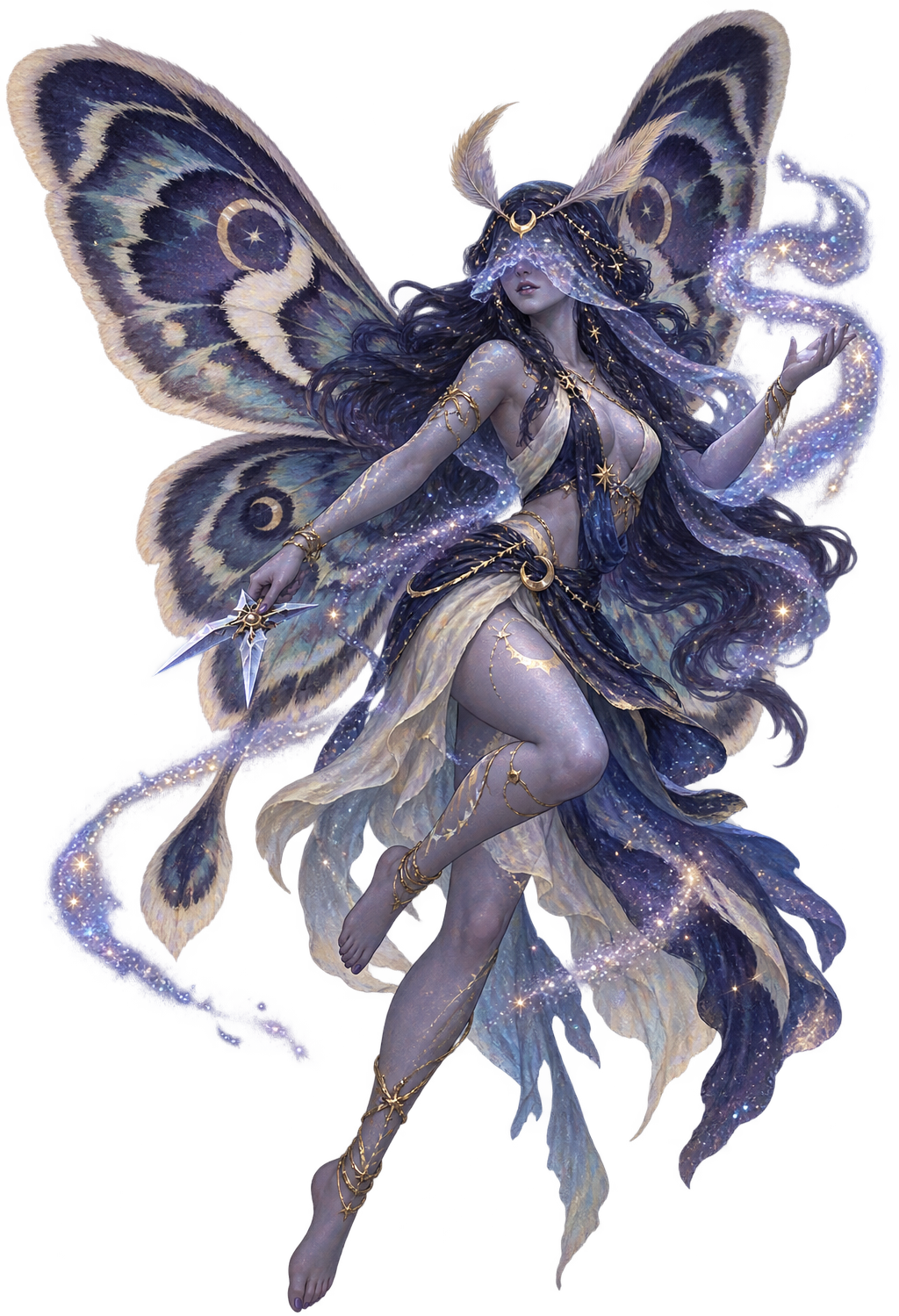
Cynosomas, sometimes called “moth angels” or “daughters of Desna”, are a race of outsiders native to the demiplane of Cynosure. They often depart their home to wander the vastness of the Material Plane, and do so with Desna’s blessing; the goddess encourages her children to choose their own path, even when it leads away from her service. Cynosomas rarely seek battle, but neither do they shy away from it, especially when innocents are threatened or when they encounter foes of their faith. In combat, a cynosoma fights with spell and starknife, using her mobility and glitterdust spell-like ability to allow for sneak attacks. Cynosomas are protectors of all who sleep, though, and no cynosoma ever willingly allows sleeping creatures—even hated enemies—to be harmed. A cynosoma stands 6 feet tall and weighs about 120 pounds.
CG Medium (, , )
An outsider is at least partially composed of the essence (but not necessarily the material) of some plane other than the Material Plane. Some creatures start out as some other type and become outsiders when they attain a higher (or lower) state of spiritual existence. An outsider has the following traits:
• Darkvision 60 feet.
• Unlike most living creatures, an outsider does not have a dual nature—its soul and body form one unit. When an outsider is slain, no soul is set loose. Spells that restore souls to their bodies, such as raise dead, reincarnate, and resurrection, don’t work on an outsider. It takes a different magical effect, such as limited wish, wish, miracle, or true resurrection to restore it to life.
• Proficient with all simple and martial weapons and any weapons mentioned in its entry.
• Proficient with whatever type of armor (light, medium, or heavy) it is described as wearing, as well as all lighter types. Outsiders not indicated as wearing armor are not proficient with armor. Outsiders are proficient with shields if they are proficient with any form of armor.
• Outsiders breathe, but do not need to eat or sleep (although they can do so if they wish).
The Chaotic subtype is usually applied to outsiders native to the chaotic-aligned Outer Planes. Most creatures that have this subtype also have chaotic alignments; however, if their alignments change, they still retain the subtype. Any effect that depends on alignment affects a creature with this subtype as if the creature had a chaotic alignment, no matter what its alignment actually is. The creature also suffers effects according to its actual alignment. A creature with the chaotic subtype overcomes damage reduction as if its natural weapons and any weapons it wields were chaotic-aligned.
The Extraplanar subtype is applied to any creature when it is on a plane other than its native plane. A creature that travels the planes can gain or lose this subtype as it goes from plane to plane. Monster entries assume that encounters with creatures take place on the Material Plane, and every creature whose native plane is not the Material Plane has the extraplanar subtype (but would not have it when on its home plane). Creatures not labeled as extraplanar are natives of the Material Plane, and they gain the extraplanar subtype if they leave the Material Plane. No creature has the extraplanar subtype when it is on a Transitive Plane (the Astral Plane, the Ethereal Plane, or the Plane of Shadow).
The Good subtype is usually applied to outsiders native to the good-aligned Outer Planes. Most creatures that have this subtype also have good alignments; however, if their alignments change, they still retain the subtype. Any effect that depends on alignment affects a creature with this subtype as if the creature had a good alignment, no matter what its alignment actually is. The creature also suffers effects according to its actual alignment. A creature with the good subtype overcomes damage reduction as if its natural weapons and any weapons it wields were good-aligned.
Init +6; Senses 60 ft.; Perception +21
Darkvision is the extraordinary ability to see with no light source at all, out to a range specified. Darkvision is black-and-white only (colors cannot be discerned). It does not allow creatures to see anything that they could not see otherwise—invisible objects are still invisible, and illusions are still visible as what they seem to be. Likewise, darkvision subjects a creature to gaze attacks normally. The presence of light does not spoil darkvision.
DEFENSE
AC 27, touch 22, flat-footed 21 (+6 deflection, +6 Dex, +5 natural)
hp 162 (12d10+96)
Fort +12, Ref +14, Will +16
Defensive Abilities ; 10/evil; cold; electricity 10, fire 10; 23
Damage Reduction (Ex or Su) The creature ignores damage from most weapons and natural attacks. Wounds heal immediately, or the weapon bounces off harmlessly; in either case, the opponent knows the attack was ineffective. The creature takes normal damage from energy attacks, including nonmagical ones, spells, spell-like abilities, and supernatural abilities. A certain kind of weapon can sometimes damage the creature normally, as described below.
The entry indicates the amount of damage ignored, usually 5 to 15 points, and the type of weapon that negates the ability. Some monsters are vulnerable to bludgeoning, piercing, or slashing damage. Others are vulnerable to materials such as adamantine, cold iron, or silver. Attacks from weapons that are not the correct type or material have their damage reduced, although a high enhancement bonus can overcome some forms of damage reduction.
Whenever damage reduction completely negates the damage from an attack, it also negates most special effects that accompany the attack, such as injury poison, injury disease, and effects delivered only when the attack deals damage. Damage reduction does not negate touch attacks, energy damage dealt along with an attack, or energy drain, and it does not affect poisons or diseases delivered by contact, ingestion, or inhalation. If damage reduction completely negates an attack’s damage, that attack does not disrupt a spell being cast.
Damage reduction does not stack with itself. When a creature has more than one form, apply the single form that gives the greatest reduction against the attack; the attacker must overcome only the qualities required by the form being applied.
Some monsters are vulnerable to magic weapons. A weapon with at least a +1 magical enhancement bonus on attack and damage rolls overcomes this damage reduction; the +1 attack bonus from a masterwork weapon does not count as a magical enhancement bonus. Such creatures’ natural weapons, but not their attacks with manufactured weapons, are treated as magic weapons for overcoming damage reduction. Ammunition fired from a projectile weapon with at least a +1 enhancement bonus is treated as magic for overcoming damage reduction.
A few powerful monsters are vulnerable only to epic weapons—magic weapons with at least a +6 enhancement bonus. Such creatures’ natural weapons are also treated as epic weapons for overcoming damage reduction.
Some monsters are vulnerable to chaotic-, evil-, good-, or lawful-aligned weapons. When a cleric casts align weapon, affected weapons might gain one or more of these properties; certain magic weapons also have them. A creature with a chaotic, evil, good, or lawful alignment subtype overcomes matching damage reduction with its natural weapons and wielded weapons as though those attacks had the alignment or alignments matching its subtype. Ammunition fired from an aligned projectile weapon is treated as having that alignment for overcoming damage reduction.
A weapon with a +3 enhancement bonus overcomes damage reduction as though it were made of cold iron and silver. A weapon with a +4 enhancement bonus also overcomes damage reduction as though it were adamantine, but this does not allow it to ignore hardness. A weapon with a +5 enhancement bonus also overcomes alignment-based damage reduction. These equivalences are cumulative with the weapon’s actual material and alignment qualities.
When a damage reduction entry has a — after the slash, no weapon negates it.
If either of two listed attack types can overcome the reduction, a weapon that deals either type does so. If a listed combination is required, the weapon must have every listed type or quality; a weapon with only one remains subject to the damage reduction.
Immunity (Ex or Su) A creature with immunities takes no damage from listed sources. Immunities can also apply to afflictions, conditions, spells (based on level, save type, or school), and other effects. A creature does not suffer any secondary effects that would normally be triggered by an effect it is immune to.
Resistance (Ex) This creature ignores some damage of the indicated type each time it takes damage of that kind, commonly acid, cold, electricity, or fire. The entry indicates the amount and type of damage ignored. Resistance is not immunity, and it applies whether the damage has a mundane or magical source. When resistance completely negates damage from an energy attack, that attack does not disrupt spellcasting. This resistance does not stack with resistance provided by a spell.
A creature with Spell Resistance has the extraordinary ability to avoid the effects of spells and spell-like abilities that directly affect it. To determine if a spell or spell-like ability works against a creature with spell resistance, the caster must make a caster level check (1d20 + caster level). If the result equals or exceeds the creature’s spell resistance, the spell works normally, although the creature is still allowed a saving throw.
OFFENSE
Speed 30 ft., 50 ft. (average)
A creature with a Fly speed can cease or resume flight as a free action on its turn. Without making a check, a flying creature can remain flying at the end of its turn so long as it moves a distance greater than half its speed. It can also turn up to 45 degrees during its turn by sacrificing 5 feet of movement, can rise at half speed at an angle of 45 degrees (ignoring the penalty for diagonal movement), and can descend at any angle at normal speed. At the beginning of its turn, a flying creature can move in a different direction than it did previously without needing a Fly check.
A creature with a natural fly speed receives a bonus (or penalty) on Fly skill checks depending on its maneuverability:
• Clumsy –8
• Poor –4
• Average +0
• Good +4
• Perfect +8
Creatures without a maneuverability rating are assumed to have average maneuverability and take no penalty on Fly checks. These modifiers are already included in the creature’s stat block.
Melee +1 returning starknife +19/+14/+9 (1d4+2/19–20/×3)
Ranged +1 returning starknife +19/+14/+9 (1d4+2/19–20/×3)
Special Attacks , +3d6
Sneak Attack If this creature catches an opponent unable to defend itself effectively from its attack, it can strike a vital spot for extra damage. Its attacks deal the listed sneak attack damage any time its target would be denied a Dexterity bonus to AC (whether the target actually has a Dexterity bonus or not), or when this creature flanks its target. Sneak attack damage is precision damage and is not multiplied on a critical hit. Ranged attacks count as sneak attacks only if the target is within 30 feet. With a weapon that deals nonlethal damage (such as a sap, whip, or unarmed strike), this creature can deal nonlethal sneak attack damage instead of lethal damage. It cannot use a weapon that deals lethal damage to deal nonlethal sneak attack damage, even with the usual –4 penalty. This creature must be able to see the target well enough to pick out a vital spot and must be able to reach that spot. It cannot sneak attack a creature with concealment.
(CL 12th; concentration +17)
Spell-like abilities are magical and work just like spells (though they are not spells and so have no verbal, somatic, focus, or material components). They go away in an antimagic field and are subject to spell resistance if the spell the ability is based on would be subject to spell resistance.
A spell-like ability usually has a limit on how often it can be used. A constant spell-like ability or one that can be used at will has no use limit; unless otherwise stated, a creature can only use a constant spell-like ability on itself. Reactivating a constant spell-like ability is a swift action. Using all other spell-like abilities is a standard action unless noted otherwise, and doing so provokes attacks of opportunity. It is possible to make a concentration check to use a spell-like ability defensively and avoid provoking an attack of opportunity, just as when casting a spell. A spell-like ability can be disrupted just as a spell can be. Spell-like abilities cannot be used to counterspell, nor can they be counterspelled.
For creatures with spell-like abilities, a designated caster level determines how difficult it is to dispel their spell-like effects and defines any level-dependent variables (such as range and duration) the abilities might have. The creature’s caster level never affects which spell-like abilities the creature has; sometimes the given caster level is lower than the level a spellcasting character would need to cast the spell of the same name. If no caster level is specified, the caster level is equal to the creature’s Hit Dice. The saving throw (if any) against a spell-like ability is 10 + the level of the spell the ability resembles or duplicates + the creature’s Charisma modifier unless the creature’s entry explicitly declares another ability-score basis; that individual declaration governs its block and is not overridden by this generic popup.
Some spell-like abilities duplicate spells that work differently when cast by characters of different classes. A monster’s spell-like abilities are presumed to be the sorcerer/wizard versions. If the spell in question is not a sorcerer/wizard spell, then default to cleric, druid, bard, paladin, and ranger, in that order.
At will—dancing lights, dream, restful sleep
3/day—greater teleport (self plus 50 lbs. of gear only), glitterdust (DC 17), dispel evil, plane shift (DC 22)
1/day—cloak of dreams (DC 21), confusion (DC 19), dream travel
STATISTICS
Str 12, Dex 23, Con 26, Int 15, Wis 22, Cha 21
Base Atk +12; +13; CMD 35
When performing a combat maneuver, you must use an action appropriate to the maneuver you are attempting to perform. While many combat maneuvers can be performed as part of an attack action, full-attack action, or attack of opportunity (in place of a melee attack), others require a specific action. Unless otherwise noted, performing a combat maneuver provokes an attack of opportunity from the target of the maneuver. If you are hit by the target, you take the damage normally and apply that amount as a penalty to the attack roll to perform the maneuver. If your target is immobilized, , or otherwise incapacitated, your maneuver automatically succeeds (treat as if you rolled a natural 20 on the attack roll). If your target is , you receive a +4 bonus on your attack roll to perform a combat maneuver against it.
When you attempt to perform a combat maneuver, make an attack roll and add your CMB in place of your normal attack bonus. Add any bonuses you currently have on attack rolls due to spells, feats, and other effects. These bonuses must be applicable to the weapon or attack used to perform the maneuver. The DC of this maneuver is your target’s Combat Maneuver Defense. Combat maneuvers are attack rolls, so you must roll for concealment and take any other penalties that would normally apply to an attack roll.
If your attack roll equals or exceeds the CMD of the target, your maneuver is a success and has the listed effect. Some maneuvers, such as bull rush, have varying levels of success depending on how much your attack roll exceeds the target’s CMD. Rolling a natural 20 while attempting a combat maneuver is always a success (except when attempting to escape from bonds), while rolling a natural 1 is always a failure.
Unconscious creatures are knocked out and . Unconsciousness can result from having negative hit points (but not more than the creature’s Constitution score), or from nonlethal damage in excess of current hit points.
A helpless character is paralyzed, held, bound, sleeping, unconscious, or otherwise completely at an opponent’s mercy. A helpless target is treated as having a Dexterity of 0 (–5 modifier). Melee attacks against a helpless target get a +4 bonus (equivalent to attacking a prone target). Ranged attacks get no special bonus against helpless targets. Rogues can sneak attack helpless targets.
As a full-round action, an enemy can use a melee weapon to deliver a coup de grace to a helpless foe. An enemy can also use a bow or crossbow, provided he is adjacent to the target. The attacker automatically hits and scores a critical hit. (A rogue also gets his sneak attack damage bonus against a helpless foe when delivering a coup de grace.) If the defender survives, he must make a Fortitude save (DC 10 + damage dealt) or die. Delivering a coup de grace provokes attacks of opportunity.
Creatures that are immune to critical hits do not take critical damage, nor do they need to make Fortitude saves to avoid being killed by a coup de grace.
A stunned creature drops everything held, can’t take actions, takes a –2 penalty to AC, and loses its Dexterity bonus to AC (if any). Attackers receive a +4 bonus on attack rolls to perform combat maneuvers against a stunned opponent.
Feats , , (starknife), , ,
Acrobatic You get a +2 bonus on all Acrobatics and Fly skill checks. If you have 10 or more ranks in one of these skills, the bonus increases to +4 for that skill.
Flyby Attack When flying, the creature can take a move action and another standard action at any point during the move. The creature cannot take a second move action during a round when it makes a flyby attack.
Normal: Without this feat, the creature takes a standard action either before or after its move.
Improved Critical (starknife) When using the weapon you selected, your threat range is doubled.
Special: This effect doesn’t stack with any other effect that expands the threat range of a weapon.
Iron Will You get a +2 bonus on all Will saving throws.
Lucid Dreamer You have greater control of the highly morphic qualities and wild magic of the Dimension of Dreams. You gain a +4 bonus on Charisma checks to determine your initial condition when your lucid body enters a dream and when attempting impossible feats in a dreamscape, and a +2 bonus on caster level checks to prevent a spell or spell-like ability from going awry because of wild magic. If someone casts a dream council spell that includes you as a target while you are dreaming, you can enter a shared dreamscape as described in that spell without spending a casting of dream or dream council. If your lucid body dies while in a dreamscape, you wake up .
A fatigued character can neither run nor charge and takes a –2 penalty to Strength and Dexterity. Doing anything that would normally cause fatigue causes the fatigued character to become . After 8 hours of complete rest, fatigued characters are no longer fatigued.
An exhausted character moves at half speed, cannot run or charge, and takes a –6 penalty to Strength and Dexterity. After 1 hour of complete rest, an exhausted character becomes fatigued. A fatigued character becomes exhausted by doing something else that would normally cause fatigue.
Weapon Finesse With a light weapon, rapier, whip, or spiked chain made for a creature of your size category, you may use your Dexterity modifier instead of your Strength modifier on attack rolls. If you carry a shield, its armor check penalty applies to your attack rolls.
Special: Natural weapons are considered light weapons.
Skills Acrobatics +22, Fly +25, Knowledge (geography) +14, Knowledge (planes) +11, Knowledge (religion) +8, Perception +21, Perform (dance) +17, Sense Motive +21, Stealth +21
Languages Celestial, Common
SQ
No Breath (Ex) This monster does not breathe, and is immune to effects that require breathing (such as inhaled poison). This does not give immunity to cloud or gas attacks that do not require breathing.
ECOLOGY
Environment any (Cynosure, Elysium)
Organization solitary, pair, or flight (3–6)
Treasure standard (+1 returning starknife, other treasure)
SPECIAL ABILITIES
Dream Powder (Su) As a standard action, a cynosoma can hurl a cloud of sleep-inducing dust at a creature within 30 feet. That creature must succeed at a DC 21 Will save or immediately fall asleep (as per deep slumber, but with no HD limit). This is a mind-affecting sleep effect. The save DC is Charisma-based.
Stardust (Ex) The shimmering dust that hangs around a cynosoma’s body helps defend her from peril, granting her a +6 deflection bonus to AC. Once per day as a swift action, a cynosoma can cause her stardust to coalesce, granting her concealment for 1d4 rounds.
Valkyrie
Surrounded by lightning, this impressive female warrior wears a gleaming golden breastplate and carries a shining spear.
Valkyries are outsiders who scour the battlefields of the Material Plane for warriors of great prowess and legendary renown. With a glance, a valkyrie can tell who is near death and ready to give up life and who fights on to live another day, and can either claim the soul of the slain or aid the living to continue the fight. Valkyries are always female, and appear as strong and beautiful human, dwarven, or elven women. A human valkyrie is 6 feet tall and weighs close to 200 pounds. Valkyries serve a variety of deities, though they are most often associated with the gods of war, conflict, valor, and courage. Although capable combatants in their own right, valkyries are almost always encountered mounted, typically on flying steeds such as dragon horses, pegasi, or sleipnirs.
CN Medium ()
An outsider is at least partially composed of the essence (but not necessarily the material) of some plane other than the Material Plane. Some creatures start out as some other type and become outsiders when they attain a higher (or lower) state of spiritual existence. An outsider has the following traits:
• Darkvision 60 feet.
• Unlike most living creatures, an outsider does not have a dual nature—its soul and body form one unit. When an outsider is slain, no soul is set loose. Spells that restore souls to their bodies, such as raise dead, reincarnate, and resurrection, don’t work on an outsider. It takes a different magical effect, such as limited wish, wish, miracle, or true resurrection to restore it to life.
• Proficient with all simple and martial weapons and any weapons mentioned in its entry.
• Proficient with whatever type of armor (light, medium, or heavy) it is described as wearing, as well as all lighter types. Outsiders not indicated as wearing armor are not proficient with armor. Outsiders are proficient with shields if they are proficient with any form of armor.
• Outsiders breathe, but do not need to eat or sleep (although they can do so if they wish).
The Extraplanar subtype is applied to any creature when it is on a plane other than its native plane. A creature that travels the planes can gain or lose this subtype as it goes from plane to plane. Monster entries assume that encounters with creatures take place on the Material Plane, and every creature whose native plane is not the Material Plane has the extraplanar subtype (but would not have it when on its home plane). Creatures not labeled as extraplanar are natives of the Material Plane, and they gain the extraplanar subtype if they leave the Material Plane. No creature has the extraplanar subtype when it is on a Transitive Plane (the Astral Plane, the Ethereal Plane, or the Plane of Shadow).
Init +3; Senses 60 ft., deathwatch; Perception +24
Darkvision is the extraordinary ability to see with no light source at all, out to a range specified. Darkvision is black-and-white only (colors cannot be discerned). It does not allow creatures to see anything that they could not see otherwise—invisible objects are still invisible, and illusions are still visible as what they seem to be. Likewise, darkvision subjects a creature to gaze attacks normally. The presence of light does not spoil darkvision.
DEFENSE
AC 27, touch 19, 24 (+8 armor, +6 deflection, +3 Dex)
A creature that has not yet acted during a combat is flat-footed, unable to react normally to the situation. A flat-footed creature cannot take immediate actions and loses their Dexterity bonus to AC and CMD (if any). The creature cannot make attacks of opportunity unless they have the Combat Reflexes feat or Uncanny Dodge class ability.
hp 168 (16d10+80)
Fort +10, Ref +13, Will +15
10/cold iron and lawful; cold, electricity, poison; acid 10, fire 10; 23
Damage Reduction (Ex or Su) The creature ignores damage from most weapons and natural attacks. Wounds heal immediately, or the weapon bounces off harmlessly; in either case, the opponent knows the attack was ineffective. The creature takes normal damage from energy attacks, including nonmagical ones, spells, spell-like abilities, and supernatural abilities. A certain kind of weapon can sometimes damage the creature normally, as described below.
The entry indicates the amount of damage ignored, usually 5 to 15 points, and the type of weapon that negates the ability. Some monsters are vulnerable to bludgeoning, piercing, or slashing damage. Others are vulnerable to materials such as adamantine, cold iron, or silver. Attacks from weapons that are not the correct type or material have their damage reduced, although a high enhancement bonus can overcome some forms of damage reduction.
Whenever damage reduction completely negates the damage from an attack, it also negates most special effects that accompany the attack, such as injury poison, injury disease, and effects delivered only when the attack deals damage. Damage reduction does not negate touch attacks, energy damage dealt along with an attack, or energy drain, and it does not affect poisons or diseases delivered by contact, ingestion, or inhalation. If damage reduction completely negates an attack’s damage, that attack does not disrupt a spell being cast.
Damage reduction does not stack with itself. When a creature has more than one form, apply the single form that gives the greatest reduction against the attack; the attacker must overcome only the qualities required by the form being applied.
Some monsters are vulnerable to magic weapons. A weapon with at least a +1 magical enhancement bonus on attack and damage rolls overcomes this damage reduction; the +1 attack bonus from a masterwork weapon does not count as a magical enhancement bonus. Such creatures’ natural weapons, but not their attacks with manufactured weapons, are treated as magic weapons for overcoming damage reduction. Ammunition fired from a projectile weapon with at least a +1 enhancement bonus is treated as magic for overcoming damage reduction.
A few powerful monsters are vulnerable only to epic weapons—magic weapons with at least a +6 enhancement bonus. Such creatures’ natural weapons are also treated as epic weapons for overcoming damage reduction.
Some monsters are vulnerable to chaotic-, evil-, good-, or lawful-aligned weapons. When a cleric casts align weapon, affected weapons might gain one or more of these properties; certain magic weapons also have them. A creature with a chaotic, evil, good, or lawful alignment subtype overcomes matching damage reduction with its natural weapons and wielded weapons as though those attacks had the alignment or alignments matching its subtype. Ammunition fired from an aligned projectile weapon is treated as having that alignment for overcoming damage reduction.
A weapon with a +3 enhancement bonus overcomes damage reduction as though it were made of cold iron and silver. A weapon with a +4 enhancement bonus also overcomes damage reduction as though it were adamantine, but this does not allow it to ignore hardness. A weapon with a +5 enhancement bonus also overcomes alignment-based damage reduction. These equivalences are cumulative with the weapon’s actual material and alignment qualities.
When a damage reduction entry has a — after the slash, no weapon negates it.
If either of two listed attack types can overcome the reduction, a weapon that deals either type does so. If a listed combination is required, the weapon must have every listed type or quality; a weapon with only one remains subject to the damage reduction.
Immunity (Ex or Su) A creature with immunities takes no damage from listed sources. Immunities can also apply to afflictions, conditions, spells (based on level, save type, or school), and other effects. A creature does not suffer any secondary effects that would normally be triggered by an effect it is immune to.
Resistance (Ex) This creature ignores some damage of the indicated type each time it takes damage of that kind, commonly acid, cold, electricity, or fire. The entry indicates the amount and type of damage ignored. Resistance is not immunity, and it applies whether the damage has a mundane or magical source. When resistance completely negates damage from an energy attack, that attack does not disrupt spellcasting. This resistance does not stack with resistance provided by a spell.
A creature with Spell Resistance has the extraordinary ability to avoid the effects of spells and spell-like abilities that directly affect it. To determine if a spell or spell-like ability works against a creature with spell resistance, the caster must make a caster level check (1d20 + caster level). If the result equals or exceeds the creature’s spell resistance, the spell works normally, although the creature is still allowed a saving throw.
OFFENSE
Speed 30 ft., 100 ft. (perfect)
A creature with a Fly speed can cease or resume flight as a free action on its turn. Without making a check, a flying creature can remain flying at the end of its turn so long as it moves a distance greater than half its speed. It can also turn up to 45 degrees during its turn by sacrificing 5 feet of movement, can rise at half speed at an angle of 45 degrees (ignoring the penalty for diagonal movement), and can descend at any angle at normal speed. At the beginning of its turn, a flying creature can move in a different direction than it did previously without needing a Fly check.
A creature with a natural fly speed receives a bonus (or penalty) on Fly skill checks depending on its maneuverability:
• Clumsy –8
• Poor –4
• Average +0
• Good +4
• Perfect +8
Creatures without a maneuverability rating are assumed to have average maneuverability and take no penalty on Fly checks. These modifiers are already included in the creature’s stat block.
Melee +2 returning spear +23/+18/+13/+8 (1d8+8/×3)
Ranged +2 returning spear +22 (1d8+6/×3)
(CL 12th; concentration +18)
Spell-like abilities are magical and work just like spells (though they are not spells and so have no verbal, somatic, focus, or material components). They go away in an antimagic field and are subject to spell resistance if the spell the ability is based on would be subject to spell resistance.
A spell-like ability usually has a limit on how often it can be used. A constant spell-like ability or one that can be used at will has no use limit; unless otherwise stated, a creature can only use a constant spell-like ability on itself. Reactivating a constant spell-like ability is a swift action. Using all other spell-like abilities is a standard action unless noted otherwise, and doing so provokes attacks of opportunity. It is possible to make a concentration check to use a spell-like ability defensively and avoid provoking an attack of opportunity, just as when casting a spell. A spell-like ability can be disrupted just as a spell can be. Spell-like abilities cannot be used to counterspell, nor can they be counterspelled.
For creatures with spell-like abilities, a designated caster level determines how difficult it is to dispel their spell-like effects and defines any level-dependent variables (such as range and duration) the abilities might have. The creature’s caster level never affects which spell-like abilities the creature has; sometimes the given caster level is lower than the level a spellcasting character would need to cast the spell of the same name. If no caster level is specified, the caster level is equal to the creature’s Hit Dice. The saving throw (if any) against a spell-like ability is 10 + the level of the spell the ability resembles or duplicates + the creature’s Charisma modifier unless the creature’s entry explicitly declares another ability-score basis; that individual declaration governs its block and is not overridden by this generic popup.
Some spell-like abilities duplicate spells that work differently when cast by characters of different classes. A monster’s spell-like abilities are presumed to be the sorcerer/wizard versions. If the spell in question is not a sorcerer/wizard spell, then default to cleric, druid, bard, paladin, and ranger, in that order.
Constant—deathwatch, tongues
At will—aid, death ward, gentle repose, plane shift (self and mount only)
3/day—call lightning storm (DC 21), divine power, geas/quest
1/day—breath of life, heal, (level 8, 1 sleipnir 100%)
A creature with the Summon SLA can summon other specific creatures of its kind much as though casting a summon monster spell, but it usually has only a limited chance of success (as specified in the creature’s entry). Roll d%: On a failure, no creature answers the summons. Summoned creatures automatically return whence they came after 1 hour. A creature summoned in this way cannot use any spells or spell-like abilities that require material components costing more than 1 gp unless those components are supplied, nor can it use its own summon ability for 1 hour. An appropriate spell level is given for each summoning ability for purposes of Will saves, caster level checks, and concentration checks. No experience points are awarded for defeating summoned monsters.
STATISTICS
Str 18, Dex 17, Con 20, Int 13, Wis 20, Cha 23
Base Atk +16; +20; CMD 39
When performing a combat maneuver, you must use an action appropriate to the maneuver you are attempting to perform. While many combat maneuvers can be performed as part of an attack action, full-attack action, or attack of opportunity (in place of a melee attack), others require a specific action. Unless otherwise noted, performing a combat maneuver provokes an attack of opportunity from the target of the maneuver. If you are hit by the target, you take the damage normally and apply that amount as a penalty to the attack roll to perform the maneuver. If your target is immobilized, unconscious, or otherwise incapacitated, your maneuver automatically succeeds (treat as if you rolled a natural 20 on the attack roll). If your target is stunned, you receive a +4 bonus on your attack roll to perform a combat maneuver against it.
When you attempt to perform a combat maneuver, make an attack roll and add your CMB in place of your normal attack bonus. Add any bonuses you currently have on attack rolls due to spells, feats, and other effects. These bonuses must be applicable to the weapon or attack used to perform the maneuver. The DC of this maneuver is your target’s Combat Maneuver Defense. Combat maneuvers are attack rolls, so you must roll for concealment and take any other penalties that would normally apply to an attack roll.
If your attack roll equals or exceeds the CMD of the target, your maneuver is a success and has the listed effect. Some maneuvers, such as bull rush, have varying levels of success depending on how much your attack roll exceeds the target’s CMD. Rolling a natural 20 while attempting a combat maneuver is always a success (except when attempting to escape from bonds), while rolling a natural 1 is always a failure.
Feats , , , (Ride), , , , (spear)
Mounted Combat Once per round when your mount is hit in combat, you may attempt a Ride check (as an immediate action) to negate the hit. The hit is negated if your Ride check result is greater than the opponent’s attack roll.
Power Attack You can choose to take a –1 penalty on all melee attack rolls and combat maneuver checks to gain a +2 bonus on all melee damage rolls. This bonus to damage is increased by half (+50%) if you are making an attack with a two-handed weapon, a one-handed weapon using two hands, or a primary natural weapon that adds 1-1/2 times your Strength modifier on damage rolls. This bonus to damage is halved (–50%) if you are making an attack with an off-hand weapon or secondary natural weapon. When your base attack bonus reaches +4, and every 4 points thereafter, the penalty increases by –1 and the bonus to damage increases by +2. You must choose to use this feat before making an attack roll, and its effects last until your next turn. The bonus damage does not apply to touch attacks or effects that do not deal hit point damage.
Ride-By Attack When you are mounted and use the charge action, you may move and attack as if with a standard charge and then move again (continuing the straight line of the charge). Your total movement for the round can’t exceed double your mounted speed. You and your mount do not provoke an attack of opportunity from the opponent that you attack.
Skill Focus (Ride) You get a +3 bonus on all checks involving the chosen skill. If you have 10 or more ranks in that skill, this bonus increases to +6.
Spirited Charge When mounted and using the charge action, you deal double damage with a melee weapon (or triple damage with a lance).
Trample When you attempt to overrun an opponent while mounted, your target may not choose to avoid you. Your mount may make one hoof attack against any target you knock down, gaining the standard +4 bonus on attack rolls against targets.
The character is lying on the ground. A prone attacker has a –4 penalty on melee attack rolls and cannot use a ranged weapon (except for a crossbow). A prone defender gains a +4 bonus to Armor Class against ranged attacks, but takes a –4 penalty to AC against melee attacks. Standing up is a move-equivalent action that provokes an attack of opportunity.
Vital Strike When you use the attack action, you can make one attack at your highest base attack bonus that deals additional damage. Roll the weapon’s damage dice for the attack twice and add the results together before adding bonuses from Strength, weapon abilities (such as flaming), precision-based damage, and other damage bonuses. These extra weapon damage dice are not multiplied on a critical hit, but are added to the total.
Weapon Focus (spear) You gain a +1 bonus on all attack rolls you make using the selected weapon.
Skills Fly +27, Handle Animal +25, Heal +24, Knowledge (planes) +20, Perception +24, Ride +28, Sense Motive +24
Languages Celestial, Common; tongues
SQ , ,
ECOLOGY
Environment any
Organization solitary or ride (2–8 valkyries)
Treasure triple (+2 breastplate, +2 returning spear, other treasure)
SPECIAL ABILITIES
Battle Trained (Ex) A valkyrie is proficient with all armor. Armor never impacts a valkyrie’s speed, nor does a valkyrie take armor check penalties on Ride checks.
Choose the Slain (Su) A valkyrie can draw the soul from a newly dead body and store it in her spear for transport to the Outer Planes. This functions as soul bind, but the dead creature must be willing to have its soul taken. If the creature is unwilling, this ability has no effect.
Holy Zeal (Su) A valkyrie adds her Charisma modifier as a deflection bonus to her Armor Class.
Empusa
This beautiful woman has red antennae, gossamer insectile wings, a wasp’s legs, and a serpentine whip.

The empusas are Calistria’s handmaidens and elite agents. Effortlessly passing for elves, empusas move secretly through society, manipulating mortals and influencing events to achieve their missions of vengeance. An empusa stands 6 feet tall and weighs 120 pounds.
CN Medium (, , )
An outsider is at least partially composed of the essence (but not necessarily the material) of some plane other than the Material Plane. Some creatures start out as some other type and become outsiders when they attain a higher (or lower) state of spiritual existence. An outsider has the following traits:
• Darkvision 60 feet.
• Unlike most living creatures, an outsider does not have a dual nature—its soul and body form one unit. When an outsider is slain, no soul is set loose. Spells that restore souls to their bodies, such as raise dead, reincarnate, and resurrection, don’t work on an outsider. It takes a different magical effect, such as limited wish, wish, miracle, or true resurrection to restore it to life.
• Proficient with all simple and martial weapons and any weapons mentioned in its entry.
• Proficient with whatever type of armor (light, medium, or heavy) it is described as wearing, as well as all lighter types. Outsiders not indicated as wearing armor are not proficient with armor. Outsiders are proficient with shields if they are proficient with any form of armor.
• Outsiders breathe, but do not need to eat or sleep (although they can do so if they wish).
The Chaotic subtype is usually applied to outsiders native to the chaotic-aligned Outer Planes. Most creatures that have this subtype also have chaotic alignments; however, if their alignments change, they still retain the subtype. Any effect that depends on alignment affects a creature with this subtype as if the creature had a chaotic alignment, no matter what its alignment actually is. The creature also suffers effects according to its actual alignment. A creature with the chaotic subtype overcomes damage reduction as if its natural weapons and any weapons it wields were chaotic-aligned.
The Extraplanar subtype is applied to any creature when it is on a plane other than its native plane. A creature that travels the planes can gain or lose this subtype as it goes from plane to plane. Monster entries assume that encounters with creatures take place on the Material Plane, and every creature whose native plane is not the Material Plane has the extraplanar subtype (but would not have it when on its home plane). Creatures not labeled as extraplanar are natives of the Material Plane, and they gain the extraplanar subtype if they leave the Material Plane. No creature has the extraplanar subtype when it is on a Transitive Plane (the Astral Plane, the Ethereal Plane, or the Plane of Shadow).
A shapechanger has the supernatural ability to assume one or more alternate forms. Many magical effects allow some kind of shapeshifting, and not every creature that can change shapes has the shapechanger subtype. A shapechanger possesses the following traits (unless otherwise noted in a creature’s entry).
• Proficient with its natural weapons, with simple weapons, and with any weapons mentioned in the creature’s description.
• Proficient with any armor mentioned in the creature’s description, as well as all lighter forms. If no form of armor is mentioned, the shapechanger is not proficient with armor. A shapechanger is proficient with shields if it is proficient with any type of armor.
Init +8; Senses 60 ft., ; Perception +21
Darkvision is the extraordinary ability to see with no light source at all, out to a range specified. Darkvision is black-and-white only (colors cannot be discerned). It does not allow creatures to see anything that they could not see otherwise—invisible objects are still invisible, and illusions are still visible as what they seem to be. Likewise, darkvision subjects a creature to gaze attacks normally. The presence of light does not spoil darkvision.
Low-Light Vision (Ex) A creature with low-light vision can see twice as far as a human in starlight, moonlight, torchlight, and similar conditions of dim light. It retains the ability to distinguish color and detail under these conditions.
DEFENSE
AC 28, touch 18, flat-footed 20 (+8 Dex, +10 natural)
hp 174 (12d10+108); 5
Fast Healing (Ex) This creature regains hit points swiftly, usually 1 or more per round, as given in the creature’s entry. Except as noted below, fast healing is just like natural healing. Fast healing does not restore hit points lost from starvation, suffocation, or thirst, nor does it allow a creature to regrow lost body parts. Unless otherwise stated, it does not allow lost body parts to be reattached. Fast healing continues to function (even at negative hit points) until a creature dies, at which point the effects of fast healing end immediately.
Fort +17, Ref +16, Will +10
10/lawful; disease, electricity, poison; 24
Damage Reduction (Ex or Su) The creature ignores damage from most weapons and natural attacks. Wounds heal immediately, or the weapon bounces off harmlessly; in either case, the opponent knows the attack was ineffective. The creature takes normal damage from energy attacks, including nonmagical ones, spells, spell-like abilities, and supernatural abilities. A certain kind of weapon can sometimes damage the creature normally, as described below.
The entry indicates the amount of damage ignored, usually 5 to 15 points, and the type of weapon that negates the ability. Some monsters are vulnerable to bludgeoning, piercing, or slashing damage. Others are vulnerable to materials such as adamantine, cold iron, or silver. Attacks from weapons that are not the correct type or material have their damage reduced, although a high enhancement bonus can overcome some forms of damage reduction.
Whenever damage reduction completely negates the damage from an attack, it also negates most special effects that accompany the attack, such as injury poison, injury disease, and effects delivered only when the attack deals damage. Damage reduction does not negate touch attacks, energy damage dealt along with an attack, or energy drain, and it does not affect poisons or diseases delivered by contact, ingestion, or inhalation. If damage reduction completely negates an attack’s damage, that attack does not disrupt a spell being cast.
Damage reduction does not stack with itself. When a creature has more than one form, apply the single form that gives the greatest reduction against the attack; the attacker must overcome only the qualities required by the form being applied.
Some monsters are vulnerable to magic weapons. A weapon with at least a +1 magical enhancement bonus on attack and damage rolls overcomes this damage reduction; the +1 attack bonus from a masterwork weapon does not count as a magical enhancement bonus. Such creatures’ natural weapons, but not their attacks with manufactured weapons, are treated as magic weapons for overcoming damage reduction. Ammunition fired from a projectile weapon with at least a +1 enhancement bonus is treated as magic for overcoming damage reduction.
A few powerful monsters are vulnerable only to epic weapons—magic weapons with at least a +6 enhancement bonus. Such creatures’ natural weapons are also treated as epic weapons for overcoming damage reduction.
Some monsters are vulnerable to chaotic-, evil-, good-, or lawful-aligned weapons. When a cleric casts align weapon, affected weapons might gain one or more of these properties; certain magic weapons also have them. A creature with a chaotic, evil, good, or lawful alignment subtype overcomes matching damage reduction with its natural weapons and wielded weapons as though those attacks had the alignment or alignments matching its subtype. Ammunition fired from an aligned projectile weapon is treated as having that alignment for overcoming damage reduction.
A weapon with a +3 enhancement bonus overcomes damage reduction as though it were made of cold iron and silver. A weapon with a +4 enhancement bonus also overcomes damage reduction as though it were adamantine, but this does not allow it to ignore hardness. A weapon with a +5 enhancement bonus also overcomes alignment-based damage reduction. These equivalences are cumulative with the weapon’s actual material and alignment qualities.
When a damage reduction entry has a — after the slash, no weapon negates it.
If either of two listed attack types can overcome the reduction, a weapon that deals either type does so. If a listed combination is required, the weapon must have every listed type or quality; a weapon with only one remains subject to the damage reduction.
Immunity (Ex or Su) A creature with immunities takes no damage from listed sources. Immunities can also apply to afflictions, conditions, spells (based on level, save type, or school), and other effects. A creature does not suffer any secondary effects that would normally be triggered by an effect it is immune to.
A creature with Spell Resistance has the extraordinary ability to avoid the effects of spells and spell-like abilities that directly affect it. To determine if a spell or spell-like ability works against a creature with spell resistance, the caster must make a caster level check (1d20 + caster level). If the result equals or exceeds the creature’s spell resistance, the spell works normally, although the creature is still allowed a saving throw.
OFFENSE
Speed 30 ft., 60 ft. (good)
A creature with a Fly speed can cease or resume flight as a free action on its turn. Without making a check, a flying creature can remain flying at the end of its turn so long as it moves a distance greater than half its speed. It can also turn up to 45 degrees during its turn by sacrificing 5 feet of movement, can rise at half speed at an angle of 45 degrees (ignoring the penalty for diagonal movement), and can descend at any angle at normal speed. At the beginning of its turn, a flying creature can move in a different direction than it did previously without needing a Fly check.
A creature with a natural fly speed receives a bonus (or penalty) on Fly skill checks depending on its maneuverability:
• Clumsy –8
• Poor –4
• Average +0
• Good +4
• Perfect +8
Creatures without a maneuverability rating are assumed to have average maneuverability and take no penalty on Fly checks. These modifiers are already included in the creature’s stat block.
Melee +22/+17/+12 (1d6+5/×2 plus )
Poison (Ex or Su) This creature can deliver poison by the method specified in its entry. The entry gives the poison’s save, frequency, effect, and cure. When no other formula is given, the save is usually Fortitude DC 10 + 1/2 the creature’s racial Hit Dice + its Constitution modifier. neutralize poison and similar effects remove poison normally.
Space 5 ft.; Reach 5 ft. (10 ft. with lash)
Special Attacks , +3d6
Sneak Attack If this creature catches an opponent unable to defend itself effectively from its attack, it can strike a vital spot for extra damage. Its attacks deal the listed sneak attack damage any time its target would be denied a Dexterity bonus to AC (whether the target actually has a Dexterity bonus or not), or when this creature flanks its target. Sneak attack damage is precision damage and is not multiplied on a critical hit. Ranged attacks count as sneak attacks only if the target is within 30 feet. With a weapon that deals nonlethal damage (such as a sap, whip, or unarmed strike), this creature can deal nonlethal sneak attack damage instead of lethal damage. It cannot use a weapon that deals lethal damage to deal nonlethal sneak attack damage, even with the usual –4 penalty. This creature must be able to see the target well enough to pick out a vital spot and must be able to reach that spot. It cannot sneak attack a creature with concealment.
(CL 13th; concentration +19)
Spell-like abilities are magical and work just like spells (though they are not spells and so have no verbal, somatic, focus, or material components). They go away in an antimagic field and are subject to spell resistance if the spell the ability is based on would be subject to spell resistance.
A spell-like ability usually has a limit on how often it can be used. A constant spell-like ability or one that can be used at will has no use limit; unless otherwise stated, a creature can only use a constant spell-like ability on itself. Reactivating a constant spell-like ability is a swift action. Using all other spell-like abilities is a standard action unless noted otherwise, and doing so provokes attacks of opportunity. It is possible to make a concentration check to use a spell-like ability defensively and avoid provoking an attack of opportunity, just as when casting a spell. A spell-like ability can be disrupted just as a spell can be. Spell-like abilities cannot be used to counterspell, nor can they be counterspelled.
For creatures with spell-like abilities, a designated caster level determines how difficult it is to dispel their spell-like effects and defines any level-dependent variables (such as range and duration) the abilities might have. The creature’s caster level never affects which spell-like abilities the creature has; sometimes the given caster level is lower than the level a spellcasting character would need to cast the spell of the same name. If no caster level is specified, the caster level is equal to the creature’s Hit Dice. The saving throw (if any) against a spell-like ability is 10 + the level of the spell the ability resembles or duplicates + the creature’s Charisma modifier unless the creature’s entry explicitly declares another ability-score basis; that individual declaration governs its block and is not overridden by this generic popup.
Some spell-like abilities duplicate spells that work differently when cast by characters of different classes. A monster’s spell-like abilities are presumed to be the sorcerer/wizard versions. If the spell in question is not a sorcerer/wizard spell, then default to cleric, druid, bard, paladin, and ranger, in that order.
Constant—tongues
At will—invisibility, major image (DC 20), modify memory (DC 20), suggestion (DC 19)
3/day—charm monster (DC 20), phantasmal vengeance (DC 20), teleport (self plus 50 lbs. of gear only)
1/day—mislead (DC 22), true seeing
STATISTICS
Str 17, Dex 26, Con 29, Int 18, Wis 22, Cha 23
Base Atk +12; +20; CMD 33
When performing a combat maneuver, you must use an action appropriate to the maneuver you are attempting to perform. While many combat maneuvers can be performed as part of an attack action, full-attack action, or attack of opportunity (in place of a melee attack), others require a specific action. Unless otherwise noted, performing a combat maneuver provokes an attack of opportunity from the target of the maneuver. If you are hit by the target, you take the damage normally and apply that amount as a penalty to the attack roll to perform the maneuver. If your target is immobilized, , or otherwise incapacitated, your maneuver automatically succeeds (treat as if you rolled a natural 20 on the attack roll). If your target is , you receive a +4 bonus on your attack roll to perform a combat maneuver against it.
When you attempt to perform a combat maneuver, make an attack roll and add your CMB in place of your normal attack bonus. Add any bonuses you currently have on attack rolls due to spells, feats, and other effects. These bonuses must be applicable to the weapon or attack used to perform the maneuver. The DC of this maneuver is your target’s Combat Maneuver Defense. Combat maneuvers are attack rolls, so you must roll for concealment and take any other penalties that would normally apply to an attack roll.
If your attack roll equals or exceeds the CMD of the target, your maneuver is a success and has the listed effect. Some maneuvers, such as bull rush, have varying levels of success depending on how much your attack roll exceeds the target’s CMD. Rolling a natural 20 while attempting a combat maneuver is always a success (except when attempting to escape from bonds), while rolling a natural 1 is always a failure.
Unconscious creatures are knocked out and . Unconsciousness can result from having negative hit points (but not more than the creature’s Constitution score), or from nonlethal damage in excess of current hit points.
A helpless character is paralyzed, held, bound, sleeping, unconscious, or otherwise completely at an opponent’s mercy. A helpless target is treated as having a Dexterity of 0 (–5 modifier). Melee attacks against a helpless target get a +4 bonus (equivalent to attacking a prone target). Ranged attacks get no special bonus against helpless targets. Rogues can sneak attack helpless targets.
As a full-round action, an enemy can use a melee weapon to deliver a coup de grace to a helpless foe. An enemy can also use a bow or crossbow, provided he is adjacent to the target. The attacker automatically hits and scores a critical hit. (A rogue also gets his sneak attack damage bonus against a helpless foe when delivering a coup de grace.) If the defender survives, he must make a Fortitude save (DC 10 + damage dealt) or die. Delivering a coup de grace provokes attacks of opportunity.
Creatures that are immune to critical hits do not take critical damage, nor do they need to make Fortitude saves to avoid being killed by a coup de grace.
A stunned creature drops everything held, can’t take actions, takes a –2 penalty to AC, and loses its Dexterity bonus to AC (if any). Attackers receive a +4 bonus on attack rolls to perform combat maneuvers against a stunned opponent.
Feats , , , , ,
Agile Maneuvers You add your Dexterity bonus to your base attack bonus and size bonus when determining your Combat Maneuver Bonus (see Combat) instead of your Strength bonus.
Normal: You add your Strength bonus to your base attack bonus and size bonus when determining your Combat Maneuver Bonus.
Combat Expertise You can choose to take a –1 penalty on melee attack rolls and combat maneuver checks to gain a +1 dodge bonus to your Armor Class. When your base attack bonus reaches +4, and every +4 thereafter, the penalty increases by –1 and the dodge bonus increases by +1. You can only choose to use this feat when you declare that you are making an attack or a full-attack action with a melee weapon. The effects of this feat last until your next turn.
Combat Reflexes You may make a number of additional attacks of opportunity per round equal to your Dexterity bonus. With this feat, you may also make attacks of opportunity while .
Normal: A character without this feat can make only one attack of opportunity per round and can’t make attacks of opportunity while .
Special: The Combat Reflexes feat does not allow a rogue to use her opportunist ability more than once per round.
A creature that has not yet acted during a combat is flat-footed, unable to react normally to the situation. A flat-footed creature cannot take immediate actions and loses their Dexterity bonus to AC and CMD (if any). The creature cannot make attacks of opportunity unless they have the Combat Reflexes feat or Uncanny Dodge class ability.
Deceitful You get a +2 bonus on all Bluff and Disguise skill checks. If you have 10 or more ranks in one of these skills, the bonus increases to +4 for that skill.
Improved Feint You can make a Bluff check to feint in combat as a move action.
Normal: Feinting in combat is a standard action.
Weapon Finesse With a light weapon, rapier, whip, or spiked chain made for a creature of your size category, you may use your Dexterity modifier instead of your Strength modifier on attack rolls. If you carry a shield, its armor check penalty applies to your attack rolls.
Special: Natural weapons are considered light weapons.
Skills Acrobatics +23, Bluff +25, Disguise +25, Fly +27, Knowledge (planes) +13, Knowledge (religion) +10, Perception +21, Ride +23, Sense Motive +21, Sleight of Hand +23, Stealth +23
Languages Common, Elven; tongues
SQ (elf, alter self)
Change Shape (Su) A creature with this special quality has the ability to assume the appearance of a specific creature or type of creature (usually a humanoid), but retains most of its own physical qualities. A creature cannot change shape to a form more than one size category smaller or larger than its original form. This ability functions as a polymorph spell, the type of which is listed in the creature’s description, but the creature does not adjust its ability scores (although it gains any other abilities of the creature it mimics). Unless otherwise stated, it can remain in an alternate form indefinitely. Some creatures, such as lycanthropes, can transform into unique forms with special modifiers and abilities. These creatures do adjust their ability scores, as noted in their description.
ECOLOGY
Environment any (Elysium)
Organization solitary, pair, or vengeance (3–6)
Treasure standard
SPECIAL ABILITIES
Lash (Su) As a move action, an empusa can manifest a whip-like weapon that appears to be a coiling serpent—once manifested, the lash exists as long as the empusa carries it. A lash vanishes if it is disarmed or the empusa drops it or is slain. An empusa’s lash has a reach of 10 feet and deals 1d6 points of slashing damage on a hit. In addition, a creature damaged by the lash is affected by its toxic venom.
Lash Venom: Lash—injury; save Fort DC 25; frequency 1/round for 6 rounds; effect 1d4 Wis damage plus for 1 round; cure 2 consecutive saves. The save DC is Constitution-based.
Phantasmal Vengeance (Sp) This spell-like ability functions as phantasmal killer, save that the image it creates is of a creature or person who the viewer has wronged in their past (or of the empusa herself if there are no other appropriate options). If the target of a phantasmal vengeance fails his Fortitude save, the empusa can opt to have the victim become for 1 hour rather than die from fear.
A confused creature is mentally befuddled and cannot act normally. A confused creature cannot tell the difference between ally and foe, treating all creatures as enemies. Allies wishing to cast a beneficial spell that requires a touch on a confused creature must succeed on a melee touch attack. If a confused creature is attacked, it retaliates by attacking the creature that last attacked it until that creature is dead or out of sight.
If the confused creature is not retaliating, roll on the following table at the beginning of each confused subject’s turn each round to see what the subject does in that round:
• 01–25 Act normally.
• 26–50 Do nothing but babble incoherently.
• 51–75 Deal 1d8 points of damage + Str modifier to self with item in hand.
• 76–100 Attack nearest creature (excluding subject’s own familiar).
A confused creature who can’t carry out the indicated action does nothing but babble incoherently. Attackers are not at any special advantage when attacking a confused creature. Any confused creature who is attacked automatically attacks its attackers on its next turn, as long as it is still confused when its turn comes. Note that a confused creature will not make attacks of opportunity against anything that it is not already devoted to attacking (either because of its most recent action or because it is retaliating).
(Note: The italicized text is unofficial but added to provide additional clarity.)
A paralyzed character is frozen in place and unable to move or act. A paralyzed character has effective Dexterity and Strength scores of 0 and is , but can take purely mental actions (such as the use of a SLA). A winged creature flying in the air at the time that it becomes paralyzed cannot flap its wings and falls. A paralyzed swimmer can’t swim and may drown. A creature can move through a space occupied by a paralyzed creature—ally or not. Each square occupied by a paralyzed creature, however, counts as 2 squares to move through.
A helpless character is paralyzed, held, bound, sleeping, unconscious, or otherwise completely at an opponent’s mercy. A helpless target is treated as having a Dexterity of 0 (–5 modifier). Melee attacks against a helpless target get a +4 bonus (equivalent to attacking a prone target). Ranged attacks get no special bonus against helpless targets. Rogues can sneak attack helpless targets.
As a full-round action, an enemy can use a melee weapon to deliver a coup de grace to a helpless foe. An enemy can also use a bow or crossbow, provided he is adjacent to the target. The attacker automatically hits and scores a critical hit. (A rogue also gets his sneak attack damage bonus against a helpless foe when delivering a coup de grace.) If the defender survives, he must make a Fortitude save (DC 10 + damage dealt) or die. Delivering a coup de grace provokes attacks of opportunity.
Creatures that are immune to critical hits do not take critical damage, nor do they need to make Fortitude saves to avoid being killed by a coup de grace.
Ghaele
This elegantly armored sentinel stands alert, her eyes radiating divine light and her noble blade crackling with power.
Ghaeles are the most knightly of the azatas, hunting fiends, dragons, and undead with equal vigor. Most appear like idealized humans or elves and are quick to smile—and equally quick to strike against those they perceive as wicked.
CG Medium (, , , , )
An outsider is at least partially composed of the essence (but not necessarily the material) of some plane other than the Material Plane. Some creatures start out as some other type and become outsiders when they attain a higher (or lower) state of spiritual existence. An outsider has the following traits:
• Darkvision 60 feet.
• Unlike most living creatures, an outsider does not have a dual nature—its soul and body form one unit. When an outsider is slain, no soul is set loose. Spells that restore souls to their bodies, such as raise dead, reincarnate, and resurrection, don’t work on an outsider. It takes a different magical effect, such as limited wish, wish, miracle, or true resurrection to restore it to life.
• Proficient with all simple and martial weapons and any weapons mentioned in its entry.
• Proficient with whatever type of armor (light, medium, or heavy) it is described as wearing, as well as all lighter types. Outsiders not indicated as wearing armor are not proficient with armor. Outsiders are proficient with shields if they are proficient with any form of armor.
• Outsiders breathe, but do not need to eat or sleep (although they can do so if they wish).
Azatas are celestials native to chaotic good-aligned Outer Planes.
• Darkvision 60 feet and low-light vision.
• Immunity to electricity and petrification.
• Resistance to cold 10 and fire 10.
• Truespeech (Su) Can speak with any creature that has a language as though using tongues; this ability is always active.
The Chaotic subtype is usually applied to outsiders native to the chaotic-aligned Outer Planes. Most creatures that have this subtype also have chaotic alignments; however, if their alignments change, they still retain the subtype. Any effect that depends on alignment affects a creature with this subtype as if the creature had a chaotic alignment, no matter what its alignment actually is. The creature also suffers effects according to its actual alignment. A creature with the chaotic subtype overcomes damage reduction as if its natural weapons and any weapons it wields were chaotic-aligned.
The Extraplanar subtype is applied to any creature when it is on a plane other than its native plane. A creature that travels the planes can gain or lose this subtype as it goes from plane to plane. Monster entries assume that encounters with creatures take place on the Material Plane, and every creature whose native plane is not the Material Plane has the extraplanar subtype (but would not have it when on its home plane). Creatures not labeled as extraplanar are natives of the Material Plane, and they gain the extraplanar subtype if they leave the Material Plane. No creature has the extraplanar subtype when it is on a Transitive Plane (the Astral Plane, the Ethereal Plane, or the Plane of Shadow).
The Good subtype is usually applied to outsiders native to the good-aligned Outer Planes. Most creatures that have this subtype also have good alignments; however, if their alignments change, they still retain the subtype. Any effect that depends on alignment affects a creature with this subtype as if the creature had a good alignment, no matter what its alignment actually is. The creature also suffers effects according to its actual alignment. A creature with the good subtype overcomes damage reduction as if its natural weapons and any weapons it wields were good-aligned.
A shapechanger has the supernatural ability to assume one or more alternate forms. Many magical effects allow some kind of shapeshifting, and not every creature that can change shapes has the shapechanger subtype. A shapechanger possesses the following traits (unless otherwise noted in a creature’s entry).
• Proficient with its natural weapons, with simple weapons, and with any weapons mentioned in the creature’s description.
• Proficient with any armor mentioned in the creature’s description, as well as all lighter forms. If no form of armor is mentioned, the shapechanger is not proficient with armor. A shapechanger is proficient with shields if it is proficient with any type of armor.
Init +5; Senses 60 ft., detect evil, , see invisibility; Perception +20
Darkvision is the extraordinary ability to see with no light source at all, out to a range specified. Darkvision is black-and-white only (colors cannot be discerned). It does not allow creatures to see anything that they could not see otherwise—invisible objects are still invisible, and illusions are still visible as what they seem to be. Likewise, darkvision subjects a creature to gaze attacks normally. The presence of light does not spoil darkvision.
Low-Light Vision (Ex) A creature with low-light vision can see twice as far as a human in starlight, moonlight, torchlight, and similar conditions of dim light. It retains the ability to distinguish color and detail under these conditions.
Aura holy aura
DEFENSE
AC 28, touch 16, 26 (+4 deflection, +1 Dex, +1 dodge, +12 natural)
A creature that has not yet acted during a combat is flat-footed, unable to react normally to the situation. A flat-footed creature cannot take immediate actions and loses their Dexterity bonus to AC and CMD (if any). The creature cannot make attacks of opportunity unless they have the Combat Reflexes feat or Uncanny Dodge class ability.
hp 136 (13d10+65)
Fort +17, Ref +11, Will +16
10/cold iron and evil; electricity, petrification; cold 10, fire 10; 25
Damage Reduction (Ex or Su) The creature ignores damage from most weapons and natural attacks. Wounds heal immediately, or the weapon bounces off harmlessly; in either case, the opponent knows the attack was ineffective. The creature takes normal damage from energy attacks, including nonmagical ones, spells, spell-like abilities, and supernatural abilities. A certain kind of weapon can sometimes damage the creature normally, as described below.
The entry indicates the amount of damage ignored, usually 5 to 15 points, and the type of weapon that negates the ability. Some monsters are vulnerable to bludgeoning, piercing, or slashing damage. Others are vulnerable to materials such as adamantine, cold iron, or silver. Attacks from weapons that are not the correct type or material have their damage reduced, although a high enhancement bonus can overcome some forms of damage reduction.
Whenever damage reduction completely negates the damage from an attack, it also negates most special effects that accompany the attack, such as injury poison, injury disease, and effects delivered only when the attack deals damage. Damage reduction does not negate touch attacks, energy damage dealt along with an attack, or energy drain, and it does not affect poisons or diseases delivered by contact, ingestion, or inhalation. If damage reduction completely negates an attack’s damage, that attack does not disrupt a spell being cast.
Damage reduction does not stack with itself. When a creature has more than one form, apply the single form that gives the greatest reduction against the attack; the attacker must overcome only the qualities required by the form being applied.
Some monsters are vulnerable to magic weapons. A weapon with at least a +1 magical enhancement bonus on attack and damage rolls overcomes this damage reduction; the +1 attack bonus from a masterwork weapon does not count as a magical enhancement bonus. Such creatures’ natural weapons, but not their attacks with manufactured weapons, are treated as magic weapons for overcoming damage reduction. Ammunition fired from a projectile weapon with at least a +1 enhancement bonus is treated as magic for overcoming damage reduction.
A few powerful monsters are vulnerable only to epic weapons—magic weapons with at least a +6 enhancement bonus. Such creatures’ natural weapons are also treated as epic weapons for overcoming damage reduction.
Some monsters are vulnerable to chaotic-, evil-, good-, or lawful-aligned weapons. When a cleric casts align weapon, affected weapons might gain one or more of these properties; certain magic weapons also have them. A creature with a chaotic, evil, good, or lawful alignment subtype overcomes matching damage reduction with its natural weapons and wielded weapons as though those attacks had the alignment or alignments matching its subtype. Ammunition fired from an aligned projectile weapon is treated as having that alignment for overcoming damage reduction.
A weapon with a +3 enhancement bonus overcomes damage reduction as though it were made of cold iron and silver. A weapon with a +4 enhancement bonus also overcomes damage reduction as though it were adamantine, but this does not allow it to ignore hardness. A weapon with a +5 enhancement bonus also overcomes alignment-based damage reduction. These equivalences are cumulative with the weapon’s actual material and alignment qualities.
When a damage reduction entry has a — after the slash, no weapon negates it.
If either of two listed attack types can overcome the reduction, a weapon that deals either type does so. If a listed combination is required, the weapon must have every listed type or quality; a weapon with only one remains subject to the damage reduction.
Immunity (Ex or Su) A creature with immunities takes no damage from listed sources. Immunities can also apply to afflictions, conditions, spells (based on level, save type, or school), and other effects. A creature does not suffer any secondary effects that would normally be triggered by an effect it is immune to.
Resistance (Ex) This creature ignores some damage of the indicated type each time it takes damage of that kind, commonly acid, cold, electricity, or fire. The entry indicates the amount and type of damage ignored. Resistance is not immunity, and it applies whether the damage has a mundane or magical source. When resistance completely negates damage from an energy attack, that attack does not disrupt spellcasting. This resistance does not stack with resistance provided by a spell.
A creature with Spell Resistance has the extraordinary ability to avoid the effects of spells and spell-like abilities that directly affect it. To determine if a spell or spell-like ability works against a creature with spell resistance, the caster must make a caster level check (1d20 + caster level). If the result equals or exceeds the creature’s spell resistance, the spell works normally, although the creature is still allowed a saving throw.
OFFENSE
Speed 50 ft., 150 ft. (perfect)
A creature with a Fly speed can cease or resume flight as a free action on its turn. Without making a check, a flying creature can remain flying at the end of its turn so long as it moves a distance greater than half its speed. It can also turn up to 45 degrees during its turn by sacrificing 5 feet of movement, can rise at half speed at an angle of 45 degrees (ignoring the penalty for diagonal movement), and can descend at any angle at normal speed. At the beginning of its turn, a flying creature can move in a different direction than it did previously without needing a Fly check.
A creature with a natural fly speed receives a bonus (or penalty) on Fly skill checks depending on its maneuverability:
• Clumsy –8
• Poor –4
• Average +0
• Good +4
• Perfect +8
Creatures without a maneuverability rating are assumed to have average maneuverability and take no penalty on Fly checks. These modifiers are already included in the creature’s stat block.
Melee +2 holy greatsword +22/+17/+12 (2d6+12)
Ranged 2 +14 ranged touch (2d12)
Special Attacks
Gaze (Su) A Gaze attack takes effect automatically when foes look at the attacking creature’s eyes. The typical range is 30 feet, but check the creature’s entry for details. A successful saving throw negates the effect. Each opponent within range of a gaze attack must attempt a saving throw each round at the beginning of his or her turn in the initiative order. Only looking directly at a creature with a gaze attack leaves an opponent vulnerable. Opponents can avoid the need to make the saving throw by not looking at the creature, in one of two ways.
Averting Eyes: The opponent avoids looking at the creature’s face, instead looking at its body, watching its shadow, tracking it in a reflective surface, etc. Each round, the opponent has a 50% chance to avoid having to make a saving throw against the gaze attack. The creature with the gaze attack, however, gains concealment (20% miss chance) against that opponent.
Wearing a Blindfold: The foe cannot see the creature at all (also possible to achieve by turning one’s back on the creature or shutting one’s eyes). The creature with the gaze attack gains total concealment (50% miss chance) against the opponent.
A creature with a gaze attack can also actively gaze as an attack action by choosing a target within range. That opponent must attempt a saving throw but can try to avoid this as described above. Thus, it is possible for an opponent to save against a creature’s gaze twice during the same round, once before the opponent’s action and once during the creature’s turn.
Gaze attacks can affect ethereal opponents. A creature is immune to gaze attacks of others of its kind unless otherwise noted. Allies of a creature with a gaze attack might be affected. All the creature’s allies are considered to be averting their eyes from the creature with the gaze attack, and have a 50% chance to not need to make a saving throw against the gaze attack each round. The creature can also veil its eyes, thus negating its gaze ability.
(CL 13th; concentration +16)
Spell-like abilities are magical and work just like spells (though they are not spells and so have no verbal, somatic, focus, or material components). They go away in an antimagic field and are subject to spell resistance if the spell the ability is based on would be subject to spell resistance.
A spell-like ability usually has a limit on how often it can be used. A constant spell-like ability or one that can be used at will has no use limit; unless otherwise stated, a creature can only use a constant spell-like ability on itself. Reactivating a constant spell-like ability is a swift action. Using all other spell-like abilities is a standard action unless noted otherwise, and doing so provokes attacks of opportunity. It is possible to make a concentration check to use a spell-like ability defensively and avoid provoking an attack of opportunity, just as when casting a spell. A spell-like ability can be disrupted just as a spell can be. Spell-like abilities cannot be used to counterspell, nor can they be counterspelled.
For creatures with spell-like abilities, a designated caster level determines how difficult it is to dispel their spell-like effects and defines any level-dependent variables (such as range and duration) the abilities might have. The creature’s caster level never affects which spell-like abilities the creature has; sometimes the given caster level is lower than the level a spellcasting character would need to cast the spell of the same name. If no caster level is specified, the caster level is equal to the creature’s Hit Dice. The saving throw (if any) against a spell-like ability is 10 + the level of the spell the ability resembles or duplicates + the creature’s Charisma modifier unless the creature’s entry explicitly declares another ability-score basis; that individual declaration governs its block and is not overridden by this generic popup.
Some spell-like abilities duplicate spells that work differently when cast by characters of different classes. A monster’s spell-like abilities are presumed to be the sorcerer/wizard versions. If the spell in question is not a sorcerer/wizard spell, then default to cleric, druid, bard, paladin, and ranger, in that order.
Constant—detect evil, holy aura (DC 21), see invisibility
At will—aid, charm monster (DC 17), continual flame, cure light wounds, dancing lights, detect thoughts (DC 15), disguise self, dispel magic, hold monster (DC 18), greater invisibility (self only), major image (DC 16), greater teleport (self plus 50 lbs. of objects only)
3/day—globe of invulnerability
1/day—chain lightning (DC 19), prismatic spray (DC 20), wall of force
(CL 13th; concentration +17)
Spells This creature casts spells as a member of the spellcasting class named in its entry. It counts as a member of that class for effects and abilities that depend on its spellcasting, can use spell-completion and spell-trigger items appropriate to that class, and can benefit from items that affect that class or its spellcasting. If the creature also has actual levels in that class, those class levels stack with its innate spellcasting level unless its entry says otherwise. The creature’s entry explains any other class-related abilities it gains or any unusual spellcasting abilities unavailable to ordinary members of the class.
7th—holy word (DC 21)
6th—banishment (DC 20), heal (DC 20)
5th—flame strike (DC 19), raise dead, true seeing
4th—death ward, dismissal (2) (DC 18), divine power, restoration
3rd—cure serious wounds (3), searing light (2)
2nd—aid, align weapon, bear’s endurance, lesser restoration (2)
1st—bless, command (DC 15), divine favor, obscuring mist, shield of faith
0 (at will)—detect magic, purify food and drink, stabilize, virtue
STATISTICS
Str 25, Dex 12, Con 20, Int 16, Wis 19, Cha 17
Base Atk +13; +20; CMD 31
When performing a combat maneuver, you must use an action appropriate to the maneuver you are attempting to perform. While many combat maneuvers can be performed as part of an attack action, full-attack action, or attack of opportunity (in place of a melee attack), others require a specific action. Unless otherwise noted, performing a combat maneuver provokes an attack of opportunity from the target of the maneuver. If you are hit by the target, you take the damage normally and apply that amount as a penalty to the attack roll to perform the maneuver. If your target is immobilized, unconscious, or otherwise incapacitated, your maneuver automatically succeeds (treat as if you rolled a natural 20 on the attack roll). If your target is stunned, you receive a +4 bonus on your attack roll to perform a combat maneuver against it.
When you attempt to perform a combat maneuver, make an attack roll and add your CMB in place of your normal attack bonus. Add any bonuses you currently have on attack rolls due to spells, feats, and other effects. These bonuses must be applicable to the weapon or attack used to perform the maneuver. The DC of this maneuver is your target’s Combat Maneuver Defense. Combat maneuvers are attack rolls, so you must roll for concealment and take any other penalties that would normally apply to an attack roll.
If your attack roll equals or exceeds the CMD of the target, your maneuver is a success and has the listed effect. Some maneuvers, such as bull rush, have varying levels of success depending on how much your attack roll exceeds the target’s CMD. Rolling a natural 20 while attempting a combat maneuver is always a success (except when attempting to escape from bonds), while rolling a natural 1 is always a failure.
Feats , , , , , ,
Combat Casting You get a +4 bonus on concentration checks made to cast a spell or use a spell-like ability when casting on the defensive or while .
A grappled creature is restrained by a creature, trap, or effect. Grappled creatures cannot move and take a –4 penalty to Dexterity. A grappled creature takes a –2 penalty on all attack rolls and combat maneuver checks, except those made to grapple or escape a grapple. In addition, grappled creatures can take no action that requires two hands to perform. A grappled character who attempts to cast a spell or use a spell-like ability must make a concentration check (DC 10 + grappler’s CMB + spell level), or lose the spell. Grappled creatures cannot make attacks of opportunity.
A grappled creature cannot use Stealth to hide from the creature grappling it, even if a special ability, such as hide in plain sight, would normally allow it to do so. If a grappled creature becomes invisible, through a spell or other ability, it gains a +2 circumstance bonus on its CMD to avoid being grappled, but receives no other benefit.
Combat Expertise You can choose to take a –1 penalty on melee attack rolls and combat maneuver checks to gain a +1 dodge bonus to your Armor Class. When your base attack bonus reaches +4, and every +4 thereafter, the penalty increases by –1 and the dodge bonus increases by +1. You can only choose to use this feat when you declare that you are making an attack or a full-attack action with a melee weapon. The effects of this feat last until your next turn.
Dodge You gain a +1 dodge bonus to your AC. A condition that makes you lose your Dex bonus to AC also makes you lose the benefits of this feat.
Improved Disarm You do not provoke an attack of opportunity when performing a disarm combat maneuver. In addition, you receive a +2 bonus on checks made to disarm a foe. You also receive a +2 bonus to your Combat Maneuver Defense whenever an opponent tries to disarm you.
Normal: You provoke an attack of opportunity when performing a disarm combat maneuver.
Improved Initiative You get a +4 bonus on initiative checks.
Improved Trip You do not provoke an attack of opportunity when performing a trip combat maneuver. In addition, you receive a +2 bonus on checks made to trip a foe. You also receive a +2 bonus to your Combat Maneuver Defense whenever an opponent tries to trip you.
Normal: You provoke an attack of opportunity when performing a trip combat maneuver.
Lightning Reflexes You get a +2 bonus on all Reflex saving throws.
Skills Diplomacy +19, Escape Artist +17, Fly +25, Handle Animal +19, Knowledge (nature) +16, Knowledge (planes) +19, Perception +20, Sense Motive +20, Stealth +17
Languages Celestial, Draconic, Infernal;
Truespeech (Su) This creature can speak with any creature that has a language, as though using a tongues spell (caster level equal to creature’s Hit Dice). This ability is always active.
SQ
ECOLOGY
Environment any (Elysium)
Organization solitary, pair, or squad (3–6)
Treasure triple (+2 holy greatsword)
SPECIAL ABILITIES
Gaze (Su) In humanoid form, a ghaele’s gaze attack slays evil creatures of 5 HD or less (range 60 feet, Will DC 18 negates, shaken for 2d10 rounds on a successful save). Nonevil creatures, and evil creatures with more than 5 HD, must succeed on a DC 18 Will save or be shaken for 2d10 rounds. A creature that saves against a ghaele’s gaze is immune to that particular ghaele’s gaze for 24 hours. This is a mind-affecting fear effect. The save DCs are Charisma-based.
Light Form (Su) A ghaele can shift between its solid body and one made of light as a standard action. In solid form, it cannot fly or use light rays. In light form, it can fly and gains the incorporeal quality—it can make light ray attacks or use spell-like abilities in this form, but can’t make physical attacks or cast spells. This ability otherwise functions similarly to a bralani’s wind form ability.
Light Ray (Ex) A ghaele’s light rays have a range of 300 feet. This attack bypasses all damage reduction.
Spells Ghaeles cast divine spells as 13th-level clerics. They do not gain access to domains or other cleric abilities.
Uinuja
This dark-skinned woman has diaphanous wings, four large eyes—one pair under the other—and a tangle of night-blue hair.
Born in Elysium from planar energies charged by pleasant dreams, these azatas watch over and study dreaming mortal minds. Uinujas live in collective mindscapes, which are often moonlit islands where rock spires rise to great heights, topped by large cocoons of dark blue silk. Uinujas enjoy stories about the stars and planes, particularly the Material Plane, which they can usually see only through mortals’ dreams. When uinujas are happy, their wings take on an iridescent glow, while at other times their wings take on a calmer blue or a sullen gray hue. An uinuja stands 9 feet tall and weighs 500 pounds.
CG Large (, , , )
An outsider is at least partially composed of the essence (but not necessarily the material) of some plane other than the Material Plane. Some creatures start out as some other type and become outsiders when they attain a higher (or lower) state of spiritual existence. An outsider has the following traits:
• Darkvision 60 feet.
• Unlike most living creatures, an outsider does not have a dual nature—its soul and body form one unit. When an outsider is slain, no soul is set loose. Spells that restore souls to their bodies, such as raise dead, reincarnate, and resurrection, don’t work on an outsider. It takes a different magical effect, such as limited wish, wish, miracle, or true resurrection to restore it to life.
• Proficient with all simple and martial weapons and any weapons mentioned in its entry.
• Proficient with whatever type of armor (light, medium, or heavy) it is described as wearing, as well as all lighter types. Outsiders not indicated as wearing armor are not proficient with armor. Outsiders are proficient with shields if they are proficient with any form of armor.
• Outsiders breathe, but do not need to eat or sleep (although they can do so if they wish).
Azatas are celestials native to chaotic good-aligned Outer Planes.
• Darkvision 60 feet and low-light vision.
• Immunity to electricity and petrification.
• Resistance to cold 10 and fire 10.
• Truespeech (Su) Can speak with any creature that has a language as though using tongues; this ability is always active.
The Chaotic subtype is usually applied to outsiders native to the chaotic-aligned Outer Planes. Most creatures that have this subtype also have chaotic alignments; however, if their alignments change, they still retain the subtype. Any effect that depends on alignment affects a creature with this subtype as if the creature had a chaotic alignment, no matter what its alignment actually is. The creature also suffers effects according to its actual alignment. A creature with the chaotic subtype overcomes damage reduction as if its natural weapons and any weapons it wields were chaotic-aligned.
The Extraplanar subtype is applied to any creature when it is on a plane other than its native plane. A creature that travels the planes can gain or lose this subtype as it goes from plane to plane. Monster entries assume that encounters with creatures take place on the Material Plane, and every creature whose native plane is not the Material Plane has the extraplanar subtype (but would not have it when on its home plane). Creatures not labeled as extraplanar are natives of the Material Plane, and they gain the extraplanar subtype if they leave the Material Plane. No creature has the extraplanar subtype when it is on a Transitive Plane (the Astral Plane, the Ethereal Plane, or the Plane of Shadow).
The Good subtype is usually applied to outsiders native to the good-aligned Outer Planes. Most creatures that have this subtype also have good alignments; however, if their alignments change, they still retain the subtype. Any effect that depends on alignment affects a creature with this subtype as if the creature had a good alignment, no matter what its alignment actually is. The creature also suffers effects according to its actual alignment. A creature with the good subtype overcomes damage reduction as if its natural weapons and any weapons it wields were good-aligned.
Init +9; Senses 60 ft., see invisibility; Perception +27
Darkvision is the extraordinary ability to see with no light source at all, out to a range specified. Darkvision is black-and-white only (colors cannot be discerned). It does not allow creatures to see anything that they could not see otherwise—invisible objects are still invisible, and illusions are still visible as what they seem to be. Likewise, darkvision subjects a creature to gaze attacks normally. The presence of light does not spoil darkvision.
Aura (DC 24)
Emotion Aura (Su) This creature surrounds itself with an area of swirling, chaotic emotions. These emotions make it difficult for spellcasters to cast spells with the emotion component. Living creatures within 30 feet must succeed at a concentration check (DC = 10 + 1/2 the HD of the creature with an emotion aura + that creature’s Charisma modifier) to cast a spell with an emotion component. Failing this check causes the spell to be lost with no effect. In addition, any spellcaster casting spells with the emotion or fear descriptor on targets inside this aura must succeed at this check or the spell fails to affect targets within the aura (although others outside the area are affected as normal). Creatures with this ability are immune to its effects and can cast spells normally.
DEFENSE
AC 30, touch 19, 25 (+5 deflection, +5 Dex, +11 natural, –1 size)
A creature that has not yet acted during a combat is flat-footed, unable to react normally to the situation. A flat-footed creature cannot take immediate actions and loses their Dexterity bonus to AC and CMD (if any). The creature cannot make attacks of opportunity unless they have the Combat Reflexes feat or Uncanny Dodge class ability.
hp 207 (18d10+108)
Fort +12, Ref +16, Will +19
10/cold iron and evil; electricity, petrification, sleep; cold 10, fire 10; 26
Damage Reduction (Ex or Su) The creature ignores damage from most weapons and natural attacks. Wounds heal immediately, or the weapon bounces off harmlessly; in either case, the opponent knows the attack was ineffective. The creature takes normal damage from energy attacks, including nonmagical ones, spells, spell-like abilities, and supernatural abilities. A certain kind of weapon can sometimes damage the creature normally, as described below.
The entry indicates the amount of damage ignored, usually 5 to 15 points, and the type of weapon that negates the ability. Some monsters are vulnerable to bludgeoning, piercing, or slashing damage. Others are vulnerable to materials such as adamantine, cold iron, or silver. Attacks from weapons that are not the correct type or material have their damage reduced, although a high enhancement bonus can overcome some forms of damage reduction.
Whenever damage reduction completely negates the damage from an attack, it also negates most special effects that accompany the attack, such as injury poison, injury disease, and effects delivered only when the attack deals damage. Damage reduction does not negate touch attacks, energy damage dealt along with an attack, or energy drain, and it does not affect poisons or diseases delivered by contact, ingestion, or inhalation. If damage reduction completely negates an attack’s damage, that attack does not disrupt a spell being cast.
Damage reduction does not stack with itself. When a creature has more than one form, apply the single form that gives the greatest reduction against the attack; the attacker must overcome only the qualities required by the form being applied.
Some monsters are vulnerable to magic weapons. A weapon with at least a +1 magical enhancement bonus on attack and damage rolls overcomes this damage reduction; the +1 attack bonus from a masterwork weapon does not count as a magical enhancement bonus. Such creatures’ natural weapons, but not their attacks with manufactured weapons, are treated as magic weapons for overcoming damage reduction. Ammunition fired from a projectile weapon with at least a +1 enhancement bonus is treated as magic for overcoming damage reduction.
A few powerful monsters are vulnerable only to epic weapons—magic weapons with at least a +6 enhancement bonus. Such creatures’ natural weapons are also treated as epic weapons for overcoming damage reduction.
Some monsters are vulnerable to chaotic-, evil-, good-, or lawful-aligned weapons. When a cleric casts align weapon, affected weapons might gain one or more of these properties; certain magic weapons also have them. A creature with a chaotic, evil, good, or lawful alignment subtype overcomes matching damage reduction with its natural weapons and wielded weapons as though those attacks had the alignment or alignments matching its subtype. Ammunition fired from an aligned projectile weapon is treated as having that alignment for overcoming damage reduction.
A weapon with a +3 enhancement bonus overcomes damage reduction as though it were made of cold iron and silver. A weapon with a +4 enhancement bonus also overcomes damage reduction as though it were adamantine, but this does not allow it to ignore hardness. A weapon with a +5 enhancement bonus also overcomes alignment-based damage reduction. These equivalences are cumulative with the weapon’s actual material and alignment qualities.
When a damage reduction entry has a — after the slash, no weapon negates it.
If either of two listed attack types can overcome the reduction, a weapon that deals either type does so. If a listed combination is required, the weapon must have every listed type or quality; a weapon with only one remains subject to the damage reduction.
Immunity (Ex or Su) A creature with immunities takes no damage from listed sources. Immunities can also apply to afflictions, conditions, spells (based on level, save type, or school), and other effects. A creature does not suffer any secondary effects that would normally be triggered by an effect it is immune to.
Resistance (Ex) This creature ignores some damage of the indicated type each time it takes damage of that kind, commonly acid, cold, electricity, or fire. The entry indicates the amount and type of damage ignored. Resistance is not immunity, and it applies whether the damage has a mundane or magical source. When resistance completely negates damage from an energy attack, that attack does not disrupt spellcasting. This resistance does not stack with resistance provided by a spell.
A creature with Spell Resistance has the extraordinary ability to avoid the effects of spells and spell-like abilities that directly affect it. To determine if a spell or spell-like ability works against a creature with spell resistance, the caster must make a caster level check (1d20 + caster level). If the result equals or exceeds the creature’s spell resistance, the spell works normally, although the creature is still allowed a saving throw.
OFFENSE
Speed 30 ft., 60 ft. (perfect)
A creature with a Fly speed can cease or resume flight as a free action on its turn. Without making a check, a flying creature can remain flying at the end of its turn so long as it moves a distance greater than half its speed. It can also turn up to 45 degrees during its turn by sacrificing 5 feet of movement, can rise at half speed at an angle of 45 degrees (ignoring the penalty for diagonal movement), and can descend at any angle at normal speed. At the beginning of its turn, a flying creature can move in a different direction than it did previously without needing a Fly check.
A creature with a natural fly speed receives a bonus (or penalty) on Fly skill checks depending on its maneuverability:
• Clumsy –8
• Poor –4
• Average +0
• Good +4
• Perfect +8
Creatures without a maneuverability rating are assumed to have average maneuverability and take no penalty on Fly checks. These modifiers are already included in the creature’s stat block.
Melee +3 starknife +27/+22/+17/+12 (1d6+10/19–20/×3)
Ranged +3 starknife +25 (1d6+10/19–20/×3)
Space 10 ft.; Reach 10 ft.
Special Attacks
(CL 18th; concentration +23)
Spell-like abilities are magical and work just like spells (though they are not spells and so have no verbal, somatic, focus, or material components). They go away in an antimagic field and are subject to spell resistance if the spell the ability is based on would be subject to spell resistance.
A spell-like ability usually has a limit on how often it can be used. A constant spell-like ability or one that can be used at will has no use limit; unless otherwise stated, a creature can only use a constant spell-like ability on itself. Reactivating a constant spell-like ability is a swift action. Using all other spell-like abilities is a standard action unless noted otherwise, and doing so provokes attacks of opportunity. It is possible to make a concentration check to use a spell-like ability defensively and avoid provoking an attack of opportunity, just as when casting a spell. A spell-like ability can be disrupted just as a spell can be. Spell-like abilities cannot be used to counterspell, nor can they be counterspelled.
For creatures with spell-like abilities, a designated caster level determines how difficult it is to dispel their spell-like effects and defines any level-dependent variables (such as range and duration) the abilities might have. The creature’s caster level never affects which spell-like abilities the creature has; sometimes the given caster level is lower than the level a spellcasting character would need to cast the spell of the same name. If no caster level is specified, the caster level is equal to the creature’s Hit Dice. The saving throw (if any) against a spell-like ability is 10 + the level of the spell the ability resembles or duplicates + the creature’s Charisma modifier unless the creature’s entry explicitly declares another ability-score basis; that individual declaration governs its block and is not overridden by this generic popup.
Some spell-like abilities duplicate spells that work differently when cast by characters of different classes. A monster’s spell-like abilities are presumed to be the sorcerer/wizard versions. If the spell in question is not a sorcerer/wizard spell, then default to cleric, druid, bard, paladin, and ranger, in that order.
Constant—see invisibility, shield of faith
At will—deep slumber (DC 18), invisibility
(CL 18th; concentration +23)
A creature with this ability can use the power of its mind to cast certain spells. Each spell cast using psychic magic consumes an amount of psychic energy. The creature has a maximum amount of psychic energy (PE) per day that refreshes after a night’s rest. A creature with this ability can cast any of the spells listed in this entry as long as it has enough psychic energy remaining to pay the spell’s PE cost. The DC for any of these spells is equal to 10 + the amount of psychic energy used to cast the spell + the creature’s Charisma or Intelligence modifier (whichever is higher). Creatures that gain access to undercast spells via this ability can cast an undercast version of the spell by spending 1 PE fewer for each level lower that the spell is cast. A psychic magic spell with a PE cost of 0 can be cast any number of times, and can be cast even if the creature has 0 PE remaining. The psychic magic granted by this ability has the same thought and emotion components as psychic spells. The monster can apply metamagic feats to these spells by spending an amount of additional PE equal to the level increase of the metamagic feat and by increasing the casting time as normal for spontaneously casting a metamagic spell. Because this ability grants psychic spellcasting, it also allows the creature to use occult skill unlocks.
24 PE—cure serious wounds (3 PE), dancing lights (0 PE), detect mindscape (2 PE), dream council (5 PE), etheric shards (5 PE, DC 20), greater create mindscape (6 PE), lesser restoration (2 PE), message (0 PE), mindscape door (3 PE), mindwipe (4 PE, DC 19), symbol of sleep (5 PE, DC 20), thought shield IV (5 PE)
STATISTICS
Str 24, Dex 21, Con 22, Int 17, Wis 22, Cha 21
Base Atk +18; +26; CMD 46
When performing a combat maneuver, you must use an action appropriate to the maneuver you are attempting to perform. While many combat maneuvers can be performed as part of an attack action, full-attack action, or attack of opportunity (in place of a melee attack), others require a specific action. Unless otherwise noted, performing a combat maneuver provokes an attack of opportunity from the target of the maneuver. If you are hit by the target, you take the damage normally and apply that amount as a penalty to the attack roll to perform the maneuver. If your target is immobilized, unconscious, or otherwise incapacitated, your maneuver automatically succeeds (treat as if you rolled a natural 20 on the attack roll). If your target is stunned, you receive a +4 bonus on your attack roll to perform a combat maneuver against it.
When you attempt to perform a combat maneuver, make an attack roll and add your CMB in place of your normal attack bonus. Add any bonuses you currently have on attack rolls due to spells, feats, and other effects. These bonuses must be applicable to the weapon or attack used to perform the maneuver. The DC of this maneuver is your target’s Combat Maneuver Defense. Combat maneuvers are attack rolls, so you must roll for concealment and take any other penalties that would normally apply to an attack roll.
If your attack roll equals or exceeds the CMD of the target, your maneuver is a success and has the listed effect. Some maneuvers, such as bull rush, have varying levels of success depending on how much your attack roll exceeds the target’s CMD. Rolling a natural 20 while attempting a combat maneuver is always a success (except when attempting to escape from bonds), while rolling a natural 1 is always a failure.
Feats , , , (starknife), , , , ,
Critical Focus You receive a +4 circumstance bonus on attack rolls made to confirm critical hits.
Deadly Aim You can choose to take a –1 penalty on all ranged attack rolls to gain a +2 bonus on all ranged damage rolls. When your base attack bonus reaches +4, and every +4 thereafter, the penalty increases by –1 and the bonus to damage increases by +2. You must choose to use this feat before making an attack roll and its effects last until your next turn. The bonus damage does not apply to touch attacks or effects that do not deal hit point damage.
Flyby Attack When flying, the creature can take a move action and another standard action at any point during the move. The creature cannot take a second move action during a round when it makes a flyby attack.
Normal: Without this feat, the creature takes a standard action either before or after its move.
Improved Critical (starknife) When using the weapon you selected, your threat range is doubled.
Special: This effect doesn’t stack with any other effect that expands the threat range of a weapon.
Improved Initiative You get a +4 bonus on initiative checks.
Iron Will You get a +2 bonus on all Will saving throws.
Power Attack You can choose to take a –1 penalty on all melee attack rolls and combat maneuver checks to gain a +2 bonus on all melee damage rolls. This bonus to damage is increased by half (+50%) if you are making an attack with a two-handed weapon, a one-handed weapon using two hands, or a primary natural weapon that adds 1-1/2 times your Strength modifier on damage rolls. This bonus to damage is halved (–50%) if you are making an attack with an off-hand weapon or secondary natural weapon. When your base attack bonus reaches +4, and every 4 points thereafter, the penalty increases by –1 and the bonus to damage increases by +2. You must choose to use this feat before making an attack roll, and its effects last until your next turn. The bonus damage does not apply to touch attacks or effects that do not deal hit point damage.
Spell Penetration You get a +2 bonus on caster level checks (1d20 + caster level) made to overcome a creature’s spell resistance.
Tiring Critical Whenever you score a critical hit, your opponent becomes . This feat has no additional effect on a or creature.
Special: You can only apply the effects of one critical feat to a given critical hit unless you possess Critical Mastery.
A fatigued character can neither run nor charge and takes a –2 penalty to Strength and Dexterity. Doing anything that would normally cause fatigue causes the fatigued character to become . After 8 hours of complete rest, fatigued characters are no longer fatigued.
An exhausted character moves at half speed, cannot run or charge, and takes a –6 penalty to Strength and Dexterity. After 1 hour of complete rest, an exhausted character becomes fatigued. A fatigued character becomes exhausted by doing something else that would normally cause fatigue.
An exhausted character moves at half speed, cannot run or charge, and takes a –6 penalty to Strength and Dexterity. After 1 hour of complete rest, an exhausted character becomes . A fatigued character becomes exhausted by doing something else that would normally cause fatigue.
A fatigued character can neither run nor charge and takes a –2 penalty to Strength and Dexterity. Doing anything that would normally cause fatigue causes the fatigued character to become exhausted. After 8 hours of complete rest, fatigued characters are no longer fatigued.
Skills Bluff +26, Diplomacy +26, Fly +32, Knowledge (geography, planes, religion) +24, Perception +27, Sense Motive +27, Stealth +22
Languages Celestial, Draconic, Infernal;
Truespeech (Su) This creature can speak with any creature that has a language, as though using a tongues spell (caster level equal to creature’s Hit Dice). This ability is always active.
SQ
ECOLOGY
Environment any (Elysium)
Organization solitary, pair, or collective (3–12)
Treasure standard (+3 starknife, other treasure)
SPECIAL ABILITIES
Dreamwalker (Su) An uinuja can travel between Elysium and the Dimension of Dreams at will, as per dream travel, except it cannot enter any other planes or take other creatures with it.
Psychic Starknife (Su) After being used in a ranged attack, a uinuja’s starknife turns into a spiritual weapon (as per the spell; caster level equal to the uinuja’s Hit Dice) and immediately continues to attack the same target. An uinuja can teleport its starknife back to its hand as a move action, which ends this effect and negates the starknife’s status as a spiritual weapon.
Havoc Dragon
This dragon’s scales and insectile wings dance with color, while its whiplike tail waves as if stirred by an unseen breeze.
Despite their best intentions, the appropriately named havoc dragons often cause collateral damage as they develop whimsical wonderlands of revelry and relaxation.
CR 8 XP 4,80010 XP 9,60012 XP 19,20013 XP 25,60015 XP 51,20016 XP 76,80017 XP 102,40019 XP 204,80020 XP 307,20021 XP 409,60022 XP 614,40024 XP 1,228,800
CG SmallMediumLargeLargeHugeHugeHugeGargantuanGargantuanGargantuanGargantuanColossal (, , )
A dragon is a reptile-like creature, usually winged, with magical or unusual abilities. A dragon possesses the following traits (unless otherwise noted in a creature’s entry).
• Darkvision 60 feet and low-light vision.
• Immunity to magic sleep effects and paralysis effects.
• Proficient with its natural weapons only unless humanoid in form (or capable of assuming humanoid form), in which case proficient with all simple weapons and any weapons mentioned in its entry.
• Proficient with no armor.
• Dragons breathe, eat, and sleep.
The Chaotic subtype is usually applied to outsiders native to the chaotic-aligned Outer Planes. Most creatures that have this subtype also have chaotic alignments; however, if their alignments change, they still retain the subtype. Any effect that depends on alignment affects a creature with this subtype as if the creature had a chaotic alignment, no matter what its alignment actually is. The creature also suffers effects according to its actual alignment. A creature with the chaotic subtype overcomes damage reduction as if its natural weapons and any weapons it wields were chaotic-aligned.
The Extraplanar subtype is applied to any creature when it is on a plane other than its native plane. A creature that travels the planes can gain or lose this subtype as it goes from plane to plane. Monster entries assume that encounters with creatures take place on the Material Plane, and every creature whose native plane is not the Material Plane has the extraplanar subtype (but would not have it when on its home plane). Creatures not labeled as extraplanar are natives of the Material Plane, and they gain the extraplanar subtype if they leave the Material Plane. No creature has the extraplanar subtype when it is on a Transitive Plane (the Astral Plane, the Ethereal Plane, or the Plane of Shadow).
The Good subtype is usually applied to outsiders native to the good-aligned Outer Planes. Most creatures that have this subtype also have good alignments; however, if their alignments change, they still retain the subtype. Any effect that depends on alignment affects a creature with this subtype as if the creature had a good alignment, no matter what its alignment actually is. The creature also suffers effects according to its actual alignment. A creature with the good subtype overcomes damage reduction as if its natural weapons and any weapons it wields were good-aligned.
Init +4+3+7+3+2+6+2+1+1+5+0+0; Senses ; Perception +101419222427293234373942
Dragons have 120 ft. and 60 ft. They see four times as well as a human in dim light and twice as well in normal light.
Darkvision is the extraordinary ability to see with no light source at all, out to a range specified. Darkvision is black-and-white only (colors cannot be discerned). It does not allow creatures to see anything that they could not see otherwise—invisible objects are still invisible, and illusions are still visible as what they seem to be. Likewise, darkvision subjects a creature to gaze attacks normally. The presence of light does not spoil darkvision.
Using extraordinary nonvisual senses, such as acute smell or hearing, a creature with blindsense notices things it cannot see. The creature usually does not need to make Perception checks to pinpoint the location of a creature within range of its blindsense ability, provided that it has line of effect to that creature. Any opponent the creature cannot see still has total concealment against the creature with blindsense, and the creature still has the normal miss chance when attacking foes that have concealment. Visibility still affects the movement of a creature with blindsense. A creature with blindsense is still denied its Dexterity bonus to Armor Class against attacks from creatures it cannot see.
Aura (120 ft., DC 22)
Frightful Presence (Ex) This special quality makes a creature’s very presence unsettling to foes. Activating this ability is a free action that is usually part of an attack or charge. This ability can only be used once per turn. Opponents within range who witness the action may become , , or . Unless specified otherwise, the range is 30 feet and the duration is 5d6 rounds. This ability affects only opponents with fewer Hit Dice than the creature has. An opponent can resist the effects with a successful Will save (DC 10 + 1/2 the frightful creature’s racial HD + the frightful creature’s Cha modifier; the exact DC is given in the creature’s descriptive text). An opponent that succeeds on the saving throw is immune to further effects from that same creature’s frightful presence for 24 hours. On a failed save, the opponent is , or if it is already shaken. A frightened opponent who fails their save becomes instead, and any creature with 4 Hit Dice or fewer automatically becomes panicked on any failed save. Frightful presence is a mind-affecting fear effect.
A shaken character takes a –2 penalty on attack rolls, saving throws, skill checks, and ability checks.
A frightened creature flees from the source of its fear as best it can. If unable to flee, it may fight. A frightened creature takes a –2 penalty on all attack rolls, saving throws, skill checks, and ability checks. A frightened creature can use special abilities, including spells, to flee; indeed, the creature must use such means if they are the only way to escape. Frightened is like shaken, except that the creature must flee if possible.
A panicked creature must drop anything it holds and flee at top speed from the source of its fear, as well as any other dangers it encounters, along a random path. It can’t take any other actions. In addition, the creature takes a –2 penalty on all saving throws, skill checks, and ability checks. If cornered, a panicked creature and does not attack, typically using the total defense action in combat. A panicked creature can use special abilities, including spells, to flee; indeed, the creature must use such means if they are the only way to escape. Panicked is a more extreme state of fear than shaken or frightened.
The character is frozen in fear and can take no actions. A cowering character takes a –2 penalty to Armor Class and loses their Dexterity bonus (if any).
Aura (150 ft., DC 23)
Frightful Presence (Ex) This special quality makes a creature’s very presence unsettling to foes. Activating this ability is a free action that is usually part of an attack or charge. This ability can only be used once per turn. Opponents within range who witness the action may become , , or . Unless specified otherwise, the range is 30 feet and the duration is 5d6 rounds. This ability affects only opponents with fewer Hit Dice than the creature has. An opponent can resist the effects with a successful Will save (DC 10 + 1/2 the frightful creature’s racial HD + the frightful creature’s Cha modifier; the exact DC is given in the creature’s descriptive text). An opponent that succeeds on the saving throw is immune to further effects from that same creature’s frightful presence for 24 hours. On a failed save, the opponent is , or if it is already shaken. A frightened opponent who fails their save becomes instead, and any creature with 4 Hit Dice or fewer automatically becomes panicked on any failed save. Frightful presence is a mind-affecting fear effect.
A shaken character takes a –2 penalty on attack rolls, saving throws, skill checks, and ability checks.
A frightened creature flees from the source of its fear as best it can. If unable to flee, it may fight. A frightened creature takes a –2 penalty on all attack rolls, saving throws, skill checks, and ability checks. A frightened creature can use special abilities, including spells, to flee; indeed, the creature must use such means if they are the only way to escape. Frightened is like shaken, except that the creature must flee if possible.
A panicked creature must drop anything it holds and flee at top speed from the source of its fear, as well as any other dangers it encounters, along a random path. It can’t take any other actions. In addition, the creature takes a –2 penalty on all saving throws, skill checks, and ability checks. If cornered, a panicked creature and does not attack, typically using the total defense action in combat. A panicked creature can use special abilities, including spells, to flee; indeed, the creature must use such means if they are the only way to escape. Panicked is a more extreme state of fear than shaken or frightened.
The character is frozen in fear and can take no actions. A cowering character takes a –2 penalty to Armor Class and loses their Dexterity bonus (if any).
Aura (180 ft., DC 26)
Frightful Presence (Ex) This special quality makes a creature’s very presence unsettling to foes. Activating this ability is a free action that is usually part of an attack or charge. This ability can only be used once per turn. Opponents within range who witness the action may become , , or . Unless specified otherwise, the range is 30 feet and the duration is 5d6 rounds. This ability affects only opponents with fewer Hit Dice than the creature has. An opponent can resist the effects with a successful Will save (DC 10 + 1/2 the frightful creature’s racial HD + the frightful creature’s Cha modifier; the exact DC is given in the creature’s descriptive text). An opponent that succeeds on the saving throw is immune to further effects from that same creature’s frightful presence for 24 hours. On a failed save, the opponent is , or if it is already shaken. A frightened opponent who fails their save becomes instead, and any creature with 4 Hit Dice or fewer automatically becomes panicked on any failed save. Frightful presence is a mind-affecting fear effect.
A shaken character takes a –2 penalty on attack rolls, saving throws, skill checks, and ability checks.
A frightened creature flees from the source of its fear as best it can. If unable to flee, it may fight. A frightened creature takes a –2 penalty on all attack rolls, saving throws, skill checks, and ability checks. A frightened creature can use special abilities, including spells, to flee; indeed, the creature must use such means if they are the only way to escape. Frightened is like shaken, except that the creature must flee if possible.
A panicked creature must drop anything it holds and flee at top speed from the source of its fear, as well as any other dangers it encounters, along a random path. It can’t take any other actions. In addition, the creature takes a –2 penalty on all saving throws, skill checks, and ability checks. If cornered, a panicked creature and does not attack, typically using the total defense action in combat. A panicked creature can use special abilities, including spells, to flee; indeed, the creature must use such means if they are the only way to escape. Panicked is a more extreme state of fear than shaken or frightened.
The character is frozen in fear and can take no actions. A cowering character takes a –2 penalty to Armor Class and loses their Dexterity bonus (if any).
Aura (210 ft., DC 27)
Frightful Presence (Ex) This special quality makes a creature’s very presence unsettling to foes. Activating this ability is a free action that is usually part of an attack or charge. This ability can only be used once per turn. Opponents within range who witness the action may become , , or . Unless specified otherwise, the range is 30 feet and the duration is 5d6 rounds. This ability affects only opponents with fewer Hit Dice than the creature has. An opponent can resist the effects with a successful Will save (DC 10 + 1/2 the frightful creature’s racial HD + the frightful creature’s Cha modifier; the exact DC is given in the creature’s descriptive text). An opponent that succeeds on the saving throw is immune to further effects from that same creature’s frightful presence for 24 hours. On a failed save, the opponent is , or if it is already shaken. A frightened opponent who fails their save becomes instead, and any creature with 4 Hit Dice or fewer automatically becomes panicked on any failed save. Frightful presence is a mind-affecting fear effect.
A shaken character takes a –2 penalty on attack rolls, saving throws, skill checks, and ability checks.
A frightened creature flees from the source of its fear as best it can. If unable to flee, it may fight. A frightened creature takes a –2 penalty on all attack rolls, saving throws, skill checks, and ability checks. A frightened creature can use special abilities, including spells, to flee; indeed, the creature must use such means if they are the only way to escape. Frightened is like shaken, except that the creature must flee if possible.
A panicked creature must drop anything it holds and flee at top speed from the source of its fear, as well as any other dangers it encounters, along a random path. It can’t take any other actions. In addition, the creature takes a –2 penalty on all saving throws, skill checks, and ability checks. If cornered, a panicked creature and does not attack, typically using the total defense action in combat. A panicked creature can use special abilities, including spells, to flee; indeed, the creature must use such means if they are the only way to escape. Panicked is a more extreme state of fear than shaken or frightened.
The character is frozen in fear and can take no actions. A cowering character takes a –2 penalty to Armor Class and loses their Dexterity bonus (if any).
Aura (240 ft., DC 29)
Frightful Presence (Ex) This special quality makes a creature’s very presence unsettling to foes. Activating this ability is a free action that is usually part of an attack or charge. This ability can only be used once per turn. Opponents within range who witness the action may become , , or . Unless specified otherwise, the range is 30 feet and the duration is 5d6 rounds. This ability affects only opponents with fewer Hit Dice than the creature has. An opponent can resist the effects with a successful Will save (DC 10 + 1/2 the frightful creature’s racial HD + the frightful creature’s Cha modifier; the exact DC is given in the creature’s descriptive text). An opponent that succeeds on the saving throw is immune to further effects from that same creature’s frightful presence for 24 hours. On a failed save, the opponent is , or if it is already shaken. A frightened opponent who fails their save becomes instead, and any creature with 4 Hit Dice or fewer automatically becomes panicked on any failed save. Frightful presence is a mind-affecting fear effect.
A shaken character takes a –2 penalty on attack rolls, saving throws, skill checks, and ability checks.
A frightened creature flees from the source of its fear as best it can. If unable to flee, it may fight. A frightened creature takes a –2 penalty on all attack rolls, saving throws, skill checks, and ability checks. A frightened creature can use special abilities, including spells, to flee; indeed, the creature must use such means if they are the only way to escape. Frightened is like shaken, except that the creature must flee if possible.
A panicked creature must drop anything it holds and flee at top speed from the source of its fear, as well as any other dangers it encounters, along a random path. It can’t take any other actions. In addition, the creature takes a –2 penalty on all saving throws, skill checks, and ability checks. If cornered, a panicked creature and does not attack, typically using the total defense action in combat. A panicked creature can use special abilities, including spells, to flee; indeed, the creature must use such means if they are the only way to escape. Panicked is a more extreme state of fear than shaken or frightened.
The character is frozen in fear and can take no actions. A cowering character takes a –2 penalty to Armor Class and loses their Dexterity bonus (if any).
Aura (270 ft., DC 30)
Frightful Presence (Ex) This special quality makes a creature’s very presence unsettling to foes. Activating this ability is a free action that is usually part of an attack or charge. This ability can only be used once per turn. Opponents within range who witness the action may become , , or . Unless specified otherwise, the range is 30 feet and the duration is 5d6 rounds. This ability affects only opponents with fewer Hit Dice than the creature has. An opponent can resist the effects with a successful Will save (DC 10 + 1/2 the frightful creature’s racial HD + the frightful creature’s Cha modifier; the exact DC is given in the creature’s descriptive text). An opponent that succeeds on the saving throw is immune to further effects from that same creature’s frightful presence for 24 hours. On a failed save, the opponent is , or if it is already shaken. A frightened opponent who fails their save becomes instead, and any creature with 4 Hit Dice or fewer automatically becomes panicked on any failed save. Frightful presence is a mind-affecting fear effect.
A shaken character takes a –2 penalty on attack rolls, saving throws, skill checks, and ability checks.
A frightened creature flees from the source of its fear as best it can. If unable to flee, it may fight. A frightened creature takes a –2 penalty on all attack rolls, saving throws, skill checks, and ability checks. A frightened creature can use special abilities, including spells, to flee; indeed, the creature must use such means if they are the only way to escape. Frightened is like shaken, except that the creature must flee if possible.
A panicked creature must drop anything it holds and flee at top speed from the source of its fear, as well as any other dangers it encounters, along a random path. It can’t take any other actions. In addition, the creature takes a –2 penalty on all saving throws, skill checks, and ability checks. If cornered, a panicked creature and does not attack, typically using the total defense action in combat. A panicked creature can use special abilities, including spells, to flee; indeed, the creature must use such means if they are the only way to escape. Panicked is a more extreme state of fear than shaken or frightened.
The character is frozen in fear and can take no actions. A cowering character takes a –2 penalty to Armor Class and loses their Dexterity bonus (if any).
Aura (300 ft., DC 32)
Frightful Presence (Ex) This special quality makes a creature’s very presence unsettling to foes. Activating this ability is a free action that is usually part of an attack or charge. This ability can only be used once per turn. Opponents within range who witness the action may become , , or . Unless specified otherwise, the range is 30 feet and the duration is 5d6 rounds. This ability affects only opponents with fewer Hit Dice than the creature has. An opponent can resist the effects with a successful Will save (DC 10 + 1/2 the frightful creature’s racial HD + the frightful creature’s Cha modifier; the exact DC is given in the creature’s descriptive text). An opponent that succeeds on the saving throw is immune to further effects from that same creature’s frightful presence for 24 hours. On a failed save, the opponent is , or if it is already shaken. A frightened opponent who fails their save becomes instead, and any creature with 4 Hit Dice or fewer automatically becomes panicked on any failed save. Frightful presence is a mind-affecting fear effect.
A shaken character takes a –2 penalty on attack rolls, saving throws, skill checks, and ability checks.
A frightened creature flees from the source of its fear as best it can. If unable to flee, it may fight. A frightened creature takes a –2 penalty on all attack rolls, saving throws, skill checks, and ability checks. A frightened creature can use special abilities, including spells, to flee; indeed, the creature must use such means if they are the only way to escape. Frightened is like shaken, except that the creature must flee if possible.
A panicked creature must drop anything it holds and flee at top speed from the source of its fear, as well as any other dangers it encounters, along a random path. It can’t take any other actions. In addition, the creature takes a –2 penalty on all saving throws, skill checks, and ability checks. If cornered, a panicked creature and does not attack, typically using the total defense action in combat. A panicked creature can use special abilities, including spells, to flee; indeed, the creature must use such means if they are the only way to escape. Panicked is a more extreme state of fear than shaken or frightened.
The character is frozen in fear and can take no actions. A cowering character takes a –2 penalty to Armor Class and loses their Dexterity bonus (if any).
Aura (330 ft., DC 33)
Frightful Presence (Ex) This special quality makes a creature’s very presence unsettling to foes. Activating this ability is a free action that is usually part of an attack or charge. This ability can only be used once per turn. Opponents within range who witness the action may become , , or . Unless specified otherwise, the range is 30 feet and the duration is 5d6 rounds. This ability affects only opponents with fewer Hit Dice than the creature has. An opponent can resist the effects with a successful Will save (DC 10 + 1/2 the frightful creature’s racial HD + the frightful creature’s Cha modifier; the exact DC is given in the creature’s descriptive text). An opponent that succeeds on the saving throw is immune to further effects from that same creature’s frightful presence for 24 hours. On a failed save, the opponent is , or if it is already shaken. A frightened opponent who fails their save becomes instead, and any creature with 4 Hit Dice or fewer automatically becomes panicked on any failed save. Frightful presence is a mind-affecting fear effect.
A shaken character takes a –2 penalty on attack rolls, saving throws, skill checks, and ability checks.
A frightened creature flees from the source of its fear as best it can. If unable to flee, it may fight. A frightened creature takes a –2 penalty on all attack rolls, saving throws, skill checks, and ability checks. A frightened creature can use special abilities, including spells, to flee; indeed, the creature must use such means if they are the only way to escape. Frightened is like shaken, except that the creature must flee if possible.
A panicked creature must drop anything it holds and flee at top speed from the source of its fear, as well as any other dangers it encounters, along a random path. It can’t take any other actions. In addition, the creature takes a –2 penalty on all saving throws, skill checks, and ability checks. If cornered, a panicked creature and does not attack, typically using the total defense action in combat. A panicked creature can use special abilities, including spells, to flee; indeed, the creature must use such means if they are the only way to escape. Panicked is a more extreme state of fear than shaken or frightened.
The character is frozen in fear and can take no actions. A cowering character takes a –2 penalty to Armor Class and loses their Dexterity bonus (if any).
Aura (360 ft., DC 35)
Frightful Presence (Ex) This special quality makes a creature’s very presence unsettling to foes. Activating this ability is a free action that is usually part of an attack or charge. This ability can only be used once per turn. Opponents within range who witness the action may become , , or . Unless specified otherwise, the range is 30 feet and the duration is 5d6 rounds. This ability affects only opponents with fewer Hit Dice than the creature has. An opponent can resist the effects with a successful Will save (DC 10 + 1/2 the frightful creature’s racial HD + the frightful creature’s Cha modifier; the exact DC is given in the creature’s descriptive text). An opponent that succeeds on the saving throw is immune to further effects from that same creature’s frightful presence for 24 hours. On a failed save, the opponent is , or if it is already shaken. A frightened opponent who fails their save becomes instead, and any creature with 4 Hit Dice or fewer automatically becomes panicked on any failed save. Frightful presence is a mind-affecting fear effect.
A shaken character takes a –2 penalty on attack rolls, saving throws, skill checks, and ability checks.
A frightened creature flees from the source of its fear as best it can. If unable to flee, it may fight. A frightened creature takes a –2 penalty on all attack rolls, saving throws, skill checks, and ability checks. A frightened creature can use special abilities, including spells, to flee; indeed, the creature must use such means if they are the only way to escape. Frightened is like shaken, except that the creature must flee if possible.
A panicked creature must drop anything it holds and flee at top speed from the source of its fear, as well as any other dangers it encounters, along a random path. It can’t take any other actions. In addition, the creature takes a –2 penalty on all saving throws, skill checks, and ability checks. If cornered, a panicked creature and does not attack, typically using the total defense action in combat. A panicked creature can use special abilities, including spells, to flee; indeed, the creature must use such means if they are the only way to escape. Panicked is a more extreme state of fear than shaken or frightened.
The character is frozen in fear and can take no actions. A cowering character takes a –2 penalty to Armor Class and loses their Dexterity bonus (if any).
DEFENSE
AC 22, touch 15, flat-footed 18 (+4 Dex, +7 natural, +1 size)23, touch 13, flat-footed 20 (+3 Dex, +10 natural)25, touch 12, flat-footed 22 (+3 Dex, +13 natural, –1 size)28, touch 12, flat-footed 25 (+3 Dex, +16 natural, –1 size)29, touch 10, flat-footed 27 (+2 Dex, +19 natural, –2 size)32, touch 10, flat-footed 30 (+2 Dex, +22 natural, –2 size)35, touch 10, flat-footed 33 (+2 Dex, +25 natural, –2 size)36, touch 7, flat-footed 35 (+1 Dex, +28 natural, –4 size)39, touch 7, flat-footed 38 (+1 Dex, +31 natural, –4 size)41, touch 7, flat-footed 40 (+1 Dex, +34 natural, –4 size)43, touch 6, flat-footed 43 (+37 natural, –4 size)42, touch 2, flat-footed 42 (+40 natural, –8 size)
hp 75 (10d12+10)102 (12d12+24)133 (14d12+42)168 (16d12+64)189 (18d12+72)230 (20d12+100)253 (22d12+110)300 (24d12+144)325 (26d12+156)378 (28d12+196)405 (30d12+210)464 (32d12+256)
Fort +81012141517182021232426, Ref +111214151516171718191920, Will +81011131416171920222325
5/lawful;
Damage Reduction (Ex or Su) The creature ignores damage from most weapons and natural attacks. Wounds heal immediately, or the weapon bounces off harmlessly; in either case, the opponent knows the attack was ineffective. The creature takes normal damage from energy attacks, including nonmagical ones, spells, spell-like abilities, and supernatural abilities. A certain kind of weapon can sometimes damage the creature normally, as described below.
The entry indicates the amount of damage ignored, usually 5 to 15 points, and the type of weapon that negates the ability. Some monsters are vulnerable to bludgeoning, piercing, or slashing damage. Others are vulnerable to materials such as adamantine, cold iron, or silver. Attacks from weapons that are not the correct type or material have their damage reduced, although a high enhancement bonus can overcome some forms of damage reduction.
Whenever damage reduction completely negates the damage from an attack, it also negates most special effects that accompany the attack, such as injury poison, injury disease, and effects delivered only when the attack deals damage. Damage reduction does not negate touch attacks, energy damage dealt along with an attack, or energy drain, and it does not affect poisons or diseases delivered by contact, ingestion, or inhalation. If damage reduction completely negates an attack’s damage, that attack does not disrupt a spell being cast.
Damage reduction does not stack with itself. When a creature has more than one form, apply the single form that gives the greatest reduction against the attack; the attacker must overcome only the qualities required by the form being applied.
Some monsters are vulnerable to magic weapons. A weapon with at least a +1 magical enhancement bonus on attack and damage rolls overcomes this damage reduction; the +1 attack bonus from a masterwork weapon does not count as a magical enhancement bonus. Such creatures’ natural weapons, but not their attacks with manufactured weapons, are treated as magic weapons for overcoming damage reduction. Ammunition fired from a projectile weapon with at least a +1 enhancement bonus is treated as magic for overcoming damage reduction.
A few powerful monsters are vulnerable only to epic weapons—magic weapons with at least a +6 enhancement bonus. Such creatures’ natural weapons are also treated as epic weapons for overcoming damage reduction.
Some monsters are vulnerable to chaotic-, evil-, good-, or lawful-aligned weapons. When a cleric casts align weapon, affected weapons might gain one or more of these properties; certain magic weapons also have them. A creature with a chaotic, evil, good, or lawful alignment subtype overcomes matching damage reduction with its natural weapons and wielded weapons as though those attacks had the alignment or alignments matching its subtype. Ammunition fired from an aligned projectile weapon is treated as having that alignment for overcoming damage reduction.
A weapon with a +3 enhancement bonus overcomes damage reduction as though it were made of cold iron and silver. A weapon with a +4 enhancement bonus also overcomes damage reduction as though it were adamantine, but this does not allow it to ignore hardness. A weapon with a +5 enhancement bonus also overcomes alignment-based damage reduction. These equivalences are cumulative with the weapon’s actual material and alignment qualities.
When a damage reduction entry has a — after the slash, no weapon negates it.
If either of two listed attack types can overcome the reduction, a weapon that deals either type does so. If a listed combination is required, the weapon must have every listed type or quality; a weapon with only one remains subject to the damage reduction. 5/lawful;
Damage Reduction (Ex or Su) The creature ignores damage from most weapons and natural attacks. Wounds heal immediately, or the weapon bounces off harmlessly; in either case, the opponent knows the attack was ineffective. The creature takes normal damage from energy attacks, including nonmagical ones, spells, spell-like abilities, and supernatural abilities. A certain kind of weapon can sometimes damage the creature normally, as described below.
The entry indicates the amount of damage ignored, usually 5 to 15 points, and the type of weapon that negates the ability. Some monsters are vulnerable to bludgeoning, piercing, or slashing damage. Others are vulnerable to materials such as adamantine, cold iron, or silver. Attacks from weapons that are not the correct type or material have their damage reduced, although a high enhancement bonus can overcome some forms of damage reduction.
Whenever damage reduction completely negates the damage from an attack, it also negates most special effects that accompany the attack, such as injury poison, injury disease, and effects delivered only when the attack deals damage. Damage reduction does not negate touch attacks, energy damage dealt along with an attack, or energy drain, and it does not affect poisons or diseases delivered by contact, ingestion, or inhalation. If damage reduction completely negates an attack’s damage, that attack does not disrupt a spell being cast.
Damage reduction does not stack with itself. When a creature has more than one form, apply the single form that gives the greatest reduction against the attack; the attacker must overcome only the qualities required by the form being applied.
Some monsters are vulnerable to magic weapons. A weapon with at least a +1 magical enhancement bonus on attack and damage rolls overcomes this damage reduction; the +1 attack bonus from a masterwork weapon does not count as a magical enhancement bonus. Such creatures’ natural weapons, but not their attacks with manufactured weapons, are treated as magic weapons for overcoming damage reduction. Ammunition fired from a projectile weapon with at least a +1 enhancement bonus is treated as magic for overcoming damage reduction.
A few powerful monsters are vulnerable only to epic weapons—magic weapons with at least a +6 enhancement bonus. Such creatures’ natural weapons are also treated as epic weapons for overcoming damage reduction.
Some monsters are vulnerable to chaotic-, evil-, good-, or lawful-aligned weapons. When a cleric casts align weapon, affected weapons might gain one or more of these properties; certain magic weapons also have them. A creature with a chaotic, evil, good, or lawful alignment subtype overcomes matching damage reduction with its natural weapons and wielded weapons as though those attacks had the alignment or alignments matching its subtype. Ammunition fired from an aligned projectile weapon is treated as having that alignment for overcoming damage reduction.
A weapon with a +3 enhancement bonus overcomes damage reduction as though it were made of cold iron and silver. A weapon with a +4 enhancement bonus also overcomes damage reduction as though it were adamantine, but this does not allow it to ignore hardness. A weapon with a +5 enhancement bonus also overcomes alignment-based damage reduction. These equivalences are cumulative with the weapon’s actual material and alignment qualities.
When a damage reduction entry has a — after the slash, no weapon negates it.
If either of two listed attack types can overcome the reduction, a weapon that deals either type does so. If a listed combination is required, the weapon must have every listed type or quality; a weapon with only one remains subject to the damage reduction. 10/lawful;
Damage Reduction (Ex or Su) The creature ignores damage from most weapons and natural attacks. Wounds heal immediately, or the weapon bounces off harmlessly; in either case, the opponent knows the attack was ineffective. The creature takes normal damage from energy attacks, including nonmagical ones, spells, spell-like abilities, and supernatural abilities. A certain kind of weapon can sometimes damage the creature normally, as described below.
The entry indicates the amount of damage ignored, usually 5 to 15 points, and the type of weapon that negates the ability. Some monsters are vulnerable to bludgeoning, piercing, or slashing damage. Others are vulnerable to materials such as adamantine, cold iron, or silver. Attacks from weapons that are not the correct type or material have their damage reduced, although a high enhancement bonus can overcome some forms of damage reduction.
Whenever damage reduction completely negates the damage from an attack, it also negates most special effects that accompany the attack, such as injury poison, injury disease, and effects delivered only when the attack deals damage. Damage reduction does not negate touch attacks, energy damage dealt along with an attack, or energy drain, and it does not affect poisons or diseases delivered by contact, ingestion, or inhalation. If damage reduction completely negates an attack’s damage, that attack does not disrupt a spell being cast.
Damage reduction does not stack with itself. When a creature has more than one form, apply the single form that gives the greatest reduction against the attack; the attacker must overcome only the qualities required by the form being applied.
Some monsters are vulnerable to magic weapons. A weapon with at least a +1 magical enhancement bonus on attack and damage rolls overcomes this damage reduction; the +1 attack bonus from a masterwork weapon does not count as a magical enhancement bonus. Such creatures’ natural weapons, but not their attacks with manufactured weapons, are treated as magic weapons for overcoming damage reduction. Ammunition fired from a projectile weapon with at least a +1 enhancement bonus is treated as magic for overcoming damage reduction.
A few powerful monsters are vulnerable only to epic weapons—magic weapons with at least a +6 enhancement bonus. Such creatures’ natural weapons are also treated as epic weapons for overcoming damage reduction.
Some monsters are vulnerable to chaotic-, evil-, good-, or lawful-aligned weapons. When a cleric casts align weapon, affected weapons might gain one or more of these properties; certain magic weapons also have them. A creature with a chaotic, evil, good, or lawful alignment subtype overcomes matching damage reduction with its natural weapons and wielded weapons as though those attacks had the alignment or alignments matching its subtype. Ammunition fired from an aligned projectile weapon is treated as having that alignment for overcoming damage reduction.
A weapon with a +3 enhancement bonus overcomes damage reduction as though it were made of cold iron and silver. A weapon with a +4 enhancement bonus also overcomes damage reduction as though it were adamantine, but this does not allow it to ignore hardness. A weapon with a +5 enhancement bonus also overcomes alignment-based damage reduction. These equivalences are cumulative with the weapon’s actual material and alignment qualities.
When a damage reduction entry has a — after the slash, no weapon negates it.
If either of two listed attack types can overcome the reduction, a weapon that deals either type does so. If a listed combination is required, the weapon must have every listed type or quality; a weapon with only one remains subject to the damage reduction. 10/lawful;
Damage Reduction (Ex or Su) The creature ignores damage from most weapons and natural attacks. Wounds heal immediately, or the weapon bounces off harmlessly; in either case, the opponent knows the attack was ineffective. The creature takes normal damage from energy attacks, including nonmagical ones, spells, spell-like abilities, and supernatural abilities. A certain kind of weapon can sometimes damage the creature normally, as described below.
The entry indicates the amount of damage ignored, usually 5 to 15 points, and the type of weapon that negates the ability. Some monsters are vulnerable to bludgeoning, piercing, or slashing damage. Others are vulnerable to materials such as adamantine, cold iron, or silver. Attacks from weapons that are not the correct type or material have their damage reduced, although a high enhancement bonus can overcome some forms of damage reduction.
Whenever damage reduction completely negates the damage from an attack, it also negates most special effects that accompany the attack, such as injury poison, injury disease, and effects delivered only when the attack deals damage. Damage reduction does not negate touch attacks, energy damage dealt along with an attack, or energy drain, and it does not affect poisons or diseases delivered by contact, ingestion, or inhalation. If damage reduction completely negates an attack’s damage, that attack does not disrupt a spell being cast.
Damage reduction does not stack with itself. When a creature has more than one form, apply the single form that gives the greatest reduction against the attack; the attacker must overcome only the qualities required by the form being applied.
Some monsters are vulnerable to magic weapons. A weapon with at least a +1 magical enhancement bonus on attack and damage rolls overcomes this damage reduction; the +1 attack bonus from a masterwork weapon does not count as a magical enhancement bonus. Such creatures’ natural weapons, but not their attacks with manufactured weapons, are treated as magic weapons for overcoming damage reduction. Ammunition fired from a projectile weapon with at least a +1 enhancement bonus is treated as magic for overcoming damage reduction.
A few powerful monsters are vulnerable only to epic weapons—magic weapons with at least a +6 enhancement bonus. Such creatures’ natural weapons are also treated as epic weapons for overcoming damage reduction.
Some monsters are vulnerable to chaotic-, evil-, good-, or lawful-aligned weapons. When a cleric casts align weapon, affected weapons might gain one or more of these properties; certain magic weapons also have them. A creature with a chaotic, evil, good, or lawful alignment subtype overcomes matching damage reduction with its natural weapons and wielded weapons as though those attacks had the alignment or alignments matching its subtype. Ammunition fired from an aligned projectile weapon is treated as having that alignment for overcoming damage reduction.
A weapon with a +3 enhancement bonus overcomes damage reduction as though it were made of cold iron and silver. A weapon with a +4 enhancement bonus also overcomes damage reduction as though it were adamantine, but this does not allow it to ignore hardness. A weapon with a +5 enhancement bonus also overcomes alignment-based damage reduction. These equivalences are cumulative with the weapon’s actual material and alignment qualities.
When a damage reduction entry has a — after the slash, no weapon negates it.
If either of two listed attack types can overcome the reduction, a weapon that deals either type does so. If a listed combination is required, the weapon must have every listed type or quality; a weapon with only one remains subject to the damage reduction. 15/lawful;
Damage Reduction (Ex or Su) The creature ignores damage from most weapons and natural attacks. Wounds heal immediately, or the weapon bounces off harmlessly; in either case, the opponent knows the attack was ineffective. The creature takes normal damage from energy attacks, including nonmagical ones, spells, spell-like abilities, and supernatural abilities. A certain kind of weapon can sometimes damage the creature normally, as described below.
The entry indicates the amount of damage ignored, usually 5 to 15 points, and the type of weapon that negates the ability. Some monsters are vulnerable to bludgeoning, piercing, or slashing damage. Others are vulnerable to materials such as adamantine, cold iron, or silver. Attacks from weapons that are not the correct type or material have their damage reduced, although a high enhancement bonus can overcome some forms of damage reduction.
Whenever damage reduction completely negates the damage from an attack, it also negates most special effects that accompany the attack, such as injury poison, injury disease, and effects delivered only when the attack deals damage. Damage reduction does not negate touch attacks, energy damage dealt along with an attack, or energy drain, and it does not affect poisons or diseases delivered by contact, ingestion, or inhalation. If damage reduction completely negates an attack’s damage, that attack does not disrupt a spell being cast.
Damage reduction does not stack with itself. When a creature has more than one form, apply the single form that gives the greatest reduction against the attack; the attacker must overcome only the qualities required by the form being applied.
Some monsters are vulnerable to magic weapons. A weapon with at least a +1 magical enhancement bonus on attack and damage rolls overcomes this damage reduction; the +1 attack bonus from a masterwork weapon does not count as a magical enhancement bonus. Such creatures’ natural weapons, but not their attacks with manufactured weapons, are treated as magic weapons for overcoming damage reduction. Ammunition fired from a projectile weapon with at least a +1 enhancement bonus is treated as magic for overcoming damage reduction.
A few powerful monsters are vulnerable only to epic weapons—magic weapons with at least a +6 enhancement bonus. Such creatures’ natural weapons are also treated as epic weapons for overcoming damage reduction.
Some monsters are vulnerable to chaotic-, evil-, good-, or lawful-aligned weapons. When a cleric casts align weapon, affected weapons might gain one or more of these properties; certain magic weapons also have them. A creature with a chaotic, evil, good, or lawful alignment subtype overcomes matching damage reduction with its natural weapons and wielded weapons as though those attacks had the alignment or alignments matching its subtype. Ammunition fired from an aligned projectile weapon is treated as having that alignment for overcoming damage reduction.
A weapon with a +3 enhancement bonus overcomes damage reduction as though it were made of cold iron and silver. A weapon with a +4 enhancement bonus also overcomes damage reduction as though it were adamantine, but this does not allow it to ignore hardness. A weapon with a +5 enhancement bonus also overcomes alignment-based damage reduction. These equivalences are cumulative with the weapon’s actual material and alignment qualities.
When a damage reduction entry has a — after the slash, no weapon negates it.
If either of two listed attack types can overcome the reduction, a weapon that deals either type does so. If a listed combination is required, the weapon must have every listed type or quality; a weapon with only one remains subject to the damage reduction. 15/lawful;
Damage Reduction (Ex or Su) The creature ignores damage from most weapons and natural attacks. Wounds heal immediately, or the weapon bounces off harmlessly; in either case, the opponent knows the attack was ineffective. The creature takes normal damage from energy attacks, including nonmagical ones, spells, spell-like abilities, and supernatural abilities. A certain kind of weapon can sometimes damage the creature normally, as described below.
The entry indicates the amount of damage ignored, usually 5 to 15 points, and the type of weapon that negates the ability. Some monsters are vulnerable to bludgeoning, piercing, or slashing damage. Others are vulnerable to materials such as adamantine, cold iron, or silver. Attacks from weapons that are not the correct type or material have their damage reduced, although a high enhancement bonus can overcome some forms of damage reduction.
Whenever damage reduction completely negates the damage from an attack, it also negates most special effects that accompany the attack, such as injury poison, injury disease, and effects delivered only when the attack deals damage. Damage reduction does not negate touch attacks, energy damage dealt along with an attack, or energy drain, and it does not affect poisons or diseases delivered by contact, ingestion, or inhalation. If damage reduction completely negates an attack’s damage, that attack does not disrupt a spell being cast.
Damage reduction does not stack with itself. When a creature has more than one form, apply the single form that gives the greatest reduction against the attack; the attacker must overcome only the qualities required by the form being applied.
Some monsters are vulnerable to magic weapons. A weapon with at least a +1 magical enhancement bonus on attack and damage rolls overcomes this damage reduction; the +1 attack bonus from a masterwork weapon does not count as a magical enhancement bonus. Such creatures’ natural weapons, but not their attacks with manufactured weapons, are treated as magic weapons for overcoming damage reduction. Ammunition fired from a projectile weapon with at least a +1 enhancement bonus is treated as magic for overcoming damage reduction.
A few powerful monsters are vulnerable only to epic weapons—magic weapons with at least a +6 enhancement bonus. Such creatures’ natural weapons are also treated as epic weapons for overcoming damage reduction.
Some monsters are vulnerable to chaotic-, evil-, good-, or lawful-aligned weapons. When a cleric casts align weapon, affected weapons might gain one or more of these properties; certain magic weapons also have them. A creature with a chaotic, evil, good, or lawful alignment subtype overcomes matching damage reduction with its natural weapons and wielded weapons as though those attacks had the alignment or alignments matching its subtype. Ammunition fired from an aligned projectile weapon is treated as having that alignment for overcoming damage reduction.
A weapon with a +3 enhancement bonus overcomes damage reduction as though it were made of cold iron and silver. A weapon with a +4 enhancement bonus also overcomes damage reduction as though it were adamantine, but this does not allow it to ignore hardness. A weapon with a +5 enhancement bonus also overcomes alignment-based damage reduction. These equivalences are cumulative with the weapon’s actual material and alignment qualities.
When a damage reduction entry has a — after the slash, no weapon negates it.
If either of two listed attack types can overcome the reduction, a weapon that deals either type does so. If a listed combination is required, the weapon must have every listed type or quality; a weapon with only one remains subject to the damage reduction. 20/lawful;
Damage Reduction (Ex or Su) The creature ignores damage from most weapons and natural attacks. Wounds heal immediately, or the weapon bounces off harmlessly; in either case, the opponent knows the attack was ineffective. The creature takes normal damage from energy attacks, including nonmagical ones, spells, spell-like abilities, and supernatural abilities. A certain kind of weapon can sometimes damage the creature normally, as described below.
The entry indicates the amount of damage ignored, usually 5 to 15 points, and the type of weapon that negates the ability. Some monsters are vulnerable to bludgeoning, piercing, or slashing damage. Others are vulnerable to materials such as adamantine, cold iron, or silver. Attacks from weapons that are not the correct type or material have their damage reduced, although a high enhancement bonus can overcome some forms of damage reduction.
Whenever damage reduction completely negates the damage from an attack, it also negates most special effects that accompany the attack, such as injury poison, injury disease, and effects delivered only when the attack deals damage. Damage reduction does not negate touch attacks, energy damage dealt along with an attack, or energy drain, and it does not affect poisons or diseases delivered by contact, ingestion, or inhalation. If damage reduction completely negates an attack’s damage, that attack does not disrupt a spell being cast.
Damage reduction does not stack with itself. When a creature has more than one form, apply the single form that gives the greatest reduction against the attack; the attacker must overcome only the qualities required by the form being applied.
Some monsters are vulnerable to magic weapons. A weapon with at least a +1 magical enhancement bonus on attack and damage rolls overcomes this damage reduction; the +1 attack bonus from a masterwork weapon does not count as a magical enhancement bonus. Such creatures’ natural weapons, but not their attacks with manufactured weapons, are treated as magic weapons for overcoming damage reduction. Ammunition fired from a projectile weapon with at least a +1 enhancement bonus is treated as magic for overcoming damage reduction.
A few powerful monsters are vulnerable only to epic weapons—magic weapons with at least a +6 enhancement bonus. Such creatures’ natural weapons are also treated as epic weapons for overcoming damage reduction.
Some monsters are vulnerable to chaotic-, evil-, good-, or lawful-aligned weapons. When a cleric casts align weapon, affected weapons might gain one or more of these properties; certain magic weapons also have them. A creature with a chaotic, evil, good, or lawful alignment subtype overcomes matching damage reduction with its natural weapons and wielded weapons as though those attacks had the alignment or alignments matching its subtype. Ammunition fired from an aligned projectile weapon is treated as having that alignment for overcoming damage reduction.
A weapon with a +3 enhancement bonus overcomes damage reduction as though it were made of cold iron and silver. A weapon with a +4 enhancement bonus also overcomes damage reduction as though it were adamantine, but this does not allow it to ignore hardness. A weapon with a +5 enhancement bonus also overcomes alignment-based damage reduction. These equivalences are cumulative with the weapon’s actual material and alignment qualities.
When a damage reduction entry has a — after the slash, no weapon negates it.
If either of two listed attack types can overcome the reduction, a weapon that deals either type does so. If a listed combination is required, the weapon must have every listed type or quality; a weapon with only one remains subject to the damage reduction. 20/lawful;
Damage Reduction (Ex or Su) The creature ignores damage from most weapons and natural attacks. Wounds heal immediately, or the weapon bounces off harmlessly; in either case, the opponent knows the attack was ineffective. The creature takes normal damage from energy attacks, including nonmagical ones, spells, spell-like abilities, and supernatural abilities. A certain kind of weapon can sometimes damage the creature normally, as described below.
The entry indicates the amount of damage ignored, usually 5 to 15 points, and the type of weapon that negates the ability. Some monsters are vulnerable to bludgeoning, piercing, or slashing damage. Others are vulnerable to materials such as adamantine, cold iron, or silver. Attacks from weapons that are not the correct type or material have their damage reduced, although a high enhancement bonus can overcome some forms of damage reduction.
Whenever damage reduction completely negates the damage from an attack, it also negates most special effects that accompany the attack, such as injury poison, injury disease, and effects delivered only when the attack deals damage. Damage reduction does not negate touch attacks, energy damage dealt along with an attack, or energy drain, and it does not affect poisons or diseases delivered by contact, ingestion, or inhalation. If damage reduction completely negates an attack’s damage, that attack does not disrupt a spell being cast.
Damage reduction does not stack with itself. When a creature has more than one form, apply the single form that gives the greatest reduction against the attack; the attacker must overcome only the qualities required by the form being applied.
Some monsters are vulnerable to magic weapons. A weapon with at least a +1 magical enhancement bonus on attack and damage rolls overcomes this damage reduction; the +1 attack bonus from a masterwork weapon does not count as a magical enhancement bonus. Such creatures’ natural weapons, but not their attacks with manufactured weapons, are treated as magic weapons for overcoming damage reduction. Ammunition fired from a projectile weapon with at least a +1 enhancement bonus is treated as magic for overcoming damage reduction.
A few powerful monsters are vulnerable only to epic weapons—magic weapons with at least a +6 enhancement bonus. Such creatures’ natural weapons are also treated as epic weapons for overcoming damage reduction.
Some monsters are vulnerable to chaotic-, evil-, good-, or lawful-aligned weapons. When a cleric casts align weapon, affected weapons might gain one or more of these properties; certain magic weapons also have them. A creature with a chaotic, evil, good, or lawful alignment subtype overcomes matching damage reduction with its natural weapons and wielded weapons as though those attacks had the alignment or alignments matching its subtype. Ammunition fired from an aligned projectile weapon is treated as having that alignment for overcoming damage reduction.
A weapon with a +3 enhancement bonus overcomes damage reduction as though it were made of cold iron and silver. A weapon with a +4 enhancement bonus also overcomes damage reduction as though it were adamantine, but this does not allow it to ignore hardness. A weapon with a +5 enhancement bonus also overcomes alignment-based damage reduction. These equivalences are cumulative with the weapon’s actual material and alignment qualities.
When a damage reduction entry has a — after the slash, no weapon negates it.
If either of two listed attack types can overcome the reduction, a weapon that deals either type does so. If a listed combination is required, the weapon must have every listed type or quality; a weapon with only one remains subject to the damage reduction. sonic, confused, nauseated, paralysis, sickened, sleep; 26
A creature with Spell Resistance has the extraordinary ability to avoid the effects of spells and spell-like abilities that directly affect it. To determine if a spell or spell-like ability works against a creature with spell resistance, the caster must make a caster level check (1d20 + caster level). If the result equals or exceeds the creature’s spell resistance, the spell works normally, although the creature is still allowed a saving throw.; 27
A creature with Spell Resistance has the extraordinary ability to avoid the effects of spells and spell-like abilities that directly affect it. To determine if a spell or spell-like ability works against a creature with spell resistance, the caster must make a caster level check (1d20 + caster level). If the result equals or exceeds the creature’s spell resistance, the spell works normally, although the creature is still allowed a saving throw.; 28
A creature with Spell Resistance has the extraordinary ability to avoid the effects of spells and spell-like abilities that directly affect it. To determine if a spell or spell-like ability works against a creature with spell resistance, the caster must make a caster level check (1d20 + caster level). If the result equals or exceeds the creature’s spell resistance, the spell works normally, although the creature is still allowed a saving throw.; 30
A creature with Spell Resistance has the extraordinary ability to avoid the effects of spells and spell-like abilities that directly affect it. To determine if a spell or spell-like ability works against a creature with spell resistance, the caster must make a caster level check (1d20 + caster level). If the result equals or exceeds the creature’s spell resistance, the spell works normally, although the creature is still allowed a saving throw.; 31
A creature with Spell Resistance has the extraordinary ability to avoid the effects of spells and spell-like abilities that directly affect it. To determine if a spell or spell-like ability works against a creature with spell resistance, the caster must make a caster level check (1d20 + caster level). If the result equals or exceeds the creature’s spell resistance, the spell works normally, although the creature is still allowed a saving throw.; 32
A creature with Spell Resistance has the extraordinary ability to avoid the effects of spells and spell-like abilities that directly affect it. To determine if a spell or spell-like ability works against a creature with spell resistance, the caster must make a caster level check (1d20 + caster level). If the result equals or exceeds the creature’s spell resistance, the spell works normally, although the creature is still allowed a saving throw.; 33
A creature with Spell Resistance has the extraordinary ability to avoid the effects of spells and spell-like abilities that directly affect it. To determine if a spell or spell-like ability works against a creature with spell resistance, the caster must make a caster level check (1d20 + caster level). If the result equals or exceeds the creature’s spell resistance, the spell works normally, although the creature is still allowed a saving throw.; 35
A creature with Spell Resistance has the extraordinary ability to avoid the effects of spells and spell-like abilities that directly affect it. To determine if a spell or spell-like ability works against a creature with spell resistance, the caster must make a caster level check (1d20 + caster level). If the result equals or exceeds the creature’s spell resistance, the spell works normally, although the creature is still allowed a saving throw.
Immunity (Ex or Su) A creature with immunities takes no damage from listed sources. Immunities can also apply to afflictions, conditions, spells (based on level, save type, or school), and other effects. A creature does not suffer any secondary effects that would normally be triggered by an effect it is immune to.
OFFENSE
Speed 60 ft., 150 ft. (average)150 ft. (average)200 ft. (poor)200 ft. (poor)200 ft. (poor)200 ft. (poor)200 ft. (poor)250 ft. (clumsy)250 ft. (clumsy)250 ft. (clumsy)250 ft. (clumsy)250 ft. (clumsy)
A creature with a Fly speed can cease or resume flight as a free action on its turn. Without making a check, a flying creature can remain flying at the end of its turn so long as it moves a distance greater than half its speed. It can also turn up to 45 degrees during its turn by sacrificing 5 feet of movement, can rise at half speed at an angle of 45 degrees (ignoring the penalty for diagonal movement), and can descend at any angle at normal speed. At the beginning of its turn, a flying creature can move in a different direction than it did previously without needing a Fly check.
A creature with a natural fly speed receives a bonus (or penalty) on Fly skill checks depending on its maneuverability:
• Clumsy –8
• Poor –4
• Average +0
• Good +4
• Perfect +8
Creatures without a maneuverability rating are assumed to have average maneuverability and take no penalty on Fly checks. These modifiers are already included in the creature’s stat block.
Melee bite +11 (1d6+1), 2 claws +11 (1d4+1)bite +15 (1d8+4), 2 claws +15 (1d6+3), 2 wings +13 (1d4+1)bite +18 (2d6+7), 2 claws +18 (1d8+5), tail slap +17 (1d8+7/19–20 plus trip), 2 wings +16 (1d6+2)bite +22 (2d6+9), 2 claws +22 (1d8+6), tail slap +21 (1d8+9/19–20 plus trip), 2 wings +19 (1d6+3)bite +25 (2d8+10/19–20), 2 claws +25 (2d6+7), tail slap +24 (2d6+10/19–20 plus trip), 2 wings +22 (1d8+3)bite +27 (2d8+12/19–20), 2 claws +26 (2d6+8), tail slap +25 (2d6+12/19–20 plus trip), 2 wings +24 (1d8+4)bite +30 (2d8+13/19–20), 2 claws +29 (2d6+9), tail slap +28 (2d6+13/19–20 plus trip), 2 wings +27 (1d8+4)bite +33 (4d6+15/19–20), 2 claws +32 (2d8+10), tail slap +31 (2d8+15/19–20/×3 plus trip), 2 wings +30 (2d6+5)bite +36 (4d6+16/19–20), 2 claws +35 (2d8+11), tail slap +34 (2d8+16/19–20/×3 plus trip), 2 wings +33 (2d6+5)bite +37 (4d6+18/19–20), 2 claws +36 (2d8+12), tail slap +35 (2d8+18/19–20/×3 plus trip), 2 wings +34 (2d6+6)bite +40 (4d6+19/19–20), 2 claws +39 (2d8+13), tail slap +38 (2d8+19/19–20/×3 plus trip), 2 wings +37 (2d6+6)bite +41 (4d8+21/19–20), 2 claws +40 (4d6+14), tail slap +39 (4d6+21/19–20/×3 plus trip), 2 wings +38 (2d8+7)
Space 5510101515152020202030 ft.; Reach 5 ft.5 ft.5 ft. (10 ft. with bite and tail slap)5 ft. (10 ft. with bite and tail slap)10 ft. (15 ft. with bite and tail slap)10 ft. (15 ft. with bite and tail slap)10 ft. (15 ft. with bite and tail slap)15 ft. (20 ft. with bite and tail slap)15 ft. (20 ft. with bite and tail slap)15 ft. (20 ft. with bite and tail slap)15 ft. (20 ft. with bite and tail slap)20 ft. (30 ft. with bite and tail slap)
Special Attacks (20-ft. cone, 2d10 sonic, Reflex DC 16 half)(30-ft. cone, 4d10 sonic, Reflex DC 18 half)(40-ft. cone, 6d10 sonic, Reflex DC 20 half), (40-ft. cone, 8d10 sonic, Reflex DC 22 half), (50-ft. cone, 10d10 sonic, Reflex DC 23 half), (Small creatures, DC 23, 2d8+10),
Crush (Ex) A flying or jumping Huge or larger dragon can land on foes as a standard action, using its whole body to crush them. Crush attacks are effective only against opponents three or more size categories smaller than the dragon. A crush attack affects as many creatures as fit in the dragon’s space. Creatures in the affected area must succeed on a Reflex save (DC equal to that of the dragon’s breath weapon) or be pinned, automatically taking bludgeoning damage during the next round unless the dragon moves off them. If the dragon chooses to maintain the pin, it must succeed at a combat maneuver check as normal. Pinned foes take damage from the crush each round if they don’t escape. A crush attack deals the indicated damage plus 1-1/2 times the dragon’s Strength bonus.(50-ft. cone, 12d10 sonic, Reflex DC 25 half), (Small creatures, DC 25, 2d8+12), ,
Crush (Ex) A flying or jumping Huge or larger dragon can land on foes as a standard action, using its whole body to crush them. Crush attacks are effective only against opponents three or more size categories smaller than the dragon. A crush attack affects as many creatures as fit in the dragon’s space. Creatures in the affected area must succeed on a Reflex save (DC equal to that of the dragon’s breath weapon) or be pinned, automatically taking bludgeoning damage during the next round unless the dragon moves off them. If the dragon chooses to maintain the pin, it must succeed at a combat maneuver check as normal. Pinned foes take damage from the crush each round if they don’t escape. A crush attack deals the indicated damage plus 1-1/2 times the dragon’s Strength bonus.(50-ft. cone, 14d10 sonic, Reflex DC 26 half), (Small creatures, DC 26, 2d8+13), ,
Crush (Ex) A flying or jumping Huge or larger dragon can land on foes as a standard action, using its whole body to crush them. Crush attacks are effective only against opponents three or more size categories smaller than the dragon. A crush attack affects as many creatures as fit in the dragon’s space. Creatures in the affected area must succeed on a Reflex save (DC equal to that of the dragon’s breath weapon) or be pinned, automatically taking bludgeoning damage during the next round unless the dragon moves off them. If the dragon chooses to maintain the pin, it must succeed at a combat maneuver check as normal. Pinned foes take damage from the crush each round if they don’t escape. A crush attack deals the indicated damage plus 1-1/2 times the dragon’s Strength bonus.(60-ft. cone, 16d10 sonic, Reflex DC 28 half), (Medium creatures, DC 28, 4d6+15), (30-ft., 2d6+15, DC 28), , ,
Crush (Ex) A flying or jumping Huge or larger dragon can land on foes as a standard action, using its whole body to crush them. Crush attacks are effective only against opponents three or more size categories smaller than the dragon. A crush attack affects as many creatures as fit in the dragon’s space. Creatures in the affected area must succeed on a Reflex save (DC equal to that of the dragon’s breath weapon) or be pinned, automatically taking bludgeoning damage during the next round unless the dragon moves off them. If the dragon chooses to maintain the pin, it must succeed at a combat maneuver check as normal. Pinned foes take damage from the crush each round if they don’t escape. A crush attack deals the indicated damage plus 1-1/2 times the dragon’s Strength bonus.
Tail Sweep (Ex) This allows a Gargantuan or larger dragon to sweep with its tail as a standard action. The sweep affects a half-circle with a radius of 30 feet (or 40 feet for a Colossal dragon), extending from an intersection on the edge of the dragon’s space in any direction. Creatures within the swept area are affected if they are four or more size categories smaller than the dragon. A tail sweep automatically deals the indicated damage plus 1-1/2 times the dragon’s Strength bonus (round down). Affected creatures can attempt Reflex saves to take half damage (DC equal to that of the dragon’s breath weapon).(60-ft. cone, 18d10 sonic, Reflex DC 29 half), (Medium creatures, DC 29, 4d6+16), (30-ft., 2d6+16, DC 29), , ,
Crush (Ex) A flying or jumping Huge or larger dragon can land on foes as a standard action, using its whole body to crush them. Crush attacks are effective only against opponents three or more size categories smaller than the dragon. A crush attack affects as many creatures as fit in the dragon’s space. Creatures in the affected area must succeed on a Reflex save (DC equal to that of the dragon’s breath weapon) or be pinned, automatically taking bludgeoning damage during the next round unless the dragon moves off them. If the dragon chooses to maintain the pin, it must succeed at a combat maneuver check as normal. Pinned foes take damage from the crush each round if they don’t escape. A crush attack deals the indicated damage plus 1-1/2 times the dragon’s Strength bonus.
Tail Sweep (Ex) This allows a Gargantuan or larger dragon to sweep with its tail as a standard action. The sweep affects a half-circle with a radius of 30 feet (or 40 feet for a Colossal dragon), extending from an intersection on the edge of the dragon’s space in any direction. Creatures within the swept area are affected if they are four or more size categories smaller than the dragon. A tail sweep automatically deals the indicated damage plus 1-1/2 times the dragon’s Strength bonus (round down). Affected creatures can attempt Reflex saves to take half damage (DC equal to that of the dragon’s breath weapon).(60-ft. cone, 20d10 sonic, Reflex DC 31 half), (Medium creatures, DC 31, 4d6+18), (30-ft., 2d6+18, DC 31), , ,
Crush (Ex) A flying or jumping Huge or larger dragon can land on foes as a standard action, using its whole body to crush them. Crush attacks are effective only against opponents three or more size categories smaller than the dragon. A crush attack affects as many creatures as fit in the dragon’s space. Creatures in the affected area must succeed on a Reflex save (DC equal to that of the dragon’s breath weapon) or be pinned, automatically taking bludgeoning damage during the next round unless the dragon moves off them. If the dragon chooses to maintain the pin, it must succeed at a combat maneuver check as normal. Pinned foes take damage from the crush each round if they don’t escape. A crush attack deals the indicated damage plus 1-1/2 times the dragon’s Strength bonus.
Tail Sweep (Ex) This allows a Gargantuan or larger dragon to sweep with its tail as a standard action. The sweep affects a half-circle with a radius of 30 feet (or 40 feet for a Colossal dragon), extending from an intersection on the edge of the dragon’s space in any direction. Creatures within the swept area are affected if they are four or more size categories smaller than the dragon. A tail sweep automatically deals the indicated damage plus 1-1/2 times the dragon’s Strength bonus (round down). Affected creatures can attempt Reflex saves to take half damage (DC equal to that of the dragon’s breath weapon).(60-ft. cone, 22d10 sonic, Reflex DC 32 half), (Medium creatures, DC 32, 4d6+19), (30-ft., 2d6+19, DC 32), , ,
Crush (Ex) A flying or jumping Huge or larger dragon can land on foes as a standard action, using its whole body to crush them. Crush attacks are effective only against opponents three or more size categories smaller than the dragon. A crush attack affects as many creatures as fit in the dragon’s space. Creatures in the affected area must succeed on a Reflex save (DC equal to that of the dragon’s breath weapon) or be pinned, automatically taking bludgeoning damage during the next round unless the dragon moves off them. If the dragon chooses to maintain the pin, it must succeed at a combat maneuver check as normal. Pinned foes take damage from the crush each round if they don’t escape. A crush attack deals the indicated damage plus 1-1/2 times the dragon’s Strength bonus.
Tail Sweep (Ex) This allows a Gargantuan or larger dragon to sweep with its tail as a standard action. The sweep affects a half-circle with a radius of 30 feet (or 40 feet for a Colossal dragon), extending from an intersection on the edge of the dragon’s space in any direction. Creatures within the swept area are affected if they are four or more size categories smaller than the dragon. A tail sweep automatically deals the indicated damage plus 1-1/2 times the dragon’s Strength bonus (round down). Affected creatures can attempt Reflex saves to take half damage (DC equal to that of the dragon’s breath weapon).(70-ft. cone, 24d10 sonic, Reflex DC 34 half), (Large creatures, DC 34, 4d8+21), (40-ft., 2d8+21, DC 34), , , ,
Crush (Ex) A flying or jumping Huge or larger dragon can land on foes as a standard action, using its whole body to crush them. Crush attacks are effective only against opponents three or more size categories smaller than the dragon. A crush attack affects as many creatures as fit in the dragon’s space. Creatures in the affected area must succeed on a Reflex save (DC equal to that of the dragon’s breath weapon) or be pinned, automatically taking bludgeoning damage during the next round unless the dragon moves off them. If the dragon chooses to maintain the pin, it must succeed at a combat maneuver check as normal. Pinned foes take damage from the crush each round if they don’t escape. A crush attack deals the indicated damage plus 1-1/2 times the dragon’s Strength bonus.
Tail Sweep (Ex) This allows a Gargantuan or larger dragon to sweep with its tail as a standard action. The sweep affects a half-circle with a radius of 30 feet (or 40 feet for a Colossal dragon), extending from an intersection on the edge of the dragon’s space in any direction. Creatures within the swept area are affected if they are four or more size categories smaller than the dragon. A tail sweep automatically deals the indicated damage plus 1-1/2 times the dragon’s Strength bonus (round down). Affected creatures can attempt Reflex saves to take half damage (DC equal to that of the dragon’s breath weapon).
Breath Weapon (Su) This creature has the ability to exhale a cone, line, or cloud of energy or other magical effect. A breath weapon attack usually deals damage and is often based on some type of energy. Breath weapons allow a Reflex save for half damage (DC 10 + 1/2 breathing creature’s racial HD + Con modifier; the exact DC is given in the creature’s descriptive text). A creature is immune to its own breath weapon unless otherwise noted. Some breath weapons allow a Fortitude save or a Will save instead of a Reflex save. Each breath weapon also specifies how often it can be used, including any per-day limit.
(CL 1st; concentration +5)
Spells This creature casts spells as a member of the spellcasting class named in its entry. It counts as a member of that class for effects and abilities that depend on its spellcasting, can use spell-completion and spell-trigger items appropriate to that class, and can benefit from items that affect that class or its spellcasting. If the creature also has actual levels in that class, those class levels stack with its innate spellcasting level unless its entry says otherwise. The creature’s entry explains any other class-related abilities it gains or any unusual spellcasting abilities unavailable to ordinary members of the class.
1st (4/day)—entropic shield, grease (DC 15)
0 (at will)—create water, detect magic, mage hand, open/close
(CL 3rd; concentration +8)
Spells This creature casts spells as a member of the spellcasting class named in its entry. It counts as a member of that class for effects and abilities that depend on its spellcasting, can use spell-completion and spell-trigger items appropriate to that class, and can benefit from items that affect that class or its spellcasting. If the creature also has actual levels in that class, those class levels stack with its innate spellcasting level unless its entry says otherwise. The creature’s entry explains any other class-related abilities it gains or any unusual spellcasting abilities unavailable to ordinary members of the class.
2nd (4/day)—sound burst (DC 16), grace
1st (7/day)—entropic shield, grease (DC 15), divine favor, detect evil
0 (at will)—create water, detect magic, light, mage hand, open/close, resistance
(CL 5th; concentration +10)
Spells This creature casts spells as a member of the spellcasting class named in its entry. It counts as a member of that class for effects and abilities that depend on its spellcasting, can use spell-completion and spell-trigger items appropriate to that class, and can benefit from items that affect that class or its spellcasting. If the creature also has actual levels in that class, those class levels stack with its innate spellcasting level unless its entry says otherwise. The creature’s entry explains any other class-related abilities it gains or any unusual spellcasting abilities unavailable to ordinary members of the class.
3rd (4/day)—dispel magic, charm monster (DC 17)
2nd (6/day)—sound burst (DC 16), grace, cure moderate wounds
1st (7/day)—entropic shield, grease (DC 15), divine favor, detect evil, obscuring mist
0 (at will)—create water, detect magic, light, mage hand, open/close, resistance, stabilize
(CL 7th; concentration +13)
Spells This creature casts spells as a member of the spellcasting class named in its entry. It counts as a member of that class for effects and abilities that depend on its spellcasting, can use spell-completion and spell-trigger items appropriate to that class, and can benefit from items that affect that class or its spellcasting. If the creature also has actual levels in that class, those class levels stack with its innate spellcasting level unless its entry says otherwise. The creature’s entry explains any other class-related abilities it gains or any unusual spellcasting abilities unavailable to ordinary members of the class.
3rd (5/day)—charm monster (DC 18), dispel magic
2nd (8/day)—cure moderate wounds, grace, sound burst (DC 18)
1st (8/day)—detect evil, divine favor, entropic shield, grease (DC 15), obscuring mist
0 (at will)—create water, detect magic, light, mage hand, open/close, resistance, stabilize
(CL 9th; concentration +15)
Spells This creature casts spells as a member of the spellcasting class named in its entry. It counts as a member of that class for effects and abilities that depend on its spellcasting, can use spell-completion and spell-trigger items appropriate to that class, and can benefit from items that affect that class or its spellcasting. If the creature also has actual levels in that class, those class levels stack with its innate spellcasting level unless its entry says otherwise. The creature’s entry explains any other class-related abilities it gains or any unusual spellcasting abilities unavailable to ordinary members of the class.
4th (5/day)—dismissal (DC 19), freedom of movement
3rd (7/day)—charm monster (DC 18), dispel magic, wind wall
2nd (7/day)—cure moderate wounds, grace, sound burst (DC 18), enthrall (DC 18)
1st (7/day)—detect evil, divine favor, entropic shield, grease (DC 15), obscuring mist
0 (at will)—create water, detect magic, light, mage hand, open/close, resistance, stabilize, mending
(CL 11th; concentration +18)
Spells This creature casts spells as a member of the spellcasting class named in its entry. It counts as a member of that class for effects and abilities that depend on its spellcasting, can use spell-completion and spell-trigger items appropriate to that class, and can benefit from items that affect that class or its spellcasting. If the creature also has actual levels in that class, those class levels stack with its innate spellcasting level unless its entry says otherwise. The creature’s entry explains any other class-related abilities it gains or any unusual spellcasting abilities unavailable to ordinary members of the class.
5th (5/day)—greater command (DC 21), mass cure light wounds
4th (7/day)—dismissal (DC 20), freedom of movement, dimension door
3rd (7/day)—charm monster (DC 19), dispel magic, wind wall, stone shape
2nd (7/day)—cure moderate wounds, grace, sound burst (DC 19), enthrall (DC 19), bear’s endurance
1st (8/day)—detect evil, divine favor, entropic shield, grease (DC 16), obscuring mist
0 (at will)—create water, detect magic, light, mage hand, open/close, resistance, stabilize, mending, detect poison
(CL 13th; concentration +20)
Spells This creature casts spells as a member of the spellcasting class named in its entry. It counts as a member of that class for effects and abilities that depend on its spellcasting, can use spell-completion and spell-trigger items appropriate to that class, and can benefit from items that affect that class or its spellcasting. If the creature also has actual levels in that class, those class levels stack with its innate spellcasting level unless its entry says otherwise. The creature’s entry explains any other class-related abilities it gains or any unusual spellcasting abilities unavailable to ordinary members of the class.
6th (5/day)—mass charm monster (DC 22), heroes’ feast
5th (7/day)—greater command (DC 21), mass cure light wounds, break enchantment, life bubble
4th (7/day)—dismissal (DC 20), freedom of movement, dimension door, tongues
3rd (7/day)—charm monster (DC 19), dispel magic, wind wall, stone shape
2nd (8/day)—cure moderate wounds, grace, sound burst (DC 19), enthrall (DC 19), bear’s endurance
1st (8/day)—detect evil, divine favor, entropic shield, grease (DC 16), obscuring mist
0 (at will)—create water, detect magic, light, mage hand, open/close, resistance, stabilize, mending, detect poison
(CL 15th; concentration +23)
Spells This creature casts spells as a member of the spellcasting class named in its entry. It counts as a member of that class for effects and abilities that depend on its spellcasting, can use spell-completion and spell-trigger items appropriate to that class, and can benefit from items that affect that class or its spellcasting. If the creature also has actual levels in that class, those class levels stack with its innate spellcasting level unless its entry says otherwise. The creature’s entry explains any other class-related abilities it gains or any unusual spellcasting abilities unavailable to ordinary members of the class.
7th (5/day)—greater restoration, word of chaos
6th (7/day)—mass charm monster (DC 24), heroes’ feast, wind walk
5th (7/day)—break enchantment, greater command (DC 23), life bubble, mass cure light wounds
4th (8/day)—dimension door, dismissal (DC 22), freedom of movement, tongues
3rd (8/day)—charm monster (DC 21), dispel magic, stone shape, wind wall
2nd (8/day)—bear’s endurance, cure moderate wounds, enthrall (DC 20), grace, sound burst (DC 20)
1st (8/day)—detect evil, divine favor, entropic shield, grease (DC 17), obscuring mist
0 (at will)—create water, detect magic, detect poison, light, mage hand, mending, open/close, resistance, stabilize
(CL 17th; concentration +25)
Spells This creature casts spells as a member of the spellcasting class named in its entry. It counts as a member of that class for effects and abilities that depend on its spellcasting, can use spell-completion and spell-trigger items appropriate to that class, and can benefit from items that affect that class or its spellcasting. If the creature also has actual levels in that class, those class levels stack with its innate spellcasting level unless its entry says otherwise. The creature’s entry explains any other class-related abilities it gains or any unusual spellcasting abilities unavailable to ordinary members of the class.
8th (4/day)—cloak of chaos, holy aura
7th (7/day)—greater restoration, word of chaos, spell turning
6th (7/day)—mass charm monster (DC 24), heroes’ feast, wind walk, greater dispel magic
5th (7/day)—break enchantment, greater command (DC 23), life bubble, mass cure light wounds
4th (7/day)—dimension door, dismissal (DC 22), freedom of movement, tongues
3rd (8/day)—charm monster (DC 21), dispel magic, stone shape, wind wall
2nd (8/day)—bear’s endurance, cure moderate wounds, enthrall (DC 20), grace, sound burst (DC 20)
1st (8/day)—detect evil, divine favor, entropic shield, grease (DC 17), obscuring mist
0 (at will)—create water, detect magic, detect poison, light, mage hand, mending, open/close, resistance, stabilize
(CL 19th; concentration +28)
Spells This creature casts spells as a member of the spellcasting class named in its entry. It counts as a member of that class for effects and abilities that depend on its spellcasting, can use spell-completion and spell-trigger items appropriate to that class, and can benefit from items that affect that class or its spellcasting. If the creature also has actual levels in that class, those class levels stack with its innate spellcasting level unless its entry says otherwise. The creature’s entry explains any other class-related abilities it gains or any unusual spellcasting abilities unavailable to ordinary members of the class.
9th (4/day)—miracle, gate
8th (7/day)—cloak of chaos, holy aura, power word stun
7th (7/day)—greater restoration, word of chaos, spell turning
6th (7/day)—mass charm monster (DC 25), heroes’ feast, wind walk, greater dispel magic
5th (8/day)—break enchantment, greater command (DC 24), life bubble, mass cure light wounds
4th (8/day)—dimension door, dismissal (DC 23), freedom of movement, tongues
3rd (8/day)—charm monster (DC 22), dispel magic, stone shape, wind wall
2nd (8/day)—bear’s endurance, cure moderate wounds, enthrall (DC 21), grace, sound burst (DC 21)
1st (8/day)—detect evil, divine favor, entropic shield, grease (DC 18), obscuring mist
0 (at will)—create water, detect magic, detect poison, light, mage hand, mending, open/close, resistance, stabilize
STATISTICS
Str 131721232527293133353739, Dex 181616161414141212121010, Con 131517191921212323252527, Int 141616181820202222242426, Wis 131515171719192121232325, Cha 141618181822222424262628
Base Atk +101214161820222426283032; +101520232730333841444754; CMD 24 (28 vs. trip)28 (32 vs. trip)33 (37 vs. trip)36 (40 vs. trip)39 (43 vs. trip)42 (46 vs. trip)45 (49 vs. trip)49 (53 vs. trip)52 (56 vs. trip)55 (59 vs. trip)57 (61 vs. trip)64 (68 vs. trip)
When performing a combat maneuver, you must use an action appropriate to the maneuver you are attempting to perform. While many combat maneuvers can be performed as part of an attack action, full-attack action, or attack of opportunity (in place of a melee attack), others require a specific action. Unless otherwise noted, performing a combat maneuver provokes an attack of opportunity from the target of the maneuver. If you are hit by the target, you take the damage normally and apply that amount as a penalty to the attack roll to perform the maneuver. If your target is immobilized, unconscious, or otherwise incapacitated, your maneuver automatically succeeds (treat as if you rolled a natural 20 on the attack roll). If your target is stunned, you receive a +4 bonus on your attack roll to perform a combat maneuver against it.
When you attempt to perform a combat maneuver, make an attack roll and add your CMB in place of your normal attack bonus. Add any bonuses you currently have on attack rolls due to spells, feats, and other effects. These bonuses must be applicable to the weapon or attack used to perform the maneuver. The DC of this maneuver is your target’s Combat Maneuver Defense. Combat maneuvers are attack rolls, so you must roll for concealment and take any other penalties that would normally apply to an attack roll.
If your attack roll equals or exceeds the CMD of the target, your maneuver is a success and has the listed effect. Some maneuvers, such as bull rush, have varying levels of success depending on how much your attack roll exceeds the target’s CMD. Rolling a natural 20 while attempting a combat maneuver is always a success (except when attempting to escape from bonds), while rolling a natural 1 is always a failure.
Feats , , , , (bite)
Improved Initiative You get a +4 bonus on initiative checks.
Lightning Reflexes You get a +2 bonus on all Reflex saving throws.
Multiattack The creature’s secondary attacks with natural weapons take only a –2 penalty.
Normal: Without this feat, the creature’s secondary attacks with natural weapons take a –5 penalty.
Power Attack You can choose to take a –1 penalty on all melee attack rolls and combat maneuver checks to gain a +2 bonus on all melee damage rolls. This bonus to damage is increased by half (+50%) if you are making an attack with a two-handed weapon, a one-handed weapon using two hands, or a primary natural weapon that adds 1-1/2 times your Strength modifier on damage rolls. This bonus to damage is halved (–50%) if you are making an attack with an off-hand weapon or secondary natural weapon. When your base attack bonus reaches +4, and every 4 points thereafter, the penalty increases by –1 and the bonus to damage increases by +2. You must choose to use this feat before making an attack roll, and its effects last until your next turn. The bonus damage does not apply to touch attacks or effects that do not deal hit point damage.
Weapon Focus (bite) You gain a +1 bonus on all attack rolls you make using the selected weapon., , , , (bite, claws)
Improved Initiative You get a +4 bonus on initiative checks.
Lightning Reflexes You get a +2 bonus on all Reflex saving throws.
Multiattack The creature’s secondary attacks with natural weapons take only a –2 penalty.
Normal: Without this feat, the creature’s secondary attacks with natural weapons take a –5 penalty.
Power Attack You can choose to take a –1 penalty on all melee attack rolls and combat maneuver checks to gain a +2 bonus on all melee damage rolls. This bonus to damage is increased by half (+50%) if you are making an attack with a two-handed weapon, a one-handed weapon using two hands, or a primary natural weapon that adds 1-1/2 times your Strength modifier on damage rolls. This bonus to damage is halved (–50%) if you are making an attack with an off-hand weapon or secondary natural weapon. When your base attack bonus reaches +4, and every 4 points thereafter, the penalty increases by –1 and the bonus to damage increases by +2. You must choose to use this feat before making an attack roll, and its effects last until your next turn. The bonus damage does not apply to touch attacks or effects that do not deal hit point damage.
Weapon Focus (bite, claws) You gain a +1 bonus on all attack rolls you make using the selected weapon. (tail slap), , , , , (tail slap),
Improved Critical (tail slap) When using the weapon you selected, your threat range is doubled.
Special: This effect doesn’t stack with any other effect that expands the threat range of a weapon.
Improved Initiative You get a +4 bonus on initiative checks.
Lightning Reflexes You get a +2 bonus on all Reflex saving throws.
Multiattack The creature’s secondary attacks with natural weapons take only a –2 penalty.
Normal: Without this feat, the creature’s secondary attacks with natural weapons take a –5 penalty.
Power Attack You can choose to take a –1 penalty on all melee attack rolls and combat maneuver checks to gain a +2 bonus on all melee damage rolls. This bonus to damage is increased by half (+50%) if you are making an attack with a two-handed weapon, a one-handed weapon using two hands, or a primary natural weapon that adds 1-1/2 times your Strength modifier on damage rolls. This bonus to damage is halved (–50%) if you are making an attack with an off-hand weapon or secondary natural weapon. When your base attack bonus reaches +4, and every 4 points thereafter, the penalty increases by –1 and the bonus to damage increases by +2. You must choose to use this feat before making an attack roll, and its effects last until your next turn. The bonus damage does not apply to touch attacks or effects that do not deal hit point damage.
Weapon Focus (tail slap) You gain a +1 bonus on all attack rolls you make using the selected weapon.
Wingover Once each round, a creature with this feat can turn up to 180 degrees as a free action without making a Fly skill check. This free turn does not consume any additional movement from the creature.
Normal: A flying creature can turn up to 90 degrees by making a DC 15 Fly skill check and expending 5 feet of movement. A flying creature can turn up to 180 degrees by making a DC 20 Fly skill check and expending 10 feet of movement. (tail slap), , , , , (bite, tail slap),
Improved Critical (tail slap) When using the weapon you selected, your threat range is doubled.
Special: This effect doesn’t stack with any other effect that expands the threat range of a weapon.
Improved Initiative You get a +4 bonus on initiative checks.
Lightning Reflexes You get a +2 bonus on all Reflex saving throws.
Multiattack The creature’s secondary attacks with natural weapons take only a –2 penalty.
Normal: Without this feat, the creature’s secondary attacks with natural weapons take a –5 penalty.
Power Attack You can choose to take a –1 penalty on all melee attack rolls and combat maneuver checks to gain a +2 bonus on all melee damage rolls. This bonus to damage is increased by half (+50%) if you are making an attack with a two-handed weapon, a one-handed weapon using two hands, or a primary natural weapon that adds 1-1/2 times your Strength modifier on damage rolls. This bonus to damage is halved (–50%) if you are making an attack with an off-hand weapon or secondary natural weapon. When your base attack bonus reaches +4, and every 4 points thereafter, the penalty increases by –1 and the bonus to damage increases by +2. You must choose to use this feat before making an attack roll, and its effects last until your next turn. The bonus damage does not apply to touch attacks or effects that do not deal hit point damage.
Weapon Focus (bite, tail slap) You gain a +1 bonus on all attack rolls you make using the selected weapon.
Wingover Once each round, a creature with this feat can turn up to 180 degrees as a free action without making a Fly skill check. This free turn does not consume any additional movement from the creature.
Normal: A flying creature can turn up to 90 degrees by making a DC 15 Fly skill check and expending 5 feet of movement. A flying creature can turn up to 180 degrees by making a DC 20 Fly skill check and expending 10 feet of movement., (bite, tail slap), , , , , (bite, tail slap),
Critical Focus You receive a +4 circumstance bonus on attack rolls made to confirm critical hits.
Improved Critical (bite, tail slap) When using the weapon you selected, your threat range is doubled.
Special: This effect doesn’t stack with any other effect that expands the threat range of a weapon.
Improved Initiative You get a +4 bonus on initiative checks.
Lightning Reflexes You get a +2 bonus on all Reflex saving throws.
Multiattack The creature’s secondary attacks with natural weapons take only a –2 penalty.
Normal: Without this feat, the creature’s secondary attacks with natural weapons take a –5 penalty.
Power Attack You can choose to take a –1 penalty on all melee attack rolls and combat maneuver checks to gain a +2 bonus on all melee damage rolls. This bonus to damage is increased by half (+50%) if you are making an attack with a two-handed weapon, a one-handed weapon using two hands, or a primary natural weapon that adds 1-1/2 times your Strength modifier on damage rolls. This bonus to damage is halved (–50%) if you are making an attack with an off-hand weapon or secondary natural weapon. When your base attack bonus reaches +4, and every 4 points thereafter, the penalty increases by –1 and the bonus to damage increases by +2. You must choose to use this feat before making an attack roll, and its effects last until your next turn. The bonus damage does not apply to touch attacks or effects that do not deal hit point damage.
Weapon Focus (bite, tail slap) You gain a +1 bonus on all attack rolls you make using the selected weapon.
Wingover Once each round, a creature with this feat can turn up to 180 degrees as a free action without making a Fly skill check. This free turn does not consume any additional movement from the creature.
Normal: A flying creature can turn up to 90 degrees by making a DC 15 Fly skill check and expending 5 feet of movement. A flying creature can turn up to 180 degrees by making a DC 20 Fly skill check and expending 10 feet of movement., (bite, tail slap), , , , , (bite, tail slap),
Critical Focus You receive a +4 circumstance bonus on attack rolls made to confirm critical hits.
Improved Critical (bite, tail slap) When using the weapon you selected, your threat range is doubled.
Special: This effect doesn’t stack with any other effect that expands the threat range of a weapon.
Improved Initiative You get a +4 bonus on initiative checks.
Lightning Reflexes You get a +2 bonus on all Reflex saving throws.
Multiattack The creature’s secondary attacks with natural weapons take only a –2 penalty.
Normal: Without this feat, the creature’s secondary attacks with natural weapons take a –5 penalty.
Power Attack You can choose to take a –1 penalty on all melee attack rolls and combat maneuver checks to gain a +2 bonus on all melee damage rolls. This bonus to damage is increased by half (+50%) if you are making an attack with a two-handed weapon, a one-handed weapon using two hands, or a primary natural weapon that adds 1-1/2 times your Strength modifier on damage rolls. This bonus to damage is halved (–50%) if you are making an attack with an off-hand weapon or secondary natural weapon. When your base attack bonus reaches +4, and every 4 points thereafter, the penalty increases by –1 and the bonus to damage increases by +2. You must choose to use this feat before making an attack roll, and its effects last until your next turn. The bonus damage does not apply to touch attacks or effects that do not deal hit point damage.
Weapon Focus (bite, tail slap) You gain a +1 bonus on all attack rolls you make using the selected weapon.
Wingover Once each round, a creature with this feat can turn up to 180 degrees as a free action without making a Fly skill check. This free turn does not consume any additional movement from the creature.
Normal: A flying creature can turn up to 90 degrees by making a DC 15 Fly skill check and expending 5 feet of movement. A flying creature can turn up to 180 degrees by making a DC 20 Fly skill check and expending 10 feet of movement., , (bite, tail slap), , , , , (bite, tail slap),
Critical Focus You receive a +4 circumstance bonus on attack rolls made to confirm critical hits.
Hover A creature with this feat can halt its movement while flying, allowing it to hover without needing to make a Fly skill check.
If a creature of size Large or larger with this feat hovers within 20 feet of the ground in an area with lots of loose debris, the draft from its wings creates a hemispherical cloud with a radius of 60 feet. The winds generated can snuff torches, small campfires, exposed lanterns, and other small, open flames of non-magical origin. Clear vision within the cloud is limited to 10 feet. Creatures have concealment at 15 to 20 feet (20% miss chance). At 25 feet or more, creatures have total concealment (50% miss chance, and opponents cannot use sight to locate the creature).
Normal: Without this feat, a creature must make a Fly skill check to hover and the creature does not create a cloud of debris while hovering.
Improved Critical (bite, tail slap) When using the weapon you selected, your threat range is doubled.
Special: This effect doesn’t stack with any other effect that expands the threat range of a weapon.
Improved Initiative You get a +4 bonus on initiative checks.
Lightning Reflexes You get a +2 bonus on all Reflex saving throws.
Multiattack The creature’s secondary attacks with natural weapons take only a –2 penalty.
Normal: Without this feat, the creature’s secondary attacks with natural weapons take a –5 penalty.
Power Attack You can choose to take a –1 penalty on all melee attack rolls and combat maneuver checks to gain a +2 bonus on all melee damage rolls. This bonus to damage is increased by half (+50%) if you are making an attack with a two-handed weapon, a one-handed weapon using two hands, or a primary natural weapon that adds 1-1/2 times your Strength modifier on damage rolls. This bonus to damage is halved (–50%) if you are making an attack with an off-hand weapon or secondary natural weapon. When your base attack bonus reaches +4, and every 4 points thereafter, the penalty increases by –1 and the bonus to damage increases by +2. You must choose to use this feat before making an attack roll, and its effects last until your next turn. The bonus damage does not apply to touch attacks or effects that do not deal hit point damage.
Weapon Focus (bite, tail slap) You gain a +1 bonus on all attack rolls you make using the selected weapon.
Wingover Once each round, a creature with this feat can turn up to 180 degrees as a free action without making a Fly skill check. This free turn does not consume any additional movement from the creature.
Normal: A flying creature can turn up to 90 degrees by making a DC 15 Fly skill check and expending 5 feet of movement. A flying creature can turn up to 180 degrees by making a DC 20 Fly skill check and expending 10 feet of movement., , (bite, tail slap), , , , , (bite, tail slap),
Critical Focus You receive a +4 circumstance bonus on attack rolls made to confirm critical hits.
Hover A creature with this feat can halt its movement while flying, allowing it to hover without needing to make a Fly skill check.
If a creature of size Large or larger with this feat hovers within 20 feet of the ground in an area with lots of loose debris, the draft from its wings creates a hemispherical cloud with a radius of 60 feet. The winds generated can snuff torches, small campfires, exposed lanterns, and other small, open flames of non-magical origin. Clear vision within the cloud is limited to 10 feet. Creatures have concealment at 15 to 20 feet (20% miss chance). At 25 feet or more, creatures have total concealment (50% miss chance, and opponents cannot use sight to locate the creature).
Normal: Without this feat, a creature must make a Fly skill check to hover and the creature does not create a cloud of debris while hovering.
Improved Critical (bite, tail slap) When using the weapon you selected, your threat range is doubled.
Special: This effect doesn’t stack with any other effect that expands the threat range of a weapon.
Improved Initiative You get a +4 bonus on initiative checks.
Lightning Reflexes You get a +2 bonus on all Reflex saving throws.
Multiattack The creature’s secondary attacks with natural weapons take only a –2 penalty.
Normal: Without this feat, the creature’s secondary attacks with natural weapons take a –5 penalty.
Power Attack You can choose to take a –1 penalty on all melee attack rolls and combat maneuver checks to gain a +2 bonus on all melee damage rolls. This bonus to damage is increased by half (+50%) if you are making an attack with a two-handed weapon, a one-handed weapon using two hands, or a primary natural weapon that adds 1-1/2 times your Strength modifier on damage rolls. This bonus to damage is halved (–50%) if you are making an attack with an off-hand weapon or secondary natural weapon. When your base attack bonus reaches +4, and every 4 points thereafter, the penalty increases by –1 and the bonus to damage increases by +2. You must choose to use this feat before making an attack roll, and its effects last until your next turn. The bonus damage does not apply to touch attacks or effects that do not deal hit point damage.
Weapon Focus (bite, tail slap) You gain a +1 bonus on all attack rolls you make using the selected weapon.
Wingover Once each round, a creature with this feat can turn up to 180 degrees as a free action without making a Fly skill check. This free turn does not consume any additional movement from the creature.
Normal: A flying creature can turn up to 90 degrees by making a DC 15 Fly skill check and expending 5 feet of movement. A flying creature can turn up to 180 degrees by making a DC 20 Fly skill check and expending 10 feet of movement., , (bite, tail slap), , , , , , (bite, tail slap),
Critical Focus You receive a +4 circumstance bonus on attack rolls made to confirm critical hits.
Hover A creature with this feat can halt its movement while flying, allowing it to hover without needing to make a Fly skill check.
If a creature of size Large or larger with this feat hovers within 20 feet of the ground in an area with lots of loose debris, the draft from its wings creates a hemispherical cloud with a radius of 60 feet. The winds generated can snuff torches, small campfires, exposed lanterns, and other small, open flames of non-magical origin. Clear vision within the cloud is limited to 10 feet. Creatures have concealment at 15 to 20 feet (20% miss chance). At 25 feet or more, creatures have total concealment (50% miss chance, and opponents cannot use sight to locate the creature).
Normal: Without this feat, a creature must make a Fly skill check to hover and the creature does not create a cloud of debris while hovering.
Improved Critical (bite, tail slap) When using the weapon you selected, your threat range is doubled.
Special: This effect doesn’t stack with any other effect that expands the threat range of a weapon.
Improved Initiative You get a +4 bonus on initiative checks.
Improved Lightning Reflexes Once per day, you may reroll a Reflex save. You must decide to use this ability before the results are revealed. You must take the second roll, even if it is worse.
Lightning Reflexes You get a +2 bonus on all Reflex saving throws.
Multiattack The creature’s secondary attacks with natural weapons take only a –2 penalty.
Normal: Without this feat, the creature’s secondary attacks with natural weapons take a –5 penalty.
Power Attack You can choose to take a –1 penalty on all melee attack rolls and combat maneuver checks to gain a +2 bonus on all melee damage rolls. This bonus to damage is increased by half (+50%) if you are making an attack with a two-handed weapon, a one-handed weapon using two hands, or a primary natural weapon that adds 1-1/2 times your Strength modifier on damage rolls. This bonus to damage is halved (–50%) if you are making an attack with an off-hand weapon or secondary natural weapon. When your base attack bonus reaches +4, and every 4 points thereafter, the penalty increases by –1 and the bonus to damage increases by +2. You must choose to use this feat before making an attack roll, and its effects last until your next turn. The bonus damage does not apply to touch attacks or effects that do not deal hit point damage.
Weapon Focus (bite, tail slap) You gain a +1 bonus on all attack rolls you make using the selected weapon.
Wingover Once each round, a creature with this feat can turn up to 180 degrees as a free action without making a Fly skill check. This free turn does not consume any additional movement from the creature.
Normal: A flying creature can turn up to 90 degrees by making a DC 15 Fly skill check and expending 5 feet of movement. A flying creature can turn up to 180 degrees by making a DC 20 Fly skill check and expending 10 feet of movement., , (bite, tail slap), , , , , , , , (bite, tail slap),
Critical Focus You receive a +4 circumstance bonus on attack rolls made to confirm critical hits.
Hover A creature with this feat can halt its movement while flying, allowing it to hover without needing to make a Fly skill check.
If a creature of size Large or larger with this feat hovers within 20 feet of the ground in an area with lots of loose debris, the draft from its wings creates a hemispherical cloud with a radius of 60 feet. The winds generated can snuff torches, small campfires, exposed lanterns, and other small, open flames of non-magical origin. Clear vision within the cloud is limited to 10 feet. Creatures have concealment at 15 to 20 feet (20% miss chance). At 25 feet or more, creatures have total concealment (50% miss chance, and opponents cannot use sight to locate the creature).
Normal: Without this feat, a creature must make a Fly skill check to hover and the creature does not create a cloud of debris while hovering.
Improved Critical (bite, tail slap) When using the weapon you selected, your threat range is doubled.
Special: This effect doesn’t stack with any other effect that expands the threat range of a weapon.
Improved Initiative You get a +4 bonus on initiative checks.
Improved Lightning Reflexes Once per day, you may reroll a Reflex save. You must decide to use this ability before the results are revealed. You must take the second roll, even if it is worse.
Lightning Reflexes You get a +2 bonus on all Reflex saving throws.
Multiattack The creature’s secondary attacks with natural weapons take only a –2 penalty.
Normal: Without this feat, the creature’s secondary attacks with natural weapons take a –5 penalty.
Power Attack You can choose to take a –1 penalty on all melee attack rolls and combat maneuver checks to gain a +2 bonus on all melee damage rolls. This bonus to damage is increased by half (+50%) if you are making an attack with a two-handed weapon, a one-handed weapon using two hands, or a primary natural weapon that adds 1-1/2 times your Strength modifier on damage rolls. This bonus to damage is halved (–50%) if you are making an attack with an off-hand weapon or secondary natural weapon. When your base attack bonus reaches +4, and every 4 points thereafter, the penalty increases by –1 and the bonus to damage increases by +2. You must choose to use this feat before making an attack roll, and its effects last until your next turn. The bonus damage does not apply to touch attacks or effects that do not deal hit point damage.
Quicken Spell Casting a quickened spell is a swift action. You can perform another action, even casting another spell, in the same round as you cast a quickened spell. A spell whose casting time is more than 1 round or 1 full-round action cannot be quickened.
A quickened spell uses up a spell slot four levels higher than the spell’s actual level. Casting a quickened spell doesn’t provoke an attack of opportunity.
Special: You can apply the effects of this feat to a spell cast spontaneously, so long as it has a casting time that is not more than 1 full-round action, without increasing the spell’s casting time.
Tiring Critical Whenever you score a critical hit, your opponent becomes . This feat has no additional effect on a or creature.
Special: You can only apply the effects of one critical feat to a given critical hit unless you possess Critical Mastery.
A fatigued character can neither run nor charge and takes a –2 penalty to Strength and Dexterity. Doing anything that would normally cause fatigue causes the fatigued character to become . After 8 hours of complete rest, fatigued characters are no longer fatigued.
An exhausted character moves at half speed, cannot run or charge, and takes a –6 penalty to Strength and Dexterity. After 1 hour of complete rest, an exhausted character becomes fatigued. A fatigued character becomes exhausted by doing something else that would normally cause fatigue.
An exhausted character moves at half speed, cannot run or charge, and takes a –6 penalty to Strength and Dexterity. After 1 hour of complete rest, an exhausted character becomes . A fatigued character becomes exhausted by doing something else that would normally cause fatigue.
A fatigued character can neither run nor charge and takes a –2 penalty to Strength and Dexterity. Doing anything that would normally cause fatigue causes the fatigued character to become exhausted. After 8 hours of complete rest, fatigued characters are no longer fatigued.
Weapon Focus (bite, tail slap) You gain a +1 bonus on all attack rolls you make using the selected weapon.
Wingover Once each round, a creature with this feat can turn up to 180 degrees as a free action without making a Fly skill check. This free turn does not consume any additional movement from the creature.
Normal: A flying creature can turn up to 90 degrees by making a DC 15 Fly skill check and expending 5 feet of movement. A flying creature can turn up to 180 degrees by making a DC 20 Fly skill check and expending 10 feet of movement., , (bite, tail slap), , , , , , , , , (bite, tail slap),
Critical Focus You receive a +4 circumstance bonus on attack rolls made to confirm critical hits.
Hover A creature with this feat can halt its movement while flying, allowing it to hover without needing to make a Fly skill check.
If a creature of size Large or larger with this feat hovers within 20 feet of the ground in an area with lots of loose debris, the draft from its wings creates a hemispherical cloud with a radius of 60 feet. The winds generated can snuff torches, small campfires, exposed lanterns, and other small, open flames of non-magical origin. Clear vision within the cloud is limited to 10 feet. Creatures have concealment at 15 to 20 feet (20% miss chance). At 25 feet or more, creatures have total concealment (50% miss chance, and opponents cannot use sight to locate the creature).
Normal: Without this feat, a creature must make a Fly skill check to hover and the creature does not create a cloud of debris while hovering.
Improved Critical (bite, tail slap) When using the weapon you selected, your threat range is doubled.
Special: This effect doesn’t stack with any other effect that expands the threat range of a weapon.
Improved Initiative You get a +4 bonus on initiative checks.
Improved Lightning Reflexes Once per day, you may reroll a Reflex save. You must decide to use this ability before the results are revealed. You must take the second roll, even if it is worse.
Lightning Reflexes You get a +2 bonus on all Reflex saving throws.
Multiattack The creature’s secondary attacks with natural weapons take only a –2 penalty.
Normal: Without this feat, the creature’s secondary attacks with natural weapons take a –5 penalty.
Power Attack You can choose to take a –1 penalty on all melee attack rolls and combat maneuver checks to gain a +2 bonus on all melee damage rolls. This bonus to damage is increased by half (+50%) if you are making an attack with a two-handed weapon, a one-handed weapon using two hands, or a primary natural weapon that adds 1-1/2 times your Strength modifier on damage rolls. This bonus to damage is halved (–50%) if you are making an attack with an off-hand weapon or secondary natural weapon. When your base attack bonus reaches +4, and every 4 points thereafter, the penalty increases by –1 and the bonus to damage increases by +2. You must choose to use this feat before making an attack roll, and its effects last until your next turn. The bonus damage does not apply to touch attacks or effects that do not deal hit point damage.
Quicken Spell Casting a quickened spell is a swift action. You can perform another action, even casting another spell, in the same round as you cast a quickened spell. A spell whose casting time is more than 1 round or 1 full-round action cannot be quickened.
A quickened spell uses up a spell slot four levels higher than the spell’s actual level. Casting a quickened spell doesn’t provoke an attack of opportunity.
Special: You can apply the effects of this feat to a spell cast spontaneously, so long as it has a casting time that is not more than 1 full-round action, without increasing the spell’s casting time.
Snatch The creature can start a grapple when it hits with a claw or bite attack, as though it had the ability. If it grapples a creature three or more sizes smaller, it squeezes each round for automatic bite or claw damage with a successful grapple check. A snatched opponent held in the creature’s mouth is not allowed a Reflex save against the creature’s , if it has one.
The creature can drop a creature it has snatched as a free action or use a standard action to fling it aside. A flung creature travels 1d6 × 10 feet, and takes 1d6 points of damage per 10 feet traveled. If the creature flings a snatched opponent while flying, the opponent takes this amount or falling damage, whichever is greater.
Grab (Ex) If this creature hits with the indicated attack, it deals normal damage and attempts to start a as a free action without provoking an attack of opportunity. The creature has the option to conduct the grapple normally, or simply use the part of its body it used in the grab to hold the opponent. If it chooses to do the latter, it takes a –20 penalty on its CMB check to make and maintain the grapple, but does not gain the grappled condition itself. A successful hold does not deal any extra damage unless the creature also has the constrict special attack. If the creature does not constrict, each successful grapple check it makes during successive rounds automatically deals the damage indicated for the attack that established the hold. Otherwise, it deals constriction damage as well (the amount is given in the creature’s descriptive text).
Creatures with the grab special attack receive a +4 bonus on combat maneuver checks made to start and maintain a grapple.
Unless otherwise noted, grab can only be used against targets of a size equal to or smaller than the creature with this ability. If the creature can use grab on creatures of other sizes, it is noted in the creature’s Special Attacks line.
A grappled creature is restrained by a creature, trap, or effect. Grappled creatures cannot move and take a –4 penalty to Dexterity. A grappled creature takes a –2 penalty on all attack rolls and combat maneuver checks, except those made to grapple or escape a grapple. In addition, grappled creatures can take no action that requires two hands to perform. A grappled character who attempts to cast a spell or use a spell-like ability must make a concentration check (DC 10 + grappler’s CMB + spell level), or lose the spell. Grappled creatures cannot make attacks of opportunity.
A grappled creature cannot use Stealth to hide from the creature grappling it, even if a special ability, such as hide in plain sight, would normally allow it to do so. If a grappled creature becomes invisible, through a spell or other ability, it gains a +2 circumstance bonus on its CMD to avoid being grappled, but receives no other benefit.
Breath Weapon (Su) This creature has the ability to exhale a cone, line, or cloud of energy or other magical effect. A breath weapon attack usually deals damage and is often based on some type of energy. Breath weapons allow a Reflex save for half damage (DC 10 + 1/2 breathing creature’s racial HD + Con modifier; the exact DC is given in the creature’s descriptive text). A creature is immune to its own breath weapon unless otherwise noted. Some breath weapons allow a Fortitude save or a Will save instead of a Reflex save. Each breath weapon also specifies how often it can be used, including any per-day limit.
Tiring Critical Whenever you score a critical hit, your opponent becomes . This feat has no additional effect on a or creature.
Special: You can only apply the effects of one critical feat to a given critical hit unless you possess Critical Mastery.
A fatigued character can neither run nor charge and takes a –2 penalty to Strength and Dexterity. Doing anything that would normally cause fatigue causes the fatigued character to become . After 8 hours of complete rest, fatigued characters are no longer fatigued.
An exhausted character moves at half speed, cannot run or charge, and takes a –6 penalty to Strength and Dexterity. After 1 hour of complete rest, an exhausted character becomes fatigued. A fatigued character becomes exhausted by doing something else that would normally cause fatigue.
An exhausted character moves at half speed, cannot run or charge, and takes a –6 penalty to Strength and Dexterity. After 1 hour of complete rest, an exhausted character becomes . A fatigued character becomes exhausted by doing something else that would normally cause fatigue.
A fatigued character can neither run nor charge and takes a –2 penalty to Strength and Dexterity. Doing anything that would normally cause fatigue causes the fatigued character to become exhausted. After 8 hours of complete rest, fatigued characters are no longer fatigued.
Weapon Focus (bite, tail slap) You gain a +1 bonus on all attack rolls you make using the selected weapon.
Wingover Once each round, a creature with this feat can turn up to 180 degrees as a free action without making a Fly skill check. This free turn does not consume any additional movement from the creature.
Normal: A flying creature can turn up to 90 degrees by making a DC 15 Fly skill check and expending 5 feet of movement. A flying creature can turn up to 180 degrees by making a DC 20 Fly skill check and expending 10 feet of movement., , , (bite, tail slap), , , , , , , , , (bite, tail slap),
Critical Focus You receive a +4 circumstance bonus on attack rolls made to confirm critical hits.
Flyby Attack When flying, the creature can take a move action and another standard action at any point during the move. The creature cannot take a second move action during a round when it makes a flyby attack.
Normal: Without this feat, the creature takes a standard action either before or after its move.
Hover A creature with this feat can halt its movement while flying, allowing it to hover without needing to make a Fly skill check.
If a creature of size Large or larger with this feat hovers within 20 feet of the ground in an area with lots of loose debris, the draft from its wings creates a hemispherical cloud with a radius of 60 feet. The winds generated can snuff torches, small campfires, exposed lanterns, and other small, open flames of non-magical origin. Clear vision within the cloud is limited to 10 feet. Creatures have concealment at 15 to 20 feet (20% miss chance). At 25 feet or more, creatures have total concealment (50% miss chance, and opponents cannot use sight to locate the creature).
Normal: Without this feat, a creature must make a Fly skill check to hover and the creature does not create a cloud of debris while hovering.
Improved Critical (bite, tail slap) When using the weapon you selected, your threat range is doubled.
Special: This effect doesn’t stack with any other effect that expands the threat range of a weapon.
Improved Initiative You get a +4 bonus on initiative checks.
Improved Lightning Reflexes Once per day, you may reroll a Reflex save. You must decide to use this ability before the results are revealed. You must take the second roll, even if it is worse.
Lightning Reflexes You get a +2 bonus on all Reflex saving throws.
Multiattack The creature’s secondary attacks with natural weapons take only a –2 penalty.
Normal: Without this feat, the creature’s secondary attacks with natural weapons take a –5 penalty.
Power Attack You can choose to take a –1 penalty on all melee attack rolls and combat maneuver checks to gain a +2 bonus on all melee damage rolls. This bonus to damage is increased by half (+50%) if you are making an attack with a two-handed weapon, a one-handed weapon using two hands, or a primary natural weapon that adds 1-1/2 times your Strength modifier on damage rolls. This bonus to damage is halved (–50%) if you are making an attack with an off-hand weapon or secondary natural weapon. When your base attack bonus reaches +4, and every 4 points thereafter, the penalty increases by –1 and the bonus to damage increases by +2. You must choose to use this feat before making an attack roll, and its effects last until your next turn. The bonus damage does not apply to touch attacks or effects that do not deal hit point damage.
Quicken Spell Casting a quickened spell is a swift action. You can perform another action, even casting another spell, in the same round as you cast a quickened spell. A spell whose casting time is more than 1 round or 1 full-round action cannot be quickened.
A quickened spell uses up a spell slot four levels higher than the spell’s actual level. Casting a quickened spell doesn’t provoke an attack of opportunity.
Special: You can apply the effects of this feat to a spell cast spontaneously, so long as it has a casting time that is not more than 1 full-round action, without increasing the spell’s casting time.
Snatch The creature can start a grapple when it hits with a claw or bite attack, as though it had the ability. If it grapples a creature three or more sizes smaller, it squeezes each round for automatic bite or claw damage with a successful grapple check. A snatched opponent held in the creature’s mouth is not allowed a Reflex save against the creature’s , if it has one.
The creature can drop a creature it has snatched as a free action or use a standard action to fling it aside. A flung creature travels 1d6 × 10 feet, and takes 1d6 points of damage per 10 feet traveled. If the creature flings a snatched opponent while flying, the opponent takes this amount or falling damage, whichever is greater.
Grab (Ex) If this creature hits with the indicated attack, it deals normal damage and attempts to start a as a free action without provoking an attack of opportunity. The creature has the option to conduct the grapple normally, or simply use the part of its body it used in the grab to hold the opponent. If it chooses to do the latter, it takes a –20 penalty on its CMB check to make and maintain the grapple, but does not gain the grappled condition itself. A successful hold does not deal any extra damage unless the creature also has the constrict special attack. If the creature does not constrict, each successful grapple check it makes during successive rounds automatically deals the damage indicated for the attack that established the hold. Otherwise, it deals constriction damage as well (the amount is given in the creature’s descriptive text).
Creatures with the grab special attack receive a +4 bonus on combat maneuver checks made to start and maintain a grapple.
Unless otherwise noted, grab can only be used against targets of a size equal to or smaller than the creature with this ability. If the creature can use grab on creatures of other sizes, it is noted in the creature’s Special Attacks line.
A grappled creature is restrained by a creature, trap, or effect. Grappled creatures cannot move and take a –4 penalty to Dexterity. A grappled creature takes a –2 penalty on all attack rolls and combat maneuver checks, except those made to grapple or escape a grapple. In addition, grappled creatures can take no action that requires two hands to perform. A grappled character who attempts to cast a spell or use a spell-like ability must make a concentration check (DC 10 + grappler’s CMB + spell level), or lose the spell. Grappled creatures cannot make attacks of opportunity.
A grappled creature cannot use Stealth to hide from the creature grappling it, even if a special ability, such as hide in plain sight, would normally allow it to do so. If a grappled creature becomes invisible, through a spell or other ability, it gains a +2 circumstance bonus on its CMD to avoid being grappled, but receives no other benefit.
Breath Weapon (Su) This creature has the ability to exhale a cone, line, or cloud of energy or other magical effect. A breath weapon attack usually deals damage and is often based on some type of energy. Breath weapons allow a Reflex save for half damage (DC 10 + 1/2 breathing creature’s racial HD + Con modifier; the exact DC is given in the creature’s descriptive text). A creature is immune to its own breath weapon unless otherwise noted. Some breath weapons allow a Fortitude save or a Will save instead of a Reflex save. Each breath weapon also specifies how often it can be used, including any per-day limit.
Tiring Critical Whenever you score a critical hit, your opponent becomes . This feat has no additional effect on a or creature.
Special: You can only apply the effects of one critical feat to a given critical hit unless you possess Critical Mastery.
A fatigued character can neither run nor charge and takes a –2 penalty to Strength and Dexterity. Doing anything that would normally cause fatigue causes the fatigued character to become . After 8 hours of complete rest, fatigued characters are no longer fatigued.
An exhausted character moves at half speed, cannot run or charge, and takes a –6 penalty to Strength and Dexterity. After 1 hour of complete rest, an exhausted character becomes fatigued. A fatigued character becomes exhausted by doing something else that would normally cause fatigue.
An exhausted character moves at half speed, cannot run or charge, and takes a –6 penalty to Strength and Dexterity. After 1 hour of complete rest, an exhausted character becomes . A fatigued character becomes exhausted by doing something else that would normally cause fatigue.
A fatigued character can neither run nor charge and takes a –2 penalty to Strength and Dexterity. Doing anything that would normally cause fatigue causes the fatigued character to become exhausted. After 8 hours of complete rest, fatigued characters are no longer fatigued.
Weapon Focus (bite, tail slap) You gain a +1 bonus on all attack rolls you make using the selected weapon.
Wingover Once each round, a creature with this feat can turn up to 180 degrees as a free action without making a Fly skill check. This free turn does not consume any additional movement from the creature.
Normal: A flying creature can turn up to 90 degrees by making a DC 15 Fly skill check and expending 5 feet of movement. A flying creature can turn up to 180 degrees by making a DC 20 Fly skill check and expending 10 feet of movement.
Skills Bluff +15, Diplomacy +15, Fly +19, Knowledge (planes) +15, Perception +14, Perform (comedy) +15, Sense Motive +14, Spellcraft +15, Use Magic Device +15Bluff +18, Diplomacy +18, Fly +18, Knowledge (local, planes) +18, Perception +17, Perform (comedy) +18, Sense Motive +17, Spellcraft +18, Use Magic Device +18Bluff +21, Fly +14, Knowledge (local, planes) +20, Perception +19, Perform (comedy) +21, Sense Motive +19, Spellcraft +20, Use Magic Device +21Bluff +23, Diplomacy +23, Fly +16, Knowledge (local, planes) +23, Perception +22, Perform (comedy, sing) +23, Sense Motive +22, Spellcraft +23, Use Magic Device +23Bluff +25, Diplomacy +25, Fly +15, Knowledge (local, planes) +25, Perception +24, Perform (comedy, sing) +25, Sense Motive +24, Spellcraft +25, Use Magic Device +25Bluff +29, Diplomacy +29, Fly +17, Knowledge (local, planes) +28, Perception +27, Perform (comedy, sing) +29, Sense Motive +27, Spellcraft +28, Use Magic Device +29Bluff +31, Diplomacy +31, Fly +18, Knowledge (local, planes) +30, Perception +29, Perform (comedy, sing) +31, Sense Motive +29, Spellcraft +30, Use Magic Device +31Bluff +35, Diplomacy +35, Fly +15, Knowledge (local, nature, planes) +34, Perception +32, Perform (comedy, sing) +35, Sense Motive +32, Spellcraft +34, Use Magic Device +35Bluff +37, Diplomacy +37, Fly +16, Knowledge (local, nature, planes) +36, Perception +34, Perform (comedy, sing) +37, Sense Motive +34, Spellcraft +36, Use Magic Device +37Bluff +39, Diplomacy +39, Fly +18, Intimidate +39, Knowledge (local, nature, planes) +38, Perception +37, Perform (comedy, sing) +39, Sense Motive +37, Spellcraft +38, Use Magic Device +39Bluff +41, Diplomacy +41, Fly +19, Intimidate +41, Knowledge (local, nature, planes) +40, Perception +39, Perform (comedy, sing) +41, Sense Motive +39, Spellcraft +40, Use Magic Device +41Bluff +44, Diplomacy +44, Fly +16, Intimidate +44, Knowledge (local, nature, planes) +43, Perception +42, Perform (comedy, sing) +44, Sense Motive +42, Spellcraft +43, Use Magic Device +44
Languages Celestial, Common, DraconicCelestial, Common, Draconic, SylvanCelestial, Common, Draconic, SylvanCelestial, Common, Draconic, SylvanCelestial, Common, Draconic, SylvanCelestial, Common, Draconic, SylvanCelestial, Common, Draconic, SylvanCelestial, Common, Draconic, Sylvan, ElvenCelestial, Common, Draconic, Sylvan, ElvenCelestial, Common, Draconic, Sylvan, ElvenCelestial, Common, Draconic, Sylvan, Elven, GiantCelestial, Common, Draconic, Sylvan, Elven, Giant
SQ (3/day) (3/day) (3/day), (120 ft.) (3/day), (150 ft.) (3/day), (180 ft.) (3/day), (210 ft.) (3/day), (240 ft.) (3/day), (270 ft.) (3/day), , (300 ft.) (3/day), , (330 ft.) (3/day), , (360 ft.)
Change Shape (Su) A creature with this special quality has the ability to assume the appearance of a specific creature or type of creature (usually a humanoid), but retains most of its own physical qualities. A creature cannot change shape to a form more than one size category smaller or larger than its original form. This ability functions as a polymorph spell, the type of which is listed in the creature’s description, but the creature does not adjust its ability scores (although it gains any other abilities of the creature it mimics). Unless otherwise stated, it can remain in an alternate form indefinitely. Some creatures, such as lycanthropes, can transform into unique forms with special modifiers and abilities. These creatures do adjust their ability scores, as noted in their description.
ECOLOGY
Environment any (Elysium)
Organization solitary
Treasure triple
SPECIAL ABILITIES
Deadly Tail (Ex) The dragon’s tail slap critical multiplier becomes ×3.
Delirium Breath (Su) A creature that fails its save against the dragon’s breath weapon becomes confused for 1 round.
Lashing Tail (Ex) A havoc dragon’s tail slap attack has reach equal to its bite attack and gains the trip special attack.
Performer (Su) A havoc dragon treats all Perform skills as class skills and can choose spells from the cleric and bard spell lists.
Planar Artist (Su) Three times per day as a standard action, a havoc dragon can reshape features within the area of its planar infusion as if casting create demiplane (except the shape function). All additional features disappear when the planar infusion ends.
Planar Infusion (Su) A juvenile or older planar dragon can influence its surroundings as a full-round action, causing an area with a radius of 30 feet × the dragon’s age category number to be treated as an extension of its home plane (Elysium). This imposes that plane’s strong alignment traits (chaotic and good) and grants the plane’s enhanced and impeded magic traits, affects whether a creature is treated as native or extraplanar for the purpose of spells like dismissal, and creates minor sensory effects evoking that plane. This effect is immobile and lasts for 10 days or until the dragon dies or uses this ability again.
Rapturous Revel (Su) Once per day as a standard action, a havoc dragon can inspire creativity and joy in each creature in a 100-foot radius for 1 minute. For each affected creature, the dragon chooses to affect the target with charm monster, confusion, or greater heroism (Will DC 35 negates). These are mind-affecting effects. The save DC is Charisma-based.
Soundproof (Ex) A havoc dragon is immune to sonic damage as well as to the confused, nauseated, and sickened conditions.
Brijidine
This beautiful woman has flesh made of lava. She soars through the sky on a trail of fire.
Brijidines are passionate, powerful azatas attuned to the powers of earth and fire. They love basking in volcanoes, writing poetry, tending to sick creatures, and pursuing spicy recipes. The quickest way to befriend a brijidine is to present her with a fireproof copy of an exotic poem or a bag of rare peppers. Though their power is tied to primal destruction, they are quick-witted and love clever wordplay, whether in a sonnet or a dirty limerick. The brijidine sees fire as a form of purity, a marked difference from its classical association with devastation and destruction. To a brijidine, the existence of hellfire is the rankest blasphemy, and while many azatas look to the demons of the Abyss as their greatest enemies, it is among the devils of Hell that most brijidines find focus for their anger. The fact that devils are immune to fire, the brijidine’s greatest strength, frustrates and angers these azatas all the more, forcing them to become far more imaginative and creative in their tactics when facing such foes. A brijidine stands 5-1/2 feet tall and weighs 150 pounds.
CG Medium (, , , , , )
An outsider is at least partially composed of the essence (but not necessarily the material) of some plane other than the Material Plane. Some creatures start out as some other type and become outsiders when they attain a higher (or lower) state of spiritual existence. An outsider has the following traits:
• Darkvision 60 feet.
• Unlike most living creatures, an outsider does not have a dual nature—its soul and body form one unit. When an outsider is slain, no soul is set loose. Spells that restore souls to their bodies, such as raise dead, reincarnate, and resurrection, don’t work on an outsider. It takes a different magical effect, such as limited wish, wish, miracle, or true resurrection to restore it to life.
• Proficient with all simple and martial weapons and any weapons mentioned in its entry.
• Proficient with whatever type of armor (light, medium, or heavy) it is described as wearing, as well as all lighter types. Outsiders not indicated as wearing armor are not proficient with armor. Outsiders are proficient with shields if they are proficient with any form of armor.
• Outsiders breathe, but do not need to eat or sleep (although they can do so if they wish).
Azatas are celestials native to chaotic good-aligned Outer Planes.
• Darkvision 60 feet and low-light vision.
• Immunity to electricity and petrification.
• Resistance to cold 10 and fire 10.
• Truespeech (Su) Can speak with any creature that has a language as though using tongues; this ability is always active.
The Chaotic subtype is usually applied to outsiders native to the chaotic-aligned Outer Planes. Most creatures that have this subtype also have chaotic alignments; however, if their alignments change, they still retain the subtype. Any effect that depends on alignment affects a creature with this subtype as if the creature had a chaotic alignment, no matter what its alignment actually is. The creature also suffers effects according to its actual alignment. A creature with the chaotic subtype overcomes damage reduction as if its natural weapons and any weapons it wields were chaotic-aligned.
The earth subtype is usually used for outsiders with a connection to the Elemental Plane of Earth. Earth creatures usually have burrow speeds, and most earth creatures can burrow through solid rock. Earth creatures with a burrow speed possess tremorsense.
The Extraplanar subtype is applied to any creature when it is on a plane other than its native plane. A creature that travels the planes can gain or lose this subtype as it goes from plane to plane. Monster entries assume that encounters with creatures take place on the Material Plane, and every creature whose native plane is not the Material Plane has the extraplanar subtype (but would not have it when on its home plane). Creatures not labeled as extraplanar are natives of the Material Plane, and they gain the extraplanar subtype if they leave the Material Plane. No creature has the extraplanar subtype when it is on a Transitive Plane (the Astral Plane, the Ethereal Plane, or the Plane of Shadow).
A creature with the fire subtype has immunity to fire and vulnerability to cold.
The Good subtype is usually applied to outsiders native to the good-aligned Outer Planes. Most creatures that have this subtype also have good alignments; however, if their alignments change, they still retain the subtype. Any effect that depends on alignment affects a creature with this subtype as if the creature had a good alignment, no matter what its alignment actually is. The creature also suffers effects according to its actual alignment. A creature with the good subtype overcomes damage reduction as if its natural weapons and any weapons it wields were good-aligned.
Init +5; Senses 60 ft., , 60 ft.; Perception +26
Darkvision is the extraordinary ability to see with no light source at all, out to a range specified. Darkvision is black-and-white only (colors cannot be discerned). It does not allow creatures to see anything that they could not see otherwise—invisible objects are still invisible, and illusions are still visible as what they seem to be. Likewise, darkvision subjects a creature to gaze attacks normally. The presence of light does not spoil darkvision.
Low-Light Vision (Ex) A creature with low-light vision can see twice as far as a human in starlight, moonlight, torchlight, and similar conditions of dim light. It retains the ability to distinguish color and detail under these conditions.
Tremorsense (Ex) A creature with tremorsense is sensitive to vibrations in the ground and can automatically pinpoint the location of anything that is in contact with the ground. Aquatic creatures with tremorsense can also sense the location of creatures moving through water. This does not allow the creature to ignore any miss chance for concealment that would otherwise apply.
Aura , holy aura
DEFENSE
AC 32, touch 19, 27 (+4 deflection, +5 Dex, +13 natural)
A creature that has not yet acted during a combat is flat-footed, unable to react normally to the situation. A flat-footed creature cannot take immediate actions and loses their Dexterity bonus to AC and CMD (if any). The creature cannot make attacks of opportunity unless they have the Combat Reflexes feat or Uncanny Dodge class ability.
hp 256 (19d10+152)
Fort +22, Ref +15, Will +21
10/cold iron and evil; electricity, fire, petrification; cold 10; 28
Damage Reduction (Ex or Su) The creature ignores damage from most weapons and natural attacks. Wounds heal immediately, or the weapon bounces off harmlessly; in either case, the opponent knows the attack was ineffective. The creature takes normal damage from energy attacks, including nonmagical ones, spells, spell-like abilities, and supernatural abilities. A certain kind of weapon can sometimes damage the creature normally, as described below.
The entry indicates the amount of damage ignored, usually 5 to 15 points, and the type of weapon that negates the ability. Some monsters are vulnerable to bludgeoning, piercing, or slashing damage. Others are vulnerable to materials such as adamantine, cold iron, or silver. Attacks from weapons that are not the correct type or material have their damage reduced, although a high enhancement bonus can overcome some forms of damage reduction.
Whenever damage reduction completely negates the damage from an attack, it also negates most special effects that accompany the attack, such as injury poison, injury disease, and effects delivered only when the attack deals damage. Damage reduction does not negate touch attacks, energy damage dealt along with an attack, or energy drain, and it does not affect poisons or diseases delivered by contact, ingestion, or inhalation. If damage reduction completely negates an attack’s damage, that attack does not disrupt a spell being cast.
Damage reduction does not stack with itself. When a creature has more than one form, apply the single form that gives the greatest reduction against the attack; the attacker must overcome only the qualities required by the form being applied.
Some monsters are vulnerable to magic weapons. A weapon with at least a +1 magical enhancement bonus on attack and damage rolls overcomes this damage reduction; the +1 attack bonus from a masterwork weapon does not count as a magical enhancement bonus. Such creatures’ natural weapons, but not their attacks with manufactured weapons, are treated as magic weapons for overcoming damage reduction. Ammunition fired from a projectile weapon with at least a +1 enhancement bonus is treated as magic for overcoming damage reduction.
A few powerful monsters are vulnerable only to epic weapons—magic weapons with at least a +6 enhancement bonus. Such creatures’ natural weapons are also treated as epic weapons for overcoming damage reduction.
Some monsters are vulnerable to chaotic-, evil-, good-, or lawful-aligned weapons. When a cleric casts align weapon, affected weapons might gain one or more of these properties; certain magic weapons also have them. A creature with a chaotic, evil, good, or lawful alignment subtype overcomes matching damage reduction with its natural weapons and wielded weapons as though those attacks had the alignment or alignments matching its subtype. Ammunition fired from an aligned projectile weapon is treated as having that alignment for overcoming damage reduction.
A weapon with a +3 enhancement bonus overcomes damage reduction as though it were made of cold iron and silver. A weapon with a +4 enhancement bonus also overcomes damage reduction as though it were adamantine, but this does not allow it to ignore hardness. A weapon with a +5 enhancement bonus also overcomes alignment-based damage reduction. These equivalences are cumulative with the weapon’s actual material and alignment qualities.
When a damage reduction entry has a — after the slash, no weapon negates it.
If either of two listed attack types can overcome the reduction, a weapon that deals either type does so. If a listed combination is required, the weapon must have every listed type or quality; a weapon with only one remains subject to the damage reduction.
Immunity (Ex or Su) A creature with immunities takes no damage from listed sources. Immunities can also apply to afflictions, conditions, spells (based on level, save type, or school), and other effects. A creature does not suffer any secondary effects that would normally be triggered by an effect it is immune to.
Resistance (Ex) This creature ignores some damage of the indicated type each time it takes damage of that kind, commonly acid, cold, electricity, or fire. The entry indicates the amount and type of damage ignored. Resistance is not immunity, and it applies whether the damage has a mundane or magical source. When resistance completely negates damage from an energy attack, that attack does not disrupt spellcasting. This resistance does not stack with resistance provided by a spell.
A creature with Spell Resistance has the extraordinary ability to avoid the effects of spells and spell-like abilities that directly affect it. To determine if a spell or spell-like ability works against a creature with spell resistance, the caster must make a caster level check (1d20 + caster level). If the result equals or exceeds the creature’s spell resistance, the spell works normally, although the creature is still allowed a saving throw.
Weaknesses to cold
Vulnerability (Ex) A creature with vulnerabilities takes half again as much damage (+50%) from a specific energy type, regardless of whether a saving throw is allowed or if the save is a success or failure. Creatures with a vulnerability that is not an energy type instead take a –4 penalty on saves against spells and effects that cause or use the listed vulnerability (such as spells with the light descriptor). Some creatures might suffer additional effects, as noted in their descriptions.
OFFENSE
Speed 40 ft., 60 ft. (good)
A creature with a Fly speed can cease or resume flight as a free action on its turn. Without making a check, a flying creature can remain flying at the end of its turn so long as it moves a distance greater than half its speed. It can also turn up to 45 degrees during its turn by sacrificing 5 feet of movement, can rise at half speed at an angle of 45 degrees (ignoring the penalty for diagonal movement), and can descend at any angle at normal speed. At the beginning of its turn, a flying creature can move in a different direction than it did previously without needing a Fly check.
A creature with a natural fly speed receives a bonus (or penalty) on Fly skill checks depending on its maneuverability:
• Clumsy –8
• Poor –4
• Average +0
• Good +4
• Perfect +8
Creatures without a maneuverability rating are assumed to have average maneuverability and take no penalty on Fly checks. These modifiers are already included in the creature’s stat block.
Melee +1 flaming burst keen longsword +25/+20/+15/+10 (1d8+8/17–20 plus 1d6 fire and )
Burn (Ex) This creature deals fire damage in addition to damage dealt on a successful hit in melee. Those affected by the burn ability must also succeed on a Reflex save or catch fire, taking the listed damage for an additional 1d4 rounds at the start of its turn (DC 10 + 1/2 burning creature’s racial HD + burning creature’s Con modifier). A burning creature can attempt a new save as a full-round action. Dropping and rolling on the ground grants a +4 bonus on this save. Creatures that hit a burning creature with natural weapons or unarmed attacks take fire damage as though hit by the burning creature and must make a Reflex save to avoid catching on fire.
Ranged +24 (16d6 fire plus and )
Entrap (Ex or Su) This creature has an ability that restricts another creature’s movement, usually with a physical attack such as ice, mud, lava, or webs. The target of an entrap attack must make a Fortitude save or become for the listed duration. If a target is already entangled by this ability, a second entrap attack means the target must make a Fortitude save or become for the listed duration. The save DCs are Constitution-based. A target made helpless by this ability is conscious but can take no physical actions (except attempting to break free) until the entrapping material is removed. The target can use spells with only verbal components or spell-like abilities if it can make a DC 20 concentration check. An entangled creature can make a Strength check (at the same DC as the entrap saving throw DC) as a full-round action to break free; the DC for a helpless creature is +5 greater than the saving throw DC. Destroying the entrapping material frees the creature.
The character is ensnared. Being entangled impedes movement, but does not entirely prevent it unless the bonds are anchored to an immobile object or tethered by an opposing force. An entangled creature moves at half speed, cannot run or charge, and takes a –2 penalty on all attack rolls and a –4 penalty to Dexterity. An entangled character who attempts to cast a spell must make a concentration check (DC 15 + spell level) or lose the spell.
A helpless character is paralyzed, held, bound, sleeping, unconscious, or otherwise completely at an opponent’s mercy. A helpless target is treated as having a Dexterity of 0 (–5 modifier). Melee attacks against a helpless target get a +4 bonus (equivalent to attacking a prone target). Ranged attacks get no special bonus against helpless targets. Rogues can sneak attack helpless targets.
As a full-round action, an enemy can use a melee weapon to deliver a coup de grace to a helpless foe. An enemy can also use a bow or crossbow, provided he is adjacent to the target. The attacker automatically hits and scores a critical hit. (A rogue also gets his sneak attack damage bonus against a helpless foe when delivering a coup de grace.) If the defender survives, he must make a Fortitude save (DC 10 + damage dealt) or die. Delivering a coup de grace provokes attacks of opportunity.
Creatures that are immune to critical hits do not take critical damage, nor do they need to make Fortitude saves to avoid being killed by a coup de grace.
Special Attacks (DC 26, instantaneous, hardness 8, hp 30), (2d6, DC 26), (1d8+7, DC 24)
Trample (Ex) As a full-round action, this creature can attempt to overrun any creature that is at least one size category smaller than itself. This works like the overrun combat maneuver, but the trampling creature does not attempt a check; it merely moves over opponents in its path. Targets take damage equal to the trampling creature’s slam damage + 1-1/2 times its Strength modifier. A target can make an attack of opportunity at a –4 penalty. If it forgoes that attack, it can attempt a Reflex save to avoid the trampling creature and take half damage. The save DC is 10 + 1/2 the creature’s Hit Dice + its Strength modifier; the exact DC appears in the creature’s descriptive text. A trampling creature deals trample damage to each target only once per round, regardless of how many times it moves over that target, and can move up to twice its land speed as part of the trample.
(CL 19th; concentration +25)
Spell-like abilities are magical and work just like spells (though they are not spells and so have no verbal, somatic, focus, or material components). They go away in an antimagic field and are subject to spell resistance if the spell the ability is based on would be subject to spell resistance.
A spell-like ability usually has a limit on how often it can be used. A constant spell-like ability or one that can be used at will has no use limit; unless otherwise stated, a creature can only use a constant spell-like ability on itself. Reactivating a constant spell-like ability is a swift action. Using all other spell-like abilities is a standard action unless noted otherwise, and doing so provokes attacks of opportunity. It is possible to make a concentration check to use a spell-like ability defensively and avoid provoking an attack of opportunity, just as when casting a spell. A spell-like ability can be disrupted just as a spell can be. Spell-like abilities cannot be used to counterspell, nor can they be counterspelled.
For creatures with spell-like abilities, a designated caster level determines how difficult it is to dispel their spell-like effects and defines any level-dependent variables (such as range and duration) the abilities might have. The creature’s caster level never affects which spell-like abilities the creature has; sometimes the given caster level is lower than the level a spellcasting character would need to cast the spell of the same name. If no caster level is specified, the caster level is equal to the creature’s Hit Dice. The saving throw (if any) against a spell-like ability is 10 + the level of the spell the ability resembles or duplicates + the creature’s Charisma modifier unless the creature’s entry explicitly declares another ability-score basis; that individual declaration governs its block and is not overridden by this generic popup.
Some spell-like abilities duplicate spells that work differently when cast by characters of different classes. A monster’s spell-like abilities are presumed to be the sorcerer/wizard versions. If the spell in question is not a sorcerer/wizard spell, then default to cleric, druid, bard, paladin, and ranger, in that order.
Constant—holy aura (DC 24)
At will—flaming sphere (DC 18), heat metal (DC 18), meld into stone (self only), soften earth and stone, stone shape
5/day—cure serious wounds, flame strike (DC 21), move earth, spike stones (DC 20), stone tell, summon nature’s ally V (earth and fire elementals only), wall of stone (DC 22)
3/day—earthquake, fire storm (DC 23), heal, stoneskin, wall of fire
STATISTICS
Str 20, Dex 21, Con 24, Int 15, Wis 18, Cha 23
Base Atk +19; +24; CMD 43
When performing a combat maneuver, you must use an action appropriate to the maneuver you are attempting to perform. While many combat maneuvers can be performed as part of an attack action, full-attack action, or attack of opportunity (in place of a melee attack), others require a specific action. Unless otherwise noted, performing a combat maneuver provokes an attack of opportunity from the target of the maneuver. If you are hit by the target, you take the damage normally and apply that amount as a penalty to the attack roll to perform the maneuver. If your target is immobilized, unconscious, or otherwise incapacitated, your maneuver automatically succeeds (treat as if you rolled a natural 20 on the attack roll). If your target is stunned, you receive a +4 bonus on your attack roll to perform a combat maneuver against it.
When you attempt to perform a combat maneuver, make an attack roll and add your CMB in place of your normal attack bonus. Add any bonuses you currently have on attack rolls due to spells, feats, and other effects. These bonuses must be applicable to the weapon or attack used to perform the maneuver. The DC of this maneuver is your target’s Combat Maneuver Defense. Combat maneuvers are attack rolls, so you must roll for concealment and take any other penalties that would normally apply to an attack roll.
If your attack roll equals or exceeds the CMD of the target, your maneuver is a success and has the listed effect. Some maneuvers, such as bull rush, have varying levels of success depending on how much your attack roll exceeds the target’s CMD. Rolling a natural 20 while attempting a combat maneuver is always a success (except when attempting to escape from bonds), while rolling a natural 1 is always a failure.
Feats , , , , , , , , ,
Cleave As a standard action, you can make a single attack at your full base attack bonus against a foe within reach. If you hit, you deal damage normally and can make an additional attack (using your full base attack bonus) against a foe that is adjacent to the first and also within reach. You can only make one additional attack per round with this feat. When you use this feat, you take a –2 penalty to your Armor Class until your next turn.
Combat Expertise You can choose to take a –1 penalty on melee attack rolls and combat maneuver checks to gain a +1 dodge bonus to your Armor Class. When your base attack bonus reaches +4, and every +4 thereafter, the penalty increases by –1 and the dodge bonus increases by +1. You can only choose to use this feat when you declare that you are making an attack or a full-attack action with a melee weapon. The effects of this feat last until your next turn.
Combat Reflexes You may make a number of additional attacks of opportunity per round equal to your Dexterity bonus. With this feat, you may also make attacks of opportunity while .
Normal: A character without this feat can make only one attack of opportunity per round and can’t make attacks of opportunity while .
Special: The Combat Reflexes feat does not allow a rogue to use her opportunist ability more than once per round.
A creature that has not yet acted during a combat is flat-footed, unable to react normally to the situation. A flat-footed creature cannot take immediate actions and loses their Dexterity bonus to AC and CMD (if any). The creature cannot make attacks of opportunity unless they have the Combat Reflexes feat or Uncanny Dodge class ability.
Critical Focus You receive a +4 circumstance bonus on attack rolls made to confirm critical hits.
Improved Bull Rush You do not provoke an attack of opportunity when performing a bull rush combat maneuver. In addition, you receive a +2 bonus on checks made to bull rush a foe. You also receive a +2 bonus to your Combat Maneuver Defense whenever an opponent tries to bull rush you.
Normal: You provoke an attack of opportunity when performing a bull rush combat maneuver.
Iron Will You get a +2 bonus on all Will saving throws.
Lunge You can increase the reach of your melee attacks by 5 feet until the end of your turn by taking a –2 penalty to your AC until your next turn. You must decide to use this ability before any attacks are made.
Power Attack You can choose to take a –1 penalty on all melee attack rolls and combat maneuver checks to gain a +2 bonus on all melee damage rolls. This bonus to damage is increased by half (+50%) if you are making an attack with a two-handed weapon, a one-handed weapon using two hands, or a primary natural weapon that adds 1-1/2 times your Strength modifier on damage rolls. This bonus to damage is halved (–50%) if you are making an attack with an off-hand weapon or secondary natural weapon. When your base attack bonus reaches +4, and every 4 points thereafter, the penalty increases by –1 and the bonus to damage increases by +2. You must choose to use this feat before making an attack roll, and its effects last until your next turn. The bonus damage does not apply to touch attacks or effects that do not deal hit point damage.
Staggering Critical Whenever you score a critical hit, your opponent becomes for 1d4+1 rounds. A successful Fortitude save reduces the duration to 1 round. The DC of this Fortitude save is equal to 10 + your base attack bonus. The effects of this feat do not stack. Additional hits instead add to the duration.
Special: You can only apply the effects of one critical feat to a given critical hit unless you possess Critical Mastery.
A staggered creature may take a single move action or standard action each round (but not both, nor can it take full-round actions). A staggered creature can still take free, swift, and immediate actions. A creature with nonlethal damage exactly equal to its current hit points gains the staggered condition.
Toughness You gain +3 hit points. For every Hit Die you possess beyond 3, you gain an additional +1 hit point. If you have more than 3 Hit Dice, you gain +1 hit points whenever you gain a Hit Die (such as when you gain a level).
Skills Craft (any one) +24, Escape Artist +27, Fly +9, Heal +26, Knowledge (nature) +24, Knowledge (planes) +24, Perception +26, Perform (oratory) +25, Sense Motive +26
Languages Celestial, Draconic, Ignan, Infernal, Terran;
Truespeech (Su) This creature can speak with any creature that has a language, as though using a tongues spell (caster level equal to creature’s Hit Dice). This ability is always active.
SQ ,
ECOLOGY
Environment any (Elysium)
Organization solitary or team (2–5)
Treasure double (no flammable items)
SPECIAL ABILITIES
Flaming Body (Su) A brijidine’s body is molten rock covered in dancing flames. Anyone striking a brijidine with a natural weapon or unarmed strike takes 1d6 points of fire damage. A creature that grapples a brijidine or is grappled by one takes 6d6 points of fire damage each round the grapple persists.
Heat Stone (Su) Whenever a brijidine uses her meld into stone, soften earth and stone, spike stones, stone shape, or wall of stone spell-like abilities, she can have the affected stone radiate intense heat for 1 minute. Any creature within 5 feet of the stone takes 1d6 fire damage per round.
Lava Blast (Su) A brijidine can hurl a glob of lava at a target as a standard action. This attack has a range increment of 30 feet.
Obsidian Blade (Ex) At will as a free action, a brijidine can create a blade of jagged volcanic glass that functions as a +1 flaming burst keen longsword.One round after it leaves the brijidine’s grasp, the weapon decays into useless powder.
Veranallia
This beautiful, rosy-haired woman has a lower body composed of a column of autumnal leaves and gently swaying vines.
Veranallias are among the most powerful azatas known and embody the changing of the seasons, from blossoming spring to dormant winter. They command the growth and decay of plants, control various aspects of the weather, and enrich soil with the remains of fallen foes. A veranallia stands 10 feet tall and weighs about 350 pounds. Beautiful and majestic, the queenly veranallia has a form that combines aspects of a beautiful woman and the subtle power of nature. A veranallia appears humanoid from the waist up, but where her thighs and legs should be, she instead sprouts countless vines, leaves, and various kinds of plant matter. These flora represent the life of plants throughout all stages of the year, continually shifting from blooming, verdant colors and textures to crisp, withered specimens and back in a matter of seconds. Veranallias hail from the wildest regions of Elysium, realms where few but the mightiest azatas dare tread. Veranallias are creatures of transition, preferring the unpredictable maelstroms of weather at Elysium’s edges to the more temperate or consistent regions of that plane. They also have a particular appreciation for areas where one element transitions into another, such as coastlines, geysers, hot springs, and underground lakes. Many among their kind can be found in the lush fields or various heavily wooded forests throughout Elysium, particularly woodlands where the flora changes color almost at random. It is thought the annual tribunals of elder veranallias are actually the source of the eldritch woodland’s transformative climate and shifting composition. At first glance, a veranallia’s body appears to be wrapped in foliage, but these vines are actually a part of the azata’s strange physiology. She is not subject to blight or similar plant-affecting magic, but attempts to use such abilities to hinder her provoke a veranallia’s ire like little else. A veranallia’s vines can entwine and crush an enemy as easily as a python would crush a field mouse. These vines often change appearance based on the veranallia’s environment, but not always in a predictable or sensible manner. Veranallias often prefer the company of other azatas, and often have a following of faithful bralanis or ghaeles. Their volatile natures can make it quite difficult for many other creatures, even other azatas— to be involved with them. For example, lillends are not inspired by the dangerous power of veranallias, and brijidines’ belief in the cleansing power of fire does not make friendship with the verdant veranallias easy. While most other celestials concede that veranallias have only the best intentions, most would still rather deal with more predictable members of the celestial planes. Archons in particular find it almost impossible to speak to veranallias, and the noble angels and agathions have trouble following a veranallia’s leaps in logic and rapidly shifting moods.
VERANALLIA ELDER
The most powerful of the veranallias are ancient entities indeed, beings known as veranallia elders. These veranallias appear as aged but still beautiful specimens, their upper human bodies looking like elderly women and their lower bodies always featuring what seems to be vegetation in late autumnal colors of red, yellow, and brown. As a general rule, veranallia elders have additional Hit Dice and vary in power from CR 21 to CR 25—they rarely take class levels, but often have powerful unique abilities beyond the capability of the standard veranallia. Two example veranallia elder powers are presented below.
Mastery of Life (Su): As an immediate action, the veranallia elder can target any creature within 60 feet that has been killed within the last round by a breath of life effect (CL 20th). A creature restored to life by this effect gains fast healing 20 for 10 rounds.
Create Gate (Su): A veranallia elder is able to create a gate between Elysium and the Material Plane once per day, as per the spell gate, but can do so only to allow travel between the two worlds. On the Material Plane end, the gate must open up into a wilderness area of natural beauty. Once created, such a gate exists until the veranallia elder is slain or chooses to end the effect. A veranallia elder can maintain up to three such gates at once; if it makes a fourth gate, it chooses which of the three gates that it previously created is then ended as a result.
CG Large (, , , )
An outsider is at least partially composed of the essence (but not necessarily the material) of some plane other than the Material Plane. Some creatures start out as some other type and become outsiders when they attain a higher (or lower) state of spiritual existence. An outsider has the following traits:
• Darkvision 60 feet.
• Unlike most living creatures, an outsider does not have a dual nature—its soul and body form one unit. When an outsider is slain, no soul is set loose. Spells that restore souls to their bodies, such as raise dead, reincarnate, and resurrection, don’t work on an outsider. It takes a different magical effect, such as limited wish, wish, miracle, or true resurrection to restore it to life.
• Proficient with all simple and martial weapons and any weapons mentioned in its entry.
• Proficient with whatever type of armor (light, medium, or heavy) it is described as wearing, as well as all lighter types. Outsiders not indicated as wearing armor are not proficient with armor. Outsiders are proficient with shields if they are proficient with any form of armor.
• Outsiders breathe, but do not need to eat or sleep (although they can do so if they wish).
Azatas are celestials native to chaotic good-aligned Outer Planes.
• Darkvision 60 feet and low-light vision.
• Immunity to electricity and petrification.
• Resistance to cold 10 and fire 10.
• Truespeech (Su) Can speak with any creature that has a language as though using tongues; this ability is always active.
The Chaotic subtype is usually applied to outsiders native to the chaotic-aligned Outer Planes. Most creatures that have this subtype also have chaotic alignments; however, if their alignments change, they still retain the subtype. Any effect that depends on alignment affects a creature with this subtype as if the creature had a chaotic alignment, no matter what its alignment actually is. The creature also suffers effects according to its actual alignment. A creature with the chaotic subtype overcomes damage reduction as if its natural weapons and any weapons it wields were chaotic-aligned.
The Extraplanar subtype is applied to any creature when it is on a plane other than its native plane. A creature that travels the planes can gain or lose this subtype as it goes from plane to plane. Monster entries assume that encounters with creatures take place on the Material Plane, and every creature whose native plane is not the Material Plane has the extraplanar subtype (but would not have it when on its home plane). Creatures not labeled as extraplanar are natives of the Material Plane, and they gain the extraplanar subtype if they leave the Material Plane. No creature has the extraplanar subtype when it is on a Transitive Plane (the Astral Plane, the Ethereal Plane, or the Plane of Shadow).
The Good subtype is usually applied to outsiders native to the good-aligned Outer Planes. Most creatures that have this subtype also have good alignments; however, if their alignments change, they still retain the subtype. Any effect that depends on alignment affects a creature with this subtype as if the creature had a good alignment, no matter what its alignment actually is. The creature also suffers effects according to its actual alignment. A creature with the good subtype overcomes damage reduction as if its natural weapons and any weapons it wields were good-aligned.
Init +12; Senses 60 ft., detect animals or plants, detect evil, , 60 ft., true seeing; Perception +35
Darkvision is the extraordinary ability to see with no light source at all, out to a range specified. Darkvision is black-and-white only (colors cannot be discerned). It does not allow creatures to see anything that they could not see otherwise—invisible objects are still invisible, and illusions are still visible as what they seem to be. Likewise, darkvision subjects a creature to gaze attacks normally. The presence of light does not spoil darkvision.
Low-Light Vision (Ex) A creature with low-light vision can see twice as far as a human in starlight, moonlight, torchlight, and similar conditions of dim light. It retains the ability to distinguish color and detail under these conditions.
Tremorsense (Ex) A creature with tremorsense is sensitive to vibrations in the ground and can automatically pinpoint the location of anything that is in contact with the ground. Aquatic creatures with tremorsense can also sense the location of creatures moving through water. This does not allow the creature to ignore any miss chance for concealment that would otherwise apply.
Aura holy aura (DC 27)
DEFENSE
AC 36, touch 21, 28 (+4 deflection, +8 Dex, +15 natural, –1 size)
A creature that has not yet acted during a combat is flat-footed, unable to react normally to the situation. A flat-footed creature cannot take immediate actions and loses their Dexterity bonus to AC and CMD (if any). The creature cannot make attacks of opportunity unless they have the Combat Reflexes feat or Uncanny Dodge class ability.
hp 372 (24d10+240)
Fort +28, Ref +20, Will +26
15/cold iron and evil; electricity, petrification; cold 10, fire 10; 31
Damage Reduction (Ex or Su) The creature ignores damage from most weapons and natural attacks. Wounds heal immediately, or the weapon bounces off harmlessly; in either case, the opponent knows the attack was ineffective. The creature takes normal damage from energy attacks, including nonmagical ones, spells, spell-like abilities, and supernatural abilities. A certain kind of weapon can sometimes damage the creature normally, as described below.
The entry indicates the amount of damage ignored, usually 5 to 15 points, and the type of weapon that negates the ability. Some monsters are vulnerable to bludgeoning, piercing, or slashing damage. Others are vulnerable to materials such as adamantine, cold iron, or silver. Attacks from weapons that are not the correct type or material have their damage reduced, although a high enhancement bonus can overcome some forms of damage reduction.
Whenever damage reduction completely negates the damage from an attack, it also negates most special effects that accompany the attack, such as injury poison, injury disease, and effects delivered only when the attack deals damage. Damage reduction does not negate touch attacks, energy damage dealt along with an attack, or energy drain, and it does not affect poisons or diseases delivered by contact, ingestion, or inhalation. If damage reduction completely negates an attack’s damage, that attack does not disrupt a spell being cast.
Damage reduction does not stack with itself. When a creature has more than one form, apply the single form that gives the greatest reduction against the attack; the attacker must overcome only the qualities required by the form being applied.
Some monsters are vulnerable to magic weapons. A weapon with at least a +1 magical enhancement bonus on attack and damage rolls overcomes this damage reduction; the +1 attack bonus from a masterwork weapon does not count as a magical enhancement bonus. Such creatures’ natural weapons, but not their attacks with manufactured weapons, are treated as magic weapons for overcoming damage reduction. Ammunition fired from a projectile weapon with at least a +1 enhancement bonus is treated as magic for overcoming damage reduction.
A few powerful monsters are vulnerable only to epic weapons—magic weapons with at least a +6 enhancement bonus. Such creatures’ natural weapons are also treated as epic weapons for overcoming damage reduction.
Some monsters are vulnerable to chaotic-, evil-, good-, or lawful-aligned weapons. When a cleric casts align weapon, affected weapons might gain one or more of these properties; certain magic weapons also have them. A creature with a chaotic, evil, good, or lawful alignment subtype overcomes matching damage reduction with its natural weapons and wielded weapons as though those attacks had the alignment or alignments matching its subtype. Ammunition fired from an aligned projectile weapon is treated as having that alignment for overcoming damage reduction.
A weapon with a +3 enhancement bonus overcomes damage reduction as though it were made of cold iron and silver. A weapon with a +4 enhancement bonus also overcomes damage reduction as though it were adamantine, but this does not allow it to ignore hardness. A weapon with a +5 enhancement bonus also overcomes alignment-based damage reduction. These equivalences are cumulative with the weapon’s actual material and alignment qualities.
When a damage reduction entry has a — after the slash, no weapon negates it.
If either of two listed attack types can overcome the reduction, a weapon that deals either type does so. If a listed combination is required, the weapon must have every listed type or quality; a weapon with only one remains subject to the damage reduction.
Immunity (Ex or Su) A creature with immunities takes no damage from listed sources. Immunities can also apply to afflictions, conditions, spells (based on level, save type, or school), and other effects. A creature does not suffer any secondary effects that would normally be triggered by an effect it is immune to.
Resistance (Ex) This creature ignores some damage of the indicated type each time it takes damage of that kind, commonly acid, cold, electricity, or fire. The entry indicates the amount and type of damage ignored. Resistance is not immunity, and it applies whether the damage has a mundane or magical source. When resistance completely negates damage from an energy attack, that attack does not disrupt spellcasting. This resistance does not stack with resistance provided by a spell.
A creature with Spell Resistance has the extraordinary ability to avoid the effects of spells and spell-like abilities that directly affect it. To determine if a spell or spell-like ability works against a creature with spell resistance, the caster must make a caster level check (1d20 + caster level). If the result equals or exceeds the creature’s spell resistance, the spell works normally, although the creature is still allowed a saving throw.
OFFENSE
Speed 50 ft., air walk
Melee +3 icy burst sickle +35/+30/+25/+20 (1d8+12/19–20 plus 1d6 cold), 4 vines +32 (1d8+9/19–20 plus )
Grab (Ex) If this creature hits with the indicated attack, it deals normal damage and attempts to start a as a free action without provoking an attack of opportunity. The creature has the option to conduct the grapple normally, or simply use the part of its body it used in the grab to hold the opponent. If it chooses to do the latter, it takes a –20 penalty on its CMB check to make and maintain the grapple, but does not gain the grappled condition itself. A successful hold does not deal any extra damage unless the creature also has the constrict special attack. If the creature does not constrict, each successful grapple check it makes during successive rounds automatically deals the damage indicated for the attack that established the hold. Otherwise, it deals constriction damage as well (the amount is given in the creature’s descriptive text).
Creatures with the grab special attack receive a +4 bonus on combat maneuver checks made to start and maintain a grapple.
Unless otherwise noted, grab can only be used against targets of a size equal to or smaller than the creature with this ability. If the creature can use grab on creatures of other sizes, it is noted in the creature’s Special Attacks line.
A grappled creature is restrained by a creature, trap, or effect. Grappled creatures cannot move and take a –4 penalty to Dexterity. A grappled creature takes a –2 penalty on all attack rolls and combat maneuver checks, except those made to grapple or escape a grapple. In addition, grappled creatures can take no action that requires two hands to perform. A grappled character who attempts to cast a spell or use a spell-like ability must make a concentration check (DC 10 + grappler’s CMB + spell level), or lose the spell. Grappled creatures cannot make attacks of opportunity.
A grappled creature cannot use Stealth to hide from the creature grappling it, even if a special ability, such as hide in plain sight, would normally allow it to do so. If a grappled creature becomes invisible, through a spell or other ability, it gains a +2 circumstance bonus on its CMD to avoid being grappled, but receives no other benefit.
Space 10 ft.; Reach 5 ft. (10 ft. with vines)
Special Attacks , (1d8+9),
Constrict (Ex) This creature can crush an opponent when it makes a successful check, dealing bludgeoning damage in addition to any other effects caused by a successful check, including additional damage. The amount of damage is given in the creature’s entry and is typically equal to the amount of damage caused by the creature’s melee attack.
A grappled creature is restrained by a creature, trap, or effect. Grappled creatures cannot move and take a –4 penalty to Dexterity. A grappled creature takes a –2 penalty on all attack rolls and combat maneuver checks, except those made to grapple or escape a grapple. In addition, grappled creatures can take no action that requires two hands to perform. A grappled character who attempts to cast a spell or use a spell-like ability must make a concentration check (DC 10 + grappler’s CMB + spell level), or lose the spell. Grappled creatures cannot make attacks of opportunity.
A grappled creature cannot use Stealth to hide from the creature grappling it, even if a special ability, such as hide in plain sight, would normally allow it to do so. If a grappled creature becomes invisible, through a spell or other ability, it gains a +2 circumstance bonus on its CMD to avoid being grappled, but receives no other benefit.
(CL 20th; concentration +29)
Spell-like abilities are magical and work just like spells (though they are not spells and so have no verbal, somatic, focus, or material components). They go away in an antimagic field and are subject to spell resistance if the spell the ability is based on would be subject to spell resistance.
A spell-like ability usually has a limit on how often it can be used. A constant spell-like ability or one that can be used at will has no use limit; unless otherwise stated, a creature can only use a constant spell-like ability on itself. Reactivating a constant spell-like ability is a swift action. Using all other spell-like abilities is a standard action unless noted otherwise, and doing so provokes attacks of opportunity. It is possible to make a concentration check to use a spell-like ability defensively and avoid provoking an attack of opportunity, just as when casting a spell. A spell-like ability can be disrupted just as a spell can be. Spell-like abilities cannot be used to counterspell, nor can they be counterspelled.
For creatures with spell-like abilities, a designated caster level determines how difficult it is to dispel their spell-like effects and defines any level-dependent variables (such as range and duration) the abilities might have. The creature’s caster level never affects which spell-like abilities the creature has; sometimes the given caster level is lower than the level a spellcasting character would need to cast the spell of the same name. If no caster level is specified, the caster level is equal to the creature’s Hit Dice. The saving throw (if any) against a spell-like ability is 10 + the level of the spell the ability resembles or duplicates + the creature’s Charisma modifier unless the creature’s entry explicitly declares another ability-score basis; that individual declaration governs its block and is not overridden by this generic popup.
Some spell-like abilities duplicate spells that work differently when cast by characters of different classes. A monster’s spell-like abilities are presumed to be the sorcerer/wizard versions. If the spell in question is not a sorcerer/wizard spell, then default to cleric, druid, bard, paladin, and ranger, in that order.
Constant—air walk, detect animals or plants, detect evil, holy aura (DC 27), speak with plants, true seeing
At will—blight (DC 24), cure serious wounds, diminish plants, entangle (DC 20), plant growth
3/day—animate plants, awaken, control plants (DC 27), grove of respite, repel metal or stone, quickened wall of thorns
1/day—regenerate, shambler
(CL 20th; concentration +28)
Spells This creature casts spells as a member of the spellcasting class named in its entry. It counts as a member of that class for effects and abilities that depend on its spellcasting, can use spell-completion and spell-trigger items appropriate to that class, and can benefit from items that affect that class or its spellcasting. If the creature also has actual levels in that class, those class levels stack with its innate spellcasting level unless its entry says otherwise. The creature’s entry explains any other class-related abilities it gains or any unusual spellcasting abilities unavailable to ordinary members of the class.
9th—implosion (DC 27), mass heal, storm of vengeance (DC 27), true resurrection
8th—dimensional lock, earthquake, mass cure critical wounds, reverse gravity, sunburst (DC 26)
7th—destruction (DC 25), fire storm (DC 25), greater restoration, mass cure serious wounds, sunbeam (DC 25)
6th—antilife shell, banishment (DC 24), greater dispel magic, heal, word of recall
5th—breath of life, call lightning storm (DC 23), dispel evil (DC 23), greater command (DC 23), insect plague
4th—antiplant shell, chaos hammer (DC 22), freedom of movement, holy smite (DC 22), ice storm, neutralize poison
3rd—daylight, dispel magic, protection from energy, remove disease, searing light, water walk
2nd—align weapon, barkskin, calm emotions (DC 20), enthrall (DC 20), gentle repose, lesser restoration
1st—divine favor, endure elements, entropic shield, protection from evil, remove fear, sanctuary (DC 19)
0 (at will)—create water, detect poison, light, purify food and drink
STATISTICS
Str 28, Dex 26, Con 31, Int 18, Wis 27, Cha 29
Base Atk +24; +34 (+38 disarm); CMD 56 (58 vs. disarm, can’t be tripped)
When performing a combat maneuver, you must use an action appropriate to the maneuver you are attempting to perform. While many combat maneuvers can be performed as part of an attack action, full-attack action, or attack of opportunity (in place of a melee attack), others require a specific action. Unless otherwise noted, performing a combat maneuver provokes an attack of opportunity from the target of the maneuver. If you are hit by the target, you take the damage normally and apply that amount as a penalty to the attack roll to perform the maneuver. If your target is immobilized, unconscious, or otherwise incapacitated, your maneuver automatically succeeds (treat as if you rolled a natural 20 on the attack roll). If your target is stunned, you receive a +4 bonus on your attack roll to perform a combat maneuver against it.
When you attempt to perform a combat maneuver, make an attack roll and add your CMB in place of your normal attack bonus. Add any bonuses you currently have on attack rolls due to spells, feats, and other effects. These bonuses must be applicable to the weapon or attack used to perform the maneuver. The DC of this maneuver is your target’s Combat Maneuver Defense. Combat maneuvers are attack rolls, so you must roll for concealment and take any other penalties that would normally apply to an attack roll.
If your attack roll equals or exceeds the CMD of the target, your maneuver is a success and has the listed effect. Some maneuvers, such as bull rush, have varying levels of success depending on how much your attack roll exceeds the target’s CMD. Rolling a natural 20 while attempting a combat maneuver is always a success (except when attempting to escape from bonds), while rolling a natural 1 is always a failure.
Feats , , , , , (sickle), (vine), , , , (wall of thorns),
Combat Casting You get a +4 bonus on concentration checks made to cast a spell or use a spell-like ability when casting on the defensive or while .
A grappled creature is restrained by a creature, trap, or effect. Grappled creatures cannot move and take a –4 penalty to Dexterity. A grappled creature takes a –2 penalty on all attack rolls and combat maneuver checks, except those made to grapple or escape a grapple. In addition, grappled creatures can take no action that requires two hands to perform. A grappled character who attempts to cast a spell or use a spell-like ability must make a concentration check (DC 10 + grappler’s CMB + spell level), or lose the spell. Grappled creatures cannot make attacks of opportunity.
A grappled creature cannot use Stealth to hide from the creature grappling it, even if a special ability, such as hide in plain sight, would normally allow it to do so. If a grappled creature becomes invisible, through a spell or other ability, it gains a +2 circumstance bonus on its CMD to avoid being grappled, but receives no other benefit.
Combat Expertise You can choose to take a –1 penalty on melee attack rolls and combat maneuver checks to gain a +1 dodge bonus to your Armor Class. When your base attack bonus reaches +4, and every +4 thereafter, the penalty increases by –1 and the dodge bonus increases by +1. You can only choose to use this feat when you declare that you are making an attack or a full-attack action with a melee weapon. The effects of this feat last until your next turn.
Critical Focus You receive a +4 circumstance bonus on attack rolls made to confirm critical hits.
Eschew Materials You can cast any spell with a material component costing 1 gp or less without needing that component. The casting of the spell still provokes attacks of opportunity as normal. If the spell requires a material component that costs more than 1 gp, you must have the material component on hand to cast the spell, as normal.
Greater Disarm You receive a +2 bonus on checks made to disarm a foe. This bonus stacks with the bonus granted by Improved Disarm. Whenever you successfully disarm an opponent, the weapon lands 15 feet away from its previous wielder, in a random direction.
Normal: Disarmed weapons and gear land at the feet of the disarmed creature.
Improved Critical (sickle) When using the weapon you selected, your threat range is doubled.
Special: This effect doesn’t stack with any other effect that expands the threat range of a weapon.
Improved Critical (vine) When using the weapon you selected, your threat range is doubled.
Special: This effect doesn’t stack with any other effect that expands the threat range of a weapon.
Improved Disarm You do not provoke an attack of opportunity when performing a disarm combat maneuver. In addition, you receive a +2 bonus on checks made to disarm a foe. You also receive a +2 bonus to your Combat Maneuver Defense whenever an opponent tries to disarm you.
Normal: You provoke an attack of opportunity when performing a disarm combat maneuver.
Improved Initiative You get a +4 bonus on initiative checks.
Power Attack You can choose to take a –1 penalty on all melee attack rolls and combat maneuver checks to gain a +2 bonus on all melee damage rolls. This bonus to damage is increased by half (+50%) if you are making an attack with a two-handed weapon, a one-handed weapon using two hands, or a primary natural weapon that adds 1-1/2 times your Strength modifier on damage rolls. This bonus to damage is halved (–50%) if you are making an attack with an off-hand weapon or secondary natural weapon. When your base attack bonus reaches +4, and every 4 points thereafter, the penalty increases by –1 and the bonus to damage increases by +2. You must choose to use this feat before making an attack roll, and its effects last until your next turn. The bonus damage does not apply to touch attacks or effects that do not deal hit point damage.
Quicken Spell-Like Ability (wall of thorns) Choose one of the creature’s spell-like abilities, subject to the restrictions described in this feat. The creature can use the chosen spell-like ability as a quickened spell-like ability three times per day (or less, if the ability is normally usable only once or twice per day).
Using a quickened spell-like ability is a swift action that does not provoke an attack of opportunity. The creature can perform another action—including the use of another spell-like ability (but not another swift action)—in the same round that it uses a quickened spell-like ability. The creature may use only one quickened spell-like ability per round.
The creature can only select a spell-like ability duplicating a spell with a level less than or equal to 1/2 its caster level (round down) – 4. For a summary, see the table below.
A spell-like ability that duplicates a spell with a casting time greater than 1 full round cannot be quickened.
| Spell Level | Caster Level to Empower | Caster Level to Quicken |
| 0 | 4th | 8th |
| 1st | 6th | 10th |
| 2nd | 8th | 12th |
| 3rd | 10th | 14th |
| 4th | 12th | 16th |
| 5th | 14th | 18th |
| 6th | 16th | 20th |
| 7th | 18th | — |
| 8th | 20th | — |
| 9th | — | — |
Sickening Critical Whenever you score a critical hit, your opponent becomes for 1 minute. The effects of this feat do not stack. Additional hits instead add to the effect’s duration.
Special: You can only apply the effects of one critical feat to a given critical hit unless you possess Critical Mastery.
A sickened character takes a –2 penalty on all attack rolls, weapon damage rolls, saving throws, skill checks, and ability checks.
Skills Bluff +36, Climb +33, Diplomacy +36, Heal +35, Knowledge (nature, planes) +31, Perception +35, Sense Motive +35, Stealth +31, Use Magic Device +36
Languages Abyssal, Celestial, Draconic, Infernal; speak with animals;
Truespeech (Su) This creature can speak with any creature that has a language, as though using a tongues spell (caster level equal to creature’s Hit Dice). This ability is always active.
SQ ,
ECOLOGY
Environment any (Elysium)
Organization solitary, pair, or grove (3–6)
Treasure double
SPECIAL ABILITIES
Autumnal Embrace (Su) At will, a veranallia can make any creature within 30 feet barren or sterile. The target must succeed at a DC 31 Fortitude save or lose any ability it has to reproduce or bear children. This effect can be removed only by a heal, limited wish, miracle, or wish spell. Creatures that reproduce magically are not affected by this ability. The save DC is Charisma-based.
Bounteous Caster (Su) Once per day, a veranallia can use the Eschew Materials feat to eschew any material component for a spell, regardless of the cost of the material component.
Rebirth (Su) Once per day, a veranallia can reincarnate a willing creature she deems worthy of the honor. The creature’s original body decays and sinks into the ground, affecting the surrounding area in a half-mile radius as though with plant growth (enrichment). Over the course of 1d4 days, a white, flowery cocoon emerges from the affected ground and splits open, revealing the newly reincarnated creature inside. Creatures reincarnated by a veranallia always return to life as aasimars. This ability otherwise functions as per reincarnate (CL 20th).
Spells Veranallias cast divine spells as 20th-level clerics. They do not gain access to domains or other cleric abilities, and can choose their spells from either the cleric spell list or the druid spell list.
Winter Sickle (Ex) At will as a free action, a veranallia can create a jagged blade from her hoarfrost-covered vines that acts as a +3 icy burst sickle. One round after it leaves the veranallia’s grasp, the weapon melts into a small puddle of water.
Elysian Titan
This titanic humanoid wears gilt-edged armor of ancient make and carries an immense hammer made of gleaming metal.
A race that was old when the world was young, titans are very near to the divine. This nearness inspired bitterness in the hearts of the mightiest titans, and when they grew jealous of the adulation the gods received from mortals, they began a crusade to destroy mortal life. As this war began, the Elysian titans turned against their kin and, by sacrificing some of their power to the gods, convinced the deities to banish their arrogant kin to the Abyss. Lone Elysian titans often wander the planes, seeking enlightenment or exploring ancient places of power. Others still have the crusading impulse of the ancient war and can be found manipulating events from behind the scenes, training aspiring heroes, counseling kings, marshaling armies to overthrow tyranny, and inspiring mortals to become legends. A titan does not age—unless slain by violence, a titan is immortal. One in every dozen Elysian titans is a prophet—a titan who manifests the goodwill of the gods and possesses the spellcasting power of a 20th-level cleric. These titans do not gain access to domains or any other cleric class abilities. They are CR 22 creatures. Elysian titans are 70 feet tall and weigh 20 tons.
CG Colossal (, , )
An outsider is at least partially composed of the essence (but not necessarily the material) of some plane other than the Material Plane. Some creatures start out as some other type and become outsiders when they attain a higher (or lower) state of spiritual existence. An outsider has the following traits:
• Darkvision 60 feet.
• Unlike most living creatures, an outsider does not have a dual nature—its soul and body form one unit. When an outsider is slain, no soul is set loose. Spells that restore souls to their bodies, such as raise dead, reincarnate, and resurrection, don’t work on an outsider. It takes a different magical effect, such as limited wish, wish, miracle, or true resurrection to restore it to life.
• Proficient with all simple and martial weapons and any weapons mentioned in its entry.
• Proficient with whatever type of armor (light, medium, or heavy) it is described as wearing, as well as all lighter types. Outsiders not indicated as wearing armor are not proficient with armor. Outsiders are proficient with shields if they are proficient with any form of armor.
• Outsiders breathe, but do not need to eat or sleep (although they can do so if they wish).
The Chaotic subtype is usually applied to outsiders native to the chaotic-aligned Outer Planes. Most creatures that have this subtype also have chaotic alignments; however, if their alignments change, they still retain the subtype. Any effect that depends on alignment affects a creature with this subtype as if the creature had a chaotic alignment, no matter what its alignment actually is. The creature also suffers effects according to its actual alignment. A creature with the chaotic subtype overcomes damage reduction as if its natural weapons and any weapons it wields were chaotic-aligned.
The Extraplanar subtype is applied to any creature when it is on a plane other than its native plane. A creature that travels the planes can gain or lose this subtype as it goes from plane to plane. Monster entries assume that encounters with creatures take place on the Material Plane, and every creature whose native plane is not the Material Plane has the extraplanar subtype (but would not have it when on its home plane). Creatures not labeled as extraplanar are natives of the Material Plane, and they gain the extraplanar subtype if they leave the Material Plane. No creature has the extraplanar subtype when it is on a Transitive Plane (the Astral Plane, the Ethereal Plane, or the Plane of Shadow).
The Good subtype is usually applied to outsiders native to the good-aligned Outer Planes. Most creatures that have this subtype also have good alignments; however, if their alignments change, they still retain the subtype. Any effect that depends on alignment affects a creature with this subtype as if the creature had a good alignment, no matter what its alignment actually is. The creature also suffers effects according to its actual alignment. A creature with the good subtype overcomes damage reduction as if its natural weapons and any weapons it wields were good-aligned.
Init +7; Senses 120 ft., true seeing; Perception +33
Darkvision is the extraordinary ability to see with no light source at all, out to a range specified. Darkvision is black-and-white only (colors cannot be discerned). It does not allow creatures to see anything that they could not see otherwise—invisible objects are still invisible, and illusions are still visible as what they seem to be. Likewise, darkvision subjects a creature to gaze attacks normally. The presence of light does not spoil darkvision.
DEFENSE
AC 37, touch 5, 34 (+9 armor, +3 Dex, +23 natural, –8 size)
A creature that has not yet acted during a combat is flat-footed, unable to react normally to the situation. A flat-footed creature cannot take immediate actions and loses their Dexterity bonus to AC and CMD (if any). The creature cannot make attacks of opportunity unless they have the Combat Reflexes feat or Uncanny Dodge class ability.
hp 409 (21d10+294); 15 (evil)
Regeneration (Ex) Regeneration is an extraordinary ability which makes a creature difficult to kill. Creatures with regeneration heal damage to themselves at a fixed rate, as with fast healing, but they cannot die as long as their regeneration is still functioning, although they still fall unconscious when their hit points are below 0. Certain damage types, typically acid and fire, cause regeneration to stop functioning on the round following the attack. During that round, the creature does not heal damage and can die normally. The creature’s descriptive text identifies the damage types that suppress its regeneration.
Attacks that do not deal hit point damage are not healed by regeneration. Regeneration also does not restore hit points lost from starvation, suffocation, or thirst. Regenerating creatures can regrow lost body parts and can reattach severed limbs or body parts if they are brought together within 1 hour of severing. Severed parts that are not reattached wither and die normally.
A creature must have a Constitution score to have regeneration.
Fort +21, Ref +15, Will +21; +8 resistance vs. mind-affecting
15/evil; aging, death effects, disease; 32
Damage Reduction (Ex or Su) The creature ignores damage from most weapons and natural attacks. Wounds heal immediately, or the weapon bounces off harmlessly; in either case, the opponent knows the attack was ineffective. The creature takes normal damage from energy attacks, including nonmagical ones, spells, spell-like abilities, and supernatural abilities. A certain kind of weapon can sometimes damage the creature normally, as described below.
The entry indicates the amount of damage ignored, usually 5 to 15 points, and the type of weapon that negates the ability. Some monsters are vulnerable to bludgeoning, piercing, or slashing damage. Others are vulnerable to materials such as adamantine, cold iron, or silver. Attacks from weapons that are not the correct type or material have their damage reduced, although a high enhancement bonus can overcome some forms of damage reduction.
Whenever damage reduction completely negates the damage from an attack, it also negates most special effects that accompany the attack, such as injury poison, injury disease, and effects delivered only when the attack deals damage. Damage reduction does not negate touch attacks, energy damage dealt along with an attack, or energy drain, and it does not affect poisons or diseases delivered by contact, ingestion, or inhalation. If damage reduction completely negates an attack’s damage, that attack does not disrupt a spell being cast.
Damage reduction does not stack with itself. When a creature has more than one form, apply the single form that gives the greatest reduction against the attack; the attacker must overcome only the qualities required by the form being applied.
Some monsters are vulnerable to magic weapons. A weapon with at least a +1 magical enhancement bonus on attack and damage rolls overcomes this damage reduction; the +1 attack bonus from a masterwork weapon does not count as a magical enhancement bonus. Such creatures’ natural weapons, but not their attacks with manufactured weapons, are treated as magic weapons for overcoming damage reduction. Ammunition fired from a projectile weapon with at least a +1 enhancement bonus is treated as magic for overcoming damage reduction.
A few powerful monsters are vulnerable only to epic weapons—magic weapons with at least a +6 enhancement bonus. Such creatures’ natural weapons are also treated as epic weapons for overcoming damage reduction.
Some monsters are vulnerable to chaotic-, evil-, good-, or lawful-aligned weapons. When a cleric casts align weapon, affected weapons might gain one or more of these properties; certain magic weapons also have them. A creature with a chaotic, evil, good, or lawful alignment subtype overcomes matching damage reduction with its natural weapons and wielded weapons as though those attacks had the alignment or alignments matching its subtype. Ammunition fired from an aligned projectile weapon is treated as having that alignment for overcoming damage reduction.
A weapon with a +3 enhancement bonus overcomes damage reduction as though it were made of cold iron and silver. A weapon with a +4 enhancement bonus also overcomes damage reduction as though it were adamantine, but this does not allow it to ignore hardness. A weapon with a +5 enhancement bonus also overcomes alignment-based damage reduction. These equivalences are cumulative with the weapon’s actual material and alignment qualities.
When a damage reduction entry has a — after the slash, no weapon negates it.
If either of two listed attack types can overcome the reduction, a weapon that deals either type does so. If a listed combination is required, the weapon must have every listed type or quality; a weapon with only one remains subject to the damage reduction.
Immunity (Ex or Su) A creature with immunities takes no damage from listed sources. Immunities can also apply to afflictions, conditions, spells (based on level, save type, or school), and other effects. A creature does not suffer any secondary effects that would normally be triggered by an effect it is immune to.
A creature with Spell Resistance has the extraordinary ability to avoid the effects of spells and spell-like abilities that directly affect it. To determine if a spell or spell-like ability works against a creature with spell resistance, the caster must make a caster level check (1d20 + caster level). If the result equals or exceeds the creature’s spell resistance, the spell works normally, although the creature is still allowed a saving throw.
OFFENSE
Speed 60 ft. (40 ft. in armor)
Melee maul of the titans +33/+28/+23/+18 (6d8+28/17–20) or 2 slams +30 (2d8+17)
Space 30 ft.; Reach 30 ft.
Special Attacks (2d8+25, DC 37)
Trample (Ex) As a full-round action, this creature can attempt to overrun any creature that is at least one size category smaller than itself. This works like the overrun combat maneuver, but the trampling creature does not attempt a check; it merely moves over opponents in its path. Targets take damage equal to the trampling creature’s slam damage + 1-1/2 times its Strength modifier. A target can make an attack of opportunity at a –4 penalty. If it forgoes that attack, it can attempt a Reflex save to avoid the trampling creature and take half damage. The save DC is 10 + 1/2 the creature’s Hit Dice + its Strength modifier; the exact DC appears in the creature’s descriptive text. A trampling creature deals trample damage to each target only once per round, regardless of how many times it moves over that target, and can move up to twice its land speed as part of the trample.
(CL 20th; concentration +27)
Spell-like abilities are magical and work just like spells (though they are not spells and so have no verbal, somatic, focus, or material components). They go away in an antimagic field and are subject to spell resistance if the spell the ability is based on would be subject to spell resistance.
A spell-like ability usually has a limit on how often it can be used. A constant spell-like ability or one that can be used at will has no use limit; unless otherwise stated, a creature can only use a constant spell-like ability on itself. Reactivating a constant spell-like ability is a swift action. Using all other spell-like abilities is a standard action unless noted otherwise, and doing so provokes attacks of opportunity. It is possible to make a concentration check to use a spell-like ability defensively and avoid provoking an attack of opportunity, just as when casting a spell. A spell-like ability can be disrupted just as a spell can be. Spell-like abilities cannot be used to counterspell, nor can they be counterspelled.
For creatures with spell-like abilities, a designated caster level determines how difficult it is to dispel their spell-like effects and defines any level-dependent variables (such as range and duration) the abilities might have. The creature’s caster level never affects which spell-like abilities the creature has; sometimes the given caster level is lower than the level a spellcasting character would need to cast the spell of the same name. If no caster level is specified, the caster level is equal to the creature’s Hit Dice. The saving throw (if any) against a spell-like ability is 10 + the level of the spell the ability resembles or duplicates + the creature’s Charisma modifier.
Some spell-like abilities duplicate spells that work differently when cast by characters of different classes. A monster’s spell-like abilities are presumed to be the sorcerer/wizard versions. If the spell in question is not a sorcerer/wizard spell, then default to cleric, druid, bard, paladin, and ranger, in that order.
Constant—air walk, mind blank, true seeing
At will—bestow curse (DC 21), break enchantment, divination, greater dispel magic, sending
3/day—greater scrying (DC 24), heal, mass suggestion (DC 23)
1/day—freedom, greater planar ally, meteor swarm (DC 26)
STATISTICS
Str 45, Dex 16, Con 39, Int 21, Wis 28, Cha 24
Base Atk +21; +46; CMD 59
When performing a combat maneuver, you must use an action appropriate to the maneuver you are attempting to perform. While many combat maneuvers can be performed as part of an attack action, full-attack action, or attack of opportunity (in place of a melee attack), others require a specific action. Unless otherwise noted, performing a combat maneuver provokes an attack of opportunity from the target of the maneuver. If you are hit by the target, you take the damage normally and apply that amount as a penalty to the attack roll to perform the maneuver. If your target is immobilized, unconscious, or otherwise incapacitated, your maneuver automatically succeeds (treat as if you rolled a natural 20 on the attack roll). If your target is stunned, you receive a +4 bonus on your attack roll to perform a combat maneuver against it.
When you attempt to perform a combat maneuver, make an attack roll and add your CMB in place of your normal attack bonus. Add any bonuses you currently have on attack rolls due to spells, feats, and other effects. These bonuses must be applicable to the weapon or attack used to perform the maneuver. The DC of this maneuver is your target’s Combat Maneuver Defense. Combat maneuvers are attack rolls, so you must roll for concealment and take any other penalties that would normally apply to an attack roll.
If your attack roll equals or exceeds the CMD of the target, your maneuver is a success and has the listed effect. Some maneuvers, such as bull rush, have varying levels of success depending on how much your attack roll exceeds the target’s CMD. Rolling a natural 20 while attempting a combat maneuver is always a success (except when attempting to escape from bonds), while rolling a natural 1 is always a failure.
Feats , , , , , , , , , ,
Awesome Blow As a standard action, the creature may perform an awesome blow combat maneuver. If the creature’s maneuver succeeds against a corporeal opponent smaller than itself, its opponent takes damage (typically slam damage plus Strength bonus) and is knocked flying 10 feet in a direction of the attacking creature’s choice and falls . The attacking creature can only push the opponent in a straight line, and the opponent can’t move closer to the attacking creature than the square it started in. If an obstacle prevents the completion of the opponent’s move, the opponent and the obstacle each take 1d6 points of damage, and the opponent is knocked in the space adjacent to the obstacle.
The character is lying on the ground. A prone attacker has a –4 penalty on melee attack rolls and cannot use a ranged weapon (except for a crossbow). A prone defender gains a +4 bonus to Armor Class against ranged attacks, but takes a –4 penalty to AC against melee attacks. Standing up is a move-equivalent action that provokes an attack of opportunity.
Critical Focus You receive a +4 circumstance bonus on attack rolls made to confirm critical hits.
Greater Sunder You receive a +2 bonus on checks made to sunder an item. This bonus stacks with the bonus granted by Improved Sunder. Whenever you sunder to destroy a weapon, shield, or suit of armor, any excess damage is applied to the item’s wielder. No damage is transferred if you decide to leave the item with 1 hit point.
Greater Vital Strike When you use the attack action, you can make one attack at your highest base attack bonus that deals additional damage. Roll the weapon’s damage dice for the attack four times and add the results together before adding bonuses from Strength, weapon abilities (such as flaming), precision-based damage, and other damage bonuses. These extra weapon damage dice are not multiplied on a critical hit, but are added to the total.
Improved Bull Rush You do not provoke an attack of opportunity when performing a bull rush combat maneuver. In addition, you receive a +2 bonus on checks made to bull rush a foe. You also receive a +2 bonus to your Combat Maneuver Defense whenever an opponent tries to bull rush you.
Normal: You provoke an attack of opportunity when performing a bull rush combat maneuver.
Improved Initiative You get a +4 bonus on initiative checks.
Improved Sunder You do not provoke an attack of opportunity when performing a sunder combat maneuver. In addition, you receive a +2 bonus on checks made to sunder an item. You also receive a +2 bonus to your Combat Maneuver Defense whenever an opponent tries to sunder your gear.
Normal: You provoke an attack of opportunity when performing a sunder combat maneuver.
Improved Vital Strike When you use the attack action, you can make one attack at your highest base attack bonus that deals additional damage. Roll the weapon’s damage dice for the attack three times and add the results together before adding bonuses from Strength, weapon abilities (such as flaming), precision-based damage, and other damage bonuses. These extra weapon damage dice are not multiplied on a critical hit, but are added to the total.
Power Attack You can choose to take a –1 penalty on all melee attack rolls and combat maneuver checks to gain a +2 bonus on all melee damage rolls. This bonus to damage is increased by half (+50%) if you are making an attack with a two-handed weapon, a one-handed weapon using two hands, or a primary natural weapon that adds 1-1/2 times your Strength modifier on damage rolls. This bonus to damage is halved (–50%) if you are making an attack with an off-hand weapon or secondary natural weapon. When your base attack bonus reaches +4, and every 4 points thereafter, the penalty increases by –1 and the bonus to damage increases by +2. You must choose to use this feat before making an attack roll, and its effects last until your next turn. The bonus damage does not apply to touch attacks or effects that do not deal hit point damage.
Staggering Critical Whenever you score a critical hit, your opponent becomes for 1d4+1 rounds. A successful Fortitude save reduces the duration to 1 round. The DC of this Fortitude save is equal to 10 + your base attack bonus. The effects of this feat do not stack. Additional hits instead add to the duration.
Special: You can only apply the effects of one critical feat to a given critical hit unless you possess Critical Mastery.
A staggered creature may take a single move action or standard action each round (but not both, nor can it take full-round actions). A staggered creature can still take free, swift, and immediate actions. A creature with nonlethal damage exactly equal to its current hit points gains the staggered condition.
Vital Strike When you use the attack action, you can make one attack at your highest base attack bonus that deals additional damage. Roll the weapon’s damage dice for the attack twice and add the results together before adding bonuses from Strength, weapon abilities (such as flaming), precision-based damage, and other damage bonuses. These extra weapon damage dice are not multiplied on a critical hit, but are added to the total.
Skills Bluff +31, Craft (any) +29, Diplomacy +31, Intimidate +31, Knowledge (engineering) +26, Knowledge (planes) +29, Perception +33, Perform (any) +28, Sense Motive +33, Spellcraft +29, Use Magic Device +31
Languages Abyssal, Celestial, Common; 300 ft.
Telepathy (Su) This creature can mentally communicate with any other creature within a certain range (specified in the creature’s entry, usually 100 feet) that has a language. It is possible to address multiple creatures at once telepathically, although maintaining a telepathic conversation with more than one creature at a time is just as difficult as simultaneously speaking and listening to multiple people at the same time.
SQ (any humanoid; alter self)
Change Shape (Su) A creature with this special quality has the ability to assume the appearance of a specific creature or type of creature (usually a humanoid), but retains most of its own physical qualities. A creature cannot change shape to a form more than one size category smaller or larger than its original form. This ability functions as a polymorph spell, the type of which is listed in the creature’s description, but the creature does not adjust its ability scores (although it gains any other abilities of the creature it mimics). Unless otherwise stated, it can remain in an alternate form indefinitely. Some creatures, such as lycanthropes, can transform into unique forms with special modifiers and abilities. These creatures do adjust their ability scores, as noted in their description.
ECOLOGY
Environment any land (Elysium)
Organization solitary, pair, or crusade (3–6)
Treasure standard (+3 breastplate, maul of the titans, other treasure)
Empyreal Lord, Cernunnos
This tall, graceful person has elven features, the horns of a majestic stag and a piercing, ageless stare.
Cernunnos is a powerful empyreal lord who embodies the primeval force of nature as well as its wildness. He surrounds himself with counselors and advisors from all of the celestial races. Although he rarely makes a rash decision, he occasionally lets anger overwhelm his better judgment, even going so far as to swear personal vendettas against specific demon lords or archdevils. A peerless archer and hunter, in such moments of vengeance Cernunnos is tempted to visit Hell or the Abyss to personally exact his revenge. His preference for decisive action against enemies puts Cernunnos at odds with Korada. Though Cernunnos agrees that even the wickedest souls can seek redemption, he worries that lives would be lost in the time it would take to allow a fiend to seek enlightenment. The Horned Lord appears as a tall and muscular humanoid with elven features, tan skin, and a pair of antlers growing from his brow. Cernunnos dresses in simple clothes and leathers, died in natural colors but typically woven or worked with motifs of birds in flight or leaping animals. On Elysium, Cernunnos dwells in an expansive palace constructed of interwoven trees and capped with lush foliage. Known as Briarbough, this sprawling complex of gardens and pools is his seat of power and a place of healing where celestials and good mortals come to have their most grievous wounds tended. Beyond lies hundreds of miles of pristine forest and plains; animals killed here are reborn the next day, fully healed. In times of war, Briarbough serves as a headquarters and hospital for good outsiders. When not in Elysium, Cernunnos works with other celestial races to stem the spread of evil throughout the cosmos. Recognizing that—despite his power—he is still only one person, the Horned Lord uses his abilities to strengthen and bolster those already allied against darkness, training marshals and emissaries to work as his agents in the mortal and fey worlds. He favors druids and rangers—archers in particular—among his devotees. In combat, Cernunnos uses stealth and range to draw enemies to terrain of his choosing. The Empyreal Lord then uses his magic to further shape the battlefield to hamper his foes before closing for melee.
CERNUNNOS’S FAITH
Good fey, intelligent plant creatures, and mortal rangers and druids worship Cernunnos. Elven fighters and rogues often view him as a patron of luck and good fortune, but others pray to him for strength against evil. His sacred places are secluded groves, waterfalls, and deep forests. Cernunnos’s holy symbol is the head of a stag, ram or similar horned creature with torcs or rings hanging from its horns. His favored weapon is the longbow. He grants access to the Animal, Chaos, Good, and Plant domains, and access to the Azata, Feather, Fur, and Growth subdomains.
CG Large (, , , )
An outsider is at least partially composed of the essence (but not necessarily the material) of some plane other than the Material Plane. Some creatures start out as some other type and become outsiders when they attain a higher (or lower) state of spiritual existence. An outsider has the following traits:
• Darkvision 60 feet.
• Unlike most living creatures, an outsider does not have a dual nature—its soul and body form one unit. When an outsider is slain, no soul is set loose. Spells that restore souls to their bodies, such as raise dead, reincarnate, and resurrection, don’t work on an outsider. It takes a different magical effect, such as limited wish, wish, miracle, or true resurrection to restore it to life.
• Proficient with all simple and martial weapons and any weapons mentioned in its entry.
• Proficient with whatever type of armor (light, medium, or heavy) it is described as wearing, as well as all lighter types. Outsiders not indicated as wearing armor are not proficient with armor. Outsiders are proficient with shields if they are proficient with any form of armor.
• Outsiders breathe, but do not need to eat or sleep (although they can do so if they wish).
Azatas are celestials native to chaotic good-aligned Outer Planes.
• Darkvision 60 feet and low-light vision.
• Immunity to electricity and petrification.
• Resistance to cold 10 and fire 10.
• Truespeech (Su) Can speak with any creature that has a language as though using tongues; this ability is always active.
The Chaotic subtype is usually applied to outsiders native to the chaotic-aligned Outer Planes. Most creatures that have this subtype also have chaotic alignments; however, if their alignments change, they still retain the subtype. Any effect that depends on alignment affects a creature with this subtype as if the creature had a chaotic alignment, no matter what its alignment actually is. The creature also suffers effects according to its actual alignment. A creature with the chaotic subtype overcomes damage reduction as if its natural weapons and any weapons it wields were chaotic-aligned.
The Extraplanar subtype is applied to any creature when it is on a plane other than its native plane. A creature that travels the planes can gain or lose this subtype as it goes from plane to plane. Monster entries assume that encounters with creatures take place on the Material Plane, and every creature whose native plane is not the Material Plane has the extraplanar subtype (but would not have it when on its home plane). Creatures not labeled as extraplanar are natives of the Material Plane, and they gain the extraplanar subtype if they leave the Material Plane. No creature has the extraplanar subtype when it is on a Transitive Plane (the Astral Plane, the Ethereal Plane, or the Plane of Shadow).
The Good subtype is usually applied to outsiders native to the good-aligned Outer Planes. Most creatures that have this subtype also have good alignments; however, if their alignments change, they still retain the subtype. Any effect that depends on alignment affects a creature with this subtype as if the creature had a good alignment, no matter what its alignment actually is. The creature also suffers effects according to its actual alignment. A creature with the good subtype overcomes damage reduction as if its natural weapons and any weapons it wields were good-aligned.
Within Cernunnos’s realm of Briarbough?
Init +16 (+26 in Briarbough); Senses 60 ft., 60 ft., detect evil, detect lies, detect poison, , true seeing; Perception +43 (+53 in Briarbough)
Blindsense (Ex) A creature with blindsense notices things it cannot see. The creature usually does not need to succeed at Perception checks to pinpoint the location of a creature within range of its blindsense ability, provided that it has line of effect to that creature. Any opponent the creature with blindsense cannot see still has total concealment from the creature, and the creature still has the normal miss chance when attacking foes that have concealment. Visibility still affects the movement of a creature with blindsense. A creature with blindsense is still denied its Dexterity bonus to Armor Class against attacks from creatures it cannot see.
Darkvision is the extraordinary ability to see with no light source at all, out to a range specified. Darkvision is black-and-white only (colors cannot be discerned). It does not allow creatures to see anything that they could not see otherwise—invisible objects are still invisible, and illusions are still visible as what they seem to be. Likewise, darkvision subjects a creature to gaze attacks normally. The presence of light does not spoil darkvision.
Low-Light Vision (Ex) A creature with low-light vision can see twice as far as a human in starlight, moonlight, torchlight, and similar conditions of dim light. It retains the ability to distinguish color and detail under these conditions.
Aura (30 ft.)
DEFENSE
AC 48, touch 22, 35 (+12 Dex, +1 dodge, +26 natural, –1 size)
A creature that has not yet acted during a combat is flat-footed, unable to react normally to the situation. A flat-footed creature cannot take immediate actions and loses their Dexterity bonus to AC and CMD (if any). The creature cannot make attacks of opportunity unless they have the Combat Reflexes feat or Uncanny Dodge class ability.
hp 663 (34d10+476); 10 (evil artifacts, effects, and spells)
Regeneration (Ex) Regeneration is an extraordinary ability which makes a creature difficult to kill. Creatures with regeneration heal damage to themselves at a fixed rate, as with fast healing, but they cannot die as long as their regeneration is still functioning, although they still fall unconscious when their hit points are below 0. Certain damage types, typically acid and fire, cause regeneration to stop functioning on the round following the attack. During that round, the creature does not heal damage and can die normally. The creature’s descriptive text identifies the damage types that suppress its regeneration.
Attacks that do not deal hit point damage are not healed by regeneration. Regeneration also does not restore hit points lost from starvation, suffocation, or thirst. Regenerating creatures can regrow lost body parts and can reattach severed limbs or body parts if they are brought together within 1 hour of severing. Severed parts that are not reattached wither and die normally.
A creature must have a Constitution score to have regeneration.
Fort +25, Ref +31, Will +25
Defensive Abilities freedom of movement, , ; 15/epic and evil; ability damage, ability drain, charm effects, compulsion effects, death effects, electricity, energy drain, petrification; cold 30, fire 30; 41
Damage Reduction (Ex or Su) The creature ignores damage from most weapons and natural attacks. Wounds heal immediately, or the weapon bounces off harmlessly; in either case, the opponent knows the attack was ineffective. The creature takes normal damage from energy attacks, including nonmagical ones, spells, spell-like abilities, and supernatural abilities. A certain kind of weapon can sometimes damage the creature normally, as described below.
The entry indicates the amount of damage ignored, usually 5 to 15 points, and the type of weapon that negates the ability. Some monsters are vulnerable to bludgeoning, piercing, or slashing damage. Others are vulnerable to materials such as adamantine, cold iron, or silver. Attacks from weapons that are not the correct type or material have their damage reduced, although a high enhancement bonus can overcome some forms of damage reduction.
Whenever damage reduction completely negates the damage from an attack, it also negates most special effects that accompany the attack, such as injury poison, injury disease, and effects delivered only when the attack deals damage. Damage reduction does not negate touch attacks, energy damage dealt along with an attack, or energy drain, and it does not affect poisons or diseases delivered by contact, ingestion, or inhalation. If damage reduction completely negates an attack’s damage, that attack does not disrupt a spell being cast.
Damage reduction does not stack with itself. When a creature has more than one form, apply the single form that gives the greatest reduction against the attack; the attacker must overcome only the qualities required by the form being applied.
Some monsters are vulnerable to magic weapons. A weapon with at least a +1 magical enhancement bonus on attack and damage rolls overcomes this damage reduction; the +1 attack bonus from a masterwork weapon does not count as a magical enhancement bonus. Such creatures’ natural weapons, but not their attacks with manufactured weapons, are treated as magic weapons for overcoming damage reduction. Ammunition fired from a projectile weapon with at least a +1 enhancement bonus is treated as magic for overcoming damage reduction.
A few powerful monsters are vulnerable only to epic weapons—magic weapons with at least a +6 enhancement bonus. Such creatures’ natural weapons are also treated as epic weapons for overcoming damage reduction.
Some monsters are vulnerable to chaotic-, evil-, good-, or lawful-aligned weapons. When a cleric casts align weapon, affected weapons might gain one or more of these properties; certain magic weapons also have them. A creature with a chaotic, evil, good, or lawful alignment subtype overcomes matching damage reduction with its natural weapons and wielded weapons as though those attacks had the alignment or alignments matching its subtype. Ammunition fired from an aligned projectile weapon is treated as having that alignment for overcoming damage reduction.
A weapon with a +3 enhancement bonus overcomes damage reduction as though it were made of cold iron and silver. A weapon with a +4 enhancement bonus also overcomes damage reduction as though it were adamantine, but this does not allow it to ignore hardness. A weapon with a +5 enhancement bonus also overcomes alignment-based damage reduction. These equivalences are cumulative with the weapon’s actual material and alignment qualities.
When a damage reduction entry has a — after the slash, no weapon negates it.
If either of two listed attack types can overcome the reduction, a weapon that deals either type does so. If a listed combination is required, the weapon must have every listed type or quality; a weapon with only one remains subject to the damage reduction.
Immunity (Ex or Su) A creature with immunities takes no damage from listed sources. Immunities can also apply to afflictions, conditions, spells (based on level, save type, or school), and other effects. A creature does not suffer any secondary effects that would normally be triggered by an effect it is immune to.
Resistance (Ex) This creature ignores some damage of the indicated type each time it takes damage of that kind, commonly acid, cold, electricity, or fire. The entry indicates the amount and type of damage ignored. Resistance is not immunity, and it applies whether the damage has a mundane or magical source. When resistance completely negates damage from an energy attack, that attack does not disrupt spellcasting. This resistance does not stack with resistance provided by a spell.
A creature with Spell Resistance has the extraordinary ability to avoid the effects of spells and spell-like abilities that directly affect it. To determine if a spell or spell-like ability works against a creature with spell resistance, the caster must make a caster level check (1d20 + caster level). If the result equals or exceeds the creature’s spell resistance, the spell works normally, although the creature is still allowed a saving throw.
OFFENSE
Speed 40 ft., 60 ft. (average)
A creature with a Fly speed can cease or resume flight as a free action on its turn. Without making a check, a flying creature can remain flying at the end of its turn so long as it moves a distance greater than half its speed. It can also turn up to 45 degrees during its turn by sacrificing 5 feet of movement, can rise at half speed at an angle of 45 degrees (ignoring the penalty for diagonal movement), and can descend at any angle at normal speed. At the beginning of its turn, a flying creature can move in a different direction than it did previously without needing a Fly check.
A creature with a natural fly speed receives a bonus (or penalty) on Fly skill checks depending on its maneuverability:
• Clumsy –8
• Poor –4
• Average +0
• Good +4
• Perfect +8
Creatures without a maneuverability rating are assumed to have average maneuverability and take no penalty on Fly checks. These modifiers are already included in the creature’s stat block.
Melee +5 holy cold iron club +48/+43/+38/+33 (1d8+18/15–20), gore +43 (2d8+18)
Ranged +5 evil outsider bane composite longbow +51/+46/+41/+36 (2d6+14/19–20/×4)
Space 10 ft.; Reach 10 ft.
Special Attacks , , (gore, 4d8+13 and ), wild shape (as 20th level druid)
Powerful Charge (Ex) When this creature charges, its attack deals extra damage in addition to the normal benefits and hazards of a charge. The attack and the damage from the attack are given in the creature’s description.
(CL 20th; concentration +25)
Spell-like abilities are magical and work just like spells (though they are not spells and so have no verbal, somatic, focus, or material components). They go away in an antimagic field and are subject to spell resistance if the spell the ability is based on would be subject to spell resistance.
A spell-like ability usually has a limit on how often it can be used. A constant spell-like ability or one that can be used at will has no use limit; unless otherwise stated, a creature can only use a constant spell-like ability on itself. Reactivating a constant spell-like ability is a swift action. Using all other spell-like abilities is a standard action unless noted otherwise, and doing so provokes attacks of opportunity. It is possible to make a concentration check to use a spell-like ability defensively and avoid provoking an attack of opportunity, just as when casting a spell. A spell-like ability can be disrupted just as a spell can be. Spell-like abilities cannot be used to counterspell, nor can they be counterspelled.
For creatures with spell-like abilities, a designated caster level determines how difficult it is to dispel their spell-like effects and defines any level-dependent variables (such as range and duration) the abilities might have. The creature’s caster level never affects which spell-like abilities the creature has; sometimes the given caster level is lower than the level a spellcasting character would need to cast the spell of the same name. If no caster level is specified, the caster level is equal to the creature’s Hit Dice. The saving throw (if any) against a spell-like ability is 10 + the level of the spell the ability resembles or duplicates + the creature’s Charisma modifier unless the creature’s entry explicitly declares another ability-score basis; that individual declaration governs its block and is not overridden by this generic popup.
Some spell-like abilities duplicate spells that work differently when cast by characters of different classes. A monster’s spell-like abilities are presumed to be the sorcerer/wizard versions. If the spell in question is not a sorcerer/wizard spell, then default to cleric, druid, bard, paladin, and ranger, in that order.
Constant—detect evil, detect lies, detect poison, freedom of movement, true seeing
At will—demand, discern location, fabricate, greater teleport, hasteM, major creation, true strikeM
3/day—break enchantmentM, breath of lifeM, dimensional anchor (DC 19)
1/day—dimensional lockM, discern location, mage’s disjunctionM (DC 24), miracle (limited to physical effects that manipulate Briarbough or to effects that are relevant to Cernunnos’s areas of concern), power word stunM, time stopM
*M Cernunnos can use the mythic version of this ability in Briarbough. This is limited to his daily use of mythic power (usually 10/day).
(CL 20th; concentration +26)
Spells This creature casts spells as a member of the spellcasting class named in its entry. It counts as a member of that class for effects and abilities that depend on its spellcasting, can use spell-completion and spell-trigger items appropriate to that class, and can benefit from items that affect that class or its spellcasting. If the creature also has actual levels in that class, those class levels stack with its innate spellcasting level unless its entry says otherwise. The creature’s entry explains any other class-related abilities it gains or any unusual spellcasting abilities unavailable to ordinary members of the class.
9th—elemental swarm, foresight, summon nature’s ally IX (2)
8th—control plants (DC 24), repel metal or stone, sunburst (DC 24), whirlwind (DC 24)
7th—control weather, creeping doom (DC 23), heal, sunbeam (DC 23)
6th—antilife shell, greater dispel magic (2), move earth, wall of stone (DC 22)
5th—atonement, baleful polymorph (DC 21), deathward, transmute rock to mud, wall of thorns
4th—cure serious wounds (2), freedom of movement, rusting grasp, true form (DC 20)
3rd—call lightning (DC 19), cure moderate wounds, neutralize poison (2), remove disease
2nd—chill metal (DC 18), fog cloud, heat metal (DC 18), lesser restoration, resist energy (2)
1st—calm animals (DC 17, 2), cure light wounds (2), pass without trace (2)
0 (at will)—create water, mending, purify food and drink, read magic
STATISTICS
Str 29, Dex 35, Con 39, Int 18, Wis 22, Cha 21
Base Atk +34; +44; CMD 67
When performing a combat maneuver, you must use an action appropriate to the maneuver you are attempting to perform. While many combat maneuvers can be performed as part of an attack action, full-attack action, or attack of opportunity (in place of a melee attack), others require a specific action. Unless otherwise noted, performing a combat maneuver provokes an attack of opportunity from the target of the maneuver. If you are hit by the target, you take the damage normally and apply that amount as a penalty to the attack roll to perform the maneuver. If your target is immobilized, unconscious, or otherwise incapacitated, your maneuver automatically succeeds (treat as if you rolled a natural 20 on the attack roll). If your target is stunned, you receive a +4 bonus on your attack roll to perform a combat maneuver against it.
When you attempt to perform a combat maneuver, make an attack roll and add your CMB in place of your normal attack bonus. Add any bonuses you currently have on attack rolls due to spells, feats, and other effects. These bonuses must be applicable to the weapon or attack used to perform the maneuver. The DC of this maneuver is your target’s Combat Maneuver Defense. Combat maneuvers are attack rolls, so you must roll for concealment and take any other penalties that would normally apply to an attack roll.
If your attack roll equals or exceeds the CMD of the target, your maneuver is a success and has the listed effect. Some maneuvers, such as bull rush, have varying levels of success depending on how much your attack roll exceeds the target’s CMD. Rolling a natural 20 while attempting a combat maneuver is always a success (except when attempting to escape from bonds), while rolling a natural 1 is always a failure.
Feats , , , (longbow), (scimitar), , , , , , , , , , (club), (gore), (longbow)
Combat Reflexes You may make a number of additional attacks of opportunity per round equal to your Dexterity bonus. With this feat, you may also make attacks of opportunity while .
Normal: A character without this feat can make only one attack of opportunity per round and can’t make attacks of opportunity while .
Special: The Combat Reflexes feat does not allow a rogue to use her opportunist ability more than once per round.
A creature that has not yet acted during a combat is flat-footed, unable to react normally to the situation. A flat-footed creature cannot take immediate actions and loses their Dexterity bonus to AC and CMD (if any). The creature cannot make attacks of opportunity unless they have the Combat Reflexes feat or Uncanny Dodge class ability.
Deadly Aim You can choose to take a –1 penalty on all ranged attack rolls to gain a +2 bonus on all ranged damage rolls. When your base attack bonus reaches +4, and every +4 thereafter, the penalty increases by –1 and the bonus to damage increases by +2. You must choose to use this feat before making an attack roll and its effects last until your next turn. The bonus damage does not apply to touch attacks or effects that do not deal hit point damage.
Dodge You gain a +1 dodge bonus to your AC. A condition that makes you lose your Dex bonus to AC also makes you lose the benefits of this feat.
Improved Critical (longbow) When using the weapon you selected, your threat range is doubled.
Special: This effect doesn’t stack with any other effect that expands the threat range of a weapon.
Improved Critical (scimitar) When using the weapon you selected, your threat range is doubled.
Special: This effect doesn’t stack with any other effect that expands the threat range of a weapon.
Improved Initiative You get a +4 bonus on initiative checks.
Improved Precise Shot Your ranged attacks ignore the AC bonus granted to targets by anything less than total cover, and the miss chance granted to targets by anything less than total concealment. Total cover and total concealment provide their normal benefits against your ranged attacks.
Normal: See the normal rules on the effects of cover and concealment in Combat.
Mobility You get a +4 dodge bonus to Armor Class against attacks of opportunity caused when you move out of or within a threatened area. A condition that makes you lose your Dexterity bonus to Armor Class (if any) also makes you lose dodge bonuses.
Dodge bonuses stack with each other, unlike most types of bonuses.
Point-Blank Shot You get a +1 bonus on attack and damage rolls with ranged weapons at ranges of up to 30 feet.
Power Attack You can choose to take a –1 penalty on all melee attack rolls and combat maneuver checks to gain a +2 bonus on all melee damage rolls. This bonus to damage is increased by half (+50%) if you are making an attack with a two-handed weapon, a one-handed weapon using two hands, or a primary natural weapon that adds 1-1/2 times your Strength modifier on damage rolls. This bonus to damage is halved (–50%) if you are making an attack with an off-hand weapon or secondary natural weapon. When your base attack bonus reaches +4, and every 4 points thereafter, the penalty increases by –1 and the bonus to damage increases by +2. You must choose to use this feat before making an attack roll, and its effects last until your next turn. The bonus damage does not apply to touch attacks or effects that do not deal hit point damage.
Precise Shot You can shoot or throw ranged weapons at an opponent engaged in melee without taking the standard –4 penalty on your attack roll.
Quick Draw You can draw a weapon as a free action instead of as a move action. You can draw a hidden weapon (see the Sleight of Hand skill) as a move action. A character who has selected this feat may throw weapons at his full normal rate of attacks (much like a character with a bow). Alchemical items, potions, scrolls, and wands cannot be drawn quickly using this feat.
Normal: Without this feat, you may draw a weapon as a move action, or (if your base attack bonus is +1 or higher) as a free action as part of movement. Without this feat, you can draw a hidden weapon as a standard action.
Rapid Shot When making a full-attack action with a ranged weapon, you can fire one additional time this round at your highest bonus. All of your attack rolls take a –2 penalty when using Rapid Shot.
Shot on the Run As a full-round action, you can move up to your speed and make a single ranged attack at any point during your movement.
Normal: You cannot move before and after an attack with a ranged weapon.
Weapon Focus (club) You gain a +1 bonus on all attack rolls you make using the selected weapon.
Weapon Focus (gore) You gain a +1 bonus on all attack rolls you make using the selected weapon.
Weapon Focus (longbow) You gain a +1 bonus on all attack rolls you make using the selected weapon.
Skills Acrobatics +46 (+50 when jumping), Diplomacy +22, Disguise +22, Fly +10, Handle Animal +22, Intimidate +22, Knowledge (geography) +24, Knowledge (nature) +24, Knowledge (planes) +24, Knowledge (religion) +21, Perception +43, Ride +32, Sense Motive +43, Stealth +45, Survival +43, Swim +26
Languages Celestial, Draconic, Infernal, Sylvan;
Truespeech (Su) This creature can speak with any creature that has a language, as though using a tongues spell (caster level equal to creature’s Hit Dice). This ability is always active.
SQ (any humanoid, alter self), , , ,
Change Shape (Su) A creature with this special quality has the ability to assume the appearance of a specific creature or type of creature (usually a humanoid), but retains most of its own physical qualities. A creature cannot change shape to a form more than one size category smaller or larger than its original form. This ability functions as a polymorph spell, the type of which is listed in the creature’s description, but the creature does not adjust its ability scores (although it gains any other abilities of the creature it mimics). Unless otherwise stated, it can remain in an alternate form indefinitely. Some creatures, such as lycanthropes, can transform into unique forms with special modifiers and abilities. These creatures do adjust their ability scores, as noted in their description.
ECOLOGY
Environment any forest or plain (Elysium)
Organization unique
Treasure standard (+5 holy cold iron club, +5 evil outsider bane longbow, other treasure)
SPECIAL ABILITIES
Greater Slaying Arrow (Su) Cernunnos can spend 1 minute crafting any kind of greater slaying arrow (DC 32). He can have only one such arrow at a time, and it only functions for him. The save DC is Charisma-based.
Heightened Awareness (Ex) An empyreal lord gains a +10 insight bonus on Perception checks and Initiative checks while in its own realm.
Horned Lord’s Charge (Ex) An opponent hit by Cernunnos’s powerful charge must succeed at a DC 39 Fort save or be , , or (Cernunnos’s choice) for 1d4 rounds. The save DC is Constitution-based.
An exhausted character moves at half speed, cannot run or charge, and takes a –6 penalty to Strength and Dexterity. After 1 hour of complete rest, an exhausted character becomes . A fatigued character becomes exhausted by doing something else that would normally cause fatigue.
A fatigued character can neither run nor charge and takes a –2 penalty to Strength and Dexterity. Doing anything that would normally cause fatigue causes the fatigued character to become exhausted. After 8 hours of complete rest, fatigued characters are no longer fatigued.
A sickened character takes a –2 penalty on all attack rolls, weapon damage rolls, saving throws, skill checks, and ability checks.
A stunned creature drops everything held, can’t take actions, takes a –2 penalty to AC, and loses its Dexterity bonus to AC (if any). Attackers receive a +4 bonus on attack rolls to perform combat maneuvers against a stunned opponent.
Lightning Rod (Su) Cernunnos absorbs and negates any electricity effect that targets him or includes him in its area. As an immediate action on his next turn, he can release this energy to grant the shock weapon special ability to all weapons wielded by his allies within 30 feet for 1 round.
Mythic Realm (Ex) Cernunnos functions as a 10th-rank mythic creature while within his realm. This includes having the ability (10/day, +1d12). He can expend uses of to use the mythic versions of any spell-like ability denoted with a M just as if the ability were a mythic spell.
Mythic Power (Su) The Mythic monster can draw upon a wellspring of power to accomplish amazing deeds and cheat fate. Each day, it can expend a number of uses of Mythic Power equal to its Mythic Rank. This amount is its maximum amount of Mythic Power. If an ability allows it to regain Mythic Power, it can never gain more than this amount. The monster automatically has the Surge ability, and can use this Mythic Power to activate it. It may have other abilities that rely on Mythic Power.
Surge (Su) This creature can call upon its Mythic Power to overcome difficult challenges. It can expend one use of Mythic Power to increase any d20 roll it just made by rolling a die and adding it to the result. Using this ability is an immediate action taken after the original roll is made and the results are revealed. The bonus die depends on the creature’s Mythic Rank. The monster can use this ability even if it’s mindless or of animal-level intelligence.
Perfect Archer (Ex) Cernunnos does not provoke attacks of opportunity for firing bow weapons in melee. He threatens squares out to his normal reach when wielding a bow. He automatically creates arrows when firing a bow and treats any bow he wields as if it had a range increment of 500 feet.
Primal Aura (Su) Any summoned animal or creature summoned by summon nature’s ally gains a +4 enhancement bonus to its Strength and Constitution while within Cernunnos’s aura. Any such creature summoned within his aura obeys him as if he had summoned it (if given conflicting orders, the creature obeys Cernunnos instead of its summoner).
Seed of Life (Sp) An empyreal lord can touch a willing creature and imbue it with magical healing power. The target radiates an aura of good as if it were an outsider and gains a +2 insight bonus on all saving throws against negative energy and death effects. As a standard action, the target can release this energy, turning it inward as a heal spell upon itself or outward as a mass cure serious wounds spell on allies within 30 feet (caster level 15th). If not released, the energy dissipates harmlessly after 24 hours. The empyreal lord can use this ability 5 times per day, but only on other creatures.
Spells Cernunnos casts spells as 20th-level druid.
Unbound (Su) Cernunnos is immune to any effects that restrict or force extradimensional movement upon him, such as banishment or dimensional anchor. He may allow these effects to affect him.