

Dead Petitioner
This skeletal figure is neither undead nor truly alive, an eternal sentinel waiting for its next command or purpose.
Petitioners are the souls of mortals brought to the Outer Planes after death in order to experience their ultimate punishment, reward, or fate. A petitioner retains fragments of its memories from life, and its appearance depends not only upon the shape it held in life but also upon the nature of the Outer Plane to which it has come.
The stark expanses of the Boneyard are the proving grounds for The Dead. While resembling animated skeletons, they are not truly undead but are in a liminal state, awaiting judgment or a greater purpose. This plane, under the watchful eye of the goddess Pharasma, is both an end and a beginning. For those souls who find a new calling, they might be elevated to become Psychopomps, eternal guardians and shepherds of souls, ensuring the eternal cycle of life, death, and rebirth remains unbroken.
Human petitioner (Dead)
N Medium ()
An outsider is at least partially composed of the essence (but not necessarily the material) of some plane other than the Material Plane. Some creatures start out as some other type and become outsiders when they attain a higher (or lower) state of spiritual existence. An outsider has the following traits:
• Darkvision 60 feet.
• Unlike most living creatures, an outsider does not have a dual nature—its soul and body form one unit. When an outsider is slain, no soul is set loose. Spells that restore souls to their bodies, such as raise dead, reincarnate, and resurrection, don’t work on an outsider. It takes a different magical effect, such as limited wish, wish, miracle, or true resurrection to restore it to life.
• Proficient with all simple and martial weapons and any weapons mentioned in its entry.
• Proficient with whatever type of armor (light, medium, or heavy) it is described as wearing, as well as all lighter types. Outsiders not indicated as wearing armor are not proficient with armor. Outsiders are proficient with shields if they are proficient with any form of armor.
• Outsiders breathe, but do not need to eat or sleep (although they can do so if they wish).
The Extraplanar subtype is applied to any creature when it is on a plane other than its native plane. A creature that travels the planes can gain or lose this subtype as it goes from plane to plane. Monster entries assume that encounters with creatures take place on the Material Plane, and every creature whose native plane is not the Material Plane has the extraplanar subtype (but would not have it when on its home plane). Creatures not labeled as extraplanar are natives of the Material Plane, and they gain the extraplanar subtype if they leave the Material Plane. No creature has the extraplanar subtype when it is on a Transitive Plane (the Astral Plane, the Ethereal Plane, or the Plane of Shadow).
Init +0; Senses 60 ft., Perception +5
Darkvision is the extraordinary ability to see with no light source at all, out to a range specified. Darkvision is black-and-white only (colors cannot be discerned). It does not allow creatures to see anything that they could not see otherwise—invisible objects are still invisible, and illusions are still visible as what they seem to be. Likewise, darkvision subjects a creature to gaze attacks normally. The presence of light does not spoil darkvision.
DEFENSE
AC 10, touch 10, flat-footed 10
hp 16 (2d10+5)
Fort +4, Ref +3, Will +0
10/bludgeoning; cold, mind-affecting effects
Damage Reduction (Ex or Su) The creature ignores damage from most weapons and natural attacks. Wounds heal immediately, or the weapon bounces off harmlessly; in either case, the opponent knows the attack was ineffective. The creature takes normal damage from energy attacks, including nonmagical ones, spells, spell-like abilities, and supernatural abilities. A certain kind of weapon can sometimes damage the creature normally, as described below.
The entry indicates the amount of damage ignored, usually 5 to 15 points, and the type of weapon that negates the ability. Some monsters are vulnerable to bludgeoning, piercing, or slashing damage. Others are vulnerable to materials such as adamantine, cold iron, or silver. Attacks from weapons that are not the correct type or material have their damage reduced, although a high enhancement bonus can overcome some forms of damage reduction.
Whenever damage reduction completely negates the damage from an attack, it also negates most special effects that accompany the attack, such as injury poison, injury disease, and effects delivered only when the attack deals damage. Damage reduction does not negate touch attacks, energy damage dealt along with an attack, or energy drain, and it does not affect poisons or diseases delivered by contact, ingestion, or inhalation. If damage reduction completely negates an attack’s damage, that attack does not disrupt a spell being cast.
Damage reduction does not stack with itself. When a creature has more than one form, apply the single form that gives the greatest reduction against the attack; the attacker must overcome only the qualities required by the form being applied.
Some monsters are vulnerable to magic weapons. A weapon with at least a +1 magical enhancement bonus on attack and damage rolls overcomes this damage reduction; the +1 attack bonus from a masterwork weapon does not count as a magical enhancement bonus. Such creatures’ natural weapons, but not their attacks with manufactured weapons, are treated as magic weapons for overcoming damage reduction. Ammunition fired from a projectile weapon with at least a +1 enhancement bonus is treated as magic for overcoming damage reduction.
A few powerful monsters are vulnerable only to epic weapons—magic weapons with at least a +6 enhancement bonus. Such creatures’ natural weapons are also treated as epic weapons for overcoming damage reduction.
Some monsters are vulnerable to chaotic-, evil-, good-, or lawful-aligned weapons. When a cleric casts align weapon, affected weapons might gain one or more of these properties; certain magic weapons also have them. A creature with a chaotic, evil, good, or lawful alignment subtype overcomes matching damage reduction with its natural weapons and wielded weapons as though those attacks had the alignment or alignments matching its subtype. Ammunition fired from an aligned projectile weapon is treated as having that alignment for overcoming damage reduction.
A weapon with a +3 enhancement bonus overcomes damage reduction as though it were made of cold iron and silver. A weapon with a +4 enhancement bonus also overcomes damage reduction as though it were adamantine, but this does not allow it to ignore hardness. A weapon with a +5 enhancement bonus also overcomes alignment-based damage reduction. These equivalences are cumulative with the weapon’s actual material and alignment qualities.
When a damage reduction entry has a — after the slash, no weapon negates it.
If either of two listed attack types can overcome the reduction, a weapon that deals either type does so. If a listed combination is required, the weapon must have every listed type or quality; a weapon with only one remains subject to the damage reduction.
Immunity (Ex or Su) A creature with immunities takes no damage from listed sources. Immunities can also apply to afflictions, conditions, spells (based on level, save type, or school), and other effects. A creature does not suffer any secondary effects that would normally be triggered by an effect it is immune to.
OFFENSE
Speed 30 ft.
Melee slam +2 (1d4)
STATISTICS
Str 11, Dex 10, Con 13, Int 10, Wis 11, Cha 10
Base Atk +2; +2; CMD 12
When performing a combat maneuver, you must use an action appropriate to the maneuver you are attempting to perform. While many combat maneuvers can be performed as part of an attack action, full-attack action, or attack of opportunity (in place of a melee attack), others require a specific action. Unless otherwise noted, performing a combat maneuver provokes an attack of opportunity from the target of the maneuver. If you are hit by the target, you take the damage normally and apply that amount as a penalty to the attack roll to perform the maneuver. If your target is immobilized, , or otherwise incapacitated, your maneuver automatically succeeds (treat as if you rolled a natural 20 on the attack roll). If your target is , you receive a +4 bonus on your attack roll to perform a combat maneuver against it.
When you attempt to perform a combat maneuver, make an attack roll and add your CMB in place of your normal attack bonus. Add any bonuses you currently have on attack rolls due to spells, feats, and other effects. These bonuses must be applicable to the weapon or attack used to perform the maneuver. The DC of this maneuver is your target’s Combat Maneuver Defense. Combat maneuvers are attack rolls, so you must roll for concealment and take any other penalties that would normally apply to an attack roll.
If your attack roll equals or exceeds the CMD of the target, your maneuver is a success and has the listed effect. Some maneuvers, such as bull rush, have varying levels of success depending on how much your attack roll exceeds the target’s CMD. Rolling a natural 20 while attempting a combat maneuver is always a success (except when attempting to escape from bonds), while rolling a natural 1 is always a failure.
Unconscious creatures are knocked out and . Unconsciousness can result from having negative hit points (but not more than the creature’s Constitution score), or from nonlethal damage in excess of current hit points.
A helpless character is paralyzed, held, bound, sleeping, unconscious, or otherwise completely at an opponent’s mercy. A helpless target is treated as having a Dexterity of 0 (–5 modifier). Melee attacks against a helpless target get a +4 bonus (equivalent to attacking a prone target). Ranged attacks get no special bonus against helpless targets. Rogues can sneak attack helpless targets.
As a full-round action, an enemy can use a melee weapon to deliver a coup de grace to a helpless foe. An enemy can also use a bow or crossbow, provided he is adjacent to the target. The attacker automatically hits and scores a critical hit. (A rogue also gets his sneak attack damage bonus against a helpless foe when delivering a coup de grace.) If the defender survives, he must make a Fortitude save (DC 10 + damage dealt) or die. Delivering a coup de grace provokes attacks of opportunity.
Creatures that are immune to critical hits do not take critical damage, nor do they need to make Fortitude saves to avoid being killed by a coup de grace.
A stunned creature drops everything held, can’t take actions, takes a –2 penalty to AC, and loses its Dexterity bonus to AC (if any). Attackers receive a +4 bonus on attack rolls to perform combat maneuvers against a stunned opponent.
Feats
Toughness You gain +3 hit points. For every Hit Die you possess beyond 3, you gain an additional +1 hit point. If you have more than 3 Hit Dice, you gain +1 hit points whenever you gain a Hit Die (such as when you gain a level).
Skills Craft (any two) +5, Knowledge (planes) +5, Perception +5, Sense Motive +5, Stealth +5
Languages Common
ECOLOGY
Environment Boneyard
Organization solitary, pair, group (3–12), or army (13 or more)
Treasure none
“Petitioner” is an acquired template that can be added to any creature whose soul migrates to one of the Outer Planes following its death (henceforth referred to as the base creature). The petitioner uses all of the base creature’s statistics and abilities except as noted below.
CR: A petitioner’s CR is 1. In some cases, at the GM’s discretion, particularly large or unusual petitioners with higher than normal ability scores may begin with a higher CR.
Alignment: A dead petitioner’s alignment is Neutral.
Size and Type: The creature’s type changes to outsider. It loses all subtypes. Its size does not change.
Senses: Petitioners lose any unusual senses they had, but gain darkvision 60 feet.
Armor Class: The petitioner loses all racial bonuses to its Armor Class.
Hit Dice: Petitioners lose all racial and class-based Hit Dice and gain 2d10 racial Hit Dice as outsiders.
Saves: Petitioners have good Fortitude and Reflex saves; a petitioner’s base saves are Fort +3, Ref +3, Will +0.
Defensive Abilities: Petitioners lose all the defensive abilities of the base creature. Petitioners are immune to mind-affecting effects.
Attacks: The creature’s BAB is +2, subject to modification for size and Strength. It loses all natural attacks and gains a slam attack as appropriate for a creature of its size.
Special Attacks: Petitioners lose all special attacks.
Abilities: Same as the base creature.
Feats: Petitioners lose all feats. As a 2 HD outsider, a petitioner gains one feat—typically Toughness.
Skills: Petitioners lose all skill ranks they possessed as mortals. As a 2 HD outsider, a petitioner has 12 skill ranks it can spend on skills (with a maximum of 2 ranks in any one skill), and gains bonus skill ranks as appropriate for its Intelligence. Unlike most outsiders, petitioners do not gain an additional 4 class skills beyond those available to all outsiders.
Special Qualities: Petitioners lose all special qualities, along with all abilities granted by class levels (including increases on saving throws and to HD and BAB).
THE DEAD
The “dead” appear as animated skeletons but are not undead—in time, they can earn the right to become psychopomps. They gain DR 10/bludgeoning and immunity to cold.
Nosoi
This strange black bird wears a leather long-nosed mask like a plague doctor.
Nosois eagerly fill the roles of clerks, scribes, and messengers in the Boneyard’s bureaucracy. They record the circumstances of each mortal’s death, any judgments for and against its soul, and its final destination among the Outer Planes. A noisoi looks like a songbird—usually a crow, sparrow, or whippoorwill—though it wears a funerary mask that accentuates its beak. Many nosois craft decorative artificial tails from grave goods and other decorations that trail behind them as they fly. A nosoi typically measures about 1 foot in length but is deceptively heavy, weighing between 10 and 15 pounds. It can use drawing and writing tools suitable for Small or Medium creatures without penalty. Nosois serve within the libraries and scriptoriums of the Boneyard, tirelessly scribbling away without rest. Being social creatures, they frequently chatter or sing with one another. A nosoi considers eating a rare treat, and sometimes shares the information it knows if given a suitable tasty bribe. A nosoi’s primary duties are to record happenings within the Boneyard, conduct souls to and from their appointed destinations, and carry messages from the Boneyard to agents in other planes. Most outsiders respect the couriers’ neutrality and allow them safe passage. Many also serve as assistants to more powerful psychopomps or even to mortals with particularly morbid concerns or important fates. Nosois take pride in knowing that their trivial tasks aid in keeping one of the multiverse’s most important systems functioning with general reliability. A true neutral spellcaster can gain a nosoi as a familiar at 7th level by taking the Improved Familiar feat. A nosoi familiar grants its master a +2 bonus on skill checks made to scribe scrolls. A nosoi immediately leaves the service of any master who creates or permanently becomes an undead.
N Tiny (, )
An outsider is at least partially composed of the essence (but not necessarily the material) of some plane other than the Material Plane. Some creatures start out as some other type and become outsiders when they attain a higher (or lower) state of spiritual existence. An outsider has the following traits:
• Darkvision 60 feet.
• Unlike most living creatures, an outsider does not have a dual nature—its soul and body form one unit. When an outsider is slain, no soul is set loose. Spells that restore souls to their bodies, such as raise dead, reincarnate, and resurrection, don’t work on an outsider. It takes a different magical effect, such as limited wish, wish, miracle, or true resurrection to restore it to life.
• Proficient with all simple and martial weapons and any weapons mentioned in its entry.
• Proficient with whatever type of armor (light, medium, or heavy) it is described as wearing, as well as all lighter types. Outsiders not indicated as wearing armor are not proficient with armor. Outsiders are proficient with shields if they are proficient with any form of armor.
• Outsiders breathe, but do not need to eat or sleep (although they can do so if they wish).
The Extraplanar subtype is applied to any creature when it is on a plane other than its native plane. A creature that travels the planes can gain or lose this subtype as it goes from plane to plane. Monster entries assume that encounters with creatures take place on the Material Plane, and every creature whose native plane is not the Material Plane has the extraplanar subtype (but would not have it when on its home plane). Creatures not labeled as extraplanar are natives of the Material Plane, and they gain the extraplanar subtype if they leave the Material Plane. No creature has the extraplanar subtype when it is on a Transitive Plane (the Astral Plane, the Ethereal Plane, or the Plane of Shadow).
Psychopomps are neutral outsiders charged with guiding souls.
• Darkvision 60 feet and low-light vision.
• DR 5/adamantine.
• Immunity to death effects, disease, and poison.
• Resistance to cold 10 and electricity 10.
• Speak Abyssal, Celestial, and Infernal unless otherwise noted.
• Spirit Touch (Ex) Natural weapons and wielded weapons function as though they had the ghost touch weapon special ability.
• Spiritsense (Su) Notices, locates, and distinguishes living and undead creatures within 60 feet as if using blindsight; it does not detect objects but can notice living things that are not creatures.
Init +3; Senses 60 ft., , ; Perception +9
Darkvision is the extraordinary ability to see with no light source at all, out to a range specified. Darkvision is black-and-white only (colors cannot be discerned). It does not allow creatures to see anything that they could not see otherwise—invisible objects are still invisible, and illusions are still visible as what they seem to be. Likewise, darkvision subjects a creature to gaze attacks normally. The presence of light does not spoil darkvision.
Low-Light Vision (Ex) A creature with low-light vision can see twice as far as a human in starlight, moonlight, torchlight, and similar conditions of dim light. It retains the ability to distinguish color and detail under these conditions.
DEFENSE
AC 15, touch 15, flat-footed 12 (+3 Dex, +2 size)
hp 19 (3d10+3)
Fort +2, Ref +6, Will +4
2/adamantine; death effects, disease, poison; cold 10, electricity 10
Damage Reduction (Ex or Su) The creature ignores damage from most weapons and natural attacks. Wounds heal immediately, or the weapon bounces off harmlessly; in either case, the opponent knows the attack was ineffective. The creature takes normal damage from energy attacks, including nonmagical ones, spells, spell-like abilities, and supernatural abilities. A certain kind of weapon can sometimes damage the creature normally, as described below.
The entry indicates the amount of damage ignored, usually 5 to 15 points, and the type of weapon that negates the ability. Some monsters are vulnerable to bludgeoning, piercing, or slashing damage. Others are vulnerable to materials such as adamantine, cold iron, or silver. Attacks from weapons that are not the correct type or material have their damage reduced, although a high enhancement bonus can overcome some forms of damage reduction.
Whenever damage reduction completely negates the damage from an attack, it also negates most special effects that accompany the attack, such as injury poison, injury disease, and effects delivered only when the attack deals damage. Damage reduction does not negate touch attacks, energy damage dealt along with an attack, or energy drain, and it does not affect poisons or diseases delivered by contact, ingestion, or inhalation. If damage reduction completely negates an attack’s damage, that attack does not disrupt a spell being cast.
Damage reduction does not stack with itself. When a creature has more than one form, apply the single form that gives the greatest reduction against the attack; the attacker must overcome only the qualities required by the form being applied.
Some monsters are vulnerable to magic weapons. A weapon with at least a +1 magical enhancement bonus on attack and damage rolls overcomes this damage reduction; the +1 attack bonus from a masterwork weapon does not count as a magical enhancement bonus. Such creatures’ natural weapons, but not their attacks with manufactured weapons, are treated as magic weapons for overcoming damage reduction. Ammunition fired from a projectile weapon with at least a +1 enhancement bonus is treated as magic for overcoming damage reduction.
A few powerful monsters are vulnerable only to epic weapons—magic weapons with at least a +6 enhancement bonus. Such creatures’ natural weapons are also treated as epic weapons for overcoming damage reduction.
Some monsters are vulnerable to chaotic-, evil-, good-, or lawful-aligned weapons. When a cleric casts align weapon, affected weapons might gain one or more of these properties; certain magic weapons also have them. A creature with a chaotic, evil, good, or lawful alignment subtype overcomes matching damage reduction with its natural weapons and wielded weapons as though those attacks had the alignment or alignments matching its subtype. Ammunition fired from an aligned projectile weapon is treated as having that alignment for overcoming damage reduction.
A weapon with a +3 enhancement bonus overcomes damage reduction as though it were made of cold iron and silver. A weapon with a +4 enhancement bonus also overcomes damage reduction as though it were adamantine, but this does not allow it to ignore hardness. A weapon with a +5 enhancement bonus also overcomes alignment-based damage reduction. These equivalences are cumulative with the weapon’s actual material and alignment qualities.
When a damage reduction entry has a — after the slash, no weapon negates it.
If either of two listed attack types can overcome the reduction, a weapon that deals either type does so. If a listed combination is required, the weapon must have every listed type or quality; a weapon with only one remains subject to the damage reduction.
Immunity (Ex or Su) A creature with immunities takes no damage from listed sources. Immunities can also apply to afflictions, conditions, spells (based on level, save type, or school), and other effects. A creature does not suffer any secondary effects that would normally be triggered by an effect it is immune to.
Resistance (Ex) This creature ignores some damage of the indicated type each time it takes damage of that kind, commonly acid, cold, electricity, or fire. The entry indicates the amount and type of damage ignored. Resistance is not immunity, and it applies whether the damage has a mundane or magical source. When resistance completely negates damage from an energy attack, that attack does not disrupt spellcasting. This resistance does not stack with resistance provided by a spell.
OFFENSE
Speed 20 ft., 50 ft. (good)
A creature with a Fly speed can cease or resume flight as a free action on its turn. Without making a check, a flying creature can remain flying at the end of its turn so long as it moves a distance greater than half its speed. It can also turn up to 45 degrees during its turn by sacrificing 5 feet of movement, can rise at half speed at an angle of 45 degrees (ignoring the penalty for diagonal movement), and can descend at any angle at normal speed. At the beginning of its turn, a flying creature can move in a different direction than it did previously without needing a Fly check.
A creature with a natural fly speed receives a bonus (or penalty) on Fly skill checks depending on its maneuverability:
• Clumsy –8
• Poor –4
• Average +0
• Good +4
• Perfect +8
Creatures without a maneuverability rating are assumed to have average maneuverability and take no penalty on Fly checks. These modifiers are already included in the creature’s stat block.
Melee bite +8 (1d3–1)
Space 2-1/2 ft.; Reach 0 ft.
Special Attacks
(CL 3rd; concentration +6)
Spell-like abilities are magical and work just like spells (though they are not spells and so have no verbal, somatic, focus, or material components). They go away in an antimagic field and are subject to spell resistance if the spell the ability is based on would be subject to spell resistance.
A spell-like ability usually has a limit on how often it can be used. A constant spell-like ability or one that can be used at will has no use limit; unless otherwise stated, a creature can only use a constant spell-like ability on itself. Reactivating a constant spell-like ability is a swift action. Using all other spell-like abilities is a standard action unless noted otherwise, and doing so provokes attacks of opportunity. It is possible to make a concentration check to use a spell-like ability defensively and avoid provoking an attack of opportunity, just as when casting a spell. A spell-like ability can be disrupted just as a spell can be. Spell-like abilities cannot be used to counterspell, nor can they be counterspelled.
For creatures with spell-like abilities, a designated caster level determines how difficult it is to dispel their spell-like effects and defines any level-dependent variables (such as range and duration) the abilities might have. The creature’s caster level never affects which spell-like abilities the creature has; sometimes the given caster level is lower than the level a spellcasting character would need to cast the spell of the same name. If no caster level is specified, the caster level is equal to the creature’s Hit Dice. The saving throw (if any) against a spell-like ability is 10 + the level of the spell the ability resembles or duplicates + the creature’s Charisma modifier.
Some spell-like abilities duplicate spells that work differently when cast by characters of different classes. A monster’s spell-like abilities are presumed to be the sorcerer/wizard versions. If the spell in question is not a sorcerer/wizard spell, then default to cleric, druid, bard, paladin, and ranger, in that order.
At will—invisibility (self only)
3/day—speak with dead (6 questions, CL 12th)
1/day—hide from undead (DC 14), sound burst (DC 15)
STATISTICS
Str 8, Dex 16, Con 12, Int 11, Wis 13, Cha 16
Base Atk +3; +4; CMD 13
When performing a combat maneuver, you must use an action appropriate to the maneuver you are attempting to perform. While many combat maneuvers can be performed as part of an attack action, full-attack action, or attack of opportunity (in place of a melee attack), others require a specific action. Unless otherwise noted, performing a combat maneuver provokes an attack of opportunity from the target of the maneuver. If you are hit by the target, you take the damage normally and apply that amount as a penalty to the attack roll to perform the maneuver. If your target is immobilized, , or otherwise incapacitated, your maneuver automatically succeeds (treat as if you rolled a natural 20 on the attack roll). If your target is , you receive a +4 bonus on your attack roll to perform a combat maneuver against it.
When you attempt to perform a combat maneuver, make an attack roll and add your CMB in place of your normal attack bonus. Add any bonuses you currently have on attack rolls due to spells, feats, and other effects. These bonuses must be applicable to the weapon or attack used to perform the maneuver. The DC of this maneuver is your target’s Combat Maneuver Defense. Combat maneuvers are attack rolls, so you must roll for concealment and take any other penalties that would normally apply to an attack roll.
If your attack roll equals or exceeds the CMD of the target, your maneuver is a success and has the listed effect. Some maneuvers, such as bull rush, have varying levels of success depending on how much your attack roll exceeds the target’s CMD. Rolling a natural 20 while attempting a combat maneuver is always a success (except when attempting to escape from bonds), while rolling a natural 1 is always a failure.
Unconscious creatures are knocked out and . Unconsciousness can result from having negative hit points (but not more than the creature’s Constitution score), or from nonlethal damage in excess of current hit points.
A helpless character is paralyzed, held, bound, sleeping, unconscious, or otherwise completely at an opponent’s mercy. A helpless target is treated as having a Dexterity of 0 (–5 modifier). Melee attacks against a helpless target get a +4 bonus (equivalent to attacking a prone target). Ranged attacks get no special bonus against helpless targets. Rogues can sneak attack helpless targets.
As a full-round action, an enemy can use a melee weapon to deliver a coup de grace to a helpless foe. An enemy can also use a bow or crossbow, provided he is adjacent to the target. The attacker automatically hits and scores a critical hit. (A rogue also gets his sneak attack damage bonus against a helpless foe when delivering a coup de grace.) If the defender survives, he must make a Fortitude save (DC 10 + damage dealt) or die. Delivering a coup de grace provokes attacks of opportunity.
Creatures that are immune to critical hits do not take critical damage, nor do they need to make Fortitude saves to avoid being killed by a coup de grace.
A stunned creature drops everything held, can’t take actions, takes a –2 penalty to AC, and loses its Dexterity bonus to AC (if any). Attackers receive a +4 bonus on attack rolls to perform combat maneuvers against a stunned opponent.
Feats ,
Alertness You get a +2 bonus on Perception and Sense Motive skill checks. If you have 10 or more ranks in one of these skills, the bonus increases to +4 for that skill.
Weapon Finesse With a light weapon, rapier, whip, or spiked chain made for a creature of your size category, you may use your Dexterity modifier instead of your Strength modifier on attack rolls. If you carry a shield, its armor check penalty applies to your attack rolls.
Special: Natural weapons are considered light weapons.
Skills Fly +17, Knowledge (history) +6, Knowledge (planes) +6, Perception +9, Profession (scribe) +7, Sense Motive +3, Stealth +17
Languages Abyssal, Celestial, Infernal
SQ (raven or songbird [same statistics], beast shape II),
Change Shape (Su) A creature with this special quality has the ability to assume the appearance of a specific creature or type of creature (usually a humanoid), but retains most of its own physical qualities. A creature cannot change shape to a form more than one size category smaller or larger than its original form. This ability functions as a polymorph spell, the type of which is listed in the creature’s description, but the creature does not adjust its ability scores (although it gains any other abilities of the creature it mimics). Unless otherwise stated, it can remain in an alternate form indefinitely. Some creatures, such as lycanthropes, can transform into unique forms with special modifiers and abilities. These creatures do adjust their ability scores, as noted in their description.
ECOLOGY
Environment any (Boneyard)
Organization solitary, pair, or group (3–15)
Treasure standard
SPECIAL ABILITIES
Haunting Melody (Su) A nosoi’s song has the power to grip the spirits of those that hear it. All living and undead creatures within a 60-foot spread must succeed at a DC 14 Will saving throw or be . A creature that successfully saves is not subject to that nosoi’s song for 24 hours. This effect continues for as long as the nosoi sings and for 1 round thereafter. A nosoi can sing for a number or rounds per day equal to twice its Hit Dice. This is a sonic mind-affecting charm effect. This ability can affect undead creatures, even though the undead subtype makes such creatures immune to mind-affecting effects (though undead creatures with immunity to mind-affecting effects from a source other than their creature type are still immune). The save DC is Charisma-based.
A fascinated creature is entranced by a supernatural or spell effect. The creature stands or sits quietly, taking no actions other than to pay attention to the fascinating effect, for as long as the effect lasts. It takes a –4 penalty on skill checks made as reactions, such as Perception checks. Any potential threat, such as a hostile creature approaching, allows the fascinated creature a new saving throw against the fascinating effect. Any obvious threat, such as someone drawing a weapon, casting a spell, or aiming a ranged weapon at the fascinated creature, automatically breaks the effect. A fascinated creature’s ally may shake it free of the spell as a standard action.
Spirit Touch (Ex) A psychopomp’s natural weapons, as well as any weapon it wields, are treated as though they had the ghost touch weapon special ability.
Spiritsense (Su) A psychopomp notices, locates, and can distinguish between living and undead creatures within 60 feet, just as if it had the blindsight ability.
Esobok
This stout, hunched predator has a ruff of dirty feathers and a crocodilian skull for a head.
Esoboks constitute a vicious predator caste of psychopomps. They patrol graveyards as feral hunters, hungry for undead flesh. As outsiders, esoboks don’t have to eat and draw no sustenance from this behavior, but the spark of undeath is a feast for their every sense, and they pursue and ravenously consume undead creatures at every opportunity. Esoboks’ unruly nature and limited intelligence make them ideal border guards and “attack animals,” although their behavior can be alien and unsettling to those who expect them to display either more animalistic instincts or the sophisticated intellects of other psychopomps. These predators are never trusted to retrieve the souls of the fallen, but they are often called to the Material Plane to help contain outbreaks of undead—in such situations, their joy at the taste of undead flesh generally prevents them from attacking living targets, despite their lust for battle. Some psychopomps (particularly vanths) have developed methods of training esoboks to realize greater potentials, allowing the creatures to tap into newfound reservoirs of magical ability. These trained esoboks have the advanced creature simple template and gain access to the following spell-like abilities, each usable once per day: ear-piercing scream, haunting mists, and teleport. The typical esobok stands 3 feet tall at the shoulder, is nearly as wide, and weighs upward of 300 pounds.
N Medium (, )
An outsider is at least partially composed of the essence (but not necessarily the material) of some plane other than the Material Plane. Some creatures start out as some other type and become outsiders when they attain a higher (or lower) state of spiritual existence. An outsider has the following traits:
• Darkvision 60 feet.
• Unlike most living creatures, an outsider does not have a dual nature—its soul and body form one unit. When an outsider is slain, no soul is set loose. Spells that restore souls to their bodies, such as raise dead, reincarnate, and resurrection, don’t work on an outsider. It takes a different magical effect, such as limited wish, wish, miracle, or true resurrection to restore it to life.
• Proficient with all simple and martial weapons and any weapons mentioned in its entry.
• Proficient with whatever type of armor (light, medium, or heavy) it is described as wearing, as well as all lighter types. Outsiders not indicated as wearing armor are not proficient with armor. Outsiders are proficient with shields if they are proficient with any form of armor.
• Outsiders breathe, but do not need to eat or sleep (although they can do so if they wish).
The Extraplanar subtype is applied to any creature when it is on a plane other than its native plane. A creature that travels the planes can gain or lose this subtype as it goes from plane to plane. Monster entries assume that encounters with creatures take place on the Material Plane, and every creature whose native plane is not the Material Plane has the extraplanar subtype (but would not have it when on its home plane). Creatures not labeled as extraplanar are natives of the Material Plane, and they gain the extraplanar subtype if they leave the Material Plane. No creature has the extraplanar subtype when it is on a Transitive Plane (the Astral Plane, the Ethereal Plane, or the Plane of Shadow).
Psychopomps are neutral outsiders charged with guiding souls.
• Darkvision 60 feet and low-light vision.
• DR 5/adamantine.
• Immunity to death effects, disease, and poison.
• Resistance to cold 10 and electricity 10.
• Speak Abyssal, Celestial, and Infernal unless otherwise noted.
• Spirit Touch (Ex) Natural weapons and wielded weapons function as though they had the ghost touch weapon special ability.
• Spiritsense (Su) Notices, locates, and distinguishes living and undead creatures within 60 feet as if using blindsight; it does not detect objects but can notice living things that are not creatures.
Init +3; Senses 60 ft., detect undead, , , ; Perception +2
Darkvision is the extraordinary ability to see with no light source at all, out to a range specified. Darkvision is black-and-white only (colors cannot be discerned). It does not allow creatures to see anything that they could not see otherwise—invisible objects are still invisible, and illusions are still visible as what they seem to be. Likewise, darkvision subjects a creature to gaze attacks normally. The presence of light does not spoil darkvision.
Low-Light Vision (Ex) A creature with low-light vision can see twice as far as a human in starlight, moonlight, torchlight, and similar conditions of dim light. It retains the ability to distinguish color and detail under these conditions.
Scent (Ex) Scent allows a creature to detect approaching enemies, sniff out hidden foes, and track by sense of smell. Creatures with the scent ability can identify familiar odors just as humans do familiar sights.
The creature can detect opponents within 30 feet by sense of smell. If the opponent is upwind, the range increases to 60 feet; if downwind, it drops to 15 feet. Strong scents, such as smoke or rotting garbage, can be detected at twice the ranges noted above. Overpowering scents, such as skunk musk or troglodyte stench, can be detected at triple normal range.
When a creature detects a scent, the exact location of the source is not revealed—only its presence somewhere within range. The creature can take a move action to note the direction of the scent. When the creature is within 5 feet of the source, it pinpoints the source’s location. This does not allow the creature to ignore any miss chance for concealment that would otherwise apply.
A creature with the scent ability can follow tracks by smell, making a Wisdom (or Survival) check to find or follow a track. The typical DC for a fresh trail is 10 (no matter what kind of surface holds the scent). This DC increases or decreases depending on how strong the quarry’s odor is, the number of creatures, and the age of the trail. For each hour that the trail is cold, the DC increases by 2. The ability otherwise follows the rules for the Survival skill. Creatures tracking by scent ignore the effects of surface conditions and poor visibility.
DEFENSE
AC 15, touch 13, flat-footed 12 (+3 Dex, +2 natural)
hp 30 (4d10+8)
Fort +6, Ref +4, Will +6
Defensive Abilities ; 2/adamantine; death effects, disease, poison; cold 10, electricity 10
Damage Reduction (Ex or Su) The creature ignores damage from most weapons and natural attacks. Wounds heal immediately, or the weapon bounces off harmlessly; in either case, the opponent knows the attack was ineffective. The creature takes normal damage from energy attacks, including nonmagical ones, spells, spell-like abilities, and supernatural abilities. A certain kind of weapon can sometimes damage the creature normally, as described below.
The entry indicates the amount of damage ignored, usually 5 to 15 points, and the type of weapon that negates the ability. Some monsters are vulnerable to bludgeoning, piercing, or slashing damage. Others are vulnerable to materials such as adamantine, cold iron, or silver. Attacks from weapons that are not the correct type or material have their damage reduced, although a high enhancement bonus can overcome some forms of damage reduction.
Whenever damage reduction completely negates the damage from an attack, it also negates most special effects that accompany the attack, such as injury poison, injury disease, and effects delivered only when the attack deals damage. Damage reduction does not negate touch attacks, energy damage dealt along with an attack, or energy drain, and it does not affect poisons or diseases delivered by contact, ingestion, or inhalation. If damage reduction completely negates an attack’s damage, that attack does not disrupt a spell being cast.
Damage reduction does not stack with itself. When a creature has more than one form, apply the single form that gives the greatest reduction against the attack; the attacker must overcome only the qualities required by the form being applied.
Some monsters are vulnerable to magic weapons. A weapon with at least a +1 magical enhancement bonus on attack and damage rolls overcomes this damage reduction; the +1 attack bonus from a masterwork weapon does not count as a magical enhancement bonus. Such creatures’ natural weapons, but not their attacks with manufactured weapons, are treated as magic weapons for overcoming damage reduction. Ammunition fired from a projectile weapon with at least a +1 enhancement bonus is treated as magic for overcoming damage reduction.
A few powerful monsters are vulnerable only to epic weapons—magic weapons with at least a +6 enhancement bonus. Such creatures’ natural weapons are also treated as epic weapons for overcoming damage reduction.
Some monsters are vulnerable to chaotic-, evil-, good-, or lawful-aligned weapons. When a cleric casts align weapon, affected weapons might gain one or more of these properties; certain magic weapons also have them. A creature with a chaotic, evil, good, or lawful alignment subtype overcomes matching damage reduction with its natural weapons and wielded weapons as though those attacks had the alignment or alignments matching its subtype. Ammunition fired from an aligned projectile weapon is treated as having that alignment for overcoming damage reduction.
A weapon with a +3 enhancement bonus overcomes damage reduction as though it were made of cold iron and silver. A weapon with a +4 enhancement bonus also overcomes damage reduction as though it were adamantine, but this does not allow it to ignore hardness. A weapon with a +5 enhancement bonus also overcomes alignment-based damage reduction. These equivalences are cumulative with the weapon’s actual material and alignment qualities.
When a damage reduction entry has a — after the slash, no weapon negates it.
If either of two listed attack types can overcome the reduction, a weapon that deals either type does so. If a listed combination is required, the weapon must have every listed type or quality; a weapon with only one remains subject to the damage reduction.
Immunity (Ex or Su) A creature with immunities takes no damage from listed sources. Immunities can also apply to afflictions, conditions, spells (based on level, save type, or school), and other effects. A creature does not suffer any secondary effects that would normally be triggered by an effect it is immune to.
Resistance (Ex) This creature ignores some damage of the indicated type each time it takes damage of that kind, commonly acid, cold, electricity, or fire. The entry indicates the amount and type of damage ignored. Resistance is not immunity, and it applies whether the damage has a mundane or magical source. When resistance completely negates damage from an energy attack, that attack does not disrupt spellcasting. This resistance does not stack with resistance provided by a spell.
OFFENSE
Speed 40 ft.
Melee bite +6 (1d6+2 plus ), 2 claws +6 (1d4+2)
Grab (Ex) If this creature hits with the indicated attack, it deals normal damage and attempts to start a as a free action without provoking an attack of opportunity. The creature has the option to conduct the grapple normally, or simply use the part of its body it used in the grab to hold the opponent. If it chooses to do the latter, it takes a –20 penalty on its CMB check to make and maintain the grapple, but does not gain the grappled condition itself. A successful hold does not deal any extra damage unless the creature also has the constrict special attack. If the creature does not constrict, each successful grapple check it makes during successive rounds automatically deals the damage indicated for the attack that established the hold. Otherwise, it deals constriction damage as well (the amount is given in the creature’s descriptive text).
Creatures with the grab special attack receive a +4 bonus on combat maneuver checks made to start and maintain a grapple.
Unless otherwise noted, grab can only be used against targets of a size equal to or smaller than the creature with this ability. If the creature can use grab on creatures of other sizes, it is noted in the creature’s Special Attacks line.
A grappled creature is restrained by a creature, trap, or effect. Grappled creatures cannot move and take a –4 penalty to Dexterity. A grappled creature takes a –2 penalty on all attack rolls and combat maneuver checks, except those made to grapple or escape a grapple. In addition, grappled creatures can take no action that requires two hands to perform. A grappled character who attempts to cast a spell or use a spell-like ability must make a concentration check (DC 10 + grappler’s CMB + spell level), or lose the spell. Grappled creatures cannot make attacks of opportunity.
A grappled creature cannot use Stealth to hide from the creature grappling it, even if a special ability, such as hide in plain sight, would normally allow it to do so. If a grappled creature becomes invisible, through a spell or other ability, it gains a +2 circumstance bonus on its CMD to avoid being grappled, but receives no other benefit.
Special Attacks ,
Pounce (Ex) When this creature makes a charge, it can make a full attack with any weapons it has (including rake attacks if the creature also has the rake ability). It maintains this ability even when subject to the slow spell, and the full attack on a pounce still receives the extra attack from haste.
(CL 4th; concentration +6)
Spell-like abilities are magical and work just like spells (though they are not spells and so have no verbal, somatic, focus, or material components). They go away in an antimagic field and are subject to spell resistance if the spell the ability is based on would be subject to spell resistance.
A spell-like ability usually has a limit on how often it can be used. A constant spell-like ability or one that can be used at will has no use limit; unless otherwise stated, a creature can only use a constant spell-like ability on itself. Reactivating a constant spell-like ability is a swift action. Using all other spell-like abilities is a standard action unless noted otherwise, and doing so provokes attacks of opportunity. It is possible to make a concentration check to use a spell-like ability defensively and avoid provoking an attack of opportunity, just as when casting a spell. A spell-like ability can be disrupted just as a spell can be. Spell-like abilities cannot be used to counterspell, nor can they be counterspelled.
For creatures with spell-like abilities, a designated caster level determines how difficult it is to dispel their spell-like effects and defines any level-dependent variables (such as range and duration) the abilities might have. The creature’s caster level never affects which spell-like abilities the creature has; sometimes the given caster level is lower than the level a spellcasting character would need to cast the spell of the same name. If no caster level is specified, the caster level is equal to the creature’s Hit Dice. The saving throw (if any) against a spell-like ability is 10 + the level of the spell the ability resembles or duplicates + the creature’s Charisma modifier.
Some spell-like abilities duplicate spells that work differently when cast by characters of different classes. A monster’s spell-like abilities are presumed to be the sorcerer/wizard versions. If the spell in question is not a sorcerer/wizard spell, then default to cleric, druid, bard, paladin, and ranger, in that order.
Constant—detect undead
3/day—invisibility (self only)
STATISTICS
Str 14, Dex 17, Con 14, Int 5, Wis 14, Cha 15
Base Atk +4; +6; CMD 19
When performing a combat maneuver, you must use an action appropriate to the maneuver you are attempting to perform. While many combat maneuvers can be performed as part of an attack action, full-attack action, or attack of opportunity (in place of a melee attack), others require a specific action. Unless otherwise noted, performing a combat maneuver provokes an attack of opportunity from the target of the maneuver. If you are hit by the target, you take the damage normally and apply that amount as a penalty to the attack roll to perform the maneuver. If your target is immobilized, , or otherwise incapacitated, your maneuver automatically succeeds (treat as if you rolled a natural 20 on the attack roll). If your target is , you receive a +4 bonus on your attack roll to perform a combat maneuver against it.
When you attempt to perform a combat maneuver, make an attack roll and add your CMB in place of your normal attack bonus. Add any bonuses you currently have on attack rolls due to spells, feats, and other effects. These bonuses must be applicable to the weapon or attack used to perform the maneuver. The DC of this maneuver is your target’s Combat Maneuver Defense. Combat maneuvers are attack rolls, so you must roll for concealment and take any other penalties that would normally apply to an attack roll.
If your attack roll equals or exceeds the CMD of the target, your maneuver is a success and has the listed effect. Some maneuvers, such as bull rush, have varying levels of success depending on how much your attack roll exceeds the target’s CMD. Rolling a natural 20 while attempting a combat maneuver is always a success (except when attempting to escape from bonds), while rolling a natural 1 is always a failure.
Unconscious creatures are knocked out and . Unconsciousness can result from having negative hit points (but not more than the creature’s Constitution score), or from nonlethal damage in excess of current hit points.
A helpless character is paralyzed, held, bound, sleeping, unconscious, or otherwise completely at an opponent’s mercy. A helpless target is treated as having a Dexterity of 0 (–5 modifier). Melee attacks against a helpless target get a +4 bonus (equivalent to attacking a prone target). Ranged attacks get no special bonus against helpless targets. Rogues can sneak attack helpless targets.
As a full-round action, an enemy can use a melee weapon to deliver a coup de grace to a helpless foe. An enemy can also use a bow or crossbow, provided he is adjacent to the target. The attacker automatically hits and scores a critical hit. (A rogue also gets his sneak attack damage bonus against a helpless foe when delivering a coup de grace.) If the defender survives, he must make a Fortitude save (DC 10 + damage dealt) or die. Delivering a coup de grace provokes attacks of opportunity.
Creatures that are immune to critical hits do not take critical damage, nor do they need to make Fortitude saves to avoid being killed by a coup de grace.
A stunned creature drops everything held, can’t take actions, takes a –2 penalty to AC, and loses its Dexterity bonus to AC (if any). Attackers receive a +4 bonus on attack rolls to perform combat maneuvers against a stunned opponent.
Feats ,
Combat Reflexes You may make a number of additional attacks of opportunity per round equal to your Dexterity bonus. With this feat, you may also make attacks of opportunity while .
Normal: A character without this feat can make only one attack of opportunity per round and can’t make attacks of opportunity while .
Special: The Combat Reflexes feat does not allow a rogue to use her opportunist ability more than once per round.
A creature that has not yet acted during a combat is flat-footed, unable to react normally to the situation. A flat-footed creature cannot take immediate actions and loses their Dexterity bonus to AC and CMD (if any). The creature cannot make attacks of opportunity unless they have the Combat Reflexes feat or Uncanny Dodge class ability.
Power Attack You can choose to take a –1 penalty on all melee attack rolls and combat maneuver checks to gain a +2 bonus on all melee damage rolls. This bonus to damage is increased by half (+50%) if you are making an attack with a two-handed weapon, a one-handed weapon using two hands, or a primary natural weapon that adds 1-1/2 times your Strength modifier on damage rolls. This bonus to damage is halved (–50%) if you are making an attack with an off-hand weapon or secondary natural weapon. When your base attack bonus reaches +4, and every 4 points thereafter, the penalty increases by –1 and the bonus to damage increases by +2. You must choose to use this feat before making an attack roll, and its effects last until your next turn. The bonus damage does not apply to touch attacks or effects that do not deal hit point damage.
Skills Climb +8, Intimidate +8, Perception +2, Stealth +9, Survival +8
Languages Abyssal, Celestial, Infernal
SQ
ECOLOGY
Environment any (Boneyard)
Organization solitary, pack (2–6), or hunting party (3–10 plus 1 vanth psychopomp)
Treasure none
SPECIAL ABILITIES
Eater of the Dead (Su) Esoboks enjoy eating undead flesh, and are immune to the and conditions.
A sickened character takes a –2 penalty on all attack rolls, weapon damage rolls, saving throws, skill checks, and ability checks.
Creatures with the nauseated condition experience stomach distress. Nauseated creatures are unable to attack, cast spells, concentrate on spells, or do anything else requiring attention. The only action such a character can take is a single move action per turn.
Spirit Touch (Ex) A psychopomp’s natural weapons, as well as any weapon it wields, are treated as though they had the ghost touch weapon special ability.
Spiritsense (Su) A psychopomp notices, locates, and can distinguish between living and undead creatures within 60 feet, just as if it had the blindsight ability.
Wrench Spirit (Su) If an esobok begins its turn grappling a living or undead creature, it can attempt to wrench that creature’s animating spirit free as a standard action. If the target succeeds at a DC 14 Will save, it takes 1d6 points of force damage; if the target fails, its spirit is stripped from its body. This effect instantly destroys mindless undead that have fewer Hit Dice than the esobok and leaves all other undead . All other targets are . Once per round, a creature dazed or paralyzed by this effect can attempt a new saving throw to free its soul from the esobok’s jaws. An esobok can’t use its bite attack while it holds a disembodied spirit, but it can release the spirit as a free action, at which point the daze or paralysis effect ends. Creatures without souls (such as constructs and oozes) and creatures whose bodies and souls are one unit (such as outsiders) are immune to this ability. The save DC is Charisma-based.
A paralyzed character is frozen in place and unable to move or act. A paralyzed character has effective Dexterity and Strength scores of 0 and is , but can take purely mental actions (such as the use of a SLA). A winged creature flying in the air at the time that it becomes paralyzed cannot flap its wings and falls. A paralyzed swimmer can’t swim and may drown. A creature can move through a space occupied by a paralyzed creature—ally or not. Each square occupied by a paralyzed creature, however, counts as 2 squares to move through.
A helpless character is paralyzed, held, bound, sleeping, unconscious, or otherwise completely at an opponent’s mercy. A helpless target is treated as having a Dexterity of 0 (–5 modifier). Melee attacks against a helpless target get a +4 bonus (equivalent to attacking a prone target). Ranged attacks get no special bonus against helpless targets. Rogues can sneak attack helpless targets.
As a full-round action, an enemy can use a melee weapon to deliver a coup de grace to a helpless foe. An enemy can also use a bow or crossbow, provided he is adjacent to the target. The attacker automatically hits and scores a critical hit. (A rogue also gets his sneak attack damage bonus against a helpless foe when delivering a coup de grace.) If the defender survives, he must make a Fortitude save (DC 10 + damage dealt) or die. Delivering a coup de grace provokes attacks of opportunity.
Creatures that are immune to critical hits do not take critical damage, nor do they need to make Fortitude saves to avoid being killed by a coup de grace.
The creature is unable to act normally. A dazed creature can take no actions, but has no penalty to AC. A dazed condition typically lasts 1 round.
Viduus
This dour being has a mostly humanoid form with its lower body wrapped in a cocoon-like husk.
Viduuses occupy the many libraries and scriptoriums of the Boneyard, where they catalog the comings and goings of extraordinary souls: their lives, deeds, deaths, and secrets. Existence holds many mysteries, and those mortals who had brushes with the extraordinary have their tales and confessions recorded by these semi-cocooned scholars and added to the volumes of the Boneyard’s expansive libraries. Although pretentious in the extreme, viduuses prove quite knowledgeable about many historical and planar secrets, and what they don’t know they generally have a decent idea of how to research, potentially summoning assistants from across the planes to aid them.
N Medium (, )
An outsider is at least partially composed of the essence (but not necessarily the material) of some plane other than the Material Plane. Some creatures start out as some other type and become outsiders when they attain a higher (or lower) state of spiritual existence. An outsider has the following traits:
• Darkvision 60 feet.
• Unlike most living creatures, an outsider does not have a dual nature—its soul and body form one unit. When an outsider is slain, no soul is set loose. Spells that restore souls to their bodies, such as raise dead, reincarnate, and resurrection, don’t work on an outsider. It takes a different magical effect, such as limited wish, wish, miracle, or true resurrection to restore it to life.
• Proficient with all simple and martial weapons and any weapons mentioned in its entry.
• Proficient with whatever type of armor (light, medium, or heavy) it is described as wearing, as well as all lighter types. Outsiders not indicated as wearing armor are not proficient with armor. Outsiders are proficient with shields if they are proficient with any form of armor.
• Outsiders breathe, but do not need to eat or sleep (although they can do so if they wish).
The Extraplanar subtype is applied to any creature when it is on a plane other than its native plane. A creature that travels the planes can gain or lose this subtype as it goes from plane to plane. Monster entries assume that encounters with creatures take place on the Material Plane, and every creature whose native plane is not the Material Plane has the extraplanar subtype (but would not have it when on its home plane). Creatures not labeled as extraplanar are natives of the Material Plane, and they gain the extraplanar subtype if they leave the Material Plane. No creature has the extraplanar subtype when it is on a Transitive Plane (the Astral Plane, the Ethereal Plane, or the Plane of Shadow).
Psychopomps are neutral outsiders charged with guiding souls.
• Darkvision 60 feet and low-light vision.
• DR 5/adamantine.
• Immunity to death effects, disease, and poison.
• Resistance to cold 10 and electricity 10.
• Speak Abyssal, Celestial, and Infernal unless otherwise noted.
• Spirit Touch (Ex) Natural weapons and wielded weapons function as though they had the ghost touch weapon special ability.
• Spiritsense (Su) Notices, locates, and distinguishes living and undead creatures within 60 feet as if using blindsight; it does not detect objects but can notice living things that are not creatures.
Init +4; Senses 60 ft., , ; Perception +14
Darkvision is the extraordinary ability to see with no light source at all, out to a range specified. Darkvision is black-and-white only (colors cannot be discerned). It does not allow creatures to see anything that they could not see otherwise—invisible objects are still invisible, and illusions are still visible as what they seem to be. Likewise, darkvision subjects a creature to gaze attacks normally. The presence of light does not spoil darkvision.
Low-Light Vision (Ex) A creature with low-light vision can see twice as far as a human in starlight, moonlight, torchlight, and similar conditions of dim light. It retains the ability to distinguish color and detail under these conditions.
DEFENSE
AC 16, touch 10, flat-footed 16 (+6 natural)
hp 47 (5d10+20)
Fort +5, Ref +4, Will +10
5/adamantine; death effects, disease, mind-affecting effects, poison; cold 10, electricity 10; 15
Damage Reduction (Ex or Su) The creature ignores damage from most weapons and natural attacks. Wounds heal immediately, or the weapon bounces off harmlessly; in either case, the opponent knows the attack was ineffective. The creature takes normal damage from energy attacks, including nonmagical ones, spells, spell-like abilities, and supernatural abilities. A certain kind of weapon can sometimes damage the creature normally, as described below.
The entry indicates the amount of damage ignored, usually 5 to 15 points, and the type of weapon that negates the ability. Some monsters are vulnerable to bludgeoning, piercing, or slashing damage. Others are vulnerable to materials such as adamantine, cold iron, or silver. Attacks from weapons that are not the correct type or material have their damage reduced, although a high enhancement bonus can overcome some forms of damage reduction.
Whenever damage reduction completely negates the damage from an attack, it also negates most special effects that accompany the attack, such as injury poison, injury disease, and effects delivered only when the attack deals damage. Damage reduction does not negate touch attacks, energy damage dealt along with an attack, or energy drain, and it does not affect poisons or diseases delivered by contact, ingestion, or inhalation. If damage reduction completely negates an attack’s damage, that attack does not disrupt a spell being cast.
Damage reduction does not stack with itself. When a creature has more than one form, apply the single form that gives the greatest reduction against the attack; the attacker must overcome only the qualities required by the form being applied.
Some monsters are vulnerable to magic weapons. A weapon with at least a +1 magical enhancement bonus on attack and damage rolls overcomes this damage reduction; the +1 attack bonus from a masterwork weapon does not count as a magical enhancement bonus. Such creatures’ natural weapons, but not their attacks with manufactured weapons, are treated as magic weapons for overcoming damage reduction. Ammunition fired from a projectile weapon with at least a +1 enhancement bonus is treated as magic for overcoming damage reduction.
A few powerful monsters are vulnerable only to epic weapons—magic weapons with at least a +6 enhancement bonus. Such creatures’ natural weapons are also treated as epic weapons for overcoming damage reduction.
Some monsters are vulnerable to chaotic-, evil-, good-, or lawful-aligned weapons. When a cleric casts align weapon, affected weapons might gain one or more of these properties; certain magic weapons also have them. A creature with a chaotic, evil, good, or lawful alignment subtype overcomes matching damage reduction with its natural weapons and wielded weapons as though those attacks had the alignment or alignments matching its subtype. Ammunition fired from an aligned projectile weapon is treated as having that alignment for overcoming damage reduction.
A weapon with a +3 enhancement bonus overcomes damage reduction as though it were made of cold iron and silver. A weapon with a +4 enhancement bonus also overcomes damage reduction as though it were adamantine, but this does not allow it to ignore hardness. A weapon with a +5 enhancement bonus also overcomes alignment-based damage reduction. These equivalences are cumulative with the weapon’s actual material and alignment qualities.
When a damage reduction entry has a — after the slash, no weapon negates it.
If either of two listed attack types can overcome the reduction, a weapon that deals either type does so. If a listed combination is required, the weapon must have every listed type or quality; a weapon with only one remains subject to the damage reduction.
Immunity (Ex or Su) A creature with immunities takes no damage from listed sources. Immunities can also apply to afflictions, conditions, spells (based on level, save type, or school), and other effects. A creature does not suffer any secondary effects that would normally be triggered by an effect it is immune to.
Resistance (Ex) This creature ignores some damage of the indicated type each time it takes damage of that kind, commonly acid, cold, electricity, or fire. The entry indicates the amount and type of damage ignored. Resistance is not immunity, and it applies whether the damage has a mundane or magical source. When resistance completely negates damage from an energy attack, that attack does not disrupt spellcasting. This resistance does not stack with resistance provided by a spell.
A creature with Spell Resistance has the extraordinary ability to avoid the effects of spells and spell-like abilities that directly affect it. To determine if a spell or spell-like ability works against a creature with spell resistance, the caster must make a caster level check (1d20 + caster level). If the result equals or exceeds the creature’s spell resistance, the spell works normally, although the creature is still allowed a saving throw.
OFFENSE
Speed 30 ft., 30 ft.
A creature with a Climb speed has a +8 racial bonus on all Climb checks. The creature must make a Climb check to climb any wall or slope with a DC higher than 0, but it can always choose to take 10, even if rushed or threatened while climbing. If a creature with a climb speed chooses an accelerated climb, it moves at double its climb speed (or at its land speed, whichever is slower) and makes a single Climb check at a –5 penalty. Such a creature retains its Dexterity bonus to Armor Class (if any) while climbing, and opponents get no special bonus to their attacks against it. It cannot, however, use the run action while climbing.
Melee +5 touch (1d4 plus or )
Special Attacks , ,
STATISTICS
Str 10, Dex 11, Con 18, Int 15, Wis 19, Cha 16
Base Atk +5; +5; CMD 15
When performing a combat maneuver, you must use an action appropriate to the maneuver you are attempting to perform. While many combat maneuvers can be performed as part of an attack action, full-attack action, or attack of opportunity (in place of a melee attack), others require a specific action. Unless otherwise noted, performing a combat maneuver provokes an attack of opportunity from the target of the maneuver. If you are hit by the target, you take the damage normally and apply that amount as a penalty to the attack roll to perform the maneuver. If your target is immobilized, , or otherwise incapacitated, your maneuver automatically succeeds (treat as if you rolled a natural 20 on the attack roll). If your target is , you receive a +4 bonus on your attack roll to perform a combat maneuver against it.
When you attempt to perform a combat maneuver, make an attack roll and add your CMB in place of your normal attack bonus. Add any bonuses you currently have on attack rolls due to spells, feats, and other effects. These bonuses must be applicable to the weapon or attack used to perform the maneuver. The DC of this maneuver is your target’s Combat Maneuver Defense. Combat maneuvers are attack rolls, so you must roll for concealment and take any other penalties that would normally apply to an attack roll.
If your attack roll equals or exceeds the CMD of the target, your maneuver is a success and has the listed effect. Some maneuvers, such as bull rush, have varying levels of success depending on how much your attack roll exceeds the target’s CMD. Rolling a natural 20 while attempting a combat maneuver is always a success (except when attempting to escape from bonds), while rolling a natural 1 is always a failure.
Unconscious creatures are knocked out and . Unconsciousness can result from having negative hit points (but not more than the creature’s Constitution score), or from nonlethal damage in excess of current hit points.
A helpless character is paralyzed, held, bound, sleeping, unconscious, or otherwise completely at an opponent’s mercy. A helpless target is treated as having a Dexterity of 0 (–5 modifier). Melee attacks against a helpless target get a +4 bonus (equivalent to attacking a prone target). Ranged attacks get no special bonus against helpless targets. Rogues can sneak attack helpless targets.
As a full-round action, an enemy can use a melee weapon to deliver a coup de grace to a helpless foe. An enemy can also use a bow or crossbow, provided he is adjacent to the target. The attacker automatically hits and scores a critical hit. (A rogue also gets his sneak attack damage bonus against a helpless foe when delivering a coup de grace.) If the defender survives, he must make a Fortitude save (DC 10 + damage dealt) or die. Delivering a coup de grace provokes attacks of opportunity.
Creatures that are immune to critical hits do not take critical damage, nor do they need to make Fortitude saves to avoid being killed by a coup de grace.
A stunned creature drops everything held, can’t take actions, takes a –2 penalty to AC, and loses its Dexterity bonus to AC (if any). Attackers receive a +4 bonus on attack rolls to perform combat maneuvers against a stunned opponent.
Feats , ,
Alertness You get a +2 bonus on Perception and Sense Motive skill checks. If you have 10 or more ranks in one of these skills, the bonus increases to +4 for that skill.
Improved Initiative You get a +4 bonus on initiative checks.
Iron Will You get a +2 bonus on all Will saving throws.
Skills Bluff +11, Climb +8, Diplomacy +11, Knowledge (history, planes, religion) +10, Perception +14, Sense Motive +14, Stealth +8
Languages Abyssal, Celestial, Common, Infernal
SQ ,
ECOLOGY
Environment any (Boneyard)
Organization solitary, pair, or library (3–12)
Treasure standard
SPECIAL ABILITIES
Censor (Su) A viduus that strikes a living creature with its quill rewrites memories. The target must succeed at a DC 15 Will save or its memories are affected similarly to modify memory. The viduus can rewrite 1 day’s worth of the target’s memories with a single strike. The target is for the next 1d4 rounds. A creature’s memories can be restored by lesser restoration, modify memory, or similar spells. Memories lost in this manner are copied into one of the numerous tomes protected by the viduus and can be relearned by reading that tome. This is a mind-affecting effect. The save DC is Charisma-based.
A confused creature is mentally befuddled and cannot act normally. A confused creature cannot tell the difference between ally and foe, treating all creatures as enemies. Allies wishing to cast a beneficial spell that requires a touch on a confused creature must succeed on a melee touch attack. If a confused creature is attacked, it retaliates by attacking the creature that last attacked it until that creature is dead or out of sight.
If the confused creature is not retaliating, roll on the following table at the beginning of each confused subject’s turn each round to see what the subject does in that round:
• 01–25 Act normally.
• 26–50 Do nothing but babble incoherently.
• 51–75 Deal 1d8 points of damage + Str modifier to self with item in hand.
• 76–100 Attack nearest creature (excluding subject’s own familiar).
A confused creature who can’t carry out the indicated action does nothing but babble incoherently. Attackers are not at any special advantage when attacking a confused creature. Any confused creature who is attacked automatically attacks its attackers on its next turn, as long as it is still confused when its turn comes. Note that a confused creature will not make attacks of opportunity against anything that it is not already devoted to attacking (either because of its most recent action or because it is retaliating).
(Note: The italicized text is unofficial but added to provide additional clarity.)
Expurgate (Su) A viduus that strikes an undead creature with its quill can obliterate that creature’s memories and rob it of its will to act. The undead creature must succeed at a DC 15 Will save or have all of its memories erased. This renders the undead immobile, as if under the effects of halt undead. An intelligent undead can attempt a saving throw at the end of each of its turns to end the effect, but unintelligent undead remain halted until the effect is removed by an outside force. The effect is broken if the halted creature is attacked or takes damage. The save DC is Charisma-based.
Quill (Su) A viduus’s quill deals piercing damage and is treated as a light weapon and a touch attack. It cannot be used by other creatures as anything other than a standard writing quill.
Spirit Touch (Ex) A psychopomp’s natural weapons, as well as any weapon it wields, are treated as though they had the ghost touch weapon special ability.
Spiritsense (Su) A psychopomp notices, locates, and can distinguish between living and undead creatures within 60 feet, just as if it had the blindsight ability.
Transformation (Su) A viduus that is reduced to 0 hit points transforms. Its cocoon body bursts open, expelling a swarm of biting black-and-white centipedes (same statistics as a spider swarm) and a bank of mind fog (CL 4th) centered on the viduus’s square. A viduus can purposefully transform by spending 3 consecutive full-round actions, in which case it reforms somewhere in the Boneyard 1 month later.
Catrina
With lengthy curling hair, a dancer’s dress, and a bouquet of flowers, this woman remains beautiful, despite having no flesh.
Catrinas welcome the dead into the afterlife, doing what they can to lessen the shock and terror experienced by mortals who haven’t accepted their own deaths or who still grieve for themselves. Eschewing the funereal themes and colors preferred by most other psychopomps, catrinas dress in festive shades, surrounding themselves with light and color to dispel a measure of death’s gloom. However, they don’t disguise their skeletal bodies, for despite any gilding they might put on the moment, they don’t seek to disguise the finality of death. A catrina’s motivation for easing the transition from life to death has more to do with making the soul’s progression calm than compassion for the soul—after all, screaming and outrage disrupts the processing of the dead. Catrinas rarely ever visit the Material Plane, but when they do so it’s typically at the command of a more powerful psychopomp or deity of death who seeks to ease the passing of a mortal of singular importance—such as a high-ranking priest of a death goddess. In such instances they serve as companions and ushers into the realm of the dead, not executioners. However, they’re capable of serving in both capacities, especially if misguided mortals try to keep them from their duty, using their deadly but painless kisses to end a life in an instant. Catrinas always appear as festively dressed skeletons—usually in women’s garb but sometimes in colorful men’s formal wear, and usually decorated with or carrying flowers. They do not have true genders, but an individual catrina may have a more masculine or feminine voice and personality. They typically stand between 5 and 6 feet tall and weigh about 20 to 30 pounds.
N Medium (, )
An outsider is at least partially composed of the essence (but not necessarily the material) of some plane other than the Material Plane. Some creatures start out as some other type and become outsiders when they attain a higher (or lower) state of spiritual existence. An outsider has the following traits:
• Darkvision 60 feet.
• Unlike most living creatures, an outsider does not have a dual nature—its soul and body form one unit. When an outsider is slain, no soul is set loose. Spells that restore souls to their bodies, such as raise dead, reincarnate, and resurrection, don’t work on an outsider. It takes a different magical effect, such as limited wish, wish, miracle, or true resurrection to restore it to life.
• Proficient with all simple and martial weapons and any weapons mentioned in its entry.
• Proficient with whatever type of armor (light, medium, or heavy) it is described as wearing, as well as all lighter types. Outsiders not indicated as wearing armor are not proficient with armor. Outsiders are proficient with shields if they are proficient with any form of armor.
• Outsiders breathe, but do not need to eat or sleep (although they can do so if they wish).
The Extraplanar subtype is applied to any creature when it is on a plane other than its native plane. A creature that travels the planes can gain or lose this subtype as it goes from plane to plane. Monster entries assume that encounters with creatures take place on the Material Plane, and every creature whose native plane is not the Material Plane has the extraplanar subtype (but would not have it when on its home plane). Creatures not labeled as extraplanar are natives of the Material Plane, and they gain the extraplanar subtype if they leave the Material Plane. No creature has the extraplanar subtype when it is on a Transitive Plane (the Astral Plane, the Ethereal Plane, or the Plane of Shadow).
Psychopomps are neutral outsiders charged with guiding souls.
• Darkvision 60 feet and low-light vision.
• DR 5/adamantine.
• Immunity to death effects, disease, and poison.
• Resistance to cold 10 and electricity 10.
• Speak Abyssal, Celestial, and Infernal unless otherwise noted.
• Spirit Touch (Ex) Natural weapons and wielded weapons function as though they had the ghost touch weapon special ability.
• Spiritsense (Su) Notices, locates, and distinguishes living and undead creatures within 60 feet as if using blindsight; it does not detect objects but can notice living things that are not creatures.
Init +7; Senses 60 ft., , ; Perception +11
Darkvision is the extraordinary ability to see with no light source at all, out to a range specified. Darkvision is black-and-white only (colors cannot be discerned). It does not allow creatures to see anything that they could not see otherwise—invisible objects are still invisible, and illusions are still visible as what they seem to be. Likewise, darkvision subjects a creature to gaze attacks normally. The presence of light does not spoil darkvision.
Low-Light Vision (Ex) A creature with low-light vision can see twice as far as a human in starlight, moonlight, torchlight, and similar conditions of dim light. It retains the ability to distinguish color and detail under these conditions.
Aura (30 ft., DC 17)
DEFENSE
AC 19, touch 13, flat-footed 16 (+3 Dex, +6 natural)
hp 51 (6d10+18)
Fort +5, Ref +8, Will +9
5/adamantine; death effects, disease, poison; cold 10, electricity 10; 16
Damage Reduction (Ex or Su) The creature ignores damage from most weapons and natural attacks. Wounds heal immediately, or the weapon bounces off harmlessly; in either case, the opponent knows the attack was ineffective. The creature takes normal damage from energy attacks, including nonmagical ones, spells, spell-like abilities, and supernatural abilities. A certain kind of weapon can sometimes damage the creature normally, as described below.
The entry indicates the amount of damage ignored, usually 5 to 15 points, and the type of weapon that negates the ability. Some monsters are vulnerable to bludgeoning, piercing, or slashing damage. Others are vulnerable to materials such as adamantine, cold iron, or silver. Attacks from weapons that are not the correct type or material have their damage reduced, although a high enhancement bonus can overcome some forms of damage reduction.
Whenever damage reduction completely negates the damage from an attack, it also negates most special effects that accompany the attack, such as injury poison, injury disease, and effects delivered only when the attack deals damage. Damage reduction does not negate touch attacks, energy damage dealt along with an attack, or energy drain, and it does not affect poisons or diseases delivered by contact, ingestion, or inhalation. If damage reduction completely negates an attack’s damage, that attack does not disrupt a spell being cast.
Damage reduction does not stack with itself. When a creature has more than one form, apply the single form that gives the greatest reduction against the attack; the attacker must overcome only the qualities required by the form being applied.
Some monsters are vulnerable to magic weapons. A weapon with at least a +1 magical enhancement bonus on attack and damage rolls overcomes this damage reduction; the +1 attack bonus from a masterwork weapon does not count as a magical enhancement bonus. Such creatures’ natural weapons, but not their attacks with manufactured weapons, are treated as magic weapons for overcoming damage reduction. Ammunition fired from a projectile weapon with at least a +1 enhancement bonus is treated as magic for overcoming damage reduction.
A few powerful monsters are vulnerable only to epic weapons—magic weapons with at least a +6 enhancement bonus. Such creatures’ natural weapons are also treated as epic weapons for overcoming damage reduction.
Some monsters are vulnerable to chaotic-, evil-, good-, or lawful-aligned weapons. When a cleric casts align weapon, affected weapons might gain one or more of these properties; certain magic weapons also have them. A creature with a chaotic, evil, good, or lawful alignment subtype overcomes matching damage reduction with its natural weapons and wielded weapons as though those attacks had the alignment or alignments matching its subtype. Ammunition fired from an aligned projectile weapon is treated as having that alignment for overcoming damage reduction.
A weapon with a +3 enhancement bonus overcomes damage reduction as though it were made of cold iron and silver. A weapon with a +4 enhancement bonus also overcomes damage reduction as though it were adamantine, but this does not allow it to ignore hardness. A weapon with a +5 enhancement bonus also overcomes alignment-based damage reduction. These equivalences are cumulative with the weapon’s actual material and alignment qualities.
When a damage reduction entry has a — after the slash, no weapon negates it.
If either of two listed attack types can overcome the reduction, a weapon that deals either type does so. If a listed combination is required, the weapon must have every listed type or quality; a weapon with only one remains subject to the damage reduction.
Immunity (Ex or Su) A creature with immunities takes no damage from listed sources. Immunities can also apply to afflictions, conditions, spells (based on level, save type, or school), and other effects. A creature does not suffer any secondary effects that would normally be triggered by an effect it is immune to.
Resistance (Ex) This creature ignores some damage of the indicated type each time it takes damage of that kind, commonly acid, cold, electricity, or fire. The entry indicates the amount and type of damage ignored. Resistance is not immunity, and it applies whether the damage has a mundane or magical source. When resistance completely negates damage from an energy attack, that attack does not disrupt spellcasting. This resistance does not stack with resistance provided by a spell.
A creature with Spell Resistance has the extraordinary ability to avoid the effects of spells and spell-like abilities that directly affect it. To determine if a spell or spell-like ability works against a creature with spell resistance, the caster must make a caster level check (1d20 + caster level). If the result equals or exceeds the creature’s spell resistance, the spell works normally, although the creature is still allowed a saving throw.
OFFENSE
Speed 30 ft.
Melee 2 slams +6 (1d8)
Special Attacks ,
(CL 6th; concentration +10)
Spell-like abilities are magical and work just like spells (though they are not spells and so have no verbal, somatic, focus, or material components). They go away in an antimagic field and are subject to spell resistance if the spell the ability is based on would be subject to spell resistance.
A spell-like ability usually has a limit on how often it can be used. A constant spell-like ability or one that can be used at will has no use limit; unless otherwise stated, a creature can only use a constant spell-like ability on itself. Reactivating a constant spell-like ability is a swift action. Using all other spell-like abilities is a standard action unless noted otherwise, and doing so provokes attacks of opportunity. It is possible to make a concentration check to use a spell-like ability defensively and avoid provoking an attack of opportunity, just as when casting a spell. A spell-like ability can be disrupted just as a spell can be. Spell-like abilities cannot be used to counterspell, nor can they be counterspelled.
For creatures with spell-like abilities, a designated caster level determines how difficult it is to dispel their spell-like effects and defines any level-dependent variables (such as range and duration) the abilities might have. The creature’s caster level never affects which spell-like abilities the creature has; sometimes the given caster level is lower than the level a spellcasting character would need to cast the spell of the same name. If no caster level is specified, the caster level is equal to the creature’s Hit Dice. The saving throw (if any) against a spell-like ability is 10 + the level of the spell the ability resembles or duplicates + the creature’s Charisma modifier unless the creature’s entry explicitly declares another ability-score basis; that individual declaration governs its block and is not overridden by this generic popup.
Some spell-like abilities duplicate spells that work differently when cast by characters of different classes. A monster’s spell-like abilities are presumed to be the sorcerer/wizard versions. If the spell in question is not a sorcerer/wizard spell, then default to cleric, druid, bard, paladin, and ranger, in that order.
At will—dancing lights, deathwatch, greater teleport (self plus 50 lbs. of objects only), invisibility (self only), speak with dead
3/day—major image (DC 20)
STATISTICS
Str 10, Dex 17, Con 16, Int 13, Wis 14, Cha 19
Base Atk +6; +6; CMD 19
When performing a combat maneuver, you must use an action appropriate to the maneuver you are attempting to perform. While many combat maneuvers can be performed as part of an attack action, full-attack action, or attack of opportunity (in place of a melee attack), others require a specific action. Unless otherwise noted, performing a combat maneuver provokes an attack of opportunity from the target of the maneuver. If you are hit by the target, you take the damage normally and apply that amount as a penalty to the attack roll to perform the maneuver. If your target is immobilized, , or otherwise incapacitated, your maneuver automatically succeeds (treat as if you rolled a natural 20 on the attack roll). If your target is , you receive a +4 bonus on your attack roll to perform a combat maneuver against it.
When you attempt to perform a combat maneuver, make an attack roll and add your CMB in place of your normal attack bonus. Add any bonuses you currently have on attack rolls due to spells, feats, and other effects. These bonuses must be applicable to the weapon or attack used to perform the maneuver. The DC of this maneuver is your target’s Combat Maneuver Defense. Combat maneuvers are attack rolls, so you must roll for concealment and take any other penalties that would normally apply to an attack roll.
If your attack roll equals or exceeds the CMD of the target, your maneuver is a success and has the listed effect. Some maneuvers, such as bull rush, have varying levels of success depending on how much your attack roll exceeds the target’s CMD. Rolling a natural 20 while attempting a combat maneuver is always a success (except when attempting to escape from bonds), while rolling a natural 1 is always a failure.
Unconscious creatures are knocked out and . Unconsciousness can result from having negative hit points (but not more than the creature’s Constitution score), or from nonlethal damage in excess of current hit points.
A helpless character is paralyzed, held, bound, sleeping, unconscious, or otherwise completely at an opponent’s mercy. A helpless target is treated as having a Dexterity of 0 (–5 modifier). Melee attacks against a helpless target get a +4 bonus (equivalent to attacking a prone target). Ranged attacks get no special bonus against helpless targets. Rogues can sneak attack helpless targets.
As a full-round action, an enemy can use a melee weapon to deliver a coup de grace to a helpless foe. An enemy can also use a bow or crossbow, provided he is adjacent to the target. The attacker automatically hits and scores a critical hit. (A rogue also gets his sneak attack damage bonus against a helpless foe when delivering a coup de grace.) If the defender survives, he must make a Fortitude save (DC 10 + damage dealt) or die. Delivering a coup de grace provokes attacks of opportunity.
Creatures that are immune to critical hits do not take critical damage, nor do they need to make Fortitude saves to avoid being killed by a coup de grace.
A stunned creature drops everything held, can’t take actions, takes a –2 penalty to AC, and loses its Dexterity bonus to AC (if any). Attackers receive a +4 bonus on attack rolls to perform combat maneuvers against a stunned opponent.
Feats , ,
Combat Expertise You can choose to take a –1 penalty on melee attack rolls and combat maneuver checks to gain a +1 dodge bonus to your Armor Class. When your base attack bonus reaches +4, and every +4 thereafter, the penalty increases by –1 and the dodge bonus increases by +1. You can only choose to use this feat when you declare that you are making an attack or a full-attack action with a melee weapon. The effects of this feat last until your next turn.
Improved Initiative You get a +4 bonus on initiative checks.
Iron Will You get a +2 bonus on all Will saving throws.
Skills Diplomacy +13, Heal +8, Knowledge (planes) +10, Knowledge (religion) +10, Perception +11, Stealth +12, Use Magic Device +10
Languages Abyssal, Celestial, Common, Infernal; tongues, 100 ft.
Telepathy (Su) This creature can mentally communicate with any other creature within a certain range (specified in the creature’s entry, usually 100 feet) that has a language. It is possible to address multiple creatures at once telepathically, although maintaining a telepathic conversation with more than one creature at a time is just as difficult as simultaneously speaking and listening to multiple people at the same time.
SQ
ECOLOGY
Environment any (Boneyard)
Organization solitary, pair, or reception (3–10)
Treasure standard
SPECIAL ABILITIES
Calm Emotions Aura (Su) A catrina’s aura acts like a calm emotions spell with a radius of 30 feet. A creature that succeeds at its save is immune to that catrina’s aura for 24 hours. The save DC is Charisma-based.
Compel Condemned (Su) As a standard action, a catrina can force one humanoid within 30 feet to make a DC 17 Will save or be affected as per the spell dominate person. This ability functions exactly as that spell, but the catrina can only command an affected creature to approach and kiss her. This action is not considered to be against the target’s nature or self-destructive. Any damage taken by the target (other than damage the catrina deals) immediately ends this effect.
Kiss of Death (Su) A catrina can kill a , , or willing target with a long, passionate kiss. The target must succeed at a DC 17 Fortitude save or take 5d6 points of damage. Any creature damaged by the same catrina’s kiss for three consecutive rounds instantly dies, regardless of how many hit points it has remaining. Creatures of the old age category take a –2 penalty on saving throws to resist this ability, while those in the venerable age category take a –4 penalty. This is a death effect. The save DCs are Charisma-based.
A grappled creature is restrained by a creature, trap, or effect. Grappled creatures cannot move and take a –4 penalty to Dexterity. A grappled creature takes a –2 penalty on all attack rolls and combat maneuver checks, except those made to grapple or escape a grapple. In addition, grappled creatures can take no action that requires two hands to perform. A grappled character who attempts to cast a spell or use a spell-like ability must make a concentration check (DC 10 + grappler’s CMB + spell level), or lose the spell. Grappled creatures cannot make attacks of opportunity.
A grappled creature cannot use Stealth to hide from the creature grappling it, even if a special ability, such as hide in plain sight, would normally allow it to do so. If a grappled creature becomes invisible, through a spell or other ability, it gains a +2 circumstance bonus on its CMD to avoid being grappled, but receives no other benefit.
A helpless character is paralyzed, held, bound, sleeping, unconscious, or otherwise completely at an opponent’s mercy. A helpless target is treated as having a Dexterity of 0 (–5 modifier). Melee attacks against a helpless target get a +4 bonus (equivalent to attacking a prone target). Ranged attacks get no special bonus against helpless targets. Rogues can sneak attack helpless targets.
As a full-round action, an enemy can use a melee weapon to deliver a coup de grace to a helpless foe. An enemy can also use a bow or crossbow, provided he is adjacent to the target. The attacker automatically hits and scores a critical hit. (A rogue also gets his sneak attack damage bonus against a helpless foe when delivering a coup de grace.) If the defender survives, he must make a Fortitude save (DC 10 + damage dealt) or die. Delivering a coup de grace provokes attacks of opportunity.
Creatures that are immune to critical hits do not take critical damage, nor do they need to make Fortitude saves to avoid being killed by a coup de grace.
Spirit Touch (Ex) A psychopomp’s natural weapons, as well as any weapon it wields, are treated as though they had the ghost touch weapon special ability.
Spiritsense (Su) A psychopomp notices, locates, and can distinguish between living and undead creatures within 60 feet, just as if it had the blindsight ability.
Moon Hag
The flesh of this withered woman’s face stretches tightly over her skull, with one red eye bulging fat in its socket.
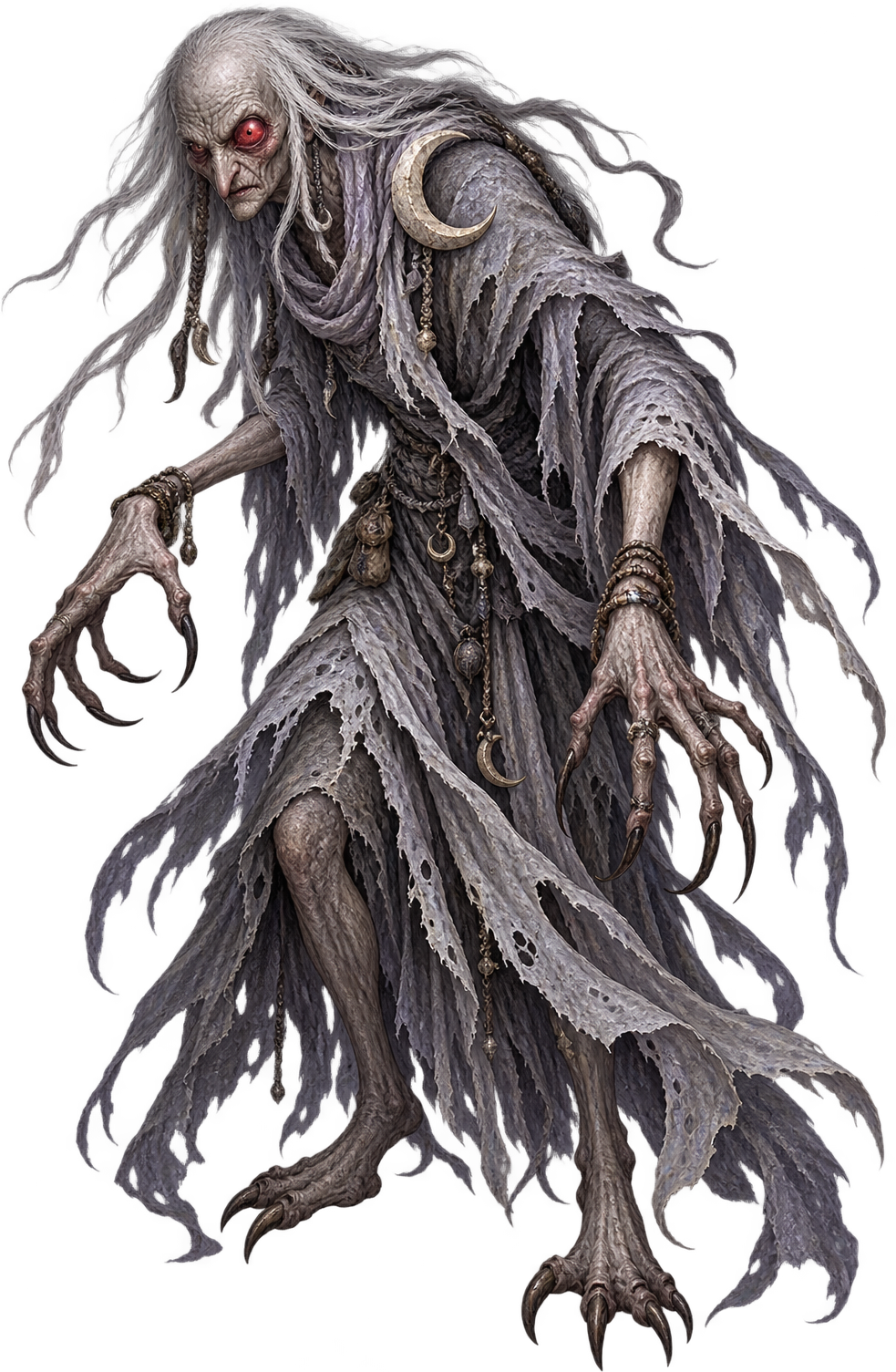
Moon hags are foul prophets that haunt the Boneyard’s endless tombs, serving Groetus, the skull-faced moon hanging eternally above. These lurid hags almost universally worship Groetus, and many claim to be mouthpieces for this god of oblivion. Moon hags are extremely knowledgeable about the secret paths and portals of the Boneyard, and they often use this knowledge to journey to the Material Plane for sinister purposes. Most moon hags use this opportunity to birth and abandon changelings, seeing even their wayward daughters as agents of Groetus’s will. Moon hag changelings are especially pale-skinned, and many are plagued by chronic anxiety, leading them to become reclusive. The daughter of a moon hag gains the moon daughter racial trait: she gains a +1 insight bonus to her AC but takes a –2 penalty on Will saving throws. If a moon is visible, the bonus and penalty each increase by 1.
CE Medium ()
Monstrous humanoids are similar to humanoids, but with monstrous or animalistic features. They often have magical abilities as well. A monstrous humanoid has the following traits (unless otherwise noted in a creature’s entry).
• Darkvision 60 feet.
• Proficient with all simple weapons and any weapons mentioned in its entry.
• Proficient with whatever type of armor (light, medium, or heavy) it is described as wearing, as well as all lighter types. Monstrous humanoids not indicated as wearing armor are not proficient with armor. Monstrous humanoids are proficient with shields if they are proficient with any form of armor.
• Monstrous humanoids breathe, eat, and sleep.
The Extraplanar subtype is applied to any creature when it is on a plane other than its native plane. A creature that travels the planes can gain or lose this subtype as it goes from plane to plane. Monster entries assume that encounters with creatures take place on the Material Plane, and every creature whose native plane is not the Material Plane has the extraplanar subtype (but would not have it when on its home plane). Creatures not labeled as extraplanar are natives of the Material Plane, and they gain the extraplanar subtype if they leave the Material Plane. No creature has the extraplanar subtype when it is on a Transitive Plane (the Astral Plane, the Ethereal Plane, or the Plane of Shadow).
Init +5; Senses 60 ft.; Perception +17
Darkvision is the extraordinary ability to see with no light source at all, out to a range specified. Darkvision is black-and-white only (colors cannot be discerned). It does not allow creatures to see anything that they could not see otherwise—invisible objects are still invisible, and illusions are still visible as what they seem to be. Likewise, darkvision subjects a creature to gaze attacks normally. The presence of light does not spoil darkvision.
DEFENSE
AC 20, touch 15, flat-footed 19 (+1 Dex, +4 insight, +5 natural)
hp 85 (9d10+36)
Fort +9, Ref +7, Will +9
Defensive Abilities , ; confusion, fear, insanity; 18
Ferocity (Ex) This creature remains conscious and can continue fighting even if its hit point total is below 0. The creature is still and loses 1 hit point each round. A creature with ferocity still dies when its hit point total reaches a negative amount equal to its Constitution score.
A staggered creature may take a single move action or standard action each round (but not both, nor can it take full-round actions). A staggered creature can still take free, swift, and immediate actions. A creature with nonlethal damage exactly equal to its current hit points gains the staggered condition.
Immunity (Ex or Su) A creature with immunities takes no damage from listed sources. Immunities can also apply to afflictions, conditions, spells (based on level, save type, or school), and other effects. A creature does not suffer any secondary effects that would normally be triggered by an effect it is immune to.
A creature with Spell Resistance has the extraordinary ability to avoid the effects of spells and spell-like abilities that directly affect it. To determine if a spell or spell-like ability works against a creature with spell resistance, the caster must make a caster level check (1d20 + caster level). If the result equals or exceeds the creature’s spell resistance, the spell works normally, although the creature is still allowed a saving throw.
OFFENSE
Speed 30 ft.
Melee bite +14 (1d6+5), 2 claws +14 (1d6+5)
Special Attacks , (2 claws, 1d6+3+7)
Rend (Ex) If it hits with two or more natural attacks in 1 round, this creature causes tremendous damage by latching onto the opponent’s body and tearing flesh. This automatically deals the listed additional damage, but no more than once per round. The type of attacks that must hit and the additional damage are included in the creature’s description.
(CL 7th; concentration +11)
Spell-like abilities are magical and work just like spells (though they are not spells and so have no verbal, somatic, focus, or material components). They go away in an antimagic field and are subject to spell resistance if the spell the ability is based on would be subject to spell resistance.
A spell-like ability usually has a limit on how often it can be used. A constant spell-like ability or one that can be used at will has no use limit; unless otherwise stated, a creature can only use a constant spell-like ability on itself. Reactivating a constant spell-like ability is a swift action. Using all other spell-like abilities is a standard action unless noted otherwise, and doing so provokes attacks of opportunity. It is possible to make a concentration check to use a spell-like ability defensively and avoid provoking an attack of opportunity, just as when casting a spell. A spell-like ability can be disrupted just as a spell can be. Spell-like abilities cannot be used to counterspell, nor can they be counterspelled.
For creatures with spell-like abilities, a designated caster level determines how difficult it is to dispel their spell-like effects and defines any level-dependent variables (such as range and duration) the abilities might have. The creature’s caster level never affects which spell-like abilities the creature has; sometimes the given caster level is lower than the level a spellcasting character would need to cast the spell of the same name. If no caster level is specified, the caster level is equal to the creature’s Hit Dice. The saving throw (if any) against a spell-like ability is 10 + the level of the spell the ability resembles or duplicates + the creature’s Charisma modifier unless the creature’s entry explicitly declares another ability-score basis; that individual declaration governs its block and is not overridden by this generic popup.
Some spell-like abilities duplicate spells that work differently when cast by characters of different classes. A monster’s spell-like abilities are presumed to be the sorcerer/wizard versions. If the spell in question is not a sorcerer/wizard spell, then default to cleric, druid, bard, paladin, and ranger, in that order.
At will—augury, deathwatch, doom (DC 15)
3/day—death knell (DC 16), rage, speak with dead (DC 17)
1/day—bestow curse (DC 18), confusion (DC 18), divination, fear (DC 18), tongues
STATISTICS
Str 20, Dex 12, Con 19, Int 14, Wis 17, Cha 19
Base Atk +9; +14; CMD 29
When performing a combat maneuver, you must use an action appropriate to the maneuver you are attempting to perform. While many combat maneuvers can be performed as part of an attack action, full-attack action, or attack of opportunity (in place of a melee attack), others require a specific action. Unless otherwise noted, performing a combat maneuver provokes an attack of opportunity from the target of the maneuver. If you are hit by the target, you take the damage normally and apply that amount as a penalty to the attack roll to perform the maneuver. If your target is immobilized, , or otherwise incapacitated, your maneuver automatically succeeds (treat as if you rolled a natural 20 on the attack roll). If your target is , you receive a +4 bonus on your attack roll to perform a combat maneuver against it.
When you attempt to perform a combat maneuver, make an attack roll and add your CMB in place of your normal attack bonus. Add any bonuses you currently have on attack rolls due to spells, feats, and other effects. These bonuses must be applicable to the weapon or attack used to perform the maneuver. The DC of this maneuver is your target’s Combat Maneuver Defense. Combat maneuvers are attack rolls, so you must roll for concealment and take any other penalties that would normally apply to an attack roll.
If your attack roll equals or exceeds the CMD of the target, your maneuver is a success and has the listed effect. Some maneuvers, such as bull rush, have varying levels of success depending on how much your attack roll exceeds the target’s CMD. Rolling a natural 20 while attempting a combat maneuver is always a success (except when attempting to escape from bonds), while rolling a natural 1 is always a failure.
Unconscious creatures are knocked out and . Unconsciousness can result from having negative hit points (but not more than the creature’s Constitution score), or from nonlethal damage in excess of current hit points.
A helpless character is paralyzed, held, bound, sleeping, unconscious, or otherwise completely at an opponent’s mercy. A helpless target is treated as having a Dexterity of 0 (–5 modifier). Melee attacks against a helpless target get a +4 bonus (equivalent to attacking a prone target). Ranged attacks get no special bonus against helpless targets. Rogues can sneak attack helpless targets.
As a full-round action, an enemy can use a melee weapon to deliver a coup de grace to a helpless foe. An enemy can also use a bow or crossbow, provided he is adjacent to the target. The attacker automatically hits and scores a critical hit. (A rogue also gets his sneak attack damage bonus against a helpless foe when delivering a coup de grace.) If the defender survives, he must make a Fortitude save (DC 10 + damage dealt) or die. Delivering a coup de grace provokes attacks of opportunity.
Creatures that are immune to critical hits do not take critical damage, nor do they need to make Fortitude saves to avoid being killed by a coup de grace.
A stunned creature drops everything held, can’t take actions, takes a –2 penalty to AC, and loses its Dexterity bonus to AC (if any). Attackers receive a +4 bonus on attack rolls to perform combat maneuvers against a stunned opponent.
Feats , , , ,
Alertness You get a +2 bonus on Perception and Sense Motive skill checks. If you have 10 or more ranks in one of these skills, the bonus increases to +4 for that skill.
Combat Casting You get a +4 bonus on concentration checks made to cast a spell or use a spell-like ability when casting on the defensive or while .
A grappled creature is restrained by a creature, trap, or effect. Grappled creatures cannot move and take a –4 penalty to Dexterity. A grappled creature takes a –2 penalty on all attack rolls and combat maneuver checks, except those made to grapple or escape a grapple. In addition, grappled creatures can take no action that requires two hands to perform. A grappled character who attempts to cast a spell or use a spell-like ability must make a concentration check (DC 10 + grappler’s CMB + spell level), or lose the spell. Grappled creatures cannot make attacks of opportunity.
A grappled creature cannot use Stealth to hide from the creature grappling it, even if a special ability, such as hide in plain sight, would normally allow it to do so. If a grappled creature becomes invisible, through a spell or other ability, it gains a +2 circumstance bonus on its CMD to avoid being grappled, but receives no other benefit.
Great Fortitude You get a +2 bonus on all Fortitude saving throws.
Power Attack You can choose to take a –1 penalty on all melee attack rolls and combat maneuver checks to gain a +2 bonus on all melee damage rolls. This bonus to damage is increased by half (+50%) if you are making an attack with a two-handed weapon, a one-handed weapon using two hands, or a primary natural weapon that adds 1-1/2 times your Strength modifier on damage rolls. This bonus to damage is halved (–50%) if you are making an attack with an off-hand weapon or secondary natural weapon. When your base attack bonus reaches +4, and every 4 points thereafter, the penalty increases by –1 and the bonus to damage increases by +2. You must choose to use this feat before making an attack roll, and its effects last until your next turn. The bonus damage does not apply to touch attacks or effects that do not deal hit point damage.
Skill Focus (Intimidate) You get a +3 bonus on all checks involving the chosen skill. If you have 10 or more ranks in that skill, this bonus increases to +6.
Skills Intimidate +19, Knowledge (planes) +11, Knowledge (religion) +11, Perception +17, Sense Motive +14, Spellcraft +11
Languages Aklo, Common
ECOLOGY
Environment any (Boneyard)
Organization solitary or coven (three hags of any kind)
Treasure standard
SPECIAL ABILITIES
Dreadful Ravings (Su) Three times per day as a standard action, the moon hag can howl a litany of dreadful prognostications at a creature within 30 feet. The predictions afflict the victim, gnawing away at its sanity. This is a language-dependent effect; if a moon (including Groetus) is visible to the victim, it takes a –2 penalty on the save against the effect.
Dreadful Ravings—; save Will DC 18; frequency 1/round for 6 rounds; effect 1d3 Wisdom damage; cure 2 consecutive saves. The save DC is Charisma-based.
Curse (Su) This creature can inflict a supernatural curse. Its entry specifies the curse’s effects, saving throw, frequency, and cure. When a save is allowed and no other formula is given, the save is usually Will DC 10 + 1/2 the creature’s racial Hit Dice + its Charisma modifier. Remove curse and similar magic can remove the curse as described by the effect.
Lunatic Insight (Su) A moon hag adds her Charisma modifier as an insight bonus to AC and on initiative checks. These bonuses increase by 2 when a moon (including Groetus) is visible above (this increase is not included in the statistics above).
Vanth
This humanoid skeleton has black raven wings, a long tail, and a polished vulture-like mask where its face should be.
Stern, silent, and cloaked in ragged black wings, vanth psychopomps serve as stoic guardians of the Boneyard and watchers along the routes of the dead. A vanth looks like a black skeleton with ravenlike wings and a mask resembling a vulture’s skull. Also known as reapers, angels of death, or amzranei, vanths protect the departed from those wishing to eat or steal their mortal souls, recapture escaped souls trying to flee their assigned fates, and are death’s foot soldiers against whatever would disrupt the natural cycle of mortality. They may also guard the dead and death’s assets, such as forgotten cemeteries, unattended mausoleums, and sacred groves. A vanth weighs 400 pounds and stands 8 feet tall, though its slumped posture means it can look most adult humanoids in the eye. Vanths are ancient creatures, perhaps predating the current gods of death, and are rumored to be ascended souls of a distant world of death-worshiping soldiers. They rarely speak or show emotion and their hollow voices carry unnaturally far. A vanth’s scythe is a badge of its station, reflecting its role as a harvester of souls. It features symbols in a language that was already lost when the death gods claimed the Boneyard. Most outsiders scorn vanths, as the psychopomps have no concern for law, rightfulness, or personal gain— only duty. Vanths view any outsider visiting the Boneyard as a potential threat, and stalk angels and demons alike.
N Medium (, )
An outsider is at least partially composed of the essence (but not necessarily the material) of some plane other than the Material Plane. Some creatures start out as some other type and become outsiders when they attain a higher (or lower) state of spiritual existence. An outsider has the following traits:
• Darkvision 60 feet.
• Unlike most living creatures, an outsider does not have a dual nature—its soul and body form one unit. When an outsider is slain, no soul is set loose. Spells that restore souls to their bodies, such as raise dead, reincarnate, and resurrection, don’t work on an outsider. It takes a different magical effect, such as limited wish, wish, miracle, or true resurrection to restore it to life.
• Proficient with all simple and martial weapons and any weapons mentioned in its entry.
• Proficient with whatever type of armor (light, medium, or heavy) it is described as wearing, as well as all lighter types. Outsiders not indicated as wearing armor are not proficient with armor. Outsiders are proficient with shields if they are proficient with any form of armor.
• Outsiders breathe, but do not need to eat or sleep (although they can do so if they wish).
The Extraplanar subtype is applied to any creature when it is on a plane other than its native plane. A creature that travels the planes can gain or lose this subtype as it goes from plane to plane. Monster entries assume that encounters with creatures take place on the Material Plane, and every creature whose native plane is not the Material Plane has the extraplanar subtype (but would not have it when on its home plane). Creatures not labeled as extraplanar are natives of the Material Plane, and they gain the extraplanar subtype if they leave the Material Plane. No creature has the extraplanar subtype when it is on a Transitive Plane (the Astral Plane, the Ethereal Plane, or the Plane of Shadow).
Psychopomps are neutral outsiders charged with guiding souls.
• Darkvision 60 feet and low-light vision.
• DR 5/adamantine.
• Immunity to death effects, disease, and poison.
• Resistance to cold 10 and electricity 10.
• Speak Abyssal, Celestial, and Infernal unless otherwise noted.
• Spirit Touch (Ex) Natural weapons and wielded weapons function as though they had the ghost touch weapon special ability.
• Spiritsense (Su) Notices, locates, and distinguishes living and undead creatures within 60 feet as if using blindsight; it does not detect objects but can notice living things that are not creatures.
Init +3; Senses 60 ft., , ; Perception +16
Darkvision is the extraordinary ability to see with no light source at all, out to a range specified. Darkvision is black-and-white only (colors cannot be discerned). It does not allow creatures to see anything that they could not see otherwise—invisible objects are still invisible, and illusions are still visible as what they seem to be. Likewise, darkvision subjects a creature to gaze attacks normally. The presence of light does not spoil darkvision.
Low-Light Vision (Ex) A creature with low-light vision can see twice as far as a human in starlight, moonlight, torchlight, and similar conditions of dim light. It retains the ability to distinguish color and detail under these conditions.
Aura fear (30 ft., DC 17)
DEFENSE
AC 20, touch 13, flat-footed 17 (+3 Dex, +7 natural)
hp 76 (9d10+27)
Fort +11, Ref +6, Will +10
10/adamantine; death effects, disease, poison; cold 10, electricity 10; 18
Damage Reduction (Ex or Su) The creature ignores damage from most weapons and natural attacks. Wounds heal immediately, or the weapon bounces off harmlessly; in either case, the opponent knows the attack was ineffective. The creature takes normal damage from energy attacks, including nonmagical ones, spells, spell-like abilities, and supernatural abilities. A certain kind of weapon can sometimes damage the creature normally, as described below.
The entry indicates the amount of damage ignored, usually 5 to 15 points, and the type of weapon that negates the ability. Some monsters are vulnerable to bludgeoning, piercing, or slashing damage. Others are vulnerable to materials such as adamantine, cold iron, or silver. Attacks from weapons that are not the correct type or material have their damage reduced, although a high enhancement bonus can overcome some forms of damage reduction.
Whenever damage reduction completely negates the damage from an attack, it also negates most special effects that accompany the attack, such as injury poison, injury disease, and effects delivered only when the attack deals damage. Damage reduction does not negate touch attacks, energy damage dealt along with an attack, or energy drain, and it does not affect poisons or diseases delivered by contact, ingestion, or inhalation. If damage reduction completely negates an attack’s damage, that attack does not disrupt a spell being cast.
Damage reduction does not stack with itself. When a creature has more than one form, apply the single form that gives the greatest reduction against the attack; the attacker must overcome only the qualities required by the form being applied.
Some monsters are vulnerable to magic weapons. A weapon with at least a +1 magical enhancement bonus on attack and damage rolls overcomes this damage reduction; the +1 attack bonus from a masterwork weapon does not count as a magical enhancement bonus. Such creatures’ natural weapons, but not their attacks with manufactured weapons, are treated as magic weapons for overcoming damage reduction. Ammunition fired from a projectile weapon with at least a +1 enhancement bonus is treated as magic for overcoming damage reduction.
A few powerful monsters are vulnerable only to epic weapons—magic weapons with at least a +6 enhancement bonus. Such creatures’ natural weapons are also treated as epic weapons for overcoming damage reduction.
Some monsters are vulnerable to chaotic-, evil-, good-, or lawful-aligned weapons. When a cleric casts align weapon, affected weapons might gain one or more of these properties; certain magic weapons also have them. A creature with a chaotic, evil, good, or lawful alignment subtype overcomes matching damage reduction with its natural weapons and wielded weapons as though those attacks had the alignment or alignments matching its subtype. Ammunition fired from an aligned projectile weapon is treated as having that alignment for overcoming damage reduction.
A weapon with a +3 enhancement bonus overcomes damage reduction as though it were made of cold iron and silver. A weapon with a +4 enhancement bonus also overcomes damage reduction as though it were adamantine, but this does not allow it to ignore hardness. A weapon with a +5 enhancement bonus also overcomes alignment-based damage reduction. These equivalences are cumulative with the weapon’s actual material and alignment qualities.
When a damage reduction entry has a — after the slash, no weapon negates it.
If either of two listed attack types can overcome the reduction, a weapon that deals either type does so. If a listed combination is required, the weapon must have every listed type or quality; a weapon with only one remains subject to the damage reduction.
Immunity (Ex or Su) A creature with immunities takes no damage from listed sources. Immunities can also apply to afflictions, conditions, spells (based on level, save type, or school), and other effects. A creature does not suffer any secondary effects that would normally be triggered by an effect it is immune to.
Resistance (Ex) This creature ignores some damage of the indicated type each time it takes damage of that kind, commonly acid, cold, electricity, or fire. The entry indicates the amount and type of damage ignored. Resistance is not immunity, and it applies whether the damage has a mundane or magical source. When resistance completely negates damage from an energy attack, that attack does not disrupt spellcasting. This resistance does not stack with resistance provided by a spell.
A creature with Spell Resistance has the extraordinary ability to avoid the effects of spells and spell-like abilities that directly affect it. To determine if a spell or spell-like ability works against a creature with spell resistance, the caster must make a caster level check (1d20 + caster level). If the result equals or exceeds the creature’s spell resistance, the spell works normally, although the creature is still allowed a saving throw.
OFFENSE
Speed 30 ft., 50 ft. (average)
A creature with a Fly speed can cease or resume flight as a free action on its turn. Without making a check, a flying creature can remain flying at the end of its turn so long as it moves a distance greater than half its speed. It can also turn up to 45 degrees during its turn by sacrificing 5 feet of movement, can rise at half speed at an angle of 45 degrees (ignoring the penalty for diagonal movement), and can descend at any angle at normal speed. At the beginning of its turn, a flying creature can move in a different direction than it did previously without needing a Fly check.
A creature with a natural fly speed receives a bonus (or penalty) on Fly skill checks depending on its maneuverability:
• Clumsy –8
• Poor –4
• Average +0
• Good +4
• Perfect +8
Creatures without a maneuverability rating are assumed to have average maneuverability and take no penalty on Fly checks. These modifiers are already included in the creature’s stat block.
Melee +1 adamantine scythe +14/+9 (2d4+7/×4) or 2 claws +13 (1d6+4)
(CL 10th; concentration +13)
Spell-like abilities are magical and work just like spells (though they are not spells and so have no verbal, somatic, focus, or material components). They go away in an antimagic field and are subject to spell resistance if the spell the ability is based on would be subject to spell resistance.
A spell-like ability usually has a limit on how often it can be used. A constant spell-like ability or one that can be used at will has no use limit; unless otherwise stated, a creature can only use a constant spell-like ability on itself. Reactivating a constant spell-like ability is a swift action. Using all other spell-like abilities is a standard action unless noted otherwise, and doing so provokes attacks of opportunity. It is possible to make a concentration check to use a spell-like ability defensively and avoid provoking an attack of opportunity, just as when casting a spell. A spell-like ability can be disrupted just as a spell can be. Spell-like abilities cannot be used to counterspell, nor can they be counterspelled.
For creatures with spell-like abilities, a designated caster level determines how difficult it is to dispel their spell-like effects and defines any level-dependent variables (such as range and duration) the abilities might have. The creature’s caster level never affects which spell-like abilities the creature has; sometimes the given caster level is lower than the level a spellcasting character would need to cast the spell of the same name. If no caster level is specified, the caster level is equal to the creature’s Hit Dice. The saving throw (if any) against a spell-like ability is 10 + the level of the spell the ability resembles or duplicates + the creature’s Charisma modifier.
Some spell-like abilities duplicate spells that work differently when cast by characters of different classes. A monster’s spell-like abilities are presumed to be the sorcerer/wizard versions. If the spell in question is not a sorcerer/wizard spell, then default to cleric, druid, bard, paladin, and ranger, in that order.
At will—deathwatch, greater teleport (self plus 50 lbs. of objects only), invisibility (self only)
3/day—bestow curse (DC 17), locate creature, searing light
STATISTICS
Str 18, Dex 16, Con 17, Int 13, Wis 19, Cha 17
Base Atk +9; +13; CMD 26
When performing a combat maneuver, you must use an action appropriate to the maneuver you are attempting to perform. While many combat maneuvers can be performed as part of an attack action, full-attack action, or attack of opportunity (in place of a melee attack), others require a specific action. Unless otherwise noted, performing a combat maneuver provokes an attack of opportunity from the target of the maneuver. If you are hit by the target, you take the damage normally and apply that amount as a penalty to the attack roll to perform the maneuver. If your target is immobilized, , or otherwise incapacitated, your maneuver automatically succeeds (treat as if you rolled a natural 20 on the attack roll). If your target is , you receive a +4 bonus on your attack roll to perform a combat maneuver against it.
When you attempt to perform a combat maneuver, make an attack roll and add your CMB in place of your normal attack bonus. Add any bonuses you currently have on attack rolls due to spells, feats, and other effects. These bonuses must be applicable to the weapon or attack used to perform the maneuver. The DC of this maneuver is your target’s Combat Maneuver Defense. Combat maneuvers are attack rolls, so you must roll for concealment and take any other penalties that would normally apply to an attack roll.
If your attack roll equals or exceeds the CMD of the target, your maneuver is a success and has the listed effect. Some maneuvers, such as bull rush, have varying levels of success depending on how much your attack roll exceeds the target’s CMD. Rolling a natural 20 while attempting a combat maneuver is always a success (except when attempting to escape from bonds), while rolling a natural 1 is always a failure.
Unconscious creatures are knocked out and . Unconsciousness can result from having negative hit points (but not more than the creature’s Constitution score), or from nonlethal damage in excess of current hit points.
A helpless character is paralyzed, held, bound, sleeping, unconscious, or otherwise completely at an opponent’s mercy. A helpless target is treated as having a Dexterity of 0 (–5 modifier). Melee attacks against a helpless target get a +4 bonus (equivalent to attacking a prone target). Ranged attacks get no special bonus against helpless targets. Rogues can sneak attack helpless targets.
As a full-round action, an enemy can use a melee weapon to deliver a coup de grace to a helpless foe. An enemy can also use a bow or crossbow, provided he is adjacent to the target. The attacker automatically hits and scores a critical hit. (A rogue also gets his sneak attack damage bonus against a helpless foe when delivering a coup de grace.) If the defender survives, he must make a Fortitude save (DC 10 + damage dealt) or die. Delivering a coup de grace provokes attacks of opportunity.
Creatures that are immune to critical hits do not take critical damage, nor do they need to make Fortitude saves to avoid being killed by a coup de grace.
A stunned creature drops everything held, can’t take actions, takes a –2 penalty to AC, and loses its Dexterity bonus to AC (if any). Attackers receive a +4 bonus on attack rolls to perform combat maneuvers against a stunned opponent.
Feats , , , ,
Cleave As a standard action, you can make a single attack at your full base attack bonus against a foe within reach. If you hit, you deal damage normally and can make an additional attack (using your full base attack bonus) against a foe that is adjacent to the first and also within reach. You can only make one additional attack per round with this feat. When you use this feat, you take a –2 penalty to your Armor Class until your next turn.
Great Fortitude You get a +2 bonus on all Fortitude saving throws.
Hover A creature with this feat can halt its movement while flying, allowing it to hover without needing to make a Fly skill check.
If a creature of size Large or larger with this feat hovers within 20 feet of the ground in an area with lots of loose debris, the draft from its wings creates a hemispherical cloud with a radius of 60 feet. The winds generated can snuff torches, small campfires, exposed lanterns, and other small, open flames of non-magical origin. Clear vision within the cloud is limited to 10 feet. Creatures have concealment at 15 to 20 feet (20% miss chance). At 25 feet or more, creatures have total concealment (50% miss chance, and opponents cannot use sight to locate the creature).
Normal: Without this feat, a creature must make a Fly skill check to hover and the creature does not create a cloud of debris while hovering.
Power Attack You can choose to take a –1 penalty on all melee attack rolls and combat maneuver checks to gain a +2 bonus on all melee damage rolls. This bonus to damage is increased by half (+50%) if you are making an attack with a two-handed weapon, a one-handed weapon using two hands, or a primary natural weapon that adds 1-1/2 times your Strength modifier on damage rolls. This bonus to damage is halved (–50%) if you are making an attack with an off-hand weapon or secondary natural weapon. When your base attack bonus reaches +4, and every 4 points thereafter, the penalty increases by –1 and the bonus to damage increases by +2. You must choose to use this feat before making an attack roll, and its effects last until your next turn. The bonus damage does not apply to touch attacks or effects that do not deal hit point damage.
Vital Strike When you use the attack action, you can make one attack at your highest base attack bonus that deals additional damage. Roll the weapon’s damage dice for the attack twice and add the results together before adding bonuses from Strength, weapon abilities (such as flaming), precision-based damage, and other damage bonuses. These extra weapon damage dice are not multiplied on a critical hit, but are added to the total.
Skills Acrobatics +9, Fly +11, Intimidate +11, Knowledge (history) +9, Knowledge (planes) +13, Knowledge (religion) +13, Perception +16, Sense Motive +16, Stealth +15
Languages Abyssal, Celestial, Infernal
SQ ,
ECOLOGY
Environment any (Boneyard)
Organization solitary, pair, or flock (2–12)
Treasure double (adamantine scythe)
SPECIAL ABILITIES
Fear Aura (Su) A creature of fewer than 10 Hit Dice that fails its save (DC 17) against the vanth’s fear aura is for as long as it remains within the aura. A creature that succeeds at its save is immune to that vanth’s aura for 24 hours. The save DC is Charisma-based.
A shaken character takes a –2 penalty on attack rolls, saving throws, skill checks, and ability checks. Shaken is a less severe state of fear than or .
A frightened creature flees from the source of its fear as best it can. If unable to flee, it may fight. A frightened creature takes a –2 penalty on all attack rolls, saving throws, skill checks, and ability checks. A frightened creature can use special abilities, including spells, to flee; indeed, the creature must use such means if they are the only way to escape. Frightened is like shaken, except that the creature must flee if possible. Panicked is a more extreme state of fear.
A panicked creature must drop anything it holds and flee at top speed from the source of its fear, as well as any other dangers it encounters, along a random path. It can’t take any other actions. In addition, the creature takes a –2 penalty on all saving throws, skill checks, and ability checks. If cornered, a panicked creature and does not attack, typically using the total defense action in combat. A panicked creature can use special abilities, including spells, to flee; indeed, the creature must use such means if they are the only way to escape. Panicked is a more extreme state of fear than shaken or frightened.
The character is frozen in fear and can take no actions. A cowering character takes a –2 penalty to Armor Class and loses their Dexterity bonus (if any).
Reaper’s Scythe (Su) Every vanth carries a distinctive adamantine scythe as both a weapon and a symbol of its duty. When the vanth wields its own scythe, the weapon gains a +1 enhancement bonus on attack rolls and damage rolls. As a free action, the vanth can summon its weapon from a personal demiplane or any other location and have it appear in its hands instantly. It can also dismiss its scythe back to its personal demiplane as a free action. If a vanth’s scythe is destroyed, it can summon a new one in 24 hours.
Spirit Touch (Ex) A psychopomp’s natural weapons, as well as any weapon it wields, are treated as though they had the ghost touch weapon special ability.
Spiritsense (Su) A psychopomp notices, locates, and can distinguish between living and undead creatures within 60 feet, just as if it had the blindsight ability.
Shoki
A wooden staff topped with a silver cage containing a ghostly face keeps this grizzled, snail-backed creature upright.
Shokis are the collectors of lingering souls, tasked with compelling even the most deluded beings to take the first step into the afterlife. Their tactics are varied, but most start by counseling the wayward dead using theosophical arguments and blunt warnings about the ravenous things that wait to feed upon lost spirits. Each shoki bears powerful tools to aid it in such pursuits—eclectic collections of holy symbols and withered staves of cold iron capable of imprisoning a single soul at a time. Shokis use their staves against only the most stubborn or demented souls, whom they capture and personally escort to the Boneyard for judgment.
N Medium (, )
An outsider is at least partially composed of the essence (but not necessarily the material) of some plane other than the Material Plane. Some creatures start out as some other type and become outsiders when they attain a higher (or lower) state of spiritual existence. An outsider has the following traits:
• Darkvision 60 feet.
• Unlike most living creatures, an outsider does not have a dual nature—its soul and body form one unit. When an outsider is slain, no soul is set loose. Spells that restore souls to their bodies, such as raise dead, reincarnate, and resurrection, don’t work on an outsider. It takes a different magical effect, such as limited wish, wish, miracle, or true resurrection to restore it to life.
• Proficient with all simple and martial weapons and any weapons mentioned in its entry.
• Proficient with whatever type of armor (light, medium, or heavy) it is described as wearing, as well as all lighter types. Outsiders not indicated as wearing armor are not proficient with armor. Outsiders are proficient with shields if they are proficient with any form of armor.
• Outsiders breathe, but do not need to eat or sleep (although they can do so if they wish).
The Extraplanar subtype is applied to any creature when it is on a plane other than its native plane. A creature that travels the planes can gain or lose this subtype as it goes from plane to plane. Monster entries assume that encounters with creatures take place on the Material Plane, and every creature whose native plane is not the Material Plane has the extraplanar subtype (but would not have it when on its home plane). Creatures not labeled as extraplanar are natives of the Material Plane, and they gain the extraplanar subtype if they leave the Material Plane. No creature has the extraplanar subtype when it is on a Transitive Plane (the Astral Plane, the Ethereal Plane, or the Plane of Shadow).
Psychopomps are neutral outsiders charged with guiding souls.
• Darkvision 60 feet and low-light vision.
• DR 5/adamantine.
• Immunity to death effects, disease, and poison.
• Resistance to cold 10 and electricity 10.
• Speak Abyssal, Celestial, and Infernal unless otherwise noted.
• Spirit Touch (Ex) Natural weapons and wielded weapons function as though they had the ghost touch weapon special ability.
• Spiritsense (Su) Notices, locates, and distinguishes living and undead creatures within 60 feet as if using blindsight; it does not detect objects but can notice living things that are not creatures.
Init +4; Senses 60 ft., detect chaos, detect evil, detect good, detect law, detect magic, , ; Perception +22
Darkvision is the extraordinary ability to see with no light source at all, out to a range specified. Darkvision is black-and-white only (colors cannot be discerned). It does not allow creatures to see anything that they could not see otherwise—invisible objects are still invisible, and illusions are still visible as what they seem to be. Likewise, darkvision subjects a creature to gaze attacks normally. The presence of light does not spoil darkvision.
Low-Light Vision (Ex) A creature with low-light vision can see twice as far as a human in starlight, moonlight, torchlight, and similar conditions of dim light. It retains the ability to distinguish color and detail under these conditions.
DEFENSE
AC 25, touch 15, flat-footed 20 (+4 Dex, +1 dodge, +10 natural)
hp 115 (10d10+60)
Fort +9, Ref +11, Will +14
10/adamantine; acid, charm, cold, death effects, disease, fear, poison, sleep; electricity 10; 20
Damage Reduction (Ex or Su) The creature ignores damage from most weapons and natural attacks. Wounds heal immediately, or the weapon bounces off harmlessly; in either case, the opponent knows the attack was ineffective. The creature takes normal damage from energy attacks, including nonmagical ones, spells, spell-like abilities, and supernatural abilities. A certain kind of weapon can sometimes damage the creature normally, as described below.
The entry indicates the amount of damage ignored, usually 5 to 15 points, and the type of weapon that negates the ability. Some monsters are vulnerable to bludgeoning, piercing, or slashing damage. Others are vulnerable to materials such as adamantine, cold iron, or silver. Attacks from weapons that are not the correct type or material have their damage reduced, although a high enhancement bonus can overcome some forms of damage reduction.
Whenever damage reduction completely negates the damage from an attack, it also negates most special effects that accompany the attack, such as injury poison, injury disease, and effects delivered only when the attack deals damage. Damage reduction does not negate touch attacks, energy damage dealt along with an attack, or energy drain, and it does not affect poisons or diseases delivered by contact, ingestion, or inhalation. If damage reduction completely negates an attack’s damage, that attack does not disrupt a spell being cast.
Damage reduction does not stack with itself. When a creature has more than one form, apply the single form that gives the greatest reduction against the attack; the attacker must overcome only the qualities required by the form being applied.
Some monsters are vulnerable to magic weapons. A weapon with at least a +1 magical enhancement bonus on attack and damage rolls overcomes this damage reduction; the +1 attack bonus from a masterwork weapon does not count as a magical enhancement bonus. Such creatures’ natural weapons, but not their attacks with manufactured weapons, are treated as magic weapons for overcoming damage reduction. Ammunition fired from a projectile weapon with at least a +1 enhancement bonus is treated as magic for overcoming damage reduction.
A few powerful monsters are vulnerable only to epic weapons—magic weapons with at least a +6 enhancement bonus. Such creatures’ natural weapons are also treated as epic weapons for overcoming damage reduction.
Some monsters are vulnerable to chaotic-, evil-, good-, or lawful-aligned weapons. When a cleric casts align weapon, affected weapons might gain one or more of these properties; certain magic weapons also have them. A creature with a chaotic, evil, good, or lawful alignment subtype overcomes matching damage reduction with its natural weapons and wielded weapons as though those attacks had the alignment or alignments matching its subtype. Ammunition fired from an aligned projectile weapon is treated as having that alignment for overcoming damage reduction.
A weapon with a +3 enhancement bonus overcomes damage reduction as though it were made of cold iron and silver. A weapon with a +4 enhancement bonus also overcomes damage reduction as though it were adamantine, but this does not allow it to ignore hardness. A weapon with a +5 enhancement bonus also overcomes alignment-based damage reduction. These equivalences are cumulative with the weapon’s actual material and alignment qualities.
When a damage reduction entry has a — after the slash, no weapon negates it.
If either of two listed attack types can overcome the reduction, a weapon that deals either type does so. If a listed combination is required, the weapon must have every listed type or quality; a weapon with only one remains subject to the damage reduction.
Immunity (Ex or Su) A creature with immunities takes no damage from listed sources. Immunities can also apply to afflictions, conditions, spells (based on level, save type, or school), and other effects. A creature does not suffer any secondary effects that would normally be triggered by an effect it is immune to.
Resistance (Ex) This creature ignores some damage of the indicated type each time it takes damage of that kind, commonly acid, cold, electricity, or fire. The entry indicates the amount and type of damage ignored. Resistance is not immunity, and it applies whether the damage has a mundane or magical source. When resistance completely negates damage from an energy attack, that attack does not disrupt spellcasting. This resistance does not stack with resistance provided by a spell.
A creature with Spell Resistance has the extraordinary ability to avoid the effects of spells and spell-like abilities that directly affect it. To determine if a spell or spell-like ability works against a creature with spell resistance, the caster must make a caster level check (1d20 + caster level). If the result equals or exceeds the creature’s spell resistance, the spell works normally, although the creature is still allowed a saving throw.
OFFENSE
Speed 30 ft.
Melee +2 cold iron quarterstaff +19/+14 (1d6+12)
Special Attacks
(CL 9th; concentration +12)
Spell-like abilities are magical and work just like spells (though they are not spells and so have no verbal, somatic, focus, or material components). They go away in an antimagic field and are subject to spell resistance if the spell the ability is based on would be subject to spell resistance.
A spell-like ability usually has a limit on how often it can be used. A constant spell-like ability or one that can be used at will has no use limit; unless otherwise stated, a creature can only use a constant spell-like ability on itself. Reactivating a constant spell-like ability is a swift action. Using all other spell-like abilities is a standard action unless noted otherwise, and doing so provokes attacks of opportunity. It is possible to make a concentration check to use a spell-like ability defensively and avoid provoking an attack of opportunity, just as when casting a spell. A spell-like ability can be disrupted just as a spell can be. Spell-like abilities cannot be used to counterspell, nor can they be counterspelled.
For creatures with spell-like abilities, a designated caster level determines how difficult it is to dispel their spell-like effects and defines any level-dependent variables (such as range and duration) the abilities might have. The creature’s caster level never affects which spell-like abilities the creature has; sometimes the given caster level is lower than the level a spellcasting character would need to cast the spell of the same name. If no caster level is specified, the caster level is equal to the creature’s Hit Dice. The saving throw (if any) against a spell-like ability is 10 + the level of the spell the ability resembles or duplicates + the creature’s Charisma modifier unless the creature’s entry explicitly declares another ability-score basis; that individual declaration governs its block and is not overridden by this generic popup.
Some spell-like abilities duplicate spells that work differently when cast by characters of different classes. A monster’s spell-like abilities are presumed to be the sorcerer/wizard versions. If the spell in question is not a sorcerer/wizard spell, then default to cleric, druid, bard, paladin, and ranger, in that order.
Constant—detect chaos, detect evil, detect good, detect law, detect magic
At will—etherealness, invisibility (self only), mass cure moderate wounds (DC 19, harm undead only), protection from evil, protection from good, searing light
1/day—plane shift (self only)
STATISTICS
Str 24, Dex 19, Con 22, Int 18, Wis 21, Cha 17
Base Atk +10; +17; CMD 32
When performing a combat maneuver, you must use an action appropriate to the maneuver you are attempting to perform. While many combat maneuvers can be performed as part of an attack action, full-attack action, or attack of opportunity (in place of a melee attack), others require a specific action. Unless otherwise noted, performing a combat maneuver provokes an attack of opportunity from the target of the maneuver. If you are hit by the target, you take the damage normally and apply that amount as a penalty to the attack roll to perform the maneuver. If your target is immobilized, , or otherwise incapacitated, your maneuver automatically succeeds (treat as if you rolled a natural 20 on the attack roll). If your target is , you receive a +4 bonus on your attack roll to perform a combat maneuver against it.
When you attempt to perform a combat maneuver, make an attack roll and add your CMB in place of your normal attack bonus. Add any bonuses you currently have on attack rolls due to spells, feats, and other effects. These bonuses must be applicable to the weapon or attack used to perform the maneuver. The DC of this maneuver is your target’s Combat Maneuver Defense. Combat maneuvers are attack rolls, so you must roll for concealment and take any other penalties that would normally apply to an attack roll.
If your attack roll equals or exceeds the CMD of the target, your maneuver is a success and has the listed effect. Some maneuvers, such as bull rush, have varying levels of success depending on how much your attack roll exceeds the target’s CMD. Rolling a natural 20 while attempting a combat maneuver is always a success (except when attempting to escape from bonds), while rolling a natural 1 is always a failure.
Unconscious creatures are knocked out and . Unconsciousness can result from having negative hit points (but not more than the creature’s Constitution score), or from nonlethal damage in excess of current hit points.
A helpless character is paralyzed, held, bound, sleeping, unconscious, or otherwise completely at an opponent’s mercy. A helpless target is treated as having a Dexterity of 0 (–5 modifier). Melee attacks against a helpless target get a +4 bonus (equivalent to attacking a prone target). Ranged attacks get no special bonus against helpless targets. Rogues can sneak attack helpless targets.
As a full-round action, an enemy can use a melee weapon to deliver a coup de grace to a helpless foe. An enemy can also use a bow or crossbow, provided he is adjacent to the target. The attacker automatically hits and scores a critical hit. (A rogue also gets his sneak attack damage bonus against a helpless foe when delivering a coup de grace.) If the defender survives, he must make a Fortitude save (DC 10 + damage dealt) or die. Delivering a coup de grace provokes attacks of opportunity.
Creatures that are immune to critical hits do not take critical damage, nor do they need to make Fortitude saves to avoid being killed by a coup de grace.
A stunned creature drops everything held, can’t take actions, takes a –2 penalty to AC, and loses its Dexterity bonus to AC (if any). Attackers receive a +4 bonus on attack rolls to perform combat maneuvers against a stunned opponent.
Feats , , , ,
Alertness You get a +2 bonus on Perception and Sense Motive skill checks. If you have 10 or more ranks in one of these skills, the bonus increases to +4 for that skill.
Combat Casting You get a +4 bonus on concentration checks made to cast a spell or use a spell-like ability when casting on the defensive or while .
A grappled creature is restrained by a creature, trap, or effect. Grappled creatures cannot move and take a –4 penalty to Dexterity. A grappled creature takes a –2 penalty on all attack rolls and combat maneuver checks, except those made to grapple or escape a grapple. In addition, grappled creatures can take no action that requires two hands to perform. A grappled character who attempts to cast a spell or use a spell-like ability must make a concentration check (DC 10 + grappler’s CMB + spell level), or lose the spell. Grappled creatures cannot make attacks of opportunity.
A grappled creature cannot use Stealth to hide from the creature grappling it, even if a special ability, such as hide in plain sight, would normally allow it to do so. If a grappled creature becomes invisible, through a spell or other ability, it gains a +2 circumstance bonus on its CMD to avoid being grappled, but receives no other benefit.
Dodge You gain a +1 dodge bonus to your AC. A condition that makes you lose your Dex bonus to AC also makes you lose the benefits of this feat.
Iron Will You get a +2 bonus on all Will saving throws.
Persuasive You get a +2 bonus on Diplomacy and Intimidate skill checks. If you have 10 or more ranks in one of these skills, the bonus increases to +4 for that skill.
Skills Bluff +16, Diplomacy +20, Intimidate +20, Knowledge (arcana, planes) +17, Knowledge (religion) +14, Perception +22, Sense Motive +22, Spellcraft +17, Stealth +17
Languages Abyssal, Celestial, Common, Infernal
SQ
ECOLOGY
Environment any (Boneyard)
Organization solitary
Treasure double (+2 cold iron quarterstaff, other treasure)
SPECIAL ABILITIES
Soul Lock (Su) Once per day as a standard action, a shoki can use its +2 cold iron quarterstaff to capture the soul of a creature at the threshold of death—any undead creature or any living being with 0 or fewer hit points. The target must succeed at a DC 20 Will save or be slain (if living) or disrupted (if undead), its spirit locked within the shoki’s staff. A corporeal undead transforms into a corpse if affected by this ability, while an incorporeal undead is trapped bodily within the staff (this ability negates a ghost’s ability to rejuvenate). A spirit trapped within a shoki’s staff cannot be returned to life through any means short of miracle, true resurrection, or wish. A trapped soul can be freed if the shoki wills it, or by casting banishment, dismissal, or freedom upon the staff. The trapped soul can also be freed by destroying the staff. A shoki’s staff can contain only one soul at a time. The save DC is Wisdom-based.
Spirit Touch (Ex) A psychopomp’s natural weapons, as well as any weapon it wields, are treated as though they had the ghost touch weapon special ability.
Spiritsense (Su) A psychopomp notices, locates, and can distinguish between living and undead creatures within 60 feet, just as if it had the blindsight ability.
Algea
This shrill swarm of whip-poor-wills flies in a spiral, their airborne antics infused with streamers of pale blue mist.
Algeas protect (and in some cases retrieve) souls that are at risk of being claimed by other entities, particularly spellcasters who dabbled with otherworldly forces but never officially pledged their souls. Algeas are particularly focused on intervening and “rescuing” souls in danger of being trapped within the Material Plane by powerful entities like the Great Old Ones or false prophets who have deluded minions into worshiping them as living gods.
N Diminutive (, , )
An outsider is at least partially composed of the essence (but not necessarily the material) of some plane other than the Material Plane. Some creatures start out as some other type and become outsiders when they attain a higher (or lower) state of spiritual existence. An outsider has the following traits:
• Darkvision 60 feet.
• Unlike most living creatures, an outsider does not have a dual nature—its soul and body form one unit. When an outsider is slain, no soul is set loose. Spells that restore souls to their bodies, such as raise dead, reincarnate, and resurrection, don’t work on an outsider. It takes a different magical effect, such as limited wish, wish, miracle, or true resurrection to restore it to life.
• Proficient with all simple and martial weapons and any weapons mentioned in its entry.
• Proficient with whatever type of armor (light, medium, or heavy) it is described as wearing, as well as all lighter types. Outsiders not indicated as wearing armor are not proficient with armor. Outsiders are proficient with shields if they are proficient with any form of armor.
• Outsiders breathe, but do not need to eat or sleep (although they can do so if they wish).
The Extraplanar subtype is applied to any creature when it is on a plane other than its native plane. A creature that travels the planes can gain or lose this subtype as it goes from plane to plane. Monster entries assume that encounters with creatures take place on the Material Plane, and every creature whose native plane is not the Material Plane has the extraplanar subtype (but would not have it when on its home plane). Creatures not labeled as extraplanar are natives of the Material Plane, and they gain the extraplanar subtype if they leave the Material Plane. No creature has the extraplanar subtype when it is on a Transitive Plane (the Astral Plane, the Ethereal Plane, or the Plane of Shadow).
A swarm is a collection of Fine, Diminutive, or Tiny creatures that acts as a single creature. A swarm has the characteristics of its type, except as noted here. A swarm has a single pool of Hit Dice and hit points, a single initiative modifier, a single speed, and a single Armor Class. A swarm makes saving throws as a single creature. A single swarm occupies a square (if it is made up of nonflying creatures) or a cube (of flying creatures) 10 feet on a side, but its reach is 0 feet, like its component creatures. In order to attack, it moves into an opponent’s space, which provokes an attack of opportunity. It can occupy the same space as a creature of any size, since it crawls all over its prey. A swarm can move through squares occupied by enemies and vice versa without impediment, although the swarm provokes an attack of opportunity if it does so. A swarm can move through cracks or holes large enough for its component creatures.
A swarm of Tiny creatures consists of 300 nonflying creatures or 1,000 flying creatures. A swarm of Diminutive creatures consists of 1,500 nonflying creatures or 5,000 flying creatures. A swarm of Fine creatures consists of 10,000 creatures, whether they are flying or not. Swarms of nonflying creatures include many more creatures than could normally fit in a 10-foot square based on their normal space, because creatures in a swarm are packed tightly together and generally crawl over each other and their prey when moving or attacking. Larger swarms are represented by multiples of single swarms. The area occupied by a large swarm is completely shapeable, though the swarm usually remains in contiguous squares.
• Swarm Traits (Ex) The dedicated swarm traits popup under DEFENSE contains the swarm’s weapon-damage, targeting, area-effect, maneuver, and dispersal rules.
• Swarm Attack (Ex) A swarm attacks creatures whose spaces it occupies without making an ordinary attack roll; the complete automatic-damage rule belongs at its top-level offensive occurrence.
• Distraction (Ex) A living creature vulnerable to a swarm’s distraction can become nauseated when it begins its turn in the swarm; the complete rule belongs at its top-level Special Attacks occurrence.
Psychopomps are neutral outsiders charged with guiding souls.
• Darkvision 60 feet and low-light vision.
• DR 5/adamantine.
• Immunity to death effects, disease, and poison.
• Resistance to cold 10 and electricity 10.
• Speak Abyssal, Celestial, and Infernal unless otherwise noted.
• Spirit Touch (Ex) Natural weapons and wielded weapons function as though they had the ghost touch weapon special ability.
• Spiritsense (Su) Notices, locates, and distinguishes living and undead creatures within 60 feet as if using blindsight; it does not detect objects but can notice living things that are not creatures.
Init +14; Senses 60 ft., greater arcane sight, , ; Perception +26
Darkvision is the extraordinary ability to see with no light source at all, out to a range specified. Darkvision is black-and-white only (colors cannot be discerned). It does not allow creatures to see anything that they could not see otherwise—invisible objects are still invisible, and illusions are still visible as what they seem to be. Likewise, darkvision subjects a creature to gaze attacks normally. The presence of light does not spoil darkvision.
Low-Light Vision (Ex) A creature with low-light vision can see twice as far as a human in starlight, moonlight, torchlight, and similar conditions of dim light. It retains the ability to distinguish color and detail under these conditions.
Aura (30 ft., DC 24)
DEFENSE
AC 24, touch 24, flat-footed 14 (+10 Dex, +4 size)
hp 149 (13d10+78)
Fort +12, Ref +20, Will +16
Defensive Abilities ; death effects, disease, poison, weapon damage; acid 10, cold 10, electricity 10, fire 10, sonic 10; 22
Swarm Traits (Ex) A swarm has no clear front or back and no discernible anatomy, so it is not subject to critical hits or flanking. A swarm made up of Tiny creatures takes half damage from slashing and piercing weapons. A swarm composed of Fine or Diminutive creatures is immune to all weapon damage. Reducing a swarm to 0 hit points or less causes it to break up, though damage taken until that point does not degrade its ability to attack or resist attack. Swarms are never staggered or reduced to a dying state by damage. Also, they cannot be tripped, grappled, or bull rushed, and they cannot grapple an opponent.
A swarm is immune to any spell or effect that targets a specific number of creatures (including single-target spells such as disintegrate), with the exception of mind-affecting effects (charms, compulsions, morale effects, patterns, and phantasms) if the swarm has an Intelligence score and a hive mind. A swarm takes half again as much damage (+50%) from spells or effects that affect an area, such as splash weapons and many evocation spells.
Swarms made up of Diminutive or Fine creatures are susceptible to high winds, such as those created by a gust of wind spell. For purposes of determining the effects of wind on a swarm, treat the swarm as a creature of the same size as its constituent creatures. A swarm rendered unconscious by means of nonlethal damage becomes disorganized and dispersed, and does not reform until its hit points exceed its nonlethal damage.
Immunity (Ex or Su) A creature with immunities takes no damage from listed sources. Immunities can also apply to afflictions, conditions, spells (based on level, save type, or school), and other effects. A creature does not suffer any secondary effects that would normally be triggered by an effect it is immune to.
Resistance (Ex) This creature ignores some damage of the indicated type each time it takes damage of that kind, commonly acid, cold, electricity, or fire. The entry indicates the amount and type of damage ignored. Resistance is not immunity, and it applies whether the damage has a mundane or magical source. When resistance completely negates damage from an energy attack, that attack does not disrupt spellcasting. This resistance does not stack with resistance provided by a spell.
A creature with Spell Resistance has the extraordinary ability to avoid the effects of spells and spell-like abilities that directly affect it. To determine if a spell or spell-like ability works against a creature with spell resistance, the caster must make a caster level check (1d20 + caster level). If the result equals or exceeds the creature’s spell resistance, the spell works normally, although the creature is still allowed a saving throw.
OFFENSE
Speed 20 ft., 80 ft. (good)
A creature with a Fly speed can cease or resume flight as a free action on its turn. Without making a check, a flying creature can remain flying at the end of its turn so long as it moves a distance greater than half its speed. It can also turn up to 45 degrees during its turn by sacrificing 5 feet of movement, can rise at half speed at an angle of 45 degrees (ignoring the penalty for diagonal movement), and can descend at any angle at normal speed. At the beginning of its turn, a flying creature can move in a different direction than it did previously without needing a Fly check.
A creature with a natural fly speed receives a bonus (or penalty) on Fly skill checks depending on its maneuverability:
• Clumsy –8
• Poor –4
• Average +0
• Good +4
• Perfect +8
Creatures without a maneuverability rating are assumed to have average maneuverability and take no penalty on Fly checks. These modifiers are already included in the creature’s stat block.
Melee (3d6 plus distraction)
Swarm Attack (Ex) Creatures with the Swarm subtype don’t make standard melee attacks. Instead, they deal automatic damage to any creature whose space they occupy at the end of their move, with no attack roll needed. Swarm attacks are not subject to a miss chance for concealment or cover.
A swarm’s attacks are nonmagical, unless the swarm’s description states otherwise. Damage reduction sufficient to reduce a swarm attack’s damage to 0, being incorporeal, or other special abilities usually give a creature immunity (or at least resistance) to damage from a swarm. Some swarms also have acid, blood drain, poison, or other special attacks in addition to normal damage.
Swarms do not threaten creatures, and do not make attacks of opportunity with their swarm attack. However, they distract foes whose squares they occupy.
Space 10 ft.; Reach 0 ft.
Special Attacks (DC 22), ,
Distraction (Ex) This creature can the creatures that it damages. Any living creature that takes damage from a creature with the distraction ability is nauseated for 1 round; a Fortitude save (DC 10 + 1/2 creature’s HD + creature’s Con modifier) negates the effect.
Creatures with the nauseated condition experience stomach distress. Nauseated creatures are unable to attack, cast spells, concentrate on spells, or do anything else requiring attention. The only action such a character can take is a single move action per turn.
(CL 11th; concentration +19)
Spell-like abilities are magical and work just like spells (though they are not spells and so have no verbal, somatic, focus, or material components). They go away in an antimagic field and are subject to spell resistance if the spell the ability is based on would be subject to spell resistance.
A spell-like ability usually has a limit on how often it can be used. A constant spell-like ability or one that can be used at will has no use limit; unless otherwise stated, a creature can only use a constant spell-like ability on itself. Reactivating a constant spell-like ability is a swift action. Using all other spell-like abilities is a standard action unless noted otherwise, and doing so provokes attacks of opportunity. It is possible to make a concentration check to use a spell-like ability defensively and avoid provoking an attack of opportunity, just as when casting a spell. A spell-like ability can be disrupted just as a spell can be. Spell-like abilities cannot be used to counterspell, nor can they be counterspelled.
For creatures with spell-like abilities, a designated caster level determines how difficult it is to dispel their spell-like effects and defines any level-dependent variables (such as range and duration) the abilities might have. The creature’s caster level never affects which spell-like abilities the creature has; sometimes the given caster level is lower than the level a spellcasting character would need to cast the spell of the same name. If no caster level is specified, the caster level is equal to the creature’s Hit Dice. The saving throw (if any) against a spell-like ability is 10 + the level of the spell the ability resembles or duplicates + the creature’s Charisma modifier.
Some spell-like abilities duplicate spells that work differently when cast by characters of different classes. A monster’s spell-like abilities are presumed to be the sorcerer/wizard versions. If the spell in question is not a sorcerer/wizard spell, then default to cleric, druid, bard, paladin, and ranger, in that order.
Constant—greater arcane sight
At will—mass invisibility (self only), speak with dead (DC 21)
3/day—call spirit (DC 23), confusion (DC 22)
1/day—plane shift (swarm counts as one creature; DC 27)
STATISTICS
Str 8, Dex 30, Con 23, Int 15, Wis 23, Cha 26
Base Atk +13; —; CMD —
When performing a combat maneuver, you must use an action appropriate to the maneuver you are attempting to perform. While many combat maneuvers can be performed as part of an attack action, full-attack action, or attack of opportunity (in place of a melee attack), others require a specific action. Unless otherwise noted, performing a combat maneuver provokes an attack of opportunity from the target of the maneuver. If you are hit by the target, you take the damage normally and apply that amount as a penalty to the attack roll to perform the maneuver. If your target is immobilized, , or otherwise incapacitated, your maneuver automatically succeeds (treat as if you rolled a natural 20 on the attack roll). If your target is , you receive a +4 bonus on your attack roll to perform a combat maneuver against it.
When you attempt to perform a combat maneuver, make an attack roll and add your CMB in place of your normal attack bonus. Add any bonuses you currently have on attack rolls due to spells, feats, and other effects. These bonuses must be applicable to the weapon or attack used to perform the maneuver. The DC of this maneuver is your target’s Combat Maneuver Defense. Combat maneuvers are attack rolls, so you must roll for concealment and take any other penalties that would normally apply to an attack roll.
If your attack roll equals or exceeds the CMD of the target, your maneuver is a success and has the listed effect. Some maneuvers, such as bull rush, have varying levels of success depending on how much your attack roll exceeds the target’s CMD. Rolling a natural 20 while attempting a combat maneuver is always a success (except when attempting to escape from bonds), while rolling a natural 1 is always a failure.
Unconscious creatures are knocked out and . Unconsciousness can result from having negative hit points (but not more than the creature’s Constitution score), or from nonlethal damage in excess of current hit points.
A helpless character is paralyzed, held, bound, sleeping, unconscious, or otherwise completely at an opponent’s mercy. A helpless target is treated as having a Dexterity of 0 (–5 modifier). Melee attacks against a helpless target get a +4 bonus (equivalent to attacking a prone target). Ranged attacks get no special bonus against helpless targets. Rogues can sneak attack helpless targets.
As a full-round action, an enemy can use a melee weapon to deliver a coup de grace to a helpless foe. An enemy can also use a bow or crossbow, provided he is adjacent to the target. The attacker automatically hits and scores a critical hit. (A rogue also gets his sneak attack damage bonus against a helpless foe when delivering a coup de grace.) If the defender survives, he must make a Fortitude save (DC 10 + damage dealt) or die. Delivering a coup de grace provokes attacks of opportunity.
Creatures that are immune to critical hits do not take critical damage, nor do they need to make Fortitude saves to avoid being killed by a coup de grace.
A stunned creature drops everything held, can’t take actions, takes a –2 penalty to AC, and loses its Dexterity bonus to AC (if any). Attackers receive a +4 bonus on attack rolls to perform combat maneuvers against a stunned opponent.
Feats , , , , , ,
Alertness You get a +2 bonus on Perception and Sense Motive skill checks. If you have 10 or more ranks in one of these skills, the bonus increases to +4 for that skill.
Combat Casting You get a +4 bonus on concentration checks made to cast a spell or use a spell-like ability when casting on the defensive or while .
A grappled creature is restrained by a creature, trap, or effect. Grappled creatures cannot move and take a –4 penalty to Dexterity. A grappled creature takes a –2 penalty on all attack rolls and combat maneuver checks, except those made to grapple or escape a grapple. In addition, grappled creatures can take no action that requires two hands to perform. A grappled character who attempts to cast a spell or use a spell-like ability must make a concentration check (DC 10 + grappler’s CMB + spell level), or lose the spell. Grappled creatures cannot make attacks of opportunity.
A grappled creature cannot use Stealth to hide from the creature grappling it, even if a special ability, such as hide in plain sight, would normally allow it to do so. If a grappled creature becomes invisible, through a spell or other ability, it gains a +2 circumstance bonus on its CMD to avoid being grappled, but receives no other benefit.
Great Fortitude You get a +2 bonus on all Fortitude saving throws.
Improved Great Fortitude Once per day, you may reroll a Fortitude save. You must decide to use this ability before the results are revealed. You must take the second roll, even if it is worse.
Improved Initiative You get a +4 bonus on initiative checks.
Iron Will You get a +2 bonus on all Will saving throws.
Lightning Reflexes You get a +2 bonus on all Reflex saving throws.
Skills Acrobatics +26, Fly +36, Knowledge (planes, religion) +18, Perception +26, Sense Motive +26, Spellcraft +18, Stealth +38
Languages Abyssal, Aklo, Celestial, Infernal
SQ
ECOLOGY
Environment any (Boneyard)
Organization solitary or spiral (2–6 swarms)
Treasure none
SPECIAL ABILITIES
Aura of Grief (Su) Each creature within 30 feet of an algea must succeed at a DC 24 Will save at the start of its turn or become stricken with intense grief for 1 round. A creature so affected can take no actions, takes a –2 penalty to AC, and loses its Dexterity bonus (if any). Once a creature successfully saves against this effect, it is immune to all algeas’ auras of grief for 24 hours. Although this is an emotion and mind-affecting effect, it can still affect undead, despite their usual immunities to such effects. The save DC is Charisma-based.
Drain Magic (Su) Whenever the algea deals swarm damage to a creature, it also dispels an active spell on the creature or one of the creature’s items as per a targeted dispel magic (CL 11th). The algea can choose which effect to dispel for each creature, targeting the most troublesome first.
Soul Cage (Su) An algea’s distraction ability works against creatures normally immune to nausea. An incorporeal creature that fails its save against an algea’s distraction is trapped within the algea’s space for 1 round, during which it can’t move out of that space (even via teleportation effects and the like). If the algea uses plane shift on any trapped creatures, they take a –4 penalty to save against the effect.
Spirit Touch (Ex) A psychopomp’s natural weapons, as well as any weapon it wields, are treated as though they had the ghost touch weapon special ability.
Spiritsense (Su) A psychopomp notices, locates, and can distinguish between living and undead creatures within 60 feet, just as if it had the blindsight ability.
Morrigna
This beautiful woman wears a mask and is completely wrapped in spider silk. Magical fetishes adorn her clothing and staff.
Morrignas are the Boneyard’s investigators, bounty hunters, and assassins, tracking down those who flout the natural cycle of death and judgment. They stand 7 to 8 feet tall and weigh 200 to 250 pounds. Many morrignas prefer to assume the appearances of those who have died. They ensure the smooth operation of death’s bureaucratic machine by eliminating complications, dedicating their existence to wiping out any forces that circumvent or corrupt the natural cycle of death and judgment.
N Medium (, )
An outsider is at least partially composed of the essence (but not necessarily the material) of some plane other than the Material Plane. Some creatures start out as some other type and become outsiders when they attain a higher (or lower) state of spiritual existence. An outsider has the following traits:
• Darkvision 60 feet.
• Unlike most living creatures, an outsider does not have a dual nature—its soul and body form one unit. When an outsider is slain, no soul is set loose. Spells that restore souls to their bodies, such as raise dead, reincarnate, and resurrection, don’t work on an outsider. It takes a different magical effect, such as limited wish, wish, miracle, or true resurrection to restore it to life.
• Proficient with all simple and martial weapons and any weapons mentioned in its entry.
• Proficient with whatever type of armor (light, medium, or heavy) it is described as wearing, as well as all lighter types. Outsiders not indicated as wearing armor are not proficient with armor. Outsiders are proficient with shields if they are proficient with any form of armor.
• Outsiders breathe, but do not need to eat or sleep (although they can do so if they wish).
The Extraplanar subtype is applied to any creature when it is on a plane other than its native plane. A creature that travels the planes can gain or lose this subtype as it goes from plane to plane. Monster entries assume that encounters with creatures take place on the Material Plane, and every creature whose native plane is not the Material Plane has the extraplanar subtype (but would not have it when on its home plane). Creatures not labeled as extraplanar are natives of the Material Plane, and they gain the extraplanar subtype if they leave the Material Plane. No creature has the extraplanar subtype when it is on a Transitive Plane (the Astral Plane, the Ethereal Plane, or the Plane of Shadow).
Psychopomps are neutral outsiders charged with guiding souls.
• Darkvision 60 feet and low-light vision.
• DR 5/adamantine.
• Immunity to death effects, disease, and poison.
• Resistance to cold 10 and electricity 10.
• Speak Abyssal, Celestial, and Infernal unless otherwise noted.
• Spirit Touch (Ex) Natural weapons and wielded weapons function as though they had the ghost touch weapon special ability.
• Spiritsense (Su) Notices, locates, and distinguishes living and undead creatures within 60 feet as if using blindsight; it does not detect objects but can notice living things that are not creatures.
Init +8; Senses 60 ft., , ; Perception +28
Darkvision is the extraordinary ability to see with no light source at all, out to a range specified. Darkvision is black-and-white only (colors cannot be discerned). It does not allow creatures to see anything that they could not see otherwise—invisible objects are still invisible, and illusions are still visible as what they seem to be. Likewise, darkvision subjects a creature to gaze attacks normally. The presence of light does not spoil darkvision.
Low-Light Vision (Ex) A creature with low-light vision can see twice as far as a human in starlight, moonlight, torchlight, and similar conditions of dim light. It retains the ability to distinguish color and detail under these conditions.
DEFENSE
AC 28, touch 13, flat-footed 25 (+8 armor, +3 Dex, +5 natural, +2 shield)
hp 171 (18d10+72); 5 (acid or fire)
Regeneration (Ex) Regeneration is an extraordinary ability which makes a creature difficult to kill. Creatures with regeneration heal damage to themselves at a fixed rate, as with fast healing, but they cannot die as long as their regeneration is still functioning, although they still fall unconscious when their hit points are below 0. Certain damage types, typically acid and fire, cause regeneration to stop functioning on the round following the attack. During that round, the creature does not heal damage and can die normally. The creature’s descriptive text identifies the damage types that suppress its regeneration.
Attacks that do not deal hit point damage are not healed by regeneration. Regeneration also does not restore hit points lost from starvation, suffocation, or thirst. Regenerating creatures can regrow lost body parts and can reattach severed limbs or body parts if they are brought together within 1 hour of severing. Severed parts that are not reattached wither and die normally.
A creature must have a Constitution score to have regeneration.
Fort +10, Ref +15, Will +16
10/adamantine; death effects, disease, poison; cold 10, electricity 10; 24
Damage Reduction (Ex or Su) The creature ignores damage from most weapons and natural attacks. Wounds heal immediately, or the weapon bounces off harmlessly; in either case, the opponent knows the attack was ineffective. The creature takes normal damage from energy attacks, including nonmagical ones, spells, spell-like abilities, and supernatural abilities. A certain kind of weapon can sometimes damage the creature normally, as described below.
The entry indicates the amount of damage ignored, usually 5 to 15 points, and the type of weapon that negates the ability. Some monsters are vulnerable to bludgeoning, piercing, or slashing damage. Others are vulnerable to materials such as adamantine, cold iron, or silver. Attacks from weapons that are not the correct type or material have their damage reduced, although a high enhancement bonus can overcome some forms of damage reduction.
Whenever damage reduction completely negates the damage from an attack, it also negates most special effects that accompany the attack, such as injury poison, injury disease, and effects delivered only when the attack deals damage. Damage reduction does not negate touch attacks, energy damage dealt along with an attack, or energy drain, and it does not affect poisons or diseases delivered by contact, ingestion, or inhalation. If damage reduction completely negates an attack’s damage, that attack does not disrupt a spell being cast.
Damage reduction does not stack with itself. When a creature has more than one form, apply the single form that gives the greatest reduction against the attack; the attacker must overcome only the qualities required by the form being applied.
Some monsters are vulnerable to magic weapons. A weapon with at least a +1 magical enhancement bonus on attack and damage rolls overcomes this damage reduction; the +1 attack bonus from a masterwork weapon does not count as a magical enhancement bonus. Such creatures’ natural weapons, but not their attacks with manufactured weapons, are treated as magic weapons for overcoming damage reduction. Ammunition fired from a projectile weapon with at least a +1 enhancement bonus is treated as magic for overcoming damage reduction.
A few powerful monsters are vulnerable only to epic weapons—magic weapons with at least a +6 enhancement bonus. Such creatures’ natural weapons are also treated as epic weapons for overcoming damage reduction.
Some monsters are vulnerable to chaotic-, evil-, good-, or lawful-aligned weapons. When a cleric casts align weapon, affected weapons might gain one or more of these properties; certain magic weapons also have them. A creature with a chaotic, evil, good, or lawful alignment subtype overcomes matching damage reduction with its natural weapons and wielded weapons as though those attacks had the alignment or alignments matching its subtype. Ammunition fired from an aligned projectile weapon is treated as having that alignment for overcoming damage reduction.
A weapon with a +3 enhancement bonus overcomes damage reduction as though it were made of cold iron and silver. A weapon with a +4 enhancement bonus also overcomes damage reduction as though it were adamantine, but this does not allow it to ignore hardness. A weapon with a +5 enhancement bonus also overcomes alignment-based damage reduction. These equivalences are cumulative with the weapon’s actual material and alignment qualities.
When a damage reduction entry has a — after the slash, no weapon negates it.
If either of two listed attack types can overcome the reduction, a weapon that deals either type does so. If a listed combination is required, the weapon must have every listed type or quality; a weapon with only one remains subject to the damage reduction.
Immunity (Ex or Su) A creature with immunities takes no damage from listed sources. Immunities can also apply to afflictions, conditions, spells (based on level, save type, or school), and other effects. A creature does not suffer any secondary effects that would normally be triggered by an effect it is immune to.
Resistance (Ex) This creature ignores some damage of the indicated type each time it takes damage of that kind, commonly acid, cold, electricity, or fire. The entry indicates the amount and type of damage ignored. Resistance is not immunity, and it applies whether the damage has a mundane or magical source. When resistance completely negates damage from an energy attack, that attack does not disrupt spellcasting. This resistance does not stack with resistance provided by a spell.
A creature with Spell Resistance has the extraordinary ability to avoid the effects of spells and spell-like abilities that directly affect it. To determine if a spell or spell-like ability works against a creature with spell resistance, the caster must make a caster level check (1d20 + caster level). If the result equals or exceeds the creature’s spell resistance, the spell works normally, although the creature is still allowed a saving throw.
OFFENSE
Speed 40 ft. (30 ft. in armor), 15 ft.
A creature with a Climb speed has a +8 racial bonus on all Climb checks. The creature must make a Climb check to climb any wall or slope with a DC higher than 0, but it can always choose to take 10, even if rushed or threatened while climbing. If a creature with a climb speed chooses an accelerated climb, it moves at double its climb speed (or at its land speed, whichever is slower) and makes a single Climb check at a –5 penalty. Such a creature retains its Dexterity bonus to Armor Class (if any) while climbing, and opponents get no special bonus to their attacks against it. It cannot, however, use the run action while climbing.
Melee 2 slams +24 (2d6+6), 2 +19 (1d6+3 plus )
Grab (Ex) If this creature hits with the indicated attack, it deals normal damage and attempts to start a as a free action without provoking an attack of opportunity. The creature has the option to conduct the grapple normally, or simply use the part of its body it used in the grab to hold the opponent. If it chooses to do the latter, it takes a –20 penalty on its CMB check to make and maintain the grapple, but does not gain the grappled condition itself. A successful hold does not deal any extra damage unless the creature also has the constrict special attack. If the creature does not constrict, each successful grapple check it makes during successive rounds automatically deals the damage indicated for the attack that established the hold. Otherwise, it deals constriction damage as well (the amount is given in the creature’s descriptive text).
Creatures with the grab special attack receive a +4 bonus on combat maneuver checks made to start and maintain a grapple.
Unless otherwise noted, grab can only be used against targets of a size equal to or smaller than the creature with this ability. If the creature can use grab on creatures of other sizes, it is noted in the creature’s Special Attacks line.
A grappled creature is restrained by a creature, trap, or effect. Grappled creatures cannot move and take a –4 penalty to Dexterity. A grappled creature takes a –2 penalty on all attack rolls and combat maneuver checks, except those made to grapple or escape a grapple. In addition, grappled creatures can take no action that requires two hands to perform. A grappled character who attempts to cast a spell or use a spell-like ability must make a concentration check (DC 10 + grappler’s CMB + spell level), or lose the spell. Grappled creatures cannot make attacks of opportunity.
A grappled creature cannot use Stealth to hide from the creature grappling it, even if a special ability, such as hide in plain sight, would normally allow it to do so. If a grappled creature becomes invisible, through a spell or other ability, it gains a +2 circumstance bonus on its CMD to avoid being grappled, but receives no other benefit.
Space 5 ft.; Reach 5 ft. (10 ft. with )
Special Attacks
(CL 12th; concentration +15)
Spell-like abilities are magical and work just like spells (though they are not spells and so have no verbal, somatic, focus, or material components). They go away in an antimagic field and are subject to spell resistance if the spell the ability is based on would be subject to spell resistance.
A spell-like ability usually has a limit on how often it can be used. A constant spell-like ability or one that can be used at will has no use limit; unless otherwise stated, a creature can only use a constant spell-like ability on itself. Reactivating a constant spell-like ability is a swift action. Using all other spell-like abilities is a standard action unless noted otherwise, and doing so provokes attacks of opportunity. It is possible to make a concentration check to use a spell-like ability defensively and avoid provoking an attack of opportunity, just as when casting a spell. A spell-like ability can be disrupted just as a spell can be. Spell-like abilities cannot be used to counterspell, nor can they be counterspelled.
For creatures with spell-like abilities, a designated caster level determines how difficult it is to dispel their spell-like effects and defines any level-dependent variables (such as range and duration) the abilities might have. The creature’s caster level never affects which spell-like abilities the creature has; sometimes the given caster level is lower than the level a spellcasting character would need to cast the spell of the same name. If no caster level is specified, the caster level is equal to the creature’s Hit Dice. The saving throw (if any) against a spell-like ability is 10 + the level of the spell the ability resembles or duplicates + the creature’s Charisma modifier unless the creature’s entry explicitly declares another ability-score basis; that individual declaration governs its block and is not overridden by this generic popup.
Some spell-like abilities duplicate spells that work differently when cast by characters of different classes. A monster’s spell-like abilities are presumed to be the sorcerer/wizard versions. If the spell in question is not a sorcerer/wizard spell, then default to cleric, druid, bard, paladin, and ranger, in that order.
At will—detect undead, stone tell
5/day—speak with dead
3/day— (level 7, 1d4 giant tarantulas 75% or 1d4 spider swarms 100%)
A creature with the Summon SLA can summon other specific creatures of its kind much as though casting a summon monster spell, but it usually has only a limited chance of success (as specified in the creature’s entry). Roll d%: On a failure, no creature answers the summons. Summoned creatures automatically return whence they came after 1 hour. A creature summoned in this way cannot use any spells or spell-like abilities that require material components costing more than 1 gp unless those components are supplied, nor can it use its own summon ability for 1 hour. An appropriate spell level is given for each summoning ability for purposes of Will saves, caster level checks, and concentration checks. No experience points are awarded for defeating summoned monsters.
(CL 12th; concentration +15)
Spells This creature casts spells as a member of the spellcasting class named in its entry. It counts as a member of that class for effects and abilities that depend on its spellcasting, can use spell-completion and spell-trigger items appropriate to that class, and can benefit from items that affect that class or its spellcasting. If the creature also has actual levels in that class, those class levels stack with its innate spellcasting level unless its entry says otherwise. The creature’s entry explains any other class-related abilities it gains or any unusual spellcasting abilities unavailable to ordinary members of the class.
4th (3)—cure critical wounds, divination, freedom of movement, spell immunity
3rd (5)—blood biography (DC 16), dimensional anchor, dispel magic, halt undead (DC 16)
2nd (6)—confess (DC 15), detect thoughts (DC 15), hold person (DC 15), invisibility, see invisibility
1st (6)—bane (DC 14), command (DC 14), comprehend languages, expeditious retreat, sanctuary (DC 14), wrath
0 (at will)—bleed (DC 13), detect magic, disrupt undead, read magic, sift, stabilize
STATISTICS
Str 22, Dex 19, Con 18, Int 13, Wis 17, Cha 16
Base Atk +18; +24 (+28 grapple); CMD 38
When performing a combat maneuver, you must use an action appropriate to the maneuver you are attempting to perform. While many combat maneuvers can be performed as part of an attack action, full-attack action, or attack of opportunity (in place of a melee attack), others require a specific action. Unless otherwise noted, performing a combat maneuver provokes an attack of opportunity from the target of the maneuver. If you are hit by the target, you take the damage normally and apply that amount as a penalty to the attack roll to perform the maneuver. If your target is immobilized, , or otherwise incapacitated, your maneuver automatically succeeds (treat as if you rolled a natural 20 on the attack roll). If your target is , you receive a +4 bonus on your attack roll to perform a combat maneuver against it.
When you attempt to perform a combat maneuver, make an attack roll and add your CMB in place of your normal attack bonus. Add any bonuses you currently have on attack rolls due to spells, feats, and other effects. These bonuses must be applicable to the weapon or attack used to perform the maneuver. The DC of this maneuver is your target’s Combat Maneuver Defense. Combat maneuvers are attack rolls, so you must roll for concealment and take any other penalties that would normally apply to an attack roll.
If your attack roll equals or exceeds the CMD of the target, your maneuver is a success and has the listed effect. Some maneuvers, such as bull rush, have varying levels of success depending on how much your attack roll exceeds the target’s CMD. Rolling a natural 20 while attempting a combat maneuver is always a success (except when attempting to escape from bonds), while rolling a natural 1 is always a failure.
Unconscious creatures are knocked out and . Unconsciousness can result from having negative hit points (but not more than the creature’s Constitution score), or from nonlethal damage in excess of current hit points.
A helpless character is paralyzed, held, bound, sleeping, unconscious, or otherwise completely at an opponent’s mercy. A helpless target is treated as having a Dexterity of 0 (–5 modifier). Melee attacks against a helpless target get a +4 bonus (equivalent to attacking a prone target). Ranged attacks get no special bonus against helpless targets. Rogues can sneak attack helpless targets.
As a full-round action, an enemy can use a melee weapon to deliver a coup de grace to a helpless foe. An enemy can also use a bow or crossbow, provided he is adjacent to the target. The attacker automatically hits and scores a critical hit. (A rogue also gets his sneak attack damage bonus against a helpless foe when delivering a coup de grace.) If the defender survives, he must make a Fortitude save (DC 10 + damage dealt) or die. Delivering a coup de grace provokes attacks of opportunity.
Creatures that are immune to critical hits do not take critical damage, nor do they need to make Fortitude saves to avoid being killed by a coup de grace.
A stunned creature drops everything held, can’t take actions, takes a –2 penalty to AC, and loses its Dexterity bonus to AC (if any). Attackers receive a +4 bonus on attack rolls to perform combat maneuvers against a stunned opponent.
Feats , , , , , , , , , ,
Alertness You get a +2 bonus on Perception and Sense Motive skill checks. If you have 10 or more ranks in one of these skills, the bonus increases to +4 for that skill.
Combat Expertise You can choose to take a –1 penalty on melee attack rolls and combat maneuver checks to gain a +1 dodge bonus to your Armor Class. When your base attack bonus reaches +4, and every +4 thereafter, the penalty increases by –1 and the dodge bonus increases by +1. You can only choose to use this feat when you declare that you are making an attack or a full-attack action with a melee weapon. The effects of this feat last until your next turn.
Combat Reflexes You may make a number of additional attacks of opportunity per round equal to your Dexterity bonus. With this feat, you may also make attacks of opportunity while .
Normal: A character without this feat can make only one attack of opportunity per round and can’t make attacks of opportunity while .
Special: The Combat Reflexes feat does not allow a rogue to use her opportunist ability more than once per round.
A creature that has not yet acted during a combat is flat-footed, unable to react normally to the situation. A flat-footed creature cannot take immediate actions and loses their Dexterity bonus to AC and CMD (if any). The creature cannot make attacks of opportunity unless they have the Combat Reflexes feat or Uncanny Dodge class ability.
Deflect Arrows You must have at least one hand free (holding nothing) to use this feat. Once per round when you would normally be hit with an attack from a ranged weapon, you may deflect it so that you take no damage from it. You must be aware of the attack and not . Attempting to deflect a ranged attack doesn’t count as an action. Unusually massive ranged weapons (such as boulders or ballista bolts) and ranged attacks generated by or spell effects can’t be deflected.
A creature that has not yet acted during a combat is flat-footed, unable to react normally to the situation. A flat-footed creature cannot take immediate actions and loses their Dexterity bonus to AC and CMD (if any). The creature cannot make attacks of opportunity unless they have the Combat Reflexes feat or Uncanny Dodge class ability.
Natural Attacks Natural attacks are made with a creature’s body rather than with manufactured weapons. A primary natural attack uses the creature’s full base attack bonus and adds its full Strength modifier to damage. A secondary natural attack is made at a –5 penalty and adds only half the creature’s Strength modifier to damage. If a creature has only one natural attack, it normally adds 1-1/2 times its Strength modifier to damage; this does not apply merely because a creature with several natural weapons chooses to use only one of them. If a creature has multiple attacks of only one natural-weapon type, those attacks are primary unless stated otherwise. A creature’s entry can override these defaults.
When a creature combines manufactured-weapon attacks with natural attacks in the same full attack, it cannot use a natural attack associated with a limb that is occupied by a manufactured weapon. Manufactured-weapon attacks use their normal attack bonuses; all remaining natural attacks are treated as secondary for that full attack. A natural attack that lists more than one damage type counts as all listed types for overcoming damage reduction. A creature with no natural weapons can make unarmed strikes, but those are treated as weapon attacks; using both hands for unarmed strikes follows the normal two-weapon fighting rules.
• Bite Fine 1; Diminutive 1d2; Tiny 1d3; Small 1d4; Medium 1d6; Large 1d8; Huge 2d6; Gargantuan 2d8; Colossal 4d6. Damage B/S/P; primary.
• Claw Fine —; Diminutive 1; Tiny 1d2; Small 1d3; Medium 1d4; Large 1d6; Huge 1d8; Gargantuan 2d6; Colossal 2d8. Damage B/S; primary.
• Gore Fine 1; Diminutive 1d2; Tiny 1d3; Small 1d4; Medium 1d6; Large 1d8; Huge 2d6; Gargantuan 2d8; Colossal 4d6. Damage P; primary.
• Hoof, Tentacle, or Wing Fine —; Diminutive 1; Tiny 1d2; Small 1d3; Medium 1d4; Large 1d6; Huge 1d8; Gargantuan 2d6; Colossal 2d8. Damage B; secondary.
• Pincers or Tail Slap Fine 1; Diminutive 1d2; Tiny 1d3; Small 1d4; Medium 1d6; Large 1d8; Huge 2d6; Gargantuan 2d8; Colossal 4d6. Damage B; secondary.
• Slam Fine —; Diminutive 1; Tiny 1d2; Small 1d3; Medium 1d4; Large 1d6; Huge 1d8; Gargantuan 2d6; Colossal 2d8. Damage B; primary.
• Sting Fine —; Diminutive 1; Tiny 1d2; Small 1d3; Medium 1d4; Large 1d6; Huge 1d8; Gargantuan 2d6; Colossal 2d8. Damage P; primary.
• Talons Fine —; Diminutive 1; Tiny 1d2; Small 1d3; Medium 1d4; Large 1d6; Huge 1d8; Gargantuan 2d6; Colossal 2d8. Damage S; primary.
• Other Fine —; Diminutive 1; Tiny 1d2; Small 1d3; Medium 1d4; Large 1d6; Huge 1d8; Gargantuan 2d6; Colossal 2d8. Damage B/S/P; secondary.
Eschew Materials You can cast any spell with a material component costing 1 gp or less without needing that component. The casting of the spell still provokes attacks of opportunity as normal. If the spell requires a material component that costs more than 1 gp, you must have the material component on hand to cast the spell, as normal.
Following Step When using the Step Up feat to follow an adjacent foe, you may move up to 10 feet. You may still take a 5-foot step during your next turn, and any movement you make using this feat does not subtract any distance from your movement during your next turn.
Normal: You can only take a 5-foot step to follow an opponent using Step Up.
Improved Initiative You get a +4 bonus on initiative checks.
Iron Will You get a +2 bonus on all Will saving throws.
Persuasive You get a +2 bonus on Diplomacy and Intimidate skill checks. If you have 10 or more ranks in one of these skills, the bonus increases to +4 for that skill.
Step Up Whenever an adjacent foe attempts to take a 5-foot step away from you, you may also make a 5-foot step as an immediate action so long as you end up adjacent to the foe that triggered this ability. If you take this step, you cannot take a 5-foot step during your next turn. If you take an action to move during your next turn, subtract 5 feet from your total movement.
Step Up and Strike When using the Step Up or Following Step feats to follow an adjacent foe, you may also make a single melee attack against that foe at your highest base attack bonus. This attack counts as one of your attacks of opportunity for the round. Using this feat does not count toward the number of actions you can usually take each round.
Normal: You can usually only take one standard action and one 5-foot step each round.
Skills Bluff +15, Climb +11, Diplomacy +25, Disguise +15, Intimidate +17, Knowledge (planes) +13, Perception +28, Sense Motive +25, Sleight of Hand +10, Stealth +22, Survival +15, Swim +6
Languages Abyssal, Celestial, Infernal; speak with animals (including vermin), tongues
SQ (any animal or humanoid),
Change Shape (Su) A creature with this special quality has the ability to assume the appearance of a specific creature or type of creature (usually a humanoid), but retains most of its own physical qualities. A creature cannot change shape to a form more than one size category smaller or larger than its original form. This ability functions as a polymorph spell, the type of which is listed in the creature’s description, but the creature does not adjust its ability scores (although it gains any other abilities of the creature it mimics). Unless otherwise stated, it can remain in an alternate form indefinitely. Some creatures, such as lycanthropes, can transform into unique forms with special modifiers and abilities. These creatures do adjust their ability scores, as noted in their description.
ECOLOGY
Environment any (Boneyard)
Organization solitary of group (3–15)
Treasure standard (+2 glamered breastplate, other treasure)
SPECIAL ABILITIES
Spells A morrigna casts spells as a 12th-level inquisitor.
Spider Sight (Su) A morrigna can see through the eyes of a spider swarm she summons as though it were the sensor of an arcane eye spell. She does not have to concentrate to use this ability.
Spirit Touch (Ex) A psychopomp’s natural weapons, as well as any weapon it wields, are treated as though they had the ghost touch weapon special ability.
Spiritsense (Su) A psychopomp notices, locates, and can distinguish between living and undead creatures within 60 feet, just as if it had the blindsight ability.
Wrappings (Su) A morrigna’s web wrappings grant her a +2 shield bonus to AC and can make secondary natural attacks.
Memitim
Eyes with the dead cast of onyx glare from beneath the legionnaire’s helmet worn by this ominous, black-winged woman.
Soldiers know memitims as the angels of death who protect fallen combatants and others who die as mass casualties from soul-hungry scavengers. While most memitims preside over massacres, their full wrath manifests against any who would cut numerous lives short in an unnatural pursuit of souls.
N Medium (, )
An outsider is at least partially composed of the essence (but not necessarily the material) of some plane other than the Material Plane. Some creatures start out as some other type and become outsiders when they attain a higher (or lower) state of spiritual existence. An outsider has the following traits:
• Darkvision 60 feet.
• Unlike most living creatures, an outsider does not have a dual nature—its soul and body form one unit. When an outsider is slain, no soul is set loose. Spells that restore souls to their bodies, such as raise dead, reincarnate, and resurrection, don’t work on an outsider. It takes a different magical effect, such as limited wish, wish, miracle, or true resurrection to restore it to life.
• Proficient with all simple and martial weapons and any weapons mentioned in its entry.
• Proficient with whatever type of armor (light, medium, or heavy) it is described as wearing, as well as all lighter types. Outsiders not indicated as wearing armor are not proficient with armor. Outsiders are proficient with shields if they are proficient with any form of armor.
• Outsiders breathe, but do not need to eat or sleep (although they can do so if they wish).
The Extraplanar subtype is applied to any creature when it is on a plane other than its native plane. A creature that travels the planes can gain or lose this subtype as it goes from plane to plane. Monster entries assume that encounters with creatures take place on the Material Plane, and every creature whose native plane is not the Material Plane has the extraplanar subtype (but would not have it when on its home plane). Creatures not labeled as extraplanar are natives of the Material Plane, and they gain the extraplanar subtype if they leave the Material Plane. No creature has the extraplanar subtype when it is on a Transitive Plane (the Astral Plane, the Ethereal Plane, or the Plane of Shadow).
Psychopomps are neutral outsiders charged with guiding souls.
• Darkvision 60 feet and low-light vision.
• DR 5/adamantine.
• Immunity to death effects, disease, and poison.
• Resistance to cold 10 and electricity 10.
• Speak Abyssal, Celestial, and Infernal unless otherwise noted.
• Spirit Touch (Ex) Natural weapons and wielded weapons function as though they had the ghost touch weapon special ability.
• Spiritsense (Su) Notices, locates, and distinguishes living and undead creatures within 60 feet as if using blindsight; it does not detect objects but can notice living things that are not creatures.
Init +13; Senses 60 ft., detect evil, detect good, , , true seeing; Perception +24
Darkvision is the extraordinary ability to see with no light source at all, out to a range specified. Darkvision is black-and-white only (colors cannot be discerned). It does not allow creatures to see anything that they could not see otherwise—invisible objects are still invisible, and illusions are still visible as what they seem to be. Likewise, darkvision subjects a creature to gaze attacks normally. The presence of light does not spoil darkvision.
Low-Light Vision (Ex) A creature with low-light vision can see twice as far as a human in starlight, moonlight, torchlight, and similar conditions of dim light. It retains the ability to distinguish color and detail under these conditions.
Aura (50 ft., DC 23)
DEFENSE
AC 32, touch 19, flat-footed 23 (+9 Dex, +13 natural)
hp 216 (16d10+128)
Fort +13, Ref +19, Will +15
Defensive Abilities freedom of movement; 10/adamantine; acid, death effects, disease; cold 10, electricity 10; 26
Damage Reduction (Ex or Su) The creature ignores damage from most weapons and natural attacks. Wounds heal immediately, or the weapon bounces off harmlessly; in either case, the opponent knows the attack was ineffective. The creature takes normal damage from energy attacks, including nonmagical ones, spells, spell-like abilities, and supernatural abilities. A certain kind of weapon can sometimes damage the creature normally, as described below.
The entry indicates the amount of damage ignored, usually 5 to 15 points, and the type of weapon that negates the ability. Some monsters are vulnerable to bludgeoning, piercing, or slashing damage. Others are vulnerable to materials such as adamantine, cold iron, or silver. Attacks from weapons that are not the correct type or material have their damage reduced, although a high enhancement bonus can overcome some forms of damage reduction.
Whenever damage reduction completely negates the damage from an attack, it also negates most special effects that accompany the attack, such as injury poison, injury disease, and effects delivered only when the attack deals damage. Damage reduction does not negate touch attacks, energy damage dealt along with an attack, or energy drain, and it does not affect poisons or diseases delivered by contact, ingestion, or inhalation. If damage reduction completely negates an attack’s damage, that attack does not disrupt a spell being cast.
Damage reduction does not stack with itself. When a creature has more than one form, apply the single form that gives the greatest reduction against the attack; the attacker must overcome only the qualities required by the form being applied.
Some monsters are vulnerable to magic weapons. A weapon with at least a +1 magical enhancement bonus on attack and damage rolls overcomes this damage reduction; the +1 attack bonus from a masterwork weapon does not count as a magical enhancement bonus. Such creatures’ natural weapons, but not their attacks with manufactured weapons, are treated as magic weapons for overcoming damage reduction. Ammunition fired from a projectile weapon with at least a +1 enhancement bonus is treated as magic for overcoming damage reduction.
A few powerful monsters are vulnerable only to epic weapons—magic weapons with at least a +6 enhancement bonus. Such creatures’ natural weapons are also treated as epic weapons for overcoming damage reduction.
Some monsters are vulnerable to chaotic-, evil-, good-, or lawful-aligned weapons. When a cleric casts align weapon, affected weapons might gain one or more of these properties; certain magic weapons also have them. A creature with a chaotic, evil, good, or lawful alignment subtype overcomes matching damage reduction with its natural weapons and wielded weapons as though those attacks had the alignment or alignments matching its subtype. Ammunition fired from an aligned projectile weapon is treated as having that alignment for overcoming damage reduction.
A weapon with a +3 enhancement bonus overcomes damage reduction as though it were made of cold iron and silver. A weapon with a +4 enhancement bonus also overcomes damage reduction as though it were adamantine, but this does not allow it to ignore hardness. A weapon with a +5 enhancement bonus also overcomes alignment-based damage reduction. These equivalences are cumulative with the weapon’s actual material and alignment qualities.
When a damage reduction entry has a — after the slash, no weapon negates it.
If either of two listed attack types can overcome the reduction, a weapon that deals either type does so. If a listed combination is required, the weapon must have every listed type or quality; a weapon with only one remains subject to the damage reduction.
Immunity (Ex or Su) A creature with immunities takes no damage from listed sources. Immunities can also apply to afflictions, conditions, spells (based on level, save type, or school), and other effects. A creature does not suffer any secondary effects that would normally be triggered by an effect it is immune to.
Resistance (Ex) This creature ignores some damage of the indicated type each time it takes damage of that kind, commonly acid, cold, electricity, or fire. The entry indicates the amount and type of damage ignored. Resistance is not immunity, and it applies whether the damage has a mundane or magical source. When resistance completely negates damage from an energy attack, that attack does not disrupt spellcasting. This resistance does not stack with resistance provided by a spell.
A creature with Spell Resistance has the extraordinary ability to avoid the effects of spells and spell-like abilities that directly affect it. To determine if a spell or spell-like ability works against a creature with spell resistance, the caster must make a caster level check (1d20 + caster level). If the result equals or exceeds the creature’s spell resistance, the spell works normally, although the creature is still allowed a saving throw.
OFFENSE
Speed 30 ft., 100 ft. (good)
A creature with a Fly speed can cease or resume flight as a free action on its turn. Without making a check, a flying creature can remain flying at the end of its turn so long as it moves a distance greater than half its speed. It can also turn up to 45 degrees during its turn by sacrificing 5 feet of movement, can rise at half speed at an angle of 45 degrees (ignoring the penalty for diagonal movement), and can descend at any angle at normal speed. At the beginning of its turn, a flying creature can move in a different direction than it did previously without needing a Fly check.
A creature with a natural fly speed receives a bonus (or penalty) on Fly skill checks depending on its maneuverability:
• Clumsy –8
• Poor –4
• Average +0
• Good +4
• Perfect +8
Creatures without a maneuverability rating are assumed to have average maneuverability and take no penalty on Fly checks. These modifiers are already included in the creature’s stat block.
Melee +3 scythe +27/+22/+17/+12 (2d4+13/19–20/×4)
(CL 14th; concentration +19)
Spell-like abilities are magical and work just like spells (though they are not spells and so have no verbal, somatic, focus, or material components). They go away in an antimagic field and are subject to spell resistance if the spell the ability is based on would be subject to spell resistance.
A spell-like ability usually has a limit on how often it can be used. A constant spell-like ability or one that can be used at will has no use limit; unless otherwise stated, a creature can only use a constant spell-like ability on itself. Reactivating a constant spell-like ability is a swift action. Using all other spell-like abilities is a standard action unless noted otherwise, and doing so provokes attacks of opportunity. It is possible to make a concentration check to use a spell-like ability defensively and avoid provoking an attack of opportunity, just as when casting a spell. A spell-like ability can be disrupted just as a spell can be. Spell-like abilities cannot be used to counterspell, nor can they be counterspelled.
For creatures with spell-like abilities, a designated caster level determines how difficult it is to dispel their spell-like effects and defines any level-dependent variables (such as range and duration) the abilities might have. The creature’s caster level never affects which spell-like abilities the creature has; sometimes the given caster level is lower than the level a spellcasting character would need to cast the spell of the same name. If no caster level is specified, the caster level is equal to the creature’s Hit Dice. The saving throw (if any) against a spell-like ability is 10 + the level of the spell the ability resembles or duplicates + the creature’s Charisma modifier unless the creature’s entry explicitly declares another ability-score basis; that individual declaration governs its block and is not overridden by this generic popup.
Some spell-like abilities duplicate spells that work differently when cast by characters of different classes. A monster’s spell-like abilities are presumed to be the sorcerer/wizard versions. If the spell in question is not a sorcerer/wizard spell, then default to cleric, druid, bard, paladin, and ranger, in that order.
Constant—detect evil, detect good, freedom of movement, true seeing
At will—dimensional anchor, dispel magic, gaseous form, greater teleport (self plus 50 lbs. of objects only), invisibility (self only), plane shift (self only), speak with dead, status, veil (DC 21)
3/day—quickened dispel magic, finger of death (DC 22), forbiddance, undeath to death (DC 21)
1/day—energy drain (DC 24)
STATISTICS
Str 24, Dex 29, Con 26, Int 17, Wis 20, Cha 21
Base Atk +16; +23; CMD 42
When performing a combat maneuver, you must use an action appropriate to the maneuver you are attempting to perform. While many combat maneuvers can be performed as part of an attack action, full-attack action, or attack of opportunity (in place of a melee attack), others require a specific action. Unless otherwise noted, performing a combat maneuver provokes an attack of opportunity from the target of the maneuver. If you are hit by the target, you take the damage normally and apply that amount as a penalty to the attack roll to perform the maneuver. If your target is immobilized, , or otherwise incapacitated, your maneuver automatically succeeds (treat as if you rolled a natural 20 on the attack roll). If your target is , you receive a +4 bonus on your attack roll to perform a combat maneuver against it.
When you attempt to perform a combat maneuver, make an attack roll and add your CMB in place of your normal attack bonus. Add any bonuses you currently have on attack rolls due to spells, feats, and other effects. These bonuses must be applicable to the weapon or attack used to perform the maneuver. The DC of this maneuver is your target’s Combat Maneuver Defense. Combat maneuvers are attack rolls, so you must roll for concealment and take any other penalties that would normally apply to an attack roll.
If your attack roll equals or exceeds the CMD of the target, your maneuver is a success and has the listed effect. Some maneuvers, such as bull rush, have varying levels of success depending on how much your attack roll exceeds the target’s CMD. Rolling a natural 20 while attempting a combat maneuver is always a success (except when attempting to escape from bonds), while rolling a natural 1 is always a failure.
Unconscious creatures are knocked out and . Unconsciousness can result from having negative hit points (but not more than the creature’s Constitution score), or from nonlethal damage in excess of current hit points.
A helpless character is paralyzed, held, bound, sleeping, unconscious, or otherwise completely at an opponent’s mercy. A helpless target is treated as having a Dexterity of 0 (–5 modifier). Melee attacks against a helpless target get a +4 bonus (equivalent to attacking a prone target). Ranged attacks get no special bonus against helpless targets. Rogues can sneak attack helpless targets.
As a full-round action, an enemy can use a melee weapon to deliver a coup de grace to a helpless foe. An enemy can also use a bow or crossbow, provided he is adjacent to the target. The attacker automatically hits and scores a critical hit. (A rogue also gets his sneak attack damage bonus against a helpless foe when delivering a coup de grace.) If the defender survives, he must make a Fortitude save (DC 10 + damage dealt) or die. Delivering a coup de grace provokes attacks of opportunity.
Creatures that are immune to critical hits do not take critical damage, nor do they need to make Fortitude saves to avoid being killed by a coup de grace.
A stunned creature drops everything held, can’t take actions, takes a –2 penalty to AC, and loses its Dexterity bonus to AC (if any). Attackers receive a +4 bonus on attack rolls to perform combat maneuvers against a stunned opponent.
Feats , , , (scythe), , , (dispel magic), (scythe)
Blinding Critical Whenever you score a critical hit, your opponent is permanently . A successful Fortitude save reduces this to for 1d4 rounds. The DC of this Fortitude save is equal to 10 + your base attack bonus. This feat has no effect on creatures that do not rely on eyes for sight or creatures with more than two eyes (although multiple critical hits might cause , at the GM’s discretion). can be cured by heal, regeneration, remove blindness, or similar abilities.
Special: You can only apply the effects of one critical feat to a given critical hit unless you possess Critical Mastery.
A blinded creature cannot see. It takes a –2 penalty to Armor Class, loses its Dexterity bonus to AC (if any), and takes a –4 penalty on most Strength– and Dexterity-based skill checks and on opposed Perception skill checks. All checks and activities that rely on vision (such as reading and Perception checks based on sight) automatically fail. All opponents are considered to have total concealment (50% miss chance) against the blinded character. Blinded creatures must make a DC 10 Acrobatics skill check to move faster than half speed. Creatures that fail this check fall prone. Characters who remain blinded for a long time grow accustomed to these drawbacks and can overcome some of them.
The creature is unable to see well because of over-stimulation of the eyes. A dazzled creature takes a –1 penalty on attack rolls and sight-based Perception checks.
Combat Casting You get a +4 bonus on concentration checks made to cast a spell or use a spell-like ability when casting on the defensive or while .
A grappled creature is restrained by a creature, trap, or effect. Grappled creatures cannot move and take a –4 penalty to Dexterity. A grappled creature takes a –2 penalty on all attack rolls and combat maneuver checks, except those made to grapple or escape a grapple. In addition, grappled creatures can take no action that requires two hands to perform. A grappled character who attempts to cast a spell or use a spell-like ability must make a concentration check (DC 10 + grappler’s CMB + spell level), or lose the spell. Grappled creatures cannot make attacks of opportunity.
A grappled creature cannot use Stealth to hide from the creature grappling it, even if a special ability, such as hide in plain sight, would normally allow it to do so. If a grappled creature becomes invisible, through a spell or other ability, it gains a +2 circumstance bonus on its CMD to avoid being grappled, but receives no other benefit.
Critical Focus You receive a +4 circumstance bonus on attack rolls made to confirm critical hits.
Improved Critical (scythe) When using the weapon you selected, your threat range is doubled.
Special: This effect doesn’t stack with any other effect that expands the threat range of a weapon.
Improved Initiative You get a +4 bonus on initiative checks.
Power Attack You can choose to take a –1 penalty on all melee attack rolls and combat maneuver checks to gain a +2 bonus on all melee damage rolls. This bonus to damage is increased by half (+50%) if you are making an attack with a two-handed weapon, a one-handed weapon using two hands, or a primary natural weapon that adds 1-1/2 times your Strength modifier on damage rolls. This bonus to damage is halved (–50%) if you are making an attack with an off-hand weapon or secondary natural weapon. When your base attack bonus reaches +4, and every 4 points thereafter, the penalty increases by –1 and the bonus to damage increases by +2. You must choose to use this feat before making an attack roll, and its effects last until your next turn. The bonus damage does not apply to touch attacks or effects that do not deal hit point damage.
Quicken Spell-Like Ability (dispel magic) Choose one of the creature’s spell-like abilities, subject to the restrictions described in this feat. The creature can use the chosen spell-like ability as a quickened spell-like ability three times per day (or less, if the ability is normally usable only once or twice per day).
Using a quickened spell-like ability is a swift action that does not provoke an attack of opportunity. The creature can perform another action—including the use of another spell-like ability (but not another swift action)—in the same round that it uses a quickened spell-like ability. The creature may use only one quickened spell-like ability per round.
The creature can only select a spell-like ability duplicating a spell with a level less than or equal to 1/2 its caster level (round down) – 4. For a summary, see the table below.
A spell-like ability that duplicates a spell with a casting time greater than 1 full round cannot be quickened.
| Spell Level | Caster Level to Empower | Caster Level to Quicken |
| 0 | 4th | 8th |
| 1st | 6th | 10th |
| 2nd | 8th | 12th |
| 3rd | 10th | 14th |
| 4th | 12th | 16th |
| 5th | 14th | 18th |
| 6th | 16th | 20th |
| 7th | 18th | — |
| 8th | 20th | — |
| 9th | — | — |
Weapon Focus (scythe) You gain a +1 bonus on all attack rolls you make using the selected weapon.
Skills Bluff +24, Diplomacy +24, Fly +32, Intimidate +24, Knowledge (planes) +22, Knowledge (religion) +22, Perception +24, Sense Motive +24, Stealth +28
Languages Abyssal, Celestial, Common, Infernal
SQ (owl, raven, or vulture; beast shape I),
Change Shape (Su) A creature with this special quality has the ability to assume the appearance of a specific creature or type of creature (usually a humanoid), but retains most of its own physical qualities. A creature cannot change shape to a form more than one size category smaller or larger than its original form. This ability functions as a polymorph spell, the type of which is listed in the creature’s description, but the creature does not adjust its ability scores (although it gains any other abilities of the creature it mimics). Unless otherwise stated, it can remain in an alternate form indefinitely. Some creatures, such as lycanthropes, can transform into unique forms with special modifiers and abilities. These creatures do adjust their ability scores, as noted in their description.
ECOLOGY
Environment any (Boneyard)
Organization solitary, pair, or dirge (3–7)
Treasure standard (+3 scythe, other treasure)
SPECIAL ABILITIES
Spirit Touch (Ex) A psychopomp’s natural weapons, as well as any weapon it wields, are treated as though they had the ghost touch weapon special ability.
Spiritsense (Su) A psychopomp notices, locates, and can distinguish between living and undead creatures within 60 feet, just as if it had the blindsight ability.
Terminal Aura (Su) Every round, any creature within 50 feet of a memitim that has –1 or fewer hit points and is stable must succeed at a DC 23 Will saving throw or be affected by the spell bleed. Any creature within this range does not receive a Constitution check to stabilize, but can be healed as normal—though it can be affected by bleed in subsequent rounds if not restored to 0 or more hit points. Any creatures with fast healing or regeneration must succeed at a DC 23 Will save every round or that ability does not function for 1 round. The save DCs are Charisma-based.
A dying creature is and near death. Creatures that have negative hit points and have not stabilized are dying. A dying creature can take no actions. On the character’s next turn, after being reduced to negative hit points (but not dead), and on all subsequent turns, the character must make a DC 10 Constitution check to become stable. The character takes a penalty on this roll equal to his negative hit point total. A character that is stable does not need to make this check. A natural 20 on this check is an automatic success. If the character fails this check, he loses 1 hit point. If a dying creature has an amount of negative hit points equal to its Constitution score, it dies.
Unconscious creatures are knocked out and . Unconsciousness can result from having negative hit points (but not more than the creature’s Constitution score), or from nonlethal damage in excess of current hit points.
A helpless character is paralyzed, held, bound, sleeping, unconscious, or otherwise completely at an opponent’s mercy. A helpless target is treated as having a Dexterity of 0 (–5 modifier). Melee attacks against a helpless target get a +4 bonus (equivalent to attacking a prone target). Ranged attacks get no special bonus against helpless targets. Rogues can sneak attack helpless targets.
As a full-round action, an enemy can use a melee weapon to deliver a coup de grace to a helpless foe. An enemy can also use a bow or crossbow, provided he is adjacent to the target. The attacker automatically hits and scores a critical hit. (A rogue also gets his sneak attack damage bonus against a helpless foe when delivering a coup de grace.) If the defender survives, he must make a Fortitude save (DC 10 + damage dealt) or die. Delivering a coup de grace provokes attacks of opportunity.
Creatures that are immune to critical hits do not take critical damage, nor do they need to make Fortitude saves to avoid being killed by a coup de grace.
Crypt Dragon
This dragon’s scales are the color of weathered bone, and its hide stretches tautly and painfully over its emaciated form.
Crypt dragons patrol the Inner Planes, ever vigilant for transgressions against the honored dead or the passage of souls to the afterlife—be they the souls of heroes or villains.
CR 8 XP 4,80010 XP 9,60012 XP 19,20013 XP 25,60015 XP 51,20016 XP 76,80017 XP 102,40019 XP 204,80020 XP 307,20021 XP 409,60022 XP 614,40024 XP 1,228,800
N SmallMediumLargeLargeHugeHugeHugeGargantuanGargantuanGargantuanGargantuanColossal ()
A dragon is a reptile-like creature, usually winged, with magical or unusual abilities. A dragon possesses the following traits (unless otherwise noted in a creature’s entry).
• Darkvision 60 feet and low-light vision.
• Immunity to magic sleep effects and paralysis effects.
• Proficient with its natural weapons only unless humanoid in form (or capable of assuming humanoid form), in which case proficient with all simple weapons and any weapons mentioned in its entry.
• Proficient with no armor.
• Dragons breathe, eat, and sleep.
The Extraplanar subtype is applied to any creature when it is on a plane other than its native plane. A creature that travels the planes can gain or lose this subtype as it goes from plane to plane. Monster entries assume that encounters with creatures take place on the Material Plane, and every creature whose native plane is not the Material Plane has the extraplanar subtype (but would not have it when on its home plane). Creatures not labeled as extraplanar are natives of the Material Plane, and they gain the extraplanar subtype if they leave the Material Plane. No creature has the extraplanar subtype when it is on a Transitive Plane (the Astral Plane, the Ethereal Plane, or the Plane of Shadow).
Init +655544433322; Senses ; Perception +202326293134363941444649
Dragons have 120 ft. and 60 ft. They see four times as well as a human in dim light and twice as well in normal light.
Darkvision is the extraordinary ability to see with no light source at all, out to a range specified. Darkvision is black-and-white only (colors cannot be discerned). It does not allow creatures to see anything that they could not see otherwise—invisible objects are still invisible, and illusions are still visible as what they seem to be. Likewise, darkvision subjects a creature to gaze attacks normally. The presence of light does not spoil darkvision.
Using extraordinary nonvisual senses, such as acute smell or hearing, a creature with blindsense notices things it cannot see. The creature usually does not need to make Perception checks to pinpoint the location of a creature within range of its blindsense ability, provided that it has line of effect to that creature. Any opponent the creature cannot see still has total concealment against the creature with blindsense, and the creature still has the normal miss chance when attacking foes that have concealment. Visibility still affects the movement of a creature with blindsense. A creature with blindsense is still denied its Dexterity bonus to Armor Class against attacks from creatures it cannot see.
Aura (120 ft., DC 20)
Frightful Presence (Ex) This special quality makes a creature’s very presence unsettling to foes. Activating this ability is a free action that is usually part of an attack or charge. This ability can only be used once per turn. Opponents within range who witness the action may become , , or . Unless specified otherwise, the range is 30 feet and the duration is 5d6 rounds. This ability affects only opponents with fewer Hit Dice than the creature has. An opponent can resist the effects with a successful Will save (DC 10 + 1/2 the frightful creature’s racial HD + the frightful creature’s Cha modifier; the exact DC is given in the creature’s descriptive text). An opponent that succeeds on the saving throw is immune to further effects from that same creature’s frightful presence for 24 hours. On a failed save, the opponent is , or if it is already shaken. A frightened opponent who fails their save becomes instead, and any creature with 4 Hit Dice or fewer automatically becomes panicked on any failed save. Frightful presence is a mind-affecting fear effect.
A shaken character takes a –2 penalty on attack rolls, saving throws, skill checks, and ability checks.
A frightened creature flees from the source of its fear as best it can. If unable to flee, it may fight. A frightened creature takes a –2 penalty on all attack rolls, saving throws, skill checks, and ability checks. A frightened creature can use special abilities, including spells, to flee; indeed, the creature must use such means if they are the only way to escape. Frightened is like shaken, except that the creature must flee if possible.
A panicked creature must drop anything it holds and flee at top speed from the source of its fear, as well as any other dangers it encounters, along a random path. It can’t take any other actions. In addition, the creature takes a –2 penalty on all saving throws, skill checks, and ability checks. If cornered, a panicked creature and does not attack, typically using the total defense action in combat. A panicked creature can use special abilities, including spells, to flee; indeed, the creature must use such means if they are the only way to escape. Panicked is a more extreme state of fear than shaken or frightened.
The character is frozen in fear and can take no actions. A cowering character takes a –2 penalty to Armor Class and loses their Dexterity bonus (if any).
Aura (150 ft., DC 21)
Frightful Presence (Ex) This special quality makes a creature’s very presence unsettling to foes. Activating this ability is a free action that is usually part of an attack or charge. This ability can only be used once per turn. Opponents within range who witness the action may become , , or . Unless specified otherwise, the range is 30 feet and the duration is 5d6 rounds. This ability affects only opponents with fewer Hit Dice than the creature has. An opponent can resist the effects with a successful Will save (DC 10 + 1/2 the frightful creature’s racial HD + the frightful creature’s Cha modifier; the exact DC is given in the creature’s descriptive text). An opponent that succeeds on the saving throw is immune to further effects from that same creature’s frightful presence for 24 hours. On a failed save, the opponent is , or if it is already shaken. A frightened opponent who fails their save becomes instead, and any creature with 4 Hit Dice or fewer automatically becomes panicked on any failed save. Frightful presence is a mind-affecting fear effect.
A shaken character takes a –2 penalty on attack rolls, saving throws, skill checks, and ability checks.
A frightened creature flees from the source of its fear as best it can. If unable to flee, it may fight. A frightened creature takes a –2 penalty on all attack rolls, saving throws, skill checks, and ability checks. A frightened creature can use special abilities, including spells, to flee; indeed, the creature must use such means if they are the only way to escape. Frightened is like shaken, except that the creature must flee if possible.
A panicked creature must drop anything it holds and flee at top speed from the source of its fear, as well as any other dangers it encounters, along a random path. It can’t take any other actions. In addition, the creature takes a –2 penalty on all saving throws, skill checks, and ability checks. If cornered, a panicked creature and does not attack, typically using the total defense action in combat. A panicked creature can use special abilities, including spells, to flee; indeed, the creature must use such means if they are the only way to escape. Panicked is a more extreme state of fear than shaken or frightened.
The character is frozen in fear and can take no actions. A cowering character takes a –2 penalty to Armor Class and loses their Dexterity bonus (if any).
Aura (180 ft., DC 25)
Frightful Presence (Ex) This special quality makes a creature’s very presence unsettling to foes. Activating this ability is a free action that is usually part of an attack or charge. This ability can only be used once per turn. Opponents within range who witness the action may become , , or . Unless specified otherwise, the range is 30 feet and the duration is 5d6 rounds. This ability affects only opponents with fewer Hit Dice than the creature has. An opponent can resist the effects with a successful Will save (DC 10 + 1/2 the frightful creature’s racial HD + the frightful creature’s Cha modifier; the exact DC is given in the creature’s descriptive text). An opponent that succeeds on the saving throw is immune to further effects from that same creature’s frightful presence for 24 hours. On a failed save, the opponent is , or if it is already shaken. A frightened opponent who fails their save becomes instead, and any creature with 4 Hit Dice or fewer automatically becomes panicked on any failed save. Frightful presence is a mind-affecting fear effect.
A shaken character takes a –2 penalty on attack rolls, saving throws, skill checks, and ability checks.
A frightened creature flees from the source of its fear as best it can. If unable to flee, it may fight. A frightened creature takes a –2 penalty on all attack rolls, saving throws, skill checks, and ability checks. A frightened creature can use special abilities, including spells, to flee; indeed, the creature must use such means if they are the only way to escape. Frightened is like shaken, except that the creature must flee if possible.
A panicked creature must drop anything it holds and flee at top speed from the source of its fear, as well as any other dangers it encounters, along a random path. It can’t take any other actions. In addition, the creature takes a –2 penalty on all saving throws, skill checks, and ability checks. If cornered, a panicked creature and does not attack, typically using the total defense action in combat. A panicked creature can use special abilities, including spells, to flee; indeed, the creature must use such means if they are the only way to escape. Panicked is a more extreme state of fear than shaken or frightened.
The character is frozen in fear and can take no actions. A cowering character takes a –2 penalty to Armor Class and loses their Dexterity bonus (if any).
Aura (210 ft., DC 26)
Frightful Presence (Ex) This special quality makes a creature’s very presence unsettling to foes. Activating this ability is a free action that is usually part of an attack or charge. This ability can only be used once per turn. Opponents within range who witness the action may become , , or . Unless specified otherwise, the range is 30 feet and the duration is 5d6 rounds. This ability affects only opponents with fewer Hit Dice than the creature has. An opponent can resist the effects with a successful Will save (DC 10 + 1/2 the frightful creature’s racial HD + the frightful creature’s Cha modifier; the exact DC is given in the creature’s descriptive text). An opponent that succeeds on the saving throw is immune to further effects from that same creature’s frightful presence for 24 hours. On a failed save, the opponent is , or if it is already shaken. A frightened opponent who fails their save becomes instead, and any creature with 4 Hit Dice or fewer automatically becomes panicked on any failed save. Frightful presence is a mind-affecting fear effect.
A shaken character takes a –2 penalty on attack rolls, saving throws, skill checks, and ability checks.
A frightened creature flees from the source of its fear as best it can. If unable to flee, it may fight. A frightened creature takes a –2 penalty on all attack rolls, saving throws, skill checks, and ability checks. A frightened creature can use special abilities, including spells, to flee; indeed, the creature must use such means if they are the only way to escape. Frightened is like shaken, except that the creature must flee if possible.
A panicked creature must drop anything it holds and flee at top speed from the source of its fear, as well as any other dangers it encounters, along a random path. It can’t take any other actions. In addition, the creature takes a –2 penalty on all saving throws, skill checks, and ability checks. If cornered, a panicked creature and does not attack, typically using the total defense action in combat. A panicked creature can use special abilities, including spells, to flee; indeed, the creature must use such means if they are the only way to escape. Panicked is a more extreme state of fear than shaken or frightened.
The character is frozen in fear and can take no actions. A cowering character takes a –2 penalty to Armor Class and loses their Dexterity bonus (if any).
Aura (240 ft., DC 28)
Frightful Presence (Ex) This special quality makes a creature’s very presence unsettling to foes. Activating this ability is a free action that is usually part of an attack or charge. This ability can only be used once per turn. Opponents within range who witness the action may become , , or . Unless specified otherwise, the range is 30 feet and the duration is 5d6 rounds. This ability affects only opponents with fewer Hit Dice than the creature has. An opponent can resist the effects with a successful Will save (DC 10 + 1/2 the frightful creature’s racial HD + the frightful creature’s Cha modifier; the exact DC is given in the creature’s descriptive text). An opponent that succeeds on the saving throw is immune to further effects from that same creature’s frightful presence for 24 hours. On a failed save, the opponent is , or if it is already shaken. A frightened opponent who fails their save becomes instead, and any creature with 4 Hit Dice or fewer automatically becomes panicked on any failed save. Frightful presence is a mind-affecting fear effect.
A shaken character takes a –2 penalty on attack rolls, saving throws, skill checks, and ability checks.
A frightened creature flees from the source of its fear as best it can. If unable to flee, it may fight. A frightened creature takes a –2 penalty on all attack rolls, saving throws, skill checks, and ability checks. A frightened creature can use special abilities, including spells, to flee; indeed, the creature must use such means if they are the only way to escape. Frightened is like shaken, except that the creature must flee if possible.
A panicked creature must drop anything it holds and flee at top speed from the source of its fear, as well as any other dangers it encounters, along a random path. It can’t take any other actions. In addition, the creature takes a –2 penalty on all saving throws, skill checks, and ability checks. If cornered, a panicked creature and does not attack, typically using the total defense action in combat. A panicked creature can use special abilities, including spells, to flee; indeed, the creature must use such means if they are the only way to escape. Panicked is a more extreme state of fear than shaken or frightened.
The character is frozen in fear and can take no actions. A cowering character takes a –2 penalty to Armor Class and loses their Dexterity bonus (if any).
Aura (270 ft., DC 29)
Frightful Presence (Ex) This special quality makes a creature’s very presence unsettling to foes. Activating this ability is a free action that is usually part of an attack or charge. This ability can only be used once per turn. Opponents within range who witness the action may become , , or . Unless specified otherwise, the range is 30 feet and the duration is 5d6 rounds. This ability affects only opponents with fewer Hit Dice than the creature has. An opponent can resist the effects with a successful Will save (DC 10 + 1/2 the frightful creature’s racial HD + the frightful creature’s Cha modifier; the exact DC is given in the creature’s descriptive text). An opponent that succeeds on the saving throw is immune to further effects from that same creature’s frightful presence for 24 hours. On a failed save, the opponent is , or if it is already shaken. A frightened opponent who fails their save becomes instead, and any creature with 4 Hit Dice or fewer automatically becomes panicked on any failed save. Frightful presence is a mind-affecting fear effect.
A shaken character takes a –2 penalty on attack rolls, saving throws, skill checks, and ability checks.
A frightened creature flees from the source of its fear as best it can. If unable to flee, it may fight. A frightened creature takes a –2 penalty on all attack rolls, saving throws, skill checks, and ability checks. A frightened creature can use special abilities, including spells, to flee; indeed, the creature must use such means if they are the only way to escape. Frightened is like shaken, except that the creature must flee if possible.
A panicked creature must drop anything it holds and flee at top speed from the source of its fear, as well as any other dangers it encounters, along a random path. It can’t take any other actions. In addition, the creature takes a –2 penalty on all saving throws, skill checks, and ability checks. If cornered, a panicked creature and does not attack, typically using the total defense action in combat. A panicked creature can use special abilities, including spells, to flee; indeed, the creature must use such means if they are the only way to escape. Panicked is a more extreme state of fear than shaken or frightened.
The character is frozen in fear and can take no actions. A cowering character takes a –2 penalty to Armor Class and loses their Dexterity bonus (if any).
Aura (300 ft., DC 31)
Frightful Presence (Ex) This special quality makes a creature’s very presence unsettling to foes. Activating this ability is a free action that is usually part of an attack or charge. This ability can only be used once per turn. Opponents within range who witness the action may become , , or . Unless specified otherwise, the range is 30 feet and the duration is 5d6 rounds. This ability affects only opponents with fewer Hit Dice than the creature has. An opponent can resist the effects with a successful Will save (DC 10 + 1/2 the frightful creature’s racial HD + the frightful creature’s Cha modifier; the exact DC is given in the creature’s descriptive text). An opponent that succeeds on the saving throw is immune to further effects from that same creature’s frightful presence for 24 hours. On a failed save, the opponent is , or if it is already shaken. A frightened opponent who fails their save becomes instead, and any creature with 4 Hit Dice or fewer automatically becomes panicked on any failed save. Frightful presence is a mind-affecting fear effect.
A shaken character takes a –2 penalty on attack rolls, saving throws, skill checks, and ability checks.
A frightened creature flees from the source of its fear as best it can. If unable to flee, it may fight. A frightened creature takes a –2 penalty on all attack rolls, saving throws, skill checks, and ability checks. A frightened creature can use special abilities, including spells, to flee; indeed, the creature must use such means if they are the only way to escape. Frightened is like shaken, except that the creature must flee if possible.
A panicked creature must drop anything it holds and flee at top speed from the source of its fear, as well as any other dangers it encounters, along a random path. It can’t take any other actions. In addition, the creature takes a –2 penalty on all saving throws, skill checks, and ability checks. If cornered, a panicked creature and does not attack, typically using the total defense action in combat. A panicked creature can use special abilities, including spells, to flee; indeed, the creature must use such means if they are the only way to escape. Panicked is a more extreme state of fear than shaken or frightened.
The character is frozen in fear and can take no actions. A cowering character takes a –2 penalty to Armor Class and loses their Dexterity bonus (if any).
Aura (330 ft., DC 32)
Frightful Presence (Ex) This special quality makes a creature’s very presence unsettling to foes. Activating this ability is a free action that is usually part of an attack or charge. This ability can only be used once per turn. Opponents within range who witness the action may become , , or . Unless specified otherwise, the range is 30 feet and the duration is 5d6 rounds. This ability affects only opponents with fewer Hit Dice than the creature has. An opponent can resist the effects with a successful Will save (DC 10 + 1/2 the frightful creature’s racial HD + the frightful creature’s Cha modifier; the exact DC is given in the creature’s descriptive text). An opponent that succeeds on the saving throw is immune to further effects from that same creature’s frightful presence for 24 hours. On a failed save, the opponent is , or if it is already shaken. A frightened opponent who fails their save becomes instead, and any creature with 4 Hit Dice or fewer automatically becomes panicked on any failed save. Frightful presence is a mind-affecting fear effect.
A shaken character takes a –2 penalty on attack rolls, saving throws, skill checks, and ability checks.
A frightened creature flees from the source of its fear as best it can. If unable to flee, it may fight. A frightened creature takes a –2 penalty on all attack rolls, saving throws, skill checks, and ability checks. A frightened creature can use special abilities, including spells, to flee; indeed, the creature must use such means if they are the only way to escape. Frightened is like shaken, except that the creature must flee if possible.
A panicked creature must drop anything it holds and flee at top speed from the source of its fear, as well as any other dangers it encounters, along a random path. It can’t take any other actions. In addition, the creature takes a –2 penalty on all saving throws, skill checks, and ability checks. If cornered, a panicked creature and does not attack, typically using the total defense action in combat. A panicked creature can use special abilities, including spells, to flee; indeed, the creature must use such means if they are the only way to escape. Panicked is a more extreme state of fear than shaken or frightened.
The character is frozen in fear and can take no actions. A cowering character takes a –2 penalty to Armor Class and loses their Dexterity bonus (if any).
Aura (360 ft., DC 34)
Frightful Presence (Ex) This special quality makes a creature’s very presence unsettling to foes. Activating this ability is a free action that is usually part of an attack or charge. This ability can only be used once per turn. Opponents within range who witness the action may become , , or . Unless specified otherwise, the range is 30 feet and the duration is 5d6 rounds. This ability affects only opponents with fewer Hit Dice than the creature has. An opponent can resist the effects with a successful Will save (DC 10 + 1/2 the frightful creature’s racial HD + the frightful creature’s Cha modifier; the exact DC is given in the creature’s descriptive text). An opponent that succeeds on the saving throw is immune to further effects from that same creature’s frightful presence for 24 hours. On a failed save, the opponent is , or if it is already shaken. A frightened opponent who fails their save becomes instead, and any creature with 4 Hit Dice or fewer automatically becomes panicked on any failed save. Frightful presence is a mind-affecting fear effect.
A shaken character takes a –2 penalty on attack rolls, saving throws, skill checks, and ability checks.
A frightened creature flees from the source of its fear as best it can. If unable to flee, it may fight. A frightened creature takes a –2 penalty on all attack rolls, saving throws, skill checks, and ability checks. A frightened creature can use special abilities, including spells, to flee; indeed, the creature must use such means if they are the only way to escape. Frightened is like shaken, except that the creature must flee if possible.
A panicked creature must drop anything it holds and flee at top speed from the source of its fear, as well as any other dangers it encounters, along a random path. It can’t take any other actions. In addition, the creature takes a –2 penalty on all saving throws, skill checks, and ability checks. If cornered, a panicked creature and does not attack, typically using the total defense action in combat. A panicked creature can use special abilities, including spells, to flee; indeed, the creature must use such means if they are the only way to escape. Panicked is a more extreme state of fear than shaken or frightened.
The character is frozen in fear and can take no actions. A cowering character takes a –2 penalty to Armor Class and loses their Dexterity bonus (if any).
DEFENSE
AC 21, touch 13, flat-footed 19 (+2 Dex, +8 natural, +1 size)22, touch 11, flat-footed 21 (+1 Dex, +11 natural)24, touch 10, flat-footed 23 (+1 Dex, +14 natural, –1 size)27, touch 10, flat-footed 26 (+1 Dex, +17 natural, –1 size)28, touch 8, flat-footed 28 (+20 natural, –2 size)31, touch 8, flat-footed 31 (+23 natural, –2 size)34, touch 8, flat-footed 34 (+26 natural, –2 size)34, touch 5, flat-footed 34 (–1 Dex, +29 natural, –4 size)37, touch 5, flat-footed 37 (–1 Dex, +32 natural, –4 size)40, touch 5, flat-footed 40 (–1 Dex, +35 natural, –4 size)42, touch 4, flat-footed 42 (–2 Dex, +38 natural, –4 size)41, touch 0, flat-footed 41 (–2 Dex, +41 natural, –8 size)
hp 85 (10d12+20)114 (12d12+36)147 (14d12+56)184 (16d12+80)207 (18d12+90)250 (20d12+120)275 (22d12+132)324 (24d12+168)351 (26d12+182)406 (28d12+224)435 (30d12+240)496 (32d12+288)
Fort +91113151618192122242527, Ref +9910111114151516171718, Will +121414161719202223252628
5/adamantine;
Damage Reduction (Ex or Su) The creature ignores damage from most weapons and natural attacks. Wounds heal immediately, or the weapon bounces off harmlessly; in either case, the opponent knows the attack was ineffective. The creature takes normal damage from energy attacks, including nonmagical ones, spells, spell-like abilities, and supernatural abilities. A certain kind of weapon can sometimes damage the creature normally, as described below.
The entry indicates the amount of damage ignored, usually 5 to 15 points, and the type of weapon that negates the ability. Some monsters are vulnerable to bludgeoning, piercing, or slashing damage. Others are vulnerable to materials such as adamantine, cold iron, or silver. Attacks from weapons that are not the correct type or material have their damage reduced, although a high enhancement bonus can overcome some forms of damage reduction.
Whenever damage reduction completely negates the damage from an attack, it also negates most special effects that accompany the attack, such as injury poison, injury disease, and effects delivered only when the attack deals damage. Damage reduction does not negate touch attacks, energy damage dealt along with an attack, or energy drain, and it does not affect poisons or diseases delivered by contact, ingestion, or inhalation. If damage reduction completely negates an attack’s damage, that attack does not disrupt a spell being cast.
Damage reduction does not stack with itself. When a creature has more than one form, apply the single form that gives the greatest reduction against the attack; the attacker must overcome only the qualities required by the form being applied.
Some monsters are vulnerable to magic weapons. A weapon with at least a +1 magical enhancement bonus on attack and damage rolls overcomes this damage reduction; the +1 attack bonus from a masterwork weapon does not count as a magical enhancement bonus. Such creatures’ natural weapons, but not their attacks with manufactured weapons, are treated as magic weapons for overcoming damage reduction. Ammunition fired from a projectile weapon with at least a +1 enhancement bonus is treated as magic for overcoming damage reduction.
A few powerful monsters are vulnerable only to epic weapons—magic weapons with at least a +6 enhancement bonus. Such creatures’ natural weapons are also treated as epic weapons for overcoming damage reduction.
Some monsters are vulnerable to chaotic-, evil-, good-, or lawful-aligned weapons. When a cleric casts align weapon, affected weapons might gain one or more of these properties; certain magic weapons also have them. A creature with a chaotic, evil, good, or lawful alignment subtype overcomes matching damage reduction with its natural weapons and wielded weapons as though those attacks had the alignment or alignments matching its subtype. Ammunition fired from an aligned projectile weapon is treated as having that alignment for overcoming damage reduction.
A weapon with a +3 enhancement bonus overcomes damage reduction as though it were made of cold iron and silver. A weapon with a +4 enhancement bonus also overcomes damage reduction as though it were adamantine, but this does not allow it to ignore hardness. A weapon with a +5 enhancement bonus also overcomes alignment-based damage reduction. These equivalences are cumulative with the weapon’s actual material and alignment qualities.
When a damage reduction entry has a — after the slash, no weapon negates it.
If either of two listed attack types can overcome the reduction, a weapon that deals either type does so. If a listed combination is required, the weapon must have every listed type or quality; a weapon with only one remains subject to the damage reduction. 5/adamantine;
Damage Reduction (Ex or Su) The creature ignores damage from most weapons and natural attacks. Wounds heal immediately, or the weapon bounces off harmlessly; in either case, the opponent knows the attack was ineffective. The creature takes normal damage from energy attacks, including nonmagical ones, spells, spell-like abilities, and supernatural abilities. A certain kind of weapon can sometimes damage the creature normally, as described below.
The entry indicates the amount of damage ignored, usually 5 to 15 points, and the type of weapon that negates the ability. Some monsters are vulnerable to bludgeoning, piercing, or slashing damage. Others are vulnerable to materials such as adamantine, cold iron, or silver. Attacks from weapons that are not the correct type or material have their damage reduced, although a high enhancement bonus can overcome some forms of damage reduction.
Whenever damage reduction completely negates the damage from an attack, it also negates most special effects that accompany the attack, such as injury poison, injury disease, and effects delivered only when the attack deals damage. Damage reduction does not negate touch attacks, energy damage dealt along with an attack, or energy drain, and it does not affect poisons or diseases delivered by contact, ingestion, or inhalation. If damage reduction completely negates an attack’s damage, that attack does not disrupt a spell being cast.
Damage reduction does not stack with itself. When a creature has more than one form, apply the single form that gives the greatest reduction against the attack; the attacker must overcome only the qualities required by the form being applied.
Some monsters are vulnerable to magic weapons. A weapon with at least a +1 magical enhancement bonus on attack and damage rolls overcomes this damage reduction; the +1 attack bonus from a masterwork weapon does not count as a magical enhancement bonus. Such creatures’ natural weapons, but not their attacks with manufactured weapons, are treated as magic weapons for overcoming damage reduction. Ammunition fired from a projectile weapon with at least a +1 enhancement bonus is treated as magic for overcoming damage reduction.
A few powerful monsters are vulnerable only to epic weapons—magic weapons with at least a +6 enhancement bonus. Such creatures’ natural weapons are also treated as epic weapons for overcoming damage reduction.
Some monsters are vulnerable to chaotic-, evil-, good-, or lawful-aligned weapons. When a cleric casts align weapon, affected weapons might gain one or more of these properties; certain magic weapons also have them. A creature with a chaotic, evil, good, or lawful alignment subtype overcomes matching damage reduction with its natural weapons and wielded weapons as though those attacks had the alignment or alignments matching its subtype. Ammunition fired from an aligned projectile weapon is treated as having that alignment for overcoming damage reduction.
A weapon with a +3 enhancement bonus overcomes damage reduction as though it were made of cold iron and silver. A weapon with a +4 enhancement bonus also overcomes damage reduction as though it were adamantine, but this does not allow it to ignore hardness. A weapon with a +5 enhancement bonus also overcomes alignment-based damage reduction. These equivalences are cumulative with the weapon’s actual material and alignment qualities.
When a damage reduction entry has a — after the slash, no weapon negates it.
If either of two listed attack types can overcome the reduction, a weapon that deals either type does so. If a listed combination is required, the weapon must have every listed type or quality; a weapon with only one remains subject to the damage reduction. 10/adamantine;
Damage Reduction (Ex or Su) The creature ignores damage from most weapons and natural attacks. Wounds heal immediately, or the weapon bounces off harmlessly; in either case, the opponent knows the attack was ineffective. The creature takes normal damage from energy attacks, including nonmagical ones, spells, spell-like abilities, and supernatural abilities. A certain kind of weapon can sometimes damage the creature normally, as described below.
The entry indicates the amount of damage ignored, usually 5 to 15 points, and the type of weapon that negates the ability. Some monsters are vulnerable to bludgeoning, piercing, or slashing damage. Others are vulnerable to materials such as adamantine, cold iron, or silver. Attacks from weapons that are not the correct type or material have their damage reduced, although a high enhancement bonus can overcome some forms of damage reduction.
Whenever damage reduction completely negates the damage from an attack, it also negates most special effects that accompany the attack, such as injury poison, injury disease, and effects delivered only when the attack deals damage. Damage reduction does not negate touch attacks, energy damage dealt along with an attack, or energy drain, and it does not affect poisons or diseases delivered by contact, ingestion, or inhalation. If damage reduction completely negates an attack’s damage, that attack does not disrupt a spell being cast.
Damage reduction does not stack with itself. When a creature has more than one form, apply the single form that gives the greatest reduction against the attack; the attacker must overcome only the qualities required by the form being applied.
Some monsters are vulnerable to magic weapons. A weapon with at least a +1 magical enhancement bonus on attack and damage rolls overcomes this damage reduction; the +1 attack bonus from a masterwork weapon does not count as a magical enhancement bonus. Such creatures’ natural weapons, but not their attacks with manufactured weapons, are treated as magic weapons for overcoming damage reduction. Ammunition fired from a projectile weapon with at least a +1 enhancement bonus is treated as magic for overcoming damage reduction.
A few powerful monsters are vulnerable only to epic weapons—magic weapons with at least a +6 enhancement bonus. Such creatures’ natural weapons are also treated as epic weapons for overcoming damage reduction.
Some monsters are vulnerable to chaotic-, evil-, good-, or lawful-aligned weapons. When a cleric casts align weapon, affected weapons might gain one or more of these properties; certain magic weapons also have them. A creature with a chaotic, evil, good, or lawful alignment subtype overcomes matching damage reduction with its natural weapons and wielded weapons as though those attacks had the alignment or alignments matching its subtype. Ammunition fired from an aligned projectile weapon is treated as having that alignment for overcoming damage reduction.
A weapon with a +3 enhancement bonus overcomes damage reduction as though it were made of cold iron and silver. A weapon with a +4 enhancement bonus also overcomes damage reduction as though it were adamantine, but this does not allow it to ignore hardness. A weapon with a +5 enhancement bonus also overcomes alignment-based damage reduction. These equivalences are cumulative with the weapon’s actual material and alignment qualities.
When a damage reduction entry has a — after the slash, no weapon negates it.
If either of two listed attack types can overcome the reduction, a weapon that deals either type does so. If a listed combination is required, the weapon must have every listed type or quality; a weapon with only one remains subject to the damage reduction. 10/adamantine;
Damage Reduction (Ex or Su) The creature ignores damage from most weapons and natural attacks. Wounds heal immediately, or the weapon bounces off harmlessly; in either case, the opponent knows the attack was ineffective. The creature takes normal damage from energy attacks, including nonmagical ones, spells, spell-like abilities, and supernatural abilities. A certain kind of weapon can sometimes damage the creature normally, as described below.
The entry indicates the amount of damage ignored, usually 5 to 15 points, and the type of weapon that negates the ability. Some monsters are vulnerable to bludgeoning, piercing, or slashing damage. Others are vulnerable to materials such as adamantine, cold iron, or silver. Attacks from weapons that are not the correct type or material have their damage reduced, although a high enhancement bonus can overcome some forms of damage reduction.
Whenever damage reduction completely negates the damage from an attack, it also negates most special effects that accompany the attack, such as injury poison, injury disease, and effects delivered only when the attack deals damage. Damage reduction does not negate touch attacks, energy damage dealt along with an attack, or energy drain, and it does not affect poisons or diseases delivered by contact, ingestion, or inhalation. If damage reduction completely negates an attack’s damage, that attack does not disrupt a spell being cast.
Damage reduction does not stack with itself. When a creature has more than one form, apply the single form that gives the greatest reduction against the attack; the attacker must overcome only the qualities required by the form being applied.
Some monsters are vulnerable to magic weapons. A weapon with at least a +1 magical enhancement bonus on attack and damage rolls overcomes this damage reduction; the +1 attack bonus from a masterwork weapon does not count as a magical enhancement bonus. Such creatures’ natural weapons, but not their attacks with manufactured weapons, are treated as magic weapons for overcoming damage reduction. Ammunition fired from a projectile weapon with at least a +1 enhancement bonus is treated as magic for overcoming damage reduction.
A few powerful monsters are vulnerable only to epic weapons—magic weapons with at least a +6 enhancement bonus. Such creatures’ natural weapons are also treated as epic weapons for overcoming damage reduction.
Some monsters are vulnerable to chaotic-, evil-, good-, or lawful-aligned weapons. When a cleric casts align weapon, affected weapons might gain one or more of these properties; certain magic weapons also have them. A creature with a chaotic, evil, good, or lawful alignment subtype overcomes matching damage reduction with its natural weapons and wielded weapons as though those attacks had the alignment or alignments matching its subtype. Ammunition fired from an aligned projectile weapon is treated as having that alignment for overcoming damage reduction.
A weapon with a +3 enhancement bonus overcomes damage reduction as though it were made of cold iron and silver. A weapon with a +4 enhancement bonus also overcomes damage reduction as though it were adamantine, but this does not allow it to ignore hardness. A weapon with a +5 enhancement bonus also overcomes alignment-based damage reduction. These equivalences are cumulative with the weapon’s actual material and alignment qualities.
When a damage reduction entry has a — after the slash, no weapon negates it.
If either of two listed attack types can overcome the reduction, a weapon that deals either type does so. If a listed combination is required, the weapon must have every listed type or quality; a weapon with only one remains subject to the damage reduction. 15/adamantine;
Damage Reduction (Ex or Su) The creature ignores damage from most weapons and natural attacks. Wounds heal immediately, or the weapon bounces off harmlessly; in either case, the opponent knows the attack was ineffective. The creature takes normal damage from energy attacks, including nonmagical ones, spells, spell-like abilities, and supernatural abilities. A certain kind of weapon can sometimes damage the creature normally, as described below.
The entry indicates the amount of damage ignored, usually 5 to 15 points, and the type of weapon that negates the ability. Some monsters are vulnerable to bludgeoning, piercing, or slashing damage. Others are vulnerable to materials such as adamantine, cold iron, or silver. Attacks from weapons that are not the correct type or material have their damage reduced, although a high enhancement bonus can overcome some forms of damage reduction.
Whenever damage reduction completely negates the damage from an attack, it also negates most special effects that accompany the attack, such as injury poison, injury disease, and effects delivered only when the attack deals damage. Damage reduction does not negate touch attacks, energy damage dealt along with an attack, or energy drain, and it does not affect poisons or diseases delivered by contact, ingestion, or inhalation. If damage reduction completely negates an attack’s damage, that attack does not disrupt a spell being cast.
Damage reduction does not stack with itself. When a creature has more than one form, apply the single form that gives the greatest reduction against the attack; the attacker must overcome only the qualities required by the form being applied.
Some monsters are vulnerable to magic weapons. A weapon with at least a +1 magical enhancement bonus on attack and damage rolls overcomes this damage reduction; the +1 attack bonus from a masterwork weapon does not count as a magical enhancement bonus. Such creatures’ natural weapons, but not their attacks with manufactured weapons, are treated as magic weapons for overcoming damage reduction. Ammunition fired from a projectile weapon with at least a +1 enhancement bonus is treated as magic for overcoming damage reduction.
A few powerful monsters are vulnerable only to epic weapons—magic weapons with at least a +6 enhancement bonus. Such creatures’ natural weapons are also treated as epic weapons for overcoming damage reduction.
Some monsters are vulnerable to chaotic-, evil-, good-, or lawful-aligned weapons. When a cleric casts align weapon, affected weapons might gain one or more of these properties; certain magic weapons also have them. A creature with a chaotic, evil, good, or lawful alignment subtype overcomes matching damage reduction with its natural weapons and wielded weapons as though those attacks had the alignment or alignments matching its subtype. Ammunition fired from an aligned projectile weapon is treated as having that alignment for overcoming damage reduction.
A weapon with a +3 enhancement bonus overcomes damage reduction as though it were made of cold iron and silver. A weapon with a +4 enhancement bonus also overcomes damage reduction as though it were adamantine, but this does not allow it to ignore hardness. A weapon with a +5 enhancement bonus also overcomes alignment-based damage reduction. These equivalences are cumulative with the weapon’s actual material and alignment qualities.
When a damage reduction entry has a — after the slash, no weapon negates it.
If either of two listed attack types can overcome the reduction, a weapon that deals either type does so. If a listed combination is required, the weapon must have every listed type or quality; a weapon with only one remains subject to the damage reduction. 15/adamantine;
Damage Reduction (Ex or Su) The creature ignores damage from most weapons and natural attacks. Wounds heal immediately, or the weapon bounces off harmlessly; in either case, the opponent knows the attack was ineffective. The creature takes normal damage from energy attacks, including nonmagical ones, spells, spell-like abilities, and supernatural abilities. A certain kind of weapon can sometimes damage the creature normally, as described below.
The entry indicates the amount of damage ignored, usually 5 to 15 points, and the type of weapon that negates the ability. Some monsters are vulnerable to bludgeoning, piercing, or slashing damage. Others are vulnerable to materials such as adamantine, cold iron, or silver. Attacks from weapons that are not the correct type or material have their damage reduced, although a high enhancement bonus can overcome some forms of damage reduction.
Whenever damage reduction completely negates the damage from an attack, it also negates most special effects that accompany the attack, such as injury poison, injury disease, and effects delivered only when the attack deals damage. Damage reduction does not negate touch attacks, energy damage dealt along with an attack, or energy drain, and it does not affect poisons or diseases delivered by contact, ingestion, or inhalation. If damage reduction completely negates an attack’s damage, that attack does not disrupt a spell being cast.
Damage reduction does not stack with itself. When a creature has more than one form, apply the single form that gives the greatest reduction against the attack; the attacker must overcome only the qualities required by the form being applied.
Some monsters are vulnerable to magic weapons. A weapon with at least a +1 magical enhancement bonus on attack and damage rolls overcomes this damage reduction; the +1 attack bonus from a masterwork weapon does not count as a magical enhancement bonus. Such creatures’ natural weapons, but not their attacks with manufactured weapons, are treated as magic weapons for overcoming damage reduction. Ammunition fired from a projectile weapon with at least a +1 enhancement bonus is treated as magic for overcoming damage reduction.
A few powerful monsters are vulnerable only to epic weapons—magic weapons with at least a +6 enhancement bonus. Such creatures’ natural weapons are also treated as epic weapons for overcoming damage reduction.
Some monsters are vulnerable to chaotic-, evil-, good-, or lawful-aligned weapons. When a cleric casts align weapon, affected weapons might gain one or more of these properties; certain magic weapons also have them. A creature with a chaotic, evil, good, or lawful alignment subtype overcomes matching damage reduction with its natural weapons and wielded weapons as though those attacks had the alignment or alignments matching its subtype. Ammunition fired from an aligned projectile weapon is treated as having that alignment for overcoming damage reduction.
A weapon with a +3 enhancement bonus overcomes damage reduction as though it were made of cold iron and silver. A weapon with a +4 enhancement bonus also overcomes damage reduction as though it were adamantine, but this does not allow it to ignore hardness. A weapon with a +5 enhancement bonus also overcomes alignment-based damage reduction. These equivalences are cumulative with the weapon’s actual material and alignment qualities.
When a damage reduction entry has a — after the slash, no weapon negates it.
If either of two listed attack types can overcome the reduction, a weapon that deals either type does so. If a listed combination is required, the weapon must have every listed type or quality; a weapon with only one remains subject to the damage reduction. 20/adamantine;
Damage Reduction (Ex or Su) The creature ignores damage from most weapons and natural attacks. Wounds heal immediately, or the weapon bounces off harmlessly; in either case, the opponent knows the attack was ineffective. The creature takes normal damage from energy attacks, including nonmagical ones, spells, spell-like abilities, and supernatural abilities. A certain kind of weapon can sometimes damage the creature normally, as described below.
The entry indicates the amount of damage ignored, usually 5 to 15 points, and the type of weapon that negates the ability. Some monsters are vulnerable to bludgeoning, piercing, or slashing damage. Others are vulnerable to materials such as adamantine, cold iron, or silver. Attacks from weapons that are not the correct type or material have their damage reduced, although a high enhancement bonus can overcome some forms of damage reduction.
Whenever damage reduction completely negates the damage from an attack, it also negates most special effects that accompany the attack, such as injury poison, injury disease, and effects delivered only when the attack deals damage. Damage reduction does not negate touch attacks, energy damage dealt along with an attack, or energy drain, and it does not affect poisons or diseases delivered by contact, ingestion, or inhalation. If damage reduction completely negates an attack’s damage, that attack does not disrupt a spell being cast.
Damage reduction does not stack with itself. When a creature has more than one form, apply the single form that gives the greatest reduction against the attack; the attacker must overcome only the qualities required by the form being applied.
Some monsters are vulnerable to magic weapons. A weapon with at least a +1 magical enhancement bonus on attack and damage rolls overcomes this damage reduction; the +1 attack bonus from a masterwork weapon does not count as a magical enhancement bonus. Such creatures’ natural weapons, but not their attacks with manufactured weapons, are treated as magic weapons for overcoming damage reduction. Ammunition fired from a projectile weapon with at least a +1 enhancement bonus is treated as magic for overcoming damage reduction.
A few powerful monsters are vulnerable only to epic weapons—magic weapons with at least a +6 enhancement bonus. Such creatures’ natural weapons are also treated as epic weapons for overcoming damage reduction.
Some monsters are vulnerable to chaotic-, evil-, good-, or lawful-aligned weapons. When a cleric casts align weapon, affected weapons might gain one or more of these properties; certain magic weapons also have them. A creature with a chaotic, evil, good, or lawful alignment subtype overcomes matching damage reduction with its natural weapons and wielded weapons as though those attacks had the alignment or alignments matching its subtype. Ammunition fired from an aligned projectile weapon is treated as having that alignment for overcoming damage reduction.
A weapon with a +3 enhancement bonus overcomes damage reduction as though it were made of cold iron and silver. A weapon with a +4 enhancement bonus also overcomes damage reduction as though it were adamantine, but this does not allow it to ignore hardness. A weapon with a +5 enhancement bonus also overcomes alignment-based damage reduction. These equivalences are cumulative with the weapon’s actual material and alignment qualities.
When a damage reduction entry has a — after the slash, no weapon negates it.
If either of two listed attack types can overcome the reduction, a weapon that deals either type does so. If a listed combination is required, the weapon must have every listed type or quality; a weapon with only one remains subject to the damage reduction. 20/adamantine;
Damage Reduction (Ex or Su) The creature ignores damage from most weapons and natural attacks. Wounds heal immediately, or the weapon bounces off harmlessly; in either case, the opponent knows the attack was ineffective. The creature takes normal damage from energy attacks, including nonmagical ones, spells, spell-like abilities, and supernatural abilities. A certain kind of weapon can sometimes damage the creature normally, as described below.
The entry indicates the amount of damage ignored, usually 5 to 15 points, and the type of weapon that negates the ability. Some monsters are vulnerable to bludgeoning, piercing, or slashing damage. Others are vulnerable to materials such as adamantine, cold iron, or silver. Attacks from weapons that are not the correct type or material have their damage reduced, although a high enhancement bonus can overcome some forms of damage reduction.
Whenever damage reduction completely negates the damage from an attack, it also negates most special effects that accompany the attack, such as injury poison, injury disease, and effects delivered only when the attack deals damage. Damage reduction does not negate touch attacks, energy damage dealt along with an attack, or energy drain, and it does not affect poisons or diseases delivered by contact, ingestion, or inhalation. If damage reduction completely negates an attack’s damage, that attack does not disrupt a spell being cast.
Damage reduction does not stack with itself. When a creature has more than one form, apply the single form that gives the greatest reduction against the attack; the attacker must overcome only the qualities required by the form being applied.
Some monsters are vulnerable to magic weapons. A weapon with at least a +1 magical enhancement bonus on attack and damage rolls overcomes this damage reduction; the +1 attack bonus from a masterwork weapon does not count as a magical enhancement bonus. Such creatures’ natural weapons, but not their attacks with manufactured weapons, are treated as magic weapons for overcoming damage reduction. Ammunition fired from a projectile weapon with at least a +1 enhancement bonus is treated as magic for overcoming damage reduction.
A few powerful monsters are vulnerable only to epic weapons—magic weapons with at least a +6 enhancement bonus. Such creatures’ natural weapons are also treated as epic weapons for overcoming damage reduction.
Some monsters are vulnerable to chaotic-, evil-, good-, or lawful-aligned weapons. When a cleric casts align weapon, affected weapons might gain one or more of these properties; certain magic weapons also have them. A creature with a chaotic, evil, good, or lawful alignment subtype overcomes matching damage reduction with its natural weapons and wielded weapons as though those attacks had the alignment or alignments matching its subtype. Ammunition fired from an aligned projectile weapon is treated as having that alignment for overcoming damage reduction.
A weapon with a +3 enhancement bonus overcomes damage reduction as though it were made of cold iron and silver. A weapon with a +4 enhancement bonus also overcomes damage reduction as though it were adamantine, but this does not allow it to ignore hardness. A weapon with a +5 enhancement bonus also overcomes alignment-based damage reduction. These equivalences are cumulative with the weapon’s actual material and alignment qualities.
When a damage reduction entry has a — after the slash, no weapon negates it.
If either of two listed attack types can overcome the reduction, a weapon that deals either type does so. If a listed combination is required, the weapon must have every listed type or quality; a weapon with only one remains subject to the damage reduction. death effects, disease, exhaustion, fatigue, negative energy, paralysis, poison, sleep; 26
A creature with Spell Resistance has the extraordinary ability to avoid the effects of spells and spell-like abilities that directly affect it. To determine if a spell or spell-like ability works against a creature with spell resistance, the caster must make a caster level check (1d20 + caster level). If the result equals or exceeds the creature’s spell resistance, the spell works normally, although the creature is still allowed a saving throw.; 27
A creature with Spell Resistance has the extraordinary ability to avoid the effects of spells and spell-like abilities that directly affect it. To determine if a spell or spell-like ability works against a creature with spell resistance, the caster must make a caster level check (1d20 + caster level). If the result equals or exceeds the creature’s spell resistance, the spell works normally, although the creature is still allowed a saving throw.; 28
A creature with Spell Resistance has the extraordinary ability to avoid the effects of spells and spell-like abilities that directly affect it. To determine if a spell or spell-like ability works against a creature with spell resistance, the caster must make a caster level check (1d20 + caster level). If the result equals or exceeds the creature’s spell resistance, the spell works normally, although the creature is still allowed a saving throw.; 30
A creature with Spell Resistance has the extraordinary ability to avoid the effects of spells and spell-like abilities that directly affect it. To determine if a spell or spell-like ability works against a creature with spell resistance, the caster must make a caster level check (1d20 + caster level). If the result equals or exceeds the creature’s spell resistance, the spell works normally, although the creature is still allowed a saving throw.; 31
A creature with Spell Resistance has the extraordinary ability to avoid the effects of spells and spell-like abilities that directly affect it. To determine if a spell or spell-like ability works against a creature with spell resistance, the caster must make a caster level check (1d20 + caster level). If the result equals or exceeds the creature’s spell resistance, the spell works normally, although the creature is still allowed a saving throw.; 32
A creature with Spell Resistance has the extraordinary ability to avoid the effects of spells and spell-like abilities that directly affect it. To determine if a spell or spell-like ability works against a creature with spell resistance, the caster must make a caster level check (1d20 + caster level). If the result equals or exceeds the creature’s spell resistance, the spell works normally, although the creature is still allowed a saving throw.; 33
A creature with Spell Resistance has the extraordinary ability to avoid the effects of spells and spell-like abilities that directly affect it. To determine if a spell or spell-like ability works against a creature with spell resistance, the caster must make a caster level check (1d20 + caster level). If the result equals or exceeds the creature’s spell resistance, the spell works normally, although the creature is still allowed a saving throw.; 35
A creature with Spell Resistance has the extraordinary ability to avoid the effects of spells and spell-like abilities that directly affect it. To determine if a spell or spell-like ability works against a creature with spell resistance, the caster must make a caster level check (1d20 + caster level). If the result equals or exceeds the creature’s spell resistance, the spell works normally, although the creature is still allowed a saving throw.
Immunity (Ex or Su) A creature with immunities takes no damage from listed sources. Immunities can also apply to afflictions, conditions, spells (based on level, save type, or school), and other effects. A creature does not suffer any secondary effects that would normally be triggered by an effect it is immune to.
OFFENSE
Speed 60 ft., 150 ft. (average)150 ft. (average)200 ft. (poor)200 ft. (poor)200 ft. (poor)200 ft. (poor)200 ft. (poor)250 ft. (clumsy)250 ft. (clumsy)250 ft. (clumsy)250 ft. (clumsy)250 ft. (clumsy)
A creature with a Fly speed can cease or resume flight as a free action on its turn. Without making a check, a flying creature can remain flying at the end of its turn so long as it moves a distance greater than half its speed. It can also turn up to 45 degrees during its turn by sacrificing 5 feet of movement, can rise at half speed at an angle of 45 degrees (ignoring the penalty for diagonal movement), and can descend at any angle at normal speed. At the beginning of its turn, a flying creature can move in a different direction than it did previously without needing a Fly check.
A creature with a natural fly speed receives a bonus (or penalty) on Fly skill checks depending on its maneuverability:
• Clumsy –8
• Poor –4
• Average +0
• Good +4
• Perfect +8
Creatures without a maneuverability rating are assumed to have average maneuverability and take no penalty on Fly checks. These modifiers are already included in the creature’s stat block.
Melee bite +13 (1d6+4), 2 claws +13 (1d4+3)bite +17 (1d8+7), 2 claws +17 (1d6+5), 2 wings +12 (1d4+2)bite +20 (2d6+9/19–20), 2 claws +19 (1d8+6), tail slap +17 (1d8+9), 2 wings +17 (1d6+3)bite +23 (2d6+11/19–20), 2 claws +22 (1d8+7), tail slap +20 (1d8+11), 2 wings +20 (1d6+3)bite +25 (2d8+12/19–20), 2 claws +24 (2d6+8), tail slap +22 (2d6+12), 2 wings +22 (1d8+4)bite +28 (2d8+13/19–20), 2 claws +27 (2d6+9), tail slap +25 (2d6+13), 2 wings +25 (1d8+4)bite +31 (2d8+14/19–20), 2 claws +30 (2d6+10), tail slap +28 (2d6+14), 2 wings +28 (1d8+5)bite +33 (4d6+16/19–20), 2 claws +32 (2d8+11), tail slap +30 (2d8+16), 2 wings +30 (2d6+5)bite +36 (4d6+17/19–20), 2 claws +35 (2d8+12), tail slap +33 (2d8+17), 2 wings +33 (2d6+6)bite +38 (4d6+19/19–20), 2 claws +37 (2d8+13/19–20), tail slap +35 (2d8+19), 2 wings +35 (2d6+6)bite +41 (4d6+20/19–20), 2 claws +40 (2d8+14/19–20), tail slap +38 (2d8+20), 2 wings +38 (2d6+7)bite +42 (4d8+22/19–20), 2 claws +41 (4d6+15/19–20), tail slap +39 (4d6+22), 2 wings +39 (2d8+7)
Space 5510101515152020202030 ft.; Reach 5 ft.5 ft. (10 ft. with bite)5 ft. (10 ft. with bite)5 ft. (10 ft. with bite)10 ft. (15 ft. with bite)10 ft. (15 ft. with bite)10 ft. (15 ft. with bite)15 ft. (20 ft. with bite)15 ft. (20 ft. with bite)15 ft. (20 ft. with bite)15 ft. (20 ft. with bite)20 ft. (30 ft. with bite)
Special Attacks (20-ft. cone, 2d10 negative energy, Reflex DC 17 half)(30-ft. cone, 4d10 negative energy, Reflex DC 19 half)(40-ft. cone, 6d10 negative energy, Reflex DC 21 half)(40-ft. cone, 8d10 negative energy, Reflex DC 23 half)(50-ft. cone, 10d10 negative energy, Reflex DC 24 half)(50-ft. cone, 12d10 negative energy, Reflex DC 26 half)(50-ft. cone, 14d10 negative energy, Reflex DC 27 half)(60-ft. cone, 16d10 negative energy, Reflex DC 29 half)(60-ft. cone, 18d10 negative energy, Reflex DC 30 half)(60-ft. cone, 20d10 negative energy, Reflex DC 32 half)(60-ft. cone, 22d10 negative energy, Reflex DC 33 half)(70-ft. cone, 24d10 negative energy, Reflex DC 35 half), , , , (1d2 negative levels), , (1d2 negative levels), , (1d2 negative levels), (Small creatures, DC 26, 2d8+13), , , (1d2 negative levels)
Crush (Ex) A flying or jumping Huge or larger dragon can land on foes as a standard action, using its whole body to crush them. Crush attacks are effective only against opponents three or more size categories smaller than the dragon. A crush attack affects as many creatures as fit in the dragon’s space. Creatures in the affected area must succeed on a Reflex save (DC equal to that of the dragon’s breath weapon) or be pinned, automatically taking bludgeoning damage during the next round unless the dragon moves off them. If the dragon chooses to maintain the pin, it must succeed at a combat maneuver check as normal. Pinned foes take damage from the crush each round if they don’t escape. A crush attack deals the indicated damage plus 1-1/2 times the dragon’s Strength bonus., (Small creatures, DC 27, 2d8+14), , , (1d2 negative levels)
Crush (Ex) A flying or jumping Huge or larger dragon can land on foes as a standard action, using its whole body to crush them. Crush attacks are effective only against opponents three or more size categories smaller than the dragon. A crush attack affects as many creatures as fit in the dragon’s space. Creatures in the affected area must succeed on a Reflex save (DC equal to that of the dragon’s breath weapon) or be pinned, automatically taking bludgeoning damage during the next round unless the dragon moves off them. If the dragon chooses to maintain the pin, it must succeed at a combat maneuver check as normal. Pinned foes take damage from the crush each round if they don’t escape. A crush attack deals the indicated damage plus 1-1/2 times the dragon’s Strength bonus., (Medium creatures, DC 29, 4d6+16), , , (1d4 negative levels), (30-ft., 2d6+16, DC 29)
Crush (Ex) A flying or jumping Huge or larger dragon can land on foes as a standard action, using its whole body to crush them. Crush attacks are effective only against opponents three or more size categories smaller than the dragon. A crush attack affects as many creatures as fit in the dragon’s space. Creatures in the affected area must succeed on a Reflex save (DC equal to that of the dragon’s breath weapon) or be pinned, automatically taking bludgeoning damage during the next round unless the dragon moves off them. If the dragon chooses to maintain the pin, it must succeed at a combat maneuver check as normal. Pinned foes take damage from the crush each round if they don’t escape. A crush attack deals the indicated damage plus 1-1/2 times the dragon’s Strength bonus.
Tail Sweep (Ex) This allows a Gargantuan or larger dragon to sweep with its tail as a standard action. The sweep affects a half-circle with a radius of 30 feet (or 40 feet for a Colossal dragon), extending from an intersection on the edge of the dragon’s space in any direction. Creatures within the swept area are affected if they are four or more size categories smaller than the dragon. A tail sweep automatically deals the indicated damage plus 1-1/2 times the dragon’s Strength bonus (round down). Affected creatures can attempt Reflex saves to take half damage (DC equal to that of the dragon’s breath weapon)., (Medium creatures, DC 30, 4d6+17), , , , (1d4 negative levels), (30-ft., 2d6+17, DC 30)
Crush (Ex) A flying or jumping Huge or larger dragon can land on foes as a standard action, using its whole body to crush them. Crush attacks are effective only against opponents three or more size categories smaller than the dragon. A crush attack affects as many creatures as fit in the dragon’s space. Creatures in the affected area must succeed on a Reflex save (DC equal to that of the dragon’s breath weapon) or be pinned, automatically taking bludgeoning damage during the next round unless the dragon moves off them. If the dragon chooses to maintain the pin, it must succeed at a combat maneuver check as normal. Pinned foes take damage from the crush each round if they don’t escape. A crush attack deals the indicated damage plus 1-1/2 times the dragon’s Strength bonus.
Tail Sweep (Ex) This allows a Gargantuan or larger dragon to sweep with its tail as a standard action. The sweep affects a half-circle with a radius of 30 feet (or 40 feet for a Colossal dragon), extending from an intersection on the edge of the dragon’s space in any direction. Creatures within the swept area are affected if they are four or more size categories smaller than the dragon. A tail sweep automatically deals the indicated damage plus 1-1/2 times the dragon’s Strength bonus (round down). Affected creatures can attempt Reflex saves to take half damage (DC equal to that of the dragon’s breath weapon)., (Medium creatures, DC 32, 4d6+19), , , , (1d6 negative levels), (30-ft., 2d6+19, DC 32)
Crush (Ex) A flying or jumping Huge or larger dragon can land on foes as a standard action, using its whole body to crush them. Crush attacks are effective only against opponents three or more size categories smaller than the dragon. A crush attack affects as many creatures as fit in the dragon’s space. Creatures in the affected area must succeed on a Reflex save (DC equal to that of the dragon’s breath weapon) or be pinned, automatically taking bludgeoning damage during the next round unless the dragon moves off them. If the dragon chooses to maintain the pin, it must succeed at a combat maneuver check as normal. Pinned foes take damage from the crush each round if they don’t escape. A crush attack deals the indicated damage plus 1-1/2 times the dragon’s Strength bonus.
Tail Sweep (Ex) This allows a Gargantuan or larger dragon to sweep with its tail as a standard action. The sweep affects a half-circle with a radius of 30 feet (or 40 feet for a Colossal dragon), extending from an intersection on the edge of the dragon’s space in any direction. Creatures within the swept area are affected if they are four or more size categories smaller than the dragon. A tail sweep automatically deals the indicated damage plus 1-1/2 times the dragon’s Strength bonus (round down). Affected creatures can attempt Reflex saves to take half damage (DC equal to that of the dragon’s breath weapon)., (Medium creatures, DC 33, 4d6+20), , , , (1d6 negative levels), (30-ft., 2d6+20, DC 33)
Crush (Ex) A flying or jumping Huge or larger dragon can land on foes as a standard action, using its whole body to crush them. Crush attacks are effective only against opponents three or more size categories smaller than the dragon. A crush attack affects as many creatures as fit in the dragon’s space. Creatures in the affected area must succeed on a Reflex save (DC equal to that of the dragon’s breath weapon) or be pinned, automatically taking bludgeoning damage during the next round unless the dragon moves off them. If the dragon chooses to maintain the pin, it must succeed at a combat maneuver check as normal. Pinned foes take damage from the crush each round if they don’t escape. A crush attack deals the indicated damage plus 1-1/2 times the dragon’s Strength bonus.
Tail Sweep (Ex) This allows a Gargantuan or larger dragon to sweep with its tail as a standard action. The sweep affects a half-circle with a radius of 30 feet (or 40 feet for a Colossal dragon), extending from an intersection on the edge of the dragon’s space in any direction. Creatures within the swept area are affected if they are four or more size categories smaller than the dragon. A tail sweep automatically deals the indicated damage plus 1-1/2 times the dragon’s Strength bonus (round down). Affected creatures can attempt Reflex saves to take half damage (DC equal to that of the dragon’s breath weapon)., (Large creatures, DC 35, 4d8+22), , , , (1d6 negative levels), , (40-ft., 2d8+22, DC 35)
Crush (Ex) A flying or jumping Huge or larger dragon can land on foes as a standard action, using its whole body to crush them. Crush attacks are effective only against opponents three or more size categories smaller than the dragon. A crush attack affects as many creatures as fit in the dragon’s space. Creatures in the affected area must succeed on a Reflex save (DC equal to that of the dragon’s breath weapon) or be pinned, automatically taking bludgeoning damage during the next round unless the dragon moves off them. If the dragon chooses to maintain the pin, it must succeed at a combat maneuver check as normal. Pinned foes take damage from the crush each round if they don’t escape. A crush attack deals the indicated damage plus 1-1/2 times the dragon’s Strength bonus.
Tail Sweep (Ex) This allows a Gargantuan or larger dragon to sweep with its tail as a standard action. The sweep affects a half-circle with a radius of 30 feet (or 40 feet for a Colossal dragon), extending from an intersection on the edge of the dragon’s space in any direction. Creatures within the swept area are affected if they are four or more size categories smaller than the dragon. A tail sweep automatically deals the indicated damage plus 1-1/2 times the dragon’s Strength bonus (round down). Affected creatures can attempt Reflex saves to take half damage (DC equal to that of the dragon’s breath weapon).
Breath Weapon (Su) This creature has the ability to exhale a cone, line, or cloud of energy or other magical effect. A breath weapon attack usually deals damage and is often based on some type of energy. Breath weapons allow a Reflex save for half damage (DC 10 + 1/2 breathing creature’s racial HD + Con modifier; the exact DC is given in the creature’s descriptive text). A creature is immune to its own breath weapon unless otherwise noted. Some breath weapons allow a Fortitude save or a Will save instead of a Reflex save. Each breath weapon also specifies how often it can be used, including any per-day limit.
(CL 1st; concentration +4)
Spells This creature casts spells as a member of the spellcasting class named in its entry. It counts as a member of that class for effects and abilities that depend on its spellcasting, can use spell-completion and spell-trigger items appropriate to that class, and can benefit from items that affect that class or its spellcasting. If the creature also has actual levels in that class, those class levels stack with its innate spellcasting level unless its entry says otherwise. The creature’s entry explains any other class-related abilities it gains or any unusual spellcasting abilities unavailable to ordinary members of the class.
1st (4/day)—sanctuary (DC 14), shield of faith
0 (at will)—bleed (DC 13), detect magic, guidance, stabilize
(CL 3rd; concentration +7)
Spells This creature casts spells as a member of the spellcasting class named in its entry. It counts as a member of that class for effects and abilities that depend on its spellcasting, can use spell-completion and spell-trigger items appropriate to that class, and can benefit from items that affect that class or its spellcasting. If the creature also has actual levels in that class, those class levels stack with its innate spellcasting level unless its entry says otherwise. The creature’s entry explains any other class-related abilities it gains or any unusual spellcasting abilities unavailable to ordinary members of the class.
1st (6/day)—bless, cure light wounds, sanctuary (DC 15), shield of faith
0 (at will)—bleed (DC 14), detect magic, guidance, mending, stabilize
(CL 5th; concentration +9)
Spells This creature casts spells as a member of the spellcasting class named in its entry. It counts as a member of that class for effects and abilities that depend on its spellcasting, can use spell-completion and spell-trigger items appropriate to that class, and can benefit from items that affect that class or its spellcasting. If the creature also has actual levels in that class, those class levels stack with its innate spellcasting level unless its entry says otherwise. The creature’s entry explains any other class-related abilities it gains or any unusual spellcasting abilities unavailable to ordinary members of the class.
2nd (5/day)—augury, gentle repose
1st (7/day)—bless, cure light wounds, hide from undead, sanctuary (DC 15), shield of faith
0 (at will)—bleed (DC 14), detect magic, guidance, mending, read magic, stabilize
(CL 7th; concentration +12)
Spells This creature casts spells as a member of the spellcasting class named in its entry. It counts as a member of that class for effects and abilities that depend on its spellcasting, can use spell-completion and spell-trigger items appropriate to that class, and can benefit from items that affect that class or its spellcasting. If the creature also has actual levels in that class, those class levels stack with its innate spellcasting level unless its entry says otherwise. The creature’s entry explains any other class-related abilities it gains or any unusual spellcasting abilities unavailable to ordinary members of the class.
3rd (5/day)—searing light, speak with dead (DC 18)
2nd (7/day)—augury, gentle repose, resist energy
1st (8/day)—bless, cure light wounds, hide from undead, sanctuary (DC 16), shield of faith
0 (at will)—bleed (DC 15), detect magic, guidance, mending, read magic, resistance, stabilize
(CL 9th; concentration +14)
Spells This creature casts spells as a member of the spellcasting class named in its entry. It counts as a member of that class for effects and abilities that depend on its spellcasting, can use spell-completion and spell-trigger items appropriate to that class, and can benefit from items that affect that class or its spellcasting. If the creature also has actual levels in that class, those class levels stack with its innate spellcasting level unless its entry says otherwise. The creature’s entry explains any other class-related abilities it gains or any unusual spellcasting abilities unavailable to ordinary members of the class.
4th (4/day)—cure critical wounds, dismissal (DC 19)
3rd (7/day)—searing light, speak with dead (DC 18), glyph of warding
2nd (7/day)—augury, gentle repose, resist energy, silence (DC 17)
1st (7/day)—bless, cure light wounds, hide from undead, sanctuary (DC 16), shield of faith
0 (at will)—bleed (DC 15), detect magic, guidance, mending, read magic, resistance, stabilize
(CL 11th; concentration +17)
Spells This creature casts spells as a member of the spellcasting class named in its entry. It counts as a member of that class for effects and abilities that depend on its spellcasting, can use spell-completion and spell-trigger items appropriate to that class, and can benefit from items that affect that class or its spellcasting. If the creature also has actual levels in that class, those class levels stack with its innate spellcasting level unless its entry says otherwise. The creature’s entry explains any other class-related abilities it gains or any unusual spellcasting abilities unavailable to ordinary members of the class.
5th (4/day)—slay living (DC 20), true seeing
4th (7/day)—cure critical wounds, dismissal (DC 20), divination, spell immunity
3rd (7/day)—glyph of warding, meld into stone, searing light, speak with dead (DC 19)
2nd (7/day)—augury, cure moderate wounds, gentle repose, resist energy, silence (DC 18)
1st (7/day)—bless, cure light wounds, hide from undead, sanctuary (DC 17), shield of faith
0 (at will)—bleed (DC 16), create water, detect magic, guidance, light, mending, read magic, resistance, stabilize
(CL 13th; concentration +19)
Spells This creature casts spells as a member of the spellcasting class named in its entry. It counts as a member of that class for effects and abilities that depend on its spellcasting, can use spell-completion and spell-trigger items appropriate to that class, and can benefit from items that affect that class or its spellcasting. If the creature also has actual levels in that class, those class levels stack with its innate spellcasting level unless its entry says otherwise. The creature’s entry explains any other class-related abilities it gains or any unusual spellcasting abilities unavailable to ordinary members of the class.
6th (4/day)—heal, word of recall
5th (6/day)—break enchantment, slay living (DC 21), true seeing, wall of stone
4th (7/day)—cure critical wounds, dismissal (DC 20), divination, spell immunity
3rd (7/day)—glyph of warding, meld into stone, searing light, speak with dead (DC 19)
2nd (7/day)—augury, cure moderate wounds, gentle repose, resist energy, silence (DC 18)
1st (7/day)—bless, cure light wounds, hide from undead, sanctuary (DC 17), shield of faith
0 (at will)—bleed (DC 16), create water, detect magic, guidance, light, mending, read magic, resistance, stabilize
(CL 15th; concentration +22)
Spells This creature casts spells as a member of the spellcasting class named in its entry. It counts as a member of that class for effects and abilities that depend on its spellcasting, can use spell-completion and spell-trigger items appropriate to that class, and can benefit from items that affect that class or its spellcasting. If the creature also has actual levels in that class, those class levels stack with its innate spellcasting level unless its entry says otherwise. The creature’s entry explains any other class-related abilities it gains or any unusual spellcasting abilities unavailable to ordinary members of the class.
7th (5/day)—destruction (DC 24), repulsion (DC 24)
6th (7/day)—animate objects, heal, word of recall
5th (7/day)—break enchantment, slay living (DC 22), true seeing, wall of stone
4th (7/day)—cure critical wounds, dismissal (DC 21), divination, spell immunity
3rd (8/day)—glyph of warding, meld into stone, searing light, speak with dead (DC 20)
2nd (8/day)—augury, cure moderate wounds, gentle repose, resist energy, silence (DC 19)
1st (8/day)—bless, cure light wounds, hide from undead, sanctuary (DC 18), shield of faith
0 (at will)—bleed (DC 17), create water, detect magic, guidance, light, mending, read magic, resistance, stabilize
(CL 17th; concentration +24)
Spells This creature casts spells as a member of the spellcasting class named in its entry. It counts as a member of that class for effects and abilities that depend on its spellcasting, can use spell-completion and spell-trigger items appropriate to that class, and can benefit from items that affect that class or its spellcasting. If the creature also has actual levels in that class, those class levels stack with its innate spellcasting level unless its entry says otherwise. The creature’s entry explains any other class-related abilities it gains or any unusual spellcasting abilities unavailable to ordinary members of the class.
8th (4/day)—fire storm (DC 25), greater spell immunity
7th (6/day)—destruction (DC 24), repulsion (DC 24), resurrection
6th (7/day)—animate objects, heal, word of recall
5th (7/day)—break enchantment, slay living (DC 22), true seeing, wall of stone
4th (7/day)—cure critical wounds, dismissal (DC 21), divination, spell immunity
3rd (8/day)—glyph of warding, meld into stone, searing light, speak with dead (DC 20)
2nd (8/day)—augury, cure moderate wounds, gentle repose, resist energy, silence (DC 19)
1st (8/day)—bless, cure light wounds, hide from undead, sanctuary (DC 18), shield of faith
0 (at will)—bleed (DC 17), create water, detect magic, guidance, light, mending, read magic, resistance, stabilize
(CL 19th; concentration +27)
Spells This creature casts spells as a member of the spellcasting class named in its entry. It counts as a member of that class for effects and abilities that depend on its spellcasting, can use spell-completion and spell-trigger items appropriate to that class, and can benefit from items that affect that class or its spellcasting. If the creature also has actual levels in that class, those class levels stack with its innate spellcasting level unless its entry says otherwise. The creature’s entry explains any other class-related abilities it gains or any unusual spellcasting abilities unavailable to ordinary members of the class.
9th (4/day)—implosion (DC 26), mass heal
8th (6/day)—fire storm (DC 25), greater spell immunity, symbol of death (DC 25)
7th (6/day)—destruction (DC 24), repulsion (DC 24), resurrection
6th (7/day)—animate objects, heal, word of recall
5th (7/day)—break enchantment, slay living (DC 22), true seeing, wall of stone
4th (7/day)—cure critical wounds, dismissal (DC 21), divination, spell immunity
3rd (8/day)—glyph of warding, meld into stone, searing light, speak with dead (DC 20)
2nd (8/day)—augury, cure moderate wounds, gentle repose, resist energy, silence (DC 19)
1st (8/day)—bless, cure light wounds, hide from undead, sanctuary (DC 18), shield of faith
0 (at will)—bleed (DC 17), create water, detect magic, guidance, light, mending, read magic, resistance, stabilize
STATISTICS
Str 151923252729313335373941, Dex 1412121210101088866, Con 151719212123232525272729, Int 141616181820202222242426, Wis 192121232325252727292931, Cha 141616181820202222242426
Base Atk +101214161820222426283032; +111621242831344043454856; CMD 23 (27 vs. trip)27 (31 vs. trip)32 (36 vs. trip)35 (39 vs. trip)38 (42 vs. trip)41 (45 vs. trip)44 (48 vs. trip)49 (53 vs. trip)52 (56 vs. trip)54 (58 vs. trip)56 (60 vs. trip)64 (68 vs. trip)
When performing a combat maneuver, you must use an action appropriate to the maneuver you are attempting to perform. While many combat maneuvers can be performed as part of an attack action, full-attack action, or attack of opportunity (in place of a melee attack), others require a specific action. Unless otherwise noted, performing a combat maneuver provokes an attack of opportunity from the target of the maneuver. If you are hit by the target, you take the damage normally and apply that amount as a penalty to the attack roll to perform the maneuver. If your target is immobilized, unconscious, or otherwise incapacitated, your maneuver automatically succeeds (treat as if you rolled a natural 20 on the attack roll). If your target is stunned, you receive a +4 bonus on your attack roll to perform a combat maneuver against it.
When you attempt to perform a combat maneuver, make an attack roll and add your CMB in place of your normal attack bonus. Add any bonuses you currently have on attack rolls due to spells, feats, and other effects. These bonuses must be applicable to the weapon or attack used to perform the maneuver. The DC of this maneuver is your target’s Combat Maneuver Defense. Combat maneuvers are attack rolls, so you must roll for concealment and take any other penalties that would normally apply to an attack roll.
If your attack roll equals or exceeds the CMD of the target, your maneuver is a success and has the listed effect. Some maneuvers, such as bull rush, have varying levels of success depending on how much your attack roll exceeds the target’s CMD. Rolling a natural 20 while attempting a combat maneuver is always a success (except when attempting to escape from bonds), while rolling a natural 1 is always a failure.
Feats , , , (bite)
Improved Initiative You get a +4 bonus on initiative checks.
Multiattack The creature’s secondary attacks with natural weapons take only a –2 penalty.
Normal: Without this feat, the creature’s secondary attacks with natural weapons take a –5 penalty.
Power Attack You can choose to take a –1 penalty on all melee attack rolls and combat maneuver checks to gain a +2 bonus on all melee damage rolls. This bonus to damage is increased by half (+50%) if you are making an attack with a two-handed weapon, a one-handed weapon using two hands, or a primary natural weapon that adds 1-1/2 times your Strength modifier on damage rolls. This bonus to damage is halved (–50%) if you are making an attack with an off-hand weapon or secondary natural weapon. When your base attack bonus reaches +4, and every 4 points thereafter, the penalty increases by –1 and the bonus to damage increases by +2. You must choose to use this feat before making an attack roll, and its effects last until your next turn. The bonus damage does not apply to touch attacks or effects that do not deal hit point damage.
Weapon Focus (bite) You gain a +1 bonus on all attack rolls you make using the selected weapon., , , , (bite)
Alertness You get a +2 bonus on Perception and Sense Motive skill checks. If you have 10 or more ranks in one of these skills, the bonus increases to +4 for that skill.
Improved Initiative You get a +4 bonus on initiative checks.
Multiattack The creature’s secondary attacks with natural weapons take only a –2 penalty.
Normal: Without this feat, the creature’s secondary attacks with natural weapons take a –5 penalty.
Power Attack You can choose to take a –1 penalty on all melee attack rolls and combat maneuver checks to gain a +2 bonus on all melee damage rolls. This bonus to damage is increased by half (+50%) if you are making an attack with a two-handed weapon, a one-handed weapon using two hands, or a primary natural weapon that adds 1-1/2 times your Strength modifier on damage rolls. This bonus to damage is halved (–50%) if you are making an attack with an off-hand weapon or secondary natural weapon. When your base attack bonus reaches +4, and every 4 points thereafter, the penalty increases by –1 and the bonus to damage increases by +2. You must choose to use this feat before making an attack roll, and its effects last until your next turn. The bonus damage does not apply to touch attacks or effects that do not deal hit point damage.
Weapon Focus (bite) You gain a +1 bonus on all attack rolls you make using the selected weapon., , (bite), , , , (bite)
Alertness You get a +2 bonus on Perception and Sense Motive skill checks. If you have 10 or more ranks in one of these skills, the bonus increases to +4 for that skill.
Critical Focus You receive a +4 circumstance bonus on attack rolls made to confirm critical hits.
Improved Critical (bite) When using the weapon you selected, your threat range is doubled.
Special: This effect doesn’t stack with any other effect that expands the threat range of a weapon.
Improved Initiative You get a +4 bonus on initiative checks.
Multiattack The creature’s secondary attacks with natural weapons take only a –2 penalty.
Normal: Without this feat, the creature’s secondary attacks with natural weapons take a –5 penalty.
Step Up Whenever an adjacent foe attempts to take a 5-foot step away from you, you may also make a 5-foot step as an immediate action so long as you end up adjacent to the foe that triggered this ability. If you take this step, you cannot take a 5-foot step during your next turn. If you take an action to move during your next turn, subtract 5 feet from your total movement.
Weapon Focus (bite) You gain a +1 bonus on all attack rolls you make using the selected weapon., , (bite), , , , , (bite)
Alertness You get a +2 bonus on Perception and Sense Motive skill checks. If you have 10 or more ranks in one of these skills, the bonus increases to +4 for that skill.
Critical Focus You receive a +4 circumstance bonus on attack rolls made to confirm critical hits.
Improved Critical (bite) When using the weapon you selected, your threat range is doubled.
Special: This effect doesn’t stack with any other effect that expands the threat range of a weapon.
Improved Initiative You get a +4 bonus on initiative checks.
Multiattack The creature’s secondary attacks with natural weapons take only a –2 penalty.
Normal: Without this feat, the creature’s secondary attacks with natural weapons take a –5 penalty.
Power Attack You can choose to take a –1 penalty on all melee attack rolls and combat maneuver checks to gain a +2 bonus on all melee damage rolls. This bonus to damage is increased by half (+50%) if you are making an attack with a two-handed weapon, a one-handed weapon using two hands, or a primary natural weapon that adds 1-1/2 times your Strength modifier on damage rolls. This bonus to damage is halved (–50%) if you are making an attack with an off-hand weapon or secondary natural weapon. When your base attack bonus reaches +4, and every 4 points thereafter, the penalty increases by –1 and the bonus to damage increases by +2. You must choose to use this feat before making an attack roll, and its effects last until your next turn. The bonus damage does not apply to touch attacks or effects that do not deal hit point damage.
Step Up Whenever an adjacent foe attempts to take a 5-foot step away from you, you may also make a 5-foot step as an immediate action so long as you end up adjacent to the foe that triggered this ability. If you take this step, you cannot take a 5-foot step during your next turn. If you take an action to move during your next turn, subtract 5 feet from your total movement.
Weapon Focus (bite) You gain a +1 bonus on all attack rolls you make using the selected weapon., , (bite), , , , , , (bite)
Alertness You get a +2 bonus on Perception and Sense Motive skill checks. If you have 10 or more ranks in one of these skills, the bonus increases to +4 for that skill.
Critical Focus You receive a +4 circumstance bonus on attack rolls made to confirm critical hits.
Improved Critical (bite) When using the weapon you selected, your threat range is doubled.
Special: This effect doesn’t stack with any other effect that expands the threat range of a weapon.
Improved Initiative You get a +4 bonus on initiative checks.
Improved Vital Strike When you use the attack action, you can make one attack at your highest base attack bonus that deals additional damage. Roll the weapon’s damage dice for the attack three times and add the results together before adding bonuses from Strength, weapon abilities (such as flaming), precision-based damage, and other damage bonuses. These extra weapon damage dice are not multiplied on a critical hit, but are added to the total.
Multiattack The creature’s secondary attacks with natural weapons take only a –2 penalty.
Normal: Without this feat, the creature’s secondary attacks with natural weapons take a –5 penalty.
Power Attack You can choose to take a –1 penalty on all melee attack rolls and combat maneuver checks to gain a +2 bonus on all melee damage rolls. This bonus to damage is increased by half (+50%) if you are making an attack with a two-handed weapon, a one-handed weapon using two hands, or a primary natural weapon that adds 1-1/2 times your Strength modifier on damage rolls. This bonus to damage is halved (–50%) if you are making an attack with an off-hand weapon or secondary natural weapon. When your base attack bonus reaches +4, and every 4 points thereafter, the penalty increases by –1 and the bonus to damage increases by +2. You must choose to use this feat before making an attack roll, and its effects last until your next turn. The bonus damage does not apply to touch attacks or effects that do not deal hit point damage.
Step Up Whenever an adjacent foe attempts to take a 5-foot step away from you, you may also make a 5-foot step as an immediate action so long as you end up adjacent to the foe that triggered this ability. If you take this step, you cannot take a 5-foot step during your next turn. If you take an action to move during your next turn, subtract 5 feet from your total movement.
Weapon Focus (bite) You gain a +1 bonus on all attack rolls you make using the selected weapon., , (bite), , , , , , , (bite)
Alertness You get a +2 bonus on Perception and Sense Motive skill checks. If you have 10 or more ranks in one of these skills, the bonus increases to +4 for that skill.
Critical Focus You receive a +4 circumstance bonus on attack rolls made to confirm critical hits.
Improved Critical (bite) When using the weapon you selected, your threat range is doubled.
Special: This effect doesn’t stack with any other effect that expands the threat range of a weapon.
Improved Initiative You get a +4 bonus on initiative checks.
Improved Vital Strike When you use the attack action, you can make one attack at your highest base attack bonus that deals additional damage. Roll the weapon’s damage dice for the attack three times and add the results together before adding bonuses from Strength, weapon abilities (such as flaming), precision-based damage, and other damage bonuses. These extra weapon damage dice are not multiplied on a critical hit, but are added to the total.
Lightning Reflexes You get a +2 bonus on all Reflex saving throws.
Multiattack The creature’s secondary attacks with natural weapons take only a –2 penalty.
Normal: Without this feat, the creature’s secondary attacks with natural weapons take a –5 penalty.
Step Up Whenever an adjacent foe attempts to take a 5-foot step away from you, you may also make a 5-foot step as an immediate action so long as you end up adjacent to the foe that triggered this ability. If you take this step, you cannot take a 5-foot step during your next turn. If you take an action to move during your next turn, subtract 5 feet from your total movement.
Vital Strike When you use the attack action, you can make one attack at your highest base attack bonus that deals additional damage. Roll the weapon’s damage dice for the attack twice and add the results together before adding bonuses from Strength, weapon abilities (such as flaming), precision-based damage, and other damage bonuses. These extra weapon damage dice are not multiplied on a critical hit, but are added to the total.
Weapon Focus (bite) You gain a +1 bonus on all attack rolls you make using the selected weapon., , (bite), , , , , , , , (bite)
Alertness You get a +2 bonus on Perception and Sense Motive skill checks. If you have 10 or more ranks in one of these skills, the bonus increases to +4 for that skill.
Critical Focus You receive a +4 circumstance bonus on attack rolls made to confirm critical hits.
Improved Critical (bite) When using the weapon you selected, your threat range is doubled.
Special: This effect doesn’t stack with any other effect that expands the threat range of a weapon.
Improved Initiative You get a +4 bonus on initiative checks.
Improved Vital Strike When you use the attack action, you can make one attack at your highest base attack bonus that deals additional damage. Roll the weapon’s damage dice for the attack three times and add the results together before adding bonuses from Strength, weapon abilities (such as flaming), precision-based damage, and other damage bonuses. These extra weapon damage dice are not multiplied on a critical hit, but are added to the total.
Lightning Reflexes You get a +2 bonus on all Reflex saving throws.
Multiattack The creature’s secondary attacks with natural weapons take only a –2 penalty.
Normal: Without this feat, the creature’s secondary attacks with natural weapons take a –5 penalty.
Power Attack You can choose to take a –1 penalty on all melee attack rolls and combat maneuver checks to gain a +2 bonus on all melee damage rolls. This bonus to damage is increased by half (+50%) if you are making an attack with a two-handed weapon, a one-handed weapon using two hands, or a primary natural weapon that adds 1-1/2 times your Strength modifier on damage rolls. This bonus to damage is halved (–50%) if you are making an attack with an off-hand weapon or secondary natural weapon. When your base attack bonus reaches +4, and every 4 points thereafter, the penalty increases by –1 and the bonus to damage increases by +2. You must choose to use this feat before making an attack roll, and its effects last until your next turn. The bonus damage does not apply to touch attacks or effects that do not deal hit point damage.
Step Up Whenever an adjacent foe attempts to take a 5-foot step away from you, you may also make a 5-foot step as an immediate action so long as you end up adjacent to the foe that triggered this ability. If you take this step, you cannot take a 5-foot step during your next turn. If you take an action to move during your next turn, subtract 5 feet from your total movement.
Vital Strike When you use the attack action, you can make one attack at your highest base attack bonus that deals additional damage. Roll the weapon’s damage dice for the attack twice and add the results together before adding bonuses from Strength, weapon abilities (such as flaming), precision-based damage, and other damage bonuses. These extra weapon damage dice are not multiplied on a critical hit, but are added to the total.
Weapon Focus (bite) You gain a +1 bonus on all attack rolls you make using the selected weapon., , , (bite), , , , , , , , (bite)
Alertness You get a +2 bonus on Perception and Sense Motive skill checks. If you have 10 or more ranks in one of these skills, the bonus increases to +4 for that skill.
Critical Focus You receive a +4 circumstance bonus on attack rolls made to confirm critical hits.
Greater Vital Strike When you use the attack action, you can make one attack at your highest base attack bonus that deals additional damage. Roll the weapon’s damage dice for the attack four times and add the results together before adding bonuses from Strength, weapon abilities (such as flaming), precision-based damage, and other damage bonuses. These extra weapon damage dice are not multiplied on a critical hit, but are added to the total.
Improved Critical (bite) When using the weapon you selected, your threat range is doubled.
Special: This effect doesn’t stack with any other effect that expands the threat range of a weapon.
Improved Initiative You get a +4 bonus on initiative checks.
Improved Vital Strike When you use the attack action, you can make one attack at your highest base attack bonus that deals additional damage. Roll the weapon’s damage dice for the attack three times and add the results together before adding bonuses from Strength, weapon abilities (such as flaming), precision-based damage, and other damage bonuses. These extra weapon damage dice are not multiplied on a critical hit, but are added to the total.
Lightning Reflexes You get a +2 bonus on all Reflex saving throws.
Multiattack The creature’s secondary attacks with natural weapons take only a –2 penalty.
Normal: Without this feat, the creature’s secondary attacks with natural weapons take a –5 penalty.
Power Attack You can choose to take a –1 penalty on all melee attack rolls and combat maneuver checks to gain a +2 bonus on all melee damage rolls. This bonus to damage is increased by half (+50%) if you are making an attack with a two-handed weapon, a one-handed weapon using two hands, or a primary natural weapon that adds 1-1/2 times your Strength modifier on damage rolls. This bonus to damage is halved (–50%) if you are making an attack with an off-hand weapon or secondary natural weapon. When your base attack bonus reaches +4, and every 4 points thereafter, the penalty increases by –1 and the bonus to damage increases by +2. You must choose to use this feat before making an attack roll, and its effects last until your next turn. The bonus damage does not apply to touch attacks or effects that do not deal hit point damage.
Step Up Whenever an adjacent foe attempts to take a 5-foot step away from you, you may also make a 5-foot step as an immediate action so long as you end up adjacent to the foe that triggered this ability. If you take this step, you cannot take a 5-foot step during your next turn. If you take an action to move during your next turn, subtract 5 feet from your total movement.
Vital Strike When you use the attack action, you can make one attack at your highest base attack bonus that deals additional damage. Roll the weapon’s damage dice for the attack twice and add the results together before adding bonuses from Strength, weapon abilities (such as flaming), precision-based damage, and other damage bonuses. These extra weapon damage dice are not multiplied on a critical hit, but are added to the total.
Weapon Focus (bite) You gain a +1 bonus on all attack rolls you make using the selected weapon., , , (bite, claw), , , , , , , , (bite)
Alertness You get a +2 bonus on Perception and Sense Motive skill checks. If you have 10 or more ranks in one of these skills, the bonus increases to +4 for that skill.
Critical Focus You receive a +4 circumstance bonus on attack rolls made to confirm critical hits.
Greater Vital Strike When you use the attack action, you can make one attack at your highest base attack bonus that deals additional damage. Roll the weapon’s damage dice for the attack four times and add the results together before adding bonuses from Strength, weapon abilities (such as flaming), precision-based damage, and other damage bonuses. These extra weapon damage dice are not multiplied on a critical hit, but are added to the total.
Improved Critical (bite, claw) When using the weapon you selected, your threat range is doubled.
Special: This effect doesn’t stack with any other effect that expands the threat range of a weapon.
Improved Initiative You get a +4 bonus on initiative checks.
Improved Vital Strike When you use the attack action, you can make one attack at your highest base attack bonus that deals additional damage. Roll the weapon’s damage dice for the attack three times and add the results together before adding bonuses from Strength, weapon abilities (such as flaming), precision-based damage, and other damage bonuses. These extra weapon damage dice are not multiplied on a critical hit, but are added to the total.
Lightning Reflexes You get a +2 bonus on all Reflex saving throws.
Multiattack The creature’s secondary attacks with natural weapons take only a –2 penalty.
Normal: Without this feat, the creature’s secondary attacks with natural weapons take a –5 penalty.
Power Attack You can choose to take a –1 penalty on all melee attack rolls and combat maneuver checks to gain a +2 bonus on all melee damage rolls. This bonus to damage is increased by half (+50%) if you are making an attack with a two-handed weapon, a one-handed weapon using two hands, or a primary natural weapon that adds 1-1/2 times your Strength modifier on damage rolls. This bonus to damage is halved (–50%) if you are making an attack with an off-hand weapon or secondary natural weapon. When your base attack bonus reaches +4, and every 4 points thereafter, the penalty increases by –1 and the bonus to damage increases by +2. You must choose to use this feat before making an attack roll, and its effects last until your next turn. The bonus damage does not apply to touch attacks or effects that do not deal hit point damage.
Step Up Whenever an adjacent foe attempts to take a 5-foot step away from you, you may also make a 5-foot step as an immediate action so long as you end up adjacent to the foe that triggered this ability. If you take this step, you cannot take a 5-foot step during your next turn. If you take an action to move during your next turn, subtract 5 feet from your total movement.
Vital Strike When you use the attack action, you can make one attack at your highest base attack bonus that deals additional damage. Roll the weapon’s damage dice for the attack twice and add the results together before adding bonuses from Strength, weapon abilities (such as flaming), precision-based damage, and other damage bonuses. These extra weapon damage dice are not multiplied on a critical hit, but are added to the total.
Weapon Focus (bite) You gain a +1 bonus on all attack rolls you make using the selected weapon., , , (bite, claw), , , , , , , , , (bite)
Alertness You get a +2 bonus on Perception and Sense Motive skill checks. If you have 10 or more ranks in one of these skills, the bonus increases to +4 for that skill.
Critical Focus You receive a +4 circumstance bonus on attack rolls made to confirm critical hits.
Greater Vital Strike When you use the attack action, you can make one attack at your highest base attack bonus that deals additional damage. Roll the weapon’s damage dice for the attack four times and add the results together before adding bonuses from Strength, weapon abilities (such as flaming), precision-based damage, and other damage bonuses. These extra weapon damage dice are not multiplied on a critical hit, but are added to the total.
Improved Critical (bite, claw) When using the weapon you selected, your threat range is doubled.
Special: This effect doesn’t stack with any other effect that expands the threat range of a weapon.
Improved Initiative You get a +4 bonus on initiative checks.
Improved Vital Strike When you use the attack action, you can make one attack at your highest base attack bonus that deals additional damage. Roll the weapon’s damage dice for the attack three times and add the results together before adding bonuses from Strength, weapon abilities (such as flaming), precision-based damage, and other damage bonuses. These extra weapon damage dice are not multiplied on a critical hit, but are added to the total.
Lightning Reflexes You get a +2 bonus on all Reflex saving throws.
Multiattack The creature’s secondary attacks with natural weapons take only a –2 penalty.
Normal: Without this feat, the creature’s secondary attacks with natural weapons take a –5 penalty.
Snatch The creature can start a grapple when it hits with a claw or bite attack, as though it had the ability. If it grapples a creature three or more sizes smaller, it squeezes each round for automatic bite or claw damage with a successful grapple check. A snatched opponent held in the creature’s mouth is not allowed a Reflex save against the creature’s , if it has one.
The creature can drop a creature it has snatched as a free action or use a standard action to fling it aside. A flung creature travels 1d6 × 10 feet, and takes 1d6 points of damage per 10 feet traveled. If the creature flings a snatched opponent while flying, the opponent takes this amount or falling damage, whichever is greater.
Grab (Ex) If this creature hits with the indicated attack, it deals normal damage and attempts to start a as a free action without provoking an attack of opportunity. The creature has the option to conduct the grapple normally, or simply use the part of its body it used in the grab to hold the opponent. If it chooses to do the latter, it takes a –20 penalty on its CMB check to make and maintain the grapple, but does not gain the grappled condition itself. A successful hold does not deal any extra damage unless the creature also has the constrict special attack. If the creature does not constrict, each successful grapple check it makes during successive rounds automatically deals the damage indicated for the attack that established the hold. Otherwise, it deals constriction damage as well (the amount is given in the creature’s descriptive text).
Creatures with the grab special attack receive a +4 bonus on combat maneuver checks made to start and maintain a grapple.
Unless otherwise noted, grab can only be used against targets of a size equal to or smaller than the creature with this ability. If the creature can use grab on creatures of other sizes, it is noted in the creature’s Special Attacks line.
A grappled creature is restrained by a creature, trap, or effect. Grappled creatures cannot move and take a –4 penalty to Dexterity. A grappled creature takes a –2 penalty on all attack rolls and combat maneuver checks, except those made to grapple or escape a grapple. In addition, grappled creatures can take no action that requires two hands to perform. A grappled character who attempts to cast a spell or use a spell-like ability must make a concentration check (DC 10 + grappler’s CMB + spell level), or lose the spell. Grappled creatures cannot make attacks of opportunity.
A grappled creature cannot use Stealth to hide from the creature grappling it, even if a special ability, such as hide in plain sight, would normally allow it to do so. If a grappled creature becomes invisible, through a spell or other ability, it gains a +2 circumstance bonus on its CMD to avoid being grappled, but receives no other benefit.
Breath Weapon (Su) This creature has the ability to exhale a cone, line, or cloud of energy or other magical effect. A breath weapon attack usually deals damage and is often based on some type of energy. Breath weapons allow a Reflex save for half damage (DC 10 + 1/2 breathing creature’s racial HD + Con modifier; the exact DC is given in the creature’s descriptive text). A creature is immune to its own breath weapon unless otherwise noted. Some breath weapons allow a Fortitude save or a Will save instead of a Reflex save. Each breath weapon also specifies how often it can be used, including any per-day limit.
Staggering Critical Whenever you score a critical hit, your opponent becomes for 1d4+1 rounds. A successful Fortitude save reduces the duration to 1 round. The DC of this Fortitude save is equal to 10 + your base attack bonus. The effects of this feat do not stack. Additional hits instead add to the duration.
Special: You can only apply the effects of one critical feat to a given critical hit unless you possess Critical Mastery.
A staggered creature may take a single move action or standard action each round (but not both, nor can it take full-round actions). A staggered creature can still take free, swift, and immediate actions. A creature with nonlethal damage exactly equal to its current hit points gains the staggered condition.
Step Up Whenever an adjacent foe attempts to take a 5-foot step away from you, you may also make a 5-foot step as an immediate action so long as you end up adjacent to the foe that triggered this ability. If you take this step, you cannot take a 5-foot step during your next turn. If you take an action to move during your next turn, subtract 5 feet from your total movement.
Vital Strike When you use the attack action, you can make one attack at your highest base attack bonus that deals additional damage. Roll the weapon’s damage dice for the attack twice and add the results together before adding bonuses from Strength, weapon abilities (such as flaming), precision-based damage, and other damage bonuses. These extra weapon damage dice are not multiplied on a critical hit, but are added to the total.
Weapon Focus (bite) You gain a +1 bonus on all attack rolls you make using the selected weapon., , , (bite, claw), , , , , , , , , , (bite)
Alertness You get a +2 bonus on Perception and Sense Motive skill checks. If you have 10 or more ranks in one of these skills, the bonus increases to +4 for that skill.
Critical Focus You receive a +4 circumstance bonus on attack rolls made to confirm critical hits.
Greater Vital Strike When you use the attack action, you can make one attack at your highest base attack bonus that deals additional damage. Roll the weapon’s damage dice for the attack four times and add the results together before adding bonuses from Strength, weapon abilities (such as flaming), precision-based damage, and other damage bonuses. These extra weapon damage dice are not multiplied on a critical hit, but are added to the total.
Improved Critical (bite, claw) When using the weapon you selected, your threat range is doubled.
Special: This effect doesn’t stack with any other effect that expands the threat range of a weapon.
Improved Initiative You get a +4 bonus on initiative checks.
Improved Vital Strike When you use the attack action, you can make one attack at your highest base attack bonus that deals additional damage. Roll the weapon’s damage dice for the attack three times and add the results together before adding bonuses from Strength, weapon abilities (such as flaming), precision-based damage, and other damage bonuses. These extra weapon damage dice are not multiplied on a critical hit, but are added to the total.
Lightning Reflexes You get a +2 bonus on all Reflex saving throws.
Multiattack The creature’s secondary attacks with natural weapons take only a –2 penalty.
Normal: Without this feat, the creature’s secondary attacks with natural weapons take a –5 penalty.
Snatch The creature can start a grapple when it hits with a claw or bite attack, as though it had the ability. If it grapples a creature three or more sizes smaller, it squeezes each round for automatic bite or claw damage with a successful grapple check. A snatched opponent held in the creature’s mouth is not allowed a Reflex save against the creature’s , if it has one.
The creature can drop a creature it has snatched as a free action or use a standard action to fling it aside. A flung creature travels 1d6 × 10 feet, and takes 1d6 points of damage per 10 feet traveled. If the creature flings a snatched opponent while flying, the opponent takes this amount or falling damage, whichever is greater.
Grab (Ex) If this creature hits with the indicated attack, it deals normal damage and attempts to start a as a free action without provoking an attack of opportunity. The creature has the option to conduct the grapple normally, or simply use the part of its body it used in the grab to hold the opponent. If it chooses to do the latter, it takes a –20 penalty on its CMB check to make and maintain the grapple, but does not gain the grappled condition itself. A successful hold does not deal any extra damage unless the creature also has the constrict special attack. If the creature does not constrict, each successful grapple check it makes during successive rounds automatically deals the damage indicated for the attack that established the hold. Otherwise, it deals constriction damage as well (the amount is given in the creature’s descriptive text).
Creatures with the grab special attack receive a +4 bonus on combat maneuver checks made to start and maintain a grapple.
Unless otherwise noted, grab can only be used against targets of a size equal to or smaller than the creature with this ability. If the creature can use grab on creatures of other sizes, it is noted in the creature’s Special Attacks line.
A grappled creature is restrained by a creature, trap, or effect. Grappled creatures cannot move and take a –4 penalty to Dexterity. A grappled creature takes a –2 penalty on all attack rolls and combat maneuver checks, except those made to grapple or escape a grapple. In addition, grappled creatures can take no action that requires two hands to perform. A grappled character who attempts to cast a spell or use a spell-like ability must make a concentration check (DC 10 + grappler’s CMB + spell level), or lose the spell. Grappled creatures cannot make attacks of opportunity.
A grappled creature cannot use Stealth to hide from the creature grappling it, even if a special ability, such as hide in plain sight, would normally allow it to do so. If a grappled creature becomes invisible, through a spell or other ability, it gains a +2 circumstance bonus on its CMD to avoid being grappled, but receives no other benefit.
Breath Weapon (Su) This creature has the ability to exhale a cone, line, or cloud of energy or other magical effect. A breath weapon attack usually deals damage and is often based on some type of energy. Breath weapons allow a Reflex save for half damage (DC 10 + 1/2 breathing creature’s racial HD + Con modifier; the exact DC is given in the creature’s descriptive text). A creature is immune to its own breath weapon unless otherwise noted. Some breath weapons allow a Fortitude save or a Will save instead of a Reflex save. Each breath weapon also specifies how often it can be used, including any per-day limit.
Staggering Critical Whenever you score a critical hit, your opponent becomes for 1d4+1 rounds. A successful Fortitude save reduces the duration to 1 round. The DC of this Fortitude save is equal to 10 + your base attack bonus. The effects of this feat do not stack. Additional hits instead add to the duration.
Special: You can only apply the effects of one critical feat to a given critical hit unless you possess Critical Mastery.
A staggered creature may take a single move action or standard action each round (but not both, nor can it take full-round actions). A staggered creature can still take free, swift, and immediate actions. A creature with nonlethal damage exactly equal to its current hit points gains the staggered condition.
Step Up Whenever an adjacent foe attempts to take a 5-foot step away from you, you may also make a 5-foot step as an immediate action so long as you end up adjacent to the foe that triggered this ability. If you take this step, you cannot take a 5-foot step during your next turn. If you take an action to move during your next turn, subtract 5 feet from your total movement.
Stunning Critical Whenever you score a critical hit, your opponent becomes for 1d4 rounds. A successful Fortitude save reduces this to for 1d4 rounds. The DC of this Fortitude save is equal to 10 + your base attack bonus. The effects of this feat do not stack. Additional hits instead add to the duration.
Special: You can only apply the effects of one critical feat to a given critical hit unless you possess Critical Mastery.
A stunned creature drops everything held, can’t take actions, takes a –2 penalty to AC, and loses its Dexterity bonus to AC (if any). Attackers receive a +4 bonus on attack rolls to perform combat maneuvers against a stunned opponent.
A staggered creature may take a single move action or standard action each round (but not both, nor can it take full-round actions). A staggered creature can still take free, swift, and immediate actions. A creature with nonlethal damage exactly equal to its current hit points gains the staggered condition.
Vital Strike When you use the attack action, you can make one attack at your highest base attack bonus that deals additional damage. Roll the weapon’s damage dice for the attack twice and add the results together before adding bonuses from Strength, weapon abilities (such as flaming), precision-based damage, and other damage bonuses. These extra weapon damage dice are not multiplied on a critical hit, but are added to the total.
Weapon Focus (bite) You gain a +1 bonus on all attack rolls you make using the selected weapon., , , (bite, claw), , , , , , , , , , , (bite)
Alertness You get a +2 bonus on Perception and Sense Motive skill checks. If you have 10 or more ranks in one of these skills, the bonus increases to +4 for that skill.
Critical Focus You receive a +4 circumstance bonus on attack rolls made to confirm critical hits.
Greater Vital Strike When you use the attack action, you can make one attack at your highest base attack bonus that deals additional damage. Roll the weapon’s damage dice for the attack four times and add the results together before adding bonuses from Strength, weapon abilities (such as flaming), precision-based damage, and other damage bonuses. These extra weapon damage dice are not multiplied on a critical hit, but are added to the total.
Improved Critical (bite, claw) When using the weapon you selected, your threat range is doubled.
Special: This effect doesn’t stack with any other effect that expands the threat range of a weapon.
Improved Initiative You get a +4 bonus on initiative checks.
Improved Vital Strike When you use the attack action, you can make one attack at your highest base attack bonus that deals additional damage. Roll the weapon’s damage dice for the attack three times and add the results together before adding bonuses from Strength, weapon abilities (such as flaming), precision-based damage, and other damage bonuses. These extra weapon damage dice are not multiplied on a critical hit, but are added to the total.
Lightning Reflexes You get a +2 bonus on all Reflex saving throws.
Multiattack The creature’s secondary attacks with natural weapons take only a –2 penalty.
Normal: Without this feat, the creature’s secondary attacks with natural weapons take a –5 penalty.
Quicken Spell Casting a quickened spell is a swift action. You can perform another action, even casting another spell, in the same round as you cast a quickened spell. A spell whose casting time is more than 1 round or 1 full-round action cannot be quickened.
A quickened spell uses up a spell slot four levels higher than the spell’s actual level. Casting a quickened spell doesn’t provoke an attack of opportunity.
Special: You can apply the effects of this feat to a spell cast spontaneously, so long as it has a casting time that is not more than 1 full-round action, without increasing the spell’s casting time.
Snatch The creature can start a grapple when it hits with a claw or bite attack, as though it had the ability. If it grapples a creature three or more sizes smaller, it squeezes each round for automatic bite or claw damage with a successful grapple check. A snatched opponent held in the creature’s mouth is not allowed a Reflex save against the creature’s , if it has one.
The creature can drop a creature it has snatched as a free action or use a standard action to fling it aside. A flung creature travels 1d6 × 10 feet, and takes 1d6 points of damage per 10 feet traveled. If the creature flings a snatched opponent while flying, the opponent takes this amount or falling damage, whichever is greater.
Grab (Ex) If this creature hits with the indicated attack, it deals normal damage and attempts to start a as a free action without provoking an attack of opportunity. The creature has the option to conduct the grapple normally, or simply use the part of its body it used in the grab to hold the opponent. If it chooses to do the latter, it takes a –20 penalty on its CMB check to make and maintain the grapple, but does not gain the grappled condition itself. A successful hold does not deal any extra damage unless the creature also has the constrict special attack. If the creature does not constrict, each successful grapple check it makes during successive rounds automatically deals the damage indicated for the attack that established the hold. Otherwise, it deals constriction damage as well (the amount is given in the creature’s descriptive text).
Creatures with the grab special attack receive a +4 bonus on combat maneuver checks made to start and maintain a grapple.
Unless otherwise noted, grab can only be used against targets of a size equal to or smaller than the creature with this ability. If the creature can use grab on creatures of other sizes, it is noted in the creature’s Special Attacks line.
A grappled creature is restrained by a creature, trap, or effect. Grappled creatures cannot move and take a –4 penalty to Dexterity. A grappled creature takes a –2 penalty on all attack rolls and combat maneuver checks, except those made to grapple or escape a grapple. In addition, grappled creatures can take no action that requires two hands to perform. A grappled character who attempts to cast a spell or use a spell-like ability must make a concentration check (DC 10 + grappler’s CMB + spell level), or lose the spell. Grappled creatures cannot make attacks of opportunity.
A grappled creature cannot use Stealth to hide from the creature grappling it, even if a special ability, such as hide in plain sight, would normally allow it to do so. If a grappled creature becomes invisible, through a spell or other ability, it gains a +2 circumstance bonus on its CMD to avoid being grappled, but receives no other benefit.
Breath Weapon (Su) This creature has the ability to exhale a cone, line, or cloud of energy or other magical effect. A breath weapon attack usually deals damage and is often based on some type of energy. Breath weapons allow a Reflex save for half damage (DC 10 + 1/2 breathing creature’s racial HD + Con modifier; the exact DC is given in the creature’s descriptive text). A creature is immune to its own breath weapon unless otherwise noted. Some breath weapons allow a Fortitude save or a Will save instead of a Reflex save. Each breath weapon also specifies how often it can be used, including any per-day limit.
Staggering Critical Whenever you score a critical hit, your opponent becomes for 1d4+1 rounds. A successful Fortitude save reduces the duration to 1 round. The DC of this Fortitude save is equal to 10 + your base attack bonus. The effects of this feat do not stack. Additional hits instead add to the duration.
Special: You can only apply the effects of one critical feat to a given critical hit unless you possess Critical Mastery.
A staggered creature may take a single move action or standard action each round (but not both, nor can it take full-round actions). A staggered creature can still take free, swift, and immediate actions. A creature with nonlethal damage exactly equal to its current hit points gains the staggered condition.
Step Up Whenever an adjacent foe attempts to take a 5-foot step away from you, you may also make a 5-foot step as an immediate action so long as you end up adjacent to the foe that triggered this ability. If you take this step, you cannot take a 5-foot step during your next turn. If you take an action to move during your next turn, subtract 5 feet from your total movement.
Stunning Critical Whenever you score a critical hit, your opponent becomes for 1d4 rounds. A successful Fortitude save reduces this to for 1d4 rounds. The DC of this Fortitude save is equal to 10 + your base attack bonus. The effects of this feat do not stack. Additional hits instead add to the duration.
Special: You can only apply the effects of one critical feat to a given critical hit unless you possess Critical Mastery.
A stunned creature drops everything held, can’t take actions, takes a –2 penalty to AC, and loses its Dexterity bonus to AC (if any). Attackers receive a +4 bonus on attack rolls to perform combat maneuvers against a stunned opponent.
A staggered creature may take a single move action or standard action each round (but not both, nor can it take full-round actions). A staggered creature can still take free, swift, and immediate actions. A creature with nonlethal damage exactly equal to its current hit points gains the staggered condition.
Vital Strike When you use the attack action, you can make one attack at your highest base attack bonus that deals additional damage. Roll the weapon’s damage dice for the attack twice and add the results together before adding bonuses from Strength, weapon abilities (such as flaming), precision-based damage, and other damage bonuses. These extra weapon damage dice are not multiplied on a critical hit, but are added to the total.
Weapon Focus (bite) You gain a +1 bonus on all attack rolls you make using the selected weapon.
Skills Fly +15, Intimidate +15, Knowledge (planes, religion) +15, Perception +20, Sense Motive +20, Spellcraft +15, Stealth +19Fly +14, Intimidate +18, Knowledge (planes, religion) +18, Perception +23, Sense Motive +23, Spellcraft +18, Stealth +16Fly +12, Intimidate +20, Knowledge (engineering, planes, religion) +20, Perception +26, Sense Motive +26, Spellcraft +20, Stealth +14Diplomacy +21, Fly +13, Intimidate +21, Knowledge (engineering, planes, religion) +21, Perception +29, Sense Motive +29, Spellcraft +21, Stealth +15Diplomacy +23, Fly +14, Intimidate +23, Knowledge (engineering, planes, religion) +23, Perception +31, Sense Motive +31, Spellcraft +23, Stealth +13Diplomacy +28, Fly +15, Intimidate +28, Knowledge (engineering, history, planes, religion) +28, Perception +34, Sense Motive +34, Spellcraft +28, Stealth +15Diplomacy +30, Fly +16, Intimidate +30, Knowledge (engineering, history, planes, religion) +30, Perception +36, Sense Motive +36, Spellcraft +30, Stealth +16Bluff +33, Diplomacy +33, Fly +12, Intimidate +33, Knowledge (arcana, engineering, history, planes, religion) +33, Perception +39, Sense Motive +39, Spellcraft +33, Stealth +14Bluff +35, Diplomacy +35, Fly +13, Intimidate +35, Knowledge (arcana, engineering, history, planes, religion) +35, Perception +41, Sense Motive +41, Spellcraft +35, Stealth +15Bluff +38, Diplomacy +38, Fly +16, Intimidate +38, Knowledge (arcana, engineering, history, planes, religion) +38, Perception +44, Sense Motive +44, Spellcraft +38, Stealth +18Bluff +40, Diplomacy +40, Fly +17, Intimidate +40, Knowledge (arcana, engineering, history, planes, religion) +40, Perception +46, Sense Motive +46, Spellcraft +40, Stealth +19Bluff +43, Diplomacy +43, Fly +14, Intimidate +43, Knowledge (arcana, engineering, history, planes, religion) +43, Perception +49, Sense Motive +49, Spellcraft +43, Stealth +13
Languages Common, DraconicAbyssal, Common, DraconicAbyssal, Celestial, Common, Draconic, InfernalAbyssal, Celestial, Common, Draconic, InfernalAbyssal, Celestial, Common, Draconic, InfernalAbyssal, Celestial, Common, Draconic, InfernalAbyssal, Celestial, Common, Draconic, InfernalAbyssal, Celestial, Common, Draconic, InfernalAbyssal, Celestial, Common, Draconic, InfernalAbyssal, Celestial, Common, Draconic, InfernalAbyssal, Celestial, Common, Draconic, InfernalAbyssal, Celestial, Common, Draconic, Infernal
SQ
Compression (Ex) This creature can move through an area as small as one-quarter its space without squeezing, or one-eighth its space when squeezing.
SQ , (120 ft.)
Compression (Ex) This creature can move through an area as small as one-quarter its space without squeezing, or one-eighth its space when squeezing.
SQ , (150 ft.)
Compression (Ex) This creature can move through an area as small as one-quarter its space without squeezing, or one-eighth its space when squeezing.
SQ , (180 ft.)
Compression (Ex) This creature can move through an area as small as one-quarter its space without squeezing, or one-eighth its space when squeezing.
SQ , (210 ft.)
Compression (Ex) This creature can move through an area as small as one-quarter its space without squeezing, or one-eighth its space when squeezing.
SQ , (240 ft.)
Compression (Ex) This creature can move through an area as small as one-quarter its space without squeezing, or one-eighth its space when squeezing.
SQ , (270 ft.)
Compression (Ex) This creature can move through an area as small as one-quarter its space without squeezing, or one-eighth its space when squeezing.
SQ , (300 ft.)
Compression (Ex) This creature can move through an area as small as one-quarter its space without squeezing, or one-eighth its space when squeezing.
SQ , (330 ft.)
Compression (Ex) This creature can move through an area as small as one-quarter its space without squeezing, or one-eighth its space when squeezing.
SQ , (360 ft.)
Compression (Ex) This creature can move through an area as small as one-quarter its space without squeezing, or one-eighth its space when squeezing.
ECOLOGY
Environment any (Boneyard)
Organization solitary
Treasure triple
SPECIAL ABILITIES
Decaying Breath (Su) A crypt dragon’s breath weapon deals damage to undead creatures as if it were positive energy.
Entombing Crush (Su) When a creature takes damage from an adult or older crypt dragon’s crush, it must succeed at a Fortitude save (DC equal to the crush DC) or become for 1d10 rounds by eldritch magical energies from the dragon’s scales.
A paralyzed character is frozen in place and unable to move or act. A paralyzed character has effective Dexterity and Strength scores of 0 and is , but can take purely mental actions (such as the use of a SLA). A winged creature flying in the air at the time that it becomes paralyzed cannot flap its wings and falls. A paralyzed swimmer can’t swim and may drown. A creature can move through a space occupied by a paralyzed creature—ally or not. Each square occupied by a paralyzed creature, however, counts as 2 squares to move through.
A helpless character is paralyzed, held, bound, sleeping, unconscious, or otherwise completely at an opponent’s mercy. A helpless target is treated as having a Dexterity of 0 (–5 modifier). Melee attacks against a helpless target get a +4 bonus (equivalent to attacking a prone target). Ranged attacks get no special bonus against helpless targets. Rogues can sneak attack helpless targets.
As a full-round action, an enemy can use a melee weapon to deliver a coup de grace to a helpless foe. An enemy can also use a bow or crossbow, provided he is adjacent to the target. The attacker automatically hits and scores a critical hit. (A rogue also gets his sneak attack damage bonus against a helpless foe when delivering a coup de grace.) If the defender survives, he must make a Fortitude save (DC 10 + damage dealt) or die. Delivering a coup de grace provokes attacks of opportunity.
Creatures that are immune to critical hits do not take critical damage, nor do they need to make Fortitude saves to avoid being killed by a coup de grace.
Inexorable Attacks (Ex) All of a very young or older crypt dragon’s natural attacks function as ghost touch weapons.
Lingering Rot (Su) Negative levels imparted by a very old or older crypt dragon’s rotting breath last for a number of hours equal to the dragon’s age category number before disappearing.
Planar Infusion (Su) A juvenile or older crypt dragon can influence its surroundings as a full-round action, causing an area with a radius of 30 feet × the dragon’s age category number to be treated as an extension of the Boneyard. This imposes that plane’s strong neutral alignment traits and grants the plane’s enhanced and impeded magic traits, affects whether a creature is treated as native or extraplanar for the purpose of spells like dismissal, and creates minor sensory effects evoking the Boneyard. This effect is immobile and lasts for 10 days or until the dragon dies or uses this ability again.
Rotting Breath (Su) Any creature that fails its saving throw against a young or older crypt dragon’s breath weapon also gains temporary negative levels (1d2 at young through young adult, 1d4 at old and very old, 1d6 at ancient and older), which disappear at a rate of 1 per round. Undead creatures that fail this save instead for an equal number of rounds.
The character is frozen in fear and can take no actions. A cowering character takes a –2 penalty to Armor Class and loses their Dexterity bonus (if any).
Sepulchral Crush (Su) A great wyrm crypt dragon’s crush can affect Huge or smaller creatures. Any creature rendered helpless by its entombing crush must succeed at a second Fortitude save or turn to stone as the flesh to stone spell (this is a effect).
A petrified character has been turned to stone and is considered . If a petrified character cracks or breaks, but the broken pieces are joined with the body as he returns to flesh, he is unharmed. If the character’s petrified body is incomplete when it returns to flesh, the body is likewise incomplete and there is some amount of permanent hit point loss and/or debilitation.
Unconscious creatures are knocked out and . Unconsciousness can result from having negative hit points (but not more than the creature’s Constitution score), or from nonlethal damage in excess of current hit points.
A helpless character is paralyzed, held, bound, sleeping, unconscious, or otherwise completely at an opponent’s mercy. A helpless target is treated as having a Dexterity of 0 (–5 modifier). Melee attacks against a helpless target get a +4 bonus (equivalent to attacking a prone target). Ranged attacks get no special bonus against helpless targets. Rogues can sneak attack helpless targets.
As a full-round action, an enemy can use a melee weapon to deliver a coup de grace to a helpless foe. An enemy can also use a bow or crossbow, provided he is adjacent to the target. The attacker automatically hits and scores a critical hit. (A rogue also gets his sneak attack damage bonus against a helpless foe when delivering a coup de grace.) If the defender survives, he must make a Fortitude save (DC 10 + damage dealt) or die. Delivering a coup de grace provokes attacks of opportunity.
Creatures that are immune to critical hits do not take critical damage, nor do they need to make Fortitude saves to avoid being killed by a coup de grace.
Olethros
This moth-winged woman wears a spiral mask and a white, silken gown glimmering with tiny bronze mirrors.
Psychopomps embody the natural cycle of birth and death; while most psychopomps are focused mainly on the transition between death and the afterlife, olethroses focus on birth, death, and the fate of those hanging in the balance between them. Olethroses are among the Boneyard’s most powerful agents in the mortal world, and they work outside that plane’s normal hierarchy, answering to only the psychopomp ushers and the enigmatic goddess of death herself. They move among mortals in disguise, watching the strands of fate interweave and acting to promote their view of fate and stymie those who fight against fate’s flow. An olethros might appear in the guise of a wise midwife or a person’s former mentor, offering words of wisdom or advice that open up new possibilities. Olethroses often see themselves as extraplanar rivals to the fey norns, though stories tell of at least one star-crossed romance between a norn and an olethros. Although inveterate meddlers themselves, olethroses can’t abide lipika aeons, disapproving of their manipulation of the cycle of life for some alien sense of karma. Occasionally, a shadow war of manipulation breaks out between an olethros and a lipika that can span lives, families, and even dynasties. Among psychopomps, morrignas look upon olethroses with respect and adulation, while nosois sometimes consider them bossy. Yamarajes respect their independence but sometimes requisition one to serve as an expert witness or an advocate during a particularly difficult judgment. Olethroses never refuse such a requisition, but most chafe at being assigned such tasks more than once in a long while. While all psychopomps loathe undead, olethroses only incidentally spar with those abominable exceptions to the cycle. Instead, the focus of their enmity is upon sahkils. Olethroses sometimes use their plane shift ability to hunt their traitorous kin on the Ethereal Plane. While none know for sure precisely why olethroses fixate on sahkils, legends say that one of the first sahkil tormentors to rise was an olethros who went rogue. Many psychopomps use manufactured weapons, such as scythes or staves, in their war against those who would endanger the flow of souls to the afterlife, but olethroses use strange weapons that function only for their kind. These are silkbows, ranged weapons built from diaphanous strands of cloth and silk that function as magical longbows. While most psychopomps are forged from mortal souls in the Boneyard, olethroses are born from other olethroses via rarely occurring immaculate conception. Olethroses claim that new members of their kind are born when a new branch of fate forks off, and the newcomers are destined to study and nurture that branch and the lineages involved. Whatever the case, very few olethroses become pregnant in this way, but those who do grow enormously in power. Olethros mothers range in CR from 20 to 25. A few of the more powerful olethros mothers advance with levels in a spellcasting class (typically cleric), but most of them advance by gaining additional Hit Dice and unique powers over birth, fate, and death. Olethros mothers occasionally use weapons other than their usual bows, either because they have developed the ability to create a different sort of weapon or because they’ve acquired a particularly powerful weapon and augmented it with their own powers. Such olethros mothers trade away the silkbow and fateful arrows abilities for amazing abilities related to their new weapons. Olethros mothers are much more likely to have subsequent daughters than an ordinary olethros is to have a first daughter, so olethros mothers are far less common than other olethroses. Each one develops her own distinct specialty, and in that area of expertise, even yamarajes defer to her; in fact, the most powerful olethros mothers serve as advisors and near peers of even the psychopomp ushers themselves. A typical olethros stands only 5 feet tall and weighs 100 pounds. An olethros mother is much taller; it is not uncommon for such powerful psychopomps to be nearly 8 feet in height and weigh 250 pounds.
N Medium (, )
An outsider is at least partially composed of the essence (but not necessarily the material) of some plane other than the Material Plane. Some creatures start out as some other type and become outsiders when they attain a higher (or lower) state of spiritual existence. An outsider has the following traits:
• Darkvision 60 feet.
• Unlike most living creatures, an outsider does not have a dual nature—its soul and body form one unit. When an outsider is slain, no soul is set loose. Spells that restore souls to their bodies, such as raise dead, reincarnate, and resurrection, don’t work on an outsider. It takes a different magical effect, such as limited wish, wish, miracle, or true resurrection to restore it to life.
• Proficient with all simple and martial weapons and any weapons mentioned in its entry.
• Proficient with whatever type of armor (light, medium, or heavy) it is described as wearing, as well as all lighter types. Outsiders not indicated as wearing armor are not proficient with armor. Outsiders are proficient with shields if they are proficient with any form of armor.
• Outsiders breathe, but do not need to eat or sleep (although they can do so if they wish).
The Extraplanar subtype is applied to any creature when it is on a plane other than its native plane. A creature that travels the planes can gain or lose this subtype as it goes from plane to plane. Monster entries assume that encounters with creatures take place on the Material Plane, and every creature whose native plane is not the Material Plane has the extraplanar subtype (but would not have it when on its home plane). Creatures not labeled as extraplanar are natives of the Material Plane, and they gain the extraplanar subtype if they leave the Material Plane. No creature has the extraplanar subtype when it is on a Transitive Plane (the Astral Plane, the Ethereal Plane, or the Plane of Shadow).
Psychopomps are neutral outsiders charged with guiding souls.
• Darkvision 60 feet and low-light vision.
• DR 5/adamantine.
• Immunity to death effects, disease, and poison.
• Resistance to cold 10 and electricity 10.
• Speak Abyssal, Celestial, and Infernal unless otherwise noted.
• Spirit Touch (Ex) Natural weapons and wielded weapons function as though they had the ghost touch weapon special ability.
• Spiritsense (Su) Notices, locates, and distinguishes living and undead creatures within 60 feet as if using blindsight; it does not detect objects but can notice living things that are not creatures.
Init +24; Senses 60 ft., discern next of kin, , , true seeing; Perception +30
Darkvision is the extraordinary ability to see with no light source at all, out to a range specified. Darkvision is black-and-white only (colors cannot be discerned). It does not allow creatures to see anything that they could not see otherwise—invisible objects are still invisible, and illusions are still visible as what they seem to be. Likewise, darkvision subjects a creature to gaze attacks normally. The presence of light does not spoil darkvision.
Low-Light Vision (Ex) A creature with low-light vision can see twice as far as a human in starlight, moonlight, torchlight, and similar conditions of dim light. It retains the ability to distinguish color and detail under these conditions.
DEFENSE
AC 32, touch 30, flat-footed 22 (+10 Dex, +10 insight, +2 natural)
hp 275 (19d10+171)
Fort +20, Ref +16, Will +19; +8 vs. mind-affecting effects
Defensive Abilities , , , mind blank, ; 15/adamantine; ability damage, ability drain, death effects, disease, energy drain, poison; cold 10, electricity 10; 28
Damage Reduction (Ex or Su) The creature ignores damage from most weapons and natural attacks. Wounds heal immediately, or the weapon bounces off harmlessly; in either case, the opponent knows the attack was ineffective. The creature takes normal damage from energy attacks, including nonmagical ones, spells, spell-like abilities, and supernatural abilities. A certain kind of weapon can sometimes damage the creature normally, as described below.
The entry indicates the amount of damage ignored, usually 5 to 15 points, and the type of weapon that negates the ability. Some monsters are vulnerable to bludgeoning, piercing, or slashing damage. Others are vulnerable to materials such as adamantine, cold iron, or silver. Attacks from weapons that are not the correct type or material have their damage reduced, although a high enhancement bonus can overcome some forms of damage reduction.
Whenever damage reduction completely negates the damage from an attack, it also negates most special effects that accompany the attack, such as injury poison, injury disease, and effects delivered only when the attack deals damage. Damage reduction does not negate touch attacks, energy damage dealt along with an attack, or energy drain, and it does not affect poisons or diseases delivered by contact, ingestion, or inhalation. If damage reduction completely negates an attack’s damage, that attack does not disrupt a spell being cast.
Damage reduction does not stack with itself. When a creature has more than one form, apply the single form that gives the greatest reduction against the attack; the attacker must overcome only the qualities required by the form being applied.
Some monsters are vulnerable to magic weapons. A weapon with at least a +1 magical enhancement bonus on attack and damage rolls overcomes this damage reduction; the +1 attack bonus from a masterwork weapon does not count as a magical enhancement bonus. Such creatures’ natural weapons, but not their attacks with manufactured weapons, are treated as magic weapons for overcoming damage reduction. Ammunition fired from a projectile weapon with at least a +1 enhancement bonus is treated as magic for overcoming damage reduction.
A few powerful monsters are vulnerable only to epic weapons—magic weapons with at least a +6 enhancement bonus. Such creatures’ natural weapons are also treated as epic weapons for overcoming damage reduction.
Some monsters are vulnerable to chaotic-, evil-, good-, or lawful-aligned weapons. When a cleric casts align weapon, affected weapons might gain one or more of these properties; certain magic weapons also have them. A creature with a chaotic, evil, good, or lawful alignment subtype overcomes matching damage reduction with its natural weapons and wielded weapons as though those attacks had the alignment or alignments matching its subtype. Ammunition fired from an aligned projectile weapon is treated as having that alignment for overcoming damage reduction.
A weapon with a +3 enhancement bonus overcomes damage reduction as though it were made of cold iron and silver. A weapon with a +4 enhancement bonus also overcomes damage reduction as though it were adamantine, but this does not allow it to ignore hardness. A weapon with a +5 enhancement bonus also overcomes alignment-based damage reduction. These equivalences are cumulative with the weapon’s actual material and alignment qualities.
When a damage reduction entry has a — after the slash, no weapon negates it.
If either of two listed attack types can overcome the reduction, a weapon that deals either type does so. If a listed combination is required, the weapon must have every listed type or quality; a weapon with only one remains subject to the damage reduction.
Immunity (Ex or Su) A creature with immunities takes no damage from listed sources. Immunities can also apply to afflictions, conditions, spells (based on level, save type, or school), and other effects. A creature does not suffer any secondary effects that would normally be triggered by an effect it is immune to.
Resistance (Ex) This creature ignores some damage of the indicated type each time it takes damage of that kind, commonly acid, cold, electricity, or fire. The entry indicates the amount and type of damage ignored. Resistance is not immunity, and it applies whether the damage has a mundane or magical source. When resistance completely negates damage from an energy attack, that attack does not disrupt spellcasting. This resistance does not stack with resistance provided by a spell.
A creature with Spell Resistance has the extraordinary ability to avoid the effects of spells and spell-like abilities that directly affect it. To determine if a spell or spell-like ability works against a creature with spell resistance, the caster must make a caster level check (1d20 + caster level). If the result equals or exceeds the creature’s spell resistance, the spell works normally, although the creature is still allowed a saving throw.
All-Around Vision (Ex) This creature sees in all directions at once. It cannot be flanked.
OFFENSE
Speed 40 ft., 100 ft. (good)
A creature with a Fly speed can cease or resume flight as a free action on its turn. Without making a check, a flying creature can remain flying at the end of its turn so long as it moves a distance greater than half its speed. It can also turn up to 45 degrees during its turn by sacrificing 5 feet of movement, can rise at half speed at an angle of 45 degrees (ignoring the penalty for diagonal movement), and can descend at any angle at normal speed. At the beginning of its turn, a flying creature can move in a different direction than it did previously without needing a Fly check.
A creature with a natural fly speed receives a bonus (or penalty) on Fly skill checks depending on its maneuverability:
• Clumsy –8
• Poor –4
• Average +0
• Good +4
• Perfect +8
Creatures without a maneuverability rating are assumed to have average maneuverability and take no penalty on Fly checks. These modifiers are already included in the creature’s stat block.
Melee 2 +23 (10d6)
Ranged +35/+30/+25/+20 (2d6+15/19–20/×3)
Special Attacks ,
(CL 17th; concentration +27)
Spell-like abilities are magical and work just like spells (though they are not spells and so have no verbal, somatic, focus, or material components). They go away in an antimagic field and are subject to spell resistance if the spell the ability is based on would be subject to spell resistance.
A spell-like ability usually has a limit on how often it can be used. A constant spell-like ability or one that can be used at will has no use limit; unless otherwise stated, a creature can only use a constant spell-like ability on itself. Reactivating a constant spell-like ability is a swift action. Using all other spell-like abilities is a standard action unless noted otherwise, and doing so provokes attacks of opportunity. It is possible to make a concentration check to use a spell-like ability defensively and avoid provoking an attack of opportunity, just as when casting a spell. A spell-like ability can be disrupted just as a spell can be. Spell-like abilities cannot be used to counterspell, nor can they be counterspelled.
For creatures with spell-like abilities, a designated caster level determines how difficult it is to dispel their spell-like effects and defines any level-dependent variables (such as range and duration) the abilities might have. The creature’s caster level never affects which spell-like abilities the creature has; sometimes the given caster level is lower than the level a spellcasting character would need to cast the spell of the same name. If no caster level is specified, the caster level is equal to the creature’s Hit Dice. The saving throw (if any) against a spell-like ability is 10 + the level of the spell the ability resembles or duplicates + the creature’s Charisma modifier.
Some spell-like abilities duplicate spells that work differently when cast by characters of different classes. A monster’s spell-like abilities are presumed to be the sorcerer/wizard versions. If the spell in question is not a sorcerer/wizard spell, then default to cleric, druid, bard, paladin, and ranger, in that order.
Constant—discern next of kin, mind blank, tongues, true seeing
At will—breath of life, greater dispel magic, greater scrying (DC 27), greater teleport (self plus 50 lbs. of objects only), prognostication
3/day—haste, mass cure critical wounds (DC 28)
1/day—moment of prescience, plane shift (self plus 50 lbs. of objects only), temporal stasis (DC 28), wail of the banshee (DC 29)
STATISTICS
Str 18, Dex 30, Con 29, Int 20, Wis 27, Cha 31
Base Atk +19; +23; CMD 53
When performing a combat maneuver, you must use an action appropriate to the maneuver you are attempting to perform. While many combat maneuvers can be performed as part of an attack action, full-attack action, or attack of opportunity (in place of a melee attack), others require a specific action. Unless otherwise noted, performing a combat maneuver provokes an attack of opportunity from the target of the maneuver. If you are hit by the target, you take the damage normally and apply that amount as a penalty to the attack roll to perform the maneuver. If your target is immobilized, , or otherwise incapacitated, your maneuver automatically succeeds (treat as if you rolled a natural 20 on the attack roll). If your target is , you receive a +4 bonus on your attack roll to perform a combat maneuver against it.
When you attempt to perform a combat maneuver, make an attack roll and add your CMB in place of your normal attack bonus. Add any bonuses you currently have on attack rolls due to spells, feats, and other effects. These bonuses must be applicable to the weapon or attack used to perform the maneuver. The DC of this maneuver is your target’s Combat Maneuver Defense. Combat maneuvers are attack rolls, so you must roll for concealment and take any other penalties that would normally apply to an attack roll.
If your attack roll equals or exceeds the CMD of the target, your maneuver is a success and has the listed effect. Some maneuvers, such as bull rush, have varying levels of success depending on how much your attack roll exceeds the target’s CMD. Rolling a natural 20 while attempting a combat maneuver is always a success (except when attempting to escape from bonds), while rolling a natural 1 is always a failure.
Unconscious creatures are knocked out and . Unconsciousness can result from having negative hit points (but not more than the creature’s Constitution score), or from nonlethal damage in excess of current hit points.
A helpless character is paralyzed, held, bound, sleeping, unconscious, or otherwise completely at an opponent’s mercy. A helpless target is treated as having a Dexterity of 0 (–5 modifier). Melee attacks against a helpless target get a +4 bonus (equivalent to attacking a prone target). Ranged attacks get no special bonus against helpless targets. Rogues can sneak attack helpless targets.
As a full-round action, an enemy can use a melee weapon to deliver a coup de grace to a helpless foe. An enemy can also use a bow or crossbow, provided he is adjacent to the target. The attacker automatically hits and scores a critical hit. (A rogue also gets his sneak attack damage bonus against a helpless foe when delivering a coup de grace.) If the defender survives, he must make a Fortitude save (DC 10 + damage dealt) or die. Delivering a coup de grace provokes attacks of opportunity.
Creatures that are immune to critical hits do not take critical damage, nor do they need to make Fortitude saves to avoid being killed by a coup de grace.
A stunned creature drops everything held, can’t take actions, takes a –2 penalty to AC, and loses its Dexterity bonus to AC (if any). Attackers receive a +4 bonus on attack rolls to perform combat maneuvers against a stunned opponent.
Feats , , , , , , , , , (silkbow)
Deadly Aim You can choose to take a –1 penalty on all ranged attack rolls to gain a +2 bonus on all ranged damage rolls. When your base attack bonus reaches +4, and every +4 thereafter, the penalty increases by –1 and the bonus to damage increases by +2. You must choose to use this feat before making an attack roll and its effects last until your next turn. The bonus damage does not apply to touch attacks or effects that do not deal hit point damage.
Greater Snap Shot Whenever you make an attack of opportunity using a ranged weapon and hit, you gain a +2 bonus on the damage roll and a +2 bonus on rolls to confirm a critical hit with that attack. These bonuses increase to +4 when you have base attack bonus +16, and to +6 when you have base attack bonus +20.
Improved Initiative You get a +4 bonus on initiative checks.
Improved Precise Shot Your ranged attacks ignore the AC bonus granted to targets by anything less than total cover, and the miss chance granted to targets by anything less than total concealment. Total cover and total concealment provide their normal benefits against your ranged attacks.
Normal: See the normal rules on the effects of cover and concealment in Combat.
Improved Snap Shot You threaten an additional 5 feet with Snap Shot.
Normal: Making a ranged attack provokes attacks of opportunity.
Point-Blank Shot You get a +1 bonus on attack and damage rolls with ranged weapons at ranges of up to 30 feet.
Precise Shot You can shoot or throw ranged weapons at an opponent engaged in melee without taking the standard –4 penalty on your attack roll.
Rapid Shot When making a full-attack action with a ranged weapon, you can fire one additional time this round at your highest bonus. All of your attack rolls take a –2 penalty when using Rapid Shot.
Snap Shot While wielding a ranged weapon with which you have Weapon Focus, you threaten squares within 5 feet of you. You can make attacks of opportunity with that ranged weapon. You do not provoke attacks of opportunity when making a ranged attack as an attack of opportunity.
Normal: While wielding a ranged weapon, you threaten no squares and can make no attacks of opportunity with that weapon.
Weapon Focus (silkbow) You gain a +1 bonus on all attack rolls you make using the selected weapon.
Skills Bluff +32, Disguise +32, Fly +36, Intimidate +29, Knowledge (arcana, planes, religion) +27, Knowledge (history) +24, Perception +30, Sense Motive +30, Spellcraft +27
Languages Abyssal, Celestial, Common, Infernal; tongues
SQ (Medium humanoid; alter self),
Change Shape (Su) A creature with this special quality has the ability to assume the appearance of a specific creature or type of creature (usually a humanoid), but retains most of its own physical qualities. A creature cannot change shape to a form more than one size category smaller or larger than its original form. This ability functions as a polymorph spell, the type of which is listed in the creature’s description, but the creature does not adjust its ability scores (although it gains any other abilities of the creature it mimics). Unless otherwise stated, it can remain in an alternate form indefinitely. Some creatures, such as lycanthropes, can transform into unique forms with special modifiers and abilities. These creatures do adjust their ability scores, as noted in their description.
ECOLOGY
Environment any (Boneyard)
Organization solitary, pair, or thread (3 plus 3–8 morrignas)
Treasure standard
SPECIAL ABILITIES
Cyclic Energy (Ex) To an olethros, the beginnings and endings of all things are inexorably connected, including the relationship between life and death. Olethroses are healed by both positive and negative energy effects and are immune to ability damage, ability drain, and energy drain.
Fated (Su) An olethros adds her Charisma modifier as an insight bonus to AC and on initiative checks.
Fated Touch (Su) An olethros’s fated touch shows her target glimpses of its own fate and draws the creature inexorably closer to its doom. A fated touch deals 10d6 points of damage that bypasses all damage reduction. This is an aging effect when used against a living target. Against undead foes, it manifests as positive energy damage. Nonliving creatures (such as constructs) and creatures that are specifically immune to aging effects are immune to an olethros’s fated touch. A creature that is critically hit by a fated touch is wracked by anguish and suffering for every bitter failure it has or shall experience, and is permanently and . This effect is a curse and a mind-affecting fear effect.
A sickened character takes a –2 penalty on all attack rolls, weapon damage rolls, saving throws, skill checks, and ability checks.
A shaken character takes a –2 penalty on attack rolls, saving throws, skill checks, and ability checks. Shaken is a less severe state of fear than or .
A frightened creature flees from the source of its fear as best it can. If unable to flee, it may fight. A frightened creature takes a –2 penalty on all attack rolls, saving throws, skill checks, and ability checks. A frightened creature can use special abilities, including spells, to flee; indeed, the creature must use such means if they are the only way to escape. Frightened is like shaken, except that the creature must flee if possible. Panicked is a more extreme state of fear.
A panicked creature must drop anything it holds and flee at top speed from the source of its fear, as well as any other dangers it encounters, along a random path. It can’t take any other actions. In addition, the creature takes a –2 penalty on all saving throws, skill checks, and ability checks. If cornered, a panicked creature and does not attack, typically using the total defense action in combat. A panicked creature can use special abilities, including spells, to flee; indeed, the creature must use such means if they are the only way to escape. Panicked is a more extreme state of fear than shaken or frightened.
The character is frozen in fear and can take no actions. A cowering character takes a –2 penalty to Armor Class and loses their Dexterity bonus (if any).
Fateful Arrows (Su) Each time an olethros deals damage to a creature with an arrow fired from her silkbow, the creature gains 1 fateful arrow point. These points persist for 24 hours. As long as a creature has any fateful arrow points, it takes a penalty equal to that point total on all saving throws against effects created by a psychopomp. This is a curse effect.
Mirror Garb (Ex) Each tiny bronze mirror woven into an olethros’s gown is a suitable focus for greater scrying, and she can view the world through them all easily with her all-around vision, allowing her to keep track of numerous situations at once. Her mind can process hundreds of streams of information simultaneously in this way. When an olethros succeeds at her saving throw against a spell or spell-like ability that targets only the olethros, there’s a 50% chance that one of these mirrors reflects the effects of the attack back upon the caster as per spell turning.
Silkbow (Su) An olethros’s strange bow functions only for the olethros who created it. In her hands, it counts as a +5 longbow. If an olethros’s silkbow is destroyed or set aside, it collapses into nonmagical silk; an olethros can create a new silkbow as a standard action. Arrows are created automatically as the olethros fires her silkbow and deal an amount of piercing damage equal to 2d6 + the olethros’s Charisma modifier.
Spirit Touch (Ex) A psychopomp’s natural weapons, as well as any weapon it wields, are treated as though they had the ghost touch weapon special ability.
Spiritsense (Su) A psychopomp notices, locates, and can distinguish between living and undead creatures within 60 feet, just as if it had the blindsight ability.
Shinigami
This emaciated, robed humanoid wields a scythe made of bone to match the skeletal wings that protrude from its shoulders.
Feared as truly impartial and merciless harbingers of death, shinigamis are relentless in their pursuit of dispensing quick and just deaths upon those who would seek to disrupt the delicate balance of life. Unlike other, more sinister bringers of doom, shinigamis do not take pleasure in their work and do not seek to impose suffering—although there are exceptions. Some individuals, aptly described by their kin as “rogue shinigamis,” subscribe to either more merciful or more despicable forms of execution, and are either lawful good or lawful evil. Victims who have had their lives spared by kind shinigamis praise the angels of death for their clemency and willingness to listen to the victims’ plight, while other dastardly survivors have successfully cheated or bribed their way out of death by manipulating credulous or less honorable shinigami. A shinigami is 9 feet tall and weighs 130 pounds.
LN Large (, )
An outsider is at least partially composed of the essence (but not necessarily the material) of some plane other than the Material Plane. Some creatures start out as some other type and become outsiders when they attain a higher (or lower) state of spiritual existence. An outsider has the following traits:
• Darkvision 60 feet.
• Unlike most living creatures, an outsider does not have a dual nature—its soul and body form one unit. When an outsider is slain, no soul is set loose. Spells that restore souls to their bodies, such as raise dead, reincarnate, and resurrection, don’t work on an outsider. It takes a different magical effect, such as limited wish, wish, miracle, or true resurrection to restore it to life.
• Proficient with all simple and martial weapons and any weapons mentioned in its entry.
• Proficient with whatever type of armor (light, medium, or heavy) it is described as wearing, as well as all lighter types. Outsiders not indicated as wearing armor are not proficient with armor. Outsiders are proficient with shields if they are proficient with any form of armor.
• Outsiders breathe, but do not need to eat or sleep (although they can do so if they wish).
The Extraplanar subtype is applied to any creature when it is on a plane other than its native plane. A creature that travels the planes can gain or lose this subtype as it goes from plane to plane. Monster entries assume that encounters with creatures take place on the Material Plane, and every creature whose native plane is not the Material Plane has the extraplanar subtype (but would not have it when on its home plane). Creatures not labeled as extraplanar are natives of the Material Plane, and they gain the extraplanar subtype if they leave the Material Plane. No creature has the extraplanar subtype when it is on a Transitive Plane (the Astral Plane, the Ethereal Plane, or the Plane of Shadow).
The Lawful subtype is usually applied to outsiders native to the lawful-aligned Outer Planes. Most creatures that have this subtype also have lawful alignments; however, if their alignments change, they still retain the subtype. Any effect that depends on alignment affects a creature with this subtype as if the creature had a lawful alignment, no matter what its alignment actually is. The creature also suffers effects according to its actual alignment. A creature with the lawful subtype overcomes damage reduction as if its natural weapons and any weapons it wields were lawful-aligned.
Init +9; Senses 60 ft., detect chaos, detect law, true seeing; Perception +31
Darkvision is the extraordinary ability to see with no light source at all, out to a range specified. Darkvision is black-and-white only (colors cannot be discerned). It does not allow creatures to see anything that they could not see otherwise—invisible objects are still invisible, and illusions are still visible as what they seem to be. Likewise, darkvision subjects a creature to gaze attacks normally. The presence of light does not spoil darkvision.
Aura (60 ft., DC 30)
Fear Aura (Su) This creature’s aura functions like the fear spell, causing subjects to become (or if they succeed in a saving throw). If the fear effect allows a saving throw, it is a Will save (DC = 10 + 1/2 the fearsome creature’s racial HD + that creature’s Charisma modifier; the exact DC is given in the creature’s descriptive text). This is a mind-affecting fear effect.
A panicked creature must drop anything it holds and flee at top speed from the source of its fear, as well as any other dangers it encounters, along a random path. It can’t take any other actions. In addition, the creature takes a –2 penalty on all saving throws, skill checks, and ability checks. If cornered, a panicked creature and does not attack, typically using the total defense action in combat. A panicked creature can use special abilities, including spells, to flee; indeed, the creature must use such means if they are the only way to escape. Panicked is a more extreme state of fear than or .
The character is frozen in fear and can take no actions. A cowering character takes a –2 penalty to Armor Class and loses their Dexterity bonus (if any).
A shaken character takes a –2 penalty on attack rolls, saving throws, skill checks, and ability checks.
A frightened creature flees from the source of its fear as best it can. If unable to flee, it may fight. A frightened creature takes a –2 penalty on all attack rolls, saving throws, skill checks, and ability checks. A frightened creature can use special abilities, including spells, to flee; indeed, the creature must use such means if they are the only way to escape. Frightened is like shaken, except that the creature must flee if possible.
A shaken character takes a –2 penalty on attack rolls, saving throws, skill checks, and ability checks.
DEFENSE
AC 31, touch 15, flat-footed 25 (+5 Dex, +1 dodge, +16 natural, –1 size)
hp 275 (22d10+154); 10
Fast Healing (Ex) This creature regains hit points swiftly, usually 1 or more per round, as given in the creature’s entry. Except as noted below, fast healing is just like natural healing. Fast healing does not restore hit points lost from starvation, suffocation, or thirst, nor does it allow a creature to regrow lost body parts. Unless otherwise stated, it does not allow lost body parts to be reattached. Fast healing continues to function (even at negative hit points) until a creature dies, at which point the effects of fast healing end immediately.
Fort +20, Ref +12, Will +19
10/chaotic and silver; ability damage, ability drain, cold, death effects, disease, energy drain, negative energy, poison; acid 10, fire 10; 28
Damage Reduction (Ex or Su) The creature ignores damage from most weapons and natural attacks. Wounds heal immediately, or the weapon bounces off harmlessly; in either case, the opponent knows the attack was ineffective. The creature takes normal damage from energy attacks, including nonmagical ones, spells, spell-like abilities, and supernatural abilities. A certain kind of weapon can sometimes damage the creature normally, as described below.
The entry indicates the amount of damage ignored, usually 5 to 15 points, and the type of weapon that negates the ability. Some monsters are vulnerable to bludgeoning, piercing, or slashing damage. Others are vulnerable to materials such as adamantine, cold iron, or silver. Attacks from weapons that are not the correct type or material have their damage reduced, although a high enhancement bonus can overcome some forms of damage reduction.
Whenever damage reduction completely negates the damage from an attack, it also negates most special effects that accompany the attack, such as injury poison, injury disease, and effects delivered only when the attack deals damage. Damage reduction does not negate touch attacks, energy damage dealt along with an attack, or energy drain, and it does not affect poisons or diseases delivered by contact, ingestion, or inhalation. If damage reduction completely negates an attack’s damage, that attack does not disrupt a spell being cast.
Damage reduction does not stack with itself. When a creature has more than one form, apply the single form that gives the greatest reduction against the attack; the attacker must overcome only the qualities required by the form being applied.
Some monsters are vulnerable to magic weapons. A weapon with at least a +1 magical enhancement bonus on attack and damage rolls overcomes this damage reduction; the +1 attack bonus from a masterwork weapon does not count as a magical enhancement bonus. Such creatures’ natural weapons, but not their attacks with manufactured weapons, are treated as magic weapons for overcoming damage reduction. Ammunition fired from a projectile weapon with at least a +1 enhancement bonus is treated as magic for overcoming damage reduction.
A few powerful monsters are vulnerable only to epic weapons—magic weapons with at least a +6 enhancement bonus. Such creatures’ natural weapons are also treated as epic weapons for overcoming damage reduction.
Some monsters are vulnerable to chaotic-, evil-, good-, or lawful-aligned weapons. When a cleric casts align weapon, affected weapons might gain one or more of these properties; certain magic weapons also have them. A creature with a chaotic, evil, good, or lawful alignment subtype overcomes matching damage reduction with its natural weapons and wielded weapons as though those attacks had the alignment or alignments matching its subtype. Ammunition fired from an aligned projectile weapon is treated as having that alignment for overcoming damage reduction.
A weapon with a +3 enhancement bonus overcomes damage reduction as though it were made of cold iron and silver. A weapon with a +4 enhancement bonus also overcomes damage reduction as though it were adamantine, but this does not allow it to ignore hardness. A weapon with a +5 enhancement bonus also overcomes alignment-based damage reduction. These equivalences are cumulative with the weapon’s actual material and alignment qualities.
When a damage reduction entry has a — after the slash, no weapon negates it.
If either of two listed attack types can overcome the reduction, a weapon that deals either type does so. If a listed combination is required, the weapon must have every listed type or quality; a weapon with only one remains subject to the damage reduction.
Immunity (Ex or Su) A creature with immunities takes no damage from listed sources. Immunities can also apply to afflictions, conditions, spells (based on level, save type, or school), and other effects. A creature does not suffer any secondary effects that would normally be triggered by an effect it is immune to.
Resistance (Ex) This creature ignores some damage of the indicated type each time it takes damage of that kind, commonly acid, cold, electricity, or fire. The entry indicates the amount and type of damage ignored. Resistance is not immunity, and it applies whether the damage has a mundane or magical source. When resistance completely negates damage from an energy attack, that attack does not disrupt spellcasting. This resistance does not stack with resistance provided by a spell.
A creature with Spell Resistance has the extraordinary ability to avoid the effects of spells and spell-like abilities that directly affect it. To determine if a spell or spell-like ability works against a creature with spell resistance, the caster must make a caster level check (1d20 + caster level). If the result equals or exceeds the creature’s spell resistance, the spell works normally, although the creature is still allowed a saving throw.
OFFENSE
Speed 30 ft., 40 ft. (perfect)
A creature with a Fly speed can cease or resume flight as a free action on its turn. Without making a check, a flying creature can remain flying at the end of its turn so long as it moves a distance greater than half its speed. It can also turn up to 45 degrees during its turn by sacrificing 5 feet of movement, can rise at half speed at an angle of 45 degrees (ignoring the penalty for diagonal movement), and can descend at any angle at normal speed. At the beginning of its turn, a flying creature can move in a different direction than it did previously without needing a Fly check.
A creature with a natural fly speed receives a bonus (or penalty) on Fly skill checks depending on its maneuverability:
• Clumsy –8
• Poor –4
• Average +0
• Good +4
• Perfect +8
Creatures without a maneuverability rating are assumed to have average maneuverability and take no penalty on Fly checks. These modifiers are already included in the creature’s stat block.
Melee +3 axiomatic scythe +30/+25/+20/+15 (2d6+10/×4), 2 wings +21 (1d8+2)
Space 10 ft.; Reach 10 ft.
Special Attacks
(CL 20th; concentration +29)
Spell-like abilities are magical and work just like spells (though they are not spells and so have no verbal, somatic, focus, or material components). They go away in an antimagic field and are subject to spell resistance if the spell the ability is based on would be subject to spell resistance.
A spell-like ability usually has a limit on how often it can be used. A constant spell-like ability or one that can be used at will has no use limit; unless otherwise stated, a creature can only use a constant spell-like ability on itself. Reactivating a constant spell-like ability is a swift action. Using all other spell-like abilities is a standard action unless noted otherwise, and doing so provokes attacks of opportunity. It is possible to make a concentration check to use a spell-like ability defensively and avoid provoking an attack of opportunity, just as when casting a spell. A spell-like ability can be disrupted just as a spell can be. Spell-like abilities cannot be used to counterspell, nor can they be counterspelled.
For creatures with spell-like abilities, a designated caster level determines how difficult it is to dispel their spell-like effects and defines any level-dependent variables (such as range and duration) the abilities might have. The creature’s caster level never affects which spell-like abilities the creature has; sometimes the given caster level is lower than the level a spellcasting character would need to cast the spell of the same name. If no caster level is specified, the caster level is equal to the creature’s Hit Dice. The saving throw (if any) against a spell-like ability is 10 + the level of the spell the ability resembles or duplicates + the creature’s Charisma modifier.
Some spell-like abilities duplicate spells that work differently when cast by characters of different classes. A monster’s spell-like abilities are presumed to be the sorcerer/wizard versions. If the spell in question is not a sorcerer/wizard spell, then default to cleric, druid, bard, paladin, and ranger, in that order.
Constant—detect chaos, detect law, tongues, true seeing
3/day—destruction (DC 26), energy drain, greater scrying (DC 26), soul bind (DC 28)
STATISTICS
Str 21, Dex 20, Con 24, Int 17, Wis 22, Cha 29
Base Atk +22; +28; CMD 44
When performing a combat maneuver, you must use an action appropriate to the maneuver you are attempting to perform. While many combat maneuvers can be performed as part of an attack action, full-attack action, or attack of opportunity (in place of a melee attack), others require a specific action. Unless otherwise noted, performing a combat maneuver provokes an attack of opportunity from the target of the maneuver. If you are hit by the target, you take the damage normally and apply that amount as a penalty to the attack roll to perform the maneuver. If your target is immobilized, , or otherwise incapacitated, your maneuver automatically succeeds (treat as if you rolled a natural 20 on the attack roll). If your target is , you receive a +4 bonus on your attack roll to perform a combat maneuver against it.
When you attempt to perform a combat maneuver, make an attack roll and add your CMB in place of your normal attack bonus. Add any bonuses you currently have on attack rolls due to spells, feats, and other effects. These bonuses must be applicable to the weapon or attack used to perform the maneuver. The DC of this maneuver is your target’s Combat Maneuver Defense. Combat maneuvers are attack rolls, so you must roll for concealment and take any other penalties that would normally apply to an attack roll.
If your attack roll equals or exceeds the CMD of the target, your maneuver is a success and has the listed effect. Some maneuvers, such as bull rush, have varying levels of success depending on how much your attack roll exceeds the target’s CMD. Rolling a natural 20 while attempting a combat maneuver is always a success (except when attempting to escape from bonds), while rolling a natural 1 is always a failure.
Unconscious creatures are knocked out and . Unconsciousness can result from having negative hit points (but not more than the creature’s Constitution score), or from nonlethal damage in excess of current hit points.
A helpless character is paralyzed, held, bound, sleeping, unconscious, or otherwise completely at an opponent’s mercy. A helpless target is treated as having a Dexterity of 0 (–5 modifier). Melee attacks against a helpless target get a +4 bonus (equivalent to attacking a prone target). Ranged attacks get no special bonus against helpless targets. Rogues can sneak attack helpless targets.
As a full-round action, an enemy can use a melee weapon to deliver a coup de grace to a helpless foe. An enemy can also use a bow or crossbow, provided he is adjacent to the target. The attacker automatically hits and scores a critical hit. (A rogue also gets his sneak attack damage bonus against a helpless foe when delivering a coup de grace.) If the defender survives, he must make a Fortitude save (DC 10 + damage dealt) or die. Delivering a coup de grace provokes attacks of opportunity.
Creatures that are immune to critical hits do not take critical damage, nor do they need to make Fortitude saves to avoid being killed by a coup de grace.
A stunned creature drops everything held, can’t take actions, takes a –2 penalty to AC, and loses its Dexterity bonus to AC (if any). Attackers receive a +4 bonus on attack rolls to perform combat maneuvers against a stunned opponent.
Feats , , , , , , , , , (scythe),
Cleave As a standard action, you can make a single attack at your full base attack bonus against a foe within reach. If you hit, you deal damage normally and can make an additional attack (using your full base attack bonus) against a foe that is adjacent to the first and also within reach. You can only make one additional attack per round with this feat. When you use this feat, you take a –2 penalty to your Armor Class until your next turn.
Combat Expertise You can choose to take a –1 penalty on melee attack rolls and combat maneuver checks to gain a +1 dodge bonus to your Armor Class. When your base attack bonus reaches +4, and every +4 thereafter, the penalty increases by –1 and the dodge bonus increases by +1. You can only choose to use this feat when you declare that you are making an attack or a full-attack action with a melee weapon. The effects of this feat last until your next turn.
Combat Reflexes You may make a number of additional attacks of opportunity per round equal to your Dexterity bonus. With this feat, you may also make attacks of opportunity while .
Normal: A character without this feat can make only one attack of opportunity per round and can’t make attacks of opportunity while .
Special: The Combat Reflexes feat does not allow a rogue to use her opportunist ability more than once per round.
A creature that has not yet acted during a combat is flat-footed, unable to react normally to the situation. A flat-footed creature cannot take immediate actions and loses their Dexterity bonus to AC and CMD (if any). The creature cannot make attacks of opportunity unless they have the Combat Reflexes feat or Uncanny Dodge class ability.
Dodge You gain a +1 dodge bonus to your AC. A condition that makes you lose your Dex bonus to AC also makes you lose the benefits of this feat.
Improved Initiative You get a +4 bonus on initiative checks.
Mobility You get a +4 dodge bonus to Armor Class against attacks of opportunity caused when you move out of or within a threatened area. A condition that makes you lose your Dexterity bonus to Armor Class (if any) also makes you lose dodge bonuses.
Dodge bonuses stack with each other, unlike most types of bonuses.
Power Attack You can choose to take a –1 penalty on all melee attack rolls and combat maneuver checks to gain a +2 bonus on all melee damage rolls. This bonus to damage is increased by half (+50%) if you are making an attack with a two-handed weapon, a one-handed weapon using two hands, or a primary natural weapon that adds 1-1/2 times your Strength modifier on damage rolls. This bonus to damage is halved (–50%) if you are making an attack with an off-hand weapon or secondary natural weapon. When your base attack bonus reaches +4, and every 4 points thereafter, the penalty increases by –1 and the bonus to damage increases by +2. You must choose to use this feat before making an attack roll, and its effects last until your next turn. The bonus damage does not apply to touch attacks or effects that do not deal hit point damage.
Spring Attack As a full-round action, you can move up to your speed and make a single melee attack without provoking any attacks of opportunity from the target of your attack. You can move both before and after the attack, but you must move at least 10 feet before the attack and the total distance that you move cannot be greater than your speed. You cannot use this ability to attack a foe that is adjacent to you at the start of your turn.
Normal: You cannot move before and after an attack.
Stand Still When a foe provokes an attack of opportunity due to moving through your adjacent squares, you can make a combat maneuver check as your attack of opportunity. If successful, the enemy cannot move for the rest of his turn. An enemy can still take the rest of his action, but cannot move. This feat also applies to any creature that attempts to move from a square that is adjacent to you if such movement provokes an attack of opportunity.
Weapon Focus (scythe) You gain a +1 bonus on all attack rolls you make using the selected weapon.
Whirlwind Attack When you use the full-attack action, you can give up your regular attacks and instead make one melee attack at your highest base attack bonus against each opponent within reach. You must make a separate attack roll against each opponent.
When you use the Whirlwind Attack feat, you also forfeit any bonus or extra attacks granted by other feats, spells, or abilities.
Skills Acrobatics +30, Diplomacy +34, Fly +36, Intimidate +34, Knowledge (planes) +28, Perception +31, Sense Motive +31, Spellcraft +28, Stealth +26
Languages Celestial, Common, Draconic, Infernal; tongues
ECOLOGY
Environment any
Organization solitary
Treasure double (+3 axiomatic scythe, other treasure)
SPECIAL ABILITIES
Destroy Soul (Su) A shinigami possesses six gems in which it encapsulates souls with its soul bind spell-like ability. These gems are only useful to the shinigami that owns them, and if the shinigami dies, the gems are destroyed as well. As a standard action once per day, a shinigami can hold up a gem that currently contains a soul and crush it, permanently destroying the soul within and releasing a 30-foot-radius burst of negative energy that inflicts 1d6 negative levels on all creatures in the area of effect. A successful DC 30 Fortitude save reduces this to 1 negative level. The soul destroyed in the process of using this ability can only be brought back to life by means of a miracle or wish spell. This is a death effect. The save DC is Charisma-based.
Yamaraj
The head of this winged, dragon-like beast is crowned with long spines. Sooty feathers cover its body.
Equal parts regal and horrifying to mortal sensibilities, yamarajes preside as judges of death and dispensers of ultimate justice. Superstitions of the living call them by many names—the final judges, the grave magistrates, the dragons who eat men’s souls—but all agree that these nobles of death wither even the stoutest hearts. The grave magistrates glide with authority throughout the Boneyard, commanding flocks of lesser psychopomps, tolerating the ministrations of devils and angels bickering for souls of note, and ordering the endless procession of petitioners. Many also serve as diplomats or military commanders to maintain the Boneyard’s neutrality, but any such role is secondary to maintaining the flow of souls and the balance of the multiverse. Though in theory each yamaraj answers to the gods of death, in practice each is unquestioned within its own courtroom. Yamarajes vaguely resemble black dragons, though they are easily distinguished once one realizes the gigantic creatures are cloaked in feathers rather than scales. Each yamaraj measures at least 30 feet in length and weighs 4 tons. Despite their massive size and largely sedentary duties, yamarajes show astounding grace when they move. Impossibly old, yamarajes are outsiders forged from lesser psychopomps or the souls of legendary mortals. As with other outsiders, they need not eat, drink, or sleep to survive, and the grave magistrates normally remain perched upon the Boneyard’s ruins for months at a time, overseeing the smooth organization of their realm. Hard work wears at their immortal drive, and like living lords, they eagerly indulge in exquisite banquets during their infrequent personal time. These bacchanals make for strange bedfellows among outsiders, as solars and pit fiends may hobnob alongside one another, vying for the attention of a yamaraj to help organize the release of judged souls and attempting to win future favors. When called into physical action, all yamarajes can breathe raw decay in the form of clouds of carrion-eating insects, and their venom saps the youth and vitality from living creatures. Yamarajes serve as lower judges and lords of the Boneyard, directing the activities of other outsiders there, presiding over the dead, pre-sorting souls destined for ultimate judgment by the death gods, and seeing to the efficiency and safety of the plane’s infinite inhabitants. As the highest order of psychopomps, they are simultaneously the most dedicated to their role as shepherds of the dead and the most prone to impressing their own opinions on their work in the form of overturning precedents, rambling speeches, and extensive opinions attached to rulings. Such flexibility is necessary when making immortal decisions based on the ever-changing actions of the living, but frustrates more absolute outsiders to no end. Unsurprisingly, yamarajes tend to vary greatly from one individual to the next. Most develop deep interests in various worldly subjects that determine the sorts of mortals they ultimately choose to watch over. A given yamaraj might go out of its way to seek out artisans, followers of specific deities, or thieves, depending on its studies or whatever has come to interest it during that eon. Yamarajes might seek to guard such pet souls, ensuring their safe travels through the Boneyard, learning more from the souls as they journey together, and ultimately advocating that the death gods grant a more peaceful judgment. Others act in reverse, finding certain sorts of mortals truly disgusting, tormenting their souls through their procession to the goddess’s throne, and even suggesting that the spirits should face particularly monstrous damnations. How a yamaraj reacts to an individual thus proves unpredictable, depending on its changeable tastes. Such idiosyncrasies vary between individual yamarajes, and might change over the course of centuries. Just as many yamarajes become fascinated with souls possessing specif ic experiences or from certain backgrounds, some of the psychopomps go out of their way to judge beings from specif ic worlds, collecting bits of information and insight with every creature that passes them by. Thus, some become experts on one or multiple worlds, having spent eternities ferreting out the histories and secrets of worlds from firsthand accounts over millennia of inquiries. Many yamarajes welcome the opportunity to share the details of their investigations, though they sometimes see inquiries into their worlds of expertise as opportunities to conscript new allies to aid the psychopomps’ cause. Standing at the pinnacle of their race, yamarajes are well informed as to the challenges and goals of many subservient psychopomps, and might only negotiate with mortals who perform a service in aid of their underlings.
N Huge (, )
An outsider is at least partially composed of the essence (but not necessarily the material) of some plane other than the Material Plane. Some creatures start out as some other type and become outsiders when they attain a higher (or lower) state of spiritual existence. An outsider has the following traits:
• Darkvision 60 feet.
• Unlike most living creatures, an outsider does not have a dual nature—its soul and body form one unit. When an outsider is slain, no soul is set loose. Spells that restore souls to their bodies, such as raise dead, reincarnate, and resurrection, don’t work on an outsider. It takes a different magical effect, such as limited wish, wish, miracle, or true resurrection to restore it to life.
• Proficient with all simple and martial weapons and any weapons mentioned in its entry.
• Proficient with whatever type of armor (light, medium, or heavy) it is described as wearing, as well as all lighter types. Outsiders not indicated as wearing armor are not proficient with armor. Outsiders are proficient with shields if they are proficient with any form of armor.
• Outsiders breathe, but do not need to eat or sleep (although they can do so if they wish).
The Extraplanar subtype is applied to any creature when it is on a plane other than its native plane. A creature that travels the planes can gain or lose this subtype as it goes from plane to plane. Monster entries assume that encounters with creatures take place on the Material Plane, and every creature whose native plane is not the Material Plane has the extraplanar subtype (but would not have it when on its home plane). Creatures not labeled as extraplanar are natives of the Material Plane, and they gain the extraplanar subtype if they leave the Material Plane. No creature has the extraplanar subtype when it is on a Transitive Plane (the Astral Plane, the Ethereal Plane, or the Plane of Shadow).
Psychopomps are neutral outsiders charged with guiding souls.
• Darkvision 60 feet and low-light vision.
• DR 5/adamantine.
• Immunity to death effects, disease, and poison.
• Resistance to cold 10 and electricity 10.
• Speak Abyssal, Celestial, and Infernal unless otherwise noted.
• Spirit Touch (Ex) Natural weapons and wielded weapons function as though they had the ghost touch weapon special ability.
• Spiritsense (Su) Notices, locates, and distinguishes living and undead creatures within 60 feet as if using blindsight; it does not detect objects but can notice living things that are not creatures.
Init +16; Senses 60 ft., detect thoughts, , , true seeing; Perception +37
Darkvision is the extraordinary ability to see with no light source at all, out to a range specified. Darkvision is black-and-white only (colors cannot be discerned). It does not allow creatures to see anything that they could not see otherwise—invisible objects are still invisible, and illusions are still visible as what they seem to be. Likewise, darkvision subjects a creature to gaze attacks normally. The presence of light does not spoil darkvision.
Low-Light Vision (Ex) A creature with low-light vision can see twice as far as a human in starlight, moonlight, torchlight, and similar conditions of dim light. It retains the ability to distinguish color and detail under these conditions.
Aura fear (30 ft., DC 32)
DEFENSE
AC 40, touch 21, flat-footed 27 (+4 armor, +12 Dex, +1 dodge, +15 natural, –2 size)
hp 337 (25d10+200); 10
Fast Healing (Ex) This creature regains hit points swiftly, usually 1 or more per round, as given in the creature’s entry. Except as noted below, fast healing is just like natural healing. Fast healing does not restore hit points lost from starvation, suffocation, or thirst, nor does it allow a creature to regrow lost body parts. Unless otherwise stated, it does not allow lost body parts to be reattached. Fast healing continues to function (even at negative hit points) until a creature dies, at which point the effects of fast healing end immediately.
Fort +22, Ref +20, Will +25
Defensive Abilities ; 15/adamantine; cold, electricity, death effects, disease, ; 31
Damage Reduction (Ex or Su) The creature ignores damage from most weapons and natural attacks. Wounds heal immediately, or the weapon bounces off harmlessly; in either case, the opponent knows the attack was ineffective. The creature takes normal damage from energy attacks, including nonmagical ones, spells, spell-like abilities, and supernatural abilities. A certain kind of weapon can sometimes damage the creature normally, as described below.
The entry indicates the amount of damage ignored, usually 5 to 15 points, and the type of weapon that negates the ability. Some monsters are vulnerable to bludgeoning, piercing, or slashing damage. Others are vulnerable to materials such as adamantine, cold iron, or silver. Attacks from weapons that are not the correct type or material have their damage reduced, although a high enhancement bonus can overcome some forms of damage reduction.
Whenever damage reduction completely negates the damage from an attack, it also negates most special effects that accompany the attack, such as injury poison, injury disease, and effects delivered only when the attack deals damage. Damage reduction does not negate touch attacks, energy damage dealt along with an attack, or energy drain, and it does not affect poisons or diseases delivered by contact, ingestion, or inhalation. If damage reduction completely negates an attack’s damage, that attack does not disrupt a spell being cast.
Damage reduction does not stack with itself. When a creature has more than one form, apply the single form that gives the greatest reduction against the attack; the attacker must overcome only the qualities required by the form being applied.
Some monsters are vulnerable to magic weapons. A weapon with at least a +1 magical enhancement bonus on attack and damage rolls overcomes this damage reduction; the +1 attack bonus from a masterwork weapon does not count as a magical enhancement bonus. Such creatures’ natural weapons, but not their attacks with manufactured weapons, are treated as magic weapons for overcoming damage reduction. Ammunition fired from a projectile weapon with at least a +1 enhancement bonus is treated as magic for overcoming damage reduction.
A few powerful monsters are vulnerable only to epic weapons—magic weapons with at least a +6 enhancement bonus. Such creatures’ natural weapons are also treated as epic weapons for overcoming damage reduction.
Some monsters are vulnerable to chaotic-, evil-, good-, or lawful-aligned weapons. When a cleric casts align weapon, affected weapons might gain one or more of these properties; certain magic weapons also have them. A creature with a chaotic, evil, good, or lawful alignment subtype overcomes matching damage reduction with its natural weapons and wielded weapons as though those attacks had the alignment or alignments matching its subtype. Ammunition fired from an aligned projectile weapon is treated as having that alignment for overcoming damage reduction.
A weapon with a +3 enhancement bonus overcomes damage reduction as though it were made of cold iron and silver. A weapon with a +4 enhancement bonus also overcomes damage reduction as though it were adamantine, but this does not allow it to ignore hardness. A weapon with a +5 enhancement bonus also overcomes alignment-based damage reduction. These equivalences are cumulative with the weapon’s actual material and alignment qualities.
When a damage reduction entry has a — after the slash, no weapon negates it.
If either of two listed attack types can overcome the reduction, a weapon that deals either type does so. If a listed combination is required, the weapon must have every listed type or quality; a weapon with only one remains subject to the damage reduction.
Immunity (Ex or Su) A creature with immunities takes no damage from listed sources. Immunities can also apply to afflictions, conditions, spells (based on level, save type, or school), and other effects. A creature does not suffer any secondary effects that would normally be triggered by an effect it is immune to.
Poison (Ex or Su) This creature can deliver poison by the method specified in its entry. The entry gives the poison’s save, frequency, effect, and cure. When no other formula is given, the save is usually Fortitude DC 10 + 1/2 the creature’s racial Hit Dice + its Constitution modifier. Neutralize poison and similar effects remove poison normally.
A creature with Spell Resistance has the extraordinary ability to avoid the effects of spells and spell-like abilities that directly affect it. To determine if a spell or spell-like ability works against a creature with spell resistance, the caster must make a caster level check (1d20 + caster level). If the result equals or exceeds the creature’s spell resistance, the spell works normally, although the creature is still allowed a saving throw.
OFFENSE
Speed 40 ft., 60 ft. (good), 40 ft.
A creature with a Fly speed can cease or resume flight as a free action on its turn. Without making a check, a flying creature can remain flying at the end of its turn so long as it moves a distance greater than half its speed. It can also turn up to 45 degrees during its turn by sacrificing 5 feet of movement, can rise at half speed at an angle of 45 degrees (ignoring the penalty for diagonal movement), and can descend at any angle at normal speed. At the beginning of its turn, a flying creature can move in a different direction than it did previously without needing a Fly check.
A creature with a natural fly speed receives a bonus (or penalty) on Fly skill checks depending on its maneuverability:
• Clumsy –8
• Poor –4
• Average +0
• Good +4
• Perfect +8
Creatures without a maneuverability rating are assumed to have average maneuverability and take no penalty on Fly checks. These modifiers are already included in the creature’s stat block.
A creature with a Swim speed can move through water at its indicated speed without making Swim checks. It gains a +8 racial bonus on any Swim check to perform a special action or avoid a hazard. The creature can always choose to take 10 on a Swim check, even if distracted or endangered when swimming. Such a creature can use the run action while swimming, provided that it swims in a straight line.
Melee bite +32 (2d6+9/19–20 plus and poison), 2 claws +32 (2d6+9), tail slap +30 (2d6+4), 2 wings +30 (1d8+4)
Grab (Ex) If this creature hits with the indicated attack, it deals normal damage and attempts to start a as a free action without provoking an attack of opportunity. The creature has the option to conduct the grapple normally, or simply use the part of its body it used in the grab to hold the opponent. If it chooses to do the latter, it takes a –20 penalty on its CMB check to make and maintain the grapple, but does not gain the grappled condition itself. A successful hold does not deal any extra damage unless the creature also has the constrict special attack. If the creature does not constrict, each successful grapple check it makes during successive rounds automatically deals the damage indicated for the attack that established the hold. Otherwise, it deals constriction damage as well (the amount is given in the creature’s descriptive text).
Creatures with the grab special attack receive a +4 bonus on combat maneuver checks made to start and maintain a grapple.
Unless otherwise noted, grab can only be used against targets of a size equal to or smaller than the creature with this ability. If the creature can use grab on creatures of other sizes, it is noted in the creature’s Special Attacks line.
A grappled creature is restrained by a creature, trap, or effect. Grappled creatures cannot move and take a –4 penalty to Dexterity. A grappled creature takes a –2 penalty on all attack rolls and combat maneuver checks, except those made to grapple or escape a grapple. In addition, grappled creatures can take no action that requires two hands to perform. A grappled character who attempts to cast a spell or use a spell-like ability must make a concentration check (DC 10 + grappler’s CMB + spell level), or lose the spell. Grappled creatures cannot make attacks of opportunity.
A grappled creature cannot use Stealth to hide from the creature grappling it, even if a special ability, such as hide in plain sight, would normally allow it to do so. If a grappled creature becomes invisible, through a spell or other ability, it gains a +2 circumstance bonus on its CMD to avoid being grappled, but receives no other benefit.
Space 15 ft.; Reach 15 ft.
Special Attacks (60-ft. cone, 20d6 cold, Reflex DC 30 half, usable every 1d4 rounds; or beetles), poison
Breath Weapon (Su) This creature has the ability to exhale a cone, line, or cloud of energy or other magical effect. A breath weapon attack usually deals damage and is often based on some type of energy. Breath weapons allow a Reflex save for half damage (DC 10 + 1/2 breathing creature’s racial HD + Con modifier; the exact DC is given in the creature’s descriptive text). A creature is immune to its own breath weapon unless otherwise noted. Some breath weapons allow a Fortitude save or a Will save instead of a Reflex save. Each breath weapon also specifies how often it can be used, including any per-day limit.
(CL 20th; concentration +30)
Spell-like abilities are magical and work just like spells (though they are not spells and so have no verbal, somatic, focus, or material components). They go away in an antimagic field and are subject to spell resistance if the spell the ability is based on would be subject to spell resistance.
A spell-like ability usually has a limit on how often it can be used. A constant spell-like ability or one that can be used at will has no use limit; unless otherwise stated, a creature can only use a constant spell-like ability on itself. Reactivating a constant spell-like ability is a swift action. Using all other spell-like abilities is a standard action unless noted otherwise, and doing so provokes attacks of opportunity. It is possible to make a concentration check to use a spell-like ability defensively and avoid provoking an attack of opportunity, just as when casting a spell. A spell-like ability can be disrupted just as a spell can be. Spell-like abilities cannot be used to counterspell, nor can they be counterspelled.
For creatures with spell-like abilities, a designated caster level determines how difficult it is to dispel their spell-like effects and defines any level-dependent variables (such as range and duration) the abilities might have. The creature’s caster level never affects which spell-like abilities the creature has; sometimes the given caster level is lower than the level a spellcasting character would need to cast the spell of the same name. If no caster level is specified, the caster level is equal to the creature’s Hit Dice. The saving throw (if any) against a spell-like ability is 10 + the level of the spell the ability resembles or duplicates + the creature’s Charisma modifier unless the creature’s entry explicitly declares another ability-score basis; that individual declaration governs its block and is not overridden by this generic popup.
Some spell-like abilities duplicate spells that work differently when cast by characters of different classes. A monster’s spell-like abilities are presumed to be the sorcerer/wizard versions. If the spell in question is not a sorcerer/wizard spell, then default to cleric, druid, bard, paladin, and ranger, in that order.
Constant—detect thoughts (DC 22), mage armor, true seeing
At will—greater dispel magic, greater teleport (self plus 50 lbs. of objects only), reincarnate, rest eternal, scrying, share language, telekinesis (DC 25), tongues
3/day—circle of death (DC 26), forcecage (DC 27), miracle (DC 29) (see final judgment), quickened lightning bolt (DC 23), undeath to death (DC 26)
1/day—soul bind, (level 9, any one CR 19 or lower psychopomp 100%), wail of the banshee (DC 29)
A creature with the Summon SLA can summon other specific creatures of its kind much as though casting a summon monster spell, but it usually has only a limited chance of success (as specified in the creature’s entry). Roll d%: On a failure, no creature answers the summons. Summoned creatures automatically return whence they came after 1 hour. A creature summoned in this way cannot use any spells or spell-like abilities that require material components costing more than 1 gp unless those components are supplied, nor can it use its own summon ability for 1 hour. An appropriate spell level is given for each summoning ability for purposes of Will saves, caster level checks, and concentration checks. No experience points are awarded for defeating summoned monsters.
STATISTICS
Str 28, Dex 35, Con 27, Int 24, Wis 28, Cha 31
Base Atk +25; +36 (+38 bull rush, +40 grapple); CMD 59 (61 vs. bull rush, 63 vs. trip)
When performing a combat maneuver, you must use an action appropriate to the maneuver you are attempting to perform. While many combat maneuvers can be performed as part of an attack action, full-attack action, or attack of opportunity (in place of a melee attack), others require a specific action. Unless otherwise noted, performing a combat maneuver provokes an attack of opportunity from the target of the maneuver. If you are hit by the target, you take the damage normally and apply that amount as a penalty to the attack roll to perform the maneuver. If your target is immobilized, , or otherwise incapacitated, your maneuver automatically succeeds (treat as if you rolled a natural 20 on the attack roll). If your target is , you receive a +4 bonus on your attack roll to perform a combat maneuver against it.
When you attempt to perform a combat maneuver, make an attack roll and add your CMB in place of your normal attack bonus. Add any bonuses you currently have on attack rolls due to spells, feats, and other effects. These bonuses must be applicable to the weapon or attack used to perform the maneuver. The DC of this maneuver is your target’s Combat Maneuver Defense. Combat maneuvers are attack rolls, so you must roll for concealment and take any other penalties that would normally apply to an attack roll.
If your attack roll equals or exceeds the CMD of the target, your maneuver is a success and has the listed effect. Some maneuvers, such as bull rush, have varying levels of success depending on how much your attack roll exceeds the target’s CMD. Rolling a natural 20 while attempting a combat maneuver is always a success (except when attempting to escape from bonds), while rolling a natural 1 is always a failure.
Unconscious creatures are knocked out and . Unconsciousness can result from having negative hit points (but not more than the creature’s Constitution score), or from nonlethal damage in excess of current hit points.
A helpless character is paralyzed, held, bound, sleeping, unconscious, or otherwise completely at an opponent’s mercy. A helpless target is treated as having a Dexterity of 0 (–5 modifier). Melee attacks against a helpless target get a +4 bonus (equivalent to attacking a prone target). Ranged attacks get no special bonus against helpless targets. Rogues can sneak attack helpless targets.
As a full-round action, an enemy can use a melee weapon to deliver a coup de grace to a helpless foe. An enemy can also use a bow or crossbow, provided he is adjacent to the target. The attacker automatically hits and scores a critical hit. (A rogue also gets his sneak attack damage bonus against a helpless foe when delivering a coup de grace.) If the defender survives, he must make a Fortitude save (DC 10 + damage dealt) or die. Delivering a coup de grace provokes attacks of opportunity.
Creatures that are immune to critical hits do not take critical damage, nor do they need to make Fortitude saves to avoid being killed by a coup de grace.
A stunned creature drops everything held, can’t take actions, takes a –2 penalty to AC, and loses its Dexterity bonus to AC (if any). Attackers receive a +4 bonus on attack rolls to perform combat maneuvers against a stunned opponent.
Feats , , , , (bite), , , , , , (lightning bolt), ,
Combat Reflexes You may make a number of additional attacks of opportunity per round equal to your Dexterity bonus. With this feat, you may also make attacks of opportunity while .
Normal: A character without this feat can make only one attack of opportunity per round and can’t make attacks of opportunity while .
Special: The Combat Reflexes feat does not allow a rogue to use her opportunist ability more than once per round.
A creature that has not yet acted during a combat is flat-footed, unable to react normally to the situation. A flat-footed creature cannot take immediate actions and loses their Dexterity bonus to AC and CMD (if any). The creature cannot make attacks of opportunity unless they have the Combat Reflexes feat or Uncanny Dodge class ability.
Dodge You gain a +1 dodge bonus to your AC. A condition that makes you lose your Dex bonus to AC also makes you lose the benefits of this feat.
Hover A creature with this feat can halt its movement while flying, allowing it to hover without needing to make a Fly skill check.
If a creature of size Large or larger with this feat hovers within 20 feet of the ground in an area with lots of loose debris, the draft from its wings creates a hemispherical cloud with a radius of 60 feet. The winds generated can snuff torches, small campfires, exposed lanterns, and other small, open flames of non-magical origin. Clear vision within the cloud is limited to 10 feet. Creatures have concealment at 15 to 20 feet (20% miss chance). At 25 feet or more, creatures have total concealment (50% miss chance, and opponents cannot use sight to locate the creature).
Normal: Without this feat, a creature must make a Fly skill check to hover and the creature does not create a cloud of debris while hovering.
Improved Bull Rush You do not provoke an attack of opportunity when performing a bull rush combat maneuver. In addition, you receive a +2 bonus on checks made to bull rush a foe. You also receive a +2 bonus to your Combat Maneuver Defense whenever an opponent tries to bull rush you.
Normal: You provoke an attack of opportunity when performing a bull rush combat maneuver.
Improved Critical (bite) When using the weapon you selected, your threat range is doubled.
Special: This effect doesn’t stack with any other effect that expands the threat range of a weapon.
Improved Initiative You get a +4 bonus on initiative checks.
Iron Will You get a +2 bonus on all Will saving throws.
Mobility You get a +4 dodge bonus to Armor Class against attacks of opportunity caused when you move out of or within a threatened area. A condition that makes you lose your Dexterity bonus to Armor Class (if any) also makes you lose dodge bonuses.
Dodge bonuses stack with each other, unlike most types of bonuses.
Multiattack The creature’s secondary attacks with natural weapons take only a –2 penalty.
Normal: Without this feat, the creature’s secondary attacks with natural weapons take a –5 penalty.
Power Attack You can choose to take a –1 penalty on all melee attack rolls and combat maneuver checks to gain a +2 bonus on all melee damage rolls. This bonus to damage is increased by half (+50%) if you are making an attack with a two-handed weapon, a one-handed weapon using two hands, or a primary natural weapon that adds 1-1/2 times your Strength modifier on damage rolls. This bonus to damage is halved (–50%) if you are making an attack with an off-hand weapon or secondary natural weapon. When your base attack bonus reaches +4, and every 4 points thereafter, the penalty increases by –1 and the bonus to damage increases by +2. You must choose to use this feat before making an attack roll, and its effects last until your next turn. The bonus damage does not apply to touch attacks or effects that do not deal hit point damage.
Quicken Spell-Like Ability (lightning bolt) Choose one of the creature’s spell-like abilities, subject to the restrictions described in this feat. The creature can use the chosen spell-like ability as a quickened spell-like ability three times per day (or less, if the ability is normally usable only once or twice per day).
Using a quickened spell-like ability is a swift action that does not provoke an attack of opportunity. The creature can perform another action—including the use of another spell-like ability (but not another swift action)—in the same round that it uses a quickened spell-like ability. The creature may use only one quickened spell-like ability per round.
The creature can only select a spell-like ability duplicating a spell with a level less than or equal to 1/2 its caster level (round down) – 4. For a summary, see the table below.
A spell-like ability that duplicates a spell with a casting time greater than 1 full round cannot be quickened.
| Spell Level | Caster Level to Empower | Caster Level to Quicken |
| 0 | 4th | 8th |
| 1st | 6th | 10th |
| 2nd | 8th | 12th |
| 3rd | 10th | 14th |
| 4th | 12th | 16th |
| 5th | 14th | 18th |
| 6th | 16th | 20th |
| 7th | 18th | — |
| 8th | 20th | — |
| 9th | — | — |
Spell Penetration You get a +2 bonus on caster level checks (1d20 + caster level) made to overcome a creature’s spell resistance.
Wind Stance If you move more than 5 feet this turn, you gain 20% concealment for 1 round against ranged attacks.
Skills Acrobatics +37 (+41 when jumping), Bluff +38, Diplomacy +35, Fly +40, Intimidate +35, Knowledge (arcana) +32, Knowledge (planes) +35, Knowledge (religion) +32, Perception +37, Sense Motive +37, Spellcraft +32, Stealth +32, Swim +42
Racial Modifiers +4 Acrobatics when jumping
Languages Abyssal, Aklo, Celestial, Common, Draconic, Infernal
SQ ,
ECOLOGY
Environment any (Boneyard)
Organization solitary
Treasure standard
SPECIAL ABILITIES
Breath Weapon (Su) In addition to its cold breath weapon, a yamaraj can breath a 60-foot cone of beetles and other insectile scavengers. Creatures in the breath weapon’s area take 16d6 points of slashing damage and are for 1d4 rounds (Reflex 30 halves damage and negates nausea). The scavengers persist as a swarm around the affected creature that is closest to the breath weapon’s point of origin; this swarm has the same statistics as an army ant swarm, but its distraction DC is the same as the yamaraj’s breath weapon DC. The save DC is Constitution-based.
Creatures with the nauseated condition experience stomach distress. Nauseated creatures are unable to attack, cast spells, concentrate on spells, or do anything else requiring attention. The only action such a character can take is a single move action per turn.
Final Judgment (Su) A yamaraj can only use its miracle spell-like ability to restore a slain outsider to life or to reproduce the following spell effects: banishment, dimensional anchor, greater restoration, plane shift, true resurrection.
Lightning Drinker (Su) A yamaraj absorbs electricity to strengthen itself. If struck by an electrical attack, it heals 1 hit point per 3 points of electricity damage the attack would otherwise deal. If the amount of healing would cause the yamaraj to exceed its full normal hit points, it gains any excess as temporary hit points (up to a maximum of 100), which last up to 1 hour.
Poison (Ex) Bite—injury; save Fort DC 30; frequency 1/round for 6 rounds; effect 1d4 Dex drain; cure 3 consecutive saves.
Spirit Touch (Ex) A psychopomp’s natural weapons, as well as any weapon it wields, are treated as though they had the ghost touch weapon special ability.
Spiritsense (Su) A psychopomp notices, locates, and can distinguish between living and undead creatures within 60 feet, just as if it had the blindsight ability.